UNIT 1
TQM and management : new management challenges, trends
and contribution of TQM.
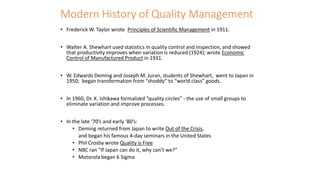
Modern History of Quality Management
• Frederick W. Taylor wrote Principles of Scientific Management in 1911.
• Walter A. Shewhart used statistics in quality control and inspection, and showed
that productivity improves when variation is reduced (1924); wrote Economic
Control of Manufactured Product in 1931.
• W. Edwards Deming and Joseph M. Juran, students of Shewhart, went to Japan in
1950; began transformation from “shoddy” to “world class” goods.
• In 1960, Dr. K. Ishikawa formalized “quality circles” - the use of small groups to
eliminate variation and improve processes.
• In the late ‘70’s and early ‘80’s:
• Deming returned from Japan to write Out of the Crisis,
and began his famous 4-day seminars in the United States
• Phil Crosby wrote Quality is Free
• NBC ran “If Japan can do it, why can’t we?”
• Motorola began 6 Sigma
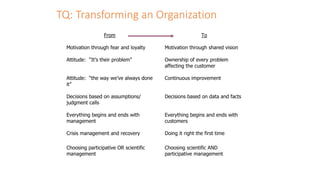
From
Motivation through fear and loyalty
To
Motivation through shared vision
Attitude: “It’s their problem” Ownership of every problem
affecting the customer
Attitude: “the way we’ve always done
it”
Continuous improvement
Decisions based on assumptions/
judgment calls
Decisions based on data and facts
Everything begins and ends with
management
Everything begins and ends with
customers
Crisis management and recovery Doing it right the first time
Choosing participative OR scientific
management
Choosing scientific AND
participative management
TQ: Transforming an Organization

Examples of Total Quality Management.pptx

  • 1.
    UNIT 1 TQM andmanagement : new management challenges, trends and contribution of TQM.
  • 2.
    Modern History ofQuality Management • Frederick W. Taylor wrote Principles of Scientific Management in 1911. • Walter A. Shewhart used statistics in quality control and inspection, and showed that productivity improves when variation is reduced (1924); wrote Economic Control of Manufactured Product in 1931. • W. Edwards Deming and Joseph M. Juran, students of Shewhart, went to Japan in 1950; began transformation from “shoddy” to “world class” goods. • In 1960, Dr. K. Ishikawa formalized “quality circles” - the use of small groups to eliminate variation and improve processes. • In the late ‘70’s and early ‘80’s: • Deming returned from Japan to write Out of the Crisis, and began his famous 4-day seminars in the United States • Phil Crosby wrote Quality is Free • NBC ran “If Japan can do it, why can’t we?” • Motorola began 6 Sigma
  • 3.
    From Motivation through fearand loyalty To Motivation through shared vision Attitude: “It’s their problem” Ownership of every problem affecting the customer Attitude: “the way we’ve always done it” Continuous improvement Decisions based on assumptions/ judgment calls Decisions based on data and facts Everything begins and ends with management Everything begins and ends with customers Crisis management and recovery Doing it right the first time Choosing participative OR scientific management Choosing scientific AND participative management TQ: Transforming an Organization