43 David Sutton
DAVID SUTTON PICTURES
DR. Muhammad Bin Zulfiqar
PGR-FCPS III SIMS/SHL
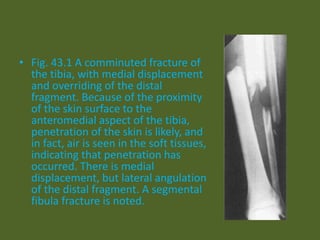
• Fig. 43.1 A comminuted fracture of
the tibia, with medial displacement
and overriding of the distal
fragment. Because of the proximity
of the skin surface to the
anteromedial aspect of the tibia,
penetration of the skin is likely, and
in fact, air is seen in the soft tissues,
indicating that penetration has
occurred. There is medial
displacement, but lateral angulation
of the distal fragment. A segmental
fibula fracture is noted.
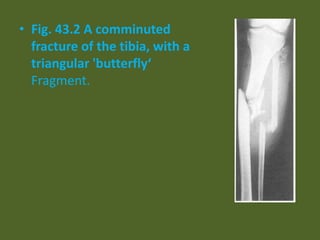
• Fig. 43.2 A comminuted
fracture of the tibia, with a
triangular 'butterfly‘
Fragment.
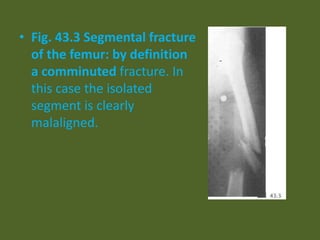
• Fig. 43.3 Segmental fracture
of the femur: by definition
a comminuted fracture. In
this case the isolated
segment is clearly
malaligned.
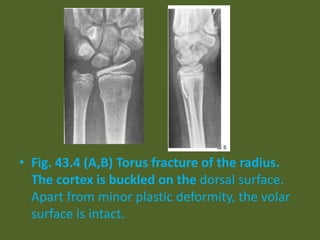
• Fig. 43.4 (A,B) Torus fracture of the radius.
The cortex is buckled on the dorsal surface.
Apart from minor plastic deformity, the volar
surface is intact.
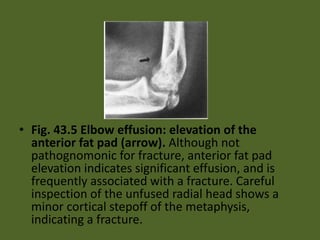
• Fig. 43.5 Elbow effusion: elevation of the
anterior fat pad (arrow). Although not
pathognomonic for fracture, anterior fat pad
elevation indicates significant effusion, and is
frequently associated with a fracture. Careful
inspection of the unfused radial head shows a
minor cortical stepoff of the metaphysis,
indicating a fracture.
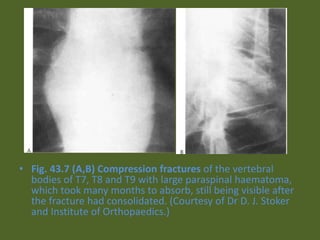
• Fig. 43.7 (A,B) Compression fractures of the vertebral
bodies of T7, T8 and T9 with large paraspinal haematoma,
which took many months to absorb, still being visible after
the fracture had consolidated. (Courtesy of Dr D. J. Stoker
and Institute of Orthopaedics.)
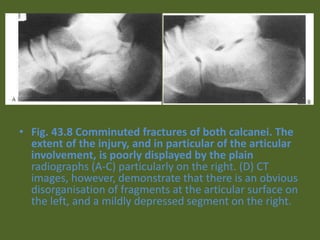
• Fig. 43.8 Comminuted fractures of both calcanei. The
extent of the injury, and in particular of the articular
involvement, is poorly displayed by the plain
radiographs (A-C) particularly on the right. (D) CT
images, however, demonstrate that there is an obvious
disorganisation of fragments at the articular surface on
the left, and a mildly depressed segment on the right.
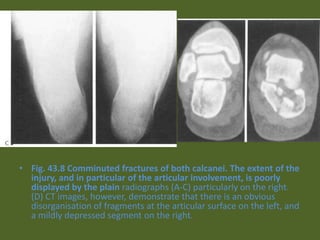
• Fig. 43.8 Comminuted fractures of both calcanei. The extent of the
injury, and in particular of the articular involvement, is poorly
displayed by the plain radiographs (A-C) particularly on the right.
(D) CT images, however, demonstrate that there is an obvious
disorganisation of fragments at the articular surface on the left, and
a mildly depressed segment on the right.
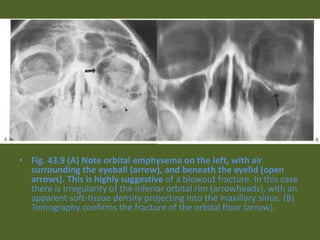
• Fig. 43.9 (A) Note orbital emphysema on the left, with air
surrounding the eyeball (arrow), and beneath the eyelid (open
arrows). This is highly suggestive of a blowout fracture. In this case
there is irregularity of the inferior orbital rim (arrowheads), with an
apparent soft-tissue density projecting into the maxillary sinus. (B)
Tomography confirms the fracture of the orbital floor (arrow).
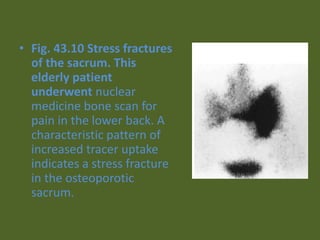
• Fig. 43.10 Stress fractures
of the sacrum. This
elderly patient
underwent nuclear
medicine bone scan for
pain in the lower back. A
characteristic pattern of
increased tracer uptake
indicates a stress fracture
in the osteoporotic
sacrum.
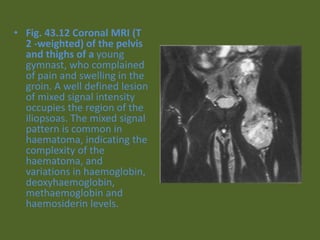
• Fig. 43.12 Coronal MRI (T
2 -weighted) of the pelvis
and thighs of a young
gymnast, who complained
of pain and swelling in the
groin. A well defined lesion
of mixed signal intensity
occupies the region of the
iliopsoas. The mixed signal
pattern is common in
haematoma, indicating the
complexity of the
haematoma, and
variations in haemoglobin,
deoxyhaemoglobin,
methaemoglobin and
haemosiderin levels.
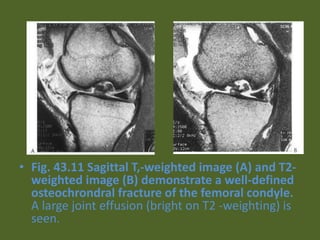
• Fig. 43.11 Sagittal T,-weighted image (A) and T2-
weighted image (B) demonstrate a well-defined
osteochrondral fracture of the femoral condyle.
A large joint effusion (bright on T2 -weighting) is
seen.
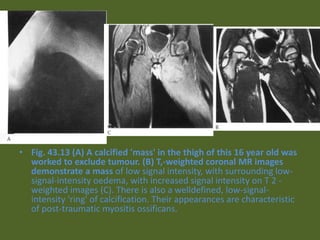
• Fig. 43.13 (A) A calcified 'mass' in the thigh of this 16 year old was
worked to exclude tumour. (B) T,-weighted coronal MR images
demonstrate a mass of low signal intensity, with surrounding low-
signal-intensity oedema, with increased signal intensity on T 2 -
weighted images (C). There is also a welldefined, low-signal-
intensity 'ring' of calcification. Their appearances are characteristic
of post-traumatic myositis ossificans.
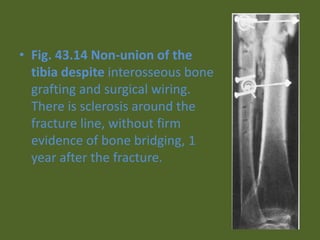
• Fig. 43.14 Non-union of the
tibia despite interosseous bone
grafting and surgical wiring.
There is sclerosis around the
fracture line, without firm
evidence of bone bridging, 1
year after the fracture.
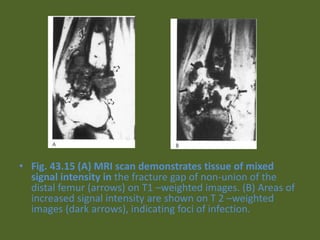
• Fig. 43.15 (A) MRI scan demonstrates tissue of mixed
signal intensity in the fracture gap of non-union of the
distal femur (arrows) on T1 –weighted images. (B) Areas of
increased signal intensity are shown on T 2 –weighted
images (dark arrows), indicating foci of infection.
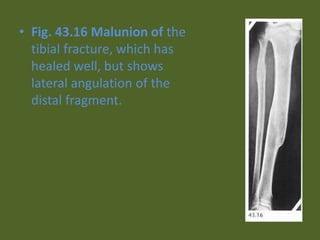
• Fig. 43.16 Malunion of the
tibial fracture, which has
healed well, but shows
lateral angulation of the
distal fragment.
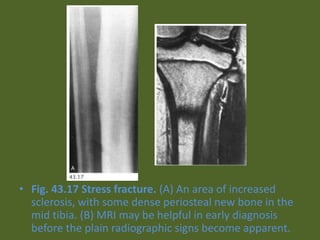
• Fig. 43.17 Stress fracture. (A) An area of increased
sclerosis, with some dense periosteal new bone in the
mid tibia. (B) MRI may be helpful in early diagnosis
before the plain radiographic signs become apparent.
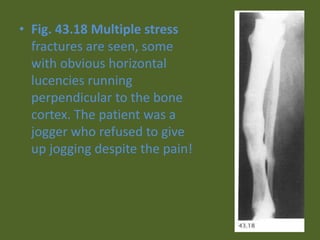
• Fig. 43.18 Multiple stress
fractures are seen, some
with obvious horizontal
lucencies running
perpendicular to the bone
cortex. The patient was a
jogger who refused to give
up jogging despite the pain!
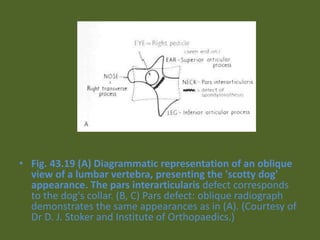
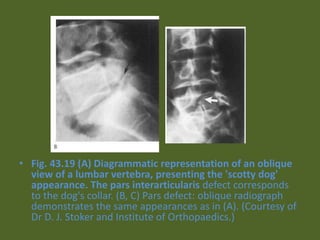
• Fig. 43.19 (A) Diagrammatic representation of an oblique
view of a lumbar vertebra, presenting the 'scotty dog'
appearance. The pars interarticularis defect corresponds
to the dog's collar. (B, C) Pars defect: oblique radiograph
demonstrates the same appearances as in (A). (Courtesy of
Dr D. J. Stoker and Institute of Orthopaedics.)
• Fig. 43.19 (A) Diagrammatic representation of an oblique
view of a lumbar vertebra, presenting the 'scotty dog'
appearance. The pars interarticularis defect corresponds
to the dog's collar. (B, C) Pars defect: oblique radiograph
demonstrates the same appearances as in (A). (Courtesy of
Dr D. J. Stoker and Institute of Orthopaedics.)
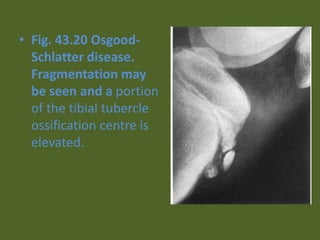
• Fig. 43.20 Osgood-
Schlatter disease.
Fragmentation may
be seen and a portion
of the tibial tubercle
ossification centre is
elevated.
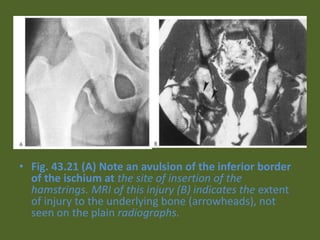
• Fig. 43.21 (A) Note an avulsion of the inferior border
of the ischium at the site of insertion of the
hamstrings. MRI of this injury (B) indicates the extent
of injury to the underlying bone (arrowheads), not
seen on the plain radiographs.
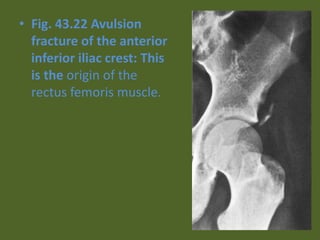
• Fig. 43.22 Avulsion
fracture of the anterior
inferior iliac crest: This
is the origin of the
rectus femoris muscle.
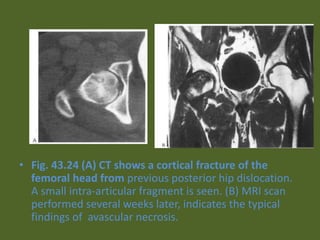
• Fig. 43.24 (A) CT shows a cortical fracture of the
femoral head from previous posterior hip dislocation.
A small intra-articular fragment is seen. (B) MRI scan
performed several weeks later, indicates the typical
findings of avascular necrosis.
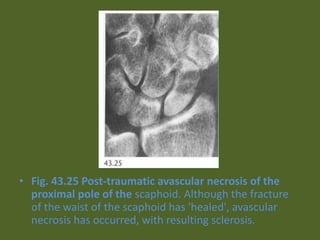
• Fig. 43.25 Post-traumatic avascular necrosis of the
proximal pole of the scaphoid. Although the fracture
of the waist of the scaphoid has 'healed', avascular
necrosis has occurred, with resulting sclerosis.
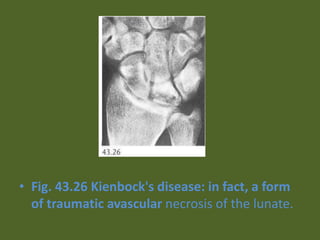
• Fig. 43.26 Kienbock's disease: in fact, a form
of traumatic avascular necrosis of the lunate.
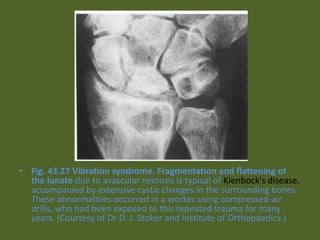
• Fig. 43.27 Vibration syndrome. Fragmentation and flattening of
the lunate due to avascular necrosis is typical of Kienbock's disease,
accompanied by extensive cystic changes in the surrounding bones.
These abnormalities occurred in a worker using compressed-air
drills, who had been exposed to this repeated trauma for many
years. (Courtesy of Dr D. J. Stoker and Institute of Orthopaedics.)
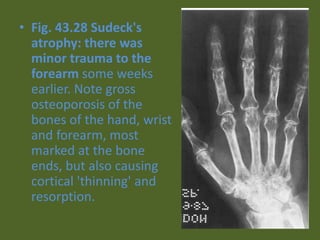
• Fig. 43.28 Sudeck's
atrophy: there was
minor trauma to the
forearm some weeks
earlier. Note gross
osteoporosis of the
bones of the hand, wrist
and forearm, most
marked at the bone
ends, but also causing
cortical 'thinning' and
resorption.
• Fig. 43.29 Post-traumatic
myositis ossificans. A well-
defined bone density
arises from the cortex of
the distal femur and
extends into the soft
tissues. There was a history
of blunt trauma, but even
so, this lesion needs to be
differentiated from
parosteal osteosarcoma.
• Fig. 43.30 Myositis ossificans associated with
paraplegia. Very extensive soft-tissue ossification
is visible around both hip joints. (Courtesy of Dr
D. J. Stoker and Institute of Orthopaedics.)
• Fig. 43.31 Pellegrini-Stieda lesion. Post-
traumatic calcification is shown in relation to
the medial femoral condyle following a tear of
the medial collateral ligament. (Courtesy of Dr
D. J. Stoker and Institute of Orthopaedics.)
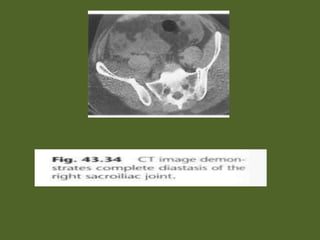
• Fig. 43.32 Traumatic avulsion of the right
superior gluteal artery (arrow) from pelvic
trauma. Bleeding from branches of the internal
iliac artery is also seen (open arrows). Marked
diastasis of the right sacroiliac joint has occurred.
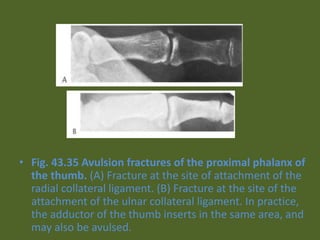
• Fig. 43.35 Avulsion fractures of the proximal phalanx of
the thumb. (A) Fracture at the site of attachment of the
radial collateral ligament. (B) Fracture at the site of the
attachment of the ulnar collateral ligament. In practice,
the adductor of the thumb inserts in the same area, and
may also be avulsed.
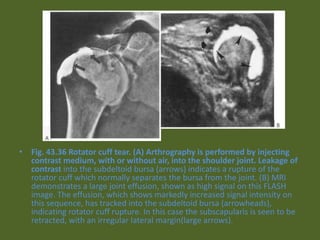
• Fig. 43.36 Rotator cuff tear. (A) Arthrography is performed by injecting
contrast medium, with or without air, into the shoulder joint. Leakage of
contrast into the subdeltoid bursa (arrows) indicates a rupture of the
rotator cuff which normally separates the bursa from the joint. (B) MRI
demonstrates a large joint effusion, shown as high signal on this FLASH
image. The effusion, which shows markedly increased signal intensity on
this sequence, has tracked into the subdeltoid bursa (arrowheads),
indicating rotator cuff rupture. In this case the subscapularis is seen to be
retracted, with an irregular lateral margin(large arrows).
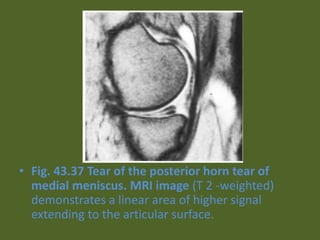
• Fig. 43.37 Tear of the posterior horn tear of
medial meniscus. MRI image (T 2 -weighted)
demonstrates a linear area of higher signal
extending to the articular surface.
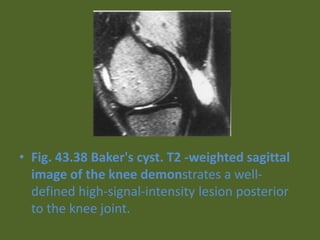
• Fig. 43.38 Baker's cyst. T2 -weighted sagittal
image of the knee demonstrates a well-
defined high-signal-intensity lesion posterior
to the knee joint.
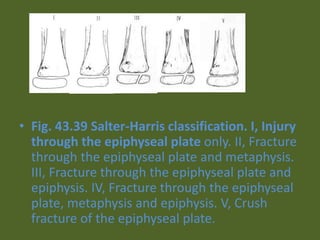
• Fig. 43.39 Salter-Harris classification. I, Injury
through the epiphyseal plate only. II, Fracture
through the epiphyseal plate and metaphysis.
III, Fracture through the epiphyseal plate and
epiphysis. IV, Fracture through the epiphyseal
plate, metaphysis and epiphysis. V, Crush
fracture of the epiphyseal plate.
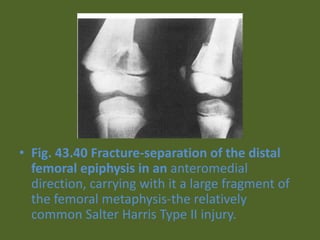
• Fig. 43.40 Fracture-separation of the distal
femoral epiphysis in an anteromedial
direction, carrying with it a large fragment of
the femoral metaphysis-the relatively
common Salter Harris Type II injury.
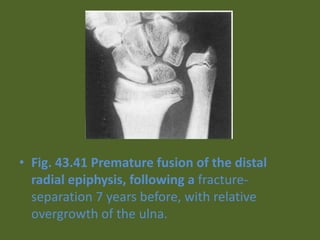
• Fig. 43.41 Premature fusion of the distal
radial epiphysis, following a fracture-
separation 7 years before, with relative
overgrowth of the ulna.
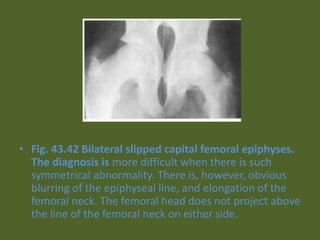
• Fig. 43.42 Bilateral slipped capital femoral epiphyses.
The diagnosis is more difficult when there is such
symmetrical abnormality. There is, however, obvious
blurring of the epiphyseal line, and elongation of the
femoral neck. The femoral head does not project above
the line of the femoral neck on either side.
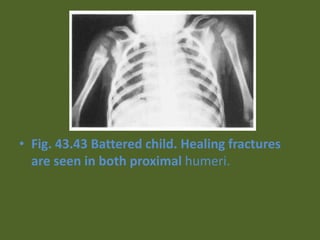
• Fig. 43.43 Battered child. Healing fractures
are seen in both proximal humeri.
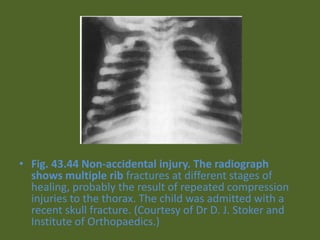
• Fig. 43.44 Non-accidental injury. The radiograph
shows multiple rib fractures at different stages of
healing, probably the result of repeated compression
injuries to the thorax. The child was admitted with a
recent skull fracture. (Courtesy of Dr D. J. Stoker and
Institute of Orthopaedics.)
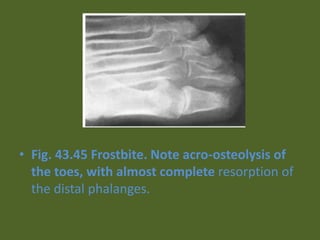
• Fig. 43.45 Frostbite. Note acro-osteolysis of
the toes, with almost complete resorption of
the distal phalanges.
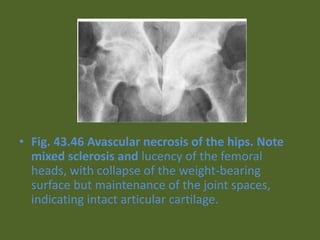
• Fig. 43.46 Avascular necrosis of the hips. Note
mixed sclerosis and lucency of the femoral
heads, with collapse of the weight-bearing
surface but maintenance of the joint spaces,
indicating intact articular cartilage.
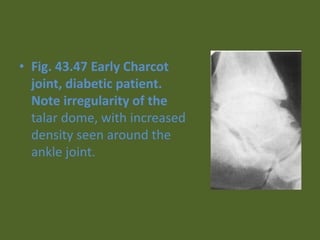
• Fig. 43.47 Early Charcot
joint, diabetic patient.
Note irregularity of the
talar dome, with increased
density seen around the
ankle joint.
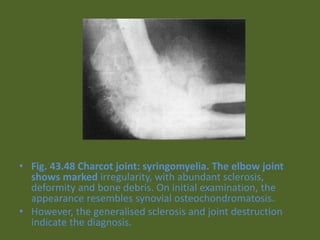
• Fig. 43.48 Charcot joint: syringomyelia. The elbow joint
shows marked irregularity, with abundant sclerosis,
deformity and bone debris. On initial examination, the
appearance resembles synovial osteochondromatosis.
• However, the generalised sclerosis and joint destruction
indicate the diagnosis.
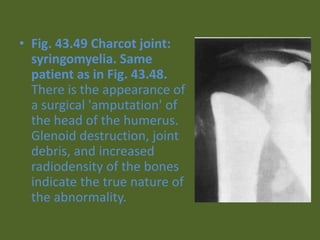
• Fig. 43.49 Charcot joint:
syringomyelia. Same
patient as in Fig. 43.48.
There is the appearance of
a surgical 'amputation' of
the head of the humerus.
Glenoid destruction, joint
debris, and increased
radiodensity of the bones
indicate the true nature of
the abnormality.
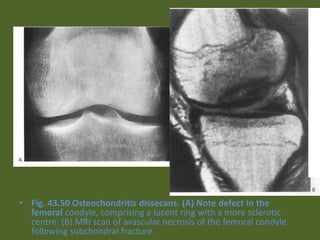
• Fig. 43.50 Osteochondritis dissecans. (A) Note defect in the
femoral condyle, comprising a lucent ring with a more sclerotic
centre. (B) MRI scan of avascular necrosis of the femoral condyle
following subchondral fracture.
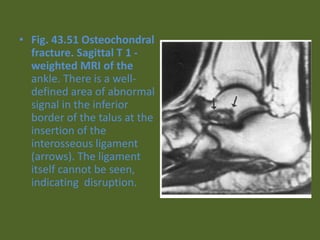
• Fig. 43.51 Osteochondral
fracture. Sagittal T 1 -
weighted MRI of the
ankle. There is a well-
defined area of abnormal
signal in the inferior
border of the talus at the
insertion of the
interosseous ligament
(arrows). The ligament
itself cannot be seen,
indicating disruption.
43 DAVID SUTTON PICTURES SKELETAL TRAUMA : GENERAL CONSIDERATION

43 DAVID SUTTON PICTURES SKELETAL TRAUMA : GENERAL CONSIDERATION

  • 1.
  • 2.
    DAVID SUTTON PICTURES DR.Muhammad Bin Zulfiqar PGR-FCPS III SIMS/SHL
  • 3.
    • Fig. 43.1A comminuted fracture of the tibia, with medial displacement and overriding of the distal fragment. Because of the proximity of the skin surface to the anteromedial aspect of the tibia, penetration of the skin is likely, and in fact, air is seen in the soft tissues, indicating that penetration has occurred. There is medial displacement, but lateral angulation of the distal fragment. A segmental fibula fracture is noted.
  • 4.
    • Fig. 43.2A comminuted fracture of the tibia, with a triangular 'butterfly‘ Fragment.
  • 5.
    • Fig. 43.3Segmental fracture of the femur: by definition a comminuted fracture. In this case the isolated segment is clearly malaligned.
  • 6.
    • Fig. 43.4(A,B) Torus fracture of the radius. The cortex is buckled on the dorsal surface. Apart from minor plastic deformity, the volar surface is intact.
  • 7.
    • Fig. 43.5Elbow effusion: elevation of the anterior fat pad (arrow). Although not pathognomonic for fracture, anterior fat pad elevation indicates significant effusion, and is frequently associated with a fracture. Careful inspection of the unfused radial head shows a minor cortical stepoff of the metaphysis, indicating a fracture.
  • 9.
    • Fig. 43.7(A,B) Compression fractures of the vertebral bodies of T7, T8 and T9 with large paraspinal haematoma, which took many months to absorb, still being visible after the fracture had consolidated. (Courtesy of Dr D. J. Stoker and Institute of Orthopaedics.)
  • 10.
    • Fig. 43.8Comminuted fractures of both calcanei. The extent of the injury, and in particular of the articular involvement, is poorly displayed by the plain radiographs (A-C) particularly on the right. (D) CT images, however, demonstrate that there is an obvious disorganisation of fragments at the articular surface on the left, and a mildly depressed segment on the right.
  • 11.
    • Fig. 43.8Comminuted fractures of both calcanei. The extent of the injury, and in particular of the articular involvement, is poorly displayed by the plain radiographs (A-C) particularly on the right. (D) CT images, however, demonstrate that there is an obvious disorganisation of fragments at the articular surface on the left, and a mildly depressed segment on the right.
  • 12.
    • Fig. 43.9(A) Note orbital emphysema on the left, with air surrounding the eyeball (arrow), and beneath the eyelid (open arrows). This is highly suggestive of a blowout fracture. In this case there is irregularity of the inferior orbital rim (arrowheads), with an apparent soft-tissue density projecting into the maxillary sinus. (B) Tomography confirms the fracture of the orbital floor (arrow).
  • 13.
    • Fig. 43.10Stress fractures of the sacrum. This elderly patient underwent nuclear medicine bone scan for pain in the lower back. A characteristic pattern of increased tracer uptake indicates a stress fracture in the osteoporotic sacrum.
  • 14.
    • Fig. 43.12Coronal MRI (T 2 -weighted) of the pelvis and thighs of a young gymnast, who complained of pain and swelling in the groin. A well defined lesion of mixed signal intensity occupies the region of the iliopsoas. The mixed signal pattern is common in haematoma, indicating the complexity of the haematoma, and variations in haemoglobin, deoxyhaemoglobin, methaemoglobin and haemosiderin levels.
  • 15.
    • Fig. 43.11Sagittal T,-weighted image (A) and T2- weighted image (B) demonstrate a well-defined osteochrondral fracture of the femoral condyle. A large joint effusion (bright on T2 -weighting) is seen.
  • 16.
    • Fig. 43.13(A) A calcified 'mass' in the thigh of this 16 year old was worked to exclude tumour. (B) T,-weighted coronal MR images demonstrate a mass of low signal intensity, with surrounding low- signal-intensity oedema, with increased signal intensity on T 2 - weighted images (C). There is also a welldefined, low-signal- intensity 'ring' of calcification. Their appearances are characteristic of post-traumatic myositis ossificans.
  • 17.
    • Fig. 43.14Non-union of the tibia despite interosseous bone grafting and surgical wiring. There is sclerosis around the fracture line, without firm evidence of bone bridging, 1 year after the fracture.
  • 18.
    • Fig. 43.15(A) MRI scan demonstrates tissue of mixed signal intensity in the fracture gap of non-union of the distal femur (arrows) on T1 –weighted images. (B) Areas of increased signal intensity are shown on T 2 –weighted images (dark arrows), indicating foci of infection.
  • 19.
    • Fig. 43.16Malunion of the tibial fracture, which has healed well, but shows lateral angulation of the distal fragment.
  • 20.
    • Fig. 43.17Stress fracture. (A) An area of increased sclerosis, with some dense periosteal new bone in the mid tibia. (B) MRI may be helpful in early diagnosis before the plain radiographic signs become apparent.
  • 21.
    • Fig. 43.18Multiple stress fractures are seen, some with obvious horizontal lucencies running perpendicular to the bone cortex. The patient was a jogger who refused to give up jogging despite the pain!
  • 22.
    • Fig. 43.19(A) Diagrammatic representation of an oblique view of a lumbar vertebra, presenting the 'scotty dog' appearance. The pars interarticularis defect corresponds to the dog's collar. (B, C) Pars defect: oblique radiograph demonstrates the same appearances as in (A). (Courtesy of Dr D. J. Stoker and Institute of Orthopaedics.)
  • 23.
    • Fig. 43.19(A) Diagrammatic representation of an oblique view of a lumbar vertebra, presenting the 'scotty dog' appearance. The pars interarticularis defect corresponds to the dog's collar. (B, C) Pars defect: oblique radiograph demonstrates the same appearances as in (A). (Courtesy of Dr D. J. Stoker and Institute of Orthopaedics.)
  • 24.
    • Fig. 43.20Osgood- Schlatter disease. Fragmentation may be seen and a portion of the tibial tubercle ossification centre is elevated.
  • 25.
    • Fig. 43.21(A) Note an avulsion of the inferior border of the ischium at the site of insertion of the hamstrings. MRI of this injury (B) indicates the extent of injury to the underlying bone (arrowheads), not seen on the plain radiographs.
  • 26.
    • Fig. 43.22Avulsion fracture of the anterior inferior iliac crest: This is the origin of the rectus femoris muscle.
  • 28.
    • Fig. 43.24(A) CT shows a cortical fracture of the femoral head from previous posterior hip dislocation. A small intra-articular fragment is seen. (B) MRI scan performed several weeks later, indicates the typical findings of avascular necrosis.
  • 29.
    • Fig. 43.25Post-traumatic avascular necrosis of the proximal pole of the scaphoid. Although the fracture of the waist of the scaphoid has 'healed', avascular necrosis has occurred, with resulting sclerosis.
  • 30.
    • Fig. 43.26Kienbock's disease: in fact, a form of traumatic avascular necrosis of the lunate.
  • 31.
    • Fig. 43.27Vibration syndrome. Fragmentation and flattening of the lunate due to avascular necrosis is typical of Kienbock's disease, accompanied by extensive cystic changes in the surrounding bones. These abnormalities occurred in a worker using compressed-air drills, who had been exposed to this repeated trauma for many years. (Courtesy of Dr D. J. Stoker and Institute of Orthopaedics.)
  • 32.
    • Fig. 43.28Sudeck's atrophy: there was minor trauma to the forearm some weeks earlier. Note gross osteoporosis of the bones of the hand, wrist and forearm, most marked at the bone ends, but also causing cortical 'thinning' and resorption.
  • 33.
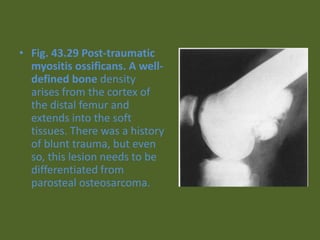
    • Fig. 43.29Post-traumatic myositis ossificans. A well- defined bone density arises from the cortex of the distal femur and extends into the soft tissues. There was a history of blunt trauma, but even so, this lesion needs to be differentiated from parosteal osteosarcoma.
  • 34.
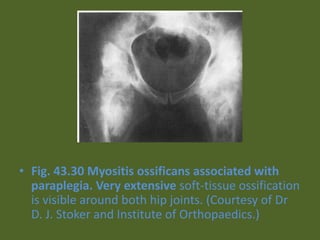
    • Fig. 43.30Myositis ossificans associated with paraplegia. Very extensive soft-tissue ossification is visible around both hip joints. (Courtesy of Dr D. J. Stoker and Institute of Orthopaedics.)
  • 35.
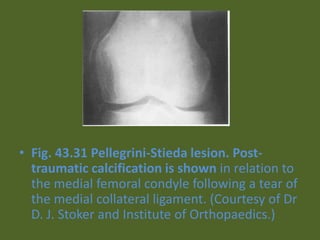
    • Fig. 43.31Pellegrini-Stieda lesion. Post- traumatic calcification is shown in relation to the medial femoral condyle following a tear of the medial collateral ligament. (Courtesy of Dr D. J. Stoker and Institute of Orthopaedics.)
  • 36.
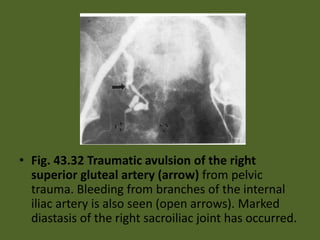
    • Fig. 43.32Traumatic avulsion of the right superior gluteal artery (arrow) from pelvic trauma. Bleeding from branches of the internal iliac artery is also seen (open arrows). Marked diastasis of the right sacroiliac joint has occurred.
  • 39.
    • Fig. 43.35Avulsion fractures of the proximal phalanx of the thumb. (A) Fracture at the site of attachment of the radial collateral ligament. (B) Fracture at the site of the attachment of the ulnar collateral ligament. In practice, the adductor of the thumb inserts in the same area, and may also be avulsed.
  • 40.
    • Fig. 43.36Rotator cuff tear. (A) Arthrography is performed by injecting contrast medium, with or without air, into the shoulder joint. Leakage of contrast into the subdeltoid bursa (arrows) indicates a rupture of the rotator cuff which normally separates the bursa from the joint. (B) MRI demonstrates a large joint effusion, shown as high signal on this FLASH image. The effusion, which shows markedly increased signal intensity on this sequence, has tracked into the subdeltoid bursa (arrowheads), indicating rotator cuff rupture. In this case the subscapularis is seen to be retracted, with an irregular lateral margin(large arrows).
  • 41.
    • Fig. 43.37Tear of the posterior horn tear of medial meniscus. MRI image (T 2 -weighted) demonstrates a linear area of higher signal extending to the articular surface.
  • 42.
    • Fig. 43.38Baker's cyst. T2 -weighted sagittal image of the knee demonstrates a well- defined high-signal-intensity lesion posterior to the knee joint.
  • 43.
    • Fig. 43.39Salter-Harris classification. I, Injury through the epiphyseal plate only. II, Fracture through the epiphyseal plate and metaphysis. III, Fracture through the epiphyseal plate and epiphysis. IV, Fracture through the epiphyseal plate, metaphysis and epiphysis. V, Crush fracture of the epiphyseal plate.
  • 44.
    • Fig. 43.40Fracture-separation of the distal femoral epiphysis in an anteromedial direction, carrying with it a large fragment of the femoral metaphysis-the relatively common Salter Harris Type II injury.
  • 45.
    • Fig. 43.41Premature fusion of the distal radial epiphysis, following a fracture- separation 7 years before, with relative overgrowth of the ulna.
  • 46.
    • Fig. 43.42Bilateral slipped capital femoral epiphyses. The diagnosis is more difficult when there is such symmetrical abnormality. There is, however, obvious blurring of the epiphyseal line, and elongation of the femoral neck. The femoral head does not project above the line of the femoral neck on either side.
  • 47.
    • Fig. 43.43Battered child. Healing fractures are seen in both proximal humeri.
  • 48.
    • Fig. 43.44Non-accidental injury. The radiograph shows multiple rib fractures at different stages of healing, probably the result of repeated compression injuries to the thorax. The child was admitted with a recent skull fracture. (Courtesy of Dr D. J. Stoker and Institute of Orthopaedics.)
  • 49.
    • Fig. 43.45Frostbite. Note acro-osteolysis of the toes, with almost complete resorption of the distal phalanges.
  • 50.
    • Fig. 43.46Avascular necrosis of the hips. Note mixed sclerosis and lucency of the femoral heads, with collapse of the weight-bearing surface but maintenance of the joint spaces, indicating intact articular cartilage.
  • 51.
    • Fig. 43.47Early Charcot joint, diabetic patient. Note irregularity of the talar dome, with increased density seen around the ankle joint.
  • 52.
    • Fig. 43.48Charcot joint: syringomyelia. The elbow joint shows marked irregularity, with abundant sclerosis, deformity and bone debris. On initial examination, the appearance resembles synovial osteochondromatosis. • However, the generalised sclerosis and joint destruction indicate the diagnosis.
  • 53.
    • Fig. 43.49Charcot joint: syringomyelia. Same patient as in Fig. 43.48. There is the appearance of a surgical 'amputation' of the head of the humerus. Glenoid destruction, joint debris, and increased radiodensity of the bones indicate the true nature of the abnormality.
  • 54.
    • Fig. 43.50Osteochondritis dissecans. (A) Note defect in the femoral condyle, comprising a lucent ring with a more sclerotic centre. (B) MRI scan of avascular necrosis of the femoral condyle following subchondral fracture.
  • 55.
    • Fig. 43.51Osteochondral fracture. Sagittal T 1 - weighted MRI of the ankle. There is a well- defined area of abnormal signal in the inferior border of the talus at the insertion of the interosseous ligament (arrows). The ligament itself cannot be seen, indicating disruption.