
PROMOTION 
PROMOTION 
PROMOTION 
PROMOTION 
PROMOTION 
PROMOTION
PROMOTION…. 
…is about telling potential 
customers about products 
…should persuade new customers to 
buy, or help keep existing customers.
THREE AIMS OF PROMOTION: 
Persuade eg switch brands 
Inform eg new features 
Remind
IMPORTANCE OF PROMOTION 
DEPENDS ON: 
Competitiveness of the market – if little competition, promotion less 
important 
Availability of Product – if in short supply, less need for promotion eg 
Morgan cars 
Differentiation of Product – if product is obviously different/better, 
less need for promotion 
Stage of Product Life Cycle
PROMOTION INTO THE PIPELINE 
Involves promotion between producer and retailer 
Used to get retailers to stock their products 
Although producers promote to the ultimate 
consumer their products are sold through retailers 
and wholesalers 
If the consumer cannot get the product they see 
advertised then the promotion is pointless
EXAMPLES OF PROMOTION COULD 
INCLUDE 
Point of sale displays – window displays, posters, in 
store displays 
Sale or return 
Dealer competitions – prizes to most successful 
retailers of product 
Staff training 
Good credit facilities – allowing retailer to pay for 
goods later 
Dealer Loaders – Where producers will throw in 
branded extras to act as an incentive
PROMOTION OUT OF THE PIPELINE 
Involves promotion between retailer and consumer 
The retailer also wants products to sell, for them to 
make profits
EXAMPLES OF SALES PROMOTION COULD 
INCLUDE 
Free samples 
Competitions 
Buy one get one free (BOGOFs) 
Discount vouchers 
Coupons 
Special offers 
Producers also promote their products straight to 
the consumer by these methods also
ABOVE & BELOW THE LINE 
With the Pipeline the focus is on the 
Promotional offers; here the focus is on the 
advertisements.
COMPLETE THE TASK YOU STARTED ON TUESDAY 
(WRITING DESCRIPTIONS, ADVANTAGES AND 
DISADVANTAGES) 
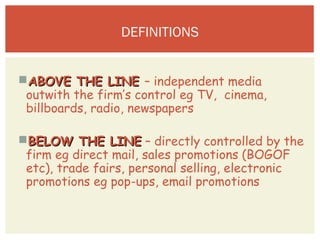
AABBOOVVEE TTHHEE LLIINNEE – independent media 
outwith the firm’s control eg TV, cinema, 
billboards, radio, newspapers 
BBEELLOOWW TTHHEE LLIINNEE – directly controlled by the 
firm eg direct mail, sales promotions (BOGOF 
etc), trade fairs, personal selling, electronic 
promotions eg pop-ups, email promotions
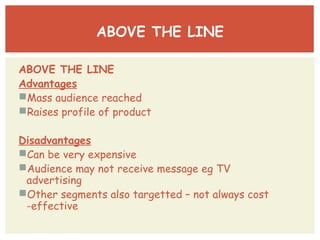
ABOVE THE LINE 
ABOVE THE LINE 
Advantages 
Mass audience reached 
Raises profile of product 
Disadvantages 
Can be very expensive 
Audience may not receive message eg TV 
advertising 
Other segments also targetted – not always cost 
-effective
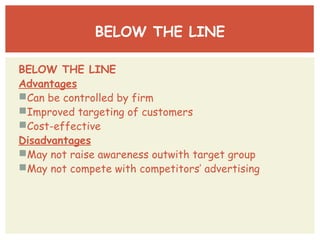
BELOW THE LINE 
BELOW THE LINE 
Advantages 
Can be controlled by firm 
Improved targeting of customers 
Cost-effective 
Disadvantages 
May not raise awareness outwith target group 
May not compete with competitors’ advertising
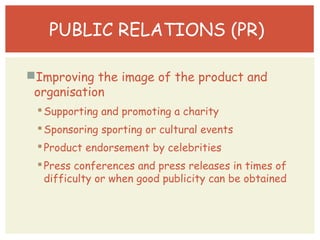
PUBLIC RELATIONS (PR) 
Improving the image of the product and 
organisation 
Supporting and promoting a charity 
Sponsoring sporting or cultural events 
 Press conferences and press releases in times of 
difficulty or when good publicity can be obtained 
 Product endorsement by celebrities
ADVERTISING STANDARDS AUTHORITY (ASA) 
Monitor adverts and promotions from 
organisations in the UK to make sure they 
adhere to specific standards. 
They also investigate complaints from the 
public and they can move/remove adverts 
from TV etc. which are inappropriate or 
misleading.
TASKS 
TASK: 
1.Google the ASA website 
2.Look for cases which have been 
investigated 
3.What were the reason for investigation? 
4.What is the ruling?

33. Promotion

  • 1.
    PROMOTION PROMOTION PROMOTION PROMOTION PROMOTION PROMOTION
  • 2.
    PROMOTION…. …is abouttelling potential customers about products …should persuade new customers to buy, or help keep existing customers.
  • 3.
    THREE AIMS OFPROMOTION: Persuade eg switch brands Inform eg new features Remind
  • 4.
    IMPORTANCE OF PROMOTION DEPENDS ON: Competitiveness of the market – if little competition, promotion less important Availability of Product – if in short supply, less need for promotion eg Morgan cars Differentiation of Product – if product is obviously different/better, less need for promotion Stage of Product Life Cycle
  • 5.
    PROMOTION INTO THEPIPELINE Involves promotion between producer and retailer Used to get retailers to stock their products Although producers promote to the ultimate consumer their products are sold through retailers and wholesalers If the consumer cannot get the product they see advertised then the promotion is pointless
  • 6.
    EXAMPLES OF PROMOTIONCOULD INCLUDE Point of sale displays – window displays, posters, in store displays Sale or return Dealer competitions – prizes to most successful retailers of product Staff training Good credit facilities – allowing retailer to pay for goods later Dealer Loaders – Where producers will throw in branded extras to act as an incentive
  • 7.
    PROMOTION OUT OFTHE PIPELINE Involves promotion between retailer and consumer The retailer also wants products to sell, for them to make profits
  • 8.
    EXAMPLES OF SALESPROMOTION COULD INCLUDE Free samples Competitions Buy one get one free (BOGOFs) Discount vouchers Coupons Special offers Producers also promote their products straight to the consumer by these methods also
  • 9.
    ABOVE & BELOWTHE LINE With the Pipeline the focus is on the Promotional offers; here the focus is on the advertisements.
  • 10.
    COMPLETE THE TASKYOU STARTED ON TUESDAY (WRITING DESCRIPTIONS, ADVANTAGES AND DISADVANTAGES) AABBOOVVEE TTHHEE LLIINNEE – independent media outwith the firm’s control eg TV, cinema, billboards, radio, newspapers BBEELLOOWW TTHHEE LLIINNEE – directly controlled by the firm eg direct mail, sales promotions (BOGOF etc), trade fairs, personal selling, electronic promotions eg pop-ups, email promotions
  • 11.
    ABOVE THE LINE ABOVE THE LINE Advantages Mass audience reached Raises profile of product Disadvantages Can be very expensive Audience may not receive message eg TV advertising Other segments also targetted – not always cost -effective
  • 12.
    BELOW THE LINE BELOW THE LINE Advantages Can be controlled by firm Improved targeting of customers Cost-effective Disadvantages May not raise awareness outwith target group May not compete with competitors’ advertising
  • 13.
    PUBLIC RELATIONS (PR) Improving the image of the product and organisation Supporting and promoting a charity Sponsoring sporting or cultural events  Press conferences and press releases in times of difficulty or when good publicity can be obtained  Product endorsement by celebrities
  • 14.
    ADVERTISING STANDARDS AUTHORITY(ASA) Monitor adverts and promotions from organisations in the UK to make sure they adhere to specific standards. They also investigate complaints from the public and they can move/remove adverts from TV etc. which are inappropriate or misleading.
  • 15.
    TASKS TASK: 1.Googlethe ASA website 2.Look for cases which have been investigated 3.What were the reason for investigation? 4.What is the ruling?