Promotion
Marketing Mix
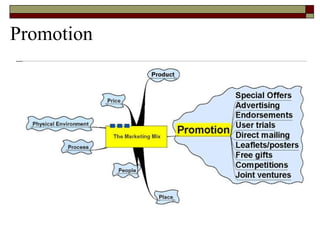
Promotion
Ways that a company
may inform, persuade,
remind a target market
about their
products/services
Product
Price
Promotion
Place
Target
Market
Promotion Ideas
What Will You Do To Sell
Your Product?
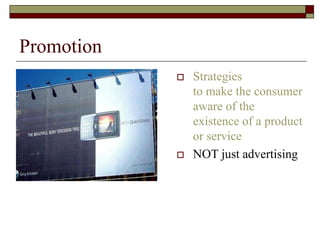
Promotion
 Strategies
to make the consumer
aware of the
existence of a product
or service
 NOT just advertising
Types of promotion
Above-the-line promotion
This uses mass media advertising over which a firm
has no direct control e.g. television, radio and
newspapers
Below-the-line promotion
This uses promotional media which the firm can
control e.g. direct mail, sales promotions, sponsorship
and social media
Promotional activities
 Advertising e.g. TV, billboards and internet.
 Sales promotions e.g. loyalty cards, BOGOF,
discounts & free gifts
 Sponsorship – a business pays to be associated with
another firm, event or cause
 Direct mailing – promotional material is sent to
potential customers by post/email
 Public relations – building the relationship between
the firm and the public by enhancing its reputation
Promotional mix
Most businesses use a combination of different
promotional activities.
The chosen promotional mix will depend on:
 Cost
 Target market
 Product
 Competitors
AIDA
Promotional campaigns often take into account the
AIDA model:
 Awareness - raising awareness of a product
 Interest – exciting interest in the product
 Desire – creating desire for the product
 Action – encouraging a purchase
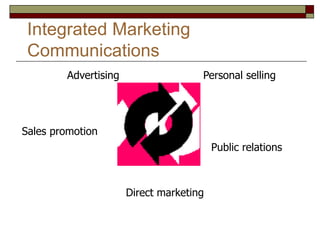
Integrated Marketing
Communications
Personal selling
Public relations
Direct marketing
Sales promotion
Advertising
Reason for
a customer
to buy a
product
Unique Selling Proposition
Differentiates a product from
its competitors,
• lowest cost
• highest quality
• first-ever product of its
kind.
• Avis’ “We’re only number two.
We try harder” campaign.
• Domino’s “30 minutes or it’s
free” promise.
• FedEx’s “When it absolutely,
positively has to be there
overnight.”
• Southwest’s claim to be the
lowest-priced airline.
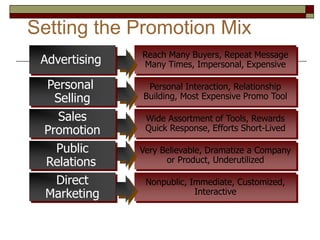
Advertising
Personal
Selling
Sales
Promotion
Public
Relations
Direct
Marketing
Reach Many Buyers, Repeat Message
Many Times, Impersonal, Expensive
Personal Interaction, Relationship
Building, Most Expensive Promo Tool
Wide Assortment of Tools, Rewards
Quick Response, Efforts Short-Lived
Very Believable, Dramatize a Company
or Product, Underutilized
Nonpublic, Immediate, Customized,
Interactive
Setting the Promotion Mix
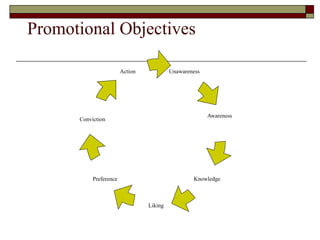
Promotional Objectives
Unawareness
Conviction
Action
Preference
Liking
Knowledge
Awareness
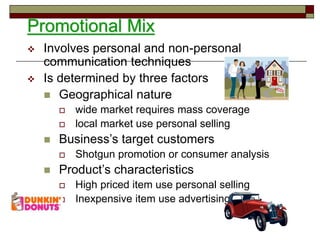
Promotional Mix
 Involves personal and non-personal
communication techniques
 Is determined by three factors
 Geographical nature
 wide market requires mass coverage
 local market use personal selling
 Business’s target customers
 Shotgun promotion or consumer analysis
 Product’s characteristics
 High priced item use personal selling
 Inexpensive item use advertising
Billboard
Promotion Mix
Advertising
 Paid for impersonal presentation of an idea that is
identified with a business.
 Informs, persuades, reminds customers
 Conveys a consistent, enduring image that reinforces the
position of the product or company
 McDonald’s “I’m Loving It”
 Pepsi “The Pepsi Generation”
 Print – magazines, newspapers, direct mail
 Broadcast – television, radio
 Display – billboards, signs, posters
 Daily newspaper, weekly newspaper, telephone directory, direct
mail, radio, television, transit, outdoor, local magazine, posters
and leaflets, billboards, athletic arenas, park benches.
 Product and Institutional advertising
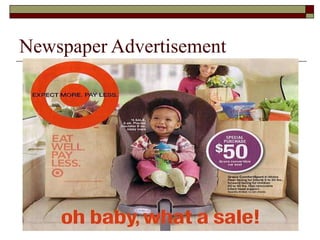
Newspaper Advertisement
 Short-term inducement to encourage trial or
purchase a product or service
 Aimed at consumers at the point-of-sale
 In-store displays or On-package
 Communication, incentive, invitation with
customers
 Contests, games, gifts, coupons, sampling, rebates,
exhibits, demonstrations, trade-in, point-of-purchase
discount, free weekends, video tapes.
 Offer promotions to top selling salespersons in
company or retail outlets selling the product
Face Book Business Page
Twitter Business Page
Nike
Instagram
Page
Personal Selling
 “Two-way communication for the purpose of making
sales and building customer relationships.”
 Face to face interaction with one or more prospective
purchasers, to make presentations, answer questions
 Provides a forum for immediate exchange of needs,
goals, ideas, and feedback
 Personal confrontation, relationship building, response
 Sales presentations, meetings, incentive programs,
samples trade shows
Public Relations
 Programs designed to promote and/or
protect a company’s image or its individual
products.
 Obtain favorable publicity, improve “corporate
image”, head off unfavorable rumors, stories,
events
 High credibility, ability to catch buyers off guard,
dramatization
 Press kits, speeches, seminars, charitable
donations, sponsorships, publications events,
company newsletter
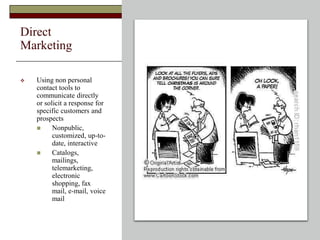
Direct
Marketing
 Using non personal
contact tools to
communicate directly
or solicit a response for
specific customers and
prospects
 Nonpublic,
customized, up-to-
date, interactive
 Catalogs,
mailings,
telemarketing,
electronic
shopping, fax
mail, e-mail, voice
mail

promotion.pptx

  • 2.
  • 3.
    Marketing Mix Promotion Ways thata company may inform, persuade, remind a target market about their products/services Product Price Promotion Place Target Market
  • 4.
  • 5.
    What Will YouDo To Sell Your Product?
  • 6.
    Promotion  Strategies to makethe consumer aware of the existence of a product or service  NOT just advertising
  • 7.
    Types of promotion Above-the-linepromotion This uses mass media advertising over which a firm has no direct control e.g. television, radio and newspapers Below-the-line promotion This uses promotional media which the firm can control e.g. direct mail, sales promotions, sponsorship and social media
  • 8.
    Promotional activities  Advertisinge.g. TV, billboards and internet.  Sales promotions e.g. loyalty cards, BOGOF, discounts & free gifts  Sponsorship – a business pays to be associated with another firm, event or cause  Direct mailing – promotional material is sent to potential customers by post/email  Public relations – building the relationship between the firm and the public by enhancing its reputation
  • 9.
    Promotional mix Most businessesuse a combination of different promotional activities. The chosen promotional mix will depend on:  Cost  Target market  Product  Competitors
  • 10.
    AIDA Promotional campaigns oftentake into account the AIDA model:  Awareness - raising awareness of a product  Interest – exciting interest in the product  Desire – creating desire for the product  Action – encouraging a purchase
  • 11.
    Integrated Marketing Communications Personal selling Publicrelations Direct marketing Sales promotion Advertising
  • 12.
  • 13.
    Unique Selling Proposition Differentiatesa product from its competitors, • lowest cost • highest quality • first-ever product of its kind. • Avis’ “We’re only number two. We try harder” campaign. • Domino’s “30 minutes or it’s free” promise. • FedEx’s “When it absolutely, positively has to be there overnight.” • Southwest’s claim to be the lowest-priced airline.
  • 14.
    Advertising Personal Selling Sales Promotion Public Relations Direct Marketing Reach Many Buyers,Repeat Message Many Times, Impersonal, Expensive Personal Interaction, Relationship Building, Most Expensive Promo Tool Wide Assortment of Tools, Rewards Quick Response, Efforts Short-Lived Very Believable, Dramatize a Company or Product, Underutilized Nonpublic, Immediate, Customized, Interactive Setting the Promotion Mix
  • 15.
  • 16.
    Promotional Mix  Involvespersonal and non-personal communication techniques  Is determined by three factors  Geographical nature  wide market requires mass coverage  local market use personal selling  Business’s target customers  Shotgun promotion or consumer analysis  Product’s characteristics  High priced item use personal selling  Inexpensive item use advertising
  • 17.
  • 18.
    Promotion Mix Advertising  Paidfor impersonal presentation of an idea that is identified with a business.  Informs, persuades, reminds customers  Conveys a consistent, enduring image that reinforces the position of the product or company  McDonald’s “I’m Loving It”  Pepsi “The Pepsi Generation”  Print – magazines, newspapers, direct mail  Broadcast – television, radio  Display – billboards, signs, posters  Daily newspaper, weekly newspaper, telephone directory, direct mail, radio, television, transit, outdoor, local magazine, posters and leaflets, billboards, athletic arenas, park benches.  Product and Institutional advertising
  • 19.
  • 20.
     Short-term inducementto encourage trial or purchase a product or service  Aimed at consumers at the point-of-sale  In-store displays or On-package  Communication, incentive, invitation with customers  Contests, games, gifts, coupons, sampling, rebates, exhibits, demonstrations, trade-in, point-of-purchase discount, free weekends, video tapes.  Offer promotions to top selling salespersons in company or retail outlets selling the product
  • 21.
  • 22.
  • 23.
  • 24.
    Personal Selling  “Two-waycommunication for the purpose of making sales and building customer relationships.”  Face to face interaction with one or more prospective purchasers, to make presentations, answer questions  Provides a forum for immediate exchange of needs, goals, ideas, and feedback  Personal confrontation, relationship building, response  Sales presentations, meetings, incentive programs, samples trade shows
  • 26.
    Public Relations  Programsdesigned to promote and/or protect a company’s image or its individual products.  Obtain favorable publicity, improve “corporate image”, head off unfavorable rumors, stories, events  High credibility, ability to catch buyers off guard, dramatization  Press kits, speeches, seminars, charitable donations, sponsorships, publications events, company newsletter
  • 27.
    Direct Marketing  Using nonpersonal contact tools to communicate directly or solicit a response for specific customers and prospects  Nonpublic, customized, up-to- date, interactive  Catalogs, mailings, telemarketing, electronic shopping, fax mail, e-mail, voice mail