Descriptive Research Design  Lecture No 3 Hamendra Dangi  [email_address] 9968316938 H.K  Dangi, FMS
Session Outline  Descriptive Research Design  Guidelines for submission of synopsis of Project  Class activity  H.K  Dangi, FMS
Review of last lecture  H.K  Dangi, FMS
Use of Descriptive Research To describe the characteristics of relevant groups, such as consumers, salespeople, organizations, or market areas.   To estimate the percentage of units in a specified population exhibiting a certain behavior.  To determine the perceptions of product characteristics. To determine the degree to which marketing variables are associated. To make specific predictions. H.K  Dangi, FMS
Methods of Descriptive Research Secondary data analyzed in a quantitative as opposed to a qualitative manner  Surveys  Panels  Observational and other data H.K  Dangi, FMS
Observation Methods Structured Versus Unstructured Observation For  structured observation , the researcher specifies in detail what is to be observed and how the measurements are to be recorded, e.g., an auditor performing inventory analysis in a store.  In  unstructured observation , the observer monitors all aspects of the phenomenon that seem relevant to the problem at hand, e.g., observing children playing with new toys.  H.K  Dangi, FMS
Observation Methods Disguised Versus Undisguised Observation In  disguised observation , the respondents are unaware that they are being observed.  Disguise may be accomplished by using one-way mirrors, hidden cameras, or inconspicuous mechanical devices.  Observers may be disguised as shoppers or sales clerks. In  undisguised observation , the respondents are aware that they are under observation. H.K  Dangi, FMS
Video file  Observation  H.K  Dangi, FMS
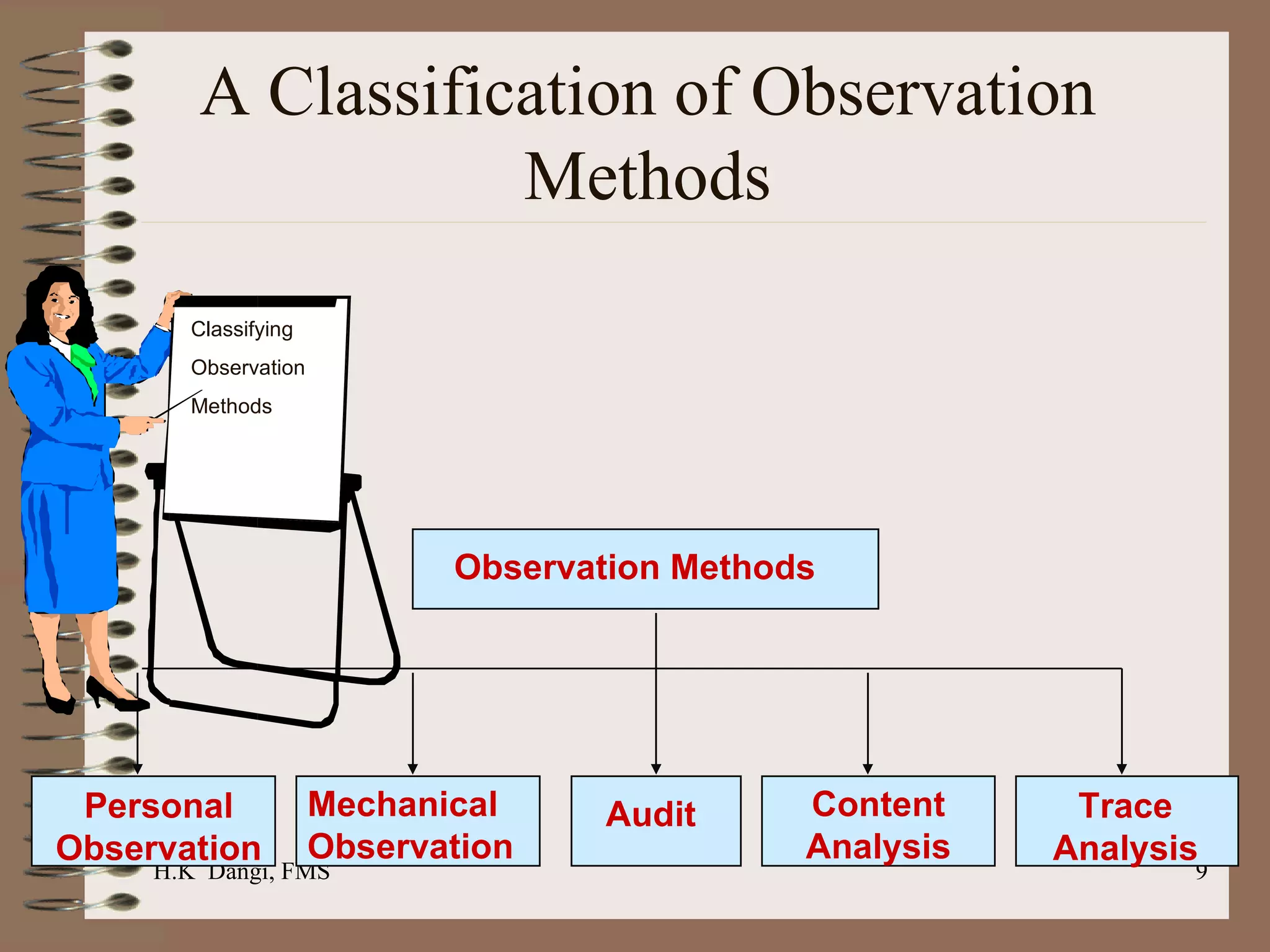
A Classification of Observation Methods H.K  Dangi, FMS  Observation Methods Personal Observation Mechanical Observation Trace Analysis Content Analysis Audit Classifying Observation Methods
Video file  Content analysis  H.K  Dangi, FMS
Definitions and Concepts Independent variables  are variables or alternatives that are manipulated and whose effects are measured and compared, e.g., price levels.  Test units  are individuals, organizations, or other entities whose response to the independent variables or treatments is being examined, e.g., consumers or stores.  Dependent variables  are the variables which measure the effect of the independent variables on the test units, e.g., sales, profits, and market shares.  Extraneous variables  are all variables other than the independent variables that affect the response of the test units, e.g., store size, store location, and competitive effort.   H.K  Dangi, FMS  H.K  Dangi, FMS
Validity in Experimentation Internal validity  refers to whether the manipulation of the independent variables or treatments actually caused the observed effects on the dependent variables.  Control of extraneous variables is a necessary condition for establishing internal validity. External validity  refers to whether the cause-and-effect relationships found in the experiment can be generalized.  To what populations, settings, times, independent variables and dependent variables can the results be projected? H.K  Dangi, FMS  H.K  Dangi, FMS
History  refers to specific events that are external to the experiment but occur at the same time as the experiment. Maturation  ( MA ) refers to changes in the test units themselves that occur with the passage of time.  Testing effects  are caused by the process of experimentation.  Typically, these are the effects on the experiment of taking a measure on the dependent variable before and after the presentation of the treatment.  The  main testing effect  ( MT ) occurs when a prior observation affects a latter observation.  Extraneous Variables H.K  Dangi, FMS  H.K  Dangi, FMS
Extraneous Variables In the  interactive testing effect  (IT), a prior measurement affects the test unit's response to the independent variable.  Instrumentation  (I) refers to changes in the measuring instrument, in the observers or in the scores themselves.  Statistical regression  effects (SR) occur when test units with extreme scores move closer to the average score during the course of the experiment.  Selection bias  (SB) refers to the improper assignment of test units to treatment conditions.  Mortality   (MO) refers to the loss of test units while the experiment is in progress.  H.K  Dangi, FMS  H.K  Dangi, FMS
Controlling Extraneous Variables Randomization  refers to the random assignment of test units to experimental groups by using random numbers.  Treatment conditions are also randomly assigned to experimental groups. Matching  involves comparing test units on a set of key background variables before assigning them to the treatment conditions.  Statistical control  involves measuring the extraneous variables and adjusting for their effects through statistical analysis. Design control  involves the use of experiments designed to control specific extraneous variables. H.K  Dangi, FMS  H.K  Dangi, FMS
Question for Discussion  Identify the potential threat to internal and external validity ? A major distributor of office equipment is considering a new sales presentation program for its salespeople. The target sales territory  is selected ,the new program  is implemented and the effect on sales is measured  H.K  Dangi, FMS  H.K  Dangi, FMS
(a) This is an example of the one-shot case study. The internal validity is threatened by  history, maturation, selection, and mortality. H.K  Dangi, FMS  H.K  Dangi, FMS
B) P&G wants to determine if a new package design for Tide is more effective than the current design . Twelve supermarkets are randomly selected in a city . In six of them , randomly selected ,Tide is sold in New package .In other six cities the detergent is sold in old package .Sales for both groups of supermarkets are monitored for three months  H.K  Dangi, FMS  H.K  Dangi, FMS
(b) This is an example of the posttest-only control group design. Internal validity is not hampered by extraneous variables. H.K  Dangi, FMS  H.K  Dangi, FMS
Video file  H.K  Dangi, FMS  H.K  Dangi, FMS
Synopsis Submission  H.K  Dangi, FMS
Class Exercise  You have been hired by business magazine to determine how students make purchase decision while buying business magazine. You are to use the method of personal observation .disguise yourself as shopper and observe the behavior of other students, prepare and present report about your finding  H.K  Dangi, FMS

Mr3 ms10

  • 1.
    Descriptive Research Design Lecture No 3 Hamendra Dangi [email_address] 9968316938 H.K Dangi, FMS
  • 2.
    Session Outline Descriptive Research Design Guidelines for submission of synopsis of Project Class activity H.K Dangi, FMS
  • 3.
    Review of lastlecture H.K Dangi, FMS
  • 4.
    Use of DescriptiveResearch To describe the characteristics of relevant groups, such as consumers, salespeople, organizations, or market areas. To estimate the percentage of units in a specified population exhibiting a certain behavior. To determine the perceptions of product characteristics. To determine the degree to which marketing variables are associated. To make specific predictions. H.K Dangi, FMS
  • 5.
    Methods of DescriptiveResearch Secondary data analyzed in a quantitative as opposed to a qualitative manner Surveys Panels Observational and other data H.K Dangi, FMS
  • 6.
    Observation Methods StructuredVersus Unstructured Observation For structured observation , the researcher specifies in detail what is to be observed and how the measurements are to be recorded, e.g., an auditor performing inventory analysis in a store. In unstructured observation , the observer monitors all aspects of the phenomenon that seem relevant to the problem at hand, e.g., observing children playing with new toys. H.K Dangi, FMS
  • 7.
    Observation Methods DisguisedVersus Undisguised Observation In disguised observation , the respondents are unaware that they are being observed. Disguise may be accomplished by using one-way mirrors, hidden cameras, or inconspicuous mechanical devices. Observers may be disguised as shoppers or sales clerks. In undisguised observation , the respondents are aware that they are under observation. H.K Dangi, FMS
  • 8.
    Video file Observation H.K Dangi, FMS
  • 9.
    A Classification ofObservation Methods H.K Dangi, FMS Observation Methods Personal Observation Mechanical Observation Trace Analysis Content Analysis Audit Classifying Observation Methods
  • 10.
    Video file Content analysis H.K Dangi, FMS
  • 11.
    Definitions and ConceptsIndependent variables are variables or alternatives that are manipulated and whose effects are measured and compared, e.g., price levels. Test units are individuals, organizations, or other entities whose response to the independent variables or treatments is being examined, e.g., consumers or stores. Dependent variables are the variables which measure the effect of the independent variables on the test units, e.g., sales, profits, and market shares. Extraneous variables are all variables other than the independent variables that affect the response of the test units, e.g., store size, store location, and competitive effort. H.K Dangi, FMS H.K Dangi, FMS
  • 12.
    Validity in ExperimentationInternal validity refers to whether the manipulation of the independent variables or treatments actually caused the observed effects on the dependent variables. Control of extraneous variables is a necessary condition for establishing internal validity. External validity refers to whether the cause-and-effect relationships found in the experiment can be generalized. To what populations, settings, times, independent variables and dependent variables can the results be projected? H.K Dangi, FMS H.K Dangi, FMS
  • 13.
    History refersto specific events that are external to the experiment but occur at the same time as the experiment. Maturation ( MA ) refers to changes in the test units themselves that occur with the passage of time. Testing effects are caused by the process of experimentation. Typically, these are the effects on the experiment of taking a measure on the dependent variable before and after the presentation of the treatment. The main testing effect ( MT ) occurs when a prior observation affects a latter observation. Extraneous Variables H.K Dangi, FMS H.K Dangi, FMS
  • 14.
    Extraneous Variables Inthe interactive testing effect (IT), a prior measurement affects the test unit's response to the independent variable. Instrumentation (I) refers to changes in the measuring instrument, in the observers or in the scores themselves. Statistical regression effects (SR) occur when test units with extreme scores move closer to the average score during the course of the experiment. Selection bias (SB) refers to the improper assignment of test units to treatment conditions. Mortality (MO) refers to the loss of test units while the experiment is in progress. H.K Dangi, FMS H.K Dangi, FMS
  • 15.
    Controlling Extraneous VariablesRandomization refers to the random assignment of test units to experimental groups by using random numbers. Treatment conditions are also randomly assigned to experimental groups. Matching involves comparing test units on a set of key background variables before assigning them to the treatment conditions. Statistical control involves measuring the extraneous variables and adjusting for their effects through statistical analysis. Design control involves the use of experiments designed to control specific extraneous variables. H.K Dangi, FMS H.K Dangi, FMS
  • 16.
    Question for Discussion Identify the potential threat to internal and external validity ? A major distributor of office equipment is considering a new sales presentation program for its salespeople. The target sales territory is selected ,the new program is implemented and the effect on sales is measured H.K Dangi, FMS H.K Dangi, FMS
  • 17.
    (a) This isan example of the one-shot case study. The internal validity is threatened by history, maturation, selection, and mortality. H.K Dangi, FMS H.K Dangi, FMS
  • 18.
    B) P&G wantsto determine if a new package design for Tide is more effective than the current design . Twelve supermarkets are randomly selected in a city . In six of them , randomly selected ,Tide is sold in New package .In other six cities the detergent is sold in old package .Sales for both groups of supermarkets are monitored for three months H.K Dangi, FMS H.K Dangi, FMS
  • 19.
    (b) This isan example of the posttest-only control group design. Internal validity is not hampered by extraneous variables. H.K Dangi, FMS H.K Dangi, FMS
  • 20.
    Video file H.K Dangi, FMS H.K Dangi, FMS
  • 21.
    Synopsis Submission H.K Dangi, FMS
  • 22.
    Class Exercise You have been hired by business magazine to determine how students make purchase decision while buying business magazine. You are to use the method of personal observation .disguise yourself as shopper and observe the behavior of other students, prepare and present report about your finding H.K Dangi, FMS