QUANTATIVE MANAGEMENT
• Topic: Journal, Ledger, Trial balance
Presented by,
ANIL@
JOURNAL
 The term JOURNAL has been derived from the French word JOUR which means day.
 Thus journal means daily record.
 It is the book used for making primary record of day-to-day transactions chronologically.
 journal is also called the ‘book of original entry’ or ‘book of prime entry’.
 The recording of a transaction in the journal is called JOURNALIZING.
ANIL@
Specimen of
Journal
Date Particulars L/F Debit
amount
Rs.
Credit
amount
Rs.
ANIL@
Date Particulars L/F Debit amount
Rs.
Credit amount
Rs.
2002
January
1
Cash a/c Dr
Jacob’s capital A/c
(Jacob invest capital into firm)
20,000
20,000
For eg…
On January 1st 2002 Mr. Jacob started business with cash-20000
Journal entry is…..
ANIL@
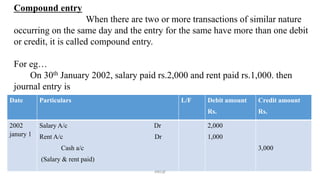
Compound entry
When there are two or more transactions of similar nature
occurring on the same day and the entry for the same have more than one debit
or credit, it is called compound entry.
For eg…
On 30th January 2002, salary paid rs.2,000 and rent paid rs.1,000. then
journal entry is
Date Particulars L/F Debit amount
Rs.
Credit amount
Rs.
2002
janury 1
Salary A/c Dr
Rent A/c Dr
Cash a/c
(Salary & rent paid)
2,000
1,000
3,000
ANIL@
Drawback of journal
It is difficult for the trader to ascertain from the journal the total
amount payable to suppliers, the amount receivable from the
customers, the total amount spent on various items the total amount
of income received, etc.as on a particular date.
ANIL@
LEDGER
A ledger is a book which contains various accounts where transactions relating
to that account are recorded.
The ledger is a ‘book of second entry’ or ‘final entry’ because transactions
first entered in journal are finally incorporated in the ledger. It is also called the
‘main or the principal book of accounts’ of a business.
The process of recording the transactions in the ledger account by referring to
the journal, is called posting.ANIL@
Specimen of a Ledger Account
Name of Account
Date Particulars J/f
Amount
Rs .
Date Particulars J/f
Amount
Rs .
ANIL@
TRIAL BALANCE
A Trial balance is a statement of balances of all ledger accounts,
prepared at the end of a period, to check the arithmetical accuracy of
the books kept under double entry principles.
ANIL@
Characteristics
Trial Balance is not a part of double entry.
It is not an account. It is only a list of balances of ledger accounts.
It is prepared on a particular date.
It is prepared before preparing the final accounts.
Total of debit and credit columns must be equal.
ANIL@
Objectives
To verify the arithmetical accuracy of the accounts.
To find out mistakes and rectify them.
To provide a basis for preparing financial
statements.
ANIL@
Code no. Name of accounts
Amount (Rs)
(debit)
Amount (Rs)
(credit)
Total
Specimen of a Trial balance…..
ANIL@
Code no. Name of accounts Amount
(debit)
Amount
(credit)
Cash in hand XXX
Cash in bank XXX
Sales XXX
Capital a/c XXX
Bills payable XXX
Sundry debtors XXX
Sundry creditors XXX
Bills receivable XXX
Stock of goods XXX
Purchases XXX
Carriage inwards XXX
Carriage outwards XXX
Sales return XXX
Purchase return XXX
Trial balance as at………..
ANIL@
Rent paid XXX
Interest paid XXX
Salaries paid XXX
Wages paid XXX
Furniture XXX
Discount received XXX
Commission received XXX
Interest received XXX
Plant & machinery XXX
Land & buildings XXX
Prepaid exps XXX
Drawings XXX
Goodwill XXX
Outstanding exps XXX
Bank loan/overdraft XXX
Total XXX XXX
ANIL@
ANIL@

basics of accounting

  • 1.
    QUANTATIVE MANAGEMENT • Topic:Journal, Ledger, Trial balance Presented by, ANIL@
  • 2.
    JOURNAL  The termJOURNAL has been derived from the French word JOUR which means day.  Thus journal means daily record.  It is the book used for making primary record of day-to-day transactions chronologically.  journal is also called the ‘book of original entry’ or ‘book of prime entry’.  The recording of a transaction in the journal is called JOURNALIZING. ANIL@
  • 3.
    Specimen of Journal Date ParticularsL/F Debit amount Rs. Credit amount Rs. ANIL@
  • 4.
    Date Particulars L/FDebit amount Rs. Credit amount Rs. 2002 January 1 Cash a/c Dr Jacob’s capital A/c (Jacob invest capital into firm) 20,000 20,000 For eg… On January 1st 2002 Mr. Jacob started business with cash-20000 Journal entry is….. ANIL@
  • 5.
    Compound entry When thereare two or more transactions of similar nature occurring on the same day and the entry for the same have more than one debit or credit, it is called compound entry. For eg… On 30th January 2002, salary paid rs.2,000 and rent paid rs.1,000. then journal entry is Date Particulars L/F Debit amount Rs. Credit amount Rs. 2002 janury 1 Salary A/c Dr Rent A/c Dr Cash a/c (Salary & rent paid) 2,000 1,000 3,000 ANIL@
  • 6.
    Drawback of journal Itis difficult for the trader to ascertain from the journal the total amount payable to suppliers, the amount receivable from the customers, the total amount spent on various items the total amount of income received, etc.as on a particular date. ANIL@
  • 7.
    LEDGER A ledger isa book which contains various accounts where transactions relating to that account are recorded. The ledger is a ‘book of second entry’ or ‘final entry’ because transactions first entered in journal are finally incorporated in the ledger. It is also called the ‘main or the principal book of accounts’ of a business. The process of recording the transactions in the ledger account by referring to the journal, is called posting.ANIL@
  • 8.
    Specimen of aLedger Account Name of Account Date Particulars J/f Amount Rs . Date Particulars J/f Amount Rs . ANIL@
  • 9.
    TRIAL BALANCE A Trialbalance is a statement of balances of all ledger accounts, prepared at the end of a period, to check the arithmetical accuracy of the books kept under double entry principles. ANIL@
  • 10.
    Characteristics Trial Balance isnot a part of double entry. It is not an account. It is only a list of balances of ledger accounts. It is prepared on a particular date. It is prepared before preparing the final accounts. Total of debit and credit columns must be equal. ANIL@
  • 11.
    Objectives To verify thearithmetical accuracy of the accounts. To find out mistakes and rectify them. To provide a basis for preparing financial statements. ANIL@
  • 12.
    Code no. Nameof accounts Amount (Rs) (debit) Amount (Rs) (credit) Total Specimen of a Trial balance….. ANIL@
  • 13.
    Code no. Nameof accounts Amount (debit) Amount (credit) Cash in hand XXX Cash in bank XXX Sales XXX Capital a/c XXX Bills payable XXX Sundry debtors XXX Sundry creditors XXX Bills receivable XXX Stock of goods XXX Purchases XXX Carriage inwards XXX Carriage outwards XXX Sales return XXX Purchase return XXX Trial balance as at……….. ANIL@
  • 14.
    Rent paid XXX Interestpaid XXX Salaries paid XXX Wages paid XXX Furniture XXX Discount received XXX Commission received XXX Interest received XXX Plant & machinery XXX Land & buildings XXX Prepaid exps XXX Drawings XXX Goodwill XXX Outstanding exps XXX Bank loan/overdraft XXX Total XXX XXX ANIL@
  • 15.