Increasing resilience when
 undertaking restoration


          David Lamb
   University of Queensland
           Australia
                              1
Several approaches to reforesting
             degraded lands
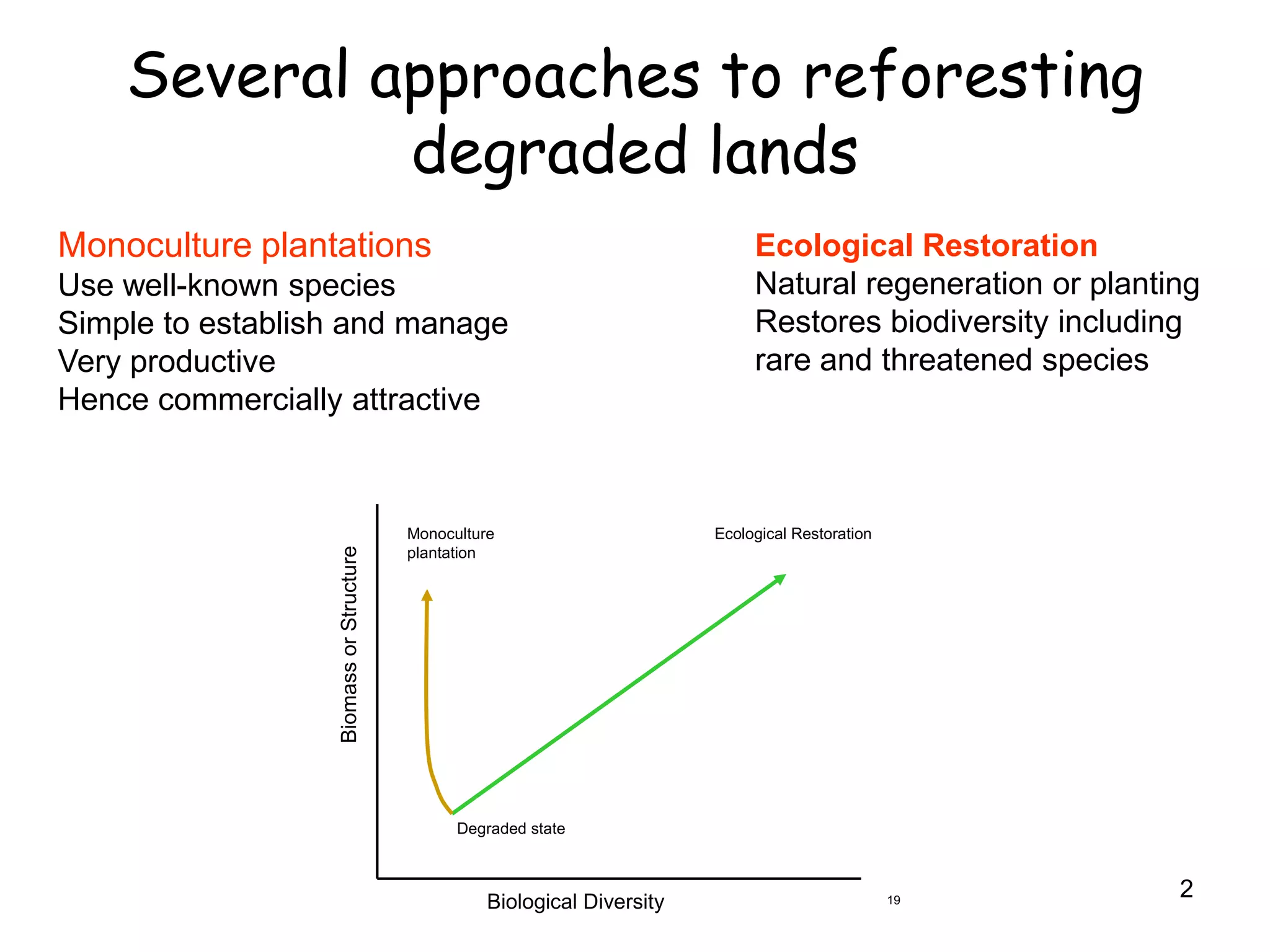
Monoculture plantations                                                        Ecological Restoration
Use well-known species                                                         Natural regeneration or planting
Simple to establish and manage                                                 Restores biodiversity including
Very productive                                                                rare and threatened species
Hence commercially attractive


                                         Monoculture                      Ecological Restoration
                  Biomass or Structure


                                         plantation


                                               Degraded state


                                                   Biological Diversity                            19
                                                                                                             2
Each has disadvantages
• Monocultures
  – Supplies limited only range of goods and services
  – Vulnerable to pests, diseases and market changes


• Ecological Restoration
  – Not always ecologically possible
  – Expensive if planted
  – Fewer financial benefits (to landholder) so less
    attractive

                                                        3
Third approach
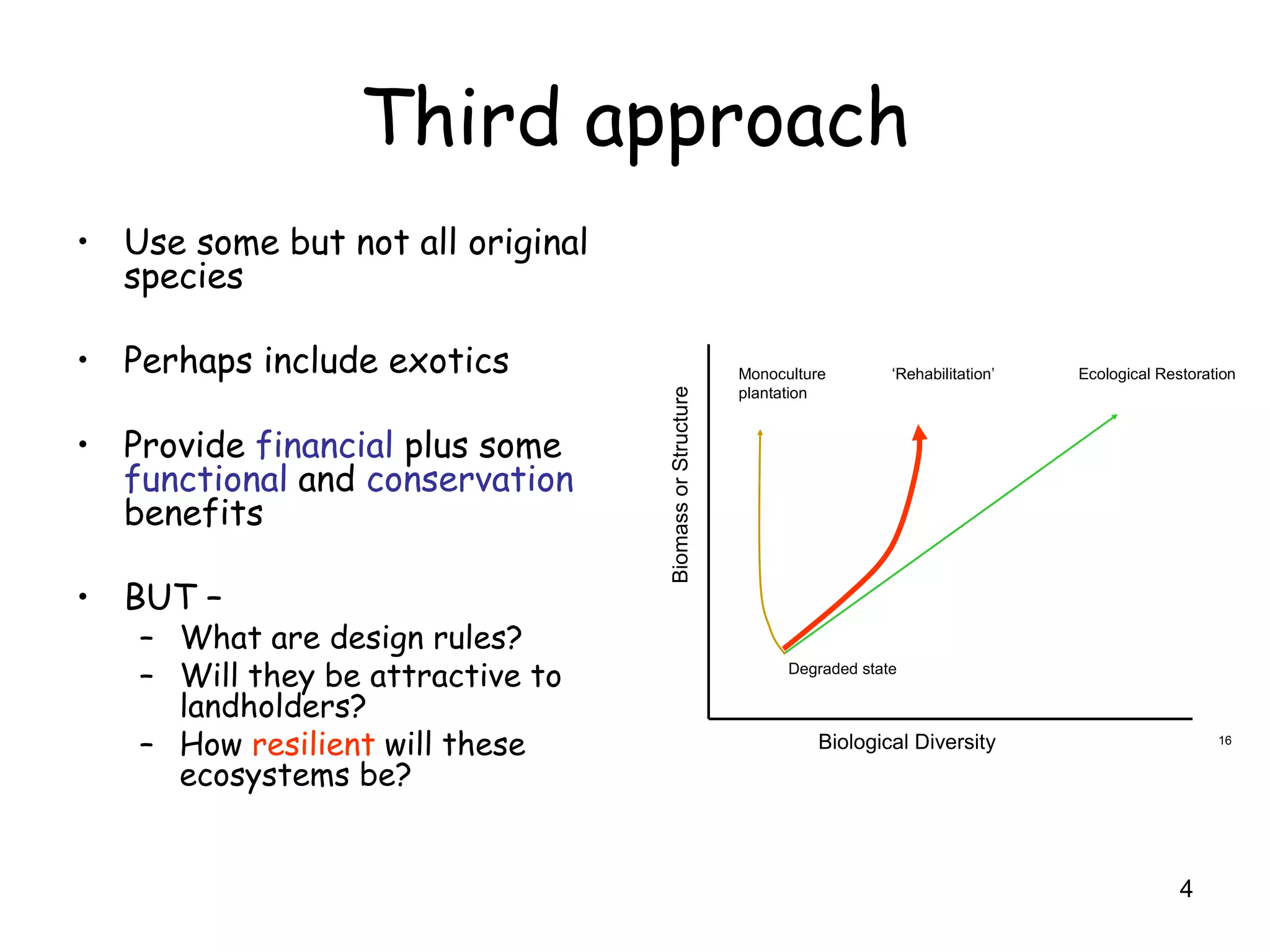
• Use some but not all original
  species

• Perhaps include exotics                                Monoculture        ‘Rehabilitation’   Ecological Restoration


                                  Biomass or Structure
                                                         plantation


• Provide financial plus some
  functional and conservation
  benefits

• BUT –
   – What are design rules?
   – Will they be attractive to                                Degraded state

     landholders?
   – How resilient will these                                      Biological Diversity                           16


     ecosystems be?


                                                                                                             4
Building resilience
• Definition of resilience
  – Capacity to tolerate/adapt to disturbances and
  – remain in same state with same structure,
    functioning and feedback mechanisms


• Avoids a search for
  – (i) optimal productivity or
  – (ii) some unattainable former state


• But how to achieve this?
                                                     5
Some attributes of resilient
        systems: they have
1. Diversity
2. Modularity (connectedness)
3. Tight feedbacks
4. Openness (inflows and outflows)
5. Reserves (e.g. seedbanks, social memories)
6. Overlapping institutions (polycentric
   governance)
7. Are adaptively managed

                                                6
In the case of restoration
resilience has four components


    • Ecological resilience

    • Economic resilience

    • Social resilience

    • Institutional resilience
                                 7
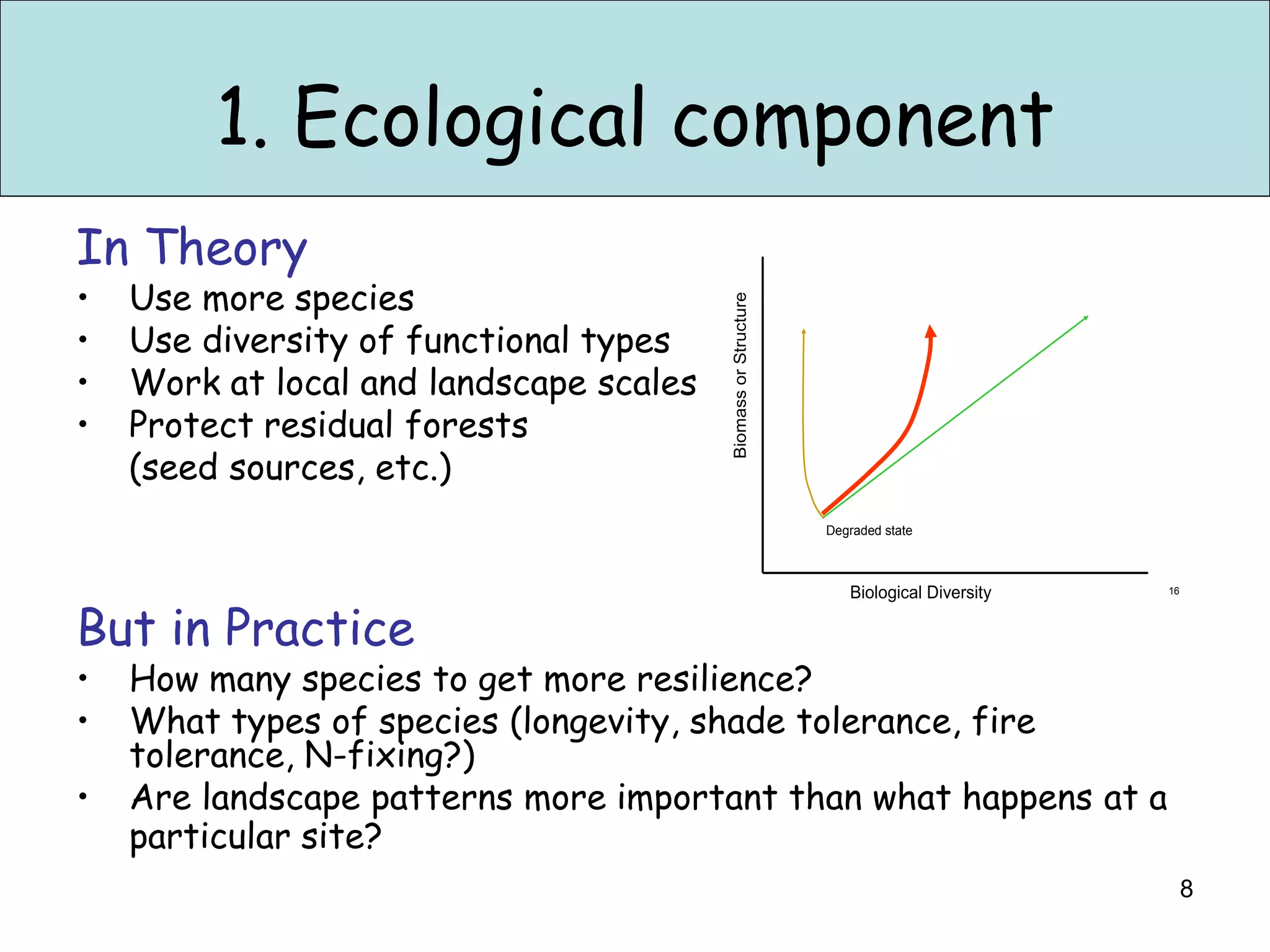
1. Ecological component
In Theory
•   Use more species
                                                                Monoculture        ‘Rehabilitation’   Ecological Restoration


                                         Biomass or Structure
                                                                plantation


•   Use diversity of functional types
•   Work at local and landscape scales
•   Protect residual forests
    (seed sources, etc.)
                                                                      Degraded state


                                                                          Biological Diversity                           16


But in Practice
•   How many species to get more resilience?
•   What types of species (longevity, shade tolerance, fire
    tolerance, N-fixing?)
•   Are landscape patterns more important than what happens at a
    particular site?
                                                                                                                              8
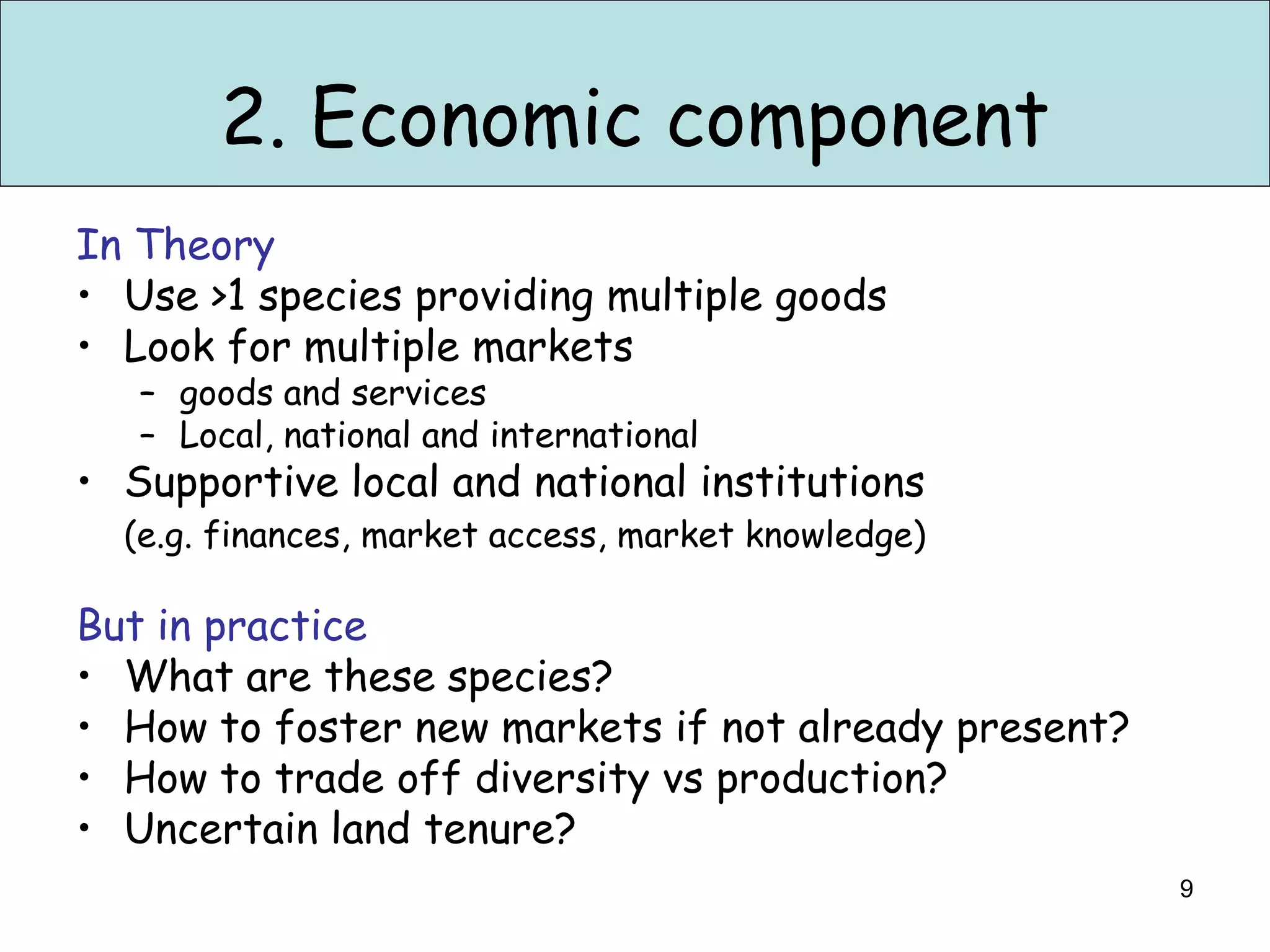
2. Economic component
In Theory
• Use >1 species providing multiple goods
• Look for multiple markets
   – goods and services
   – Local, national and international
• Supportive local and national institutions
  (e.g. finances, market access, market knowledge)

But in practice
• What are these species?
• How to foster new markets if not already present?
• How to trade off diversity vs production?
• Uncertain land tenure?
                                                      9
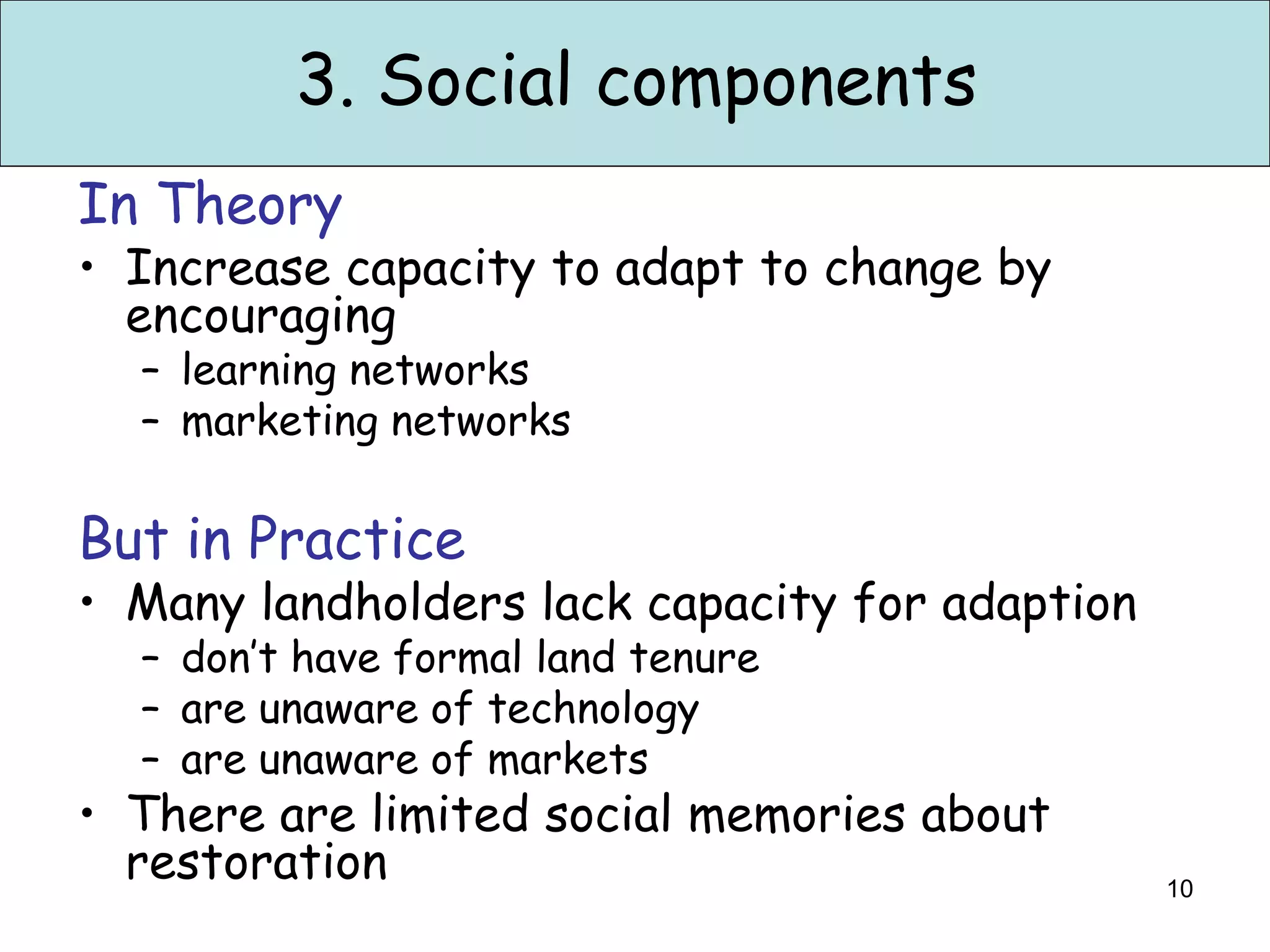
3. Social components
In Theory
• Increase capacity to adapt to change by
  encouraging
  – learning networks
  – marketing networks

But in Practice
• Many landholders lack capacity for adaption
  – don’t have formal land tenure
  – are unaware of technology
  – are unaware of markets
• There are limited social memories about
  restoration                                   10
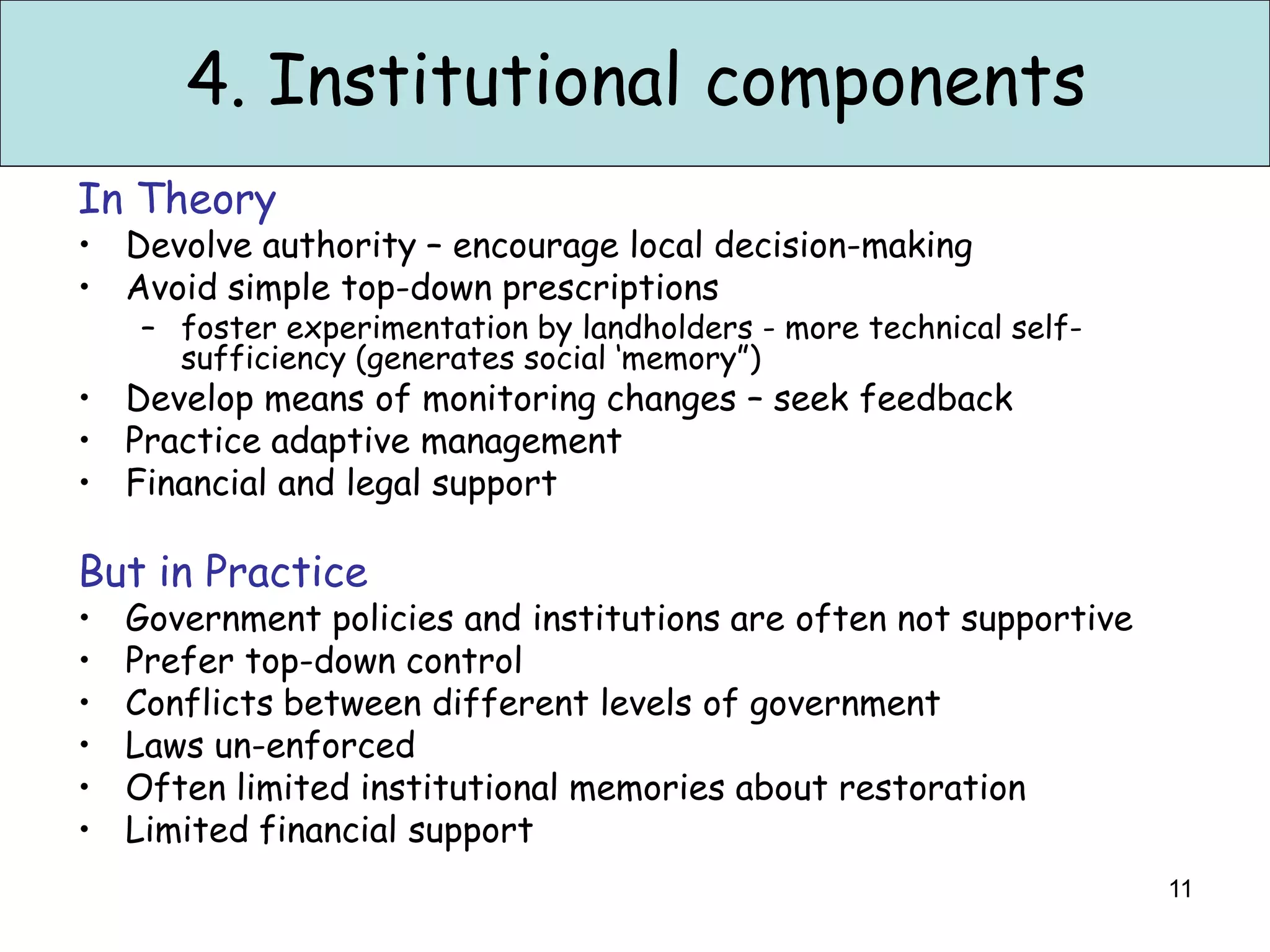
4. Institutional components
In Theory
• Devolve authority – encourage local decision-making
• Avoid simple top-down prescriptions
    – foster experimentation by landholders - more technical self-
      sufficiency (generates social ‘memory”)
• Develop means of monitoring changes – seek feedback
• Practice adaptive management
• Financial and legal support

But in Practice
•   Government policies and institutions are often not supportive
•   Prefer top-down control
•   Conflicts between different levels of government
•   Laws un-enforced
•   Often limited institutional memories about restoration
•   Limited financial support
                                                                     11
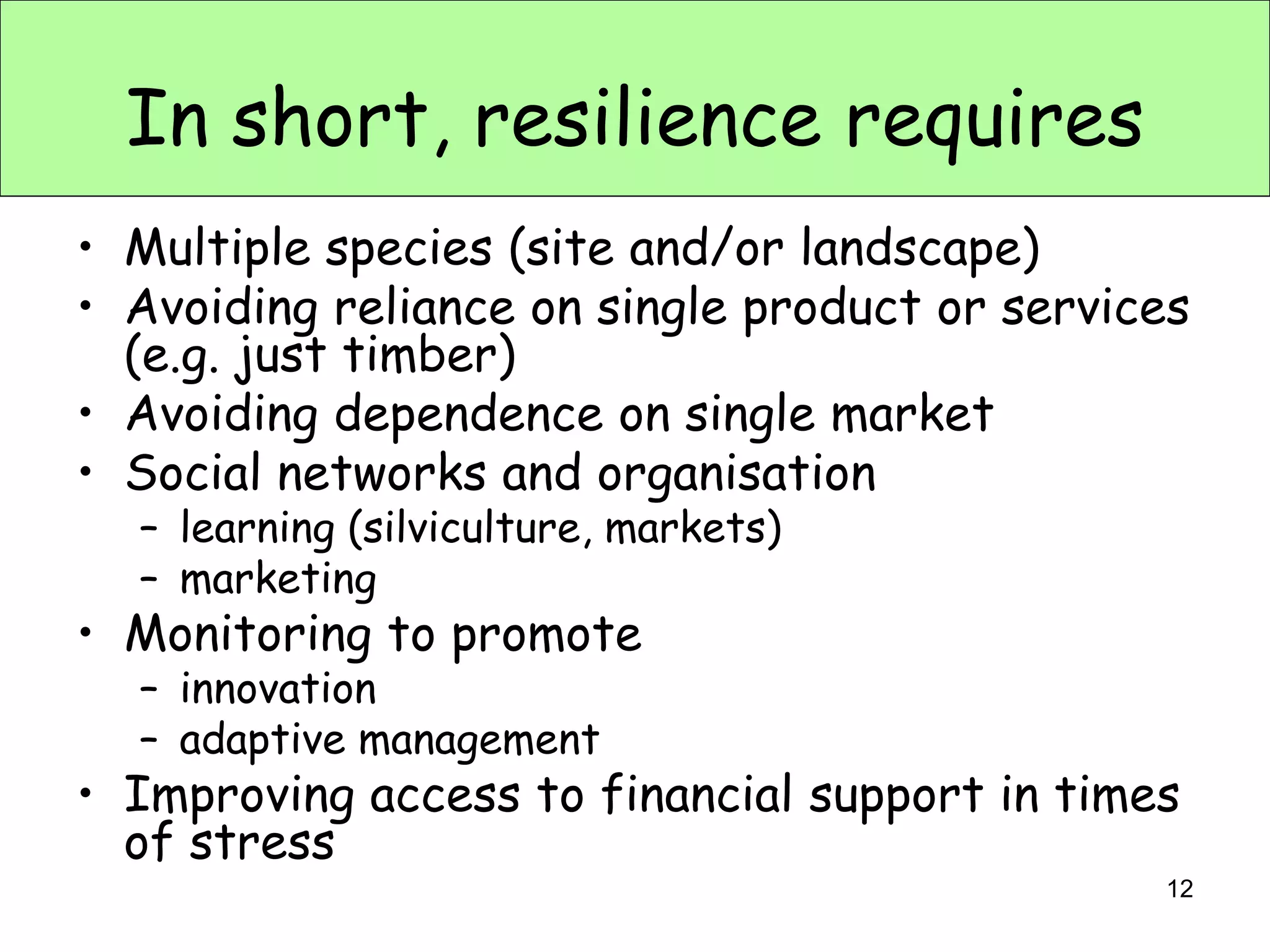
In short, resilience requires
• Multiple species (site and/or landscape)
• Avoiding reliance on single product or services
  (e.g. just timber)
• Avoiding dependence on single market
• Social networks and organisation
  – learning (silviculture, markets)
  – marketing
• Monitoring to promote
  – innovation
  – adaptive management
• Improving access to financial support in times
  of stress
                                               12
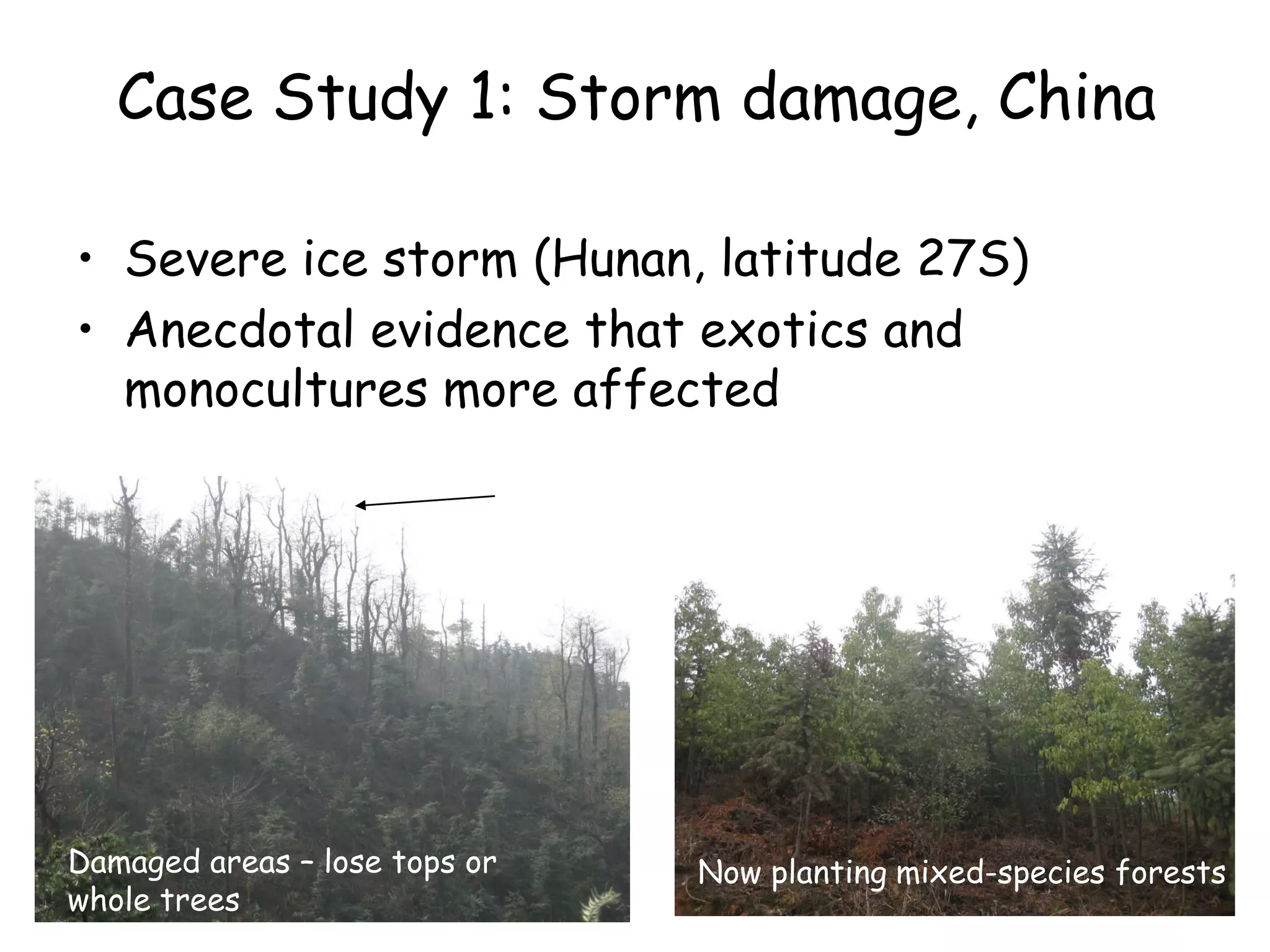
Case Study 1: Storm damage, China

• Severe ice storm (Hunan, latitude 27S)
• Anecdotal evidence that exotics and
  monocultures more affected


Damaged areas – lose tops or   Now planting mixed-species forests
whole trees                                                  13
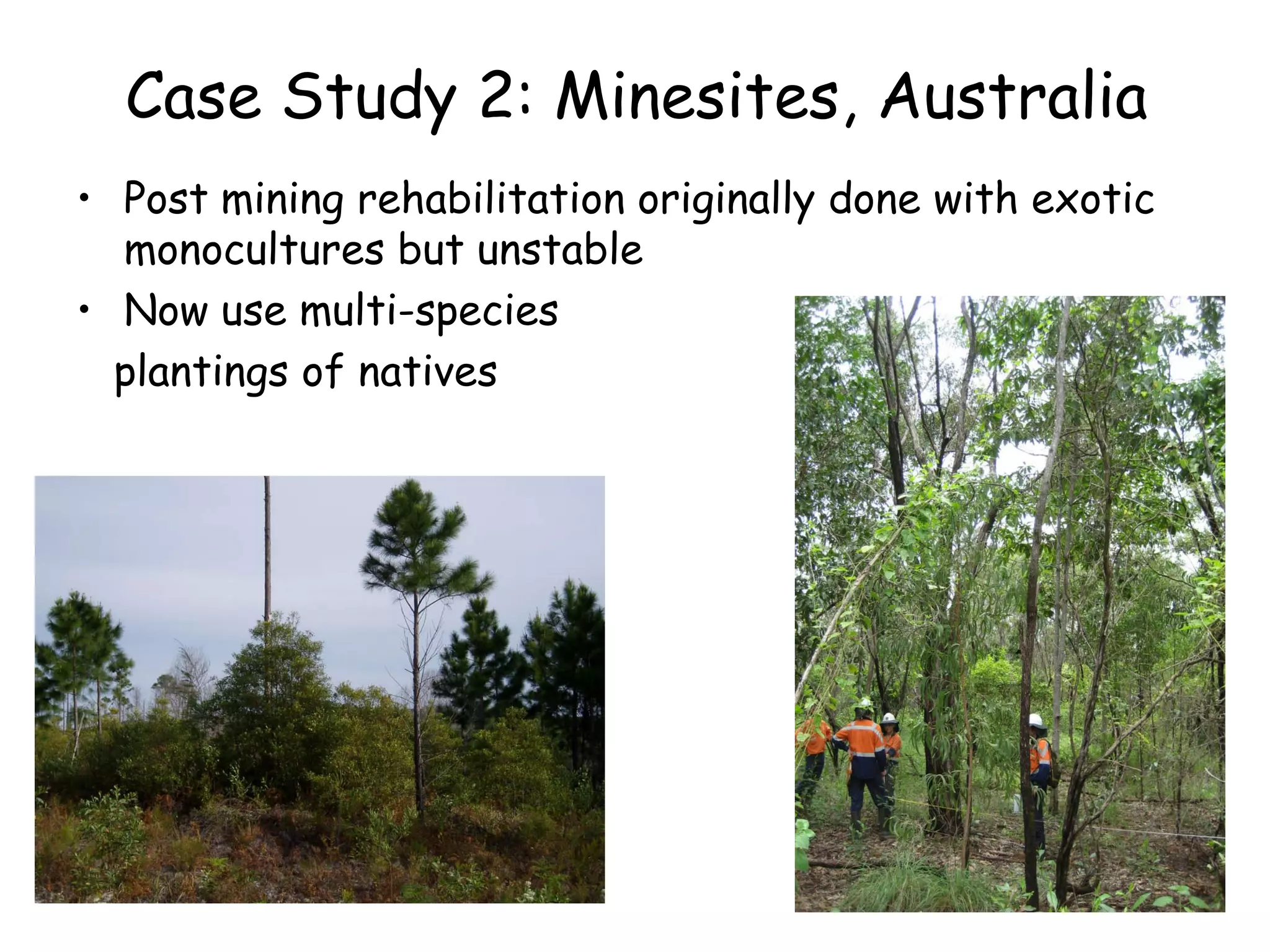
Case Study 2: Minesites, Australia
• Post mining rehabilitation originally done with exotic
  monocultures but unstable
• Now use multi-species
  plantings of natives


                                                           14
Importance of Context
• Production areas
   – Close to markets
   – Distant from markets
   – Smallholder or Corporate


• Protection areas

• Extent of degradation
   – severe
   – less-severe


• Short term risks vs long term risks
                                        15
Raises important questions
1.    How to predict the ecological and economic risks at particular locations?
         how severe might they be?
         how long might they take to appear?

2. What is an appropriate balance between increasing resilience and increasing
     productivity?
         how many and which species?
         how far are they compatible and when do they diverge?
         Scale - sites vs landscapes

3. Are there trade-offs between ecological and economic or social resilience?
         are win-win solutions possible?
         building social capital?

4. Hence, how much (and what type of) resilience needed?
          what are the key stressors?
          what are they necessary institutional arrangements?


                                                                                  16
17
1. How to predict the ecological and
    economic risks at particular
             locations?

 • how severe might they be?
 • how long might they take to
   appear?

         Land use history?
         Ecological trends?
         Institutional framework?
                                    18
2. What is an appropriate balance
between increasing resilience and
    increasing productivity?


• How many and what type of species?
• does context matter? (‘close to’ or ‘distant
  from’ markets?)
• how far do they go together and when do they
  diverge?
• Sites vs landscape scales

                                            19
3. Are there trade-offs between
ecological and economic or social
            resilience?

• Which species (for markets? For
  ecological functioning?)
• are win-win solutions possible?
• Nurturing markets as well as
  ecosystems?


                                    20
4. How much (and what type of)
     resilience is needed

• what are the key stressors?
• how to build social capital?
• what are the necessary institutional
  arrangements?


                                         21
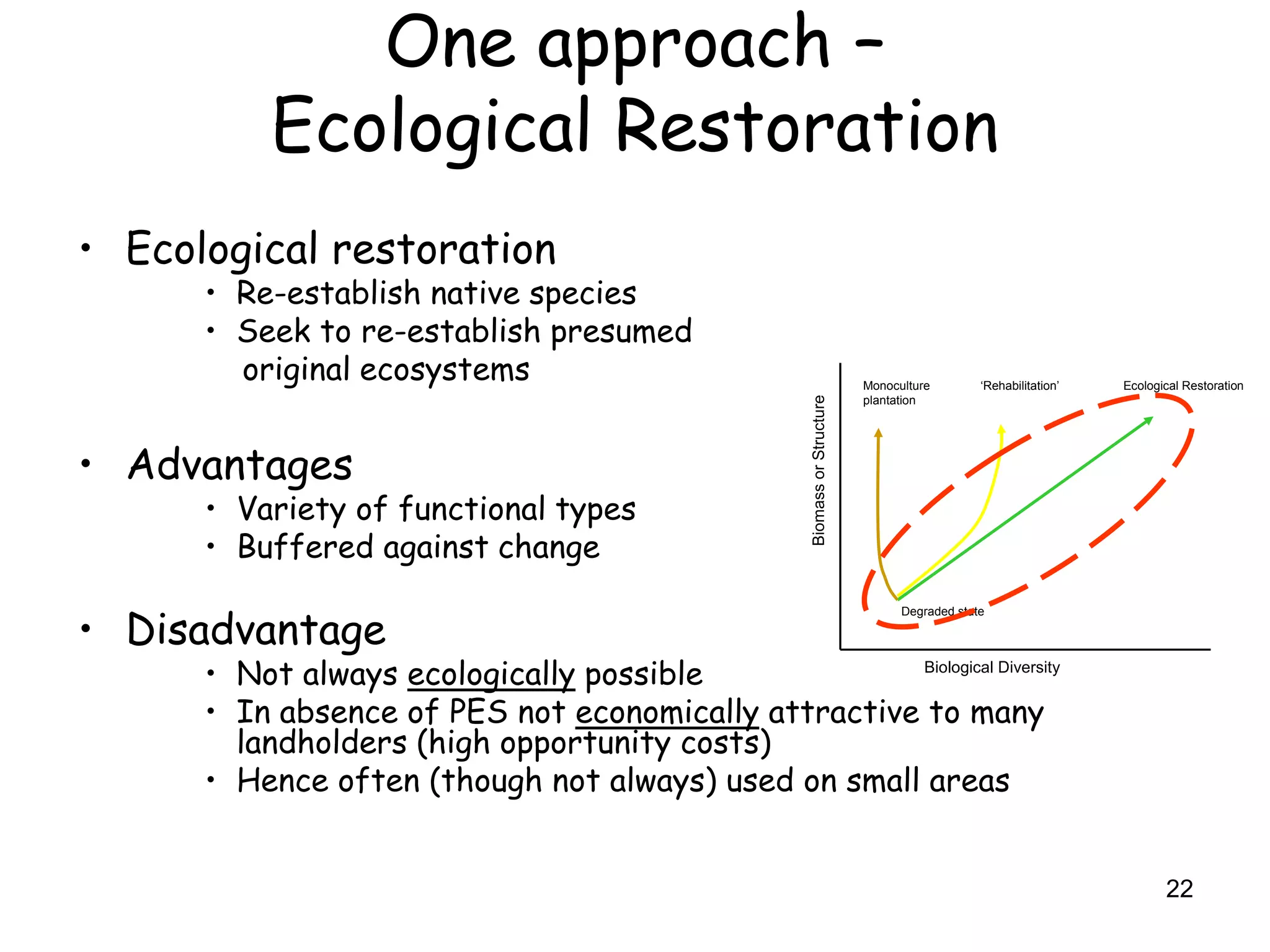
One approach –
           Ecological Restoration
• Ecological restoration
      • Re-establish native species
      • Seek to re-establish presumed
        original ecosystems                                                  Monoculture        ‘Rehabilitation’   Ecological Restoration


                                                      Biomass or Structure
                                                                             plantation


• Advantages
      • Variety of functional types
      • Buffered against change

• Disadvantage
                                                                                   Degraded state


      • Not always ecologically possible              Biological Diversity


      • In absence of PES not economically attractive to many
        landholders (high opportunity costs)
      • Hence often (though not always) used on small areas


                                                                                                                          22
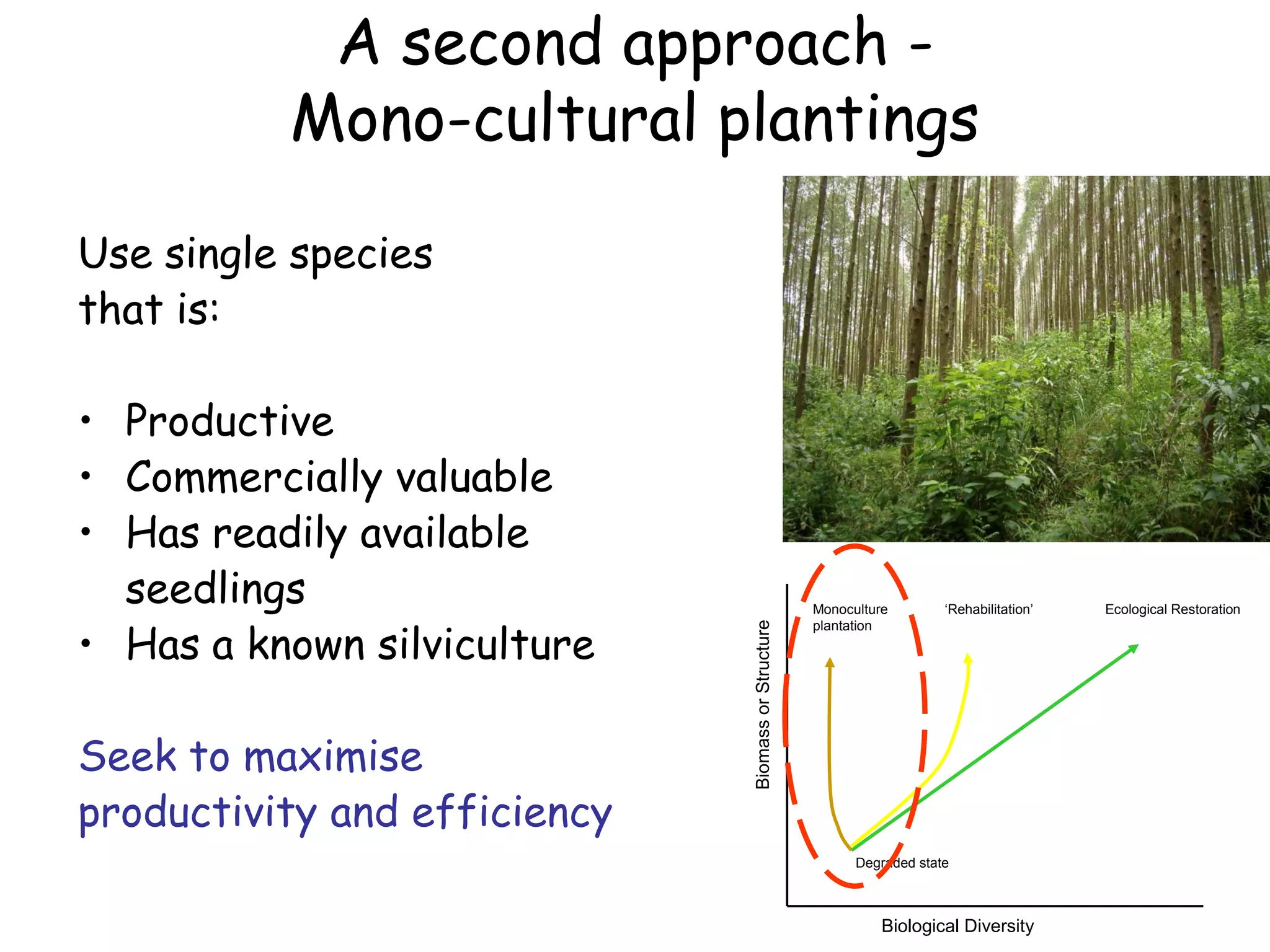
A second approach -
          Mono-cultural plantings

Use single species
that is:

• Productive
• Commercially valuable
• Has readily available
  seedlings                                          Monoculture        ‘Rehabilitation’   Ecological Restoration


• Has a known silviculture

                              Biomass or Structure
                                                     plantation


Seek to maximise
productivity and efficiency
                                                           Degraded state

                                                                                                    23
                                                               Biological Diversity
Advantages and Disadvantages
ADVANTAGES
• Can be financially profitable
• Hence attractive to landholders
   – Widely implemented (agriculture, forestry)

DISADVANTAGES
• Monocultures risky over longer term
• Sensitive to changes in circumstances
   – Ecological (pests, disease, storms, etc)
   – Economic (market changes)

• i.e. Lacks resilience

                                                  24
Difficult to restore degraded lands
• Ecological problems
  – Finding species able to tolerate changed conditions
  – Working out
     • how and sequencing of re-establishment,
     • the relative proportions of each species to use,
     • managing inter-actions, etc


• Economic and social problems
  – who pays for restoration?
  – Overcoming opportunity costs
  – Scaling up to cover ecologically significant areas
                                                          25

Increasing resilience when undertaking restoration

  • 1.
    Increasing resilience when undertaking restoration David Lamb University of Queensland Australia 1
  • 2.
    Several approaches toreforesting degraded lands Monoculture plantations Ecological Restoration Use well-known species Natural regeneration or planting Simple to establish and manage Restores biodiversity including Very productive rare and threatened species Hence commercially attractive Monoculture Ecological Restoration Biomass or Structure plantation Degraded state Biological Diversity 19 2
  • 3.
    Each has disadvantages •Monocultures – Supplies limited only range of goods and services – Vulnerable to pests, diseases and market changes • Ecological Restoration – Not always ecologically possible – Expensive if planted – Fewer financial benefits (to landholder) so less attractive 3
  • 4.
    Third approach • Usesome but not all original species • Perhaps include exotics Monoculture ‘Rehabilitation’ Ecological Restoration Biomass or Structure plantation • Provide financial plus some functional and conservation benefits • BUT – – What are design rules? – Will they be attractive to Degraded state landholders? – How resilient will these Biological Diversity 16 ecosystems be? 4
  • 5.
    Building resilience • Definitionof resilience – Capacity to tolerate/adapt to disturbances and – remain in same state with same structure, functioning and feedback mechanisms • Avoids a search for – (i) optimal productivity or – (ii) some unattainable former state • But how to achieve this? 5
  • 6.
    Some attributes ofresilient systems: they have 1. Diversity 2. Modularity (connectedness) 3. Tight feedbacks 4. Openness (inflows and outflows) 5. Reserves (e.g. seedbanks, social memories) 6. Overlapping institutions (polycentric governance) 7. Are adaptively managed 6
  • 7.
    In the caseof restoration resilience has four components • Ecological resilience • Economic resilience • Social resilience • Institutional resilience 7
  • 8.
    1. Ecological component InTheory • Use more species Monoculture ‘Rehabilitation’ Ecological Restoration Biomass or Structure plantation • Use diversity of functional types • Work at local and landscape scales • Protect residual forests (seed sources, etc.) Degraded state Biological Diversity 16 But in Practice • How many species to get more resilience? • What types of species (longevity, shade tolerance, fire tolerance, N-fixing?) • Are landscape patterns more important than what happens at a particular site? 8
  • 9.
    2. Economic component InTheory • Use >1 species providing multiple goods • Look for multiple markets – goods and services – Local, national and international • Supportive local and national institutions (e.g. finances, market access, market knowledge) But in practice • What are these species? • How to foster new markets if not already present? • How to trade off diversity vs production? • Uncertain land tenure? 9
  • 10.
    3. Social components InTheory • Increase capacity to adapt to change by encouraging – learning networks – marketing networks But in Practice • Many landholders lack capacity for adaption – don’t have formal land tenure – are unaware of technology – are unaware of markets • There are limited social memories about restoration 10
  • 11.
    4. Institutional components InTheory • Devolve authority – encourage local decision-making • Avoid simple top-down prescriptions – foster experimentation by landholders - more technical self- sufficiency (generates social ‘memory”) • Develop means of monitoring changes – seek feedback • Practice adaptive management • Financial and legal support But in Practice • Government policies and institutions are often not supportive • Prefer top-down control • Conflicts between different levels of government • Laws un-enforced • Often limited institutional memories about restoration • Limited financial support 11
  • 12.
    In short, resiliencerequires • Multiple species (site and/or landscape) • Avoiding reliance on single product or services (e.g. just timber) • Avoiding dependence on single market • Social networks and organisation – learning (silviculture, markets) – marketing • Monitoring to promote – innovation – adaptive management • Improving access to financial support in times of stress 12
  • 13.
    Case Study 1:Storm damage, China • Severe ice storm (Hunan, latitude 27S) • Anecdotal evidence that exotics and monocultures more affected Damaged areas – lose tops or Now planting mixed-species forests whole trees 13
  • 14.
    Case Study 2:Minesites, Australia • Post mining rehabilitation originally done with exotic monocultures but unstable • Now use multi-species plantings of natives 14
  • 15.
    Importance of Context •Production areas – Close to markets – Distant from markets – Smallholder or Corporate • Protection areas • Extent of degradation – severe – less-severe • Short term risks vs long term risks 15
  • 16.
    Raises important questions 1. How to predict the ecological and economic risks at particular locations? how severe might they be? how long might they take to appear? 2. What is an appropriate balance between increasing resilience and increasing productivity? how many and which species? how far are they compatible and when do they diverge? Scale - sites vs landscapes 3. Are there trade-offs between ecological and economic or social resilience? are win-win solutions possible? building social capital? 4. Hence, how much (and what type of) resilience needed? what are the key stressors? what are they necessary institutional arrangements? 16
  • 17.
  • 18.
    1. How topredict the ecological and economic risks at particular locations? • how severe might they be? • how long might they take to appear? Land use history? Ecological trends? Institutional framework? 18
  • 19.
    2. What isan appropriate balance between increasing resilience and increasing productivity? • How many and what type of species? • does context matter? (‘close to’ or ‘distant from’ markets?) • how far do they go together and when do they diverge? • Sites vs landscape scales 19
  • 20.
    3. Are theretrade-offs between ecological and economic or social resilience? • Which species (for markets? For ecological functioning?) • are win-win solutions possible? • Nurturing markets as well as ecosystems? 20
  • 21.
    4. How much(and what type of) resilience is needed • what are the key stressors? • how to build social capital? • what are the necessary institutional arrangements? 21
  • 22.
    One approach – Ecological Restoration • Ecological restoration • Re-establish native species • Seek to re-establish presumed original ecosystems Monoculture ‘Rehabilitation’ Ecological Restoration Biomass or Structure plantation • Advantages • Variety of functional types • Buffered against change • Disadvantage Degraded state • Not always ecologically possible Biological Diversity • In absence of PES not economically attractive to many landholders (high opportunity costs) • Hence often (though not always) used on small areas 22
  • 23.
    A second approach- Mono-cultural plantings Use single species that is: • Productive • Commercially valuable • Has readily available seedlings Monoculture ‘Rehabilitation’ Ecological Restoration • Has a known silviculture Biomass or Structure plantation Seek to maximise productivity and efficiency Degraded state 23 Biological Diversity
  • 24.
    Advantages and Disadvantages ADVANTAGES •Can be financially profitable • Hence attractive to landholders – Widely implemented (agriculture, forestry) DISADVANTAGES • Monocultures risky over longer term • Sensitive to changes in circumstances – Ecological (pests, disease, storms, etc) – Economic (market changes) • i.e. Lacks resilience 24
  • 25.
    Difficult to restoredegraded lands • Ecological problems – Finding species able to tolerate changed conditions – Working out • how and sequencing of re-establishment, • the relative proportions of each species to use, • managing inter-actions, etc • Economic and social problems – who pays for restoration? – Overcoming opportunity costs – Scaling up to cover ecologically significant areas 25