6th October 2010
Bundestag , Berlin


The Economics of Ecosystems & Biodiversity

                        Pavan Sukhdev
                    Study Leader – TEEB, &
       Special Adviser & Head - Green Economy Initiative
                             UNEP
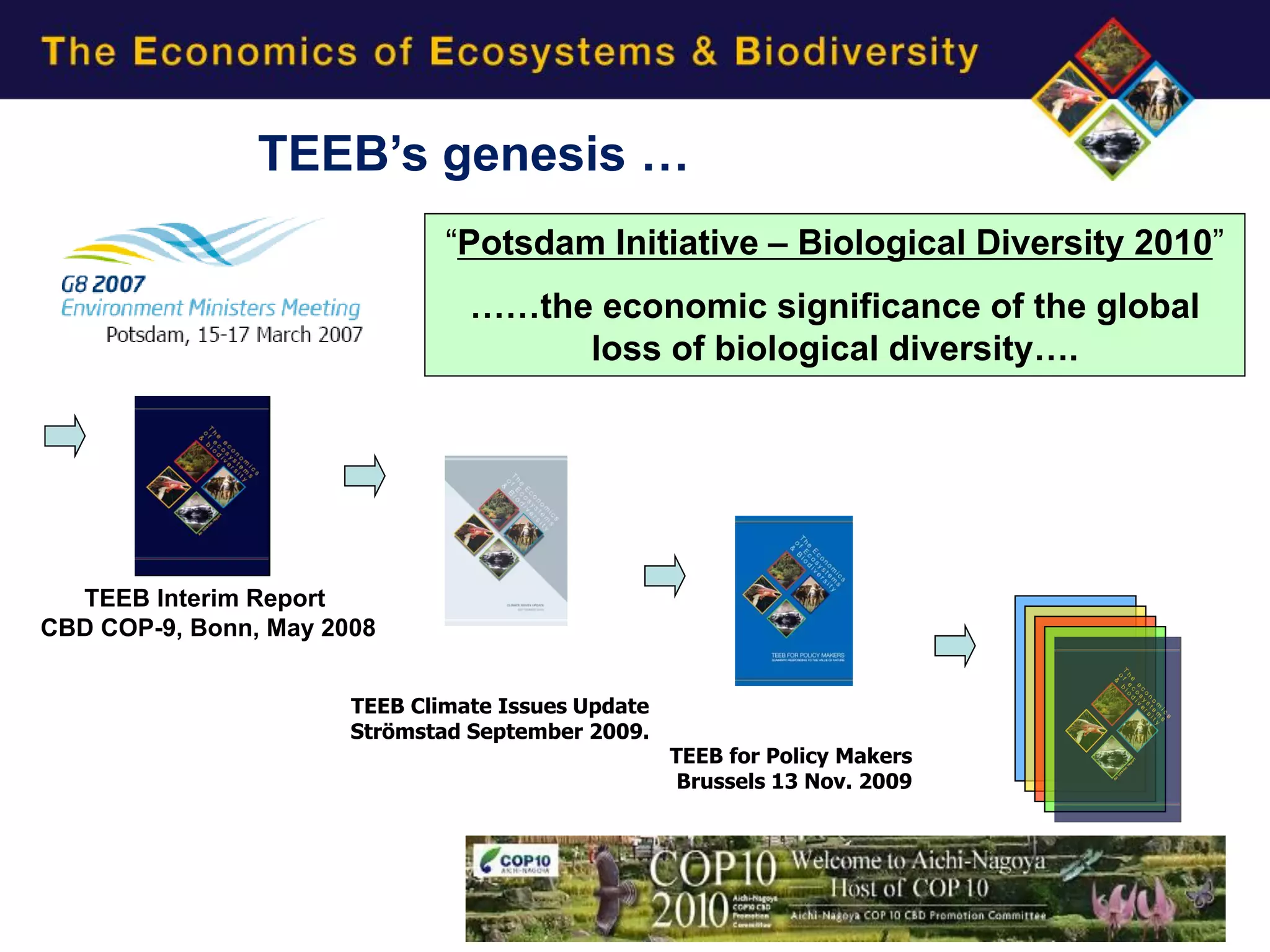
TEEB’s genesis …
                               “Potsdam Initiative – Biological Diversity 2010”
                                 ……the economic significance of the global
                                      loss of biological diversity….


  TEEB Interim Report
CBD COP-9, Bonn, May 2008


                       TEEB Climate Issues Update
                       Strömstad September 2009.
                                                    TEEB for Policy Makers
                                                     Brussels 13 Nov. 2009
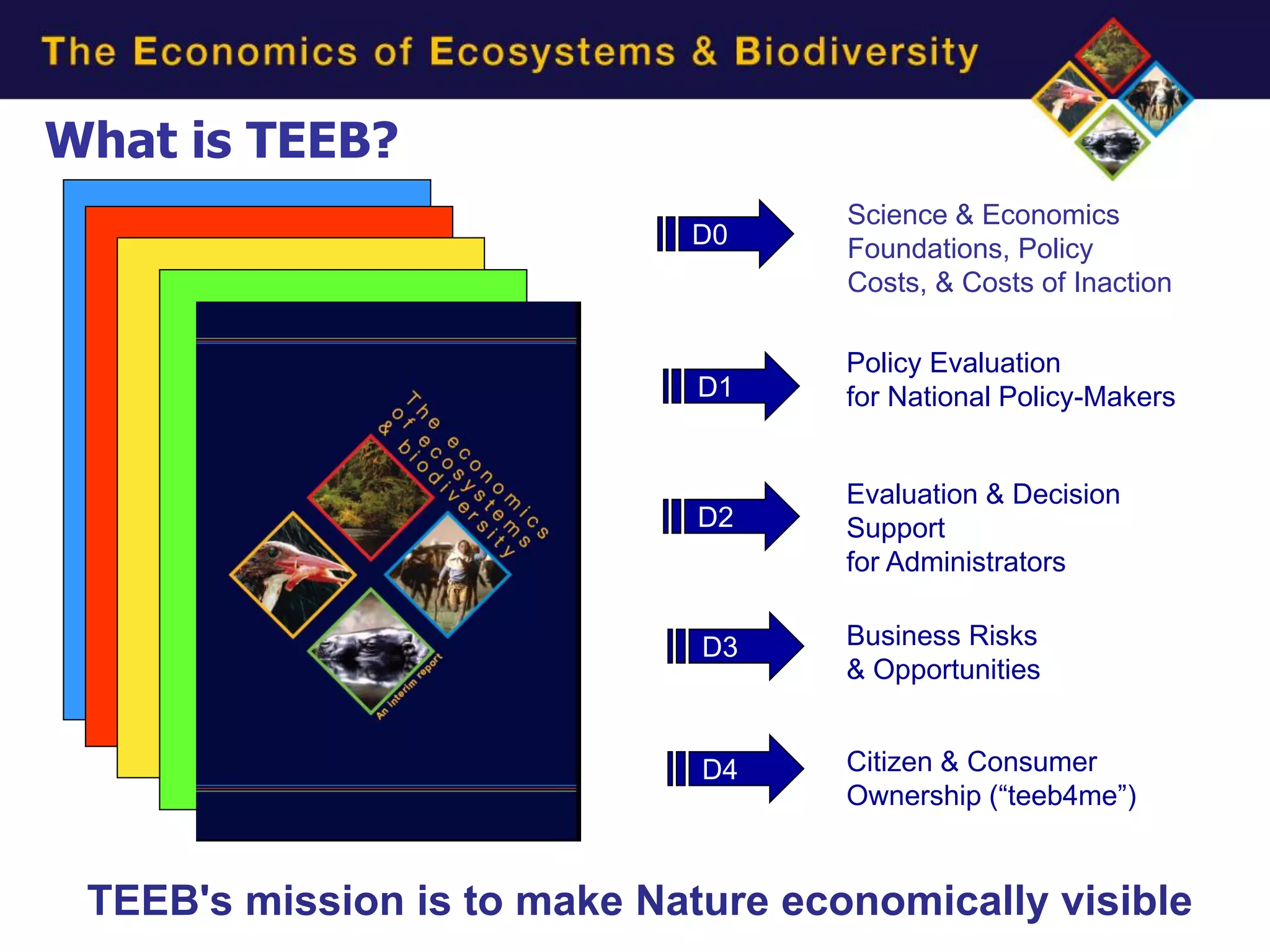
What is TEEB?
                                     Science & Economics
                             D0      Foundations, Policy
                                     Costs, & Costs of Inaction

                                     Policy Evaluation
                              D1     for National Policy-Makers


                                     Evaluation & Decision
                              D2     Support
                                     for Administrators


                              D3     Business Risks
                                     & Opportunities


                              D4     Citizen & Consumer
                                     Ownership (“teeb4me”)


 TEEB's mission is to make Nature economically visible
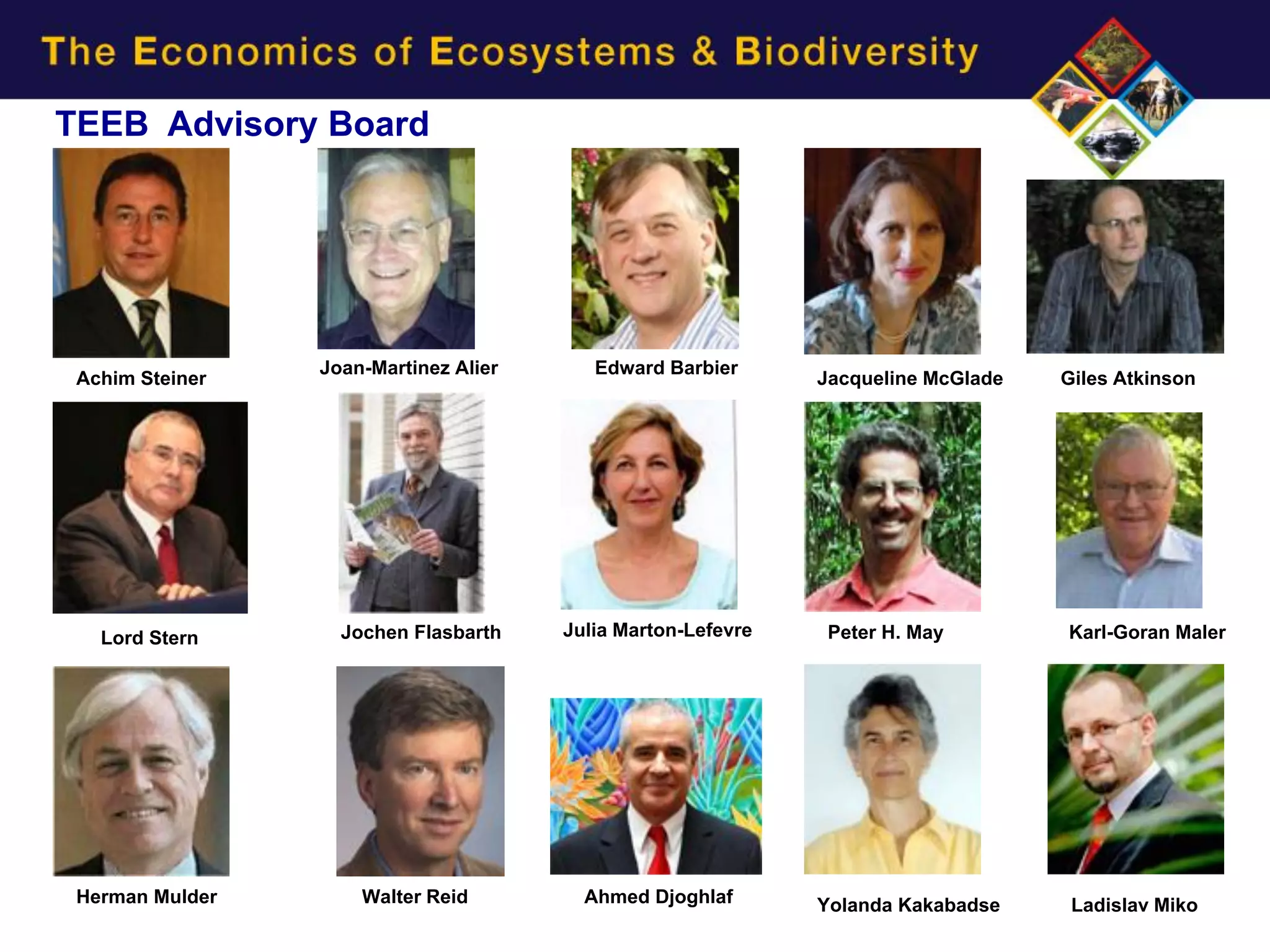
TEEB Advisory Board


                 Joan-Martinez Alier      Edward Barbier
 Achim Steiner                                                Jacqueline McGlade   Giles Atkinson


   Lord Stern      Jochen Flasbarth    Julia Marton-Lefevre    Peter H. May        Karl-Goran Maler


 Herman Mulder       Walter Reid         Ahmed Djoghlaf       Yolanda Kakabadse     Ladislav Miko
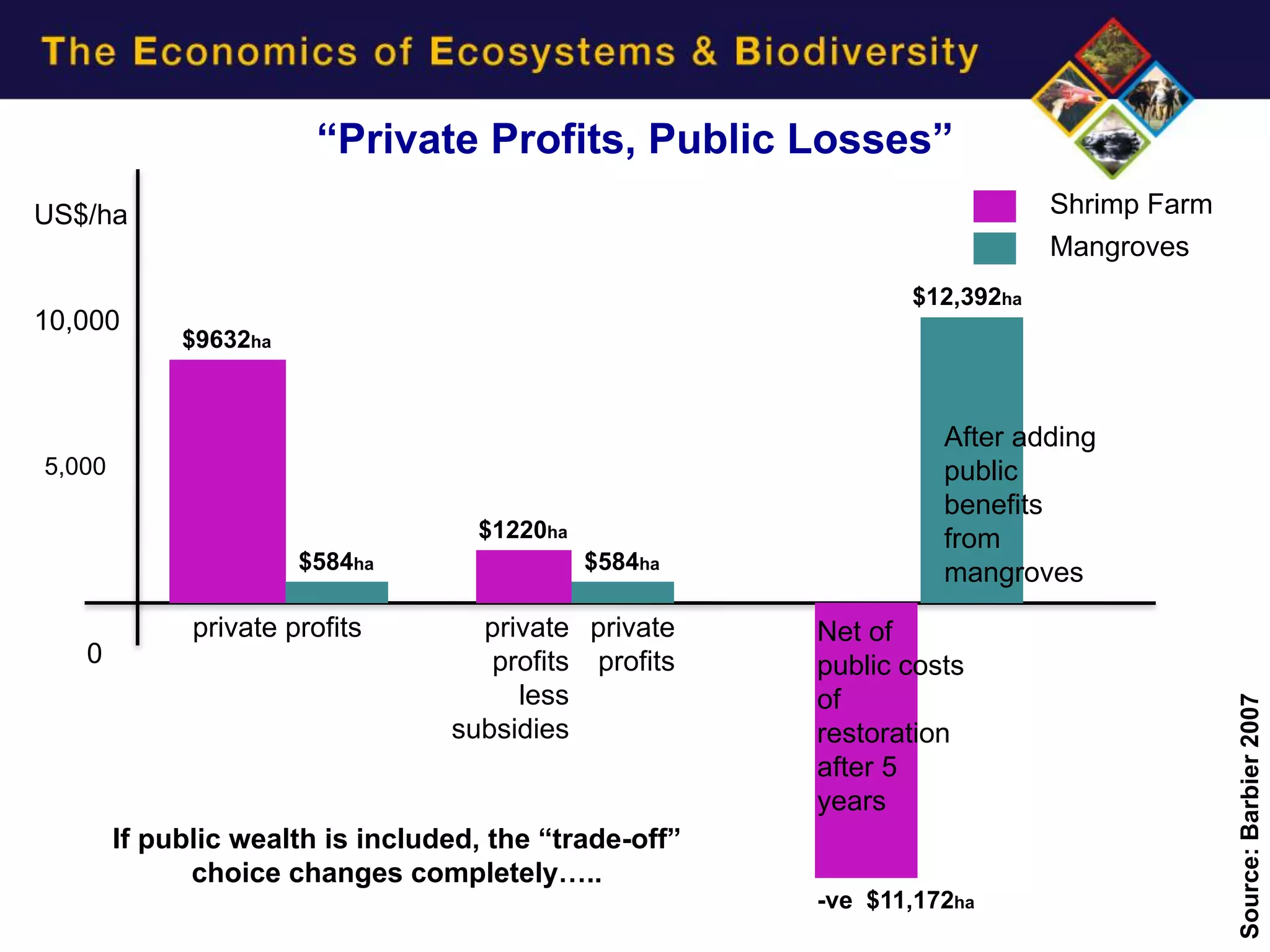
“Private Profits, Public Losses”
US$/ha                                                                     Shrimp Farm
                                                                           Mangroves
                                                               $12,392ha
10,000
             $9632ha


                                                                  After adding
5,000                                                             public
                                                                  benefits
                                    $1220ha                       from
                       $584ha                 $584ha              mangroves
              private profits       private private     Net of
   0                                 profits profits    public costs
                                       less             of


                                                                                         Source: Barbier 2007
                                  subsidies             restoration
                                                        after 5
                                                        years
        If public wealth is included, the “trade-off”
              choice changes completely…..
                                                        -ve $11,172ha
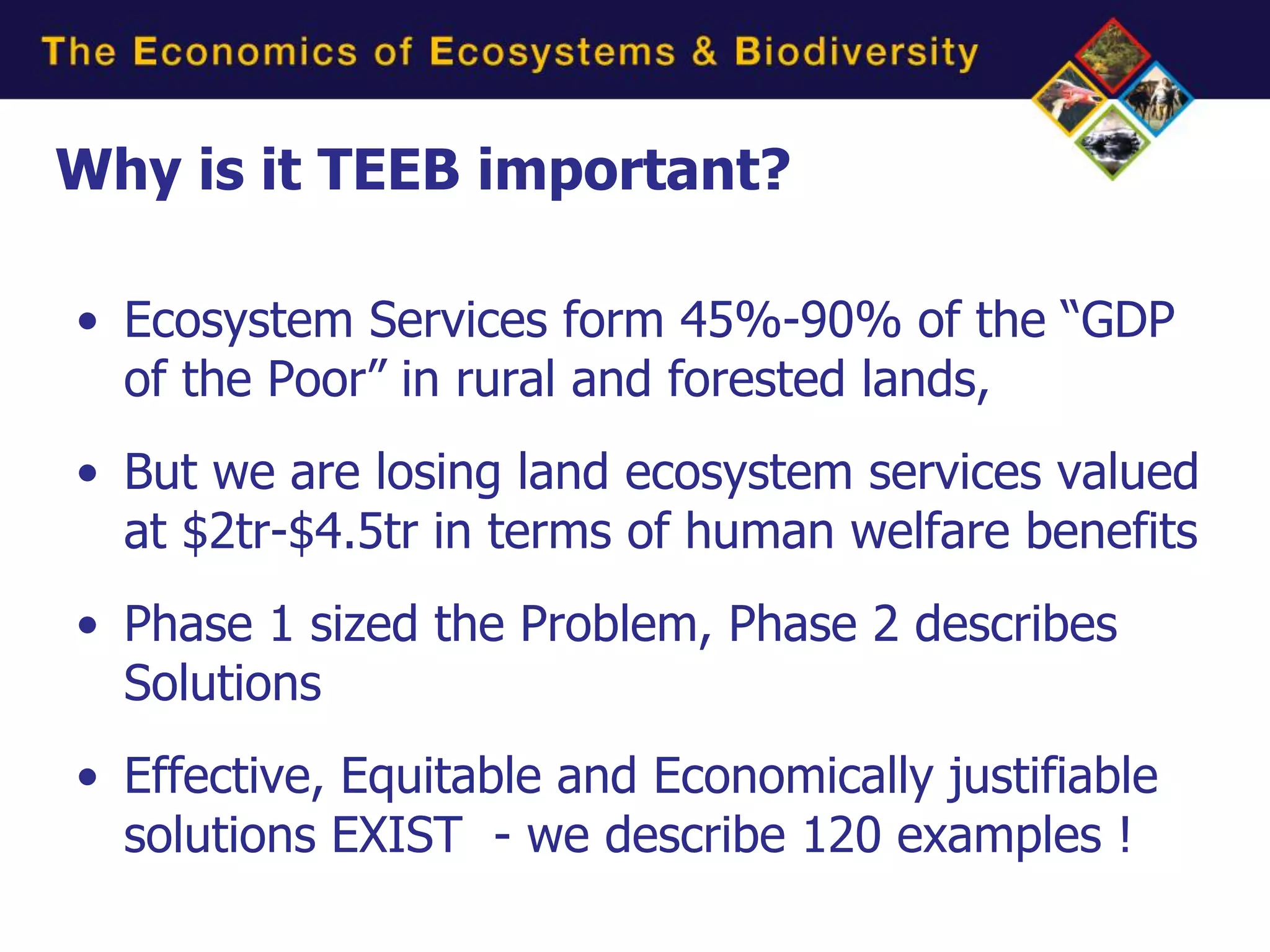
Why is it TEEB important?

• Ecosystem Services form 45%-90% of the “GDP
  of the Poor” in rural and forested lands,
• But we are losing land ecosystem services valued
  at $2tr-$4.5tr in terms of human welfare benefits
• Phase 1 sized the Problem, Phase 2 describes
  Solutions
• Effective, Equitable and Economically justifiable
  solutions EXIST - we describe 120 examples !
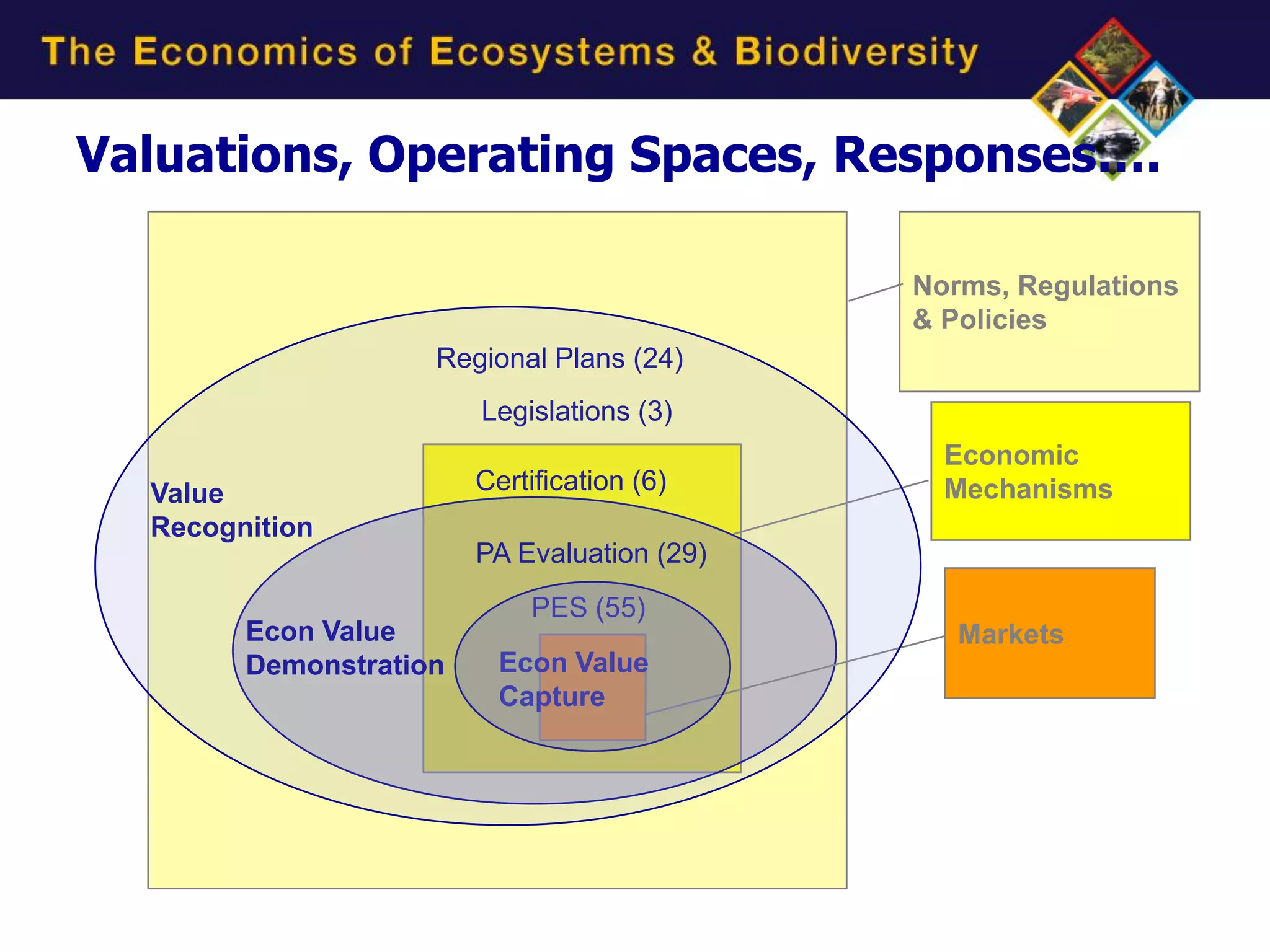
Valuations, Operating Spaces, Responses….

                                             Norms, Regulations
                                             & Policies
                    Regional Plans (24)
                        Legislations (3)
                                               Economic
  Value                 Certification (6)      Mechanisms
  Recognition
                        PA Evaluation (29)
                            PES (55)
        Econ Value                              Markets
        Demonstration     Econ Value
                          Capture
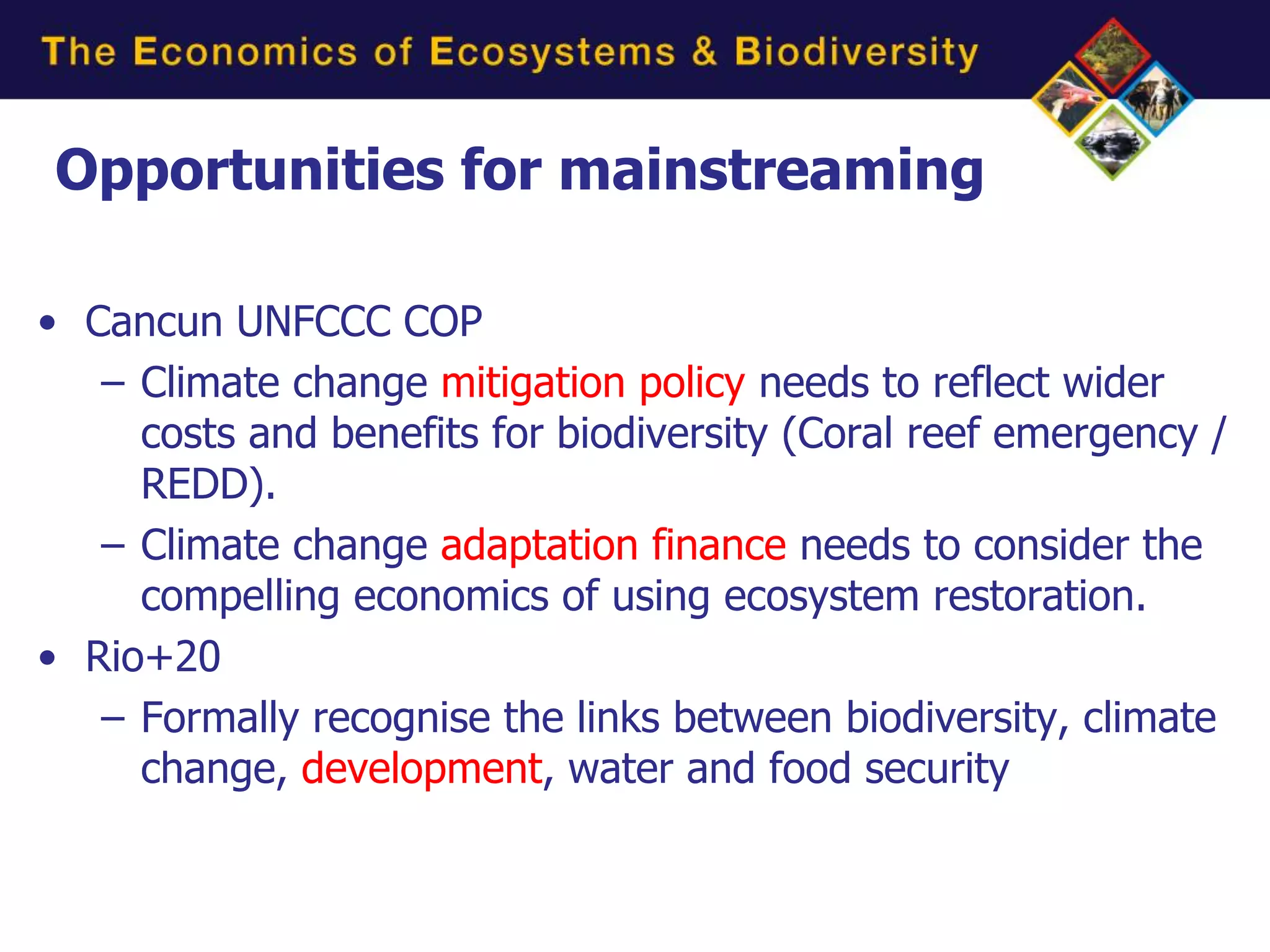
Opportunities for mainstreaming

• Cancun UNFCCC COP
   – Climate change mitigation policy needs to reflect wider
     costs and benefits for biodiversity (Coral reef emergency /
     REDD).
   – Climate change adaptation finance needs to consider the
     compelling economics of using ecosystem restoration.
• Rio+20
   – Formally recognise the links between biodiversity, climate
     change, development, water and food security
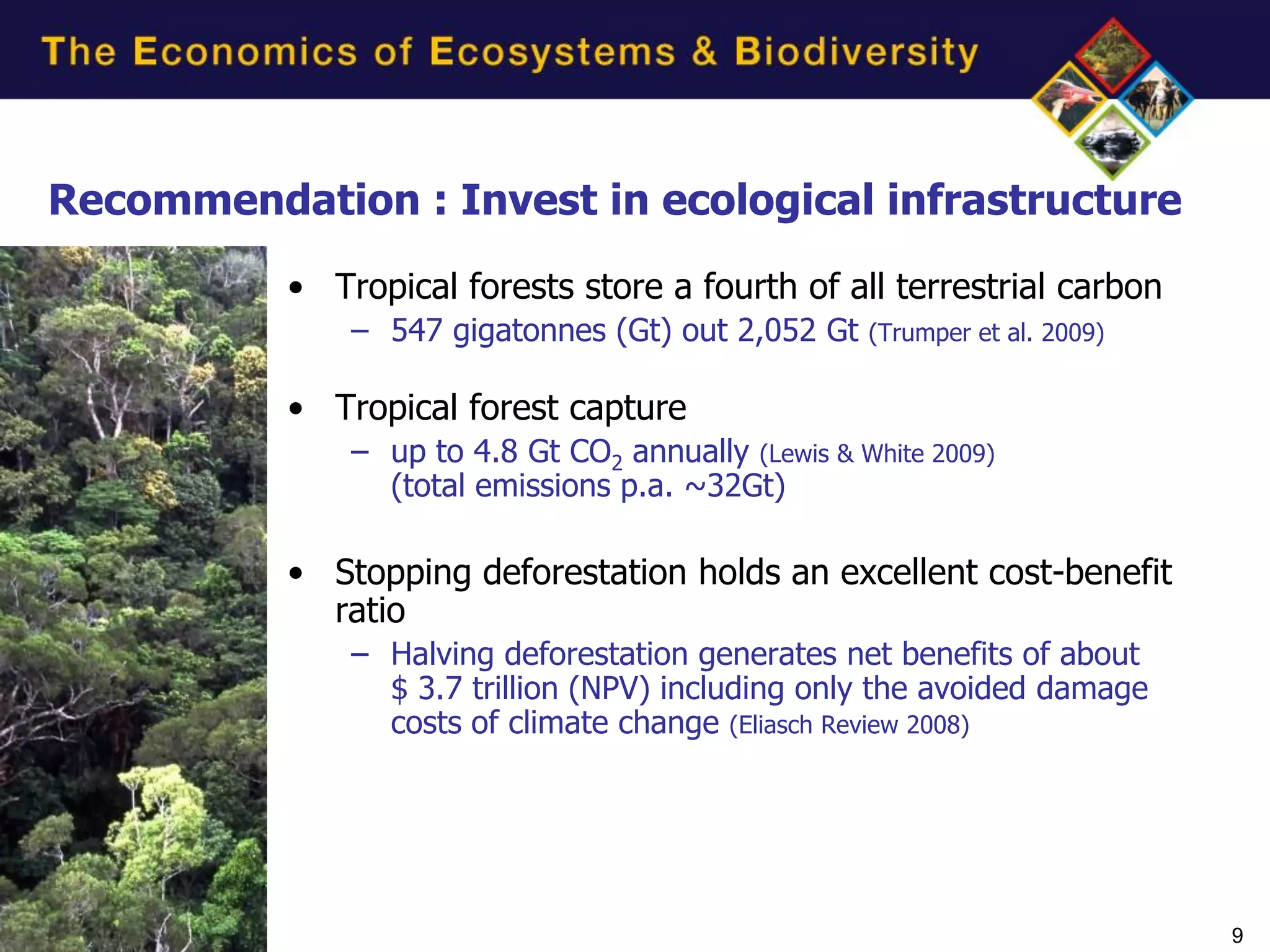
Recommendation : Invest in ecological infrastructure
           • Tropical forests store a fourth of all terrestrial carbon
               – 547 gigatonnes (Gt) out 2,052 Gt    (Trumper et al. 2009)


           • Tropical forest capture
               – up to 4.8 Gt CO2 annually (Lewis & White 2009)
                 (total emissions p.a. ~32Gt)

           • Stopping deforestation holds an excellent cost-benefit
             ratio
               – Halving deforestation generates net benefits of about
                 $ 3.7 trillion (NPV) including only the avoided damage
                 costs of climate change (Eliasch Review 2008)


                                                                             9
Recomm : Recognise the value of protected areas
• Global spending on PAs p.a.:                 ~ $6.5-10 billion
• Need for PAs (15% land, 30% sea) p.a.:       ~ $45 billion
• Need for Natura2000 p.a.:                    ~ $6.5 billion
• Benefits from effective PAs p.a.:            ~$4-5 trillion

• International NGO funding:                   ~ >$1 billion
  p.a.
• International gov funding (30-50% to PAs):   ~$4-5 billion p.a.
• Market-based income to PAs                   ~ $1-2 billion p.a
• Percentage of total ODA:                     ~ 2.8%

(TEEB D1 ch8)
Investment in ecological infrastructure

Ecological infrastructure key for adaptation to climate change


•   Afforestation: carbon store+ reduced risk of soil erosion & landslides
•   Wetlands and forests and reduced risk of flooding impacts
•   Mangroves and coastal erosion and natural hazards
•   Restore Forests, lakes and wetlands to address water scarcity
•   Coral reefs as fish nurseries for fisheries productivity / food security
•   PAs & connectivity to facilitate resilience of ecosystems and species

                     From local to national to EU efforts

                     Global responsibility / contribution
Investments in Ecological Infrastructure
for Climate adaptation

• restoration can be cost effective way of
  providing a service :


   planting mangroves along coastline in Vietnam cost
      $1.1 million but saved $ 7.3 million annually in
      dyke maintenance (GRID-Arendal 2002; Reid and Huq
     2005)
Example : Nature-based climate change
       mitigation, Germany
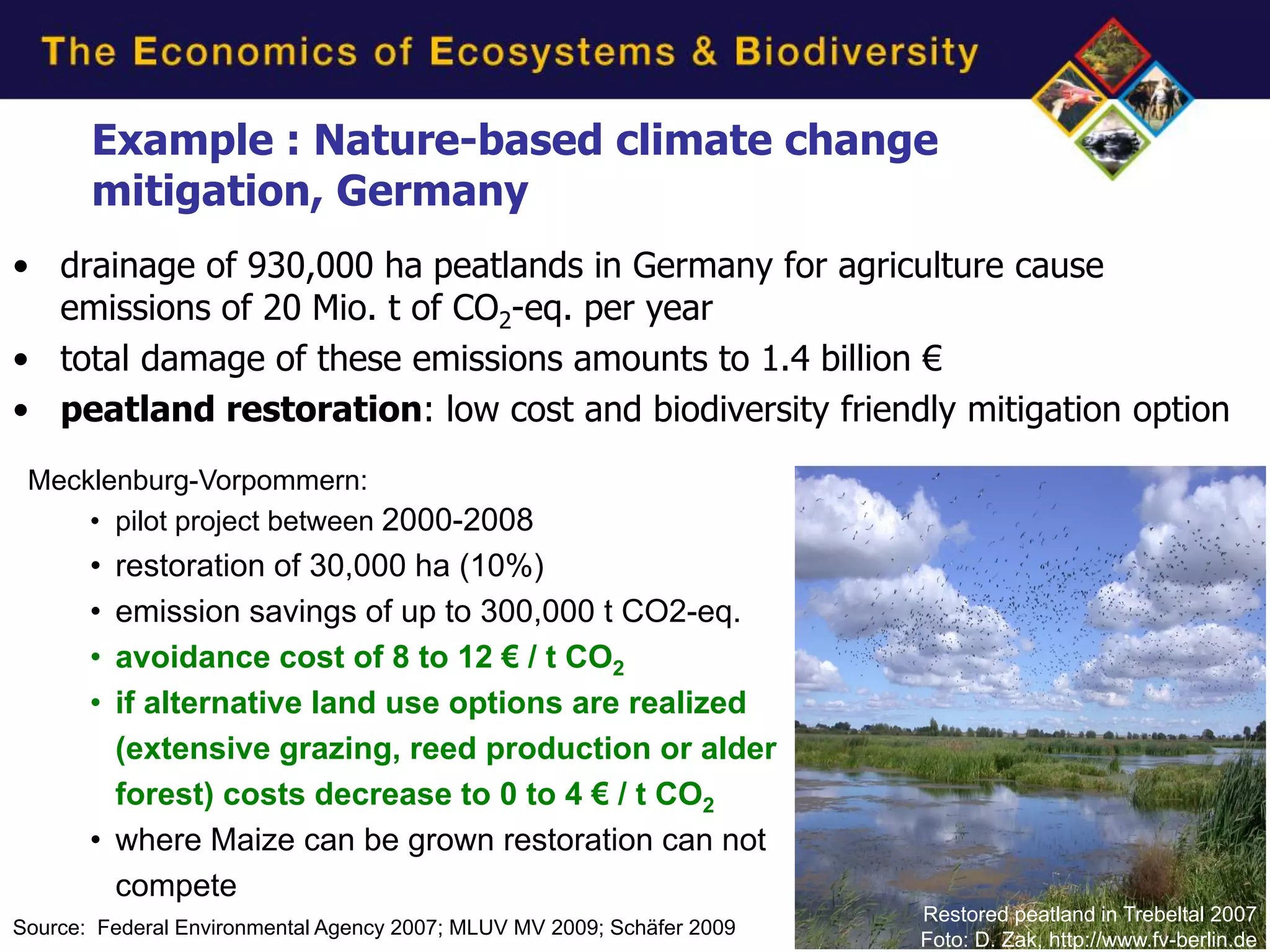
• drainage of 930,000 ha peatlands in Germany for agriculture cause
  emissions of 20 Mio. t of CO2-eq. per year
• total damage of these emissions amounts to 1.4 billion €
• peatland restoration: low cost and biodiversity friendly mitigation option
 Mecklenburg-Vorpommern:
     • pilot project between 2000-2008
       • restoration of 30,000 ha (10%)
       • emission savings of up to 300,000 t CO2-eq.
       • avoidance cost of 8 to 12 € / t CO2
       • if alternative land use options are realized
         (extensive grazing, reed production or alder
         forest) costs decrease to 0 to 4 € / t CO2
       • where Maize can be grown restoration can not
         compete
                                                                        Restored peatland in Trebeltal 2007
Source: Federal Environmental Agency 2007; MLUV MV 2009; Schäfer 2009
                                                                        Foto: D. Zak, http://www.fv-berlin.de
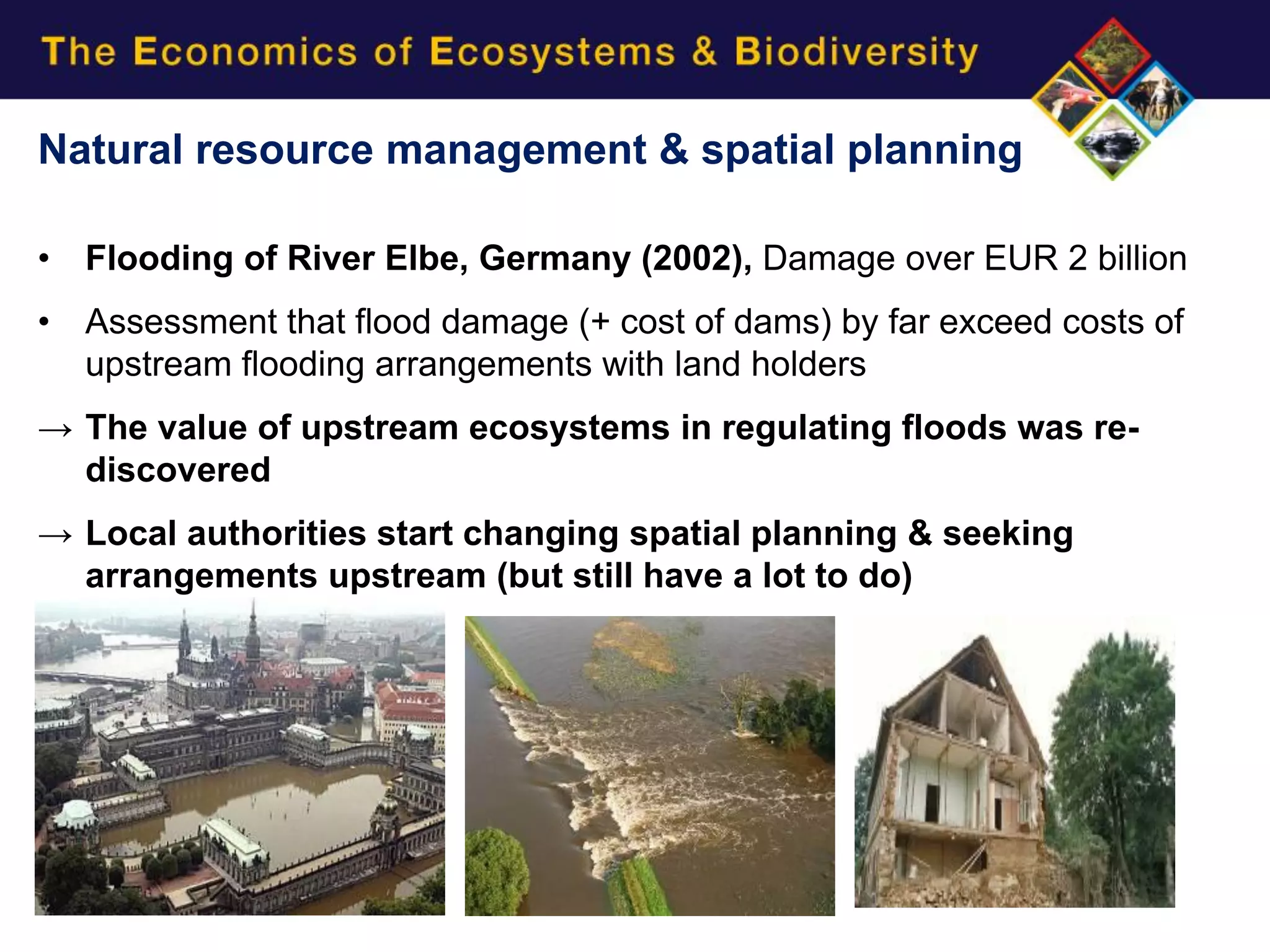
Natural resource management & spatial planning

•   Flooding of River Elbe, Germany (2002), Damage over EUR 2 billion
•   Assessment that flood damage (+ cost of dams) by far exceed costs of
    upstream flooding arrangements with land holders
→ The value of upstream ecosystems in regulating floods was re-
  discovered
→ Local authorities start changing spatial planning & seeking
  arrangements upstream (but still have a lot to do)
River Elbe flooding, Germany
 Step 1: Specify and agree on the problem
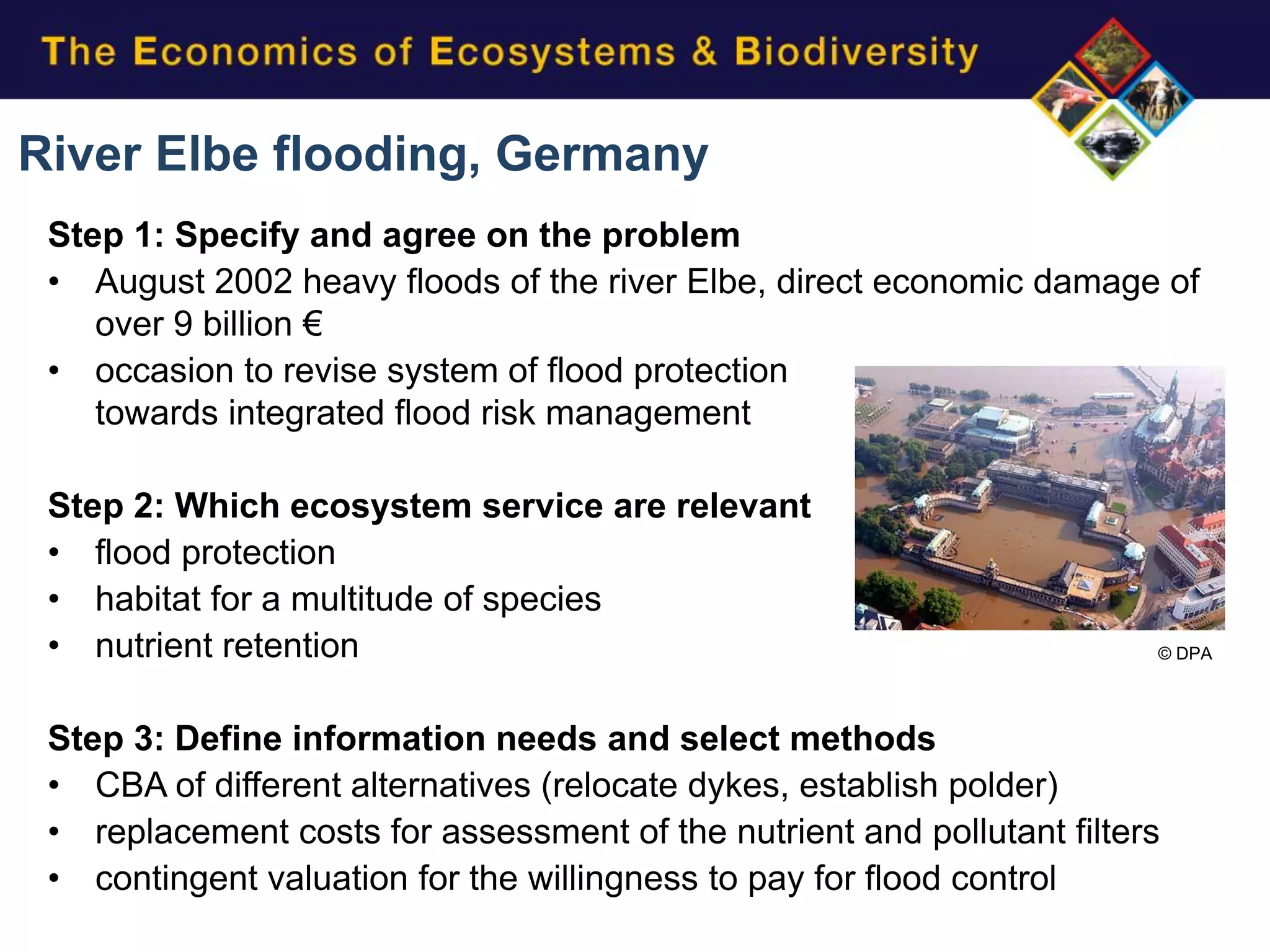
 • August 2002 heavy floods of the river Elbe, direct economic damage of
    over 9 billion €
 • occasion to revise system of flood protection
    towards integrated flood risk management

 Step 2: Which ecosystem service are relevant
 • flood protection
 • habitat for a multitude of species
 • nutrient retention                                                   © DPA


 Step 3: Define information needs and select methods
 • CBA of different alternatives (relocate dykes, establish polder)
 • replacement costs for assessment of the nutrient and pollutant filters
 • contingent valuation for the willingness to pay for flood control
Step 4: Conduct the assessment
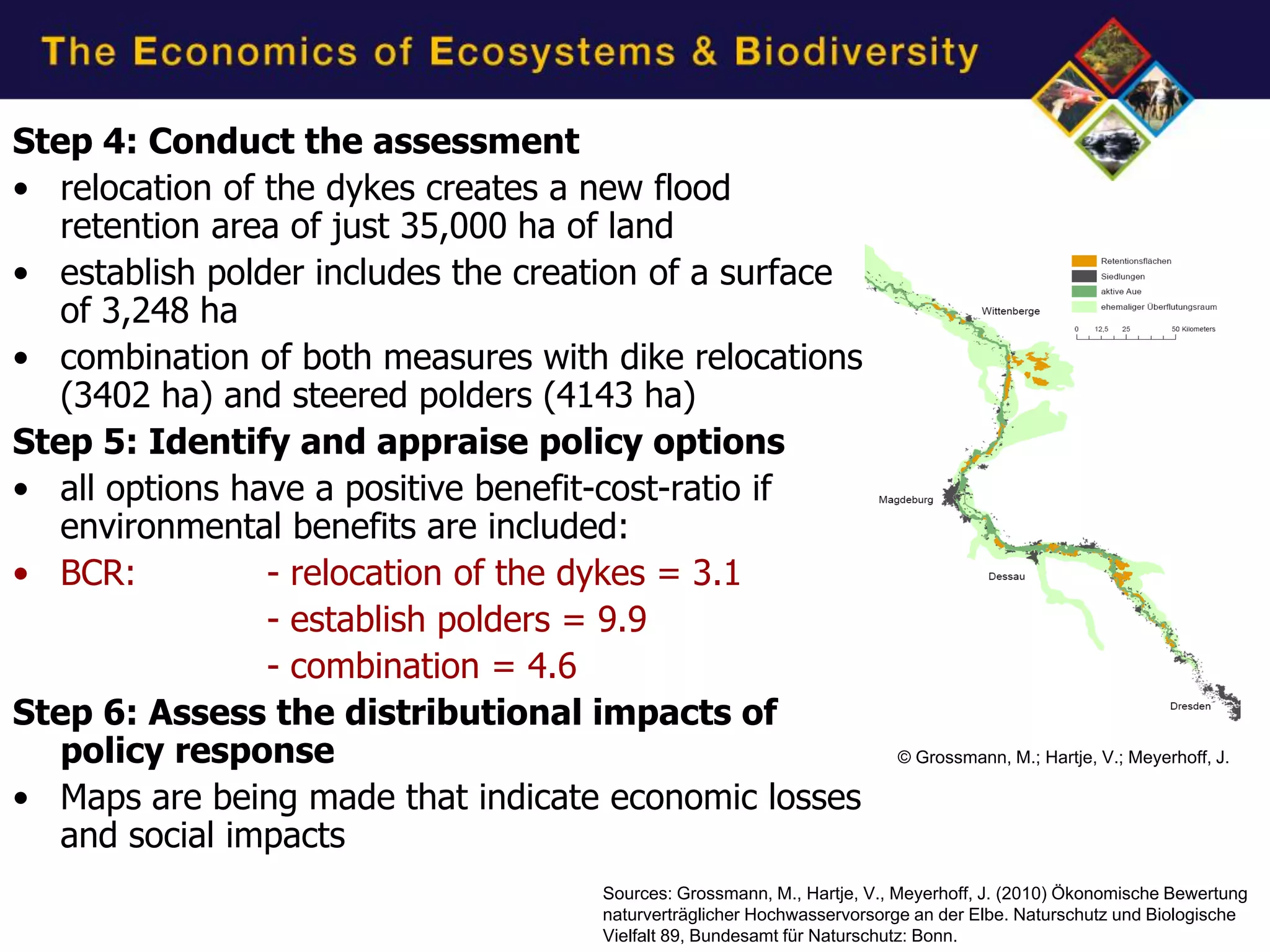
• relocation of the dykes creates a new flood
   retention area of just 35,000 ha of land
• establish polder includes the creation of a surface
   of 3,248 ha
• combination of both measures with dike relocations
   (3402 ha) and steered polders (4143 ha)
Step 5: Identify and appraise policy options
• all options have a positive benefit-cost-ratio if
   environmental benefits are included:
• BCR:          - relocation of the dykes = 3.1
                - establish polders = 9.9
                - combination = 4.6
Step 6: Assess the distributional impacts of
   policy response                                                     © Grossmann, M.; Hartje, V.; Meyerhoff, J.

• Maps are being made that indicate economic losses
   and social impacts
                                    Sources: Grossmann, M., Hartje, V., Meyerhoff, J. (2010) Ökonomische Bewertung
                                    naturverträglicher Hochwasservorsorge an der Elbe. Naturschutz und Biologische
                                    Vielfalt 89, Bundesamt für Naturschutz: Bonn.
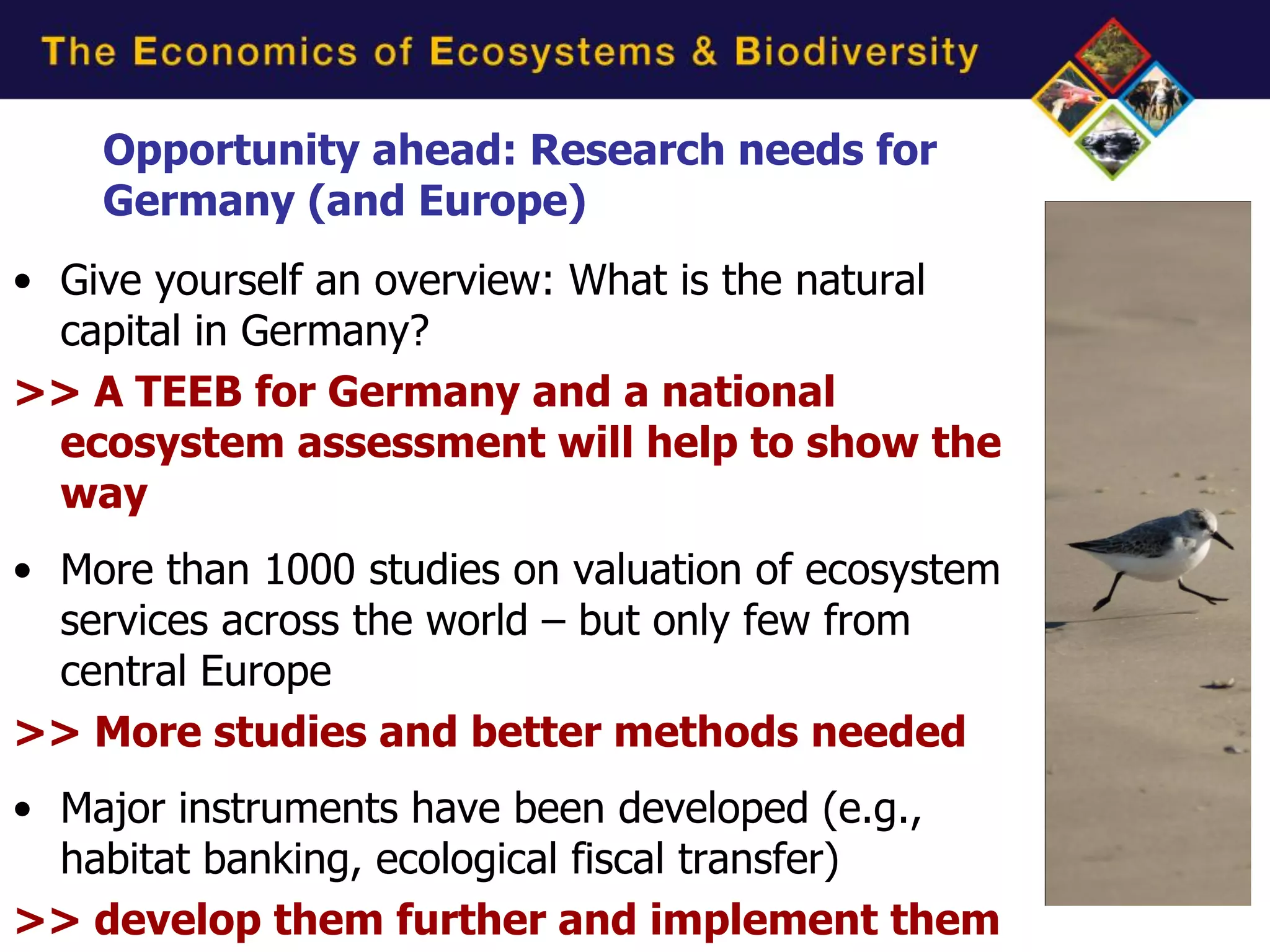
Opportunity ahead: Research needs for
    Germany (and Europe)
• Give yourself an overview: What is the natural
  capital in Germany?
>> A TEEB for Germany and a national
  ecosystem assessment will help to show the
  way
• More than 1000 studies on valuation of ecosystem
  services across the world – but only few from
  central Europe
>> More studies and better methods needed
• Major instruments have been developed (e.g.,
  habitat banking, ecological fiscal transfer)
>> develop them further and implement them
TEEB and economic development

• From Interim Report (2008), & Report for local and regional
  policy makers (2010) : biodiversity is acutely important for
  the worst off in society

   – Ecosystems contribution to the “GDP” of the poor -
     subsistence farmers, pastoralists, forest-dwellers…

   – Links to the MDGs : 1, 3, 4, 5 and 7.
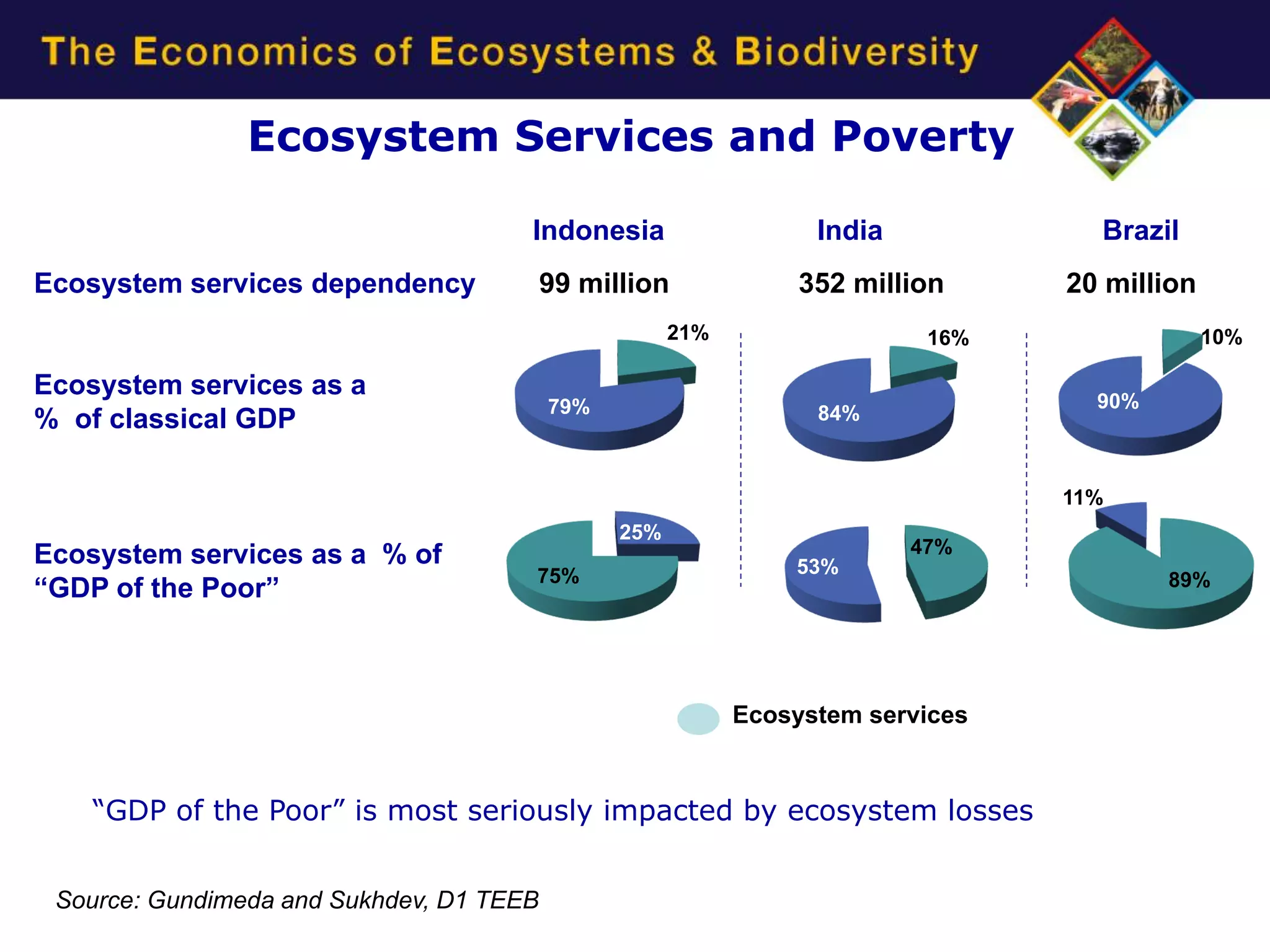
Ecosystem Services and Poverty

                                      Indonesia                   India            Brazil
Ecosystem services dependency             99 million             352 million     20 million
                                                      21%                  16%                10%

Ecosystem services as a                                                            90%
                                          79%                     84%
% of classical GDP

                                                                                 11%
                                                25%
Ecosystem services as a % of                                              47%
                                      75%                       53%
“GDP of the Poor”                                                                        89%


                                                            Ecosystem services


    “GDP of the Poor” is most seriously impacted by ecosystem losses


 Source: Gundimeda and Sukhdev, D1 TEEB
 06.10.2010                                     19
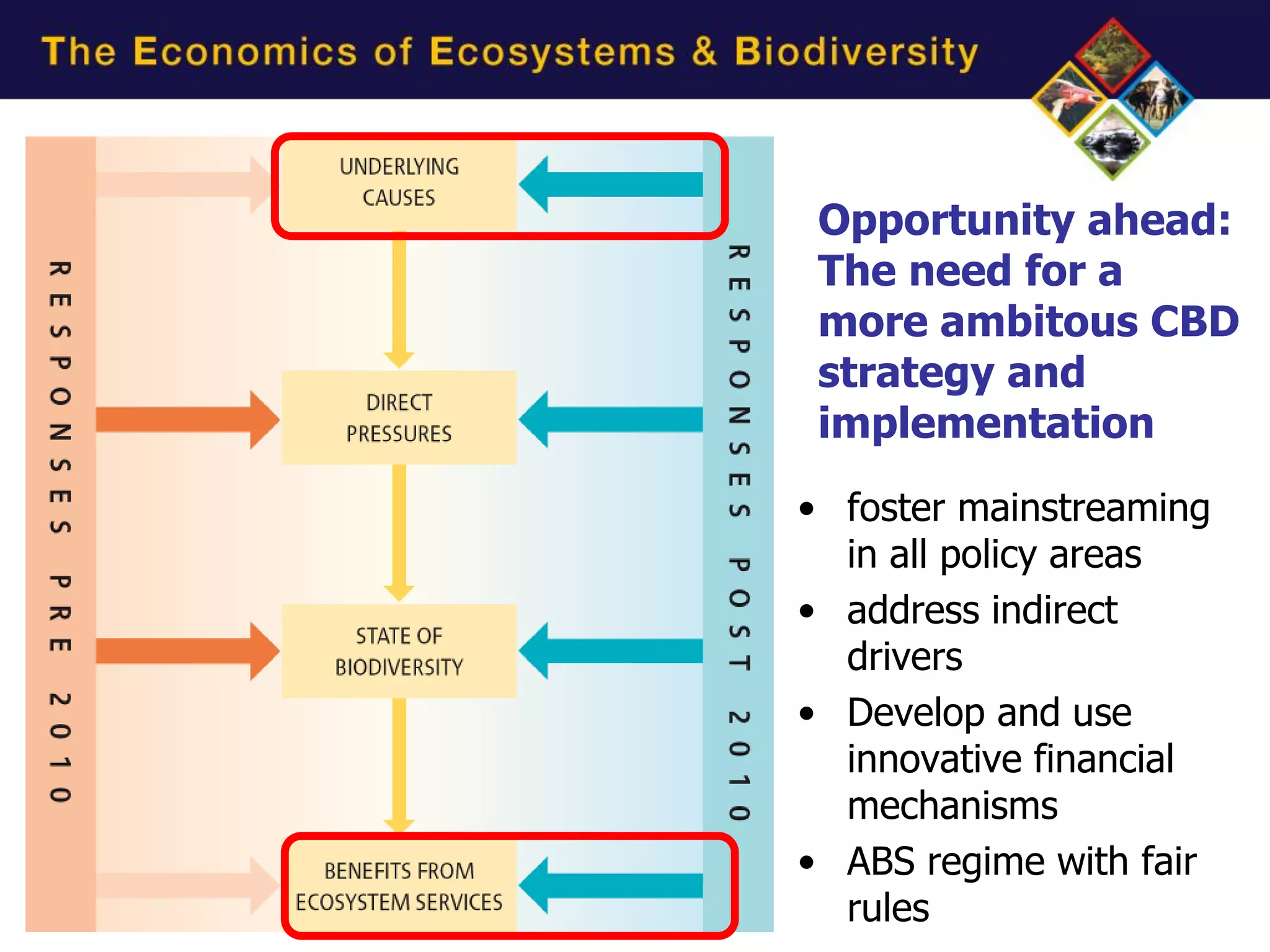
Opportunity ahead:
 The need for a
 more ambitous CBD
 strategy and
 implementation
• foster mainstreaming
  in all policy areas
• address indirect
  drivers
• Develop and use
  innovative financial
  mechanisms
• ABS regime with fair
  rules
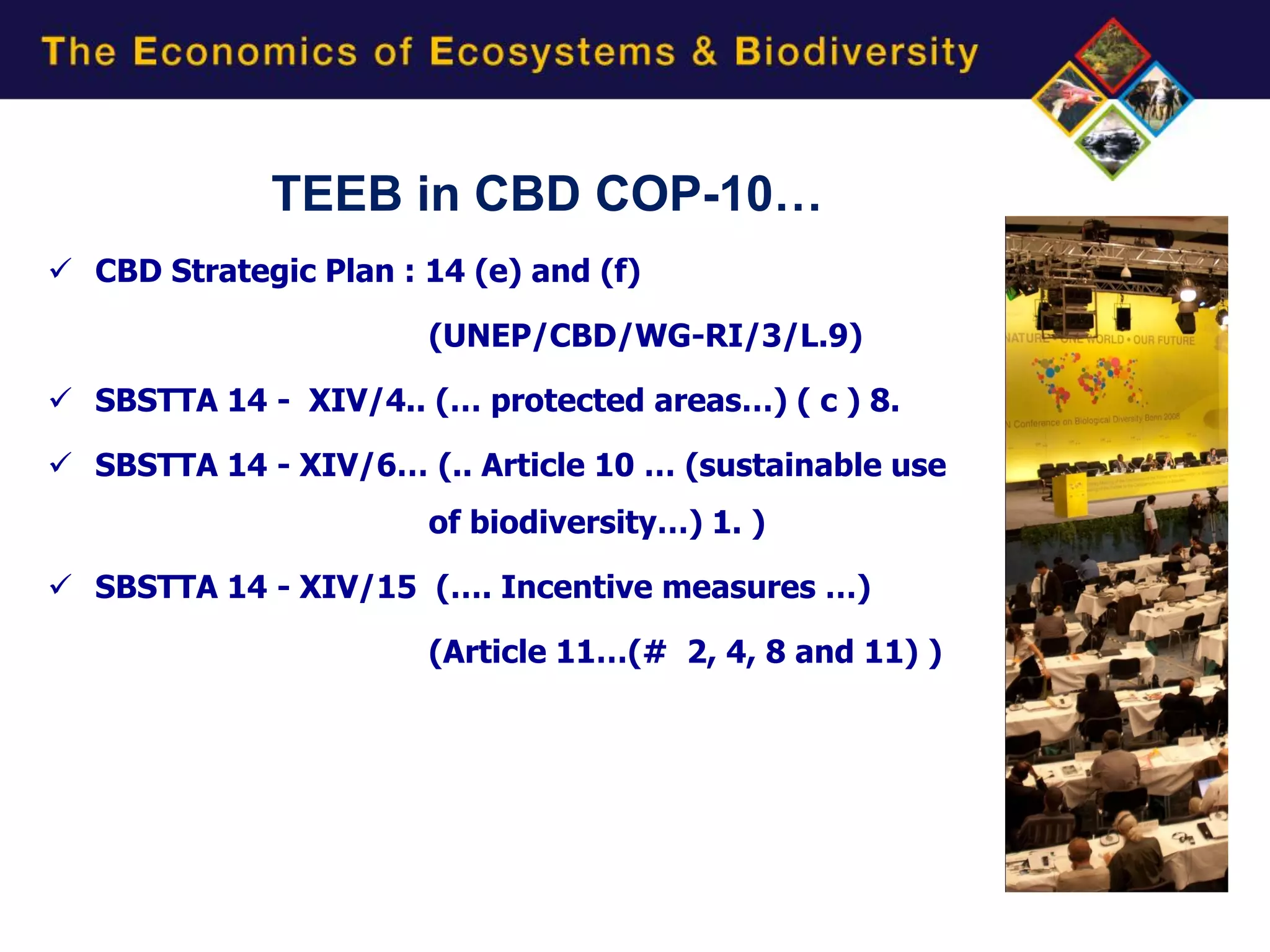
TEEB in CBD COP-10…
 CBD Strategic Plan : 14 (e) and (f)

                       (UNEP/CBD/WG-RI/3/L.9)

 SBSTTA 14 - XIV/4.. (… protected areas…) ( c ) 8.

 SBSTTA 14 - XIV/6… (.. Article 10 … (sustainable use
                       of biodiversity…) 1. )

 SBSTTA 14 - XIV/15 (…. Incentive measures …)

                       (Article 11…(# 2, 4, 8 and 11) )
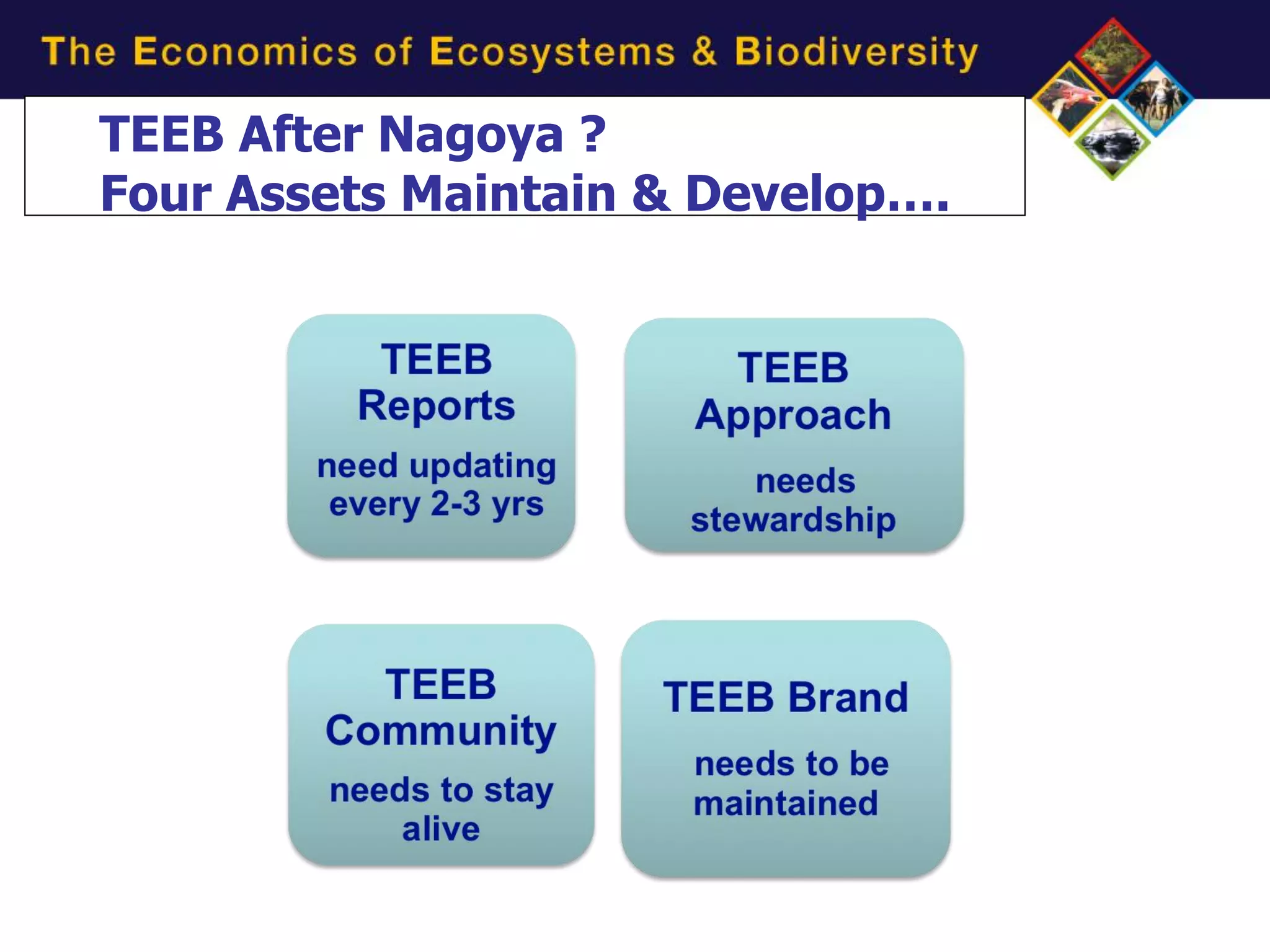
TEEB After Nagoya ?
Four Assets Maintain & Develop….
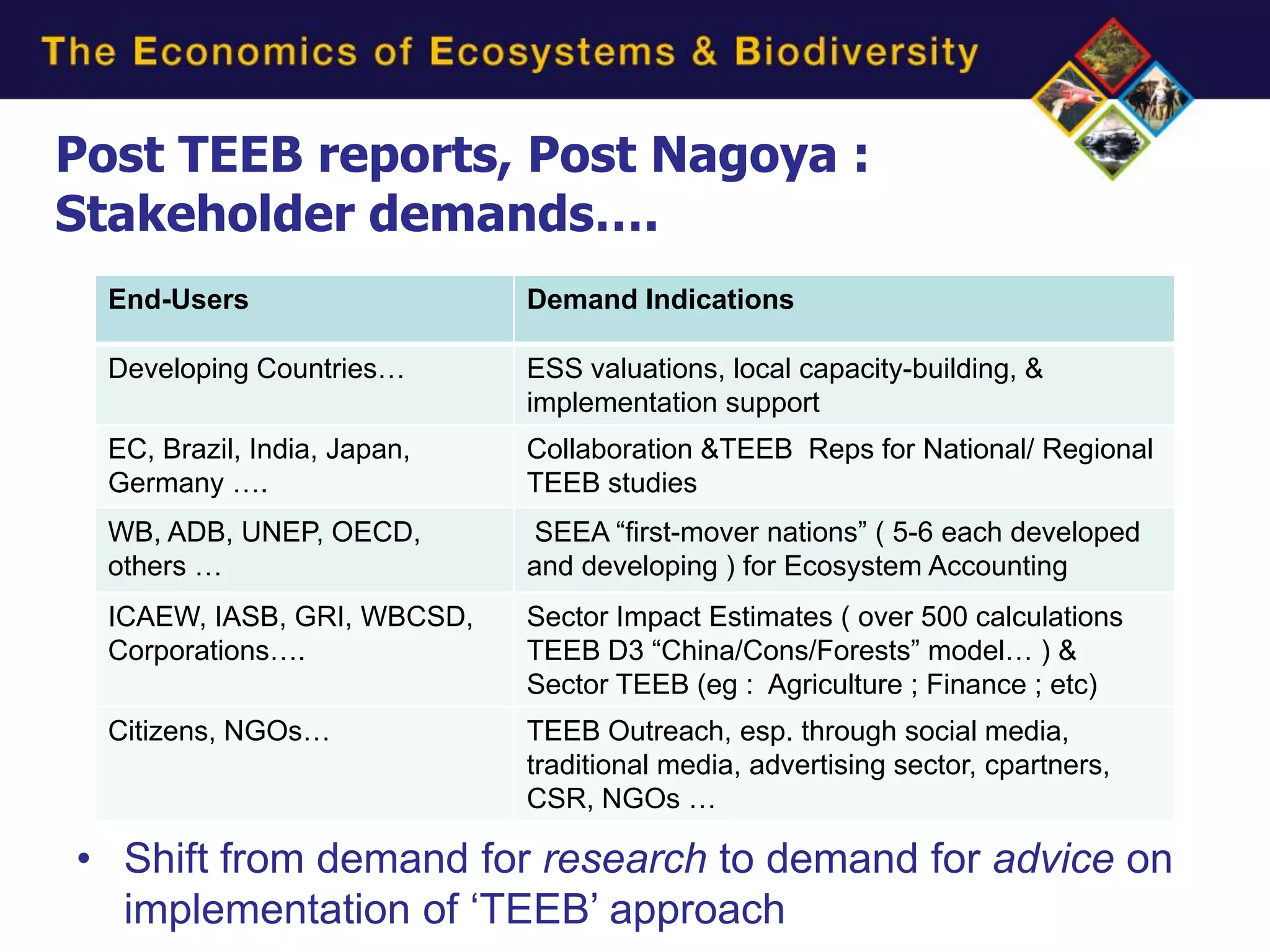
Post TEEB reports, Post Nagoya :
Stakeholder demands….
  End-Users                   Demand Indications

  Developing Countries…       ESS valuations, local capacity-building, &
                              implementation support
  EC, Brazil, India, Japan,   Collaboration &TEEB Reps for National/ Regional
  Germany ….                  TEEB studies
  WB, ADB, UNEP, OECD,        SEEA “first-mover nations” ( 5-6 each developed
  others …                    and developing ) for Ecosystem Accounting
  ICAEW, IASB, GRI, WBCSD,    Sector Impact Estimates ( over 500 calculations
  Corporations….              TEEB D3 “China/Cons/Forests” model… ) &
                              Sector TEEB (eg : Agriculture ; Finance ; etc)
  Citizens, NGOs…             TEEB Outreach, esp. through social media,
                              traditional media, advertising sector, cpartners,
                              CSR, NGOs …

• Shift from demand for research to demand for advice on
  implementation of „TEEB‟ approach
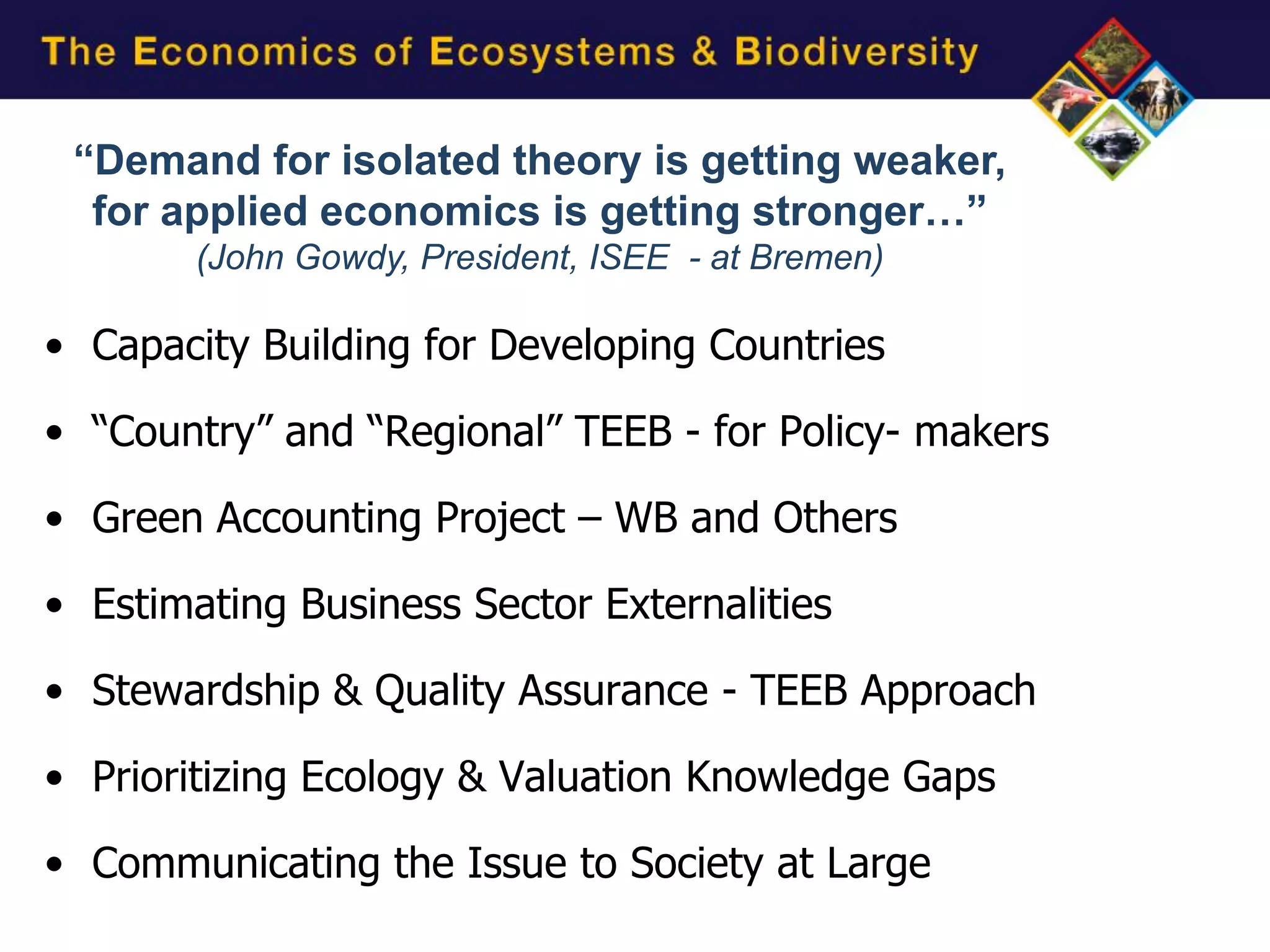
“Demand for isolated theory is getting weaker,
  for applied economics is getting stronger…”
        (John Gowdy, President, ISEE - at Bremen)

• Capacity Building for Developing Countries

• “Country” and “Regional” TEEB - for Policy- makers

• Green Accounting Project – WB and Others

• Estimating Business Sector Externalities

• Stewardship & Quality Assurance - TEEB Approach

• Prioritizing Ecology & Valuation Knowledge Gaps

• Communicating the Issue to Society at Large
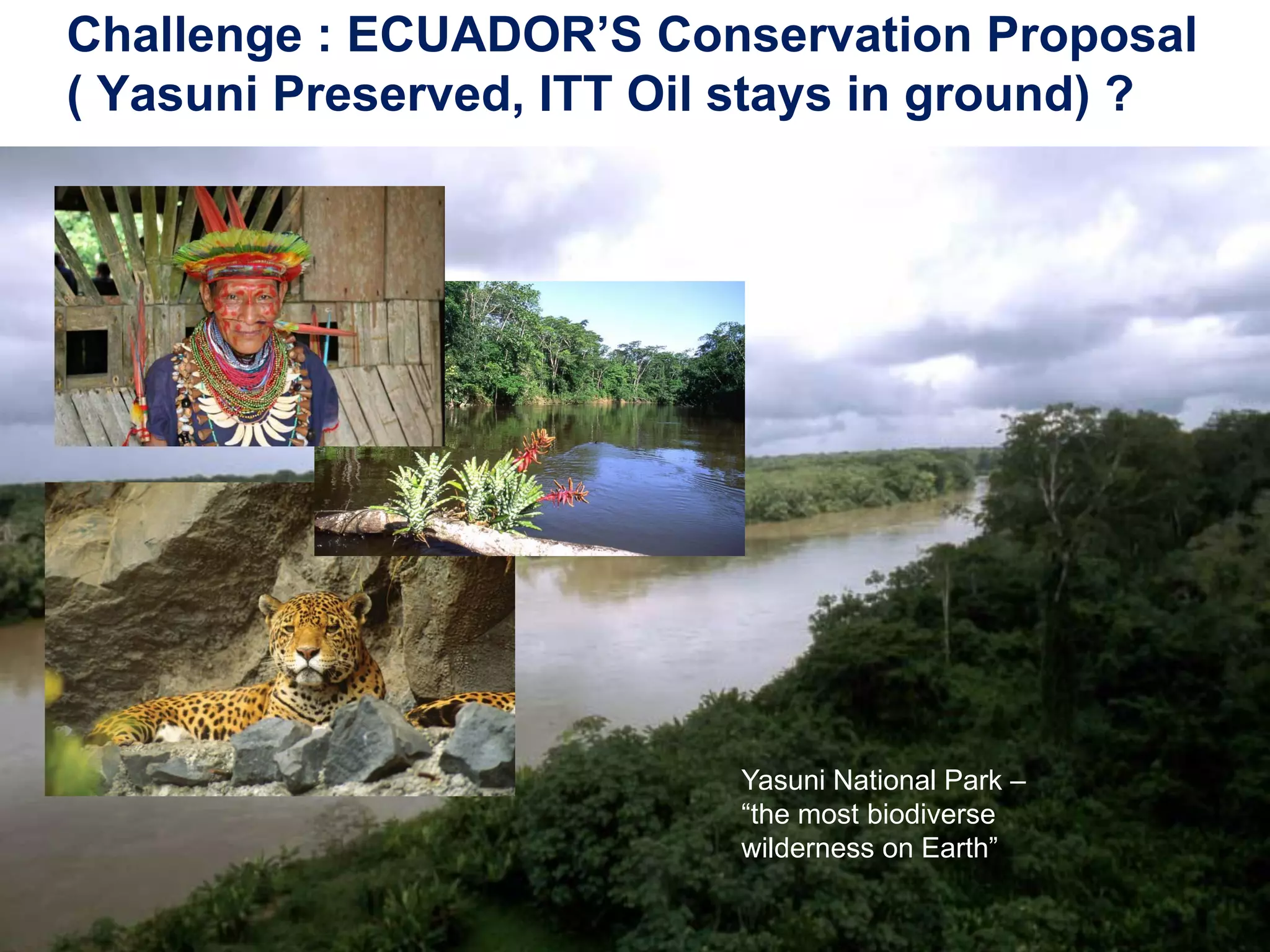
Challenge : ECUADOR’S Conservation Proposal
( Yasuni Preserved, ITT Oil stays in ground) ?


                           Yasuni National Park –
                           “the most biodiverse
                           wilderness on Earth”

25
Thank You !

www.teebweb.org

www.teeb4me.com

The Economics of Ecosystems & Biodiversity

  • 1.
    6th October 2010 Bundestag, Berlin The Economics of Ecosystems & Biodiversity Pavan Sukhdev Study Leader – TEEB, & Special Adviser & Head - Green Economy Initiative UNEP
  • 2.
    TEEB’s genesis … “Potsdam Initiative – Biological Diversity 2010” ……the economic significance of the global loss of biological diversity…. TEEB Interim Report CBD COP-9, Bonn, May 2008 TEEB Climate Issues Update Strömstad September 2009. TEEB for Policy Makers Brussels 13 Nov. 2009
  • 3.
    What is TEEB? Science & Economics D0 Foundations, Policy Costs, & Costs of Inaction Policy Evaluation D1 for National Policy-Makers Evaluation & Decision D2 Support for Administrators D3 Business Risks & Opportunities D4 Citizen & Consumer Ownership (“teeb4me”) TEEB's mission is to make Nature economically visible
  • 4.
    TEEB Advisory Board Joan-Martinez Alier Edward Barbier Achim Steiner Jacqueline McGlade Giles Atkinson Lord Stern Jochen Flasbarth Julia Marton-Lefevre Peter H. May Karl-Goran Maler Herman Mulder Walter Reid Ahmed Djoghlaf Yolanda Kakabadse Ladislav Miko
  • 5.
    “Private Profits, PublicLosses” US$/ha Shrimp Farm Mangroves $12,392ha 10,000 $9632ha After adding 5,000 public benefits $1220ha from $584ha $584ha mangroves private profits private private Net of 0 profits profits public costs less of Source: Barbier 2007 subsidies restoration after 5 years If public wealth is included, the “trade-off” choice changes completely….. -ve $11,172ha
  • 6.
    Why is itTEEB important? • Ecosystem Services form 45%-90% of the “GDP of the Poor” in rural and forested lands, • But we are losing land ecosystem services valued at $2tr-$4.5tr in terms of human welfare benefits • Phase 1 sized the Problem, Phase 2 describes Solutions • Effective, Equitable and Economically justifiable solutions EXIST - we describe 120 examples !
  • 7.
    Valuations, Operating Spaces,Responses…. Norms, Regulations & Policies Regional Plans (24) Legislations (3) Economic Value Certification (6) Mechanisms Recognition PA Evaluation (29) PES (55) Econ Value Markets Demonstration Econ Value Capture
  • 8.
    Opportunities for mainstreaming •Cancun UNFCCC COP – Climate change mitigation policy needs to reflect wider costs and benefits for biodiversity (Coral reef emergency / REDD). – Climate change adaptation finance needs to consider the compelling economics of using ecosystem restoration. • Rio+20 – Formally recognise the links between biodiversity, climate change, development, water and food security
  • 9.
    Recommendation : Investin ecological infrastructure • Tropical forests store a fourth of all terrestrial carbon – 547 gigatonnes (Gt) out 2,052 Gt (Trumper et al. 2009) • Tropical forest capture – up to 4.8 Gt CO2 annually (Lewis & White 2009) (total emissions p.a. ~32Gt) • Stopping deforestation holds an excellent cost-benefit ratio – Halving deforestation generates net benefits of about $ 3.7 trillion (NPV) including only the avoided damage costs of climate change (Eliasch Review 2008) 9
  • 10.
    Recomm : Recognisethe value of protected areas • Global spending on PAs p.a.: ~ $6.5-10 billion • Need for PAs (15% land, 30% sea) p.a.: ~ $45 billion • Need for Natura2000 p.a.: ~ $6.5 billion • Benefits from effective PAs p.a.: ~$4-5 trillion • International NGO funding: ~ >$1 billion p.a. • International gov funding (30-50% to PAs): ~$4-5 billion p.a. • Market-based income to PAs ~ $1-2 billion p.a • Percentage of total ODA: ~ 2.8% (TEEB D1 ch8)
  • 11.
    Investment in ecologicalinfrastructure Ecological infrastructure key for adaptation to climate change • Afforestation: carbon store+ reduced risk of soil erosion & landslides • Wetlands and forests and reduced risk of flooding impacts • Mangroves and coastal erosion and natural hazards • Restore Forests, lakes and wetlands to address water scarcity • Coral reefs as fish nurseries for fisheries productivity / food security • PAs & connectivity to facilitate resilience of ecosystems and species From local to national to EU efforts Global responsibility / contribution
  • 12.
    Investments in EcologicalInfrastructure for Climate adaptation • restoration can be cost effective way of providing a service : planting mangroves along coastline in Vietnam cost $1.1 million but saved $ 7.3 million annually in dyke maintenance (GRID-Arendal 2002; Reid and Huq 2005)
  • 13.
    Example : Nature-basedclimate change mitigation, Germany • drainage of 930,000 ha peatlands in Germany for agriculture cause emissions of 20 Mio. t of CO2-eq. per year • total damage of these emissions amounts to 1.4 billion € • peatland restoration: low cost and biodiversity friendly mitigation option Mecklenburg-Vorpommern: • pilot project between 2000-2008 • restoration of 30,000 ha (10%) • emission savings of up to 300,000 t CO2-eq. • avoidance cost of 8 to 12 € / t CO2 • if alternative land use options are realized (extensive grazing, reed production or alder forest) costs decrease to 0 to 4 € / t CO2 • where Maize can be grown restoration can not compete Restored peatland in Trebeltal 2007 Source: Federal Environmental Agency 2007; MLUV MV 2009; Schäfer 2009 Foto: D. Zak, http://www.fv-berlin.de
  • 14.
    Natural resource management& spatial planning • Flooding of River Elbe, Germany (2002), Damage over EUR 2 billion • Assessment that flood damage (+ cost of dams) by far exceed costs of upstream flooding arrangements with land holders → The value of upstream ecosystems in regulating floods was re- discovered → Local authorities start changing spatial planning & seeking arrangements upstream (but still have a lot to do)
  • 15.
    River Elbe flooding,Germany Step 1: Specify and agree on the problem • August 2002 heavy floods of the river Elbe, direct economic damage of over 9 billion € • occasion to revise system of flood protection towards integrated flood risk management Step 2: Which ecosystem service are relevant • flood protection • habitat for a multitude of species • nutrient retention © DPA Step 3: Define information needs and select methods • CBA of different alternatives (relocate dykes, establish polder) • replacement costs for assessment of the nutrient and pollutant filters • contingent valuation for the willingness to pay for flood control
  • 16.
    Step 4: Conductthe assessment • relocation of the dykes creates a new flood retention area of just 35,000 ha of land • establish polder includes the creation of a surface of 3,248 ha • combination of both measures with dike relocations (3402 ha) and steered polders (4143 ha) Step 5: Identify and appraise policy options • all options have a positive benefit-cost-ratio if environmental benefits are included: • BCR: - relocation of the dykes = 3.1 - establish polders = 9.9 - combination = 4.6 Step 6: Assess the distributional impacts of policy response © Grossmann, M.; Hartje, V.; Meyerhoff, J. • Maps are being made that indicate economic losses and social impacts Sources: Grossmann, M., Hartje, V., Meyerhoff, J. (2010) Ökonomische Bewertung naturverträglicher Hochwasservorsorge an der Elbe. Naturschutz und Biologische Vielfalt 89, Bundesamt für Naturschutz: Bonn.
  • 17.
    Opportunity ahead: Researchneeds for Germany (and Europe) • Give yourself an overview: What is the natural capital in Germany? >> A TEEB for Germany and a national ecosystem assessment will help to show the way • More than 1000 studies on valuation of ecosystem services across the world – but only few from central Europe >> More studies and better methods needed • Major instruments have been developed (e.g., habitat banking, ecological fiscal transfer) >> develop them further and implement them
  • 18.
    TEEB and economicdevelopment • From Interim Report (2008), & Report for local and regional policy makers (2010) : biodiversity is acutely important for the worst off in society – Ecosystems contribution to the “GDP” of the poor - subsistence farmers, pastoralists, forest-dwellers… – Links to the MDGs : 1, 3, 4, 5 and 7.
  • 19.
    Ecosystem Services andPoverty Indonesia India Brazil Ecosystem services dependency 99 million 352 million 20 million 21% 16% 10% Ecosystem services as a 90% 79% 84% % of classical GDP 11% 25% Ecosystem services as a % of 47% 75% 53% “GDP of the Poor” 89% Ecosystem services “GDP of the Poor” is most seriously impacted by ecosystem losses Source: Gundimeda and Sukhdev, D1 TEEB 06.10.2010 19
  • 20.
    Opportunity ahead: Theneed for a more ambitous CBD strategy and implementation • foster mainstreaming in all policy areas • address indirect drivers • Develop and use innovative financial mechanisms • ABS regime with fair rules
  • 21.
    TEEB in CBDCOP-10…  CBD Strategic Plan : 14 (e) and (f) (UNEP/CBD/WG-RI/3/L.9)  SBSTTA 14 - XIV/4.. (… protected areas…) ( c ) 8.  SBSTTA 14 - XIV/6… (.. Article 10 … (sustainable use of biodiversity…) 1. )  SBSTTA 14 - XIV/15 (…. Incentive measures …) (Article 11…(# 2, 4, 8 and 11) )
  • 22.
    TEEB After Nagoya? Four Assets Maintain & Develop….
  • 23.
    Post TEEB reports,Post Nagoya : Stakeholder demands…. End-Users Demand Indications Developing Countries… ESS valuations, local capacity-building, & implementation support EC, Brazil, India, Japan, Collaboration &TEEB Reps for National/ Regional Germany …. TEEB studies WB, ADB, UNEP, OECD, SEEA “first-mover nations” ( 5-6 each developed others … and developing ) for Ecosystem Accounting ICAEW, IASB, GRI, WBCSD, Sector Impact Estimates ( over 500 calculations Corporations…. TEEB D3 “China/Cons/Forests” model… ) & Sector TEEB (eg : Agriculture ; Finance ; etc) Citizens, NGOs… TEEB Outreach, esp. through social media, traditional media, advertising sector, cpartners, CSR, NGOs … • Shift from demand for research to demand for advice on implementation of „TEEB‟ approach
  • 24.
    “Demand for isolatedtheory is getting weaker, for applied economics is getting stronger…” (John Gowdy, President, ISEE - at Bremen) • Capacity Building for Developing Countries • “Country” and “Regional” TEEB - for Policy- makers • Green Accounting Project – WB and Others • Estimating Business Sector Externalities • Stewardship & Quality Assurance - TEEB Approach • Prioritizing Ecology & Valuation Knowledge Gaps • Communicating the Issue to Society at Large
  • 25.
    Challenge : ECUADOR’SConservation Proposal ( Yasuni Preserved, ITT Oil stays in ground) ? Yasuni National Park – “the most biodiverse wilderness on Earth” 25
  • 26.