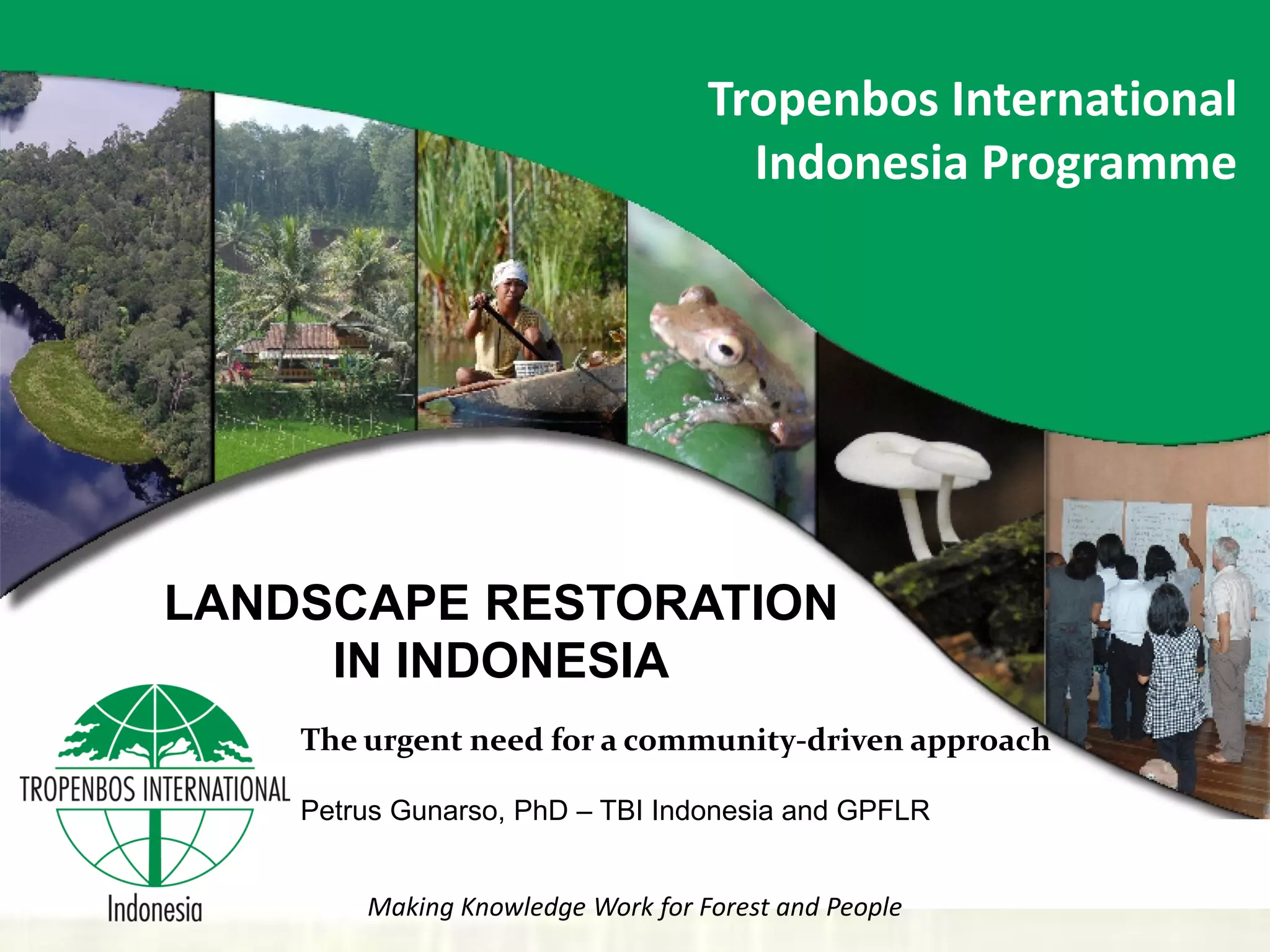

Tropenbos International
                                     Indonesia Programme


LANDSCAPE RESTORATION
     IN INDONESIA
    The urgent need for a community-driven approach

    Petrus Gunarso, PhD – TBI Indonesia and GPFLR


        Making Knowledge Work for Forest and People
Outline

• Introduction
• Failure to perform SFM and Conservation
• Government and market driven restoration
• Global incentives for Forests Restoration
• Community initiative and community driven
  restoration of forests
• Expanding Community – driven Approach
• Conclusion
Introduction - 1

• We have large areas of degraded forest and
  land due to unsustainable management by
  large companies and small holders.
• The productivity of these forests and lands
  need to be restored.
• Restoring forests or rehabilitation is an
  important goal of the Ministry of Forestry in
  Indonesia.
Introduction 2

• Restoration of forests and lands is cross ministerial/
  sectoral responsibility - not the sole responsibility of
  Ministry of Forestry
• Ministry of Forestry, Ministry of Mining and Energy,
  Ministry of Environment, Ministry of Agriculture.
• GOAL of MOF – Rehabilitation of 11.5 Million ha of forest
  up to 2030. This rehabilitation is expected to absorb CO2
  from the atmosphere as part of climate change mitigation
• At a landscape level – coordination among the ministries is
  clearly required. With the absence of on the ground or
  landscape level restoration, the role of community driven
  restoration becomes essential.
Failure to implement SFM and
                 Conservation
• SFM has been introduced since the initial stage of
  forest management in Indonesia in the seventies
• SFM has become a target for ITTO, wherein, all forest
  management, including in Indonesia, will be
  sustainably managed by 2000
• Conservation target of 10% of all terrestrial and
  marine areas by 2020. Degradation and deforestation
  in the targeted areas continues to exist and in some
  places has intensified.
Government and Market Driven
              Restoration
• Forest rehabilitation has been implemented through government
  projects since the seventies with little success. In reality, the rate of
  deforestation and forest degradation exceeds the rate of
  rehabilitation.
• Government has started to invite community participation through
  KBR – Kebun Bibit Rakyat - Community Nursery, but this might be
  too little and too late.
• Companies have started with ‘intensive silviculture - SILIN’ – to
  overcome the failure of natural regeneration with local fast growing
  species. This is mainly at a research driven level of rehabilitation
  and regeneration.
• Market driven reforestation/rehabilitation due to a shortage of
  timber does not exist – but unsurprisingly, importation of steel and
  aluminum frames and cheap plywood from China has increased
  sharply.
Global incentives for Forest Restoration
• Climate change mitigation and adaptation –
  global discourse and intense negotiation
• REDD+ promises ‘compensation’ from Annex 1
  countries for reducing emission from
  deforestation and forest degradation – ‘a low
  hanging fruit’
• Green economy, green development, and green
  energy
• Global efforts for forest restoration – ecosystem
  restoration
Community initiative and community
     driven forest restoration
• MASBENI – principles and guidelines has been
  developed and a toolkits is being prepared
• Forum RE – facing challenging issues related to
  incentives and recognition as an important investment
  for the future of forestry in Indonesia
• This Conference – has attracted a large amount of
  interest from people who want to be involved and
  promoted the importance of restoration in Indonesia
• GPFLR – global movement to share learning on
  landscape restoration; promoting a multidisciplinary
  approach.
Expanding a Community-driven
                approach
• Partnership
   – Government – Community
   – Company – Community
   – Community - Community
• Collaboration
   – Need champions, transparency, ‘inclusive -keberpihakan’,
     togetherness, and innovation,
• “Gotong Royong”
   – Togetherness in addressing the community’s burden
Why community-driven restoration is
            urgent?
• The problem is so enormous that government alone, without
  support from communities, will not be able to address it.
• Budget and field staff of the government working at the
  landscape level are limited
• If there is a budget – often implemented with a short term
  vision or short term project approach
• Focus of the government on rehabilitation/restoration is
  lacking – considered as a cost center
• Companies are under no pressure to do it – they set aside the
  budget but have no pressure to spent the money
Thank You

Landscape restoration indonesia

  • 1.
    Tropenbos International Indonesia Programme LANDSCAPE RESTORATION IN INDONESIA The urgent need for a community-driven approach Petrus Gunarso, PhD – TBI Indonesia and GPFLR Making Knowledge Work for Forest and People
  • 2.
    Outline • Introduction • Failureto perform SFM and Conservation • Government and market driven restoration • Global incentives for Forests Restoration • Community initiative and community driven restoration of forests • Expanding Community – driven Approach • Conclusion
  • 3.
    Introduction - 1 •We have large areas of degraded forest and land due to unsustainable management by large companies and small holders. • The productivity of these forests and lands need to be restored. • Restoring forests or rehabilitation is an important goal of the Ministry of Forestry in Indonesia.
  • 4.
    Introduction 2 • Restorationof forests and lands is cross ministerial/ sectoral responsibility - not the sole responsibility of Ministry of Forestry • Ministry of Forestry, Ministry of Mining and Energy, Ministry of Environment, Ministry of Agriculture. • GOAL of MOF – Rehabilitation of 11.5 Million ha of forest up to 2030. This rehabilitation is expected to absorb CO2 from the atmosphere as part of climate change mitigation • At a landscape level – coordination among the ministries is clearly required. With the absence of on the ground or landscape level restoration, the role of community driven restoration becomes essential.
  • 5.
    Failure to implementSFM and Conservation • SFM has been introduced since the initial stage of forest management in Indonesia in the seventies • SFM has become a target for ITTO, wherein, all forest management, including in Indonesia, will be sustainably managed by 2000 • Conservation target of 10% of all terrestrial and marine areas by 2020. Degradation and deforestation in the targeted areas continues to exist and in some places has intensified.
  • 6.
    Government and MarketDriven Restoration • Forest rehabilitation has been implemented through government projects since the seventies with little success. In reality, the rate of deforestation and forest degradation exceeds the rate of rehabilitation. • Government has started to invite community participation through KBR – Kebun Bibit Rakyat - Community Nursery, but this might be too little and too late. • Companies have started with ‘intensive silviculture - SILIN’ – to overcome the failure of natural regeneration with local fast growing species. This is mainly at a research driven level of rehabilitation and regeneration. • Market driven reforestation/rehabilitation due to a shortage of timber does not exist – but unsurprisingly, importation of steel and aluminum frames and cheap plywood from China has increased sharply.
  • 7.
    Global incentives forForest Restoration • Climate change mitigation and adaptation – global discourse and intense negotiation • REDD+ promises ‘compensation’ from Annex 1 countries for reducing emission from deforestation and forest degradation – ‘a low hanging fruit’ • Green economy, green development, and green energy • Global efforts for forest restoration – ecosystem restoration
  • 8.
    Community initiative andcommunity driven forest restoration • MASBENI – principles and guidelines has been developed and a toolkits is being prepared • Forum RE – facing challenging issues related to incentives and recognition as an important investment for the future of forestry in Indonesia • This Conference – has attracted a large amount of interest from people who want to be involved and promoted the importance of restoration in Indonesia • GPFLR – global movement to share learning on landscape restoration; promoting a multidisciplinary approach.
  • 9.
    Expanding a Community-driven approach • Partnership – Government – Community – Company – Community – Community - Community • Collaboration – Need champions, transparency, ‘inclusive -keberpihakan’, togetherness, and innovation, • “Gotong Royong” – Togetherness in addressing the community’s burden
  • 10.
    Why community-driven restorationis urgent? • The problem is so enormous that government alone, without support from communities, will not be able to address it. • Budget and field staff of the government working at the landscape level are limited • If there is a budget – often implemented with a short term vision or short term project approach • Focus of the government on rehabilitation/restoration is lacking – considered as a cost center • Companies are under no pressure to do it – they set aside the budget but have no pressure to spent the money
  • 11.