Process

   Organized By: Vinay Arora
                 Assistant Professor
                 CSED, TU


                                   Vinay Arora
                                    CSED,TU
Disclaimer

           This is NOT A COPYRIGHT          MATERIAL


   Content has been taken mainly from the following books:

        Operating Systems Concepts By Silberschatz & Galvin,
Operating Systems: Internals and Design Principles By William Stallings
                        www.os-book.com
         www.cs.jhu.edu/~yairamir/cs418/os2/sld001.htm
     www.personal.kent.edu/~rmuhamma/OpSystems/os.html
 http://msdn.microsoft.com/en-us/library/ms685096(VS.85).aspx
http://www.computer.howsttuffworks.com/operating-system6.htm
         http://williamstallings.com/OS/Animations.html
                               Etc…

                              Vinay Arora
                               CSED,TU
Process
   A Program in Execution is called as a PROCESS.

   An operating system executes a variety of programs:

      Batch System – Jobs
      Time-Shared Systems – User Programs or Tasks

   A Process Includes:

      Program Counter
      Stack
      Data Section

                                Vinay Arora
                                 CSED,TU
Process in Memory


               Vinay Arora
                CSED,TU
Process
   A Program is a Passive Entity and a Process is an Active Entity.


   Process associates PC and a set of other resources with it.


   A Program becomes a Process when an executable file is loaded into
   memory.


   Two Techniques are present for loading Executable Files.
   (Double Clicking EXE, Running EXE through Command Prompt)

                                  Vinay Arora
                                   CSED,TU
Set of Values held by a PROCESS

   # Current value of Program Counter (PC)


   # Contents of the Processors Registers


   # Value of the Variables


   # The Process Stack (SP) which typically contains temporary data
   such as subroutine parameter, return address, and temporary
   variables.

   # A Data Section that contains Global Variables.

                                 Vinay Arora
                                  CSED,TU
Process States


                 Vinay Arora
                  CSED,TU
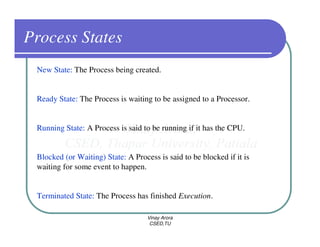
Process States
 New State: The Process being created.


 Ready State: The Process is waiting to be assigned to a Processor.


 Running State: A Process is said to be running if it has the CPU.


 Blocked (or Waiting) State: A Process is said to be blocked if it is
 waiting for some event to happen.


 Terminated State: The Process has finished Execution.

                                    Vinay Arora
                                     CSED,TU
State Diagram


                Vinay Arora
                 CSED,TU
State Diagram


                Vinay Arora
                 CSED,TU
Process Control Block


                Vinay Arora
                 CSED,TU
Process Control Block
 Information associated with each Process

    Process state

    Program counter

    CPU registers

    CPU scheduling information

    Memory-management information

    Accounting information

    I/O status information


                                 Vinay Arora
                                  CSED,TU
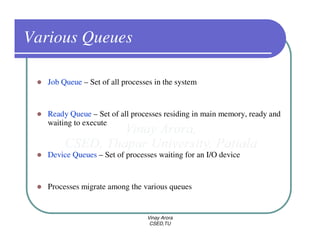
Various Queues

   Job Queue – Set of all processes in the system


   Ready Queue – Set of all processes residing in main memory, ready and
   waiting to execute


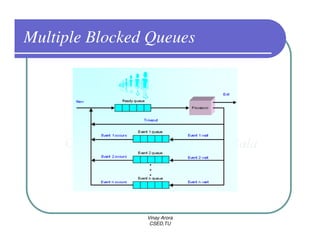
   Device Queues – Set of processes waiting for an I/O device


   Processes migrate among the various queues


                                 Vinay Arora
                                  CSED,TU
Multiple Blocked Queues


                Vinay Arora
                 CSED,TU
Ready Queue


              Vinay Arora
               CSED,TU
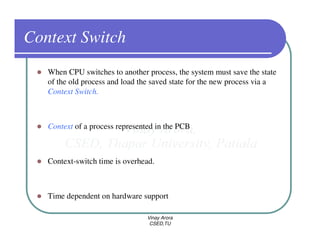
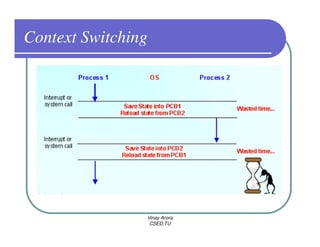
Context Switch
   When CPU switches to another process, the system must save the state
   of the old process and load the saved state for the new process via a
   Context Switch.


   Context of a process represented in the PCB


   Context-switch time is overhead.


   Time dependent on hardware support

                                 Vinay Arora
                                  CSED,TU
Context Switching


                Vinay Arora
                 CSED,TU
CPU Switching


                Vinay Arora
                 CSED,TU
Process Scheduling Diagram


                Vinay Arora
                 CSED,TU
LSM Term Scheduler
   Long-Term Scheduler (or Job scheduler) – Selects which Processes
   should be brought into the Ready queue


   Short-Term Scheduler (or CPU scheduler) – Selects which Process
   should be executed next and allocates CPU


   Medium-Term Scheduler – Intermediate Level of Scheduling. Limit the
   Multiprogramming and executes Swapping.


                               Vinay Arora
                                CSED,TU
Medium Term Scheduler


               Vinay Arora
                CSED,TU
Parent & Child Process
  Parent Process create Children Processes, which, in turn create other
  Processes, forming a tree of Processes

  Generally, Process identified and managed via a Process Identifier (PId)

  Resource Sharing

      Parent and Children share all Resources
      Children share subset of parent’s Resources
      Parent and child share no Resources

  Execution

      Parent and Children execute Concurrently
      Parent waits until children Terminate


                                   Vinay Arora
                                    CSED,TU
Process Creation (Unix)

   UNIX Examples


   Fork System Call creates new Process.


   Exec System Call used after a fork to replace the process’ memory
   space with a new Program.


                                Vinay Arora
                                 CSED,TU
Process Creation (Unix)


                 Vinay Arora
                  CSED,TU
Tree of Processes on Solaris


                 Vinay Arora
                  CSED,TU
Process Termination
   Process executes last statement and asks the operating system to delete it (exit)

            Output data from child to parent (via wait)
            Process' resources are deallocated by operating system

   Parent may terminate execution of children processes (abort)

     Child has exceeded allocated resources

     Task assigned to child is no longer required

     If parent is exiting

           Some operating system do not allow child to continue if its parent
         terminates

   All children terminated - Cascading Termination
                                      Vinay Arora
                                       CSED,TU
InterProcess Communication
   Processes within a system may be Independent or Cooperating

   Cooperating process can affect or be affected by other processes, including
   sharing data

   Reasons for cooperating processes:

    Information sharing
    Computation speedup
    Modularity
    Convenience

   Cooperating processes need Inter Process Communication (IPC)

   Two models of IPC - Shared memory & Message passing


                                     Vinay Arora
                                      CSED,TU
Direct Communication
   Processes must name each other explicitly:

     send (P, message) –send a message to process P

     receive (Q, message) –receive a message from process Q

   Properties of Communication link

     Links are established automatically
     A link is associated with exactly one pair of communicating processes
     Between each pair there exists exactly one link
     The link may be unidirectional, but is usually bi-directional

                                 Vinay Arora
                                  CSED,TU
Interaction b/w Processes
   Data Sharing – Common Variable/Data.

   Message Passing – Communication b/w 2 processes.

   Synchronization – Coordination in Activities.

   Signals – To Convey a situation to a Process so that it can perform some
   special actions to handle the situation.

   Concurrency & Parallelism.
   Computational Speed Up.
   Scheduling & Dispatching.

                                 Vinay Arora
                                  CSED,TU
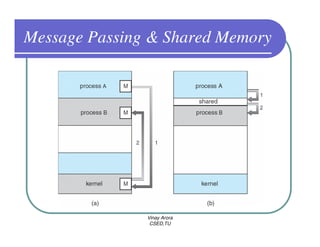
Message Passing & Shared Memory


               Vinay Arora
                CSED,TU
Thnx…


  Vinay Arora
   CSED,TU

OS - Process

  • 1.
    Process Organized By: Vinay Arora Assistant Professor CSED, TU Vinay Arora CSED,TU
  • 2.
    Disclaimer This is NOT A COPYRIGHT MATERIAL Content has been taken mainly from the following books: Operating Systems Concepts By Silberschatz & Galvin, Operating Systems: Internals and Design Principles By William Stallings www.os-book.com www.cs.jhu.edu/~yairamir/cs418/os2/sld001.htm www.personal.kent.edu/~rmuhamma/OpSystems/os.html http://msdn.microsoft.com/en-us/library/ms685096(VS.85).aspx http://www.computer.howsttuffworks.com/operating-system6.htm http://williamstallings.com/OS/Animations.html Etc… Vinay Arora CSED,TU
  • 3.
    Process A Program in Execution is called as a PROCESS. An operating system executes a variety of programs: Batch System – Jobs Time-Shared Systems – User Programs or Tasks A Process Includes: Program Counter Stack Data Section Vinay Arora CSED,TU
  • 4.
    Process in Memory Vinay Arora CSED,TU
  • 5.
    Process A Program is a Passive Entity and a Process is an Active Entity. Process associates PC and a set of other resources with it. A Program becomes a Process when an executable file is loaded into memory. Two Techniques are present for loading Executable Files. (Double Clicking EXE, Running EXE through Command Prompt) Vinay Arora CSED,TU
  • 6.
    Set of Valuesheld by a PROCESS # Current value of Program Counter (PC) # Contents of the Processors Registers # Value of the Variables # The Process Stack (SP) which typically contains temporary data such as subroutine parameter, return address, and temporary variables. # A Data Section that contains Global Variables. Vinay Arora CSED,TU
  • 7.
    Process States Vinay Arora CSED,TU
  • 8.
    Process States NewState: The Process being created. Ready State: The Process is waiting to be assigned to a Processor. Running State: A Process is said to be running if it has the CPU. Blocked (or Waiting) State: A Process is said to be blocked if it is waiting for some event to happen. Terminated State: The Process has finished Execution. Vinay Arora CSED,TU
  • 9.
    State Diagram Vinay Arora CSED,TU
  • 10.
    State Diagram Vinay Arora CSED,TU
  • 11.
    Process Control Block Vinay Arora CSED,TU
  • 12.
    Process Control Block Information associated with each Process Process state Program counter CPU registers CPU scheduling information Memory-management information Accounting information I/O status information Vinay Arora CSED,TU
  • 13.
    Various Queues Job Queue – Set of all processes in the system Ready Queue – Set of all processes residing in main memory, ready and waiting to execute Device Queues – Set of processes waiting for an I/O device Processes migrate among the various queues Vinay Arora CSED,TU
  • 14.
    Multiple Blocked Queues Vinay Arora CSED,TU
  • 15.
    Ready Queue Vinay Arora CSED,TU
  • 16.
    Context Switch When CPU switches to another process, the system must save the state of the old process and load the saved state for the new process via a Context Switch. Context of a process represented in the PCB Context-switch time is overhead. Time dependent on hardware support Vinay Arora CSED,TU
  • 17.
    Context Switching Vinay Arora CSED,TU
  • 18.
    CPU Switching Vinay Arora CSED,TU
  • 19.
    Process Scheduling Diagram Vinay Arora CSED,TU
  • 20.
    LSM Term Scheduler Long-Term Scheduler (or Job scheduler) – Selects which Processes should be brought into the Ready queue Short-Term Scheduler (or CPU scheduler) – Selects which Process should be executed next and allocates CPU Medium-Term Scheduler – Intermediate Level of Scheduling. Limit the Multiprogramming and executes Swapping. Vinay Arora CSED,TU
  • 21.
    Medium Term Scheduler Vinay Arora CSED,TU
  • 22.
    Parent & ChildProcess Parent Process create Children Processes, which, in turn create other Processes, forming a tree of Processes Generally, Process identified and managed via a Process Identifier (PId) Resource Sharing Parent and Children share all Resources Children share subset of parent’s Resources Parent and child share no Resources Execution Parent and Children execute Concurrently Parent waits until children Terminate Vinay Arora CSED,TU
  • 23.
    Process Creation (Unix) UNIX Examples Fork System Call creates new Process. Exec System Call used after a fork to replace the process’ memory space with a new Program. Vinay Arora CSED,TU
  • 24.
    Process Creation (Unix) Vinay Arora CSED,TU
  • 25.
    Tree of Processeson Solaris Vinay Arora CSED,TU
  • 26.
    Process Termination Process executes last statement and asks the operating system to delete it (exit) Output data from child to parent (via wait) Process' resources are deallocated by operating system Parent may terminate execution of children processes (abort) Child has exceeded allocated resources Task assigned to child is no longer required If parent is exiting Some operating system do not allow child to continue if its parent terminates All children terminated - Cascading Termination Vinay Arora CSED,TU
  • 27.
    InterProcess Communication Processes within a system may be Independent or Cooperating Cooperating process can affect or be affected by other processes, including sharing data Reasons for cooperating processes: Information sharing Computation speedup Modularity Convenience Cooperating processes need Inter Process Communication (IPC) Two models of IPC - Shared memory & Message passing Vinay Arora CSED,TU
  • 28.
    Direct Communication Processes must name each other explicitly: send (P, message) –send a message to process P receive (Q, message) –receive a message from process Q Properties of Communication link Links are established automatically A link is associated with exactly one pair of communicating processes Between each pair there exists exactly one link The link may be unidirectional, but is usually bi-directional Vinay Arora CSED,TU
  • 29.
    Interaction b/w Processes Data Sharing – Common Variable/Data. Message Passing – Communication b/w 2 processes. Synchronization – Coordination in Activities. Signals – To Convey a situation to a Process so that it can perform some special actions to handle the situation. Concurrency & Parallelism. Computational Speed Up. Scheduling & Dispatching. Vinay Arora CSED,TU
  • 30.
    Message Passing &Shared Memory Vinay Arora CSED,TU
  • 31.
    Thnx… VinayArora CSED,TU