Chapter 8:  Secondary-Storage Structure
Overview of Mass Storage Structure Magnetic tape Was early secondary-storage medium Relatively permanent and holds large quantities of data Access time slow Random access ~1000 times slower than disk Mainly used for backup, storage of infrequently-used data, transfer medium between systems Kept in spool and wound or rewound past read-write head Once data under head, transfer rates comparable to disk 20-200GB typical storage Common technologies are 4mm, 8mm, 19mm, LTO-2 and SDLT
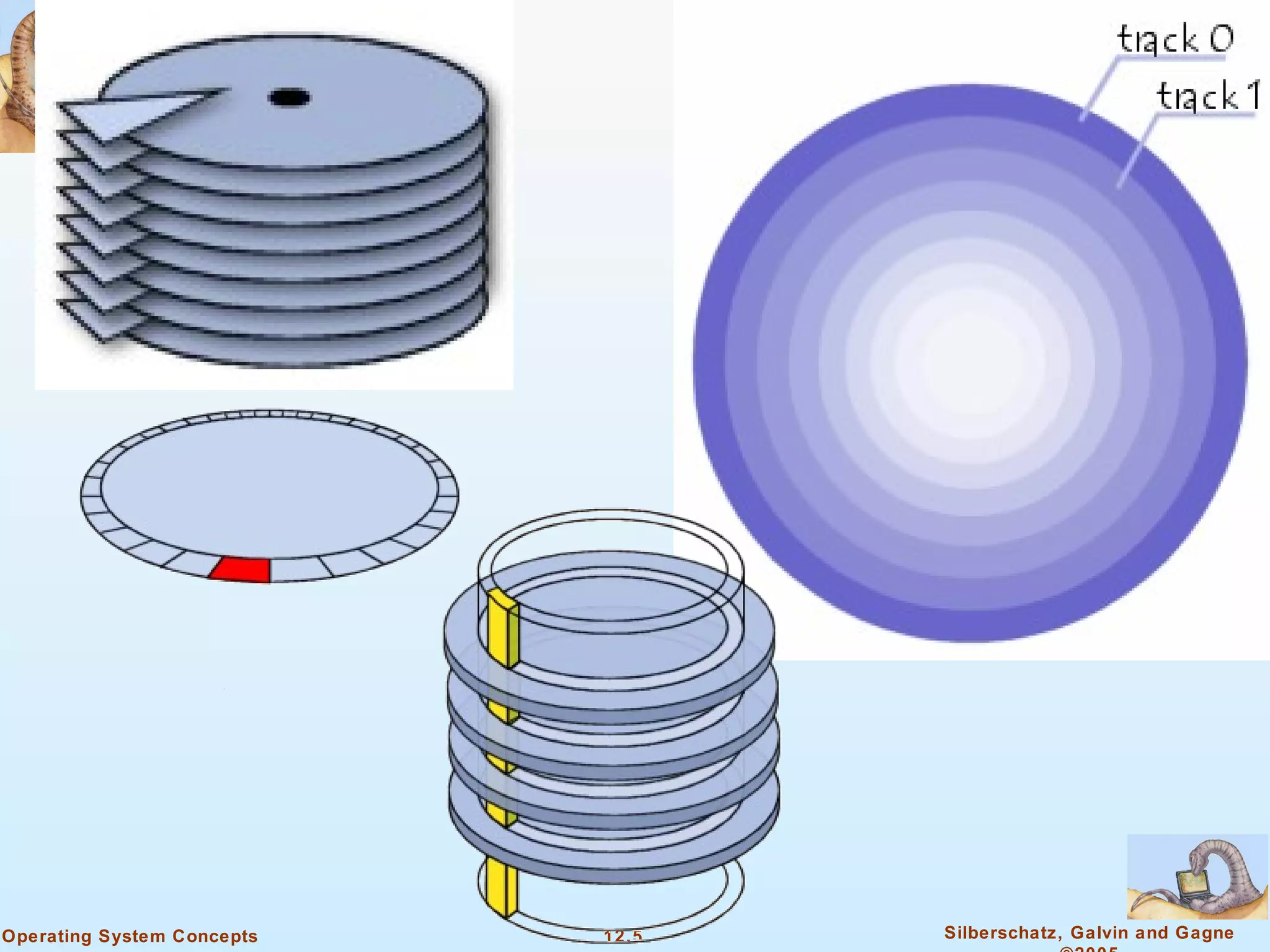
Overview of Mass Storage Structure Magnetic disks  - provide bulk of secondary storage of modern computers A collection of  tracks  (5 to 10) form a cylinder Tracks are split into  sectors  (10 to 30), which are usually the smallest unit that data can be read/written to a disk. Drives rotate at 60 to 200 times per second Transfer rate  is rate at which data flow between drive and computer Positioning time  ( random-access time ) is time to move disk arm to desired cylinder ( seek time ) and time for desired sector to rotate under the disk head ( rotational latency ) Head crash  results from disk head making contact with the disk surface -- That’s bad Disks can be removable Drive attached to computer via  I/O bus Busses vary, including  EIDE, ATA, SATA, USB, Fibre Channel, SCSI Host controller  in computer uses bus to talk to  disk controller  built into drive or storage array
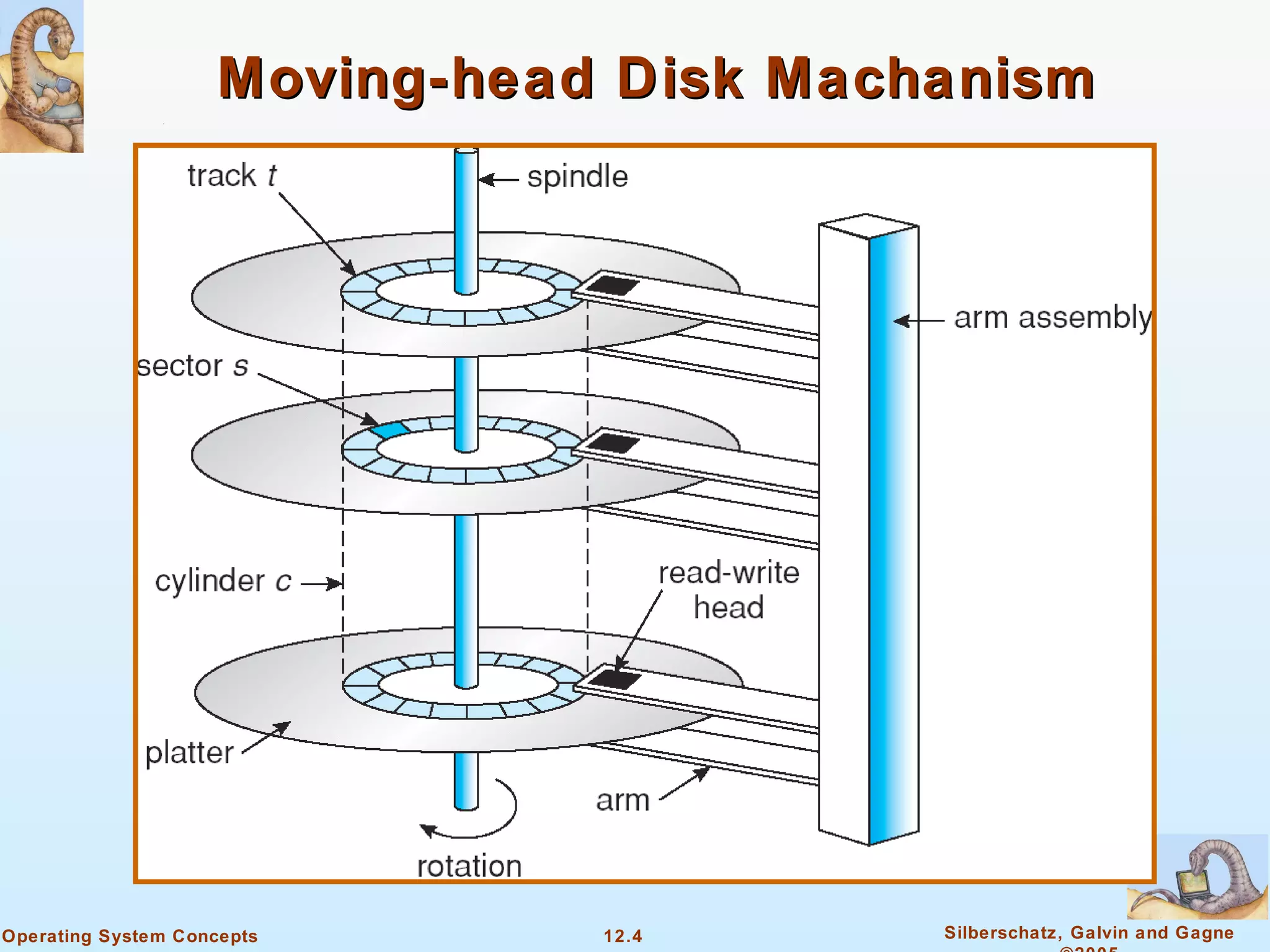
Moving-head Disk Machanism
 
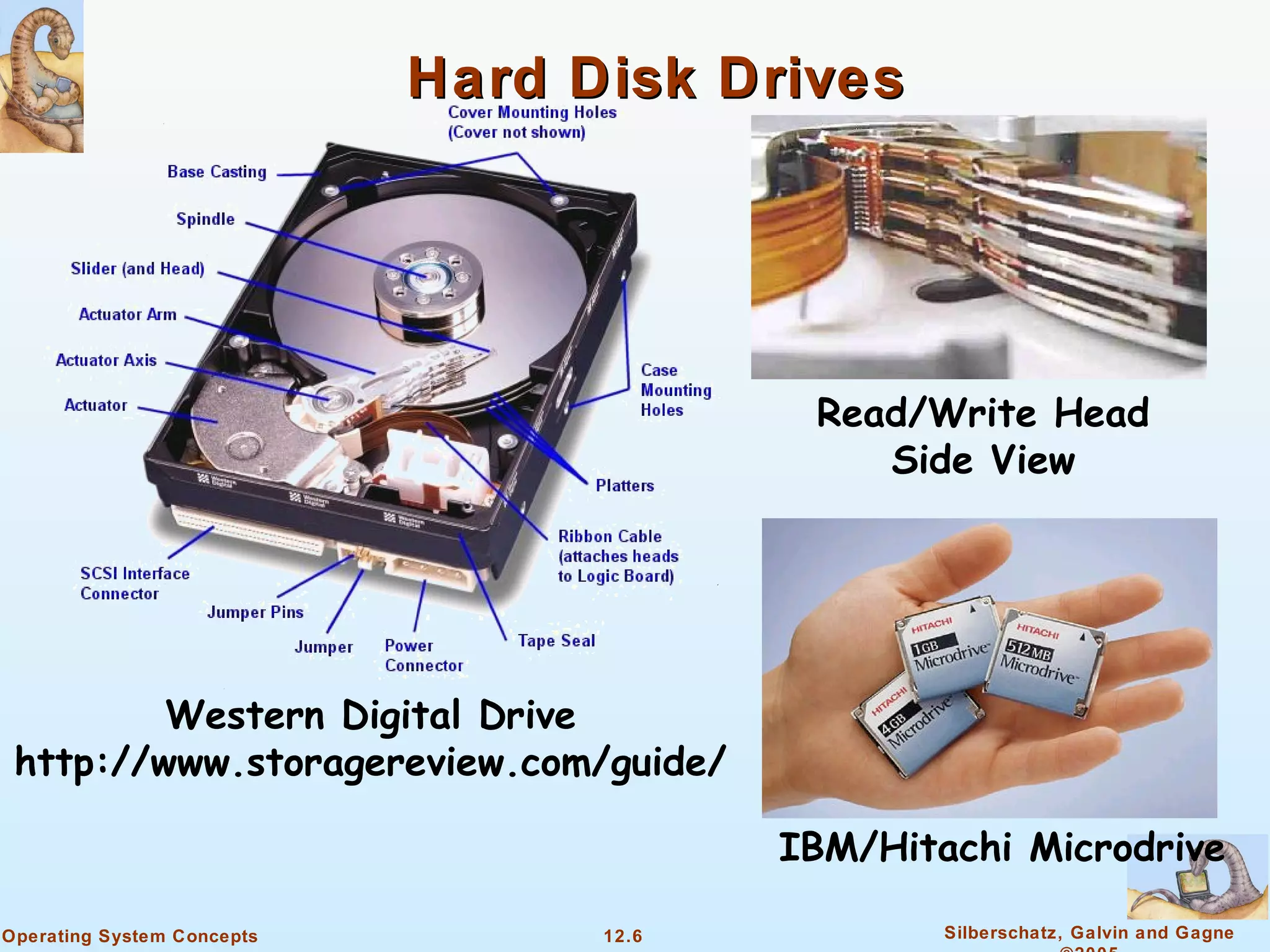
Hard Disk Drives IBM/Hitachi Microdrive Western Digital Drive http://www.storagereview.com/guide/ Read/Write Head Side View
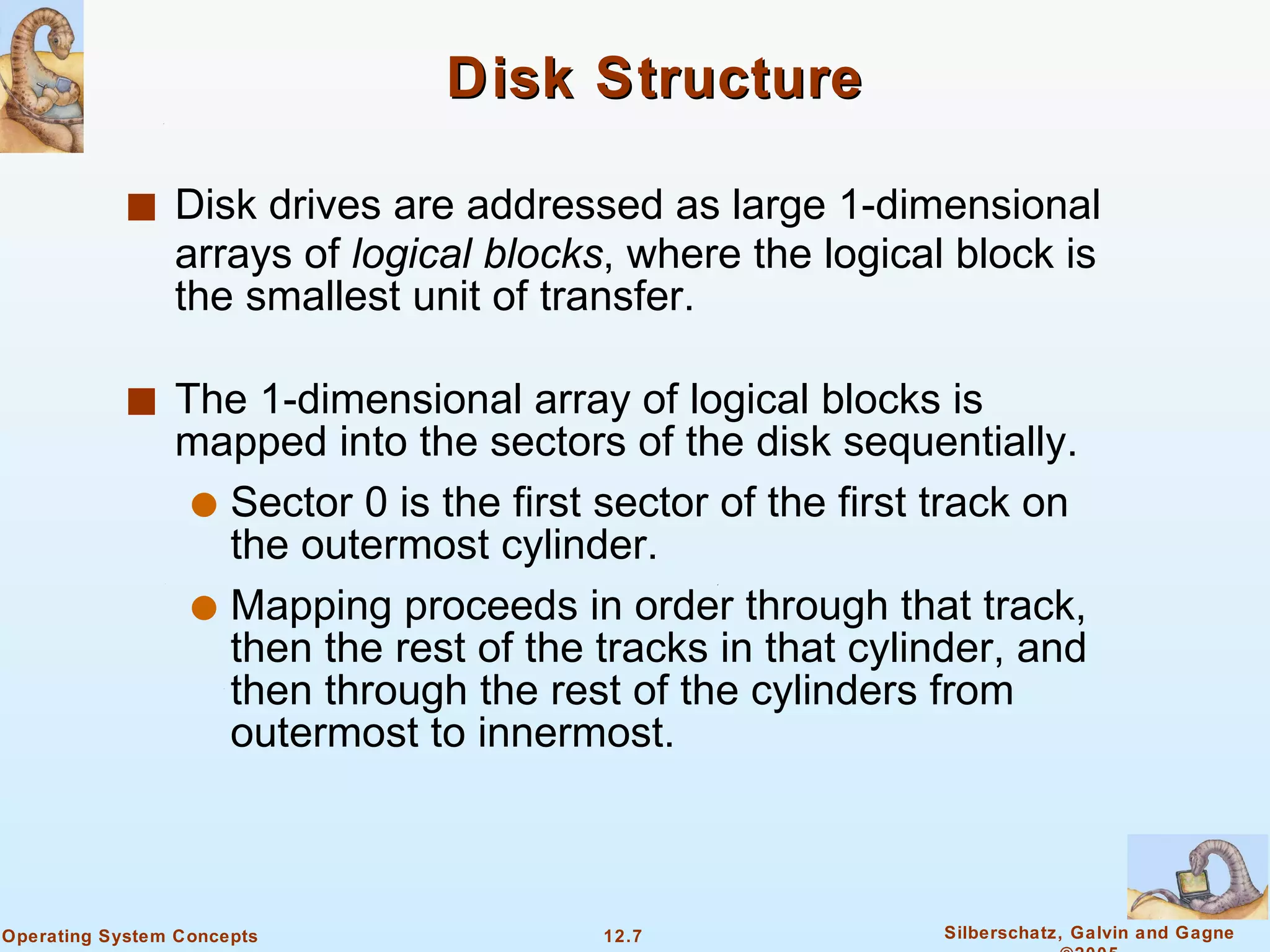
Disk Structure Disk drives are addressed as large 1-dimensional arrays of  logical blocks , where the logical block is the smallest unit of transfer.  The 1-dimensional array of logical blocks is mapped into the sectors of the disk sequentially. Sector 0 is the first sector of the first track on the outermost cylinder. Mapping proceeds in order through that track, then the rest of the tracks in that cylinder, and then through the rest of the cylinders from outermost to innermost.
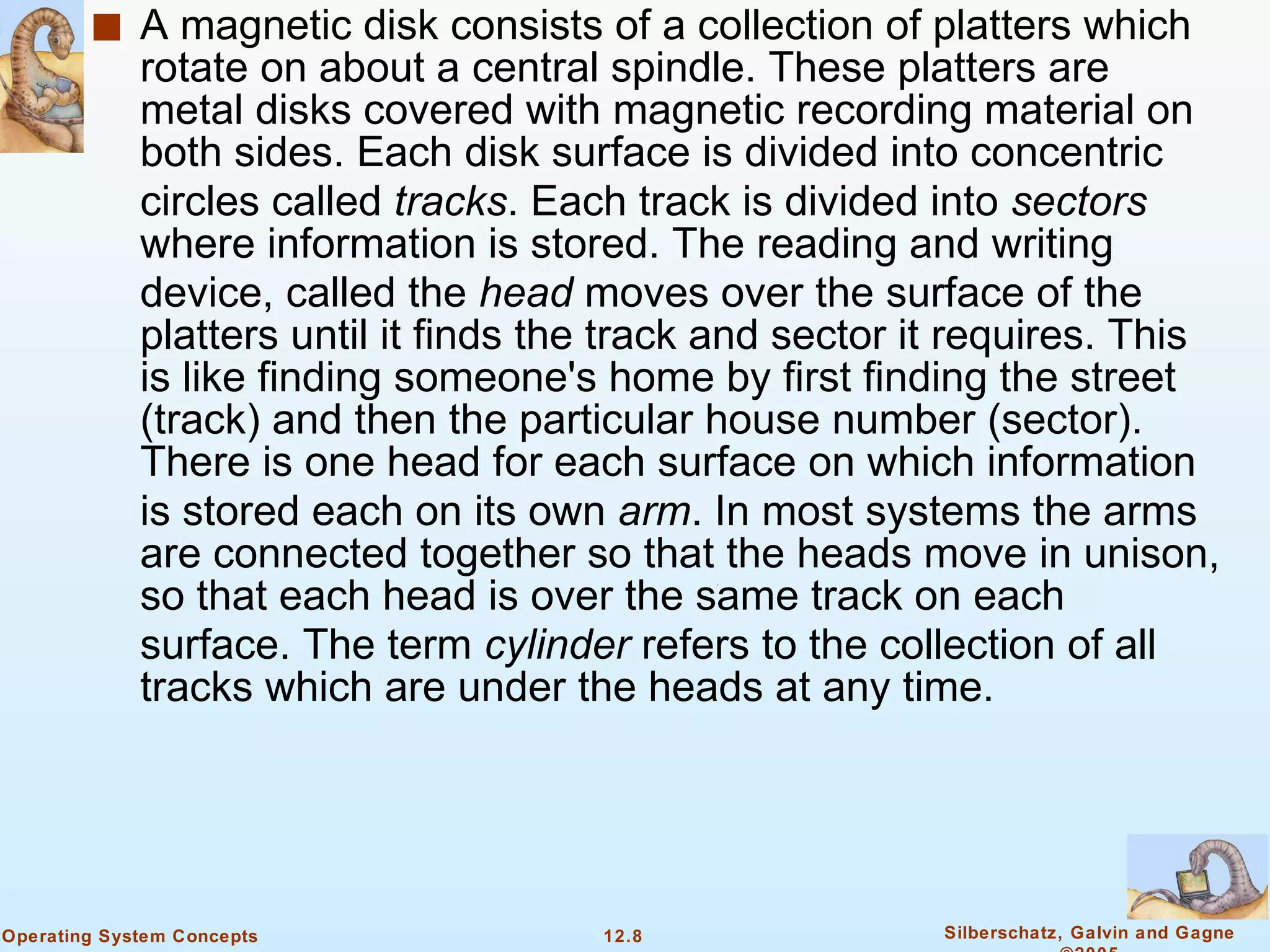
A magnetic disk consists of a collection of platters which rotate on about a central spindle. These platters are metal disks covered with magnetic recording material on both sides. Each disk surface is divided into concentric circles called  tracks . Each track is divided into  sectors  where information is stored. The reading and writing device, called the  head  moves over the surface of the platters until it finds the track and sector it requires. This is like finding someone's home by first finding the street (track) and then the particular house number (sector). There is one head for each surface on which information is stored each on its own  arm . In most systems the arms are connected together so that the heads move in unison, so that each head is over the same track on each surface. The term  cylinder  refers to the collection of all tracks which are under the heads at any time.
In order to satisfy an I/O request the disk controller must first move the head to the correct track and sector. Moving the head between cylinders takes a relatively long time so in order to maximise the number of I/O requests which can be satisfied the scheduling policy should try to minimise the movement of the head.
Disk Scheduling The operating system is responsible for using hardware efficiently — for the disk drives, this means having a fast access time and disk bandwidth. Access time has two major components Seek time  is the time for the disk are to move the heads to the cylinder containing the desired sector. Rotational latency  is the additional time waiting for the disk to rotate the desired sector to the disk head. Minimize seek time Seek time    seek distance Disk bandwidth is the total number of bytes transferred, divided by the total time between the first request for service and the completion of the last transfer.
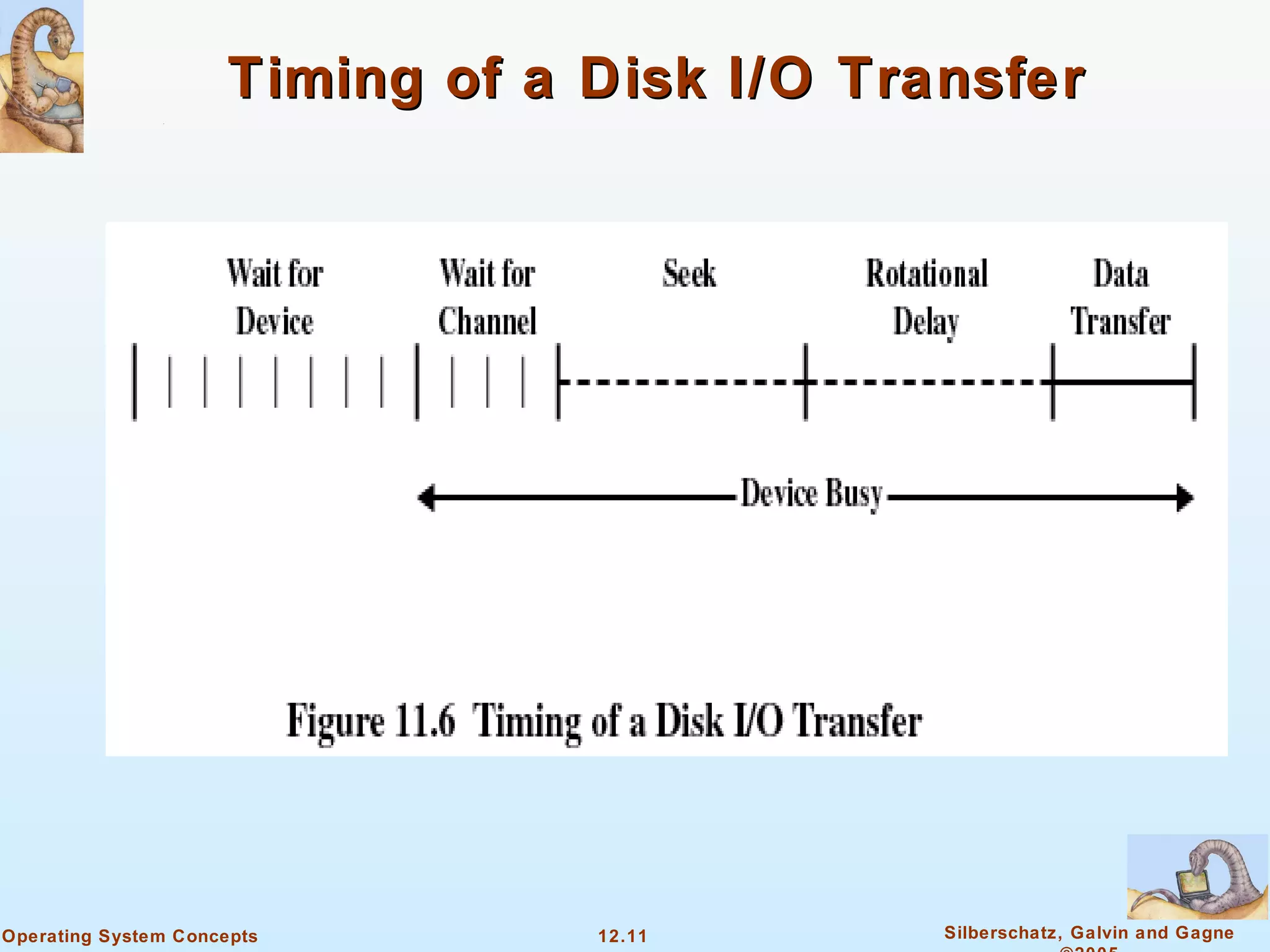
Timing of a Disk I/O Transfer
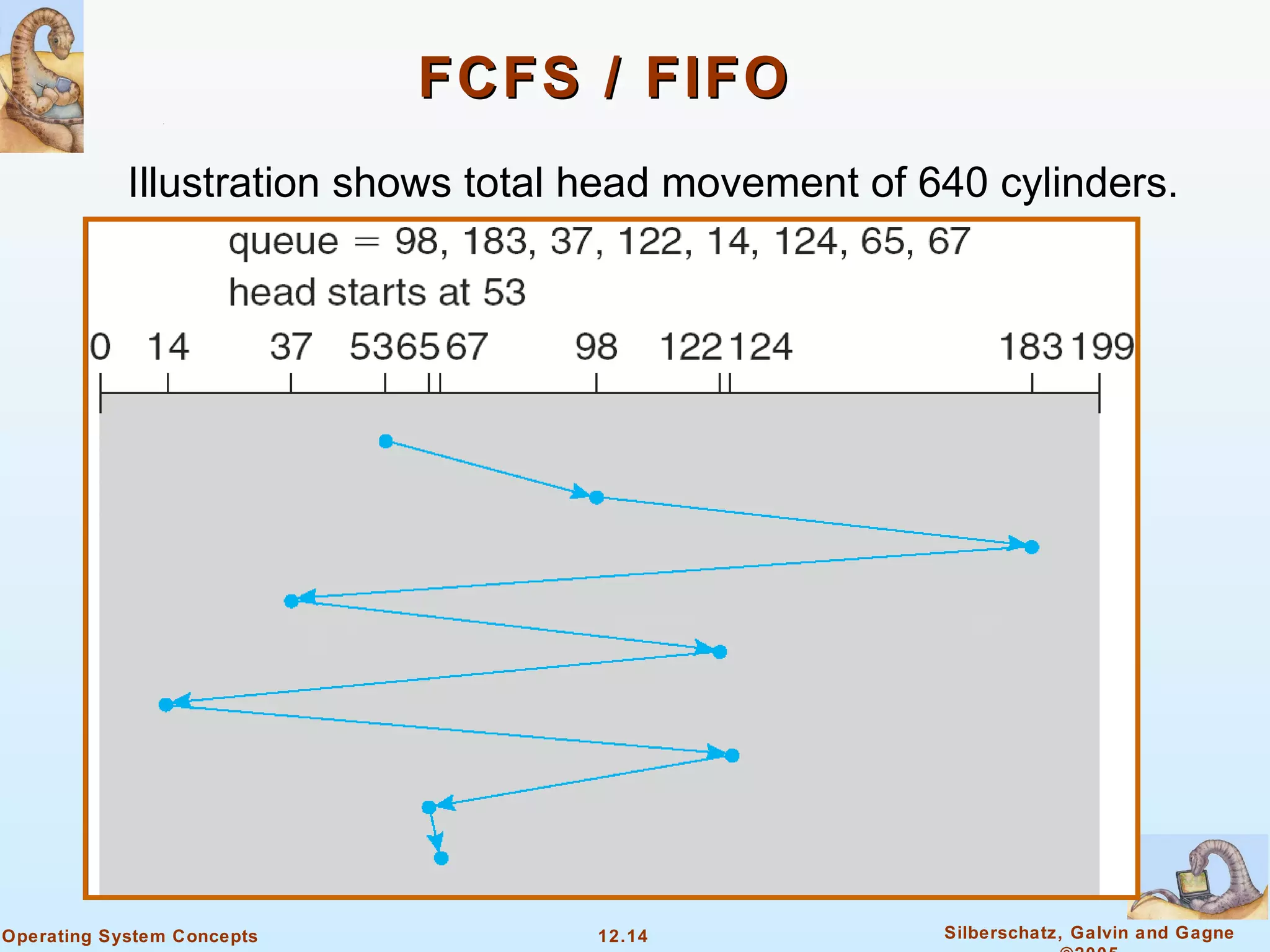
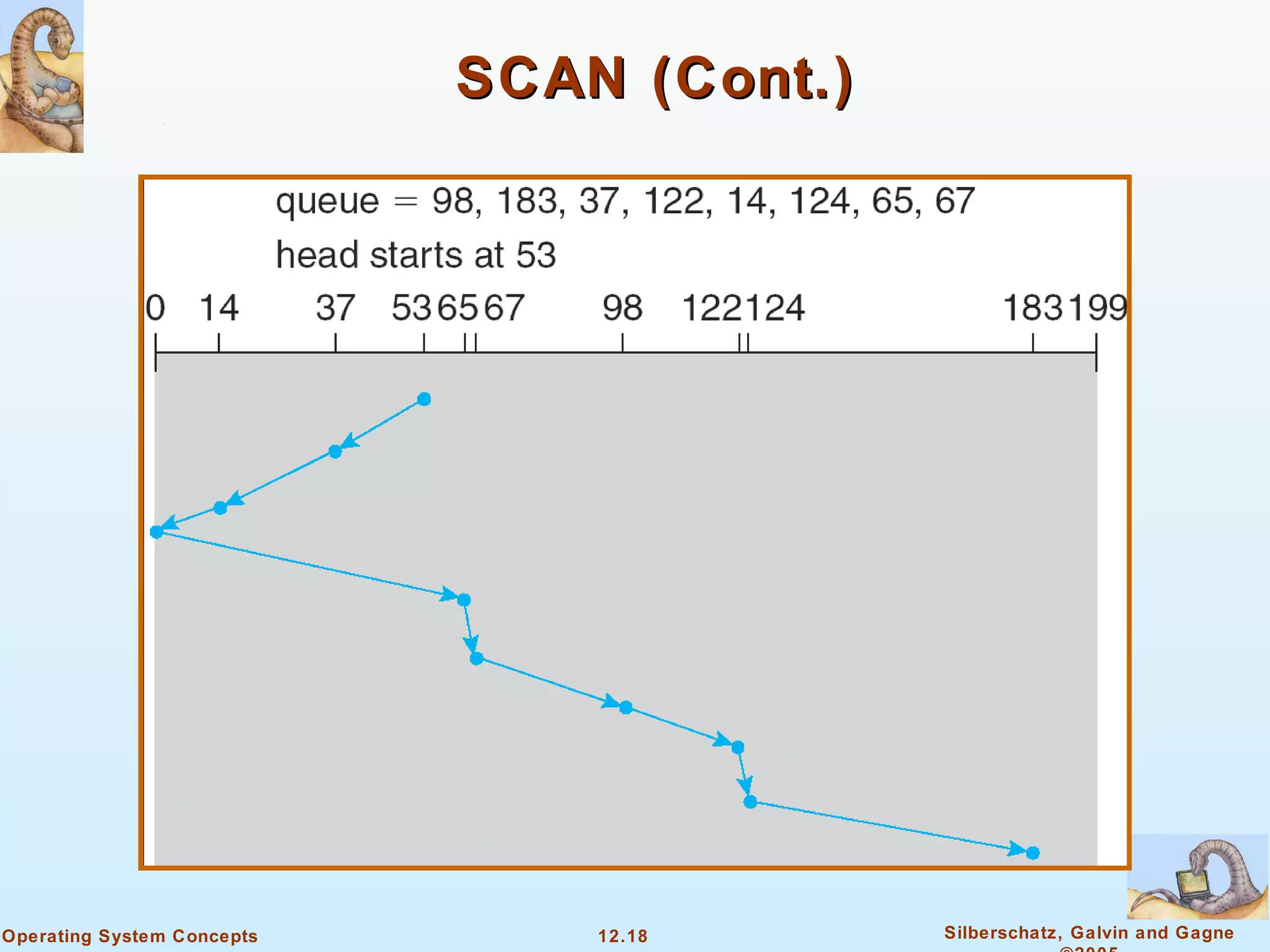
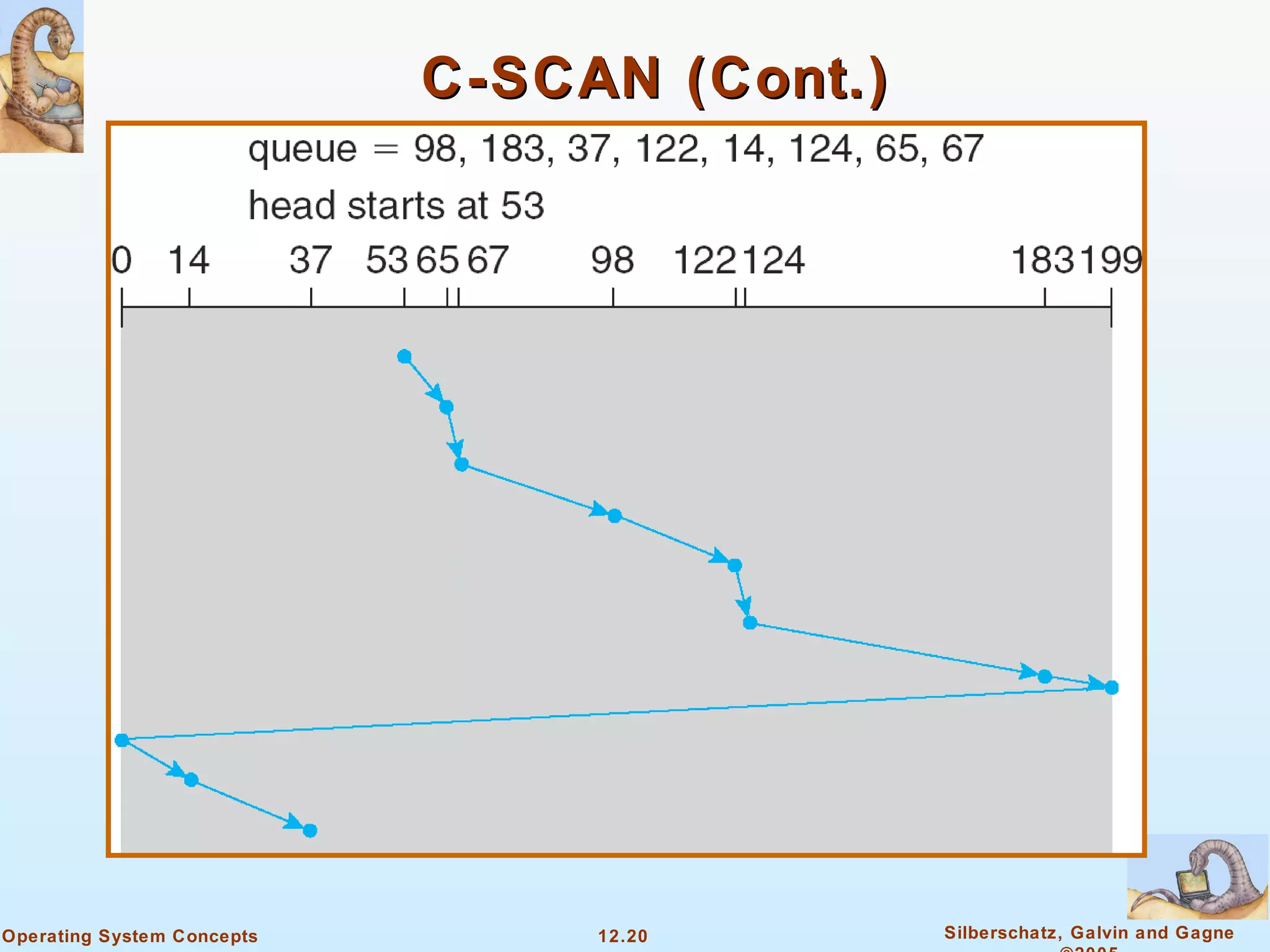
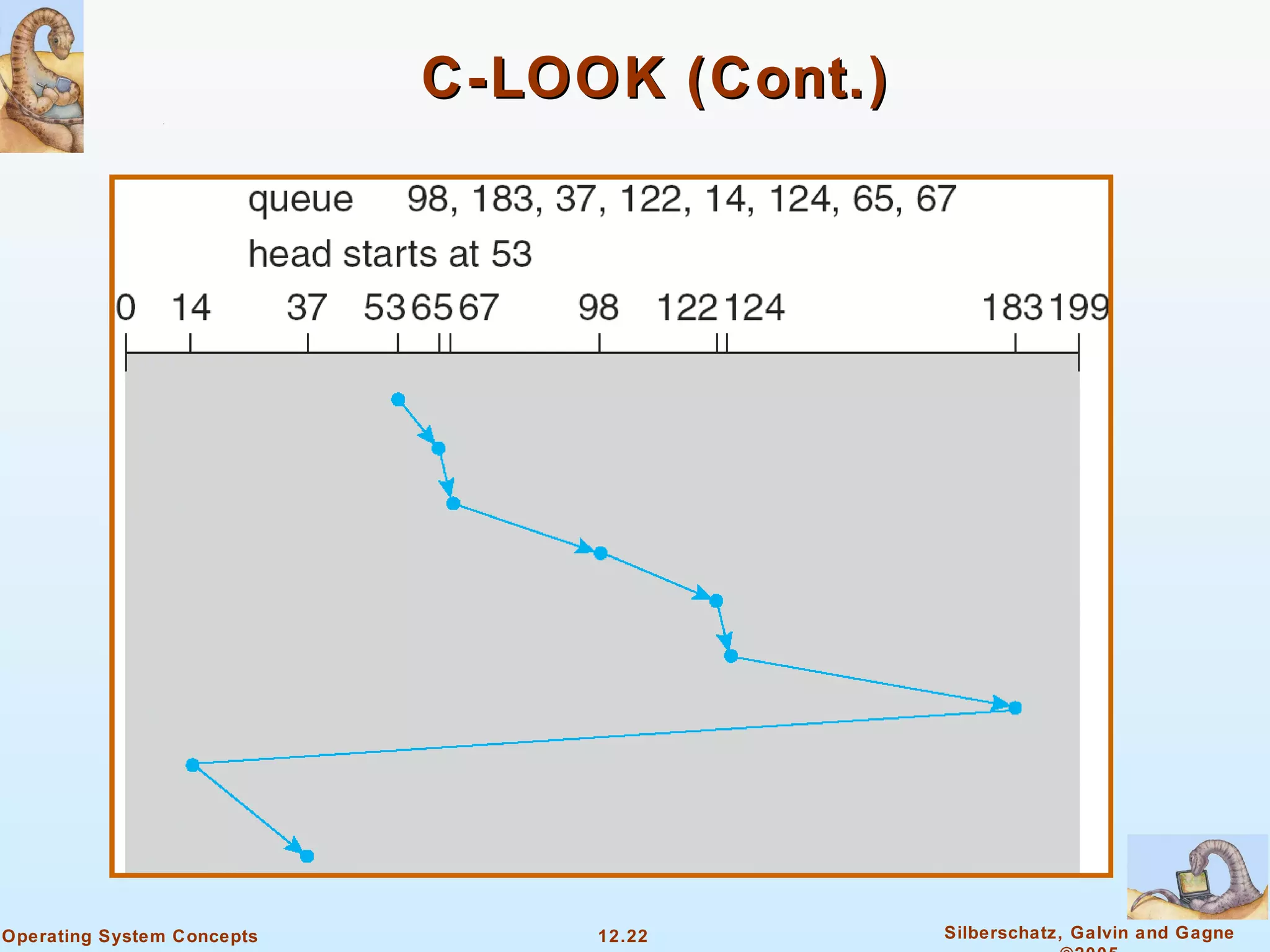
Disk Scheduling Several algorithms exist to schedule the servicing of disk I/O requests.  We illustrate them with a request queue (0-199). 98, 183, 37, 122, 14, 124, 65, 67 Head pointer 53
FCFS  (First Come, First Served)   FCFS  (First Come, First Served)  perform operations in order requested  no reordering of work queue  no  starvation : every request is serviced  poor performance
FCFS / FIFO Illustration shows total head movement of 640 cylinders.
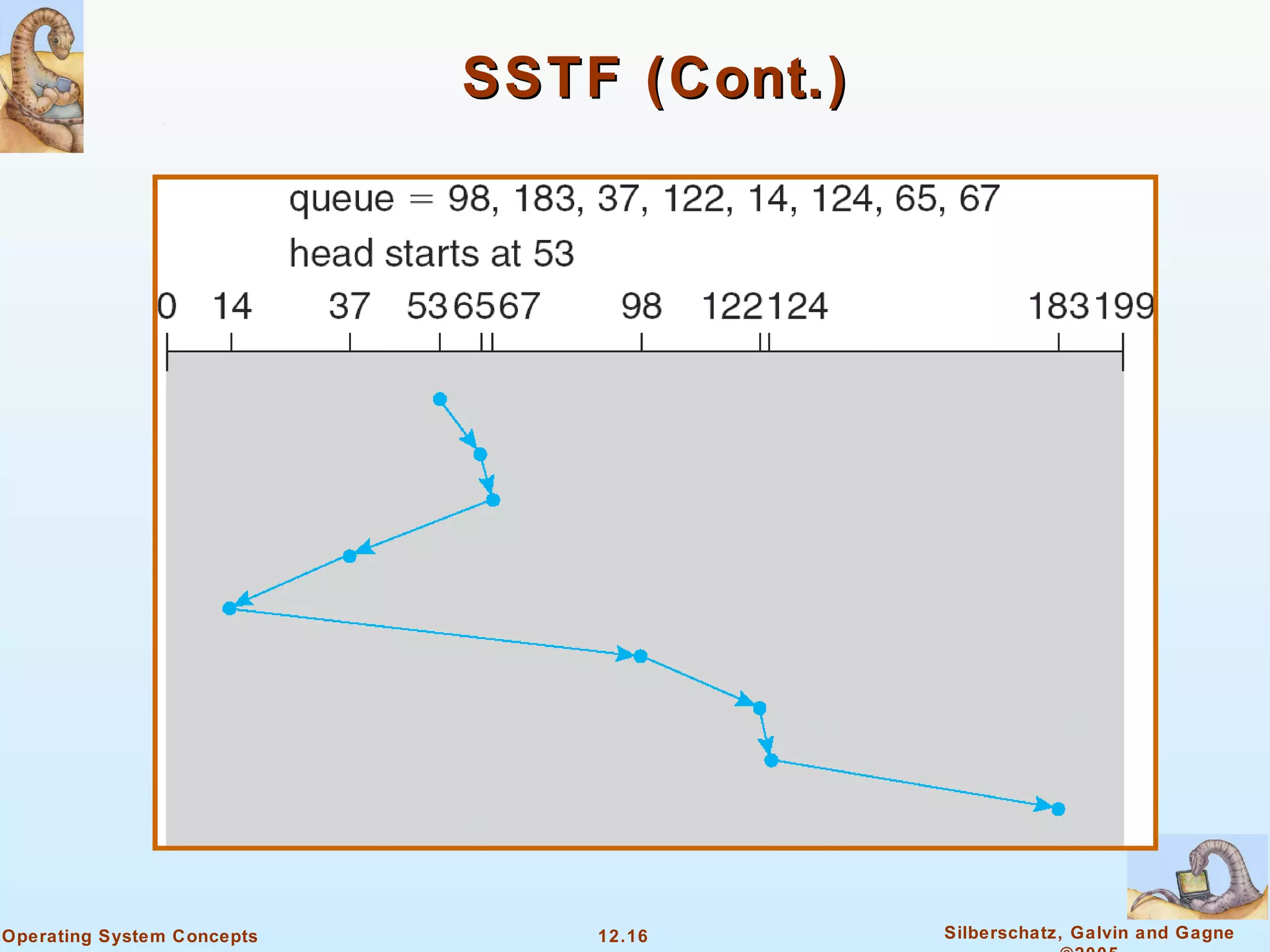
Shortest Seek Time First (SSTF) Selects the request with the minimum seek time from the current head position. SSTF scheduling is a form of SJF scheduling; may cause starvation of some requests. Illustration shows total head movement of 236 cylinders. SSTF  (Shortest Seek Time First)  after a request, go to the closest request in the work queue, regardless of direction  reduces total seek time compared to FCFS  Disadvantages  starvation  is possible; stay in one area of the disk if very busy  switching directions slows things down
SSTF (Cont.)
SCAN The disk arm starts at one end of the disk, and moves toward the other end, servicing requests until it gets to the other end of the disk, where the head movement is reversed and servicing continues. Sometimes called the  elevator algorithm . Illustration shows total head movement of 208 cylinders.
SCAN (Cont.)
C-SCAN Provides a more uniform wait time than SCAN. The head moves from one end of the disk to the other. servicing requests as it goes.  When it reaches the other end, however, it immediately returns to the beginning of the disk, without servicing any requests on the return trip. Treats the cylinders as a circular list that wraps around from the last cylinder to the first one.
C-SCAN (Cont.)
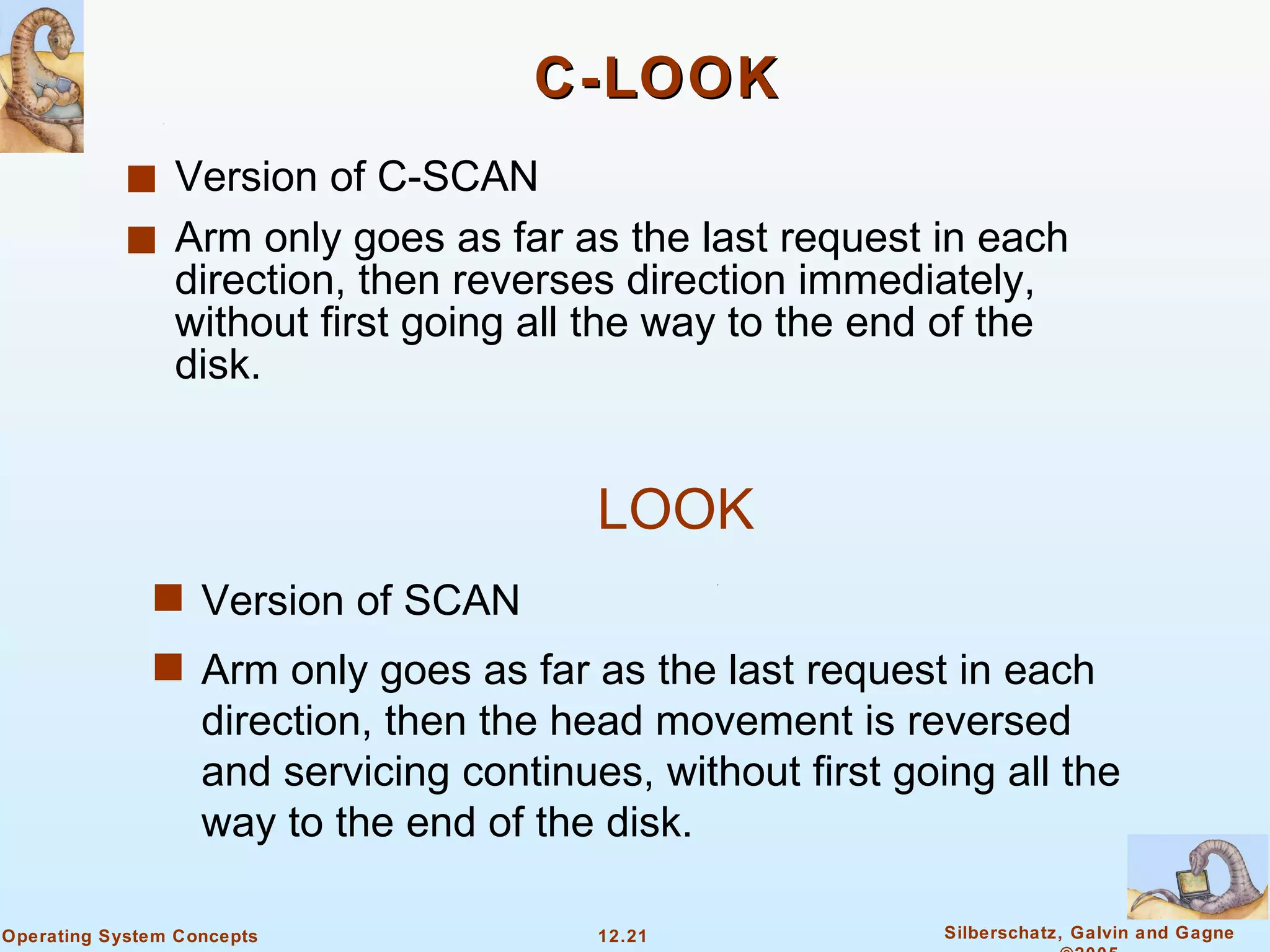
C-LOOK Version of C-SCAN Arm only goes as far as the last request in each direction, then reverses direction immediately, without first going all the way to the end of the disk.  LOOK Version of SCAN Arm only goes as far as the last request in each direction, then the head movement is reversed and servicing continues, without first going all the way to the end of the disk.
C-LOOK (Cont.)
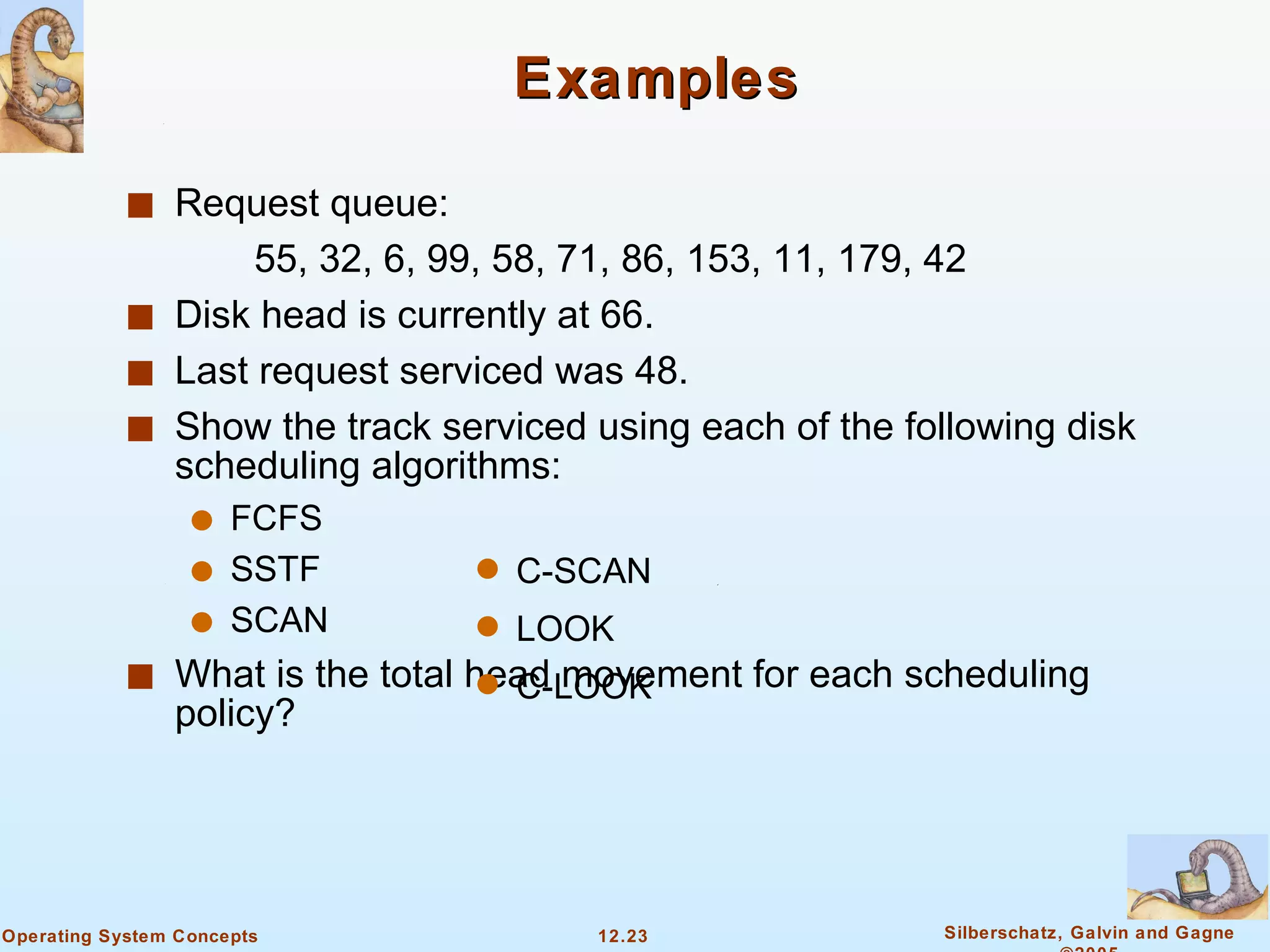
Examples Request queue:  55, 32, 6, 99, 58, 71, 86, 153, 11, 179, 42 Disk head is currently at 66. Last request serviced was 48. Show the track serviced using each of the following disk scheduling algorithms: FCFS SSTF SCAN What is the total head movement for each scheduling policy? C-SCAN LOOK C-LOOK
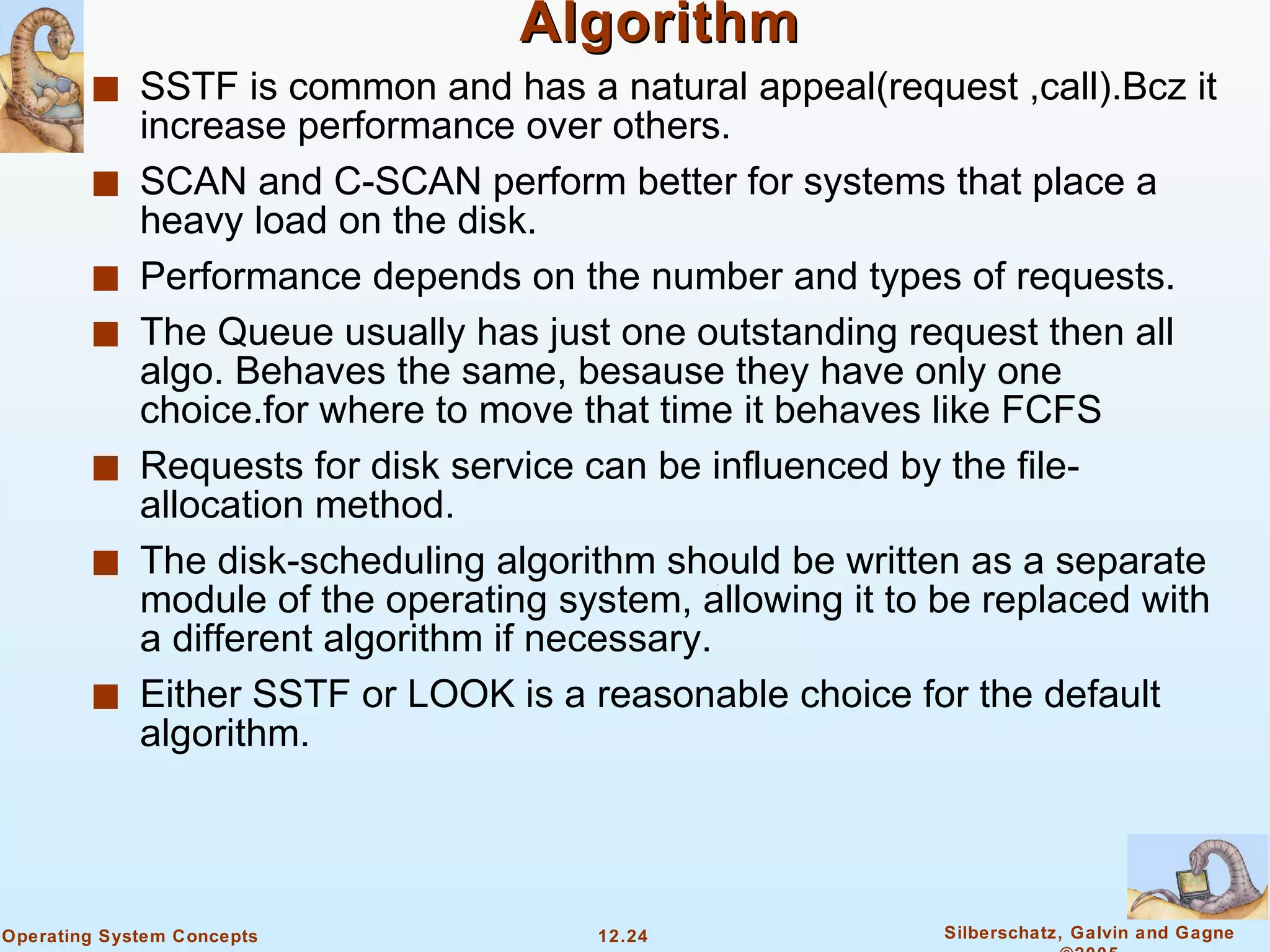
Selecting a Disk-Scheduling Algorithm SSTF is common and has a natural appeal(request ,call).Bcz it increase performance over others. SCAN and C-SCAN perform better for systems that place a heavy load on the disk. Performance depends on the number and types of requests. The Queue usually has just one outstanding request then all algo. Behaves the same, besause they have only one choice.for where to move that time it behaves like FCFS Requests for disk service can be influenced by the file-allocation method. The disk-scheduling algorithm should be written as a separate module of the operating system, allowing it to be replaced with a different algorithm if necessary. Either SSTF or LOOK is a reasonable choice for the default algorithm.
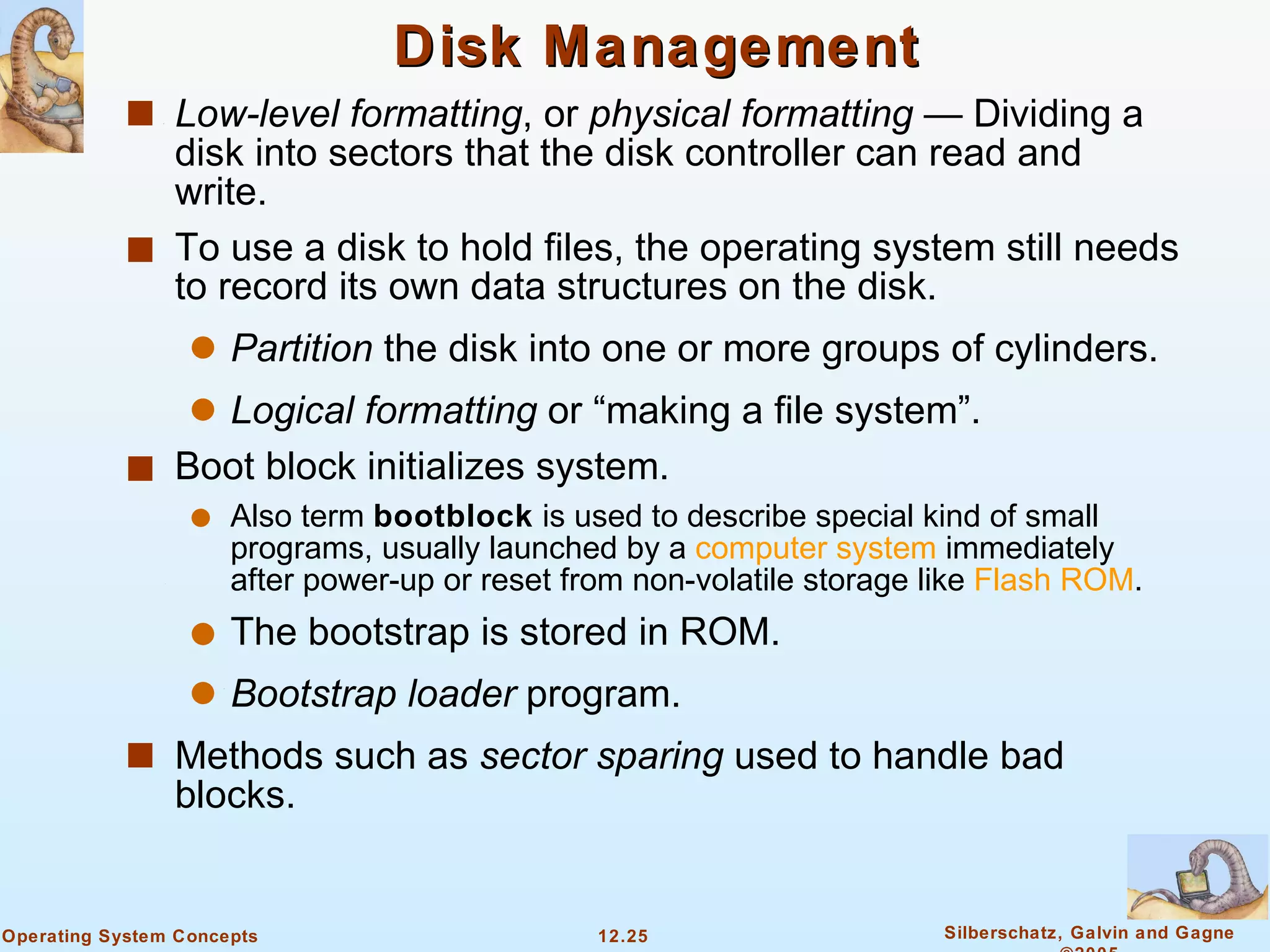
Disk Management Low-level formatting , or  physical formatting  — Dividing a disk into sectors that the disk controller can read and write. To use a disk to hold files, the operating system still needs to record its own data structures on the disk. Partition  the disk into one or more groups of cylinders. Logical formatting  or “making a file system”. Boot block initializes system. Also term  bootblock  is used to describe special kind of small programs, usually launched by a  computer system  immediately after power-up or reset from non-volatile storage like  Flash ROM .  The bootstrap is stored in ROM. Bootstrap loader  program. Methods such as  sector sparing  used to handle bad blocks.

7 disk managment

  • 1.
    Chapter 8: Secondary-Storage Structure
  • 2.
    Overview of MassStorage Structure Magnetic tape Was early secondary-storage medium Relatively permanent and holds large quantities of data Access time slow Random access ~1000 times slower than disk Mainly used for backup, storage of infrequently-used data, transfer medium between systems Kept in spool and wound or rewound past read-write head Once data under head, transfer rates comparable to disk 20-200GB typical storage Common technologies are 4mm, 8mm, 19mm, LTO-2 and SDLT
  • 3.
    Overview of MassStorage Structure Magnetic disks - provide bulk of secondary storage of modern computers A collection of tracks (5 to 10) form a cylinder Tracks are split into sectors (10 to 30), which are usually the smallest unit that data can be read/written to a disk. Drives rotate at 60 to 200 times per second Transfer rate is rate at which data flow between drive and computer Positioning time ( random-access time ) is time to move disk arm to desired cylinder ( seek time ) and time for desired sector to rotate under the disk head ( rotational latency ) Head crash results from disk head making contact with the disk surface -- That’s bad Disks can be removable Drive attached to computer via I/O bus Busses vary, including EIDE, ATA, SATA, USB, Fibre Channel, SCSI Host controller in computer uses bus to talk to disk controller built into drive or storage array
  • 4.
  • 5.
  • 6.
    Hard Disk DrivesIBM/Hitachi Microdrive Western Digital Drive http://www.storagereview.com/guide/ Read/Write Head Side View
  • 7.
    Disk Structure Diskdrives are addressed as large 1-dimensional arrays of logical blocks , where the logical block is the smallest unit of transfer. The 1-dimensional array of logical blocks is mapped into the sectors of the disk sequentially. Sector 0 is the first sector of the first track on the outermost cylinder. Mapping proceeds in order through that track, then the rest of the tracks in that cylinder, and then through the rest of the cylinders from outermost to innermost.
  • 8.
    A magnetic diskconsists of a collection of platters which rotate on about a central spindle. These platters are metal disks covered with magnetic recording material on both sides. Each disk surface is divided into concentric circles called tracks . Each track is divided into sectors where information is stored. The reading and writing device, called the head moves over the surface of the platters until it finds the track and sector it requires. This is like finding someone's home by first finding the street (track) and then the particular house number (sector). There is one head for each surface on which information is stored each on its own arm . In most systems the arms are connected together so that the heads move in unison, so that each head is over the same track on each surface. The term cylinder refers to the collection of all tracks which are under the heads at any time.
  • 9.
    In order tosatisfy an I/O request the disk controller must first move the head to the correct track and sector. Moving the head between cylinders takes a relatively long time so in order to maximise the number of I/O requests which can be satisfied the scheduling policy should try to minimise the movement of the head.
  • 10.
    Disk Scheduling Theoperating system is responsible for using hardware efficiently — for the disk drives, this means having a fast access time and disk bandwidth. Access time has two major components Seek time is the time for the disk are to move the heads to the cylinder containing the desired sector. Rotational latency is the additional time waiting for the disk to rotate the desired sector to the disk head. Minimize seek time Seek time  seek distance Disk bandwidth is the total number of bytes transferred, divided by the total time between the first request for service and the completion of the last transfer.
  • 11.
    Timing of aDisk I/O Transfer
  • 12.
    Disk Scheduling Severalalgorithms exist to schedule the servicing of disk I/O requests. We illustrate them with a request queue (0-199). 98, 183, 37, 122, 14, 124, 65, 67 Head pointer 53
  • 13.
    FCFS (FirstCome, First Served) FCFS (First Come, First Served) perform operations in order requested no reordering of work queue no starvation : every request is serviced poor performance
  • 14.
    FCFS / FIFOIllustration shows total head movement of 640 cylinders.
  • 15.
    Shortest Seek TimeFirst (SSTF) Selects the request with the minimum seek time from the current head position. SSTF scheduling is a form of SJF scheduling; may cause starvation of some requests. Illustration shows total head movement of 236 cylinders. SSTF (Shortest Seek Time First) after a request, go to the closest request in the work queue, regardless of direction reduces total seek time compared to FCFS Disadvantages starvation is possible; stay in one area of the disk if very busy switching directions slows things down
  • 16.
  • 17.
    SCAN The diskarm starts at one end of the disk, and moves toward the other end, servicing requests until it gets to the other end of the disk, where the head movement is reversed and servicing continues. Sometimes called the elevator algorithm . Illustration shows total head movement of 208 cylinders.
  • 18.
  • 19.
    C-SCAN Provides amore uniform wait time than SCAN. The head moves from one end of the disk to the other. servicing requests as it goes. When it reaches the other end, however, it immediately returns to the beginning of the disk, without servicing any requests on the return trip. Treats the cylinders as a circular list that wraps around from the last cylinder to the first one.
  • 20.
  • 21.
    C-LOOK Version ofC-SCAN Arm only goes as far as the last request in each direction, then reverses direction immediately, without first going all the way to the end of the disk. LOOK Version of SCAN Arm only goes as far as the last request in each direction, then the head movement is reversed and servicing continues, without first going all the way to the end of the disk.
  • 22.
  • 23.
    Examples Request queue: 55, 32, 6, 99, 58, 71, 86, 153, 11, 179, 42 Disk head is currently at 66. Last request serviced was 48. Show the track serviced using each of the following disk scheduling algorithms: FCFS SSTF SCAN What is the total head movement for each scheduling policy? C-SCAN LOOK C-LOOK
  • 24.
    Selecting a Disk-SchedulingAlgorithm SSTF is common and has a natural appeal(request ,call).Bcz it increase performance over others. SCAN and C-SCAN perform better for systems that place a heavy load on the disk. Performance depends on the number and types of requests. The Queue usually has just one outstanding request then all algo. Behaves the same, besause they have only one choice.for where to move that time it behaves like FCFS Requests for disk service can be influenced by the file-allocation method. The disk-scheduling algorithm should be written as a separate module of the operating system, allowing it to be replaced with a different algorithm if necessary. Either SSTF or LOOK is a reasonable choice for the default algorithm.
  • 25.
    Disk Management Low-levelformatting , or physical formatting — Dividing a disk into sectors that the disk controller can read and write. To use a disk to hold files, the operating system still needs to record its own data structures on the disk. Partition the disk into one or more groups of cylinders. Logical formatting or “making a file system”. Boot block initializes system. Also term bootblock is used to describe special kind of small programs, usually launched by a computer system immediately after power-up or reset from non-volatile storage like Flash ROM . The bootstrap is stored in ROM. Bootstrap loader program. Methods such as sector sparing used to handle bad blocks.