PAST SIMPLE & PAST
CONTINUOUS
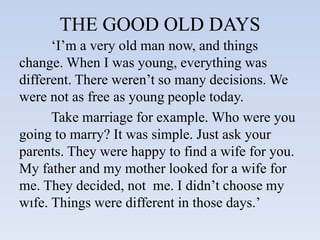
THE GOOD OLD DAYS
‘I’m a very old man now, and things
change. When I was young, everything was
different. There weren’t so many decisions. We
were not as free as young people today.
Take marriage for example. Who were you
going to marry? It was simple. Just ask your
parents. They were happy to find a wife for you.
My father and my mother looked for a wife for
me. They decided, not me. I didn’t choose my
wıfe. Things were different in those days.’
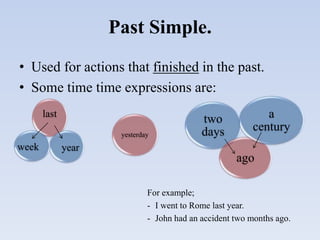
Past Simple.
• Used for actions that finished in the past.
• Some time time expressions are:
For example;
- I went to Rome last year.
- John had an accident two months ago.
last
yearweek
two
days
ago
a
century
yesterday
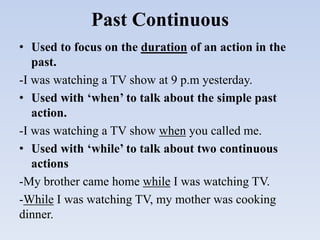
Past Continuous
• Used to focus on the duration of an action in the
past.
-I was watching a TV show at 9 p.m yesterday.
• Used with ‘when’ to talk about the simple past
action.
-I was watching a TV show when you called me.
• Used with ‘while’ to talk about two continuous
actions
-My brother came home while I was watching TV.
-While I was watching TV, my mother was cooking
dinner.
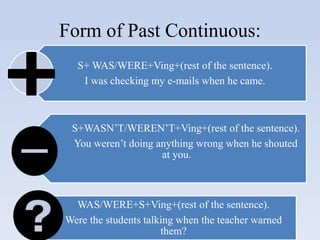
Form of Past Continuous:
S+ WAS/WERE+Ving+(rest of the sentence).
I was checking my e-mails when he came.
S+WASN’T/WEREN’T+Ving+(rest of the sentence).
You weren’t doing anything wrong when he shouted
at you.
WAS/WERE+S+Ving+(rest of the sentence).
Were the students talking when the teacher warned
them?
Watch Out!
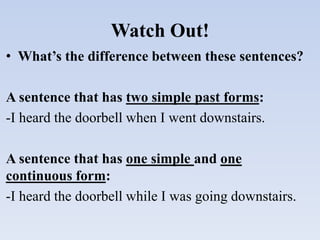
• What’s the difference between these sentences?
A sentence that has two simple past forms:
-I heard the doorbell when I went downstairs.
A sentence that has one simple and one
continuous form:
-I heard the doorbell while I was going downstairs.
Watch Out!
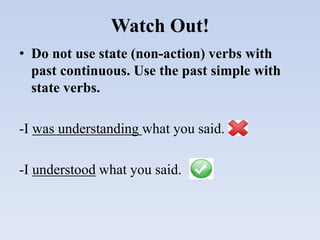
• Do not use state (non-action) verbs with
past continuous. Use the past simple with
state verbs.
-I was understanding what you said.
-I understood what you said.
Watch Out!
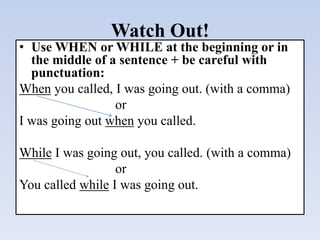
• Use WHEN or WHILE at the beginning or in
the middle of a sentence + be careful with
punctuation:
When you called, I was going out. (with a comma)
or
I was going out when you called.
While I was going out, you called. (with a comma)
or
You called while I was going out.
LET’S TALK!
WAS LIFE DIFFERENT IN THE PAST?
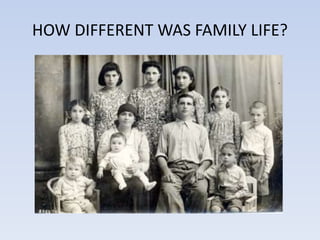
HOW DIFFERENT WAS FAMILY LIFE?
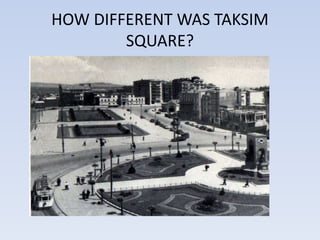
HOW DIFFERENT WAS TAKSIM
SQUARE?
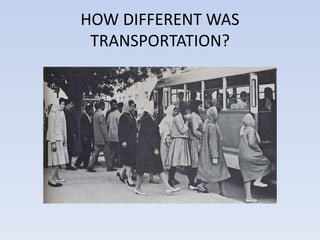
HOW DIFFERENT WAS
TRANSPORTATION?
HOW DIFFERENT WERE YOUNG
PEOPLE?
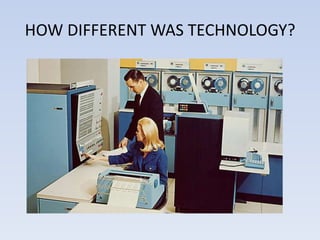
HOW DIFFERENT WAS TECHNOLOGY?
Now it’s your turn!
• In small groups, talk about life in your country 50 years
ago. What was a typical woman’s life like? How about
men? You can talk about their jobs, education, eating
habits and so on.
• Take some notes based on your and your friends’ ideas.
• Then talk about life in your country today. Are
women’s and men’s roles changing?
• After comparing past and present, use your notes and
write a short paragraph of 40-50 words.
THANK YOU ALL!

3 past simple tense and past continuous tense presentation

  • 1.
    PAST SIMPLE &PAST CONTINUOUS
  • 2.
    THE GOOD OLDDAYS ‘I’m a very old man now, and things change. When I was young, everything was different. There weren’t so many decisions. We were not as free as young people today. Take marriage for example. Who were you going to marry? It was simple. Just ask your parents. They were happy to find a wife for you. My father and my mother looked for a wife for me. They decided, not me. I didn’t choose my wıfe. Things were different in those days.’
  • 3.
    Past Simple. • Usedfor actions that finished in the past. • Some time time expressions are: For example; - I went to Rome last year. - John had an accident two months ago. last yearweek two days ago a century yesterday
  • 4.
    Past Continuous • Usedto focus on the duration of an action in the past. -I was watching a TV show at 9 p.m yesterday. • Used with ‘when’ to talk about the simple past action. -I was watching a TV show when you called me. • Used with ‘while’ to talk about two continuous actions -My brother came home while I was watching TV. -While I was watching TV, my mother was cooking dinner.
  • 5.
    Form of PastContinuous: S+ WAS/WERE+Ving+(rest of the sentence). I was checking my e-mails when he came. S+WASN’T/WEREN’T+Ving+(rest of the sentence). You weren’t doing anything wrong when he shouted at you. WAS/WERE+S+Ving+(rest of the sentence). Were the students talking when the teacher warned them?
  • 6.
    Watch Out! • What’sthe difference between these sentences? A sentence that has two simple past forms: -I heard the doorbell when I went downstairs. A sentence that has one simple and one continuous form: -I heard the doorbell while I was going downstairs.
  • 7.
    Watch Out! • Donot use state (non-action) verbs with past continuous. Use the past simple with state verbs. -I was understanding what you said. -I understood what you said.
  • 8.
    Watch Out! • UseWHEN or WHILE at the beginning or in the middle of a sentence + be careful with punctuation: When you called, I was going out. (with a comma) or I was going out when you called. While I was going out, you called. (with a comma) or You called while I was going out.
  • 9.
    LET’S TALK! WAS LIFEDIFFERENT IN THE PAST?
  • 10.
    HOW DIFFERENT WASFAMILY LIFE?
  • 11.
    HOW DIFFERENT WASTAKSIM SQUARE?
  • 12.
  • 13.
    HOW DIFFERENT WEREYOUNG PEOPLE?
  • 14.
    HOW DIFFERENT WASTECHNOLOGY?
  • 15.
    Now it’s yourturn! • In small groups, talk about life in your country 50 years ago. What was a typical woman’s life like? How about men? You can talk about their jobs, education, eating habits and so on. • Take some notes based on your and your friends’ ideas. • Then talk about life in your country today. Are women’s and men’s roles changing? • After comparing past and present, use your notes and write a short paragraph of 40-50 words.
  • 16.

Editor's Notes

  • #4 Note for the teacher: You can ask your students whether they remember the use of past simple or not (as they worked on this tense before).
  • #7 Please highlight the sequence difference here via questions
  • #8 Note for the teacher: You can elicit more state verbs that your students remember.