Past continuous and Past simple
To talk about a temporary situation that
existed at or around a particular time
in the past, we can use the past
continuous.
For example:
At the time of the robbery, they were
staying with my parents.

My head was aching again, so I went.
Compare the use of the past
continuous and the past simple
in the following sentences
She was shaking with anger as she left
the hotel.
When he realised I was looking at him,
he turned away.
Sarah dropped her bag while she was
getting into her car.
We often use the past simple to talk
about a completed past events and
the past continuous to describe the
situation that existed at the time. The
completed event might have
interrupted the situation, or just
occurred while the situation or event
was in progress.
However...
We don’t normally use the past continuous with
certain verbs describing states.
This house belonged to the King of Sweden
When we talk about two past actions or
events that went on over the same
period of time, we can often use the
past continuous for both.
For example:
Sally was reading to the children while
Kevin was washing up.
Mario was working in a resturant when I
was living in London.
However...
We can often use the past simple to express
a similar meaning:
Mario worked in a resturant while he lived
in London.
When we talk about two or more past
completed events that follow each
other, we use the past simple for
both.
The first may have caused the second.
For example
She got up when the alarm clock went off.
He jumped out of bed and ran to see who the
parcel was for.
When we talk about a permanent or longterm situation that existed in the past, we
use the past simple rather than the past
continuous.
When I was a child I played the violin.
However, if the situation was temporary,
we can also use the past continuous.
For example
I was working in a car factory during the
summer of 1976.
(or I worked....)
He worked hard all his life.
We use the past simple rather than the
past continuous when we are talking
about repeated actions or events in
the past.
For example
We visited Spain three times last year.
I went past her house every day.
She slept very badly whenever she stayed
with her grandparents.
Look at these sentences:
1. When his wife walked in, he dropped his
2.
3.
4.

glass.
When his wife walked in, he was
dropping his glass.
When his wife was walking in, he was
dropping his glass.
When his wife was walking in, he
dropped his glass.
Which are correct?
past simple or past continuous?
Now look at these two sentences:
A. She looked away when I spoke to her.
B. She was looking away when I spoke to

her.
In which one, A or B, do we get the idea
that perhaps she was angry with me?
Think about it another way:
…she looked away.
…she was looking away.
Which action seems quicker?
Looked away.
So if we want to suggest looked away is a
quick action, because I spoke to her,
sentence A is better.
In sentence B, was looking away suggests
a longer action. Perhaps she was looking
away before I spoke to her.
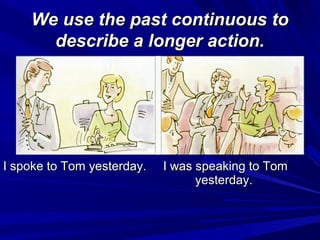
We use the past continuous to
describe a longer action.

I spoke to Tom yesterday.

I was speaking to Tom
yesterday.
Now think about sentences 1 – 4 again.
1. When his wife walked in, he dropped his glass.
This one is most likely – she walked in and he drops the
glass – two short actions.
2. When his wife walked in, he was dropping his glass.
This is almost impossible. You can’t drop a glass slowly.
3. When his wife was walking in, he was dropping his
glass.
The same problem here.
4. When his wife was walking in, he dropped his glass.
This is possible. She walks in more slowly and he drops
the glass. Maybe she just felt tired.
Now decide which sentences are possible . In

each pair, it might be one – or both.
a. While I was having a shower, the phone rang.
b. While I was having a shower, the phone was
c.
d.
e.
f.

ringing.
While he was walking home in the storm, a
tree fell down.
While he was walking home in the storm, a
tree was falling down.
When Mark saw Mary he was speaking to her.
When Mark saw Mary he spoke to her.
a.
b.
c.
d.
e.
f.

While she was walking along the street, she
was speaking to the baby.
While she walked along the street, she was
speaking to the baby.
When the car left the track, a wheel came off.
When the car was leaving the track, a wheel
came off.
While she was having lunch, the fire alarm was
ringing.
While she was having lunch, the fire alarm
rang.
when or while?
We often use while instead of when with the
past continuous because it stresses that
the action is longer. However, it is not
wrong to use when in sentences like this.
When I was having a shower. (is possible)
While I was having a shower. (is maybe
better)
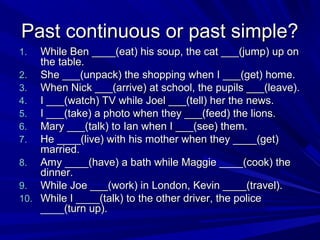
Past continuous or past simple?
While Ben ____(eat) his soup, the cat ___(jump) up on
the table.
2. She ___(unpack) the shopping when I ___(get) home.
3. When Nick ___(arrive) at school, the pupils ___(leave).
4. I ___(watch) TV while Joel ___(tell) her the news.
5. I ___(take) a photo when they ___(feed) the lions.
6. Mary ___(talk) to Ian when I ___(see) them.
7. He ____(live) with his mother when they ____(get)
married.
8. Amy ____(have) a bath while Maggie ____(cook) the
dinner.
9. While Joe ___(work) in London, Kevin ____(travel).
10. While I ____(talk) to the other driver, the police
____(turn up).
1.
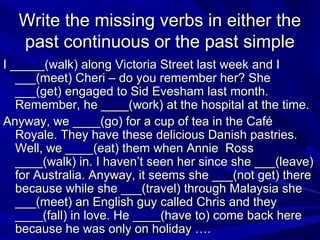
Write the missing verbs in either the
past continuous or the past simple
I _____(walk) along Victoria Street last week and I
___(meet) Cheri – do you remember her? She
___(get) engaged to Sid Evesham last month.
Remember, he ____(work) at the hospital at the time.
Anyway, we ____(go) for a cup of tea in the Café
Royale. They have these delicious Danish pastries.
Well, we ____(eat) them when Annie Ross
____(walk) in. I haven’t seen her since she ___(leave)
for Australia. Anyway, it seems she ___(not get) there
because while she ___(travel) through Malaysia she
___(meet) an English guy called Chris and they
____(fall) in love. He ____(have to) come back here
because he was only on holiday ….
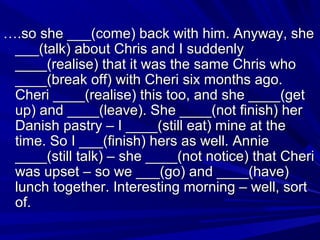
….so she ___(come) back with him. Anyway, she
___(talk) about Chris and I suddenly
____(realise) that it was the same Chris who
____(break off) with Cheri six months ago.
Cheri ____(realise) this too, and she ____(get
up) and ____(leave). She ____(not finish) her
Danish pastry – I ____(still eat) mine at the
time. So I ___(finish) hers as well. Annie
____(still talk) – she ____(not notice) that Cheri
was upset – so we ___(go) and ____(have)
lunch together. Interesting morning – well, sort
of.
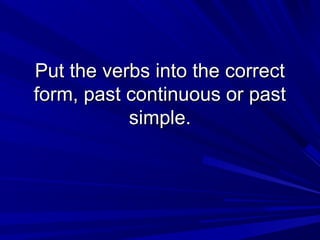
Put the verbs into the correct
form, past continuous or past
simple.
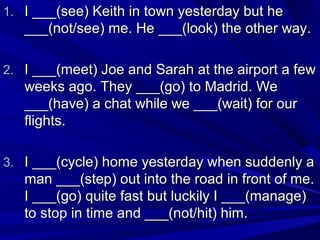
1. I ___(see) Keith in town yesterday but he

___(not/see) me. He ___(look) the other way.
2. I ___(meet) Joe and Sarah at the airport a few

weeks ago. They ___(go) to Madrid. We
___(have) a chat while we ___(wait) for our
flights.
3. I ___(cycle) home yesterday when suddenly a

man ___(step) out into the road in front of me.
I ___(go) quite fast but luckily I ___(manage)
to stop in time and ___(not/hit) him.

2 grammar-and-exercises

  • 1.
    Past continuous andPast simple To talk about a temporary situation that existed at or around a particular time in the past, we can use the past continuous.
  • 2.
    For example: At thetime of the robbery, they were staying with my parents. My head was aching again, so I went.
  • 3.
    Compare the useof the past continuous and the past simple in the following sentences
  • 4.
    She was shakingwith anger as she left the hotel. When he realised I was looking at him, he turned away. Sarah dropped her bag while she was getting into her car.
  • 5.
    We often usethe past simple to talk about a completed past events and the past continuous to describe the situation that existed at the time. The completed event might have interrupted the situation, or just occurred while the situation or event was in progress.
  • 6.
    However... We don’t normallyuse the past continuous with certain verbs describing states. This house belonged to the King of Sweden
  • 7.
    When we talkabout two past actions or events that went on over the same period of time, we can often use the past continuous for both.
  • 8.
    For example: Sally wasreading to the children while Kevin was washing up. Mario was working in a resturant when I was living in London.
  • 9.
    However... We can oftenuse the past simple to express a similar meaning: Mario worked in a resturant while he lived in London.
  • 10.
    When we talkabout two or more past completed events that follow each other, we use the past simple for both. The first may have caused the second.
  • 11.
    For example She gotup when the alarm clock went off. He jumped out of bed and ran to see who the parcel was for.
  • 12.
    When we talkabout a permanent or longterm situation that existed in the past, we use the past simple rather than the past continuous. When I was a child I played the violin.
  • 13.
    However, if thesituation was temporary, we can also use the past continuous.
  • 14.
    For example I wasworking in a car factory during the summer of 1976. (or I worked....) He worked hard all his life.
  • 15.
    We use thepast simple rather than the past continuous when we are talking about repeated actions or events in the past.
  • 16.
    For example We visitedSpain three times last year. I went past her house every day. She slept very badly whenever she stayed with her grandparents.
  • 17.
    Look at thesesentences: 1. When his wife walked in, he dropped his 2. 3. 4. glass. When his wife walked in, he was dropping his glass. When his wife was walking in, he was dropping his glass. When his wife was walking in, he dropped his glass. Which are correct?
  • 18.
    past simple orpast continuous? Now look at these two sentences: A. She looked away when I spoke to her. B. She was looking away when I spoke to her. In which one, A or B, do we get the idea that perhaps she was angry with me?
  • 19.
    Think about itanother way: …she looked away. …she was looking away. Which action seems quicker? Looked away. So if we want to suggest looked away is a quick action, because I spoke to her, sentence A is better. In sentence B, was looking away suggests a longer action. Perhaps she was looking away before I spoke to her.
  • 20.
    We use thepast continuous to describe a longer action. I spoke to Tom yesterday. I was speaking to Tom yesterday.
  • 21.
    Now think aboutsentences 1 – 4 again. 1. When his wife walked in, he dropped his glass. This one is most likely – she walked in and he drops the glass – two short actions. 2. When his wife walked in, he was dropping his glass. This is almost impossible. You can’t drop a glass slowly. 3. When his wife was walking in, he was dropping his glass. The same problem here. 4. When his wife was walking in, he dropped his glass. This is possible. She walks in more slowly and he drops the glass. Maybe she just felt tired.
  • 22.
    Now decide whichsentences are possible . In each pair, it might be one – or both. a. While I was having a shower, the phone rang. b. While I was having a shower, the phone was c. d. e. f. ringing. While he was walking home in the storm, a tree fell down. While he was walking home in the storm, a tree was falling down. When Mark saw Mary he was speaking to her. When Mark saw Mary he spoke to her.
  • 23.
    a. b. c. d. e. f. While she waswalking along the street, she was speaking to the baby. While she walked along the street, she was speaking to the baby. When the car left the track, a wheel came off. When the car was leaving the track, a wheel came off. While she was having lunch, the fire alarm was ringing. While she was having lunch, the fire alarm rang.
  • 24.
    when or while? Weoften use while instead of when with the past continuous because it stresses that the action is longer. However, it is not wrong to use when in sentences like this. When I was having a shower. (is possible) While I was having a shower. (is maybe better)
  • 25.
    Past continuous orpast simple? While Ben ____(eat) his soup, the cat ___(jump) up on the table. 2. She ___(unpack) the shopping when I ___(get) home. 3. When Nick ___(arrive) at school, the pupils ___(leave). 4. I ___(watch) TV while Joel ___(tell) her the news. 5. I ___(take) a photo when they ___(feed) the lions. 6. Mary ___(talk) to Ian when I ___(see) them. 7. He ____(live) with his mother when they ____(get) married. 8. Amy ____(have) a bath while Maggie ____(cook) the dinner. 9. While Joe ___(work) in London, Kevin ____(travel). 10. While I ____(talk) to the other driver, the police ____(turn up). 1.
  • 26.
    Write the missingverbs in either the past continuous or the past simple I _____(walk) along Victoria Street last week and I ___(meet) Cheri – do you remember her? She ___(get) engaged to Sid Evesham last month. Remember, he ____(work) at the hospital at the time. Anyway, we ____(go) for a cup of tea in the Café Royale. They have these delicious Danish pastries. Well, we ____(eat) them when Annie Ross ____(walk) in. I haven’t seen her since she ___(leave) for Australia. Anyway, it seems she ___(not get) there because while she ___(travel) through Malaysia she ___(meet) an English guy called Chris and they ____(fall) in love. He ____(have to) come back here because he was only on holiday ….
  • 27.
    ….so she ___(come)back with him. Anyway, she ___(talk) about Chris and I suddenly ____(realise) that it was the same Chris who ____(break off) with Cheri six months ago. Cheri ____(realise) this too, and she ____(get up) and ____(leave). She ____(not finish) her Danish pastry – I ____(still eat) mine at the time. So I ___(finish) hers as well. Annie ____(still talk) – she ____(not notice) that Cheri was upset – so we ___(go) and ____(have) lunch together. Interesting morning – well, sort of.
  • 28.
    Put the verbsinto the correct form, past continuous or past simple.
  • 29.
    1. I ___(see)Keith in town yesterday but he ___(not/see) me. He ___(look) the other way. 2. I ___(meet) Joe and Sarah at the airport a few weeks ago. They ___(go) to Madrid. We ___(have) a chat while we ___(wait) for our flights. 3. I ___(cycle) home yesterday when suddenly a man ___(step) out into the road in front of me. I ___(go) quite fast but luckily I ___(manage) to stop in time and ___(not/hit) him.