LOGO
Travellers’ Tales
www.themegallery.com
Contents
Reading: matching, reading gist and specific information , scanning
for specific information and detailed comprehension
1
Vocabulary: types of holidays, climate and weather, means of
transport, adjectives expressing feelings
Intonation: Expressing annoyance
2
Grammar: past simple, past continuous,
Listening: listening for specific information , gap-fill
3
Speaking : talking about holidays, talking about the weather
and climates, expressing feelings
Writing: a holiday advertisement, a weather forecast, a short
factual text, a story
4
The people in pictures 1-4 live in the USA and are all trying to choose
a holiday, decide which of the holidays (A-F) is the most suitable for
the people (1-4)
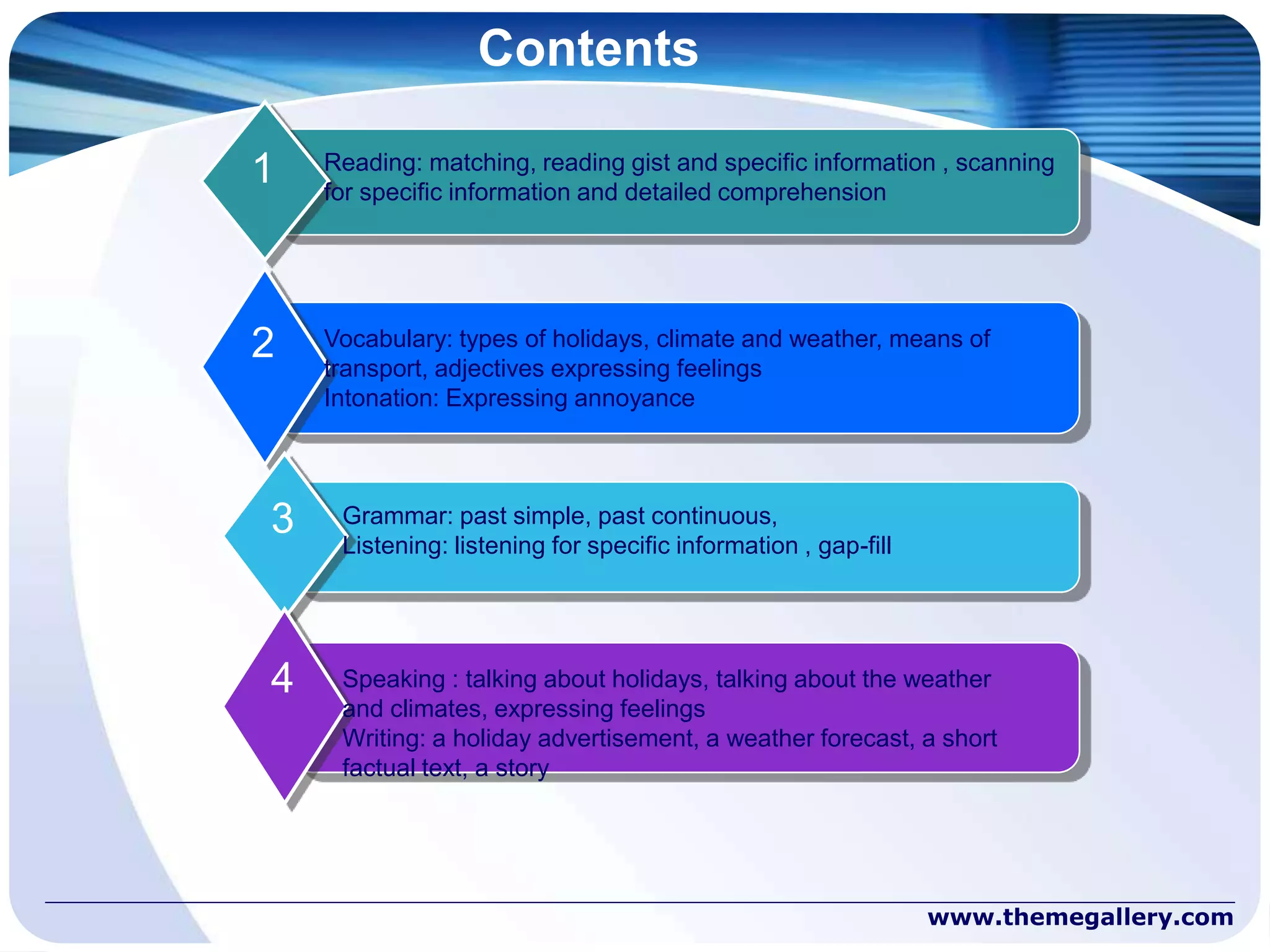
Danny and Lisa have been married for ten years
and are planning a special holiday. They both
like exotic places and wildlife photography. They
are looking for an unforgettable holiday full of
surprises.
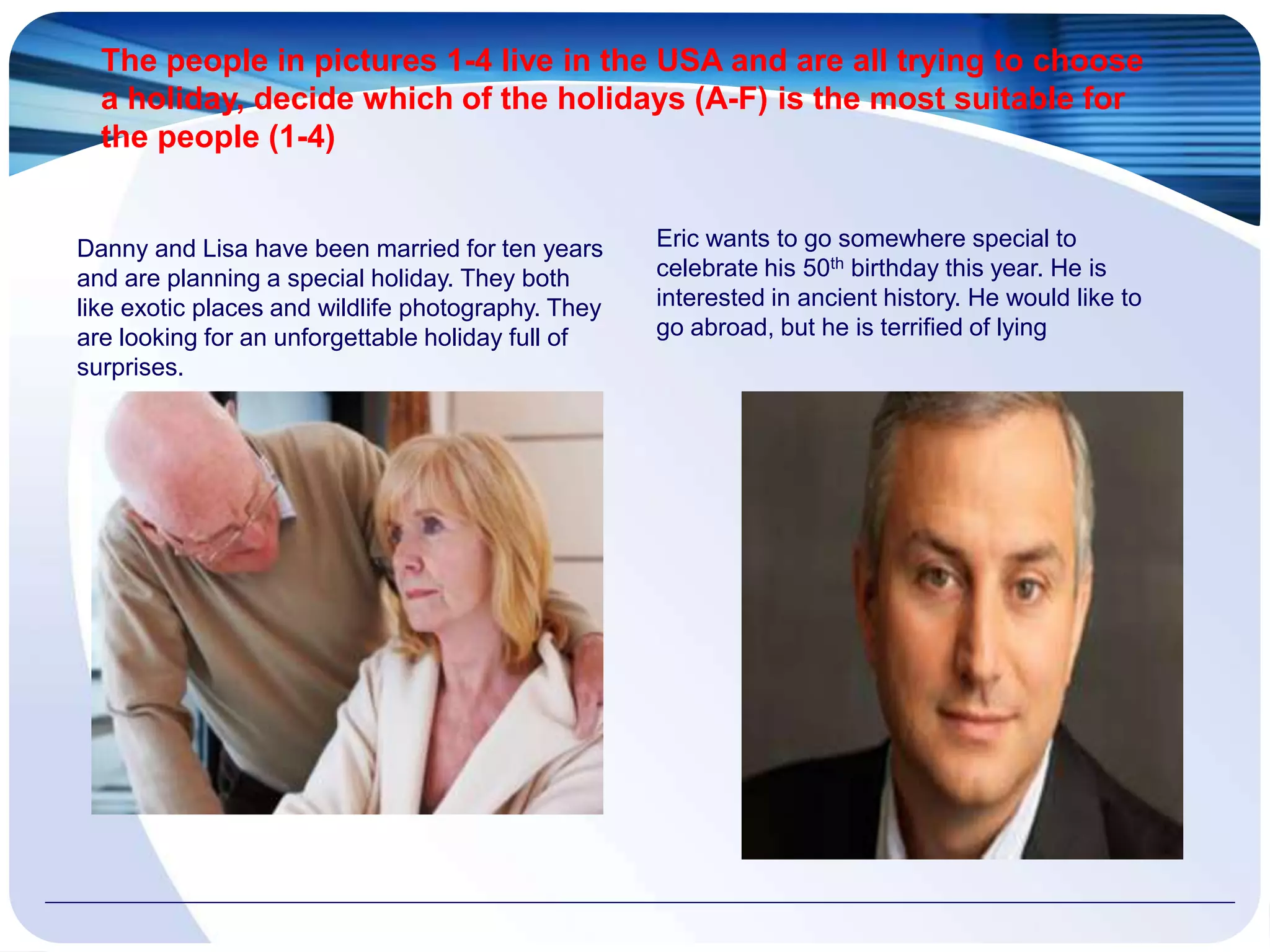
Eric wants to go somewhere special to
celebrate his 50th birthday this year. He is
interested in ancient history. He would like to
go abroad, but he is terrified of lying
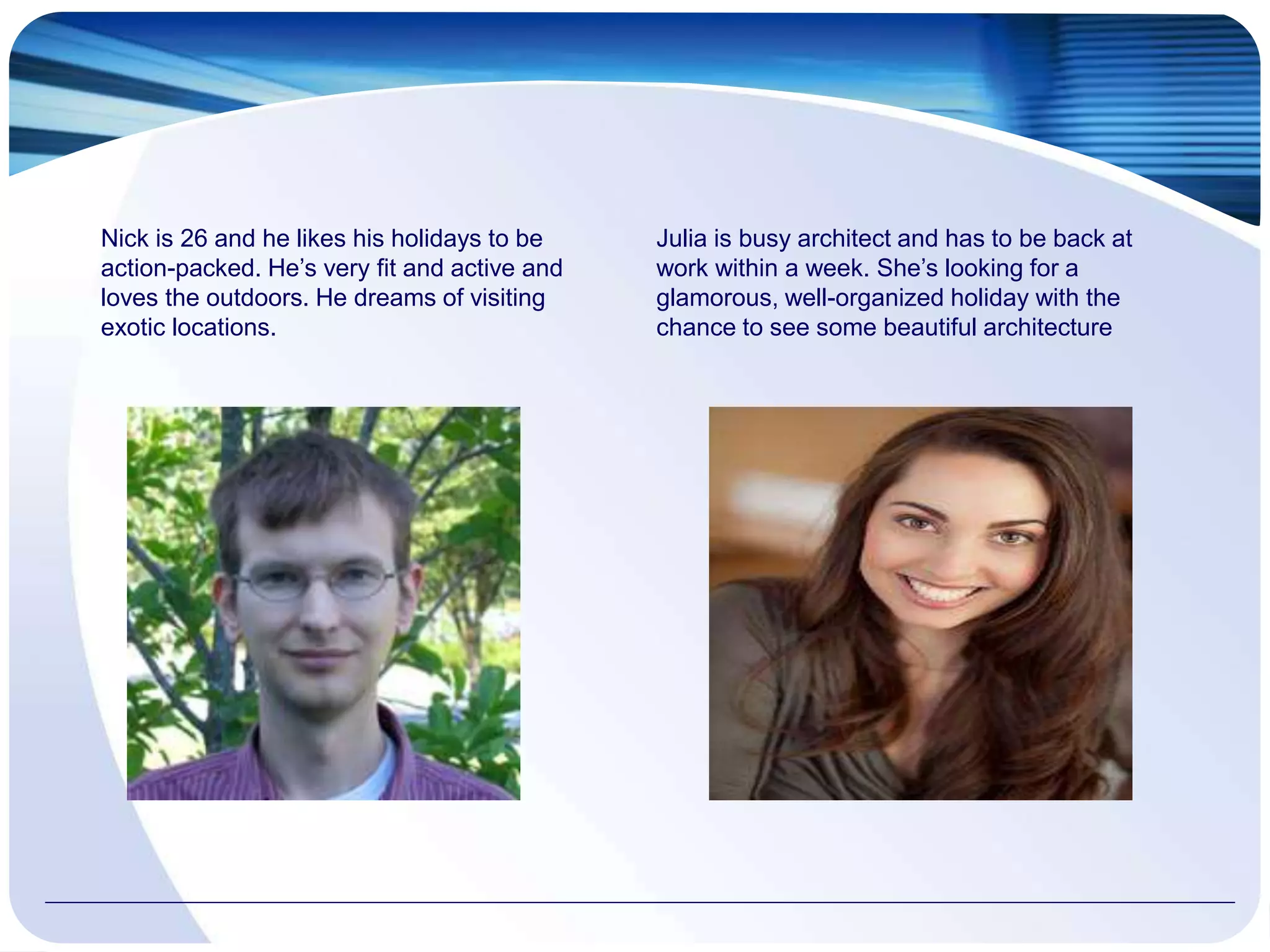
Nick is 26 and he likes his holidays to be
action-packed. He’s very fit and active and
loves the outdoors. He dreams of visiting
exotic locations.
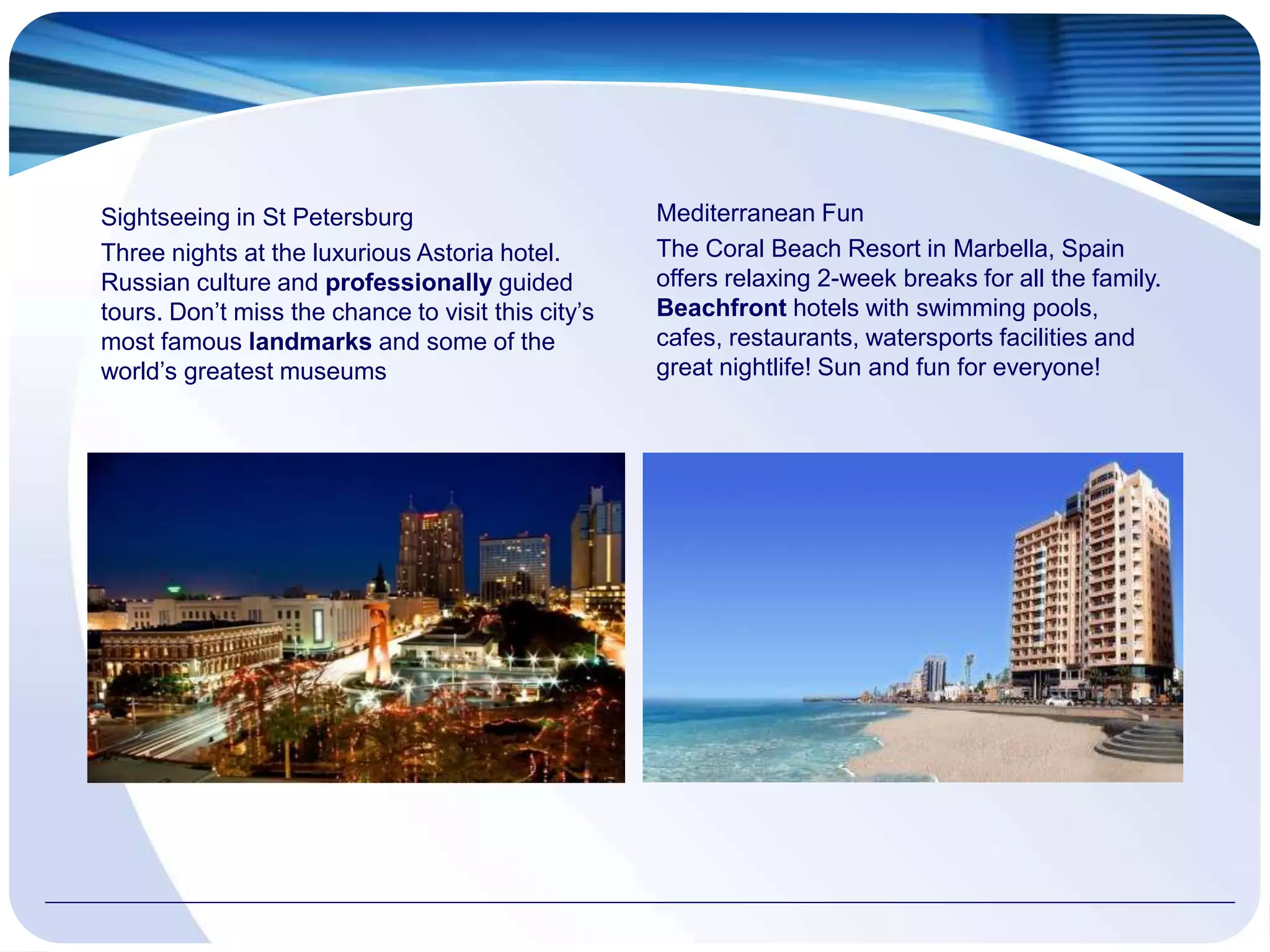
Julia is busy architect and has to be back at
work within a week. She’s looking for a
glamorous, well-organized holiday with the
chance to see some beautiful architecture
Sightseeing in St Petersburg
Three nights at the luxurious Astoria hotel.
Russian culture and professionally guided
tours. Don’t miss the chance to visit this city’s
most famous landmarks and some of the
world’s greatest museums
Mediterranean Fun
The Coral Beach Resort in Marbella, Spain
offers relaxing 2-week breaks for all the family.
Beachfront hotels with swimming pools,
cafes, restaurants, watersports facilities and
great nightlife! Sun and fun for everyone!
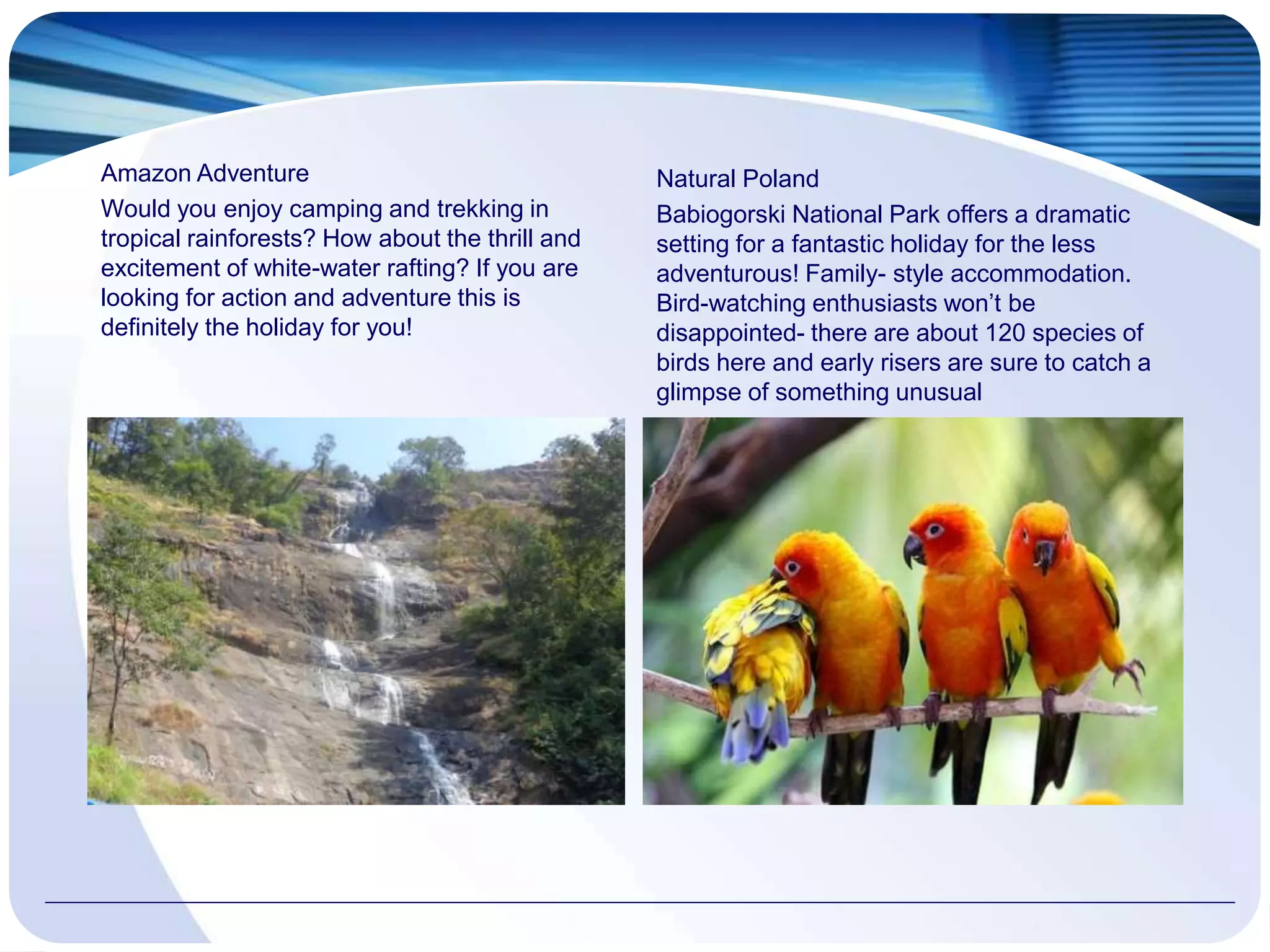
Amazon Adventure
Would you enjoy camping and trekking in
tropical rainforests? How about the thrill and
excitement of white-water rafting? If you are
looking for action and adventure this is
definitely the holiday for you!
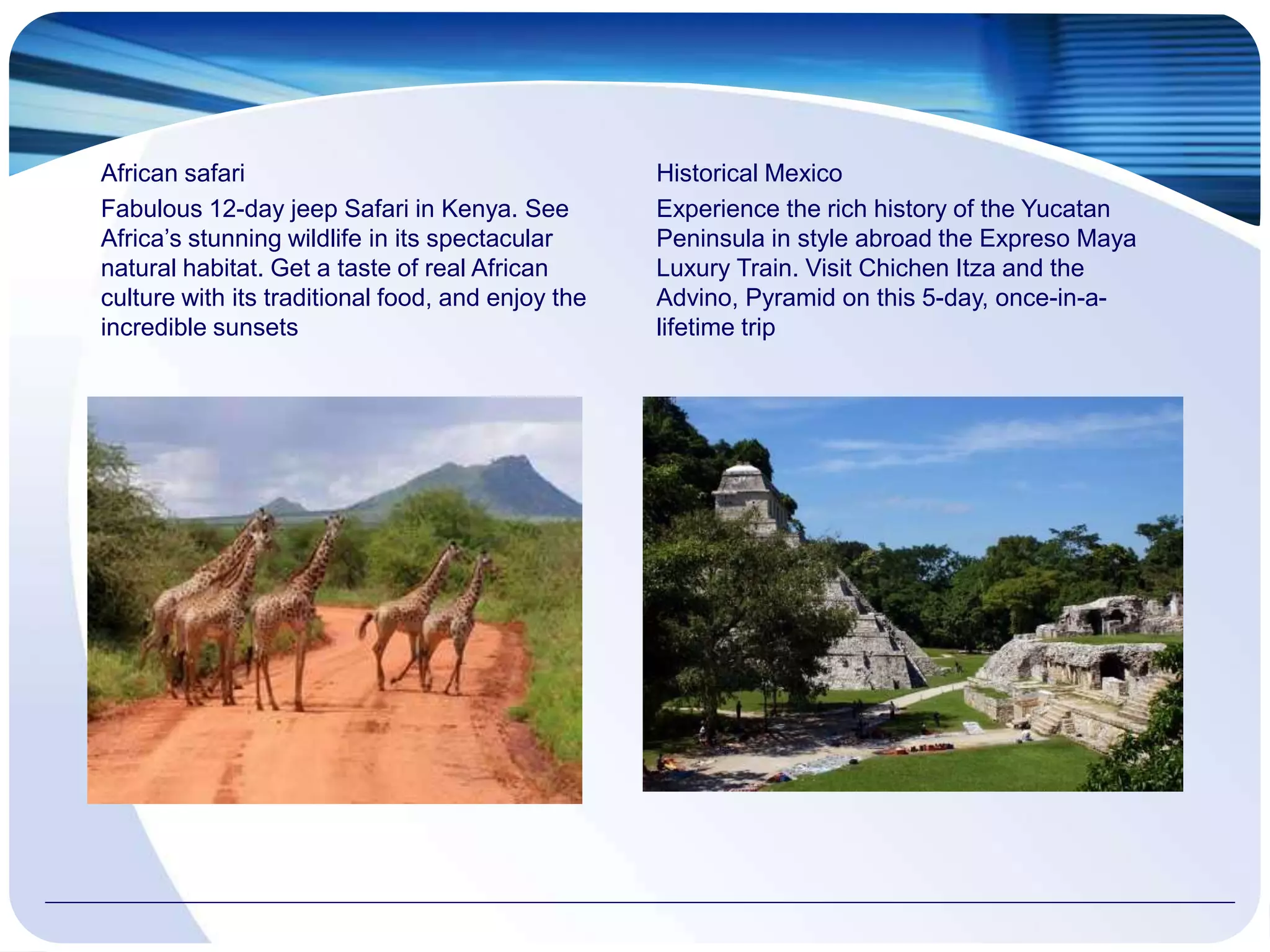
Natural Poland
Babiogorski National Park offers a dramatic
setting for a fantastic holiday for the less
adventurous! Family- style accommodation.
Bird-watching enthusiasts won’t be
disappointed- there are about 120 species of
birds here and early risers are sure to catch a
glimpse of something unusual
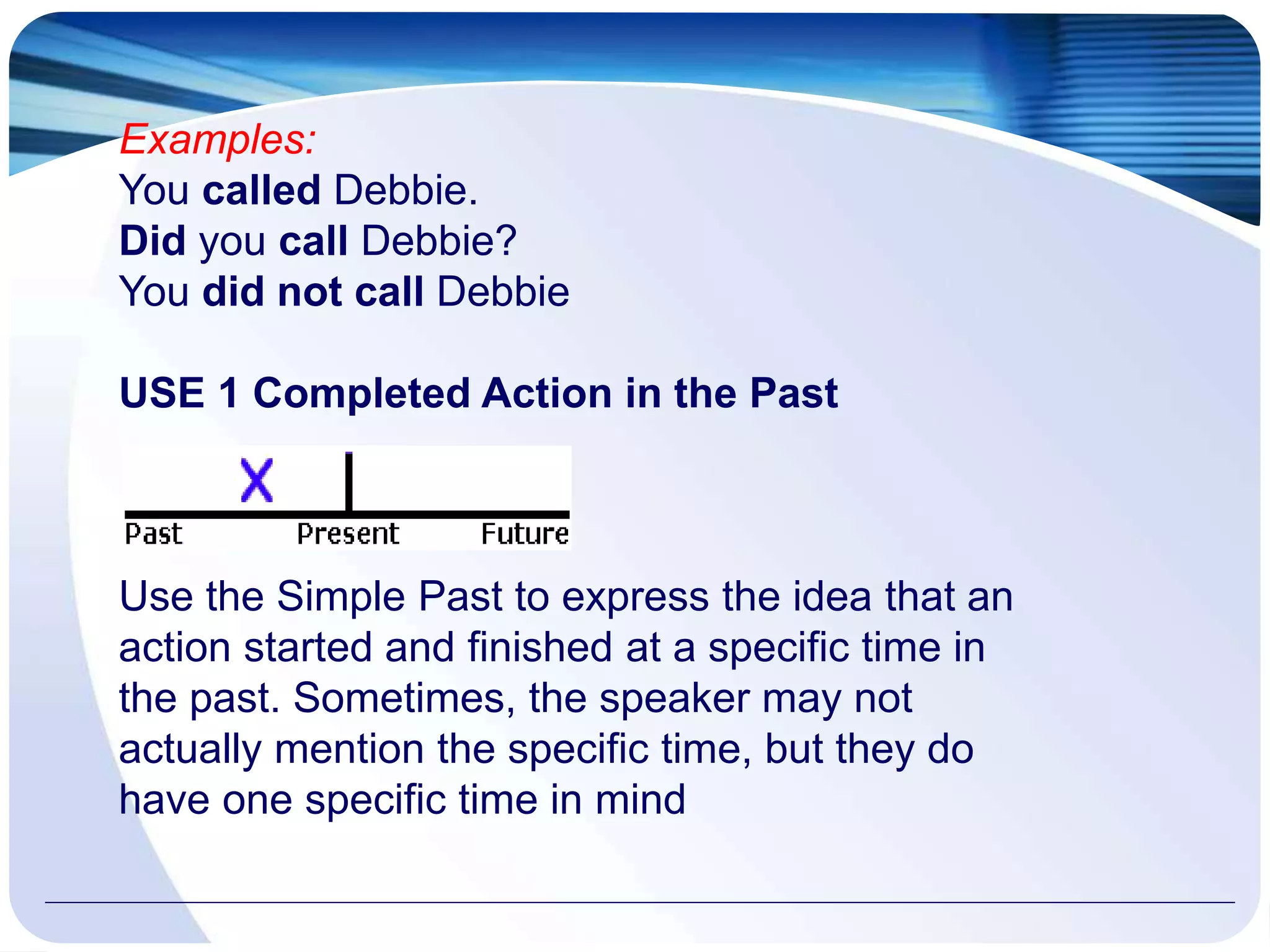
African safari
Fabulous 12-day jeep Safari in Kenya. See
Africa’s stunning wildlife in its spectacular
natural habitat. Get a taste of real African
culture with its traditional food, and enjoy the
incredible sunsets
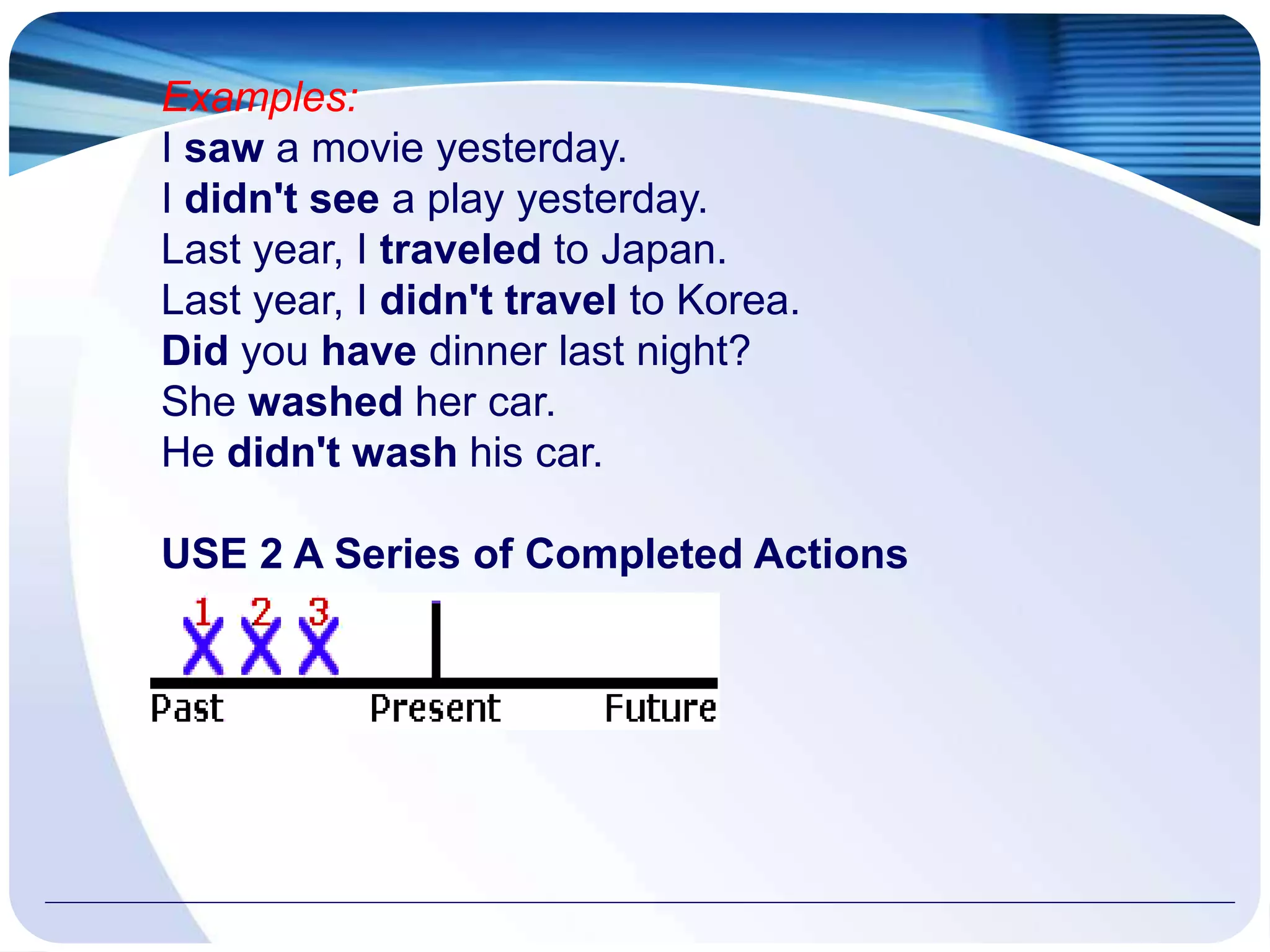
Historical Mexico
Experience the rich history of the Yucatan
Peninsula in style abroad the Expreso Maya
Luxury Train. Visit Chichen Itza and the
Advino, Pyramid on this 5-day, once-in-a-
lifetime trip
LOGO
Past Simple Tense
[VERB+ed] or irregular verbs
Examples:
You called Debbie.
Did you call Debbie?
You did not call Debbie
USE 1 Completed Action in the Past
Use the Simple Past to express the idea that an
action started and finished at a specific time in
the past. Sometimes, the speaker may not
actually mention the specific time, but they do
have one specific time in mind
Examples:
I saw a movie yesterday.
I didn't see a play yesterday.
Last year, I traveled to Japan.
Last year, I didn't travel to Korea.
Did you have dinner last night?
She washed her car.
He didn't wash his car.
USE 2 A Series of Completed Actions
We use the Simple Past to list a series of
completed actions in the past. These
actions happen 1st, 2nd, 3rd, 4th, and so
on.
Examples:
I finished work, walked to the beach,
and found a nice place to swim.
He arrived from the airport at
8:00, checked into the hotel at 9:00,
and met the others at 10:00.
Did you add flour, pour in the milk, and
then add the eggs?
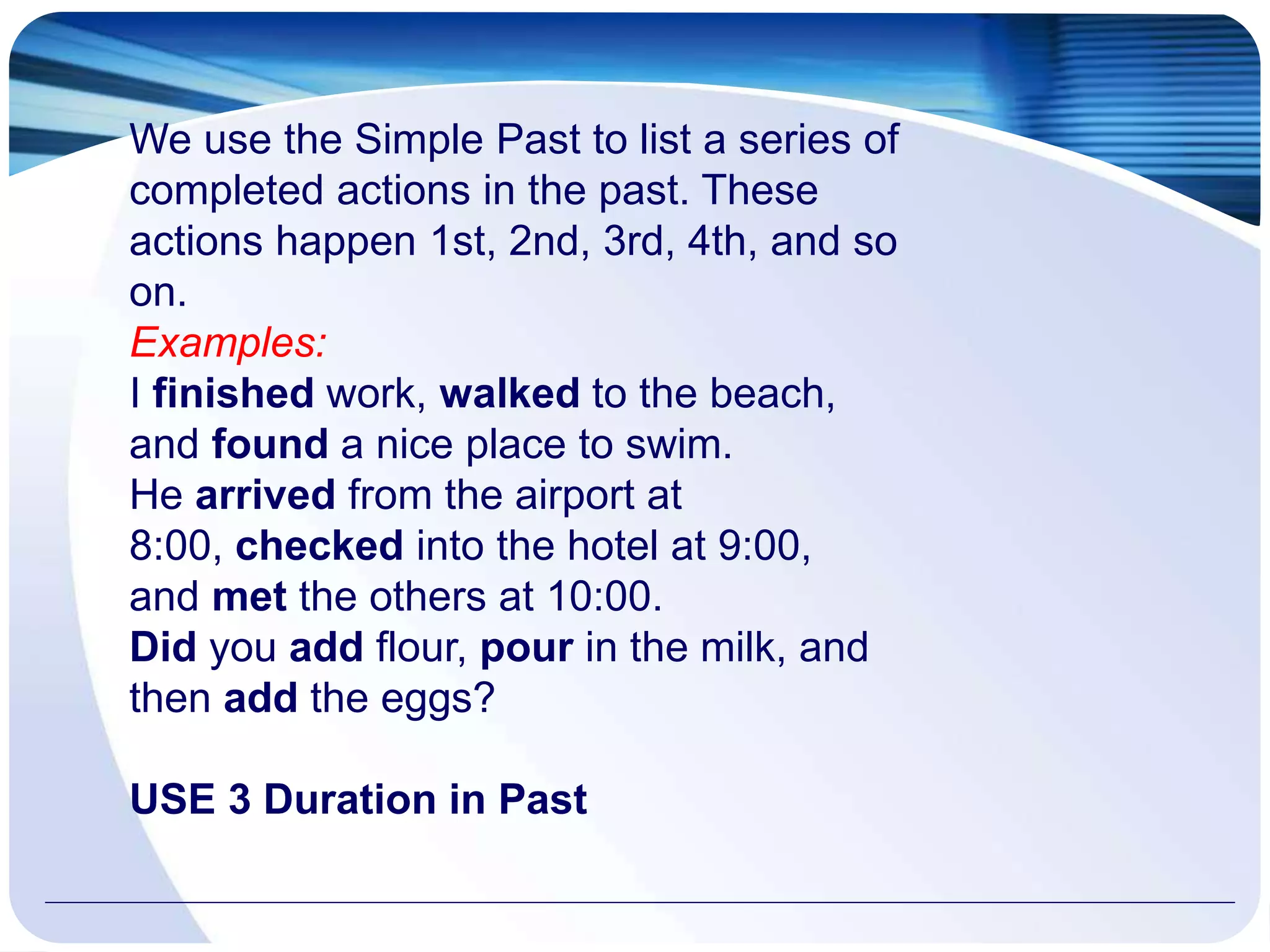
USE 3 Duration in Past
The Simple Past can be used with a duration
which starts and stops in the past. A duration is a
longer action often indicated by expressions
such as: for two years, for five minutes, all day,
all year, etc.
Examples:
I lived in Brazil for two years.
Shauna studied Japanese for five years.
They sat at the beach all day.
They did not stay at the party the entire time.
We talked on the phone for thirty minutes.
A: How long did you wait for them?
B: We waited for one hour.
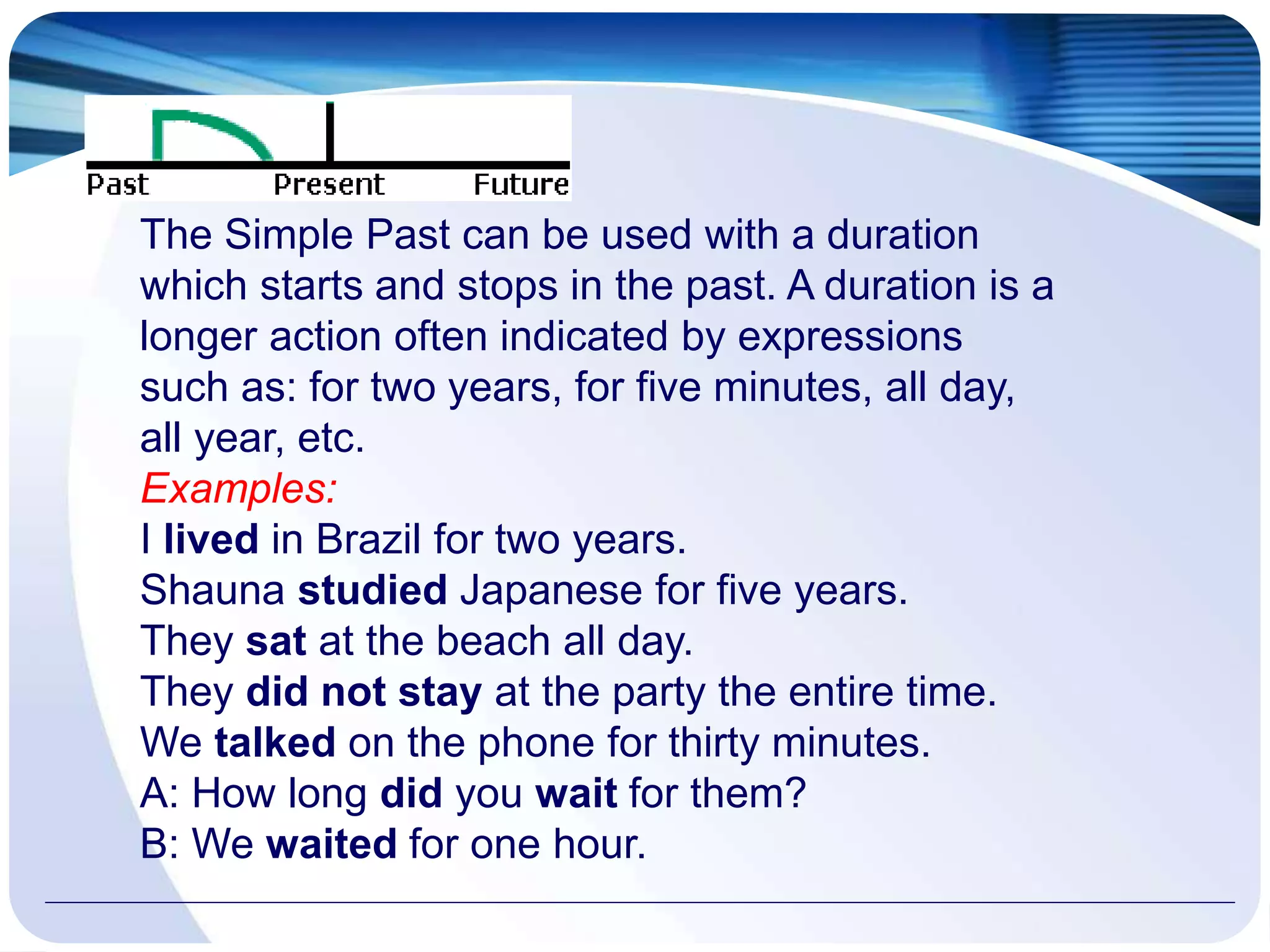
USE 4 Habits in the Past
The Simple Past can also be used to describe a habit which
stopped in the past. It can have the same meaning
as “Used to” To make it clear that we are talking about a
habit, we often add expressions such as: always, often,
usually, never, when I was a child, when I was younger, etc.
Examples:
I studied French when I was a child.
He played the violin.
He didn't play the piano.
Did you play a musical instrument when you were a kid?
She worked at the movie theater after school.
They never went to school, they always skipped class.
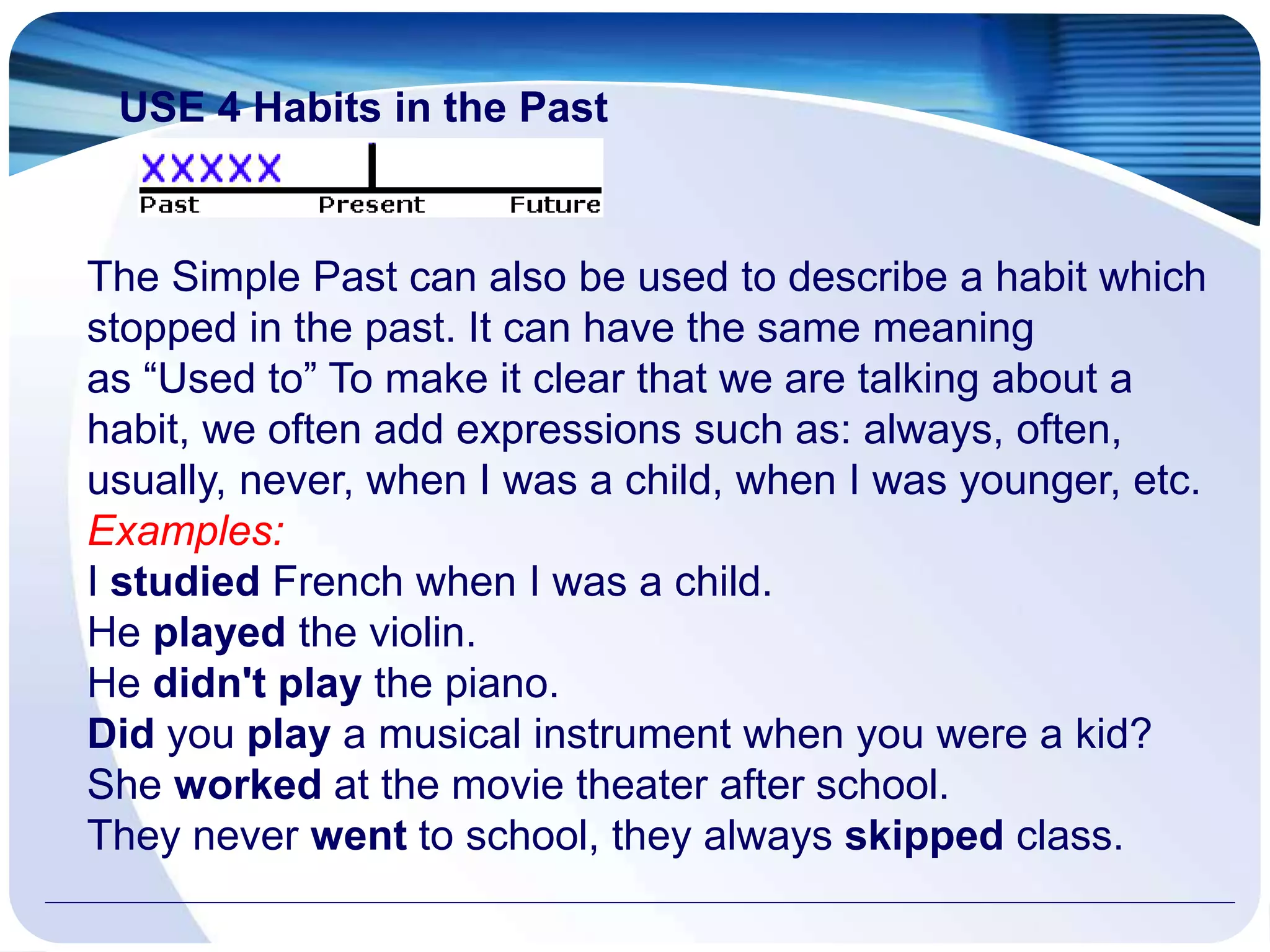
USE 5 Past Facts or Generalizations
The Simple Past can also be used to describe past facts or
generalizations which are no longer true. As in USE 4
above, this use of the Simple Past is quite similar to the
expression “ used to”
Examples:
She was shy as a child, but now she is very outgoing.
He didn't like tomatoes before.
Did you live in Texas when you were a kid?
People paid much more to make cell phone calls in the
past.
LOGO
Past Continuous Tense
FORM
[was/were + present participle]
Examples:
You were studying when she called.
Were you studying when she called?
You were not studying when she called.
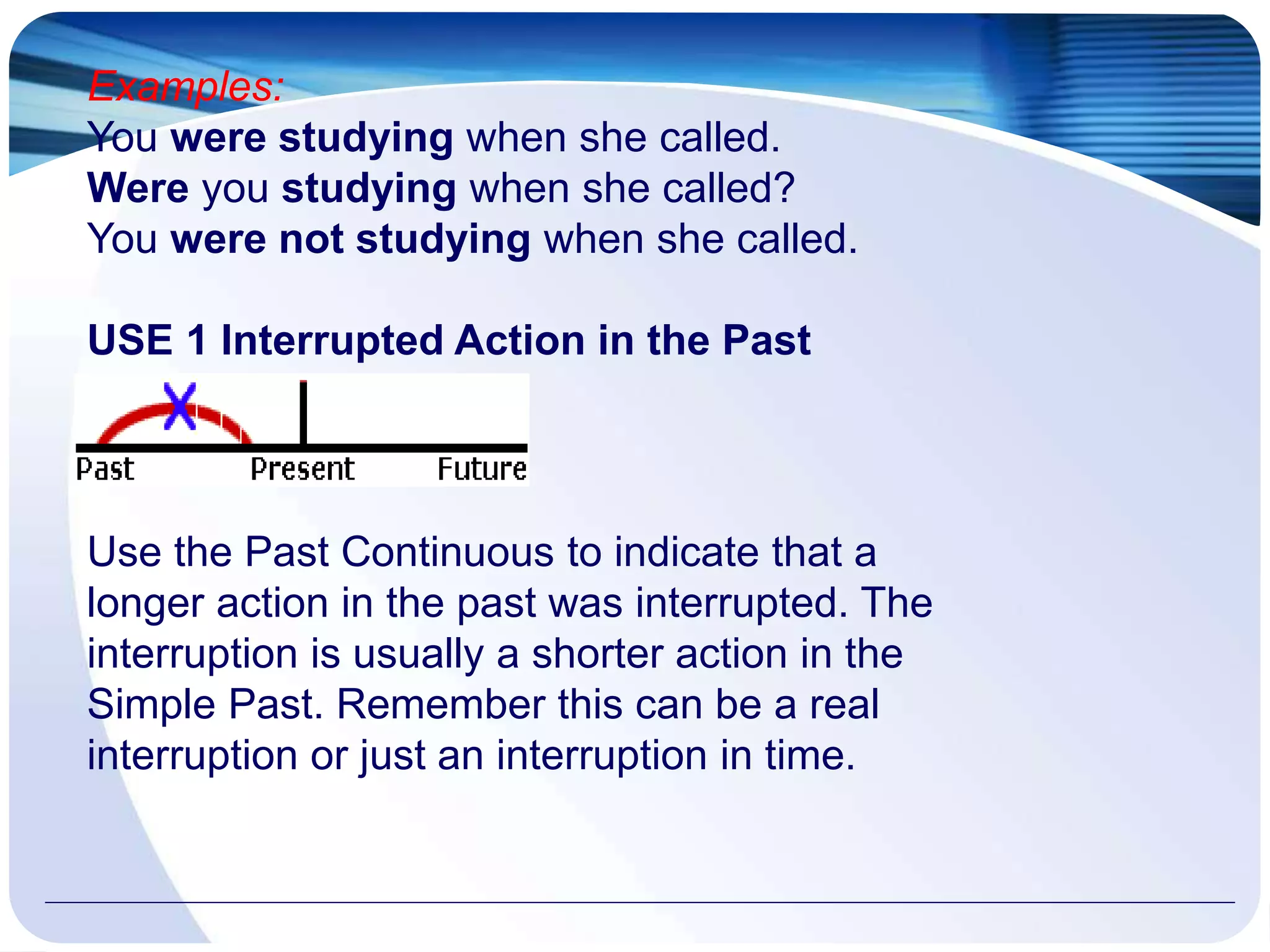
USE 1 Interrupted Action in the Past
Use the Past Continuous to indicate that a
longer action in the past was interrupted. The
interruption is usually a shorter action in the
Simple Past. Remember this can be a real
interruption or just an interruption in time.
Examples:
I was watching TV when she called.
When the phone rang, she was writing a letter.
While we were having the picnic, it started to rain.
What were you doing when the earthquake started?
I was listening to my iPod, so I didn't hear the fire alarm.
You were not listening to me when I told you to turn the
oven off.
While John was sleeping last night, someone stole his
car.
Sammy was waiting for us when we got off the plane.
While I was writing the email, the computer suddenly
went off.
A: What were you doing when you broke your leg?
B: I was snowboarding.
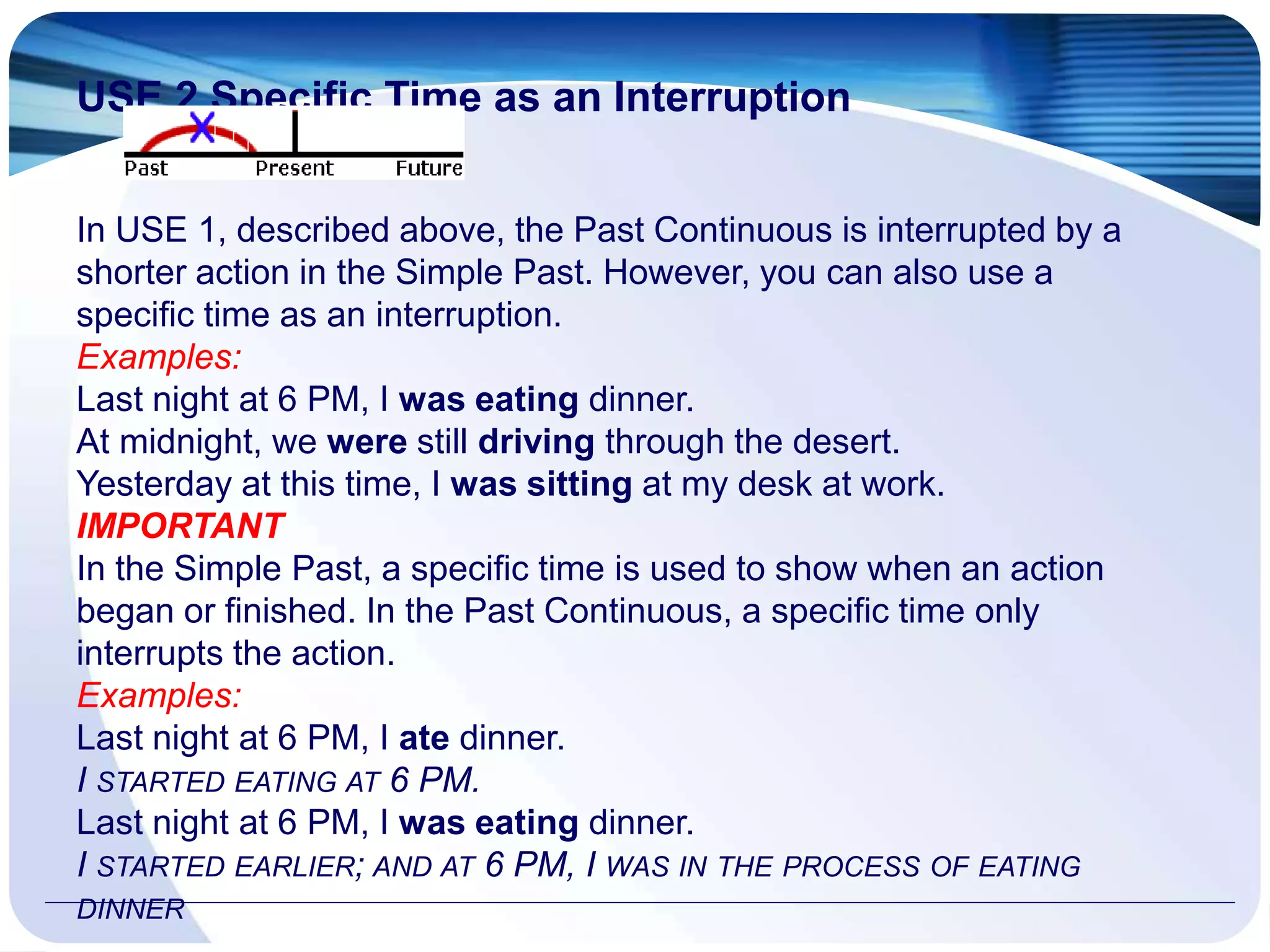
USE 2 Specific Time as an Interruption
In USE 1, described above, the Past Continuous is interrupted by a
shorter action in the Simple Past. However, you can also use a
specific time as an interruption.
Examples:
Last night at 6 PM, I was eating dinner.
At midnight, we were still driving through the desert.
Yesterday at this time, I was sitting at my desk at work.
IMPORTANT
In the Simple Past, a specific time is used to show when an action
began or finished. In the Past Continuous, a specific time only
interrupts the action.
Examples:
Last night at 6 PM, I ate dinner.
I STARTED EATING AT 6 PM.
Last night at 6 PM, I was eating dinner.
I STARTED EARLIER; AND AT 6 PM, I WAS IN THE PROCESS OF EATING
DINNER
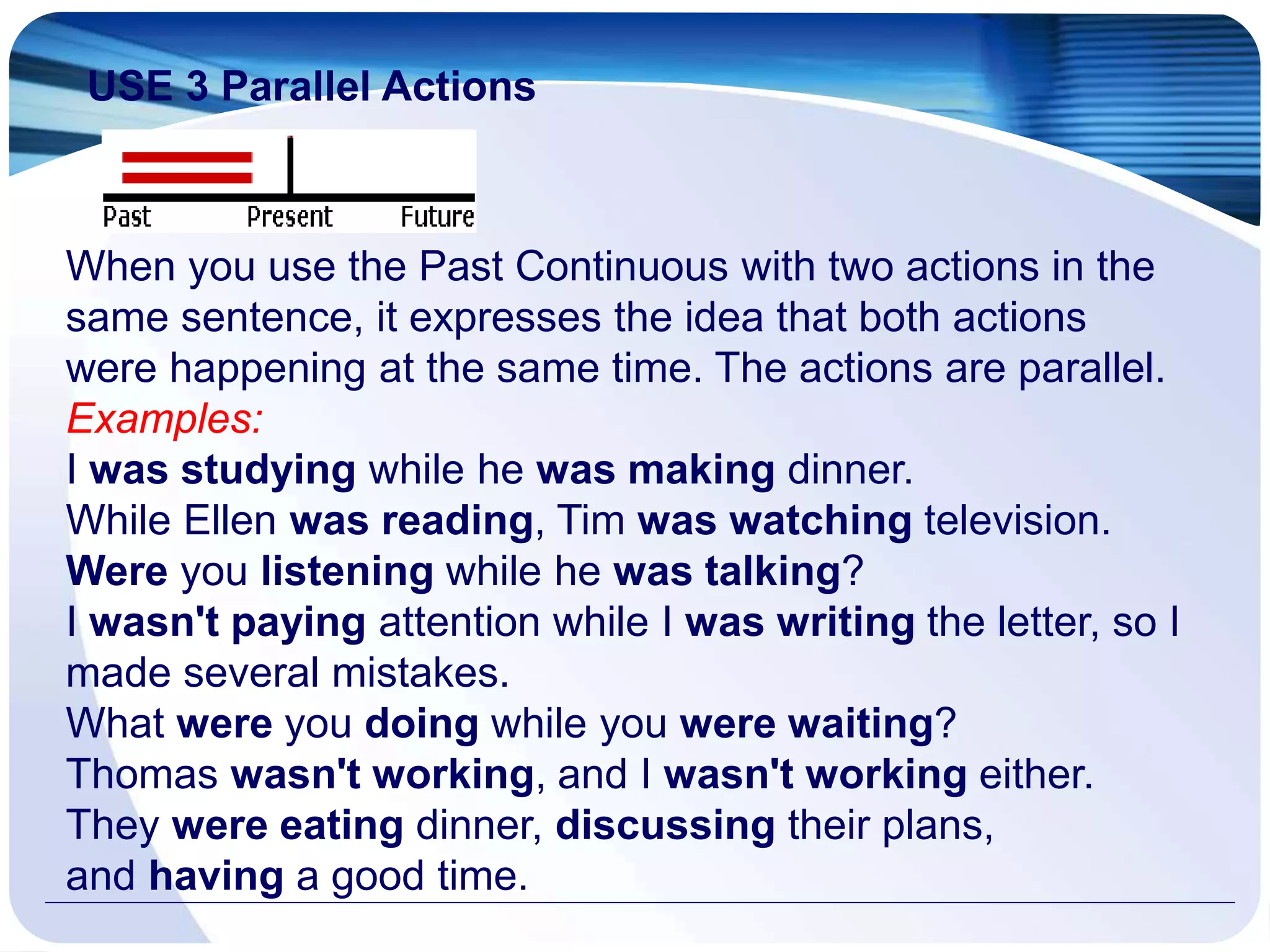
USE 3 Parallel Actions
When you use the Past Continuous with two actions in the
same sentence, it expresses the idea that both actions
were happening at the same time. The actions are parallel.
Examples:
I was studying while he was making dinner.
While Ellen was reading, Tim was watching television.
Were you listening while he was talking?
I wasn't paying attention while I was writing the letter, so I
made several mistakes.
What were you doing while you were waiting?
Thomas wasn't working, and I wasn't working either.
They were eating dinner, discussing their plans,
and having a good time.
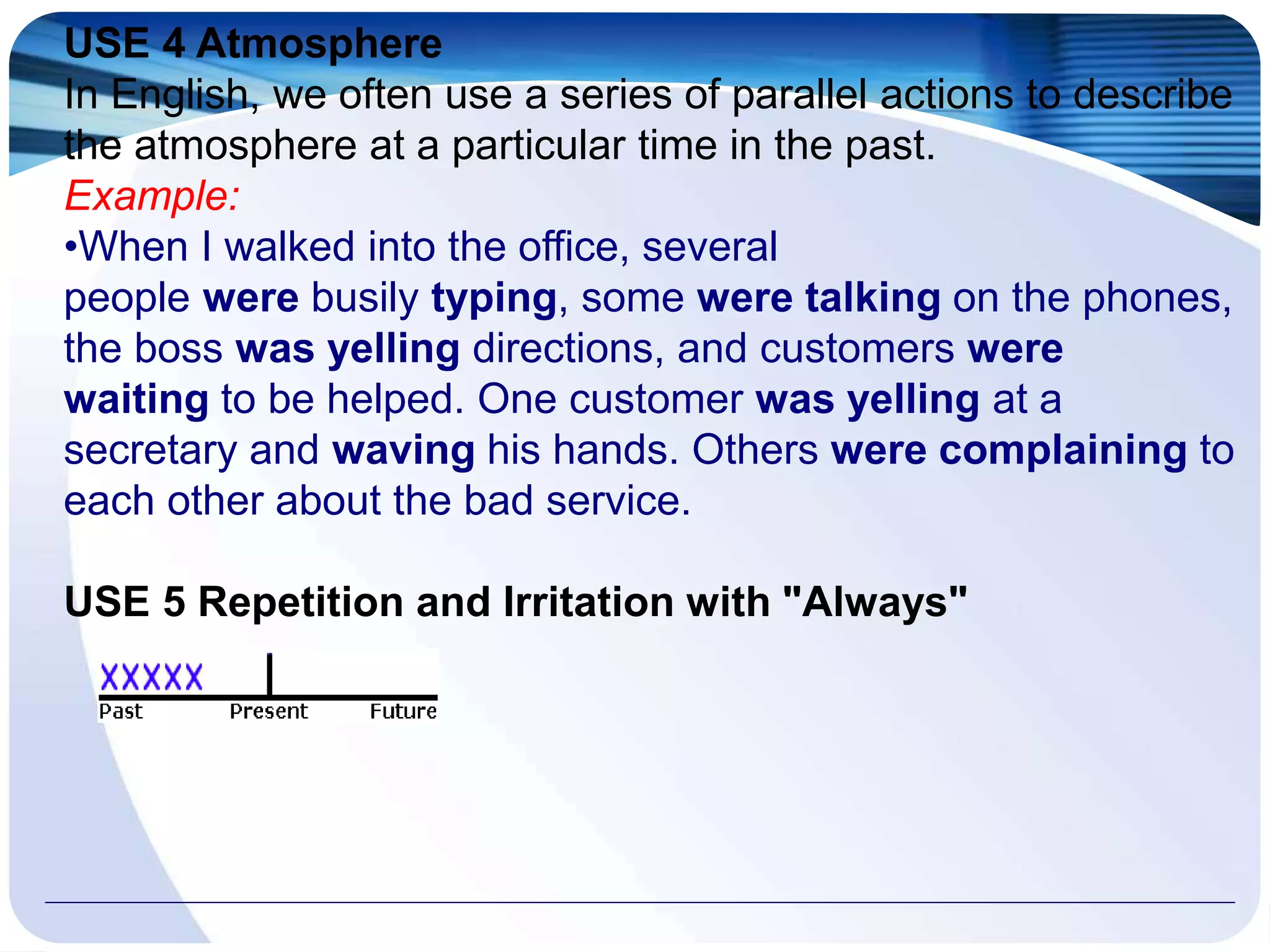
USE 4 Atmosphere
In English, we often use a series of parallel actions to describe
the atmosphere at a particular time in the past.
Example:
•When I walked into the office, several
people were busily typing, some were talking on the phones,
the boss was yelling directions, and customers were
waiting to be helped. One customer was yelling at a
secretary and waving his hands. Others were complaining to
each other about the bad service.
USE 5 Repetition and Irritation with "Always"
The Past Continuous with words such as "always" or "constantly"
expresses the idea that something irritating or shocking often happened in
the past. The concept is very similar to the expression “ used to” but with
negative emotion. Remember to put the words "always" or "constantly"
between "be" and "verb+ing."
Examples:
She was always coming to class late.
He was constantly talking. He annoyed everyone.
I didn't like them because they were always complaining.
While vs. When
Clauses are groups of words which have meaning, but are often not
complete sentences. Some clauses begin with the word "when" such as
"when she called" or "when it bit me." Other clauses begin with "while" such
as "while she was sleeping" and "while he was surfing." When you talk
about things in the past, "when" is most often followed by the verb tense
Simple Past, whereas "while" is usually followed by Past Continuous.
"While" expresses the idea of "during that time." Study the examples below.
They have similar meanings, but they emphasize different parts of the
sentence.
Examples:
I was studying when she called.
While I was studying, she called.
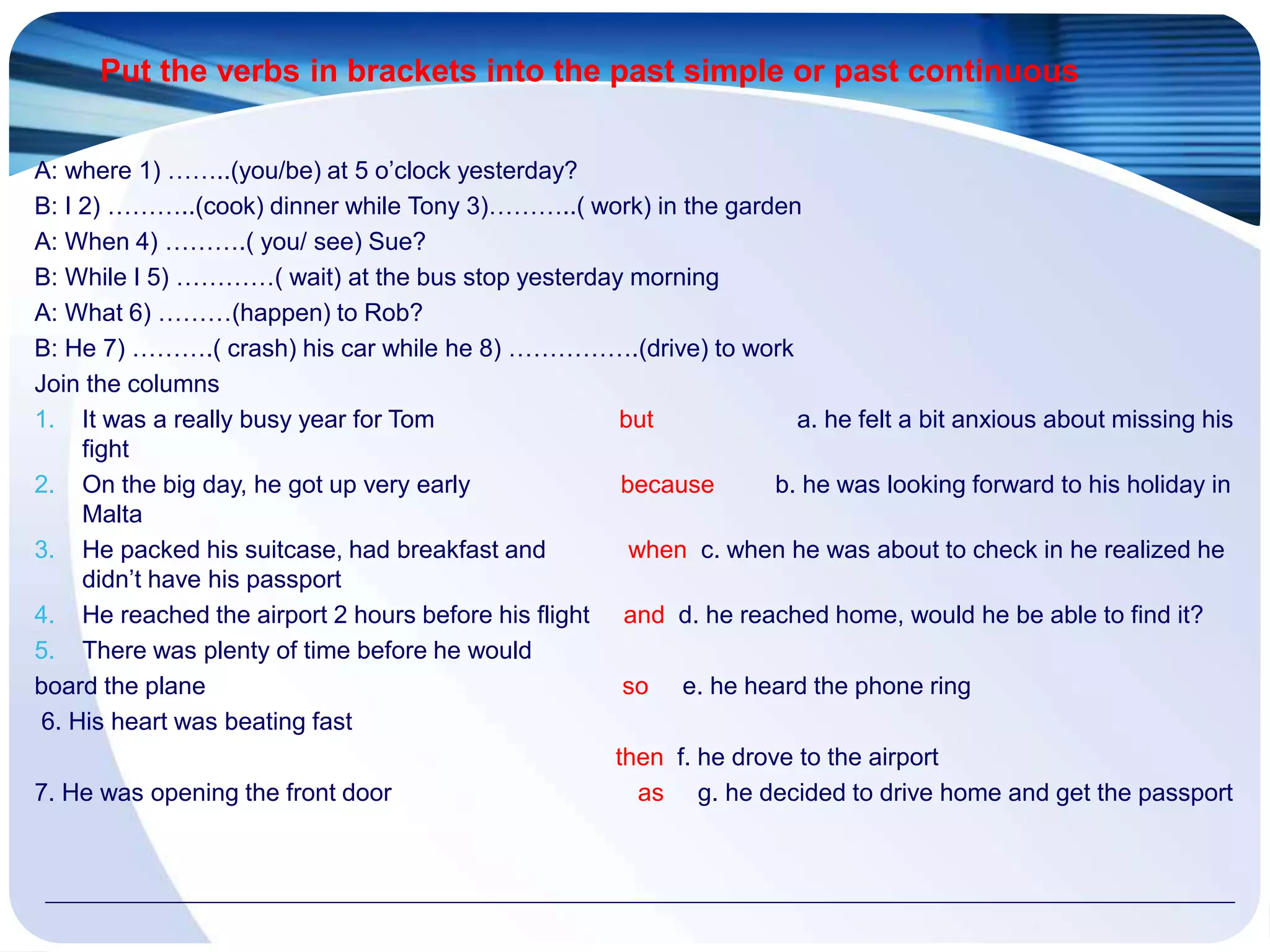
Put the verbs in brackets into the past simple or past continuous
A: where 1) ……..(you/be) at 5 o’clock yesterday?
B: I 2) ………..(cook) dinner while Tony 3)………..( work) in the garden
A: When 4) ……….( you/ see) Sue?
B: While I 5) …………( wait) at the bus stop yesterday morning
A: What 6) ………(happen) to Rob?
B: He 7) ……….( crash) his car while he 8) …………….(drive) to work
Join the columns
1. It was a really busy year for Tom but a. he felt a bit anxious about missing his
fight
2. On the big day, he got up very early because b. he was looking forward to his holiday in
Malta
3. He packed his suitcase, had breakfast and when c. when he was about to check in he realized he
didn’t have his passport
4. He reached the airport 2 hours before his flight and d. he reached home, would he be able to find it?
5. There was plenty of time before he would
board the plane so e. he heard the phone ring
6. His heart was beating fast
then f. he drove to the airport
7. He was opening the front door as g. he decided to drive home and get the passport
LOGO

Unit IV

  • 1.
  • 2.
    www.themegallery.com Contents Reading: matching, readinggist and specific information , scanning for specific information and detailed comprehension 1 Vocabulary: types of holidays, climate and weather, means of transport, adjectives expressing feelings Intonation: Expressing annoyance 2 Grammar: past simple, past continuous, Listening: listening for specific information , gap-fill 3 Speaking : talking about holidays, talking about the weather and climates, expressing feelings Writing: a holiday advertisement, a weather forecast, a short factual text, a story 4
  • 3.
    The people inpictures 1-4 live in the USA and are all trying to choose a holiday, decide which of the holidays (A-F) is the most suitable for the people (1-4) Danny and Lisa have been married for ten years and are planning a special holiday. They both like exotic places and wildlife photography. They are looking for an unforgettable holiday full of surprises. Eric wants to go somewhere special to celebrate his 50th birthday this year. He is interested in ancient history. He would like to go abroad, but he is terrified of lying
  • 4.
    Nick is 26and he likes his holidays to be action-packed. He’s very fit and active and loves the outdoors. He dreams of visiting exotic locations. Julia is busy architect and has to be back at work within a week. She’s looking for a glamorous, well-organized holiday with the chance to see some beautiful architecture
  • 5.
    Sightseeing in StPetersburg Three nights at the luxurious Astoria hotel. Russian culture and professionally guided tours. Don’t miss the chance to visit this city’s most famous landmarks and some of the world’s greatest museums Mediterranean Fun The Coral Beach Resort in Marbella, Spain offers relaxing 2-week breaks for all the family. Beachfront hotels with swimming pools, cafes, restaurants, watersports facilities and great nightlife! Sun and fun for everyone!
  • 6.
    Amazon Adventure Would youenjoy camping and trekking in tropical rainforests? How about the thrill and excitement of white-water rafting? If you are looking for action and adventure this is definitely the holiday for you! Natural Poland Babiogorski National Park offers a dramatic setting for a fantastic holiday for the less adventurous! Family- style accommodation. Bird-watching enthusiasts won’t be disappointed- there are about 120 species of birds here and early risers are sure to catch a glimpse of something unusual
  • 7.
    African safari Fabulous 12-dayjeep Safari in Kenya. See Africa’s stunning wildlife in its spectacular natural habitat. Get a taste of real African culture with its traditional food, and enjoy the incredible sunsets Historical Mexico Experience the rich history of the Yucatan Peninsula in style abroad the Expreso Maya Luxury Train. Visit Chichen Itza and the Advino, Pyramid on this 5-day, once-in-a- lifetime trip
  • 8.
  • 9.
    Examples: You called Debbie. Didyou call Debbie? You did not call Debbie USE 1 Completed Action in the Past Use the Simple Past to express the idea that an action started and finished at a specific time in the past. Sometimes, the speaker may not actually mention the specific time, but they do have one specific time in mind
  • 10.
    Examples: I saw amovie yesterday. I didn't see a play yesterday. Last year, I traveled to Japan. Last year, I didn't travel to Korea. Did you have dinner last night? She washed her car. He didn't wash his car. USE 2 A Series of Completed Actions
  • 11.
    We use theSimple Past to list a series of completed actions in the past. These actions happen 1st, 2nd, 3rd, 4th, and so on. Examples: I finished work, walked to the beach, and found a nice place to swim. He arrived from the airport at 8:00, checked into the hotel at 9:00, and met the others at 10:00. Did you add flour, pour in the milk, and then add the eggs? USE 3 Duration in Past
  • 12.
    The Simple Pastcan be used with a duration which starts and stops in the past. A duration is a longer action often indicated by expressions such as: for two years, for five minutes, all day, all year, etc. Examples: I lived in Brazil for two years. Shauna studied Japanese for five years. They sat at the beach all day. They did not stay at the party the entire time. We talked on the phone for thirty minutes. A: How long did you wait for them? B: We waited for one hour.
  • 13.
    USE 4 Habitsin the Past The Simple Past can also be used to describe a habit which stopped in the past. It can have the same meaning as “Used to” To make it clear that we are talking about a habit, we often add expressions such as: always, often, usually, never, when I was a child, when I was younger, etc. Examples: I studied French when I was a child. He played the violin. He didn't play the piano. Did you play a musical instrument when you were a kid? She worked at the movie theater after school. They never went to school, they always skipped class.
  • 14.
    USE 5 PastFacts or Generalizations The Simple Past can also be used to describe past facts or generalizations which are no longer true. As in USE 4 above, this use of the Simple Past is quite similar to the expression “ used to” Examples: She was shy as a child, but now she is very outgoing. He didn't like tomatoes before. Did you live in Texas when you were a kid? People paid much more to make cell phone calls in the past.
  • 15.
  • 16.
    Examples: You were studyingwhen she called. Were you studying when she called? You were not studying when she called. USE 1 Interrupted Action in the Past Use the Past Continuous to indicate that a longer action in the past was interrupted. The interruption is usually a shorter action in the Simple Past. Remember this can be a real interruption or just an interruption in time.
  • 17.
    Examples: I was watchingTV when she called. When the phone rang, she was writing a letter. While we were having the picnic, it started to rain. What were you doing when the earthquake started? I was listening to my iPod, so I didn't hear the fire alarm. You were not listening to me when I told you to turn the oven off. While John was sleeping last night, someone stole his car. Sammy was waiting for us when we got off the plane. While I was writing the email, the computer suddenly went off. A: What were you doing when you broke your leg? B: I was snowboarding.
  • 18.
    USE 2 SpecificTime as an Interruption In USE 1, described above, the Past Continuous is interrupted by a shorter action in the Simple Past. However, you can also use a specific time as an interruption. Examples: Last night at 6 PM, I was eating dinner. At midnight, we were still driving through the desert. Yesterday at this time, I was sitting at my desk at work. IMPORTANT In the Simple Past, a specific time is used to show when an action began or finished. In the Past Continuous, a specific time only interrupts the action. Examples: Last night at 6 PM, I ate dinner. I STARTED EATING AT 6 PM. Last night at 6 PM, I was eating dinner. I STARTED EARLIER; AND AT 6 PM, I WAS IN THE PROCESS OF EATING DINNER
  • 19.
    USE 3 ParallelActions When you use the Past Continuous with two actions in the same sentence, it expresses the idea that both actions were happening at the same time. The actions are parallel. Examples: I was studying while he was making dinner. While Ellen was reading, Tim was watching television. Were you listening while he was talking? I wasn't paying attention while I was writing the letter, so I made several mistakes. What were you doing while you were waiting? Thomas wasn't working, and I wasn't working either. They were eating dinner, discussing their plans, and having a good time.
  • 20.
    USE 4 Atmosphere InEnglish, we often use a series of parallel actions to describe the atmosphere at a particular time in the past. Example: •When I walked into the office, several people were busily typing, some were talking on the phones, the boss was yelling directions, and customers were waiting to be helped. One customer was yelling at a secretary and waving his hands. Others were complaining to each other about the bad service. USE 5 Repetition and Irritation with "Always"
  • 21.
    The Past Continuouswith words such as "always" or "constantly" expresses the idea that something irritating or shocking often happened in the past. The concept is very similar to the expression “ used to” but with negative emotion. Remember to put the words "always" or "constantly" between "be" and "verb+ing." Examples: She was always coming to class late. He was constantly talking. He annoyed everyone. I didn't like them because they were always complaining. While vs. When Clauses are groups of words which have meaning, but are often not complete sentences. Some clauses begin with the word "when" such as "when she called" or "when it bit me." Other clauses begin with "while" such as "while she was sleeping" and "while he was surfing." When you talk about things in the past, "when" is most often followed by the verb tense Simple Past, whereas "while" is usually followed by Past Continuous. "While" expresses the idea of "during that time." Study the examples below. They have similar meanings, but they emphasize different parts of the sentence. Examples: I was studying when she called. While I was studying, she called.
  • 22.
    Put the verbsin brackets into the past simple or past continuous A: where 1) ……..(you/be) at 5 o’clock yesterday? B: I 2) ………..(cook) dinner while Tony 3)………..( work) in the garden A: When 4) ……….( you/ see) Sue? B: While I 5) …………( wait) at the bus stop yesterday morning A: What 6) ………(happen) to Rob? B: He 7) ……….( crash) his car while he 8) …………….(drive) to work Join the columns 1. It was a really busy year for Tom but a. he felt a bit anxious about missing his fight 2. On the big day, he got up very early because b. he was looking forward to his holiday in Malta 3. He packed his suitcase, had breakfast and when c. when he was about to check in he realized he didn’t have his passport 4. He reached the airport 2 hours before his flight and d. he reached home, would he be able to find it? 5. There was plenty of time before he would board the plane so e. he heard the phone ring 6. His heart was beating fast then f. he drove to the airport 7. He was opening the front door as g. he decided to drive home and get the passport
  • 23.