EXPERTS!!
so, more, too, very and enough,
Joel Armengol
Natalia Ortiz
Marcos Pecero
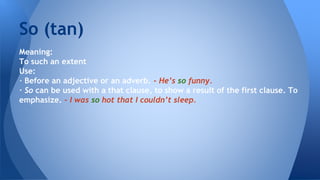
Meaning:
To such an extent
Use:
· Before an adjective or an adverb. - He’s so funny.
· So can be used with a that clause, to show a result of the first clause. To
emphasize. - I was so hot that I couldn’t sleep.
So (tan)
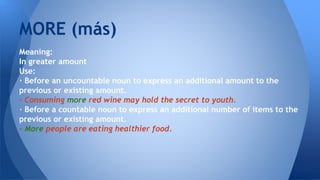
Meaning:
In greater amount
Use:
· Before an uncountable noun to express an additional amount to the
previous or existing amount.
- Consuming more red wine may hold the secret to youth.
· Before a countable noun to express an additional number of items to the
previous or existing amount.
- More people are eating healthier food.
MORE (más)
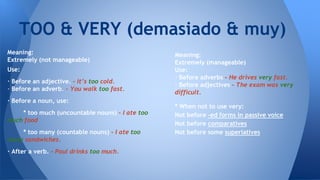
TOO & VERY (demasiado & muy)
Meaning:
Extremely (not manageable)
Use:
· Before an adjective. - It’s too cold.
· Before an adverb. - You walk too fast.
· Before a noun, use:
* too much (uncountable nouns) - I ate too
much food
* too many (countable nouns) - I ate too
many sandwiches.
· After a verb. - Paul drinks too much.
Meaning:
Extremely (manageable)
Use:
· Before adverbs - He drives very fast.
· Before adjectives - The exam was very
difficult.
* When not to use very:
Not before -ed forms in passive voice
Not before comparatives
Not before some superlatives
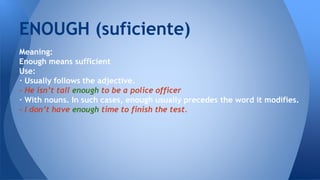
Meaning:
Enough means sufficient
Use:
· Usually follows the adjective.
- He isn’t tall enough to be a police officer
· With nouns. In such cases, enough usually precedes the word it modifies.
- I don’t have enough time to finish the test.
ENOUGH (suficiente)
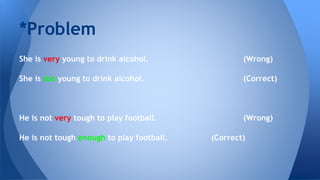
She is very young to drink alcohol. (Wrong)
She is too young to drink alcohol. (Correct)
He is not very tough to play football. (Wrong)
He is not tough enough to play football. (Correct)
*Problem
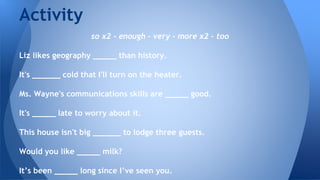
so x2 - enough - very - more x2 - too
Liz likes geography _____ than history.
It's ______ cold that I'll turn on the heater.
Ms. Wayne's communications skills are _____ good.
It's _____ late to worry about it.
This house isn't big ______ to lodge three guests.
Would you like _____ milk?
It’s been _____ long since I’ve seen you.
Activity
THANKS FOR YOUR
ATTENTION!

So, More, Too, Very, Enough

  • 1.
    EXPERTS!! so, more, too,very and enough, Joel Armengol Natalia Ortiz Marcos Pecero
  • 2.
    Meaning: To such anextent Use: · Before an adjective or an adverb. - He’s so funny. · So can be used with a that clause, to show a result of the first clause. To emphasize. - I was so hot that I couldn’t sleep. So (tan)
  • 3.
    Meaning: In greater amount Use: ·Before an uncountable noun to express an additional amount to the previous or existing amount. - Consuming more red wine may hold the secret to youth. · Before a countable noun to express an additional number of items to the previous or existing amount. - More people are eating healthier food. MORE (más)
  • 4.
    TOO & VERY(demasiado & muy) Meaning: Extremely (not manageable) Use: · Before an adjective. - It’s too cold. · Before an adverb. - You walk too fast. · Before a noun, use: * too much (uncountable nouns) - I ate too much food * too many (countable nouns) - I ate too many sandwiches. · After a verb. - Paul drinks too much. Meaning: Extremely (manageable) Use: · Before adverbs - He drives very fast. · Before adjectives - The exam was very difficult. * When not to use very: Not before -ed forms in passive voice Not before comparatives Not before some superlatives
  • 5.
    Meaning: Enough means sufficient Use: ·Usually follows the adjective. - He isn’t tall enough to be a police officer · With nouns. In such cases, enough usually precedes the word it modifies. - I don’t have enough time to finish the test. ENOUGH (suficiente)
  • 6.
    She is veryyoung to drink alcohol. (Wrong) She is too young to drink alcohol. (Correct) He is not very tough to play football. (Wrong) He is not tough enough to play football. (Correct) *Problem
  • 7.
    so x2 -enough - very - more x2 - too Liz likes geography _____ than history. It's ______ cold that I'll turn on the heater. Ms. Wayne's communications skills are _____ good. It's _____ late to worry about it. This house isn't big ______ to lodge three guests. Would you like _____ milk? It’s been _____ long since I’ve seen you. Activity
  • 8.