© Archana Veerabahu
Business Design
Session 2
Opportunity Validation
© Archana Veerabahu
A quick recap of Sector Analysis
© Archana Veerabahu
2 competing standards
• GICS – Global Industrial Classification Standard – S&P, MSCI
• ICB – Industrial Classification Benchmark – Dow Jones, FTSE
11Sectors
© Archana Veerabahu
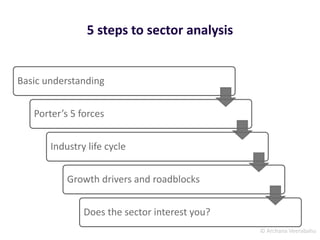
5 steps to sector analysis
Basic understanding
Porter’s 5 forces
Industry life cycle
Growth drivers and roadblocks
Does the sector interest you?
© Archana Veerabahu
Source: ibef
Telecom
Telecom
Mobile Fixed Line
Internet
Services
© Archana Veerabahu
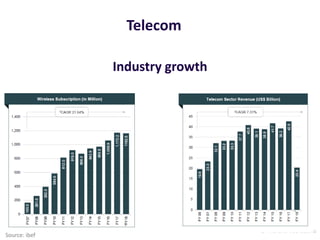
Industry growth
Source: ibef
Telecom
© Archana Veerabahu
Porter’s Five Forces Analysis
Threat of substitutes
Bargaining power of buyers Bargaining power of
suppliers
Competitive rivalry
Threat of new entrants
Economies of Scale
Capital Costs
Government Policies
Access to Distribution
Availability of Substitutes
Buyer concentration vs Firm
concentration
Brand Loyalty
Product Differentiation
Differentiation of Inputs on
Quality
Threat of Backward Integration
Switching costs of Buyers
Number of Competitors
Relative Size of Competitors
Industry Growth Rate
Brand Loyalty
Number of Substitutes
Buyer propensity to
substitute
Switching cost for Firms to
substitute
Telecom
© Archana Veerabahu
Porter’s Five Forces Analysis
Threat of substitutes
Bargaining power of buyers Bargaining power of
suppliers
Competitive rivalry
Threat of new entrants
Economies of Scale
Capital Costs
Government Policies
Access to Distribution
Availability of Substitutes
Buyer concentration vs Firm
concentration
Brand Loyalty
Product Differentiation
Differentiation of Inputs on
Quality
Threat of Backward Integration
Switching costs of Buyers
Number of Competitors
Relative Size of Competitors
Industry Growth Rate
Brand Loyalty
Number of Substitutes
Buyer propensity to
substitute
Switching cost for Firms to
substitute
Telecom
© Archana Veerabahu
Let’s try a different sector
© Archana Veerabahu
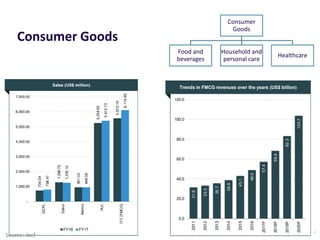
Consumer Goods
Consumer
Goods
Food and
beverages
Household and
personal care
Healthcare
Source: ibef
© Archana Veerabahu
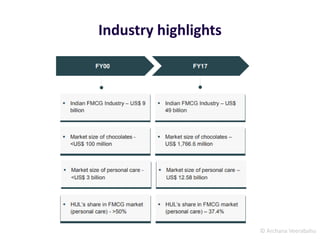
Industry highlights
© Archana Veerabahu
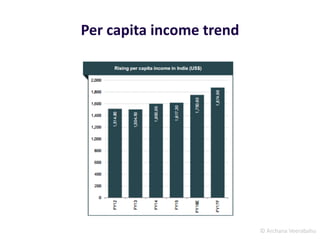
Per capita income trend
© Archana Veerabahu
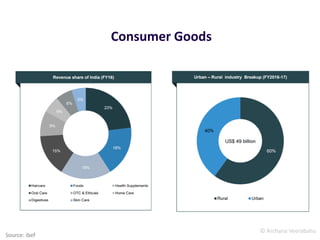
Source: ibef
Consumer Goods
© Archana Veerabahu
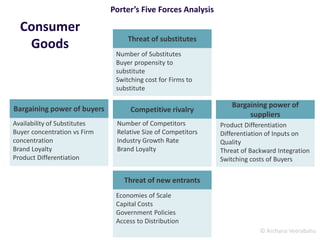
Porter’s Five Forces Analysis
Threat of substitutes
Bargaining power of buyers Bargaining power of
suppliers
Competitive rivalry
Threat of new entrants
Economies of Scale
Capital Costs
Government Policies
Access to Distribution
Availability of Substitutes
Buyer concentration vs Firm
concentration
Brand Loyalty
Product Differentiation
Differentiation of Inputs on
Quality
Threat of Backward Integration
Switching costs of Buyers
Number of Competitors
Relative Size of Competitors
Industry Growth Rate
Brand Loyalty
Number of Substitutes
Buyer propensity to
substitute
Switching cost for Firms to
substitute
Consumer
Goods
© Archana Veerabahu
Porter’s Five Forces Analysis
Threat of substitutes
Bargaining power of buyers Bargaining power of
suppliers
Competitive rivalry
Threat of new entrants
Economies of Scale
Capital Costs
Government Policies
Access to Distribution
Availability of Substitutes
Buyer concentration vs Firm
concentration
Brand Loyalty
Product Differentiation
Differentiation of Inputs on
Quality
Threat of Backward Integration
Switching costs of Buyers
Number of Competitors
Relative Size of Competitors
Industry Growth Rate
Brand Loyalty
Number of Substitutes
Buyer propensity to
substitute
Switching cost for Firms to
substitute
Consumer
Goods
© Archana Veerabahu
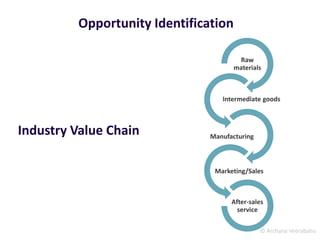
Industry Value Chain
Raw
materials
Intermediate goods
Manufacturing
Marketing/Sales
After-sales
service
Opportunity Identification
© Archana Veerabahu
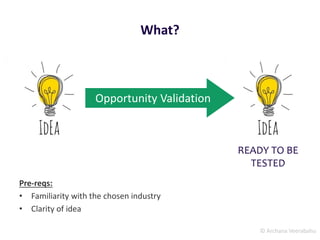
Opportunity Validation
Pre-reqs:
• Familiarity with the chosen industry
• Clarity of idea
READY TO BE
TESTED
What?
© Archana Veerabahu
Who do you want to be?
© Archana Veerabahu
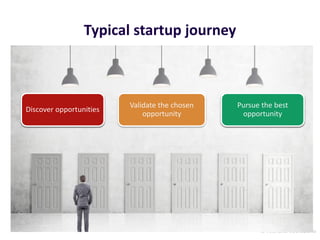
Typical startup journey
Discover opportunities
Pursue the best
opportunity
Validate the chosen
opportunity
© Archana Veerabahu
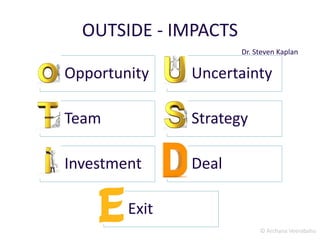
OUTSIDE - IMPACTS
Opportunity Uncertainty
Team Strategy
Investment Deal
Exit
Dr. Steven Kaplan
© Archana Veerabahu
Opportunity
Does it have IMPACTS?
Idea
•What is the idea / industry ?
Market
•Is the target market large
enough to support
substantial growth /
valuation?
Positive Present Value
•Why does the opportunity
generate a positive present
value? What is unique?
Acceptance
• Will customers in
that market
accept / buy this
new product /
service?
Competition
• Why won't the
value be
competed away?
Time
• Why is this a good
time to enter?
Speed
• How quickly can
this be
implemented?
© Archana Veerabahu
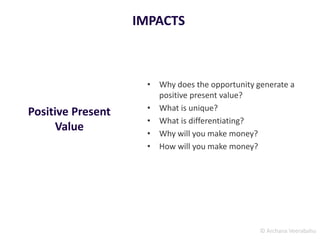
Positive Present
Value
• Why does the opportunity generate a
positive present value?
• What is unique?
• What is differentiating?
• Why will you make money?
• How will you make money?
IMPACTS
© Archana Veerabahu
Acceptance
• Will customers in that market accept / buy
this new product / service?
• How does the customer spend the day
• Why will they buy your product / service?
• What do they buy now?
• Why do they buy what they do now?
• Why will they switch from their current
product?
• How will you get to the customers?
– Direct Salesforce
– Resellers
– Distributors
– How much of each? How quickly?
• Advertising
– How much will it cost?
– How will you retain customers?
– How much will it cost?
IMPACTS
© Archana Veerabahu
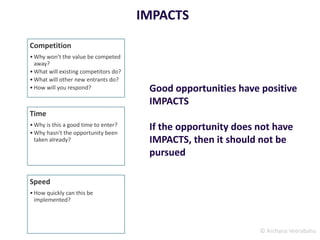
IMPACTS
Competition
•Why won't the value be competed
away?
•What will existing competitors do?
•What will other new entrants do?
•How will you respond?
Time
•Why is this a good time to enter?
•Why hasn't the opportunity been
taken already?
Speed
•How quickly can this be
implemented?
Good opportunities have positive
IMPACTS
If the opportunity does not have
IMPACTS, then it should not be
pursued
© Archana Veerabahu
OUTSIDE
• What are major uncertainties?
– Market size
– Customer acceptance
– Customer approach
– Competition
– Management team
• Potential real options
– Which uncertainties can be
managed so that outcome is more
likely to be favorable?
– Choice of initial customers
– Choice of investors
– How do the answers affect the
opportunity?
Uncertainties
© Archana Veerabahu
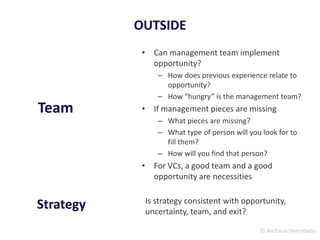
OUTSIDE
• Can management team implement
opportunity?
– How does previous experience relate to
opportunity?
– How “hungry” is the management team?
• If management pieces are missing
– What pieces are missing?
– What type of person will you look for to
fill them?
– How will you find that person?
• For VCs, a good team and a good
opportunity are necessities
Team
Is strategy consistent with opportunity,
uncertainty, team, and exit?
Strategy
© Archana Veerabahu
OUTSIDE
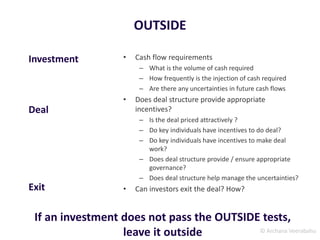
• Cash flow requirements
– What is the volume of cash required
– How frequently is the injection of cash required
– Are there any uncertainties in future cash flows
• Does deal structure provide appropriate
incentives?
– Is the deal priced attractively ?
– Do key individuals have incentives to do deal?
– Do key individuals have incentives to make deal
work?
– Does deal structure provide / ensure appropriate
governance?
– Does deal structure help manage the uncertainties?
• Can investors exit the deal? How?
Investment
Deal
Exit
If an investment does not pass the OUTSIDE tests,
leave it outside
© Archana Veerabahu
An alternative approach
7+1 framework by Dr. Patrick Berbon
Multiple frameworks exist to validate any business opportunity
Each PE/VC firm has a proprietary framework that they use to evaluate ventures
1. Large pain point
2. Superior solution 3. Profitable model
Target Opportunity
4. Team 5. Timing 6. Scalability
7. Capital
Efficiency
© Archana Veerabahu
1. Large Pain point
© Archana Veerabahu
1. Large Pain point
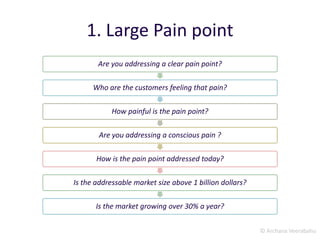
Are you addressing a clear pain point?
Who are the customers feeling that pain?
How painful is the pain point?
Are you addressing a conscious pain ?
How is the pain point addressed today?
Is the addressable market size above 1 billion dollars?
Is the market growing over 30% a year?
© Archana Veerabahu
2. A superior solution to the particular pain point
© Archana Veerabahu
2. A superior solution to the particular pain point
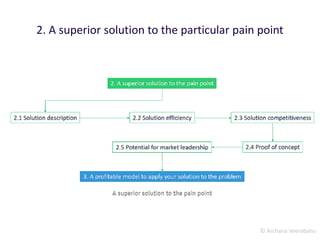
What is your solution?
Does your solution solve the pain point?
How is your solution 10 times better in at least one dimension than your competitors’?
Is your solution beyond proof of concept?
Can your solution become the market leader?
© Archana Veerabahu
3. A profitable model
© Archana Veerabahu
3. A profitable model
What is your Business Model?
What is your competitive advantage?
How will you receive monopoly profit’?
What is your Customer Lifetime Value (CLV) and Customer Acquisition Cost (CAC)?
How do you reach the customers?
© Archana Veerabahu
4. A stellar team
© Archana Veerabahu
4. A stellar team
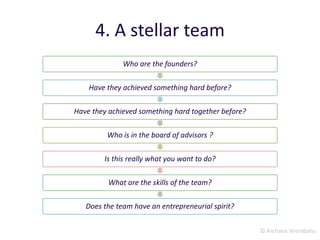
Who are the founders?
Have they achieved something hard before?
Have they achieved something hard together before?
Who is in the board of advisors ?
Is this really what you want to do?
What are the skills of the team?
Does the team have an entrepreneurial spirit?
© Archana Veerabahu
5. An answer to “Why now?”
© Archana Veerabahu
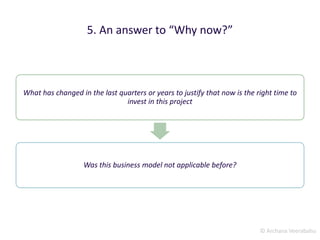
5. An answer to “Why now?”
What has changed in the last quarters or years to justify that now is the right time to
invest in this project
Was this business model not applicable before?
© Archana Veerabahu
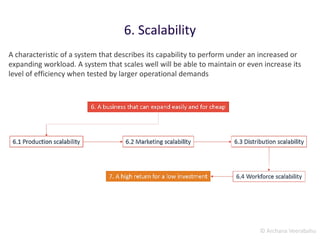
6. Scalability
A characteristic of a system that describes its capability to perform under an increased or
expanding workload. A system that scales well will be able to maintain or even increase its
level of efficiency when tested by larger operational demands
© Archana Veerabahu
6. Scalability
Is my production scalable?
Is my marketing scalable?
Is my distribution scalable?
Is my workforce scalable?
© Archana Veerabahu
6. Capital Efficiency
ROI!
© Archana Veerabahu
7. Capital Efficiency
What return on capital can an investor expect from your project?
Can you become cash-flow positive with a small amount of money?
© Archana Veerabahu
Horse or jockey?
• Some VCs believe company’s product and market are key
• Bet on the horse
• Others believe that VC investment is about management,
management, management.
• Bet on the jockey
© Archana Veerabahu
What will you do?
That’s the real question!

Opportunity validation

  • 1.
    © Archana Veerabahu BusinessDesign Session 2 Opportunity Validation
  • 2.
    © Archana Veerabahu Aquick recap of Sector Analysis
  • 3.
    © Archana Veerabahu 2competing standards • GICS – Global Industrial Classification Standard – S&P, MSCI • ICB – Industrial Classification Benchmark – Dow Jones, FTSE 11Sectors
  • 4.
    © Archana Veerabahu 5steps to sector analysis Basic understanding Porter’s 5 forces Industry life cycle Growth drivers and roadblocks Does the sector interest you?
  • 5.
    © Archana Veerabahu Source:ibef Telecom Telecom Mobile Fixed Line Internet Services
  • 6.
    © Archana Veerabahu Industrygrowth Source: ibef Telecom
  • 7.
    © Archana Veerabahu Porter’sFive Forces Analysis Threat of substitutes Bargaining power of buyers Bargaining power of suppliers Competitive rivalry Threat of new entrants Economies of Scale Capital Costs Government Policies Access to Distribution Availability of Substitutes Buyer concentration vs Firm concentration Brand Loyalty Product Differentiation Product Differentiation Differentiation of Inputs on Quality Threat of Backward Integration Switching costs of Buyers Number of Competitors Relative Size of Competitors Industry Growth Rate Brand Loyalty Number of Substitutes Buyer propensity to substitute Switching cost for Firms to substitute Telecom
  • 8.
    © Archana Veerabahu Porter’sFive Forces Analysis Threat of substitutes Bargaining power of buyers Bargaining power of suppliers Competitive rivalry Threat of new entrants Economies of Scale Capital Costs Government Policies Access to Distribution Availability of Substitutes Buyer concentration vs Firm concentration Brand Loyalty Product Differentiation Product Differentiation Differentiation of Inputs on Quality Threat of Backward Integration Switching costs of Buyers Number of Competitors Relative Size of Competitors Industry Growth Rate Brand Loyalty Number of Substitutes Buyer propensity to substitute Switching cost for Firms to substitute Telecom
  • 9.
    © Archana Veerabahu Let’stry a different sector
  • 10.
    © Archana Veerabahu ConsumerGoods Consumer Goods Food and beverages Household and personal care Healthcare Source: ibef
  • 11.
  • 12.
    © Archana Veerabahu Percapita income trend
  • 13.
    © Archana Veerabahu Source:ibef Consumer Goods
  • 14.
    © Archana Veerabahu Porter’sFive Forces Analysis Threat of substitutes Bargaining power of buyers Bargaining power of suppliers Competitive rivalry Threat of new entrants Economies of Scale Capital Costs Government Policies Access to Distribution Availability of Substitutes Buyer concentration vs Firm concentration Brand Loyalty Product Differentiation Product Differentiation Differentiation of Inputs on Quality Threat of Backward Integration Switching costs of Buyers Number of Competitors Relative Size of Competitors Industry Growth Rate Brand Loyalty Number of Substitutes Buyer propensity to substitute Switching cost for Firms to substitute Consumer Goods
  • 15.
    © Archana Veerabahu Porter’sFive Forces Analysis Threat of substitutes Bargaining power of buyers Bargaining power of suppliers Competitive rivalry Threat of new entrants Economies of Scale Capital Costs Government Policies Access to Distribution Availability of Substitutes Buyer concentration vs Firm concentration Brand Loyalty Product Differentiation Product Differentiation Differentiation of Inputs on Quality Threat of Backward Integration Switching costs of Buyers Number of Competitors Relative Size of Competitors Industry Growth Rate Brand Loyalty Number of Substitutes Buyer propensity to substitute Switching cost for Firms to substitute Consumer Goods
  • 16.
    © Archana Veerabahu IndustryValue Chain Raw materials Intermediate goods Manufacturing Marketing/Sales After-sales service Opportunity Identification
  • 17.
    © Archana Veerabahu OpportunityValidation Pre-reqs: • Familiarity with the chosen industry • Clarity of idea READY TO BE TESTED What?
  • 18.
    © Archana Veerabahu Whodo you want to be?
  • 19.
    © Archana Veerabahu Typicalstartup journey Discover opportunities Pursue the best opportunity Validate the chosen opportunity
  • 20.
    © Archana Veerabahu OUTSIDE- IMPACTS Opportunity Uncertainty Team Strategy Investment Deal Exit Dr. Steven Kaplan
  • 21.
    © Archana Veerabahu Opportunity Doesit have IMPACTS? Idea •What is the idea / industry ? Market •Is the target market large enough to support substantial growth / valuation? Positive Present Value •Why does the opportunity generate a positive present value? What is unique? Acceptance • Will customers in that market accept / buy this new product / service? Competition • Why won't the value be competed away? Time • Why is this a good time to enter? Speed • How quickly can this be implemented?
  • 22.
    © Archana Veerabahu PositivePresent Value • Why does the opportunity generate a positive present value? • What is unique? • What is differentiating? • Why will you make money? • How will you make money? IMPACTS
  • 23.
    © Archana Veerabahu Acceptance •Will customers in that market accept / buy this new product / service? • How does the customer spend the day • Why will they buy your product / service? • What do they buy now? • Why do they buy what they do now? • Why will they switch from their current product? • How will you get to the customers? – Direct Salesforce – Resellers – Distributors – How much of each? How quickly? • Advertising – How much will it cost? – How will you retain customers? – How much will it cost? IMPACTS
  • 24.
    © Archana Veerabahu IMPACTS Competition •Whywon't the value be competed away? •What will existing competitors do? •What will other new entrants do? •How will you respond? Time •Why is this a good time to enter? •Why hasn't the opportunity been taken already? Speed •How quickly can this be implemented? Good opportunities have positive IMPACTS If the opportunity does not have IMPACTS, then it should not be pursued
  • 25.
    © Archana Veerabahu OUTSIDE •What are major uncertainties? – Market size – Customer acceptance – Customer approach – Competition – Management team • Potential real options – Which uncertainties can be managed so that outcome is more likely to be favorable? – Choice of initial customers – Choice of investors – How do the answers affect the opportunity? Uncertainties
  • 26.
    © Archana Veerabahu OUTSIDE •Can management team implement opportunity? – How does previous experience relate to opportunity? – How “hungry” is the management team? • If management pieces are missing – What pieces are missing? – What type of person will you look for to fill them? – How will you find that person? • For VCs, a good team and a good opportunity are necessities Team Is strategy consistent with opportunity, uncertainty, team, and exit? Strategy
  • 27.
    © Archana Veerabahu OUTSIDE •Cash flow requirements – What is the volume of cash required – How frequently is the injection of cash required – Are there any uncertainties in future cash flows • Does deal structure provide appropriate incentives? – Is the deal priced attractively ? – Do key individuals have incentives to do deal? – Do key individuals have incentives to make deal work? – Does deal structure provide / ensure appropriate governance? – Does deal structure help manage the uncertainties? • Can investors exit the deal? How? Investment Deal Exit If an investment does not pass the OUTSIDE tests, leave it outside
  • 28.
    © Archana Veerabahu Analternative approach 7+1 framework by Dr. Patrick Berbon Multiple frameworks exist to validate any business opportunity Each PE/VC firm has a proprietary framework that they use to evaluate ventures 1. Large pain point 2. Superior solution 3. Profitable model Target Opportunity 4. Team 5. Timing 6. Scalability 7. Capital Efficiency
  • 29.
    © Archana Veerabahu 1.Large Pain point
  • 30.
    © Archana Veerabahu 1.Large Pain point Are you addressing a clear pain point? Who are the customers feeling that pain? How painful is the pain point? Are you addressing a conscious pain ? How is the pain point addressed today? Is the addressable market size above 1 billion dollars? Is the market growing over 30% a year?
  • 31.
    © Archana Veerabahu 2.A superior solution to the particular pain point
  • 32.
    © Archana Veerabahu 2.A superior solution to the particular pain point What is your solution? Does your solution solve the pain point? How is your solution 10 times better in at least one dimension than your competitors’? Is your solution beyond proof of concept? Can your solution become the market leader?
  • 33.
    © Archana Veerabahu 3.A profitable model
  • 34.
    © Archana Veerabahu 3.A profitable model What is your Business Model? What is your competitive advantage? How will you receive monopoly profit’? What is your Customer Lifetime Value (CLV) and Customer Acquisition Cost (CAC)? How do you reach the customers?
  • 35.
  • 36.
    © Archana Veerabahu 4.A stellar team Who are the founders? Have they achieved something hard before? Have they achieved something hard together before? Who is in the board of advisors ? Is this really what you want to do? What are the skills of the team? Does the team have an entrepreneurial spirit?
  • 37.
    © Archana Veerabahu 5.An answer to “Why now?”
  • 38.
    © Archana Veerabahu 5.An answer to “Why now?” What has changed in the last quarters or years to justify that now is the right time to invest in this project Was this business model not applicable before?
  • 39.
    © Archana Veerabahu 6.Scalability A characteristic of a system that describes its capability to perform under an increased or expanding workload. A system that scales well will be able to maintain or even increase its level of efficiency when tested by larger operational demands
  • 40.
    © Archana Veerabahu 6.Scalability Is my production scalable? Is my marketing scalable? Is my distribution scalable? Is my workforce scalable?
  • 41.
    © Archana Veerabahu 6.Capital Efficiency ROI!
  • 42.
    © Archana Veerabahu 7.Capital Efficiency What return on capital can an investor expect from your project? Can you become cash-flow positive with a small amount of money?
  • 43.
    © Archana Veerabahu Horseor jockey? • Some VCs believe company’s product and market are key • Bet on the horse • Others believe that VC investment is about management, management, management. • Bet on the jockey
  • 44.
    © Archana Veerabahu Whatwill you do? That’s the real question!