1
Chapter 8 (11)
Organizational Structure
& Design
2
Organizing
Management function that involves
arranging and structuring work to
accomplish the organization’s goals.
Organizational Structure
The formal arrangement of jobs within
an organization.
3
• Divides work to be done into specific jobs and
departments.
• Assigns tasks and responsibilities associated
with individual jobs.
• Establishes formal lines of authority.
• Establishes relationships among individuals,
groups, and departments.
• Allocates and deploys organizational resources.
Purposes of Organizing
4
Organizational Design
Creating or changing an organization’s
structure.
A process involving decisions about six
key elements:
Work specialization
Departmentalization
Chain of command
Span of control
Centralization and decentralization
Formalization
5
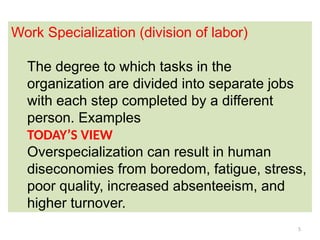
Work Specialization (division of labor)
The degree to which tasks in the
organization are divided into separate jobs
with each step completed by a different
person. Examples
TODAY’S VIEW
Overspecialization can result in human
diseconomies from boredom, fatigue, stress,
poor quality, increased absenteeism, and
higher turnover.
6
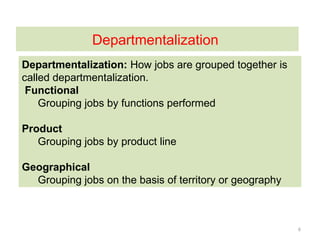
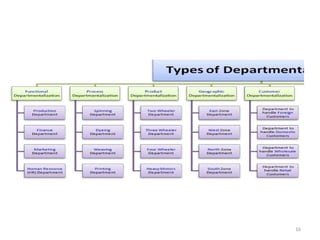
Departmentalization
Departmentalization: How jobs are grouped together is
called departmentalization.
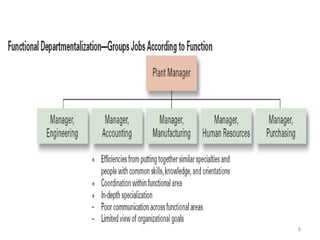
Functional
Grouping jobs by functions performed
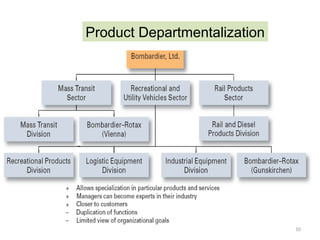
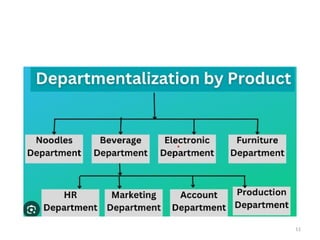
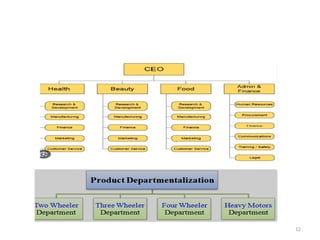
Product
Grouping jobs by product line
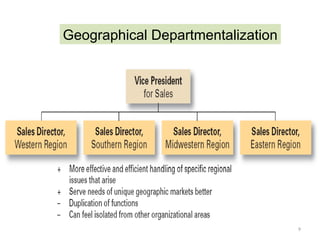
Geographical
Grouping jobs on the basis of territory or geography
7
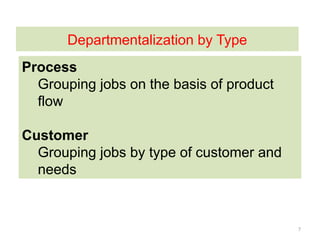
Departmentalization by Type
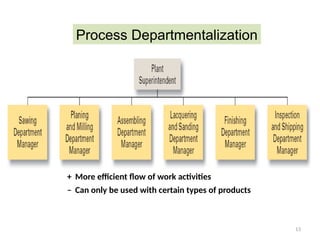
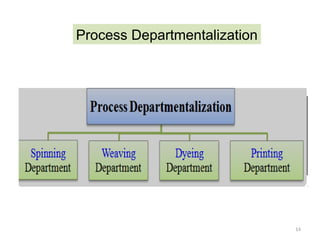
Process
Grouping jobs on the basis of product
flow
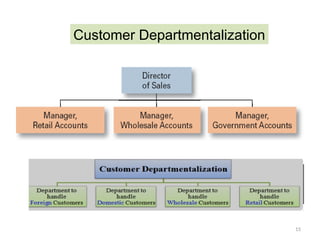
Customer
Grouping jobs by type of customer and
needs
8
9
Geographical Departmentalization
10
Product Departmentalization
11
12
13
Process Departmentalization
+ More efficient flow of work activities
– Can only be used with certain types of products
14
Process Departmentalization
15
Customer Departmentalization
16
17
TODAY’S VIEW
• Most large organizations continue to use
combinations of most or all of these types of
departmentalization.
• Pearson Education, publisher of this textbook,
arranges its business by educational market segment
(Pre K–12, higher education, and professional) and
its customers (students, professors, and workplace
educators), and arranges its sales function around
customers and geographic regions (for example, the
United States, Europe, and Asia)
18
Chain of Command
The continuous line of authority that
extends from upper levels of an
organization to the lowest levels of the
organization and clarifies who reports to
whom.
To understand the chain of command, you
have to understand three other important
concepts: authority, responsibility, and unity
of command
19
Authority
The rights inherent in a managerial position
to tell people what to do and to expect
them to do it.
Line authority: Authority that entitles a
manager to direct the work of an employee
Staff authority: Positions with some authority
that have been created to support, assist, and
advise those holding line authority
20
Unity of Command
The concept that a person should have one
boss and should report only to that person.
21
Today’s View?
• Although early management theorists (Fayol,
Weber, Taylor, Barnard, and others) believed
that chain of command, authority (line and
staff), responsibility, and unity of command
were essential, times have changed.
• Those elements are far less important today.
22
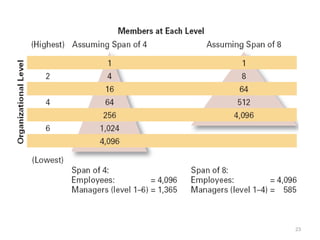
Span of Control
The number of employees who can be
effectively and efficiently supervised
by a manager.
23
24
Today’s View?
• The trend in recent years has been toward
larger spans of control, which is consistent with
managers’ efforts to speed up decision making,
increase flexibility, get closer to customers,
empower employees, and reduce costs.
Managers are beginning to recognize that they
can handle a wider span when employees know
their jobs well and when those employees
understand organizational processes
25
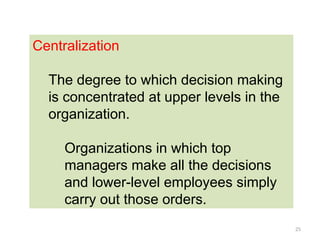
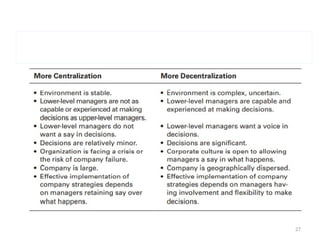
Centralization
The degree to which decision making
is concentrated at upper levels in the
organization.
Organizations in which top
managers make all the decisions
and lower-level employees simply
carry out those orders.
26
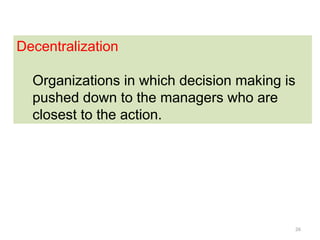
Decentralization
Organizations in which decision making is
pushed down to the managers who are
closest to the action.
27
28
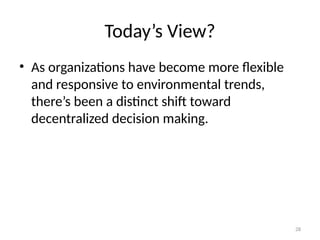
Today’s View?
• As organizations have become more flexible
and responsive to environmental trends,
there’s been a distinct shift toward
decentralized decision making.
29
Employee Empowerment
Increasing the decision-making authority
(power) of employees.
30
Formalization
The degree to which jobs within the
organization are standardized and the
extent to which employee behavior is
guided by rules and procedures.
31
Formalization
Highly formalized jobs offer little
discretion over what is to be done.
Low formalization means fewer
constraints on how employees do their
work.
32
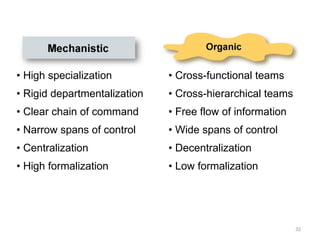
• High specialization
• Rigid departmentalization
• Clear chain of command
• Narrow spans of control
• Centralization
• High formalization
• Cross-functional teams
• Cross-hierarchical teams
• Free flow of information
• Wide spans of control
• Decentralization
• Low formalization
Contingency Factors
33
34
Structural decisions are influenced by:
Overall strategy of the organization
Organizational structure follows
strategy.
Size of the organization
As an organization grows larger, its
structure tends to change from organic
to mechanistic with increased
specialization, departmentalization,
centralization, and rules and
35
Structural decisions are influenced by:
Technology use by the organization
Firms adapt their structure to the
technology they use.
Degree of environmental uncertainty
Dynamic environments require organic
structures; mechanistic structures need
stable environments.
36
Technology and Structure
Organizations adapt their structures to
their technology.
37
Technology and Structure
Woodward’s classification of firms based on
the complexity of the technology employed:
Unit production of single units or small
batches
Mass production of large batches of
output
Process production in continuous
process of outputs
38
Technology and Structure
Routine technology = mechanistic
organizations
Non-routine technology = organic
organizations
39
Environmental Uncertainty and Structure
Mechanistic organizational structures
tend to be most effective in stable and
simple environments.
The flexibility of organic organizational
structures is better suited for dynamic
and complex environments.
Common Organizational
Designs
40
41
Traditional Designs
Simple structure
Low departmentalization, wide spans of
control, centralized authority, little
formalization
42
Traditional Designs
Functional structure
Departmentalization by function
Operations, finance, marketing,
human resources, and product
research and development
43
Traditional Designs
Divisional structure
Composed of separate business units
or divisions with limited autonomy
under the coordination and control the
parent corporation.
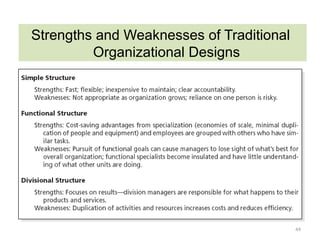
44
Strengths and Weaknesses of Traditional
Organizational Designs
Contemporary
Organizational Designs
45
46
Team structures
The entire organization is made up of
work groups or self-managed teams
of empowered employees.
47
Boundaryless Organization
An flexible and unstructured organizational design that is
intended to break down external barriers between the
organization and its customers and suppliers.
Removes internal (horizontal) boundaries:
Eliminates the chain of command
Has limitless spans of control
Uses empowered teams rather than departments
Eliminates external boundaries:
Uses virtual, network, and modular organizational
structures to get closer to stakeholders.
48
Virtual Organization
An organization that consists of a small core of full-
time employees and that temporarily hires specialists
to work on opportunities that arise.
Network Organization
A small core organization that outsources its major
business functions (e.g., manufacturing) in order to
concentrate on what it does best.
Modular Organization
A manufacturing organization that uses outside
suppliers to provide product components for its final
assembly operations.
Chapter 8 businesses Organizational Structure.pptx

  • 1.
  • 2.
    2 Organizing Management function thatinvolves arranging and structuring work to accomplish the organization’s goals. Organizational Structure The formal arrangement of jobs within an organization.
  • 3.
    3 • Divides workto be done into specific jobs and departments. • Assigns tasks and responsibilities associated with individual jobs. • Establishes formal lines of authority. • Establishes relationships among individuals, groups, and departments. • Allocates and deploys organizational resources. Purposes of Organizing
  • 4.
    4 Organizational Design Creating orchanging an organization’s structure. A process involving decisions about six key elements: Work specialization Departmentalization Chain of command Span of control Centralization and decentralization Formalization
  • 5.
    5 Work Specialization (divisionof labor) The degree to which tasks in the organization are divided into separate jobs with each step completed by a different person. Examples TODAY’S VIEW Overspecialization can result in human diseconomies from boredom, fatigue, stress, poor quality, increased absenteeism, and higher turnover.
  • 6.
    6 Departmentalization Departmentalization: How jobsare grouped together is called departmentalization. Functional Grouping jobs by functions performed Product Grouping jobs by product line Geographical Grouping jobs on the basis of territory or geography
  • 7.
    7 Departmentalization by Type Process Groupingjobs on the basis of product flow Customer Grouping jobs by type of customer and needs
  • 8.
  • 9.
  • 10.
  • 11.
  • 12.
  • 13.
    13 Process Departmentalization + Moreefficient flow of work activities – Can only be used with certain types of products
  • 14.
  • 15.
  • 16.
  • 17.
    17 TODAY’S VIEW • Mostlarge organizations continue to use combinations of most or all of these types of departmentalization. • Pearson Education, publisher of this textbook, arranges its business by educational market segment (Pre K–12, higher education, and professional) and its customers (students, professors, and workplace educators), and arranges its sales function around customers and geographic regions (for example, the United States, Europe, and Asia)
  • 18.
    18 Chain of Command Thecontinuous line of authority that extends from upper levels of an organization to the lowest levels of the organization and clarifies who reports to whom. To understand the chain of command, you have to understand three other important concepts: authority, responsibility, and unity of command
  • 19.
    19 Authority The rights inherentin a managerial position to tell people what to do and to expect them to do it. Line authority: Authority that entitles a manager to direct the work of an employee Staff authority: Positions with some authority that have been created to support, assist, and advise those holding line authority
  • 20.
    20 Unity of Command Theconcept that a person should have one boss and should report only to that person.
  • 21.
    21 Today’s View? • Althoughearly management theorists (Fayol, Weber, Taylor, Barnard, and others) believed that chain of command, authority (line and staff), responsibility, and unity of command were essential, times have changed. • Those elements are far less important today.
  • 22.
    22 Span of Control Thenumber of employees who can be effectively and efficiently supervised by a manager.
  • 23.
  • 24.
    24 Today’s View? • Thetrend in recent years has been toward larger spans of control, which is consistent with managers’ efforts to speed up decision making, increase flexibility, get closer to customers, empower employees, and reduce costs. Managers are beginning to recognize that they can handle a wider span when employees know their jobs well and when those employees understand organizational processes
  • 25.
    25 Centralization The degree towhich decision making is concentrated at upper levels in the organization. Organizations in which top managers make all the decisions and lower-level employees simply carry out those orders.
  • 26.
    26 Decentralization Organizations in whichdecision making is pushed down to the managers who are closest to the action.
  • 27.
  • 28.
    28 Today’s View? • Asorganizations have become more flexible and responsive to environmental trends, there’s been a distinct shift toward decentralized decision making.
  • 29.
    29 Employee Empowerment Increasing thedecision-making authority (power) of employees.
  • 30.
    30 Formalization The degree towhich jobs within the organization are standardized and the extent to which employee behavior is guided by rules and procedures.
  • 31.
    31 Formalization Highly formalized jobsoffer little discretion over what is to be done. Low formalization means fewer constraints on how employees do their work.
  • 32.
    32 • High specialization •Rigid departmentalization • Clear chain of command • Narrow spans of control • Centralization • High formalization • Cross-functional teams • Cross-hierarchical teams • Free flow of information • Wide spans of control • Decentralization • Low formalization
  • 33.
  • 34.
    34 Structural decisions areinfluenced by: Overall strategy of the organization Organizational structure follows strategy. Size of the organization As an organization grows larger, its structure tends to change from organic to mechanistic with increased specialization, departmentalization, centralization, and rules and
  • 35.
    35 Structural decisions areinfluenced by: Technology use by the organization Firms adapt their structure to the technology they use. Degree of environmental uncertainty Dynamic environments require organic structures; mechanistic structures need stable environments.
  • 36.
    36 Technology and Structure Organizationsadapt their structures to their technology.
  • 37.
    37 Technology and Structure Woodward’sclassification of firms based on the complexity of the technology employed: Unit production of single units or small batches Mass production of large batches of output Process production in continuous process of outputs
  • 38.
    38 Technology and Structure Routinetechnology = mechanistic organizations Non-routine technology = organic organizations
  • 39.
    39 Environmental Uncertainty andStructure Mechanistic organizational structures tend to be most effective in stable and simple environments. The flexibility of organic organizational structures is better suited for dynamic and complex environments.
  • 40.
  • 41.
    41 Traditional Designs Simple structure Lowdepartmentalization, wide spans of control, centralized authority, little formalization
  • 42.
    42 Traditional Designs Functional structure Departmentalizationby function Operations, finance, marketing, human resources, and product research and development
  • 43.
    43 Traditional Designs Divisional structure Composedof separate business units or divisions with limited autonomy under the coordination and control the parent corporation.
  • 44.
    44 Strengths and Weaknessesof Traditional Organizational Designs
  • 45.
  • 46.
    46 Team structures The entireorganization is made up of work groups or self-managed teams of empowered employees.
  • 47.
    47 Boundaryless Organization An flexibleand unstructured organizational design that is intended to break down external barriers between the organization and its customers and suppliers. Removes internal (horizontal) boundaries: Eliminates the chain of command Has limitless spans of control Uses empowered teams rather than departments Eliminates external boundaries: Uses virtual, network, and modular organizational structures to get closer to stakeholders.
  • 48.
    48 Virtual Organization An organizationthat consists of a small core of full- time employees and that temporarily hires specialists to work on opportunities that arise. Network Organization A small core organization that outsources its major business functions (e.g., manufacturing) in order to concentrate on what it does best. Modular Organization A manufacturing organization that uses outside suppliers to provide product components for its final assembly operations.
Editor's Notes

  • #6 a hotel might have departments such as front desk operations, sales and catering, housekeeping and laundry, and maintenance.)
  • #19 For instance, a human resource management director who cannot effectively handle managing all the activities the department needs creates a recruitment department, performance management department, and compensation and rewards department, which are staff functions.