Consumer Buying decision
Making Process
Problem Recognition
Information Search
Alternative Evaluation & Selection
Store Choice
Post Purchase Behaviour/Processes
Consumer decision Porcess
Purchase Involvement : Level of concern for or interest in the
purchase process triggered by the need to consider a particular
purchase.
Product Involvement
A consumer may have very involved with a brand (Café Coffee Day
or Ford) or a product category (coffee or cars) and yet have a very
low ;level of involvement with a particular purchase of that product
because of brand loyalty , time pressures etc.
TYPES OF Consumer Decisions
Habitual Decision Making
Limited decision Making
Extended Decision Making
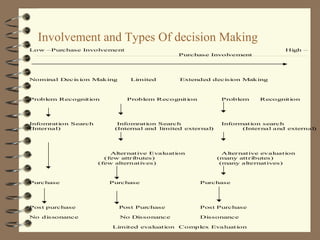
Involvement and Types Of decision Making
Low –Purchase Involvement High –
Purchase Involvement
Nominal Decis ion Making Limited Extended decision Making
Problem Recognition Problem Recognition Problem Recognition
Infomration Search Infomration Search Information search
(Internal) (Internal and limited external) (Internal and external)
Alternative Evaluation Alternative evaluation
(few attributes) (many attributes)
(few alternatives) (many alternatives)
Purchase Purchase Purchase
Post purchase Post Purchase Post Purchase
No dissonance No Dissonance Dissonance
Limited evaluation Complex Evaluation
Process of Problem Recognition
Routine Problems Of Depletion : toothpaste over, petrol
over---> readily recognized, defined and resolved.
Unexpected breakdown of a major appliance (CTV, W/M)
creates an unplanned problem that is easily recognized but
is often more difficult to resolve.
Recognition of other problems such as need for PC , may
take longer as they may be subtle and evolve slowly over
time.
Nature of Problem Recognition
Problem recognition is the result of a discrepancy between a desired
state and an actual state that is sufficient to arouse and activate the
decision process
An actual state : is the way an individual perceives his/her feelings and
situation to be at the present state.
A desired State: way an individual wants to feel or be at the present
time.
Problem recognition is the first stage in the consumer decision process
Process of Problem Recognition
Desired Consumer Lifestyle Current Situation
Desired State Actual State
NATURE OF DISCREPANCY
No difference Desired state exceeds Actual state
Actual state exceeds desired state
Satisfaction
No action problem recognized
(Information search initiated)
Desire to Resolve Recognized problems.
The level of one’s desire to resolve a particular problem depends on
two factors : 1)
The magnitude of the discrepancy between the desired and actual
states and
2) The relative importance of the problem
e.g : 1) A person has a car which gives 15 km per litre. He desires to
have 18 Km/litre. Thus discrepancy exists , but the magnitude is not
large enough to motivate the consumer to proceed to next step of
decision process.
2) A consumer owns an old Esteem and desires to buy Skoda.
The discrepancy is large but the relative importance could be small.
Compared to other consumption problems such as hosing,
utilities and food.
Relative importance is critical concept because all consumers
have budget constraints , time constraints or both.
Marketing Strategy & Problem recognition
Marketing Managers have 4 concerns related to problem recognition
1) Discovering Consumer Problems.
2) Responding to consumer Problems
3)Helping consumers recognize problems
4) Suppressing problem recognition
1) Discovering consumer Problems
a) intuition : managers analyze a given product
category and logically determine were improvements can be made.
B) Research techniques: 1) Survey 2) Focus group
Both focus group and survey tend to take one of the following
approaches to problem identification.
B1---> Activity analysis : Focuses on a particular activity such as
preparing dinner,, maintaining the lawn etc. Focus group attempts to
determine what problems the consumers feel occur during the
performance of the activity.
B2:---> Product Analysis: Examines the purchase and /or use of a
particular product/brand.
E.g :-- consumers may be asked about problems faced with W/M or
CTV or Bikes etc.
B3:--- Problem Analysis : It starts with the list of problems and asks to
indicate which activities , products or brands are associated with those
problems.
E.g A study dealing in packaging could include questions like
1) ------------ Packages are hard to open
2) ___________ doesn't pour well
3) Packages of ---------- don’t fit on the shelf.
2) Responding to consumer Problems
Marketers structure the marketing mix to solve the problems
This can involve developing a new product or altering existing one ,
changing pricing policy , distribution or promotion.
E.g : Weekend and late night stores (some 24 hours format)and
also internet stores --- response to consumer problems of limited
weekday shopping activities ---> particularly important to families
were both spouses are working
The approach of graduation , companies respond with credit
cards , insurance - to solve problems associated with onset of
financial independence and major change in lifestyle.
3. Approaches to activate problem recognition
:
a) Influence desired state: marketers often advertise the
benefits their products will provide , hoping that these benefits will
become desired by consumers e.g Hyundai Accent ad
b) Influence perceptions of existing state : e.g Personal
care ads use statements that generate concerns about an existing state
Lifebouy ad -- showing 3 college girls
3. Approaches to activate problem recognition
:
The Timing Of Problem recognition : Consumers often recognize
problems at times when purchasing a solution is difficult. Or
impossible.
E.g Need for insurance after the accident
Need for cold medicine when we are sick but we don’t fell
like going to the store to buy one.
Common strategy is to trigger problem recognition in advance of
actual problem
CEASTE FIRE
national Assurance , Dabur Chywanprash
Franklin templeton ads.
4. Suppressing Problem recognition
In some cases the above needs to be done
e.g : A cigarette company giving an ad saying “ Alive with Pleasure”
showing a happy laughing couple . This could easily be interpreted as
an attempt to minimize any problem recognition caused by the
mandatory warning at the bottom of the advertising “ Cigarette
smoking is injurious to health”
Stage 2: Information search
What is nature of information search.
What types of information are sought
What sources of information are used
What marketing strategies can be developed based on patterns of
search behavior.
A) Nature of Information Search
1) Internal Search : “ If Trishun had given relief against cold last
time , he would go to nearest store and buy Trishun without further
information search or evaluation”
2)External Search :
a)Opinion of friends , neighbors , relatives
b) Professional information that is provided in internet ,
newspapers ,magazines etc.
C) Ads, Instore displays
B) Types of Information Search:
1) Appropriate evaluation criteria for the solution of a
problem 2) Existence of various alternative solution.
3) performance level or characteristics of each
alternative solution on each alternative criterion
Marketing Strategies
Maintenance strategy : ( Habitual,evoked set) :
Brands purchased habitually use this strategy. This
requires consistent attention to product quality ,
distribution and a reinforcement advt. Strategy --- Colgate,
HLL.
Disrupt Strategy : Habitual, not evoked set) :
Attention attracting advertisement aimed specifically
at breaking habitual decision making can be successful.
Free samples, discounts, coupons etc. are common
approaches --- Anchor Toothpaste.
Marketing Strategies
Capture Strategy : ( Limited Decision Making, Evoked set)
Limited decision making involves few brands which are
evaluated on a few criteria such as price , brand name and
availability. Information search occurs at the point of
purchase or through readily available media prior to
purchase --- So emphasis is on POP--- Low end kitchn
items like Mixer, Grinder , Juicer etc.
Marketing Strategies
Intercept strategy : (Limited , Not evoked set): same as
capture strategy but for brands not in evoked set .
Attractive POPs , Product demos, contests and other sales
promotion tools like extended warranty can be used.--- e.g
Kenstar mixer with 7 year warranty on motor to counter
SUMEET.
Marketing Strategies
Preference (Extended , Evoked set) : A strong positioning on key
attributes important to the target market has to be done. Next
promotion has to be done in all appropriate media–
Electrolux– Enjoy the freshness, Videocon– Germ free refrigerators,
Whirlpool– Fast cooling, Kelvinator– coolest one.
Acceptance (Extended, Not evoked set ) : Motivate target market to
learn about the brand. The primary objective is to move the brand into
evoked set.– E.G Tata Indica – Test drives.
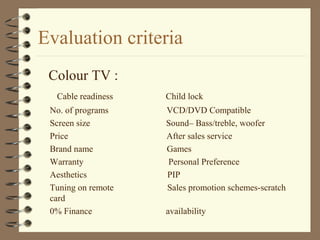
Evaluation criteria
Colour TV :
Cable readiness Child lock
No. of programs VCD/DVD Compatible
Screen size Sound– Bass/treble, woofer
Price After sales service
Brand name Games
Warranty Personal Preference
Aesthetics PIP
Tuning on remote Sales promotion schemes-scratch
card
0% Finance availability
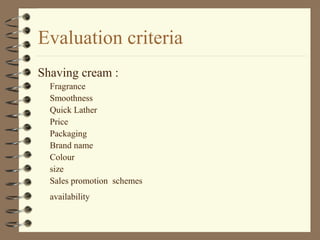
Evaluation criteria
Shaving cream :
Fragrance
Smoothness
Quick Lather
Price
Packaging
Brand name
Colour
size
Sales promotion schemes
availability
Evaluation criteria
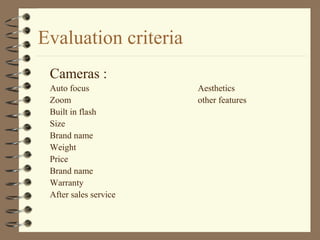
Cameras :
Auto focus Aesthetics
Zoom other features
Built in flash
Size
Brand name
Weight
Price
Brand name
Warranty
After sales service
Evaluation criteria
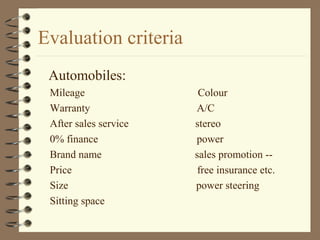
Automobiles:
Mileage Colour
Warranty A/C
After sales service stereo
0% finance power
Brand name sales promotion --
Price free insurance etc.
Size power steering
Sitting space
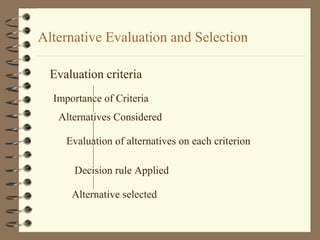
Alternative Evaluation and Selection
Evaluation criteria
Importance of Criteria
Alternatives Considered
Evaluation of alternatives on each criterion
Decision rule Applied
Alternative selected
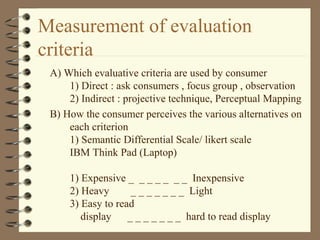
Measurement of evaluation
criteria
A) Which evaluative criteria are used by consumer
1) Direct : ask consumers , focus group , observation
2) Indirect : projective technique, Perceptual Mapping
B) How the consumer perceives the various alternatives on
each criterion
1) Semantic Differential Scale/ likert scale
IBM Think Pad (Laptop)
1) Expensive _ _ _ _ _ _ _ Inexpensive
2) Heavy _ _ _ _ _ _ _ Light
3) Easy to read
display _ _ _ _ _ _ _ hard to read display
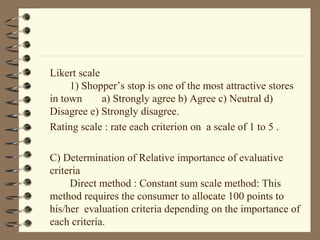
Likert scale
1) Shopper’s stop is one of the most attractive stores
in town a) Strongly agree b) Agree c) Neutral d)
Disagree e) Strongly disagree.
Rating scale : rate each criterion on a scale of 1 to 5 .
C) Determination of Relative importance of evaluative
criteria
Direct method : Constant sum scale method: This
method requires the consumer to allocate 100 points to
his/her evaluation criteria depending on the importance of
each criteria.
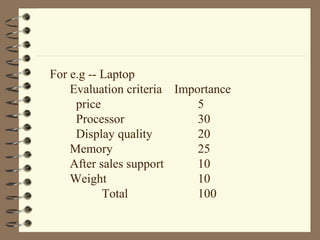
For e.g -- Laptop
Evaluation criteria Importance
price 5
Processor 30
Display quality 20
Memory 25
After sales support 10
Weight 10
Total 100
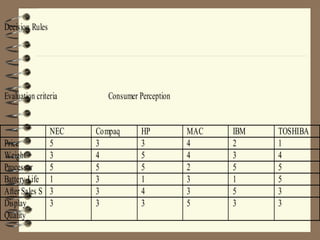
Decision Rules
Evaluation criteria Consumer Perception
NEC Compaq HP MAC IBM TOSHIBA
Price 5 3 3 4 2 1
Weight 3 4 5 4 3 4
Processor 5 5 5 2 5 5
Battery Life 1 3 1 3 1 5
AfterSales S 3 3 4 3 5 3
Display
Quality
3 3 3 5 3 3
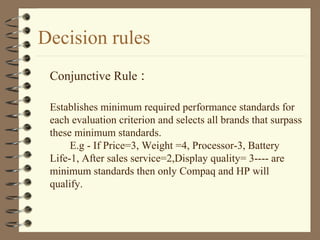
Decision rules
Conjunctive Rule :
Establishes minimum required performance standards for
each evaluation criterion and selects all brands that surpass
these minimum standards.
E.g - If Price=3, Weight =4, Processor-3, Battery
Life-1, After sales service=2,Display quality= 3---- are
minimum standards then only Compaq and HP will
qualify.
Decision Rules
Disjunctive Rule :
Establishes a minimum level of performance for each
important attribute (normally a high level) . All brands that
surpass the level for any key attribute are considered
acceptable . E.g
Price=5, Weight-5, Display Quality -5 , other parameters-
not critical .
NEC (price), HP (Weight), Macintosh (Display
Quality) will be in the final reckoning.
Decision Rules
3) Elimination By Aspects:
1) Consumers rank the evaluation criteria in
terms of their importance and establishes a cut-off point
for each criterion.
2) All brands are first considered on the most
important criterion.
3) Those brands that do not surpass the cut-off point
are dropped from further consideration.
4) The process continues till only one brand remains
.
Decision Rules
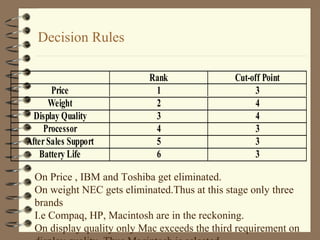
Rank Cut-off Point
Price 1 3
Weight 2 4
Display Quality 3 4
Processor 4 3
AfterSales Support 5 3
Battery Life 6 3
On Price , IBM and Toshiba get eliminated.
On weight NEC gets eliminated.Thus at this stage only three
brands
I.e Compaq, HP, Macintosh are in the reckoning.
On display quality only Mac exceeds the third requirement on
Decision Rules
4) Lexicographic :
1)Seeks maximum performance at each stage.
2)Consumer ranks the criteria in order of importance .
3) Selects the brand that performs best on the most
important attribute.
4) if 2 or more brands are tied on this attribute , they
are evaluated on the 2nd important attribute.
In this case , NEC would be selected on price.
But if NEC -4 on price , it would have tied with
Macintosh. Then NEC and Macintosh would be compared
on Weight, wherein Macintosh would have got selected.
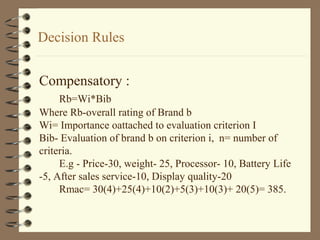
Decision Rules
Compensatory :
Rb=Wi*Bib
Where Rb-overall rating of Brand b
Wi= Importance oattached to evaluation criterion I
Bib- Evaluation of brand b on criterion i, n= number of
criteria.
E.g - Price-30, weight- 25, Processor- 10, Battery Life
-5, After sales service-10, Display quality-20
Rmac= 30(4)+25(4)+10(2)+5(3)+10(3)+ 20(5)= 385.
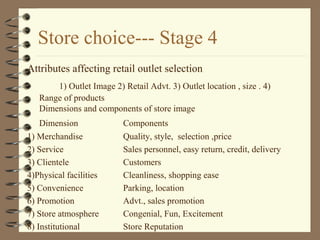
Store choice--- Stage 4
Attributes affecting retail outlet selection
1) Outlet Image 2) Retail Advt. 3) Outlet location , size . 4)
Range of products
Dimensions and components of store image
Dimension Components
1) Merchandise Quality, style, selection ,price
2) Service Sales personnel, easy return, credit, delivery
3) Clientele Customers
4)Physical facilities Cleanliness, shopping ease
5) Convenience Parking, location
6) Promotion Advt., sales promotion
7) Store atmosphere Congenial, Fun, Excitement
8) Institutional Store Reputation

Consumer Buying Behaviour

  • 1.
    Consumer Buying decision MakingProcess Problem Recognition Information Search Alternative Evaluation & Selection Store Choice Post Purchase Behaviour/Processes
  • 2.
    Consumer decision Porcess PurchaseInvolvement : Level of concern for or interest in the purchase process triggered by the need to consider a particular purchase. Product Involvement A consumer may have very involved with a brand (Café Coffee Day or Ford) or a product category (coffee or cars) and yet have a very low ;level of involvement with a particular purchase of that product because of brand loyalty , time pressures etc. TYPES OF Consumer Decisions Habitual Decision Making Limited decision Making Extended Decision Making
  • 3.
    Involvement and TypesOf decision Making Low –Purchase Involvement High – Purchase Involvement Nominal Decis ion Making Limited Extended decision Making Problem Recognition Problem Recognition Problem Recognition Infomration Search Infomration Search Information search (Internal) (Internal and limited external) (Internal and external) Alternative Evaluation Alternative evaluation (few attributes) (many attributes) (few alternatives) (many alternatives) Purchase Purchase Purchase Post purchase Post Purchase Post Purchase No dissonance No Dissonance Dissonance Limited evaluation Complex Evaluation
  • 4.
    Process of ProblemRecognition Routine Problems Of Depletion : toothpaste over, petrol over---> readily recognized, defined and resolved. Unexpected breakdown of a major appliance (CTV, W/M) creates an unplanned problem that is easily recognized but is often more difficult to resolve. Recognition of other problems such as need for PC , may take longer as they may be subtle and evolve slowly over time.
  • 5.
    Nature of ProblemRecognition Problem recognition is the result of a discrepancy between a desired state and an actual state that is sufficient to arouse and activate the decision process An actual state : is the way an individual perceives his/her feelings and situation to be at the present state. A desired State: way an individual wants to feel or be at the present time. Problem recognition is the first stage in the consumer decision process
  • 6.
    Process of ProblemRecognition Desired Consumer Lifestyle Current Situation Desired State Actual State NATURE OF DISCREPANCY No difference Desired state exceeds Actual state Actual state exceeds desired state Satisfaction No action problem recognized (Information search initiated)
  • 7.
    Desire to ResolveRecognized problems. The level of one’s desire to resolve a particular problem depends on two factors : 1) The magnitude of the discrepancy between the desired and actual states and 2) The relative importance of the problem e.g : 1) A person has a car which gives 15 km per litre. He desires to have 18 Km/litre. Thus discrepancy exists , but the magnitude is not large enough to motivate the consumer to proceed to next step of decision process. 2) A consumer owns an old Esteem and desires to buy Skoda. The discrepancy is large but the relative importance could be small. Compared to other consumption problems such as hosing, utilities and food. Relative importance is critical concept because all consumers have budget constraints , time constraints or both.
  • 8.
    Marketing Strategy &Problem recognition Marketing Managers have 4 concerns related to problem recognition 1) Discovering Consumer Problems. 2) Responding to consumer Problems 3)Helping consumers recognize problems 4) Suppressing problem recognition
  • 9.
    1) Discovering consumerProblems a) intuition : managers analyze a given product category and logically determine were improvements can be made. B) Research techniques: 1) Survey 2) Focus group Both focus group and survey tend to take one of the following approaches to problem identification. B1---> Activity analysis : Focuses on a particular activity such as preparing dinner,, maintaining the lawn etc. Focus group attempts to determine what problems the consumers feel occur during the performance of the activity. B2:---> Product Analysis: Examines the purchase and /or use of a particular product/brand. E.g :-- consumers may be asked about problems faced with W/M or CTV or Bikes etc.
  • 10.
    B3:--- Problem Analysis: It starts with the list of problems and asks to indicate which activities , products or brands are associated with those problems. E.g A study dealing in packaging could include questions like 1) ------------ Packages are hard to open 2) ___________ doesn't pour well 3) Packages of ---------- don’t fit on the shelf.
  • 11.
    2) Responding toconsumer Problems Marketers structure the marketing mix to solve the problems This can involve developing a new product or altering existing one , changing pricing policy , distribution or promotion. E.g : Weekend and late night stores (some 24 hours format)and also internet stores --- response to consumer problems of limited weekday shopping activities ---> particularly important to families were both spouses are working The approach of graduation , companies respond with credit cards , insurance - to solve problems associated with onset of financial independence and major change in lifestyle.
  • 12.
    3. Approaches toactivate problem recognition : a) Influence desired state: marketers often advertise the benefits their products will provide , hoping that these benefits will become desired by consumers e.g Hyundai Accent ad b) Influence perceptions of existing state : e.g Personal care ads use statements that generate concerns about an existing state Lifebouy ad -- showing 3 college girls
  • 13.
    3. Approaches toactivate problem recognition : The Timing Of Problem recognition : Consumers often recognize problems at times when purchasing a solution is difficult. Or impossible. E.g Need for insurance after the accident Need for cold medicine when we are sick but we don’t fell like going to the store to buy one. Common strategy is to trigger problem recognition in advance of actual problem CEASTE FIRE national Assurance , Dabur Chywanprash Franklin templeton ads.
  • 14.
    4. Suppressing Problemrecognition In some cases the above needs to be done e.g : A cigarette company giving an ad saying “ Alive with Pleasure” showing a happy laughing couple . This could easily be interpreted as an attempt to minimize any problem recognition caused by the mandatory warning at the bottom of the advertising “ Cigarette smoking is injurious to health”
  • 15.
    Stage 2: Informationsearch What is nature of information search. What types of information are sought What sources of information are used What marketing strategies can be developed based on patterns of search behavior. A) Nature of Information Search 1) Internal Search : “ If Trishun had given relief against cold last time , he would go to nearest store and buy Trishun without further information search or evaluation” 2)External Search : a)Opinion of friends , neighbors , relatives b) Professional information that is provided in internet , newspapers ,magazines etc. C) Ads, Instore displays
  • 16.
    B) Types ofInformation Search: 1) Appropriate evaluation criteria for the solution of a problem 2) Existence of various alternative solution. 3) performance level or characteristics of each alternative solution on each alternative criterion
  • 17.
    Marketing Strategies Maintenance strategy: ( Habitual,evoked set) : Brands purchased habitually use this strategy. This requires consistent attention to product quality , distribution and a reinforcement advt. Strategy --- Colgate, HLL. Disrupt Strategy : Habitual, not evoked set) : Attention attracting advertisement aimed specifically at breaking habitual decision making can be successful. Free samples, discounts, coupons etc. are common approaches --- Anchor Toothpaste.
  • 18.
    Marketing Strategies Capture Strategy: ( Limited Decision Making, Evoked set) Limited decision making involves few brands which are evaluated on a few criteria such as price , brand name and availability. Information search occurs at the point of purchase or through readily available media prior to purchase --- So emphasis is on POP--- Low end kitchn items like Mixer, Grinder , Juicer etc.
  • 19.
    Marketing Strategies Intercept strategy: (Limited , Not evoked set): same as capture strategy but for brands not in evoked set . Attractive POPs , Product demos, contests and other sales promotion tools like extended warranty can be used.--- e.g Kenstar mixer with 7 year warranty on motor to counter SUMEET.
  • 20.
    Marketing Strategies Preference (Extended, Evoked set) : A strong positioning on key attributes important to the target market has to be done. Next promotion has to be done in all appropriate media– Electrolux– Enjoy the freshness, Videocon– Germ free refrigerators, Whirlpool– Fast cooling, Kelvinator– coolest one. Acceptance (Extended, Not evoked set ) : Motivate target market to learn about the brand. The primary objective is to move the brand into evoked set.– E.G Tata Indica – Test drives.
  • 21.
    Evaluation criteria Colour TV: Cable readiness Child lock No. of programs VCD/DVD Compatible Screen size Sound– Bass/treble, woofer Price After sales service Brand name Games Warranty Personal Preference Aesthetics PIP Tuning on remote Sales promotion schemes-scratch card 0% Finance availability
  • 22.
    Evaluation criteria Shaving cream: Fragrance Smoothness Quick Lather Price Packaging Brand name Colour size Sales promotion schemes availability
  • 23.
    Evaluation criteria Cameras : Autofocus Aesthetics Zoom other features Built in flash Size Brand name Weight Price Brand name Warranty After sales service
  • 24.
    Evaluation criteria Automobiles: Mileage Colour WarrantyA/C After sales service stereo 0% finance power Brand name sales promotion -- Price free insurance etc. Size power steering Sitting space
  • 25.
    Alternative Evaluation andSelection Evaluation criteria Importance of Criteria Alternatives Considered Evaluation of alternatives on each criterion Decision rule Applied Alternative selected
  • 26.
    Measurement of evaluation criteria A)Which evaluative criteria are used by consumer 1) Direct : ask consumers , focus group , observation 2) Indirect : projective technique, Perceptual Mapping B) How the consumer perceives the various alternatives on each criterion 1) Semantic Differential Scale/ likert scale IBM Think Pad (Laptop) 1) Expensive _ _ _ _ _ _ _ Inexpensive 2) Heavy _ _ _ _ _ _ _ Light 3) Easy to read display _ _ _ _ _ _ _ hard to read display
  • 27.
    Likert scale 1) Shopper’sstop is one of the most attractive stores in town a) Strongly agree b) Agree c) Neutral d) Disagree e) Strongly disagree. Rating scale : rate each criterion on a scale of 1 to 5 . C) Determination of Relative importance of evaluative criteria Direct method : Constant sum scale method: This method requires the consumer to allocate 100 points to his/her evaluation criteria depending on the importance of each criteria.
  • 28.
    For e.g --Laptop Evaluation criteria Importance price 5 Processor 30 Display quality 20 Memory 25 After sales support 10 Weight 10 Total 100
  • 29.
    Decision Rules Evaluation criteriaConsumer Perception NEC Compaq HP MAC IBM TOSHIBA Price 5 3 3 4 2 1 Weight 3 4 5 4 3 4 Processor 5 5 5 2 5 5 Battery Life 1 3 1 3 1 5 AfterSales S 3 3 4 3 5 3 Display Quality 3 3 3 5 3 3
  • 30.
    Decision rules Conjunctive Rule: Establishes minimum required performance standards for each evaluation criterion and selects all brands that surpass these minimum standards. E.g - If Price=3, Weight =4, Processor-3, Battery Life-1, After sales service=2,Display quality= 3---- are minimum standards then only Compaq and HP will qualify.
  • 31.
    Decision Rules Disjunctive Rule: Establishes a minimum level of performance for each important attribute (normally a high level) . All brands that surpass the level for any key attribute are considered acceptable . E.g Price=5, Weight-5, Display Quality -5 , other parameters- not critical . NEC (price), HP (Weight), Macintosh (Display Quality) will be in the final reckoning.
  • 32.
    Decision Rules 3) EliminationBy Aspects: 1) Consumers rank the evaluation criteria in terms of their importance and establishes a cut-off point for each criterion. 2) All brands are first considered on the most important criterion. 3) Those brands that do not surpass the cut-off point are dropped from further consideration. 4) The process continues till only one brand remains .
  • 33.
    Decision Rules Rank Cut-offPoint Price 1 3 Weight 2 4 Display Quality 3 4 Processor 4 3 AfterSales Support 5 3 Battery Life 6 3 On Price , IBM and Toshiba get eliminated. On weight NEC gets eliminated.Thus at this stage only three brands I.e Compaq, HP, Macintosh are in the reckoning. On display quality only Mac exceeds the third requirement on
  • 34.
    Decision Rules 4) Lexicographic: 1)Seeks maximum performance at each stage. 2)Consumer ranks the criteria in order of importance . 3) Selects the brand that performs best on the most important attribute. 4) if 2 or more brands are tied on this attribute , they are evaluated on the 2nd important attribute. In this case , NEC would be selected on price. But if NEC -4 on price , it would have tied with Macintosh. Then NEC and Macintosh would be compared on Weight, wherein Macintosh would have got selected.
  • 35.
    Decision Rules Compensatory : Rb=Wi*Bib WhereRb-overall rating of Brand b Wi= Importance oattached to evaluation criterion I Bib- Evaluation of brand b on criterion i, n= number of criteria. E.g - Price-30, weight- 25, Processor- 10, Battery Life -5, After sales service-10, Display quality-20 Rmac= 30(4)+25(4)+10(2)+5(3)+10(3)+ 20(5)= 385.
  • 36.
    Store choice--- Stage4 Attributes affecting retail outlet selection 1) Outlet Image 2) Retail Advt. 3) Outlet location , size . 4) Range of products Dimensions and components of store image Dimension Components 1) Merchandise Quality, style, selection ,price 2) Service Sales personnel, easy return, credit, delivery 3) Clientele Customers 4)Physical facilities Cleanliness, shopping ease 5) Convenience Parking, location 6) Promotion Advt., sales promotion 7) Store atmosphere Congenial, Fun, Excitement 8) Institutional Store Reputation