MOLE CONCEPT
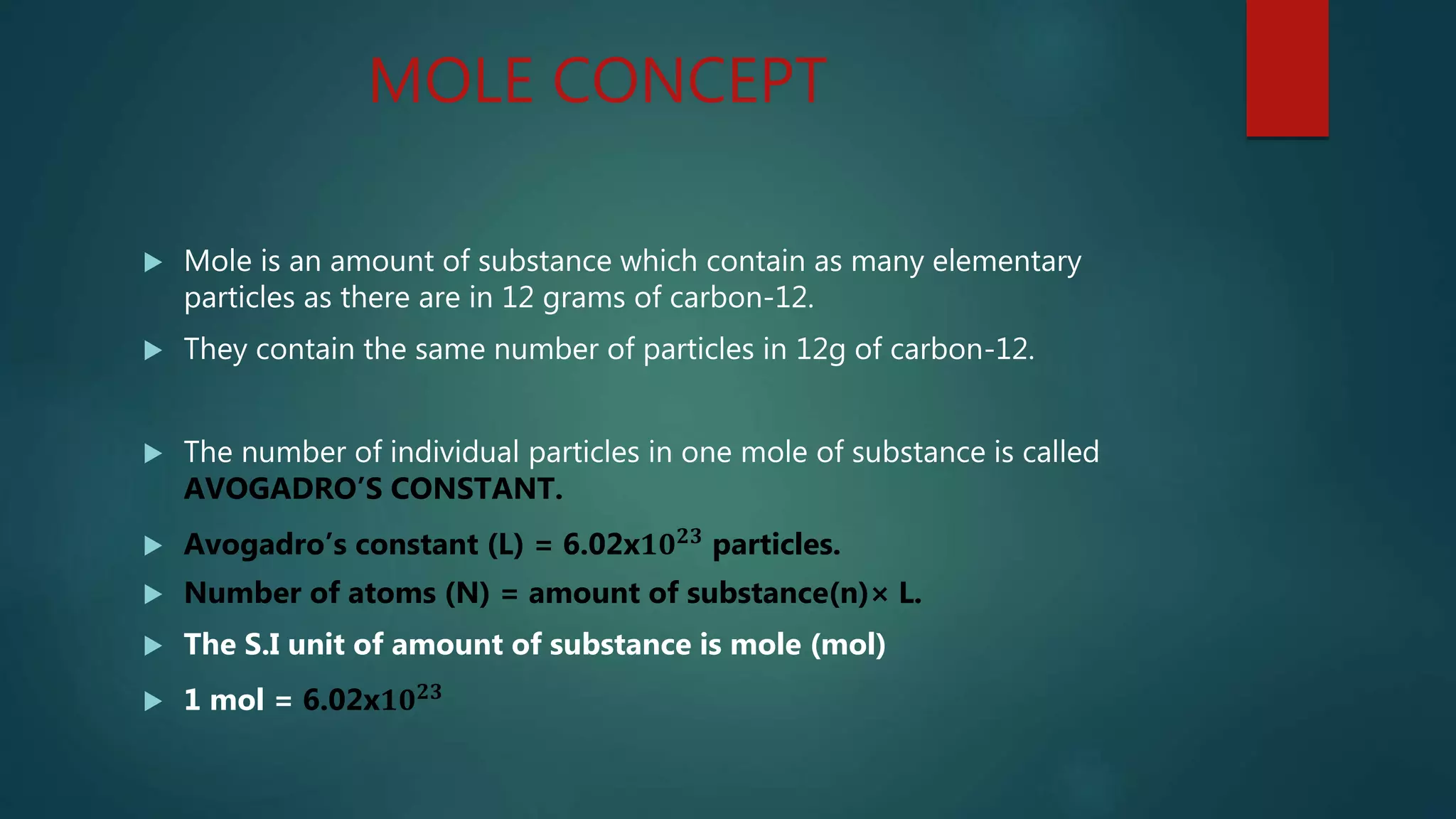
 Mole is an amount of substance which contain as many elementary
particles as there are in 12 grams of carbon-12.
 They contain the same number of particles in 12g of carbon-12.
 The number of individual particles in one mole of substance is called
AVOGADRO’S CONSTANT.
 Avogadro’s constant (L) = 6.02x𝟏𝟎 𝟐𝟑
particles.
 Number of atoms (N) = amount of substance(n)× L.
 The S.I unit of amount of substance is mole (mol)
 1 mol = 6.02x𝟏𝟎 𝟐𝟑
 Mathematically, Amount of substance (n) =
𝑚𝑎𝑠𝑠(𝑚)
𝑀𝑜𝑙𝑎𝑟 𝑚𝑎𝑠𝑠 (𝑀)
 Molar mass (M) is the mass of 1 mole of a substance. Its unit is g/mol.
 From the equation: m = n×M and M =
𝑚
𝑛
.
WORKED EXAMPLE
 Calculate the number of moles in 5.85g of NaCl. [ Na = 23, Cl = 35.5]
solution
Number of moles(n) =
𝒎𝒂𝒔𝒔(𝒎)
𝑴𝒐𝒍𝒂𝒓 𝒎𝒂𝒔𝒔(𝑴)
where
m = 5.85g and M = 23+35.5 = 58.5g/mol
Hence: n =
𝟓.𝟖𝟓𝒈
𝟓𝟖.𝟓𝒈/𝒎𝒐𝒍
= 0.1 mol.
 Magnesium ribbon of mass 4.0g is placed in dilute hydrochloric acid (HCl)
contained in a beaker. Calculate the number of moles of HCl that would be
required to react completely with the ribbon. [Mg = 24, H = 1.0, Cl =35.5 ].
SOLUTION
 From the reaction:
𝑀𝑔(𝑠) + 2𝐻𝐶𝑙(𝑎𝑞) → 𝑀𝑔𝐶𝑙2 (𝑎𝑞) + 𝐻2 (𝑔)
From the balanced chemical equation:
n (Mg) =
𝑚
𝑀
=
4.0
24
= 0.167 mol
If 1 mol of Mg = 2 mol of 0.167mol.
Then 0.167mol is :
2
1
× 0.167 = 0.334 𝑚𝑜𝑙
Hence 0.334 moles of HCl react completely with the ribbon.
PREPARATION OF SOLUTION OF A GIVEN CONCENTRATION
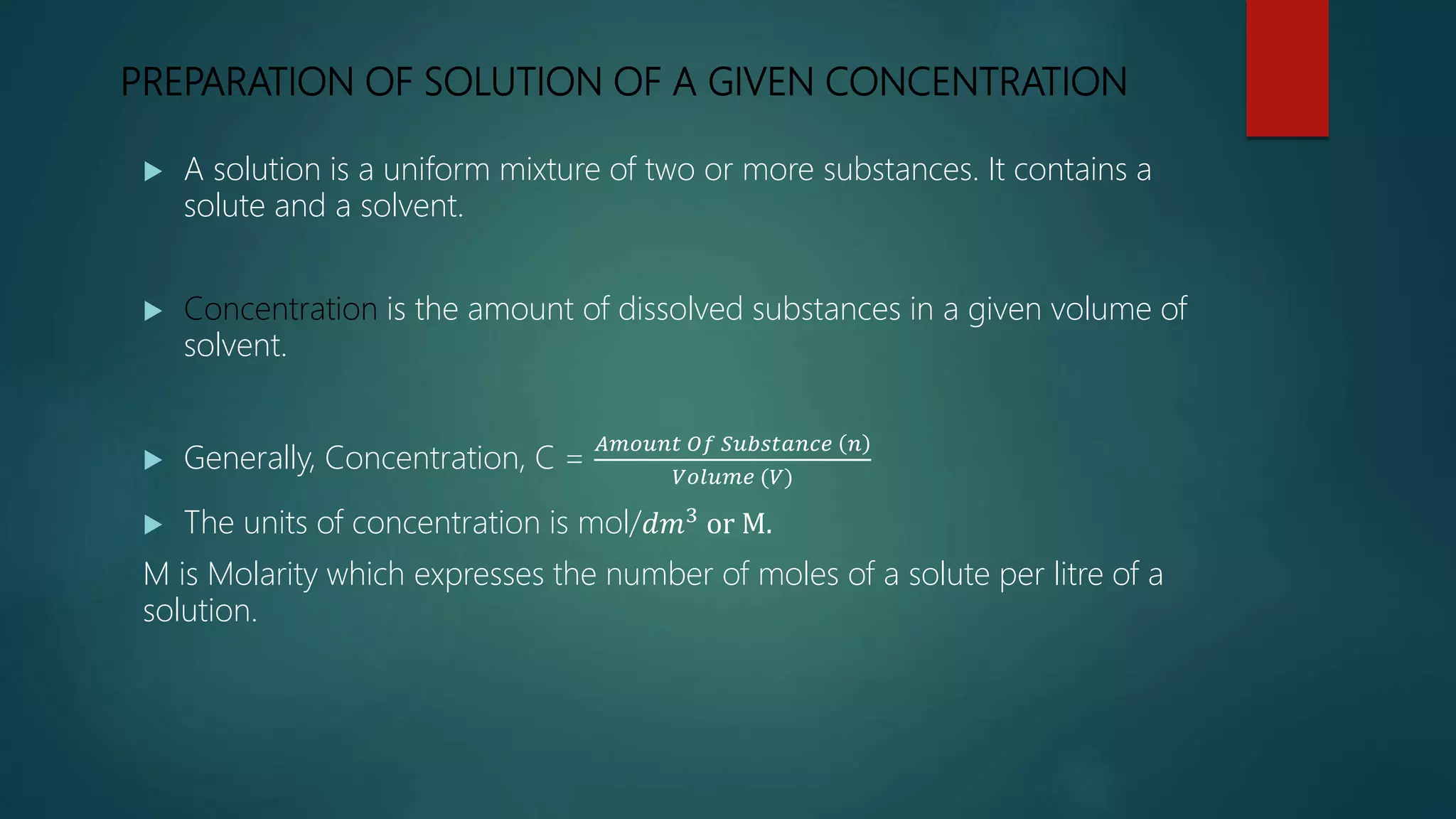
 A solution is a uniform mixture of two or more substances. It contains a
solute and a solvent.
 Concentration is the amount of dissolved substances in a given volume of
solvent.
 Generally, Concentration, C =
𝐴𝑚𝑜𝑢𝑛𝑡 𝑂𝑓 𝑆𝑢𝑏𝑠𝑡𝑎𝑛𝑐𝑒 𝑛
𝑉𝑜𝑙𝑢𝑚𝑒 (𝑉)
 The units of concentration is mol/𝑑𝑚3 or M.
M is Molarity which expresses the number of moles of a solute per litre of a
solution.
Worked Example
 An aqueous solution of volume 2.0𝑑𝑚3 contains 25.5g NaCl. Calculate the
concentration of the solution. [ NaCl = 58.5 ]
solution
Concentration, C =
𝑛
𝑉
, where
v = 2.0𝑑𝑚3
and n =
𝑚
𝑀
=
25.5
58.5
= 0.436 mol
Hence C =
0.436𝑚𝑜𝑙
2.0𝑑𝑚3 = 0,218 mol/𝑑𝑚3
TRY:
 In a laboratory experiment, a student was required to prepare 500𝑐𝑚3 of
1.0 M solution of glucose (𝐶6 𝐻12 𝑂6 ). Determine the
(i) molar mass of glucose.
(ii) Amount of substance in moles in the solution,
(iii) mass of glucose contained in the solution.
[ C = 12 , H = 1.0 , O = 16 ]
Answer
(i) 180g/mol
(ii) 0.5 mol
(iii) 90g
DILUTION
 Dilution is the process of reducing the concentration of a solute in a solution by
addition of more solvent. A concentrated solution from which a dilute solution is
prepared is called stock solution.
 In diluting a solution;
Amount of substance in concentrated solution 𝑛1 = Amount of substance in dilute
solution 𝑛2 .
If n = C × 𝑣
then 𝐶1 𝑉1 = 𝐶2 𝑉2
Where 𝐶1 = Initial concentration
𝐶2 = Final concentration
𝑉1 = Initial volume
𝑉2 = Final volume
Worked Example
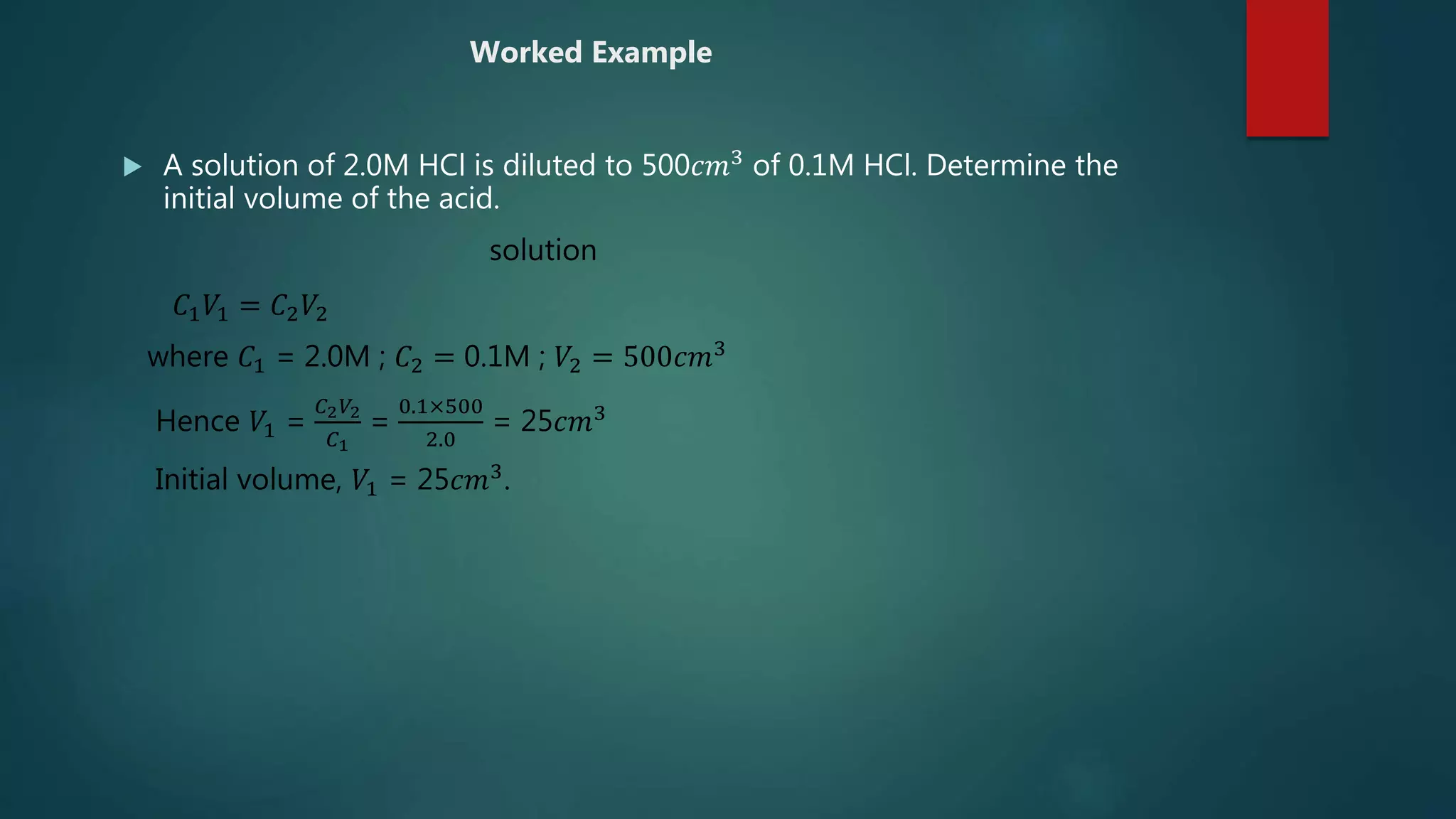
 A solution of 2.0M HCl is diluted to 500𝑐𝑚3 of 0.1M HCl. Determine the
initial volume of the acid.
solution
𝐶1 𝑉1 = 𝐶2 𝑉2
where 𝐶1 = 2.0M ; 𝐶2 = 0.1M ; 𝑉2 = 500𝑐𝑚3
Hence 𝑉1 =
𝐶2 𝑉2
𝐶1
=
0.1×500
2.0
= 25𝑐𝑚3
Initial volume, 𝑉1 = 25𝑐𝑚3.
TRY:
 Determine the volume of water required to change the concentration of
100.0𝑐𝑚3
of 0.5M HCl to 0.1M HCl.
ans: 500.0𝑐𝑚3
 If 500.0𝑐𝑚3 of 1.0M NaOH solution is diluted to 1.0𝑑𝑚3 with distilled
water, calculate the concentration of the diluted solution.
ans: 0.5𝑑𝑚3

Mole concept

  • 1.
    MOLE CONCEPT  Moleis an amount of substance which contain as many elementary particles as there are in 12 grams of carbon-12.  They contain the same number of particles in 12g of carbon-12.  The number of individual particles in one mole of substance is called AVOGADRO’S CONSTANT.  Avogadro’s constant (L) = 6.02x𝟏𝟎 𝟐𝟑 particles.  Number of atoms (N) = amount of substance(n)× L.  The S.I unit of amount of substance is mole (mol)  1 mol = 6.02x𝟏𝟎 𝟐𝟑
  • 2.
     Mathematically, Amountof substance (n) = 𝑚𝑎𝑠𝑠(𝑚) 𝑀𝑜𝑙𝑎𝑟 𝑚𝑎𝑠𝑠 (𝑀)  Molar mass (M) is the mass of 1 mole of a substance. Its unit is g/mol.  From the equation: m = n×M and M = 𝑚 𝑛 .
  • 3.
    WORKED EXAMPLE  Calculatethe number of moles in 5.85g of NaCl. [ Na = 23, Cl = 35.5] solution Number of moles(n) = 𝒎𝒂𝒔𝒔(𝒎) 𝑴𝒐𝒍𝒂𝒓 𝒎𝒂𝒔𝒔(𝑴) where m = 5.85g and M = 23+35.5 = 58.5g/mol Hence: n = 𝟓.𝟖𝟓𝒈 𝟓𝟖.𝟓𝒈/𝒎𝒐𝒍 = 0.1 mol.  Magnesium ribbon of mass 4.0g is placed in dilute hydrochloric acid (HCl) contained in a beaker. Calculate the number of moles of HCl that would be required to react completely with the ribbon. [Mg = 24, H = 1.0, Cl =35.5 ].
  • 4.
    SOLUTION  From thereaction: 𝑀𝑔(𝑠) + 2𝐻𝐶𝑙(𝑎𝑞) → 𝑀𝑔𝐶𝑙2 (𝑎𝑞) + 𝐻2 (𝑔) From the balanced chemical equation: n (Mg) = 𝑚 𝑀 = 4.0 24 = 0.167 mol If 1 mol of Mg = 2 mol of 0.167mol. Then 0.167mol is : 2 1 × 0.167 = 0.334 𝑚𝑜𝑙 Hence 0.334 moles of HCl react completely with the ribbon.
  • 5.
    PREPARATION OF SOLUTIONOF A GIVEN CONCENTRATION  A solution is a uniform mixture of two or more substances. It contains a solute and a solvent.  Concentration is the amount of dissolved substances in a given volume of solvent.  Generally, Concentration, C = 𝐴𝑚𝑜𝑢𝑛𝑡 𝑂𝑓 𝑆𝑢𝑏𝑠𝑡𝑎𝑛𝑐𝑒 𝑛 𝑉𝑜𝑙𝑢𝑚𝑒 (𝑉)  The units of concentration is mol/𝑑𝑚3 or M. M is Molarity which expresses the number of moles of a solute per litre of a solution.
  • 6.
    Worked Example  Anaqueous solution of volume 2.0𝑑𝑚3 contains 25.5g NaCl. Calculate the concentration of the solution. [ NaCl = 58.5 ] solution Concentration, C = 𝑛 𝑉 , where v = 2.0𝑑𝑚3 and n = 𝑚 𝑀 = 25.5 58.5 = 0.436 mol Hence C = 0.436𝑚𝑜𝑙 2.0𝑑𝑚3 = 0,218 mol/𝑑𝑚3
  • 7.
    TRY:  In alaboratory experiment, a student was required to prepare 500𝑐𝑚3 of 1.0 M solution of glucose (𝐶6 𝐻12 𝑂6 ). Determine the (i) molar mass of glucose. (ii) Amount of substance in moles in the solution, (iii) mass of glucose contained in the solution. [ C = 12 , H = 1.0 , O = 16 ] Answer (i) 180g/mol (ii) 0.5 mol (iii) 90g
  • 8.
    DILUTION  Dilution isthe process of reducing the concentration of a solute in a solution by addition of more solvent. A concentrated solution from which a dilute solution is prepared is called stock solution.  In diluting a solution; Amount of substance in concentrated solution 𝑛1 = Amount of substance in dilute solution 𝑛2 . If n = C × 𝑣 then 𝐶1 𝑉1 = 𝐶2 𝑉2 Where 𝐶1 = Initial concentration 𝐶2 = Final concentration 𝑉1 = Initial volume 𝑉2 = Final volume
  • 9.
    Worked Example  Asolution of 2.0M HCl is diluted to 500𝑐𝑚3 of 0.1M HCl. Determine the initial volume of the acid. solution 𝐶1 𝑉1 = 𝐶2 𝑉2 where 𝐶1 = 2.0M ; 𝐶2 = 0.1M ; 𝑉2 = 500𝑐𝑚3 Hence 𝑉1 = 𝐶2 𝑉2 𝐶1 = 0.1×500 2.0 = 25𝑐𝑚3 Initial volume, 𝑉1 = 25𝑐𝑚3.
  • 10.
    TRY:  Determine thevolume of water required to change the concentration of 100.0𝑐𝑚3 of 0.5M HCl to 0.1M HCl. ans: 500.0𝑐𝑚3  If 500.0𝑐𝑚3 of 1.0M NaOH solution is diluted to 1.0𝑑𝑚3 with distilled water, calculate the concentration of the diluted solution. ans: 0.5𝑑𝑚3