
Presented by- Dr. Sunayana Kumthekar
JR III, Community Medicine.
*Content
* Introduction
* Difference between MDGs & SDGs
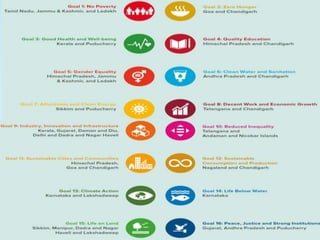
* SDGs elements
* Pillars of SDGs
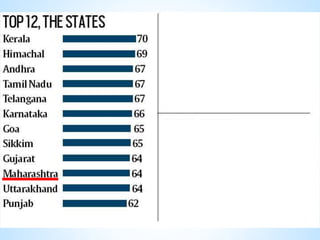
* SDG & INDIA
* SDG Goal 3
* Challenges of SDGs
*Introduction
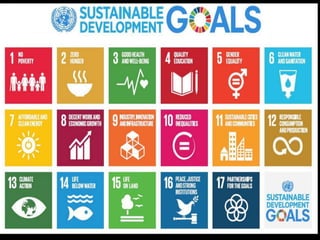
 What: SDGs / Global Goals
 When: 25 Sept. 2015
 Where: At the United Nations.
 How: 17 Goals,169 Targets & 244
Indicators (actual 232) by 2030
 Agreed by 193 countries.
*
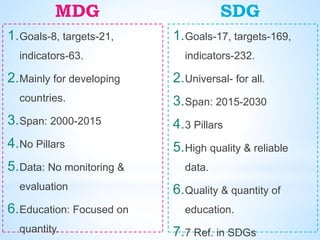
MDG
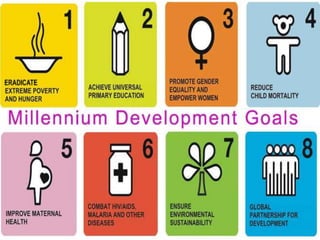
1.Goals-8, targets-21,
indicators-63.
2.Mainly for developing
countries.
3.Span: 2000-2015
4.No Pillars
5.Data: No monitoring &
evaluation
6.Education: Focused on
quantity.
SDG
1.Goals-17, targets-169,
indicators-232.
2.Universal- for all.
3.Span: 2015-2030
4.3 Pillars
5.High quality & reliable
data.
6.Quality & quantity of
education.
7.7 Ref. in SDGs
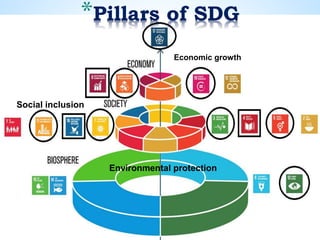
*Pillars of SDG
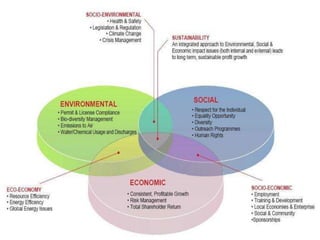
Environmental protection
Social inclusion
Economic growth
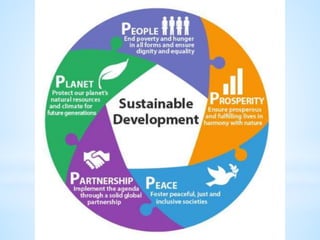
*
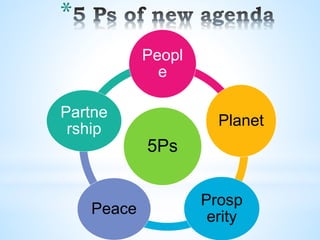
5Ps
Peopl
e
Planet
Prosp
erityPeace
Partne
rship
*SDG & INDIA
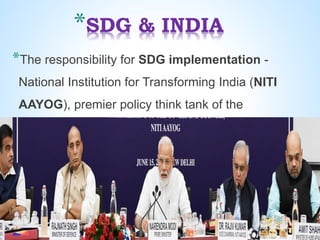
*The responsibility for SDG implementation -
National Institution for Transforming India (NITI
AAYOG), premier policy think tank of the
Government.
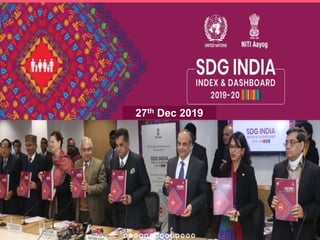
27th Dec 2019
*
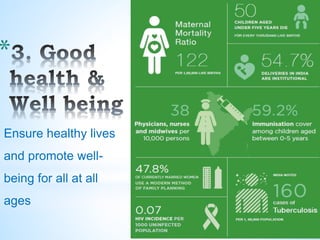
Ensure healthy lives
and promote well-
being for all at all
ages
Mainly 9 Targets.
*
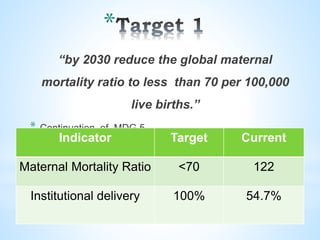
“by 2030 reduce the global maternal
mortality ratio to less than 70 per 100,000
live births.”
* Continuation of MDG 5.
Indicator Target Current
Maternal Mortality Ratio <70 122
Institutional delivery 100% 54.7%
*
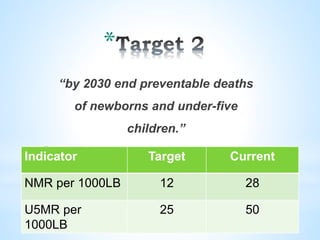
“by 2030 end preventable deaths
of newborns and under-five
children.”
* Continuation of MDG 4.
Indicator Target Current
NMR per 1000LB 12 28
U5MR per
1000LB
25 50
*
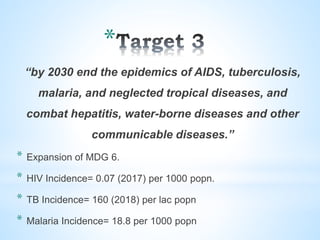
“by 2030 end the epidemics of AIDS, tuberculosis,
malaria, and neglected tropical diseases, and
combat hepatitis, water-borne diseases and other
communicable diseases.”
* Expansion of MDG 6.
* HIV Incidence= 0.07 (2017) per 1000 popn.
* TB Incidence= 160 (2018) per lac popn
* Malaria Incidence= 18.8 per 1000 popn
*
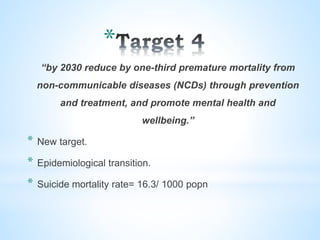
“by 2030 reduce by one-third premature mortality from
non-communicable diseases (NCDs) through prevention
and treatment, and promote mental health and
wellbeing.”
* New target.
* Epidemiological transition.
* Suicide mortality rate= 16.3/ 1000 popn
*
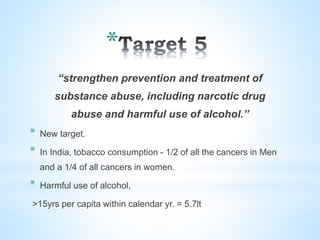
“strengthen prevention and treatment of
substance abuse, including narcotic drug
abuse and harmful use of alcohol.”
* New target.
* In India, tobacco consumption - 1/2 of all the cancers in Men
and a 1/4 of all cancers in women.
* Harmful use of alcohol,
>15yrs per capita within calendar yr. = 5.7lt
*
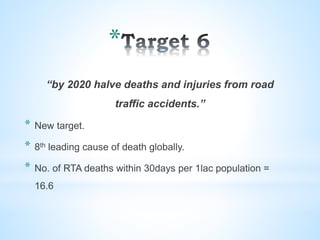
“by 2020 halve deaths and injuries from road
traffic accidents.”
* New target.
* 8th leading cause of death globally.
* No. of RTA deaths within 30days per 1lac population =
16.6
*
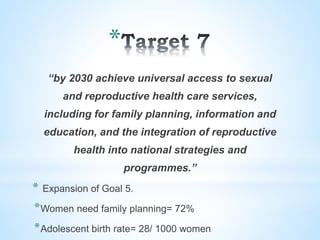
“by 2030 achieve universal access to sexual
and reproductive health care services,
including for family planning, information and
education, and the integration of reproductive
health into national strategies and
programmes.”
* Expansion of Goal 5.
*Women need family planning= 72%
*Adolescent birth rate= 28/ 1000 women
*
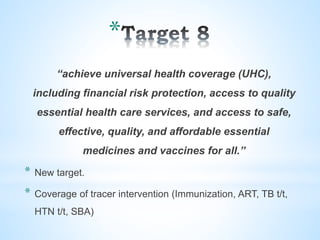
“achieve universal health coverage (UHC),
including financial risk protection, access to quality
essential health care services, and access to safe,
effective, quality, and affordable essential
medicines and vaccines for all.”
* New target.
* Coverage of tracer intervention (Immunization, ART, TB t/t,
HTN t/t, SBA)
*
“by 2030 substantially reduce the number of
deaths and illnesses from hazardous
chemicals and air, water and soil pollution
and contamination.”
* New target.
* Mortality (Air pollution) = 185/ lac population
* Mortality (chem. Other pollution) = 187/ lac
population
*
“strengthen implementation of WHO
framework on tobacco control”
*Tobacco use >15yr : M=20.6%, F= 1.9%
*
“provide access to medicines and
vaccines for all, irrespective of
intellectual property right ”
*Proportion of population with access to affordable
medicine & vaccine
*
“increase health financing & health
workforce in developing countries”
*Health worker density & distribution = 30.2 / 10,000
popn.
*
“strengthen capacity for early warning, risk
reduction & management of health risks”
* Attributes of 13 core capacities attained at specific time
India= 95%
*
* Poverty line should be revised
* Huge task
* Major determinants- Health & Education
* Social determinants of health require integrated approach.
* Inadequate funding / donation
*Reference
1. Preventive & social medicine, K. Park 25th edition,
Bhanot publications.
2. SDG India Index 2019-20
3. National health programmes, J Kishor, 13th edition,
century publication.
4. https://sdgindiaindex.niti.gov.in
*

SDG (Sustainable Development Goals) Explained target 3

  • 1.
    Presented by- Dr.Sunayana Kumthekar JR III, Community Medicine.
  • 2.
    *Content * Introduction * Differencebetween MDGs & SDGs * SDGs elements * Pillars of SDGs * SDG & INDIA * SDG Goal 3 * Challenges of SDGs
  • 3.
    *Introduction  What: SDGs/ Global Goals  When: 25 Sept. 2015  Where: At the United Nations.  How: 17 Goals,169 Targets & 244 Indicators (actual 232) by 2030  Agreed by 193 countries.
  • 4.
  • 5.
    MDG 1.Goals-8, targets-21, indicators-63. 2.Mainly fordeveloping countries. 3.Span: 2000-2015 4.No Pillars 5.Data: No monitoring & evaluation 6.Education: Focused on quantity. SDG 1.Goals-17, targets-169, indicators-232. 2.Universal- for all. 3.Span: 2015-2030 4.3 Pillars 5.High quality & reliable data. 6.Quality & quantity of education. 7.7 Ref. in SDGs
  • 7.
    *Pillars of SDG Environmentalprotection Social inclusion Economic growth
  • 9.
  • 10.
    *SDG & INDIA *Theresponsibility for SDG implementation - National Institution for Transforming India (NITI AAYOG), premier policy think tank of the Government.
  • 11.
  • 14.
    * Ensure healthy lives andpromote well- being for all at all ages
  • 15.
  • 16.
    * “by 2030 reducethe global maternal mortality ratio to less than 70 per 100,000 live births.” * Continuation of MDG 5. Indicator Target Current Maternal Mortality Ratio <70 122 Institutional delivery 100% 54.7%
  • 17.
    * “by 2030 endpreventable deaths of newborns and under-five children.” * Continuation of MDG 4. Indicator Target Current NMR per 1000LB 12 28 U5MR per 1000LB 25 50
  • 18.
    * “by 2030 endthe epidemics of AIDS, tuberculosis, malaria, and neglected tropical diseases, and combat hepatitis, water-borne diseases and other communicable diseases.” * Expansion of MDG 6. * HIV Incidence= 0.07 (2017) per 1000 popn. * TB Incidence= 160 (2018) per lac popn * Malaria Incidence= 18.8 per 1000 popn
  • 19.
    * “by 2030 reduceby one-third premature mortality from non-communicable diseases (NCDs) through prevention and treatment, and promote mental health and wellbeing.” * New target. * Epidemiological transition. * Suicide mortality rate= 16.3/ 1000 popn
  • 20.
    * “strengthen prevention andtreatment of substance abuse, including narcotic drug abuse and harmful use of alcohol.” * New target. * In India, tobacco consumption - 1/2 of all the cancers in Men and a 1/4 of all cancers in women. * Harmful use of alcohol, >15yrs per capita within calendar yr. = 5.7lt
  • 21.
    * “by 2020 halvedeaths and injuries from road traffic accidents.” * New target. * 8th leading cause of death globally. * No. of RTA deaths within 30days per 1lac population = 16.6
  • 22.
    * “by 2030 achieveuniversal access to sexual and reproductive health care services, including for family planning, information and education, and the integration of reproductive health into national strategies and programmes.” * Expansion of Goal 5. *Women need family planning= 72% *Adolescent birth rate= 28/ 1000 women
  • 23.
    * “achieve universal healthcoverage (UHC), including financial risk protection, access to quality essential health care services, and access to safe, effective, quality, and affordable essential medicines and vaccines for all.” * New target. * Coverage of tracer intervention (Immunization, ART, TB t/t, HTN t/t, SBA)
  • 24.
    * “by 2030 substantiallyreduce the number of deaths and illnesses from hazardous chemicals and air, water and soil pollution and contamination.” * New target. * Mortality (Air pollution) = 185/ lac population * Mortality (chem. Other pollution) = 187/ lac population
  • 25.
    * “strengthen implementation ofWHO framework on tobacco control” *Tobacco use >15yr : M=20.6%, F= 1.9%
  • 26.
    * “provide access tomedicines and vaccines for all, irrespective of intellectual property right ” *Proportion of population with access to affordable medicine & vaccine
  • 27.
    * “increase health financing& health workforce in developing countries” *Health worker density & distribution = 30.2 / 10,000 popn.
  • 28.
    * “strengthen capacity forearly warning, risk reduction & management of health risks” * Attributes of 13 core capacities attained at specific time India= 95%
  • 30.
    * * Poverty lineshould be revised * Huge task * Major determinants- Health & Education * Social determinants of health require integrated approach. * Inadequate funding / donation
  • 31.
    *Reference 1. Preventive &social medicine, K. Park 25th edition, Bhanot publications. 2. SDG India Index 2019-20 3. National health programmes, J Kishor, 13th edition, century publication. 4. https://sdgindiaindex.niti.gov.in
  • 32.

Editor's Notes

  • #6 Edu, employment, red. Inequality, inclusive cities, disaggregation of data by disability
  • #8 Environmental protection Economic growth Social inclusion
  • #11 Goi established niti ayog to replace planning commision on 1st jan 2015. Think tank bcz- provide strategic n technical advice at central n state level. Also monitor n evaluate implementation of program.
  • #15 Immunz- Manipur >75%. Nagaland- 12%
  • #17 MMR- achived..Kerala-42, MH-55, TN-63… highest- ASAM- 229 Kerala 74%, UT- puduchery n chandigad= 100%
  • #18  SRS 2017- 37 U5MR, but of only 22 states so using NFHS4 data.. highest, Up= 78 Kerala, goa, UT. Andaman nicobar, puduchery- acheived
  • #19 HIV, highest, mizoram-1.32, nagaland- 0.59, manipur-0.58.. Lowest in HP closest to target of zero- 0.01 TB, lowest- tripura- 66, UT lakshdweep 29 per lac