1
Table of contents
1. Abstract ` 2
2. List of figures 3
3. Chapter 1
1.1 Climate Change 4
1.2 Climate of Bangladesh 4-6
4. Chapter 2
2.1 Climate Change and its possible Security Implications 7
2.2 Climate change and Security issue 8-9
2.3 Evidences of climate change 10
2.4 Vulnerable To Climate Change 11
5. Chapter 3
3.1 Climate change causes impact and prevention 12-13
6. Chapter 4
4.1 National And International Initiatives For Climate Change 14
4.2 Bangladesh Climate Change Trust Fund 15
4.3 Future Probable Adaptation Strategy 15
7.Conclusion 16
8.Reference 17
2
Abstract
More recently the issue of climate change assumed special importance because of the
accumulation of evidence of global warming. Climate change is a global challenge. All nations
are affected, some more than others. It is a threat to social and economic stability and
sustainable human existence. Bangladesh is one of the most proactive developing countries on
the global scene to address the challenges of climate change. Our sustainable future depends, to
great extent on our ability to build a world where people have sustainable livelihood, food
security, pro people health care services and green environment for them. Climate change and
its adverse impact has become a block against all our efforts to mitigate the effects of our
poverty situation and to achieve the millennium goal of Bangladesh. Climate change has come
to the forefront of discussion and attention amongst the governments, business leaders,
nongovernment
quarters and people in general. It covers all sectors and human endeavors. Its
management therefore will be a complex and highly interactive responsibility for all.
Coordination along with keeping track of development imperatives will be the key for a
successful implementation of future strategies.
3
List of figure
Figure 1: Climate On Bangladesh 05
Figure 2 : Climate Map On Bangladesh 06
Figure 3 : Evidences Of Climate Change 10
Figure 4 : Vulnerable areas in BAGLADESH 11
Figure 5 : GHG Gases and their contribution 12
Figure 6 : Source of GHG Gases 12
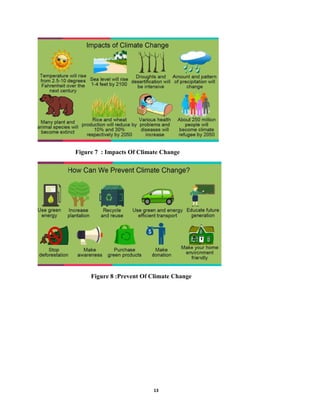
Figure 7 : Impacts Of Climate Change 13
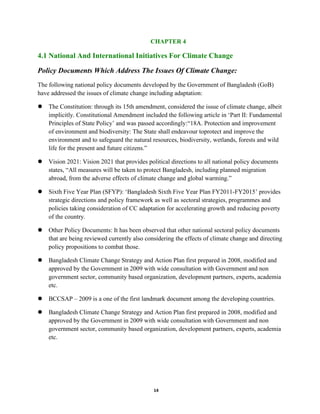
Figure 8 : Prevent Of Climate Change 13
4
CHAPTER1
1.1 Climate Change
A change in global or regional climate patterns, in particular a change apparent from the mid to
late 20th century onwards and attributed largely to the increased levels of atmospheric carbon
dioxide produced by the use of fossil fuels.
Climate is usually defined as the "average weather" in a place. It includes patterns of temperature,
precipitation (rain or snow), humidity, wind and seasons. Climate patterns play a fundamental role
in shaping natural ecosystems, and the human economies and cultures that depend on them. But
the climate we’ve come to expect is not what it used to be, because the past is no longer a reliable
predictor of the future. Our climate is rapidly changing with disruptive impacts, and that change is
progressing faster than any seen in the last 2,000 years.
1.2 Climate of Bangladesh
Bangladesh is in its location in map its longitude 23.6850° N, latidute 90.3563E. For this longitude
and latidute it is in tropical weather.Bangladesh has a tropical monsoon-type climate, with a hot
and rainy summer and a dry winter. January is the coolest month with temperatures averaging near
26 deg C (78 d F) and April the warmest with temperatures from 33 to 36 deg C (91 to 96 deg F).
The climate is one of the wettest in the world. Most places receive more than 1,525 mm of rain a
year, and areas near the hills receive 5,080 mm ). Most rains occur during the monsoon (June-
September) and little in winter (November-February).
Bangladesh is subject to devastating cyclones, originating over the Bay of Bengal, in the periods of
April to May and September to November. Often accompanied by surging waves, these storms can
cause great damage and loss of life. The cyclone of November 1970, in which about 500,000 lives
were lost in Bangladesh, was one of the worst natural disasters of the country in the 20th century.
Bangladesh has warm temperatures throughout the year, with relatively little variation from month
to month. January tends to be the coolest month and May the warmest. In Dhaka the average
January temperature is about 19°C (about 66°F), and the average May temperature is about 29°C
(about 84°F).
Required clothing: Lightweight cottons and linens throughout the year. Warmer clothes are needed
in the evenings during the cool season. Waterproofs are necessary during the monsoon season.
5
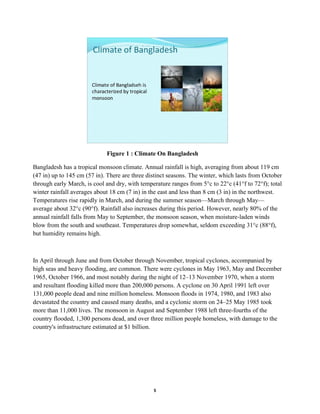
Figure 1 : Climate On Bangladesh
Bangladesh has a tropical monsoon climate. Annual rainfall is high, averaging from about 119 cm
(47 in) up to 145 cm (57 in). There are three distinct seasons. The winter, which lasts from October
through early March, is cool and dry, with temperature ranges from 5°c to 22°c (41°f to 72°f); total
winter rainfall averages about 18 cm (7 in) in the east and less than 8 cm (3 in) in the northwest.
Temperatures rise rapidly in March, and during the summer season—March through May—
average about 32°c (90°f). Rainfall also increases during this period. However, nearly 80% of the
annual rainfall falls from May to September, the monsoon season, when moisture-laden winds
blow from the south and southeast. Temperatures drop somewhat, seldom exceeding 31°c (88°f),
but humidity remains high.
In April through June and from October through November, tropical cyclones, accompanied by
high seas and heavy flooding, are common. There were cyclones in May 1963, May and December
1965, October 1966, and most notably during the night of 12–13 November 1970, when a storm
and resultant flooding killed more than 200,000 persons. A cyclone on 30 April 1991 left over
131,000 people dead and nine million homeless. Monsoon floods in 1974, 1980, and 1983 also
devastated the country and caused many deaths, and a cyclonic storm on 24–25 May 1985 took
more than 11,000 lives. The monsoon in August and September 1988 left three-fourths of the
country flooded, 1,300 persons dead, and over three million people homeless, with damage to the
country's infrastructure estimated at $1 billion.
6
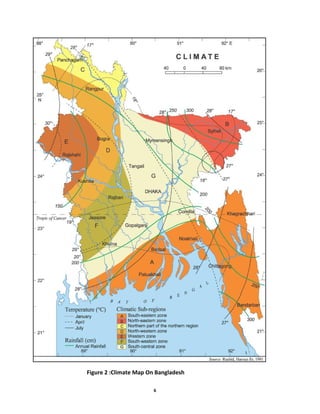
Figure 2 :Climate Map On Bangladesh
7
Chapter 2
2.1 Climate Change and its possible Security Implications
Bangladesh is already experiencing the adverse impacts of global warming and climate change.
The following impacts have been observed. Summers are becoming hotter, monsoon irregular,
untimely rainfall, heavy rainfall over short period causing water logging and landslides, very
little rainfall in dry period, increased river flow and inundation during monsoon, increased
frequency, intensity and recurrence of floods, crop damage due to flash floods and monsoon
floods, crop failure due to drought, prolonged cold spell, salinity intrusion along the coast
leading to scarcity of potable water and redundancy of prevailing crop practices, coastal erosion,
riverbank erosion, deaths due to extreme heat and extreme cold, increasing mortality, morbidity,
prevalence and outbreak of dengue, malaria, cholera and diarrhea, etc. Climate change impacts
are already adding significant stress to our physical and environmental resources, our human
ability, and economic activities. IPCC in its AR4 described with high confidence climatic
anomalies and their impacts on Bangladesh. Climate risks for Bangladesh are as follows:
Environmental Impacts
Changes in rainfall patterns
Increased frequency and severity of: Floods Droughts Storms Heat waves
Changes in growing seasons and regions
Changes in water quality and quantity
Sea level rise
Glacial melt
Table 1 :Environment impact
A major concern for Bangladesh are climate change victims who are increasing in number every
day and must seek refuge due to loss of their homes, land, settlement to river erosion, coastal
erosion, and permanent inundation.The number of families and villages who lose their homes
permanently to rivers every year are perhaps one of the highest in Bangladesh. It has been
reported that many of the slum dwellers in the metropolitan areas are the victims of riverbank
erosion.
8
2.2 Climate change and Security issue
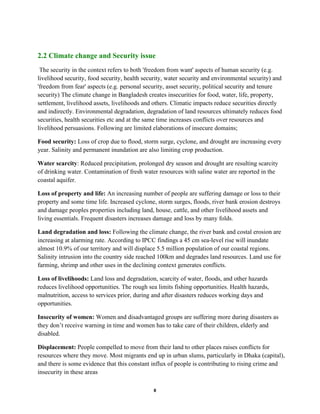
The security in the context refers to both 'freedom from want' aspects of human security (e.g.
livelihood security, food security, health security, water security and environmental security) and
'freedom from fear' aspects (e.g. personal security, asset security, political security and tenure
security) The climate change in Bangladesh creates insecurities for food, water, life, property,
settlement, livelihood assets, livelihoods and others. Climatic impacts reduce securities directly
and indirectly. Environmental degradation, degradation of land resources ultimately reduces food
securities, health securities etc and at the same time increases conflicts over resources and
livelihood persuasions. Following are limited elaborations of insecure domains;
Food security: Loss of crop due to flood, storm surge, cyclone, and drought are increasing every
year. Salinity and permanent inundation are also limiting crop production.
Water scarcity: Reduced precipitation, prolonged dry season and drought are resulting scarcity
of drinking water. Contamination of fresh water resources with saline water are reported in the
coastal aquifer.
Loss of property and life: An increasing number of people are suffering damage or loss to their
property and some time life. Increased cyclone, storm surges, floods, river bank erosion destroys
and damage peoples properties including land, house, cattle, and other livelihood assets and
living essentials. Frequent disasters increases damage and loss by many folds.
Land degradation and loss: Following the climate change, the river bank and costal erosion are
increasing at alarming rate. According to IPCC findings a 45 cm sea-level rise will inundate
almost 10.9% of our territory and will displace 5.5 million population of our coastal regions.
Salinity intrusion into the country side reached 100km and degrades land resources. Land use for
farming, shrimp and other uses in the declining context generates conflicts.
Loss of livelihoods: Land loss and degradation, scarcity of water, floods, and other hazards
reduces livelihood opportunities. The rough sea limits fishing opportunities. Health hazards,
malnutrition, access to services prior, during and after disasters reduces working days and
opportunities.
Insecurity of women: Women and disadvantaged groups are suffering more during disasters as
they don’t receive warning in time and women has to take care of their children, elderly and
disabled.
Displacement: People compelled to move from their land to other places raises conflicts for
resources where they move. Most migrants end up in urban slums, particularly in Dhaka (capital),
and there is some evidence that this constant influx of people is contributing to rising crime and
insecurity in these areas
9
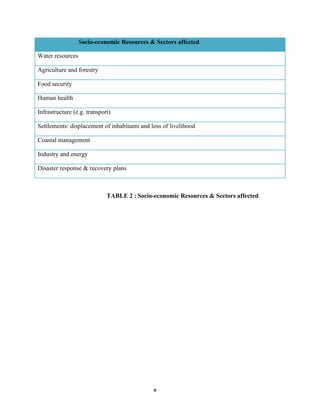
Socio-economic Resources & Sectors affected
Water resources
Agriculture and forestry
Food security
Human health
Infrastructure (e.g. transport)
Settlements: displacement of inhabitants and loss of livelihood
Coastal management
Industry and energy
Disaster response & recovery plans
TABLE 2 : Socio-economic Resources & Sectors affected
10
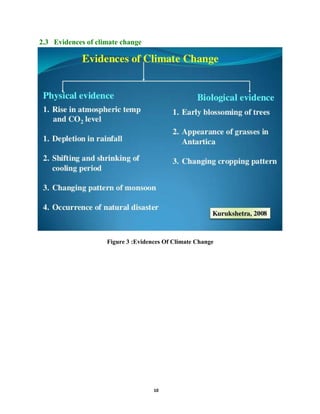
2.3 Evidences of climate change
Figure 3 :Evidences Of Climate Change
11
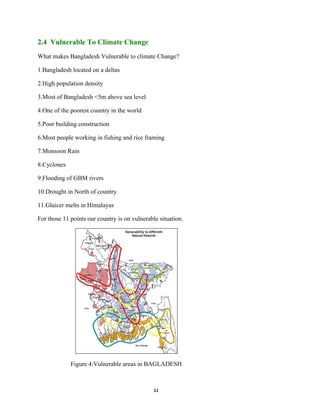
2.4 Vulnerable To Climate Change
What makes Bangladesh Vulnerable to climate Change?
1.Bangladesh located on a deltas
2.High population density
3.Most of Bangladesh <5m above sea level
4.One of the poorest country in the world
5.Poor building construction
6.Most people working in fishing and rice framing
7.Monsoon Rain
8.Cyclones
9.Flooding of GBM rivers
10.Drought in North of country
11.Glaicer melts in Himalayas
For those 11 points our country is on vulnerable situation.
Figure 4:Vulnerable areas in BAGLADESH
12
Chapter 3
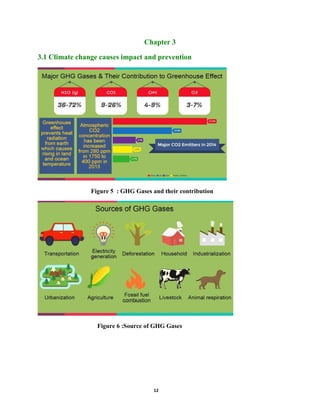
3.1 Climate change causes impact and prevention
Figure 5 : GHG Gases and their contribution
Figure 6 :Source of GHG Gases
13
Figure 7 : Impacts Of Climate Change
Figure 8 :Prevent Of Climate Change
14
CHAPTER 4
4.1 National And International Initiatives For Climate Change
Policy Documents Which Address The Issues Of Climate Change:
The following national policy documents developed by the Government of Bangladesh (GoB)
have addressed the issues of climate change including adaptation:
 The Constitution: through its 15th amendment, considered the issue of climate change, albeit
implicitly. Constitutional Amendment included the following article in ‘Part II: Fundamental
Principles of State Policy’ and was passed accordingly:“18A. Protection and improvement
of environment and biodiversity: The State shall endeavour toprotect and improve the
environment and to safeguard the natural resources, biodiversity, wetlands, forests and wild
life for the present and future citizens.”
 Vision 2021: Vision 2021 that provides political directions to all national policy documents
states, “All measures will be taken to protect Bangladesh, including planned migration
abroad, from the adverse effects of climate change and global warming.”
 Sixth Five Year Plan (SFYP): ‘Bangladesh Sixth Five Year Plan FY2011-FY2015’ provides
strategic directions and policy framework as well as sectoral strategies, programmes and
policies taking consideration of CC adaptation for accelerating growth and reducing poverty
of the country.
 Other Policy Documents: It has been observed that other national sectoral policy documents
that are being reviewed currently also considering the effects of climate change and directing
policy propositions to combat those.
 Bangladesh Climate Change Strategy and Action Plan first prepared in 2008, modified and
approved by the Government in 2009 with wide consultation with Government and non
government sector, community based organization, development partners, experts, academia
etc.
 BCCSAP – 2009 is a one of the first landmark document among the developing countries.
 Bangladesh Climate Change Strategy and Action Plan first prepared in 2008, modified and
approved by the Government in 2009 with wide consultation with Government and non
government sector, community based organization, development partners, experts, academia
etc.
15
4.2 Bangladesh Climate Change Trust Fund:
 CCTF has approved 82 government projects for implementation. An amount of Tk. around
150 million USD has been allocated for these projects.
 CCTF has also approved on principle around 55 projects of NGOs (around 35 crore taka)
 Several projects of Government and NGOs are in the process of consideration.
Available Fund and Allocation:
•A total 125 million USD is available currently
•3 ministry proposals have already been selected:
 LGED – cyclone shelters – USD 25m
 DAE – resilient crops – USD 25m
 MoEF – coastal and hilly afforestation –USD 25m
4.3 Future Probable Adaptation Strategy:
Near term:
 Addressing current climate-related risks
 Research and Knowledge Building
Medium to Long Term:
 Sound development policies
 Adjustment of design standards for infrastructure
 Development of climate-resilient cultivars and cropping
 Improved governance and stakeholder participation
 Strengthened regional cooperation
16
Conclusion:
Of all the countries in the world, Bangladesh is one of the most vulnerable to the effects of
climate change. The regular and severe natural hazards that already batter the country – tropical
cyclones, river erosion, flood, landslides and drought – are all set to increase in intensity and
frequency as a result of climate change. Rising sea levels will increasingly inundate
Bangladesh’s coast, and dramatic coastal and river erosion will destroy land and homes. These
and the many other adverse effects of climate change will have profound repercussions for the
economy and development of the country.
One of the most dramatic impacts will be the forced movement of people throughout Bangladesh
as a result of losing their homes, lands, property and livelihoods to the effects of climate change.
While it is impossible to predict with complete accuracy how many people will be displaced by
climate change, the best current estimates state that rising sea levels alone will displace 18
million Bangladeshis within the next 40 years. The vast majority of these people will be
displaced domestically – not across international borders – presenting the government with
enormous challenges, particularly when it comes to finding places to live and work for those who
have been displaced.
17
Reference:
1.Climate In Bangladesh:
http://www.discoverybangladesh.com/meetbangladesh/climate.html
2.Climate Change and its possible Security Implications
http://reliefweb.int/report/bangladesh/security-implications-climate-change-case-study-
bangladesh
3.Evidences of Climate Change:
https://cdkn.org/2013/03/research-on-cc-induced-migration-in-bangladesh-yields-initial-
findings-and-policy-recommendations/?loclang=en_gb
4.National And International Initiatives For Climate Change:
http://www.bcct.gov.bd/
5.Climate:http://www.encyclopedia.com/places/asia/bangladesh-political-geography/bangladesh

Climate change in bd termpaper

  • 1.
    1 Table of contents 1.Abstract ` 2 2. List of figures 3 3. Chapter 1 1.1 Climate Change 4 1.2 Climate of Bangladesh 4-6 4. Chapter 2 2.1 Climate Change and its possible Security Implications 7 2.2 Climate change and Security issue 8-9 2.3 Evidences of climate change 10 2.4 Vulnerable To Climate Change 11 5. Chapter 3 3.1 Climate change causes impact and prevention 12-13 6. Chapter 4 4.1 National And International Initiatives For Climate Change 14 4.2 Bangladesh Climate Change Trust Fund 15 4.3 Future Probable Adaptation Strategy 15 7.Conclusion 16 8.Reference 17
  • 2.
    2 Abstract More recently theissue of climate change assumed special importance because of the accumulation of evidence of global warming. Climate change is a global challenge. All nations are affected, some more than others. It is a threat to social and economic stability and sustainable human existence. Bangladesh is one of the most proactive developing countries on the global scene to address the challenges of climate change. Our sustainable future depends, to great extent on our ability to build a world where people have sustainable livelihood, food security, pro people health care services and green environment for them. Climate change and its adverse impact has become a block against all our efforts to mitigate the effects of our poverty situation and to achieve the millennium goal of Bangladesh. Climate change has come to the forefront of discussion and attention amongst the governments, business leaders, nongovernment quarters and people in general. It covers all sectors and human endeavors. Its management therefore will be a complex and highly interactive responsibility for all. Coordination along with keeping track of development imperatives will be the key for a successful implementation of future strategies.
  • 3.
    3 List of figure Figure1: Climate On Bangladesh 05 Figure 2 : Climate Map On Bangladesh 06 Figure 3 : Evidences Of Climate Change 10 Figure 4 : Vulnerable areas in BAGLADESH 11 Figure 5 : GHG Gases and their contribution 12 Figure 6 : Source of GHG Gases 12 Figure 7 : Impacts Of Climate Change 13 Figure 8 : Prevent Of Climate Change 13
  • 4.
    4 CHAPTER1 1.1 Climate Change Achange in global or regional climate patterns, in particular a change apparent from the mid to late 20th century onwards and attributed largely to the increased levels of atmospheric carbon dioxide produced by the use of fossil fuels. Climate is usually defined as the "average weather" in a place. It includes patterns of temperature, precipitation (rain or snow), humidity, wind and seasons. Climate patterns play a fundamental role in shaping natural ecosystems, and the human economies and cultures that depend on them. But the climate we’ve come to expect is not what it used to be, because the past is no longer a reliable predictor of the future. Our climate is rapidly changing with disruptive impacts, and that change is progressing faster than any seen in the last 2,000 years. 1.2 Climate of Bangladesh Bangladesh is in its location in map its longitude 23.6850° N, latidute 90.3563E. For this longitude and latidute it is in tropical weather.Bangladesh has a tropical monsoon-type climate, with a hot and rainy summer and a dry winter. January is the coolest month with temperatures averaging near 26 deg C (78 d F) and April the warmest with temperatures from 33 to 36 deg C (91 to 96 deg F). The climate is one of the wettest in the world. Most places receive more than 1,525 mm of rain a year, and areas near the hills receive 5,080 mm ). Most rains occur during the monsoon (June- September) and little in winter (November-February). Bangladesh is subject to devastating cyclones, originating over the Bay of Bengal, in the periods of April to May and September to November. Often accompanied by surging waves, these storms can cause great damage and loss of life. The cyclone of November 1970, in which about 500,000 lives were lost in Bangladesh, was one of the worst natural disasters of the country in the 20th century. Bangladesh has warm temperatures throughout the year, with relatively little variation from month to month. January tends to be the coolest month and May the warmest. In Dhaka the average January temperature is about 19°C (about 66°F), and the average May temperature is about 29°C (about 84°F). Required clothing: Lightweight cottons and linens throughout the year. Warmer clothes are needed in the evenings during the cool season. Waterproofs are necessary during the monsoon season.
  • 5.
    5 Figure 1 :Climate On Bangladesh Bangladesh has a tropical monsoon climate. Annual rainfall is high, averaging from about 119 cm (47 in) up to 145 cm (57 in). There are three distinct seasons. The winter, which lasts from October through early March, is cool and dry, with temperature ranges from 5°c to 22°c (41°f to 72°f); total winter rainfall averages about 18 cm (7 in) in the east and less than 8 cm (3 in) in the northwest. Temperatures rise rapidly in March, and during the summer season—March through May— average about 32°c (90°f). Rainfall also increases during this period. However, nearly 80% of the annual rainfall falls from May to September, the monsoon season, when moisture-laden winds blow from the south and southeast. Temperatures drop somewhat, seldom exceeding 31°c (88°f), but humidity remains high. In April through June and from October through November, tropical cyclones, accompanied by high seas and heavy flooding, are common. There were cyclones in May 1963, May and December 1965, October 1966, and most notably during the night of 12–13 November 1970, when a storm and resultant flooding killed more than 200,000 persons. A cyclone on 30 April 1991 left over 131,000 people dead and nine million homeless. Monsoon floods in 1974, 1980, and 1983 also devastated the country and caused many deaths, and a cyclonic storm on 24–25 May 1985 took more than 11,000 lives. The monsoon in August and September 1988 left three-fourths of the country flooded, 1,300 persons dead, and over three million people homeless, with damage to the country's infrastructure estimated at $1 billion.
  • 6.
    6 Figure 2 :ClimateMap On Bangladesh
  • 7.
    7 Chapter 2 2.1 ClimateChange and its possible Security Implications Bangladesh is already experiencing the adverse impacts of global warming and climate change. The following impacts have been observed. Summers are becoming hotter, monsoon irregular, untimely rainfall, heavy rainfall over short period causing water logging and landslides, very little rainfall in dry period, increased river flow and inundation during monsoon, increased frequency, intensity and recurrence of floods, crop damage due to flash floods and monsoon floods, crop failure due to drought, prolonged cold spell, salinity intrusion along the coast leading to scarcity of potable water and redundancy of prevailing crop practices, coastal erosion, riverbank erosion, deaths due to extreme heat and extreme cold, increasing mortality, morbidity, prevalence and outbreak of dengue, malaria, cholera and diarrhea, etc. Climate change impacts are already adding significant stress to our physical and environmental resources, our human ability, and economic activities. IPCC in its AR4 described with high confidence climatic anomalies and their impacts on Bangladesh. Climate risks for Bangladesh are as follows: Environmental Impacts Changes in rainfall patterns Increased frequency and severity of: Floods Droughts Storms Heat waves Changes in growing seasons and regions Changes in water quality and quantity Sea level rise Glacial melt Table 1 :Environment impact A major concern for Bangladesh are climate change victims who are increasing in number every day and must seek refuge due to loss of their homes, land, settlement to river erosion, coastal erosion, and permanent inundation.The number of families and villages who lose their homes permanently to rivers every year are perhaps one of the highest in Bangladesh. It has been reported that many of the slum dwellers in the metropolitan areas are the victims of riverbank erosion.
  • 8.
    8 2.2 Climate changeand Security issue The security in the context refers to both 'freedom from want' aspects of human security (e.g. livelihood security, food security, health security, water security and environmental security) and 'freedom from fear' aspects (e.g. personal security, asset security, political security and tenure security) The climate change in Bangladesh creates insecurities for food, water, life, property, settlement, livelihood assets, livelihoods and others. Climatic impacts reduce securities directly and indirectly. Environmental degradation, degradation of land resources ultimately reduces food securities, health securities etc and at the same time increases conflicts over resources and livelihood persuasions. Following are limited elaborations of insecure domains; Food security: Loss of crop due to flood, storm surge, cyclone, and drought are increasing every year. Salinity and permanent inundation are also limiting crop production. Water scarcity: Reduced precipitation, prolonged dry season and drought are resulting scarcity of drinking water. Contamination of fresh water resources with saline water are reported in the coastal aquifer. Loss of property and life: An increasing number of people are suffering damage or loss to their property and some time life. Increased cyclone, storm surges, floods, river bank erosion destroys and damage peoples properties including land, house, cattle, and other livelihood assets and living essentials. Frequent disasters increases damage and loss by many folds. Land degradation and loss: Following the climate change, the river bank and costal erosion are increasing at alarming rate. According to IPCC findings a 45 cm sea-level rise will inundate almost 10.9% of our territory and will displace 5.5 million population of our coastal regions. Salinity intrusion into the country side reached 100km and degrades land resources. Land use for farming, shrimp and other uses in the declining context generates conflicts. Loss of livelihoods: Land loss and degradation, scarcity of water, floods, and other hazards reduces livelihood opportunities. The rough sea limits fishing opportunities. Health hazards, malnutrition, access to services prior, during and after disasters reduces working days and opportunities. Insecurity of women: Women and disadvantaged groups are suffering more during disasters as they don’t receive warning in time and women has to take care of their children, elderly and disabled. Displacement: People compelled to move from their land to other places raises conflicts for resources where they move. Most migrants end up in urban slums, particularly in Dhaka (capital), and there is some evidence that this constant influx of people is contributing to rising crime and insecurity in these areas
  • 9.
    9 Socio-economic Resources &Sectors affected Water resources Agriculture and forestry Food security Human health Infrastructure (e.g. transport) Settlements: displacement of inhabitants and loss of livelihood Coastal management Industry and energy Disaster response & recovery plans TABLE 2 : Socio-economic Resources & Sectors affected
  • 10.
    10 2.3 Evidences ofclimate change Figure 3 :Evidences Of Climate Change
  • 11.
    11 2.4 Vulnerable ToClimate Change What makes Bangladesh Vulnerable to climate Change? 1.Bangladesh located on a deltas 2.High population density 3.Most of Bangladesh <5m above sea level 4.One of the poorest country in the world 5.Poor building construction 6.Most people working in fishing and rice framing 7.Monsoon Rain 8.Cyclones 9.Flooding of GBM rivers 10.Drought in North of country 11.Glaicer melts in Himalayas For those 11 points our country is on vulnerable situation. Figure 4:Vulnerable areas in BAGLADESH
  • 12.
    12 Chapter 3 3.1 Climatechange causes impact and prevention Figure 5 : GHG Gases and their contribution Figure 6 :Source of GHG Gases
  • 13.
    13 Figure 7 :Impacts Of Climate Change Figure 8 :Prevent Of Climate Change
  • 14.
    14 CHAPTER 4 4.1 NationalAnd International Initiatives For Climate Change Policy Documents Which Address The Issues Of Climate Change: The following national policy documents developed by the Government of Bangladesh (GoB) have addressed the issues of climate change including adaptation:  The Constitution: through its 15th amendment, considered the issue of climate change, albeit implicitly. Constitutional Amendment included the following article in ‘Part II: Fundamental Principles of State Policy’ and was passed accordingly:“18A. Protection and improvement of environment and biodiversity: The State shall endeavour toprotect and improve the environment and to safeguard the natural resources, biodiversity, wetlands, forests and wild life for the present and future citizens.”  Vision 2021: Vision 2021 that provides political directions to all national policy documents states, “All measures will be taken to protect Bangladesh, including planned migration abroad, from the adverse effects of climate change and global warming.”  Sixth Five Year Plan (SFYP): ‘Bangladesh Sixth Five Year Plan FY2011-FY2015’ provides strategic directions and policy framework as well as sectoral strategies, programmes and policies taking consideration of CC adaptation for accelerating growth and reducing poverty of the country.  Other Policy Documents: It has been observed that other national sectoral policy documents that are being reviewed currently also considering the effects of climate change and directing policy propositions to combat those.  Bangladesh Climate Change Strategy and Action Plan first prepared in 2008, modified and approved by the Government in 2009 with wide consultation with Government and non government sector, community based organization, development partners, experts, academia etc.  BCCSAP – 2009 is a one of the first landmark document among the developing countries.  Bangladesh Climate Change Strategy and Action Plan first prepared in 2008, modified and approved by the Government in 2009 with wide consultation with Government and non government sector, community based organization, development partners, experts, academia etc.
  • 15.
    15 4.2 Bangladesh ClimateChange Trust Fund:  CCTF has approved 82 government projects for implementation. An amount of Tk. around 150 million USD has been allocated for these projects.  CCTF has also approved on principle around 55 projects of NGOs (around 35 crore taka)  Several projects of Government and NGOs are in the process of consideration. Available Fund and Allocation: •A total 125 million USD is available currently •3 ministry proposals have already been selected:  LGED – cyclone shelters – USD 25m  DAE – resilient crops – USD 25m  MoEF – coastal and hilly afforestation –USD 25m 4.3 Future Probable Adaptation Strategy: Near term:  Addressing current climate-related risks  Research and Knowledge Building Medium to Long Term:  Sound development policies  Adjustment of design standards for infrastructure  Development of climate-resilient cultivars and cropping  Improved governance and stakeholder participation  Strengthened regional cooperation
  • 16.
    16 Conclusion: Of all thecountries in the world, Bangladesh is one of the most vulnerable to the effects of climate change. The regular and severe natural hazards that already batter the country – tropical cyclones, river erosion, flood, landslides and drought – are all set to increase in intensity and frequency as a result of climate change. Rising sea levels will increasingly inundate Bangladesh’s coast, and dramatic coastal and river erosion will destroy land and homes. These and the many other adverse effects of climate change will have profound repercussions for the economy and development of the country. One of the most dramatic impacts will be the forced movement of people throughout Bangladesh as a result of losing their homes, lands, property and livelihoods to the effects of climate change. While it is impossible to predict with complete accuracy how many people will be displaced by climate change, the best current estimates state that rising sea levels alone will displace 18 million Bangladeshis within the next 40 years. The vast majority of these people will be displaced domestically – not across international borders – presenting the government with enormous challenges, particularly when it comes to finding places to live and work for those who have been displaced.
  • 17.
    17 Reference: 1.Climate In Bangladesh: http://www.discoverybangladesh.com/meetbangladesh/climate.html 2.ClimateChange and its possible Security Implications http://reliefweb.int/report/bangladesh/security-implications-climate-change-case-study- bangladesh 3.Evidences of Climate Change: https://cdkn.org/2013/03/research-on-cc-induced-migration-in-bangladesh-yields-initial- findings-and-policy-recommendations/?loclang=en_gb 4.National And International Initiatives For Climate Change: http://www.bcct.gov.bd/ 5.Climate:http://www.encyclopedia.com/places/asia/bangladesh-political-geography/bangladesh