Government of India
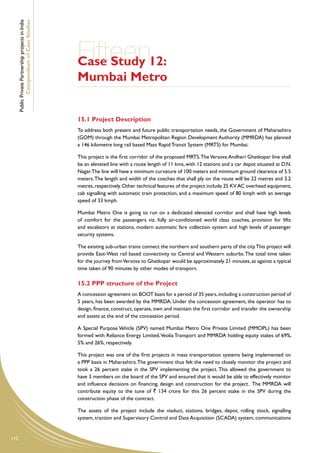
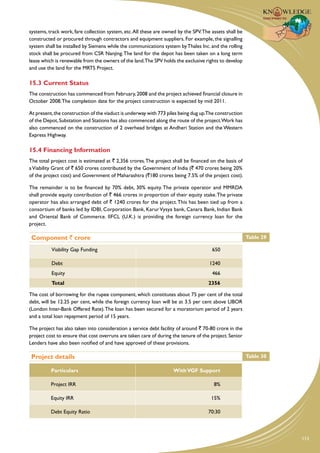
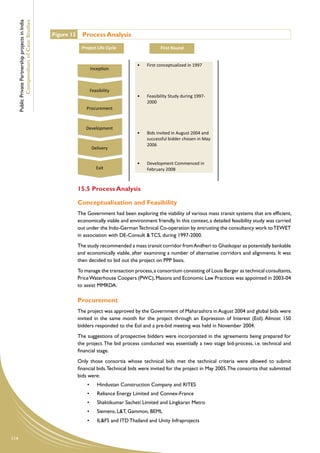
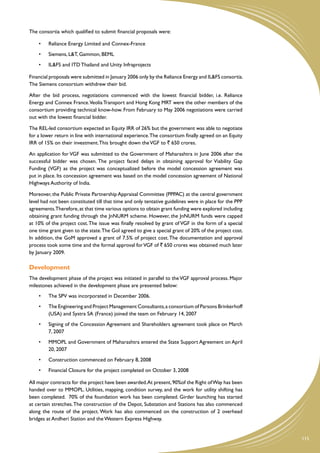
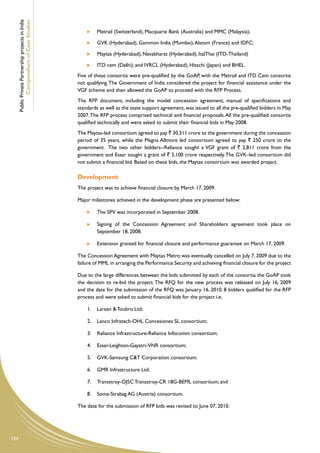
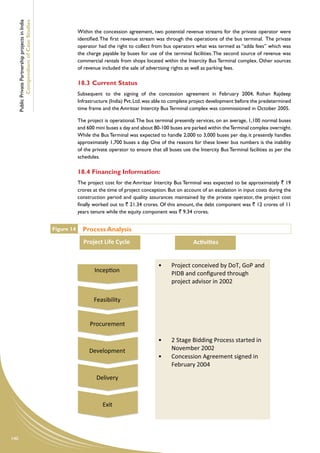
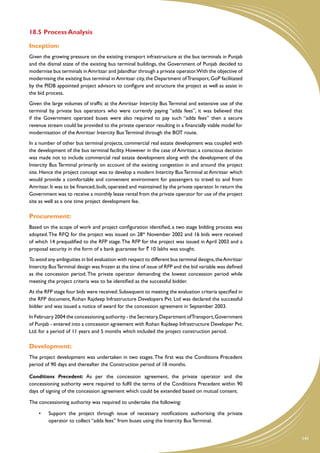
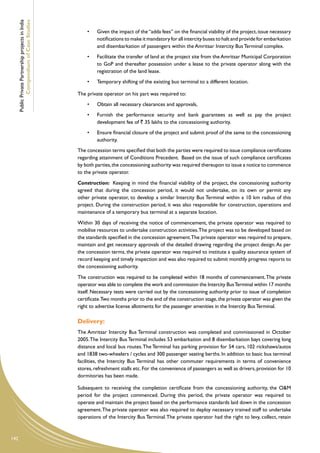
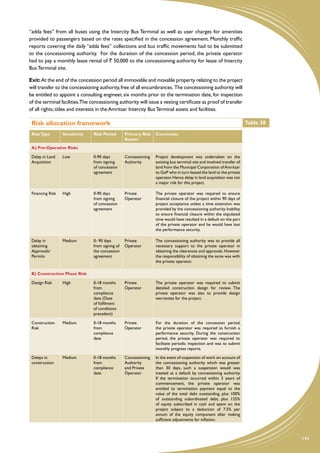
                       Ministry of Finance
                 Department of Economic Affairs


Public Private Partnership
Projects in India
Compendium of Case Studies


                                                  c
Government of India
            Ministry of Finance
      Department of Economic Affairs


Public Private Partnership
Projects in India
Compendium of Case Studies


December 2010
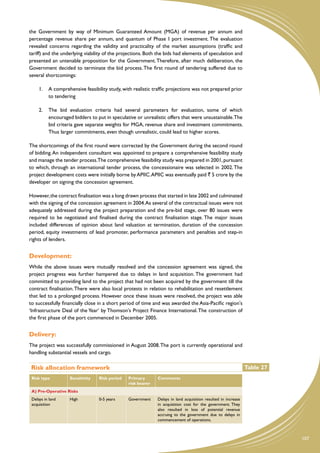
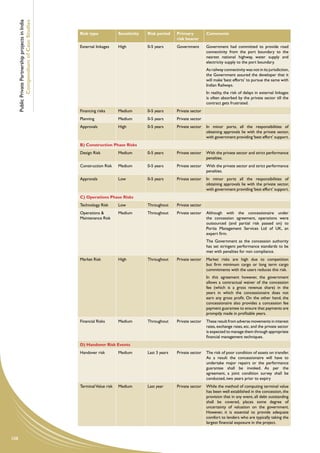
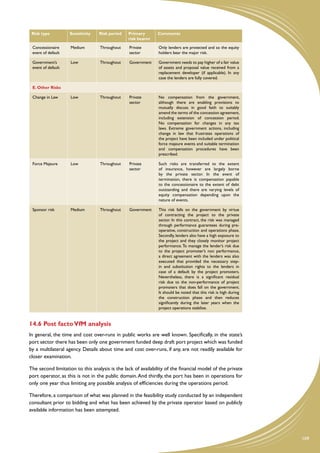
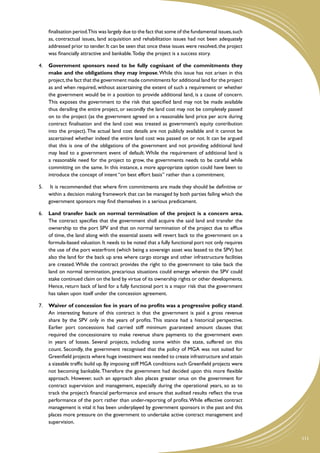
Public Private Partnership projects in India
        Compendium of Case Studies


                                               © Department of Economic Affairs
                                               All rights reserved

                                               Published by:
                                               PPP Cell, Department of Economic Affairs
                                               Ministry of Finance, Government of India
                                               New Delhi-110 001, India
                                               www.pppinindia.com


                                               Disclaimer

                                               This Compendium of Case Studies has been prepared as a part of a PPP capacity building
                                               programme that is being developed by the Department of Economic Affairs, Ministry of Finance,
                                               Government of India (DEA) with funding support from the World Bank, AusAID South Asia Region
                                               Infrastructure for Growth Initiative and the Public Private Infrastructure Advisory Facility (PPIAF).
                                               A consulting consortium, consisting of Economic Consulting Associates Limited (ECA) and CRISIL
                                               Risk and Infrastructure Solutions Limited (CRIS), commissioned by the World Bank, has prepared
                                               this compendium based on extensive external consultations.

                                               ECA and CRIS have taken due care and caution in preparing the contents of this compendium. The
                                               accuracy, adequacy or completeness of any information contained in this toolkit is not guaranteed
                                               and DEA,World Bank, AusAID, PPIAF, ECA or CRIS are not responsible for any errors or omissions,
                                               or for the results obtained from the use of such information. The contents of this compendium
                                               should not be construed to be the opinion of the DEA, World Bank, AusAID or PPIAF. DEA is not
                                               liable for any direct, indirect, incidental or consequential damages of any kind whatsoever to the
                                               subscribers / users / transmitters / distributors of this toolkit.

                                               The compendium shall not be reproduced in any form, other than those intended by DEA, without
                                               prior written permission from DEA.
Contents


1	   Overview		                                                                                1


2.	 Snapshot Of Case Studies	                                                                  2


3.	 Key Learnings		                                                                            5


4.	 Case Study 1: 	    Alandur Sewerage Project	                                              15


5.	 Case Study 2: 	    Karnataka Urban Water Supply Improvement Project	                      27


6.	 Case Study 3: 	    Latur Water Supply Project	                                            38


7.	 Case Study 4: 	    Salt Lake Water Supply And Sewerage Network	                           50


8.	 Case Study 5: 	    Timarpur Okhla Integrated Municipal Solid Waste Management Project	    58


9.	 Case Study 6: 	    Vadodara Halol Toll Road	                                              68


10.	 Case Study 7: 	   Tuni Anakapalli Annuity Road Project	                                  76


11.	 Case Study 8: 	   Delhi Gurgaon Expressway	                                              82


12.	 Case Study 9: 	   Nhava Sheva International Container Terminal	                          90


13.	 Case Study 10: 	 Kakinada Deep Water Port	                                               98


14.	 Case Study 11: 	 Gangavaram Port	                                                       105


15.	 Case Study 12: 	 Mumbai Metro	                                                          112


16.	 Case Study 13: 	 Hyderabad Metro	                                                       121


17.	 Case Study 14:	 Bhiwandi Electricity Distribution Franchisee	                           130


18.	 Case Study 15: 	 Amritsar Intercity Bus Terminal Project	                               139


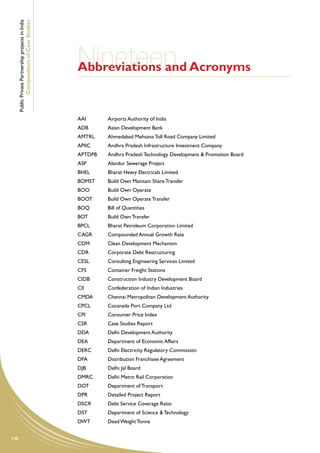
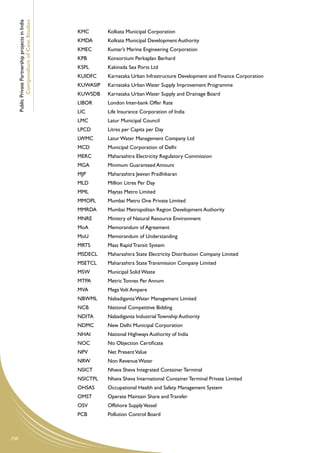
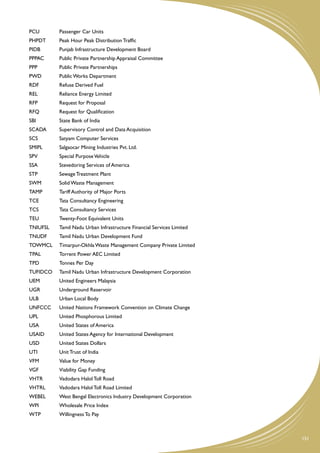
19.	 Abbreviations and Acronyms	                                                             148


                                                                                                   iii
Public Private Partnership projects in India
        Compendium of Case Studies
One
Overview


This compendium presents case studies of fifteen select Public-Private-Partnership (PPP) projects
in India. The case studies have been prepared to highlight the experience and lessons learnt so far
and thereby influence the design of future PPP processes and structures to improve the quality of
PPP projects.

The choice of case studies provides a representation across different sectors, covers different PPP
project structures, includes projects at different stages of the PPP life-cycle and has projects with
different levels of complexity.

These case studies include the following:

    a.	 A description of the project with project features;

    b.	 The project structure adopted with details of the roles and responsibilities of the private
        and public partners;

    c.	 The financing details of the project along with the current status

    d.	 A description of the PPP process adopted including project identification, project feasibility,
        structuring of the contract/concession and awarding projects to private partners. This
        includes details like the timing of major events like tendering and details like the level of
        response to the bid process;

    e.	 A detailed matrix of initial allocation of key risks across the public and private sector
        partners, along with details of subsequent changes, if any, and an assessment of the
        implications of the risk allocation;

    f.	   A concise assessment of the achievement of objectives originally set out for the project,
          viz., improvements in service delivery - e.g., capacity, quality, coverage affordability - with
          indicative parameters, to the extent possible;

    g.	 A Value For Money (VFM) assessment of the project to illustrate the benefits of following
        a PPP approach vis-à-vis the alternative of public procurement; and

    h.	 A summary of the key learning and observations from the project.

It is expected that the case studies will assist the public authorities in:

      	   Understanding the needs, challenges and risks associated with alternate PPP arrangements
          in specific sector.

      	   Improving quality of project identification, preparation, award and monitoring of PPPs and
          associated issues such as, for example, governance and fiscal implications.

      	   Managing the transition to a large scale PPP program to improve infrastructure services.


                                                                                                            1
Public Private Partnership projects in India
            Compendium of Case Studies


                                                   Two of Case Studies
                                                   Snapshot


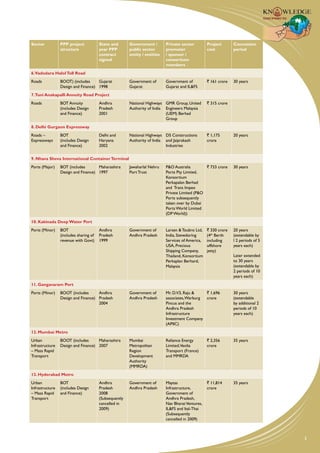
                                                   The following table provides a snapshot of the fifteen case studies.
                                                   Sector           Ppp project         State and     Government /           Private sector         Project        Concession
                                                                    structure           year ppp      public sector          promoter               cost           period
                                                                                        contract      entity / entities      / sponsor /
                                                                                        signed                               consortium
                                                                                                                             members
                                                   1. Alandur Underground Sewerage Project
                                                   Sewerage         Construction        Tamil Nadu    Alandur                 IVRCL                 ` 34.6 crore   O&M Contract
                                                                    Contract            2000          Municipality and the    Infrastructures and   (Sewerage      – 5 years
                                                                    (Underground                      Tamil Nadu Urban        Projects Ltd and      Network)
                                                                    Sewage System)                    Infrastructure          Va Tech Wabag                        BOT Annuity –
                                                                                                      Financial Services      Technologies Ltd.     ` 6.68 crore   14 years
                                                                    O&M Contract                      Limited (TNUIFSL)
                                                                    (Underground                                                                    (Sewage
                                                                    Sewerage System)                                                                Treatment
                                                                                                                                                    Plant)
                                                                    Build-Operate-
                                                                    Transfer (BOT)
                                                                    Annuity (Sewage
                                                                    Treatment Plant)
                                                   2. Karnataka Urban Water Supply Improvement
                                                   Urban Water      Operations &        Karnataka     Karnataka Urban        Veolia Water       ` 32 crore         42 months
                                                   Supply           Management          2005          Infrastructure         (formerly known as                    (Later
                                                                    Contract                          Development            Compagnie Generale                    extended to 59
                                                                                                      and Finance            des Eaux, France)                     months)
                                                                                                      Corporation
                                                                                                      (KUIDFC)
                                                   3. Latur Water Supply Project
                                                   Water Supply     Operations &        Maharashtra   Maharashtra        Subhash Projects &         ` 182 crore    10 years
                                                                    Management          2006          Jeevan Pradhikaran Marketing Limited,         (including
                                                                    Contract                                             UPL Environmental          payment
                                                                                                                         Engineers Limited          to MJP for
                                                                                                                         and Hydro Comp             right to use
                                                                                                                         Enterprises India          assets)
                                                                                                                         Private Limited.
                                                   4. Salt Lake Water Supply and Sewage Disposal System
                                                   Water &          BOT                 West Bengal   Kolkata                Jamshedpur Utilities   `70.09 crore 30 years
                                                   Sewage           (includes Design    2007          Metropolitan           and Services
                                                                    and Finance)                      Development            Company Limited
                                                                                                      Authority and          and Voltas Limited
                                                                                                      Naba Diganta
                                                                                                      Industrial
                                                                                                      Township
                                                                                                      Authority
                                                   5.Timarpur Okhla Integrated Municipal Solid Waste Management Project
                                                   Urban            BOOT (includes      Delhi         New Delhi              Jindal Urban           ` 200 crore    25 years
                                                   Infrastructure   Design and Finance) 2008          Municipal              Infrastructure
                                                   - Municipal                                        Corporation            Limited
                                                   Solid Waste                                        (NDMC) and
                                                                                                      Municipal
                                                                                                      Corporation of
                                                                                                      Delhi (MCD)


2
Sector           Ppp project            State and       Government /        Private sector         Project       Concession
                 structure              year ppp        public sector       promoter               cost          period
                                        contract        entity / entities   / sponsor /
                                        signed                              consortium
                                                                            members
6.Vadodara Halol Toll Road
Roads            BOOT) (includes     Gujarat            Government of       Government of          ` 161 crore   30 years
                 Design and Finance) 1998               Gujarat             Gujarat and IL&FS
7.Tuni Anakapalli Annuity Road Project
Roads            BOT Annuity            Andhra          National Highways GMR Group, United        ` 315 crore
                 (includes Design       Pradesh         Authority of India Engineers Malaysia
                 and Finance)           2001                               (UEM) Berhad
                                                                           Group
8. Delhi Gurgaon Expressway
Roads –          BOT                    Delhi and       National Highways DS Constructions         ` 1,175       20 years
Expressways      (includes Design       Haryana         Authority of India and Jaiprakash          crore
                 and Finance)           2002                               Industries


9. Nhava Sheva International Container Terminal
Ports (Major)    BOT (includes       Maharashtra        Jawaharlal Nehru    P&O Australia        ` 733 crore     30 years
                 Design and Finance) 1997               Port Trust          Ports Pty Limited,
                                                                            Konsortium
                                                                            Perkapalan Berhad
                                                                            and Trans Impex
                                                                            Private Limited (P&O
                                                                            Ports subsequently
                                                                            taken over by Dubai
                                                                            Ports World Limited
                                                                            (DP World))
10. Kakinada Deep Water Port
Ports (Minor)    BOT                    Andhra          Government of       Larsen & Toubro Ltd,   ` 330 crore   20 years
                 (includes sharing of   Pradesh         Andhra Pradesh      India, Stevedoring     (4th Berth    (extendable by
                 revenue with Govt)     1999                                Services of America,   including     l 2 periods of 5
                                                                            USA, Precious          offshore      years each)
                                                                            Shipping Company,      jetty)
                                                                            Thailand, Konsortium                 Later extended
                                                                            Perkaplan Berhard,                   to 30 years
                                                                            Malaysia                             (extendable by
                                                                                                                 2 periods of 10
                                                                                                                 years each)
11. Gangavaram Port
Ports (Minor)    BOOT (includes      Andhra             Government of       Mr. D.V.S. Raju &   ` 1,696          30 years
                 Design and Finance) Pradesh            Andhra Pradesh      associates, Warburg crore            (extendable
                                     2004                                   Pincus and the                       by additional 2
                                                                            Andhra Pradesh                       periods of 10
                                                                            Infrastructure                       years each)
                                                                            Investment Company
                                                                            (APIIC)
12. Mumbai Metro
Urban            BOOT (includes      Maharashtra        Mumbai              Reliance Energy        ` 2,356       35 years
Infrastructure   Design and Finance) 2007               Metropolitan        Limited,Veolia         crore
– Mass Rapid                                            Region              Transport (France)
Transport                                               Development         and MMRDA
                                                        Authority
                                                        (MMRDA)
13. Hyderabad Metro
Urban            BOT                    Andhra          Government of       Maytas                 ` 11,814      35 years
Infrastructure   (includes Design       Pradesh         Andhra Pradesh      Infrastructure,        crore
– Mass Rapid     and Finance)           2008                                Government of
Transport                               (Subsequently                       Andhra Pradesh,
                                        cancelled in                        Nav Bharat Ventures,
                                        2009)                               IL&FS and Ital-Thai
                                                                            (Subsequently
                                                                            cancelled in 2009)


                                                                                                                                    3
Public Private Partnership projects in India
            Compendium of Case Studies
                                                   Sector         Ppp project        State and        Government /        Private sector        Project       Concession
                                                                  structure          year ppp         public sector       promoter              cost          period
                                                                                     contract         entity / entities   / sponsor /
                                                                                     signed                               consortium
                                                                                                                          members
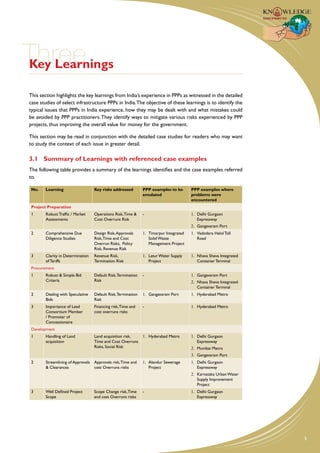
                                                   14. Bhiwandi Electricity Distribution Franchisee
                                                   Electricity    Operations &       Maharashtra      Maharashtra         Torrent Power AEC     ` 61 crore    10 years
                                                   Distribution   Management         2004             State Electricity   Limited (TPAL)        (MSEDCL)
                                                                  Contract                            Distribution
                                                                  (Franchisee)                        Company Limited                           ` 250 crore
                                                                                                                                                (TPAL)
                                                   15. Amritsar Inter-city Bus Terminal
                                                   Urban          BOT                Punjab           Department of       Rohan Builders        ` 21.34       11 years 5
                                                   Transport      (includes Design   2004             Transportation      (India) Pvt Ltd.,     crore         months
                                                                  and Finance)                        (DoT),              Rajdeep Buildcon
                                                                                                      Government of       Pvt Ltd and Rajdeep
                                                                                                      Punjab              Road Developers
                                                                                                                          Pvt. Ltd.


4
Three
Key Learnings

This section highlights the key learnings from India’s experience in PPPs as witnessed in the detailed
case studies of select infrastructure PPPs in India. The objective of these learnings is to identify the
typical issues that PPPs in India experience, how they may be dealt with and what mistakes could
be avoided by PPP practitioners. They identify ways to mitigate various risks experienced by PPP
projects, thus improving the overall value for money for the government.

This section may be read in conjunction with the detailed case studies for readers who may want
to study the context of each issue in greater detail.

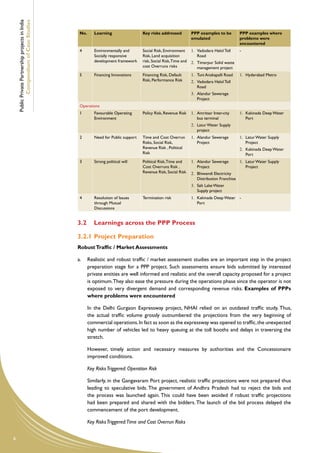
3.1	 Summary of Learnings with referenced case examples
The following table provides a summary of the learnings identifies and the case examples referred
to.

 No.    Learning                    Key risks addressed         Ppp examples to be        Ppp examples where
                                                                emulated                  problems were
                                                                                          encountered
 Project Preparation
 1      Robust Traffic / Market     Operations Risk, Time &     -                         1.	 Delhi Gurgaon
        Assessments                 Cost Overruns Risk                                        Expressway
                                                                                          2.	 Gangavaram Port
 2      Comprehensive Due           Design Risk, Approvals      1.	 Timarpur Integrated   1.	 Vadodara Halol Toll
        Diligence Studies           Risk, Time and Cost             Solid Waste               Road
                                    Overrun Risks, Policy           Management Project
                                    Risk, Revenue Risk
 3      Clarity in Determination    Revenue Risk,               1.	 Latur Water Supply    1.	 Nhava Sheva Integrated
        of Tariffs                  Termination Risk                Project                   Container Terminal
 Procurement
 1      Robust & Simple Bid         Default Risk, Termination   -                         1.	 Gangavaram Port
        Criteria                    Risk                                                  2.	 Nhava Sheva Integrated
                                                                                              Container Terminal
 2      Dealing with Speculative    Default Risk, Termination   1.	 Gangavaram Port       1.	 Hyderabad Metro
        Bids                        Risk
 3      Importance of Lead          Financing risk, Time and    -                         1.	 Hyderabad Metro
        Consortium Member           cost overruns risks
        / Promoter of
        Concessionaire
 Development
 1      Handling of Land            Land acquisition risk,      1.	 Hyderabad Metro       1.	 Delhi Gurgaon
        acquisition                 Time and Cost Overruns                                    Expressway
                                    Risks, Social Risk                                    2.	 Mumbai Metro
                                                                                          3.	 Gangavaram Port
 2      Streamlining of Approvals   Approvals risk, Time and    1.	 Alandur Sewerage      1.	 Delhi Gurgaon
        & Clearances                cost Overruns risks             Project                   Expressway
                                                                                          2.	 Karnataka Urban Water
                                                                                              Supply Improvement
                                                                                              Project
 3      Well Defined Project        Scope Change risk, Time     -                         1.	 Delhi Gurgaon
        Scope                       and cost Overruns risks                                   Expressway


                                                                                                                       5
Public Private Partnership projects in India
            Compendium of Case Studies
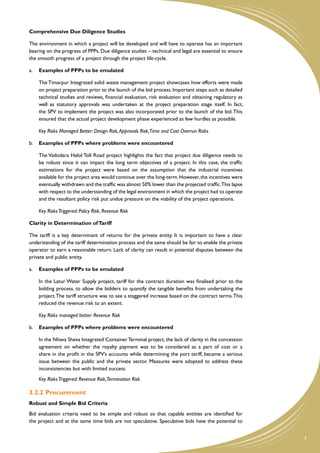
                                                       No.      Learning                  Key risks addressed           Ppp examples to be           Ppp examples where
                                                                                                                        emulated                     problems were
                                                                                                                                                     encountered
                                                       4        Environmentally and       Social Risk, Environment      1.	 Vadodara Halol Toll      -
                                                                Socially responsive       Risk, Land acquisition            Road
                                                                development framework     risk, Social Risk, Time and   2.	 Timarpur Solid waste
                                                                                          cost Overruns risks               management project
                                                       5        Financing Innovations     Financing Risk, Default       1.	 Tuni Anakapalli Road     1.	 Hyderabad Metro
                                                                                          Risk, Performance Risk        2.	 Vadodara Halol Toll
                                                                                                                            Road
                                                                                                                        3.	 Alandur Sewerage
                                                                                                                            Project
                                                       Operations
                                                       1        Favourable Operating      Policy Risk, Revenue Risk     1.	 Amritsar Inter-city      1.	 Kakinada Deep Water
                                                                Environment                                                 bus terminal                 Port
                                                                                                                        2.	 Latur Water Supply
                                                                                                                            project
                                                       2        Need for Public support   Time and Cost Overrun         1.	 Alandur Sewerage         1.	 Latur Water Supply
                                                                                          Risks, Social Risk,               Project                      Project
                                                                                          Revenue Risk , Political                                   2.	 Kakinada Deep Water
                                                                                          Risk                                                           Port
                                                       3        Strong political will     Political Risk, Time and      1.	 Alandur Sewerage         1.	 Latur Water Supply
                                                                                          Cost Overruns Risk ,              Project                      Project
                                                                                          Revenue Risk, Social Risk     2.	 Bhiwandi Electricity
                                                                                                                            Distribution Franchise
                                                                                                                        3.	 Salt Lake Water
                                                                                                                            Supply project
                                                       4        Resolution of Issues      Termination risk              1.	 Kakinada Deep Water -
                                                                through Mutual                                              Port
                                                                Discussions


                                                   3.2	�Learnings across the PPP Process

                                                   3.2.1	�Project Preparation
                                                   Robust Traffic / Market Assessments

                                                   a.	 Realistic and robust traffic / market assessment studies are an important step in the project
                                                       preparation stage for a PPP project. Such assessments ensure bids submitted by interested
                                                       private entities are well informed and realistic and the overall capacity proposed for a project
                                                       is optimum. They also ease the pressure during the operations phase since the operator is not
                                                       exposed to very divergent demand and corresponding revenue risks. Examples of PPPs
                                                       where problems were encountered

                                                   	         In the Delhi Gurgaon Expressway project, NHAI relied on an outdated traffic study. Thus,
                                                             the actual traffic volume grossly outnumbered the projections from the very beginning of
                                                             commercial operations. In fact as soon as the expressway was opened to traffic, the unexpected
                                                             high number of vehicles led to heavy queuing at the toll booths and delays in traversing the
                                                             stretch.

                                                   	         However, timely action and necessary measures by authorities and the Concessionaire
                                                             improved conditions.

                                                   	         Key Risks Triggered: Operation Risk

                                                             Similarly, in the Gangavaram Port project, realistic traffic projections were not prepared thus
                                                             leading to speculative bids. The government of Andhra Pradesh had to reject the bids and
                                                             the process was launched again. This could have been avoided if robust traffic projections
                                                             had been prepared and shared with the bidders. The launch of the bid process delayed the
                                                             commencement of the port development.

                                                             Key Risks Triggered:Time and Cost Overrun Risks


6
Comprehensive Due Diligence Studies

The environment in which a project will be developed and will have to operate has an important
bearing on the progress of PPPs. Due diligence studies – technical and legal are essential to ensure
the smooth progress of a project through the project life-cycle.

a.	 Examples of PPPs to be emulated

	   The Timarpur Integrated solid waste management project showcases how efforts were made
    on project preparation prior to the launch of the bid process. Important steps such as detailed
    technical studies and reviews, financial evaluation, risk evaluation and obtaining regulatory as
    well as statutory approvals was undertaken at the project preparation stage itself. In fact,
    the SPV to implement the project was also incorporated prior to the launch of the bid. This
    ensured that the actual project development phase experienced as few hurdles as possible.

	   Key Risks Managed Better: Design Risk, Approvals Risk,Time and Cost Overrun Risks

b.	 Examples of PPPs where problems were encountered

	   The Vadodara Halol Toll Road project highlights the fact that project due diligence needs to
    be robust since it can impact the long term objectives of a project. In this case, the traffic
    estimations for the project were based on the assumption that the industrial incentives
    available for the project area would continue over the long-term. However, the incentives were
    eventually withdrawn and the traffic was almost 50% lower than the projected traffic.This lapse
    with respect to the understanding of the legal environment in which the project had to operate
    and the resultant policy risk put undue pressure on the viability of the project operations.

	   Key Risks Triggered: Policy Risk, Revenue Risk

Clarity in Determination of Tariff

The tariff is a key determinant of returns for the private entity. It is important to have a clear
understanding of the tariff determination process and the same should be fair to enable the private
operator to earn a reasonable return. Lack of clarity can result in potential disputes between the
private and public entity.

a.	 Examples of PPPs to be emulated

	   In the Latur Water Supply project, tariff for the contract duration was finalised prior to the
    bidding process, to allow the bidders to quantify the tangible benefits from undertaking the
    project. The tariff structure was to see a staggered increase based on the contract terms. This
    reduced the revenue risk to an extent.

	   Key Risks managed better: Revenue Risk

b.	 Examples of PPPs where problems were encountered

	   In the Nhava Sheva Integrated Container Terminal project, the lack of clarity in the concession
    agreement on whether the royalty payment was to be considered as a part of cost or a
    share in the profit in the SPV’s accounts while determining the port tariff, became a serious
    issue between the public and the private sector. Measures were adopted to address these
    inconsistencies but with limited success.
	   Key Risks Triggered: Revenue Risk,Termination Risk

3.2.2	�Procurement
Robust and Simple Bid Criteria
Bid evaluation criteria need to be simple and robust so that capable entities are identified for
the project and at the same time bids are not speculative. Speculative bids have the potential to


                                                                                                       7
Public Private Partnership projects in India
            Compendium of Case Studies
                                                   derail a project during the operations stage if the private entity is unable to sustain its overstated
                                                   commitments. Ambiguities in the bid criteria, on the other hand, can lead to disputes between the
                                                   private and public entity during the operations stage.

                                                   a.	 Examples of PPPs where problems were encountered

                                                   	   In the Gangavaram port project, the first round of tendering had several evaluation parameters
                                                       that were working at cross purposes and encouraged speculative bidding. The bid criteria
                                                       gave separate weights for the Minimum Guaranteed Amount, revenue share and investment
                                                       commitments. Thus larger commitments, even though unrealistic, could have lead to higher
                                                       scores. While the government eventually decided to terminate the process, this could have
                                                       resulted in an unsustainable project.

                                                   	   Key Risks Triggered: Default Risk, Termination Risk (However since the bid process was
                                                       terminated, these risks did not actually get triggered – Refer Learning 2.2.2)

                                                   	   In the Nhave Sheva Integrated Container Terminal, the bid evaluation criterion of the highest
                                                       NPV of royalty payment was simple but insufficient. The lack of a methodology to assess the
                                                       royalty payout to the licensor and the problems arising from the interaction of the royalty with
                                                       the tariff level created a number of issues in the subsequent operations phase.

                                                   	   Key Risks Triggered: Default Risk,Termination Risk 	

                                                   Dealing with Speculative Bids

                                                   a.	 While speculative bids should ideally be avoided, if encountered, the public entity should deal
                                                       with them without jeopardising the long term prospects of the project. This could even mean
                                                       terminating and re-launching the bid process. Examples of PPPs to be emulated

                                                   	   In the Gangavaram port project, the evaluation in the first round of bids revealed concerns
                                                       regarding the validity and practicality of the market assumptions and the underlying viability
                                                       of the projections. Both the bids had elements of speculation and presented an untenable
                                                       proposition for the Government. This was due to the absence of a comprehensive feasibility
                                                       study with realistic traffic projections which should have been undertaken by the government.
                                                       (Refer learning 2.1.1) However, the Government did not get attracted by the speculative bids
                                                       and decided to terminate the bid process.

                                                   	   Key Risks Managed Better: Default Risk, Termination Risk

                                                   b.	 Examples of PPPs where problems were encountered

                                                   	   In the Hyderabad Metro project, the government provided commercial development rights
                                                       for almost 296 acres of land allocated for the depots and the stations. This aggregated to
                                                       a cumulative maximum of 18.5 million square feet and was a substantial percentage of the
                                                       project cost.

                                                   	   This opportunity of the utilization of land on a commercial basis coupled with the metro
                                                       project led to widely divergent bids from the bidders. While the Siemens Consortium bid
                                                       a negative viability gap of ` 250 crore, the Maytas Consortium bid a very high a negative
                                                       viability gap of ` 30,311 crore. On the other hand, the two other bidders--Reliance sought a
                                                       VGF grant of ` 2,811 crore from the government and Essar sought a grant of ` 3,100 crore.
                                                       While the award of this project to Maytas was eventually withdrawn, such speculative bids
                                                       exposed the project to the risk of the actual construction and quality of the metro being
                                                       compromised as the private operator would have had a greater incentive to complete the real
                                                       estate development at the cost of the metro.

                                                   	   Key Risks Triggered: Default Risk,Termination Risk


8
Importance of Lead Consortium Member / Promoter of Concessionaire

The concessionaire’s ability to undertake complex projects is typically a function of the experience
and expertise brought on board by their lead consortium member or promoter. Accordingly, it is
essential that there is adequate due diligence of the promoter backing the concessionaire and the
continued involvement of the lead member is contractually ensured, at least during the project
development stage.

a.	 Examples of PPPs where problems were encountered

	   The Hyderabad Metro project saw the winning consortium of Maytas Metro getting adversely
    affected due to the issues besetting its promoter – Satyam Computer Services. Although the
    project was to be implemented by a separate Special Purpose Vehicle, there was a loss of
    investor confidence in the promoters of the project and consequently, the project was not able
    to achieve financial closure. The government finally had to withdraw its award and re-launch
    the bid process.

	   Key Risks Triggered: Financing risk, Time and cost overruns risks

3.2.3	�Development
Handling of Land Acquisition

a.	 The land acquisition process for PPP projects is no doubt the most challenging pre-
    development activity in India. In most cases, the government commits provision of land free
    from encumbrances for the project before actually completing the necessary formalities.
    Examples of PPPs to be emulated
	   While many readers may associate the bankruptcy of its promoters (Satyam) with the Hyderabad
    Metro project, a lesser known fact is the commendable manner in which the government dealt
    with land acquisition in the concession agreement. It required the government to handover
    land to the concessionaire by the financial closure date. Further, 90% of the land had to be
    handed-over within 120 days from signing of the agreement. There were penalties built in
    to the contract in case the government delayed the delivery of the land. Such contractual
    treatment would have ensured greater planning and focussed efforts on land acquisition by the
    government. Further to mitigate this risk, the project intended to use government lands for the
    developments of depots and stations to the extent possible.
	   Key Risks managed better: Land acquisition Risk,Time and Cost Overruns Risks

b.	 Examples of PPPs where problems were encountered

	   In the Delhi Gurgaon expressway project, the government committed to the promoters for
    providing a substantial area of land, prior to actually acquiring the land. Due to the thickly
    populated surrounding areas of the expressway, there were certain pockets of land that were
    difficult to acquire. This exposed the government to the risk of not providing the land within
    reasonable time impacting the overall schedule of the project. It would have been better if
    uncontrollable risks such as these were addressed before the project procurement stage itself
    to ensure smooth functioning of the project. This could have been achieved by completing the
    land acquisition process prior to the project procurement process itself.

	   Key Risks Triggered: Land acquisition risk,Time and Cost Overruns Risks

    Similarly for the Mumbai Metro, the government committed that the land for the project would
    be procured as per the land procurement schedule provided in the agreement. However, this
    land was under private ownership and at times under dispute. This exposed the government
    to the risk of land not being available thereby resulting in inordinate delays in commencement
    of construction of the project. While this issue was eventually resolved, it would have been
    a better option for the government to have dealt with it prior to signing of the concession
    agreement.


                                                                                                       9
Public Private Partnership projects in India
             Compendium of Case Studies
                                                        Key Risks Triggered: Land acquisition risk,Time and Cost Overruns Risks

                                                        The Gangavaram port project was another case in point where the land acquisition process
                                                        was prolonged due to local protests in relation to rehabilitation and resettlement.

                                                        Key Risks Triggered: Land acquisition risk,Time and Cost Overruns Risks, Social Risk

                                                    Streamlining of Approvals & Clearances

                                                    Apart from land acquisition, obtaining numerous clearances and approvals has been the bane
                                                    of Indian PPP projects. Typically, the concessionaire needs to obtain clearances from multiple
                                                    government departments and apprise different departments about the progress of a project. These
                                                    delays add to the cost of developing the PPP and thereby reduce the value for money to the public
                                                    sector.

                                                    Ideally a single interface for interactions or coordination on all such approvals should be setup by
                                                    the government to prevent undue delays. This could be in the form of a lead entity taking up the
                                                    responsibility or a common project steering/ empowered committee that is appointed to take care
                                                    of all such formalities. With this, the concessionaire could focus on the core development issues
                                                    rather than being entangled in administrative processes.

                                                    a.	 Examples of PPPs to be emulate

                                                    	   The Alandur Sewerage Project had a streamlined process for obtaining approvals and clearances
                                                        related to the project. The Alandur Municipality took up the responsibility for key approvals,
                                                        including road cutting, shifting of services and environmental clearances. The developer was
                                                        responsible only of the ‘works’ related approvals. This approach ensured there was minimum
                                                        delay in obtaining the necessary permits.

                                                    	   Key Risks Managed Better: Approvals risk,Time and cost Overruns risks

                                                    b.	 Examples of PPPs where problems were encountered

                                                    	   The Delhi Gurgaon expressway project is a case in point where the approvals process resulted
                                                        in significant delays for the concessionaire. Since the project was spread across the states of
                                                        Delhi and Haryana, there were more than fifteen government agencies/civic bodies affected
                                                        by the development of this highway that had to grant approvals for the project. This became a
                                                        complex and time consuming process during the construction period.

                                                    	   Key Risks Triggered: Approvals risk,Time and cost Overruns risks

                                                    	   On similar lines, the Karnataka Urban Water Supply Improvement project, experienced delays
                                                        in obtaining permits from several departments due to the lack of co-ordination across the
                                                        three Urban Local Bodies involved in the project.

                                                    	   Key Risks Triggered: Approvals risk,Time and cost Overruns risks

                                                    Well Defined Scope of Work

                                                    It is essential that the concessionaire’s scope of work is well defined, prior to the launch of the
                                                    bid process and the same is not modified except in the case of unavoidable and unforeseen
                                                    circumstances. Changes in scope of work, which typically result in time and cost overruns, have the
                                                    potential to derail PPP projects.

                                                    a.	 Examples of PPPs where problems were encountered

                                                    	   The Delhi Gurgaon expressway experienced significant time and cost overruns on account of
                                                        a change in the concessionaire’s scope of work. There were substantial changes in the original
                                                        design that were sought by NHAI and the government keeping in mind future requirements and
                                                        the convenience of commuters. While these should have been anticipated and incorporated


10
prior to the launch of the bid process, the order for provisional change of scope was finalised
    and issued to the concessionaire just days before the original scheduled completion date of the
    project.

	   Key Risks Triggered: Scope Change risk,Time and cost Overruns risks

Environmentally and Socially responsive development framework

Infrastructure projects typically have significant social and environmental impacts, arising from their
construction and operation. Social impacts are on the communities affected by the project and
environmental impacts are on account of the project location.

It is therefore necessary that PPPs have an environmentally and socially responsive development
framework. While social and environment impact assessments are mandatory, there are few
examples of how projects have proactively adopted best practices in this regard.

An environmentally and socially responsive framework would in fact help garner public support for
a PPP project more easily (Refer Learning 2.4.2) and have a positive impact on the land acquisition
process. (Refer Learning 2.3.1)

a.	 Examples of PPPs to be emulated

	   The Vadodara Halol Toll Road was the first project that introduced environmental and
    social safeguards measures as part of the contractual obligation of the concessionaire. The
    environmental and social assessment for the project noted that the project in its original
    form would lead to resettlement and rehabilitation of about 300 project affected families.
    Intense public consultations were carried out to develop various alternatives. Bypasses were
    introduced at various critical locations such that the extent of resettlement was reduced to
    only 10 project affected households.

	   This created a benchmark and had immense demonstration value since it highlighted that
    infrastructure can be developed in an environmentally and socially responsible manner. The
    project was in fact designated by the World Bank as a 'best practice' example for its environment
    risk mitigation and social rehabilitation plan in India amongst World Bank assisted projects.

	   Key Risks Managed Better: Land acquisition risk, Social Risk,Time and cost Overruns risks

	   In another case, the Timarpur solid waste management project, that was located in the vicinity
    of residential areas, organised public hearings to address concerns with respect to pollution.

	   Key Risks Managed Better: Social Risk, Environment risk

Financing Innovations

While the government of India has provided financial support initiatives such as the Viability Gap
funding (VGF) scheme or the Jawaharlal Nehru Nation Urban Renewal Mission, it is important for
PPP projects to be financially independent to the extent possible and minimise reliance on such
grants or schemes. This is possible through innovative financing structures that not only bring
down the cost of funds but also tap new sources of funding. However, a fine balance needs to be
maintained to ensure that such innovations in financing do not result in speculative bids during the
procurement stage.

a.	 Examples of PPPs to be emulated

	   The concessionaire for the Tuni Anakapalli Road project, during its operations stage, raised
    debt at very low interest rates by securitizing the annuity payments receivable from NHAI.
    This mode of funding enabled the concessionaire to repay the term loan taken for the project
    development by accessing to relatively lower cost funding.

	   Key Risks Managed Better: Default Risk, Performance Risk


                                                                                                          11
Public Private Partnership projects in India
             Compendium of Case Studies
                                                    	   The Vadodara Halol Toll Road was another project that utilized several financing methods such
                                                        as deep discount bonds with an option of take-out financing, cumulative convertible preference
                                                        shares and long term loans as a part of its financing structure.

                                                    	   Key Risks Managed Better: Financing risk

                                                    	   The public deposits sought in the Alandur Sewerage Project, were also a landmark innovation
                                                        that were taken up despite the possibility of strong resistance from the people. Almost 29% of
                                                        the project cost was funded from public contributions.

                                                    	   Key Risks Managed Better: Financing risk

                                                    b.	 Examples of PPPs where problems were encountered

                                                    	   In the Hyderabad Metro project, the government provided commercial development rights for
                                                        almost 296 acres of land to the Concessionaire which aggregated to a cumulative maximum of
                                                        18.5 million square feet of built-up space.

                                                    	   This opportunity of the utilization of land on a commercial basis coupled with the metro
                                                        project led to widely divergent bids from the bidders. While the Siemens Consortium bid a
                                                        negative viability gap of ` 250 crore, the Maytas Consortium bid a very high a negative viability
                                                        gap of ` 30,311 crore. On the other hand, the two other bidders--Reliance sought a VGF grant
                                                        of ` 2,811 crore from the government and Essar sought a grant of ` 3,100 crore.

                                                    	   The real estate market is very volatile and cyclical in nature. An adverse outlook for the sector
                                                        would have the risk of compromising the development and construction of the project. Thus,
                                                        ideally real estate development should be a smaller component of the project or alternatively
                                                        should be separated from the core infrastructure project.

                                                    	   Key Risks Triggered: Default risk, Performance Risk

                                                    3.2.4	�Operations
                                                    Favourable Operating Environment

                                                    PPP projects require the private sector to operate in a space where traditionally the public sector
                                                    is dominant and in some cases solely responsible. In this context, it is important for an enabling
                                                    operating environment to be created for the private sector to function optimally.

                                                    a.	 Examples of PPPs to be emulated

                                                    	   In the Amritsar Inter-state Bus Terminal project, the government took the necessary steps to
                                                        create a favourable environment so that the concessionaire’s revenue streams are not at risk.
                                                        The government issued notifications to the effect that all intercity buses would be required to
                                                        pickup and drop off passengers at the new Inter City Bus Terminal.

                                                    	   Key Risks Managed Better: Revenue Risk

                                                    	   Similarly, in the Latur water supply project, a clearly defined tariff and metering policy was
                                                        established, prior to the bidding process, to allow the bidders to quantify the tangible benefits
                                                        from undertaking the project.

                                                    	   Key Risks Managed Better: Policy risk, Revenue Risk

                                                    b.	 Examples of PPPs where problems were encountered

                                                    	   The drawbacks of not clearly establishing an operations policy were experienced by the
                                                        Kakinada Deep Water Port project. In this case, during the tendering stage, the government
                                                        had indicated that the private developer would get complete rights while operating the port.
                                                        However, during the award of the project, there were restrictions on the type of cargo to be


12
handled, in favour of the Kakinada anchorage port that was operating in parallel. This ended up
    becoming one of the key issues under dispute between the concessionaire and the Government
    of Andhra Pradesh.

	   Key Risks Triggered: Revenue Risk

Need for Public Support

a.	 Effective communication of project benefits to various stakeholders and mobilising public
    support is one of the key lessons to be drawn from India’s PPP experience to date. Absence of
    a buy-in from the people at large can lead to significant hurdles in various stages of a project
    such as during land acquisition because of the displacement of people, or during project
    operations due resistance to collection of revenues in the form of toll, charges or tariffs. Public
    support is thus critical for project siting decisions. Examples of PPPs to be emulated

	   The Alandur Sewerage project is a prime example where stakeholder support went a step
    further and included public contributions towards the project cost. An aggressive public
    outreach campaign was conducted by the municipality and Government of Tamil Nadu and the
    engagement of stakeholders was essential to convince them about the benefits of the project.

	   Key Risks Managed Better:Time and Cost Overrun Risks, Social Risk, Revenue Risk

b.	 Examples of PPPs where problems were encountered

	   In the Latur water supply project, public consultations were taken-up by the Maharashtra Jeevan
    Pradhikaran only after the signing of the agreements with the concessionaire. Accordingly the
    project met with resistance in the form of agitation campaigns and public rallies resulting in
    even the closing down of the concessionaire’s office in Latur. As a consequence of the lack
    of public support, the transfer of project assets to the concessionaire has been delayed even
    though the agreement was signed in June 2008.

	   Key Risks Triggered:Time and Cost Overruns Risks, Social Risk, Political Risk

	   Similarly in the Kakinada deep water port project, labourers of the adjoining anchorage port
    went on strike in protest of the competition from the deep water port in handling agricultural
    commodities such as wheat. Stakeholder consultations could have avoided this situation.

	   Key Risks Triggered: Revenue Risk, Social Risk, Political Risk

Strong political will

While public support is no doubt a must for PPP projects, strong political will to make a project
happen, is equally important. Large path-breaking projects require active hand--holding from the
government throughout the project planning and execution stages.

a.	 Examples of PPPs to be emulated

	   The Alandur Sewerage Project demonstrated the benefit of such sustained political will which
    ensured that the project proceeded smoothly. The chairman and the council of the local
    municipality played an important role in convincing the citizens to pay a share of the project
    cost and accept the entry of the private concessionaire.

	   Key Risks Managed Better: Political Risk, Social Risk

	   The Bhiwandi electricity distribution franchisee project is another example where strong
    political conviction enabled the implementation of a new PPP structure in amongst the most
    challenging regions in Maharashtra.

	   Key Risks Managed Better: Political Risk


                                                                                                          13
Public Private Partnership projects in India
             Compendium of Case Studies
                                                    	   Similarly in the Salt Lake water supply and sewerage network project, the Kolkata Municipal
                                                        Development Authority and the Nabadiganta Industrial Township Authority played a critical
                                                        role in providing key concessions to the private developer to arrive at a rational water cum
                                                        sewerage charge.

                                                    	   Key Risks Managed Better: Revenue Risk

                                                    b.	 Examples of PPPs where problems were encountered

                                                    	   The Latur water supply project witnessed significant hurdles due to the lack of political
                                                        consensus on the project. Although the management contract between the Maharashtra
                                                        Jeevan Pradhikaran and the private operator was signed in June 2008, the transfer of assets
                                                        was delayed, preventing the private operator from commencing its project obligations as per
                                                        schedule.

                                                    	   Key Risks Triggered: Political Risk,Time and Cost Overruns risks

                                                    Resolution of Issues through Mutual Discussions

                                                    PPP Projects, being complex with long concession periods, there is a likelihood of issues cropping up
                                                    from time to time between the government and the public agency. While contracts typically specify
                                                    the formal mechanism to deal with such issues, it is at times through mutual discussions carried out
                                                    in good faith that solutions can be identified that are in the best interests of both parties.

                                                    a.	 Examples of PPPs to be emulated

                                                    	   The Kakinada Project is a case in point where key amendments with respect to revenue
                                                        sharing, the concession period and rights for undertaking additional developments were made
                                                        in the terms of the concession agreement through mutual discussions and negotiations. This
                                                        ensured the continuity of the project.

                                                    	   Key Risks managed better:Termination risk


14
Four 1:
Case Study
Alandur Sewerage Project
4.1	 Project Description
The Alandur Sewerage Project (ASP) was initiated in the year 1996 by the Chairman of the Alandur
Municipality (AM). AM, located adjacent to Chennai, forms a part of the Chennai Metropolitan
Area. With a population of around 165,000, the municipality is a residential suburb of Chennai with
predominantly residential and commercial activities. Approximately one-fourth of its population
lives in slums.

Prior to 1996, the town did not have an underground sewerage system and all sewage was managed
with individual septic tanks. The largely unregulated disposal of sewage in storm water drains
was an environmental and health concern for the local residents and was frequently raised as a
political issue.Around 98% of 19,800 households used either septic tanks or holding tanks collected
periodically by tankers and disposed in the low-lying areas outside the municipal limits.

In 1996, AM announced an ambitious plan to construct an underground sewerage system and waste
water treatment facility with the participation of the private sector, contribution from the public,
and payment to be provided by the city. The proposal was ‘transformational’ as it involved a service
never before made available by the municipality, with financial and management responsibilities
being shared by the municipality, the residents, the private sector, and state government bodies.

The ASP was designed with the following objectives:

     	 To improve the standard of living of the residents of Alandur (on par with that of Chennai);

     	 To provide the most essential basic facility to all the residents of the town;

     	 To eradicate the mosquito menace;

     	 To avoid the recurring expenditure on septic tank cleaning; and

     	 To avoid ground water contamination.

The proposed sewerage system was to be designed for the estimated population of about 300,000
in 2027 and was planned to be completed within a five-year period from its inception date. The
project components included:

     	 A sewerage network consisting of the main sewer line, branch sewer line and manholes;

     	   Construction of a sewage pumping station;

     	   A sewage treatment plant; and

     	   Low cost sanitation

In the initial phase the plant was to treat 12 million litres per day (mld) of sewage supplied to it by
the municipality. The ultimate capacity was to be 24 mld.

To plan this complex and politically challenging project, the AM worked in partnership with the
Tamil Nadu Urban Infrastructure Financial Services Limited (TNUIFSL), the state asset management
company and with USAID’s Financial Institution Reform and Expansion (FIRE) Project.


                                                                                                          15
Public Private Partnership projects in India
             Compendium of Case Studies
                                                    4.2	 PPP structure of the Project
                                                    The ASP was the first project in the municipal water sector to be taken through the Public Private
                                                    Partnership route in India. The construction of the underground sewerage system in Alandur town,
                                                    involving the laying of pipes, construction of pumping station, etc., was done on a BOQ (Bill of
                                                    Quantities) basis, and the sewerage treatment plant (STP) on a BOT (Build, Operate and Transfer)
                                                    basis. Besides the construction responsibility, the contractor was also required to undertake the
                                                    operation and maintenance of the sewerage system for a period of five years from the date of
                                                    completion of the construction, on a fixed fee basis. The collection of tariff and provision of new
                                                    connections during the O&M phase was to be undertaken by the municipality directly.

                                                    Accordingly, the PPP structure of this complex project was governed by three contracting
                                                    mechanisms awarded to one engineering, procurement, and construction (EPC) contractor selected
                                                    through a competitive bidding process:

                                                         	   A Works Contract for construction of the sewage network, using the World Bank’s
                                                             Contract for National Competitive Bidding (NCB-W2) as the template;
                                                         	     An Operations and Management Contract, also using NCB-W2. The selected
                                                             contractor would operate and maintain the underground sewerage system for a period of
                                                             five years on a fixed fee basis.
                                                         	   A Lease Contract (in the nature of a BOT Agreement) for the STP, using guidelines from
                                                             the International Federation of Consulting Engineers (FIDIC). Through this Agreement,
                                                             the contractor would finance, build and operate the STP for a period as proposed in the
                                                             contractor’s successful bid. The contractor would be required to recover the investment
                                                             on the STP on the basis of a per unit rate payment from the municipality for treatment
                                                             of sewage delivered. The municipality agreed to provide a minimum payment level per
                                                             annum regardless of the volume of sewage actually delivered. It was designed to cover
                                                             the company's minimum fixed operating cost and capital investment. Accordingly, the PPP
                                                             structure was technically in the nature of BOT-Annuity.
                                                    Following the bid process, the project was awarded to IVRCL Infrastructures and Projects Ltd in
                                                    technical collaboration with Va Tech Wabag Technologies Ltd. A Special Project vehicle (SPV) called
                                                    ‘First Sewerage Treatment Plant Pvt Ltd’ (First STP) was incorporated and was the concessionaire
                                                    company with whom the BOT Agreement was signed. Once the project achieved financial closure,
                                                    First STP Pvt. Ltd signed contracts with IVRCL and Va Tech Wabag. IVRCL was to carry out the
                                                    civil works for the project. Va Tech Wabag, through the electro mechanical contract, was to design
                                                    the process, supply, install and commission the equipment. It was also to carry out a contract for
                                                    operating and maintaining the facility for 14 years. The land on which the plant was set up was
                                                    leased by the municipality to First STP.

                                                    4.3	 Current Status
                                                    As per the Agreement the date of completion was 31st March 2003. By end 2001, the laying of the
                                                    sewer pipes and main sewers was completed, as also the construction of the Pumping Station,
                                                    Pumping Mains and the Sewerage Treatment Plant. The overall date of completion was October
                                                    2003.
                                                    Of the 23,000 households who paid for the services, 8,350 households were connected in the first
                                                    phase, i.e. by 2005. Nearly 500 slum households out of 7,000 had sewerage connections, and 43% of
                                                    slum dwellers had opted for and paid for individual sewerage connections. By 2010, of the 30,600
                                                    households who paid for the services, 29,300 households were connected; 14 community toilets
                                                    were constructed to serve poor clusters.
                                                    The management contract for the operations and management of the sewerage system expired in
                                                    2005, after the stipulated contract period of 5 years. Following this the operations and management
                                                    function has reverted to the municipality. The AM is currently in the process of sourcing an O&M
                                                    manager for the operations of the sewerage system.


16
The STP Agreement will terminate in the year 2019.

4.4	 Financing Information
Initially, the cost of the project was estimated to be ` 45.31 crore, which was later revised to `
40.86 crore. To finance the municipality’s portion of the capital cost, a package of loans and grants
was structured as shown in the table 1. All loans were from domestic sources and denominated in
Indian rupees. A unique aspect of the project funding was the initiative of bringing in people’s money
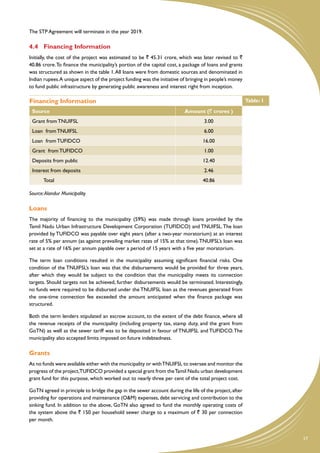
to fund public infrastructure by generating public awareness and interest right from inception.

Financing Information                                                                                    Table: 1
 Source                                                                   Amount (` crores )
 Grant from TNUIFSL                                                                3.00
 Loan from TNUIFSL                                                                 6.00
 Loan from TUFIDCO                                                                 16.00
 Grant from TUFIDCO                                                                1.00
 Deposits from public                                                              12.40
 Interest from deposits                                                            2.46
       Total                                                                       40.86

Source: Alandur Municipality

Loans
The majority of financing to the municipality (59%) was made through loans provided by the
Tamil Nadu Urban Infrastructure Development Corporation (TUFIDCO) and TNUIFSL. The loan
provided by TUFIDCO was payable over eight years (after a two-year moratorium) at an interest
rate of 5% per annum (as against prevailing market rates of 15% at that time). TNUIFSL’s loan was
set at a rate of 16% per annum payable over a period of 15 years with a five year moratorium.

The term loan conditions resulted in the municipality assuming significant financial risks. One
condition of the TNUIFSL’s loan was that the disbursements would be provided for three years,
after which they would be subject to the condition that the municipality meets its connection
targets. Should targets not be achieved, further disbursements would be terminated. Interestingly,
no funds were required to be disbursed under the TNUIFSL loan as the revenues generated from
the one-time connection fee exceeded the amount anticipated when the finance package was
structured.

Both the term lenders stipulated an escrow account, to the extent of the debt finance, where all
the revenue receipts of the municipality (including property tax, stamp duty, and the grant from
GoTN) as well as the sewer tariff was to be deposited in favour of TNUIFSL and TUFIDCO. The
municipality also accepted limits imposed on future indebtedness.

Grants
As no funds were available either with the municipality or with TNUIFSL to oversee and monitor the
progress of the project,TUFIDCO provided a special grant from the Tamil Nadu urban development
grant fund for this purpose, which worked out to nearly three per cent of the total project cost.

GoTN agreed in principle to bridge the gap in the sewer account during the life of the project, after
providing for operations and maintenance (O&M) expenses, debt servicing and contribution to the
sinking fund. In addition to the above, GoTN also agreed to fund the monthly operating costs of
the system above the ` 150 per household sewer charge to a maximum of ` 30 per connection
per month.


                                                                                                                    17
Public Private Partnership projects in India
             Compendium of Case Studies
                                                               Public Contribution
                                                               On the basis of a financial analysis of the project, the AM decided to collect one-time deposits in
                                                               the form of connection charges from the citizens of Alandur. The connection charges for different
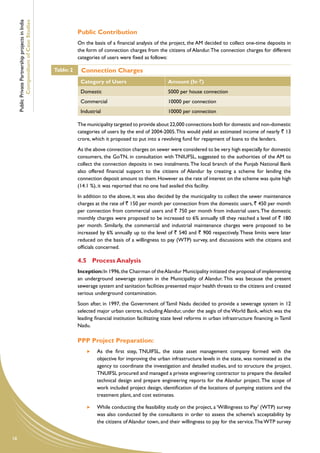
                                                               categories of users were fixed as follows:

                                                    Table: 2    Connection Charges
                                                                Category of Users                          Amount (In `)
                                                                Domestic                                   5000 per house connection
                                                                Commercial                                 10000 per connection
                                                                Industrial                                 10000 per connection

                                                               The municipality targeted to provide about 22,000 connections both for domestic and non-domestic
                                                               categories of users by the end of 2004-2005. This would yield an estimated income of nearly ` 13
                                                               crore, which it proposed to put into a revolving fund for repayment of loans to the lenders.
                                                               As the above connection charges on sewer were considered to be very high especially for domestic
                                                               consumers, the GoTN, in consultation with TNIUFSL, suggested to the authorities of the AM to
                                                               collect the connection deposits in two instalments. The local branch of the Punjab National Bank
                                                               also offered financial support to the citizens of Alandur by creating a scheme for lending the
                                                               connection deposit amount to them. However as the rate of interest on the scheme was quite high
                                                               (14.1 %), it was reported that no one had availed this facility.
                                                               In addition to the above, it was also decided by the municipality to collect the sewer maintenance
                                                               charges at the rate of ` 150 per month per connection from the domestic users, ` 450 per month
                                                               per connection from commercial users and ` 750 per month from industrial users. The domestic
                                                               monthly charges were proposed to be increased to 6% annually till they reached a level of ` 180
                                                               per month. Similarly, the commercial and industrial maintenance charges were proposed to be
                                                               increased by 6% annually up to the level of ` 540 and ` 900 respectively. These limits were later
                                                               reduced on the basis of a willingness to pay (WTP) survey, and discussions with the citizens and
                                                               officials concerned.

                                                               4.5	 Process Analysis
                                                               Inception: In 1996, the Chairman of the Alandur Municipality initiated the proposal of implementing
                                                               an underground sewerage system in the Municipality of Alandur. This was because the present
                                                               sewerage system and sanitation facilities presented major health threats to the citizens and created
                                                               serious underground contamination.
                                                               Soon after, in 1997, the Government of Tamil Nadu decided to provide a sewerage system in 12
                                                               selected major urban centres, including Alandur, under the aegis of the World Bank, which was the
                                                               leading financial institution facilitating state level reforms in urban infrastructure financing in Tamil
                                                               Nadu.

                                                               PPP Project Preparation:
                                                                     	   As the first step, TNUIFSL, the state asset management company formed with the
                                                                         objective for improving the urban infrastructure levels in the state, was nominated as the
                                                                         agency to coordinate the investigation and detailed studies, and to structure the project.
                                                                         TNUIFSL procured and managed a private engineering contractor to prepare the detailed
                                                                         technical design and prepare engineering reports for the Alandur project. The scope of
                                                                         work included project design, identification of the locations of pumping stations and the
                                                                         treatment plant, and cost estimates.

                                                                     	   While conducting the feasibility study on the project, a ‘Willingness to Pay’ (WTP) survey
                                                                         was also conducted by the consultants in order to assess the scheme’s acceptability by
                                                                         the citizens of Alandur town, and their willingness to pay for the service. The WTP survey


18
covered more than 10 per cent of the population of the AM, spread over to 42 wards. It
         indicated that the average household income of the majority of the people was in the range
         of ` 1000-5000 per month.According to the survey, although the public strongly supported
         the project and accepted that users should pay for sewage services, this willingness had its
         limits. About 29% of the respondents were willing to pay a one-time connection fee lower
         than ` 500 per household and 21% were open to paying a one-time connection fee more
         than ` 2000 per household. Further, about 86% of the respondents were willing to pay
         monthly sewer charges in the range of ` 21 to ` 50 per month, comparable to the existing
         water charges structure.

     	   GoTN accorded administrative sanctions to the project on 9 December 1998 and
         technical sanction on 27 January 1999.

As part of the project preparation, land for the project was identified and proposed to be acquired
through the Alandur Municipality.

Public Participation: The ASP project is a unique case of public participation in financing of a
municipal infrastructure project. The collection of sewer charges and convincing the community
to pay for it was a difficult and challenging task. Since there had been no precedence of private
participation in municipal water and sanitation services in the state, or a BOT Agreement awarded
anywhere in India, public outreach was critical to overcome initial resistance as well as public
concerns about the need to pay for the new sewage services.

To gain acceptance and build consensus among the public, the municipality mounted a vigorous
public outreach/public participation campaign with extensive media coverage to explain the projects
benefits, costs, and tariff system. The municipality adopted the following procedures:

     	   A detailed discussion was held among the officers and staff along with the Chairman about
         the sewerage project.
     	   All the holidays including Saturdays and Sundays were used for discussion with the
         residents’ welfare associations. During the discussions, the scheme was explained in detail:
         its advantages on the city environment and quality of life of the residents of Alandur.
     	   Residents were motivated through corner meetings and advertisements on the public
         transport system such as auto rickshaw, buses; cable network; local newspapers; distribution
         of pamphlets, etc. In addition, all the staff including sanitary workers earnestly carried out
         door-to-door canvassing of the benefits of the underground sewerage scheme.
     	   Although, initially a sizeable population of the town was not ready to pay the high deposits
         on account of sewerage connection charges and monthly tariff (as indicated through the
         survey), later through active canvassing and educating the people on the benefits of the
         project they agreed to pay the sewer charges as per the municipal tariff structure.
     	   By the end of May 2000, more than 13,000 connection seekers (domestic and non-
         domestic) had deposited the one time connection fee to the municipality. In order to
         assess the commitment of the citizens of Alandur to the proposed sewerage scheme, the
         lending institutions, including TNUDF and TNUIFSL, had stipulated that the municipality
         should collect deposits from at least 10,000 residents before the award of work to the
         selected contractor.This would not only confirm effective public participation in the project
         but would also provide positive signals to the lending institutions on the sustainability of
         the project as also recovery of their investments. Accordingly, the municipality started
         collecting one-time deposits from the residents, and completed the target before awarding
         the contract for the project to the selected contractor.
     	   In order to facilitate the collection procedure, the municipality opened collection centres
         at different locations keeping in view the convenience of the residents. Arrangements
         were made for collection of deposits even on the receipt of phone messages and at the
         designated bank.


                                                                                                          19
Public Private Partnership projects in India
             Compendium of Case Studies                  	   With a view to inform the public on the progress of the project at various stages, as also
                                                             to seek their opinion on different issues concerning the successful implementation of the
                                                             project, the authorities of the AM called for the meeting of representatives of welfare
                                                             associations on a monthly basis. This procedure created a system of effective participation
                                                             of the community in the project implementation process.

                                                    Procurement:
                                                    The project was structured such that an engineering, procurement and construction contractor,
                                                    selected through competitive bidding process, would design and implement the sewerage system,
                                                    on turnkey works contract, and would also finance, design, build, and operate the STP on BOT
                                                    (Annuity) basis.

                                                    The procurement of private contractor for the execution of the project was carried out as per
                                                    the standards prescribed by the World Bank. A two stage bid process was adopted - a technical
                                                    proposal followed by a financial proposal.

                                                    The technical capabilities of the contractors and their experience in similar works were given
                                                    importance. Of the 13 entities who submitted the bids, three were short-listed, and the financial
                                                    proposals were received from such technically qualified firms.As per the financial evaluation criteria,
                                                    the bidder quoting the lowest cost for the sewerage system and lowest lease period for the STP
                                                    was selected as the final, successful contractor.

                                                    Based on the evaluation of the proposals and on the recommendations of TNUIFSL, the project
                                                    was awarded to the IVRCL Infrastructures & Projects Limited, in joint venture with Va Tech Wabag
                                                    Technologies Limited in February 2000, and the site was handed over to them subsequently.

                                                    The contract document signed on 2 March 2000 was in three parts and included (i) a construction
                                                    contract, (ii) and operation and maintenance contract; and (iii) a Lease Contract for the sewage
                                                    treatment plant.

                                                    Implementation:
                                                    As per the Agreement, the expected date of completion was 31st March, 2005. In order to
                                                    ensure timely implementation of the project and adherence to quality specifications, Consulting
                                                    Engineering Services Limited (CESL) was appointed as Project Management Consultants for the
                                                    detailed supervision and quality control. Along with the consultants, the Chairman, Commissioner
                                                    and Engineer of the AM reviewed the progress of the project on a weekly basis.The Commissioner
                                                    of Municipal Administration, GoTN, the Secretary of the Municipal Administration & Water Supply
                                                    and the Chief Executive of TNUIFSL also reviewed the progress of the project every month, and
                                                    provided administrative support for acquiring the necessary clearances from agencies such as the
                                                    railways, highway authority, PWD, etc.

                                                    Delivery:
                                                    The project work was carried out in two phases. In the first phase (the first two and a half years),
                                                    50% of the branch sewers, main sewers, pump house including installation of machinery, pumping
                                                    main and one 12 MLD capacity sewage treatment plant, were completed and commissioned. The
                                                    remaining work relating to the project was to be carried out in the next phase.

                                                    By end 2001, the laying of the sewer pipes and main sewers was completed, as also the construction
                                                    of the Pumping Station, Pumping Mains and Sewerage Treatment Plant.The overall date of completion
                                                    was October 2003.

                                                    With respect to funding, by March 2001, approximately ` 9.16 crores was received from TUFIDCO
                                                    in the form of grants and a loan and more than ` 6.84 crores was generated as a one-time sewer
                                                    connection charge from about 13,434 households.


20
Exit:
The management contract for the operations and management of the sewerage system expired in
2005, after the stipulated contract period of 5 years. Following this the operations and management
function has reverted to the municipality. It is understood that the AM is currently in the process
of sourcing an O&M manager for the operations of the sewerage system.

The STP Agreement will terminate in the year 2019 at the end of the stipulated lease period of 14
years at which time the STP will be transferred to the AM free of cost. The defect liability period,
however, will extend for one year beyond the expiry of the STP lease period.

It is understood that the STP Agreement has worked well with no penalties being imposed during
the contract and no significant lapses in obligations, till date. There has been only one issue that
arose at the beginning of the Agreement and is currently in the process of being resolved, through
arbitration. The issue concerned the date of commencement of the Sewerage System and payment
due for the first six months from AM to the Private Developer. The reason for this was the
obtaining of the approval from the Pollution Control Board (PCB) - apparently the period for which
operations were performed and payment claimed from the AM did not have the PCB approval in
place. It is understood that AM has been cooperative in this matter and has no objection to making
the payment – however, approval from the government for making the payment is under process.


 Risk Allocation Framework                                                                                         Table 3

 Risk Type            Sensitivity   Risk Period   Primary Risk        Comments
                                                  Bearer

 Land acquisition     High          -             Government          AM took the responsibility for directly
                                                                      acquiring the land for the construction
                                                                      of the STP.

 Delay in obtaining   High          0-3 months    AM, Private         The AM took responsibility under the
 permits                                          developer           Contract for key approvals, including
                                                                      road cutting, shifting of services
                                                                      and environmental clearances. The
                                                                      developer was responsible only of the
                                                                      ‘works’ related approvals.

 Design Risk          High                        Private developer   Design for the Sewerage System as well
                                                                      as the STP was developed by the AM
                                                                      as part of the feasibility study. The same
                                                                      was provided to the developer as part
                                                                      of the RFP document. The Bidder had
                                                                      the option to comment on the design
                                                                      provided and suggest changes, if any.
                                                                      However, after the submission of bids,
                                                                      the Contractor was required to adhere
                                                                      to the design provided by the AM.

 Construction Risk    High          0-2 years     Private developer   The Construction Contract for
                                                                      the underground Sewerage System
                                                                      specified strict construction milestones
                                                                      linked to the payment along with a
                                                                      one year defect liability period to
                                                                      address any construction related risk.
                                                                      Liquidated damages were prescribed
                                                                      in the contract for every day of delay
                                                                      limited to 10% of contact price.

                                                                      In respect of the STP, the construction
                                                                      risk was borne by the Developer as
                                                                      the investment was made by him. The
                                                                      STP was constructed in two phases
                                                                      under tight deadlines.The defect liability
                                                                      period for the STP extend one year
                                                                      beyond the lease period of 14 years,
                                                                      during which the developer operated
                                                                      and managed the facility.


                                                                                                                             21
Public Private Partnership projects in India
             Compendium of Case Studies
                                                    Risk Type           Sensitivity   Risk Period    Primary Risk        Comments
                                                                                                     Bearer
                                                    Construction cost   High          0-2 years      Private developer   The construction of the Sewerage
                                                    over runs                                                            System was based on detailed bill of
                                                                                                                         quantities with rigorous clauses related
                                                                                                                         to cost over-runs. In respect of the
                                                                                                                         STP, though the developer bore the
                                                                                                                         construction cost, the design and cost
                                                                                                                         was based on detailed costing pre-
                                                                                                                         determined at the bid stage. Since the
                                                                                                                         construction cost was also the basis of
                                                                                                                         the annuity payment determined in the
                                                                                                                         bid, it was carefully controlled.
                                                                                                                         Since the construction did not
                                                                                                                         experience any time over-runs, cost
                                                                                                                         over-runs were also controlled. The
                                                                                                                         project was implemented as per the
                                                                                                                         original cost estimation.
                                                    Change in Scope     -             -              -                   As the design and costing had been
                                                    Risk                                                                 drawn up at the bidding stage itself, this
                                                                                                                         risk was largely controlled. And did not
                                                                                                                         arise on the ground.
                                                    Payment Risk        -             3 years        Government          The key risk in respect of payment of
                                                    (Capital Cost for                                                    capital cost for the sewerage system
                                                    Sewerage System)                                                     was the component of the cost that had
                                                                                                                         to be met through public contribution.
                                                                                                                         While the AM assumed significant risk
                                                                                                                         in this regard, the risk was addressed
                                                                                                                         effectively through extensive public
                                                                                                                         consultation and interactions. In fact
                                                                                                                         that the collection exceeded initial plans
                                                                                                                         and the AM did not have to draw upon
                                                                                                                         the debt as planned from TNUIFSL.
                                                    Payment Risk (STP   -             Through the    Government          The question of periodic payment arose
                                                    Annuity Payment)                  Lease Period                       only in respect of the Annuity Payment
                                                                                      for the STP                        for the STP for which the AM was
                                                                                                                         contractually bound over the period of
                                                                                                                         lease. Here the AM assumed significant
                                                                                                                         risk. However, based on the ‘willingness
                                                                                                                         to pay’ survey, the Government had
                                                                                                                         agreed to extend subsidy support to
                                                                                                                         meet operational cost to the extent
                                                                                                                         of `30 per person per month. On the
                                                                                                                         ground, the AM has been able to collect
                                                                                                                         the monthly sewer fees effectively and
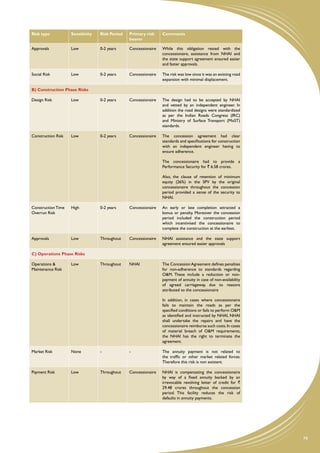
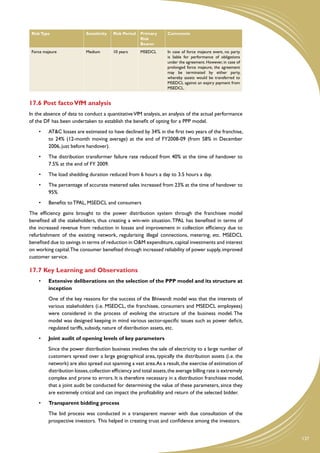
                                                                                                                         has not faced any issues in this regard.
                                                    Payment risk        -             -              Lenders             Lender’s risk was addressed through
                                                    (Debt Repayment)                                                     an escrow arrangement opened in
                                                                                                                         favour of the term lenders where all the
                                                                                                                         revenue receipts of the AM (including
                                                                                                                         property tax, stamp duty, and the grant
                                                                                                                         from GoTN) as well as sewer fee was
                                                                                                                         be deposited.The AM had also accepted
                                                                                                                         limits on future indebtedness. In
                                                                                                                         addition, a State Government guarantee
                                                                                                                         also backed the borrowing of the AM.
                                                    Technology Risk                                  Government          There are no clear references to this
                                                                                                                         in the agreement. However, the design
                                                                                                                         was prepared at the bidding stage and
                                                                                                                         thereafter accepted by the Bidder
                                                                                                                         during submission of proposal. Also
                                                                                                                         since the project was implemented
                                                                                                                         without significant delays, the question
                                                                                                                         of technology up-gradation due to
                                                                                                                         passage of time did not arise.
                                                    Operations Risk     High          -              Private developer   The performance parameter mainly
                                                                                                                         referred to the treatment of sewage as
                                                                                                                         fed into the STP during the lease period.
                                                                                                                         The Agreement prescribed a fine if the
                                                                                                                         treated effluents failed to meet the
                                                                                                                         required standards at the rate of `
                                                                                                                         10,000 per day of default.


22
Risk Type             Sensitivity     Risk Period   Primary Risk        Comments
                                                     Bearer

 Financial Risk        High            0-4 years     Government and      The AM bore the financial risk in respect
                                                     Private developer   of the Sewerage System while the
                                                                         Private developer bore the risk for the
                                                                         STP. While the AM’s capital investment
                                                                         plan was carefully planned even before
                                                                         the bidding process, the key risk arose
                                                                         from the portion of the capital cost that
                                                                         was to come from public contribution
                                                                         towards connection charges.

                                                                         In respect of the STP, the Private
                                                                         Developer was able to raise the capital
                                                                         funds effectively as re-payment was
                                                                         protected by the annuity payments as
                                                                         assured by the AM, including acceptance
                                                                         of ‘take or pay’ charges for the minimum
                                                                         assured sewage to be fed into the STP.

 Force Majeure                                       Government and      Both the Construction Contract
                                                     Private developer   and the Lease Contract had suitable
                                                                         provisions for Force Majeure protecting
                                                                         the ensuing risks for both the AM and
                                                                         the private developer.


4.6	 Post facto VfM Analysis
The ASP was not a commercial project but an initiative at the municipal government level to
improve the life style of its residents. Taking this into account, a qualitative VfM assessment has
been undertaken here with the purpose of highlighting the benefits drawn by way of private sector
participation in the implementation and continued operation of the project.

         	   Suitability for PPP

     	       One of the parameters used for the VfM assessment is the suitability of the project to
             be undertaken on a PPP basis. The greatest challenge (as well as accomplishment) of the
             ASP, was that both the municipality and the public recognized and accepted the ‘value’ of
             bringing in private participation. Indeed, this project truly demonstrates the benefits of
             bringing in PPP in the municipal sector in terms of drawing private sector expertise while
             addressing important risk related aspect that would make the project attractive for the
             private sector.

     	       The bid criteria for the project ensured that the municipality obtained the best offer in
             terms of the ‘lowest Evaluated Construction Price’ and the ‘lowest Lease Period’ both of
             which were the selection criteria with a weightage of 90:10.As the municipality had already
             undertaken a feasibility study and also prepared the detailed design and costing for the
             project, the private sector was able to bid for the project with considerable background
             information. The ensuing offer, therefore, provided value for money.

     	       The PPP structure evolved also facilitated an effective implementation of the project.
             The ASP was one of the few projects with a complex PPP structure wherein the works
             contract of the sewerage system and the BOT contract of the STP was jointly bid for and
             awarded to the same developer. The bidding parameter was also combined and addressed
             the best commercial aspect of both projects. Thus the bidder offering the lowest cost for
             the sewerage system and lowest lease period for the STP was selected. By combining both
             the projects under an effective structure the municipality ensured a competitive bid that
             gave value for money.

         	   Impact of PPP

     	       A brief on the difference made by the ASP, as captured at Table 4, illustrates that the ‘value
             for money’ brought in by the project far exceeded any monetary consideration:


                                                                                                                     23
Public Private Partnership projects in India
             Compendium of Case Studies
                                                    Table 4   Important Act of PPP
                                                              Sr. No       Parameter              Situation Before Ppp Intervention        Situation After Ppp Intervention
                                                              1.           Urban service          No sewerage system for a population of 120 km of underground sewerage system,
                                                                                                  165,000                                pumping stations and an STP of 24 MLD
                                                              2.           Urban service          Water borne sanitation facilities, septic/ Underground sewerage system with
                                                                                                  holding tanks for disposal of night soil   direct connection to each household


                                                              3.           Urban service          Unregulated disposal of sewerage in storm Modern sewerage treatment plant
                                                                                                  water drainage and low lying areas        designed to international standards.
                                                              4.           Environment and        Open storm water drains stagnating in Underground sewerage system has
                                                                           Health                 outer areas of town – environmental and eliminated risk of mosquitoes and related
                                                                                                  health hazard                           diseases for the citizens of Alandur and
                                                                                                                                          surrounding areas.
                                                              5.           Environment and        Contamination of underground water Almost 100% eradication of ground water
                                                                           health                 sources due to open drains         contamination through underground
                                                                                                                                     sewerage system and waste water
                                                                                                                                     treatment plant.
                                                              6.           Public participation   -                                        ` 12 crores out of the capital cost was
                                                                                                                                           through public contribution
                                                              7.           Public participation   -                                        Collection of sewerage fee from the public
                                                                                                                                           (on a graded structure amounting to a
                                                                                                                                           weighted average of ` 75 per connection)
                                                                                                                                           amounts to ` 2 crores per month and
                                                                                                                                           covers both debt repayment and O&M
                                                                                                                                           costs of the AM


                                                              4.7	 Key Learning and Observations
                                                                    	 Beneficiary participatory approach: People’s participation in the project, including
                                                                       the fact that almost 29% of the project cost was garnered from public contributions,
                                                                       was the most outstanding aspect and learning from the ASP. The project established that
                                                                       mobilising people’s participation for infrastructure projects is possible through collective
                                                                       efforts and transparent procedures.

                                                                   	       The success of the project from the outset depended highly on effective collection of
                                                                           connection charges and monthly sewer fees as also public acceptance of engaging a private
                                                                           BOT participant. Community awareness, support and on-going cooperation was, therefore,
                                                                           critical.The aggressive public outreach campaign conducted by the municipality and GoTN
                                                                           and the engagement of stakeholders was essential to assure the lending agencies and city
                                                                           officials that repayment provisions would be met.

                                                                       	   Stakeholder involvement and interdepartmental coordination: Continued
                                                                           involvement of stakeholders throughout the project ensured timely completion of the
                                                                           project and addressing of issues even as they arise.

                                                                   	       To maintain support for the project, a citizen’s committee was formed and it met frequently
                                                                           to review the status of the project, monitor performance of the BOT contractor and
                                                                           provide a forum in which citizens could air their concerns.

                                                                   	       The ASP established that close involvement of all stakeholders/departments at the key
                                                                           decision-making stages of the project, as also for review and monitoring, is critical to
                                                                           ensuring that the project stays on-track.

                                                                       	 Political will and strong decision making, especially at the grass-root level:
                                                                          The ASP demonstrated that ‘political will and quick decisions make projects happen’. The
                                                                          political leadership and strong advocacy for the project provided by the chairman and
                                                                          council of the municipality proved to be critical element of the success. While strong
                                                                          support for the sewerage system within Alandur existed, political will was essential to
                                                                          convince the customers and citizens to pay a significant share of the cost and accept the
                                                                          entry of the private sector. Throughout the project decision making stages, the members


24
of the municipality maintained full support for the project.

    	   Acceptance of fiscal discipline:The term lenders,TNUIFSL and TUFIDCO, placed strict
        lending conditions on the municipality, requiring the municipality to accept and implement
        strong fiscal discipline measures.TNUIFSL required the municipality to establish a separate
        sewer account distinct from the general budget of the municipality, forcing discipline and
        transparency on the officials managing the system. The municipality was also required to
        limit new debts to a certain percentage (typically 30%) of their revenue. GoTN, which
        provide loan guarantee, stipulated that any payment made to these entities on account of
        default by the municipality would be recovered from the annual transfer of payments from
        the municipality to the state government.

	       Similarly the contractual obligations between the municipality and the BOT operator
        forced the municipal government to ensure timely payment for management and waste
        water treatment services.

	       Thus, the loan as well as contractual obligations ensured strong fiscal discipline by the
        municipal body, by making it take difficult decisions on capital priorities, closely oversee
        the sewer system management, and ensure budgeting of sufficient funds to meet payment
        schedules

    	   Implementing an effective fee system: Despite the willingness to pay survey that
        indicated that public willingness was far below the tariff requirement to meet the capital
        and operational cost of the project, the municipal council, through its rigorous public
        outreach measures, managed to impose reasonable levels of connection charges and
        sewer fee on the public. The municipality also managed to collect the connection charges
        fairly well in time to pre-empt the need for the TNUIFSL loan.

	       A large part of the success of the municipality in this aspect sprung from the fact that they
        provided sympathetic measures that addressed the concern of the public. For example,
        the connection deposits were collected in two instalments as per the convenience of the
        consumers; the local branch of the Punjab National Bank also offered financial support to
        the citizens of Alandur by creating a scheme for lending the connection deposit amount to
        them.

    	   Assurances on payment to the Private Sector Participant: The municipality
        agreed to provide the BOT operator a minimum level of income by accepting the ‘take
        or pay’ condition in the Agreement. Thus, the municipality assumed the risk of minimum
        payment to the operator while the private partner assumed all other responsibilities and
        risks of financing, constructing and operating the STP for a period of 14 years.

    	   Access to finance for the municipality: An important aspect of the success of the
        project stemmed from concession financing and subsidies from the Government and
        public-private entities, established specifically to meet the credit needs of the municipalities
        without access to private capital, due to a low or non-existent credit rating.Though almost
        30% of the capital was generated by the municipality from connection fees, grants from
        GoTN and loans from TUFIDCO were crucial. The loan agreement from TNUIFSL, while
        proving to be unnecessary in the end, was imperative for participation in the finance
        package by all the parties.

    	 Technical and financial assistance: The expertise needed to plan and manage the
       technical and financial aspects of the project far exceeded the capacity of the municipality.
       Assistance from the other government bodies in the state, the Chennai Corporation,
       and sources, such as the USAID’s FIRE project, was critical. TNUIFSL and FIRE played a
       substantial role in structuring the project, managing the feasibility studies, and preparing
       the bid and contract documents crucial to project success.The review and approval of the
       engineering reports by the management committee, consisting of senior officials of the AM,


                                                                                                           25
Public Private Partnership projects in India
             Compendium of Case Studies
                                                            the Tamil Nadu Water supply and Sewerage Board, Chennai Metropolitan Water Supply
                                                            and Sewerage Board, and TNUIFSL, were essential for successful project management.

                                                        	   Transparency in bidding and contracting procedures: The transparent approach to
                                                            the project, right from inception to selection of contractor/operator and implementation,
                                                            was critical to providing the necessary assurance to the private sector bidders on the
                                                            professional approach of the municipality. This included strict application of World Bank
                                                            and FIDIC processes, oversight and approval of the process by the World Bank. Public
                                                            participation in the deliberations of the management committee overseeing the tendering
                                                            process execution was also important.

                                                    Documents Referred To:
                                                        	   RFP document

                                                        	   Contract for the Sewerage System

                                                        	   Agreement for the STP between AM and IVRCL

                                                        	 “Alandur Sewerage Project, A success story of Public- private partnership arrangements”,
                                                           by Dr. Mukesh P. Mathur

                                                        	   “Private Sector Participation in the Water Sector” – Presentation on the Alandur Sewerage
                                                            project given by Dr. Mukesh P. Mathur

                                                        	   “Peoples Participation in Underground Sewerage Project in Alandur Municipality” – India
                                                            best Practices Catalogue 2003.

                                                        	   “Financing Water and Sanitation” – Presentation by Dr. Rajivan in the Expert Group
                                                            Meeting on Urban Sector Strategy Review

                                                        	   USAID Case Studies of “Bankable Water and Sewerage Utilities, 2005”

                                                        	   Internal papers and research material

                                                    Interactions with:
                                                        	   Ms. Gayatri, Project Officer, TNUDF

                                                        	   Dr. K. Rajivan, Urban Finance Specialist, TNUDF

                                                        	   Dr. Ravikumar, Project Officer during procurement, TNUDF 	


26
Five 2:
Case Study
Karnataka Urban Water Supply
Improvement Project
5.1	 Project Description
In 2005, the Government of Karnataka (GoK), with assistance from the World Bank, initiated a water
supply service delivery improvement programme with private sector participation at the local level.
This initiative was part of a larger project developed by GoK to improve the performance of the
urban water sector by providing high quality and sustainable services in all the Urban Local Bodies
(ULBs) of the state. The project termed as Karnataka Urban Water Sector Improvement Project
(KUWASIP) was designed and implemented with funding assistance from the World Bank through
the Karnataka Urban Infrastructure Development and Finance Corporation (KUIDFC), which
is the nodal agency for externally funding projects in Karnataka. Under the KUWASIP initiative,
water supply improvement projects were planned at the state and local body level. These projects
included both reform-based programmes aimed at strengthening of the water supply and sanitation
sector of Karnataka and also specific projects for increasing the water availability and service
delivery levels at the ULB level.

At the local body level, projects were identified for the select three ULBs of Belgaum, Gulbarga
and Hubli-Dharwad. These projects aimed towards augmentation of the bulk water supply and
improvements to the distribution system. This objective was undertaken through a project aimed
at providing a 24*7 water supply system on a Public Private Partnership basis for a defined project
area.

A pilot project in five demonstration zones of the select three Municipal Corporations of Karnataka
was taken up.The project involved refurbishment/rehabilitation of the existing distribution network
of the select five demonstration zones in these three Urban Local Bodies, followed by the operation
and management of water distribution systems in these zones on a PPP basis.

The project was structured such that a private developer was identified for undertaking the required
rehabilitation works and for undertaking the operation and maintenance (O&M) of the distribution
network for the period of the contract.The capital investment required for the rehabilitation works
was to be compensated for by the World Bank through KUIDFC and the private developer was to
be provided a fee for undertaking the O&M activity.The project was planned for a total time period
of 3 years and 6 months inclusive of both rehabilitation works for the distribution networks and
the operation and maintenance of the distribution system.


5.2	 PPP structure of the Project
The PPP contract for the project was essentially a management contract involving the following
institutions: the three ULBs viz. Belgaum, Gulbarga and Hubli-Dharwad, the GoK through the
Karnataka Urban Infrastructure Development and Finance Corporation (KUIDFC) and the
Karnataka Urban Water Supply and Drainage Board (KUWSDB), and the private developer. Under
the PPP structure, the private developer was to undertake rehabilitation/construction activity as
specified by KUWSDB and KUIDFC for the distribution network across the zones of the three
cities. The rehabilitation/construction activity largely included replacement of the distribution
pipelines, installation of bulk water meters and consumer meters and setting up of a computerised


                                                                                                       27
Public Private Partnership projects in India
             Compendium of Case Studies
                                                    billing system. The rehabilitation activity, to be undertaken by the private developer, was to be
                                                    funded from KUIDFC funds as a grant to the project. A maximum of ` 42 crores was set aside as
                                                    the grant amount for the capital works, and the private developer was required to carry out the
                                                    rehabilitation works within this sum.

                                                    The detailed design of the capital works to be undertaken was to be provided by the private
                                                    developer and, subject to approval from KUWSDB and KUIDFC; the works were to be implemented
                                                    by the private developer. The performance targets to be achieved by the private developer on the
                                                    project were also listed by KUIDFC.

                                                    The private developer was responsible for identifying and tendering out the construction
                                                    activity. Post construction of the project, the private developer was required to demonstrate the
                                                    achievement of the performance targets in the demonstration zones. Subject to an audit of the
                                                    efficiency of the working of the system in the demonstration zones, the private developer would
                                                    take over the distribution system for the operation and maintenance phase of the project. The
                                                    activity of raw water supply, its treatment and supply till the treated bulk water distribution points
                                                    was to be fully managed by KUWSDB.The tariff to be levied and the structure of the same were to
                                                    be set by the ULBs in consultation with KUWSDB and KUIDFC.

                                                    During the O&M phase of the project, the private developer was required to ensure 100% individual
                                                    house service connections in the demonstration zones, supply treated water to the customers,
                                                    ensure reduction in distribution losses as per performance targets set, generate bills as per the
                                                    tariff set by the ULBs and distribute bills to the consumers. The collection against the bills was the
                                                    responsibility of the respective ULBs.

                                                    For the activities undertaken by the private developer, a fee was to be paid by ULBs and KUIDFC
                                                    for the period of the contract.The fee included a fixed component of 60% and a variable component
                                                    of 40%, the latter being based on the meeting of performance targets. In addition, further incentives
                                                    were to be provided to the private developer for achievement of the targets beyond a set level.
                                                    This incentive was over and above the operator fee remuneration. (The performance targets and
                                                    incentives have been listed in a later section of this case note)

                                                    During the contract period, the asset ownership for the existing and the rehabilitated assets inclusive
                                                    of pipelines, valves and meters, fully remained with the respective ULBs. Post the rehabilitation
                                                    phase, the private developer was only provided the right to operate and maintain the facilities. At
                                                    the end of the tenure of the contract, the distribution network would have to be handed back to
                                                    the respective ULBs for operations and maintenance.

                                                    5.3	 Current Status
                                                    The contract was awarded in 2005 to Compagnie Generale des Eaux, Paris, France (now known
                                                    as Veolia Water). The chosen bidder was required to undertake both the rehabilitation and the
                                                    operation and maintenance activity of the distribution network for the identified zones in the
                                                    three ULBs. The distribution network rehabilitation activity was completed by April 2008, and the
                                                    operation and maintenance contract which became effective therein is ongoing and is expected
                                                    to conclude by March 2010. The contract awarded in 2005, had therefore been extended. All the
                                                    performance related activities such as reduction in loss levels, ensuring 100% coverage to the
                                                    existing and regularised connections, etc has to be achieved during the O&M phase.

                                                    5.4	 Financing Information
                                                    The total cost for the construction/rehabilitation activity was capped at ` 42 crores. The actual
                                                    cost incurred against this ceiling has been approximately ` 32 crores. The ULBs did not bear the
                                                    debt burden for the capital costs. Upon incurring the expenditure on capital works for distribution
                                                    infrastructure and the costs of financing during construction, the private developer was reimbursed
                                                    the costs from KUWASIP funds via KUIDFC. It is to be noted here that Veolia did not arrange for
                                                    any upfront funding.


28
The operator fee of ` 22 crores was to be paid from the revenues accruing to the ULBs from the
user charges collected. However, during the course of the implementation of the project, there
were delays which arose, resulting in an escalation in the compensation to be paid to the operator
by KUIDFC. The operator fee finally increased to ` 28 crores.

    Project Details                                                                                       Table 5
    Particulars
    Project IRR                                       14%
    Debt Equity Ratio                                 80:20
    NPV                                               ` 2.57 crores

Of the estimated project cost of approximately at ` 62 crores1 (USD 13.79 million), World Bank’s
loan based assistance to the project was approximately ` 45 crores (USD 11.61 million). Information
on the financial details relating to NPV, IRR, and DSCR etc on the project from the project feasibility
report is not available in the public domain. The figures in the above table are obtained from an
economic viability study undertaken by the World Bank.

The project was structured in such a way that there were built in financial incentives to the private
developer for efficient execution of the rehabilitation works and the operation and management
activity. The maximum permissible bonus was set as 25% of the remuneration (initially decided as `
22 crores and later revised to ` 28 crores) to be paid to the private developer.The incentives to be
provided under the construction phase and operation phase are as listed below:

    Incentives to be provided under the construction phase                                                Table 6
    No      Component                                     Target                Percentage share
                                                                                  of the bonus
    1.      Savings in the total capital expenditure      Upto 25%                     3.75%
            incurred on rehabilitation works              >25%                          10%
    2.      Savings in the O&M expense                    Upto 25%                      15%
                                                          >25%                          40%
    3.      Reduction in real losses                      Between 15-20%                20%
                                                          < 15%                         30%
    4.      Percentage increase in billed volume to the   Upto 25% increase             12%
            base volume of bulk supplied water1           > 25%                         30%

For instance, if the private developer made a saving of greater than 25% on the capital expenditure
amount, he is eligible to get an incentive of 10% from the corpus (25% of operator fee) set aside
for the same. During the rehabilitation and construction phase of the project, the private developer
was able to reduce the capital costs by over 25% and was eligible to avail the incentives as set.
The construction was undertaken at a cost of approximately ` 32 crores. During the course of
execution of the O&M phase of the project, the private developer was able to bring about savings
greater than 25% in the O&M expense, bring about reduction in the losses to less than 15% and
also increase the billed water supply to over 25%.

5.5	 Process Analysis

Inception:
The GoK with the assistance of the World Bank launched an urban water supply and sanitation
sector reform process through KUWASIP. One of the objectives under KUWASIP was to bring
initial improvements in water supply systems of the three ULBs of Belgaum, Gulbarga and Hubli-

1
    Assumption of 1 USD = ` 45


                                                                                                                    29
Public Private Partnership projects in India
             Compendium of Case Studies
                                                    Dharwad. For furthering the same, five demonstration zones were identified where specific
                                                    interventions were to be brought about under a 24x7 water supply system. These three ULBs
                                                    experienced poor water supply levels, inclusive of non reliable supply hours for water and a high
                                                    level of leakages.

                                                    PPP Project Preparation:
                                                    As a first level of preparatory activity, an assessment of the project area was undertaken by Tata
                                                    Consultancy Engineering (TCE) to ascertain the status of the water supply service levels in the
                                                    project area. This assessment was supported by the World Bank. As per the assessment it was
                                                    identified that the water supply service delivery standards were extremely poor in the project area
                                                    of the three ULBs. For instance, the frequency of water supply ranged between once in 7 days for
                                                    Hubli-Dharwad, once in 2 days for Gulbarga and on alternate days in Belgaum. Also, it was assessed
                                                    that the Non-Revenue- Water levels in these cities was on an average higher than 50%. Capital
                                                    investment estimates were prepared for undertaking the works so identified. The financial status
                                                    of the three Municipal Corporations was reviewed to assess the capital investment sustainability of
                                                    the capacity to bear the investment burden. However, on account of low sustenance capacity of the
                                                    three Corporations, the capital investment required for the rehabilitation work was to be funded
                                                    from the KUWASIP funds. A project for rehabilitation, operation and maintenance of a 24x7 water
                                                    supply system in the demonstration zones on a public private partnership basis was prepared with
                                                    the following objectives:

                                                         	 To assess whether post rehabilitation/refurbishment works, a 24x7 water supply system
                                                            can be implemented in an identified area

                                                         	   To ascertain the cost involved in the refurbishment activity

                                                         	   To assess whether the project can be replicated in other areas

                                                         	   To identify the socio-economic benefits of the project

                                                    Procurement:
                                                    A two stage bidding process was thereby followed, i.e. the Request for Qualification (RFQ) stage
                                                    followed by the Request for Proposal (RFP) stage. At the RFQ stage interest was expressed by
                                                    approximately 30 bidders constituting both domestic and international firms. From the 30 bidders,
                                                    seven were selected for the RFP stage. The technical qualification criteria stated in the RFQ
                                                    document resulted in only international players in the water business being eligible for undertaking
                                                    the project. Most of the Indian firms could not qualify due to the lack of adequate experience.
                                                    Indian firms however bid together with the international players as part of consortia. The financial
                                                    bid evaluation criteria was determined as the lowest financial quote made by the bidder for
                                                    remuneration towards operation and maintenance activity. The lowest quote so received was
                                                    for an amount of ` 22 crores from the French company Compagnie Generale des Eaux, which
                                                    was selected as the preferred bidder. The financial bid had a fixed remuneration component and
                                                    another component dependant on the meeting of performance targets by the private developer. It
                                                    may be noted here that there was no request from the participating bidders for having a fixed and
                                                    a performance based component in the bid.

                                                    Development:
                                                    The project was planned in three phases. These phases are as explained below:

                                                         	 Preparatory period A: The period was envisaged as 6 months during which the private
                                                            developer was required to first undertake an assessment of the existing water supply
                                                            system of the zones in the three ULBs. On the basis of the assessment, the private
                                                            developer was required to prepare the draft investment requirement, and prepare detailed
                                                            designs. During this period, the private developer was also required to get the approval
                                                            from KUIDFC and KUWSDB on the designs submitted.


30
Preparatory period B: The second phase of the project was envisaged to be spread
         over 9 months. During this phase, the private developer was required to first arrange
         for finance for the investment amount as identified in the Draft Investment Report
         approved by KUIDFC. As stated earlier, this investment amount was capped at ` 42
         crores. Following the receipt of approvals, the developer was required to commence the
         construction works for the rehabilitation/ refurbishment activity. The activity of floating
         tenders, selection of contractors and supervision of the rehabilitation works was to be
         managed by the private developer. During the construction activity, it was necessary for
         the private developer to maintain the then existing level of water supply services to the
         consumers. The private developer did not disconnect the existing consumers during the
         rehabilitation phase and instead water was made available through the existing lines, and
         / or parallel lines to all the zones. Additionally, during this period, the private developer
         was required to manage all installation works, provide house service connections to the
         customers approved by the ULBs and demonstrate the efficient working of the system
         where the performance targets were being met. The efficient working of the system
         was subject to an audit by an independent engineer appointed by KUIDFC, and post
         approval, the private developer was allowed to take over the system for the operation
         and maintenance phase of the project. It is to be noted here that the private developer,
         during this phase, also undertook a consumer survey in the project zone to ascertain
         the number and type of connections which were to be provided. The private developer
         identified the authorised consumers and those which required regularisation by the
         ULBs.

     	 Period C: During this phase of the project, the private developer was required to undertake
        O&M of the entire distribution system for a period of 2 years. The tasks of the private
        developer entailed provision of 25,000 direct house service connections, a 24*7 supply
        of treated water at a set pressure level, reduction in leakages, redressal of consumer
        complaints etc.

The total time allocated for these three activities as per the RFP was 42 months. However, during
the course of the implementation of the project for the rehabilitation works, there were delays
which arose during the construction phase of the project and during the demonstration phase.
The delays which arose were on account a combined set of factors such as delays in obtaining
permits from other utilities’ departments for digging and construction activities, limited or poor
co-operation from the three ULBs in information sharing, delays brought about due to the
unfavourable climatic conditions during the construction phase etc. Additional delays occurred at
the time of commencement of the demonstration works. This delay was largely caused due to the
non availability of the bulk water supply by KUWSDB as per schedule. Parallel to the 24*7 water
supply project, there was a parallel project which was being implemented for sourcing of raw bulk
water and supply of treated water to these Corporations. The bulk water supply project which
was also funded by the World Bank was expected to be completed by the time the rehabilitation
works in the three ULBs concluded. However, since the bulk water supply project did not complete
on time, there were delays on the part of KUWSDB in supply, resulting in delays for the private
developer to commence the demonstration works.

Also during the O&M phase, assistance was required by the private developer from the ULBs for
undertaking all the improvement works and for provision of all connections. However, the same
was not fully forthcoming resulting in delays.

On account of all these factors, the total time period was extended by 17 months as against what
was envisaged in the RFP (59 months as against the initial 42 months). As per the contract, the
private developer had to adhere to the performance targets set and any non compliance would
result in immediate termination. There were no separate set of penalties which were stated in
the contract. KUIDFC however noted that the delays were largely caused due to delays from the
client’s side i.e. from the ULBs and the KUWSDB and therefore no penalties in this regard were
imposed on the private developer. Also, for the period of extension, KUDIFC fully compensated the


                                                                                                         31
Public Private Partnership projects in India
             Compendium of Case Studies
                                                              private developer for additional costs incurred due to time over runs. Therefore, the operator fee
                                                              increased from ` 22 crores to ` 28 crores for the extended time period.

                                                              Delivery:
                                                              Subsequent to completion of the rehabilitation works, the O&M activity was to be undertaken over
                                                              a time period of 104 weeks. The actual time taken by the private developer for the O&M activity
                                                              was the same as that mentioned in the RFP document.

                                                              The performance targets which were set for the private developer included the following:
                                                                   	   Continuous pressured water supply to every connected property and stand-post
                                                                       connected to the public network
                                                                   	   Emergency stoppages to reduce to maximum of four for less than 12 hours in a year and
                                                                       redressal of customer complaints
                                                                   	   100% metering of all property connections (individual and shared), public stand-posts and
                                                                       feeds to street storage tanks and maintenance of computerised records of the readings.
                                                                   	   100% of customer meters to be read every month and a bill for water used based on these
                                                                       volumetric readings to be issued to 100% of connected properties each month with prior
                                                                       approval of the respective ULB
                                                                   	   Reduction in losses from the distribution network in the following manner:

                                                    Table 7    Reduction in losses


                                                                   Elapsed time from the final                Losses (in litres/connection/day/meter
                                                                   takeover date (in months)                                  pressure)
                                                                                   12                                                25
                                                                                   18                                                23
                                                                                   24                                                20

                                                                   	   System connection requests to be fulfilled within 7 days of directions being issued by the
                                                                       Corporation subsequent to the payment of connection fee
                                                                   	   Set up a customer service and support centre which is to situated at a location easily
                                                                       accessible to residents of the given area and is to be operated on a 24-hour basis
                                                                   	   All customer queries and complaints to be responded to within 24 hours and redressed
                                                                       within 7 days of such complaint or query, except the complaints concerning low pressure
                                                                       or poor quality of water, which must be responded to within 12 hours and redressed
                                                                       within 24 hours of such complaint
                                                              In order to monitor the achievement of the above listed performance targets, KUIDFC appointed
                                                              a technical auditor. The technical auditor continuously monitored the performance of the private
                                                              developer against these parameters. It is to be noted that these performance targets which were set
                                                              for the O&M activity have been largely met by the private developer in these demonstration zones.
                                                              For each of the five zones, manpower numbering eight per zone were also provided from each ULB.
                                                              The manpower provided was for the purpose of assisting the private developer in their various
                                                              works. However, it is understood that the manpower so provided was of limited assistance to
                                                              the private developer. The private developer could not depend on them and therein had to bring
                                                              along their own manpower at the project site. It may be noted here that there was no instance
                                                              of resistance from the employees of the participating ULBs in the entire implementation process.
                                                              The private developer however did face a few issues during the O&M phase of the project. For
                                                              instance, the private developer was required to provide direct connections to those consumers


32
for whom regularisation authorization had been provided by the ULBs. These had to be provided
within seven days of receipt of such a request by the private developer. However, the ULBs did
not provide information on the authorised consumer list in a timely manner. Instead, at random
intervals, information was shared on the connections to be provided by the developer.This resulted
in the developer requiring to address too many requests within a short time period of seven days.
Instead, the ULBs were requested to share such information at regular intervals. Another issue
faced by the private developer related to demands for provision of the services beyond the project
area. Such demands would have had adverse financial implications for the private developer.
To ensure effective operations and provide the necessary assistance to the private developer,
KUIDFC played a very active role.A Project Improvement Units (PIU) was established to coordinate
the O&M activity. Additionally a technical auditor was appointed to oversee the O&M works being
undertaken on the site. Also, as per the site conditions, a few modifications were made to the
performance targets set for the private developer. For instance, the private developer for the first
six months of commencement of operations was to generate the water usage bill on a flat tariff
basis and eventually adopt a volumetric structure. However, it was mutually agreed by KUIDFC and
KUWSDB that since the right to set and determine the tariff is the prerogative of the ULBs, the
final say on the same rests with the ULBs. Since the ULBs did not adopt a volumetric tariff structure,
the private developer continued to generate bills as per the applicable flat rate.
The project saw initial resistance from the general public on account of apprehensions of private
sector involvement in provision of water supply services. However, effective provision of water
supply services in the demonstration zone of Belgaum resulted in greater acceptance of the project
in the remaining zones. Additionally, Non Governmental Organisations (NGOs) were involved in
awareness creation among the general public regarding the project, its benefits etc.

Exit:
The O&M activity to be managed by the private developer is expected to be completed by March
2010. Post termination of the contract, the entire distribution system including the assets created
by the private developer would be handed over to the respective ULBs for O&M activities.As a part
of the exit activity, the private developer has been providing training to the existing staff at the three
ULBs for handling of the system post termination of the contract. The private developer however
has raised concerns regarding the skills of the existing staff to be able to effectively manage the
system post its exit.

 Risk Allocation Framework                                                                                         Table 8
 Risk Type          Sensitivity   Risk Period    Primary Risk        Comments
                                                 Bearer
 A) Pre-Operative Risks
 Delay in obtaining High          0-3 months     Private developer   The private developer was responsible
 permits                                                             for obtaining permits for rehabilitation
                                                                     works. There were difficulties in the same
                                                                     owing to the need to obtain permits from
                                                                     several departments which were not
                                                                     forthcoming. Lack of coordination among
                                                                     various departments resulted in a delay
                                                                     in permits being obtained. However, since
                                                                     the three ULBs were stakeholders in the
                                                                     project, the process of obtaining permits
                                                                     was eventually managed.


 Design Risk        High                         Private developer   The three ULBs did not have an asset
                                                                     inventory list and there were no detailed
                                                                     drawings of the physical assets. The design
                                                                     for the system was to be fully developed
                                                                     by the private developer based on their
                                                                     own assessment of the distribution system.
                                                                     Post implementation of the project there
                                                                     have been no design related issues which
                                                                     have arisen.


                                                                                                                             33
Public Private Partnership projects in India
             Compendium of Case Studies
                                                    Risk Type           Sensitivity   Risk Period   Primary Risk        Comments
                                                                                                    Bearer
                                                    Construction Risk   High          0-2 years     Private developer   The private developer was allowed to sub
                                                                                                                        contract the construction activity, and fully
                                                                                                                        manage the process. The construction
                                                                                                                        period exceeded the timeline envisaged.
                                                                                                                        However, no penalty was imposed on the
                                                                                                                        private developer since, the delays were
                                                                                                                        largely attributed to lack of on ground
                                                                                                                        information sharing and assistance by the
                                                                                                                        respective ULBs
                                                    Construction cost High            0-2 years     Private developer   The construction cost ceiling was pre
                                                    over runs                                                           determined and the upper ceiling set.
                                                                                                                        In the event of the costs exceeding the
                                                                                                                        limits set, KUIDFC had the authority to
                                                                                                                        terminate the contract. The project was
                                                                                                                        however implemented well within the
                                                                                                                        limits set.
                                                    Performance risk Low              0-2 years     Private developer   The private developer was required to
                                                    during the transition                                               maintain the service standards as were
                                                    phase       between                                                 available at the time of handover of the
                                                    construction      and                                               system for rehabilitation work. The
                                                    commencement of                                                     private developer was able to manage the
                                                    O&M management                                                      same without any disruption of supply.
                                                    Change in Scope -                 -             -                   No specific provision for change in law was
                                                    Risk                                                                made in the contract. On ground, however,
                                                                                                                        there was no change in scope of the
                                                                                                                        developer once the project commenced.
                                                    Market Risk                       2 years       Government          The private developer was to be paid
                                                                                                                        a fixed remuneration of ` 22 crores as
                                                                                                                        operator fees. This fee increased to `
                                                                                                                        28 crores on account of delays from the
                                                                                                                        Government side. Additionally, financial
                                                                                                                        incentives had to be paid for achievement
                                                                                                                        of performance targets by the private
                                                                                                                        developer. Further, although the private
                                                                                                                        developer undertook the generation
                                                                                                                        of bills as per the tariff set, its levy and
                                                                                                                        collection was the responsibility of the
                                                                                                                        respective ULBs.
                                                    Technology Risk                                 Government          (No clear reference in the agreement)
                                                    Operations Risk     High          2 years       Private developer   The release of operator fee to the private
                                                                                                                        developer was based on achievement of
                                                                                                                        performance targets. However, though
                                                                                                                        the performance targets were met by the
                                                                                                                        private developer, there were substantial
                                                                                                                        time delays on the part of the ULBs in
                                                                                                                        release of the operator fee. These delays
                                                                                                                        ranged from 3 months to almost a year in
                                                                                                                        some instances.
                                                    Financial Risk      High          0-4 years     Private developer   The private developer was to prepare
                                                                                                                        a capital investment plan for the
                                                                                                                        rehabilitation works and undertake
                                                                                                                        the construction within the ceiling of
                                                                                                                        ` 42 crores specified. Any incremental
                                                                                                                        expenditure above the same would have,
                                                                                                                        as per the agreement, resulted in the
                                                                                                                        private developer having to bear the same,
                                                                                                                        or in case of non compliance, would have
                                                                                                                        resulted in termination of the contract.
                                                    Force Majeure                                   Government and      In the event of the private developer being
                                                                                                    Private developer   unable to perform the duties on account
                                                                                                                        of Force Majeure event, the Government
                                                                                                                        would provide suitable extension, and
                                                                                                                        would continue reimbursements to the
                                                                                                                        private developer.


                                                    5.6	 Post facto VfM analysis
                                                    A qualitative VfM assessment has been undertaken here with the purpose of highlighting the benefits
                                                    drawn by way of private sector participation in the implementation and continued operation of the


34
project on account of limited availability of financial data.
      	   One of the parameters used for the VfM assessment is the suitability of the project to
          be undertaken on a PPP basis. The project has seen efficiency both at the construction
          phase and during the O&M phase. In the construction phase for instance, the budget
          allocation for the rehabilitation works was capped at ` 42 crores. Though majority of
          the rehabilitation works have been executed, there are ongoing civil works as part of the
          O&M activity. The final estimate of the capital expenditure so incurred on the project can
          be correctly estimated only at the time of completion of the contract i.e. in March 2010.
          However, it is understood that of the original budget of ` 42 crores for rehabilitation
          works, approximately a total of ` 32 crores has been expended by the private developer
          towards capital works. There has therefore been a substantial saving in the project costs
          which the private developer has been able to bring about. During the O&M phase, the
          operator has been able to bring down the O&M costs by effectively monitoring the power
          consumption. Also, the private developer has managed to meet the performance targets
          effectively which has resulted in financial incentives over and above the operator fee.
      	   The risk allocation as worked out in the PPP arrangement has also facilitated in effective
          implementation of the project. The key risks of the project were largely to be managed
          by the private developer with assistance from the ULBs and KUIDFC in some cases.
          For instance, the private developer was held responsible for obtaining all the requisite
          permits. However, the ULBs were required to assist the private developer in securing
          these permits. The construction risk, cost over runs during construction if any were to be
          managed by the private developer. The market risk was however borne by KUIDFC since
          the collection of the bills generated was by the respective ULBs. Such an arrangement has
          benefited the private developer to the extent that variations in the collection levels do not
          affect its remuneration receivable.
      	   One of the objectives while developing the project was to verify if the PPP model is viable.
          This was to be assessed especially in the context of the poor service conditions which
          prevailed in the selected zones. With the rehabilitation activity undertaken effectively, the
          private developer was able to demonstrate the effective working of the system as per
          the performance parameters. Also, the O&M activity is being implemented efficiently with
          reduced costs and achievement of performance targets. Also, with the project being able
          to demonstrate the benefits of the system, the initial resistance which came up from
          few of the customers was effectively addressed. With assured supply, the consumers
          were themselves willing to make tariff payments. Increasingly, attempts are being made to
          replicate the 24*7 model demonstrated by this project in other urban areas of the state of
          Karnataka. A brief on the performance levels before the PPP based intervention and after
          the implementation of the project are represented in the table 9:

 Performance levels before and after PPP intervention                                                                 Table 9
 Sr. No Parameter                             Situation Before Ppp Situation After Ppp Intervention
                                              Intervention
 1.       Hours of supply                     Average of 3 hours in 3-7 24*7
                                              days
 2.       Average pressure in the distribution 0-5 m; highly un-equitable 17.70m
          system (m)                           distribution
 3.       Population served                   180,000                    180,000 by 25,000 connections
 4.       Number of public fountains          433                        Nil; all customers have been provided with
                                                                         individual metered connections
 5.       Losses as a % of input              More than 50%              10%
 6.       Metering                            Negligible                 100%
 7.       Computerized records maintained/ Nil                           100%
          bills based on monthly readings
          issued
 8.       Customer complaints response time Nil                          24 hrs
 9.       Customer service                    No specified response 24*7 customer service
                                              mechanism


                                                                                                                                35
Public Private Partnership projects in India
             Compendium of Case Studies                    	   The project has brought about strong socio economic benefits. These benefits have been
                                                               with respect to health issues, and also willingness on part of the consumers to make
                                                               payments for the water supplied. It has been reported that post implementation of the
                                                               project, the number of cases of water borne diseases in the project area has seen a
                                                               significant fall. As per a study by the Health inspector for the region, it has been reported
                                                               that the number of gastronomic diseases have reduced from 400 cases pre project phase
                                                               to approximately 80 cases post implementation phase.

                                                    5.7	 Key Learning and Observations
                                                           	 Pre project assessment critical: Before tendering out the project, it is important
                                                              that the government undertakes a first level service assessment of the project area.
                                                              This assessment should be able to indicate the status of the physical infrastructure and
                                                              the service delivery gaps and on the basis of the assessment, ascertain the nature of
                                                              rehabilitation works required and the investment needed. Such an assessment would give
                                                              a realistic picture of the on ground situation to the government and also post award of
                                                              bids, to the private developer. It is therefore important on the part of the ULB to have
                                                              undertaken the following basic studies to assess the ground situation before performance
                                                              parameters are developed and a private developer is brought in. These studies include:

                                                               •	   Water audit studies
                                                               •	   Energy audit studies
                                                               •	   Consumer survey
                                                               •	   Pre feasibility studies

                                                       	       These studies will ascertain the actual loss levels in the system, will highlight the areas of
                                                               issues, would ascertain the actual consumer base etc. On the basis of this information, it
                                                               would be possible for the ULB to ascertain the various interventions which are required
                                                               in the system and a suitable contract can be drawn up. Similarly, the private developer can
                                                               also plan for the works required appropriately. A clear understanding of the on ground
                                                               situation would help minimize on future disputes.

                                                           	 Effective facilitation of project implementation by the government: There were
                                                              project awareness activities, which were initiated by KUIDFC, to familiarise the consumers
                                                              with the proposed project. Additionally several NGOs and PIUs were brought together
                                                              to facilitate effective implementation of the project. Such facilitation has worked towards
                                                              effective implementation of the project.

                                                           	 Government needs to provide full cooperation to the private developer at
                                                              various phases: The private developer needs to be provided with maximum cooperation
                                                              in implementation of the project. It has been observed that there were delays during the
                                                              demonstration phase of the project due to the non availability of bulk water for supply
                                                              by KUWSDB. Additionally, the ULBs did not provide sufficient information on time and
                                                              also did not release the payments due to the developer on time. It is important that such
                                                              payments are made on time to the private developer.There were also delays in permitting.

                                                           	 Project ownership by the implementing agency and the participating ULBs is
                                                              important: For the success of water supply projects it is important that there is project
                                                              ownership by both the implementing agency and the participating ULBs. It also requires
                                                              that correct and relevant information be collected during preparation to identify what
                                                              potential users want and what resources they are willing to apply to finance and manage
                                                              installed systems. Consultation and participation of the consumers and other stakeholders
                                                              are crucial for successful implementation.

                                                           	   Appropriate time allocation for different phases of the project: It is critical
                                                               that the private developer be provided reasonable time for achievement of the various
                                                               tasks enlisted under each phase of the project. For instance, the preparatory period A


36
of the project was 6 months during which the private developer was required to carry
         out a detailed assessment of the project area and develop designs on the basis of the
         same. In the context of a situation where the ULBs have a poor information base of the
         existing infrastructure level and service delivery status, it is important that sufficient time
         be provided to undertake a detailed assessment in order to arrive at an accurate situation
         analysis.

     	   Proper preparation for takeover by the ULBs and KUIDFC: The private developer
         has been providing training to the existing staff of the three ULBs for managing the
         system post hand over by the private developer. It is important that these skills are well
         absorbed by the officials and the management of the system understood well for effective
         implementation and continuance of smooth operations of the system by the ULBs.

It should be noted that an important characteristic of this pilot project was that capital financing
was provided by a development agency (the World Bank), and not from commercial sources.

Documents Referred to:
     	   RFP document
     	 Draft Concession Agreement
     	   Project Appraisal Document on KUWASIP ,World Bank
     	   Project Information Document on KUWASIP, World Bank

Interviews:
     	   Mr. Janardhanan, Advisor, KUIDFC
     	   Mr P.M. Kulkarni, former Advisor, KUIDFC
     	   Mr K.A. Joseph, Regional Director,Veolia Water


                                                                                                           37
Public Private Partnership projects in India
             Compendium of Case Studies


                                                    SixStudy 3:
                                                    Case
                                                    Latur Water Supply Project


                                                    6.1	 Project Description
                                                    Located in the Maratwada region, Latur city is a district headquarter covering an area of 32.56
                                                    sq kms and a population of 3.5 lakhs (2001 census). The city is anticipated to witness a significant
                                                    decadal growth in population of about 52%.

                                                    The Latur Municipal Council (LMC) is responsible for water supply to Latur City. Prior to May 2005,
                                                    the primary sources of water supply to the city were 2 weirs on Manjra river that supplied about 35
                                                    million litres per day (mlpd) of water. LMC operated two water treatment plants and a distribution
                                                    network covering 350 kms. In addition, the city was also drawing about 3 mlpd of ground water
                                                    through borewells and open wells.

                                                    Historically, Latur city has faced acute water scarcity. LMC was supplying water to the city through
                                                    individual connections as well as public standposts. Of the 26,000 regularised water connections,
                                                    majority were unmetered connections alongside a significant number of illegal connections. In
                                                    addition to limited availability of water, the demand coverage was also low with only 70% of the
                                                    population receiving water once a week. The situation was further aggravated during the summer
                                                    season.

                                                    For the state of Maharashtra, the Maharashtra Jeevan Pradhikaran (MJP) is the nodal agency
                                                    responsible for development and regulation of water supply and sanitation.To overcome the source
                                                    limitation of Latur city, in May 2005, MJP commissioned a source augmentation project for the
                                                    city through the Stage V water supply scheme – a bulk water supply and distribution project. This
                                                    included bulk water transmission over 65 kms at a capital cost of approximately ` 130 crores.With
                                                    the commissioning of this scheme, MJP increased the total length of the water distribution system
                                                    of Latur city by an additional 126 kms.

                                                    LMC took over this scheme from MJP in 2005 but was unable to operate and maintain it optimally.
                                                    Despite ample availability of water, LMC was unable to manage its distribution network and Latur
                                                    city was receiving water only once a week. Consequently the percentage of Non Revenue Water
                                                    (NRW), which is the difference between the quantity of treated water in the distribution system and
                                                    the quantity of water that is actually billed to consumers, was also very high for LMC. In addition
                                                    to such operational issues, LMC was also plagued by low collection efficiencies and constraints on
                                                    revenue growth through revisions in water tariffs. Given LMC’s existing liabilities and its inability to
                                                    raise additional resources of ` 17.17 crores for completing the existing water supply system, LMC
                                                    initially decided to transfer the Stage V Water Supply scheme to MJP.

                                                    Subsequently, LMC resolved to transfer the existing water supply scheme for the entire Latur city
                                                    to MJP. Based on the resolution passed by LMC, MJP was given the right to operate the water
                                                    supply scheme for Latur city for a period of 30 years. It was responsible for the operations and
                                                    maintenance of existing water supply schemes as well as raising finance for completing the water
                                                    supply scheme through a private operator. MJP was also given the right to charge water tariff as
                                                    necessary and collect the revenue from the water users.


38
MJP eventually floated a management contract tender in March 2006, which was the first source to
tap integrated management contract being executed through a Special Purpose Vehicle (SPV). For
the contract duration, the private entity is responsible for:

     	     Taking over existing assets from source to tap and providing operations, maintenance and
           repair of such resources

     	     Deploying of operations and maintenance staff, including key employees, on deputation
           from MJP and LMC. It would also provide adequate staff to meet network expansion
           requirements

     	     Providing a minimum average water supply to residents at adequate pressure and ensuring
           24*7 pressurised water supply within 2 years of the contract period

     	     Increasing piped water coverage through new connections and ensuring 100% metering of
           existing connections

     	     Recovering cost of water supply based on tariffs fixed in the management contract

     	     Implementing a billing and collection system

     	     Creating consumer awareness and implementing a consumer redressal mechanism

The project area consists of 3 water sources, 6 pumping stations, 6 electrical installation, 3 water
treatment plants, 2 master balancing reservoirs, 95 kms of transmission mains, 10 elevated service
reservoirs, 1 ground service reservoir and 476 kms of distribution lines.

6.2	 PPP structure of the Project
The PPP structure for the project is a performance based management contract for integrated
source to tap water supply management for the Latur city. The project contracting structure
deployed is at Figure 1:

 Project Structure                                                                                                 Figure 1


                                                Transfer of right of
                                                  use of Assets
         Creation of          Latur Municipal                              Maharashtra           Major Repairs &
         New Assets           Council (LMC)                            Jeevan Pradhikaran        Rehabilitation
                                                  1st Agreement
                                                    (30 years)
                                                           Fixed Monthly            10 yr Mgt.
                                                               Payment              Contract


               Tripartite                                               Latur Water Mgt.         Operations and
              Agreement                                                Company (LWMC)             Maintenance


                                                                                           Water
                                                             Water Tariff
                                                                                       Distribution &
                                                                                          Supply

                                                                           Consumers


                                                                                                                              39
Public Private Partnership projects in India
             Compendium of Case Studies
                                                    The key components of the PPP structure are:

                                                         	   First Agreement between LMC and MJP: MJP entered into an agreement with LMC
                                                             in February 2006 under which MJP was awarded the right of use of the water transmission
                                                             and distribution assets of LMC. MJP is responsible for water supply to Latur city as well as
                                                             operation and maintenance of related assets. Under the agreement MJP has the authority
                                                             to charge water tariff and collect related revenue from consumers. This agreement was
                                                             entered into for a period of 30 years.

                                                         	   Management Contract between MJP and LWMC: Based on a competitive bidding
                                                             process, MJP awarded the management contract for operation, maintenance and repair
                                                             to the consortium consisting of three companies, Subhash Projects and Marketing Ltd.,
                                                             UPL-Environmental Engineers Limited and Hydro Comp Enterprises. As per the terms of
                                                             engagement, an SPV “Latur Water Management Company Ltd.” (LWMC) was created by
                                                             the private operator consortium with each partner having an equal stake of 33.3%. MJP
                                                             entered into a ten year Management Contract with LWMC in June 2008 for operation,
                                                             maintenance and repairs of all assets and resources under the Latur Water Supply Scheme.
                                                             It included metering, billing and collection along with all fixed and variable investments
                                                             relating to the water supply scheme. The underlying premise of the contract terms were
                                                             the reduction of NRW and provision of 24*7 water supply to Latur city within 2 years. Key
                                                             highlights of contract terms are given below:

                                                             •	   Role allocation between parties to contract was undertaken such that LWMC would
                                                                  be in charge of operations and maintenance of assets while MJP would take care of
                                                                  major repairs and rehabilitation activities.

                                                             •	   Facilitation of project execution through establishment of Steering Committee. The
                                                                  Steering Committee would comprise the district collector, superintendent of police,
                                                                  chairman of municipal council, president of municipal council, chairman of water
                                                                  supply committee, chief officer of LMC, superintending engineer, executive engineer,
                                                                  sub-division engineer of MJP along with project manager of the Contractor and two
                                                                  of his field persons. The Steering Committee would meet at least once a month to
                                                                  oversee the issues that may be raised by LWMC.

                                                             •	   Specification of Performance standards for project execution in terms of minimum
                                                                  compliance levels were detailed in the contract terms.

                                                             •	   Provision for additional capital expenditure for efficiency improvements and infrastructure
                                                                  upgrading to be made by LWMC as it considers necessary.

                                                             •	   Collection of Water tariff from the consumer as agreed upon in the management
                                                                  contract.

                                                             •	   Payment of Fixed monthly fees by LWMC to MJP for the contract duration.

                                                             •	   Provision of 70 qualified employees by MJP to LWMC who would work on this project
                                                                  under the direction and control of LWMC during the contract period. MJP would
                                                                  transfer 15 qualified employees while LMC would transfer 55 employees to LWMC.

                                                             •	   Provision for stability in electricity tariff was provided for in the contract terms to ensure
                                                                  input cost of electricity would remain within a specified price band. This price band
                                                                  provided for an incremental electricity tariff increase over the contract term. In the
                                                                  event of increase in electricity tariff beyond the price band, the terms of the contract
                                                                  ensured that MJP would compensate the private operator for such an increase. In case
                                                                  of reduction in electricity tariffs, the differential amount would be passed on to MJP/
                                                                  LMC by LWMC.

                                                             •	   Adoption of a pro-poor strategy wherein billing concessions were provided for slum


40
areas and the concept of group connections was introduced. To ensure a smoother
              transition, concessions were provided to slum dwellers in terms of flat tariffs for the
              first nine months. Group connections were introduced for upto 4 households and the
              identified group leader would be responsible for collection and payment of all dues.

The management contract that was entered into for Latur water supply was not a typical water
supply management contract but a hybrid version of a management contract with elements of
affermage / concession built into it wherein the private operator was taking on more that the
standard levels of technical and commercial risks of a management contract.

The decision to enter into such a contract with a private party was driven by resource limitations
of LMC to finance and operate the water supply networks.

The rationale for such a structuring of the management contract involving revenue collection and
retention by the private operator rather than fixed payments for services, could also be on account
of the fact that the cash strapped entity LMC or MJP would not have been in a position to guarantee
any fixed payments to the private operator. Hence it decided to allow the private operator to retain
revenues but ensure efficient service delivery by defining the service level standards and parameters
and penalising the private operator in the event that he was unable to meet predefined standards.

     	   Tripartite Agreement between MJP, LMC and LWMC: In addition to the above
         agreements, a tripartite agreement was entered into between MJP, LMC and LWMC to
         ensure efficient execution of the project. As per the terms of this tripartite agreement

         •	   Asset ownership relating to the project was retained by LMC. LMC would remain the
              sole owner of the existing water supply and distribution assets as well as additional
              assets that would be created by MJP and LWMC under the investment plan specified
              in the agreement. MJP would act as a custodian of the assets.

         •	   Necessary provisions were made to ensure adequate availability of raw water to
              LWMC for distribution. In case of scarcity of water in dams, MJP/LMC would provide
              all necessary support, including diversion of any funds received from any Governmental
              Agency to MJP, as decided by MJP and LMC. Additionally, in case there is any variation
              in the price of raw water provided by the irrigation department, MJP/LMC would also
              absorb the same.

         •	   MJP/LMC would also provide the necessary support to LWMC during the conditions
              precedent period with respect to the repair of assets, water regularisation and 100%
              metering implementation.

         •	   MJP and LMC would have an equal share in any profit/penalty payable by/to LWMC
              and associated with the execution of this management contract.

While all three agreements were to be viewed in conjunction, in case of any inconsistencies, the
terms of the Tripartite Agreement would prevail.


6.3	 Current Status
The management contract between MJP and the private operator was signed in June 2008 and
subsequently the tripartite agreement was also entered into between LMC, MJP and the private
operator in June 2008.

Subsequent to entering into the contract, MJP undertook a campaign to educate consumers on
the new initiative and to inform them of the new metering policy. This was however met with stiff
resistance and led to the formation of an Opposition Committee which started a severe agitation
campaign against what they termed “privatisation of water supply”. A number of protests ensued,
which included rallies against the project and call for a “Bandh” in Latur. MJP took a number of
steps to hold dialogues with various stakeholders to highlight the benefits of the contract. Keeping


                                                                                                        41
Public Private Partnership projects in India
             Compendium of Case Studies
                                                              in mind the law and order implications of this agitation, the District Collector of Latur, announced
                                                              the formation of a study committee and issued a temporary stay order on the field activities till
                                                              submission of the study committee report.

                                                              The study committee was expected to review the tripartite agreement and contract terms. The
                                                              committee found the contract in favour of the residents of Latur city and the Government of
                                                              Maharashtra approved the report in October 2008. In accordance with the government directive,
                                                              LWMC was expected to restart operations. However the opposition to the project continued with
                                                              agitators vandalizing and closing down the LWMC office in Latur. LWMC is now operating out of
                                                              the MJP premises. MJP and LWMC also initiated an “information, education and communication”
                                                              campaign to increase consumer awareness on metering policy.

                                                              As a consequence of the above, transfer of assets from LMC to MJP has not taken place and in turn
                                                              MJP has not been able to transfer the right of use of assets to LWMC. In the interim, in anticipation
                                                              of such transfer of assets, the private operator has undertaken preliminary studies relating to
                                                              water supply in city. Necessary site visits, customer survey and asset condition survey including
                                                              network survey on GIS platform have been undertaken. LWMC has also initiated procurement of
                                                              customer meters for undertaking 100% metering activities. Additionally, MJP has undertaken repairs
                                                              to the distribution system to improve operational efficiency of the system. The transfer of assets
                                                              from LMC to MJP is expected to happen in December 2009 and thereafter the contract term will
                                                              commence.

                                                              6.4	 Financing Information
                                                              Under the terms of contract, the total amount to be paid by the private operator to MJP is ` 42.9
                                                              crores, of which the private operator would make a down payment of ` 33.4 crores to acquire right
                                                              of use of existing assets and additional payments amounting to ` 9.5 crores during the contract
                                                              period. There is no Viability Gap Funding (VGF) support provided to this project.

                                                              Over the contract term, the private operator is expected to make investments of ` 139 crores,
                                                              of which ` 18 crores is anticipated to be invested within the first year of commencement of the
                                                              contract.2 Based on estimates made by the private operator3, the management contract is expected
                                                                    Project Life Cycle
                                                    Figure2       Project Life Cycle

                                                                          Inception                    •   PPP route for Latur Water
                                                                                                           Supply conceived in Feb 2006


                                                                         Feasibility

                                                                                                       •   2 Stage Bidding Process
                                                                       Procurement                         started in 2006 and successful
                                                                                                           bidder identified in 2007

                                                                       Development
                                                                                                       •   Contract signed in June 2008

                                                                           Delivery

                                                                                                       •   Asset transfer from LMC to
                                                                              Exit                         MJP was opposed and is likely
                                                                                                           in December 2009, contract to
                                                                                                           commence thereafter
                                                              2
                                                                  Source: MJP
                                                              3
                                                                  Source: Outlook Profit, 3 Oct 2008


42
to generate gross revenues of about ` 190 crores for LWMC during the contract period. The
project IRR based on statements given by private operator to the press was 19.6%.

6.5	 Process Analysis

Inception:
Given the inability of the Latur Municipal Council to optimally manage the Stage V water supply
project, LMC handed over the operations and maintenance of the project to MJP. MJP, inturn, decided
to take over this particular water supply system and operate and manage the same through a private
contractor. Subsequently, given LMC’s inadequacies in managing the water supply and distribution
network of Latur city as a whole, LMC entered into an agreement with MJP on 22/2/2006 to take
over operation and maintenance of water supply of the entire Latur city for a period of 30 years.
Thereafter MJP invited tenders for the Latur Water Supply Management Contract on 14/03/2006.
This was to be India’s first integrated source to tap water management contract with a duration
of 10 years.

Procurement:
For procurement of operator services to provide source to tap water supply for Latur city, a
two stage bidding process was followed. A pre-bid conference was organised in January 2007 and
tenders were purchased by 7 potential bidders.

     	 Request for Qualification (RFQ): At the RFQ stage, the objective was to identify
        private operators having adequate financial capabilities as well as technical expertise.
        Being the first source to tap management contract of the country, two technical criteria
        were specified. The first technical criterion was that the private operator should have
        experience, at a national/international level, of handling water distribution and supply
        of 20 MLD or more, for at least one town. The private operator was also required to
        have experience, not only in water supply delivery, but also in billing and collections. The
        second technical criterion was spread across seven different technical parameters to allow
        maximum participation in the bid process, both nationally as well as internationally. To
        qualify at this stage, bidders needed to fulfil the financial criteria and any one of the
        technical criteria. At the RFQ stage, three bids were received and all the three bidders
        qualified and moved on to the Request for Proposal Stage.

     	 Request for Proposal (RFP): The qualified bidders were required to submit a
        techno business proposal as well as a financial proposal. The techno business proposals
        were evaluated on their compliance with project scope and practicality of proposed
        implementation. With respect to the financial proposal, the RFP specified the minimum
        guaranteed payments that need to be made to MJP. The bidders were also required to
        quote the payments that they would make over and above the minimum guaranteed
        payments specified in the RFP for a period of 5 years. Of the three bidders shortlisted
        for the RFP stage, the bidding consortium providing the highest total present value of
        bid payment to MJP for the specified 5 year period, was declared as the winning bid. This
        bid payment involved a fixed minimum payment as prescribed by MJP and an additional
        amount that the bidder is willing to pay MJP for the management contract. The highest bid
        was from the consortium of Subhash Projects & Marketing Ltd and UPL Environmental
        Engineers Ltd. Subsequently, this successful bidding consortium invited and included
        Hydro-Comp Enterprises, Cyprus, an internationally reputed company involved in water
        management activities, to join as a technical partner in the consortium. The SPV, Latur
        Water Management Company, was incorporated in October 2007. Given the unique
        nature of arrangements, MJP entered into a Management Contract with the consortium
        and additionally a tripartite agreement was also entered into between LMC, MJP and
        LWMC in June 2008 to ensure smooth functioning of the water supply scheme by the
        private operator.


                                                                                                       43
Public Private Partnership projects in India
             Compendium of Case Studies
                                                    Development and Delivery:
                                                    In line with the complex nature of the integrated management contract and criticality of service
                                                    delivery, the project development was segregated into two stages.

                                                         	   Conditions Precedent Period: This period was for six months starting from the time of
                                                             contract signing. MJP had the discretion of extending this conditions period by 3 months
                                                             on mutually agreed terms and conditions. During the conditions precedent period, MJP
                                                             was responsible for obtaining all the necessary permits and approvals to facilitate the
                                                             private operator to function as LWMC. Performance improvements were initiated by
                                                             LWMC through commercial data validation, network data validation and GIS & network
                                                             asset management. Subsequently, further measures for performance improvement were
                                                             initiated through implementation of consumer billing and information systems as well as
                                                             hydraulic modelling systems. During the said conditions precedent period, LWMC was
                                                             also responsible for organizing and employing requisite manpower for operating and
                                                             maintaining the water supply scheme. It took on the services of 70 employees of MJP
                                                             for the contract term. MJP along with LWMC was also responsible for implementation
                                                             of water metering and connection regularisation plans within 3 months of notification.
                                                             This was aimed at regularisation of illegal water connections and installing new meters to
                                                             achieve the target of 25,000 metered connections.The primary objective of the conditions
                                                             precedent term was to ensure 100% metering and undertaking the necessary groundwork
                                                             for transition of O&M activities of the water supply scheme to the private operator prior
                                                             to the commencement of the contract term. However, on account of the inability to
                                                             transfer water supply and distribution assets from LMC to MJP, only some of the conditions
                                                             precedent were achieved.

                                                         	   Contract Period: Based on the contract terms, on fulfilling the conditions precedent, LWMC
                                                             will take over the implementation of the management contract. During this contract
                                                             period, LWMC will be responsible for meeting the pre-defined performance standards set
                                                             in the management contract for providing adequately pressurised water supply to Latur
                                                             city along with undertaking the necessary O&M activities. Additionally, LWMC will also be
                                                             responsible for network rehabilitation and optimization. The terms of contract have set a
                                                             minimum service level for the contractor to operate the water supply scheme such that
                                                             consumer can draw an average of 100 LPCD with the minimum set at 80 LPCD during the
                                                             supply hours.The performance standards also cap the maximum water transmission losses
                                                             across various operational parameters. The contract specifies that distribution losses will
                                                             be reduced incrementally by 10% per year from the commencement date. Standards
                                                             specify the timeframe for repair and maintenance activities with penal charges to be levied
                                                             in case of default. LWMC will be allowed to collect water tariffs based on contract terms
                                                             which provide for a staggered increase in water tariff over the contract period. As a part
                                                             of the contract, LWMC will also operate a 24*7 customer redressal cell for the water
                                                             supply scheme wherein consumer grievances will be responded to within 24 hours and
                                                             resolved within 7 days. This is with the exception of low water pressure or poor water
                                                             quality complaints, which will have to be responded within 12 hours and resolved within
                                                             24 hours.

                                                    Exit:
                                                    The management contract that has been entered into by MJP and LWMC is for a period of 10 years.
                                                    At the time of expiration of the agreement term, all water supply and distribution assets of LWMC
                                                    would transfer back to MJP free of cost and without any encumbrances.


44
Risk allocation framework                                                                                             Table 10
Risk type                Sensitivity   Risk period     Primary risk      Comments
                                                       bearer
A) Pre-Operative Risks
Delay    in   obtaining High           0-1 month       MJP               The contract clearly lays down the terms
Approvals/Permits                                                        of engagement wherein MJP has the
                                                                         onus of obtaining all necessary approvals
                                                                         and permits which included the transfer
                                                                         of the right of use of assets, NOC from
                                                                         Bankers of LMC for transfer of billing
                                                                         rights to the private operator without
                                                                         transfer of any liabilities and also the
                                                                         necessary approvals from Maharashtra
                                                                         State Electricity Distribution Company
                                                                         and water resource departments. The
                                                                         project has not commenced on
                                                                         account of the delay in transfer of
                                                                         assets from LMC to MJP.
Design Risk              High          0-6 months      Private           The private operator has to take over
                                                       Operator          operation and maintenance of assets
                                                                         from MJP. Efficient O&M of project
                                                                         could have potentially been impacted
                                                                         on account of the lack of accurate
                                                                         information on network drawings. A
                                                                         detailed investigation of asset conditions
                                                                         and asset life cycle was undertaken by
                                                                         the private operator.
Political Risk           High          0-6 months      MJP and Private Being the first integrated source to tap
                                                       Operator        management contract to be handled by
                                                                       a private operator in India, the political
                                                                       risk associated with such a project is high.
                                                                       Water supply being an essential service,
                                                                       the number of stakeholders involved
                                                                       with divergent and strong views is also
                                                                       high. The project execution has been
                                                                       delayed and has not commenced
                                                                       as on date on account of political
                                                                       resistance to the take over of water
                                                                       supply and distribution assets by the
                                                                       private operator.
B) Operations Phase Risk
Performance Risk         High          Throughout      Private           The terms of engagement clearly lay
                                       contract term   Operator          down the minimum performance
                                                                         standards to be maintained by the
                                                                         operator in terms of service availability
                                                                         and quality. Non adherence and/or
                                                                         divergence will impose penal charges
                                                                         on the private operator, having a direct
                                                                         impact on cash flows of the project.
Policy Risk              High          Throughout      MJP and Private The contract terms provide for
                                       contract term   Operator        partial risk sharing between MJP and
                                                                       the private operator. Specific risks
                                                                       arising on account of tariff revisions
                                                                       by the Maharashtra State Electricity
                                                                       Distribution     Company,     irrigation
                                                                       department as well as water sourcing
                                                                       issues are to be absorbed by MJP in the
                                                                       contract.
Revenue Risk             Medium        0-6 Months      MJP and Private The revenue from water connections
                                                       Operator        is the primary source of cash flows for
                                                                       the project. Part of this risk is mitigated
                                                                       by MJP in the contract through setting
                                                                       of the condition precedent of 100%
                                                                       metering of 25,000 connections which
                                                                       will ensure a basic minimum revenue
                                                                       stream to the private operator.
                                                                       Additionally, commercial data validation
                                                                       through detailed consumer surveys was
                                                                       undertaken by the private operator to
                                                                       identify and estimate definitive number
                                                                       of water connections.


                                                                                                                                 45
Public Private Partnership projects in India
             Compendium of Case Studies
                                                     Risk type              Sensitivity    Risk period     Primary risk     Comments
                                                                                                           bearer
                                                     Change in Scope Risk   Medium         Throughout      MJP and Private Changes in the scope of the project
                                                                                           contract term   Operator        relating to an increase in the coverage
                                                                                                                           area are addressed in the contract.
                                                                                                                           MJP will have the right to undertake a
                                                                                                                           detailed study to increase the coverage
                                                                                                                           of the water supply scheme. In case MJP
                                                                                                                           identifies such a requirement, a bidding
                                                                                                                           process will be initiated in which the
                                                                                                                           private operator will also submit his
                                                                                                                           bid. In the event that the highest bidder
                                                                                                                           is not the existing private operator,
                                                                                                                           the first right of refusal will be given
                                                                                                                           to him to match the highest bid. If
                                                                                                                           the private operator is able to meet
                                                                                                                           the highest bid, MJP will enter into an
                                                                                                                           amended agreement with the existing
                                                                                                                           private operator for the enhancement
                                                                                                                           in service coverage area. The private
                                                                                                                           operator will also have to compensate
                                                                                                                           a fixed amount to the highest bidder as
                                                                                                                           the cost of bidding.
                                                     C) Other Risks
                                                     Handover risk          Medium         6-9 months      Private          The private operator will be required
                                                                                           from            Operator         to maintain a minimum quality and
                                                                                           termination                      quantity of asset inventory during the
                                                                                           date                             term of contract and the same will
                                                                                                                            be handed over to MJP at the time of
                                                                                                                            termination of the contract. The terms
                                                                                                                            of the contract specify the cessation
                                                                                                                            requirements to be met by the private
                                                                                                                            operator. A joint inspection of assets
                                                                                                                            by MJP and the private operator will
                                                                                                                            be undertaken 6-9 months before the
                                                                                                                            termination date which will identify
                                                                                                                            asset renewal work that may be needed.
                                                                                                                            In the event of default, the performance
                                                                                                                            guarantee along with the letter of credit
                                                                                                                            could be invoked by MJP to recover all
                                                                                                                            dues towards such renewal activities.
                                                     Force Majeure          Low            Throughout      Private          Such risks have been transferred to the
                                                                                           contract term   Operator         extent of insurance. Any extension to
                                                                                                                            the terms of contract will be mutually
                                                                                                                            agreed upon.


                                                    6.6	 Post facto VfM analysis
                                                    A qualitative VfM assessment of the project is undertaken. This is primarily on account of lack of
                                                    availability of details of the financial model prepared by the private operator. Additionally, since the
                                                    commencement of the project has been delayed, there are no metrics available for comparison of
                                                    performance and efficiency improvements. Hence the VfM analysis is based on anticipated benefits
                                                    to Latur city on account of implementation of the management contract based on the private
                                                    operator being able to successfully meet the terms of the contract.

                                                    Being a region that has historically seen significant water scarcity, the key long term objective of this
                                                    project is the provision of 24*7 water supply to the Latur city. To be able to achieve this objective,
                                                    a number of tertiary improvements have been proposed through this management contract. The
                                                    proposed improvements are:

                                                          	   Significant improvements in revenues through achievement of 100% metering:
                                                              At the time of issue of bid documents for the project, there were about 26,000 water
                                                              connections in Latur city. Based on information available with LMC, of these water
                                                              connections, only 199 were metered connections. Further, surveys estimated the actual
                                                              number of water connections to be as high as 114,000, which included group metered
                                                              connections in slums. Only about 50% of households had an individual household water
                                                              connection. Among the major problems with the water supply system were the lack of


46
availability of meters and illegal connections. As a part of the conditions precedent to the
        contract, LWMC is expected to achieve 100% metering. With the support of LMC/MJP,
        regularisation of illegal meters would also be achieved. Additionally, high quality Class B
        meters would also be installed.

    	   Efficient utilisation of water supply assets through network optimisation: A
        Network Optimisation Study was undertaken by Hydro Comp, one of the consortium
        partners.The study report identified the changes required to be made to the transmission
        and distribution network of Latur city to achieve continuous water supply in the future.
        The significant benefit of the network optimisation study will be a reduction in capital
        expenditure through a more efficient utilisation of existing storage reservoirs. The
        proposed changes based on this network optimization study will allow the existing system
        to meet water demands of Latur City till 2031, assuming continuous water supply.

    	   Significant and tangible benefits to consumers through establishment of 24*7
        consumer redressal services with defined timelines for grievance redressal:
        Improvement in the consumer interface are proposed under the contract wherein
        significant reductions in response time and redressal time are required to be achieved.
        In addition, a computerised billing and information system will be established by LWMC
        during the conditions precedent period.

    	   Ensures development of at least minimum water supply and distribution
        infrastructure for Latur City: The contract terms also assure minimum infrastructure
        investment to be undertaken by MJP with the support of LWMC. As per the agreed terms,
        the distribution network would be expanded by one km every year for which pipes would
        be provided by MJP to LWMC for installation.


6.7	 Key Learning and Observations
   1.	 Developing an effective communication strategy: Preliminary identification of
       key stakeholders through a communication needs survey greatly helps in developing
       a communication strategy to provide a conducive environment for project execution.
       Creating the necessary awareness among the consumers to pay for water in exchange for
       uninterrupted availability is a key variable to the success of such a delivery mechanism.
       Since transfer of the right of use of public assets to a private operator is a politically
       sensitive issue, necessary groundwork to facilitate such transition needs to be undertaken
       by the Government agencies prior to involvement of private parties. Open and frank
       discussions on issues relating to the existing water supply scheme/project and the positive
       impact of the involvement of the private operator through improved service delivery
       would also ensure a quicker buy-in from the stakeholders to such a management contract
       arrangement. In case of the Latur Water Supply project, there was stiff resistance to the
       project due to apprehensions of price increases. Hence creating the necessary consumer
       awareness and having an inclusive approach to stakeholder interaction, participation and
       management is the key to success.

   2.	 Identifying a Nodal Agency to facilitate smooth project implementation
       and execution: The involvement of an agency with necessary technical knowledge,
       government backing and with experience in handling consumer relations in the specific
       sector would greatly help in facilitating project execution. In case of Latur Water Supply
       project, MJP played a critical role in conceiving the project as well as at implementation
       stage which included mediating between private operator and stakeholders at the time
       of public resistance. MJP also provided necessary support and protection to the private
       operator which ensured his continuance in the project despite severe public opposition.
       Such nodal agencies which have government backing could play an important role in
       facilitating PPP infrastructure development.


                                                                                                       47
Public Private Partnership projects in India
             Compendium of Case Studies
                                                    3.	 Carrying out comprehensive and detailed project preparation activities:
                                                        Availability of data on key project parameters is critical to successful bidding of project.
                                                        In case of a contract wherein the private operator takes on a significant amount of the
                                                        commercial risk as in case of Latur Water Supply Project, the availability of accurate
                                                        information on the key and basic variables such as distribution networks and consumers
                                                        is important. In case of this project, the network drawings were incomplete and data was
                                                        inaccurate. The private operator had to conduct a detailed asset survey and conditions
                                                        assessment. Additionally a commercial validation of data through a detailed consumer
                                                        survey was also required and undertaken by the private operator.

                                                    4.	 Undertaking necessary capital expenditure to ensure efficient operability
                                                        of assets prior to bidding. A thorough assessment of asset conditions and expected
                                                        lifecycle of assets should be undertaken prior to the process of bidding. In addition,
                                                        sufficient capital expenditure needs to be incurred by the utility before handing over the
                                                        operations to a private contractor. It is pertinent to ensure that the water supply scheme
                                                        is not plagued by any major operational issues which would hamper the ability of the
                                                        private operator to discharge his obligations under the contract. Most Government
                                                        agencies may not be in a position to undertake such an assessment since the primary
                                                        drivers of such privatization initiatives are the financial constraints of such agencies as was
                                                        the case in Latur where LMC was not in a position to raise finances for future investments.
                                                        However, provision of funds for such studies and undertaking the same could potentially
                                                        improve the ability of such projects to be funded through the private sector.

                                                    5.	 Developing an efficient and effective risk management mechanism is critical
                                                        to success of complex management contracts: Risk identification and mitigation
                                                        are critical elements to the success of any contracting structure. In case of Latur, a detailed
                                                        risk identification process was undertaken by MJP. Various scenarios were identified and
                                                        discussions were undertaken with relevant state officials and industry experts. A risk
                                                        mitigation framework was developed for capping the identified risks and these were
                                                        incorporated into the integrated management contract. For instance, the contract was
                                                        structured in such a way that financial protection was provided to the private operator
                                                        by ensuring that the estimated income through water tariff collections is always more
                                                        than the estimated expenditure during the contract term. Undertaking such a detailed
                                                        risk analysis and identification of measures to cap such risks at the time of developing
                                                        the management contracts would help improve the confidence of private sector and in
                                                        turn may translate into better private participation in projects which would otherwise be
                                                        perceived as a high risk.

                                                    6.	 Creating a favourable policy environment by establishing a clearly defined
                                                        tariff and metering policy prior to the bidding process. The tariff for the contract
                                                        duration was finalised prior to the bidding process, to allow the bidders to quantify the
                                                        tangible benefits from undertaking the project. The tariff structure was to see a staggered
                                                        increase based on the contract terms. This reduced the revenue risk to an extent.

                                                    7.	 Undertaking flexible project structuring: The Latur Water Supply project is an
                                                        example of striking a balance between a pro poor strategy and developing a financially
                                                        viable project for the private operator based on operational efficiency improvements.

                                                        •	   Pro poor strategy:The project structuring and contract terms were undertaken keeping
                                                             in mind the specific circumstances of Latur city. As mentioned previously, concessions
                                                             were provided to slum dwellers for the first nine months of the contract period in
                                                             terms of a flat monthly water supply rate. Additionally, public standposts were to be
                                                             done away with and affected parties were to be encouraged to take individual or
                                                             group connections for up to 4 households.

                                                        •	   Financially viable project for private operator: In the case of Latur, an attempt was made
                                                             to develop a financially viable model based on operational efficiency improvements.


48
Minimum performance standards had been set in the contract while increases in
             revenue could be achieved by the private operator through improved operational
             efficiencies. The private operator was able to successfully bid on the basis of loss
             reductions in the existing system along with revenues generated through metered
             connections. The financial model was based on improvements in operating efficiency
             and reduction in transmission losses through the contract period. As mentioned
             previously, tariff rationalization was undertaken by MJP prior to bidding. This coupled
             with the minimization of input risks in terms of electricity and water costs further
             strengthened the financial viability of the project.

        •	   Possible changes to minimise opposition: The opposition to this project was both to
             the concept of “privatization” as well as billing of water supply services. Prior to this
             arrangement, the residents of Latur were not receiving regular water supply and were
             also not used to being billed for water supply. To minimise the opposition to such a
             system, a longer contract term could have been considered which would have allowed
             for staggered tariff increases and would have given the private operator enough time
             to recover his costs.

Documents Referred To:
    	   RFQ document
    	   RFP document and Project Information Document
    	   Draft Management Contract
    	   Draft Tripartite Agreement
    	   Urban - JNNURM presentation by Ashok Natarajan, Former MD, Latur Water Management
        Company

Interviews:
    	   Dr. Sanjay Dahasahasra, Member Secretary, Maharashtra Jeevan Pradhikaran
    	   Mr. Ramesh SonKamble, Deputy Engineer, Maharashtra Jeevan Pradhikaran


                                                                                                         49
Public Private Partnership projects in India
             Compendium of Case Studies


                                                    Seven4:
                                                    Case Study
                                                    Salt Lake Water Supply And
                                                    Sewerage Network
                                                    7.1	 Project Description
                                                    The Government of West Bengal (GoWB) had identified Sector V, Salt Lake City in Kolkata as the IT
                                                    & ITeS (Information Technology / Information Technology Enabled Services) hub of West Bengal and
                                                    intended to upgrade Sector V to international standards. This site was spread over an area of 300
                                                    acres in the eastern fringes of Kolkata. The consumer mix at Sector V included office spaces of the
                                                    IT companies, government institutions, and office spaces owned by other private firms. However,
                                                    Sector V was devoid of an organized water supply and sewerage system. Due to the lack of proper
                                                    water supply and sewerage systems, the industrial units of Sector V had to depend on ground water
                                                    for water supply and developed on-site sanitation facility at their own costs. This practice resulted
                                                    in indiscriminate extraction of underground water.

                                                    In the absence of a developed supportive civic infrastructure, the up-gradation of the IT sector in
                                                    Sector V was considered to be difficult. In 2005, the Urban Development Department of the GoWB
                                                    appointed the Kolkata Municipal Development Authority (KMDA) to lay out a comprehensive plan
                                                    for the development of basic infrastructure services in the industrial township of Nabadiganta.
                                                    Accordingly, the KMDA along with the Nabadiganta Industrial Township Authority (NDITA) planned
                                                    a combined water supply-cum-sewerage project.This project was planned to be implemented under
                                                    the Built-Operate-Transfer (BOT) PPP arrangement. The project was developed with financial
                                                    assistance under the central government’s scheme of Jawaharlal Nehru National Urban Renewal
                                                    Mission (JNNURM).

                                                    The project involved the design, construction and commissioning of all the water supply and
                                                    sewerage facilities on a PPP basis. Specifically, for the water supply infrastructure, the project
                                                    required the construction of an Elevated Storage Reservoir (ESR), a rising main, an Underground
                                                    Reservoir (UGR), and the laying of pipelines along individual roads which would be connected to
                                                    the dedicated main. With respect to the sewerage sector, the project required the construction of
                                                    a sanitary network and a pumping station and the development of a waste treatment system.

                                                    KMDA and NDITA selected a private developer on a competitive basis. The private developer
                                                    formed a SPV – the Nabadiganta Water Management Limited (NBWML). The SPV was required
                                                    to undertake part-financing; design the specified components of the water supply and sewerage
                                                    system; plan; undertake its construction; and operate and manage the system including the purchase
                                                    of water, generation of bills and collection for the concession period. The project infrastructure
                                                    was planned to be developed within a total time period of 18 months. Post completion of the
                                                    construction works, the SPV was to undertake the operation and maintenance of the water supply
                                                    system for a concession period of 30 years.


                                                    7.2	 PPP structure of the Project
                                                    The PPP contract for the project is a Concession Agreement for the development of the project
                                                    on a BOT basis.The contract involves the following parties, viz., KMDA, NDITA and the consortium
                                                    of private developers. As per the Concession Agreement, the private developer is required to
                                                    undertake the development, design, engineering, financing, procurement, construction, completion,


50
commissioning, implementation, management, administration, operation and maintenance of the
Water Supply Network, Sewerage Network and the Sewage Treatment Plant (STP) at the site, viz.,
Sector V. Against the capital investment made, the private developer is permitted to charge the
consumers a water supply-cum-sewerage tariff. The Concession Agreement requires the private
developer to operate and manage the water supply and sewerage system for a time period of 30
years.

As part of the pre-implementation activities, the private developer was required to prepare a
Detailed Project Report for the project to be implemented. The detailed design of the capital
works to be undertaken was to be provided by the private developer and, subject to approval from
KMDA and NDITA; the works were to be implemented by the private developer. The grant under
the JNNURM scheme is subject to approval of the DPR by the Ministry of Urban Development
(MoUD). The tariff to be levied and the structure of the same will be determined by the private
developer in consultation with KMDA, NDITA and the concerned stakeholders which include the
representatives of the IT offices located in Sector V.

Post completion of the construction phase, the private developer is required to purchase the
treated water from NDITA and supply water to all the connected units and collect sewage; the
sewage then has to be disposed off following treatment. Further, the generation of bills and its
collection is to be managed by the private developer. The private developer will retain the user
charges so collected from the consumers. For undertaking the construction works, and for setting
up the STP, the private developer will be provided the required land area free of cost. Additionally,
the private developer is also not required to make any type of licensee fee payment or annuity
payment to the KMDA or NDITA during the period of the contract.

At the end of the tenure of the contract, the water supply and sewerage network has to be handed
back to NDITA for future operations and maintenance.


7.3	 Current Status
The contract was awarded in December 2007 to a consortium of private developers, viz., Jamshedpur
Utilities and Services Company Limited (JUSCO) and Voltas Limited. The chosen bidder was
required to undertake the construction of the water supply and sewerage assets within a period of
18 months and post construction commence the operations of the system.The actual construction
activity commenced by May 2008 and is expected to be completed by March 2010. (The reasons for
the delay have been explained in detail in the following sections) The operations and maintenance
of the system is expected to commence once the construction works are completed.


7.4	 Financing Information
The total project cost was estimated to be ` 62.2 crores by KMDA and NDITA at its inception,
of which the water supply component was estimated to cost ` 26.06 crores, and the sewerage
component estimated to be ` 36.15 crores. The scope of the water supply component was
increased to include the creation of a UGR and an additional pumping station resulting in an
increase of the cost by ` 7.87 crores.The revised capital cost was thus ` 70.09 crores. However, it
is to be noted here that prior to the expansion of scope, the funding arrangement was such that
of the total capital cost, 35% was to be funded under the JNNURM scheme and the remaining
65% by the private developer. With the increase in costs due to the scope expansion, the funding
pattern only for the increased cost was reworked as - 35% of the funding to cover the increased
cost of ` 7.87 crores, would come via the JNNURM scheme, 32.5% from NDITA and the remaining
32.5% from SPV-NBWML.

The water supply-cum-sewerage tariff has been estimated to be ` 25/KL. This tariff schedule is
subject to a 10% increase every five years. The private developer is also authorised to charge a
one-time connection fee of ` 10/- per sq. ft. of the built up area.


                                                                                                        51
Public Private Partnership projects in India
             Compendium of Case Studies
                                                    Table 11    Project Details
                                                                PARTICULARS                                          With JNNURM Support
                                                                Project IRR                                          -
                                                                Equity IRR                                           16.4%
                                                                Average DSCR                                         1.9
                                                                Minimum DSCR                                         0.9
                                                                Debt Equity Ratio                                    60:40
                                                                NPV                                                  ` 1.4 crore


                                                               7.5	 Process Analysis

                                                               Inception:
                                                               The GoWB had planned to develop the IT industries sector in the state. As part of this initiative,
                                                               the government had identified Sector V, Salt Lake city of Kolkata as suitable for facilitating such
                                                               a development. Prior to this initiative, Sector V had several cottage industry units. Infrastructure
                                                               services in terms of water supply, power, etc. were provided by a state government undertaking,
                                                               West Bengal Electronics Industry Development Corporation (WEBEL). However, services provided
                                                               by WEBEL were limited to only two blocks of Sector V. Existing industrial units in the remaining area
                                                               were largely dependant on captive ground water by way of extraction using individual tube wells.

                                                               With the GoWB’s initiative to develop IT and ITeS units in Sector V, there was a need to develop
                                                               and upgrade civic infrastructure in order to serve the IT units better. The infrastructure created
                                                               by WEBEL to supply water was limited to two blocks and was in a dilapidated condition. The
                                                               dependence on ground water also resulted in several issues arising due to depleting ground water
                                                               level. Further, the absence of a sewerage system resulted in existing industrial units depending
                                                               on individual soak pits. There was overflow of sewage and untreated sewage was being directly
                                                               dumped into the river. Due to the lack of supportive infrastructure, the few IT units which were set
                                                               up in Sector V were also considering a shift base to other IT destinations in the country. In order
                                                               to avoid a shift of the IT units from the state, the GoWB decided to undertake a proper planned
                                                               development of the water supply and sewerage network. GoWB mandated the KMDA to develop
                                                               a plan to provide these services.

                                                               KMDA undertook a study and prepared a comprehensive development plan to facilitate the overall
                                                               development of Sector V. The study established the need to take up development of the water supply
                                                               and sewerage infrastructure of Sector V on a priority basis. The findings of KMDA were presented
                                                               before an advisory council comprising GoWB’s urban development department. It was then decided
                                                               to explore various alternatives to develop the required infrastructure. KMDA also prepared a brief
                                                               project report for the same which listed the components of the infrastructure which needed
                                                               to be developed. In order to undertake the development of the requisite infrastructure, KMDA
                                                               decided to involve the private sector owing to the significant requirement for capital investment.
                                                               KMDA then developed a basic outline of the proposal for development of the infrastructure on a
                                                               PPP basis and invited interest from various developers in the country. The GoWB also constituted
                                                               the NDITA to facilitate the planned development of water supply and sewerage infrastructure in
                                                               Sector V.

                                                               PPP Project Preparation:
                                                               As part of the preparatory activity, KMDA prepared a broad proposal in which the intention
                                                               to develop the water supply and sewerage network on a PPP basis was indicated. The proposal
                                                               was brief, indicating the components of the infrastructure which needed to be developed and
                                                               the technical and financial qualifications of the bidders. KMDA and NDITA however had not
                                                               undertaken any assessment study to ascertain the extent, scope or feasibility of the development


52
of the infrastructure on a PPP basis. Also, with minimal existing infrastructure on the site, no further
studies were undertaken by KMDA to verify the suitability of the site conditions for development
of the requisite infrastructure. The lack of basic infrastructure on the site resulted in the proposed
project being developed more as a greenfield project. KMDA had estimated on a broad level the
extent of capital investment which would be required for the project and the likely water supply-
cum-sewerage tariff which would have to be levied.

Procurement:
The procurement of a developer to undertake the construction works and operate and maintain the
water supply and sewerage works was carried out as a two-stage bidding process, i.e., the Request
for Qualification (RFQ) stage followed by the Request for Proposal (RFP) stage. At the RFQ stage,
interest was expressed by 17 bidders comprising both domestic and international firms. Of the 17
bidders, 4 were short-listed for the RFP stage. At the RFP stage, the evaluation of the technical and
the financial bids was carried out on a 60:40 weightage i.e. 60 for technical and 40 for financial. Only
the bidders who scored an aggregate score ≥ 60 were declared technically qualified and eligible for
opening of financial bids. Only one bidder was technically qualified having adequate amount of both
construction and operation and maintenance experience. At the end of the procurement process,
the consortium of JUSCO and Voltas Ltd was selected as the successful bidder.


Development:
The project has been developed in the following phases.

        	   Phase I: Post-identification of the developer for the construction and operation and
            maintenance works, and before the signing of the Concession Agreement, the tariff to be
            levied had to be determined. The private developer was required to estimate the capital
            investments required for the water supply and sewerage works planned in order to
            determine an appropriate tariff. The consortium of JUSCO and Voltas estimated a tariff of
            ` 48/KL. In the absence of a detailed analysis or feasibility study, KMDA and NDITA could
            not ascertain if the tariff of ` 48/KL was reasonable. In order to ascertain this, KMDA and
            NDITA entered into several rounds of discussions with a committee of representatives of
            the IT firms which had established their units at Sector V and the private developers. The
            purpose of the discussions was to identify the tariff level acceptable to the IT units. KMDA
            also collected information on the prevailing tariff levels in other parts of the country. On
            the basis of several discussions, the acceptable tariff was identified to be in the range of
            ` 20-25/KL. KMDA further directed the consortium of developers to reduce the existing
            estimate of ` 48/KL to ` 20-25/KL. KMDA directed the private developers to identify
            alternatives to reduce the capital investment.

    	       On the basis of the pruning of design, and further analysis, the developers provided KMDA
            with three alternatives for reducing the original estimate of ` 48/KL:

            •	   Provision of free land for undertaking the construction works and for setting up the
                 STP

            •	   Provision of a  capital subsidy to the private developer

            •	   Design optimisation to reduce the capital investment estimate

    	       As per KMDA’s original plan, 1.44 ha of land was to be provided at a predetermined lease
            rate. However, post several rounds of negotiations, KMDA and NDITA agreed to provide
            the required land free of cost to the private developer for the concession period. Further,
            it was also decided that a capital subsidy would be provided to the project by way of a
            grant under the central government’s JNNURM scheme. For provision of a grant to the
            project under the JNNURM scheme, preparation of a DPR was mandatory. The private
            developer thus prepared a DPR for the proposed project on behalf of KMDA. KMDA


                                                                                                           53
Public Private Partnership projects in India
             Compendium of Case Studies
                                                                forwarded the DPR for sanction under JNNURM. Post receipt of sanction on the project,
                                                                it was determined that 35% of the project cost would be received as subsidy. On the
                                                                basis of a combination of the first two alternatives being exercised, the developer’s initial
                                                                estimate of tariff of ` 48/KL was reduced to ` 25/KL as the applicable water supply cum
                                                                sewerage tariff. Of the ` 25/KL tariff, ` 15/KL was towards the provision of the water
                                                                supply services and ` 10/KL for the sewerage services.
                                                        	       In addition to the tariff, the developer was also given the right to charge a one time
                                                                connection fee from the consumers at the rate of ` 10/- per sq. ft. as development charges.
                                                                This entire phase before signing of the concession agreement was spread over a total time
                                                                period of six months.
                                                            	   Phase II: The Concession Agreement between KMDA, NDITA and JUSCO and Voltas was
                                                                signed by December 2007. Post signing of the contract, the private developers undertook
                                                                detailed site studies which were necessary before commencement of the construction
                                                                work. Simultaneously, the necessary permits required to undertake the construction
                                                                works had also to be obtained by the private developer. It is to be noted here that as
                                                                per the Concession Agreement, NDITA was to facilitate the process of obtaining the
                                                                necessary permits by the private developer. The construction works commenced by May
                                                                2008. The main components of the construction works were:
                                                                •	   Water Supply:
                                                                     -	   1 million gallons(mg) capacity elevated reservoir at an identified location within
                                                                          Sector-V for which about a half-acre plot was made available
                                                                     -	   A dedicated main of 750 mm dia. from the source near the Central Park to the
                                                                          elevated reservoir in Sector-V over a length of about 3 km
                                                                     -	   UGR for storage and stable supply through pumping
                                                                     -	   Branch lines along individual roads within Sector-V which were connected to the
                                                                          dedicated main

                                                                •	   Sewerage
                                                                     -	   Approximately 10,000 metres length of sanitary sewer line network
                                                                     -	   Construction of eight MLD capacity STPs

                                                        	       Other than the above mentioned components, there are several other civil works which
                                                                would also be undertaken as part of the project. The design period for the project was
                                                                decided to be till 2039, when the population was projected to be 2.67 lakhs. The current
                                                                population which is projected to be served is 1 lakh. The construction works are, as
                                                                mentioned earlier, expected to be finished by August 2010.

                                                    Delivery:
                                                    The construction works for the project commenced by May 2008.The construction activity was to
                                                    be completed within a time period of 18 months. However, the period of construction activity has
                                                    extended by another 6 months and is expected to complete by only August 2010. This extension
                                                    has been due to the delay in handover of the required land area to the JUSCO-Voltas consortium
                                                    for commencement of the construction works. KMDA and NDITA faced issues in acquisition of
                                                    land. The land deed between NDITA and JUSCO-Voltas consortium is yet to be signed and is
                                                    expected soon.
                                                    In order to create sufficient awareness among the intended consumers, both KMDA and NDITA
                                                    and the JUSCO-Voltas consortium organised several road shows. There has also been substantial
                                                    cooperation extended by the GoWB through the KMDA and NDITA.
                                                    Post conclusion of the construction works, the operation and maintenance works would commence
                                                    for a time period of 30 years as per the Concession Agreement. As indicated earlier, NDITA would
                                                    be responsible for purchase of water from the Kolkata Municipal Corporation (KMC). Typically,


54
KMC charges ` 15/KL for non-domestic bulk supply. However, under the new arrangement, NDITA
would make treated water available for the JUSCO network at the cost of ` 5/KL. The Concession
Agreement has authorized the JUSCO-Voltas consortium to collect user charges six months in
advance by way of revolving bank guarantees. The Agreement specifically requires NDITA to issue
notifications banning the use of ground water by all the existing consumers in Sector V. NDITA is
further required to seal the entire existing ground water take-off points and existing wells. During
the concession period, any repair and maintenance cost that would arise would have to be borne
by the private developer. The JUSCO-Voltas consortium would levy the tariff of ` 25/KL on its
consumers. The tariff, as mentioned earlier, is scheduled to escalate by 10% every five years for
the entire period of the Concession Agreement. The O&M phase of the project is expected to
commence by August 2010 and is envisaged to provide 500 connections.

Exit:
The O&M activity to be managed by the private developer is expected to be completed by the year
2039. Post-termination of the contract, the entire water supply and sewerage system, including the
assets created by the private developer, would be handed over to KMDA and NDITA for O&M
activities.

Risk allocation framework                                                                                       Table 12
Risk type              Sensitivity   Risk period   Primary risk Comments
                                                   bearer
A) Pre-Operative Risks

Delay in obtaining     High          0-6 months    Private     The private developer was responsible for
permits                                            developer   obtaining permits for the rehabilitation
                                                               works. The process of obtaining permits was
                                                               however to be facilitated by NDITA. The
                                                               JUSCO-Voltas consortium did not face issues
                                                               in this area owing to the support extended by
                                                               GoWB through KMDA and NDITA.

Design Risk            High          Throughout    Both        The initial designs for the water supply and
                                                               sewerage system had been prepared by
                                                               KMDA and NDITA. Post selection of the
                                                               bidder, the detailed designs for the project
                                                               had to be completely developed by the
                                                               JUSCO-Voltas consortium for the ultimate
                                                               population for 2039. The designs were
                                                               detailed out in the DPR and were subject
                                                               to approval by the KMDA and NDITA
                                                               before implementation. The designs were
                                                               approved by KMDA and NDITA after a few
                                                               requirements for design optimisation. The
                                                               design risk was therefore shared by both the
                                                               parties.

Construction Risk      High          0-2 years     Private     The JUSCO-Voltas consortium was to
                                                   developer   undertake and manage the construction of
                                                               the components as per the DPR. The risk of
                                                               construction rests with the private developer.

Construction cost      High          0-2 years     Private     The cost of the project has been agreed upon
over runs                                          developer   as per the Agreement. Any construction cost
                                                               overruns would have to be borne by the
                                                               JUSCO-Voltas consortium.

Change in Scope Risk   -             Throughout    Joint       Any change in scope by the private developer
                                                               as per the Agreement is subject to approval
                                                               by the KMDA and NDITA. In the project,
                                                               there were additions to the works to be
                                                               undertaken by the JUSCO-Voltas consortium
                                                               at the behest of KMDA. The cost for the
                                                               increased civil works was jointly borne by
                                                               NDITA, the JUSCO-Voltas consortium and
                                                               by way of a central government grant under
                                                               JNNURM.


                                                                                                                           55
Public Private Partnership projects in India
             Compendium of Case Studies
                                                    Risk type             Sensitivity    Risk period   Primary risk Comments
                                                                                                       bearer
                                                    Market Risk                          Throughout    Private        The recovery of the capital investments made
                                                                                                       developer      by the private developers would be through
                                                                                                                      the tariff that would be levied on the IT and
                                                                                                                      other units in Sector V. The consumer base
                                                                                                                      was projected for the design period of 2039.
                                                                                                                      The revenues for the developer are extremely
                                                                                                                      sensitive to changes in the population in the
                                                                                                                      project area and the subsequent variation in
                                                                                                                      the demand for the water supply services.
                                                                                                                      This risk is however to be borne completely
                                                                                                                      by the JUSCO-Voltas consortium.
                                                    Operations Risk       High           Throughout    Government     The treated water to be supplied to the
                                                                                                       and            consumer base is to be supplied in adequate
                                                                                                                      quantum at the agreed frequency by NDITA.
                                                                                                       Private        Any inability on the part of NDITA to provide
                                                                                                       developer      water would disrupt the operations of the
                                                                                                                      private developers.The overall working of the
                                                                                                                      supply of treated water to all the consumers,
                                                                                                                      collection and treatment of the sewage rests
                                                                                                                      with the private developer. Operations risk is
                                                                                                                      thus shared between both the parties.
                                                    Financial Risk        High           Throughout    Private        The private developer is required to
                                                                                                       developer      undertake the construction works within
                                                                                                                      the capital costs which were estimated
                                                                                                                      for the project, and any associated cost
                                                                                                                      overruns need to be fully borne by the
                                                                                                                      private developer. The recovery of the capital
                                                                                                                      investments made by the private developer
                                                                                                                      is dependent on the collection of the water
                                                                                                                      supply-cum-sewerage tariff and connection
                                                                                                                      charges levied on consumers. Any change in
                                                                                                                      the demand would have a direct bearing on
                                                                                                                      the revenues collected during the O&M phase.
                                                                                                                      The financial risk involved in the project is to
                                                                                                                      be borne by the private developer.
                                                    Force Majeure                                      Government     In the event of the private developer being
                                                                                                       and Private    unable to perform its duties on account of a
                                                                                                       developer      Force Majeure event, the Government would
                                                                                                                      provide a suitable extension, and would
                                                                                                                      continue to make reimbursements to the
                                                                                                                      private developer.


                                                    7.6	 Post facto VfM analysis
                                                    A qualitative VfM assessment has been undertaken with the purpose of highlighting the benefits
                                                    drawn by way of private sector participation in the implementation and continued operation of the
                                                    project on account of limited availability of financial data.
                                                          	   One of the parameters used for the VfM assessment is the suitability of the project to be
                                                              undertaken on a PPP basis. Discussions with KMDA officials indicate that development of
                                                              the project on a PPP basis has been beneficial in raising significant private sector investment.
                                                              At the inception stage of the project, there were apprehensions on the implementation
                                                              of the project owing to the lack of adequate funds. The involvement of the private sector
                                                              has suitably addressed this concern. Though there have been delays in meeting the target
                                                              of execution of the construction works within the timeline of 18 months to almost 21
                                                              months, the discussions with the private developer do not indicate escalation in project
                                                              cost. From KMDA and NDITA’s perspective, no additional capital costs other than that
                                                              agreed to in the contract need to be borne by them.
                                                          	   The tariff determined at ` 25/KL has been found to be acceptable by the consumers and no
                                                              issues relating to the same are envisaged during the O&M phase of the project.Additionally,
                                                              critical concessions have been provided and extended to the private developers by KMDA
                                                              and NDITA in terms of land being made available free of cost, reduction in the cost of
                                                              treated water supplied, permission to levy one-time connection fees, and capital grants
                                                              under JNNURM.


56
The involvement of the private sector has assured that the water supply and sewerage
        services would be provided to the IT and the other industrial units in sector V during the
        concession period. This is critical infrastructure to support the development of IT units as
        in line with the GoWB’s vision.

7.7	 Key Learning and Observations
    	   Pre-project assessment and feasibility studies critical: Before tendering out
        the project, it is important that the government undertakes a first level assessment of
        the project area. This assessment should be able to indicate the status of the physical
        infrastructure and the service delivery gaps and on the basis of the assessment, it should
        ascertain the nature of infrastructure required and the investment needed. Such an
        assessment would give a realistic picture of the on ground situation to the government and
        the private developer. Additionally, a detailed feasibility study should also be undertaken
        especially in the case of a greenfield project to determine the commercial viability of the
        proposed project.

    	   Effective facilitation of project implementation by the government: KMDA and
        NDITA played a critical role in providing key concessions to the private developer to
        arrive at a rational water cum sewerage charge. KMDA had several rounds of discussions
        with the stakeholders i.e. the IT firms to ascertain the acceptable tariff.

    	   Government needs to provide full cooperation to the private developer at
        various phases: The private developer needs to be provided with maximum cooperation
        in implementation of the project. There were delays in handing over of land free of cost
        to the private developer which resulted in delays in commencement of the construction
        works. It is important for the government agencies to avoid such delays. However, in all
        other areas, the private developer has received substantial assistance from KMDA and
        NDITA to ensure smooth implementation of the project.

Documents Referred To:
    	   Draft Concession Agreement

    	   Compendium on Public Private Partnership in Urban infrastructure, Case Studies, CII

Interviews:
    	   Mr. Kalyan Roy, Additional Director (Socio-economics) - KMDA

    	   Mr. Conrad Fernandez, Head Business Development - JUSCO Ltd.


                                                                                                       57
Public Private Partnership projects in India
             Compendium of Case Studies


                                                    Eight 5:
                                                    Case Study
                                                    Timarpur Okhla Integrated
                                                    Municipal Solid Waste
                                                    Management Project
                                                    8.1	 Project Description
                                                    Delhi generates 7,000 metric tonnes (MT) of Municipal Solid Waste (MSW) daily, which is expected
                                                    to increase to 18,000 MT by 2021. The present landfill sites that are being utilized for disposing
                                                    the garbage are approaching their full capacity and even with the envisaged capacity addition, the
                                                    situation is unlikely to improve.

                                                    The Municipal Corporation of Delhi (MCD) has thus embarked on a project to reduce the amount
                                                    of MSW being disposed in the landfill sites and utilizing the waste for productive purposes such as
                                                    generation of power from waste. MCD has identified two locations, namely Timarpur and Okhla,
                                                    for implementing this project.

                                                    The following facilities are to be developed as a part of the integrated municipal waste handling
                                                    project:

                                                        1.	 Plants for converting MSW to Refuse Derived Fuel (RDF), capable of processing 1300 TPD
                                                            at Okhla and 650 TPD at Timarpur.

                                                        2.	 A bio-methanation plant capable of handling of 100 TPD of green waste at Okhla.

                                                        3.	 A water recovery plant capable of handling up to 6 MLD of treated sewage at the Okhla
                                                            site for recycling into process water and cooling water.

                                                        4.	 A Power plant with a generation capacity of 16 MW at Okhla.

                                                        5.	 Transportation of RDF from Timarpur to Okhla for combustion in the boiler of the power
                                                            plant mentioned above.

                                                    The project is registered with the United Nations Framework Convention on Climate Change
                                                    (UNFCCC) for the Clean Development Mechanism (CDM) to earn 2.6 million Certified Emission
                                                    Reductions (CERs) over a ten-year period.

                                                    8.2	 PPP structure of the Project
                                                    The project has been undertaken on Built, Own, Operate and Transfer (BOOT) basis. IL&FS
                                                    Infrastructure Development Corporation Limited (IL&FS – IDC) was mandated to structure
                                                    the project, evaluate various technologies, carry out project development activities and select
                                                    suitable developer through competitive bidding. IL&FS IDC and the Andhra Pradesh Technology
                                                    Development & Promotion Board established an SPV known as the Timarpur-Okhla Waste
                                                    Management Company Private Limited (TOWMCL) prior to the bid itself.

                                                    The successful bidder M/s Jindal Urban Infrastructure Limited (JUIL) acquired 100% equity in the
                                                    SPV - TOWMCL. The following were the agreements executed by the SPV for this project

                                                        1.	 The SPV signed the main concession agreement for the development, construction,
                                                            operation and maintenance of an integrated municipal waste processing plant with NDMC.


58
2.	 The SPV signed a lease agreement with the Delhi Power Company Limited (DPCL) for the
        land at Timarpur. DPCL, the owner of the Timarpur site, is a holding company with shares
        in Indraprastha Power Generation Company Limited (the electricity generation company),
        Delhi Power Supply Company Limited (the electricity procurement, transmission and bulk
        supply company) and in the three power distribution companies (Central & East Delhi
        Electricity Distribution Co. Ltd., South and West Delhi Electricity Distribution Co. Ltd. and
        North and North West Delhi Electricity Distribution Co. Ltd.)

    3.	 The SPV signed a lease agreement with New Delhi Municipal Council (NDMC) for the land
        at Okhla for 25 years. NDMC had taken this land on lease from the Delhi Development
        Authority.

    4.	 The SPV entered into agreements with the MCD and NDMC for the supply of municipal
        waste.

    5.	 It entered into an agreement with the Delhi Jal Board (DJB) for receiving sewage and
        disposing treated effluent.

    6.	 The SPV entered into a Power Purchase Agreement with BSES Rajdhani Power Limited.


 Project Structure                                                                                      Figure 3


                                 Jindal Urban Infrastructure Limited (JUIL)
                                 Jindal Urban Infrastructure Limited (JUIL)


                   100% equity stake


                                                 TOWMCL
                                                 TOWMCL


                                                                                             Assets
                                  Bio-methanation
                                  Biio-methanation
                                  Bio-methanation
                                  B       t    inn      Water recovery
                                                        W ater recovery
                                                        Water recovery
                                                        W           e
                  MSW
                  MSW
                  MSW
                   S                                                          Powerrplantt
                                                                              Power plant
                                                                              Powe
                                                                                 e
                                        plant
                                        plant
                                        plant
                                           a                 plant
                                                             plant
                                                             plant
                                                                a


   Timarpur-650
   Timarpur-650
   Timarpur-650     Okhla-1300
                    Okhla-1300
                    Okhla-1300       Okhla-100
                                     Okhla-100
                                     Okhla-100           Okhla-6 MLD
                                                         Okhla-6 MLD
                                                         Okhla-6 MLD          Okhla-16 MW
                                                                              Okhla-16 MW
                                                                              Okhla-16 MW
       TPD
       TPD
       TPD             TPD
                       TPD
                       TPD             TPD
                                       TPD
                                       TPD


The figure 3 explains the structure.

Asset Ownership: As per the bid document the ownership of all the land would always remain
with Delhi Power Company Limited and the Delhi Development Authority (DDA) as NDMC had
taken the land on lease from DDA. The ownership of plant and machinery will be with financer of
the project during the term of the loan. After the loan has been repaid, the ownership of the plant
and machinery will be with the SPV.

Asset Transfer on Termination: On the expiration of stipulated concession period of 25
years, all the structures, all equipments, machinery, ancillaries, etc would be handed over to
NDMC.


                                                                                                                   59
Public Private Partnership projects in India
             Compendium of Case Studies
                                                               8.3	 Current Status
                                                               M/s Jindal Urban Infrastructure limited (JUIL), was awarded the project in January 2008. JUIL was
                                                               among the six bidders which had submitted their bids from 30 potential bidders. JUIL was awarded
                                                               the contract on the basis of the lowest levelised power tariff of ` 2.83 per unit, which was the
                                                               financial bid parameter as per the bidding documents.

                                                               The project is currently under development and is expected to commence operations with a delay
                                                               of six months. Accordingly, the original start date of mid-2010 has now been postponed to the end
                                                               of calendar 2010.

                                                               8.4	 Financing Information
                                                               JUIL had estimated the project cost to be ` 200 crores, ` 25 crores more than the stated DPR
                                                               cost of ` 175 crores. The increase in cost was principally due to the increase in the capacity of the
                                                               power plant from 16 MW to 20 MW.

                                                               JUIL arranged finance through a mixture of equity and debt, with the debt being raised from financial
                                                               institutions. Axis bank was the lead consortium bank for lending towards the project.

                                                                Particulars                                                Without CDM               With CDM


                                                    Table 13   Project Details

                                                                Project IRR                                                      9.6%                   16.5%
                                                                Average DSCR                                                     1.08                    1.96
                                                                Minimum DSCR                                                     1.06                    1.21
                                                                Debt Equity Ratio                                                70:30                  70:30

                                                               Note: The financial indicators mentioned above have been taken from the application for carbon credits to
                                                               the UNFCCC.The financial indicators with CDM Support were calculated considering the sale of energy at
                                                               ` 4.75 per kwh. However the final selected bidder quoted a levelised tariff of ` 2.83 per kwh.

                                                               8.5	 Process Analysis

                                                               Inception:
                                                               India has been experiencing the difficulty of finding and assessing methods of disposing municipal
                                                               solid waste (MSW) and sewerage in an efficient and non-polluting manner. The problem is more
                                                               acute in the case of urban metropolitan areas, where rapid population growth has resulted in over
                                                               utilization of the infrastructure.

                                                               In order to identify a solution to the MSW disposal problem in Delhi, NDMC and MCD desired to
                                                               implement an Integrated Municipal Waste Processing Facility at Timarpur & Okhla in Delhi.


                                                               Feasibility:
                                                               MCD mandated IL&FS– IDC to identify a suitable waste management solution from various
                                                               technologies, to structure the project, carry out project development activities and select a suitable
                                                               developer through competitive bidding.

                                                               In order to meet the above objective of MCD and NDMC, IL&FS, in cooperation with Andhra
                                                               Pradesh Technology Development & Promotion Board (APTDPB), decided to implement the
                                                               technology developed by the Department of Science & Technology (DST). DST had developed
                                                               a technology for segregating MSW at source, converting it into Refuse Derived Fuel (RDF) and
                                                               using the RDF to generate fuel power. The technology has been successfully implemented at two


60
Process Analysis                                                                                            Figure 4

                              Delhi experienced difficulties with respect of disposal // treatment of
                              Delhi experienced difficulties with respect of disposal treatment of
                              solid waste and inadequate power supply.
                              solid waste and inadequate power supply.
     Inception                MCD thus embarked on a project to reduce the amount of MSW being
                              MCD thus embarked on a project to reduce the amount of MSW being
      Inception               disposed in to the landfill sites and utilising the waste for alternative
                              disposed in to the landfill sites and utilising the waste for alternative
                              purposes.
                              purposes.

                              Technical
                              Technical
                              Cost effective technology best suited to Indian conditions
                              Cost effective technology best suited to Indian conditions
                              Environmentally friendly since it reduces carbon emissions
                              Environmentally friendly since it reduces carbon emissions
                              Financial
                              Financial
    Feasibility
    Feasibility               Two main revenue streams: Sale of Power and Carbon Credits
                              Two main revenue streams: Sale of Power and Carbon Credits
                              Raw material is supplied at zero cost.
                               Raw material is supplied at zero cost.
                              It is possible to operate the project profitability without any concession
                               It is possible to operate the project profitability without any concession
                              or grant
                               or grant
                              Road shows organised for attracting bidders
                               Road shows organised for attracting bidders
                              A knowledge sharing session was organised with leading EPC
                               A knowledge sharing session was organised with leading EPC
                              contractors, to highlight the potential of such a project.
                               contractors, to highlight the potential of such a project.
   Procurement
   Procurement                Clearances obtained by the SPV from various government
                               Clearances obtained by the SPV from various government
                              departments
                               departments
                              Of the 6 bids received, project was awarded to JUIL on the basis of
                               Of the 6 bids received, project was awarded to JUIL on the basis of
                              lowest tariff.
                               lowest tariff.


                              The project is at the development stage
                               The project is at the development stage
   Development                It is expected to commence operations at the end of 2010,a delay of
                               It is expected to commence operations at the end of 2010,a delay of
   Development
                              six months.
                               six months.


                               The SPV will produce 20 MW of power
                               The SPV will produce 20 MW of power
                               Advance deal closed for sale of carbon credits – It is expected to
                               Advance deal closed for sale of carbon credits – It is expected to
      Delivery
      Delivery                 earn 2.6 million CERs over a ten-year period
                               earn 2.6 million CERs over a ten-year period


                               The concession period is 25 years.
                                The concession period is 25 years.
                               Post expiration of the concession agreement, parties may mutually
                                Post expiration of the concession agreement, parties may mutually
         Exit
         Exit                  renew the agreement
                                renew the agreement


locations in the state of Andhra Pradesh. APTDPB was given the mandate by DST to commercialize
the said technology for MSW processing.

The project incorporated a unique concept which overcame the shortcomings of other technologies.
The previous applied technologies did not succeed due to the mixed & un-segregated nature of
Indian waste. The technology developed by DST involved integrating the solid waste with liquid
waste under an integrated municipal waste-processing complex, resulting in cost optimization and
a commercially viable project.

The salient features of the integration concept are:

    1.	 Solid and liquid waste can be treated in the same complex.


                                                                                                                       61
Public Private Partnership projects in India
             Compendium of Case Studies
                                                                   2.	 The treatment process is well integrated in terms of inputs and output.

                                                                   3.	 The complex generates compost and methane from the Bio-methanation process, fuel
                                                                       from the RDF plant and power from the RDF fluff and methane.

                                                               The integration is desirable for the following reasons:

                                                                     	   The integration improves the viability of the project, as it leads to cost optimization.

                                                                     	   The integration is also environmentally desirable, as it uses wastewater. Secondly, it
                                                                         substantially reduces the need for land for landfill and produces very high quality compost.

                                                                     	   It produces green fuel and reduces methane emission – one of India’s commitments
                                                                         towards the Kyoto Protocol

                                                                     	   It is technically desirable to use the produced methane (from green waste) in        a boiler
                                                                                                                               of RDF. It reduces the         cost of
                                                                                                                                 the bio-methanation          process,
                                                    Figure 5                                                                     because separate fuel        engines
                                                                                                                                 are not required.

                                                                                                                                    The       Delhi    Government
                                                                                                                                    identified two locations: one
                                                                                                                                    in Timarpur and the other in
                                                                                                                                    Okhla for implementing the
                                                                                                                                    waster to power concept. The
                                                                                                                                    sites have been demarcated in
                                                                                                                                    the following map:

                                                                                                                                In terms of the financial feasibility
                                                                                                                                of the project, revenues from
                                                                                                                                the sale of carbon credits
                                                                                                                                under CDM have the potential
                                                                                                                                to substantially improve the
                                                                                                                               Internal Rate of Return (IRR) for
                                                               the project. The project IRR without sale of carbon credits under CDM is expected to be 9.6%,
                                                               whereas with sale of carbon credits the project IRR improves to 16.5%.

                                                               Procurement:
                                                               IL&FS undertook the bidding process for selecting a developer to develop the project on BOOT
                                                               basis in August 2007. The project received interest from as many as 35 parties from all over the
                                                               world including Europe, USA, and other parts of Asia. Finally the following 6 bids were received:

                                                                     	   M/s Acciona Services Urbanos SRL

                                                                     	   M/s Delhi International Airport Ltd. in consortium with M/s Selco International Limited

                                                                     	   M/s Jindal Urban Infrastructure Ltd.

                                                                     	   M/s Ramky Enviro Engineers Ltd.

                                                                     	   M/s SMV Agencies in consortium with M/s Jaipuria Advance Technologies Pvt Ltd. and

                                                                     	   M/s Veolia Environmental Services Asia Pvt. Ltd.

                                                               Out of the above six, four bidders qualified for opening of financial proposals. Based on the
                                                               specified criteria of the lowest power tariff quoted, JUIL was selected as the successful bidder for
                                                               implementing the project. JUIL quoted a first year tariff of ` 2.49 and a levelised tariff of ` 2.83 per
                                                               kwh. The Letter of Intent was issued to JUIL on 29 January 2008.


62
Development and Delivery:
The project is currently under development and is expected to commence operations with a delay
of six months. Accordingly, the original start date of mid-2010 has now been postponed to the end
of calendar 2010. The operational structure of the project is depicted at Figure 6.

Operational Structure                                                                                                       Figure 6

    Mixed Waste                             RDF Plant
    (Residential)                           Timarpur
                                                                     Power Plant                    Electricity


   Mixed Waste                              RDF Plant
   (Residential)                             Okhla


  Green Waste
                                     Bio - methanation
    (Hotels,                                                                                    Organic Manure
                                            Plant
 Restaurants etc)


                                              Water
      Treated                                                                                         Treated
                                            Treatment
     Sewerage                                                                                         Effluent
                                             System


Exit:
As per concession agreement the developer shall undertake the operation and maintenance of the
plant facilities for a period of 25 years.

Risk allocation framework                                                                                                   Table 14
 Risk type                    Sensitivity      Risk period   Primary       Comments
                                                             risk bearer

 Delays in land acquisition   High             First year    Government    In case NDMC failed to handover the land
                                                                           after signing the concession agreement,
                                                                           NDMC was liable to reimburse the
                                                                           Development Costs incurred by the
                                                                           developer.
 Delays in linkages           High             Throughout    Government    As per the agreement signed with NDMC,
                                                                           NDMC shall ensure the provision of a
                                                                           sanitary landfill site for the disposal of
                                                                           refuse and inert material. However, as on
                                                                           date, MCD does not have an engineered
                                                                           landfill site. The site at Narela is under
                                                                           development and the other dumping
                                                                           grounds of MCD have already reached
                                                                           their full capacity. Therefore, the scientific
                                                                           disposal of refuse and inert material is a
                                                                           risk the NDMC shall have to manage.
 Regulatory,                  Low              Pre project   TOWMCL
 administrative delays                         period
 Construction Risk                             0-2 years     TOWMCL        In the event the construction of the plant is
                                                                           not completed within 24 months from the
                                                                           date of financial closure,TOWMCL shall be
                                                                           liable to pay NDMC Rupees 100 per ton of
                                                                           MSW that is being disposed by NDMC at
                                                                           the MCD landfill site, for each day of delay
                                                                           in the construction of the Plant.

 Change in Scale Risk         Low              Throughout    TOWMCL        Solid Waste during the Term of this
                                                                           Agreement would be accommodated at
                                                                           the Plant either by an increase in working
                                                                           hours or by putting in place additional
                                                                           capacities at the sole cost and expense
                                                                           of TOWMCL. NDMC shall not incur any
                                                                           liability in this respect.


                                                                                                                                       63
Public Private Partnership projects in India
             Compendium of Case Studies
                                                    Risk type                   Sensitivity   Risk period   Primary       Comments
                                                                                                            risk bearer

                                                    Market Risk                 Low           Throughout    TOWMCL        There are two saleable end products
                                                                                                                          from the plant – Electricity and Organic
                                                                                                                          fertilizer. In terms of revenue potential, the
                                                                                                                          sale of power contributes a major share of
                                                                                                                          the expected revenue. A Power Purchase
                                                                                                                          agreement has been signed with DERC
                                                                                                                          for purchase of electricity generated from
                                                                                                                          Integrated Waste Management Plant.

                                                    Operations Risk

                                                    Repairs of weigh bridge.    Moderate      Throughout    TOWMCL        In case TOWMCL is unable to get the
                                                                                                                          weighbridge repaired within 24 hours,
                                                                                                                          TOWMCL shall be liable to pay a penalty
                                                                                                                          to NDMC at the rate of `10,000/- per
                                                                                                                          day (Rupees Ten Thousand per day) and
                                                                                                                          NDMC shall have the right to get the
                                                                                                                          weighbridge repaired on its own, but at
                                                                                                                          the cost and risk of TOWMCL.

                                                    Determination of            Moderate      Throughout    TOWMCL        If determination of any Rejected Waste
                                                    rejected waste                                                        is made after the relevant consignment
                                                                                                                          had been accepted and mixed with the
                                                                                                                          stored MSW at the Site, then TOWMCL
                                                                                                                          shall bear all costs associated with the
                                                                                                                          transportation of such Rejected Waste to
                                                                                                                          the Landfill.

                                                     Supply of minimum          Moderate      Throughout    NDMC          If NDMC is not able to deliver the
                                                    quantity of Waste                                                     agreed MSW quantity for a period of six
                                                                                                                          consecutive days, it shall pay TOWMCL
                                                                                                                          for each day of such failure after the six
                                                                                                                          day period, as pre agreed compensation.

                                                    Provision of landfill       High          Throughout    NDMC          The Residual Inert Matter shall be
                                                    site for the disposal of                                              accepted at the Landfill made available
                                                    residual / rejected waste                                             by MCD at no cost to TOWMCL and/or
                                                                                                                          to NDMC. However, if such a Landfill is
                                                                                                                          not made available by MCD due to any
                                                                                                                          reasons whatsoever, or at a later date
                                                                                                                          MCD refuses to accept Residual Inert
                                                                                                                          Matter generated by the NDMC MSW
                                                                                                                          Quantity, then NDMC shall cause the
                                                                                                                          Landfill Site to be made available for the
                                                                                                                          purposes of this Agreement at its own
                                                                                                                          cost and expense (including payment of
                                                                                                                          all levies, charges and taxes whatever) and
                                                                                                                          as per the requirements and conditions as
                                                                                                                          prescribed under Applicable Law. In case if
                                                                                                                          any tipping fee is charged by MCD for the
                                                                                                                          disposal of waste on the landfill provided
                                                                                                                          by MCD, the expenses for the same shall
                                                                                                                          be borne by NDMC.

                                                    Financial Risk

                                                    Revenue Streams             High          Throughout    TOWMCL        Major financial risk results from the
                                                                                                                          realisation of carbon credits, as the
                                                                                                                          project cash flows bank on the same.
                                                                                                                          there is no mention of any guarantee from
                                                                                                                          either NDMC or MCD to provide for the
                                                                                                                          funds in absence of realisation of revenue
                                                                                                                          from carbon credits.

                                                                                                                          The risk of non realisation of revenue
                                                                                                                          from carbon credits is thus borne by the
                                                                                                                          developer.

                                                                                                                          Another financial risk may result from the
                                                                                                                          upward movement of interest rates.


64
Risk type                Sensitivity   Risk period   Primary       Comments
                                                      risk bearer

 Financing the project    High          0-5 years     Government    NDMC agreed to enter into agreement
                                                                    with the lenders to enable the financing
                                                                    of the project. Usually, the developer must
                                                                    ensure the financing of the project.
 Force Majeure            High          Throughout    TOWMCL        Upon termination of the Agreement due
                                                                    to a Force Majeure Event, NDMC shall
                                                                    not be liable to pay to any Termination
                                                                    Payments to TOWMCL. All Termination
                                                                    Payments shall be as made good by
                                                                    Insurance only under the provisions of
                                                                    Insurance obligations of TOWMCL.

                                                                    In case of losses and damages, NDMC
                                                                    will not be liable in respect of any losses,
                                                                    damage cost, expense, claims, demands
                                                                    and proceedings relating to or arising out
                                                                    of occurrence or existing of any Force
                                                                    Majeure Event.
 Change in Law            High          Throughout    TOWMCL        If TOWMCL has to bear any additional
                                                                    expenditure over and above their agreed
                                                                    project expenditure on account of change
                                                                    in law, NDMC shall reimburse 100%
                                                                    of the amount, or make changes in the
                                                                    agreement provided such additional cost
                                                                    is not more than 5% of the project cost.
 Transfer and Hand back   Medium        On            TOWMCL        If at the end of the term of the agreement
 of project facilities                  completion                  or in the event of the termination of
                                        or                          the agreement, NDMC decides not to
                                        termination                 take over the operations of the plant
                                        of contract                 then in that case the developer shall be
                                                                    required to provide the site free of all
                                                                    encumbrances at its own cost.


8.6	 Post facto VfM analysis
The successful bid process of this project, laid the foundation for other PPP projects in MSW.
An increasing number of PPP projects in this sector reflect the benefits being derived by the
government and the citizens from the participation of the private sector.

A qualitative VfM assessment is as follows:

Viability:The Government of National Capital Territory of Delhi (GoNCTD) in 1980s had initiated
a similar project for converting waste to power, but was unsuccessful due to the low calorific value
of waste and the inability of MCD to segregate the waste at source. The participation of a private
entity in this project is expected to address the issues related to the conversion of waste to power
and reduction in the amount of garbage being dumped in the landfills.

MCD will be accountable through a bidding contract with the private party / SPV for supplying
waste, since there are penalties against the non-supply of the same. At the same time, the private
entity will try to increase the operational efficiencies in order to maximise its profits. By serving its
own motive, the private party will ensure that society benefits from the project in the most efficient
manner. The private party will deploy specialised staff trained or having experience of this sector
which will also add to the efficiency gains.

Desirability: The project in question is quite desirable, because it addresses the twin problems
of a growing city. The first is to reduce the amount of waste being dumped in the landfills and the
second is how to generate more electricity through its own resources. These problems will be
addressed by the project because it ensures that the plant is operational through the year, there is
off take of waste and a new technology is adopted which will convert most of the waste into RDF
with minimum pollution levels. The Agreement with MCD, NDMC and the power utilities ensures
that there will be a fixed supply of raw material and agreed minimum off take of electricity.


                                                                                                                   65
Public Private Partnership projects in India
             Compendium of Case Studies
                                                    The project is expected to reduce carbon emissions substantially. Total estimated reductions in
                                                    carbon emissions are expected to be 2.66 million tonnes of CO2e over 10 years of operations.

                                                    Achievability:This project is envisaged to be economically viable and does not require any kind of
                                                    support. With the available grants like MNRE (Ministry of Natural Resource Environment) grants,
                                                    the cost of assets will reduce and thereby the electricity tariff could be revised. The revenue from
                                                    the sale of carbon credits is sufficient to increase the viability of the project, which the previous
                                                    project was unable to do. Clearances from various government departments have already been
                                                    obtained, due to which the private entity can focus primarily on developing the project.

                                                    8.7	 Key Learning and Observations
                                                    When this particular project was awarded in the year 2008, it was one of its kinds in the sector.
                                                    Generally MSW was not regarded as a sector for attracting private participation. The development
                                                    of the project has outlined the following learning:

                                                            	   Project Preparedness
                                                        	       Observation

                                                        	       The extent of preparation prior to the launch of the bid process was considerable. This
                                                                phase entailed detailed technical studies and reviews, financial evaluation, contractual
                                                                clarity, risk evaluation and obtaining regulatory as well as statutory approvals. In fact the
                                                                SPV to implement the project was also incorporated prior to the launch of the bid.

                                                        	       Learning
                                                        	       Good project preparation is critical to ensure project attractiveness and faster financial
                                                                closure. Clarity on the contractual and regulatory framework reduces the extent of
                                                                uncertainty faced by the private investors.

                                                            	   Government Support:
                                                        	       Observation
                                                        	       IL&FS and APTDPB had the support and the backing of the Chief Minister of GoNCTD
                                                                and the Principle Secretary (Power and Urban Development of GoNCTD). Despite this
                                                                government support, it took three years to bid out the project. One of the reasons was
                                                                the time taken to convince stakeholders, along with procuring clearances and no-objection
                                                                certificates from various government departments.

                                                        	       Learning
                                                        	       It is quite essential the government establishes a single clearance window or an authority
                                                                to resolves such issues. This process will assist in reducing the time lag between expected
                                                                and the actual time for completing the project. It is also essential to have complete
                                                                government support which helps in obtaining a buy in from the general public.

                                                            	   Technology:
                                                        	       Observation

                                                        	       The consortium chose RDF over the other proven technologies owing to the nature
                                                                of Indian waste. The technology is able to efficiently convert majority of the waste into
                                                                pellets to be utilized in the power plant.The technology was experimented at two different
                                                                locations before being implemented in Delhi.

                                                        	       Learning
                                                        	       When there is a choice of technology or method to achieve the said output, the benefits
                                                                and losses by adopting that particular method or technology should be thoroughly
                                                                assessed by way of a comparative study.

                                                            	   Consumer Education:
                                                        	       Observations


66
•	   The project is located in the vicinity of residential localities, resulting in protests about
                its development and pollution from burning waste.

           •	   To address these concerns, five public hearings were organised; three in Timarpur, one
                in Okhla and one in the Delhi Electricity Regulatory Commission. The public hearings
                helped address substantial doubts regarding the project.

           Learning
   	       Implementation of a new technology requires consumer or end user education, so as
           to appreciate the benefits. Projects which have multiple stakeholders should have public
           hearings or stakeholder interactions to obtain a buy-in.

       	   Convenience:
   	       Observation
   	       Involvement of multiple stakeholders increases the complexity of the project. In case
           of this project, the SPV had to take clearances from multiple government departments,
           appraise different departments about the progress and at the same time achieve financial
           closure.

   	       Learning
   	       It is essential to have a single clearance window, which will facilitate smooth flow on
           information and transactions. Even if this is not possible, a government entity could be
           appointed to take care of such formalities. With this the private entity could focus more
           on the core development issues rather than being entangled in administrative processes.

Documents Referred To:
       	   Draft Concession Agreement between NDMC and Jindal Urban Infrastructure Limited

       	   Project Design Document – UNFCCC

       	   IL&FS IDC Interface - Newsletter on Integrated Approach to Municipal Solid Waste
           Management, September 2008

       	   Presentation on “Facilitating an Integrated Approach for Sustainable Waste Management”,
           FICCI, April 2008

       	   Delhi Electricity Regulatory Commission (DERC) Petitions

Interviews:
       	   Mr. Deepak Gupta, Manager, IL&FS


                                                                                                                67
Public Private Partnership projects in India
             Compendium of Case Studies


                                                    Nine 6:
                                                    Case Study
                                                    Vadodara Halol Toll Road


                                                    9.1	 Project Description
                                                    The Vadodara Halol Toll Road (VHTR) was one of the first State Highway widening projects
                                                    developed on a Public Private Partnership basis in India and it has subsequently paved the way for
                                                    a large number of projects to be undertaken on a similar format in Gujarat and the rest of India.

                                                    VHTR was an initiative commissioned as a part of the Vision 2010 – an infrastructure master
                                                    plan developed by the Government of Gujarat (GoG). The underlying principle of the vision
                                                    was to develop infrastructure projects in Gujarat by attracting private sector participation. The
                                                    project involved widening and strengthening of 32 kilometres (km) of the existing two-lane State
                                                    Highway (SH 87) connecting Vadodara to the industrial town of Halol into a four-lane tolled
                                                    expressway.

                                                    The GoG commissioned the Infrastructure Leasing and Financial Services (IL&FS) to jointly develop
                                                    two road projects in the State, i.e. Vadodara-Halol and Ahmedabad-Mahesana. The Roads and
                                                    Buildings Department (R&B), GoG and IL&FS signed a Memorandum of Agreement (MoA) to this
                                                    effect on 31st October 1995.

                                                    A special purpose vehicle (SPV) was constituted for this purpose named the Vadodara Halol Toll
                                                    Road Company Limited (VHTRL)4. VHTRL in turn appointed a contractor, through international
                                                    competitive bidding, for the construction, operation and maintenance of the project. The
                                                    construction of VHTR commenced on 1st March 1999 and completed on 15th September 2000. The
                                                    toll operations commenced on 24th October 2000. VHTRL manages, operates and maintains the
                                                    road for 30 years starting from 2000.

                                                    9.2	 PPP structure of the Project
                                                    The VHTR project is developed under the Built, Own, Operate and Transfer (BOOT) basis. For the
                                                    purpose of effectively executing the project, an SPV – VHTRL was created. VHTRL was promoted
                                                    by the GoG and IL&FS. It entered into a concession agreement with GoG to design, finance, build,
                                                    operate, maintain, and transfer the facility after recovery of a predetermined return.VHTRL in turn
                                                    appointed a consortium of Punj Lloyd Limited and IRCON International Limited as contractors to
                                                    construct, operate and maintain the project. The contractors also have an equity stake in VHTRL.

                                                    The scope of work for VHTRL included the following activities:

                                                    Construction
                                                    This included the design and completion of the road, including the pavement, cross drainage system,
                                                    bridges, toll facilities, medians, separators, road furniture, and horticultural aspects.


                                                    4
                                                      VHTRL has merged with the Ahmedabad Mehsana Toll Road Company Limited to form the Gujarat Road and Infrastructure
                                                    Company Limited (GRICL) in 2005. In effect the concessionaire is now GRICL. We have however referred to the
                                                    concessionaire as VHTRL throughout this case study.


68
Management, operation and maintenance
This includes toll collection, operating the toll plaza, traffic regulation and maintenance of the
facility. It also includes special maintenance activities such as eliminating potholes in the pavements,
replacing drainage structures, road markings and signage, cleaning lanes, shoulders, right-of-way
strips, structures, maintaining operational installations and drainage facilities. Rehabilitation works
include preliminary works, slurry seals, surface treatments, resurfacing and emergency works.

In consideration for performing its obligations, VHTRL has a right to charge toll directly to the
users of VHTR and is permitted to earn from advertisements, hoardings and other commercial
activities at the project site.

The concession period is for a period of 30 years. In case VHTRL is unable to recover the total cost
of the project, including a 20% return, within 30 years from the date of operation, the concession
period shall, at the request of VHTRL, without qualification be extended by GoG for a period of
two years at a time until the total project cost and returns have been recovered by VHTRL. Any
request for an extension needs to be supported by a certificate from an ‘Independent Auditor’
confirming the same.

Further, the GoG may also grant certain development rights to VHTRL. The terms and conditions
governing the utilization of development rights shall be specified in a separate agreement entered
into between the parties.All the development income generated by VHTRL shall be applied towards
the recovery of the total cost of project and the returns.

The land for the project is leased to VHTRL by GoG through a lease agreement between the
parties.

On the termination of the Concession Period, the Concessionaire has to transfer and assign
to the GoG all the Concessionaire's rights, title deeds, and interest in the facility for a nominal
consideration of Rupee 1. The Concessionaire also has to deliver to GoG operating manuals, plans,
design drawings and other information to enable it to continue operating the Facility.

9.3	 Current Status
The project has been operational since 2000. The traffic on the road has however not been in line
with the expected traffic levels as had been established in the traffic study.The primary reason is that
the traffic estimates were based on the assumption that the incentives for industrial development
available in Halol area were to continue over the long term. These incentives were eventually
withdrawn and hence the traffic did not grow to the estimated levels.

Due to this, the financial condition of VHTRL started deteriorating and it was unable to service its
debt obligations. This resulted in the company resorting to corporate debt restructuring in 2004.

9.4	 Financing Information
The cost of the project was ` 161 crores of which the construction cost accounted for approximately
` 119 crores.

IL&FS appraised and syndicated the project. Equity of ` 67.9 crores was raised from GoG, IL&FS,
American Insurance Group, and the consortium of contractors. IL&FS also raised debt of ` 93.2
crores through various Indian financial institutions including Industrial Development Bank of India,
Infrastructure Development and Finance Corporation (IDFC), State Bank of India, and other lenders.
IL&FS itself provided the subordinate debt. The figure 7 depicts the financing structure.

IL&FS (to the extent of ` 10 crore) and IDFC (to the extent of ` 20 crore) together provided credit
enhancement in the form of an irrevocable take-out option through purchase of Deep Discount
Bonds issued by VHTRL.


                                                                                                           69
Public Private Partnership projects in India
             Compendium of Case Studies
                                                    Figure 7
                                                                                                            Govt. of
                                                                                                            Gujarat

                                                                       Debt                                                                      Equity
                                                                                                                     Concession
                                                                   World Bank &                                      Agreement
                                                                                                                                                   IL&FS
                                                                      IL&FS

                                                                                                                                                  Govt. of
                                                                       Banks
                                                                                                                                                  Gujarat
                                                                                                            VHTRL
                                                                     Financial
                                                                                                                                              O&M Operator
                                                                    Institutions          Loan                               Shareholding
                                                                                          Agreement                            Agreement

                                                                      Govt. of                                         O&M                       Financial
                                                                      Gujarat                                          Agreement                Institutions


                                                                                                        O&M Operator


                                                    Table 15   Project Details
                                                                Particulars
                                                                Project IRR                                               20%
                                                                Equity IRR                                                32%
                                                                Debt Equity Ratio                                         58:42

                                                               The figures in the above table are obtained from other case studies on this project available in the
                                                               public domain.


                                                               9.5	 Process Analysis

                                                               Inception:
                                                               The Government of Gujarat wanted to upgrade the Vadodara to Halol section of State Highway 87.
                                                               Typically, the GoG had been executing road projects through EPC contracts. However, there was
                                                               a need felt for improving efficiencies and attracting private capital for infrastructure development
                                                               in order to free up government resources for alternative uses. IL&FS was working closely with
                                                               the GoG for creating a positive environment for private sector participation in infrastructure
                                                               development. In order to effectively execute the VHTR project, the GoG signed a Memorandum of
                                                               Agreement (MoA) with the IL & FS to develop the Vadodara Halol stretch on BOOT basis.


                                                               Feasibility:
                                                               After signing the MoA, a consulting firm was selected by GoG and IL&FS through a competitive
                                                               bidding process and commissioned to undertake a preliminary technical-economic feasibility study.
                                                               Based on the findings of this study, GoG approved widening and strengthening of the existing two-
                                                               lane road to four lanes with the provision of service roads. Investment recovery was recommended
                                                               in the form of toll collections.

                                                               Procurement:
                                                               VHTRL entered into a concession agreement dated October 17, 1998 with the GoG. Pursuant
                                                               to the Concession Agreement, the GoG granted VHTRL the exclusive right and authority to


70
implement the project during the concession period of 30 years from the commercial operations
date or till such time as VHTRL recovered the total cost of the project and returns.

GoG entitled VHTRL the exclusive right and authority, during the concession period:
     	   to develop, design, engineer, finance, procure and construct the highway project

     	   upon completion of construction, to manage, operate and maintain the highway project
         and regulate the use by third parties

     	   to demand, collect, retain and appropriate toll from the users of the facility and apply the
         same to recover the total cost of the project

     	   to enforce the collection of toll from all delinquent users of the facility and impound the
         vehicles and goods

     	   to enter into private contracts with the users for regular use of the facility or any special
         use, and to sell, distribute or issue at various outlets coupons or tokens against the
         payment of toll; and

     	   to appoint subcontractors or agents to assist in fulfilling its obligations.

VHTRL appointed a contractor for design, construction, operation and maintenance of the project
facilities, in accordance with the concession agreement, through a transparent international
competitive bidding process. The financial criterion was the lowest price offered by the bidder.
The lowest price was the net present value (NPV) calculated on the bidders’ estimate of:
     	   fixed price of construction;
     	   interest during construction; and
     	   costs during the concession period on routine maintenance, periodic maintenance
         (renewal and overlay), toll systems, and toll augmentation

VHTRL entered into an Operations & Maintenance Contract dated January 22, 1999 (O&M
Agreement) with Punj Lloyd Limited and IRCON International Limited. Punj Lloyd Limited and
IRCON International Limited were appointed to provide services from the date of financial closure
until the termination date.


Development:
The development of the 31.7 km stretch was achieved in a single phase with all the required road
works and related facilities being developed. While the Concessionaire was to ensure completion
of all works within a period of 18 months, the construction of the entire stretch was completed 4
months ahead of schedule.

One of the key features of this project was its Environmental and Social Impact Assessment and
mitigation plan. The Environmental and Social Assessment noted that the project in its original
form would lead to resettlement and rehabilitation of about 300 project affected families,
having residential and/or commercial structures within the proposed right of way. Intense public
consultations were carried out from the site selection stage itself which facilitated the development
of various alternatives. A systematic analysis of various alternatives was undertaken and bypasses
were introduced at various critical locations. The extent of resettlement was thus reduced and
resulted in the resettlement of only 10 project affected households. VHTRL also undertook
voluntary relocation of temples, schools, and environmental infrastructure. It implemented its
environmental and social management plan by creating wetlands, complying with emission norms,
and hazard management for local communities as part of its rehabilitation measures. It also created
additional facilities such as pedestrian subways and compound walls and provided additional houses
for the relocation of communities. In order to minimise the negative impacts and to enhance the
community benefits 550 trees were planted along the road, a noise barrier at sensitive receptors
was provided and water bodies in two project villages were deepened.


                                                                                                         71
Public Private Partnership projects in India
             Compendium of Case Studies
                                                    The VHTR project was in fact was designated by the World Bank as a 'best practice' example for
                                                    its environment risk mitigation and social rehabilitation plan in India amongst World Bank assisted
                                                    projects.

                                                    Delivery:
                                                    The work on the Vadodara Halol Road commenced in March 1999 and was completed by September
                                                    2000.The toll operations commenced in October 2000.The contract made provision for five major
                                                    items of operation and maintenance during the life of the project. These were:

                                                          	   Routine Maintenance (continuous)
                                                          	   Periodic Overlay (every five years)
                                                          	   Periodic Renewal (every fifteen years)
                                                          	   Toll Operation and Management (once a year)

                                                    The toll has to be determined, levied, collected, retained and appropriated from all the users of the
                                                    facility. Toll rates are based on a fixed formula and are allowed to increase on an annual basis in line
                                                    with an escalation formula linked to the Consumer Price Index (CPI).

                                                    For increases beyond that, VHTRL is entitled to submit to the GoG, with the certificate of the
                                                    Independent Auditor, an upward revision of the toll rates. In the event that the GoG agrees with
                                                    the revision of the toll rates, then it shall pass appropriate notifications for effecting the revision of
                                                    the toll rates. In the event the GoG fails to issue the notifications within the stipulated time, it shall
                                                    compensate VHTRL to the extent of loss of revenue caused due to such delay.

                                                    Performance standards for major activities of operation and maintenance are specified in the
                                                    agreement. Due to lower than projected toll-collections and slippage in traffic, financial condition
                                                    of VHTRL started deteriorating and it was unable to service its debt obligations.This resulted in the
                                                    company resorting to corporate debt restructuring (CDR) in 2004.

                                                    As per the proposed scheme, both VHTRL and the Ahmedabad Mehsana Toll Road Company Limited
                                                    (AMTRL) were merged into a single entity - Gujarat Road and Infrastructure Company Limited
                                                    (GRICL) and all the outstanding debt obligations were restructured. GoG and IL&FS infused ` 30
                                                    crore each as fresh capital in Financial Year (FY) 05 and FY06 respectively and IL&FS also provided
                                                    an irrevocable Line of Credit facility for an amount of ` 100 crore to GRICL for meeting any
                                                    shortfall in funds for debt servicing as per terms of CDR scheme.

                                                    The IDFC component of the DDBs was also restructured and converted to term loans under the
                                                    new entity.The IL&FS component of the DDBs are to be redeemed in 2012-14. Interest on all term
                                                    loans and other outstanding debts was reduced from contracted rates to 10% p.a. payable monthly.

                                                    Subsequently, in FY 2007, IL&FS, as a part of its internal restructuring exercise, transferred its stake
                                                    in all toll road SPVs, including GRICL, to its subsidiary IL&FS Transportation Networks (India)
                                                    Limited (ITNL).

                                                    Exit:
                                                    The concession period is expected to end in 2030. However, in case the developer is unable to
                                                    recover project cost and earn a return, there is a possibility of extension of the concession period.
                                                    The typical extension allowed under the Concession Agreement is for two years. This is a rolling
                                                    period, which means that the Concession period will keep extending by 2 years till the time the
                                                    Concessionaire is able to gain a return of 20% on investment.


72
Risk allocation framework                                                                                              Table: 16

Risk type             Sensitivity   Risk Period     Primary        Comments
                                                    risk bearer
Delays in land        High                          Government     Land Acquisition and provision of vacant
acquisition                                                        possession to the concessionaire was a
                                                                   condition precedent under the agreement.

                                                                   Failure to do so implied an extension of the
                                                                   period for fulfilment of Conditions Precedent.
                                                                   In case of persisted non performance, the
                                                                   concessionaire had a right to terminate the
                                                                   agreement.
Delays in Obtaining   High                          Private        While the Government had to facilitate
Permits                                             Developer      approvals and permits, it was the private
                                                                   developer’s responsibility to obtain the same.
Design Risk           High                          Private        The Contractor needs to adhere to the
                                                    Developer      performance standards and technical
                                                    (transferred   specifications. The contractor would need to
                                                    to             bear any additional costs due to rectification
                                                    Contractor)    of construction due to non compliance with
                                                                   the technical specifications.
Inflation Risk        Medium                        Private        Borne by the Concessionaire but this is
                                                    Developer      transferred to the contractor due to the fixed
                                                    (transferred   price nature of the contract.
                                                    to
                                                    contractor)
Revenue/ Demand       Low                           Private        Revenue risk on account of a shortfall in traffic
Risk                                                Developer /    projections is borne by the Private Developer.
                                                    Government     However, additional revenue streams in the
                                                                   form of development rights also possible at
                                                                   the discretion of the GoG.


                                                                   In case the developer is unable to recover
                                                                   the total cost, including a return, there is a
                                                                   provision to extend the Concession period
                                                                   for 2 years (beyond the stipulated period
                                                                   of 30 years.) i.e. the concession period is a
                                                                   rolling period and is extendable in tranches
                                                                   of 2 years until the concessionaire is able
                                                                   to recover the investments made and a
                                                                   20% return thereon. In case the traffic
                                                                   demand picks up, the incremental revenue
                                                                   generation thus achieved would accrue to the
                                                                   concessionaire alone.
Construction Risk     High          0-1 years and   Private        The complete construction was to be
                                    6 months        Developer      accomplished within 18 months. The increase
                                                    (transferred   in project cost due to any delay had to be
                                                    to             absorbed by the Concessionaire. This was
                                                    contractor)    transferred to the contractor due to the fixed
                                                                   cost nature of the contract.
Financial Risk        High                          Private        Any increase in the projected capital cost
                                                    Developer      was to be borne by the private developer.
                                                                   However, the developer was protected, in
                                                                   situations where the increase was beyond
                                                                   its control, with the provision for extending
                                                                   the concession period till a 20% return was
                                                                   achieved.
Force Majeure         Low                           Private        Comprehensive insurance coverage and a
                                                    Developer      temporary toll review provision to mitigate
                                                                   loss of revenue for a short period of time due
                                                                   to Force Majeure.
Political Risk        Low                           Government     Comprehensive insurance package and GoG
                                                                   to at least pay compensation to meet all
                                                                   project costs including takeout of lenders and
                                                                   other investors.


                                                                                                                                   73
Public Private Partnership projects in India
             Compendium of Case Studies
                                                    9.6	 Post facto VfM analysis
                                                    A Value for Money Analysis has been presented here which highlights the benefits of involving the
                                                    private sector in the development process. A qualitative approach has been adopted, given the lack
                                                    of data:

                                                         	   One of the objectives of undertaking the project was to change the traditional paradigm
                                                             of executing infrastructure projects only through contractual arrangements. This was one
                                                             of the first projects being executed through a public private partnership framework which
                                                             not only exposed the state government machinery to a new development paradigm but
                                                             also paved way for a large number of future projects being executed through the PPP
                                                             framework. The project resulted in capacity building of the state government machinery
                                                             and also created a platform for private developers to participate in infrastructure building
                                                             in the country.

                                                         	   One of the objectives of utilizing a PPP framework for infrastructure projects is to bring in
                                                             efficient execution of projects.VHTR is a case in point as the key advantage of developing
                                                             this road via private sector participation has been that the project was completed within
                                                             the stipulated time and budgeted amount. The project was completed well within the 18
                                                             months timeframe as was stipulated in the contracting arrangement with the Construction
                                                             Contractor. The original estimated cost of the project was approximately ` 175 crores.
                                                             The actual landed cost of the project was ` 160 crores. Thus the project has resulted in
                                                             both cost and time savings.

                                                         	   VHTR is one of the first projects in the road sector to have contractually binding terms
                                                             for development of an environmental and social management plan. As detailed earlier, the
                                                             development of required infrastructure factored in the social and environmental impact
                                                             that was likely and mitigated the same through an effective mechanism.

                                                    9.7	 Key Learning and Observations
                                                    The case study provides several insights that need to be highlighted so that lessons can be drawn
                                                    and applied to other projects as well:

                                                         	   Pre-development market assessment is critical:The VHTR case makes it amply clear
                                                             that the pre-development preparations need to be more robust since such preparations
                                                             can impact the long term objectives of the project. For instance, the traffic estimations for
                                                             the project were based on the assumptions that the industrial incentives available for the
                                                             area would continue for long-term. Eventually, with time the incentives were withdrawn
                                                             and the traffic was almost 50% lower than the projected traffic. Such unaccounted risk
                                                             factors can jeopardize the project and lead to significant losses.

                                                         	   Competitive bidding can ensure a “better deal”: Competitive bidding for a long-
                                                             term concession for critical infrastructure projects is extremely critical. This not only
                                                             brings in the best private sector capabilities, but also allows the government to get the
                                                             best possible financial terms by ensuring competition and a level playing field. This also, to
                                                             an extent, requires capabilities within the government machinery to structure projects in
                                                             fashion where the private sector capabilities are tapped in the best possible manner.VHTR
                                                             was developed through a MoA between the GoG and IL&FS and did not create adequate
                                                             competitive tension since there were no precedents that were available to develop such
                                                             a structure. The appointment of the contractor was, however, through a competitive bid
                                                             process.

                                                         	   Need to create a balanced risk return profile: The risk return profile of the project
                                                             was skewed in favour of the private developer. For instance, the concession agreement
                                                             ensured that the private developer earned toll revenues till he was able to achieve a
                                                             return of 20% on the overall investment. This was further protected with a provision


74
for additional revenues i.e. development rights on land parcels abutting the road, in case
         the toll revenues did not result in the expected returns. There was also an annual toll
         revision linked to WPI / CPI to the extent of 100% of the rates which resulted in the
         developer having an assured revenue stream. Further, the lack of penal provision for non
         compliance with performance standards during operation and maintenance meant that
         the developer could save on costs if desired. Adverse effects of Change in Law, occurrence
         of a Force Majeure event, unexpected increase (more than 25%) in the estimated costs of
         any maintenance expenditure, interest rates fluctuations, inflation exceeding 50%, were all
         made pass through to the consumers.

Moreover, in case the traffic and toll revenues exceeded the projections, the entire surplus would
accrue to the concessionaire and there was no obligation to share the same with the government.

     	   Conflicts of interest should be identified early and avoided: Conflicts of interest
         need to be identified early in the development process to ensure that transparency and
         integrity of the transaction are not compromised. In the case of VHTR, IL&FS itself was the
         developer/promoter, the consultant, financier in the project leading to serious conflicts of
         interest. A conflict of interest also existed on the Government side as it was the Grantor
         of Concessions and also held 11% of the Equity in the project.

     	   Innovative financing mechanisms: VHTR was one of the first projects to utilize
         several innovative financing methods. One of the instruments used was that of Deep
         Discount Bonds with an option of take-out financing. The project further utilized several
         other instruments like cumulative convertible preference shares and long term loans from
         IL & FS. This project thus created several examples that were eventually followed in the
         country for infrastructure development.

     	   Environmentally and Socially responsive development framework: The VHTRL
         was the first project that introduced Environmental and Social Safeguards measures as
         part of the contractual obligation of the developer. This created a benchmark and had
         immense demonstration value since it highlighted that infrastructure can be developed in
         an environmentally and socially responsible manner.

Documents Referred To:
     	   Toolkit for Public Private Partnerships in Roads and Highways, World Bank
     	   IL&FS Transportation Networks Limited, Draft Red Herring Prospectus
     	   Case Study Vadodara-Halol Toll Road BOOT Project in Gujarat, India - Dr. Anand
         Chiplunkar, ADB Staff Consultant on PPP
     	   Quarterly newsletter of the Kazakhstan Resident Mission of the Asian Development Bank
     	   IL&FS Transport Network Limited website
     	   Website of the Roads and Buildings Department, GoG
     	   Report on “Review of Effectiveness of Environmental Assessments in World Bank-Assisted
         Projected”
     	   Rating note on long – term bank loans of the Gujarat Road and Infrastructure Company
         Ltd.
     	   Rating note on Deep Discount Bonds of the Vadodara Halol Toll Road Co. Ltd.


                                                                                                        75
Public Private Partnership projects in India
             Compendium of Case Studies


                                                    Ten 7:
                                                    Case Study
                                                    Tuni Anakapalli Annuity
                                                    Road Project
                                                    10.1	Project Description
                                                    The Tuni Anakapalli project is a road expansion project undertaken by the National Highways
                                                    Authority of India (NHAI) as one of the several projects under the Golden Quadrilateral
                                                    programme. The project’s scope was to strengthen the existing two lanes and widen it to a four
                                                    lane dual carriageway of an aggregate 59 kilometre stretch between Tuni and Anakapalli on National
                                                    Highway (NH) 5 (Chennai to Kolkata) in Andhra Pradesh on PPP basis. Keeping in mind the lack of
                                                    attractiveness in tolling the road, NHAI decided to take up the project on the Build Own Transfer
                                                    (BOT) Annuity model.

                                                    The GMR Group, in consortium with United Engineers Malaysia (UEM) Berhad Group, were
                                                    awarded the project contract. An SPV with the name GMR Tuni Anakapalli Expressways Private
                                                    Limited (GTAEPL) was formed to execute the project. The construction (expansion) of the road
                                                    started in May 2002 and ended in December 2004 after a month’s time overrun due to delays in
                                                    handing over of land by NHAI. The total project cost was ` 295 crores.

                                                    The NHAI pays the concessionaire a fixed annuity of ` 29.48 crores semi annually from May 9, 2005
                                                    to November 9, 2019.

                                                    10.2	PPP structure of the Project
                                                    The Project has been awarded by NHAI on a BOT (Annuity) basis. The annuity model involves the
                                                    payment of a fixed semi-annual sum by the NHAI to the concessionaire during the concession
                                                    period to compensate him for the capital cost and operational and maintenance expenses of the
                                                    project plus a certain percentage of returns thereon.

                                                    If due to the conessionaire’s failure, the actual availability of carriageway in any annuity payment
                                                    period is less than the assured availability then the annuity is proportionately reduced. NHAI
                                                    secures the annuity payment by providing a revolving letter of credit from a schedule bank in India
                                                    throughout the operations period.

                                                    The GMR Group (that included GMR Power Corporation Private Limited, GMR Infrastructure
                                                    Limited and GMR Technologies and Industries Limited), in consortium with UEM Group of Malaysia,
                                                    won the project contract to develop, operate and maintain the road for a 17.5 years concession
                                                    period including the construction period of 2.5 years. An SPV - GTAEPL was formed to execute the
                                                    project in which the GMR group had 74% stake and UEM had 26% stake.

                                                    GTAEPL has also entered into a State Support Agreement dated March 18, 2003 with the State of
                                                    Andhra Pradesh and NHAI, under which the Government has agreed to extend continued support
                                                    and to grant certain rights, authorities to facilitate the implementation and operation of the project,
                                                    including all infrastructural facilities, applicable permissions, dedicated team of police personnel,
                                                    highway patrols and to generally support the project implementation.

                                                    GTAEPL does not have any right to toll, levy charges or allow any kind of other developments
                                                    or advertising options on the road. The annuity is the only project revenue for the developer.


76
However, NHAI has the right to levy and collect a toll or fee or permit any advertisements.

GTAEPL has entered into an operations and maintenance agreement with UEM Limited (O&M
Contractor) to operate and maintain and to take full risk in the care of the project facilities against:
    (i)	 An O&M fee of ` 0.125 crore per month; and
    (ii)	 A periodic fee of ` 7.5 crore.

The O&M fee and the periodic fee are escalated by 1.5% per annum, 1 year from the date of
commencement of operations.

At the end of the concession period in November 2019, the concessionaire shall handover the
project assets free of cost to NHAI.

10.3	Current Status
The project commenced operations in December 2004 and is in its eighth year of operations. It has
been progressing well without any issues.

10.4	Financing Information
The estimated project cost of the project was ` 315 crore.The project achieved financial closure on
26 June 2002. The project was funded on a debt-equity ratio of 3:1. The term loan component was
` 154 crore, the non convertible debentures component was ` 82 crore and the equity component
was ` 78.69 crore.

ICICI Bank was the lead banker and the lending consortium included several public sector banks
such as State Bank of India, Union Bank of India, Indian Overseas Bank, Jammu & Kashmir Bank, Bank
of India, Punjab National Bank, Industrial Investment Bank of India and State Bank of Mysore. The
average spread of the loan ranged from 12.5% to 12.75%. The loan tenure was 13.5 years, including
a construction period of 2.5 years.

The equity funding for the project was primarily through the issue of preference shares.

In May 2005, GTAEPL raised further debt of about ` 372 crores from a consortium of lenders
through securitisation of future annuity receivables (68% of annuity receivables) to be received
from NHAI over a period of fifteen years. These funds were raised at a cost lower than the cost of
project debt by about 3% and were used for prepayment of the project debt.

10.5	Process Analysis

Inception:
The road expansion project of Tuni-Anakapalli Expressway was undertaken as a part of the 42
individual road expansion projects that were taken up to improve NH-5, 6 and 60 (the Kolkata-
Chennai stretch) under the Golden Quadrilateral initiative of NHAI. The road was a two-lane
structure and the project was to extend it to a four-lane road. At the time, NHAI was actively
considering various PPP options such as direct tolling or shadow tolling for such projects.

Direct tolling was beginning to lose favour with the developers for many stretches of the National
Highways because of the lack of viability and effective access control. Shadow tolling was another
option for which the Tuni Anakapalli project was in fact initially to be the pilot project. However,
this option was eventually not adopted due to the absence of a model concession agreement within
the limited time available. NHAI thus decided to take up the project on the BOT (Annuity) model.

Procurement:
A two-stage bidding process was adopted. The first stage was to qualify bidders based on their
technical experience and financial capability, while the second stage was to select the final developer


                                                                                                           77
Public Private Partnership projects in India
             Compendium of Case Studies
                                                           based on the annuity amount quoted. The RFQ stage had sixteen bidders while the RFP stage had
                                                           six bidders, of which the GMR-UEM consortium was awarded the bid.

                                                           The RFQ sought:

                                                                 	    Technical Capability: Experience of the bidder as a developer and / or Construction
                                                                      contractor and

                                                                 	    Financial capability: Net Worth at the end of the recent most financial year to be at least
                                                                      equal to ` 240 crore and aggregate net cash accruals for the last three financial years to
                                                                      be at least equal to ` 120 crore.

                                                           In the bidding stage, an annuity quote was sought from the bidders and GTAEPL with the least
                                                           annuity amount was awarded the bid. The concession agreement was signed in October 2001.

                                                           Development:
                                                           GTAEPL appointed a turnkey construction contractor for development of the project. The
                                                           contractor was an affiliate of UEM. The construction (expansion) of the road started in May 2002
                                                           and ended in December 2004 after a month’s time overrun due to delays in handing over of land
                                                           by NHAI. As per the Concession agreement, NHAI agreed to award an extension of 46 days to the
                                                           commencement date to compensate against the loss of time for delayed hand over of project land.
                                                           Hence, GTAEPL was not liable to pay any penalty to NHAI. The actual project cost was eventually
                                                           ` 295 crores as against the envisaged project cost of ` 315 crores.

                                                           Delivery:
                                                           The project commenced commercial operations in December 2004. The project has been
                                                           progressing well without any issues (legal or operational) during the operations stage.

                                                           In case of any requirements for capacity augmentation during the concession period, the NHAI has
                                                           the option to invite bids from eligible developers including the concessionaire. After evaluation, the
                                                           concessionaire, if not the lowest bidder, will get the first right of refusal or alternatively receive a
                                                           termination payment from the winning bidder.

                                                           Exit:
                                                           At the end of the concession period in November 2019, the concessionaire shall handover the
                                                           project free of cost to NHAI. Prior to the handover, an independent engineer will inspect and
                                                           certify the quality of the road. If required, the independent engineer will furnish the concessionaire
                                                           a list of works to be carried out to ensure that the road conforms to the handover standards.

                                                    Table 17 Risk allocation framework

                                                            Risk type           Sensitivity   Risk Period   Primary risk     Comments
                                                                                                            bearer

                                                            A) Pre-Operative Risks

                                                            Delays in land      Low           0-1 years     NHAI             The obligation for land acquisition was with
                                                            acquisition                                                      NHAI.The land already had all environmental
                                                                                                                             and other clearances. However, there was a
                                                                                                                             slight delay in the land acquisition because
                                                                                                                             of which the construction was delayed by a
                                                                                                                             month.

                                                            Financing risks     Low           0-2 years     Concessionaire   While the concessionaire had to bear this risk,
                                                                                                                             it was relatively easier to get financing because
                                                                                                                             of fixed annuity payments from NHAI.

                                                                                                                             In addition, NHAI also gave an irrevocable
                                                                                                                             revolving letter of credit for ` 29.48 crores
                                                                                                                             throughout the concession period. This
                                                                                                                             provided comfort to the bankers.


78
Risk type           Sensitivity   Risk Period   Primary risk     Comments
                                                bearer

Approvals           Low           0-2 years     Concessionaire   While this obligation rested with the
                                                                 concessionaire, assistance from NHAI and
                                                                 the state support agreement ensured easier
                                                                 and faster approvals.

Social Risk         Low           0-2 years     Concessionaire   The risk was low since it was an existing road
                                                                 expansion with minimal displacement.

B) Construction Phase Risks

Design Risk         Low           0-2 years     Concessionaire   The design had to be accepted by NHAI
                                                                 and vetted by an independent engineer. In
                                                                 addition the road designs were standardized
                                                                 as per the Indian Roads Congress (IRC)
                                                                 and Ministry of Surface Transport (MoST)
                                                                 standards.

Construction Risk   Low           0-2 years     Concessionaire   The concession agreement had clear
                                                                 standards and specifications for construction
                                                                 with an independent engineer having to
                                                                 ensure adherence.

                                                                 The concessionaire had to provide a
                                                                 Performance Security for ` 6.58 crores.

                                                                 Also, the clause of retention of minimum
                                                                 equity (26%) in the SPV by the original
                                                                 concessionaire throughout the concession
                                                                 period provided a sense of the security to
                                                                 NHAI.

Construction Time   High          0-2 years     Concessionaire   An early or late completion attracted a
Overrun Risk                                                     bonus or penalty. Moreover the concession
                                                                 period included the construction period
                                                                 which incentivised the concessionaire to
                                                                 complete the construction at the earliest.

Approvals           Low           Throughout    Concessionaire   NHAI assistance and the state support
                                                                 agreement ensured easier approvals

C) Operations Phase Risks

Operations &        Low           Throughout    NHAI             The Concession Agreement defines penalties
Maintenance Risk                                                 for non-adherence to standards regarding
                                                                 O&M. These include a reduction or non-
                                                                 payment of annuity in case of non-availability
                                                                 of agreed carriageway, due to reasons
                                                                 attributed to the concessionaire

                                                                 In addition, in cases where concessionaire
                                                                 fails to maintain the roads as per the
                                                                 specified conditions or fails to perform O&M
                                                                 as identified and instructed by NHAI, NHAI
                                                                 shall undertake the repairs and have the
                                                                 concessionaire reimburse such costs. In cases
                                                                 of material breach of O&M requirements,
                                                                 the NHAI has the right to terminate the
                                                                 agreement.

Market Risk         None          -             -                The annuity payment is not related to
                                                                 the traffic or other market related forces.
                                                                 Therefore this risk is non existent.

Payment Risk        Low           Throughout    Concessionaire   NHAI is compensating the concessionaire
                                                                 by way of a fixed annuity backed by an
                                                                 irrevocable revolving letter of credit for `
                                                                 29.48 crores throughout the concession
                                                                 period. This facility reduces the risk of
                                                                 defaults in annuity payments.


                                                                                                                  79
Public Private Partnership projects in India
             Compendium of Case Studies
                                                     Risk type          Sensitivity   Risk Period   Primary risk      Comments
                                                                                                    bearer

                                                     D) Handover Risk Events

                                                     Handover risk      Low           17-18 years   Concessionaire    The concession agreement defines the
                                                                                                                      standards for handover of the project site
                                                                                                                      back to NHAI. An independent engineer
                                                                                                                      certifies the quality of the road. NHAI
                                                                                                                      ensures the requisite repairs are undertaken
                                                                                                                      by the Concessionaire before handover, by
                                                                                                                      retaining a sum of ` 7.4 crores from four
                                                                                                                      annuity payments immediately preceding the
                                                                                                                      expiry of the concession period.

                                                     Concessionaire     Low           Throughout    Concessionaire    NHAI has the right to terminate the
                                                     event of default                                                 contract and pay the concessionaire 70%
                                                                                                                      of the book value of assets (if it is after the
                                                                                                                      commencement of operations).

                                                     Government’s       Low           Throughout    NHAI              Concessionaire can terminate the contract
                                                     event of default                                                 and NHAI is liable to pay the concessionaire
                                                                                                                      the discounted value of future net cash flows
                                                                                                                      (if it is after commencement of operations)
                                                                                                                      or Book Value of assets + interest (if
                                                                                                                      termination is before commencement of
                                                                                                                      operations)

                                                     E) Other Risks

                                                     Change in Law      Medium        Throughout    Concessionaire/   The Concessionaire is exposed to risks in
                                                                                                    NHAI              case of any increase in the capital expenditure
                                                                                                                      and/or operating costs or taxes due to a
                                                                                                                      change in law.

                                                                                                                      This obligation of the Concessionaire
                                                                                                                      is limited to ` 6 crores, beyond which
                                                                                                                      NHAI has to bear the expense. In case of
                                                                                                                      operating expenditure the exposure of the
                                                                                                                      Concessionaire is restricted to ` 1 crore.


                                                    10.6	Post facto VfM analysis
                                                    The VfM assessment of the project has been carried out on a qualitative basis primarily on account
                                                    of limited financial information available in the public domain. The VfM analysis is based on the
                                                    benefits from this project.The key benefits which have accrued as a consequence of this project are:
                                                    Speed and Scale of Development: The Golden Quadrilateral project was one of the earliest
                                                    initiatives of the Government of India to modernize and improve the quality of roads in India.
                                                    NHAI was assigned the responsibility of developing and improving these stretches with ambitious
                                                    timelines.
                                                    Undertaking the projects as PPPs was the most viable and workable option to meet the timelines
                                                    and provide improved facilities to the users of the roads. The private sector not only brought the
                                                    efficiencies of construction and modern technologies to reduce time in construction, but also had
                                                    skill sets and resources to operate and maintain the roads.
                                                    Private Sector Efficiencies: The concessionaire not only managed to complete the project
                                                    with only a month’s delay (attributed to delay in land acquisition by NHAI), but also completed the
                                                    construction at a lower project cost. It was able to bring in innovative financing techniques such as
                                                    securitisation to lower the overall cost of funds for the project.
                                                    Transfer of Risk: The Annuity model ensured that the government had to make no upfront
                                                    investment in the project and had a fixed pre-determined annual outflow towards the project. The
                                                    risk of time and cost overruns which are typical to public procurement were thus transferred to
                                                    the private sector on account of the annuity model.
                                                    Demonstration Effect: The Tuni-Anakapalli was amongst the first set of projects considered
                                                    for the BOT (Annuity) model. The project, till date, has been progressing well and has created a
                                                    demonstration effect for projects to be taken up on similar lines.


80
10.7	Key Learning and Observations

Innovative Funding through Securitisation
During the operations stage, GTAEPL raised debt at very low interest rates by securitizing the
annuity payments receivable from NHAI. This mode of funding enabled the concessionaire to repay
the term loan and provided access to relatively lower cost funding.

Transfer of Risk
The GMR consortium stabilized its risks by entering into a long term O&M contract with its own
consortium partner, thereby transferring substantial risk of the project.

Incentive to Developer to complete construction on schedule
The Developer had an incentive for early completion that attracted a bonus payment while a
delay led to a penalty. Moreover since the concession period included the construction period, the
developer was incentivised for an earlier completion to begin earning annuities.

Documents referred to:
     	   Concession Agreement

     	   Credit Rating Perspective on GMR Tuni-Anakapalli Expressways Pvt. Limited

     	   Share Issue Prospectus of GMR Infrastructure Limited

     	   Articles in periodicals and publications

Interviews:
     	   Mr. M.P.S Rana, GM, National Highways Authority of India


                                                                                                     81
Public Private Partnership projects in India
             Compendium of Case Studies


                                                    Eleven8:
                                                    Case Study
                                                    Delhi Gurgaon Expressway


                                                    11.1	Project Description
                                                    The National Highways Authority of India (NHAI), under the Ministry of Road Transport & Highways
                                                    (MoRT&H), was entrusted the responsibility for implementation of the Golden Quadrilateral project
                                                    (Highway Project connecting the four metro cities of New Delhi, Mumbai, Chennai and Kolkata). As
                                                    a part of this project, it proposed the conversion of a very busy section of NH-8 connecting Delhi
                                                    to Gurgaon into a 6/8 lane access controlled divided carriageway.

                                                    The then existing 4 lane, 27.7 km section of NH-8 between Delhi and Gurgaon with as many as
                                                    20 intersections, experienced high vehicular density (145,000 Passenger Car Units (PCUs)/day in
                                                    2000) and non-segregation of traffic that led to increase in accidents, acute congestion, wastage of
                                                    fuel and excessive pollution.

                                                    The project was awarded to the consortium of Jaypee Industries and DS Construction Ltd to
                                                    design, finance, construct, operate and maintain the facility for a concession period of 20 years. As
                                                    in a typical BOT highway project, the Concessionaire is allowed to collect toll from the users of
                                                    the project facility during the operation period to recover his investment and the expressway is
                                                    required to be transferred back to the Government at the end of the concession period.

                                                    This was the first BOT project in India to have been awarded on negative grant basis where in
                                                    the concessionaire offered to pay an upfront fee to NHAI in return of the concession as against
                                                    a capital grant from the Government. In consideration of robust traffic projections, the selected
                                                    bidder offered to pay ` 61.06 crore to NHAI.

                                                    The expressway was commissioned in January 2008 after much delay primarily owing to issues in
                                                    land acquisition and changes in the scope of work. It carries more than 180,000 PCUs per day as
                                                    on date.

                                                    11.2	PPP structure of the Project
                                                    The project was awarded to the consortium of Jaiprakash Industries Ltd and DS Construction Ltd
                                                    on Built-Operate-Transfer (BOT) basis for a period of 20 years.The selected concessionaire offered
                                                    to pay ` 61.06 crore upfront as negative grant to the NHAI.

                                                    The Concessionaire was required to design, construct, operate and maintain the expressway in
                                                    accordance with the specifications as approved by NHAI. The concession period included the
                                                    construction period to encourage the concessionaire to complete the construction early.

                                                    A Special Purpose Vehicle called the Delhi Gurgaon Super Connectivity Ltd (formerly Jaypee DSC
                                                    Ventures Ltd.), was created for execution of the project. While at the time of bidding, Jaiprakash
                                                    Industries had a controlling stake of 51% and DS Constructions held 49%, during the course of
                                                    project implementation, Jaiprakash Industries reduced its stake in the SPV to about 1.2%.

                                                    The SPV entered into a fixed time-fixed price Engineering, Procurement & Construction (EPC)
                                                    contract with DS Constructions Limited for this project.


82
Key Obligations of NHAI
     	   NHAI was responsible for undertaking land acquisition and providing the Right of Way
         (RoW) to the Concessionaire free from all encumbrances. A notional concession fee of `
         1/- was to be paid annually by the Concessionaire to NHAI.
     	   During the development period, NHAI undertook the operation and maintenance of the
         existing highway at its own cost.
     	   The shifting of utilities and related expenses was the responsibility of NHAI.
     	   NHAI was also required to have necessary environmental clearances, permits etc. granted
         to the Concessionaire.
     	   A loan facility, in case of the revenue falling short of subsistence revenue level, was made
         available by NHAI at the State Bank of India Prime Lending Rate. Such a loan could also be
         provided by NHAI to cover a shortfall in meeting debt service payments.

Key Obligations of the Concessionaire
     	   The Concessionaire was required to comply with the all the requirements needed for
         clearances, approvals, permits etc. from various government agencies.
     	   The Concessionaire was obliged to enter into a state support agreement with NHAI,
         the Government of National Capital Territory of Delhi (GoNCTD) and Government of
         Haryana (GoH).
     	   A performance security was to be paid by the Concessionaire on or before the date of the
         Agreement for its due and faithful obligation during the Construction Period.
     	   To allow recovery of investment and to earn a suitable return, the Concessionaire is
         entitled to collect toll from the users of the expressway during the operation period.
         The toll is notified by the MoRTH and there is an annual revision linked to the extent of
         variation in the WPI. The toll has to be shared with NHAI if more than 130,000 PCUs are
         tolled on the expressway.
     	   At the end of the concession tenure, the expressway shall be transferred back to the
         Government.

11.3	Current Status
The expressway has been operational for two years now after it was opened to traffic in January
2008. It carries more than 180,000 PCUs per day, which is much higher than the traffic estimates
for the project by 13,000 to 15,000 PCUs per day.The substantially higher number of vehicles using
the facility has often led to a queuing up of vehicles at the toll plazas.

The expressway consists of 9 flyovers, 4 underpasses and 2 foot-over bridges and 3 toll-plazas.
Smart tags have been introduced to enable cashless automatic payment.

11.4	Financing Information
The funding for the project at the time of financial closure (9 May 2003) is provided in table 18:

 Financial Information                                                                                  Table 18

Particulars                                                                               Amount
Debt                                                                                ` 383.3 crore

Equity                                                                             ` 164.2 crore*

TOTAL                                                                               ` 547.5 crore


                                                                                                                   83
Public Private Partnership projects in India
             Compendium of Case Studies
                                                    ` 200 crore of the debt was provided by the Housing and Urban Development Corporation Limited
                                                    (HUDCO). The other lenders included State Bank of Mysore (` 30 crore), Punjab National Bank
                                                    (` 30 crore), Srei International Finance (` 25 crore) and Jammu & Kashmir Bank (` 15 crore). The
                                                    SPV also issued non convertible debentures amounting to ` 50 crore to LIC and ` 37.30 crore to
                                                    UTI Bank.

                                                    The actual cost of the project was eventually ` 1,175 crore. The project cost overrun was funded
                                                    by the promoters, by withholding payments to DSC Limited (EPC contractor) and from the amount
                                                    received from NHAI (` 155.25 crore) on account of changes in scope.

                                                    * Including a grant of ` 61 crore.

                                                    Note:The financing information is sourced from rating rationales for the SPV available in the public domain.

                                                    11.5	Process Analysis

                                                    Inception:
                                                    The plan for an expressway connecting Gurgaon and Delhi was initiated in the late 1990s and a
                                                    detailed project report was prepared for the same. Subsequently, in 2000-01, the MoRT&H decided
                                                    to augment the capacity of the National Highways connecting the four metros under the prestigious
                                                    Golden Quadrilateral project, as traffic intensity on these corridors had increased manifold which
                                                    hampered safe and efficient movement of vehicles.

                                                    As per the capacity augmentation plan, the Western Transport Corridor comprising the National
                                                    Highway (NH) – 8 (Delhi-Jaipur-Ahmedabad-Mumbai) was identified as one of the top priorities
                                                    to be undertaken for upgradation. NH-8 carries a sizeable amount of intra-state and inter-state
                                                    traffic as well as import-export traffic to and from the ports on the Arabian Sea. Accordingly,
                                                    NHAI decided to upgrade the section of NH-8 connecting Delhi and Gurgaon into 8/6 lane
                                                    access controlled expressway as it was the busiest part of the highway. It was estimated that the
                                                    expressway would reduce the travel time between the Delhi and Gurgaon from about 65 minutes
                                                    to around 20 minutes.

                                                    NHAI was finding itself constrained to fund the estimated ` 555 Crore for the expressway. The
                                                    risk of cost escalation during the period of construction was also a cause for concern. Malaysia’s
                                                    Construction Industry Development Board (CIDB) was initially proposed to take up this project
                                                    under the memorandum of understanding (MoU) route as a part of a government to government
                                                    initiative. However, this proposal sought a grant of ` 120 crore from NHAI and was thus rejected.

                                                    The Government of India, at the time, was keen to promote public private partnership (PPP) in
                                                    viable expressway projects to attract funding and capitalize on private sector efficiency. It was
                                                    therefore decided to undertake the project on BOT (Build-operate-Transfer) basis. NHAI used the
                                                    Detailed Project Report prepared in 1998 for the traffic projections for this project.

                                                    Procurement
                                                    The MoRT&H invited pre-qualification bids in 2001. The project was initially envisaged to require
                                                    a capital grant to be paid by NHAI to the successful bidder towards the cost of construction for
                                                    enhancing the viability of the highway project. However, considering the robust traffic projections,
                                                    bids were received with negative grants. In April 2002, the consortium of Jaiprakash Industries and
                                                    DS Constructions was declared the successful bidder. RBM Malaysia, which was the L2 bidder, had
                                                    quoted ` 55 crore as the negative grant. Other bidders were Gamuda Malaysia, IJM Malaysia and
                                                    Larsen & Toubro (L&T).

                                                    Development	
                                                    The erstwhile Jaypee DSC Ventures Ltd. (now known as Delhi Gurgaon Super Connectivity Ltd.),
                                                    the SPV incorporated by the Concessionaire for the project, achieved financial closure in May 2003.


84
The construction of the expressway commenced in January 2003.

In June 2004, Jaiprakash Industries, despite being the lead promoter, sold its stake to DS Constructions
and retained only 1.2%.

The project development, however, soon ran into issues over approvals, land acquisition and
additions to the scope of work which was largely due to the physical setting of the project highway.

The highway was the first semi-access controlled highway in an urban environment traversing
two states besides having access to both the domestic and the international airport and sensitive
defence establishments along its route.There were more than 15 government agencies/civic bodies
such as the Delhi Jal Board, the Ministry of Defence, GAIL, BPCL, Delhi Development Authority
(DDA), Haryana Urban Development Authority (HUDA), GoH, GoNCTD, Haryana Tourism,
Airports Authority of India (AAI), etc., affected by the development of this highway that had to
grant various approvals for the project.This became a complex and time consuming process during
the construction period.

Being in a thickly populated environment, land acquisition became a problem impacting delivery.
This was in fact one of the core obligations of NHAI and the State Government under the tripartite
State Support Agreement entered into with the concessionaire. NHAI and other agencies involved
with this project put in a great deal of effort to hasten the process. However, there were certain
small parcels of land which were difficult to acquire. In addition, court cases, removal of trees,
shifting of religious structures and the massive number of utilities that had to be shifted contributed
to the delay.

Another major reason for delay in project completion was the change in the scope of work. There
were substantial changes in the original design that were sought by NHAI and the government
keeping in mind future requirements and the convenience of commuters. Out of a total of 11
structures, spread over the entire project length, 9 structures had significant design modifications.
Since the structures were closely spaced, the entire alignment of the project was affected which
necessitated the change of scope and the scheduled project completion date had to be revised.
Demands made by bodies like HUDA and DDA regarding other connected projects also played a
role in the delay.The provisional change of scope order was finalised and issued to the concessionaire
in July 2005 just days before the original scheduled completion date.

Moreover, with the high density of traffic on the route and the requirement of a minimum length
for acceleration and de-acceleration of traffic being approximately 300 meters (As per the Indian
Roads Congress Provisions), the partial opening of expressway had to be held back for safety
reasons even if completed at certain locations.

Delivery
The project was commissioned on 25 January, 2008. The expressway is fully operational and is
handling a significant traffic volume of more than 180,000 PCUs per day, growing at 9% year-on-year.

Exit
The concession period is for 20 years and the projected end date is 11 January 2023 when the
expressway will be handed over to the government.


                                                                                                           85
Public Private Partnership projects in India
             Compendium of Case Studies
                                                    Table 19   Risk allocation framework
                                                               Risk Type         Sensitivity   Risk Period   Primary          Comments
                                                                                                             Risk Bearer
                                                               A) Pre-Operative Risks
                                                               Delays in land    High          0-5 years     NHAI             NHAI was liable to pay damages of if it failed to
                                                               acquisition                                                    provide RoW within the specified time.
                                                                                                                              Delays in land acquisition resulted in an increase in
                                                                                                                              the acquisition cost for the government. They also
                                                                                                                              resulted in loss of potential revenue accruing to the
                                                                                                                              Concessionaire due to delays in commencement of
                                                                                                                              operations.
                                                               Financing risks   Medium        0-5 years     Private sector   The Concessionaire was required to achieve
                                                                                                                              financial closure within 180 days from the date
                                                                                                                              of the agreement beyond which an additional
                                                                                                                              period of 90 days was allowed subject to an
                                                                                                                              advance weekly payment of ` 1,00,000 per week
                                                                                                                              as damages by the Concessionaire for delay in
                                                                                                                              achieving financial closure.
                                                               Approvals         Low           0-5 years     Private sector   Though the Government was expected to provide
                                                                                                                              ‘best effort’ support, the obligation was the
                                                                                                                              Concessionaire’s.
                                                                                                                              With multiple stake holders involved such as GoH,
                                                                                                                              GoNCTD, DDA, HUDA, Ministry of Defence, AAI,
                                                                                                                              etc., the process of approvals was slow.

                                                               B) Construction Phase Risks
                                                               Design Risk       High          0-5 years     Private sector   There were substantial changes in the design that
                                                                                                                              led to escalation in cost as well as time over-run.
                                                                                                                              This meant revenue loss to the Concessionaire as
                                                                                                                              the concession period was not altered.
                                                               Construction      High          0-5 years     Private sector   If Concessionaire failed to complete the project
                                                               Risk                                                           construction by the scheduled completion date,
                                                                                                                              the agreement prescribed weekly damages at the
                                                                                                                              rate of 0.01% of the total project cost.
                                                                                                                              The construction of the expressway got delayed
                                                                                                                              due to inordinate delays in land acquisition and
                                                                                                                              changes in the scope of work.
                                                                                                                              The risk was primarily borne by the Concessionaire
                                                                                                                              and more specifically by DS Constructions Ltd. as
                                                                                                                              it was also the EPC contractor for the project.
                                                                                                                              For change in scope, NHAI was also asked to
                                                                                                                              contribute the increased investment requirement.
                                                               C) Operations Phase Risks
                                                               Operations &      Medium        Throughout    Private sector   The risk is primarily with the concessionaire
                                                               Maintenance
                                                               Risk                                                           NHAI as the concession authority has set stringent
                                                                                                                              performance standards and obligations to be met.
                                                               Market Risk       Low           Throughout    Private sector   Market risk that primarily manifests in terms of
                                                                                                                              lack of tollable traffic in a typical BOT project is
                                                                                                                              with the private sector.
                                                                                                                              However, it has proven to be non-existent in the
                                                                                                                              particular case. The actual traffic has so far been
                                                                                                                              much higher than that projected and is only
                                                                                                                              expected to grow.
                                                                                                                              The only risk factor could be that of the possibility
                                                                                                                              of a competing road facility allowed to be
                                                                                                                              constructed by NHAI, GoNCTD or GoH either
                                                                                                                              on the PCU level reaching 170,000/day (continuous
                                                                                                                              for 180 days) or expiry of 20 years, whichever
                                                                                                                              is earlier. However, this risk is also sufficiently
                                                                                                                              mitigated through the allowance of an increase in
                                                                                                                              the concession period (equal to half the number of
                                                                                                                              years by which commissioning of such competing
                                                                                                                              road precedes expiry of Concession period) and
                                                                                                                              the provision of toll for the competing facility to
                                                                                                                              be kept higher (133% of per km fee) than that
                                                                                                                              applicable for the expressway.


86
Risk Type          Sensitivity   Risk Period     Primary          Comments
                                                  Risk Bearer
 Financial Risks    Medium        Throughout      Private sector   These are a result of adverse movements in interest
                                                                   rates, exchange rates, etc. and the private sector
                                                                   is expected to manage them through appropriate
                                                                   financial management techniques.
 D) Handover risk events
 Handover risk      Medium        Last 2.5 to 3   Private sector   The risk of poor condition of assets on transfer is
                                  years                            with the private operator.
                                                                   As per the agreement, a joint inspection shall be
                                                                   conducted, not less than 30 months or more than
                                                                   36 months prior to the expiry of the concession
                                                                   period. 2 years prior to the expiry, an amount
                                                                   equivalent to the fees realised for a traffic volume
                                                                   of 10,000 PCUs/day for the last 2 years or higher
                                                                   based on certification from the Independent
                                                                   Consultant shall be retained in an escrow account
                                                                   for renewal works.
 Concessionaire     Medium        Throughout      Private sector   For a Concessionaire event of default, NHAI will
 event of default                                                  pay a termination payment equal to 90% of the
                                                                   debt due less any insurance claims.
 NHAI’s event of    Low           Throughout      NHAI             For an NHAI event of default during operations
 default                                                           period, NHAI will pay a termination payment
                                                                   equal to the total debt due, 120% of subordinated
                                                                   debt, 150% of the equity subscribed in cash and
                                                                   the negative grant amount. Beyond 3 years from
                                                                   appointed date, the equity amount will be adjusted
                                                                   for changes in the Wholesale Price Index and this
                                                                   adjusted amount will be reduced by 7.5% every
                                                                   year.
 E) Other Risks
 Change in Law      Low           Throughout      Private sector   In case a change in law results in a financial burden
                                                  and NHAI         greater than ` 1 crore in any accounting year for
                                                                   the concessionaire, the concessionaire may notify
                                                                   NHAI and propose amendments to the concession
                                                                   agreement so that the concessionaire is in the
                                                                   same financial position.
                                                                   Similarly, if a change in law results in a
                                                                   financial benefit greater than ` 1 crore for the
                                                                   concessionaire, NHAI may notify and propose
                                                                   changes in the concession agreement.
 Force Majeure      Low           Throughout      NHAI             In case of a Force Majeure event before financial
                                                                   closure, the date for achieving financial closure
                                                                   shall be extended by the period for which the force
                                                                   majeure event shall subsist.
                                                                   In case of a Force Majeure event after financial
                                                                   closure, before commencement of operations, the
                                                                   dates in the project completion schedule and the
                                                                   concession period shall be extended.
                                                                   In case of a Force Majeure event after
                                                                   commencement of operations, the concessionaire
                                                                   shall make efforts to collect toll, failing which the
                                                                   concession period shall be extended.


11.6	Post facto VfM analysis
One of the limitations to this analysis is the lack of access to the feasibility report for the project
with which to draw quantitative comparisons. Secondly, the expressway has been in operation
for only two years, thus limiting the possible analysis of efficiencies during the operations period.
Therefore, an assessment of potential benefits achieved by the Concessionaire based on publicly
available information has been attempted.

     1.	 Remunerative for the Government: The project has been developed as a state-
         of-the-art facility which was procured on a negative grant basis. It has also generated
         steady revenues due to the revenue sharing mechanism incorporated into the Agreement.


                                                                                                                           87
Public Private Partnership projects in India
             Compendium of Case Studies
                                                                      Moreover, the facility will revert back to the Government on expiry of the concession
                                                                      period. Thus, the procurement of the project through this PPP model has been sufficiently
                                                                      remunerative for the Government despite various challenges experienced during the
                                                                      course of its development.

                                                                  2.	 Efficiencies Achieved: The table 20 presents the brief analysis of some of the efficiencies
                                                                      achieved:
                                                    Table 20   Efficiencies Achieved
                                                               Particulars                                  Earlier                     Now
                                                               Average Travel Speed                         25.65Km/Hr                  66 Km/Hr
                                                               Average Travel Time from Delhi to Gurgaon 65 Minutes                     25 minutes
                                                               Capacity (in terms of lanes)                 6 Lane – 5 km-              8 Lane - 22.3 Km
                                                                                                            4 Lane - 22.7 Km            6 Lane - 5.4 km
                                                               Intersections                                20 Intersections            10 Grade Separated
                                                                                                                                        Intersections

                                                                  3.	 Risk of Time and Cost Overruns largely borne by the Private Sector: The project
                                                                      experienced a substantial increase in the project cost due to a scope change and time
                                                                      overruns. While NHAI contributed to the increase in cost due to a scope change, the
                                                                      promoters funded a large portion of the cost overrun by withholding payments to DSC
                                                                      Limited –the EPC contractor. Such overruns would have typically been retained by the
                                                                      public sector under public procurement.

                                                               11.7	Key Learning and Observations
                                                                  1.	 Land Acquisition process: The government had committed to the promoters for
                                                                      providing substantial area of land, prior to actually acquiring the land. Due to the thickly
                                                                      populated surrounding areas of the expressway, there were certain pockets of land that
                                                                      were difficult to acquire. This exposed the government to the risk of not providing the
                                                                      land within reasonable time impacting the overall schedule of the project. It would have
                                                                      been better if uncontrollable concerns such as these were addressed before the project
                                                                      procurement stage itself to ensure smooth functioning of the project.

                                                                  2.	 Support from Stakeholders for the project: For a project of this magnitude, it
                                                                      is important for the government agency to garner adequate public support to ensure
                                                                      smooth implementation. Public support for land acquisition and road expansion activities
                                                                      should be ensured through a continuous dialogue with the affected individuals. Such an
                                                                      effort shall create a feeling of ownership through involvement among the public and
                                                                      reduce resistance leading to delays and other complexities. Moreover with the project
                                                                      spread across 2 states, various government agencies made demands for changes in the
                                                                      project alignment and design that resulted in a substantial change in scope, project cost
                                                                      and consequent delay in project execution. Ideally, such issues should be resolved during
                                                                      the project preparation stage through consultation.

                                                                  3.	 Approvals from multiple entities: More than 15 government agencies/civic bodies
                                                                      etc., that were affected in one way or other by the development of this highway, had
                                                                      to grant various approvals for the project. This became a complex and time consuming
                                                                      process during the construction period. The government could have provided a single
                                                                      window clearance for a project of this magnitude.

                                                                  4.	 Traffic Risk is lower in case of brown-field projects: Though traffic risk is the
                                                                      biggest risk to the viability of a typical toll road project, the risk is substantially lower
                                                                      in case the project involves improvement and tolling of an existing highway since traffic
                                                                      flow is more or less established. The Delhi Gurgaon section of NH-8 has been one of the


88
busiest sections in the country and to that extent had the advantage of bankable traffic
        and therefore possible revenues.

   5.	 Outdated Traffic forecasts: NHAI relied on the traffic study conducted in 1998 at the
       time of the project procurement. Thus, the actual traffic volume grossly outnumbered
       the projections from the very beginning of commercial operations. In fact as soon as
       the expressway was opened to traffic, the unexpected high number of vehicles led to
       heavy queuing at the toll booths and delays in traversing the stretch. This appeared to
       have defeated the very purpose of the expressway to reduce travel time, fuel cost and
       congestion making the project socially unviable. However, timely action and necessary
       measures by authorities and the Concessionaire improved conditions.

   6.	 Fee sharing requiring efficient contract management: The contract has a provision
       for sharing of fee realised through toll beyond a threshold daily traffic level. However,
       such an approach places greater onus on the government for contract supervision and
       management, so as to track the project’s performance and ensure that audited results
       reflect the true performance of the expressway.

Documents Referred To:
    	   Concession Agreement between National Highways Authority of India and Jaypee DSC
        Ventures Limited

    	   Website of Delhi Gurgaon Super Connectivity Limited

    	   Rating Rationales

    	   Articles in periodicals and publications

Interviews:
    	   Mr.V.K. Rajawat, General Manager, National Highways Authority of India

    	   Mr. Kaushalveer Singh, Deputy General Manager, National Highways Authority of India


                                                                                                   89
Public Private Partnership projects in India
             Compendium of Case Studies


                                                    Twelve9:
                                                    Case Study
                                                    Nhava Sheva International
                                                    Container Terminal
                                                    12.1	Project Description
                                                    The Nhava Sheva International Container Terminal (NSICT) is India’s first private container terminal
                                                    and one of the most modern container terminals in India. It is promoted by P&O Ports, Australia.
                                                    The terminal is located within the Jawaharlal Nehru Port across from the island of Mumbai.

                                                    The 30 year license for the port was awarded in 1997 on the basis of highest Net Present Value
                                                    (NPV) of royalty offered, for:

                                                             	   the construction of a 600 metre long piled wharf with three approach bridges,
                                                             	   reclamation of 20 hectares for container yards and installation of requisite container
                                                                 handling equipment
                                                             	   construction of office facilities and ancillary buildings and
                                                             	   construction of an electrical sub-station and associated electrical work

                                                    It was the first totally automated container terminal to be developed in India with all its operations,
                                                    right from receiving the vessel bay plans to invoicing, being computerized. The total design capacity
                                                    of the 2-berth container terminal was 7.2 million tonnes per annum in Phase I (i.e. 0.65 million
                                                    Twenty-Foot Equivalent Units (TEU)) and a cumulative 15.6 million tonnes per annum (i.e. 1.3
                                                    million TEU (0.6 million TEU + 0.7 million TEU = 1.3 million TEU)) in Phase II. The port was fully
                                                    operational, with both Phase I & II capacity, by July 2000. It is currently operating at more than 100%
                                                    capacity.

                                                    12.2	PPP structure of the Project
                                                    Nhava Sheva International Container Terminal Private Limited (NSICTPL) was incorporated
                                                    as a Special Purpose Vehicle in 1997, based on the joint venture agreement between M/s P&O
                                                    Australia Ports Pty Limited, M/s Konsortium Perkapalan Berhad and M/s D.B.C Group of companies
                                                    (represented by Trans Impex Private Limited). In March 2006, P&O Ports was taken over by Dubai
                                                    Ports World Limited (DP World), one of the world’s largest container terminal operators, following
                                                    which NSICTPL became the part of the DP World terminal network.

                                                    Obligations of the Parties: The concession agreement was for the development, operation,
                                                    maintenance and management of the container terminal on a Build, Operate and Transfer (BOT)
                                                    basis for a period of 30 years, expiring in 2027. JNPT was responsible for scheduling entry and
                                                    berthing of vessels, pilotage and towage, dredging, navigational safety, supply of electricity, water
                                                    supply to terminals and ships and monitoring air and water pollution. JNPT was to provide the
                                                    licensee with six hectares of additional developed container yard area and make available a fully
                                                    developed railway yard of two hectares for inland container depot operations of the licensee.

                                                    The licensee, in this case NSICTPL, was responsible for developing, managing, operating and
                                                    maintaining the facilities on common user basis. NSICTPL was required to pay royalty to JNPT for

                                                    5
                                                        Assuming 1 TEU = 12 tonnes


90
guaranteed traffic in the event of not achieving the minimum traffic indicated.The ownership of the
land, reclaimed sea and water in the licensed premises remained with JNPT.
Pricing: With regard to pricing, the licensee had to collect prescribed rates and charges not
exceeding the minimum rates published in the JNPT Port Tariff Schedule and Scale of Rates as
approved by the Government of India. The port anticipated 20-25 percent increase in tariff every
three years. The licensee had to bill the users of the container terminal for services, including
terminal charges, container handling and cargo related charges. As per the bid document the
successful bidder would guarantee handling at least 90 percent of the projected annual throughput
levels.
Termination: On the expiration of the stipulated license period, all the civil engineering structures,
equipments, machinery, ancillaries, etc would be handed over to JNPT free of cost. If JNPT were to
terminate the agreement prior to the thirty-year period, the license would receive the depreciated
cost of permanent construction and other assets as taken over. The document specified the life
span of the assets for estimating depreciation.
The Figure 8 depicts the PPP structure for this project.

 PPP Structure                                                                                             Figure 8

                                     Board of Trustees of
                                    Jawaharlal Nehru Port,
                                 (Corporate body under Major
                                Port Trust Act 1963 - Licensor)                     M/s Konsortium
                                                                                   Perkapalan Behrad,
                                                       Concession                       Malaysia
                                                       Agreement
                     Acquired
                     P&O and
                                           NSICTPL                                  M/s P&O Australia
                      hence                                         SPV
     DP World                             (Licensee)
                                                                                    Ports Pty Limited
                     NSICTPL


                                                                                     M/s D.B.C Group
                                                                                  (represented by Trans
                                                                                  Impex Private Limited)


12.3	Current Status
NSICT is fully operational and handles close to 20% of India's container traffic. The primary goods
exported are garments, sporting goods, carpets, machines, boneless meat, medicaments and other
textile articles like embroidery,. The main products imported are chemicals, machinery, plastics,
electrical machinery, vegetable oils, aluminium and other non-ferrous metals. The terminal has
convenient access to neighbouring Mumbai and to the hinterland of Maharashtra, Madhya Pradesh,
Gujarat, Karnataka and a large part of North India.
12.4	Financing Information
The terminal project was developed at a cost of ` 733 crores over a period of two years. No
VGF was provided to the project. The Debt Equity Ratio for the project was 1:1. ICICI led a
consortium of lenders and lent around ` 190 crores (26% of project cost) to the SPV under a
guarantee provided by P&O Ports, Australia. The remaining debt of ` 177 crores was raised from
other financial institutions. Of the total debt, 55% was US$ denominated debt while the balance
was Rupee denominated debt. The cost of debt mentioned by NSICTL in their cost statement
submissions to TAMP is 10.5%.

 Project Details                                                                                           Table 21
 Particulars
 Project IRR                                                              18%
 Debt Equity Ratio                                                        1:1
 NPV                                                                      ` 224.59 crore


                                                                                                                      91
Public Private Partnership projects in India
             Compendium of Case Studies
                                                               Note: The project IRR estimate is based on the return on capital employed normally permitted as
                                                               per JNPT’s tariff. The NPV is based on the winning consortium’s bid.

                                                               12.5	Process Analysis
                                                               The figure 9 provides the timeline of NSICT’s development:

                                                    Figure 9    Timeline of NSICT’s development
                                                                                                                  Construction of
                                                                                                                  600m long quay
                                                                                                                  Commenced            Fully Operational
                                                                                                                                       with Phase I&II of
                                                               Inception                    Global Bid                                 1.3 mn TEU
                                                               of the                       Invited on                                 capacity completed
                                                               project                      BOT basis


                                                                                            Dec
                                                                                             Dec         July
                                                                                                          July      Oct
                                                                                                                    Oct             Mar
                                                                                                                                     Mar    July
                                                                                                                                             July
                                                                 1993
                                                                 1993        1994
                                                                             1994           19 95
                                                                                            19 95        19 97
                                                                                                          19 97      19 97
                                                                                                                     19 97          1999
                                                                                                                                    1999    2000
                                                                                                                                             2000


                                                                                                     Concession
                                                                                                     Agreement (CA)
                                                                           Feasibility of
                                                                                                     signed between          Phase I with
                                                                           the project
                                                                                                     P&O Ports               with 0.6 mn
                                                                                                     consortium and          TEU Capacity
                                                                                                     JNPT                    completed

                                                               Inception:
                                                               Following reforms introduced in India since early nineties, the core sector industries including the
                                                               Indian port sector began to witness a new phase of revival and growth. In view of continuous growth
                                                               in container traffic and to meet the growing demand of for additional container handling facilities,
                                                               JNPT took the initiative to introduce private participation in ports for the first time in India.

                                                               In January 1994, it was initially decided to contract out the existing container terminal at JNPT
                                                               to private operators. The Government of India accordingly requested the World Bank (WB) to
                                                               conduct the necessary work for the tendering of operations of the JNPT container terminal.
                                                               However subsequently, the proposal was amended and it was decided to invite private participation
                                                               for creating a new container terminal while retaining the existing one under government ownership
                                                               and operation.

                                                               Procurement:
                                                               The JNPT Port Planning and Development Department prepared an extensive bid document in
                                                               consultation with the WB, Ministry of Surface Transport (MoST) and other ministries. Though the
                                                               WB played a critical role, both at the Inception and Procurement stage, JNPT took a long time to
                                                               finalise the bid document which delayed the start of the procurement process by about 2 years.
                                                               JNPT finally issued the global tender for a new container terminal on “Build, Operate and Transfer”
                                                               basis for thirty years in December 1995.

                                                               Thirty firms from India and abroad purchased the bid document, of which five consortia submitted
                                                               their proposals. The financial offer made by the four responsive bidders to the Government by way
                                                               of the highest NPV of Royalty Offered was assessed. The four consortia were:

                                                                    	   A consortium led by Hutchinson International Port Holding Ltd., Hong Kong including
                                                                        ABG Heavy Industries Ltd. and Bank of America International Investment Corporation.


92
A consortium led by Marubeni Corporation, Japan consisting including Evergreen
           International and ILFS, Mumbai.
       	   A consortium led by P&O Ports Australia Pvt. Ltd. including DBC Port Management and
           Konsortium Perkapalan Berhad.
       	   A consortium led by the Port of Singapore Authority including Samsung Corporation,
           Seletar Investment, Neptune Orient Lines Ltd., and Samrat Shipping.
The final concession agreement between Jawaharlal Nehru Port Trust and the SPV led by P&O
Ports (now Dubai Ports) was signed in January 1997. Based on the documents available in public
domain, the royalty payable per TEU ranged from about 2% in the initial years to about 50% of the
Minimum Guaranteed Royalty payment in the terminal year.

Development:
Construction work commenced in October 1997. The first stage of the project was completed by
December 1998 and the second phase by December 2000.

Operations:
Issue of Royalty:The terminal started experiencing issues related to the royalty payout.There was
lack of clarity in the concession agreement on whether the royalty payment was to be considered
as a part of cost or a share in the profit in the SPV’s accounts while determining the port tariff.
NSICTPL was of the view that, although royalty was in the form of a revenue share, since it was
paid to the Port Trust, it should have been considered an expense (The basic nature of Royalty
is an expense as per the Indian Companies Act and is not considered as a part of profit). The
Tariff Authority of Major Ports (TAMP) view on the other hand was that royalty should not be
considered as a part of cost as it was an appropriation of profit.
It may be recalled that in the procurement process, the royalty payment was the central bid parameter.
The treatment of royalty as an expense could led to a scenario where a firm, in order to win a bid,
would quote a higher revenue share as royalty by increasing the proposed port-user charges. Thus,
while on one hand the operator would share a higher amount of royalty with the government to
win the bid, on other hand, by assuming royalty as a cost, it would seek higher port-user charges
to recover the return on investment as specified by TAMP. This ultimately would result in an excess
burden on the port / terminal users and thus would reduce the demand for the port services.
In its revised guidelines in 2005,TAMP recognised the principle that royalty would be paid out of the
Operating Surplus (i.e. Profit) of the concessionaire. However, for bids received prior to July 29, 2003,
it allowed royalty to be considered as a cost in the tariff computation up to the maximum of the
next highest bid. This meant that if firm “A” won the bid by offering 30% of the revenue as royalty
and firm “B” bid 24% of the revenue as royalty, then the maximum royalty that could be allowed as
cost for tariff computation would be 24%.TAMP’s guidelines were framed in such a manner with the
objective that the operator does not incur losses due to royalty payments. However, there was no
clarity on considering royalty as a cost in cases where the terminal operators were making profits.
Although this revision resulted in a reduction in NSICT’s tariff by 12%, it still imposed an excess
burden on port users.
Port Performance: NSICT has achieved operational results comparable with global standards.
In recognition of its performance, the Confederation of Indian Industries (CII) bestowed the CII
Award for Excellence in Infrastructure to NSICT in February 2003. Throughput figures for the
terminal since its commissioning in March 1999 are stated in Table 22.

 Operational Results                                                                                             Table 22
                                FY00 FY01 FY02 FY03 FY04 FY05 FY06 FY07 FY08 FY09 FY10
 Total NSICT Throughout 0.34            0.69     0.94    1.20   1.23   1.23   1.32   1.36   1.51   1.43   0.64
 (m teu)
 Note: FY10 figures are from April 2009 to August 2010

Source: NSICT

                                                                                                                            93
Public Private Partnership projects in India
             Compendium of Case Studies
                                                               Exit:
                                                               The concession agreement has been entered into for a period of 30 years and will expire in 2027.
                                                               On the expiration of the stipulated license period, all the civil engineering structures, equipments,
                                                               machinery, ancillaries, etc would be handed over to JNPT free of cost.

                                                               	
                                                    Table 23       Risk allocation framework
                                                                   Risk Type           Sensitivity   Risk Period    Primary     Comments
                                                                                                                    Risk Bearer
                                                                   A) Pre-Operative Risks
                                                                   Delays in land      Low           1-2 years      Public Sector   The Port Trust already owned the land required
                                                                   acquisition                                      – Port Trust    for the project. However, there was lack of clarity
                                                                                                                                    in the concession agreement for additional land
                                                                                                                                    for expansion and allied activities.
                                                                   External linkages   High          Throughout     Private         The Port Trust provided the road connectivity
                                                                                                     the contract   Operator        from the port boundary to the nearest national
                                                                                                                                    highway as well as railway connectivity.
                                                                                                                                    However over the last 10 years, this capacity has
                                                                                                                                    become congested largely due to two reasons –
                                                                                                                                    Low initial traffic projections and
                                                                                                                                    Growth in the urban developments in the vicinity
                                                                                                                                    of port.
                                                                                                                                    The expansion of these linkages (road and rail)
                                                                                                                                    has thus become a major issue and is adversely
                                                                                                                                    impacting the port operations.
                                                                   Regulatory          High          Throughout     Private         In NSICT’s the case regulatory risks were high
                                                                                                                    Operator        because the government had limited experience
                                                                                                                                    with respect to PPP and the laws governing PPPs
                                                                                                                                    were new and untested which led to contractual
                                                                                                                                    gaps and subsequently caused several issues
                                                                                                                                    during the operations phase.
                                                                   Approvals           Low           0-5 years      Private         Being an extension of an existing port, NSICT did
                                                                                                                    Operator        not face many issues related to approvals. Most of
                                                                                                                                    the approvals were within the purview of existing
                                                                                                                                    regulations / guidelines and hence obtaining them
                                                                                                                                    was not a bottleneck for the project.
                                                                   B) Construction Phase Risks
                                                                   Design Risk         Medium        1-3 years      Private
                                                                                                                    Operator
                                                                   Construction Risk   Low           1-3 years      Private
                                                                                                                    Operator
                                                                   C) Operations Phase Risks
                                                                   Technology Risk     High          Throughout     Private
                                                                                                                    Operator
                                                                   Operations &        Medium        Throughout     Private         As the location of the port / terminal allows
                                                                   Maintenance Risk                                 Operator        limited expansion of Container Freight Stations
                                                                                                                                    (CFS), warehouses or other allied facilities, this has
                                                                                                                                    an impact on the efficiency of terminal operations.
                                                                                                                                    Issues impacting operations such as transport
                                                                                                                                    strikes, congestion on rail & road capacities were
                                                                                                                                    beyond the private players control and have had
                                                                                                                                    a detrimental impact on operations.
                                                                   Market Risk         High          Throughout     Private         Market risks are high due to competition
                                                                                                                    Operator        but guaranteed minimum cargo in the form
                                                                                                                                    of long term cargo commitments from users
                                                                                                                                    have mitigated these risks. A thorough market
                                                                                                                                    assessment could have also assisted in mitigating
                                                                                                                                    this risk as capacity and capital investment would
                                                                                                                                    have accordingly been planned.
                                                                   Financial Risks     Medium        Throughout     Private         There has been uncertainty with respect to the
                                                                                                                    Operator        tariff, which is set by an independent authority.
                                                                                                                                    Other financial risks, as a result of adverse
                                                                                                                                    movements in interest rates, exchange rates,
                                                                                                                                    etc., are expected to be managed by the private
                                                                                                                                    sector through appropriate financial management
                                                                                                                                    techniques.


94
Risk Type             Sensitivity   Risk Period    Primary     Comments
                                                   Risk Bearer
D) Handover Risk Events
Handover risk         Medium        Last 3 years   Private
                                                   Operator
Terminal Value risk   Medium        Last year      Private
                                                   Operator
Concessionaire        Medium        Throughout     Lenders      In this case, lenders are the most vulnerable
event of default                                                because in case of default on account of the
                                                                concessionaire, the lenders would only be able to
                                                                realise their investment after the licensor clears
                                                                all his dues, which could take a year and a half.
                                                                During this period the lender would have to bear
                                                                the risk.
Government’s          Low           Throughout     Government   The Government needs to pay higher of a fair
event of default                                                value of assets and the proposal value received
                                                                from a replacement developer (if applicable).
E) Other Risks
Change in Law         Low           Throughout     Private      No compensation from the government is
                                                   Operator     due, although there is an enabling provision
                                                                to mutually discuss in good faith and suitably
                                                                amend the terms of the concession agreement,
                                                                including an extension of concession period.
                                                                No compensation for changes in any tax
                                                                laws. Extreme government actions, including
                                                                change in law that frustrates operations of the
                                                                project have been included under political force
                                                                majeure events and suitable termination and
                                                                compensation procedures have been prescribed.
Force Majeure         Low           Throughout     Private      While, force majeure risks are partially transferred
                                                   Operator     to the extent of insurance, they are largely
                                                                borne by the private operator. In the event of
                                                                termination, there is compensation payable to the
                                                                concessionaire to the extent of debt outstanding
                                                                and varying levels of equity contribution,
                                                                depending upon the nature of the event.


12.6	Post facto VfM analysis
In general, the time and cost over-runs in public works are well known. In this case, the entire
process of bidding of NSICT is a classic case of a successful PPP process implementation barring of
the issues related to tariff and royalty on account of contractual gaps in the concession agreement.
The VfM analysis lacks a quantitative assessment due to the non availability of financial data /
information of the private port operator in the public domain.The value from this project has been
assessed by way of the efficiencies the private sector was able to bring on board in the terminal
operations.

Operational Efficiencies:
The container traffic growth at the NSICT from FY01 onwards catapulted the positive traffic
growth at JNPT. The figure 10 highlights the impact of NSICT on the overall performance of JNPT.
Significant improvements were observed in key port efficiency parameters:
      	   The average turnaround time dropped from 4.5 days in FY98 to about 2 days in FY09.
      	   The pre-berthing delays dropped from close to 1.5 days to 0.5 days over same period.
The success of NSICT can be attributed to its superior productivity parameters as well as the
state-of-the-art equipment and latest technology.


                                                                                                                       95
Public Private Partnership projects in India
             Compendium of Case Studies
                                                    Figure 10 Impact of NSICT on Performance of JNPT
                                                                                              1,600                                                                                                        5.0

                                                                                                                                                                                                           4.5
                                                                                              1,400
                                                                                                                                                                                                           4.0


                                                                                                                                                                                                                     JNPT (JNPCT+NSICT+GTIL)
                                                                                              1,200


                                                                                                                                                                                                                 Performance Parameters (Days)
                                                                                                                                                                                                           3.5


                                                             Throughput in (Thousands TEUs)
                                                                                              1,000                                                                                                        3.0

                                                                                               800                                                                                                         2.5

                                                                                               600                                                                                                         2.0

                                                                                                                                                                                                           1.5
                                                                                               400
                                                                                                                                                                                                           1.0
                                                                                               200
                                                                                                                                                                                                           0.5

                                                                                                    0                                                                                                      0.0
                                                                                                           FY98   FY99    FY00   FY01   FY02    FY03     FY04    FY05   FY06      FY07     FY08     FY09
                                                                                                   JNPCT          NSICT      GTIL       Actual Turnaround Time (Days)          Pre-Berthing Delay (Days)

                                                            JNPCT = Jawaharlal Nehru Port Container Terminal
                                                            GTIL = Gateway Terminals India Limited


                                                            Positive Impact on Competition:
                                                            By offering better customer services and faster turnaround times, NSICT started diverting traffic
                                                            away from the JNPCT where traffic declined from FY00 to FY01. This diversion prompted the
                                                            JNPCT authorities to acknowledge the importance of efficient port operations and capacity
                                                            augmentation through better handling equipments to compete with NSICT. Thus the success of
                                                            NSICT through the PPP route, created a “demonstration effect” on JNPCT to modify their policy
                                                            measures and strategy so as to compete with NSICT. JNPCT adopted following measures –
                                                                                               	        Capacity Augmentation and modernisation of facilities and equipments
                                                                                               	        Capacity Restructuring by allocating the existing liquid terminal to two Indian oil majors
                                                                                                        to develop a liquid terminal on BOT basis. However later this liquid terminal was further
                                                                                                        transformed into the third container terminal – GTIL.
                                                                                               	        Financial Restructuring by reorganising its capital to clear its debt liabilities
                                                                                               	        Enhancing Labour Productivity by introducing various schemes like the “official incentives
                                                                                                        scheme” which provided benefits to workers to clear cargo faster and the “hot seat
                                                                                                        exchange scheme” which implied that there would not be any break between shifts,
                                                                                                        thereby leading to an increase in the number of man-hours.

                                                            12.7	Key Learning and Observations
                                                                                              1.	 Bid evaluation criteria need to be simple but robust. The bid evaluation criterion –
                                                                                                  Highest NPV of Royalty payment - was simple but insufficient. The lack of a methodology
                                                                                                  to assess the royalty payout to the licensor and the failure to foresee problems arising
                                                                                                  from the interaction of the royalty with the tariff level created a number of issues in the
                                                                                                  subsequent operations phase.
                                                                                              2.	 Quality of market assessment. The traffic forecast (market assessment) is the key input
                                                                                                  in tariff setting and is directly linked to the revenues against which cost and returns are set
                                                                                                  off. For the same level of investments, the unit cost of container handling varies with different
                                                                                                  levels of traffic, largely because of the distribution of fixed costs and returns over the traffic
                                                                                                  base. Hence the quality of traffic projections (market assessment) for a port is critical.
                                                                                              3.	 Clear definition of Roles and Responsibilities of licensor and licensee.The clarity
                                                                                                  on the roles and responsibilities of both licensor and licensee, not only during the bidding
                                                                                                  phase and termination phase, but also during the operations phase is critical. For instance,
                                                                                                  the provision of sufficient transport linkages directly influences the efficient operations of
                                                                                                  the port.


96
4.	 Addressing project performance & contractual issues in the agreement
       explicitly. This issue is related to specific performance norms or delivery standards that
       need to be specified to safeguard users’ interests. In the NSICT agreement, the only
       performance related standard mentioned was crane productivity (i.e. moves per hour),
       which was of limited interest to the users. Moreover, there was no mention of penalties in
       case of shortfalls in performance.
   5.	 Proactive approach towards tariff structuring and Efficient Project Management.
       The operations of TAMP should be critically examined to ensure efficient and cost effective
       management of port facilities by port service providers – public and private.
   	       Further along with tariff structuring, a capable Project Management Team, with the ability
           to take decisions, should be empowered to monitor port operations and maintain the
           performance standards as defined by the guidelines.
   6.	 Commitment for providing additional land: Additional land may be required for
       various purposes including for road / rail linkages, warehouses, storage yards, etc. At the
       time of contract signing, it could not be reasonably ascertained as to what would be the
       requirement of additional land during the concession period, whether there was such
       extent of additional land available or whether the port trusts would be in a position to
       provide additional land.
   	       Hence, while drafting the agreement, appropriate provisions for such expansion could have
           been considered to avoid an adverse impact on the terminal / port growth.
   7.	 Termination commitments to cover debt due: It is a standard practice to protect
       lenders’ interest and such a provision is quite common in concession agreements. However,
       it places greater pressure on the government to monitor the borrowings and repayments
       of the SPV.This is even more critical in areas where independent regulators have not been
       instituted to monitor service and financial performance. For example in major ports, the
       Tariff Authority of Major Ports (TAMP) scrutinises the capital expenditure of port terminals
       and allows or disallows certain expenditure to be included under the heading of ‘allowable
       expenditure’ for the purpose of tariff setting. In summary, while the commitment to cover
       ‘debt due’ is essential, the government sponsors are also required to build capacity for
       effective contract supervision and regulation to ensure lender’s interests are protected.
   8.	 Impetus to other Port Sector PPPs: The successful bid process of the NSICT project,
       paved the way for other PPP projects in the ports sector, which is now the most sought
       after infrastructure sector. Of-late, the increase in the number of port projects being
       offered through the PPP route reflects the benefits being derived from the participation of
       private entities by the government.

Documents Referred To:
       	   Background paper prepared for the World Development Report 2005 – “Managing Port
           Reforms In India: Case Study of Jawaharlal Nehru Port Trust (JNPT) Mumbai” By Amit S
           Ray, Professor of Economics, School of International Studies, Jawaharlal Nehru University
           New Delhi 110067 India (2004)
       	   “A Diagnostic Study of Jawaharlal Nehru Port Trust” on behalf of Ministry of Commerce,
           Government of India, G. Raghuram, IIM Ahmedabad (2005)
       	   Planning Commission Case Study “Concession for Nhava Sheva Container Terminal”
           Bharat Salhotra (Nov, 2007)
       	   TAMP Order (2000, 2005, 2006) for NSICT, http://tariffauthority.gov.in/htmldocs/
           JNPTorNSICT.htm

Interviews:
       	   A senior official from NSICTPL.


                                                                                                        97
Public Private Partnership projects in India
             Compendium of Case Studies


                                                    Thirteen
                                                    Case Study 10:
                                                    Kakinada Deep Water Port


                                                    13.1	Project Description
                                                    The Kakinada deep water port (KDWP) is a part of the Kakinada Port located on the southern part
                                                    of the east coast of India in the state of Andhra Pradesh. The Kakinada Port is the second largest
                                                    port in the state after Visakhapatnam. It comprises the Kakinada Anchorage Port, KDWP, Kakinada
                                                    Fishing Harbour and Ship-Breaking Unit.

                                                    While Kakinada Anchorage Port is operated by the Government of Andhra Pradesh (GoAP),
                                                    KDWP was commissioned in November 1997 by GoAP before being privatised under the PPP
                                                    route in 1999.The PPP model adopted for this project is OMST / BOMST (Operate Maintain Share
                                                    and Transfer / Build Operate Maintain Share and Transfer) with Kakinada Seaports Limited (KSPL)
                                                    as the private entity operating the port.

                                                    13.2	PPP structure of the Project
                                                    In order to attract private investments and to improve operational efficiency, KDWP was privatised
                                                    on the OMST / BOMST basis.

                                                    The concession agreement was signed on the 19th March 1999 with M/s International Seaports
                                                    Pte Ltd (ISPL), a joint venture company registered in Singapore, promoted by Larsen & Toubro
                                                    Ltd, India, Stevedoring Services of America (SSA), USA and Precious Shipping Company, Thailand.
                                                    ISPL subsequently inducted Konsortium Perkaplan Berhard (KPB), Malaysia and floated a Special
                                                    Purpose Company in the name of Cocanada Port Company Ltd (CPCL) for managing the port
                                                    operations. CPCL was renamed as Kakinada Sea Ports Ltd (KSPL)6.

                                                    KSPL commenced port operations from 1st April 1999 for an initial period of 20 years (expiring on
                                                    March 31, 2019) with an option of two extensions of five years each. Under the original concession
                                                    agreement, KSPL was to:

                                                             	   Operate and manage the existing three berths at the already existing deep water port on
                                                                 OMST basis (Phase 1)
                                                             	   Construct, operate and manage a fourth berth at a later date, contiguous to the existing
                                                                 three berths after 70% berth occupancy was reached on BOMST basis (Phase 2).
                                                    KSPL is permitted to levy, collect and retain appropriate charges from port users. Since KDWP is
                                                    a minor port, it has flexibility in tariff determination and is not governed by the Tariff Authority of
                                                    Major Ports regulations.
                                                    It has to pay GoAP a 20-22% revenue share annually subject to a minimum guaranteed amount
                                                    (MGA) specified on a year-wise basis. Lease to GoAP for use of the land for the port is also payable
                                                    by KSPL. Further, all movable assets at the port were sold to KSPL by GoAP.

                                                    In early 2009, concession agreement was amended by way of a supplementary agreement. The
                                                    amendments included:

                                                    6
                                                        The concessionaire has been referred to as KSPL throughout this case.


98
Extension of the concession period from the original tenure of 20 years to 30 years, with
         a further option for extension by 20 years in two blocks of 10 years each

     	   Elimination of the stipulation with respect to the MGA for revenue sharing with the GoAP

     	   Allowing KSPL to undertake additional/ new developments at the port (such as construction
         of fifth berth, at the same terms and conditions of the existing agreement)

At the end of the concession, KSPL shall transfer all the immovable project assets to GoAP free of
cost. The movable assets are to be transferred to GoAP subject to payment of the book value of
assets at the time.

13.3	Current Status
KDWP presently has four berths. It enjoys multi-modal connectivity by road, rail and pipelines (for
liquid cargo).

The total vessels handled by the KDWP have increased substantially to 3,755 vessels in Financial
Year (FY) 09 from around 555 vessels in FY 04, mainly attributable to the significant increase in
Offshore Supply Vessel (OSV) traffic to 2,400 vessel turnarounds from 171 vessel turnarounds in FY
04.The cargo vessel traffic at the port has also increased to 1,062 vessels in FY 09 from 304 vessels
in FY 04 in line with the increase in cargo throughput.

The total cargo handled at the Kakinada port increased to 14.5 million tonnes in FY 09 from 5.6
million tonnes in FY 04 at a CAGR of 21%. Of the various cargo items handled, there is a relatively
high dependence on some items like iron-ore (24%); fertilisers (19%); Fertiliser Raw Materials
(19%); edible oil (13%) and coal (10%) for the bulk of the volumes.

The Port has several quality certifications including the ISO 9001, the ISO 14001 & the Occupational
Health and Safety Management System (OHSAS) 18001. It is also an International Ship and Port
Facility Security (ISPS) certified port.

While there has been very strong growth in the traffic in the past few years, there is increased
competition from the new neighbouring ports of Gangavaram and Krishnapatnam.

Despite this competition, in order to cater to the growth in traffic, and also ease some of the
congestion at the port, KSPL has planned an expansion of its capacity by constructing an additional
berth with facilities for handling edible oil, other liquid and general cargo. This would increase the
port capacity by approximately 3 million tonnes.The proposed capex is expected to be in the range
of ` 150 – 200 crore and is likely to be funded in a Debt-equity ratio of 50:50.

The concessionaire is financially performing well with improving margins over the years. The PAT
margin has improved to 41% in 2009 from 27% in 2007. Similarly RoCE has improved to 35% from
23%.

13.4	Financing Information
Three berths at KDWP were constructed by GoAP at a cost of ` 293 crore, of which the Asian
Development Bank provided a loan of ` 242 crore.

KSPL was appointed the concessionaire for operation and maintenance of the three berth facility
and for developing the fourth berth. Phase 1 of the development, on the existing 3 berths, involved
an investment of ` 175 crore, which had an equity contribution of ` 60 crore and debt funding of
` 115 crore. IDFC was the lead lender providing ` 60 crores of the debt. The loan had a tenure of
11 years.

The fourth berth including an offshore jetty was developed at a cost of ` 330 crore. The post tax
project IRR for Phase 1 and Phase 2 developments as per the financial proposal submitted by the
concessionaire was 18.46%.


                                                                                                         99
Public Private Partnership projects in India
              Compendium of Case Studies
                                                                13.5	Process Analysis

                                                                Inception:
                                                                Kakinada Port was developed by the GoAP and comprises of Kakinada Anchorage Port, Kakinada
                                                                Deep Water Port, Kakinada Fishing Harbour and Ship-Breaking Unit. KDWP was developed during
                                                                the period 1992 to 1996 by GoAP and the port commenced operations in November 1996. It
                                                                was initially developed with three berths and the master plan envisaged 15 additional berths to be
                                                                developed over a period of time requiring an investment of over ` 1,500 crores. Since GoAP did
                                                                not have the capacity to develop the full infrastructure and make the port operations efficient, it
                                                                decided to privatise the port operations under the Port Privatisation Policy.

                                                                Procurement:
                                                                The procurement process for KDWP was based on international competitive bidding for development
                                                                of the port on the OMST/BOMST format. It was a two stage process with a prequalification stage
                                                                and an RFP stage. At the end of the prequalification stage, 14 parties were shortlisted of which the
                                                                following four consortia submitted detailed proposals:

                                                                     	   International Seaports Pte. Limited (ISPL)
                                                                     	   KPB, Malaysia (KPB)
                                                                     	   ABG Heavy Industries Limited
                                                                     	   Kumar’s Marine Engineering Corporation (KMEC)

                                                                The technical evaluation of proposals was across the following parameters:

                                                                     	   Methodology for traffic forecast
                                                                     	   Master plan for development of facility offered
                                                                     	   Capital cost estimates
                                                                     	   Financial plan and tie ups
                                                                     	   Tariff structure
                                                                     	   Organisation set-up for project and operational stages
                                                                     	   Competency of Project Chief
                                                                     	   Productivity norms

                                                                KMEC eventually withdrew from the process and the proposal of ABG Heavy Industries Ltd. was
                                                                found to have errors and hence, not considered for further evaluation.

                                                                Thus, the financial evaluation was between the bids of ISPL and KPB, Malaysia across the following
                                                                parameters:

                                                     Table 24   Financial evaluation
                                                                 Criteria                                                                           Weight
                                                                 Minimum Guaranteed Share of Income (MGA)                                             50%
                                                                 Percentage Share of Income to be paid to GoAP                                        30%
                                                                 Investment Planned in Phase 1 development                                            20%

                                                                Based on the financial evaluation the consortium of ISPL was awarded the contract.

                                                                Development and Delivery:
                                                                GoAP handed over the project facilities to KSPL in March 1999. All immovable assets were
                                                                transferred without any consideration. All movable assets like tugs, cranes and fork lifts were
                                                                transferred at a rate calculated as per the norms agreed in the concession agreement.


100
Soon after, it was realized that the project was not likely to be viable on the existing terms of the
concession.The primary reason was the non-realization of estimated traffic and the high component
of MGA that the developer had to pay to GoAP.
GoAP reportedly failed to allow KSPL to handle the cargo mix as mentioned in the tender forms.
This included agri-centric cargo like fertilisers, oil extractions, sugar, rice and wheat that constituted
70 per cent of the projected volumes at the time of the bid. In fact there was considerable social
unrest with respect to handling of commodities at the anchorage port and the deep water port.
There were instances of the anchorage port workers going on strike in protest of the deep water
port handling agri commodities such as wheat.
KSPL thus was unable to meet the obligation of the MGA. This also impacted the financial closure
for the Phase 1 development.Accordingly, there were several rounds of negotiations and discussions
where KSPL requested the government to withdraw the MGA clause and retain only the revenue
sharing clause. In 2003, the Government agreed that the payment of MGA can be rescheduled
ensuring that the net present value of the amount to be paid during the concession period
remained the same. KSPL was thus able to achieve financial closure for the Phase 1 development
in 2004 which envisaged back-up area development, railway line connectivity and procurement of
equipment.
In 2004, Salgaocar Mining Industries Pvt. Ltd. (SMIPL) was inducted as a shareholder in KSPL.
Subsequently, KSPL took up the development of the fourth berth and an OSV complex in 2007.The
same was completed in 2008.
Despite the changes in the concession agreement, KSPL continued to experience difficulty in
attracting traffic and paying the MGA to the Government. In addition, the development of the new
ports of Gangavaram and Krishnapatnam, in the vicinity of Kakinada, with modern facilities and a
deeper draft, added to the problems of the KSPL. Accordingly, KSPL once again appealed to the
government for flexibility and amendment in terms and conditions.
After a detailed evaluation and analysis, GoAP, in 2009, agreed to amend the concession agreement
by way of a supplementary agreement. The amendments included an extension in the concession
period from the original tenure of 20 years to 30 years, with a further option for extension by 20
years in two blocks of 10 years each, elimination of the stipulation with respect to the MGA for
revenue sharing with the GoAP and allowing KSPL to undertake additional/ new developments at
the port at the same terms and conditions of the existing agreement.
In 2009, the principal shareholder L&T sold its stake in KSPL to Kakinada Infrastructure Holdings
Pvt. Ltd. (KIHPL). KIHPL also purchased the 2% stake held by SMIPL and now holds the single
largest stake in KSPL. The revised shareholding pattern of the company is as follows: KIHPL – 41%;
Everlink Asia Investments Ltd. (owned by the Salgaocar Group) - 30% and Konsortium Ports Pte
Ltd. (and its associate) - 29%.
KSPL plans to expand its capacity by 3 million tonnes by constructing an additional berth with
facilities for handling edible oil, other liquid and general cargo at an investment of ` 150 – 200 crore.

Exit
At the end of the concession (presently March 2029), KSPL shall transfer all the immovable project
assets to GoAP free of cost.The movable assets are to be transferred to GoAP subject to payment
of the book value of assets at the time. However, the concession period is extendable by 20 years
in two blocks of 10 years each.


                                                                                                             101
Public Private Partnership projects in India
              Compendium of Case Studies
                                                     Table 25 Risk allocation framework
                                                             Risk type             Sensitivity   Risk period   Primary risk bearer   Comments

                                                             A) Pre-Operative Risks

                                                             Delays in         land Low          0-5 years     Government            The port already existed and was
                                                             acquisition                                                             given out for private sector operation
                                                                                                                                     and maintenance. Therefore, there
                                                                                                                                     was only limited land acquisition that
                                                                                                                                     was required for some supplementary
                                                                                                                                     purposes such as rail connectivity. This
                                                                                                                                     obligation rested with the government.

                                                             External linkages     Low           0-5 years     Government            The port already had external linkages
                                                                                                                                     in terms of connecting roads, etc. There
                                                                                                                                     was only a necessity for upgrading the
                                                                                                                                     existing facilities which did not translate
                                                                                                                                     into high risk.

                                                             Financing risks       Low           0-5 years     Private sector        The financing risks for the expansion
                                                                                                                                     of existing facilities were relatively
                                                                                                                                     lower since the traffic movement at the
                                                                                                                                     existing port already provided some
                                                                                                                                     base comfort. However the private
                                                                                                                                     entity faced difficulties in achieving
                                                                                                                                     financial closure due to the unfavourable
                                                                                                                                     terms in the concession agreement.

                                                             Social Risk           High          0-4 years     Private sector        This risk was high since KDWP was
                                                                                                                                     potentially competing with the Kakinada
                                                                                                                                     Anchorage Port and there were cases of
                                                                                                                                     social unrest and strikes by employees
                                                                                                                                     of the anchorage port.

                                                             B) Construction Phase Risks

                                                             Design Risk           High          0-5 years     Private sector        The design of the fourth berth had to be
                                                                                                                                     developed by the private operator and
                                                                                                                                     was subject to approval from GoAP.

                                                             Latent Defect Risk    High          0-5 years     Private sector        Cavities detected in the diaphragm
                                                                                                                                     wall translated into higher costs from
                                                                                                                                     repair expenses with respect to existing
                                                                                                                                     infrastructure. These costs were not
                                                                                                                                     taken into consideration when the
                                                                                                                                     contract was signed.

                                                             Construction Risk     High          0-5 years     Private sector        The private operator had to provide a
                                                                                                                                     performance guarantee in the form of
                                                                                                                                     two bank guarantees equal to 0.5% of
                                                                                                                                     the estimated capital cost for Phase 1.

                                                             Approvals             Moderate      0-5 years     Private sector        In this case, the port was already
                                                                                                                                     constructed with GoAP itself having
                                                                                                                                     taken all approvals during construction.
                                                                                                                                     However, the risks of getting approvals
                                                                                                                                     for additional berths remained fully with
                                                                                                                                     private developer with the agreement
                                                                                                                                     only stating that the Government “may
                                                                                                                                     assist in obtaining clearances”. The
                                                                                                                                     clause did not even include the term
                                                                                                                                     “best efforts”.

                                                             C) Operations Phase Risks

                                                             Operations       & High             Throughout    Private sector        The private operator had to operate
                                                             Maintenance Risk                                                        and maintain the facility in accordance
                                                                                                                                     with the minimum performance
                                                                                                                                     standards specified in the concession
                                                                                                                                     agreement. Failure to do so would result
                                                                                                                                     in penalties followed by termination.


102
Risk type          Sensitivity   Risk period    Primary risk bearer   Comments

Market Risk        High          Throughout     Private sector        There were over-optimistic traffic
                                                                      projections which impacted the
                                                                      estimated revenues adversely and
                                                                      resulted in a high risk to the developer
                                                                      owing to the MGA clause, thus affecting
                                                                      unfavourable the project viability.

Competition Risk   High          Throughout     Private sector        In addition to the possibility of the
                                                                      new ports coming up in the vicinity,
                                                                      the concession agreement also allows
                                                                      GoAP to grant a facility for another
                                                                      terminal (similar to the fourth berth)
                                                                      to a private party on same terms as
                                                                      the current developer. However, the
                                                                      amendment in the agreement in 2009
                                                                      resulted in KSPL having the right to
                                                                      develop additional facilities on the same
                                                                      terms and conditions of the existing
                                                                      agreement.

D) Handover Risk Events

Handover risk      Low           Last 1 year    Private sector        GoAP has the right to depute inspectors
                                                                      to assess the condition of the assets at
                                                                      least one year prior to the expiry of
                                                                      the concession. KSPL has to rectify any
                                                                      defects failing which a penalty may be
                                                                      imposed.

E) Other Risks

Change in Law      High          Throughout     Private sector        The private operator is not entitled for
                                                                      compensation from the government,
                                                                      although there is an enabling provision
                                                                      to mutually discuss and amend the
                                                                      terms of the concession agreement,
                                                                      including extension of the concession
                                                                      period. No compensation for changes in
                                                                      any tax laws.

Force Majeure      High          Throughout     Private sector        Any costs arising out of force majeure
                                                                      because of non-political events have to
                                                                      be borne by the Concessionaire. The
                                                                      same are restricted to the extent of
                                                                      insurance.


13.6	Post facto VfM analysis
The VfM assessment of the KDWP has been carried out on a qualitative basis primarily on account
of limited financial information available in the public domain. The VfM analysis is based on the
benefits from this project.The key benefits which have accrued as a consequence of this project are:

Maximisation of the Port Potential:
KDWP was developed by GoAP with only three berths while the master plan envisaged 15
additional berths to be developed over a period of time requiring an investment of over ` 1,500
crores. However, GoAP did not have the capacity to develop the full infrastructure and maximise
the potential of the port. The private sector was able to step in and ensure adequate traffic to take
up the development of the fourth berth. It is now also looking to develop a fifth berth.

Revenue Stream to the Government:
Although the MGA was eventually withdrawn, the project continues to provide the government a
steady revenue stream by way of a revenue share and lease payments from the private operator.

Demonstration Effect:
KDWP was amongst the first minor ports to be privatised in India. Accordingly it paved the way for
other port projects to be taken up on the PPP route.


                                                                                                                  103
Public Private Partnership projects in India
              Compendium of Case Studies
                                                     Improvement in Port Performance:
                                                     KSPL has achieved a substantial improvement in port performance. The total cargo handled at the
                                                     port has increased from 5.6 million tonnes in FY 04 to 14.5 million tonnes in FY 09 at a CAGR
                                                     of 21%. The total vessels handled have increased substantially from 555 vessels in FY 04 to 3,755
                                                     vessels in FY 09 of which the cargo vessel traffic has increased from 304 vessels in FY 04 to 1,062
                                                     vessels in FY 09.

                                                     13.7	Key Learning and Observations
                                                     Level Playing Field: During the bid process/ tendering stage, the Government had indicated that
                                                     the private developer would get complete rights for development of Port. However, during the
                                                     award of the project, there were restrictions in terms of the anchorage port that will be operating
                                                     in parallel. One of the key reasons for the disputes between KSPL and GoAP was the restrictions
                                                     on the cargo that KDWP could handle. In order to protect the volume of cargo at the existing
                                                     anchorage port, GoAP did not provide a level playing field to KSPL thus affecting the traffic to an
                                                     extent. While this issue was resolved subsequently, ideally it should have been dealt with at the
                                                     inception stage to prevent an adverse impact on the project.

                                                     MGA to the Government: The revenue maximization approach of the Government by insisting
                                                     on a minimum guaranteed amount put substantial pressure on the project and could have derailed
                                                     it. The government had to eventually agree to an elimination of this stipulation.

                                                     Technical Due Diligence: There were a number of issues with respect to the port assets
                                                     such as cavities in the diaphragm wall, additional dredging requirement and requirement for
                                                     removal of boulders. Since this was a brownfield asset being privatised, the government should
                                                     have undertaken a detailed technical due diligence of the project site to accurately estimate the
                                                     investment requirement.

                                                     Stakeholder Consultation: The project experienced social unrest with strikes by employees of
                                                     the anchorage port against the deep water port’s operations. A stakeholder consultation prior to
                                                     the appointment of the private operator where various affected parties would have been taken into
                                                     confidence could have prevented such disruptions.

                                                     Resolution of Issues through Mutual Discussions: The noteworthy learning from this project
                                                     is the amendments that were made in the terms of the concession agreement through mutual
                                                     discussions without abandoning the project. Despite the nature of the issues such as MGA and the
                                                     term of the concession agreement, both GoAP and KSPL mutually agreed to modify the agreement
                                                     and ensured continuity of the project.

                                                     Competing Facilities and Better Packages: Newer ports such as the Gangavaram Port and
                                                     the Krishnapatnam Port have given tough competition to KDWP. Both these ports had competitive
                                                     advantages in terms of being greenfield ports, availability of huge land for future expansion, longer
                                                     concession period and better concession terms because of the evolution of concession agreements
                                                     and risk sharing mechanisms in the country. Thus while KDWP was at a disadvantage initially, its
                                                     concession terms were modified to bridge the gap.

                                                     Documents Referred To:
                                                          	   Original Concession Agreement
                                                          	   Supplementary Concession Agreement
                                                          	   Credit Rating Rationale
                                                          	   Articles in newspapers, periodicals

                                                     Interviews:
                                                          	   Mr. KV Brahmananda Reddy, Government of Andhra Pradesh


104
Fourteen
Case Study 11:
Gangavaram Port


14.1	Project Description
Located on the East Coast of India in the State of Andhra Pradesh (district of Visakhapatnam
around Latitude 17° 37' N and Longitude 83° 14' E, about 15 kms south of Visakhapatnam Port),
Gangavaram Port has been developed as all weather, multipurpose, deep water port with a depth
of up to 21 meters, capable of handling Super Cape size vessels of up to 200,000 DWT.

The master plan has a provision for 29 berths with a capacity of 200 MTPA to be developed in three
phases over 15-20 years. In Phase I, five berths have been constructed with an estimated handling
capacity of 35 MTPA. One berth is dedicated to iron ore, the second berth is for handling coal and
there are three multi-purpose berths to handle containers and other cargo. The port has a total
land area of 2800 acres for port facilities development.

The port also has good connectivity to the national railway system with its own independent
railway siding, while a four-lane road from the port connects to National Highway 5, the Kolkata-
Chennai arm of the Golden Quadrilateral.

14.2	PPP structure of the Project
After conducting a global bid process, the consortium led by Mr. D.V.S. Raju was selected to develop
the port on BOOT basis in 2002. Under the concession agreement, the Government of Andhra
Pradesh, through its Transport, Roads and Building Department (TR&B), provided the private
sector the right to the waterfront and concession to build-own-operate-transfer the port project.
The private sector is responsible for preparing a comprehensive long-term master plan for the
port, design the facility, arrange for the requisite finance, build the facility, own the assets that are
constructed and operate the assets till the end of the concession period. The initial concession
period is for 30 years (extendable by additional two periods of 10 year each).

The Government also provided land to the Project. A portion of the land was acquired by Andhra
Pradesh Industrial Infrastructure Corporation Limited, a government of AP enterprise, and provided
to the project in lieu of equity stake of 11% in the SPV. The remaining land was purchased by the
SPV on direct payment.

The SPV named Gangavaram Port Limited (GPL) was formed with Mr. Raju and associates owning a
51% stake with US-based private equity firm - Warburg Pincus holding 28% and the Andhra Pradesh
Infrastructure Investment Company (APIIC) holding 11% in the consortium.

14.3	Current Status
The port is operational since August, 2008 and has handled more than 8 MT of cargo as at August
2009, including cargo such as Coking Coal, Steam Coal, Iron Ore, Limestone, Bauxite, Urea, Slag,
Steel, Raw Sugar, Scrap and Project Cargo.

The port has handled the largest coal vessel to call at Indian Ports, Capesize vessel MV Ocean
Dragon (151,049 DWT) and has achieved high cargo discharge rates. (71,808 tonnes per day).


                                                                                                            105
Public Private Partnership projects in India
              Compendium of Case Studies
                                                                 14.4	Financing Information
                                                                 The total project cost is estimated at ` 1,696 crores. No VGF has been provided to the project. A
                                                                 consortium of 13 Banks led by SBI Capital Markets arranged term senior & subordinate loans of
                                                                 ` 1,170 crores for the phase I development. The transaction won the award of being the largest
                                                                 transaction in India of a merchant greenfield port financing on non-recourse basis at a leveraging
                                                                 of 69:31.

                                                                 The future receivables of port usage will be used by GPL to repay the loans which have been raised
                                                                 at an attractive rate of under 9% p.a. for the 14 year facility.

                                                     Table 26    Project Details
                                                                  Particulars
                                                                  Project IRR (Post-tax)                                                                    22%
                                                                  Equity IRR                                                                                30%
                                                                  Average DSCR                                                                               2.2
                                                                  Debt Equity Ratio                                                                        69:31

                                                                 The financial model of the private operator is not available in the public domain. Hence, financial
                                                                 ratios of the feasibility study that was prepared by an independent consultant prior to tendering
                                                                 have been provided as an indication of the viability of the project.

                                                     Figure 11     Process Analysis
                                                                   Project Life Cycle                First Round                        Second Round


                                                                       IncepƟon            •     First conceptualized in       •   A reputed consultant appointed
                                                                                                 1994                              for feasibility and procurement in
                                                                                                                                   2001
                                                                  Project PreparaƟon                                           •   Comprehensive feasibility study
                                                                                                                                   prepared
                                                                                                                               •   Second round of internaƟonal
                                                                                                                                   compeƟƟve bidding and
                                                                     Procurement                                                   developer awarded concession
                                                                                                                                   by GoAP in 2002
                                                                                                                               •   Several developmental issues
                                                                     Development                                                   came up and were resolved
                                                                                                                                   (2002-2004)
                                                                                             •    Bids invited in 1996,        •   Financial closure in 2005. The
                                                                                                  rejected by GoAP as              deal was awarded Asia-Pacific
                                                                       Delivery
                                                                                                  speculaƟve                       region's ‘Infrastructure Deal of
                                                                                                                                   the Year' by Thomson's Project
                                                                                                                                   Finance InternaƟonal
                                                                         Exit                                                  •   The construcƟon of the port
                                                                                                                                   completed in April, 2008


                                                                 14.5	Process Analysis

                                                                 Inception & Project Preparation:
                                                                 Gangavaram Port was first conceptualised in 1994. The concession authority was the Transport,
                                                                 Roads and Buildings (TR&B) Department of Govt of Andhra Pradesh. They delegated the task of
                                                                 project preparation and procurement to APIIC.

                                                                 Procurement:
                                                                 The first round of bids was received in 1996 wherein the two pre-qualified consortia submitted
                                                                 their bids. The proposals were assessed for commercial viability, for the financial offer made to


106
the Government by way of Minimum Guaranteed Amount (MGA) of revenue per annum and
percentage revenue share per annum, and quantum of Phase I port investment. The evaluation
revealed concerns regarding the validity and practicality of the market assumptions (traffic and
tariff) and the underlying viability of the projections. Both the bids had elements of speculation and
presented an untenable proposition for the Government. Therefore, after much deliberation, the
Government decided to terminate the bid process. The first round of tendering suffered due to
several shortcomings:

     1.	 A comprehensive feasibility study, with realistic traffic projections was not prepared prior
         to tendering

     2.	 The bid evaluation criteria had several parameters for evaluation, some of which
         encouraged bidders to put in speculative or unrealistic offers that were unsustainable.The
         bid criteria gave separate weights for MGA, revenue share and investment commitments.
         Thus larger commitments, even though unrealistic, could lead to higher scores.

The shortcomings of the first round were corrected by the Government during the second round
of bidding. An independent consultant was appointed to prepare a comprehensive feasibility study
and manage the tender process.The comprehensive feasibility study was prepared in 2001, pursuant
to which, through an international tender process, the concessionaire was selected in 2002. The
project development costs were initially borne by APIIC. APIIC was eventually paid ` 5 crore by the
developer on signing the concession agreement.

However, the contract finalisation was a long drawn process that started in late 2002 and culminated
with the signing of the concession agreement in 2004. As several of the contractual issues were not
adequately addressed during the project preparation and the pre-bid stage, over 80 issues were
required to be negotiated and finalised during the contract finalisation stage. The major issues
included differences of opinion about land valuation at termination, duration of the concession
period, equity investments of lead promoter, performance parameters and penalties and step-in
rights of lenders.


Development:
While the above issues were mutually resolved and the concession agreement was signed, the
project progress was further hampered due to delays in land acquisition. The government had
committed to providing land to the project that had not been acquired by the government till the
contract finalisation. There were also local protests in relation to rehabilitation and resettlement
that led to a prolonged process. However once these issues were resolved, the project was able
to successfully financially close in a short period of time and was awarded the Asia-Pacific region's
‘Infrastructure Deal of the Year' by Thomson's Project Finance International. The construction of
the first phase of the port commenced in December 2005.


Delivery:
The project was successfully commissioned in August 2008. The port is currently operational and
handling substantial vessels and cargo.

Risk allocation framework                                                                                      Table 27
 Risk type         Sensitivity   Risk period   Primary       Comments
                                               risk bearer
 A) Pre-Operative Risks
 Delays in land    High          0-5 years     Government    Delays in land acquisition resulted in increase
 acquisition                                                 in acquisition cost for the government. They
                                                             also resulted in loss of potential revenue
                                                             accruing to the government due to delays in
                                                             commencement of operations.


                                                                                                                          107
Public Private Partnership projects in India
              Compendium of Case Studies
                                                     Risk type             Sensitivity   Risk period    Primary          Comments
                                                                                                        risk bearer
                                                     External linkages     High          0-5 years      Government       Government had committed to provide road
                                                                                                                         connectivity from the port boundary to the
                                                                                                                         nearest national highway, water supply and
                                                                                                                         electricity supply to the port boundary.
                                                                                                                         As railway connectivity was not in its jurisdiction,
                                                                                                                         the Government assured the developer that it
                                                                                                                         will make ‘best efforts’ to pursue the same with
                                                                                                                         Indian Railways.
                                                                                                                         In reality, the risk of delays in external linkages
                                                                                                                         is often absorbed by the private sector till the
                                                                                                                         contract gets frustrated.
                                                     Financing risks       Medium        0-5 years      Private sector
                                                     Planning              Medium        0-5 years      Private sector
                                                     Approvals             High          0-5 years      Private sector   In minor ports, all the responsibilities of
                                                                                                                         obtaining approvals lie with the private sector,
                                                                                                                         with government providing ‘best effort’ support.
                                                     B) Construction Phase Risks
                                                     Design Risk           Medium        0-5 years      Private sector   With the private sector and strict performance
                                                                                                                         penalties.
                                                     Construction Risk     Medium        0-5 years      Private sector   With the private sector and strict performance
                                                                                                                         penalties.
                                                     Approvals             Low           0-5 years      Private sector   In minor ports all the responsibilities of
                                                                                                                         obtaining approvals lie with the private sector,
                                                                                                                         with government providing ‘best effort’ support.
                                                     C) Operations Phase Risks
                                                     Technology Risk       Low           Throughout     Private sector
                                                     Operations &          Medium        Throughout     Private sector   Although with the concessionaire under
                                                     Maintenance Risk                                                    the concession agreement, operations were
                                                                                                                         outsourced (and partial risk passed on) to
                                                                                                                         Portia Management Services Ltd of UK, an
                                                                                                                         expert firm.
                                                                                                                         The Government as the concession authority
                                                                                                                         has set stringent performance standards to be
                                                                                                                         met with penalties for non compliance.
                                                     Market Risk           High          Throughout     Private sector   Market risks are high due to competition
                                                                                                                         but firm minimum cargo or long term cargo
                                                                                                                         commitments with the users reduces this risk.
                                                                                                                         In this agreement however, the government
                                                                                                                         allows a contractual waiver of the concession
                                                                                                                         fee (which is a gross revenue share) in the
                                                                                                                         years in which the concessionaire does not
                                                                                                                         earn any gross profit. On the other hand, the
                                                                                                                         concessionaire also provides a concession fee
                                                                                                                         payment guarantee to ensure that payments are
                                                                                                                         promptly made in profitable years.
                                                     Financial Risks       Medium        Throughout     Private sector   These result from adverse movements in interest
                                                                                                                         rates, exchange rates, etc. and the private sector
                                                                                                                         is expected to manage them through appropriate
                                                                                                                         financial management techniques.
                                                     D) Handover Risk Events
                                                     Handover risk         Medium        Last 3 years   Private sector   The risk of poor condition of assets on transfer.
                                                                                                                         As a result the concessionaire will have to
                                                                                                                         undertake major repairs or the performance
                                                                                                                         guarantee shall be invoked. As per the
                                                                                                                         agreement, a joint condition survey shall be
                                                                                                                         conducted, two years prior to expiry
                                                     Terminal Value risk   Medium        Last year      Private sector   While the method of computing terminal value
                                                                                                                         has been well established in the concession, the
                                                                                                                         provision that in any event, all debt outstanding
                                                                                                                         shall be covered, places some degree of
                                                                                                                         uncertainty of valuation on the government.
                                                                                                                         However, it is essential to provide adequate
                                                                                                                         comfort to lenders who are typically taking the
                                                                                                                         largest financial exposure in the project.


108
Risk type          Sensitivity   Risk period   Primary       Comments
                                                risk bearer

 Concessionaire     Medium        Throughout    Private        Only lenders are protected and so the equity
 event of default                               sector         holders bear the major risk.

 Government’s       Low           Throughout    Government     Government needs to pay higher of a fair value
 event of default                                              of assets and proposal value received from a
                                                               replacement developer (if applicable). In any
                                                               case the lenders are fully covered.

 E. Other Risks

 Change in Law      Low           Throughout    Private        No compensation from the government,
                                                sector         although there are enabling provisions to
                                                               mutually discuss in good faith to suitably
                                                               amend the terms of the concession agreement,
                                                               including extension of concession period.
                                                               No compensation for changes in any tax
                                                               laws. Extreme government actions, including
                                                               change in law that frustrates operations of
                                                               the project have been included under political
                                                               force majeure events and suitable termination
                                                               and compensation procedures have been
                                                               prescribed.

 Force Majeure      Low           Throughout    Private        Such risks are transferred to the extent
                                                sector         of insurance, however are largely borne
                                                               by the private sector. In the event of
                                                               termination, there is compensation payable
                                                               to the concessionaire to the extent of debt
                                                               outstanding and there are varying levels of
                                                               equity compensation depending upon the
                                                               nature of events.

 Sponsor risk       Medium        Throughout    Government     This risk falls on the government by virtue
                                                               of contracting the project to the private
                                                               sector. In this contract, the risk was managed
                                                               through performance guarantees during pre-
                                                               operative, construction and operations phase.
                                                               Secondly, lenders also have a high exposure to
                                                               the project and they closely monitor project
                                                               performance. To manage the lender’s risk due
                                                               to the project promoter’s non performance,
                                                               a direct agreement with the lenders was also
                                                               executed that provided the necessary step-
                                                               in and substitution rights to the lenders in
                                                               case of a default by the project promoters.
                                                               Nevertheless, there is a significant residual
                                                               risk due to the non-performance of project
                                                               promoters that does fall on the government.
                                                               It should be noted that this risk is high during
                                                               the construction phase and then reduces
                                                               significantly during the later years when the
                                                               project operations stabilise.


14.6 Post facto VfM analysis
In general, the time and cost over-runs in public works are well known. Specifically, in the state’s
port sector there has been only one government funded deep draft port project which was funded
by a multilateral agency. Details about time and cost over-runs, if any, are not readily available for
closer examination.

The second limitation to this analysis is the lack of availability of the financial model of the private
port operator, as this is not in the public domain. And thirdly, the port has been in operations for
only one year thus limiting any possible analysis of efficiencies during the operations period.

Therefore, a comparison of what was planned in the feasibility study conducted by an independent
consultant prior to bidding and what has been achieved by the private operator based on publicly
available information has been attempted.


                                                                                                                  109
Public Private Partnership projects in India
              Compendium of Case Studies
                                                                The most apparent efficiency gain is seen in the manner in which the capital expenditure has been
                                                                incurred by the private sector. Based on available data, it can be observed that two major factors
                                                                appear to contribute towards this efficiency gain:

                                                                     1.	 The private operator created greater capacity compared to the feasibility study concept and
                                                                         in doing so achieved efficiency in capital expenditure. A simplistic analysis of average capital
                                                                         expenditure per berth highlights an 11% efficiency gain. It is appropriate to place a word of
                                                                         caution here. The capital expenditure in a port consists of infrastructure, superstructures
                                                                         and equipment. Therefore, if more superstructures or equipment investments are made
                                                                         then some of the infrastructure investments can get spread over a larger base, thereby
                                                                         achieving greater economies in infrastructure created.

                                                                     2.	 Another contributing factor to the efficiency in capital expenditure was the ability of the
                                                                         private operator to negotiate better financing terms with the lenders. This resulted in a
                                                                         lower interest rate (9% as compared to 15.5% interest rate in Feasibility Study and a longer
                                                                         tenor of debt. Readers may note that interest rates are a function of prevailing market
                                                                         conditions and the interest rates were declining during the period of financial closure for
                                                                         the project. Therefore, there would have been a fortuitous timing in the investment cycle
                                                                         that could have contributed to this efficiency.

                                                                As more data on the actual performance of the port is not publicly available and the fact that the
                                                                port has just completed its first year of operations, a more comprehensive analysis of VfM is not
                                                                possible. The table 28 presents the brief analysis.

                                                     Table 28    Project analysis
                                                                                                                     Feasibility Study         Actual Achieved
                                                                 Project Cost                                                   ` 1528 Cr                 ` 1700 Cr
                                                                 Berths                                                                   4                         5
                                                                 Maximum vessel size                                       1,20,000 DWT              2,00,000 DWT
                                                                 Cargo in Year 1                                                 10 MTPA                     8 MTPA
                                                                 Interest Rate                                                     15.50%                         9%
                                                                 Tenure                                                           10 years                  14 years
                                                                 Efficiency in Project Cost                                                                      11%
                                                                 [% Savings in Average Capex per Berth Achieved]

                                                                It may also be noted that if the optimism bias in the public sector expenditure was considered then
                                                                the efficiency gains achieved would be in excess of 11%. For example, if one was to assume that
                                                                there is a minimum 30% optimism bias in public capital expenditure programmes, then a capital
                                                                expenditure efficiency of 41% would be observed. As empirical data related to public expenditure
                                                                in ports for the state are not available, readers are advised to make their own judgments on the
                                                                quantum of optimism bias that they would expect and therefore compute the efficiency gains.

                                                                14.7	 Key Learning and Observations
                                                                     1.	 Robust project preparation by government sponsors prior to tender is critical.
                                                                         As was experienced in the first round of tendering, realistic traffic projections were not
                                                                         prepared thus leading to unfounded optimism from both the government and the bidders’
                                                                         side.

                                                                     2.	 Bid evaluation criteria need to be simple but robust. The first round of tendering
                                                                         had several evaluation parameters that were working at cross purposes and encouraged
                                                                         speculative bidding.

                                                                     3.	 Addressing fundamental project related and contractual issues, prior to the
                                                                         tender, is important.The second round of tendering experienced a long drawn contract


110
finalisation period.This was largely due to the fact that some of the fundamental issues, such
      as, contractual issues, land acquisition and rehabilitation issues had not been adequately
      addressed prior to tender. It can be seen that once these issues were resolved, the project
      was financially attractive and bankable. Today the project is a success story.

4.	 Government sponsors need to be fully cognisant of the commitments they
    make and the obligations they may impose. While this issue has not arisen in this
    project, the fact that the government made commitments for additional land for the project
    as and when required, without ascertaining the extent of such a requirement or whether
    the government would be in a position to provide additional land, is a cause of concern.
    This exposes the government to the risk that specified land may not be made available
    thus derailing the entire project, or secondly the land cost may not be completely passed
    on to the project (as the government agreed on a reasonable land price per acre during
    contract finalisation and the land cost was treated as government’s equity contribution
    into the project). The actual land cost details are not publicly available and it cannot be
    ascertained whether indeed the entire land cost was passed on or not. It can be argued
    that this is one of the obligations of the government and not providing additional land
    may lead to a government event of default. While the requirement of additional land is
    a reasonable need for the project to grow, the governments needs to be careful while
    committing on the same. In this instance, a more appropriate option could have been to
    introduce the concept of intent “on best effort basis” rather than a commitment.

5.	    It is recommended that where firm commitments are made they should be definitive or
      within a decision making framework that can be managed by both parties failing which the
      government sponsors may find themselves in a serious predicament.

6.	 Land transfer back on normal termination of the project is a concern area.
    The contract specifies that the government shall acquire the said land and transfer the
    ownership to the port SPV and that on normal termination of the project due to efflux
    of time, the land along with the essential assets will revert back to the government on a
    formula-based valuation. It needs to be noted that a fully functional port not only requires
    the use of the port waterfront (which being a sovereign asset was leased to the SPV) but
    also the land for the back up area where cargo storage and other infrastructure facilities
    are created. While the contract provides the right to the government to take back the
    land on normal termination, precarious situations could emerge wherein the SPV could
    stake continued claim on the land by virtue of its ownership rights or other developments.
    Hence, return back of land for a fully functional port is a major risk that the government
    has taken upon itself under the concession agreement.

7.	 Waiver of concession fee in years of no profits was a progressive policy stand.
    An interesting feature of this contract is that the government is paid a gross revenue
    share by the SPV only in the years of profits. This stance had a historical perspective.
    Earlier port concessions had carried stiff minimum guaranteed amount clauses that
    required the concessionaire to make revenue share payments to the government even
    in years of losses. Several projects, including some within the state, suffered on this
    count. Secondly, the government recognised that the policy of MGA was not suited for
    Greenfield projects where huge investment was needed to create infrastructure and attain
    a sizeable traffic build up. By imposing stiff MGA conditions such Greenfield projects were
    not becoming bankable. Therefore the government had decided upon this more flexible
    approach. However, such an approach also places greater onus on the government for
    contract supervision and management, especially during the operational years, so as to
    track the project’s financial performance and ensure that audited results reflect the true
    performance of the port rather than under-reporting of profits. While effective contract
    management is vital it has been underplayed by government sponsors in the past and this
    places more pressure on the government to undertake active contract management and
    supervision.


                                                                                                       111
Public Private Partnership projects in India
              Compendium of Case Studies


                                                     Fifteen12:
                                                     Case Study
                                                     Mumbai Metro


                                                     15.1 Project Description
                                                     To address both present and future public transportation needs, the Government of Maharashtra
                                                     (GOM) through the Mumbai Metropolitan Region Development Authority (MMRDA) has planned
                                                     a 146 kilometre long rail based Mass Rapid Transit System (MRTS) for Mumbai.

                                                     This project is the first corridor of the proposed MRTS. The Versova Andheri Ghatkopar line shall
                                                     be an elevated line with a route length of 11 kms, with 12 stations and a car depot situated at D.N.
                                                     Nagar.The line will have a minimum curvature of 100 meters and minimum ground clearance of 5.5
                                                     meters. The length and width of the coaches that shall ply on the route will be 22 metres and 3.2
                                                     metres, respectively. Other technical features of the project include 25 KV AC overhead equipment,
                                                     cab signalling with automatic train protection, and a maximum speed of 80 kmph with an average
                                                     speed of 33 kmph.

                                                     Mumbai Metro One is going to run on a dedicated elevated corridor and shall have high levels
                                                     of comfort for the passengers viz. fully air-conditioned world class coaches, provision for lifts
                                                     and escalators at stations, modern automatic fare collection system and high levels of passenger
                                                     security systems.

                                                     The existing sub-urban trains connect the northern and southern parts of the city. This project will
                                                     provide East-West rail based connectivity to Central and Western suburbs. The total time taken
                                                     for the journey from Versova to Ghatkopar would be approximately 21 minutes, as against a typical
                                                     time taken of 90 minutes by other modes of transport.

                                                     15.2 PPP structure of the Project
                                                     A concession agreement on BOOT basis for a period of 35 years, including a construction period of
                                                     5 years, has been awarded by the MMRDA. Under the concession agreement, the operator has to
                                                     design, finance, construct, operate, own and maintain the first corridor and transfer the ownership
                                                     and assets at the end of the concession period.

                                                     A Special Purpose Vehicle (SPV) named Mumbai Metro One Private Limited (MMOPL) has been
                                                     formed with Reliance Energy Limited, Veolia Transport and MMRDA holding equity stakes of 69%,
                                                     5% and 26%, respectively.

                                                     This project was one of the first projects in mass transportation systems being implemented on
                                                     a PPP basis in Maharashtra. The government thus felt the need to closely monitor the project and
                                                     took a 26 percent stake in the SPV implementing the project. This allowed the government to
                                                     have 3 members on the board of the SPV and ensured that it would be able to effectively monitor
                                                     and influence decisions on financing, design and construction for the project. The MMRDA will
                                                     contribute equity to the tune of ` 134 crore for this 26 percent stake in the SPV during the
                                                     construction phase of the contract.

                                                     The assets of the project include the viaduct, stations, bridges, depot, rolling stock, signalling
                                                     system, traction and Supervisory Control and Data Acquisition (SCADA) system, communications


112
systems, track work, fare collection system, etc. All these are owned by the SPV. The assets shall be
constructed or procured through contractors and equipment suppliers. For example, the signalling
system shall be installed by Siemens while the communications system by Thales Inc. and the rolling
stock shall be procured from CSR Nanjing. The land for the depot has been taken on a long term
lease which is renewable from the owners of the land.The SPV holds the exclusive rights to develop
and use the land for the MRTS Project.

15.3 Current Status
The construction has commenced from February, 2008 and the project achieved financial closure in
October 2008. The completion date for the project construction is expected by mid 2011.

At present, the construction of the viaduct is underway with 773 piles being dug up.The construction
of the Depot, Substation and Stations has also commenced along the route of the project.Work has
also commenced on the construction of 2 overhead bridges at Andheri Station and the Western
Express Highway.

15.4 Financing Information
The total project cost is estimated at ` 2,356 crores. The project shall be financed on the basis of
a Viability Grant of ` 650 crores contributed by the Government of India (` 470 crores being 20%
of the project cost) and Government of Maharashtra (`180 crores being 7.5% of the project cost).

The remainder is to be financed by 70% debt, 30% equity. The private operator and MMRDA
shall provide equity contribution of ` 466 crores in proportion of their equity stake. The private
operator has also arranged debt of ` 1240 crores for the project. This has been tied up from a
consortium of banks led by IDBI, Corporation Bank, Karur Vysya bank, Canara Bank, Indian Bank
and Oriental Bank of Commerce. IIFCL (U.K.) is providing the foreign currency loan for the
project.

 Component ` crore                                                                                      Table 29

          Viability Gap Funding                                                       650

          Debt                                                                       1240
          Equity                                                                      466
          Total                                                                     2356

The cost of borrowing for the rupee component, which constitutes about 75 per cent of the total
debt, will be 12.25 per cent, while the foreign currency loan will be at 3.5 per cent above LIBOR
(London Inter-Bank Offered Rate). The loan has been secured for a moratorium period of 2 years
and a total loan repayment period of 15 years.

The project has also taken into consideration a service debt facility of around ` 70-80 crore in the
project cost to ensure that cost overruns are taken care of during the tenure of the project. Senior
Lenders have also been notified of and have approved of these provisions.

 Project details                                                                                        Table 30

          Particulars                                               With VGF Support

          Project IRR                                                                  8%

          Equity IRR                                                                  15%

          Debt Equity Ratio                                                         70:30


                                                                                                                   113
Public Private Partnership projects in India
              Compendium of Case Studies
                                                     Figure 12     Process Analysis
                                                                   Project Life Cycle                    First Round


                                                                                              •   First conceptualized in 1997
                                                                       IncepƟon


                                                                       Feasibility
                                                                                              •   Feasibility Study during 1997-
                                                                                                  2000
                                                                     Procurement


                                                                     Development
                                                                                              •   Bids invited in August 2004 and
                                                                                                  successful bidder chosen in May
                                                                                                  2006
                                                                          Delivery


                                                                                              •   Development Commenced in
                                                                            Exit                  February 2008


                                                                 15.5 Process Analysis

                                                                 Conceptualisation and Feasibility
                                                                 The Government had been exploring the viability of various mass transit systems that are efficient,
                                                                 economically viable and environment friendly. In this context, a detailed feasibility study was carried
                                                                 out under the Indo-German Technical Co-operation by entrusting the consultancy work to TEWET
                                                                 in association with DE-Consult & TCS, during 1997-2000.
                                                                 The study recommended a mass transit corridor from Andheri to Ghatkopar as potentially bankable
                                                                 and economically viable, after examining a number of alternative corridors and alignments. It was
                                                                 then decided to bid out the project on PPP basis.
                                                                 To manage the transaction process, a consortium consisting of Louis Berger as technical consultants,
                                                                 Price Waterhouse Coopers (PWC), Masons and Economic Law Practices was appointed in 2003-04
                                                                 to assist MMRDA.

                                                                 Procurement
                                                                 The project was approved by the Government of Maharashtra in August 2004 and global bids were
                                                                 invited in the same month for the project through an Expression of Interest (EoI). Almost 150
                                                                 bidders responded to the EoI and a pre-bid meeting was held in November 2004.
                                                                 The suggestions of prospective bidders were incorporated in the agreements being prepared for
                                                                 the project. The bid process conducted was essentially a two stage bid-process, i.e. technical and
                                                                 financial stage.
                                                                 Only those consortia whose technical bids met the technical criteria were allowed to submit
                                                                 financial bids. Technical bids were invited for the project in May 2005. The consortia that submitted
                                                                 bids were:
                                                                     •	     Hindustan Construction Company and RITES
                                                                     •	     Reliance Energy Limited and Connex-France
                                                                     •	     Shaktikumar Sacheti Limited and Lingkaran Metro
                                                                     •	     Siemens, L&T, Gammon, BEML
                                                                     •	     IL&FS and ITD Thailand and Unity Infraprojects


114
The consortia which qualified to submit financial proposals were:

    •	   Reliance Energy Limited and Connex-France
    •	   Siemens, L&T, Gammon, BEML
    •	   IL&FS and ITD Thailand and Unity Infraprojects

Financial proposals were submitted in January 2006 only by the Reliance Energy and IL&FS consortia.
The Siemens consortium withdrew their bid.

After the bid process, negotiations commenced with the lowest financial bidder, i.e. Reliance
Energy and Connex France.Veolia Transport and Hong Kong MRT were the other members of the
consortium providing technical know-how. From February to May 2006 negotiations were carried
out with the lowest financial bidder.

The REL-led consortium expected an Equity IRR of 26% but the government was able to negotiate
for a lower return in line with international experience. The consortium finally agreed on an Equity
IRR of 15% on their investment. This brought down the VGF to ` 650 crores.

An application for VGF was submitted to the Government of Maharashtra in June 2006 after the
successful bidder was chosen. The project faced delays in obtaining approval for Viability Gap
Funding (VGF) as the project was conceptualized before the model concession agreement was
put in place. Its concession agreement was based on the model concession agreement of National
Highways Authority of India.

Moreover, the Public Private Partnership Appraisal Committee (PPPAC) at the central government
level had not been constituted till that time and only tentative guidelines were in place for the PPP
agreements.Therefore, at that time various options to obtain grant funding were explored including
obtaining grant funding through the JnNURM scheme. However, the JnNURM funds were capped
at 10% of the project cost. The issue was finally resolved by grant of VGF in the form of a special
one time grant given to the state. The GoI agreed to give a special grant of 20% of the project cost.
In addition, the GoM approved a grant of 7.5% of project cost. The documentation and approval
process took some time and the formal approval for VGF of ` 650 crores was obtained much later
by January 2009.

Development
The development phase of the project was initiated in parallel to the VGF approval process. Major
milestones achieved in the development phase are presented below:
    •	   The SPV was incorporated in December 2006.
    •	   The Engineering and Project Management Consultants, a consortium of Parsons Brinkerhoff
         (USA) and Systra SA (France) joined the team on February 14, 2007
    •	   Signing of the Concession Agreement and Shareholders agreement took place on March
         7, 2007
    •	   MMOPL and Government of Maharashtra entered the State Support Agreement on April
         20, 2007
    •	   Construction commenced on February 8, 2008
    •	   Financial Closure for the project completed on October 3, 2008

All major contracts for the project have been awarded. At present, 90%of the Right of Way has been
handed over to MMOPL. Utilities, mapping, condition survey, and the work for utility shifting has
been completed. 70% of the foundation work has been completed. Girder launching has started
at certain stretches. The construction of the Depot, Substation and Stations has also commenced
along the route of the project. Work has also commenced on the construction of 2 overhead
bridges at Andheri Station and the Western Express Highway.


                                                                                                        115
Public Private Partnership projects in India
              Compendium of Case Studies
                                                             The construction completion date for the project is expected to be mid 2011.

                                                     Table 31 Risk allocation framework
                                                              Risk Type           Sensitivity   Risk Period   Primary          Comments
                                                                                                              Risk Bearer
                                                              Pre-Operative Risks
                                                              Delays in land      High          0-5 years     Government       The land will be handed over to the
                                                              acquisition                                                      concessionaire as per the schedule submitted
                                                                                                                               in the contract. If the MMRDA is not able to
                                                                                                                               provide access to any part or parts of the site
                                                                                                                               for reasons other than a Force Majeure then
                                                                                                                               the MMRDA is liable to extend the Project
                                                                                                                               Completion Date, Financial Closure Date as
                                                                                                                               well as the Concession Period as determined
                                                                                                                               by an Independent Engineer.
                                                              Financing Risks     Medium        0-5 years     Private Sector   The Private Operator has to achieve financial
                                                                                                                               closure 180 days after the signing of the
                                                                                                                               contract. MMRDA can extend the date for
                                                                                                                               financial closure for a further 180 days in case
                                                                                                                               the private operator cannot achieve financial
                                                                                                                               closure.
                                                              Planning            Medium        0-5 years     Private Sector   The risk for the planning and execution of the
                                                                                                                               project would vest with the private operator
                                                                                                                               and would need to be executed in conformance
                                                                                                                               with the Specification and Standards specified
                                                                                                                               in the Schedules of the Agreement. (i.e.
                                                                                                                               Performance     Requirements, Performance
                                                                                                                               Standards and Technologies, Proposal submitted
                                                                                                                               by private operator)
                                                              Regulatory,         Low           0-5 years     Private Sector   This risk is borne by the private operator
                                                              administrative &                                                 who has to obtain all applicable permits/
                                                              approval delays                                                  clearances from the GoI/GoM with regard
                                                                                                                               to the implementation of the project. This is
                                                                                                                               a Condition Precedent to the Concession
                                                                                                                               Contract. However, if the GoI/GoM inordinately
                                                                                                                               delay the project applicable permits so as to
                                                                                                                               cause a Material Adverse Effect then MMRDA
                                                                                                                               (i.e. Shareholder in MMOPL SPV) shall not
                                                                                                                               terminate the agreement
                                                              Construction Phase Risks
                                                              Design Risk         Medium        0-5 years     Private Sector   The private operator would submit all the
                                                                                                                               drawings and the schedule of the project to
                                                                                                                               MMRDA. These would be reviewed by MMRDA
                                                                                                                               and scrutinised by the Independent Engineer.
                                                                                                                               MMRDA would not be responsible for any
                                                                                                                               delays caused due to the drawings of the
                                                                                                                               project.
                                                              Construction Risk   Medium        0-5 years     Private Sector   The private operator, for the due and faithful
                                                                                                                               performance of its obligations, shall provide a
                                                                                                                               Performance Security of ` 14 crore (USD 2.8
                                                                                                                               million) for the due and faithful performance
                                                                                                                               of its obligations. This security would be
                                                                                                                               renewed from time to time and would need
                                                                                                                               to be replenished within 30 days. The private
                                                                                                                               operator would also be liable to pay damages at
                                                                                                                               the rate of ` 2 crores /day if it fails to achieve any
                                                                                                                               milestone. Furthermore the private operator
                                                                                                                               has to submit Monthly progress reports and
                                                                                                                               allow the Independent Engineer to inspect
                                                                                                                               the progress of construction. The Independent
                                                                                                                               Engineer also would subject the MRTS to test
                                                                                                                               and provide a provisional completion certificate
                                                                                                                               for the project.
                                                              Change in Scope     Low           0-5 years     Government       If the government requires additional works
                                                              Risk                                                             and services which are beyond the scope of the
                                                                                                                               project, all such change in scope shall be made by
                                                                                                                               MMRDA by an order and giving consideration
                                                                                                                               to the operations and maintenance costs which
                                                                                                                               would be spent by the private operator and
                                                                                                                               then subsequently reimbursed by MMRDA


116
Risk Type          Sensitivity   Risk Period   Primary          Comments
                                               Risk Bearer
Financing Risk     Medium        0-5years      Private Sector   Only 85% of the viability gap will be released
                                                                during the construction phase of the project.
                                                                These tranches would only be released after the
                                                                senior lenders release the funds for the project.
                                                                The remainder of the capital would be released
                                                                6 months after the project is operational.
Operational Phase Risk
Technology Risk    Low           0-35 years    Private          The technology risk would vest with the both
                                               Sector/          the private operator/governments as the
                                               Government       project would be executed in conformance with
                                                                the Specification and Standards specified in the
                                                                Schedules of the Agreement. (i.e. Performance
                                                                Requirements, Performance Standards and
                                                                Technologies, Proposal submitted by private
                                                                operator)
Operations &       Medium        0-35 years    Private Sector   The operations risk lies with the private sector
Maintenance Risk                                                with the private operator having to submit
                                                                an operations and maintenance manual to
                                                                MMRDA for approval. The private operator can
                                                                mitigate this risk as he is allowed to appoint
                                                                O&M contractors for the running of the system
Market Risk        High          0-30 years    Private Sector   The private operator would be allowed to
                                                                levy and collect the fares from the users of the
                                                                Metro and would not be entitled to revise these
                                                                fares. All revenues accruing from the system
                                                                would be deposited in an Escrow account
                                                                from which payments would be disbursed. The
                                                                private operator would have access to any
                                                                revenues in the account after all payments have
                                                                been made.

                                                                The fares would be revised at a rate of 11%
                                                                every fourth year. The private operator
                                                                can however approach the Government of
                                                                Maharashtra for any upward revision of fares
                                                                beyond those permitted in case of an increase
                                                                in costs.

                                                                There is no revenue guarantee from the
                                                                government and the market risk is completely
                                                                borne by the concessionaire.
Performance Risk   High          0-30 years    Private Sector   A lock-in condition exists where the private
                                                                operator has to hold at least 51% equity
                                                                during construction and in the 2 years after
                                                                completion of the project. The lead consortium
                                                                member will have to hold at least 26% equity
                                                                stake in the project for a minimum period of 15
                                                                years after completion of project.
Handover Risks
Handover Risk      Low           35th year     Private Sector   A joint inspection would be conducted
                                                                by both the parties (private operator and
                                                                MMRDA) 60 months prior to expiry of the
                                                                concession period to gauge their compliance
                                                                with the serviceability requirements defined
                                                                in the agreement. This would be verified by an
                                                                Independent Engineer and the private operator
                                                                would have to pay the charges for compliance
                                                                with these serviceability requirements if found
                                                                deficient
Private Operator   Low           0-35 years    Private Sector   Only lenders are protected and so the equity
Event of Default                                                holders bear the major risk. MMRDA takes
                                                                over the assets and is liable to pay 90% of the
                                                                debt due less insurance claims.

MMRDA Event of     Low           0-35 years    Government       MMRDA takes over the assets and is liable
Default                                                         to pay a higher value of the assets. (110% of
                                                                adjusted equity and 100% of debt due). Lenders
                                                                are covered.


                                                                                                                    117
Public Private Partnership projects in India
              Compendium of Case Studies
                                                      Risk Type           Sensitivity   Risk Period   Primary          Comments
                                                                                                      Risk Bearer
                                                      Other Risks
                                                      Interface Risk      Medium        Throughout    Private sector   The concession agreement only touches upon
                                                      (with other metro                                                the interface aspect. It states that as and when
                                                      corridors)                                                       the other corridors become operational,
                                                                                                                       integration would be necessary which will call
                                                                                                                       for co-operation and co-ordination amongst
                                                                                                                       various SPVs / Operators. The risk would
                                                                                                                       be with the private concessionaire with no
                                                                                                                       financial involvement of MMRDA.
                                                      Force Majeure       Low           Throughout    Shared           In case of a Force Majeure event occurring
                                                                                                      (Depending       before the financial closure date, the project
                                                                                                      on the type      completion date and concession period would
                                                                                                      of event)        be extended.

                                                                                                                       In case of a Force Majeure event arising due to
                                                                                                                       an indirect and non-political event each party
                                                                                                                       would bear their respective costs.

                                                                                                                       In case of a Force Majeure arising out of a
                                                                                                                       direct political event the MMRDA would
                                                                                                                       reimburse the private operator to the tune of
                                                                                                                       the costs incurred due to the Force Majeure.
                                                                                                                       The compensation shall include O&M expenses,
                                                                                                                       debt and increases in cost of construction. In
                                                                                                                       the event of termination there is compensation
                                                                                                                       payable to the concessionaire till the extent of
                                                                                                                       debt outstanding and varying levels of equity
                                                                                                                       compensation depending upon the nature of
                                                                                                                       events.
                                                      Change in Law       Low           Throughout    Private sector   No compensation from the government,
                                                      Risk                                                             although enabling provision to mutually discuss
                                                                                                                       in good faith to suitably amend the terms of the
                                                                                                                       concession agreement, including extension of
                                                                                                                       concession if the financial effect of the change
                                                                                                                       in law is greater than ` 1 crore. MMRDA is
                                                                                                                       required to pay the amount of cost increase in
                                                                                                                       case no settlement is reached.


                                                     15.6 Post facto VfM analysis
                                                     A VfM analysis for the project has not been undertaken in the Feasibility Study. The only other
                                                     comparable is the Delhi Metro where the Delhi Metro Rail Corporation (DMRC), which is a public
                                                     sector organisation, has been very successful in managing project timelines and costs. On the other
                                                     hand, there is no precedent of similar institution in rail based public transport in Maharashtra.
                                                     Neither can data on other public works contract be adapted for the Mumbai Metro One project.
                                                     Therefore, a quantitative analysis to assess VfM will not be practical for this project.

                                                     Therefore, a qualitative assessment of what has been achieved by the private operator based
                                                     on publicly available information and discussions with officials working on the project has been
                                                     attempted. The following major factors listed below have contributed toward creating value for
                                                     money for the state government in relation to this project:

                                                         1.	 Reduction in financial burden on the state budget: The PPP project was structured to
                                                             ensure that it was viable by providing a viability gap funding for the project. The financial
                                                             bid parameter was the lowest viability gap quoted. The lowest financial bid quoted was
                                                             viability gap funding of ` 1250 crores which was reduced after negotiations to ` 650 crores.
                                                             The government is also committed to compensating the concessionaire for expenses
                                                             incurred towards shifting of public utilities on the right of way. This is estimated to be
                                                             around ` 50-60 crores. The total taxes estimated for the project are around ` 300 crores.
                                                             This represents an inward remittance to the government.Thus, effectively the government
                                                             would end up with a net spending of ` 400 crores and the city would get access to an
                                                             asset worth ` 2300 crores. The asset would also transfer back to the government at the
                                                             end of the concession period. In conclusion, the state government is able to cover through


118
the private sector participation the construction and operations of a critical infrastructure
         facility for a period of 30 years with a reduced requirement of upfront money. The cost of
         the project compares favourably with other international projects. For e.g. the 80 km, US
         $ 3.7 billion Gautrain Project in South Africa is being implemented at a construction cost
         of US $ 46 million/km. This compares favourably with the Mumbai Metro 1 which is being
         built at a cost of US $ 44 million/per km.The Delhi Metro which cost US $ 3.22 billion for
         Phase-I and Phase-II has a cost of construction of US $ 44.6 million per km is also in the
         same range.

    2.	 Substantial risk transfer: The private sector has undertaken substantial project risks, such
        as financing, construction, operations and traffic/ revenue risks. Traffic risk, which is one of
        the major risks of a user fee based model, is completely vested with the private operator
        with no clauses that provide for any compensation by the state government if the rider
        ship of the metro is low. The transfer of major risks during the operational phase has
        ensured that the private operator will place its best efforts in the operating the system so
        as to ensure sustainability of operations.

While the above factors do point to the fact that there was substantial merit in adopting the PPP
approach, we must acknowledge the implicit risks that the public sector would continue to retain.
There have been several international precedents where governments have taken back certain risks
or bailed out ailing public infrastructure projects on the grounds of protecting public interest. For
example, the Mexican toll road crisis where the government had to take on the financial liabilities
of ailing toll road operators or the bail out of the Thai BTS. Indeed such financial support or bail-
out packages were, perhaps, necessary for those economies. However, these are implicit risks for
the government due to the nature of public service or infrastructure facility being rendered and
the government’s stated or implicit obligations to its citizens for the provision of the same should
be noted.

15.7 Key Learning and Observations
    1.	 Expediting the bid process is critical to ensuring a good response to the proposal: The
        entire bid process for choosing the successful bidder took more than 2 years. This led
        to a lesser number of bidders to bid for the project. Similar hurdles were experienced
        in the bid process for the Metro Line 2 as the concession agreement was based on
        the model concession agreement. This agreement however had to be tailored for use
        for implementation of a metro system. These delays resulted in only one bidder finally
        submitting a bid for the project.

    2.	 Delay in Obtaining VGF approval: There was substantial delay in obtaining approval for
        VGF from the Government.While this was attributed to the model concession agreement
        not being in place, the PPP Appraisal Committee not be constituted and only tentative
        guidelines with respect to VGF approval being available at the time, this issue was a
        deterring factor for developers and is also likely to have impacted the level of interest in
        the Phase 2 bid.

    3.	 Delay in approvals can potentially derail the project: There was a delay in obtaining
        approvals for the over bridge that passed over the railway line from the railway authorities.
        This had the potential of delaying the project schedule. This was due to the railways
        exploring the feasibility of another project invading the path of the metro line. However a
        quick resolution of this issue ensured that work was able to continue. It is recommended
        that authorities be cognizant of all other upcoming infrastructure projects that have the
        potential to affect operations of the planned project while bidding out such projects and
        resolve the same prior to the appointment of a developer.

    4.	 Land Acquisition process can lead to issues in the project:The government committed that
        the land for the project which essentially consists of land allocated for the depot would be


                                                                                                           119
Public Private Partnership projects in India
              Compendium of Case Studies
                                                             procured as per the land procurement schedule provided in the agreement. However, this
                                                             land was under private ownership and under dispute.This exposed the government to the
                                                             risk of land not being available for the depot thereby bringing in a possibility of derailing
                                                             the project. The issue was finally resolved by the private owner of the land agreeing to
                                                             allocate 75% of the land for the development of the project on the condition of the
                                                             government granting him the right to the Floor Space Index (FSI) available over the entire
                                                             plot of land for 25% of the land. This land has been provided on a nominal lease rent to
                                                             the concessionaire for the concession period. It is recommended in the future concerns
                                                             such as these are addressed before the project procurement stage itself to ensure smooth
                                                             functioning of the project.

                                                        5.	 Clear Specifications on Asset Transfer on termination: On the termination of the project
                                                            through the efflux of time, 5 years before the expiry of the concession period a survey of
                                                            the assets would be carried out to determine whether they are in working condition as
                                                            given in the agreement. The survey is to be carried out by an independent engineer based
                                                            on a schedule of specifications on the condition of assets. However, the schedule in the
                                                            concession agreement does not have clear and robust specifications. There is thus a risk
                                                            of a difference of opinion between the concessionaire and the government and this can
                                                            potentially lead to a dispute. The government could manage this better by incorporating
                                                            clear and robust specifications on the condition it would want the assets to be handed
                                                            over to the government.

                                                        6.	 Public Support for the project: For a project of this magnitude, it is important for the
                                                            government agency to garner adequate public support to ensure smooth implementation.
                                                            MMRDA ensured adequate public support for land acquisition and road expansion
                                                            activities by a dialogue with the affected individuals. Despite these efforts, the project was
                                                            susceptible to delays and similar difficulties are also being experienced in phase 2 of the
                                                            project.

                                                        7.	 Role of Good Project Preparation:The viability gap funding used in the project (` 650 crore)
                                                            makes up a significant component (27.5 percent) of the project cost. This project cost has
                                                            been shared between the central and state governments. The initial quote submitted by
                                                            the successful bidder quoted an amount (` 1250 crore) which was subsequently revised to
                                                            the current figure through negotiations. Thus, there is an increased need for good project
                                                            preparation prior to the procurement process to ensure that the fair bids are received
                                                            for the projects. This would eliminate private operators colluding with each other and/or
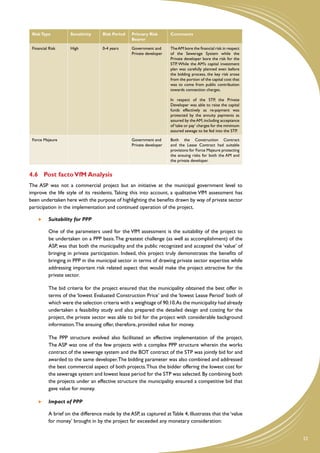
                                                            speculative bids.

                                                     Documents Referred To:
                                                         	   Concession Agreement between Reliance Energy, MMRDA and Veolia Transport

                                                         	   Shareholders Agreement

                                                         	   State Support Agreement

                                                         	   Website Mumbai Metro One Private Limited

                                                         	   General articles in periodicals and publications

                                                     Interviews:
                                                         	   Mr.V. Sivakumaran, Special Officer on Duty, MRTS Cell, MMRDA

                                                         	   Mr. R. K. Madan, Special Officer on Duty, MRTS Cell, MMRDA


120
Sixteen
Case Study 13:
Hyderabad Metro


16.1 Project Description
Hyderabad is a growing city that covers 625 square kilometres of municipal corporation area
and 6,852 square kilometres of metropolitan area (Metropolitan area includes 16 mandals in
Hyderabad District, 22 mandals in Ranga Reddy District, 10 mandals in Medak District, 5 mandals in
Nalgonda District and 3 mandals in Mehboobnagar District). It is a hub for Information Technology
/ Information Technology Enabled Services (IT/ITES), Biotech and Pharmaceutical sectors along with
being a tourist attraction.

The burgeoning population has put Hyderabad’s transportation system under immense pressure.
The city requires a robust, dependable, comfortable, affordable and sustainable transportation
system. To address this need, the Government of Andhra Pradesh (GoAP) has planned a Mass
Rapid Transit system (MRTS) covering three high traffic density corridors of Hyderabad. The
project is planned to be developed on a PPP basis through the Build Operate Transfer (BOT)
mode.

This project will cover 3 dedicated elevated corridors i.e. Corridor 1: Miyapur – L. B. Nagar (29.87
kms) having 27 stations, Corridor 2: Jubilee Bus Stations – Falaknuma (14.78 kms) having 16 stations
and Corridor 3: Nagole – Shilparammam (26.51 kms) having 23 stations.There will be three depots,
one for each Corridor, located at Miyapur, Falaknuma and Nagole. Corridors 1, 2 and 3 will be
designed for peak hour peak distribution traffic (PHPDT) of 50,000, 35,000 and 50,000 respectively.
The speed of the system would vary from 34 kmph to 80 kmph and the trains would have a
frequency of 3 to 5 minutes.


16.2 PPP structure of the Project
Hyderabad Metro Rail Ltd, a fully owned Public Sector Undertaking of GoAP is currently
implementing the Hyderabad Metro Rail Project.The project is to be developed under a concession
agreement on BOT basis for a period of 35 years, including a construction period of 5 years. Under
the concession agreement, the operator has to design, finance, construct, operate, and maintain the
3 corridors and transfer the assets at the end of the concession period.

The assets of the project include the viaduct, stations, bridges, depots, rolling stock, signalling system,
traction systems, communications systems, track work, fare collection system, etc.The assets would
be constructed or procured through contractors and equipment suppliers.

In addition, the operator would also have access to the commercial development of land available at
the depots (212 acres) and 10% of the carpet area of the station sites identified in the concession
agreement. This aggregates to a cumulative maximum of 12.5 million square feet in the case of
depots and a cumulative maximum of 6 million square feet in the case of stations. The SPV would
also be allowed to undertake real estate development over the parking and circulation areas at
stations. All the real estate development related assets created under the project would also be
considered the assets of the SPV which would be handed over to the Government at the end of
the concession period of 35 years.


                                                                                                              121
Public Private Partnership projects in India
              Compendium of Case Studies
                                                                A Special Purpose Vehicle (SPV) named Maytas Metro Limited (MML) was formed with Maytas
                                                                Infrastructure holding 26% equity, Government of Andhra Pradesh (GoAP) holding 11% Nav Bharat
                                                                Ventures holding 16% and IL&FS and Ital-Thai holding 5% each. MML owned the remaining 37%,
                                                                which it proposed to sell partially or completely, at a premium by roping in more partners.

                                                                16.3 Current Status
                                                                The Maytas consortium was awarded the contract for the Hyderabad Metro in July 2008 and
                                                                the concession agreement was signed on 18th September 2008 between MML and the GoAP. The
                                                                consortium had to achieve financial closure and deposit a performance guarantee of ` 240 crore
                                                                for the project before March 17, 2009.

                                                                The promoter of Maytas Limited was Teja Raju, the son of R. Ramalinga Raju, founder and chairman
                                                                of Satyam Computer Services (SCS). The Raju family held an over 36 percent stake in Maytas Infra
                                                                Limited. The SCS irregularities, perpetrated by R Ramalinga Raju, which surfaced in late December
                                                                2009, with an abortive bid by SCS of Maytas Infrastructure Limited, were the start of the problems
                                                                for the Hyderabad Metro. Lenders lacked confidence in the promoters of Maytas and the consortium
                                                                was unable to raise the performance guarantee and achieve financial closure despite a grace period
                                                                of around 4 months. Consequently, on July 7, 2009, GoAP cancelled the contract awarded to the
                                                                Maytas consortium and a decision to re-bid the project was taken.

                                                                GoAP launched the rebid with the issue of the RFQ on July 16, 2009. 8 bidders qualified for the RFP
                                                                process and were asked to submit financial bids for the project by June 07, 2010.

                                                                16.4 Financing Information
                                                                The total cost of the project was estimated at ` 11,814 crore. While the Government of India had
                                                                approved a viability gap of ` 3,500 crore for the project, MML had quoted a negative viability gap
                                                                funding and thus did not seek VGF support for this project.

                                                                The consortium quoted a negative viability gap (i.e. the consortium would pay the government)
                                                                with a present value of ` 1,240 crore (discounted at 13.5 percent). This amount was proposed to
                                                                be paid by the consortium over a period of 35 years as per the following schedule.


                                                     Table 32   Amount was proposed to be paid by the consortium

                                                                  Concession Year                             Payment

                                                                  Upfront                                     ` 11 crore

                                                                  Appointment Date                            ` 50 crore

                                                                  4th Year                                    ` 200 crore

                                                                  7th to 9th Year                             ` 100 crore

                                                                  18th to 34th Year                           ` 1,750 crore

                                                                  20th to 35th Year                           1% of the net realisable fare in the 20th year, 2% of
                                                                                                              the net realisable fare in 21st year and so on.

                                                                The cost of the project was to be financed with a debt to equity ratio of 2:1. Therefore the
                                                                consortium had to raise debt of ` 7,876 crore and contribute equity of ` 3,938 crore without any
                                                                VGF support.


122
Process Analysis                                                                                    Figure 13


   Project Life Cycle                                        First Round


                                         •      First conceptualized in 2005
         IncepƟon

                                         •      Feasibility Study during 2005
         Feasibility
                                         •      InvitaƟon of Bids in November
                                                2005
      Procurement
                                         •      SelecƟon of Maytas Infra as the
                                                preferred bidder on July 2008
      Development
                                         •      CancellaƟon of contract with
                                                Maytas Infra due to non
                                                payment of performance
          Delivery                              guarantee and inability to
                                                achieve financial closure. Fresh
                                                bid launched.
             Exit


16.5 Process Analysis

Conceptualisation and Feasibility
The Government had been exploring the viability of various mass transit systems that are efficient,
economically viable and environment friendly in Hyderabad.
In this context, a detailed feasibility study was carried out by the Delhi Metro Rail Corporation
(DMRC) in 2005. The study recommended a metro length of 61 kms over 3 corridors. However,
the government increased the length of line 3 by 5 kms. The study further recommended that
property development would be required to partly fund the cost of the project and that the
Hyderabad Metro be bid out on a BOT basis. It also recommended a VGF of around 40% of the
project cost to make the project potentially bankable and economically viable.

Procurement
The project was approved by the GoAP and global bids were invited through an Expression of
Interest-cum-Request for Qualification (EoI-cum-RFQ) in November 2005. The EOI-cum-RFQ had
stringent technical and financial criteria. The following seven consortia submitted their EOI along
with their bids for pre-qualification.
     	   Essar Constructions (Mumbai), Srei (Kolkata), SembCorp, STE (Singapore) and Singapore
         MRT;
     	   Magna Allmore (Malaysia), Siemens AG (Germany), ETA (Dubai) and NCC (Hyderabad);

     	   Reliance Energy (Mumbai) and Bombardier (Canada);


                                                                                                                  123
Public Private Partnership projects in India
              Compendium of Case Studies
                                                          	   Metrail (Switzerland), Macquarie Bank (Australia) and MMC (Malaysia);

                                                          	   GVK (Hyderabad), Gammon India (Mumbai), Alstom (France) and IDFC;

                                                          	   Maytas (Hyderabad), Navabharat (Hyderabad), ItalThai (ITD-Thailand)

                                                          	   ITD cem (Delhi); and IVRCL (Hyderabad), Hitachi (Japan) and BHEL.
                                                     Five of these consortia were pre-qualified by the GoAP, with the Metrail and ITD Cem consortia
                                                     not qualifying. The Government of India considered the project for financial assistance under the
                                                     VGF scheme and then allowed the GoAP to proceed with the RFP Process.
                                                     The RFP document, including the model concession agreement, manual of specifications and
                                                     standards as well as the state support agreement, was issued to all the pre-qualified bidders in May
                                                     2007. The RFP process comprised technical and financial proposals. All the pre-qualified consortia
                                                     qualified technically and were asked to submit their financial bids in May 2008.
                                                     The Maytas-led consortium agreed to pay ` 30,311 crore to the government during the concession
                                                     period of 35 years, while the Magna Allmore led consortium agreed to pay ` 250 crore to the
                                                     government. The two other bidders--Reliance sought a VGF grant of ` 2,811 crore from the
                                                     government and Essar sought a grant of ` 3,100 crore respectively. The GVK–led consortium did
                                                     not submit a financial bid. Based on these bids, the Maytas consortium was awarded project.

                                                     Development
                                                     The project was to achieve financial closure by March 17, 2009.

                                                     Major milestones achieved in the development phase are presented below:

                                                          	   The SPV was incorporated in September 2008.

                                                          	   Signing of the Concession Agreement and Shareholders agreement took place on
                                                              September 18, 2008.

                                                          	   Extension granted for financial closure and performance guarantee on March 17, 2009.

                                                     The Concession Agreement with Maytas Metro was eventually cancelled on July 7, 2009 due to the
                                                     failure of MML in arranging the Performance Security and achieving financial closure for the project

                                                     Due to the large differences between the bids submitted by each of the consortia the GoAP took
                                                     the decision to re-bid the project. The RFQ for the new process was released on July 16, 2009
                                                     and the date for the submission of the RFQ was January 16, 2010. 8 bidders qualified for the RFP
                                                     process and were asked to submit financial bids for the project i.e.

                                                         1.	 Larsen & Toubro Ltd;

                                                         2.	 Lanco Infratech-OHL Concesiones SL consortium;

                                                         3.	 Reliance Infrastructure-Reliance Infocomm consortium;

                                                         4.	 Essar-Leighton-Gayatri-VNR consortium;

                                                         5.	 GVK-Samsung C&T Corporation consortium;

                                                         6.	 GMR Infrastructure Ltd;

                                                         7.	 Transstroy-OJSC Transstroy-CR 18G-BEML consortium; and

                                                         8.	 Soma-Strabag AG (Austria) consortium.

                                                     The date for the submission of RFP bids was revised to June 07, 2010.


124
Risk allocation framework                                                                                               Table 33

Risk Type        Sensitivity   Risk Period   Primary       Comments
                                             Risk Bearer
Pre-Operative Risks

Delays in land   High          0-5 years     Government    The land has to be handed over to the concessionaire
acquisition                                                on or prior to the Appointed Date (i.e. date on which
                                                           financial closure is achieved). Further, up to 90% of
                                                           the land has to be handed over to the concessionaire
                                                           within 120 days of signing of the agreement
                                                           (contingent on paying of Payment Security). This
                                                           is a Condition Precedent for the Agreement. The
                                                           government is liable to pay damages to the tune
                                                           of 0.1 percent of the Performance Security (` 240
                                                           crore) for each day of delay. If the GoAP is not able
                                                           to provide access to the remainder 10% of the land
                                                           for reasons other than a Force Majeure, it shall pay
                                                           the Concessionaire damages to the tune of ` 1000
                                                           per day for every 500 square meters, commencing
                                                           from the 91st day of the Appointed Date.

Financing        Medium        0-5 years     Private       The Concessionaire has to achieve financial closure
Risks                                        Operator      180 days after the signing of the contract. GoAP can
                                                           extend the date for financial closure for a further
                                                           120 days in case the private operator cannot achieve
                                                           financial closure. The Concessionaire would be
                                                           liable to pay damages to the tune of 0.1 percent
                                                           of Performance Security for every day of delay in
                                                           achieving financial closure. The GoAP has the right
                                                           to cancel the contract after a period of 6 months
                                                           from the signing of the contract.

Planning         Medium        0-5 years     Private       The risk for the planning and execution of the project
                                             Operator      vests with the private operator. It needs to execute
                                                           the project in conformance with the detailed design
                                                           and construction methodology, quality assurance
                                                           procedures and the time schedule for completion
                                                           of the Project as submitted by the private operator
                                                           to the GoAP on or before the Appointed Date. The
                                                           project is also subject to a review by the Independent
                                                           Engineer appointed for the project.

Regulatory,      Low           0-5 years     Private       This private operator has to obtain all applicable
administrative                               Operator      permits/clearances from the GoI/GoAP with regard
& approval                                                 to the implementation of the project. This is a
delays                                                     Condition Precedent. However, if the GoI/GoAP
                                                           inordinately delay the project applicable permits so
                                                           as to cause a Material Adverse Effect then GoAP
                                                           shall not terminate the agreement

Construction Phase Risks

Design Risk      Medium        0-5 years     Private       The private operator has to submit all the drawings
                                             Operator      and the schedule of the project to the GoAP. These
                                                           have to be reviewed by GoAP and scrutinised by the
                                                           Independent Engineer.The GoAP is not liable for any
                                                           delays caused due to late submissions of drawings
                                                           of the project.

Construction     Medium        0-5 years     Private       The Concessionaire has to provide a Performance
Risk                                         Operator      Security of ` 240 crore for the performance of its
                                                           obligations. This security has to be renewed from
                                                           time to time and replenished within 30 days. The
                                                           Concessionaire is also liable to pay damages at the
                                                           rate of 0.1 percent of the Performance Security/day
                                                           if it fails to achieve any milestone. Further, the private
                                                           operator has to submit monthly progress reports
                                                           and allow the Independent Engineer to inspect the
                                                           progress of construction. The Independent Engineer
                                                           has to subject the metro system to test and provide
                                                           a provisional completion certificate.


                                                                                                                                   125
Public Private Partnership projects in India
              Compendium of Case Studies
                                                     Risk Type        Sensitivity   Risk Period   Primary       Comments
                                                                                                  Risk Bearer

                                                     Change in        Low           0-5 years     Government    If the government requires additional works and
                                                     Scope Risk                                                 services which are beyond the scope of the project,
                                                                                                                such a change in scope shall be made by GoAP by
                                                                                                                an order, giving consideration to the operations and
                                                                                                                maintenance costs which would be spent by the
                                                                                                                private operator and then subsequently reimbursed
                                                                                                                by GoAP


                                                     Financing Risk   Medium        0-5years      Private       The private operator is solely responsible for
                                                                                                  Operator      arranging financial closure for the project. The
                                                                                                                private operator has to achieve financial closure
                                                                                                                within 180 days. The government may provide an
                                                                                                                additional period of 120 days after this period
                                                                                                                subject to the payment of damages (0.1 percent of
                                                                                                                Performance Security) per day of delay.


                                                     Operational Phase Risk

                                                     Technology       Low           0-35 years    Private       The technology risk vests with the both the private
                                                     Risk                                         Operator /    operator and the government as the project would
                                                                                                  Government    be executed in conformance with the detailed design
                                                                                                                and construction methodology, quality assurance
                                                                                                                procedures and procurement of engineering and
                                                                                                                construction time schedule for completion of the
                                                                                                                Project as submitted by the operator to the GoAP
                                                                                                                and approved by the Independent Engineer.

                                                     Operations &     Medium        0-35 years    Private       The private operator has to submit a maintenance
                                                     Maintenance                                  Operator      manual and maintenance program to GoAP for
                                                     Risk                                                       approval and needs to comply with the requirements
                                                                                                                in the same. In case of non-compliance with these
                                                                                                                requirements the government has the right to
                                                                                                                undertake and complete these requirements by
                                                                                                                itself and recover 120% of the costs associated
                                                                                                                with completing these requirements or even initiate
                                                                                                                termination proceedings if necessary. The private
                                                                                                                operator can mitigate this risk as he is allowed to
                                                                                                                appoint O&M contractors for the running of the
                                                                                                                system

                                                     Market Risk      High          0-30 years    Private       The private operator will levy and collect the fares
                                                                                                  Operator /    from the users of the Metro and is entitled to
                                                                                                  Government    revise these fares upto 60% of the Wholesale Price
                                                                                                                Inflation in the previous year. The private operator
                                                                                                                shares the traffic risk with the government. The
                                                                                                                government would provide a revenue shortfall loan
                                                                                                                to the tune of the revenue shortfall at at an interest
                                                                                                                rate 2% above the standard bank rate specified by
                                                                                                                the RBI. In the event of the actual traffic falling short
                                                                                                                of the target traffic by more than 2.5 percent, on
                                                                                                                a pre-determined target date (1 October 2011),
                                                                                                                the concession period shall be increased by 1.5
                                                                                                                percent of the concession period thereof for every
                                                                                                                1% shortfall compared to actual traffic. In the event
                                                                                                                the actual traffic is more than target traffic then the
                                                                                                                concession period will be reduced by 1% for every
                                                                                                                1% reduction in traffic.

                                                     Performance      High          0-30 years    Private       The private operator has to provide a Performance
                                                     Risk                                         Operator      Security of ` 240 crore for the performance of its
                                                                                                                obligations. Further, the private operator is not
                                                                                                                allowed a change in ownership that causes the
                                                                                                                aggregate holding of the Consortium Members,
                                                                                                                together with their Associates in the total equity to
                                                                                                                decline below 52 percent during a period of 5 years
                                                                                                                following the Commercial Operations Date of the
                                                                                                                Metro System and 26 percent during the rest of the
                                                                                                                concession period. Any change of equity greater than
                                                                                                                15 percent would require prior written approval of
                                                                                                                the government.


126
Risk Type     Sensitivity   Risk Period   Primary       Comments
                                           Risk Bearer

 Handover Risks

 Handover      Low           35th year     Private       A joint inspection would be conducted by the
 Risk                                      Operator      private operator and GoAP, 90 days before the
                                                         termination of the Agreement.This would be verified
                                                         by an Independent Engineer and the private operator
                                                         would have to pay the charges for compliance with
                                                         the serviceability requirements, if found deficient.

 Private       Low           0-35 years    Private       Only lenders are protected and the equity holders
 Operator                                  Operator      bear the major risk. (GoAP is liable to pay 90%
 Event of                                                of debt due less insurance claims) and 70% of
 Default                                                 Additional Termination Payment comprising Real
                                                         Estate Development and any other assets (as valued
                                                         by an Approved Valuer) developed after the 5th
                                                         anniversary of the Commercial Operations Date.

 GoAP Event    Low           0-35 years    Government    GoAP is liable to pay 150% of adjusted equity, 115%
 of Default                                              of Concession Royalty Payments which have already
                                                         been paid to the GoAP, Debt due and 115% of
                                                         Additional Termination Payments comprising Real
                                                         Estate Developments and any other assets).

 Other Risks
 Force         Low           Throughout    Private       Force Majeure risks are transferred to the extent
 Majeure                                   Operator      of insurance, but are largely borne by the private
                                                         sector. In case of a Force Majeure event before
                                                         the financial closure date, the project completion
                                                         date and concession period would be extended.
                                                         Compensation for Force Majeure arising out of a
                                                         direct political event would be paid to the extent of
                                                         a termination payment arising out of a government
                                                         event of default. The compensation shall include
                                                         O&M expenses, debt, additional termination
                                                         payments and increases in cost of construction.
 Change in     Low           Throughout    Private       No compensation due from the government,
 Law Risk                                  Operator      although an enabling provision to mutually discuss
                                                         in good faith to suitably amend the terms of the
                                                         concession agreement, including extension of
                                                         concession if the financial effect of the change in law
                                                         is greater than ` 1 crore and 0.5% of the Realisable
                                                         Fare in the Accounting Year. GoAP is required to
                                                         make amendments to the Agreement so as to enable
                                                         the private operator to be in the same financial
                                                         position as it would be had there been no Change
                                                         in Law.


16.6 Post facto VfM analysis
A VfM qualitative assessment based on publicly available information and discussions with officials
working on the project has been attempted on account of the limited availability of financial data
on the project.The following major factors listed below have contributed toward creating value for
money for the state government in relation to this project:

    1.	 Reduction in financial burden on the state budget: The PPP project was structured to
        ensure that it was viable by providing a viability gap funding for the project. The lowest
        financial bid quoted was in fact a negative viability gap funding of ` 1,204 crores (present
        value terms). The government is only committed to compensating the concessionaire
        for expenses incurred towards shifting of public utilities on the right of way. Thus the
        government is able to achieve, through private sector participation, the construction and
        operations of a critical infrastructure facility for a period of 30 years with a reduced
        requirement of upfront money.

    2.	 Substantial risk transfer: The private sector is to undertake substantial project risks, such
        as financing, construction, operations and revenue risks. The transfer of major risks during


                                                                                                                   127
Public Private Partnership projects in India
              Compendium of Case Studies
                                                              the operational phase along with imposition of a stiff performance security (` 240 crore)
                                                              ensures that the private operator places its best efforts in the operating the system so as
                                                              to ensure sustainability of operations.

                                                     While the above factors do point to the fact that there was substantial merit in adopting the PPP
                                                     approach, we must acknowledge the implicit risks that the public sector would continue to retain. In
                                                     this case the project itself was scrapped and a re-bid ordered.There have been several international
                                                     precedents where governments have had to either taken back certain risks or cancelled ailing
                                                     public infrastructure projects on the grounds of protecting public interest. Indeed, such financial
                                                     support or bail-out packages were perhaps, necessary for those economies. However, these are
                                                     implicit risks for the government due to the nature of public service or infrastructure facility being
                                                     rendered and the governments stated or implicit obligations to its citizens for the provision of the
                                                     same should be noted.

                                                     16.7	Key Learning and Observations
                                                         1.	 Real Estate Development: The government provided commercial development rights
                                                             for almost 296 acres of land to the Concessionaire which essentially consisted of land
                                                             allocated for the depots and land for the stations. The real estate development allowed
                                                             in the case of depots was a cumulative maximum of 12.5 million square feet and in the
                                                             case of stations was a cumulative maximum of 6 million square feet. The total value of real
                                                             estate development aggregated to a substantial percentage of the project cost.

                                                         	    This opportunity of the utilization of land on a commercial basis coupled with the metro
                                                              project led to widely divergent bids from the bidders. The bids were on the basis of the
                                                              consortium recovering its capital investment from the real estate development. While the
                                                              Siemens Consortium bid a negative viability gap of ` 250 crore, the Maytas Consortium
                                                              bid a very high a negative viability gap of ` 30,311 crore. On the other hand, the two other
                                                              bidders--Reliance sought a VGF grant of ` 2,811 crore from the government and Essar
                                                              sought a grant of ` 3,100 crore.

                                                         	    The real estate market is very volatile and cyclical in nature. An adverse outlook for
                                                              the sector would have the risk of compromising the development and construction of
                                                              the project. Thus, ideally real estate development should be a smaller component of the
                                                              project which would allow the private operator to complete the project despite downturn
                                                              in the real estate sector. DMRC, which conducted the feasibility study for the project, in
                                                              fact recommended that the quantum of real estate development should ideally be not
                                                              more than 7-8 percent of the total project cost.

                                                         	    Moreover, real estate development typically provides faster returns on capital invested
                                                              than investment in the metro rail system. A large component of real estate development
                                                              would expose the project to the risk of the actual construction and quality of the metro
                                                              being compromised as the private operator would have a greater incentive to complete
                                                              the real estate development rather than constructing the metro.

                                                         	    An alternative available to the government was to undertake the real estate development
                                                              by itself and/or bringing in a private operator to develop this land through a separate
                                                              procurement process. This development revenue could have been used to cross-subsidize
                                                              the construction/operational phase of the project.

                                                         	    Another alternative would have been to break-up the project into smaller components
                                                              (e.g. The 3 corridors could have been bid out to different bidders to minimize the risk of
                                                              operator default.)

                                                         2.	 Traffic Risk: The concession agreement transferred the traffic risk to a large extent on
                                                             to the government. As per the agreement, if the target traffic was lesser than 275 lakh
                                                             passenger kms then the concession period would be increased. Similarly, if the traffic was


128
more than the target traffic, the concession period would be reduced. Ideally such traffic
        estimates should not be a part of the Concession Agreement and this market risk should
        totally vest with the Private operator. This would incentivise the operator to provide a
        better level of service and thus increase the number of passengers travelling on the Metro
        line.

   3.	 Right of Way: The creation of the right of way for the viaduct of the Hyderabad Metro
       also posed a major challenge as the proposed route passed through populated areas of
       the city. This hurdle was overcome by using persuasive techniques like giving an additional
       Floor Space Index (FSI) for development. The local municipal corporation i.e. Greater
       Hyderabad Municipal Corporation (GHMC) was also closely involved in this negotiation
       process. The project also attempted to mitigate the risk of the project being stalled due
       to vested interests and/or affected private parties by using government lands for the
       developments of depots, stations etc. as much as possible.

   4.	 Promoter Backing: The winning consortium of Maytas Metro was adversely affected
       due to the issues besetting the promoters of the Maytas Infrastructure Limited. The
       perpetrator of the SCS irregularities i.e. R Ramalinga Raju owned a stake in Maytas
       Infrastructure which was promoted by his son Teja Raju. Though the Maytas Metro
       Project was to be implemented as a separate Special Purpose Vehicle there was a loss of
       investor confidence in the promoters of the project. Consequently, the project was not
       able to achieve financial closure. Thus, promoter profile and backing is critical to project
       sustenance and success.

Documents Referred To:
    	   Concession Agreement between Maytas Metro Limited and Government of Andhra
        Pradesh

    	   Model Concession Agreement

    	   Website of Hyderabad Metro Rail

    	   Articles in periodicals and publications

Interviews:
    	   Mr. N.V. S. Reddy, Managing Director, Hyderabad Metro Rail Limited

    	   Mr. N. Shivakumaran, Officer on Special Duty, MRTS, MMRDA


                                                                                                      129
Public Private Partnership projects in India
              Compendium of Case Studies


                                                     Seventeen
                                                     Case Study 14:
                                                     Bhiwandi Electricity Distribution
                                                     Franchisee
                                                     17.1 Project Description
                                                     The worsening power deficit scenario in Maharashtra warranted immediate action on the part of
                                                     the Maharashtra State Electricity Distribution Company Limited (MSEDCL). Since the gestation
                                                     period for addition of generation capacity is long, MSEDCL decided to focus on load-side energy
                                                     management and utilise the savings thereof to curtail the growing deficit to some extent. MSEDCL
                                                     also decided to bring in private sector expertise for increasing efficiencies in the distribution system
                                                     in certain selected circles (networks) through a distribution franchising arrangement.

                                                     The Electricity Act 2003 allows the holder of a distribution licence to contract out some or all
                                                     of the distribution activities to a franchisee. The distribution franchise arrangement applied to the
                                                     distribution circle in the town of Bhiwandi, about 48 km north-east of Mumbai is a pioneering project
                                                     and the first “input” distribution franchisee project following the introduction of the concept in the
                                                     Electricity Act. In an “input” model, the agency is responsible for supply of power at the input point
                                                     and the franchisee is responsible for all obligations of distribution license in the franchisee area i.e.

                                                           	   Supply of power

                                                           	   Consumer Service

                                                           	   Operation and maintenance of distribution network

                                                           	   Billing and Collection

                                                           	   Compliance with regulatory standards

                                                     Bhiwandi was chosen for the project since it had a reputation of being a chronic defaulter on its
                                                     power bills and had a poor distribution network with a very high level of Aggregate Technical and
                                                     Commercial (AT&C) losses. It had, at the time, 160,000 customers (total population of about one
                                                     million) over a geographical area of 721 sq kilometres. The power demand of the Bhiwandi circle,
                                                     with a significant number of textiles /garment manufacturing units (mainly power looms), at the
                                                     time, was about 800 MVA, translating into an annual energy input of about 2,500 gigawatt hours
                                                     (GWh).

                                                     Torrent Power AEC Limited (TPAL) was the private entity appointed by MSEDCL for this project.

                                                     17.2 PPP structure of the Project
                                                     The Distribution Franchisee Agreement (DFA) for the Bhiwandi circle is valid for an initial term of
                                                     10 years. The structure of the distribution franchisee model is as follows:

                                                           	   MSEDCL continues to be the distribution licensee and authorises the franchisee to
                                                               distribute electricity on its behalf in a specific area (Bhiwandi distribution circle).

                                                           	   The franchisee has the right to use the distribution assets of MSEDCL in the franchise area
                                                               for carrying out his responsibilities and obligations.


130
The franchisee is responsible for the following functions of the MSEDCL for the term of
         the DFA:

         •	   Distribution and supply of power to the consumers of MSEDCL in the franchise area,

         •	   Operation and maintenance in the franchise area,

         •	   Metering, billing, collection and all such consumer related services,

         •	   Compliance with all the standards including the Electricity Supply code and the
              Standards of Performance and other regulatory provisions.

     	   MSEDCL is committed to provide a certain minimum quantum of electricity at identified
         input points to the distribution franchisee.The franchisee makes payments to MSEDCL for
         supply of power at a pre-determined tariff referred to as the input rate.The input rate was
         the key bidding parameter, determined at the time of evaluation of bids. The franchisee is
         allowed to procure additional power for supply in case of shortfall, from the sources other
         than MSEDCL.

     	   MSDECL has to incur a certain minimum capital expenditure towards the distribution
         network as per its minimum investment plan for five years.

     	   The franchisee is given full autonomy for planning and execution of its capital expenditure
         (other than the capital expenditure planned and committed by MSEDCL) with the
         objective of meeting an agreed minimum reduction in losses and improvement in collection
         efficiency. The value of any assets added has to be certified by MSEDCL as acceptable.

     	   The consumers are charged the same tariff as applicable to other consumers of MSEDCL,
         and as determined by the independent regulatory agency – Maharashtra Electricity
         Regulatory Commission (MERC).

     	   MSEDCL will make termination payments to the franchisee upon expiry or in the event of
         default by MSEDCL / franchisee for the capital expenditure incurred by the franchisee at
         the depreciated value of the distribution assets created.

17.3 Current Status
The project is operational. The process of handing over assets to the private sector entity, TPAL,
started in July 2006 after the issue of the Letter of Intent (LoI) to TPAL.TPAL took over operations
from MSEDCL with effect from 26th January 2007 after the DFA was executed in December 2006.

TPAL has completed close to three years of operations as the distribution franchisee for the
Bhiwandi circle.

17.4 Financing Information
As per the franchisee agreement, MSEDCL was required to invest a minimum capital expenditure of
` 61 crores, over a 5 year period, towards the upgradation of the distribution network, while TPAL
was required to additionally make capital investments in the franchisee area to improve efficiencies,
upgrade the network, etc. Since the takeover of operations, TPAL has invested over ` 250 crores
towards improving the network and services in the Bhiwandi circle.

17.5 Process Analysis

Inception:
The Bhiwandi circle had one of the worst performances among distribution circles in Maharashtra.
In the five years between Financial Year (FY) 2002-07, revenues from the circle stagnated at about `
240 crores despite the sale of power in physical terms going up by over 42% to 1.225 billion units.


                                                                                                        131
Public Private Partnership projects in India
              Compendium of Case Studies
                                                                The situation in the Bhiwandi circle at the time of takeover was as follows:

                                                                      	   Aggregate technical and commercial (AT&C) losses - 58%
                                                                      	   Mandatory load shedding of 6 hours per day
                                                                      	   Distress load shedding due to a deficit of 300 MVA in Extra High Voltage (EHV) network
                                                                      	   Transformer failure rate of 40%
                                                                      	   Unregistered customers
                                                                      	   Poor reliability of supply and frequent incidents of appliance failure

                                                                This poor performance was on account of the following reasons:
                                                                      	   There had been effectively no capital investment in Bhiwandi’s distribution network in
                                                                          the last decade or so. This had resulted in a high level of network overloading and a high
                                                                          transformer failure rate.
                                                                      	   Getting official connections or an additional load sanctioned was very difficult and time
                                                                          consuming, leading to an increasing tendency on the part of consumers to resort to illegal
                                                                          connections.

                                                                In an effort to solve problems of high distribution losses, lower collection efficiency, and inefficient
                                                                distribution network, MSEDCL decided to utilize the provisions of Electricity Act 2003 and bring in
                                                                private expertise through distribution franchising in the Bhiwandi circle.

                                                                PPP Project Preparation:
                                                                Conceptualisation: The concept development phase involved analysing various forms of
                                                                distribution models to enable selection of the most suitable project structure. This involved
                                                                identification of various technical and / or commercial services, forming the financial and commercial
                                                                structure of the model, development of performance benchmarks for monitoring, etc. An input
                                                                based distribution franchisee model was proposed for Bhiwandi.

                                                                In an input based distribution franchisee model, the franchisee is primarily responsible for supply
                                                                of electricity, network related capital investments, the operation and maintenance of the network
                                                                and consumer services including billing and collection. The purchase of power is primarily at a pre-
                                                                determined rate i.e. the input rate from the licensee, thus significantly removing the uncertainty
                                                                linked to high power procurement costs. Also, since there is no transfer of assets or shares, the
                                                                valuation of assets is not necessary, although a joint audit of key parameters and assets needs to
                                                                be conducted.

                                                                Discussion with stakeholders: The proposed structure was discussed with all concerned
                                                                stakeholders including prospective investors, prior to finalisation. Various issues relating to the
                                                                baseline data, human resources, arrears, regulatory risk were discussed and necessary amendments
                                                                were made. The issues and the solution for addressing the same have been discussed in Table 34.

                                                     Table 34   Issues and solution
                                                                 Key Points of Discussion   Challenges / Issues Raised By               Solution / Action
                                                                 in Stakeholder Meetings    Stakeholders
                                                                 Opening level data         Investors had concerns on the reliability Sufficient opportunity was provided to
                                                                                            of opening level data on distribution losses bidders to carry out a due diligence of
                                                                                            and collection efficiency, since it was the existing performance.
                                                                                            basis for financial calculations for the bids,
                                                                                            and impacted business profitability.
                                                                 Regulatory uncertainty     Since tariff was regulated, investors had   The franchisee was largely insulated against
                                                                                            concerns whether tariff increases in        power purchase costs changes as the bulk
                                                                                            the future would be adequate to fully       supply tariff was indexed to the average
                                                                                            compensate for an increase in power         retail tariff.
                                                                                            purchase costs.


132
Key Points of Discussion   Challenges / Issues Raised By                  Solution / Action
 in Stakeholder Meetings    Stakeholders
 Commitment of              There was no commitment from MSEDCL            MSEDCL committed to provide minimum
 minimum input power        to supply power to Bhiwandi. Revenues          input level of energy linked to the FY 2006
 from MSEDCL                from sale of power were directly linked        level of 2,426 GWh.
                            to energy received by the Distribution
                            Franchisee. Thus, the investors wanted
                            MSEDCL to commit a minimum level of
                            energy input.
 Capital expenditure        Since MSEDCL was better aware of the           MSEDCL decided to commit ` 61 crores
                            condition of physical assets in Bhiwandi,      towards capital expenditure over the first
                            investors proposed that MSEDCL should          5 years. The distribution franchisee was
                            suggest and commit capital expenditure to      free to invest over and above this.
                            improve the system.
 Employee deputation        MSEDCL employees had concerns about            MSEDCL employees were given the option
                            their terms of service and enforceability of   to work on deputation with the franchisee.
                            deputation.                                    The franchisee was to offer equal or better
                                                                           terms to such employees. Employees were
                                                                           also given the right to return to MSEDCL.

                                                                           At the same time, the DF was also given the
                                                                           opportunity to select employees required
                                                                           to run its operations. It had full rights to
                                                                           cancel the deputation of any MSEDCL
                                                                           employee, if found unsuitable.
 Past period receivables    The investors pointed out that collection of   The franchisee was offered an incentive
                            current bills would be their focus and they    @10% of the total amount net of taxes
                            should have separate financial incentives to   collected from consumers who had arrears
                            collect past arrears of MSEDCL.                pending more than three months prior to
                                                                           the effective date but were still connected.

                                                                           For collections from disconnected
                                                                           consumers, the incentive was @ 20%.
 Existing contracts         Some investors wanted flexibility to           The same was incorporated in the final RfP
                            terminate existing operational contracts of    and DFA.
                            MSEDCL.


After due consultation with all the stakeholders, the input based franchisee structure was finalised
for implementation.

Procurement:
Expression of Interest (EoI): MSEDCL developed the principles of EoI and sought submissions
by 8th April 2005. An overwhelming 116 applications were received.

RfP Process: The transaction was a single stage bidding process, wherein the bidders were asked
to submit a technical and financial proposal.The RFP was issued on 10th February 2006.The following
five bidders purchased the bid documents:

      	   M/s Tata Power Company Limited

      	   M/s Torrent Power AEC Limited (TPAL)

      	   M/s Crompton Greaves Limited

      	   M/s Reliance Energy Limited

      	   M/s Subhash Projects & Marketing Limited	

Two bidders namely, TPAL and M/s Crompton Greaves Limited submitted their offers along with
the necessary documents on 20th April 2006.

The evaluation criteria for the technical bid were based on two parameters, namely, Experience and
Track Record and the Financial Capability of the bidder.


                                                                                                                          133
Public Private Partnership projects in India
              Compendium of Case Studies
                                                     Table 35    Experience and Track Record
                                                                 S. No.    Parameter                                 Indicator

                                                                 1.        Experience in handling retail consumer    No. of consumers (at least 2 lakh consumers)
                                                                           base or experience in employee handling
                                                                                                                     OR

                                                                                                                     No. of employees (at least 500 employees for 2 years)

                                                                 2.        Relevant Experience of key Personnel      Experience in power sector related activities – At least 5
                                                                                                                     personnel with power sector experience of more than 10 years


                                                     Table 36    Financial Capability
                                                                 S. No.    Parameter                                 Indicator

                                                                 1.        Size of operations                        •	   Net worth – At least ` 50 crores for the last financial year

                                                                                                                     •	   Annual Turnover – At least ` 250 crores for the last two
                                                                                                                          financial years

                                                                 2.        Support from internal accruals            Cash flow from operations - At least ` 25 crores for the last
                                                                                                                     two financial years

                                                                 3.        Corporate Governance                      Listing on a recognized stock exchange


                                                                The financial bid was based on the levelised (annualised) input rate to be quoted by the bidder for
                                                                the power inputted by MSEDCL. The bidder was required to quote the levelised input rate for the
                                                                franchisee period after factoring in the stipulated minimum loss reduction and collection efficiency
                                                                improvements. MSEDCL had also set internal input rate benchmarks for evaluating the financial
                                                                bids.

                                                                After the technical evaluation, both the bidders were declared technically qualified and eligible for
                                                                opening of price bids.The financial bids were opened on 10th May 2006 - Crompton Greaves quoted
                                                                a levelised tariff of ` 2.02 per unit while TPAL quoted ` 2.04 per unit as input rate. As TPAL quoted
                                                                the higher bid among the two, it was declared selected bidder.

                                                                The RfP contained only principles of franchisee agreement. The agreement was finalised after
                                                                negotiations between TPAL and MSEDCL. Subsequent to signing the DFA on 20th December 2006,
                                                                on 25th January 2007, a day before TPAL took over operations at Bhiwandi on 26th January 2007, a
                                                                supplementary agreement to DFA was signed between MSEDCL and TPAL. This agreement made
                                                                some improvements / corrections in the DFA.

                                                                Development:
                                                                The process of handing over of electricity distribution assets started in July 2006 after the issue of
                                                                the Letter of Intent (LoI) to TPAL.The following activities were completed as a part of the handover
                                                                process:

                                                                      	   MSEDCL continued its own operations and in parallel helped TPAL in establishing its
                                                                          presence in Bhiwandi.

                                                                      	   A joint audit team comprising representatives of MSEDCL and TPAL was formed to
                                                                          confirm opening level details.

                                                                      	   A walk down survey for counting and verification of all the assets was conducted.

                                                                      	   An infrastructure roll out plan as per the terms of the agreement was submitted.

                                                                      	   Offices and IT infrastructure were established and staff was recruited.

                                                                This handover phase from MSEDCL to TPAL lasted till January 2007 by when all the conditions
                                                                precedent in the DFA were satisfied.


134
Delivery:
TPAL has completed over two years as the distribution franchisee for the Bhiwandi circle. TPAL,
on takeover of the area, did a consumer survey and started regularizing illegal connections. Post
creation of new assets, it concentrated on augmentation and overhaul of the existing distribution
lines. TPAL also invested in improving the metering system of consumers. All these actions resulted
in a reduction in distribution losses and an improvement in the collection efficiency in the Bhiwandi
circle. The results to date have been positive and are summarised below:

      	   AT&C losses are estimated to have declined by 34% in the first two years of the franchise,
          to 24% (12-month moving average) at the end of FY2008-09 (from 58% in December
          2006, just before handover). Based on the pre-PPP project energy input of 2,500 GWh for
          the Bhiwandi circle and using a per unit rate of 2 K/kwh, the annual value of the reduction
          in AT&C losses can be pegged at about ` 170 crores, as against capital investment of about
          ` 250 crores by the DF over this period.

      	   The consumption of electricity increased from ~2,200 GWh to ~ 3,000 GWh.

      	   Approximately 55,000 new connections have been added including the regularised ones

      	   The distribution transformer failure rate has reduced from 40% at the time of handover
          to 7.5% at the end of FY 2009.

      	   The duration of load shedding has reduced form 6 hours a day to 3.5 hours a day.

      	   The metering coverage has increased from 23% at the time of handover to 95%

      	   Consumers are satisfied due to the improvement in quality in power supply, faster
          processing of applications for new connections, better complaint handling and easy bill
          payments.

TPAL focussed on three important areas namely network upgradation, loss reduction and consumer
services to achieve the above results. The actions taken by TPAL are summarised below:

      	   Immediately after the handover, TPAL initiated the process of regularisation of illegal
          connections and metering. It replaced all existing meters with accurate and tamper proof
          meters to ensure that all consumers are billed as per consumption.

      	   TPAL conducted a survey jointly with Maharashtra State Transmission Company Limited
          (MSETCL) for augmentation of the EHV capacity and prepared a 3 year EHV augmentation
          plan which included reconfiguration of the EHV lines, addition of power transformers and
          EHV substations and feeders. TPAL has added a total EHV capacity of 250 MVA in the
          Bhiwandi area by the end of FY 2009.

      	   TPAL replaced 1,700 distribution transformers and added a further 241 new distribution
          transformers, thereby reducing the transformer failure rate.

      	   TPAL also improved customer services by introduction of 24X7 call centre facility, online
          collection centres, user-friendly bills, extending the operating time for customer care
          centres and public awareness and community development activities.

 Risk allocation framework                                                                                     Table 37

 Risk Type                  Sensitivity   Risk Period   Primary   Comments
                                                        Risk
                                                        Bearer
 Pre-Operative Phase Risk                                         The distribution franchise was an
                                                                  operating business at the time of
                                                                  handover. Therefore, this risk category is
                                                                  not applicable


                                                                                                                          135
Public Private Partnership projects in India
              Compendium of Case Studies
                                                     Risk Type                      Sensitivity   Risk Period   Primary        Comments
                                                                                                                Risk
                                                                                                                Bearer
                                                     CONSTRUCTION PHASE                                                        The distribution franchise was an
                                                     RISK                                                                      operating business at the time of
                                                                                                                               handover. Therefore, this risk category is
                                                                                                                               not applicable.
                                                     Operations Risk
                                                     Procurement risk               High          10 years      Shared         MSEDCL is obligated to supply the agreed
                                                                                                                               quantum of power in absolute terms
                                                                                                                               and at the agreed input rate payable by
                                                                                                                               distribution franchisee. The distribution
                                                                                                                               franchisee may procure power from
                                                                                                                               other sources for any shortfall.
                                                     Tariff Risk                    High          10 years      Shared         The tariff charged to the consumer is
                                                                                                                               regulated. At the same time, the input rate
                                                                                                                               i.e. the cost of power purchase is indexed
                                                                                                                               to the changes in the consumer tariff.
                                                                                                                               Thus in case of an increase /decrease in
                                                                                                                               tariff, the input cost for the franchisee will
                                                                                                                               also increase / decrease in line with the
                                                                                                                               formula prescribed in the DFA. However,
                                                                                                                               on a net basis, there will be some impact
                                                                                                                               on the cash flows of the franchisee.
                                                     Market Risk                    High          10 years      Distribution   The market risk in terms of power
                                                                                                                franchisee     consumption, consumption growth, and
                                                                                                                               consumer mix in the Franchise Area
                                                                                                                               is borne by the Franchisee. Since the
                                                                                                                               input rate bid by the franchisee is based
                                                                                                                               on projections with consumer mix and
                                                                                                                               consumption growth assumptions, non-
                                                                                                                               achievement of the same can adversely
                                                                                                                               impact the franchisee cash flows.

                                                                                                                               However, the distribution franchisee is
                                                                                                                               the exclusive franchise in the franchisee
                                                                                                                               area and hence is not subject to any
                                                                                                                               competition.
                                                     Financial Risk / Receivables   High          10 years      Distribution   The onus of collection efficiency during
                                                     risk                                                       franchisee     the applicability of the DFA is on the
                                                                                                                               distribution franchisee.

                                                                                                                               For arrears from current consumers, up
                                                                                                                               to 3 months prior to the effective date,
                                                                                                                               the distribution franchisee is responsible
                                                                                                                               for ensuring 65% collection efficiency.

                                                                                                                               For past arrears, pending more than 3
                                                                                                                               months prior to the effective date, the
                                                                                                                               franchisee is provided an incentive @ 10
                                                                                                                               % of collections. The same is @20% of
                                                                                                                               collections for disconnected consumers.
                                                     Other Risks
                                                     Risk arising from erroneous    Medium        10 years      Distribution   The findings of the joint audit conducted
                                                     baseline data                                              Franchisee     post-selection of franchisee may differ
                                                                                                                               from the baseline data provided by
                                                                                                                               MSEDCL. Distribution franchisee was
                                                                                                                               allowed to conduct a due diligence of its
                                                                                                                               own in the franchise area.
                                                     Socio-political risk           Medium        10 years      Distribution   Since the distribution franchisee becomes
                                                                                                                franchisee     the point of contact for consumers, any
                                                                                                                               dissatisfaction on account of action /
                                                                                                                               inaction by the franchisee can lead to
                                                                                                                               instances of opposition or resistance
                                                                                                                               and political pressures. For example, load
                                                                                                                               shedding can lead to discontent among
                                                                                                                               the consumers. In such a scenario there
                                                                                                                               may pressure from the state to ensure
                                                                                                                               regular supply. As a result the franchisee
                                                                                                                               may have to purchase expensive traded
                                                                                                                               power from the market.


136
Risk Type                 Sensitivity   Risk Period   Primary      Comments
                                                       Risk
                                                       Bearer
 Force majeure             Medium        10 years      MSEDCL       In case of force majeure event, no party
                                                                    is liable for performance of obligations
                                                                    under the agreement. However, in case of
                                                                    prolonged force majeure, the agreement
                                                                    may be terminated by either party,
                                                                    whereby assets would be transferred to
                                                                    MSEDCL against an expiry payment from
                                                                    MSEDCL.


17.6 Post facto VfM analysis
In the absence of data to conduct a quantitative VfM analysis, an analysis of the actual performance
of the DF has been undertaken to establish the benefit of opting for a PPP model.
    •	   AT&C losses are estimated to have declined by 34% in the first two years of the franchise,
         to 24% (12-month moving average) at the end of FY2008-09 (from 58% in December
         2006, just before handover).
    •	   The distribution transformer failure rate reduced from 40% at the time of handover to
         7.5% at the end of FY 2009.
    •	   The load shedding duration reduced from 6 hours a day to 3.5 hours a day.
    •	   The percentage of accurate metered sales increased from 23% at the time of handover to
         95%
    •	   Benefits to TPAL, MSEDCL and consumers
The efficiency gains brought to the power distribution system through the franchisee model
benefited all the stakeholders, thus creating a win-win situation. TPAL has benefited in terms of
the increased revenue from reduction in losses and improvement in collection efficiency due to
refurbishment of the existing network, regularising illegal connections, metering, etc. MSEDCL
benefited due to savings in terms of reduction in O&M expenditure, capital investments and interest
on working capital.The consumer benefited through increased reliability of power supply, improved
customer service.

17.7 Key Learning and Observations
    •	   Extensive deliberations on the selection of the PPP model and its structure at
         inception
    	    One of the key reasons for the success of the Bhiwandi model was that the interests of
         various stakeholders (i.e. MSEDCL, the franchisee, consumers and MSEDCL employees)
         were considered in the process of evolving the structure of the business model. The
         model was designed keeping in mind various sector-specific issues such as power deficit,
         regulated tariffs, subsidy, nature of distribution assets, etc.
    •	   Joint audit of opening levels of key parameters
    	    Since the power distribution business involves the sale of electricity to a large number of
         customers spread over a large geographical area, typically the distribution assets (i.e. the
         network) are also spread out spanning a vast area. As a result, the exercise of estimation of
         distribution losses, collection efficiency and total assets, the average billing rate is extremely
         complex and prone to errors. It is therefore necessary in a distribution franchisee model,
         that a joint audit be conducted for determining the value of these parameters, since they
         are extremely critical and can impact the profitability and return of the selected bidder.
    •	   Transparent bidding process
    	    The bid process was conducted in a transparent manner with due consultation of the
         prospective investors. This helped in creating trust and confidence among the investors.


                                                                                                               137
Public Private Partnership projects in India
              Compendium of Case Studies
                                                        •	   Emergence of alternative distribution reform model to privatisation in the
                                                             Indian context

                                                        	    In the input distribution franchisee model, the risks related to power purchase costs and
                                                             regulated tariff are substantially mitigated for the private partner. Further, the franchisee
                                                             has an incentive to implement operational efficiencies in the distribution system (i.e.
                                                             reduction of distribution losses and improvement in collection efficiency) since this would
                                                             result in higher margins to the franchisee for the same power purchase cost. The ability
                                                             of this PPP model to harness these profit-motivated efficiency incentives was crucial to
                                                             the success of the Bhiwandi project, especially in the Indian context of power deficit and
                                                             a regulated tariff regime.

                                                     Documents Referred To:
                                                        -	   Request for Proposal, Distribution Franchisee Agreement, and the Report on Evaluation of
                                                             Financial Bids

                                                        -	   Infrastructure Development Finance Corporation (IDFC) – Policy Group Quarterly, No. 4
                                                             (June, 2009)

                                                        -	   Presentation by TAPL

                                                        -	   Presentation by Prayas (Energy Group) before The Planning Commission

                                                     Interviews:
                                                        -	   Mr. Chatterjee, Principal Consultant, MSEDCL


138
Eighteen
Case Study 15:
Amritsar Intercity Bus Terminal
Project
18.1 Project Description
Located along the Grand Trunk (G.T.) road, Amritsar city is not only the spiritual centre for the
Sikh community but has traditionally been a hub for trade related activities in this region. Given
the city’s religious heritage, Amritsar attracts large number of tourists (as high as 50,000 per day)
who visit the Golden Temple. The proximity of Amritsar to the Wagah (India-Pakistan) border has
also provided an opportunity for it to develop as a trading centre for cross border commercial
activities. In addition, a significant section of the local population uses public transport such as buses
for movement across the state. These factors have had a growing impact on the existing urban
infrastructure, especially the transport infrastructure.

Spread on an area of 8.5 acres, the existing bus terminal of Amritsar city, which functioned as an
intercity terminus, was established in 1965 on the G.T. Road. This bus terminal complex included
all administrative areas, passenger waiting areas as well as amenities. As per the bus schedules
drawn up by the Department of Transportation (DoT), Government of Punjab (GoP), there were
as many as 1,800 to 2,000 bus arrivals per day at the Amritsar bus terminal. With the growing
demand pressures, traffic at the terminal far outstripping the available facilities and the existing
terminal building being in a state of disrepair, the DoT, GoP facilitated by the Punjab Infrastructure
Development Board (PIDB) decided on modernising and developing the existing Amritsar bus
terminal through the Build, Operate, Transfer (BOT) route. This project was among the first
bus terminal projects in India to be built and operated by the private sector through the BOT
route.

The Intercity Bus Terminal of Amritsar city was developed at the same location as the existing
bus terminal. The project involved demolishing the existing terminal building and complex and
development of a modern state of the art Intercity Bus Terminal to cater to the growing demands
of the city. The project is under operation by a private operator for a period of 11 years and 5
months, which includes the construction period. At the end of the concession period, the project
will transfer back to the concessioning authority free of all encumbrances.


18.2 PPP structure of the Project
Through a two stage bidding process, DoT, GoP awarded the contract to Rohan Rajdeep
Infrastructure (a partnership between Rohan Builders (India) Pvt Ltd., Rajdeep Buildcon Pvt Ltd
and Rajdeep Road Developers Pvt. Ltd.) to undertake the development and operation of a modern
bus terminal at Amritsar on a BOT basis.

Subsequent to signing of the concession agreement, the private operator established a Special
Purpose Vehicle (SPV) called the Rohan Rajdeep Infrastructure (India) Pvt Ltd. for executing the
project. Under the concession agreement, the private operator was responsible for finance, building,
operations and maintenance of the Amritsar Intercity Bus Terminal complex for a concession period
of 11 years and 5 months. The private operator was required to pay a project development fee of
` 35 lakhs for the project site lease and a lease rental of ` 50,000 per month for use of the project
site over the concession period.


                                                                                                             139
Public Private Partnership projects in India
              Compendium of Case Studies
                                                                 Within the concession agreement, two potential revenue streams for the private operator were
                                                                 identified. The first revenue stream was through the operations of the bus terminal. The private
                                                                 operator had the right to collect from bus operators what was termed as “adda fees” which was
                                                                 the charge payable by buses for use of the terminal facilities. The second source of revenue was
                                                                 commercial rentals from shops located within the Intercity Bus Terminal complex. Other sources
                                                                 of revenue included the sale of advertising rights as well as parking fees.

                                                                 18.3	Current Status
                                                                 Subsequent to the signing of the concession agreement in February 2004, Rohan Rajdeep
                                                                 Infrastructure (India) Pvt. Ltd. was able to complete project development before the predetermined
                                                                 time frame and the Amritsar Intercity Bus Terminal complex was commissioned in October 2005.

                                                                 The project is operational. The bus terminal presently services, on an average, 1,100 normal buses
                                                                 and 600 mini buses a day and about 80-100 buses are parked within the Terminal complex overnight.
                                                                 While the Bus Terminal was expected to handle 2,000 to 3,000 buses per day, it presently handles
                                                                 approximately 1,700 buses a day. One of the reasons for these lower bus numbers is the inability
                                                                 of the private operator to ensure that all buses use the Intercity Bus Terminal facilities as per the
                                                                 schedules.

                                                                 18.4 Financing Information:
                                                                 The project cost for the Amritsar Intercity Bus Terminal was expected to be approximately ` 19
                                                                 crores at the time of project conception. But on account of an escalation in input costs during the
                                                                 construction period and quality assurances maintained by the private operator, the project cost
                                                                 finally worked out to ` 21.34 crores. Of this amount, the debt component was ` 12 crores of 11
                                                                 years tenure while the equity component was ` 9.34 crores.


                                                     Figure 14     Process Analysis
                                                                   Project Life Cycle                                  AcƟviƟes


                                                                                                       •     Project conceived by DoT, GoP and
                                                                        IncepƟon                             PIDB and configured through
                                                                                                             project advisor in 2002

                                                                        Feasibility


                                                                      Procurement

                                                                                                       •     2 Stage Bidding Process started in
                                                                      Development                            November 2002
                                                                                                       •     Concession Agreement signed in
                                                                                                             February 2004

                                                                         Delivery


                                                                            Exit


140
18.5	Process Analysis

Inception:
Given the growing pressure on the existing transport infrastructure at the bus terminals in Punjab
and the dismal state of the existing bus terminal buildings, the Government of Punjab decided to
modernise bus terminals in Amritsar and Jalandhar through a private operator.With the objective of
modernising the existing bus terminal in Amritsar city, the Department of Transport, GoP facilitated
by the PIDB appointed project advisors to configure and structure the project as well as assist in
the bid process.
Given the large volumes of traffic at the Amritsar Intercity Bus Terminal and extensive use of the
terminal by private bus operators who were currently paying “adda fees”, it was believed that
if the Government operated buses were also required to pay such “adda fees” then a secure
revenue stream could be provided to the private operator resulting in a financially viable model for
modernisation of the Amritsar Intercity Bus Terminal through the BOT route.
In a number of other bus terminal projects, commercial real estate development was coupled with
the development of the bus terminal facility. However in the case of Amritsar, a conscious decision
was made not to include commercial real estate development along with the development of the
Intercity Bus Terminal primarily on account of the existing congestion in and around the project
site. Hence the project concept was to develop a modern Intercity Bus Terminal at Amritsar which
would provide a comfortable and convenient environment for passengers to travel to and from
Amritsar. It was to be financed, built, operated and maintained by the private operator. In return the
Government was to receive a monthly lease rental from the private operator for use of the project
site as well as a one time project development fee.

Procurement:
Based on the scope of work and project configuration identified, a two stage bidding process was
adopted. The RFQ for the project was issued on 28th November 2002 and 16 bids were received
of which 14 prequalified to the RFP stage. The RFP for the project was issued in April 2003 and a
proposal security in the form of a bank guarantee for ` 10 lakhs was sought.
To avoid any ambiguities in bid evaluation with respect to different bus terminal designs, the Amritsar
Intercity Bus Terminal design was frozen at the time of issue of RFP and the bid variable was defined
as the concession period. The private operator demanding the lowest concession period while
meeting the project criteria was to be identified as the successful bidder.
At the RFP stage four bids were received. Subsequent to meeting the evaluation criteria specified in
the RFP document, Rohan Rajdeep Infrastructure Developers Pvt. Ltd was declared the successful
bidder and was issued a notice of award for the concession agreement in September 2003.
In February 2004 the concessioning authority - the Secretary, Department of Transport, Government
of Punjab - entered into a concession agreement with Rohan Rajdeep Infrastructure Developer Pvt.
Ltd. for a period of 11 years and 5 months which included the project construction period.

Development:
The project development was undertaken in two stages. The first was the Conditions Precedent
period of 90 days and thereafter the Construction period of 18 months.

Conditions Precedent: As per the concession agreement, the private operator and the
concessioning authority were required to fulfil the terms of the Conditions Precedent within 90
days of signing of the concession agreement which could be extended based on mutual consent.

The concessioning authority was required to undertake the following:

    •	   Support the project through issue of necessary notifications authorising the private
         operator to collect “adda fees” from buses using the Intercity Bus Terminal.


                                                                                                          141
Public Private Partnership projects in India
              Compendium of Case Studies
                                                         •	   Given the impact of the “adda fees” on the financial viability of the project, issue necessary
                                                              notifications to make it mandatory for all intercity buses to halt and provide for embarkation
                                                              and disembarkation of passengers within the Amritsar Intercity Bus Terminal complex.
                                                         •	   Facilitate the transfer of land at the project site from the Amritsar Municipal Corporation
                                                              to GoP and thereafter possession under a lease to the private operator along with the
                                                              registration of the land lease.
                                                         •	   Temporary shifting of the existing bus terminal to a different location.

                                                     The private operator on his part was required to:
                                                         •	   Obtain all necessary clearances and approvals,
                                                         •	   Furnish the performance security and bank guarantees as well as pay the project
                                                              development fee of ` 35 lakhs to the concessioning authority.
                                                         •	   Ensure financial closure of the project and submit proof of the same to the concessioning
                                                              authority.
                                                     The concession terms specified that both the parties were required to issue compliance certificates
                                                     regarding attainment of Conditions Precedent. Based on the issue of such compliance certificates
                                                     by both parties, the concessioning authority was required thereupon to issue a notice to commence
                                                     to the private operator.
                                                     Construction: Keeping in mind the financial viability of the project, the concessioning authority
                                                     agreed that during the concession period, it would not undertake, on its own or permit any
                                                     other private operator, to develop a similar Intercity Bus Terminal within a 10 km radius of this
                                                     project. During the construction period, it was also responsible for construction, operations and
                                                     maintenance of a temporary bus terminal at a separate location.
                                                     Within 30 days of receiving the notice of commencement, the private operator was required to
                                                     mobilise resources to undertake construction activities. The project was to be developed based on
                                                     the standards specified in the concession agreement.The private operator was required to prepare,
                                                     maintain and get necessary approvals of the detailed drawing regarding the project design. As per
                                                     the concession terms, the private operator was required to institute a quality assurance system of
                                                     record keeping and timely inspection and was also required to submit monthly progress reports to
                                                     the concessioning authority.
                                                     The construction was required to be completed within 18 months of commencement. The private
                                                     operator was able to complete the work and commission the Intercity Bus Terminal within 17 months
                                                     itself. Necessary tests were carried out by the concessioning authority prior to issue of completion
                                                     certificate.Two months prior to the end of the construction stage, the private operator was given the
                                                     right to advertise license allotments for the passenger amenities in the Intercity Bus Terminal.

                                                     Delivery:
                                                     The Amritsar Intercity Bus Terminal construction was completed and commissioned in October
                                                     2005. The Intercity Bus Terminal includes 53 embarkation and 8 disembarkation bays covering long
                                                     distance and local bus routes. The Terminal has parking provision for 54 cars, 102 rickshaws/autos
                                                     and 1838 two-wheelers / cycles and 300 passenger seating berths. In addition to basic bus terminal
                                                     facilities, the Intercity Bus Terminal has other commuter requirements in terms of convenience
                                                     stores, refreshment stalls etc. For the convenience of passengers as well as drivers, provision for 10
                                                     dormitories has been made.

                                                     Subsequent to receiving the completion certificate from the concessioning authority, the O&M
                                                     period for the project commenced. During this period, the private operator was required to
                                                     operate and maintain the project based on the performance standards laid down in the concession
                                                     agreement. The private operator was also required to deploy necessary trained staff to undertake
                                                     operations of the Intercity Bus Terminal. The private operator had the right to levy, collect, retain


142
“adda fees” from all buses using the Intercity Bus Terminal as well as user charges for amenities
provided to passengers based on the rates specified in the concession agreement. Monthly traffic
reports covering the daily “adda fees” collections and bus traffic movements had to be submitted
to the concessioning authority. For the duration of the concession period, the private operator
had to pay a monthly lease rental of ` 50,000 to the concessioning authority for lease of Intercity
Bus Terminal site.

Exit: At the end of the concession period all immovable and movable property relating to the project
will transfer to the concessioning authority, free of all encumbrances. The concessioning authority will
be entitled to appoint a consulting engineer, six months prior to the termination date, for inspection
of the terminal facilities.The concessioning authority will issue a vesting certificate as proof of transfer
of all rights, titles and interests in the Amritsar Intercity Bus Terminal assets and facilities.

 Risk allocation framework                                                                                              Table 38

 Risk Type        Sensitivity   Risk Period       Primary Risk    Comments
                                                  Bearer
 A) Pre-Operative Risks

 Delay in Land    Low           0-90 days         Concessioning   Project development was undertaken on the
 Acquisition                    from signing      Authority       existing bus terminal site and involved transfer of
                                of concession                     land from the Municipal Corporation of Amritsar
                                agreement                         to GoP who in turn leased the land to the private
                                                                  operator. Hence delay in land acquisition was not
                                                                  a major risk for this project.

 Financing Risk   High          0-90 days         Private         The private operator was required to ensure
                                from signing      Operator        financial closure of the project within 90 days of
                                of concession                     project acceptance unless a time extension was
                                agreement                         provided by the concessioning authority. Inability
                                                                  to ensure financial closure within the stipulated
                                                                  time would have resulted in a default on the part
                                                                  of the private operator and he would have lost
                                                                  the performance security.

 Delay in         Medium        0- 90 days        Private         The concessioning authority was to provide all
 obtaining                      from signing of   Operator        necessary support to the private operator in
 Approvals/                     the concession                    obtaining the clearances and approvals. However
 Permits                        agreement                         the responsibility of obtaining the same was with
                                                                  the private operator.

 B) Construction Phase Risk

 Design Risk      High          0-18 months       Private         The private operator was required to submit
                                from              Operator        detailed construction design for review. The
                                compliance                        private operator was also to provide design
                                date (Date                        warranties for the project.
                                of fulfilment
                                of conditions
                                precedent)

 Construction     Medium        0-18 months       Private         For the duration of the concession period,
 Risk                           from              Operator        the private operator was required to furnish a
                                compliance                        performance security. During the construction
                                date                              period, the private operator was required to
                                                                  facilitate periodic inspection and was to submit
                                                                  monthly progress reports.

 Delays in        Medium        0-18 months       Concessioning   In the event of suspension of work on account of
 construction                   from              Authority       the concessioning authority which was greater
                                compliance        and Private     than 30 days, such a suspension would was
                                date              Operator        treated as a default by concessioning authority.
                                                                  If the termination occurred within 3 years of
                                                                  commencement, the private operator was
                                                                  entitled to termination payment equal to the
                                                                  value of the total debt outstanding, plus 100%
                                                                  of outstanding subordinated debt, plus 125%
                                                                  of equity subscribed in cash and spent on the
                                                                  project subject to a deduction of 7.5% per
                                                                  annum of the equity component after making
                                                                  sufficient adjustments for inflation.


                                                                                                                                   143
Public Private Partnership projects in India
              Compendium of Case Studies
                                                     Risk Type      Sensitivity   Risk Period      Primary Risk    Comments
                                                                                                   Bearer
                                                     C) Operations Phase Risk
                                                     Revenue Risk   Low           Throughout       Private         For the concession period, the concessioning
                                                                                                   Operator        authority agreed not to permit any future
                                                                                                                   development of a similar Intercity Bus Terminal
                                                                                                                   within a 10 km radius of this project. Additionally,
                                                                                                                   a notification was issued to the effect that all
                                                                                                                   intercity buses would be required to halt, drop
                                                                                                                   and pick up passengers from the Intercity Bus
                                                                                                                   Terminal. However, the private operator has
                                                                                                                   not been able to ensure that all buses use
                                                                                                                   the Intercity Bus Terminal facilities as per the
                                                                                                                   schedules, thus impacting his revenues.
                                                     Policy Risk    Low           Throughout       Concessioning   In case of any changes/modification in laws,
                                                                                  contract term    Authority       interpretations of the same or impositions of
                                                                                                                   new statutory or regulatory approvals or taxes
                                                                                                                   or duties imposed subsequent to the proposal
                                                                                                                   acceptance date, the concessioning authority
                                                                                                                   would take necessary action to ensure that
                                                                                                                   there is no change to the private operator’s legal,
                                                                                                                   commercial and financial position as a result of
                                                                                                                   such change.
                                                     Change in      Medium        Throughout       Concessioning   If any variations were initiated by the private
                                                     Scope Risk                   contract term    Authority       operator, a proposal for the same would be
                                                                                                   and Private     sought from the private operator and if found
                                                                                                   Operator        reasonable, necessary changes would be made to
                                                                                                                   the concession period.
                                                                                                                   In case variations were initiated by the
                                                                                                                   concessioning authority, the private operator
                                                                                                                   would be entitled to make a claim for additional
                                                                                                                   cost, if the adjustment in the concession period
                                                                                                                   required as a consequence of such variation was
                                                                                                                   more than 30 days.
                                                     Performance    High          Throughout       Private         The private operator was required to maintain
                                                     Risk                         Concession       Operator        standards  during the construction as well as
                                                                                  Period                           O&M period as per the detailed specifications
                                                                                                                   in the concession agreement. In case of non
                                                                                                                   compliance, the concessioning authority had
                                                                                                                   the power to invoke the performance security.
                                                                                                                   Additionally, no dilution of stake was permissible
                                                                                                                   under the concession agreement. The lead
                                                                                                                   consortium member needed to maintain a
                                                                                                                   minimum equity component of 26% of the
                                                                                                                   concessionaire’s equity contribution.
                                                     Operations &   Medium        Throughout       Private         The private operator was required to create an
                                                     Maintenance                  Concession       Operator        O&M manual, detailing the regular and preventive
                                                     Risk                         Period                           maintenance which would be undertaken. Strict
                                                                                                                   adherence to the performance standards as per
                                                                                                                   the concession agreement and O&M manual was
                                                                                                                   required failing which the concessioning authority
                                                                                                                   had the right to invoke the performance security
                                                                                                                   and impose a penalty for non compliance.
                                                     D) Other Risks
                                                     Handover risk Medium         6 months from    Private         The concessioning authority had the right to
                                                                                  termination      Operator        appoint a consulting engineer to assess the
                                                                                  date                             condition of the project facilities to ensure that
                                                                                                                   they met the standards specified in concession
                                                                                                                   agreement after taking into account reasonable
                                                                                                                   wear and tear. Any shortfalls needed to be
                                                                                                                   remedied by the private operator prior to
                                                                                                                   handover of assets.
                                                     Default        Low           Throughout       Private         In the event of a private operator default
                                                     by Private                   the concession   Operator        leading to termination, the operator would be
                                                     Operator                     period                           reimbursed the cost of works undertaken up to
                                                                                                                   termination date minus the cost of completion
                                                                                                                   of the project by the concessioning authority
                                                                                                                   or a third party. In case the cost involved in
                                                                                                                   completion of works is greater than amount
                                                                                                                   to be reimbursed, the concessioning authority
                                                                                                                   would have the right to recover such costs by
                                                                                                                   invoking the performance security or from the
                                                                                                                   sale of unused plant, machinery or material of
                                                                                                                   the private operator.

144
Risk Type       Sensitivity   Risk Period      Primary Risk    Comments
                                                Bearer
 Force Majeure   Medium        Throughout       Concessioning   This risk was partially covered through insurance.
                               Concession       Authority       In case of force majeure prior to commencement
                               Period           and Private     of the project, an extension to the concession
                                                Operator        period for the time period of the force majeure
                                                                would be provided with each party bearing its
                                                                own respective costs.

                                                                In case of a force majeure subsequent to the
                                                                commencement date and before construction
                                                                completion, an extension of the concession
                                                                period for the duration of force majeure would
                                                                be provided.

                                                                In case of a force majeure subsequent to issue of
                                                                the completion certificate, the private operator
                                                                would be required to make reasonable efforts
                                                                to collect the user charges. In the event that
                                                                he is unable to collect the user charges, the
                                                                concession period would be extended by the
                                                                time period for which the private operator was
                                                                unable to collect the user charges.

                                                                In case of force majeure as a non political event
                                                                directly related to the project, the concessioning
                                                                authority would reimburse 50% of any loss due
                                                                to a shortfall in insurance reimbursement.

                                                                In case of force majeure as a political event
                                                                disrupting the project, the concessioning
                                                                authority would reimburse the entire loss
                                                                incurred by the private operator.
 Default by      Low           Throughout       Concessioning   In the event of default by the concessioning
 Concessioning                 the concession   Authority       authority, the private operator would receive
 Authority                     period                           termination payment equal to total debt due
                                                                plus 100% of outstanding subordinated debt, if
                                                                any and 125% of equity subscribed in cash and
                                                                actually spent of the project if the termination
                                                                takes place within 3 years of commencement
                                                                date and thereafter the reimbursement of
                                                                equity component amount would be reduced
                                                                by 7.5% per annum and reduced amount would
                                                                be further adjusted every year to reflect the
                                                                changes in the Wholesale Price Index.


18.6	Post facto VfM analysis
The VfM assessment of the Amritsar Intercity Bus Terminal has been carried out on a qualitative
basis primarily on account of limited financial information available in the public domain. The VfM
analysis is based on the anticipated benefits from this project. The key benefits which have accrued
as a consequence of this project are:

      	   Assured revenues to the concessioning authority through lease payments.
          During the concession period, the concessioning authority receives a lease rental of
          ` 50,000 per month from the private operator for use of the project site. This is in
          addition to the project development fee of ` 35 lakhs paid by the private operator to
          the concessioning authority. Hence for the duration of the project, the concessioning
          authority is assured a fixed payment in addition to a state of the art Intercity Bus Terminal
          which it would get at the end of the concession period.

      	   Development of a modern Intercity Bus Terminal with O&M being efficiently
          handled by the private operator. The existing bus terminal at Amritsar was constructed
          in 1965 and was unable to meet the growing demands and increasing passenger traffic of
          Amritsar city. Additionally with the anticipated growth in the city expected in the years to
          come, the concessioning of this terminal to a private operator enabled the development
          of a modern Intercity Bus Terminal which was better equipped to handle the growing


                                                                                                                     145
Public Private Partnership projects in India
              Compendium of Case Studies
                                                             volumes of passenger traffic. The terminal provides a comfortable, safe and convenient
                                                             environment for passengers embarking and disembarking at this terminal. It is a significant
                                                             upgrade to the existing Inter city bus terminal infrastructure in Amritsar. In addition to
                                                             upgrade on basic passenger services like provision of adequate seating, designated bus bays,
                                                             electronic displays and car and bike parking areas, this terminal also provided for eateries
                                                             and convenience shopping area for passengers. There was also provision for dormitory
                                                             facilities for passengers or drivers requiring overnight stay.

                                                         	   No cash outlay for the concessioning authority during the construction as well
                                                             as O&M period. As a consequence of undertaking development of the modern Intercity
                                                             Bus Terminal through the BOT route, the concessioning agency did not have any cash
                                                             exposure in the project either during the construction stage or the O&M period. At the
                                                             end of the concession period, the Intercity Bus Terminal complex would transfer back to
                                                             the concessioning authority without any capital expenditure being undertaken by it.

                                                         	   Demonstration effect: The Amritsar Bus Terminal was only the second such project
                                                             to be undertaken in India and has met with good response with the effect that a number
                                                             of other bus terminals in Punjab as well other cities in India are being bid out in a similar
                                                             fashion.

                                                     18.7	Key Learning and Observations
                                                        1.	 Facilitation provided by Government to ensure efficient execution. In case of the
                                                            development of the Amritsar Intercity Bus Terminal, necessary facilitation was provided
                                                            by the Government through ensuring efficient leasing of land to the private operator,
                                                            necessary approvals for project development and providing support to the private
                                                            operator during the construction stage as well as the O&M stage of the project. This was
                                                            a critical element in the timely execution of the project and the private operator was able
                                                            to complete the construction ahead of time and largely within the budgeted costs.

                                                        2.	 Favourable policy environment to ensure revenue stream. As a part of the terms
                                                            of the concession agreement, the Government issued notifications to the effect that all
                                                            intercity buses would be required to pickup and drop off passengers at the new Inter
                                                            City Bus Terminal. The concession terms also specified “adda fees” and the user charges
                                                            for specific passenger amenities with assured escalations during the concession period.
                                                            Additionally, uncertainties relating to the policy environment were also addressed in
                                                            the concession agreement wherein any policy level changes having a direct impact on
                                                            the project viability and which happened subsequent to the signing of the concession
                                                            agreement would be compensated by the concessioning authority.

                                                        3.	 Flexible project structuring was undertaken to facilitate funding of the project.
                                                            In case of the Amritsar Intercity Bus Terminal project, the Government made necessary
                                                            provisions within the concession agreement to facilitate funding of the project through
                                                            borrowing. Since collection of “adda fees” was similar to toll collections on road projects,
                                                            the lenders were provided enough security through access to the revenue streams of the
                                                            project and were provided substitution rights in case of a default by the private operator.

                                                        4.	 Need to develop a monitoring and implementation mechanism. As per the
                                                            preliminary estimates, the Amritsar Intercity Bus Terminal was expected to be handling
                                                            2000 to 3000 buses per day based on the predefined schedules of the Department of
                                                            Transportation, Government of Punjab. However presently the Intercity Bus Terminal only
                                                            handles approximately 1700 buses a day. While the recent slow down in the economy has
                                                            impacted the bus arrivals, part of these lower bus numbers is attributable to the inability
                                                            of the private operator to ensure that all buses use the Intercity Bus Terminal facilities
                                                            as per schedules. A number of buses pick and drop passengers outside the Intercity
                                                            Bus Terminal complex, thereby avoiding payment of “adda fees”. In addition to issuing


146
notifications, a monitoring mechanism should also be created to ensure that all buses
        comply with notifications. The necessary implementation mechanism between the various
        divisions of the government also should be identified and put in place to ensure effective
        implementation of predetermined schedules as well as levy of penalty for non compliance
        to such schedules. This would help in improving the financial viability of such projects and
        mitigate risks relating to such occurrences.

   5.	 Detailed and clear definition of project design and scope. Detailed definition of
       project scope and providing comprehensive design specifications for the construction
       stage as well as performance parameters for the O&M period are critical in such projects
       which are being undertaken for the first time in the private sector. This is to ensure that
       the project is developed in line with expectations of the concessioning authority and
       necessary standards are maintained by the private operator for both project development
       and delivery.

Documents Referred To:
    	   Draft Concession Agreement

Interviews:
    	   Mr. G.P.S. Mann, Chief General Manager, Punjab Infrastructure Development Board

    	   Mr. Devendra Nagar, Director, Rohan Developers

    	   Mr. Anil Gandhi, President, Transaction Advisory Services, Feedback Ventures

    	   Mr. Abhijit Bhaumik, Formerly with Feedback Ventures


                                                                                                       147
Public Private Partnership projects in India
              Compendium of Case Studies


                                                     Nineteen Acronyms
                                                     Abbreviations and


                                                     AAI	      Airports Authority of India
                                                     ADB	      Asian Development Bank
                                                     AMTRL	    Ahmedabad Mehsana Toll Road Company Limited
                                                     APIIC	    Andhra Pradesh Infrastructure Investment Company
                                                     APTDPB	   Andhra Pradesh Technology Development & Promotion Board
                                                     ASP	      Alandur Sewerage Project
                                                     BHEL	     Bharat Heavy Electricals Limited
                                                     BOMST	    Build Own Maintain Share Transfer
                                                     BOO	      Build Own Operate
                                                     BOOT	     Build Own Operate Transfer
                                                     BOQ	      Bill of Quantities
                                                     BOT	      Build Own Transfer
                                                     BPCL	     Bharat Petroleum Corporation Limited
                                                     CAGR	     Compounded Annual Growth Rate
                                                     CDM	      Clean Development Mechanism
                                                     CDR	      Corporate Debt Restructuring
                                                     CESL	     Consulting Engineering Services Limited
                                                     CFS	      Container Freight Stations
                                                     CIDB	     Construction Industry Development Board
                                                     CII	      Confederation of Indian Industries
                                                     CMDA	     Chennai Metropolitan Development Authority
                                                     CPCL	     Cocanada Port Company Ltd
                                                     CPI	      Consumer Price Index
                                                     CSR	      Case Studies Report
                                                     DDA	      Delhi Development Authority
                                                     DEA	      Department of Economic Affairs
                                                     DERC	     Delhi Electricity Regulatory Commission
                                                     DFA	      Distribution Franchisee Agreement
                                                     DJB	      Delhi Jal Board
                                                     DMRC	     Delhi Metro Rail Corporation
                                                     DOT	      Department of Transport
                                                     DPR	      Detailed Project Report
                                                     DSCR	     Debt Service Coverage Ratio
                                                     DST	      Department of Science & Technology
                                                     DWT	      Dead Weight Tonne


148
ECA	        Economic Consulting Associates
EHV	        Extra High Voltage
EOI	        Expression of Interest
EPC	        Engineering, Procurement & Construction
ESR	        Elevated Storage Reservoir
FICCI	      Federation of Indian Chambers of Commerce and Industry
FIDIC	      International Federation of Consulting Engineers
FIRE	       Financial Institution Reform and Expansion
FSI	        Floor Space Index
GAIL	       Gas Authority of India Limited
GHMC	       Greater Hyderabad Municipal Corporation
GIS	        Geographic Information System
GoI	        Government of India
GOM	        Government of Maharashtra
GoNCTD	     Government of National Capital Territory of Delhi
GoP	        Government of Punjab
GoWB	       Government of West Bengal
GPL	        Gangavaram Port Limited
GRICL	      Gujarat Road and Infrastructure Company Limited
GTAEPL	     GMR Tuni Anakapalli Expressways Private Limited
GTIL	       Gateway Terminals India Limited
HUDA	       Haryana Urban Development Authority
HUDCO	      Housing and Urban Development Corporation Limited
IDBI	       Industrial Development Bank of India
IDFC	       Infrastructure Development Finance Company
IIFCL	      India Infrastructure Finance Company Limited
IIM	        Indian Institute of Management
IIPDF	      India Infrastructure Project Development Fund
IL&FS-IDC	 IL&FS Infrastructure Development Corporation Limited
ILFS	       Infrastructure Leasing & Financial Services Limited
IRC	        Indian Roads Congress
IRR	        Internal Rate of Return
ISO	        International Organization for Standardization
ISPL	       International Seaports Pte Ltd
ISPS	       International Ship and Port Facility Security
ITD	        Italian Thai Development Corporation
ITES	       Information Technology Enabled Services
JNNURM	     Jawaharlal Nehru National Urban Renewal Mission
JNPCT	      Jawaharlal Nehru Port Container Terminal
JNPT	       Jawaharlal Nehru Port Trust
JUIL	       Jindal Urban Infrastructure Limited
JUSCO	      Jamshedpur Utilities and Services Company Limited
KDWP	       Kakinada Deep Water Port
KIHPL	      Kakinada Infrastructure Holdings Pvt. Ltd.


                                                                     149
Public Private Partnership projects in India
              Compendium of Case Studies
                                                     KMC	       Kolkata Municipal Corporation
                                                     KMDA	      Kolkata Municipal Development Authority
                                                     KMEC	      Kumar’s Marine Engineering Corporation
                                                     KPB	       Konsortium Perkaplan Berhard
                                                     KSPL	      Kakinada Sea Ports Ltd
                                                     KUIDFC	    Karnataka Urban Infrastructure Development and Finance Corporation
                                                     KUWASIP	   Karnataka Urban Water Supply Improvement Programme
                                                     KUWSDB	    Karnataka Urban Water Supply and Drainage Board
                                                     LIBOR	     London Inter-bank Offer Rate
                                                     LIC	       Life Insurance Corporation of India
                                                     LMC	       Latur Municipal Council
                                                     LPCD	      Litres per Capita per Day
                                                     LWMC	      Latur Water Management Company Ltd
                                                     MCD	       Municipal Corporation of Delhi
                                                     MERC	      Maharashtra Electricity Regulatory Commission
                                                     MGA	       Minimum Guaranteed Amount
                                                     MJP	       Maharashtra Jeevan Pradhikaran
                                                     MLD	       Million Litres Per Day
                                                     MML	       Maytas Metro Limited
                                                     MMOPL	     Mumbai Metro One Private Limited
                                                     MMRDA	     Mumbai Metropolitan Region Development Authority
                                                     MNRE	      Ministry of Natural Resource Environment
                                                     MoA	       Memorandum of Agreement
                                                     MoU	       Memorandum of Understanding
                                                     MRTS	      Mass Rapid Transit System
                                                     MSDECL	    Maharashtra State Electricity Distribution Company Limited
                                                     MSETCL	    Maharashtra State Transmission Company Limited
                                                     MSW	       Municipal Solid Waste
                                                     MTPA	      Metric Tonnes Per Annum
                                                     MVA	       Mega Volt Ampere
                                                     NBWML	     Nabadiganta Water Management Limited
                                                     NCB	       National Competitive Bidding
                                                     NDITA	     Nabadiganta Industrial Township Authority
                                                     NDMC	      New Delhi Municipal Corporation
                                                     NHAI	      National Highways Authority of India
                                                     NOC	       No Objection Certificate
                                                     NPV	       Net Present Value
                                                     NRW	       Non Revenue Water
                                                     NSICT	     Nhava Sheva Integrated Container Terminal
                                                     NSICTPL	   Nhava Sheva International Container Terminal Private Limited
                                                     OHSAS	     Occupational Health and Safety Management System
                                                     OMST	      Operate Maintain Share and Transfer
                                                     OSV	       Offshore Supply Vessel
                                                     PCB	       Pollution Control Board


150
PCU	       Passenger Car Units
PHPDT	     Peak Hour Peak Distribution Traffic
PIDB	      Punjab Infrastructure Development Board
PPPAC	     Public Private Partnership Appraisal Committee
PPP	       Public Private Partnerships
PWD	       Public Works Department
RDF	       Refuse Derived Fuel
REL	       Reliance Energy Limited
RFP	       Request for Proposal
RFQ	       Request for Qualification
SBI	       State Bank of India
SCADA	     Supervisory Control and Data Acquisition
SCS	       Satyam Computer Services
SMIPL	     Salgaocar Mining Industries Pvt. Ltd.
SPV	       Special Purpose Vehicle
SSA	       Stevedoring Services of America
STP	       Sewage Treatment Plant
SWM	       Solid Waste Management
TAMP	      Tariff Authority of Major Ports
TCE	       Tata Consultancy Engineering
TCS	       Tata Consultancy Services
TEU	       Twenty-Foot Equivalent Units
TNIUFSL	   Tamil Nadu Urban Infrastructure Financial Services Limited
TNUDF	     Tamil Nadu Urban Development Fund
TOWMCL	 Timarpur-Okhla Waste Management Company Private Limited
TPAL	      Torrent Power AEC Limited
TPD	       Tonnes Per Day
TUFIDCO	   Tamil Nadu Urban Infrastructure Development Corporation
UEM	       United Engineers Malaysia
UGR	       Underground Reservoir
ULB	       Urban Local Body
UNFCCC	    United Nations Framework Convention on Climate Change
UPL	       United Phosphorous Limited
USA	       United States of America
USAID	     United States Agency for International Development
USD	       United States Dollars
UTI	       Unit Trust of India
VFM	       Value for Money
VGF	       Viability Gap Funding
VHTR	      Vadodara Halol Toll Road
VHTRL	     Vadodara Halol Toll Road Limited
WEBEL	     West Bengal Electronics Industry Development Corporation
WPI	       Wholesale Price Index
WTP	       Willingness To Pay


                                                                        151
152
      Public Private Partnership projects in India
              Compendium of Case Studies
                                          Notes:
Public Private Partnership projects in India
            Compendium of Case Studies


                                        Capacity Building Curriculum

                                        Case Studies
                                        Education
                                        Health
                                        Legal Issues
                                        Roads
                                        Strategic Communication
                                        Toolkits
                                        Urban Transport
                                        Water


b

Case studies ppp

  • 1.
    Government of India Ministry of Finance Department of Economic Affairs Public Private Partnership Projects in India Compendium of Case Studies c
  • 2.
    Government of India Ministry of Finance Department of Economic Affairs Public Private Partnership Projects in India Compendium of Case Studies December 2010
  • 3.
    Public Private Partnershipprojects in India Compendium of Case Studies © Department of Economic Affairs All rights reserved Published by: PPP Cell, Department of Economic Affairs Ministry of Finance, Government of India New Delhi-110 001, India www.pppinindia.com Disclaimer This Compendium of Case Studies has been prepared as a part of a PPP capacity building programme that is being developed by the Department of Economic Affairs, Ministry of Finance, Government of India (DEA) with funding support from the World Bank, AusAID South Asia Region Infrastructure for Growth Initiative and the Public Private Infrastructure Advisory Facility (PPIAF). A consulting consortium, consisting of Economic Consulting Associates Limited (ECA) and CRISIL Risk and Infrastructure Solutions Limited (CRIS), commissioned by the World Bank, has prepared this compendium based on extensive external consultations. ECA and CRIS have taken due care and caution in preparing the contents of this compendium. The accuracy, adequacy or completeness of any information contained in this toolkit is not guaranteed and DEA,World Bank, AusAID, PPIAF, ECA or CRIS are not responsible for any errors or omissions, or for the results obtained from the use of such information. The contents of this compendium should not be construed to be the opinion of the DEA, World Bank, AusAID or PPIAF. DEA is not liable for any direct, indirect, incidental or consequential damages of any kind whatsoever to the subscribers / users / transmitters / distributors of this toolkit. The compendium shall not be reproduced in any form, other than those intended by DEA, without prior written permission from DEA.
  • 4.
    Contents 1 Overview 1 2. Snapshot Of Case Studies 2 3. Key Learnings 5 4. Case Study 1: Alandur Sewerage Project 15 5. Case Study 2: Karnataka Urban Water Supply Improvement Project 27 6. Case Study 3: Latur Water Supply Project 38 7. Case Study 4: Salt Lake Water Supply And Sewerage Network 50 8. Case Study 5: Timarpur Okhla Integrated Municipal Solid Waste Management Project 58 9. Case Study 6: Vadodara Halol Toll Road 68 10. Case Study 7: Tuni Anakapalli Annuity Road Project 76 11. Case Study 8: Delhi Gurgaon Expressway 82 12. Case Study 9: Nhava Sheva International Container Terminal 90 13. Case Study 10: Kakinada Deep Water Port 98 14. Case Study 11: Gangavaram Port 105 15. Case Study 12: Mumbai Metro 112 16. Case Study 13: Hyderabad Metro 121 17. Case Study 14: Bhiwandi Electricity Distribution Franchisee 130 18. Case Study 15: Amritsar Intercity Bus Terminal Project 139 19. Abbreviations and Acronyms 148 iii
  • 5.
    Public Private Partnershipprojects in India Compendium of Case Studies
  • 6.
    One Overview This compendium presentscase studies of fifteen select Public-Private-Partnership (PPP) projects in India. The case studies have been prepared to highlight the experience and lessons learnt so far and thereby influence the design of future PPP processes and structures to improve the quality of PPP projects. The choice of case studies provides a representation across different sectors, covers different PPP project structures, includes projects at different stages of the PPP life-cycle and has projects with different levels of complexity. These case studies include the following: a. A description of the project with project features; b. The project structure adopted with details of the roles and responsibilities of the private and public partners; c. The financing details of the project along with the current status d. A description of the PPP process adopted including project identification, project feasibility, structuring of the contract/concession and awarding projects to private partners. This includes details like the timing of major events like tendering and details like the level of response to the bid process; e. A detailed matrix of initial allocation of key risks across the public and private sector partners, along with details of subsequent changes, if any, and an assessment of the implications of the risk allocation; f. A concise assessment of the achievement of objectives originally set out for the project, viz., improvements in service delivery - e.g., capacity, quality, coverage affordability - with indicative parameters, to the extent possible; g. A Value For Money (VFM) assessment of the project to illustrate the benefits of following a PPP approach vis-à-vis the alternative of public procurement; and h. A summary of the key learning and observations from the project. It is expected that the case studies will assist the public authorities in: Understanding the needs, challenges and risks associated with alternate PPP arrangements in specific sector. Improving quality of project identification, preparation, award and monitoring of PPPs and associated issues such as, for example, governance and fiscal implications. Managing the transition to a large scale PPP program to improve infrastructure services. 1
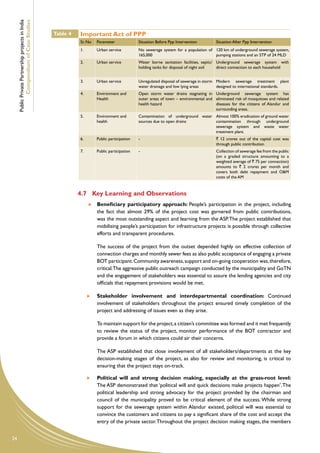
  • 7.
    Public Private Partnershipprojects in India Compendium of Case Studies Two of Case Studies Snapshot The following table provides a snapshot of the fifteen case studies. Sector Ppp project State and Government / Private sector Project Concession structure year ppp public sector promoter cost period contract entity / entities / sponsor / signed consortium members 1. Alandur Underground Sewerage Project Sewerage Construction Tamil Nadu Alandur IVRCL ` 34.6 crore O&M Contract Contract 2000 Municipality and the Infrastructures and (Sewerage – 5 years (Underground Tamil Nadu Urban Projects Ltd and Network) Sewage System) Infrastructure Va Tech Wabag BOT Annuity – Financial Services Technologies Ltd. ` 6.68 crore 14 years O&M Contract Limited (TNUIFSL) (Underground (Sewage Sewerage System) Treatment Plant) Build-Operate- Transfer (BOT) Annuity (Sewage Treatment Plant) 2. Karnataka Urban Water Supply Improvement Urban Water Operations & Karnataka Karnataka Urban Veolia Water ` 32 crore 42 months Supply Management 2005 Infrastructure (formerly known as (Later Contract Development Compagnie Generale extended to 59 and Finance des Eaux, France) months) Corporation (KUIDFC) 3. Latur Water Supply Project Water Supply Operations & Maharashtra Maharashtra Subhash Projects & ` 182 crore 10 years Management 2006 Jeevan Pradhikaran Marketing Limited, (including Contract UPL Environmental payment Engineers Limited to MJP for and Hydro Comp right to use Enterprises India assets) Private Limited. 4. Salt Lake Water Supply and Sewage Disposal System Water & BOT West Bengal Kolkata Jamshedpur Utilities `70.09 crore 30 years Sewage (includes Design 2007 Metropolitan and Services and Finance) Development Company Limited Authority and and Voltas Limited Naba Diganta Industrial Township Authority 5.Timarpur Okhla Integrated Municipal Solid Waste Management Project Urban BOOT (includes Delhi New Delhi Jindal Urban ` 200 crore 25 years Infrastructure Design and Finance) 2008 Municipal Infrastructure - Municipal Corporation Limited Solid Waste (NDMC) and Municipal Corporation of Delhi (MCD) 2
  • 8.
    Sector Ppp project State and Government / Private sector Project Concession structure year ppp public sector promoter cost period contract entity / entities / sponsor / signed consortium members 6.Vadodara Halol Toll Road Roads BOOT) (includes Gujarat Government of Government of ` 161 crore 30 years Design and Finance) 1998 Gujarat Gujarat and IL&FS 7.Tuni Anakapalli Annuity Road Project Roads BOT Annuity Andhra National Highways GMR Group, United ` 315 crore (includes Design Pradesh Authority of India Engineers Malaysia and Finance) 2001 (UEM) Berhad Group 8. Delhi Gurgaon Expressway Roads – BOT Delhi and National Highways DS Constructions ` 1,175 20 years Expressways (includes Design Haryana Authority of India and Jaiprakash crore and Finance) 2002 Industries 9. Nhava Sheva International Container Terminal Ports (Major) BOT (includes Maharashtra Jawaharlal Nehru P&O Australia ` 733 crore 30 years Design and Finance) 1997 Port Trust Ports Pty Limited, Konsortium Perkapalan Berhad and Trans Impex Private Limited (P&O Ports subsequently taken over by Dubai Ports World Limited (DP World)) 10. Kakinada Deep Water Port Ports (Minor) BOT Andhra Government of Larsen & Toubro Ltd, ` 330 crore 20 years (includes sharing of Pradesh Andhra Pradesh India, Stevedoring (4th Berth (extendable by revenue with Govt) 1999 Services of America, including l 2 periods of 5 USA, Precious offshore years each) Shipping Company, jetty) Thailand, Konsortium Later extended Perkaplan Berhard, to 30 years Malaysia (extendable by 2 periods of 10 years each) 11. Gangavaram Port Ports (Minor) BOOT (includes Andhra Government of Mr. D.V.S. Raju & ` 1,696 30 years Design and Finance) Pradesh Andhra Pradesh associates, Warburg crore (extendable 2004 Pincus and the by additional 2 Andhra Pradesh periods of 10 Infrastructure years each) Investment Company (APIIC) 12. Mumbai Metro Urban BOOT (includes Maharashtra Mumbai Reliance Energy ` 2,356 35 years Infrastructure Design and Finance) 2007 Metropolitan Limited,Veolia crore – Mass Rapid Region Transport (France) Transport Development and MMRDA Authority (MMRDA) 13. Hyderabad Metro Urban BOT Andhra Government of Maytas ` 11,814 35 years Infrastructure (includes Design Pradesh Andhra Pradesh Infrastructure, crore – Mass Rapid and Finance) 2008 Government of Transport (Subsequently Andhra Pradesh, cancelled in Nav Bharat Ventures, 2009) IL&FS and Ital-Thai (Subsequently cancelled in 2009) 3
  • 9.
    Public Private Partnershipprojects in India Compendium of Case Studies Sector Ppp project State and Government / Private sector Project Concession structure year ppp public sector promoter cost period contract entity / entities / sponsor / signed consortium members 14. Bhiwandi Electricity Distribution Franchisee Electricity Operations & Maharashtra Maharashtra Torrent Power AEC ` 61 crore 10 years Distribution Management 2004 State Electricity Limited (TPAL) (MSEDCL) Contract Distribution (Franchisee) Company Limited ` 250 crore (TPAL) 15. Amritsar Inter-city Bus Terminal Urban BOT Punjab Department of Rohan Builders ` 21.34 11 years 5 Transport (includes Design 2004 Transportation (India) Pvt Ltd., crore months and Finance) (DoT), Rajdeep Buildcon Government of Pvt Ltd and Rajdeep Punjab Road Developers Pvt. Ltd. 4
  • 10.
    Three Key Learnings This sectionhighlights the key learnings from India’s experience in PPPs as witnessed in the detailed case studies of select infrastructure PPPs in India. The objective of these learnings is to identify the typical issues that PPPs in India experience, how they may be dealt with and what mistakes could be avoided by PPP practitioners. They identify ways to mitigate various risks experienced by PPP projects, thus improving the overall value for money for the government. This section may be read in conjunction with the detailed case studies for readers who may want to study the context of each issue in greater detail. 3.1 Summary of Learnings with referenced case examples The following table provides a summary of the learnings identifies and the case examples referred to. No. Learning Key risks addressed Ppp examples to be Ppp examples where emulated problems were encountered Project Preparation 1 Robust Traffic / Market Operations Risk, Time & - 1. Delhi Gurgaon Assessments Cost Overruns Risk Expressway 2. Gangavaram Port 2 Comprehensive Due Design Risk, Approvals 1. Timarpur Integrated 1. Vadodara Halol Toll Diligence Studies Risk, Time and Cost Solid Waste Road Overrun Risks, Policy Management Project Risk, Revenue Risk 3 Clarity in Determination Revenue Risk, 1. Latur Water Supply 1. Nhava Sheva Integrated of Tariffs Termination Risk Project Container Terminal Procurement 1 Robust & Simple Bid Default Risk, Termination - 1. Gangavaram Port Criteria Risk 2. Nhava Sheva Integrated Container Terminal 2 Dealing with Speculative Default Risk, Termination 1. Gangavaram Port 1. Hyderabad Metro Bids Risk 3 Importance of Lead Financing risk, Time and - 1. Hyderabad Metro Consortium Member cost overruns risks / Promoter of Concessionaire Development 1 Handling of Land Land acquisition risk, 1. Hyderabad Metro 1. Delhi Gurgaon acquisition Time and Cost Overruns Expressway Risks, Social Risk 2. Mumbai Metro 3. Gangavaram Port 2 Streamlining of Approvals Approvals risk, Time and 1. Alandur Sewerage 1. Delhi Gurgaon & Clearances cost Overruns risks Project Expressway 2. Karnataka Urban Water Supply Improvement Project 3 Well Defined Project Scope Change risk, Time - 1. Delhi Gurgaon Scope and cost Overruns risks Expressway 5
  • 11.
    Public Private Partnershipprojects in India Compendium of Case Studies No. Learning Key risks addressed Ppp examples to be Ppp examples where emulated problems were encountered 4 Environmentally and Social Risk, Environment 1. Vadodara Halol Toll - Socially responsive Risk, Land acquisition Road development framework risk, Social Risk, Time and 2. Timarpur Solid waste cost Overruns risks management project 5 Financing Innovations Financing Risk, Default 1. Tuni Anakapalli Road 1. Hyderabad Metro Risk, Performance Risk 2. Vadodara Halol Toll Road 3. Alandur Sewerage Project Operations 1 Favourable Operating Policy Risk, Revenue Risk 1. Amritsar Inter-city 1. Kakinada Deep Water Environment bus terminal Port 2. Latur Water Supply project 2 Need for Public support Time and Cost Overrun 1. Alandur Sewerage 1. Latur Water Supply Risks, Social Risk, Project Project Revenue Risk , Political 2. Kakinada Deep Water Risk Port 3 Strong political will Political Risk, Time and 1. Alandur Sewerage 1. Latur Water Supply Cost Overruns Risk , Project Project Revenue Risk, Social Risk 2. Bhiwandi Electricity Distribution Franchise 3. Salt Lake Water Supply project 4 Resolution of Issues Termination risk 1. Kakinada Deep Water - through Mutual Port Discussions 3.2 �Learnings across the PPP Process 3.2.1 �Project Preparation Robust Traffic / Market Assessments a. Realistic and robust traffic / market assessment studies are an important step in the project preparation stage for a PPP project. Such assessments ensure bids submitted by interested private entities are well informed and realistic and the overall capacity proposed for a project is optimum. They also ease the pressure during the operations phase since the operator is not exposed to very divergent demand and corresponding revenue risks. Examples of PPPs where problems were encountered In the Delhi Gurgaon Expressway project, NHAI relied on an outdated traffic study. Thus, the actual traffic volume grossly outnumbered the projections from the very beginning of commercial operations. In fact as soon as the expressway was opened to traffic, the unexpected high number of vehicles led to heavy queuing at the toll booths and delays in traversing the stretch. However, timely action and necessary measures by authorities and the Concessionaire improved conditions. Key Risks Triggered: Operation Risk Similarly, in the Gangavaram Port project, realistic traffic projections were not prepared thus leading to speculative bids. The government of Andhra Pradesh had to reject the bids and the process was launched again. This could have been avoided if robust traffic projections had been prepared and shared with the bidders. The launch of the bid process delayed the commencement of the port development. Key Risks Triggered:Time and Cost Overrun Risks 6
  • 12.
    Comprehensive Due DiligenceStudies The environment in which a project will be developed and will have to operate has an important bearing on the progress of PPPs. Due diligence studies – technical and legal are essential to ensure the smooth progress of a project through the project life-cycle. a. Examples of PPPs to be emulated The Timarpur Integrated solid waste management project showcases how efforts were made on project preparation prior to the launch of the bid process. Important steps such as detailed technical studies and reviews, financial evaluation, risk evaluation and obtaining regulatory as well as statutory approvals was undertaken at the project preparation stage itself. In fact, the SPV to implement the project was also incorporated prior to the launch of the bid. This ensured that the actual project development phase experienced as few hurdles as possible. Key Risks Managed Better: Design Risk, Approvals Risk,Time and Cost Overrun Risks b. Examples of PPPs where problems were encountered The Vadodara Halol Toll Road project highlights the fact that project due diligence needs to be robust since it can impact the long term objectives of a project. In this case, the traffic estimations for the project were based on the assumption that the industrial incentives available for the project area would continue over the long-term. However, the incentives were eventually withdrawn and the traffic was almost 50% lower than the projected traffic.This lapse with respect to the understanding of the legal environment in which the project had to operate and the resultant policy risk put undue pressure on the viability of the project operations. Key Risks Triggered: Policy Risk, Revenue Risk Clarity in Determination of Tariff The tariff is a key determinant of returns for the private entity. It is important to have a clear understanding of the tariff determination process and the same should be fair to enable the private operator to earn a reasonable return. Lack of clarity can result in potential disputes between the private and public entity. a. Examples of PPPs to be emulated In the Latur Water Supply project, tariff for the contract duration was finalised prior to the bidding process, to allow the bidders to quantify the tangible benefits from undertaking the project. The tariff structure was to see a staggered increase based on the contract terms. This reduced the revenue risk to an extent. Key Risks managed better: Revenue Risk b. Examples of PPPs where problems were encountered In the Nhava Sheva Integrated Container Terminal project, the lack of clarity in the concession agreement on whether the royalty payment was to be considered as a part of cost or a share in the profit in the SPV’s accounts while determining the port tariff, became a serious issue between the public and the private sector. Measures were adopted to address these inconsistencies but with limited success. Key Risks Triggered: Revenue Risk,Termination Risk 3.2.2 �Procurement Robust and Simple Bid Criteria Bid evaluation criteria need to be simple and robust so that capable entities are identified for the project and at the same time bids are not speculative. Speculative bids have the potential to 7
  • 13.
    Public Private Partnershipprojects in India Compendium of Case Studies derail a project during the operations stage if the private entity is unable to sustain its overstated commitments. Ambiguities in the bid criteria, on the other hand, can lead to disputes between the private and public entity during the operations stage. a. Examples of PPPs where problems were encountered In the Gangavaram port project, the first round of tendering had several evaluation parameters that were working at cross purposes and encouraged speculative bidding. The bid criteria gave separate weights for the Minimum Guaranteed Amount, revenue share and investment commitments. Thus larger commitments, even though unrealistic, could have lead to higher scores. While the government eventually decided to terminate the process, this could have resulted in an unsustainable project. Key Risks Triggered: Default Risk, Termination Risk (However since the bid process was terminated, these risks did not actually get triggered – Refer Learning 2.2.2) In the Nhave Sheva Integrated Container Terminal, the bid evaluation criterion of the highest NPV of royalty payment was simple but insufficient. The lack of a methodology to assess the royalty payout to the licensor and the problems arising from the interaction of the royalty with the tariff level created a number of issues in the subsequent operations phase. Key Risks Triggered: Default Risk,Termination Risk Dealing with Speculative Bids a. While speculative bids should ideally be avoided, if encountered, the public entity should deal with them without jeopardising the long term prospects of the project. This could even mean terminating and re-launching the bid process. Examples of PPPs to be emulated In the Gangavaram port project, the evaluation in the first round of bids revealed concerns regarding the validity and practicality of the market assumptions and the underlying viability of the projections. Both the bids had elements of speculation and presented an untenable proposition for the Government. This was due to the absence of a comprehensive feasibility study with realistic traffic projections which should have been undertaken by the government. (Refer learning 2.1.1) However, the Government did not get attracted by the speculative bids and decided to terminate the bid process. Key Risks Managed Better: Default Risk, Termination Risk b. Examples of PPPs where problems were encountered In the Hyderabad Metro project, the government provided commercial development rights for almost 296 acres of land allocated for the depots and the stations. This aggregated to a cumulative maximum of 18.5 million square feet and was a substantial percentage of the project cost. This opportunity of the utilization of land on a commercial basis coupled with the metro project led to widely divergent bids from the bidders. While the Siemens Consortium bid a negative viability gap of ` 250 crore, the Maytas Consortium bid a very high a negative viability gap of ` 30,311 crore. On the other hand, the two other bidders--Reliance sought a VGF grant of ` 2,811 crore from the government and Essar sought a grant of ` 3,100 crore. While the award of this project to Maytas was eventually withdrawn, such speculative bids exposed the project to the risk of the actual construction and quality of the metro being compromised as the private operator would have had a greater incentive to complete the real estate development at the cost of the metro. Key Risks Triggered: Default Risk,Termination Risk 8
  • 14.
    Importance of LeadConsortium Member / Promoter of Concessionaire The concessionaire’s ability to undertake complex projects is typically a function of the experience and expertise brought on board by their lead consortium member or promoter. Accordingly, it is essential that there is adequate due diligence of the promoter backing the concessionaire and the continued involvement of the lead member is contractually ensured, at least during the project development stage. a. Examples of PPPs where problems were encountered The Hyderabad Metro project saw the winning consortium of Maytas Metro getting adversely affected due to the issues besetting its promoter – Satyam Computer Services. Although the project was to be implemented by a separate Special Purpose Vehicle, there was a loss of investor confidence in the promoters of the project and consequently, the project was not able to achieve financial closure. The government finally had to withdraw its award and re-launch the bid process. Key Risks Triggered: Financing risk, Time and cost overruns risks 3.2.3 �Development Handling of Land Acquisition a. The land acquisition process for PPP projects is no doubt the most challenging pre- development activity in India. In most cases, the government commits provision of land free from encumbrances for the project before actually completing the necessary formalities. Examples of PPPs to be emulated While many readers may associate the bankruptcy of its promoters (Satyam) with the Hyderabad Metro project, a lesser known fact is the commendable manner in which the government dealt with land acquisition in the concession agreement. It required the government to handover land to the concessionaire by the financial closure date. Further, 90% of the land had to be handed-over within 120 days from signing of the agreement. There were penalties built in to the contract in case the government delayed the delivery of the land. Such contractual treatment would have ensured greater planning and focussed efforts on land acquisition by the government. Further to mitigate this risk, the project intended to use government lands for the developments of depots and stations to the extent possible. Key Risks managed better: Land acquisition Risk,Time and Cost Overruns Risks b. Examples of PPPs where problems were encountered In the Delhi Gurgaon expressway project, the government committed to the promoters for providing a substantial area of land, prior to actually acquiring the land. Due to the thickly populated surrounding areas of the expressway, there were certain pockets of land that were difficult to acquire. This exposed the government to the risk of not providing the land within reasonable time impacting the overall schedule of the project. It would have been better if uncontrollable risks such as these were addressed before the project procurement stage itself to ensure smooth functioning of the project. This could have been achieved by completing the land acquisition process prior to the project procurement process itself. Key Risks Triggered: Land acquisition risk,Time and Cost Overruns Risks Similarly for the Mumbai Metro, the government committed that the land for the project would be procured as per the land procurement schedule provided in the agreement. However, this land was under private ownership and at times under dispute. This exposed the government to the risk of land not being available thereby resulting in inordinate delays in commencement of construction of the project. While this issue was eventually resolved, it would have been a better option for the government to have dealt with it prior to signing of the concession agreement. 9
  • 15.
    Public Private Partnershipprojects in India Compendium of Case Studies Key Risks Triggered: Land acquisition risk,Time and Cost Overruns Risks The Gangavaram port project was another case in point where the land acquisition process was prolonged due to local protests in relation to rehabilitation and resettlement. Key Risks Triggered: Land acquisition risk,Time and Cost Overruns Risks, Social Risk Streamlining of Approvals & Clearances Apart from land acquisition, obtaining numerous clearances and approvals has been the bane of Indian PPP projects. Typically, the concessionaire needs to obtain clearances from multiple government departments and apprise different departments about the progress of a project. These delays add to the cost of developing the PPP and thereby reduce the value for money to the public sector. Ideally a single interface for interactions or coordination on all such approvals should be setup by the government to prevent undue delays. This could be in the form of a lead entity taking up the responsibility or a common project steering/ empowered committee that is appointed to take care of all such formalities. With this, the concessionaire could focus on the core development issues rather than being entangled in administrative processes. a. Examples of PPPs to be emulate The Alandur Sewerage Project had a streamlined process for obtaining approvals and clearances related to the project. The Alandur Municipality took up the responsibility for key approvals, including road cutting, shifting of services and environmental clearances. The developer was responsible only of the ‘works’ related approvals. This approach ensured there was minimum delay in obtaining the necessary permits. Key Risks Managed Better: Approvals risk,Time and cost Overruns risks b. Examples of PPPs where problems were encountered The Delhi Gurgaon expressway project is a case in point where the approvals process resulted in significant delays for the concessionaire. Since the project was spread across the states of Delhi and Haryana, there were more than fifteen government agencies/civic bodies affected by the development of this highway that had to grant approvals for the project. This became a complex and time consuming process during the construction period. Key Risks Triggered: Approvals risk,Time and cost Overruns risks On similar lines, the Karnataka Urban Water Supply Improvement project, experienced delays in obtaining permits from several departments due to the lack of co-ordination across the three Urban Local Bodies involved in the project. Key Risks Triggered: Approvals risk,Time and cost Overruns risks Well Defined Scope of Work It is essential that the concessionaire’s scope of work is well defined, prior to the launch of the bid process and the same is not modified except in the case of unavoidable and unforeseen circumstances. Changes in scope of work, which typically result in time and cost overruns, have the potential to derail PPP projects. a. Examples of PPPs where problems were encountered The Delhi Gurgaon expressway experienced significant time and cost overruns on account of a change in the concessionaire’s scope of work. There were substantial changes in the original design that were sought by NHAI and the government keeping in mind future requirements and the convenience of commuters. While these should have been anticipated and incorporated 10
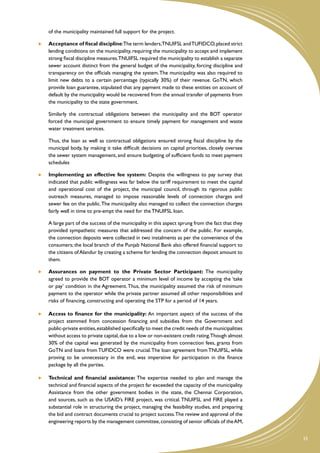
  • 16.
    prior to thelaunch of the bid process, the order for provisional change of scope was finalised and issued to the concessionaire just days before the original scheduled completion date of the project. Key Risks Triggered: Scope Change risk,Time and cost Overruns risks Environmentally and Socially responsive development framework Infrastructure projects typically have significant social and environmental impacts, arising from their construction and operation. Social impacts are on the communities affected by the project and environmental impacts are on account of the project location. It is therefore necessary that PPPs have an environmentally and socially responsive development framework. While social and environment impact assessments are mandatory, there are few examples of how projects have proactively adopted best practices in this regard. An environmentally and socially responsive framework would in fact help garner public support for a PPP project more easily (Refer Learning 2.4.2) and have a positive impact on the land acquisition process. (Refer Learning 2.3.1) a. Examples of PPPs to be emulated The Vadodara Halol Toll Road was the first project that introduced environmental and social safeguards measures as part of the contractual obligation of the concessionaire. The environmental and social assessment for the project noted that the project in its original form would lead to resettlement and rehabilitation of about 300 project affected families. Intense public consultations were carried out to develop various alternatives. Bypasses were introduced at various critical locations such that the extent of resettlement was reduced to only 10 project affected households. This created a benchmark and had immense demonstration value since it highlighted that infrastructure can be developed in an environmentally and socially responsible manner. The project was in fact designated by the World Bank as a 'best practice' example for its environment risk mitigation and social rehabilitation plan in India amongst World Bank assisted projects. Key Risks Managed Better: Land acquisition risk, Social Risk,Time and cost Overruns risks In another case, the Timarpur solid waste management project, that was located in the vicinity of residential areas, organised public hearings to address concerns with respect to pollution. Key Risks Managed Better: Social Risk, Environment risk Financing Innovations While the government of India has provided financial support initiatives such as the Viability Gap funding (VGF) scheme or the Jawaharlal Nehru Nation Urban Renewal Mission, it is important for PPP projects to be financially independent to the extent possible and minimise reliance on such grants or schemes. This is possible through innovative financing structures that not only bring down the cost of funds but also tap new sources of funding. However, a fine balance needs to be maintained to ensure that such innovations in financing do not result in speculative bids during the procurement stage. a. Examples of PPPs to be emulated The concessionaire for the Tuni Anakapalli Road project, during its operations stage, raised debt at very low interest rates by securitizing the annuity payments receivable from NHAI. This mode of funding enabled the concessionaire to repay the term loan taken for the project development by accessing to relatively lower cost funding. Key Risks Managed Better: Default Risk, Performance Risk 11
  • 17.
    Public Private Partnershipprojects in India Compendium of Case Studies The Vadodara Halol Toll Road was another project that utilized several financing methods such as deep discount bonds with an option of take-out financing, cumulative convertible preference shares and long term loans as a part of its financing structure. Key Risks Managed Better: Financing risk The public deposits sought in the Alandur Sewerage Project, were also a landmark innovation that were taken up despite the possibility of strong resistance from the people. Almost 29% of the project cost was funded from public contributions. Key Risks Managed Better: Financing risk b. Examples of PPPs where problems were encountered In the Hyderabad Metro project, the government provided commercial development rights for almost 296 acres of land to the Concessionaire which aggregated to a cumulative maximum of 18.5 million square feet of built-up space. This opportunity of the utilization of land on a commercial basis coupled with the metro project led to widely divergent bids from the bidders. While the Siemens Consortium bid a negative viability gap of ` 250 crore, the Maytas Consortium bid a very high a negative viability gap of ` 30,311 crore. On the other hand, the two other bidders--Reliance sought a VGF grant of ` 2,811 crore from the government and Essar sought a grant of ` 3,100 crore. The real estate market is very volatile and cyclical in nature. An adverse outlook for the sector would have the risk of compromising the development and construction of the project. Thus, ideally real estate development should be a smaller component of the project or alternatively should be separated from the core infrastructure project. Key Risks Triggered: Default risk, Performance Risk 3.2.4 �Operations Favourable Operating Environment PPP projects require the private sector to operate in a space where traditionally the public sector is dominant and in some cases solely responsible. In this context, it is important for an enabling operating environment to be created for the private sector to function optimally. a. Examples of PPPs to be emulated In the Amritsar Inter-state Bus Terminal project, the government took the necessary steps to create a favourable environment so that the concessionaire’s revenue streams are not at risk. The government issued notifications to the effect that all intercity buses would be required to pickup and drop off passengers at the new Inter City Bus Terminal. Key Risks Managed Better: Revenue Risk Similarly, in the Latur water supply project, a clearly defined tariff and metering policy was established, prior to the bidding process, to allow the bidders to quantify the tangible benefits from undertaking the project. Key Risks Managed Better: Policy risk, Revenue Risk b. Examples of PPPs where problems were encountered The drawbacks of not clearly establishing an operations policy were experienced by the Kakinada Deep Water Port project. In this case, during the tendering stage, the government had indicated that the private developer would get complete rights while operating the port. However, during the award of the project, there were restrictions on the type of cargo to be 12
  • 18.
    handled, in favourof the Kakinada anchorage port that was operating in parallel. This ended up becoming one of the key issues under dispute between the concessionaire and the Government of Andhra Pradesh. Key Risks Triggered: Revenue Risk Need for Public Support a. Effective communication of project benefits to various stakeholders and mobilising public support is one of the key lessons to be drawn from India’s PPP experience to date. Absence of a buy-in from the people at large can lead to significant hurdles in various stages of a project such as during land acquisition because of the displacement of people, or during project operations due resistance to collection of revenues in the form of toll, charges or tariffs. Public support is thus critical for project siting decisions. Examples of PPPs to be emulated The Alandur Sewerage project is a prime example where stakeholder support went a step further and included public contributions towards the project cost. An aggressive public outreach campaign was conducted by the municipality and Government of Tamil Nadu and the engagement of stakeholders was essential to convince them about the benefits of the project. Key Risks Managed Better:Time and Cost Overrun Risks, Social Risk, Revenue Risk b. Examples of PPPs where problems were encountered In the Latur water supply project, public consultations were taken-up by the Maharashtra Jeevan Pradhikaran only after the signing of the agreements with the concessionaire. Accordingly the project met with resistance in the form of agitation campaigns and public rallies resulting in even the closing down of the concessionaire’s office in Latur. As a consequence of the lack of public support, the transfer of project assets to the concessionaire has been delayed even though the agreement was signed in June 2008. Key Risks Triggered:Time and Cost Overruns Risks, Social Risk, Political Risk Similarly in the Kakinada deep water port project, labourers of the adjoining anchorage port went on strike in protest of the competition from the deep water port in handling agricultural commodities such as wheat. Stakeholder consultations could have avoided this situation. Key Risks Triggered: Revenue Risk, Social Risk, Political Risk Strong political will While public support is no doubt a must for PPP projects, strong political will to make a project happen, is equally important. Large path-breaking projects require active hand--holding from the government throughout the project planning and execution stages. a. Examples of PPPs to be emulated The Alandur Sewerage Project demonstrated the benefit of such sustained political will which ensured that the project proceeded smoothly. The chairman and the council of the local municipality played an important role in convincing the citizens to pay a share of the project cost and accept the entry of the private concessionaire. Key Risks Managed Better: Political Risk, Social Risk The Bhiwandi electricity distribution franchisee project is another example where strong political conviction enabled the implementation of a new PPP structure in amongst the most challenging regions in Maharashtra. Key Risks Managed Better: Political Risk 13
  • 19.
    Public Private Partnershipprojects in India Compendium of Case Studies Similarly in the Salt Lake water supply and sewerage network project, the Kolkata Municipal Development Authority and the Nabadiganta Industrial Township Authority played a critical role in providing key concessions to the private developer to arrive at a rational water cum sewerage charge. Key Risks Managed Better: Revenue Risk b. Examples of PPPs where problems were encountered The Latur water supply project witnessed significant hurdles due to the lack of political consensus on the project. Although the management contract between the Maharashtra Jeevan Pradhikaran and the private operator was signed in June 2008, the transfer of assets was delayed, preventing the private operator from commencing its project obligations as per schedule. Key Risks Triggered: Political Risk,Time and Cost Overruns risks Resolution of Issues through Mutual Discussions PPP Projects, being complex with long concession periods, there is a likelihood of issues cropping up from time to time between the government and the public agency. While contracts typically specify the formal mechanism to deal with such issues, it is at times through mutual discussions carried out in good faith that solutions can be identified that are in the best interests of both parties. a. Examples of PPPs to be emulated The Kakinada Project is a case in point where key amendments with respect to revenue sharing, the concession period and rights for undertaking additional developments were made in the terms of the concession agreement through mutual discussions and negotiations. This ensured the continuity of the project. Key Risks managed better:Termination risk 14
  • 20.
    Four 1: Case Study AlandurSewerage Project 4.1 Project Description The Alandur Sewerage Project (ASP) was initiated in the year 1996 by the Chairman of the Alandur Municipality (AM). AM, located adjacent to Chennai, forms a part of the Chennai Metropolitan Area. With a population of around 165,000, the municipality is a residential suburb of Chennai with predominantly residential and commercial activities. Approximately one-fourth of its population lives in slums. Prior to 1996, the town did not have an underground sewerage system and all sewage was managed with individual septic tanks. The largely unregulated disposal of sewage in storm water drains was an environmental and health concern for the local residents and was frequently raised as a political issue.Around 98% of 19,800 households used either septic tanks or holding tanks collected periodically by tankers and disposed in the low-lying areas outside the municipal limits. In 1996, AM announced an ambitious plan to construct an underground sewerage system and waste water treatment facility with the participation of the private sector, contribution from the public, and payment to be provided by the city. The proposal was ‘transformational’ as it involved a service never before made available by the municipality, with financial and management responsibilities being shared by the municipality, the residents, the private sector, and state government bodies. The ASP was designed with the following objectives:  To improve the standard of living of the residents of Alandur (on par with that of Chennai);  To provide the most essential basic facility to all the residents of the town;  To eradicate the mosquito menace;  To avoid the recurring expenditure on septic tank cleaning; and  To avoid ground water contamination. The proposed sewerage system was to be designed for the estimated population of about 300,000 in 2027 and was planned to be completed within a five-year period from its inception date. The project components included:  A sewerage network consisting of the main sewer line, branch sewer line and manholes; Construction of a sewage pumping station; A sewage treatment plant; and Low cost sanitation In the initial phase the plant was to treat 12 million litres per day (mld) of sewage supplied to it by the municipality. The ultimate capacity was to be 24 mld. To plan this complex and politically challenging project, the AM worked in partnership with the Tamil Nadu Urban Infrastructure Financial Services Limited (TNUIFSL), the state asset management company and with USAID’s Financial Institution Reform and Expansion (FIRE) Project. 15
  • 21.
    Public Private Partnershipprojects in India Compendium of Case Studies 4.2 PPP structure of the Project The ASP was the first project in the municipal water sector to be taken through the Public Private Partnership route in India. The construction of the underground sewerage system in Alandur town, involving the laying of pipes, construction of pumping station, etc., was done on a BOQ (Bill of Quantities) basis, and the sewerage treatment plant (STP) on a BOT (Build, Operate and Transfer) basis. Besides the construction responsibility, the contractor was also required to undertake the operation and maintenance of the sewerage system for a period of five years from the date of completion of the construction, on a fixed fee basis. The collection of tariff and provision of new connections during the O&M phase was to be undertaken by the municipality directly. Accordingly, the PPP structure of this complex project was governed by three contracting mechanisms awarded to one engineering, procurement, and construction (EPC) contractor selected through a competitive bidding process: A Works Contract for construction of the sewage network, using the World Bank’s Contract for National Competitive Bidding (NCB-W2) as the template; An Operations and Management Contract, also using NCB-W2. The selected contractor would operate and maintain the underground sewerage system for a period of five years on a fixed fee basis. A Lease Contract (in the nature of a BOT Agreement) for the STP, using guidelines from the International Federation of Consulting Engineers (FIDIC). Through this Agreement, the contractor would finance, build and operate the STP for a period as proposed in the contractor’s successful bid. The contractor would be required to recover the investment on the STP on the basis of a per unit rate payment from the municipality for treatment of sewage delivered. The municipality agreed to provide a minimum payment level per annum regardless of the volume of sewage actually delivered. It was designed to cover the company's minimum fixed operating cost and capital investment. Accordingly, the PPP structure was technically in the nature of BOT-Annuity. Following the bid process, the project was awarded to IVRCL Infrastructures and Projects Ltd in technical collaboration with Va Tech Wabag Technologies Ltd. A Special Project vehicle (SPV) called ‘First Sewerage Treatment Plant Pvt Ltd’ (First STP) was incorporated and was the concessionaire company with whom the BOT Agreement was signed. Once the project achieved financial closure, First STP Pvt. Ltd signed contracts with IVRCL and Va Tech Wabag. IVRCL was to carry out the civil works for the project. Va Tech Wabag, through the electro mechanical contract, was to design the process, supply, install and commission the equipment. It was also to carry out a contract for operating and maintaining the facility for 14 years. The land on which the plant was set up was leased by the municipality to First STP. 4.3 Current Status As per the Agreement the date of completion was 31st March 2003. By end 2001, the laying of the sewer pipes and main sewers was completed, as also the construction of the Pumping Station, Pumping Mains and the Sewerage Treatment Plant. The overall date of completion was October 2003. Of the 23,000 households who paid for the services, 8,350 households were connected in the first phase, i.e. by 2005. Nearly 500 slum households out of 7,000 had sewerage connections, and 43% of slum dwellers had opted for and paid for individual sewerage connections. By 2010, of the 30,600 households who paid for the services, 29,300 households were connected; 14 community toilets were constructed to serve poor clusters. The management contract for the operations and management of the sewerage system expired in 2005, after the stipulated contract period of 5 years. Following this the operations and management function has reverted to the municipality. The AM is currently in the process of sourcing an O&M manager for the operations of the sewerage system. 16
  • 22.
    The STP Agreementwill terminate in the year 2019. 4.4 Financing Information Initially, the cost of the project was estimated to be ` 45.31 crore, which was later revised to ` 40.86 crore. To finance the municipality’s portion of the capital cost, a package of loans and grants was structured as shown in the table 1. All loans were from domestic sources and denominated in Indian rupees. A unique aspect of the project funding was the initiative of bringing in people’s money to fund public infrastructure by generating public awareness and interest right from inception. Financing Information Table: 1 Source Amount (` crores ) Grant from TNUIFSL 3.00 Loan from TNUIFSL 6.00 Loan from TUFIDCO 16.00 Grant from TUFIDCO 1.00 Deposits from public 12.40 Interest from deposits 2.46 Total 40.86 Source: Alandur Municipality Loans The majority of financing to the municipality (59%) was made through loans provided by the Tamil Nadu Urban Infrastructure Development Corporation (TUFIDCO) and TNUIFSL. The loan provided by TUFIDCO was payable over eight years (after a two-year moratorium) at an interest rate of 5% per annum (as against prevailing market rates of 15% at that time). TNUIFSL’s loan was set at a rate of 16% per annum payable over a period of 15 years with a five year moratorium. The term loan conditions resulted in the municipality assuming significant financial risks. One condition of the TNUIFSL’s loan was that the disbursements would be provided for three years, after which they would be subject to the condition that the municipality meets its connection targets. Should targets not be achieved, further disbursements would be terminated. Interestingly, no funds were required to be disbursed under the TNUIFSL loan as the revenues generated from the one-time connection fee exceeded the amount anticipated when the finance package was structured. Both the term lenders stipulated an escrow account, to the extent of the debt finance, where all the revenue receipts of the municipality (including property tax, stamp duty, and the grant from GoTN) as well as the sewer tariff was to be deposited in favour of TNUIFSL and TUFIDCO. The municipality also accepted limits imposed on future indebtedness. Grants As no funds were available either with the municipality or with TNUIFSL to oversee and monitor the progress of the project,TUFIDCO provided a special grant from the Tamil Nadu urban development grant fund for this purpose, which worked out to nearly three per cent of the total project cost. GoTN agreed in principle to bridge the gap in the sewer account during the life of the project, after providing for operations and maintenance (O&M) expenses, debt servicing and contribution to the sinking fund. In addition to the above, GoTN also agreed to fund the monthly operating costs of the system above the ` 150 per household sewer charge to a maximum of ` 30 per connection per month. 17
  • 23.
    Public Private Partnershipprojects in India Compendium of Case Studies Public Contribution On the basis of a financial analysis of the project, the AM decided to collect one-time deposits in the form of connection charges from the citizens of Alandur. The connection charges for different categories of users were fixed as follows: Table: 2 Connection Charges Category of Users Amount (In `) Domestic 5000 per house connection Commercial 10000 per connection Industrial 10000 per connection The municipality targeted to provide about 22,000 connections both for domestic and non-domestic categories of users by the end of 2004-2005. This would yield an estimated income of nearly ` 13 crore, which it proposed to put into a revolving fund for repayment of loans to the lenders. As the above connection charges on sewer were considered to be very high especially for domestic consumers, the GoTN, in consultation with TNIUFSL, suggested to the authorities of the AM to collect the connection deposits in two instalments. The local branch of the Punjab National Bank also offered financial support to the citizens of Alandur by creating a scheme for lending the connection deposit amount to them. However as the rate of interest on the scheme was quite high (14.1 %), it was reported that no one had availed this facility. In addition to the above, it was also decided by the municipality to collect the sewer maintenance charges at the rate of ` 150 per month per connection from the domestic users, ` 450 per month per connection from commercial users and ` 750 per month from industrial users. The domestic monthly charges were proposed to be increased to 6% annually till they reached a level of ` 180 per month. Similarly, the commercial and industrial maintenance charges were proposed to be increased by 6% annually up to the level of ` 540 and ` 900 respectively. These limits were later reduced on the basis of a willingness to pay (WTP) survey, and discussions with the citizens and officials concerned. 4.5 Process Analysis Inception: In 1996, the Chairman of the Alandur Municipality initiated the proposal of implementing an underground sewerage system in the Municipality of Alandur. This was because the present sewerage system and sanitation facilities presented major health threats to the citizens and created serious underground contamination. Soon after, in 1997, the Government of Tamil Nadu decided to provide a sewerage system in 12 selected major urban centres, including Alandur, under the aegis of the World Bank, which was the leading financial institution facilitating state level reforms in urban infrastructure financing in Tamil Nadu. PPP Project Preparation: As the first step, TNUIFSL, the state asset management company formed with the objective for improving the urban infrastructure levels in the state, was nominated as the agency to coordinate the investigation and detailed studies, and to structure the project. TNUIFSL procured and managed a private engineering contractor to prepare the detailed technical design and prepare engineering reports for the Alandur project. The scope of work included project design, identification of the locations of pumping stations and the treatment plant, and cost estimates. While conducting the feasibility study on the project, a ‘Willingness to Pay’ (WTP) survey was also conducted by the consultants in order to assess the scheme’s acceptability by the citizens of Alandur town, and their willingness to pay for the service. The WTP survey 18
  • 24.
    covered more than10 per cent of the population of the AM, spread over to 42 wards. It indicated that the average household income of the majority of the people was in the range of ` 1000-5000 per month.According to the survey, although the public strongly supported the project and accepted that users should pay for sewage services, this willingness had its limits. About 29% of the respondents were willing to pay a one-time connection fee lower than ` 500 per household and 21% were open to paying a one-time connection fee more than ` 2000 per household. Further, about 86% of the respondents were willing to pay monthly sewer charges in the range of ` 21 to ` 50 per month, comparable to the existing water charges structure. GoTN accorded administrative sanctions to the project on 9 December 1998 and technical sanction on 27 January 1999. As part of the project preparation, land for the project was identified and proposed to be acquired through the Alandur Municipality. Public Participation: The ASP project is a unique case of public participation in financing of a municipal infrastructure project. The collection of sewer charges and convincing the community to pay for it was a difficult and challenging task. Since there had been no precedence of private participation in municipal water and sanitation services in the state, or a BOT Agreement awarded anywhere in India, public outreach was critical to overcome initial resistance as well as public concerns about the need to pay for the new sewage services. To gain acceptance and build consensus among the public, the municipality mounted a vigorous public outreach/public participation campaign with extensive media coverage to explain the projects benefits, costs, and tariff system. The municipality adopted the following procedures: A detailed discussion was held among the officers and staff along with the Chairman about the sewerage project. All the holidays including Saturdays and Sundays were used for discussion with the residents’ welfare associations. During the discussions, the scheme was explained in detail: its advantages on the city environment and quality of life of the residents of Alandur. Residents were motivated through corner meetings and advertisements on the public transport system such as auto rickshaw, buses; cable network; local newspapers; distribution of pamphlets, etc. In addition, all the staff including sanitary workers earnestly carried out door-to-door canvassing of the benefits of the underground sewerage scheme. Although, initially a sizeable population of the town was not ready to pay the high deposits on account of sewerage connection charges and monthly tariff (as indicated through the survey), later through active canvassing and educating the people on the benefits of the project they agreed to pay the sewer charges as per the municipal tariff structure. By the end of May 2000, more than 13,000 connection seekers (domestic and non- domestic) had deposited the one time connection fee to the municipality. In order to assess the commitment of the citizens of Alandur to the proposed sewerage scheme, the lending institutions, including TNUDF and TNUIFSL, had stipulated that the municipality should collect deposits from at least 10,000 residents before the award of work to the selected contractor.This would not only confirm effective public participation in the project but would also provide positive signals to the lending institutions on the sustainability of the project as also recovery of their investments. Accordingly, the municipality started collecting one-time deposits from the residents, and completed the target before awarding the contract for the project to the selected contractor. In order to facilitate the collection procedure, the municipality opened collection centres at different locations keeping in view the convenience of the residents. Arrangements were made for collection of deposits even on the receipt of phone messages and at the designated bank. 19
  • 25.
    Public Private Partnershipprojects in India Compendium of Case Studies With a view to inform the public on the progress of the project at various stages, as also to seek their opinion on different issues concerning the successful implementation of the project, the authorities of the AM called for the meeting of representatives of welfare associations on a monthly basis. This procedure created a system of effective participation of the community in the project implementation process. Procurement: The project was structured such that an engineering, procurement and construction contractor, selected through competitive bidding process, would design and implement the sewerage system, on turnkey works contract, and would also finance, design, build, and operate the STP on BOT (Annuity) basis. The procurement of private contractor for the execution of the project was carried out as per the standards prescribed by the World Bank. A two stage bid process was adopted - a technical proposal followed by a financial proposal. The technical capabilities of the contractors and their experience in similar works were given importance. Of the 13 entities who submitted the bids, three were short-listed, and the financial proposals were received from such technically qualified firms.As per the financial evaluation criteria, the bidder quoting the lowest cost for the sewerage system and lowest lease period for the STP was selected as the final, successful contractor. Based on the evaluation of the proposals and on the recommendations of TNUIFSL, the project was awarded to the IVRCL Infrastructures & Projects Limited, in joint venture with Va Tech Wabag Technologies Limited in February 2000, and the site was handed over to them subsequently. The contract document signed on 2 March 2000 was in three parts and included (i) a construction contract, (ii) and operation and maintenance contract; and (iii) a Lease Contract for the sewage treatment plant. Implementation: As per the Agreement, the expected date of completion was 31st March, 2005. In order to ensure timely implementation of the project and adherence to quality specifications, Consulting Engineering Services Limited (CESL) was appointed as Project Management Consultants for the detailed supervision and quality control. Along with the consultants, the Chairman, Commissioner and Engineer of the AM reviewed the progress of the project on a weekly basis.The Commissioner of Municipal Administration, GoTN, the Secretary of the Municipal Administration & Water Supply and the Chief Executive of TNUIFSL also reviewed the progress of the project every month, and provided administrative support for acquiring the necessary clearances from agencies such as the railways, highway authority, PWD, etc. Delivery: The project work was carried out in two phases. In the first phase (the first two and a half years), 50% of the branch sewers, main sewers, pump house including installation of machinery, pumping main and one 12 MLD capacity sewage treatment plant, were completed and commissioned. The remaining work relating to the project was to be carried out in the next phase. By end 2001, the laying of the sewer pipes and main sewers was completed, as also the construction of the Pumping Station, Pumping Mains and Sewerage Treatment Plant.The overall date of completion was October 2003. With respect to funding, by March 2001, approximately ` 9.16 crores was received from TUFIDCO in the form of grants and a loan and more than ` 6.84 crores was generated as a one-time sewer connection charge from about 13,434 households. 20
  • 26.
    Exit: The management contractfor the operations and management of the sewerage system expired in 2005, after the stipulated contract period of 5 years. Following this the operations and management function has reverted to the municipality. It is understood that the AM is currently in the process of sourcing an O&M manager for the operations of the sewerage system. The STP Agreement will terminate in the year 2019 at the end of the stipulated lease period of 14 years at which time the STP will be transferred to the AM free of cost. The defect liability period, however, will extend for one year beyond the expiry of the STP lease period. It is understood that the STP Agreement has worked well with no penalties being imposed during the contract and no significant lapses in obligations, till date. There has been only one issue that arose at the beginning of the Agreement and is currently in the process of being resolved, through arbitration. The issue concerned the date of commencement of the Sewerage System and payment due for the first six months from AM to the Private Developer. The reason for this was the obtaining of the approval from the Pollution Control Board (PCB) - apparently the period for which operations were performed and payment claimed from the AM did not have the PCB approval in place. It is understood that AM has been cooperative in this matter and has no objection to making the payment – however, approval from the government for making the payment is under process. Risk Allocation Framework Table 3 Risk Type Sensitivity Risk Period Primary Risk Comments Bearer Land acquisition High - Government AM took the responsibility for directly acquiring the land for the construction of the STP. Delay in obtaining High 0-3 months AM, Private The AM took responsibility under the permits developer Contract for key approvals, including road cutting, shifting of services and environmental clearances. The developer was responsible only of the ‘works’ related approvals. Design Risk High Private developer Design for the Sewerage System as well as the STP was developed by the AM as part of the feasibility study. The same was provided to the developer as part of the RFP document. The Bidder had the option to comment on the design provided and suggest changes, if any. However, after the submission of bids, the Contractor was required to adhere to the design provided by the AM. Construction Risk High 0-2 years Private developer The Construction Contract for the underground Sewerage System specified strict construction milestones linked to the payment along with a one year defect liability period to address any construction related risk. Liquidated damages were prescribed in the contract for every day of delay limited to 10% of contact price. In respect of the STP, the construction risk was borne by the Developer as the investment was made by him. The STP was constructed in two phases under tight deadlines.The defect liability period for the STP extend one year beyond the lease period of 14 years, during which the developer operated and managed the facility. 21
  • 27.
    Public Private Partnershipprojects in India Compendium of Case Studies Risk Type Sensitivity Risk Period Primary Risk Comments Bearer Construction cost High 0-2 years Private developer The construction of the Sewerage over runs System was based on detailed bill of quantities with rigorous clauses related to cost over-runs. In respect of the STP, though the developer bore the construction cost, the design and cost was based on detailed costing pre- determined at the bid stage. Since the construction cost was also the basis of the annuity payment determined in the bid, it was carefully controlled. Since the construction did not experience any time over-runs, cost over-runs were also controlled. The project was implemented as per the original cost estimation. Change in Scope - - - As the design and costing had been Risk drawn up at the bidding stage itself, this risk was largely controlled. And did not arise on the ground. Payment Risk - 3 years Government The key risk in respect of payment of (Capital Cost for capital cost for the sewerage system Sewerage System) was the component of the cost that had to be met through public contribution. While the AM assumed significant risk in this regard, the risk was addressed effectively through extensive public consultation and interactions. In fact that the collection exceeded initial plans and the AM did not have to draw upon the debt as planned from TNUIFSL. Payment Risk (STP - Through the Government The question of periodic payment arose Annuity Payment) Lease Period only in respect of the Annuity Payment for the STP for the STP for which the AM was contractually bound over the period of lease. Here the AM assumed significant risk. However, based on the ‘willingness to pay’ survey, the Government had agreed to extend subsidy support to meet operational cost to the extent of `30 per person per month. On the ground, the AM has been able to collect the monthly sewer fees effectively and has not faced any issues in this regard. Payment risk - - Lenders Lender’s risk was addressed through (Debt Repayment) an escrow arrangement opened in favour of the term lenders where all the revenue receipts of the AM (including property tax, stamp duty, and the grant from GoTN) as well as sewer fee was be deposited.The AM had also accepted limits on future indebtedness. In addition, a State Government guarantee also backed the borrowing of the AM. Technology Risk Government There are no clear references to this in the agreement. However, the design was prepared at the bidding stage and thereafter accepted by the Bidder during submission of proposal. Also since the project was implemented without significant delays, the question of technology up-gradation due to passage of time did not arise. Operations Risk High - Private developer The performance parameter mainly referred to the treatment of sewage as fed into the STP during the lease period. The Agreement prescribed a fine if the treated effluents failed to meet the required standards at the rate of ` 10,000 per day of default. 22
  • 28.
    Risk Type Sensitivity Risk Period Primary Risk Comments Bearer Financial Risk High 0-4 years Government and The AM bore the financial risk in respect Private developer of the Sewerage System while the Private developer bore the risk for the STP. While the AM’s capital investment plan was carefully planned even before the bidding process, the key risk arose from the portion of the capital cost that was to come from public contribution towards connection charges. In respect of the STP, the Private Developer was able to raise the capital funds effectively as re-payment was protected by the annuity payments as assured by the AM, including acceptance of ‘take or pay’ charges for the minimum assured sewage to be fed into the STP. Force Majeure Government and Both the Construction Contract Private developer and the Lease Contract had suitable provisions for Force Majeure protecting the ensuing risks for both the AM and the private developer. 4.6 Post facto VfM Analysis The ASP was not a commercial project but an initiative at the municipal government level to improve the life style of its residents. Taking this into account, a qualitative VfM assessment has been undertaken here with the purpose of highlighting the benefits drawn by way of private sector participation in the implementation and continued operation of the project. Suitability for PPP One of the parameters used for the VfM assessment is the suitability of the project to be undertaken on a PPP basis. The greatest challenge (as well as accomplishment) of the ASP, was that both the municipality and the public recognized and accepted the ‘value’ of bringing in private participation. Indeed, this project truly demonstrates the benefits of bringing in PPP in the municipal sector in terms of drawing private sector expertise while addressing important risk related aspect that would make the project attractive for the private sector. The bid criteria for the project ensured that the municipality obtained the best offer in terms of the ‘lowest Evaluated Construction Price’ and the ‘lowest Lease Period’ both of which were the selection criteria with a weightage of 90:10.As the municipality had already undertaken a feasibility study and also prepared the detailed design and costing for the project, the private sector was able to bid for the project with considerable background information. The ensuing offer, therefore, provided value for money. The PPP structure evolved also facilitated an effective implementation of the project. The ASP was one of the few projects with a complex PPP structure wherein the works contract of the sewerage system and the BOT contract of the STP was jointly bid for and awarded to the same developer. The bidding parameter was also combined and addressed the best commercial aspect of both projects. Thus the bidder offering the lowest cost for the sewerage system and lowest lease period for the STP was selected. By combining both the projects under an effective structure the municipality ensured a competitive bid that gave value for money. Impact of PPP A brief on the difference made by the ASP, as captured at Table 4, illustrates that the ‘value for money’ brought in by the project far exceeded any monetary consideration: 23
  • 29.
    Public Private Partnershipprojects in India Compendium of Case Studies Table 4 Important Act of PPP Sr. No Parameter Situation Before Ppp Intervention Situation After Ppp Intervention 1. Urban service No sewerage system for a population of 120 km of underground sewerage system, 165,000 pumping stations and an STP of 24 MLD 2. Urban service Water borne sanitation facilities, septic/ Underground sewerage system with holding tanks for disposal of night soil direct connection to each household 3. Urban service Unregulated disposal of sewerage in storm Modern sewerage treatment plant water drainage and low lying areas designed to international standards. 4. Environment and Open storm water drains stagnating in Underground sewerage system has Health outer areas of town – environmental and eliminated risk of mosquitoes and related health hazard diseases for the citizens of Alandur and surrounding areas. 5. Environment and Contamination of underground water Almost 100% eradication of ground water health sources due to open drains contamination through underground sewerage system and waste water treatment plant. 6. Public participation - ` 12 crores out of the capital cost was through public contribution 7. Public participation - Collection of sewerage fee from the public (on a graded structure amounting to a weighted average of ` 75 per connection) amounts to ` 2 crores per month and covers both debt repayment and O&M costs of the AM 4.7 Key Learning and Observations  Beneficiary participatory approach: People’s participation in the project, including the fact that almost 29% of the project cost was garnered from public contributions, was the most outstanding aspect and learning from the ASP. The project established that mobilising people’s participation for infrastructure projects is possible through collective efforts and transparent procedures. The success of the project from the outset depended highly on effective collection of connection charges and monthly sewer fees as also public acceptance of engaging a private BOT participant. Community awareness, support and on-going cooperation was, therefore, critical.The aggressive public outreach campaign conducted by the municipality and GoTN and the engagement of stakeholders was essential to assure the lending agencies and city officials that repayment provisions would be met. Stakeholder involvement and interdepartmental coordination: Continued involvement of stakeholders throughout the project ensured timely completion of the project and addressing of issues even as they arise. To maintain support for the project, a citizen’s committee was formed and it met frequently to review the status of the project, monitor performance of the BOT contractor and provide a forum in which citizens could air their concerns. The ASP established that close involvement of all stakeholders/departments at the key decision-making stages of the project, as also for review and monitoring, is critical to ensuring that the project stays on-track.  Political will and strong decision making, especially at the grass-root level: The ASP demonstrated that ‘political will and quick decisions make projects happen’. The political leadership and strong advocacy for the project provided by the chairman and council of the municipality proved to be critical element of the success. While strong support for the sewerage system within Alandur existed, political will was essential to convince the customers and citizens to pay a significant share of the cost and accept the entry of the private sector. Throughout the project decision making stages, the members 24
  • 30.
    of the municipalitymaintained full support for the project. Acceptance of fiscal discipline:The term lenders,TNUIFSL and TUFIDCO, placed strict lending conditions on the municipality, requiring the municipality to accept and implement strong fiscal discipline measures.TNUIFSL required the municipality to establish a separate sewer account distinct from the general budget of the municipality, forcing discipline and transparency on the officials managing the system. The municipality was also required to limit new debts to a certain percentage (typically 30%) of their revenue. GoTN, which provide loan guarantee, stipulated that any payment made to these entities on account of default by the municipality would be recovered from the annual transfer of payments from the municipality to the state government. Similarly the contractual obligations between the municipality and the BOT operator forced the municipal government to ensure timely payment for management and waste water treatment services. Thus, the loan as well as contractual obligations ensured strong fiscal discipline by the municipal body, by making it take difficult decisions on capital priorities, closely oversee the sewer system management, and ensure budgeting of sufficient funds to meet payment schedules Implementing an effective fee system: Despite the willingness to pay survey that indicated that public willingness was far below the tariff requirement to meet the capital and operational cost of the project, the municipal council, through its rigorous public outreach measures, managed to impose reasonable levels of connection charges and sewer fee on the public. The municipality also managed to collect the connection charges fairly well in time to pre-empt the need for the TNUIFSL loan. A large part of the success of the municipality in this aspect sprung from the fact that they provided sympathetic measures that addressed the concern of the public. For example, the connection deposits were collected in two instalments as per the convenience of the consumers; the local branch of the Punjab National Bank also offered financial support to the citizens of Alandur by creating a scheme for lending the connection deposit amount to them. Assurances on payment to the Private Sector Participant: The municipality agreed to provide the BOT operator a minimum level of income by accepting the ‘take or pay’ condition in the Agreement. Thus, the municipality assumed the risk of minimum payment to the operator while the private partner assumed all other responsibilities and risks of financing, constructing and operating the STP for a period of 14 years. Access to finance for the municipality: An important aspect of the success of the project stemmed from concession financing and subsidies from the Government and public-private entities, established specifically to meet the credit needs of the municipalities without access to private capital, due to a low or non-existent credit rating.Though almost 30% of the capital was generated by the municipality from connection fees, grants from GoTN and loans from TUFIDCO were crucial. The loan agreement from TNUIFSL, while proving to be unnecessary in the end, was imperative for participation in the finance package by all the parties.  Technical and financial assistance: The expertise needed to plan and manage the technical and financial aspects of the project far exceeded the capacity of the municipality. Assistance from the other government bodies in the state, the Chennai Corporation, and sources, such as the USAID’s FIRE project, was critical. TNUIFSL and FIRE played a substantial role in structuring the project, managing the feasibility studies, and preparing the bid and contract documents crucial to project success.The review and approval of the engineering reports by the management committee, consisting of senior officials of the AM, 25
  • 31.
    Public Private Partnershipprojects in India Compendium of Case Studies the Tamil Nadu Water supply and Sewerage Board, Chennai Metropolitan Water Supply and Sewerage Board, and TNUIFSL, were essential for successful project management. Transparency in bidding and contracting procedures: The transparent approach to the project, right from inception to selection of contractor/operator and implementation, was critical to providing the necessary assurance to the private sector bidders on the professional approach of the municipality. This included strict application of World Bank and FIDIC processes, oversight and approval of the process by the World Bank. Public participation in the deliberations of the management committee overseeing the tendering process execution was also important. Documents Referred To: RFP document Contract for the Sewerage System Agreement for the STP between AM and IVRCL  “Alandur Sewerage Project, A success story of Public- private partnership arrangements”, by Dr. Mukesh P. Mathur “Private Sector Participation in the Water Sector” – Presentation on the Alandur Sewerage project given by Dr. Mukesh P. Mathur “Peoples Participation in Underground Sewerage Project in Alandur Municipality” – India best Practices Catalogue 2003. “Financing Water and Sanitation” – Presentation by Dr. Rajivan in the Expert Group Meeting on Urban Sector Strategy Review USAID Case Studies of “Bankable Water and Sewerage Utilities, 2005” Internal papers and research material Interactions with: Ms. Gayatri, Project Officer, TNUDF Dr. K. Rajivan, Urban Finance Specialist, TNUDF Dr. Ravikumar, Project Officer during procurement, TNUDF 26
  • 32.
    Five 2: Case Study KarnatakaUrban Water Supply Improvement Project 5.1 Project Description In 2005, the Government of Karnataka (GoK), with assistance from the World Bank, initiated a water supply service delivery improvement programme with private sector participation at the local level. This initiative was part of a larger project developed by GoK to improve the performance of the urban water sector by providing high quality and sustainable services in all the Urban Local Bodies (ULBs) of the state. The project termed as Karnataka Urban Water Sector Improvement Project (KUWASIP) was designed and implemented with funding assistance from the World Bank through the Karnataka Urban Infrastructure Development and Finance Corporation (KUIDFC), which is the nodal agency for externally funding projects in Karnataka. Under the KUWASIP initiative, water supply improvement projects were planned at the state and local body level. These projects included both reform-based programmes aimed at strengthening of the water supply and sanitation sector of Karnataka and also specific projects for increasing the water availability and service delivery levels at the ULB level. At the local body level, projects were identified for the select three ULBs of Belgaum, Gulbarga and Hubli-Dharwad. These projects aimed towards augmentation of the bulk water supply and improvements to the distribution system. This objective was undertaken through a project aimed at providing a 24*7 water supply system on a Public Private Partnership basis for a defined project area. A pilot project in five demonstration zones of the select three Municipal Corporations of Karnataka was taken up.The project involved refurbishment/rehabilitation of the existing distribution network of the select five demonstration zones in these three Urban Local Bodies, followed by the operation and management of water distribution systems in these zones on a PPP basis. The project was structured such that a private developer was identified for undertaking the required rehabilitation works and for undertaking the operation and maintenance (O&M) of the distribution network for the period of the contract.The capital investment required for the rehabilitation works was to be compensated for by the World Bank through KUIDFC and the private developer was to be provided a fee for undertaking the O&M activity.The project was planned for a total time period of 3 years and 6 months inclusive of both rehabilitation works for the distribution networks and the operation and maintenance of the distribution system. 5.2 PPP structure of the Project The PPP contract for the project was essentially a management contract involving the following institutions: the three ULBs viz. Belgaum, Gulbarga and Hubli-Dharwad, the GoK through the Karnataka Urban Infrastructure Development and Finance Corporation (KUIDFC) and the Karnataka Urban Water Supply and Drainage Board (KUWSDB), and the private developer. Under the PPP structure, the private developer was to undertake rehabilitation/construction activity as specified by KUWSDB and KUIDFC for the distribution network across the zones of the three cities. The rehabilitation/construction activity largely included replacement of the distribution pipelines, installation of bulk water meters and consumer meters and setting up of a computerised 27
  • 33.
    Public Private Partnershipprojects in India Compendium of Case Studies billing system. The rehabilitation activity, to be undertaken by the private developer, was to be funded from KUIDFC funds as a grant to the project. A maximum of ` 42 crores was set aside as the grant amount for the capital works, and the private developer was required to carry out the rehabilitation works within this sum. The detailed design of the capital works to be undertaken was to be provided by the private developer and, subject to approval from KUWSDB and KUIDFC; the works were to be implemented by the private developer. The performance targets to be achieved by the private developer on the project were also listed by KUIDFC. The private developer was responsible for identifying and tendering out the construction activity. Post construction of the project, the private developer was required to demonstrate the achievement of the performance targets in the demonstration zones. Subject to an audit of the efficiency of the working of the system in the demonstration zones, the private developer would take over the distribution system for the operation and maintenance phase of the project. The activity of raw water supply, its treatment and supply till the treated bulk water distribution points was to be fully managed by KUWSDB.The tariff to be levied and the structure of the same were to be set by the ULBs in consultation with KUWSDB and KUIDFC. During the O&M phase of the project, the private developer was required to ensure 100% individual house service connections in the demonstration zones, supply treated water to the customers, ensure reduction in distribution losses as per performance targets set, generate bills as per the tariff set by the ULBs and distribute bills to the consumers. The collection against the bills was the responsibility of the respective ULBs. For the activities undertaken by the private developer, a fee was to be paid by ULBs and KUIDFC for the period of the contract.The fee included a fixed component of 60% and a variable component of 40%, the latter being based on the meeting of performance targets. In addition, further incentives were to be provided to the private developer for achievement of the targets beyond a set level. This incentive was over and above the operator fee remuneration. (The performance targets and incentives have been listed in a later section of this case note) During the contract period, the asset ownership for the existing and the rehabilitated assets inclusive of pipelines, valves and meters, fully remained with the respective ULBs. Post the rehabilitation phase, the private developer was only provided the right to operate and maintain the facilities. At the end of the tenure of the contract, the distribution network would have to be handed back to the respective ULBs for operations and maintenance. 5.3 Current Status The contract was awarded in 2005 to Compagnie Generale des Eaux, Paris, France (now known as Veolia Water). The chosen bidder was required to undertake both the rehabilitation and the operation and maintenance activity of the distribution network for the identified zones in the three ULBs. The distribution network rehabilitation activity was completed by April 2008, and the operation and maintenance contract which became effective therein is ongoing and is expected to conclude by March 2010. The contract awarded in 2005, had therefore been extended. All the performance related activities such as reduction in loss levels, ensuring 100% coverage to the existing and regularised connections, etc has to be achieved during the O&M phase. 5.4 Financing Information The total cost for the construction/rehabilitation activity was capped at ` 42 crores. The actual cost incurred against this ceiling has been approximately ` 32 crores. The ULBs did not bear the debt burden for the capital costs. Upon incurring the expenditure on capital works for distribution infrastructure and the costs of financing during construction, the private developer was reimbursed the costs from KUWASIP funds via KUIDFC. It is to be noted here that Veolia did not arrange for any upfront funding. 28
  • 34.
    The operator feeof ` 22 crores was to be paid from the revenues accruing to the ULBs from the user charges collected. However, during the course of the implementation of the project, there were delays which arose, resulting in an escalation in the compensation to be paid to the operator by KUIDFC. The operator fee finally increased to ` 28 crores. Project Details Table 5 Particulars Project IRR 14% Debt Equity Ratio 80:20 NPV ` 2.57 crores Of the estimated project cost of approximately at ` 62 crores1 (USD 13.79 million), World Bank’s loan based assistance to the project was approximately ` 45 crores (USD 11.61 million). Information on the financial details relating to NPV, IRR, and DSCR etc on the project from the project feasibility report is not available in the public domain. The figures in the above table are obtained from an economic viability study undertaken by the World Bank. The project was structured in such a way that there were built in financial incentives to the private developer for efficient execution of the rehabilitation works and the operation and management activity. The maximum permissible bonus was set as 25% of the remuneration (initially decided as ` 22 crores and later revised to ` 28 crores) to be paid to the private developer.The incentives to be provided under the construction phase and operation phase are as listed below: Incentives to be provided under the construction phase Table 6 No Component Target Percentage share of the bonus 1. Savings in the total capital expenditure Upto 25% 3.75% incurred on rehabilitation works >25% 10% 2. Savings in the O&M expense Upto 25% 15% >25% 40% 3. Reduction in real losses Between 15-20% 20% < 15% 30% 4. Percentage increase in billed volume to the Upto 25% increase 12% base volume of bulk supplied water1 > 25% 30% For instance, if the private developer made a saving of greater than 25% on the capital expenditure amount, he is eligible to get an incentive of 10% from the corpus (25% of operator fee) set aside for the same. During the rehabilitation and construction phase of the project, the private developer was able to reduce the capital costs by over 25% and was eligible to avail the incentives as set. The construction was undertaken at a cost of approximately ` 32 crores. During the course of execution of the O&M phase of the project, the private developer was able to bring about savings greater than 25% in the O&M expense, bring about reduction in the losses to less than 15% and also increase the billed water supply to over 25%. 5.5 Process Analysis Inception: The GoK with the assistance of the World Bank launched an urban water supply and sanitation sector reform process through KUWASIP. One of the objectives under KUWASIP was to bring initial improvements in water supply systems of the three ULBs of Belgaum, Gulbarga and Hubli- 1 Assumption of 1 USD = ` 45 29
  • 35.
    Public Private Partnershipprojects in India Compendium of Case Studies Dharwad. For furthering the same, five demonstration zones were identified where specific interventions were to be brought about under a 24x7 water supply system. These three ULBs experienced poor water supply levels, inclusive of non reliable supply hours for water and a high level of leakages. PPP Project Preparation: As a first level of preparatory activity, an assessment of the project area was undertaken by Tata Consultancy Engineering (TCE) to ascertain the status of the water supply service levels in the project area. This assessment was supported by the World Bank. As per the assessment it was identified that the water supply service delivery standards were extremely poor in the project area of the three ULBs. For instance, the frequency of water supply ranged between once in 7 days for Hubli-Dharwad, once in 2 days for Gulbarga and on alternate days in Belgaum. Also, it was assessed that the Non-Revenue- Water levels in these cities was on an average higher than 50%. Capital investment estimates were prepared for undertaking the works so identified. The financial status of the three Municipal Corporations was reviewed to assess the capital investment sustainability of the capacity to bear the investment burden. However, on account of low sustenance capacity of the three Corporations, the capital investment required for the rehabilitation work was to be funded from the KUWASIP funds. A project for rehabilitation, operation and maintenance of a 24x7 water supply system in the demonstration zones on a public private partnership basis was prepared with the following objectives:  To assess whether post rehabilitation/refurbishment works, a 24x7 water supply system can be implemented in an identified area To ascertain the cost involved in the refurbishment activity To assess whether the project can be replicated in other areas To identify the socio-economic benefits of the project Procurement: A two stage bidding process was thereby followed, i.e. the Request for Qualification (RFQ) stage followed by the Request for Proposal (RFP) stage. At the RFQ stage interest was expressed by approximately 30 bidders constituting both domestic and international firms. From the 30 bidders, seven were selected for the RFP stage. The technical qualification criteria stated in the RFQ document resulted in only international players in the water business being eligible for undertaking the project. Most of the Indian firms could not qualify due to the lack of adequate experience. Indian firms however bid together with the international players as part of consortia. The financial bid evaluation criteria was determined as the lowest financial quote made by the bidder for remuneration towards operation and maintenance activity. The lowest quote so received was for an amount of ` 22 crores from the French company Compagnie Generale des Eaux, which was selected as the preferred bidder. The financial bid had a fixed remuneration component and another component dependant on the meeting of performance targets by the private developer. It may be noted here that there was no request from the participating bidders for having a fixed and a performance based component in the bid. Development: The project was planned in three phases. These phases are as explained below:  Preparatory period A: The period was envisaged as 6 months during which the private developer was required to first undertake an assessment of the existing water supply system of the zones in the three ULBs. On the basis of the assessment, the private developer was required to prepare the draft investment requirement, and prepare detailed designs. During this period, the private developer was also required to get the approval from KUIDFC and KUWSDB on the designs submitted. 30
  • 36.
    Preparatory period B:The second phase of the project was envisaged to be spread over 9 months. During this phase, the private developer was required to first arrange for finance for the investment amount as identified in the Draft Investment Report approved by KUIDFC. As stated earlier, this investment amount was capped at ` 42 crores. Following the receipt of approvals, the developer was required to commence the construction works for the rehabilitation/ refurbishment activity. The activity of floating tenders, selection of contractors and supervision of the rehabilitation works was to be managed by the private developer. During the construction activity, it was necessary for the private developer to maintain the then existing level of water supply services to the consumers. The private developer did not disconnect the existing consumers during the rehabilitation phase and instead water was made available through the existing lines, and / or parallel lines to all the zones. Additionally, during this period, the private developer was required to manage all installation works, provide house service connections to the customers approved by the ULBs and demonstrate the efficient working of the system where the performance targets were being met. The efficient working of the system was subject to an audit by an independent engineer appointed by KUIDFC, and post approval, the private developer was allowed to take over the system for the operation and maintenance phase of the project. It is to be noted here that the private developer, during this phase, also undertook a consumer survey in the project zone to ascertain the number and type of connections which were to be provided. The private developer identified the authorised consumers and those which required regularisation by the ULBs.  Period C: During this phase of the project, the private developer was required to undertake O&M of the entire distribution system for a period of 2 years. The tasks of the private developer entailed provision of 25,000 direct house service connections, a 24*7 supply of treated water at a set pressure level, reduction in leakages, redressal of consumer complaints etc. The total time allocated for these three activities as per the RFP was 42 months. However, during the course of the implementation of the project for the rehabilitation works, there were delays which arose during the construction phase of the project and during the demonstration phase. The delays which arose were on account a combined set of factors such as delays in obtaining permits from other utilities’ departments for digging and construction activities, limited or poor co-operation from the three ULBs in information sharing, delays brought about due to the unfavourable climatic conditions during the construction phase etc. Additional delays occurred at the time of commencement of the demonstration works. This delay was largely caused due to the non availability of the bulk water supply by KUWSDB as per schedule. Parallel to the 24*7 water supply project, there was a parallel project which was being implemented for sourcing of raw bulk water and supply of treated water to these Corporations. The bulk water supply project which was also funded by the World Bank was expected to be completed by the time the rehabilitation works in the three ULBs concluded. However, since the bulk water supply project did not complete on time, there were delays on the part of KUWSDB in supply, resulting in delays for the private developer to commence the demonstration works. Also during the O&M phase, assistance was required by the private developer from the ULBs for undertaking all the improvement works and for provision of all connections. However, the same was not fully forthcoming resulting in delays. On account of all these factors, the total time period was extended by 17 months as against what was envisaged in the RFP (59 months as against the initial 42 months). As per the contract, the private developer had to adhere to the performance targets set and any non compliance would result in immediate termination. There were no separate set of penalties which were stated in the contract. KUIDFC however noted that the delays were largely caused due to delays from the client’s side i.e. from the ULBs and the KUWSDB and therefore no penalties in this regard were imposed on the private developer. Also, for the period of extension, KUDIFC fully compensated the 31
  • 37.
    Public Private Partnershipprojects in India Compendium of Case Studies private developer for additional costs incurred due to time over runs. Therefore, the operator fee increased from ` 22 crores to ` 28 crores for the extended time period. Delivery: Subsequent to completion of the rehabilitation works, the O&M activity was to be undertaken over a time period of 104 weeks. The actual time taken by the private developer for the O&M activity was the same as that mentioned in the RFP document. The performance targets which were set for the private developer included the following: Continuous pressured water supply to every connected property and stand-post connected to the public network Emergency stoppages to reduce to maximum of four for less than 12 hours in a year and redressal of customer complaints 100% metering of all property connections (individual and shared), public stand-posts and feeds to street storage tanks and maintenance of computerised records of the readings. 100% of customer meters to be read every month and a bill for water used based on these volumetric readings to be issued to 100% of connected properties each month with prior approval of the respective ULB Reduction in losses from the distribution network in the following manner: Table 7 Reduction in losses Elapsed time from the final Losses (in litres/connection/day/meter takeover date (in months) pressure) 12 25 18 23 24 20 System connection requests to be fulfilled within 7 days of directions being issued by the Corporation subsequent to the payment of connection fee Set up a customer service and support centre which is to situated at a location easily accessible to residents of the given area and is to be operated on a 24-hour basis All customer queries and complaints to be responded to within 24 hours and redressed within 7 days of such complaint or query, except the complaints concerning low pressure or poor quality of water, which must be responded to within 12 hours and redressed within 24 hours of such complaint In order to monitor the achievement of the above listed performance targets, KUIDFC appointed a technical auditor. The technical auditor continuously monitored the performance of the private developer against these parameters. It is to be noted that these performance targets which were set for the O&M activity have been largely met by the private developer in these demonstration zones. For each of the five zones, manpower numbering eight per zone were also provided from each ULB. The manpower provided was for the purpose of assisting the private developer in their various works. However, it is understood that the manpower so provided was of limited assistance to the private developer. The private developer could not depend on them and therein had to bring along their own manpower at the project site. It may be noted here that there was no instance of resistance from the employees of the participating ULBs in the entire implementation process. The private developer however did face a few issues during the O&M phase of the project. For instance, the private developer was required to provide direct connections to those consumers 32
  • 38.
    for whom regularisationauthorization had been provided by the ULBs. These had to be provided within seven days of receipt of such a request by the private developer. However, the ULBs did not provide information on the authorised consumer list in a timely manner. Instead, at random intervals, information was shared on the connections to be provided by the developer.This resulted in the developer requiring to address too many requests within a short time period of seven days. Instead, the ULBs were requested to share such information at regular intervals. Another issue faced by the private developer related to demands for provision of the services beyond the project area. Such demands would have had adverse financial implications for the private developer. To ensure effective operations and provide the necessary assistance to the private developer, KUIDFC played a very active role.A Project Improvement Units (PIU) was established to coordinate the O&M activity. Additionally a technical auditor was appointed to oversee the O&M works being undertaken on the site. Also, as per the site conditions, a few modifications were made to the performance targets set for the private developer. For instance, the private developer for the first six months of commencement of operations was to generate the water usage bill on a flat tariff basis and eventually adopt a volumetric structure. However, it was mutually agreed by KUIDFC and KUWSDB that since the right to set and determine the tariff is the prerogative of the ULBs, the final say on the same rests with the ULBs. Since the ULBs did not adopt a volumetric tariff structure, the private developer continued to generate bills as per the applicable flat rate. The project saw initial resistance from the general public on account of apprehensions of private sector involvement in provision of water supply services. However, effective provision of water supply services in the demonstration zone of Belgaum resulted in greater acceptance of the project in the remaining zones. Additionally, Non Governmental Organisations (NGOs) were involved in awareness creation among the general public regarding the project, its benefits etc. Exit: The O&M activity to be managed by the private developer is expected to be completed by March 2010. Post termination of the contract, the entire distribution system including the assets created by the private developer would be handed over to the respective ULBs for O&M activities.As a part of the exit activity, the private developer has been providing training to the existing staff at the three ULBs for handling of the system post termination of the contract. The private developer however has raised concerns regarding the skills of the existing staff to be able to effectively manage the system post its exit. Risk Allocation Framework Table 8 Risk Type Sensitivity Risk Period Primary Risk Comments Bearer A) Pre-Operative Risks Delay in obtaining High 0-3 months Private developer The private developer was responsible permits for obtaining permits for rehabilitation works. There were difficulties in the same owing to the need to obtain permits from several departments which were not forthcoming. Lack of coordination among various departments resulted in a delay in permits being obtained. However, since the three ULBs were stakeholders in the project, the process of obtaining permits was eventually managed. Design Risk High Private developer The three ULBs did not have an asset inventory list and there were no detailed drawings of the physical assets. The design for the system was to be fully developed by the private developer based on their own assessment of the distribution system. Post implementation of the project there have been no design related issues which have arisen. 33
  • 39.
    Public Private Partnershipprojects in India Compendium of Case Studies Risk Type Sensitivity Risk Period Primary Risk Comments Bearer Construction Risk High 0-2 years Private developer The private developer was allowed to sub contract the construction activity, and fully manage the process. The construction period exceeded the timeline envisaged. However, no penalty was imposed on the private developer since, the delays were largely attributed to lack of on ground information sharing and assistance by the respective ULBs Construction cost High 0-2 years Private developer The construction cost ceiling was pre over runs determined and the upper ceiling set. In the event of the costs exceeding the limits set, KUIDFC had the authority to terminate the contract. The project was however implemented well within the limits set. Performance risk Low 0-2 years Private developer The private developer was required to during the transition maintain the service standards as were phase between available at the time of handover of the construction and system for rehabilitation work. The commencement of private developer was able to manage the O&M management same without any disruption of supply. Change in Scope - - - No specific provision for change in law was Risk made in the contract. On ground, however, there was no change in scope of the developer once the project commenced. Market Risk 2 years Government The private developer was to be paid a fixed remuneration of ` 22 crores as operator fees. This fee increased to ` 28 crores on account of delays from the Government side. Additionally, financial incentives had to be paid for achievement of performance targets by the private developer. Further, although the private developer undertook the generation of bills as per the tariff set, its levy and collection was the responsibility of the respective ULBs. Technology Risk Government (No clear reference in the agreement) Operations Risk High 2 years Private developer The release of operator fee to the private developer was based on achievement of performance targets. However, though the performance targets were met by the private developer, there were substantial time delays on the part of the ULBs in release of the operator fee. These delays ranged from 3 months to almost a year in some instances. Financial Risk High 0-4 years Private developer The private developer was to prepare a capital investment plan for the rehabilitation works and undertake the construction within the ceiling of ` 42 crores specified. Any incremental expenditure above the same would have, as per the agreement, resulted in the private developer having to bear the same, or in case of non compliance, would have resulted in termination of the contract. Force Majeure Government and In the event of the private developer being Private developer unable to perform the duties on account of Force Majeure event, the Government would provide suitable extension, and would continue reimbursements to the private developer. 5.6 Post facto VfM analysis A qualitative VfM assessment has been undertaken here with the purpose of highlighting the benefits drawn by way of private sector participation in the implementation and continued operation of the 34
  • 40.
    project on accountof limited availability of financial data. One of the parameters used for the VfM assessment is the suitability of the project to be undertaken on a PPP basis. The project has seen efficiency both at the construction phase and during the O&M phase. In the construction phase for instance, the budget allocation for the rehabilitation works was capped at ` 42 crores. Though majority of the rehabilitation works have been executed, there are ongoing civil works as part of the O&M activity. The final estimate of the capital expenditure so incurred on the project can be correctly estimated only at the time of completion of the contract i.e. in March 2010. However, it is understood that of the original budget of ` 42 crores for rehabilitation works, approximately a total of ` 32 crores has been expended by the private developer towards capital works. There has therefore been a substantial saving in the project costs which the private developer has been able to bring about. During the O&M phase, the operator has been able to bring down the O&M costs by effectively monitoring the power consumption. Also, the private developer has managed to meet the performance targets effectively which has resulted in financial incentives over and above the operator fee. The risk allocation as worked out in the PPP arrangement has also facilitated in effective implementation of the project. The key risks of the project were largely to be managed by the private developer with assistance from the ULBs and KUIDFC in some cases. For instance, the private developer was held responsible for obtaining all the requisite permits. However, the ULBs were required to assist the private developer in securing these permits. The construction risk, cost over runs during construction if any were to be managed by the private developer. The market risk was however borne by KUIDFC since the collection of the bills generated was by the respective ULBs. Such an arrangement has benefited the private developer to the extent that variations in the collection levels do not affect its remuneration receivable. One of the objectives while developing the project was to verify if the PPP model is viable. This was to be assessed especially in the context of the poor service conditions which prevailed in the selected zones. With the rehabilitation activity undertaken effectively, the private developer was able to demonstrate the effective working of the system as per the performance parameters. Also, the O&M activity is being implemented efficiently with reduced costs and achievement of performance targets. Also, with the project being able to demonstrate the benefits of the system, the initial resistance which came up from few of the customers was effectively addressed. With assured supply, the consumers were themselves willing to make tariff payments. Increasingly, attempts are being made to replicate the 24*7 model demonstrated by this project in other urban areas of the state of Karnataka. A brief on the performance levels before the PPP based intervention and after the implementation of the project are represented in the table 9: Performance levels before and after PPP intervention Table 9 Sr. No Parameter Situation Before Ppp Situation After Ppp Intervention Intervention 1. Hours of supply Average of 3 hours in 3-7 24*7 days 2. Average pressure in the distribution 0-5 m; highly un-equitable 17.70m system (m) distribution 3. Population served 180,000 180,000 by 25,000 connections 4. Number of public fountains 433 Nil; all customers have been provided with individual metered connections 5. Losses as a % of input More than 50% 10% 6. Metering Negligible 100% 7. Computerized records maintained/ Nil 100% bills based on monthly readings issued 8. Customer complaints response time Nil 24 hrs 9. Customer service No specified response 24*7 customer service mechanism 35
  • 41.
    Public Private Partnershipprojects in India Compendium of Case Studies The project has brought about strong socio economic benefits. These benefits have been with respect to health issues, and also willingness on part of the consumers to make payments for the water supplied. It has been reported that post implementation of the project, the number of cases of water borne diseases in the project area has seen a significant fall. As per a study by the Health inspector for the region, it has been reported that the number of gastronomic diseases have reduced from 400 cases pre project phase to approximately 80 cases post implementation phase. 5.7 Key Learning and Observations  Pre project assessment critical: Before tendering out the project, it is important that the government undertakes a first level service assessment of the project area. This assessment should be able to indicate the status of the physical infrastructure and the service delivery gaps and on the basis of the assessment, ascertain the nature of rehabilitation works required and the investment needed. Such an assessment would give a realistic picture of the on ground situation to the government and also post award of bids, to the private developer. It is therefore important on the part of the ULB to have undertaken the following basic studies to assess the ground situation before performance parameters are developed and a private developer is brought in. These studies include: • Water audit studies • Energy audit studies • Consumer survey • Pre feasibility studies These studies will ascertain the actual loss levels in the system, will highlight the areas of issues, would ascertain the actual consumer base etc. On the basis of this information, it would be possible for the ULB to ascertain the various interventions which are required in the system and a suitable contract can be drawn up. Similarly, the private developer can also plan for the works required appropriately. A clear understanding of the on ground situation would help minimize on future disputes.  Effective facilitation of project implementation by the government: There were project awareness activities, which were initiated by KUIDFC, to familiarise the consumers with the proposed project. Additionally several NGOs and PIUs were brought together to facilitate effective implementation of the project. Such facilitation has worked towards effective implementation of the project.  Government needs to provide full cooperation to the private developer at various phases: The private developer needs to be provided with maximum cooperation in implementation of the project. It has been observed that there were delays during the demonstration phase of the project due to the non availability of bulk water for supply by KUWSDB. Additionally, the ULBs did not provide sufficient information on time and also did not release the payments due to the developer on time. It is important that such payments are made on time to the private developer.There were also delays in permitting.  Project ownership by the implementing agency and the participating ULBs is important: For the success of water supply projects it is important that there is project ownership by both the implementing agency and the participating ULBs. It also requires that correct and relevant information be collected during preparation to identify what potential users want and what resources they are willing to apply to finance and manage installed systems. Consultation and participation of the consumers and other stakeholders are crucial for successful implementation. Appropriate time allocation for different phases of the project: It is critical that the private developer be provided reasonable time for achievement of the various tasks enlisted under each phase of the project. For instance, the preparatory period A 36
  • 42.
    of the projectwas 6 months during which the private developer was required to carry out a detailed assessment of the project area and develop designs on the basis of the same. In the context of a situation where the ULBs have a poor information base of the existing infrastructure level and service delivery status, it is important that sufficient time be provided to undertake a detailed assessment in order to arrive at an accurate situation analysis. Proper preparation for takeover by the ULBs and KUIDFC: The private developer has been providing training to the existing staff of the three ULBs for managing the system post hand over by the private developer. It is important that these skills are well absorbed by the officials and the management of the system understood well for effective implementation and continuance of smooth operations of the system by the ULBs. It should be noted that an important characteristic of this pilot project was that capital financing was provided by a development agency (the World Bank), and not from commercial sources. Documents Referred to: RFP document  Draft Concession Agreement Project Appraisal Document on KUWASIP ,World Bank Project Information Document on KUWASIP, World Bank Interviews: Mr. Janardhanan, Advisor, KUIDFC Mr P.M. Kulkarni, former Advisor, KUIDFC Mr K.A. Joseph, Regional Director,Veolia Water 37
  • 43.
    Public Private Partnershipprojects in India Compendium of Case Studies SixStudy 3: Case Latur Water Supply Project 6.1 Project Description Located in the Maratwada region, Latur city is a district headquarter covering an area of 32.56 sq kms and a population of 3.5 lakhs (2001 census). The city is anticipated to witness a significant decadal growth in population of about 52%. The Latur Municipal Council (LMC) is responsible for water supply to Latur City. Prior to May 2005, the primary sources of water supply to the city were 2 weirs on Manjra river that supplied about 35 million litres per day (mlpd) of water. LMC operated two water treatment plants and a distribution network covering 350 kms. In addition, the city was also drawing about 3 mlpd of ground water through borewells and open wells. Historically, Latur city has faced acute water scarcity. LMC was supplying water to the city through individual connections as well as public standposts. Of the 26,000 regularised water connections, majority were unmetered connections alongside a significant number of illegal connections. In addition to limited availability of water, the demand coverage was also low with only 70% of the population receiving water once a week. The situation was further aggravated during the summer season. For the state of Maharashtra, the Maharashtra Jeevan Pradhikaran (MJP) is the nodal agency responsible for development and regulation of water supply and sanitation.To overcome the source limitation of Latur city, in May 2005, MJP commissioned a source augmentation project for the city through the Stage V water supply scheme – a bulk water supply and distribution project. This included bulk water transmission over 65 kms at a capital cost of approximately ` 130 crores.With the commissioning of this scheme, MJP increased the total length of the water distribution system of Latur city by an additional 126 kms. LMC took over this scheme from MJP in 2005 but was unable to operate and maintain it optimally. Despite ample availability of water, LMC was unable to manage its distribution network and Latur city was receiving water only once a week. Consequently the percentage of Non Revenue Water (NRW), which is the difference between the quantity of treated water in the distribution system and the quantity of water that is actually billed to consumers, was also very high for LMC. In addition to such operational issues, LMC was also plagued by low collection efficiencies and constraints on revenue growth through revisions in water tariffs. Given LMC’s existing liabilities and its inability to raise additional resources of ` 17.17 crores for completing the existing water supply system, LMC initially decided to transfer the Stage V Water Supply scheme to MJP. Subsequently, LMC resolved to transfer the existing water supply scheme for the entire Latur city to MJP. Based on the resolution passed by LMC, MJP was given the right to operate the water supply scheme for Latur city for a period of 30 years. It was responsible for the operations and maintenance of existing water supply schemes as well as raising finance for completing the water supply scheme through a private operator. MJP was also given the right to charge water tariff as necessary and collect the revenue from the water users. 38
  • 44.
    MJP eventually floateda management contract tender in March 2006, which was the first source to tap integrated management contract being executed through a Special Purpose Vehicle (SPV). For the contract duration, the private entity is responsible for: Taking over existing assets from source to tap and providing operations, maintenance and repair of such resources Deploying of operations and maintenance staff, including key employees, on deputation from MJP and LMC. It would also provide adequate staff to meet network expansion requirements Providing a minimum average water supply to residents at adequate pressure and ensuring 24*7 pressurised water supply within 2 years of the contract period Increasing piped water coverage through new connections and ensuring 100% metering of existing connections Recovering cost of water supply based on tariffs fixed in the management contract Implementing a billing and collection system Creating consumer awareness and implementing a consumer redressal mechanism The project area consists of 3 water sources, 6 pumping stations, 6 electrical installation, 3 water treatment plants, 2 master balancing reservoirs, 95 kms of transmission mains, 10 elevated service reservoirs, 1 ground service reservoir and 476 kms of distribution lines. 6.2 PPP structure of the Project The PPP structure for the project is a performance based management contract for integrated source to tap water supply management for the Latur city. The project contracting structure deployed is at Figure 1: Project Structure Figure 1 Transfer of right of use of Assets Creation of Latur Municipal Maharashtra Major Repairs & New Assets Council (LMC) Jeevan Pradhikaran Rehabilitation 1st Agreement (30 years) Fixed Monthly 10 yr Mgt. Payment Contract Tripartite Latur Water Mgt. Operations and Agreement Company (LWMC) Maintenance Water Water Tariff Distribution & Supply Consumers 39
  • 45.
    Public Private Partnershipprojects in India Compendium of Case Studies The key components of the PPP structure are: First Agreement between LMC and MJP: MJP entered into an agreement with LMC in February 2006 under which MJP was awarded the right of use of the water transmission and distribution assets of LMC. MJP is responsible for water supply to Latur city as well as operation and maintenance of related assets. Under the agreement MJP has the authority to charge water tariff and collect related revenue from consumers. This agreement was entered into for a period of 30 years. Management Contract between MJP and LWMC: Based on a competitive bidding process, MJP awarded the management contract for operation, maintenance and repair to the consortium consisting of three companies, Subhash Projects and Marketing Ltd., UPL-Environmental Engineers Limited and Hydro Comp Enterprises. As per the terms of engagement, an SPV “Latur Water Management Company Ltd.” (LWMC) was created by the private operator consortium with each partner having an equal stake of 33.3%. MJP entered into a ten year Management Contract with LWMC in June 2008 for operation, maintenance and repairs of all assets and resources under the Latur Water Supply Scheme. It included metering, billing and collection along with all fixed and variable investments relating to the water supply scheme. The underlying premise of the contract terms were the reduction of NRW and provision of 24*7 water supply to Latur city within 2 years. Key highlights of contract terms are given below: • Role allocation between parties to contract was undertaken such that LWMC would be in charge of operations and maintenance of assets while MJP would take care of major repairs and rehabilitation activities. • Facilitation of project execution through establishment of Steering Committee. The Steering Committee would comprise the district collector, superintendent of police, chairman of municipal council, president of municipal council, chairman of water supply committee, chief officer of LMC, superintending engineer, executive engineer, sub-division engineer of MJP along with project manager of the Contractor and two of his field persons. The Steering Committee would meet at least once a month to oversee the issues that may be raised by LWMC. • Specification of Performance standards for project execution in terms of minimum compliance levels were detailed in the contract terms. • Provision for additional capital expenditure for efficiency improvements and infrastructure upgrading to be made by LWMC as it considers necessary. • Collection of Water tariff from the consumer as agreed upon in the management contract. • Payment of Fixed monthly fees by LWMC to MJP for the contract duration. • Provision of 70 qualified employees by MJP to LWMC who would work on this project under the direction and control of LWMC during the contract period. MJP would transfer 15 qualified employees while LMC would transfer 55 employees to LWMC. • Provision for stability in electricity tariff was provided for in the contract terms to ensure input cost of electricity would remain within a specified price band. This price band provided for an incremental electricity tariff increase over the contract term. In the event of increase in electricity tariff beyond the price band, the terms of the contract ensured that MJP would compensate the private operator for such an increase. In case of reduction in electricity tariffs, the differential amount would be passed on to MJP/ LMC by LWMC. • Adoption of a pro-poor strategy wherein billing concessions were provided for slum 40
  • 46.
    areas and theconcept of group connections was introduced. To ensure a smoother transition, concessions were provided to slum dwellers in terms of flat tariffs for the first nine months. Group connections were introduced for upto 4 households and the identified group leader would be responsible for collection and payment of all dues. The management contract that was entered into for Latur water supply was not a typical water supply management contract but a hybrid version of a management contract with elements of affermage / concession built into it wherein the private operator was taking on more that the standard levels of technical and commercial risks of a management contract. The decision to enter into such a contract with a private party was driven by resource limitations of LMC to finance and operate the water supply networks. The rationale for such a structuring of the management contract involving revenue collection and retention by the private operator rather than fixed payments for services, could also be on account of the fact that the cash strapped entity LMC or MJP would not have been in a position to guarantee any fixed payments to the private operator. Hence it decided to allow the private operator to retain revenues but ensure efficient service delivery by defining the service level standards and parameters and penalising the private operator in the event that he was unable to meet predefined standards. Tripartite Agreement between MJP, LMC and LWMC: In addition to the above agreements, a tripartite agreement was entered into between MJP, LMC and LWMC to ensure efficient execution of the project. As per the terms of this tripartite agreement • Asset ownership relating to the project was retained by LMC. LMC would remain the sole owner of the existing water supply and distribution assets as well as additional assets that would be created by MJP and LWMC under the investment plan specified in the agreement. MJP would act as a custodian of the assets. • Necessary provisions were made to ensure adequate availability of raw water to LWMC for distribution. In case of scarcity of water in dams, MJP/LMC would provide all necessary support, including diversion of any funds received from any Governmental Agency to MJP, as decided by MJP and LMC. Additionally, in case there is any variation in the price of raw water provided by the irrigation department, MJP/LMC would also absorb the same. • MJP/LMC would also provide the necessary support to LWMC during the conditions precedent period with respect to the repair of assets, water regularisation and 100% metering implementation. • MJP and LMC would have an equal share in any profit/penalty payable by/to LWMC and associated with the execution of this management contract. While all three agreements were to be viewed in conjunction, in case of any inconsistencies, the terms of the Tripartite Agreement would prevail. 6.3 Current Status The management contract between MJP and the private operator was signed in June 2008 and subsequently the tripartite agreement was also entered into between LMC, MJP and the private operator in June 2008. Subsequent to entering into the contract, MJP undertook a campaign to educate consumers on the new initiative and to inform them of the new metering policy. This was however met with stiff resistance and led to the formation of an Opposition Committee which started a severe agitation campaign against what they termed “privatisation of water supply”. A number of protests ensued, which included rallies against the project and call for a “Bandh” in Latur. MJP took a number of steps to hold dialogues with various stakeholders to highlight the benefits of the contract. Keeping 41
  • 47.
    Public Private Partnershipprojects in India Compendium of Case Studies in mind the law and order implications of this agitation, the District Collector of Latur, announced the formation of a study committee and issued a temporary stay order on the field activities till submission of the study committee report. The study committee was expected to review the tripartite agreement and contract terms. The committee found the contract in favour of the residents of Latur city and the Government of Maharashtra approved the report in October 2008. In accordance with the government directive, LWMC was expected to restart operations. However the opposition to the project continued with agitators vandalizing and closing down the LWMC office in Latur. LWMC is now operating out of the MJP premises. MJP and LWMC also initiated an “information, education and communication” campaign to increase consumer awareness on metering policy. As a consequence of the above, transfer of assets from LMC to MJP has not taken place and in turn MJP has not been able to transfer the right of use of assets to LWMC. In the interim, in anticipation of such transfer of assets, the private operator has undertaken preliminary studies relating to water supply in city. Necessary site visits, customer survey and asset condition survey including network survey on GIS platform have been undertaken. LWMC has also initiated procurement of customer meters for undertaking 100% metering activities. Additionally, MJP has undertaken repairs to the distribution system to improve operational efficiency of the system. The transfer of assets from LMC to MJP is expected to happen in December 2009 and thereafter the contract term will commence. 6.4 Financing Information Under the terms of contract, the total amount to be paid by the private operator to MJP is ` 42.9 crores, of which the private operator would make a down payment of ` 33.4 crores to acquire right of use of existing assets and additional payments amounting to ` 9.5 crores during the contract period. There is no Viability Gap Funding (VGF) support provided to this project. Over the contract term, the private operator is expected to make investments of ` 139 crores, of which ` 18 crores is anticipated to be invested within the first year of commencement of the contract.2 Based on estimates made by the private operator3, the management contract is expected Project Life Cycle Figure2 Project Life Cycle Inception • PPP route for Latur Water Supply conceived in Feb 2006 Feasibility • 2 Stage Bidding Process Procurement started in 2006 and successful bidder identified in 2007 Development • Contract signed in June 2008 Delivery • Asset transfer from LMC to Exit MJP was opposed and is likely in December 2009, contract to commence thereafter 2 Source: MJP 3 Source: Outlook Profit, 3 Oct 2008 42
  • 48.
    to generate grossrevenues of about ` 190 crores for LWMC during the contract period. The project IRR based on statements given by private operator to the press was 19.6%. 6.5 Process Analysis Inception: Given the inability of the Latur Municipal Council to optimally manage the Stage V water supply project, LMC handed over the operations and maintenance of the project to MJP. MJP, inturn, decided to take over this particular water supply system and operate and manage the same through a private contractor. Subsequently, given LMC’s inadequacies in managing the water supply and distribution network of Latur city as a whole, LMC entered into an agreement with MJP on 22/2/2006 to take over operation and maintenance of water supply of the entire Latur city for a period of 30 years. Thereafter MJP invited tenders for the Latur Water Supply Management Contract on 14/03/2006. This was to be India’s first integrated source to tap water management contract with a duration of 10 years. Procurement: For procurement of operator services to provide source to tap water supply for Latur city, a two stage bidding process was followed. A pre-bid conference was organised in January 2007 and tenders were purchased by 7 potential bidders.  Request for Qualification (RFQ): At the RFQ stage, the objective was to identify private operators having adequate financial capabilities as well as technical expertise. Being the first source to tap management contract of the country, two technical criteria were specified. The first technical criterion was that the private operator should have experience, at a national/international level, of handling water distribution and supply of 20 MLD or more, for at least one town. The private operator was also required to have experience, not only in water supply delivery, but also in billing and collections. The second technical criterion was spread across seven different technical parameters to allow maximum participation in the bid process, both nationally as well as internationally. To qualify at this stage, bidders needed to fulfil the financial criteria and any one of the technical criteria. At the RFQ stage, three bids were received and all the three bidders qualified and moved on to the Request for Proposal Stage.  Request for Proposal (RFP): The qualified bidders were required to submit a techno business proposal as well as a financial proposal. The techno business proposals were evaluated on their compliance with project scope and practicality of proposed implementation. With respect to the financial proposal, the RFP specified the minimum guaranteed payments that need to be made to MJP. The bidders were also required to quote the payments that they would make over and above the minimum guaranteed payments specified in the RFP for a period of 5 years. Of the three bidders shortlisted for the RFP stage, the bidding consortium providing the highest total present value of bid payment to MJP for the specified 5 year period, was declared as the winning bid. This bid payment involved a fixed minimum payment as prescribed by MJP and an additional amount that the bidder is willing to pay MJP for the management contract. The highest bid was from the consortium of Subhash Projects & Marketing Ltd and UPL Environmental Engineers Ltd. Subsequently, this successful bidding consortium invited and included Hydro-Comp Enterprises, Cyprus, an internationally reputed company involved in water management activities, to join as a technical partner in the consortium. The SPV, Latur Water Management Company, was incorporated in October 2007. Given the unique nature of arrangements, MJP entered into a Management Contract with the consortium and additionally a tripartite agreement was also entered into between LMC, MJP and LWMC in June 2008 to ensure smooth functioning of the water supply scheme by the private operator. 43
  • 49.
    Public Private Partnershipprojects in India Compendium of Case Studies Development and Delivery: In line with the complex nature of the integrated management contract and criticality of service delivery, the project development was segregated into two stages. Conditions Precedent Period: This period was for six months starting from the time of contract signing. MJP had the discretion of extending this conditions period by 3 months on mutually agreed terms and conditions. During the conditions precedent period, MJP was responsible for obtaining all the necessary permits and approvals to facilitate the private operator to function as LWMC. Performance improvements were initiated by LWMC through commercial data validation, network data validation and GIS & network asset management. Subsequently, further measures for performance improvement were initiated through implementation of consumer billing and information systems as well as hydraulic modelling systems. During the said conditions precedent period, LWMC was also responsible for organizing and employing requisite manpower for operating and maintaining the water supply scheme. It took on the services of 70 employees of MJP for the contract term. MJP along with LWMC was also responsible for implementation of water metering and connection regularisation plans within 3 months of notification. This was aimed at regularisation of illegal water connections and installing new meters to achieve the target of 25,000 metered connections.The primary objective of the conditions precedent term was to ensure 100% metering and undertaking the necessary groundwork for transition of O&M activities of the water supply scheme to the private operator prior to the commencement of the contract term. However, on account of the inability to transfer water supply and distribution assets from LMC to MJP, only some of the conditions precedent were achieved. Contract Period: Based on the contract terms, on fulfilling the conditions precedent, LWMC will take over the implementation of the management contract. During this contract period, LWMC will be responsible for meeting the pre-defined performance standards set in the management contract for providing adequately pressurised water supply to Latur city along with undertaking the necessary O&M activities. Additionally, LWMC will also be responsible for network rehabilitation and optimization. The terms of contract have set a minimum service level for the contractor to operate the water supply scheme such that consumer can draw an average of 100 LPCD with the minimum set at 80 LPCD during the supply hours.The performance standards also cap the maximum water transmission losses across various operational parameters. The contract specifies that distribution losses will be reduced incrementally by 10% per year from the commencement date. Standards specify the timeframe for repair and maintenance activities with penal charges to be levied in case of default. LWMC will be allowed to collect water tariffs based on contract terms which provide for a staggered increase in water tariff over the contract period. As a part of the contract, LWMC will also operate a 24*7 customer redressal cell for the water supply scheme wherein consumer grievances will be responded to within 24 hours and resolved within 7 days. This is with the exception of low water pressure or poor water quality complaints, which will have to be responded within 12 hours and resolved within 24 hours. Exit: The management contract that has been entered into by MJP and LWMC is for a period of 10 years. At the time of expiration of the agreement term, all water supply and distribution assets of LWMC would transfer back to MJP free of cost and without any encumbrances. 44
  • 50.
    Risk allocation framework Table 10 Risk type Sensitivity Risk period Primary risk Comments bearer A) Pre-Operative Risks Delay in obtaining High 0-1 month MJP The contract clearly lays down the terms Approvals/Permits of engagement wherein MJP has the onus of obtaining all necessary approvals and permits which included the transfer of the right of use of assets, NOC from Bankers of LMC for transfer of billing rights to the private operator without transfer of any liabilities and also the necessary approvals from Maharashtra State Electricity Distribution Company and water resource departments. The project has not commenced on account of the delay in transfer of assets from LMC to MJP. Design Risk High 0-6 months Private The private operator has to take over Operator operation and maintenance of assets from MJP. Efficient O&M of project could have potentially been impacted on account of the lack of accurate information on network drawings. A detailed investigation of asset conditions and asset life cycle was undertaken by the private operator. Political Risk High 0-6 months MJP and Private Being the first integrated source to tap Operator management contract to be handled by a private operator in India, the political risk associated with such a project is high. Water supply being an essential service, the number of stakeholders involved with divergent and strong views is also high. The project execution has been delayed and has not commenced as on date on account of political resistance to the take over of water supply and distribution assets by the private operator. B) Operations Phase Risk Performance Risk High Throughout Private The terms of engagement clearly lay contract term Operator down the minimum performance standards to be maintained by the operator in terms of service availability and quality. Non adherence and/or divergence will impose penal charges on the private operator, having a direct impact on cash flows of the project. Policy Risk High Throughout MJP and Private The contract terms provide for contract term Operator partial risk sharing between MJP and the private operator. Specific risks arising on account of tariff revisions by the Maharashtra State Electricity Distribution Company, irrigation department as well as water sourcing issues are to be absorbed by MJP in the contract. Revenue Risk Medium 0-6 Months MJP and Private The revenue from water connections Operator is the primary source of cash flows for the project. Part of this risk is mitigated by MJP in the contract through setting of the condition precedent of 100% metering of 25,000 connections which will ensure a basic minimum revenue stream to the private operator. Additionally, commercial data validation through detailed consumer surveys was undertaken by the private operator to identify and estimate definitive number of water connections. 45
  • 51.
    Public Private Partnershipprojects in India Compendium of Case Studies Risk type Sensitivity Risk period Primary risk Comments bearer Change in Scope Risk Medium Throughout MJP and Private Changes in the scope of the project contract term Operator relating to an increase in the coverage area are addressed in the contract. MJP will have the right to undertake a detailed study to increase the coverage of the water supply scheme. In case MJP identifies such a requirement, a bidding process will be initiated in which the private operator will also submit his bid. In the event that the highest bidder is not the existing private operator, the first right of refusal will be given to him to match the highest bid. If the private operator is able to meet the highest bid, MJP will enter into an amended agreement with the existing private operator for the enhancement in service coverage area. The private operator will also have to compensate a fixed amount to the highest bidder as the cost of bidding. C) Other Risks Handover risk Medium 6-9 months Private The private operator will be required from Operator to maintain a minimum quality and termination quantity of asset inventory during the date term of contract and the same will be handed over to MJP at the time of termination of the contract. The terms of the contract specify the cessation requirements to be met by the private operator. A joint inspection of assets by MJP and the private operator will be undertaken 6-9 months before the termination date which will identify asset renewal work that may be needed. In the event of default, the performance guarantee along with the letter of credit could be invoked by MJP to recover all dues towards such renewal activities. Force Majeure Low Throughout Private Such risks have been transferred to the contract term Operator extent of insurance. Any extension to the terms of contract will be mutually agreed upon. 6.6 Post facto VfM analysis A qualitative VfM assessment of the project is undertaken. This is primarily on account of lack of availability of details of the financial model prepared by the private operator. Additionally, since the commencement of the project has been delayed, there are no metrics available for comparison of performance and efficiency improvements. Hence the VfM analysis is based on anticipated benefits to Latur city on account of implementation of the management contract based on the private operator being able to successfully meet the terms of the contract. Being a region that has historically seen significant water scarcity, the key long term objective of this project is the provision of 24*7 water supply to the Latur city. To be able to achieve this objective, a number of tertiary improvements have been proposed through this management contract. The proposed improvements are: Significant improvements in revenues through achievement of 100% metering: At the time of issue of bid documents for the project, there were about 26,000 water connections in Latur city. Based on information available with LMC, of these water connections, only 199 were metered connections. Further, surveys estimated the actual number of water connections to be as high as 114,000, which included group metered connections in slums. Only about 50% of households had an individual household water connection. Among the major problems with the water supply system were the lack of 46
  • 52.
    availability of metersand illegal connections. As a part of the conditions precedent to the contract, LWMC is expected to achieve 100% metering. With the support of LMC/MJP, regularisation of illegal meters would also be achieved. Additionally, high quality Class B meters would also be installed. Efficient utilisation of water supply assets through network optimisation: A Network Optimisation Study was undertaken by Hydro Comp, one of the consortium partners.The study report identified the changes required to be made to the transmission and distribution network of Latur city to achieve continuous water supply in the future. The significant benefit of the network optimisation study will be a reduction in capital expenditure through a more efficient utilisation of existing storage reservoirs. The proposed changes based on this network optimization study will allow the existing system to meet water demands of Latur City till 2031, assuming continuous water supply. Significant and tangible benefits to consumers through establishment of 24*7 consumer redressal services with defined timelines for grievance redressal: Improvement in the consumer interface are proposed under the contract wherein significant reductions in response time and redressal time are required to be achieved. In addition, a computerised billing and information system will be established by LWMC during the conditions precedent period. Ensures development of at least minimum water supply and distribution infrastructure for Latur City: The contract terms also assure minimum infrastructure investment to be undertaken by MJP with the support of LWMC. As per the agreed terms, the distribution network would be expanded by one km every year for which pipes would be provided by MJP to LWMC for installation. 6.7 Key Learning and Observations 1. Developing an effective communication strategy: Preliminary identification of key stakeholders through a communication needs survey greatly helps in developing a communication strategy to provide a conducive environment for project execution. Creating the necessary awareness among the consumers to pay for water in exchange for uninterrupted availability is a key variable to the success of such a delivery mechanism. Since transfer of the right of use of public assets to a private operator is a politically sensitive issue, necessary groundwork to facilitate such transition needs to be undertaken by the Government agencies prior to involvement of private parties. Open and frank discussions on issues relating to the existing water supply scheme/project and the positive impact of the involvement of the private operator through improved service delivery would also ensure a quicker buy-in from the stakeholders to such a management contract arrangement. In case of the Latur Water Supply project, there was stiff resistance to the project due to apprehensions of price increases. Hence creating the necessary consumer awareness and having an inclusive approach to stakeholder interaction, participation and management is the key to success. 2. Identifying a Nodal Agency to facilitate smooth project implementation and execution: The involvement of an agency with necessary technical knowledge, government backing and with experience in handling consumer relations in the specific sector would greatly help in facilitating project execution. In case of Latur Water Supply project, MJP played a critical role in conceiving the project as well as at implementation stage which included mediating between private operator and stakeholders at the time of public resistance. MJP also provided necessary support and protection to the private operator which ensured his continuance in the project despite severe public opposition. Such nodal agencies which have government backing could play an important role in facilitating PPP infrastructure development. 47
  • 53.
    Public Private Partnershipprojects in India Compendium of Case Studies 3. Carrying out comprehensive and detailed project preparation activities: Availability of data on key project parameters is critical to successful bidding of project. In case of a contract wherein the private operator takes on a significant amount of the commercial risk as in case of Latur Water Supply Project, the availability of accurate information on the key and basic variables such as distribution networks and consumers is important. In case of this project, the network drawings were incomplete and data was inaccurate. The private operator had to conduct a detailed asset survey and conditions assessment. Additionally a commercial validation of data through a detailed consumer survey was also required and undertaken by the private operator. 4. Undertaking necessary capital expenditure to ensure efficient operability of assets prior to bidding. A thorough assessment of asset conditions and expected lifecycle of assets should be undertaken prior to the process of bidding. In addition, sufficient capital expenditure needs to be incurred by the utility before handing over the operations to a private contractor. It is pertinent to ensure that the water supply scheme is not plagued by any major operational issues which would hamper the ability of the private operator to discharge his obligations under the contract. Most Government agencies may not be in a position to undertake such an assessment since the primary drivers of such privatization initiatives are the financial constraints of such agencies as was the case in Latur where LMC was not in a position to raise finances for future investments. However, provision of funds for such studies and undertaking the same could potentially improve the ability of such projects to be funded through the private sector. 5. Developing an efficient and effective risk management mechanism is critical to success of complex management contracts: Risk identification and mitigation are critical elements to the success of any contracting structure. In case of Latur, a detailed risk identification process was undertaken by MJP. Various scenarios were identified and discussions were undertaken with relevant state officials and industry experts. A risk mitigation framework was developed for capping the identified risks and these were incorporated into the integrated management contract. For instance, the contract was structured in such a way that financial protection was provided to the private operator by ensuring that the estimated income through water tariff collections is always more than the estimated expenditure during the contract term. Undertaking such a detailed risk analysis and identification of measures to cap such risks at the time of developing the management contracts would help improve the confidence of private sector and in turn may translate into better private participation in projects which would otherwise be perceived as a high risk. 6. Creating a favourable policy environment by establishing a clearly defined tariff and metering policy prior to the bidding process. The tariff for the contract duration was finalised prior to the bidding process, to allow the bidders to quantify the tangible benefits from undertaking the project. The tariff structure was to see a staggered increase based on the contract terms. This reduced the revenue risk to an extent. 7. Undertaking flexible project structuring: The Latur Water Supply project is an example of striking a balance between a pro poor strategy and developing a financially viable project for the private operator based on operational efficiency improvements. • Pro poor strategy:The project structuring and contract terms were undertaken keeping in mind the specific circumstances of Latur city. As mentioned previously, concessions were provided to slum dwellers for the first nine months of the contract period in terms of a flat monthly water supply rate. Additionally, public standposts were to be done away with and affected parties were to be encouraged to take individual or group connections for up to 4 households. • Financially viable project for private operator: In the case of Latur, an attempt was made to develop a financially viable model based on operational efficiency improvements. 48
  • 54.
    Minimum performance standardshad been set in the contract while increases in revenue could be achieved by the private operator through improved operational efficiencies. The private operator was able to successfully bid on the basis of loss reductions in the existing system along with revenues generated through metered connections. The financial model was based on improvements in operating efficiency and reduction in transmission losses through the contract period. As mentioned previously, tariff rationalization was undertaken by MJP prior to bidding. This coupled with the minimization of input risks in terms of electricity and water costs further strengthened the financial viability of the project. • Possible changes to minimise opposition: The opposition to this project was both to the concept of “privatization” as well as billing of water supply services. Prior to this arrangement, the residents of Latur were not receiving regular water supply and were also not used to being billed for water supply. To minimise the opposition to such a system, a longer contract term could have been considered which would have allowed for staggered tariff increases and would have given the private operator enough time to recover his costs. Documents Referred To: RFQ document RFP document and Project Information Document Draft Management Contract Draft Tripartite Agreement Urban - JNNURM presentation by Ashok Natarajan, Former MD, Latur Water Management Company Interviews: Dr. Sanjay Dahasahasra, Member Secretary, Maharashtra Jeevan Pradhikaran Mr. Ramesh SonKamble, Deputy Engineer, Maharashtra Jeevan Pradhikaran 49
  • 55.
    Public Private Partnershipprojects in India Compendium of Case Studies Seven4: Case Study Salt Lake Water Supply And Sewerage Network 7.1 Project Description The Government of West Bengal (GoWB) had identified Sector V, Salt Lake City in Kolkata as the IT & ITeS (Information Technology / Information Technology Enabled Services) hub of West Bengal and intended to upgrade Sector V to international standards. This site was spread over an area of 300 acres in the eastern fringes of Kolkata. The consumer mix at Sector V included office spaces of the IT companies, government institutions, and office spaces owned by other private firms. However, Sector V was devoid of an organized water supply and sewerage system. Due to the lack of proper water supply and sewerage systems, the industrial units of Sector V had to depend on ground water for water supply and developed on-site sanitation facility at their own costs. This practice resulted in indiscriminate extraction of underground water. In the absence of a developed supportive civic infrastructure, the up-gradation of the IT sector in Sector V was considered to be difficult. In 2005, the Urban Development Department of the GoWB appointed the Kolkata Municipal Development Authority (KMDA) to lay out a comprehensive plan for the development of basic infrastructure services in the industrial township of Nabadiganta. Accordingly, the KMDA along with the Nabadiganta Industrial Township Authority (NDITA) planned a combined water supply-cum-sewerage project.This project was planned to be implemented under the Built-Operate-Transfer (BOT) PPP arrangement. The project was developed with financial assistance under the central government’s scheme of Jawaharlal Nehru National Urban Renewal Mission (JNNURM). The project involved the design, construction and commissioning of all the water supply and sewerage facilities on a PPP basis. Specifically, for the water supply infrastructure, the project required the construction of an Elevated Storage Reservoir (ESR), a rising main, an Underground Reservoir (UGR), and the laying of pipelines along individual roads which would be connected to the dedicated main. With respect to the sewerage sector, the project required the construction of a sanitary network and a pumping station and the development of a waste treatment system. KMDA and NDITA selected a private developer on a competitive basis. The private developer formed a SPV – the Nabadiganta Water Management Limited (NBWML). The SPV was required to undertake part-financing; design the specified components of the water supply and sewerage system; plan; undertake its construction; and operate and manage the system including the purchase of water, generation of bills and collection for the concession period. The project infrastructure was planned to be developed within a total time period of 18 months. Post completion of the construction works, the SPV was to undertake the operation and maintenance of the water supply system for a concession period of 30 years. 7.2 PPP structure of the Project The PPP contract for the project is a Concession Agreement for the development of the project on a BOT basis.The contract involves the following parties, viz., KMDA, NDITA and the consortium of private developers. As per the Concession Agreement, the private developer is required to undertake the development, design, engineering, financing, procurement, construction, completion, 50
  • 56.
    commissioning, implementation, management,administration, operation and maintenance of the Water Supply Network, Sewerage Network and the Sewage Treatment Plant (STP) at the site, viz., Sector V. Against the capital investment made, the private developer is permitted to charge the consumers a water supply-cum-sewerage tariff. The Concession Agreement requires the private developer to operate and manage the water supply and sewerage system for a time period of 30 years. As part of the pre-implementation activities, the private developer was required to prepare a Detailed Project Report for the project to be implemented. The detailed design of the capital works to be undertaken was to be provided by the private developer and, subject to approval from KMDA and NDITA; the works were to be implemented by the private developer. The grant under the JNNURM scheme is subject to approval of the DPR by the Ministry of Urban Development (MoUD). The tariff to be levied and the structure of the same will be determined by the private developer in consultation with KMDA, NDITA and the concerned stakeholders which include the representatives of the IT offices located in Sector V. Post completion of the construction phase, the private developer is required to purchase the treated water from NDITA and supply water to all the connected units and collect sewage; the sewage then has to be disposed off following treatment. Further, the generation of bills and its collection is to be managed by the private developer. The private developer will retain the user charges so collected from the consumers. For undertaking the construction works, and for setting up the STP, the private developer will be provided the required land area free of cost. Additionally, the private developer is also not required to make any type of licensee fee payment or annuity payment to the KMDA or NDITA during the period of the contract. At the end of the tenure of the contract, the water supply and sewerage network has to be handed back to NDITA for future operations and maintenance. 7.3 Current Status The contract was awarded in December 2007 to a consortium of private developers, viz., Jamshedpur Utilities and Services Company Limited (JUSCO) and Voltas Limited. The chosen bidder was required to undertake the construction of the water supply and sewerage assets within a period of 18 months and post construction commence the operations of the system.The actual construction activity commenced by May 2008 and is expected to be completed by March 2010. (The reasons for the delay have been explained in detail in the following sections) The operations and maintenance of the system is expected to commence once the construction works are completed. 7.4 Financing Information The total project cost was estimated to be ` 62.2 crores by KMDA and NDITA at its inception, of which the water supply component was estimated to cost ` 26.06 crores, and the sewerage component estimated to be ` 36.15 crores. The scope of the water supply component was increased to include the creation of a UGR and an additional pumping station resulting in an increase of the cost by ` 7.87 crores.The revised capital cost was thus ` 70.09 crores. However, it is to be noted here that prior to the expansion of scope, the funding arrangement was such that of the total capital cost, 35% was to be funded under the JNNURM scheme and the remaining 65% by the private developer. With the increase in costs due to the scope expansion, the funding pattern only for the increased cost was reworked as - 35% of the funding to cover the increased cost of ` 7.87 crores, would come via the JNNURM scheme, 32.5% from NDITA and the remaining 32.5% from SPV-NBWML. The water supply-cum-sewerage tariff has been estimated to be ` 25/KL. This tariff schedule is subject to a 10% increase every five years. The private developer is also authorised to charge a one-time connection fee of ` 10/- per sq. ft. of the built up area. 51
  • 57.
    Public Private Partnershipprojects in India Compendium of Case Studies Table 11 Project Details PARTICULARS With JNNURM Support Project IRR - Equity IRR 16.4% Average DSCR 1.9 Minimum DSCR 0.9 Debt Equity Ratio 60:40 NPV ` 1.4 crore 7.5 Process Analysis Inception: The GoWB had planned to develop the IT industries sector in the state. As part of this initiative, the government had identified Sector V, Salt Lake city of Kolkata as suitable for facilitating such a development. Prior to this initiative, Sector V had several cottage industry units. Infrastructure services in terms of water supply, power, etc. were provided by a state government undertaking, West Bengal Electronics Industry Development Corporation (WEBEL). However, services provided by WEBEL were limited to only two blocks of Sector V. Existing industrial units in the remaining area were largely dependant on captive ground water by way of extraction using individual tube wells. With the GoWB’s initiative to develop IT and ITeS units in Sector V, there was a need to develop and upgrade civic infrastructure in order to serve the IT units better. The infrastructure created by WEBEL to supply water was limited to two blocks and was in a dilapidated condition. The dependence on ground water also resulted in several issues arising due to depleting ground water level. Further, the absence of a sewerage system resulted in existing industrial units depending on individual soak pits. There was overflow of sewage and untreated sewage was being directly dumped into the river. Due to the lack of supportive infrastructure, the few IT units which were set up in Sector V were also considering a shift base to other IT destinations in the country. In order to avoid a shift of the IT units from the state, the GoWB decided to undertake a proper planned development of the water supply and sewerage network. GoWB mandated the KMDA to develop a plan to provide these services. KMDA undertook a study and prepared a comprehensive development plan to facilitate the overall development of Sector V. The study established the need to take up development of the water supply and sewerage infrastructure of Sector V on a priority basis. The findings of KMDA were presented before an advisory council comprising GoWB’s urban development department. It was then decided to explore various alternatives to develop the required infrastructure. KMDA also prepared a brief project report for the same which listed the components of the infrastructure which needed to be developed. In order to undertake the development of the requisite infrastructure, KMDA decided to involve the private sector owing to the significant requirement for capital investment. KMDA then developed a basic outline of the proposal for development of the infrastructure on a PPP basis and invited interest from various developers in the country. The GoWB also constituted the NDITA to facilitate the planned development of water supply and sewerage infrastructure in Sector V. PPP Project Preparation: As part of the preparatory activity, KMDA prepared a broad proposal in which the intention to develop the water supply and sewerage network on a PPP basis was indicated. The proposal was brief, indicating the components of the infrastructure which needed to be developed and the technical and financial qualifications of the bidders. KMDA and NDITA however had not undertaken any assessment study to ascertain the extent, scope or feasibility of the development 52
  • 58.
    of the infrastructureon a PPP basis. Also, with minimal existing infrastructure on the site, no further studies were undertaken by KMDA to verify the suitability of the site conditions for development of the requisite infrastructure. The lack of basic infrastructure on the site resulted in the proposed project being developed more as a greenfield project. KMDA had estimated on a broad level the extent of capital investment which would be required for the project and the likely water supply- cum-sewerage tariff which would have to be levied. Procurement: The procurement of a developer to undertake the construction works and operate and maintain the water supply and sewerage works was carried out as a two-stage bidding process, i.e., the Request for Qualification (RFQ) stage followed by the Request for Proposal (RFP) stage. At the RFQ stage, interest was expressed by 17 bidders comprising both domestic and international firms. Of the 17 bidders, 4 were short-listed for the RFP stage. At the RFP stage, the evaluation of the technical and the financial bids was carried out on a 60:40 weightage i.e. 60 for technical and 40 for financial. Only the bidders who scored an aggregate score ≥ 60 were declared technically qualified and eligible for opening of financial bids. Only one bidder was technically qualified having adequate amount of both construction and operation and maintenance experience. At the end of the procurement process, the consortium of JUSCO and Voltas Ltd was selected as the successful bidder. Development: The project has been developed in the following phases. Phase I: Post-identification of the developer for the construction and operation and maintenance works, and before the signing of the Concession Agreement, the tariff to be levied had to be determined. The private developer was required to estimate the capital investments required for the water supply and sewerage works planned in order to determine an appropriate tariff. The consortium of JUSCO and Voltas estimated a tariff of ` 48/KL. In the absence of a detailed analysis or feasibility study, KMDA and NDITA could not ascertain if the tariff of ` 48/KL was reasonable. In order to ascertain this, KMDA and NDITA entered into several rounds of discussions with a committee of representatives of the IT firms which had established their units at Sector V and the private developers. The purpose of the discussions was to identify the tariff level acceptable to the IT units. KMDA also collected information on the prevailing tariff levels in other parts of the country. On the basis of several discussions, the acceptable tariff was identified to be in the range of ` 20-25/KL. KMDA further directed the consortium of developers to reduce the existing estimate of ` 48/KL to ` 20-25/KL. KMDA directed the private developers to identify alternatives to reduce the capital investment. On the basis of the pruning of design, and further analysis, the developers provided KMDA with three alternatives for reducing the original estimate of ` 48/KL: • Provision of free land for undertaking the construction works and for setting up the STP • Provision of a capital subsidy to the private developer • Design optimisation to reduce the capital investment estimate As per KMDA’s original plan, 1.44 ha of land was to be provided at a predetermined lease rate. However, post several rounds of negotiations, KMDA and NDITA agreed to provide the required land free of cost to the private developer for the concession period. Further, it was also decided that a capital subsidy would be provided to the project by way of a grant under the central government’s JNNURM scheme. For provision of a grant to the project under the JNNURM scheme, preparation of a DPR was mandatory. The private developer thus prepared a DPR for the proposed project on behalf of KMDA. KMDA 53
  • 59.
    Public Private Partnershipprojects in India Compendium of Case Studies forwarded the DPR for sanction under JNNURM. Post receipt of sanction on the project, it was determined that 35% of the project cost would be received as subsidy. On the basis of a combination of the first two alternatives being exercised, the developer’s initial estimate of tariff of ` 48/KL was reduced to ` 25/KL as the applicable water supply cum sewerage tariff. Of the ` 25/KL tariff, ` 15/KL was towards the provision of the water supply services and ` 10/KL for the sewerage services. In addition to the tariff, the developer was also given the right to charge a one time connection fee from the consumers at the rate of ` 10/- per sq. ft. as development charges. This entire phase before signing of the concession agreement was spread over a total time period of six months. Phase II: The Concession Agreement between KMDA, NDITA and JUSCO and Voltas was signed by December 2007. Post signing of the contract, the private developers undertook detailed site studies which were necessary before commencement of the construction work. Simultaneously, the necessary permits required to undertake the construction works had also to be obtained by the private developer. It is to be noted here that as per the Concession Agreement, NDITA was to facilitate the process of obtaining the necessary permits by the private developer. The construction works commenced by May 2008. The main components of the construction works were: • Water Supply: - 1 million gallons(mg) capacity elevated reservoir at an identified location within Sector-V for which about a half-acre plot was made available - A dedicated main of 750 mm dia. from the source near the Central Park to the elevated reservoir in Sector-V over a length of about 3 km - UGR for storage and stable supply through pumping - Branch lines along individual roads within Sector-V which were connected to the dedicated main • Sewerage - Approximately 10,000 metres length of sanitary sewer line network - Construction of eight MLD capacity STPs Other than the above mentioned components, there are several other civil works which would also be undertaken as part of the project. The design period for the project was decided to be till 2039, when the population was projected to be 2.67 lakhs. The current population which is projected to be served is 1 lakh. The construction works are, as mentioned earlier, expected to be finished by August 2010. Delivery: The construction works for the project commenced by May 2008.The construction activity was to be completed within a time period of 18 months. However, the period of construction activity has extended by another 6 months and is expected to complete by only August 2010. This extension has been due to the delay in handover of the required land area to the JUSCO-Voltas consortium for commencement of the construction works. KMDA and NDITA faced issues in acquisition of land. The land deed between NDITA and JUSCO-Voltas consortium is yet to be signed and is expected soon. In order to create sufficient awareness among the intended consumers, both KMDA and NDITA and the JUSCO-Voltas consortium organised several road shows. There has also been substantial cooperation extended by the GoWB through the KMDA and NDITA. Post conclusion of the construction works, the operation and maintenance works would commence for a time period of 30 years as per the Concession Agreement. As indicated earlier, NDITA would be responsible for purchase of water from the Kolkata Municipal Corporation (KMC). Typically, 54
  • 60.
    KMC charges `15/KL for non-domestic bulk supply. However, under the new arrangement, NDITA would make treated water available for the JUSCO network at the cost of ` 5/KL. The Concession Agreement has authorized the JUSCO-Voltas consortium to collect user charges six months in advance by way of revolving bank guarantees. The Agreement specifically requires NDITA to issue notifications banning the use of ground water by all the existing consumers in Sector V. NDITA is further required to seal the entire existing ground water take-off points and existing wells. During the concession period, any repair and maintenance cost that would arise would have to be borne by the private developer. The JUSCO-Voltas consortium would levy the tariff of ` 25/KL on its consumers. The tariff, as mentioned earlier, is scheduled to escalate by 10% every five years for the entire period of the Concession Agreement. The O&M phase of the project is expected to commence by August 2010 and is envisaged to provide 500 connections. Exit: The O&M activity to be managed by the private developer is expected to be completed by the year 2039. Post-termination of the contract, the entire water supply and sewerage system, including the assets created by the private developer, would be handed over to KMDA and NDITA for O&M activities. Risk allocation framework Table 12 Risk type Sensitivity Risk period Primary risk Comments bearer A) Pre-Operative Risks Delay in obtaining High 0-6 months Private The private developer was responsible for permits developer obtaining permits for the rehabilitation works. The process of obtaining permits was however to be facilitated by NDITA. The JUSCO-Voltas consortium did not face issues in this area owing to the support extended by GoWB through KMDA and NDITA. Design Risk High Throughout Both The initial designs for the water supply and sewerage system had been prepared by KMDA and NDITA. Post selection of the bidder, the detailed designs for the project had to be completely developed by the JUSCO-Voltas consortium for the ultimate population for 2039. The designs were detailed out in the DPR and were subject to approval by the KMDA and NDITA before implementation. The designs were approved by KMDA and NDITA after a few requirements for design optimisation. The design risk was therefore shared by both the parties. Construction Risk High 0-2 years Private The JUSCO-Voltas consortium was to developer undertake and manage the construction of the components as per the DPR. The risk of construction rests with the private developer. Construction cost High 0-2 years Private The cost of the project has been agreed upon over runs developer as per the Agreement. Any construction cost overruns would have to be borne by the JUSCO-Voltas consortium. Change in Scope Risk - Throughout Joint Any change in scope by the private developer as per the Agreement is subject to approval by the KMDA and NDITA. In the project, there were additions to the works to be undertaken by the JUSCO-Voltas consortium at the behest of KMDA. The cost for the increased civil works was jointly borne by NDITA, the JUSCO-Voltas consortium and by way of a central government grant under JNNURM. 55
  • 61.
    Public Private Partnershipprojects in India Compendium of Case Studies Risk type Sensitivity Risk period Primary risk Comments bearer Market Risk Throughout Private The recovery of the capital investments made developer by the private developers would be through the tariff that would be levied on the IT and other units in Sector V. The consumer base was projected for the design period of 2039. The revenues for the developer are extremely sensitive to changes in the population in the project area and the subsequent variation in the demand for the water supply services. This risk is however to be borne completely by the JUSCO-Voltas consortium. Operations Risk High Throughout Government The treated water to be supplied to the and consumer base is to be supplied in adequate quantum at the agreed frequency by NDITA. Private Any inability on the part of NDITA to provide developer water would disrupt the operations of the private developers.The overall working of the supply of treated water to all the consumers, collection and treatment of the sewage rests with the private developer. Operations risk is thus shared between both the parties. Financial Risk High Throughout Private The private developer is required to developer undertake the construction works within the capital costs which were estimated for the project, and any associated cost overruns need to be fully borne by the private developer. The recovery of the capital investments made by the private developer is dependent on the collection of the water supply-cum-sewerage tariff and connection charges levied on consumers. Any change in the demand would have a direct bearing on the revenues collected during the O&M phase. The financial risk involved in the project is to be borne by the private developer. Force Majeure Government In the event of the private developer being and Private unable to perform its duties on account of a developer Force Majeure event, the Government would provide a suitable extension, and would continue to make reimbursements to the private developer. 7.6 Post facto VfM analysis A qualitative VfM assessment has been undertaken with the purpose of highlighting the benefits drawn by way of private sector participation in the implementation and continued operation of the project on account of limited availability of financial data. One of the parameters used for the VfM assessment is the suitability of the project to be undertaken on a PPP basis. Discussions with KMDA officials indicate that development of the project on a PPP basis has been beneficial in raising significant private sector investment. At the inception stage of the project, there were apprehensions on the implementation of the project owing to the lack of adequate funds. The involvement of the private sector has suitably addressed this concern. Though there have been delays in meeting the target of execution of the construction works within the timeline of 18 months to almost 21 months, the discussions with the private developer do not indicate escalation in project cost. From KMDA and NDITA’s perspective, no additional capital costs other than that agreed to in the contract need to be borne by them. The tariff determined at ` 25/KL has been found to be acceptable by the consumers and no issues relating to the same are envisaged during the O&M phase of the project.Additionally, critical concessions have been provided and extended to the private developers by KMDA and NDITA in terms of land being made available free of cost, reduction in the cost of treated water supplied, permission to levy one-time connection fees, and capital grants under JNNURM. 56
  • 62.
    The involvement ofthe private sector has assured that the water supply and sewerage services would be provided to the IT and the other industrial units in sector V during the concession period. This is critical infrastructure to support the development of IT units as in line with the GoWB’s vision. 7.7 Key Learning and Observations Pre-project assessment and feasibility studies critical: Before tendering out the project, it is important that the government undertakes a first level assessment of the project area. This assessment should be able to indicate the status of the physical infrastructure and the service delivery gaps and on the basis of the assessment, it should ascertain the nature of infrastructure required and the investment needed. Such an assessment would give a realistic picture of the on ground situation to the government and the private developer. Additionally, a detailed feasibility study should also be undertaken especially in the case of a greenfield project to determine the commercial viability of the proposed project. Effective facilitation of project implementation by the government: KMDA and NDITA played a critical role in providing key concessions to the private developer to arrive at a rational water cum sewerage charge. KMDA had several rounds of discussions with the stakeholders i.e. the IT firms to ascertain the acceptable tariff. Government needs to provide full cooperation to the private developer at various phases: The private developer needs to be provided with maximum cooperation in implementation of the project. There were delays in handing over of land free of cost to the private developer which resulted in delays in commencement of the construction works. It is important for the government agencies to avoid such delays. However, in all other areas, the private developer has received substantial assistance from KMDA and NDITA to ensure smooth implementation of the project. Documents Referred To: Draft Concession Agreement Compendium on Public Private Partnership in Urban infrastructure, Case Studies, CII Interviews: Mr. Kalyan Roy, Additional Director (Socio-economics) - KMDA Mr. Conrad Fernandez, Head Business Development - JUSCO Ltd. 57
  • 63.
    Public Private Partnershipprojects in India Compendium of Case Studies Eight 5: Case Study Timarpur Okhla Integrated Municipal Solid Waste Management Project 8.1 Project Description Delhi generates 7,000 metric tonnes (MT) of Municipal Solid Waste (MSW) daily, which is expected to increase to 18,000 MT by 2021. The present landfill sites that are being utilized for disposing the garbage are approaching their full capacity and even with the envisaged capacity addition, the situation is unlikely to improve. The Municipal Corporation of Delhi (MCD) has thus embarked on a project to reduce the amount of MSW being disposed in the landfill sites and utilizing the waste for productive purposes such as generation of power from waste. MCD has identified two locations, namely Timarpur and Okhla, for implementing this project. The following facilities are to be developed as a part of the integrated municipal waste handling project: 1. Plants for converting MSW to Refuse Derived Fuel (RDF), capable of processing 1300 TPD at Okhla and 650 TPD at Timarpur. 2. A bio-methanation plant capable of handling of 100 TPD of green waste at Okhla. 3. A water recovery plant capable of handling up to 6 MLD of treated sewage at the Okhla site for recycling into process water and cooling water. 4. A Power plant with a generation capacity of 16 MW at Okhla. 5. Transportation of RDF from Timarpur to Okhla for combustion in the boiler of the power plant mentioned above. The project is registered with the United Nations Framework Convention on Climate Change (UNFCCC) for the Clean Development Mechanism (CDM) to earn 2.6 million Certified Emission Reductions (CERs) over a ten-year period. 8.2 PPP structure of the Project The project has been undertaken on Built, Own, Operate and Transfer (BOOT) basis. IL&FS Infrastructure Development Corporation Limited (IL&FS – IDC) was mandated to structure the project, evaluate various technologies, carry out project development activities and select suitable developer through competitive bidding. IL&FS IDC and the Andhra Pradesh Technology Development & Promotion Board established an SPV known as the Timarpur-Okhla Waste Management Company Private Limited (TOWMCL) prior to the bid itself. The successful bidder M/s Jindal Urban Infrastructure Limited (JUIL) acquired 100% equity in the SPV - TOWMCL. The following were the agreements executed by the SPV for this project 1. The SPV signed the main concession agreement for the development, construction, operation and maintenance of an integrated municipal waste processing plant with NDMC. 58
  • 64.
    2. The SPVsigned a lease agreement with the Delhi Power Company Limited (DPCL) for the land at Timarpur. DPCL, the owner of the Timarpur site, is a holding company with shares in Indraprastha Power Generation Company Limited (the electricity generation company), Delhi Power Supply Company Limited (the electricity procurement, transmission and bulk supply company) and in the three power distribution companies (Central & East Delhi Electricity Distribution Co. Ltd., South and West Delhi Electricity Distribution Co. Ltd. and North and North West Delhi Electricity Distribution Co. Ltd.) 3. The SPV signed a lease agreement with New Delhi Municipal Council (NDMC) for the land at Okhla for 25 years. NDMC had taken this land on lease from the Delhi Development Authority. 4. The SPV entered into agreements with the MCD and NDMC for the supply of municipal waste. 5. It entered into an agreement with the Delhi Jal Board (DJB) for receiving sewage and disposing treated effluent. 6. The SPV entered into a Power Purchase Agreement with BSES Rajdhani Power Limited. Project Structure Figure 3 Jindal Urban Infrastructure Limited (JUIL) Jindal Urban Infrastructure Limited (JUIL) 100% equity stake TOWMCL TOWMCL Assets Bio-methanation Biio-methanation Bio-methanation B t inn Water recovery W ater recovery Water recovery W e MSW MSW MSW S Powerrplantt Power plant Powe e plant plant plant a plant plant plant a Timarpur-650 Timarpur-650 Timarpur-650 Okhla-1300 Okhla-1300 Okhla-1300 Okhla-100 Okhla-100 Okhla-100 Okhla-6 MLD Okhla-6 MLD Okhla-6 MLD Okhla-16 MW Okhla-16 MW Okhla-16 MW TPD TPD TPD TPD TPD TPD TPD TPD TPD The figure 3 explains the structure. Asset Ownership: As per the bid document the ownership of all the land would always remain with Delhi Power Company Limited and the Delhi Development Authority (DDA) as NDMC had taken the land on lease from DDA. The ownership of plant and machinery will be with financer of the project during the term of the loan. After the loan has been repaid, the ownership of the plant and machinery will be with the SPV. Asset Transfer on Termination: On the expiration of stipulated concession period of 25 years, all the structures, all equipments, machinery, ancillaries, etc would be handed over to NDMC. 59
  • 65.
    Public Private Partnershipprojects in India Compendium of Case Studies 8.3 Current Status M/s Jindal Urban Infrastructure limited (JUIL), was awarded the project in January 2008. JUIL was among the six bidders which had submitted their bids from 30 potential bidders. JUIL was awarded the contract on the basis of the lowest levelised power tariff of ` 2.83 per unit, which was the financial bid parameter as per the bidding documents. The project is currently under development and is expected to commence operations with a delay of six months. Accordingly, the original start date of mid-2010 has now been postponed to the end of calendar 2010. 8.4 Financing Information JUIL had estimated the project cost to be ` 200 crores, ` 25 crores more than the stated DPR cost of ` 175 crores. The increase in cost was principally due to the increase in the capacity of the power plant from 16 MW to 20 MW. JUIL arranged finance through a mixture of equity and debt, with the debt being raised from financial institutions. Axis bank was the lead consortium bank for lending towards the project. Particulars Without CDM With CDM Table 13 Project Details Project IRR 9.6% 16.5% Average DSCR 1.08 1.96 Minimum DSCR 1.06 1.21 Debt Equity Ratio 70:30 70:30 Note: The financial indicators mentioned above have been taken from the application for carbon credits to the UNFCCC.The financial indicators with CDM Support were calculated considering the sale of energy at ` 4.75 per kwh. However the final selected bidder quoted a levelised tariff of ` 2.83 per kwh. 8.5 Process Analysis Inception: India has been experiencing the difficulty of finding and assessing methods of disposing municipal solid waste (MSW) and sewerage in an efficient and non-polluting manner. The problem is more acute in the case of urban metropolitan areas, where rapid population growth has resulted in over utilization of the infrastructure. In order to identify a solution to the MSW disposal problem in Delhi, NDMC and MCD desired to implement an Integrated Municipal Waste Processing Facility at Timarpur & Okhla in Delhi. Feasibility: MCD mandated IL&FS– IDC to identify a suitable waste management solution from various technologies, to structure the project, carry out project development activities and select a suitable developer through competitive bidding. In order to meet the above objective of MCD and NDMC, IL&FS, in cooperation with Andhra Pradesh Technology Development & Promotion Board (APTDPB), decided to implement the technology developed by the Department of Science & Technology (DST). DST had developed a technology for segregating MSW at source, converting it into Refuse Derived Fuel (RDF) and using the RDF to generate fuel power. The technology has been successfully implemented at two 60
  • 66.
    Process Analysis Figure 4 Delhi experienced difficulties with respect of disposal // treatment of Delhi experienced difficulties with respect of disposal treatment of solid waste and inadequate power supply. solid waste and inadequate power supply. Inception MCD thus embarked on a project to reduce the amount of MSW being MCD thus embarked on a project to reduce the amount of MSW being Inception disposed in to the landfill sites and utilising the waste for alternative disposed in to the landfill sites and utilising the waste for alternative purposes. purposes. Technical Technical Cost effective technology best suited to Indian conditions Cost effective technology best suited to Indian conditions Environmentally friendly since it reduces carbon emissions Environmentally friendly since it reduces carbon emissions Financial Financial Feasibility Feasibility Two main revenue streams: Sale of Power and Carbon Credits Two main revenue streams: Sale of Power and Carbon Credits Raw material is supplied at zero cost. Raw material is supplied at zero cost. It is possible to operate the project profitability without any concession It is possible to operate the project profitability without any concession or grant or grant Road shows organised for attracting bidders Road shows organised for attracting bidders A knowledge sharing session was organised with leading EPC A knowledge sharing session was organised with leading EPC contractors, to highlight the potential of such a project. contractors, to highlight the potential of such a project. Procurement Procurement Clearances obtained by the SPV from various government Clearances obtained by the SPV from various government departments departments Of the 6 bids received, project was awarded to JUIL on the basis of Of the 6 bids received, project was awarded to JUIL on the basis of lowest tariff. lowest tariff. The project is at the development stage The project is at the development stage Development It is expected to commence operations at the end of 2010,a delay of It is expected to commence operations at the end of 2010,a delay of Development six months. six months. The SPV will produce 20 MW of power The SPV will produce 20 MW of power Advance deal closed for sale of carbon credits – It is expected to Advance deal closed for sale of carbon credits – It is expected to Delivery Delivery earn 2.6 million CERs over a ten-year period earn 2.6 million CERs over a ten-year period The concession period is 25 years. The concession period is 25 years. Post expiration of the concession agreement, parties may mutually Post expiration of the concession agreement, parties may mutually Exit Exit renew the agreement renew the agreement locations in the state of Andhra Pradesh. APTDPB was given the mandate by DST to commercialize the said technology for MSW processing. The project incorporated a unique concept which overcame the shortcomings of other technologies. The previous applied technologies did not succeed due to the mixed & un-segregated nature of Indian waste. The technology developed by DST involved integrating the solid waste with liquid waste under an integrated municipal waste-processing complex, resulting in cost optimization and a commercially viable project. The salient features of the integration concept are: 1. Solid and liquid waste can be treated in the same complex. 61
  • 67.
    Public Private Partnershipprojects in India Compendium of Case Studies 2. The treatment process is well integrated in terms of inputs and output. 3. The complex generates compost and methane from the Bio-methanation process, fuel from the RDF plant and power from the RDF fluff and methane. The integration is desirable for the following reasons: The integration improves the viability of the project, as it leads to cost optimization. The integration is also environmentally desirable, as it uses wastewater. Secondly, it substantially reduces the need for land for landfill and produces very high quality compost. It produces green fuel and reduces methane emission – one of India’s commitments towards the Kyoto Protocol It is technically desirable to use the produced methane (from green waste) in a boiler of RDF. It reduces the cost of the bio-methanation process, Figure 5 because separate fuel engines are not required. The Delhi Government identified two locations: one in Timarpur and the other in Okhla for implementing the waster to power concept. The sites have been demarcated in the following map: In terms of the financial feasibility of the project, revenues from the sale of carbon credits under CDM have the potential to substantially improve the Internal Rate of Return (IRR) for the project. The project IRR without sale of carbon credits under CDM is expected to be 9.6%, whereas with sale of carbon credits the project IRR improves to 16.5%. Procurement: IL&FS undertook the bidding process for selecting a developer to develop the project on BOOT basis in August 2007. The project received interest from as many as 35 parties from all over the world including Europe, USA, and other parts of Asia. Finally the following 6 bids were received: M/s Acciona Services Urbanos SRL M/s Delhi International Airport Ltd. in consortium with M/s Selco International Limited M/s Jindal Urban Infrastructure Ltd. M/s Ramky Enviro Engineers Ltd. M/s SMV Agencies in consortium with M/s Jaipuria Advance Technologies Pvt Ltd. and M/s Veolia Environmental Services Asia Pvt. Ltd. Out of the above six, four bidders qualified for opening of financial proposals. Based on the specified criteria of the lowest power tariff quoted, JUIL was selected as the successful bidder for implementing the project. JUIL quoted a first year tariff of ` 2.49 and a levelised tariff of ` 2.83 per kwh. The Letter of Intent was issued to JUIL on 29 January 2008. 62
  • 68.
    Development and Delivery: Theproject is currently under development and is expected to commence operations with a delay of six months. Accordingly, the original start date of mid-2010 has now been postponed to the end of calendar 2010. The operational structure of the project is depicted at Figure 6. Operational Structure Figure 6 Mixed Waste RDF Plant (Residential) Timarpur Power Plant Electricity Mixed Waste RDF Plant (Residential) Okhla Green Waste Bio - methanation (Hotels, Organic Manure Plant Restaurants etc) Water Treated Treated Treatment Sewerage Effluent System Exit: As per concession agreement the developer shall undertake the operation and maintenance of the plant facilities for a period of 25 years. Risk allocation framework Table 14 Risk type Sensitivity Risk period Primary Comments risk bearer Delays in land acquisition High First year Government In case NDMC failed to handover the land after signing the concession agreement, NDMC was liable to reimburse the Development Costs incurred by the developer. Delays in linkages High Throughout Government As per the agreement signed with NDMC, NDMC shall ensure the provision of a sanitary landfill site for the disposal of refuse and inert material. However, as on date, MCD does not have an engineered landfill site. The site at Narela is under development and the other dumping grounds of MCD have already reached their full capacity. Therefore, the scientific disposal of refuse and inert material is a risk the NDMC shall have to manage. Regulatory, Low Pre project TOWMCL administrative delays period Construction Risk 0-2 years TOWMCL In the event the construction of the plant is not completed within 24 months from the date of financial closure,TOWMCL shall be liable to pay NDMC Rupees 100 per ton of MSW that is being disposed by NDMC at the MCD landfill site, for each day of delay in the construction of the Plant. Change in Scale Risk Low Throughout TOWMCL Solid Waste during the Term of this Agreement would be accommodated at the Plant either by an increase in working hours or by putting in place additional capacities at the sole cost and expense of TOWMCL. NDMC shall not incur any liability in this respect. 63
  • 69.
    Public Private Partnershipprojects in India Compendium of Case Studies Risk type Sensitivity Risk period Primary Comments risk bearer Market Risk Low Throughout TOWMCL There are two saleable end products from the plant – Electricity and Organic fertilizer. In terms of revenue potential, the sale of power contributes a major share of the expected revenue. A Power Purchase agreement has been signed with DERC for purchase of electricity generated from Integrated Waste Management Plant. Operations Risk Repairs of weigh bridge. Moderate Throughout TOWMCL In case TOWMCL is unable to get the weighbridge repaired within 24 hours, TOWMCL shall be liable to pay a penalty to NDMC at the rate of `10,000/- per day (Rupees Ten Thousand per day) and NDMC shall have the right to get the weighbridge repaired on its own, but at the cost and risk of TOWMCL. Determination of Moderate Throughout TOWMCL If determination of any Rejected Waste rejected waste is made after the relevant consignment had been accepted and mixed with the stored MSW at the Site, then TOWMCL shall bear all costs associated with the transportation of such Rejected Waste to the Landfill. Supply of minimum Moderate Throughout NDMC If NDMC is not able to deliver the quantity of Waste agreed MSW quantity for a period of six consecutive days, it shall pay TOWMCL for each day of such failure after the six day period, as pre agreed compensation. Provision of landfill High Throughout NDMC The Residual Inert Matter shall be site for the disposal of accepted at the Landfill made available residual / rejected waste by MCD at no cost to TOWMCL and/or to NDMC. However, if such a Landfill is not made available by MCD due to any reasons whatsoever, or at a later date MCD refuses to accept Residual Inert Matter generated by the NDMC MSW Quantity, then NDMC shall cause the Landfill Site to be made available for the purposes of this Agreement at its own cost and expense (including payment of all levies, charges and taxes whatever) and as per the requirements and conditions as prescribed under Applicable Law. In case if any tipping fee is charged by MCD for the disposal of waste on the landfill provided by MCD, the expenses for the same shall be borne by NDMC. Financial Risk Revenue Streams High Throughout TOWMCL Major financial risk results from the realisation of carbon credits, as the project cash flows bank on the same. there is no mention of any guarantee from either NDMC or MCD to provide for the funds in absence of realisation of revenue from carbon credits. The risk of non realisation of revenue from carbon credits is thus borne by the developer. Another financial risk may result from the upward movement of interest rates. 64
  • 70.
    Risk type Sensitivity Risk period Primary Comments risk bearer Financing the project High 0-5 years Government NDMC agreed to enter into agreement with the lenders to enable the financing of the project. Usually, the developer must ensure the financing of the project. Force Majeure High Throughout TOWMCL Upon termination of the Agreement due to a Force Majeure Event, NDMC shall not be liable to pay to any Termination Payments to TOWMCL. All Termination Payments shall be as made good by Insurance only under the provisions of Insurance obligations of TOWMCL. In case of losses and damages, NDMC will not be liable in respect of any losses, damage cost, expense, claims, demands and proceedings relating to or arising out of occurrence or existing of any Force Majeure Event. Change in Law High Throughout TOWMCL If TOWMCL has to bear any additional expenditure over and above their agreed project expenditure on account of change in law, NDMC shall reimburse 100% of the amount, or make changes in the agreement provided such additional cost is not more than 5% of the project cost. Transfer and Hand back Medium On TOWMCL If at the end of the term of the agreement of project facilities completion or in the event of the termination of or the agreement, NDMC decides not to termination take over the operations of the plant of contract then in that case the developer shall be required to provide the site free of all encumbrances at its own cost. 8.6 Post facto VfM analysis The successful bid process of this project, laid the foundation for other PPP projects in MSW. An increasing number of PPP projects in this sector reflect the benefits being derived by the government and the citizens from the participation of the private sector. A qualitative VfM assessment is as follows: Viability:The Government of National Capital Territory of Delhi (GoNCTD) in 1980s had initiated a similar project for converting waste to power, but was unsuccessful due to the low calorific value of waste and the inability of MCD to segregate the waste at source. The participation of a private entity in this project is expected to address the issues related to the conversion of waste to power and reduction in the amount of garbage being dumped in the landfills. MCD will be accountable through a bidding contract with the private party / SPV for supplying waste, since there are penalties against the non-supply of the same. At the same time, the private entity will try to increase the operational efficiencies in order to maximise its profits. By serving its own motive, the private party will ensure that society benefits from the project in the most efficient manner. The private party will deploy specialised staff trained or having experience of this sector which will also add to the efficiency gains. Desirability: The project in question is quite desirable, because it addresses the twin problems of a growing city. The first is to reduce the amount of waste being dumped in the landfills and the second is how to generate more electricity through its own resources. These problems will be addressed by the project because it ensures that the plant is operational through the year, there is off take of waste and a new technology is adopted which will convert most of the waste into RDF with minimum pollution levels. The Agreement with MCD, NDMC and the power utilities ensures that there will be a fixed supply of raw material and agreed minimum off take of electricity. 65
  • 71.
    Public Private Partnershipprojects in India Compendium of Case Studies The project is expected to reduce carbon emissions substantially. Total estimated reductions in carbon emissions are expected to be 2.66 million tonnes of CO2e over 10 years of operations. Achievability:This project is envisaged to be economically viable and does not require any kind of support. With the available grants like MNRE (Ministry of Natural Resource Environment) grants, the cost of assets will reduce and thereby the electricity tariff could be revised. The revenue from the sale of carbon credits is sufficient to increase the viability of the project, which the previous project was unable to do. Clearances from various government departments have already been obtained, due to which the private entity can focus primarily on developing the project. 8.7 Key Learning and Observations When this particular project was awarded in the year 2008, it was one of its kinds in the sector. Generally MSW was not regarded as a sector for attracting private participation. The development of the project has outlined the following learning: Project Preparedness Observation The extent of preparation prior to the launch of the bid process was considerable. This phase entailed detailed technical studies and reviews, financial evaluation, contractual clarity, risk evaluation and obtaining regulatory as well as statutory approvals. In fact the SPV to implement the project was also incorporated prior to the launch of the bid. Learning Good project preparation is critical to ensure project attractiveness and faster financial closure. Clarity on the contractual and regulatory framework reduces the extent of uncertainty faced by the private investors. Government Support: Observation IL&FS and APTDPB had the support and the backing of the Chief Minister of GoNCTD and the Principle Secretary (Power and Urban Development of GoNCTD). Despite this government support, it took three years to bid out the project. One of the reasons was the time taken to convince stakeholders, along with procuring clearances and no-objection certificates from various government departments. Learning It is quite essential the government establishes a single clearance window or an authority to resolves such issues. This process will assist in reducing the time lag between expected and the actual time for completing the project. It is also essential to have complete government support which helps in obtaining a buy in from the general public. Technology: Observation The consortium chose RDF over the other proven technologies owing to the nature of Indian waste. The technology is able to efficiently convert majority of the waste into pellets to be utilized in the power plant.The technology was experimented at two different locations before being implemented in Delhi. Learning When there is a choice of technology or method to achieve the said output, the benefits and losses by adopting that particular method or technology should be thoroughly assessed by way of a comparative study. Consumer Education: Observations 66
  • 72.
    The project is located in the vicinity of residential localities, resulting in protests about its development and pollution from burning waste. • To address these concerns, five public hearings were organised; three in Timarpur, one in Okhla and one in the Delhi Electricity Regulatory Commission. The public hearings helped address substantial doubts regarding the project. Learning Implementation of a new technology requires consumer or end user education, so as to appreciate the benefits. Projects which have multiple stakeholders should have public hearings or stakeholder interactions to obtain a buy-in. Convenience: Observation Involvement of multiple stakeholders increases the complexity of the project. In case of this project, the SPV had to take clearances from multiple government departments, appraise different departments about the progress and at the same time achieve financial closure. Learning It is essential to have a single clearance window, which will facilitate smooth flow on information and transactions. Even if this is not possible, a government entity could be appointed to take care of such formalities. With this the private entity could focus more on the core development issues rather than being entangled in administrative processes. Documents Referred To: Draft Concession Agreement between NDMC and Jindal Urban Infrastructure Limited Project Design Document – UNFCCC IL&FS IDC Interface - Newsletter on Integrated Approach to Municipal Solid Waste Management, September 2008 Presentation on “Facilitating an Integrated Approach for Sustainable Waste Management”, FICCI, April 2008 Delhi Electricity Regulatory Commission (DERC) Petitions Interviews: Mr. Deepak Gupta, Manager, IL&FS 67
  • 73.
    Public Private Partnershipprojects in India Compendium of Case Studies Nine 6: Case Study Vadodara Halol Toll Road 9.1 Project Description The Vadodara Halol Toll Road (VHTR) was one of the first State Highway widening projects developed on a Public Private Partnership basis in India and it has subsequently paved the way for a large number of projects to be undertaken on a similar format in Gujarat and the rest of India. VHTR was an initiative commissioned as a part of the Vision 2010 – an infrastructure master plan developed by the Government of Gujarat (GoG). The underlying principle of the vision was to develop infrastructure projects in Gujarat by attracting private sector participation. The project involved widening and strengthening of 32 kilometres (km) of the existing two-lane State Highway (SH 87) connecting Vadodara to the industrial town of Halol into a four-lane tolled expressway. The GoG commissioned the Infrastructure Leasing and Financial Services (IL&FS) to jointly develop two road projects in the State, i.e. Vadodara-Halol and Ahmedabad-Mahesana. The Roads and Buildings Department (R&B), GoG and IL&FS signed a Memorandum of Agreement (MoA) to this effect on 31st October 1995. A special purpose vehicle (SPV) was constituted for this purpose named the Vadodara Halol Toll Road Company Limited (VHTRL)4. VHTRL in turn appointed a contractor, through international competitive bidding, for the construction, operation and maintenance of the project. The construction of VHTR commenced on 1st March 1999 and completed on 15th September 2000. The toll operations commenced on 24th October 2000. VHTRL manages, operates and maintains the road for 30 years starting from 2000. 9.2 PPP structure of the Project The VHTR project is developed under the Built, Own, Operate and Transfer (BOOT) basis. For the purpose of effectively executing the project, an SPV – VHTRL was created. VHTRL was promoted by the GoG and IL&FS. It entered into a concession agreement with GoG to design, finance, build, operate, maintain, and transfer the facility after recovery of a predetermined return.VHTRL in turn appointed a consortium of Punj Lloyd Limited and IRCON International Limited as contractors to construct, operate and maintain the project. The contractors also have an equity stake in VHTRL. The scope of work for VHTRL included the following activities: Construction This included the design and completion of the road, including the pavement, cross drainage system, bridges, toll facilities, medians, separators, road furniture, and horticultural aspects. 4 VHTRL has merged with the Ahmedabad Mehsana Toll Road Company Limited to form the Gujarat Road and Infrastructure Company Limited (GRICL) in 2005. In effect the concessionaire is now GRICL. We have however referred to the concessionaire as VHTRL throughout this case study. 68
  • 74.
    Management, operation andmaintenance This includes toll collection, operating the toll plaza, traffic regulation and maintenance of the facility. It also includes special maintenance activities such as eliminating potholes in the pavements, replacing drainage structures, road markings and signage, cleaning lanes, shoulders, right-of-way strips, structures, maintaining operational installations and drainage facilities. Rehabilitation works include preliminary works, slurry seals, surface treatments, resurfacing and emergency works. In consideration for performing its obligations, VHTRL has a right to charge toll directly to the users of VHTR and is permitted to earn from advertisements, hoardings and other commercial activities at the project site. The concession period is for a period of 30 years. In case VHTRL is unable to recover the total cost of the project, including a 20% return, within 30 years from the date of operation, the concession period shall, at the request of VHTRL, without qualification be extended by GoG for a period of two years at a time until the total project cost and returns have been recovered by VHTRL. Any request for an extension needs to be supported by a certificate from an ‘Independent Auditor’ confirming the same. Further, the GoG may also grant certain development rights to VHTRL. The terms and conditions governing the utilization of development rights shall be specified in a separate agreement entered into between the parties.All the development income generated by VHTRL shall be applied towards the recovery of the total cost of project and the returns. The land for the project is leased to VHTRL by GoG through a lease agreement between the parties. On the termination of the Concession Period, the Concessionaire has to transfer and assign to the GoG all the Concessionaire's rights, title deeds, and interest in the facility for a nominal consideration of Rupee 1. The Concessionaire also has to deliver to GoG operating manuals, plans, design drawings and other information to enable it to continue operating the Facility. 9.3 Current Status The project has been operational since 2000. The traffic on the road has however not been in line with the expected traffic levels as had been established in the traffic study.The primary reason is that the traffic estimates were based on the assumption that the incentives for industrial development available in Halol area were to continue over the long term. These incentives were eventually withdrawn and hence the traffic did not grow to the estimated levels. Due to this, the financial condition of VHTRL started deteriorating and it was unable to service its debt obligations. This resulted in the company resorting to corporate debt restructuring in 2004. 9.4 Financing Information The cost of the project was ` 161 crores of which the construction cost accounted for approximately ` 119 crores. IL&FS appraised and syndicated the project. Equity of ` 67.9 crores was raised from GoG, IL&FS, American Insurance Group, and the consortium of contractors. IL&FS also raised debt of ` 93.2 crores through various Indian financial institutions including Industrial Development Bank of India, Infrastructure Development and Finance Corporation (IDFC), State Bank of India, and other lenders. IL&FS itself provided the subordinate debt. The figure 7 depicts the financing structure. IL&FS (to the extent of ` 10 crore) and IDFC (to the extent of ` 20 crore) together provided credit enhancement in the form of an irrevocable take-out option through purchase of Deep Discount Bonds issued by VHTRL. 69
  • 75.
    Public Private Partnershipprojects in India Compendium of Case Studies Figure 7 Govt. of Gujarat Debt Equity Concession World Bank & Agreement IL&FS IL&FS Govt. of Banks Gujarat VHTRL Financial O&M Operator Institutions Loan Shareholding Agreement Agreement Govt. of O&M Financial Gujarat Agreement Institutions O&M Operator Table 15 Project Details Particulars Project IRR 20% Equity IRR 32% Debt Equity Ratio 58:42 The figures in the above table are obtained from other case studies on this project available in the public domain. 9.5 Process Analysis Inception: The Government of Gujarat wanted to upgrade the Vadodara to Halol section of State Highway 87. Typically, the GoG had been executing road projects through EPC contracts. However, there was a need felt for improving efficiencies and attracting private capital for infrastructure development in order to free up government resources for alternative uses. IL&FS was working closely with the GoG for creating a positive environment for private sector participation in infrastructure development. In order to effectively execute the VHTR project, the GoG signed a Memorandum of Agreement (MoA) with the IL & FS to develop the Vadodara Halol stretch on BOOT basis. Feasibility: After signing the MoA, a consulting firm was selected by GoG and IL&FS through a competitive bidding process and commissioned to undertake a preliminary technical-economic feasibility study. Based on the findings of this study, GoG approved widening and strengthening of the existing two- lane road to four lanes with the provision of service roads. Investment recovery was recommended in the form of toll collections. Procurement: VHTRL entered into a concession agreement dated October 17, 1998 with the GoG. Pursuant to the Concession Agreement, the GoG granted VHTRL the exclusive right and authority to 70
  • 76.
    implement the projectduring the concession period of 30 years from the commercial operations date or till such time as VHTRL recovered the total cost of the project and returns. GoG entitled VHTRL the exclusive right and authority, during the concession period: to develop, design, engineer, finance, procure and construct the highway project upon completion of construction, to manage, operate and maintain the highway project and regulate the use by third parties to demand, collect, retain and appropriate toll from the users of the facility and apply the same to recover the total cost of the project to enforce the collection of toll from all delinquent users of the facility and impound the vehicles and goods to enter into private contracts with the users for regular use of the facility or any special use, and to sell, distribute or issue at various outlets coupons or tokens against the payment of toll; and to appoint subcontractors or agents to assist in fulfilling its obligations. VHTRL appointed a contractor for design, construction, operation and maintenance of the project facilities, in accordance with the concession agreement, through a transparent international competitive bidding process. The financial criterion was the lowest price offered by the bidder. The lowest price was the net present value (NPV) calculated on the bidders’ estimate of: fixed price of construction; interest during construction; and costs during the concession period on routine maintenance, periodic maintenance (renewal and overlay), toll systems, and toll augmentation VHTRL entered into an Operations & Maintenance Contract dated January 22, 1999 (O&M Agreement) with Punj Lloyd Limited and IRCON International Limited. Punj Lloyd Limited and IRCON International Limited were appointed to provide services from the date of financial closure until the termination date. Development: The development of the 31.7 km stretch was achieved in a single phase with all the required road works and related facilities being developed. While the Concessionaire was to ensure completion of all works within a period of 18 months, the construction of the entire stretch was completed 4 months ahead of schedule. One of the key features of this project was its Environmental and Social Impact Assessment and mitigation plan. The Environmental and Social Assessment noted that the project in its original form would lead to resettlement and rehabilitation of about 300 project affected families, having residential and/or commercial structures within the proposed right of way. Intense public consultations were carried out from the site selection stage itself which facilitated the development of various alternatives. A systematic analysis of various alternatives was undertaken and bypasses were introduced at various critical locations. The extent of resettlement was thus reduced and resulted in the resettlement of only 10 project affected households. VHTRL also undertook voluntary relocation of temples, schools, and environmental infrastructure. It implemented its environmental and social management plan by creating wetlands, complying with emission norms, and hazard management for local communities as part of its rehabilitation measures. It also created additional facilities such as pedestrian subways and compound walls and provided additional houses for the relocation of communities. In order to minimise the negative impacts and to enhance the community benefits 550 trees were planted along the road, a noise barrier at sensitive receptors was provided and water bodies in two project villages were deepened. 71
  • 77.
    Public Private Partnershipprojects in India Compendium of Case Studies The VHTR project was in fact was designated by the World Bank as a 'best practice' example for its environment risk mitigation and social rehabilitation plan in India amongst World Bank assisted projects. Delivery: The work on the Vadodara Halol Road commenced in March 1999 and was completed by September 2000.The toll operations commenced in October 2000.The contract made provision for five major items of operation and maintenance during the life of the project. These were: Routine Maintenance (continuous) Periodic Overlay (every five years) Periodic Renewal (every fifteen years) Toll Operation and Management (once a year) The toll has to be determined, levied, collected, retained and appropriated from all the users of the facility. Toll rates are based on a fixed formula and are allowed to increase on an annual basis in line with an escalation formula linked to the Consumer Price Index (CPI). For increases beyond that, VHTRL is entitled to submit to the GoG, with the certificate of the Independent Auditor, an upward revision of the toll rates. In the event that the GoG agrees with the revision of the toll rates, then it shall pass appropriate notifications for effecting the revision of the toll rates. In the event the GoG fails to issue the notifications within the stipulated time, it shall compensate VHTRL to the extent of loss of revenue caused due to such delay. Performance standards for major activities of operation and maintenance are specified in the agreement. Due to lower than projected toll-collections and slippage in traffic, financial condition of VHTRL started deteriorating and it was unable to service its debt obligations.This resulted in the company resorting to corporate debt restructuring (CDR) in 2004. As per the proposed scheme, both VHTRL and the Ahmedabad Mehsana Toll Road Company Limited (AMTRL) were merged into a single entity - Gujarat Road and Infrastructure Company Limited (GRICL) and all the outstanding debt obligations were restructured. GoG and IL&FS infused ` 30 crore each as fresh capital in Financial Year (FY) 05 and FY06 respectively and IL&FS also provided an irrevocable Line of Credit facility for an amount of ` 100 crore to GRICL for meeting any shortfall in funds for debt servicing as per terms of CDR scheme. The IDFC component of the DDBs was also restructured and converted to term loans under the new entity.The IL&FS component of the DDBs are to be redeemed in 2012-14. Interest on all term loans and other outstanding debts was reduced from contracted rates to 10% p.a. payable monthly. Subsequently, in FY 2007, IL&FS, as a part of its internal restructuring exercise, transferred its stake in all toll road SPVs, including GRICL, to its subsidiary IL&FS Transportation Networks (India) Limited (ITNL). Exit: The concession period is expected to end in 2030. However, in case the developer is unable to recover project cost and earn a return, there is a possibility of extension of the concession period. The typical extension allowed under the Concession Agreement is for two years. This is a rolling period, which means that the Concession period will keep extending by 2 years till the time the Concessionaire is able to gain a return of 20% on investment. 72
  • 78.
    Risk allocation framework Table: 16 Risk type Sensitivity Risk Period Primary Comments risk bearer Delays in land High Government Land Acquisition and provision of vacant acquisition possession to the concessionaire was a condition precedent under the agreement. Failure to do so implied an extension of the period for fulfilment of Conditions Precedent. In case of persisted non performance, the concessionaire had a right to terminate the agreement. Delays in Obtaining High Private While the Government had to facilitate Permits Developer approvals and permits, it was the private developer’s responsibility to obtain the same. Design Risk High Private The Contractor needs to adhere to the Developer performance standards and technical (transferred specifications. The contractor would need to to bear any additional costs due to rectification Contractor) of construction due to non compliance with the technical specifications. Inflation Risk Medium Private Borne by the Concessionaire but this is Developer transferred to the contractor due to the fixed (transferred price nature of the contract. to contractor) Revenue/ Demand Low Private Revenue risk on account of a shortfall in traffic Risk Developer / projections is borne by the Private Developer. Government However, additional revenue streams in the form of development rights also possible at the discretion of the GoG. In case the developer is unable to recover the total cost, including a return, there is a provision to extend the Concession period for 2 years (beyond the stipulated period of 30 years.) i.e. the concession period is a rolling period and is extendable in tranches of 2 years until the concessionaire is able to recover the investments made and a 20% return thereon. In case the traffic demand picks up, the incremental revenue generation thus achieved would accrue to the concessionaire alone. Construction Risk High 0-1 years and Private The complete construction was to be 6 months Developer accomplished within 18 months. The increase (transferred in project cost due to any delay had to be to absorbed by the Concessionaire. This was contractor) transferred to the contractor due to the fixed cost nature of the contract. Financial Risk High Private Any increase in the projected capital cost Developer was to be borne by the private developer. However, the developer was protected, in situations where the increase was beyond its control, with the provision for extending the concession period till a 20% return was achieved. Force Majeure Low Private Comprehensive insurance coverage and a Developer temporary toll review provision to mitigate loss of revenue for a short period of time due to Force Majeure. Political Risk Low Government Comprehensive insurance package and GoG to at least pay compensation to meet all project costs including takeout of lenders and other investors. 73
  • 79.
    Public Private Partnershipprojects in India Compendium of Case Studies 9.6 Post facto VfM analysis A Value for Money Analysis has been presented here which highlights the benefits of involving the private sector in the development process. A qualitative approach has been adopted, given the lack of data: One of the objectives of undertaking the project was to change the traditional paradigm of executing infrastructure projects only through contractual arrangements. This was one of the first projects being executed through a public private partnership framework which not only exposed the state government machinery to a new development paradigm but also paved way for a large number of future projects being executed through the PPP framework. The project resulted in capacity building of the state government machinery and also created a platform for private developers to participate in infrastructure building in the country. One of the objectives of utilizing a PPP framework for infrastructure projects is to bring in efficient execution of projects.VHTR is a case in point as the key advantage of developing this road via private sector participation has been that the project was completed within the stipulated time and budgeted amount. The project was completed well within the 18 months timeframe as was stipulated in the contracting arrangement with the Construction Contractor. The original estimated cost of the project was approximately ` 175 crores. The actual landed cost of the project was ` 160 crores. Thus the project has resulted in both cost and time savings. VHTR is one of the first projects in the road sector to have contractually binding terms for development of an environmental and social management plan. As detailed earlier, the development of required infrastructure factored in the social and environmental impact that was likely and mitigated the same through an effective mechanism. 9.7 Key Learning and Observations The case study provides several insights that need to be highlighted so that lessons can be drawn and applied to other projects as well: Pre-development market assessment is critical:The VHTR case makes it amply clear that the pre-development preparations need to be more robust since such preparations can impact the long term objectives of the project. For instance, the traffic estimations for the project were based on the assumptions that the industrial incentives available for the area would continue for long-term. Eventually, with time the incentives were withdrawn and the traffic was almost 50% lower than the projected traffic. Such unaccounted risk factors can jeopardize the project and lead to significant losses. Competitive bidding can ensure a “better deal”: Competitive bidding for a long- term concession for critical infrastructure projects is extremely critical. This not only brings in the best private sector capabilities, but also allows the government to get the best possible financial terms by ensuring competition and a level playing field. This also, to an extent, requires capabilities within the government machinery to structure projects in fashion where the private sector capabilities are tapped in the best possible manner.VHTR was developed through a MoA between the GoG and IL&FS and did not create adequate competitive tension since there were no precedents that were available to develop such a structure. The appointment of the contractor was, however, through a competitive bid process. Need to create a balanced risk return profile: The risk return profile of the project was skewed in favour of the private developer. For instance, the concession agreement ensured that the private developer earned toll revenues till he was able to achieve a return of 20% on the overall investment. This was further protected with a provision 74
  • 80.
    for additional revenuesi.e. development rights on land parcels abutting the road, in case the toll revenues did not result in the expected returns. There was also an annual toll revision linked to WPI / CPI to the extent of 100% of the rates which resulted in the developer having an assured revenue stream. Further, the lack of penal provision for non compliance with performance standards during operation and maintenance meant that the developer could save on costs if desired. Adverse effects of Change in Law, occurrence of a Force Majeure event, unexpected increase (more than 25%) in the estimated costs of any maintenance expenditure, interest rates fluctuations, inflation exceeding 50%, were all made pass through to the consumers. Moreover, in case the traffic and toll revenues exceeded the projections, the entire surplus would accrue to the concessionaire and there was no obligation to share the same with the government. Conflicts of interest should be identified early and avoided: Conflicts of interest need to be identified early in the development process to ensure that transparency and integrity of the transaction are not compromised. In the case of VHTR, IL&FS itself was the developer/promoter, the consultant, financier in the project leading to serious conflicts of interest. A conflict of interest also existed on the Government side as it was the Grantor of Concessions and also held 11% of the Equity in the project. Innovative financing mechanisms: VHTR was one of the first projects to utilize several innovative financing methods. One of the instruments used was that of Deep Discount Bonds with an option of take-out financing. The project further utilized several other instruments like cumulative convertible preference shares and long term loans from IL & FS. This project thus created several examples that were eventually followed in the country for infrastructure development. Environmentally and Socially responsive development framework: The VHTRL was the first project that introduced Environmental and Social Safeguards measures as part of the contractual obligation of the developer. This created a benchmark and had immense demonstration value since it highlighted that infrastructure can be developed in an environmentally and socially responsible manner. Documents Referred To: Toolkit for Public Private Partnerships in Roads and Highways, World Bank IL&FS Transportation Networks Limited, Draft Red Herring Prospectus Case Study Vadodara-Halol Toll Road BOOT Project in Gujarat, India - Dr. Anand Chiplunkar, ADB Staff Consultant on PPP Quarterly newsletter of the Kazakhstan Resident Mission of the Asian Development Bank IL&FS Transport Network Limited website Website of the Roads and Buildings Department, GoG Report on “Review of Effectiveness of Environmental Assessments in World Bank-Assisted Projected” Rating note on long – term bank loans of the Gujarat Road and Infrastructure Company Ltd. Rating note on Deep Discount Bonds of the Vadodara Halol Toll Road Co. Ltd. 75
  • 81.
    Public Private Partnershipprojects in India Compendium of Case Studies Ten 7: Case Study Tuni Anakapalli Annuity Road Project 10.1 Project Description The Tuni Anakapalli project is a road expansion project undertaken by the National Highways Authority of India (NHAI) as one of the several projects under the Golden Quadrilateral programme. The project’s scope was to strengthen the existing two lanes and widen it to a four lane dual carriageway of an aggregate 59 kilometre stretch between Tuni and Anakapalli on National Highway (NH) 5 (Chennai to Kolkata) in Andhra Pradesh on PPP basis. Keeping in mind the lack of attractiveness in tolling the road, NHAI decided to take up the project on the Build Own Transfer (BOT) Annuity model. The GMR Group, in consortium with United Engineers Malaysia (UEM) Berhad Group, were awarded the project contract. An SPV with the name GMR Tuni Anakapalli Expressways Private Limited (GTAEPL) was formed to execute the project. The construction (expansion) of the road started in May 2002 and ended in December 2004 after a month’s time overrun due to delays in handing over of land by NHAI. The total project cost was ` 295 crores. The NHAI pays the concessionaire a fixed annuity of ` 29.48 crores semi annually from May 9, 2005 to November 9, 2019. 10.2 PPP structure of the Project The Project has been awarded by NHAI on a BOT (Annuity) basis. The annuity model involves the payment of a fixed semi-annual sum by the NHAI to the concessionaire during the concession period to compensate him for the capital cost and operational and maintenance expenses of the project plus a certain percentage of returns thereon. If due to the conessionaire’s failure, the actual availability of carriageway in any annuity payment period is less than the assured availability then the annuity is proportionately reduced. NHAI secures the annuity payment by providing a revolving letter of credit from a schedule bank in India throughout the operations period. The GMR Group (that included GMR Power Corporation Private Limited, GMR Infrastructure Limited and GMR Technologies and Industries Limited), in consortium with UEM Group of Malaysia, won the project contract to develop, operate and maintain the road for a 17.5 years concession period including the construction period of 2.5 years. An SPV - GTAEPL was formed to execute the project in which the GMR group had 74% stake and UEM had 26% stake. GTAEPL has also entered into a State Support Agreement dated March 18, 2003 with the State of Andhra Pradesh and NHAI, under which the Government has agreed to extend continued support and to grant certain rights, authorities to facilitate the implementation and operation of the project, including all infrastructural facilities, applicable permissions, dedicated team of police personnel, highway patrols and to generally support the project implementation. GTAEPL does not have any right to toll, levy charges or allow any kind of other developments or advertising options on the road. The annuity is the only project revenue for the developer. 76
  • 82.
    However, NHAI hasthe right to levy and collect a toll or fee or permit any advertisements. GTAEPL has entered into an operations and maintenance agreement with UEM Limited (O&M Contractor) to operate and maintain and to take full risk in the care of the project facilities against: (i) An O&M fee of ` 0.125 crore per month; and (ii) A periodic fee of ` 7.5 crore. The O&M fee and the periodic fee are escalated by 1.5% per annum, 1 year from the date of commencement of operations. At the end of the concession period in November 2019, the concessionaire shall handover the project assets free of cost to NHAI. 10.3 Current Status The project commenced operations in December 2004 and is in its eighth year of operations. It has been progressing well without any issues. 10.4 Financing Information The estimated project cost of the project was ` 315 crore.The project achieved financial closure on 26 June 2002. The project was funded on a debt-equity ratio of 3:1. The term loan component was ` 154 crore, the non convertible debentures component was ` 82 crore and the equity component was ` 78.69 crore. ICICI Bank was the lead banker and the lending consortium included several public sector banks such as State Bank of India, Union Bank of India, Indian Overseas Bank, Jammu & Kashmir Bank, Bank of India, Punjab National Bank, Industrial Investment Bank of India and State Bank of Mysore. The average spread of the loan ranged from 12.5% to 12.75%. The loan tenure was 13.5 years, including a construction period of 2.5 years. The equity funding for the project was primarily through the issue of preference shares. In May 2005, GTAEPL raised further debt of about ` 372 crores from a consortium of lenders through securitisation of future annuity receivables (68% of annuity receivables) to be received from NHAI over a period of fifteen years. These funds were raised at a cost lower than the cost of project debt by about 3% and were used for prepayment of the project debt. 10.5 Process Analysis Inception: The road expansion project of Tuni-Anakapalli Expressway was undertaken as a part of the 42 individual road expansion projects that were taken up to improve NH-5, 6 and 60 (the Kolkata- Chennai stretch) under the Golden Quadrilateral initiative of NHAI. The road was a two-lane structure and the project was to extend it to a four-lane road. At the time, NHAI was actively considering various PPP options such as direct tolling or shadow tolling for such projects. Direct tolling was beginning to lose favour with the developers for many stretches of the National Highways because of the lack of viability and effective access control. Shadow tolling was another option for which the Tuni Anakapalli project was in fact initially to be the pilot project. However, this option was eventually not adopted due to the absence of a model concession agreement within the limited time available. NHAI thus decided to take up the project on the BOT (Annuity) model. Procurement: A two-stage bidding process was adopted. The first stage was to qualify bidders based on their technical experience and financial capability, while the second stage was to select the final developer 77
  • 83.
    Public Private Partnershipprojects in India Compendium of Case Studies based on the annuity amount quoted. The RFQ stage had sixteen bidders while the RFP stage had six bidders, of which the GMR-UEM consortium was awarded the bid. The RFQ sought: Technical Capability: Experience of the bidder as a developer and / or Construction contractor and Financial capability: Net Worth at the end of the recent most financial year to be at least equal to ` 240 crore and aggregate net cash accruals for the last three financial years to be at least equal to ` 120 crore. In the bidding stage, an annuity quote was sought from the bidders and GTAEPL with the least annuity amount was awarded the bid. The concession agreement was signed in October 2001. Development: GTAEPL appointed a turnkey construction contractor for development of the project. The contractor was an affiliate of UEM. The construction (expansion) of the road started in May 2002 and ended in December 2004 after a month’s time overrun due to delays in handing over of land by NHAI. As per the Concession agreement, NHAI agreed to award an extension of 46 days to the commencement date to compensate against the loss of time for delayed hand over of project land. Hence, GTAEPL was not liable to pay any penalty to NHAI. The actual project cost was eventually ` 295 crores as against the envisaged project cost of ` 315 crores. Delivery: The project commenced commercial operations in December 2004. The project has been progressing well without any issues (legal or operational) during the operations stage. In case of any requirements for capacity augmentation during the concession period, the NHAI has the option to invite bids from eligible developers including the concessionaire. After evaluation, the concessionaire, if not the lowest bidder, will get the first right of refusal or alternatively receive a termination payment from the winning bidder. Exit: At the end of the concession period in November 2019, the concessionaire shall handover the project free of cost to NHAI. Prior to the handover, an independent engineer will inspect and certify the quality of the road. If required, the independent engineer will furnish the concessionaire a list of works to be carried out to ensure that the road conforms to the handover standards. Table 17 Risk allocation framework Risk type Sensitivity Risk Period Primary risk Comments bearer A) Pre-Operative Risks Delays in land Low 0-1 years NHAI The obligation for land acquisition was with acquisition NHAI.The land already had all environmental and other clearances. However, there was a slight delay in the land acquisition because of which the construction was delayed by a month. Financing risks Low 0-2 years Concessionaire While the concessionaire had to bear this risk, it was relatively easier to get financing because of fixed annuity payments from NHAI. In addition, NHAI also gave an irrevocable revolving letter of credit for ` 29.48 crores throughout the concession period. This provided comfort to the bankers. 78
  • 84.
    Risk type Sensitivity Risk Period Primary risk Comments bearer Approvals Low 0-2 years Concessionaire While this obligation rested with the concessionaire, assistance from NHAI and the state support agreement ensured easier and faster approvals. Social Risk Low 0-2 years Concessionaire The risk was low since it was an existing road expansion with minimal displacement. B) Construction Phase Risks Design Risk Low 0-2 years Concessionaire The design had to be accepted by NHAI and vetted by an independent engineer. In addition the road designs were standardized as per the Indian Roads Congress (IRC) and Ministry of Surface Transport (MoST) standards. Construction Risk Low 0-2 years Concessionaire The concession agreement had clear standards and specifications for construction with an independent engineer having to ensure adherence. The concessionaire had to provide a Performance Security for ` 6.58 crores. Also, the clause of retention of minimum equity (26%) in the SPV by the original concessionaire throughout the concession period provided a sense of the security to NHAI. Construction Time High 0-2 years Concessionaire An early or late completion attracted a Overrun Risk bonus or penalty. Moreover the concession period included the construction period which incentivised the concessionaire to complete the construction at the earliest. Approvals Low Throughout Concessionaire NHAI assistance and the state support agreement ensured easier approvals C) Operations Phase Risks Operations & Low Throughout NHAI The Concession Agreement defines penalties Maintenance Risk for non-adherence to standards regarding O&M. These include a reduction or non- payment of annuity in case of non-availability of agreed carriageway, due to reasons attributed to the concessionaire In addition, in cases where concessionaire fails to maintain the roads as per the specified conditions or fails to perform O&M as identified and instructed by NHAI, NHAI shall undertake the repairs and have the concessionaire reimburse such costs. In cases of material breach of O&M requirements, the NHAI has the right to terminate the agreement. Market Risk None - - The annuity payment is not related to the traffic or other market related forces. Therefore this risk is non existent. Payment Risk Low Throughout Concessionaire NHAI is compensating the concessionaire by way of a fixed annuity backed by an irrevocable revolving letter of credit for ` 29.48 crores throughout the concession period. This facility reduces the risk of defaults in annuity payments. 79
  • 85.
    Public Private Partnershipprojects in India Compendium of Case Studies Risk type Sensitivity Risk Period Primary risk Comments bearer D) Handover Risk Events Handover risk Low 17-18 years Concessionaire The concession agreement defines the standards for handover of the project site back to NHAI. An independent engineer certifies the quality of the road. NHAI ensures the requisite repairs are undertaken by the Concessionaire before handover, by retaining a sum of ` 7.4 crores from four annuity payments immediately preceding the expiry of the concession period. Concessionaire Low Throughout Concessionaire NHAI has the right to terminate the event of default contract and pay the concessionaire 70% of the book value of assets (if it is after the commencement of operations). Government’s Low Throughout NHAI Concessionaire can terminate the contract event of default and NHAI is liable to pay the concessionaire the discounted value of future net cash flows (if it is after commencement of operations) or Book Value of assets + interest (if termination is before commencement of operations) E) Other Risks Change in Law Medium Throughout Concessionaire/ The Concessionaire is exposed to risks in NHAI case of any increase in the capital expenditure and/or operating costs or taxes due to a change in law. This obligation of the Concessionaire is limited to ` 6 crores, beyond which NHAI has to bear the expense. In case of operating expenditure the exposure of the Concessionaire is restricted to ` 1 crore. 10.6 Post facto VfM analysis The VfM assessment of the project has been carried out on a qualitative basis primarily on account of limited financial information available in the public domain. The VfM analysis is based on the benefits from this project.The key benefits which have accrued as a consequence of this project are: Speed and Scale of Development: The Golden Quadrilateral project was one of the earliest initiatives of the Government of India to modernize and improve the quality of roads in India. NHAI was assigned the responsibility of developing and improving these stretches with ambitious timelines. Undertaking the projects as PPPs was the most viable and workable option to meet the timelines and provide improved facilities to the users of the roads. The private sector not only brought the efficiencies of construction and modern technologies to reduce time in construction, but also had skill sets and resources to operate and maintain the roads. Private Sector Efficiencies: The concessionaire not only managed to complete the project with only a month’s delay (attributed to delay in land acquisition by NHAI), but also completed the construction at a lower project cost. It was able to bring in innovative financing techniques such as securitisation to lower the overall cost of funds for the project. Transfer of Risk: The Annuity model ensured that the government had to make no upfront investment in the project and had a fixed pre-determined annual outflow towards the project. The risk of time and cost overruns which are typical to public procurement were thus transferred to the private sector on account of the annuity model. Demonstration Effect: The Tuni-Anakapalli was amongst the first set of projects considered for the BOT (Annuity) model. The project, till date, has been progressing well and has created a demonstration effect for projects to be taken up on similar lines. 80
  • 86.
    10.7 Key Learning andObservations Innovative Funding through Securitisation During the operations stage, GTAEPL raised debt at very low interest rates by securitizing the annuity payments receivable from NHAI. This mode of funding enabled the concessionaire to repay the term loan and provided access to relatively lower cost funding. Transfer of Risk The GMR consortium stabilized its risks by entering into a long term O&M contract with its own consortium partner, thereby transferring substantial risk of the project. Incentive to Developer to complete construction on schedule The Developer had an incentive for early completion that attracted a bonus payment while a delay led to a penalty. Moreover since the concession period included the construction period, the developer was incentivised for an earlier completion to begin earning annuities. Documents referred to: Concession Agreement Credit Rating Perspective on GMR Tuni-Anakapalli Expressways Pvt. Limited Share Issue Prospectus of GMR Infrastructure Limited Articles in periodicals and publications Interviews: Mr. M.P.S Rana, GM, National Highways Authority of India 81
  • 87.
    Public Private Partnershipprojects in India Compendium of Case Studies Eleven8: Case Study Delhi Gurgaon Expressway 11.1 Project Description The National Highways Authority of India (NHAI), under the Ministry of Road Transport & Highways (MoRT&H), was entrusted the responsibility for implementation of the Golden Quadrilateral project (Highway Project connecting the four metro cities of New Delhi, Mumbai, Chennai and Kolkata). As a part of this project, it proposed the conversion of a very busy section of NH-8 connecting Delhi to Gurgaon into a 6/8 lane access controlled divided carriageway. The then existing 4 lane, 27.7 km section of NH-8 between Delhi and Gurgaon with as many as 20 intersections, experienced high vehicular density (145,000 Passenger Car Units (PCUs)/day in 2000) and non-segregation of traffic that led to increase in accidents, acute congestion, wastage of fuel and excessive pollution. The project was awarded to the consortium of Jaypee Industries and DS Construction Ltd to design, finance, construct, operate and maintain the facility for a concession period of 20 years. As in a typical BOT highway project, the Concessionaire is allowed to collect toll from the users of the project facility during the operation period to recover his investment and the expressway is required to be transferred back to the Government at the end of the concession period. This was the first BOT project in India to have been awarded on negative grant basis where in the concessionaire offered to pay an upfront fee to NHAI in return of the concession as against a capital grant from the Government. In consideration of robust traffic projections, the selected bidder offered to pay ` 61.06 crore to NHAI. The expressway was commissioned in January 2008 after much delay primarily owing to issues in land acquisition and changes in the scope of work. It carries more than 180,000 PCUs per day as on date. 11.2 PPP structure of the Project The project was awarded to the consortium of Jaiprakash Industries Ltd and DS Construction Ltd on Built-Operate-Transfer (BOT) basis for a period of 20 years.The selected concessionaire offered to pay ` 61.06 crore upfront as negative grant to the NHAI. The Concessionaire was required to design, construct, operate and maintain the expressway in accordance with the specifications as approved by NHAI. The concession period included the construction period to encourage the concessionaire to complete the construction early. A Special Purpose Vehicle called the Delhi Gurgaon Super Connectivity Ltd (formerly Jaypee DSC Ventures Ltd.), was created for execution of the project. While at the time of bidding, Jaiprakash Industries had a controlling stake of 51% and DS Constructions held 49%, during the course of project implementation, Jaiprakash Industries reduced its stake in the SPV to about 1.2%. The SPV entered into a fixed time-fixed price Engineering, Procurement & Construction (EPC) contract with DS Constructions Limited for this project. 82
  • 88.
    Key Obligations ofNHAI NHAI was responsible for undertaking land acquisition and providing the Right of Way (RoW) to the Concessionaire free from all encumbrances. A notional concession fee of ` 1/- was to be paid annually by the Concessionaire to NHAI. During the development period, NHAI undertook the operation and maintenance of the existing highway at its own cost. The shifting of utilities and related expenses was the responsibility of NHAI. NHAI was also required to have necessary environmental clearances, permits etc. granted to the Concessionaire. A loan facility, in case of the revenue falling short of subsistence revenue level, was made available by NHAI at the State Bank of India Prime Lending Rate. Such a loan could also be provided by NHAI to cover a shortfall in meeting debt service payments. Key Obligations of the Concessionaire The Concessionaire was required to comply with the all the requirements needed for clearances, approvals, permits etc. from various government agencies. The Concessionaire was obliged to enter into a state support agreement with NHAI, the Government of National Capital Territory of Delhi (GoNCTD) and Government of Haryana (GoH). A performance security was to be paid by the Concessionaire on or before the date of the Agreement for its due and faithful obligation during the Construction Period. To allow recovery of investment and to earn a suitable return, the Concessionaire is entitled to collect toll from the users of the expressway during the operation period. The toll is notified by the MoRTH and there is an annual revision linked to the extent of variation in the WPI. The toll has to be shared with NHAI if more than 130,000 PCUs are tolled on the expressway. At the end of the concession tenure, the expressway shall be transferred back to the Government. 11.3 Current Status The expressway has been operational for two years now after it was opened to traffic in January 2008. It carries more than 180,000 PCUs per day, which is much higher than the traffic estimates for the project by 13,000 to 15,000 PCUs per day.The substantially higher number of vehicles using the facility has often led to a queuing up of vehicles at the toll plazas. The expressway consists of 9 flyovers, 4 underpasses and 2 foot-over bridges and 3 toll-plazas. Smart tags have been introduced to enable cashless automatic payment. 11.4 Financing Information The funding for the project at the time of financial closure (9 May 2003) is provided in table 18: Financial Information Table 18 Particulars Amount Debt ` 383.3 crore Equity ` 164.2 crore* TOTAL ` 547.5 crore 83
  • 89.
    Public Private Partnershipprojects in India Compendium of Case Studies ` 200 crore of the debt was provided by the Housing and Urban Development Corporation Limited (HUDCO). The other lenders included State Bank of Mysore (` 30 crore), Punjab National Bank (` 30 crore), Srei International Finance (` 25 crore) and Jammu & Kashmir Bank (` 15 crore). The SPV also issued non convertible debentures amounting to ` 50 crore to LIC and ` 37.30 crore to UTI Bank. The actual cost of the project was eventually ` 1,175 crore. The project cost overrun was funded by the promoters, by withholding payments to DSC Limited (EPC contractor) and from the amount received from NHAI (` 155.25 crore) on account of changes in scope. * Including a grant of ` 61 crore. Note:The financing information is sourced from rating rationales for the SPV available in the public domain. 11.5 Process Analysis Inception: The plan for an expressway connecting Gurgaon and Delhi was initiated in the late 1990s and a detailed project report was prepared for the same. Subsequently, in 2000-01, the MoRT&H decided to augment the capacity of the National Highways connecting the four metros under the prestigious Golden Quadrilateral project, as traffic intensity on these corridors had increased manifold which hampered safe and efficient movement of vehicles. As per the capacity augmentation plan, the Western Transport Corridor comprising the National Highway (NH) – 8 (Delhi-Jaipur-Ahmedabad-Mumbai) was identified as one of the top priorities to be undertaken for upgradation. NH-8 carries a sizeable amount of intra-state and inter-state traffic as well as import-export traffic to and from the ports on the Arabian Sea. Accordingly, NHAI decided to upgrade the section of NH-8 connecting Delhi and Gurgaon into 8/6 lane access controlled expressway as it was the busiest part of the highway. It was estimated that the expressway would reduce the travel time between the Delhi and Gurgaon from about 65 minutes to around 20 minutes. NHAI was finding itself constrained to fund the estimated ` 555 Crore for the expressway. The risk of cost escalation during the period of construction was also a cause for concern. Malaysia’s Construction Industry Development Board (CIDB) was initially proposed to take up this project under the memorandum of understanding (MoU) route as a part of a government to government initiative. However, this proposal sought a grant of ` 120 crore from NHAI and was thus rejected. The Government of India, at the time, was keen to promote public private partnership (PPP) in viable expressway projects to attract funding and capitalize on private sector efficiency. It was therefore decided to undertake the project on BOT (Build-operate-Transfer) basis. NHAI used the Detailed Project Report prepared in 1998 for the traffic projections for this project. Procurement The MoRT&H invited pre-qualification bids in 2001. The project was initially envisaged to require a capital grant to be paid by NHAI to the successful bidder towards the cost of construction for enhancing the viability of the highway project. However, considering the robust traffic projections, bids were received with negative grants. In April 2002, the consortium of Jaiprakash Industries and DS Constructions was declared the successful bidder. RBM Malaysia, which was the L2 bidder, had quoted ` 55 crore as the negative grant. Other bidders were Gamuda Malaysia, IJM Malaysia and Larsen & Toubro (L&T). Development The erstwhile Jaypee DSC Ventures Ltd. (now known as Delhi Gurgaon Super Connectivity Ltd.), the SPV incorporated by the Concessionaire for the project, achieved financial closure in May 2003. 84
  • 90.
    The construction ofthe expressway commenced in January 2003. In June 2004, Jaiprakash Industries, despite being the lead promoter, sold its stake to DS Constructions and retained only 1.2%. The project development, however, soon ran into issues over approvals, land acquisition and additions to the scope of work which was largely due to the physical setting of the project highway. The highway was the first semi-access controlled highway in an urban environment traversing two states besides having access to both the domestic and the international airport and sensitive defence establishments along its route.There were more than 15 government agencies/civic bodies such as the Delhi Jal Board, the Ministry of Defence, GAIL, BPCL, Delhi Development Authority (DDA), Haryana Urban Development Authority (HUDA), GoH, GoNCTD, Haryana Tourism, Airports Authority of India (AAI), etc., affected by the development of this highway that had to grant various approvals for the project.This became a complex and time consuming process during the construction period. Being in a thickly populated environment, land acquisition became a problem impacting delivery. This was in fact one of the core obligations of NHAI and the State Government under the tripartite State Support Agreement entered into with the concessionaire. NHAI and other agencies involved with this project put in a great deal of effort to hasten the process. However, there were certain small parcels of land which were difficult to acquire. In addition, court cases, removal of trees, shifting of religious structures and the massive number of utilities that had to be shifted contributed to the delay. Another major reason for delay in project completion was the change in the scope of work. There were substantial changes in the original design that were sought by NHAI and the government keeping in mind future requirements and the convenience of commuters. Out of a total of 11 structures, spread over the entire project length, 9 structures had significant design modifications. Since the structures were closely spaced, the entire alignment of the project was affected which necessitated the change of scope and the scheduled project completion date had to be revised. Demands made by bodies like HUDA and DDA regarding other connected projects also played a role in the delay.The provisional change of scope order was finalised and issued to the concessionaire in July 2005 just days before the original scheduled completion date. Moreover, with the high density of traffic on the route and the requirement of a minimum length for acceleration and de-acceleration of traffic being approximately 300 meters (As per the Indian Roads Congress Provisions), the partial opening of expressway had to be held back for safety reasons even if completed at certain locations. Delivery The project was commissioned on 25 January, 2008. The expressway is fully operational and is handling a significant traffic volume of more than 180,000 PCUs per day, growing at 9% year-on-year. Exit The concession period is for 20 years and the projected end date is 11 January 2023 when the expressway will be handed over to the government. 85
  • 91.
    Public Private Partnershipprojects in India Compendium of Case Studies Table 19 Risk allocation framework Risk Type Sensitivity Risk Period Primary Comments Risk Bearer A) Pre-Operative Risks Delays in land High 0-5 years NHAI NHAI was liable to pay damages of if it failed to acquisition provide RoW within the specified time. Delays in land acquisition resulted in an increase in the acquisition cost for the government. They also resulted in loss of potential revenue accruing to the Concessionaire due to delays in commencement of operations. Financing risks Medium 0-5 years Private sector The Concessionaire was required to achieve financial closure within 180 days from the date of the agreement beyond which an additional period of 90 days was allowed subject to an advance weekly payment of ` 1,00,000 per week as damages by the Concessionaire for delay in achieving financial closure. Approvals Low 0-5 years Private sector Though the Government was expected to provide ‘best effort’ support, the obligation was the Concessionaire’s. With multiple stake holders involved such as GoH, GoNCTD, DDA, HUDA, Ministry of Defence, AAI, etc., the process of approvals was slow. B) Construction Phase Risks Design Risk High 0-5 years Private sector There were substantial changes in the design that led to escalation in cost as well as time over-run. This meant revenue loss to the Concessionaire as the concession period was not altered. Construction High 0-5 years Private sector If Concessionaire failed to complete the project Risk construction by the scheduled completion date, the agreement prescribed weekly damages at the rate of 0.01% of the total project cost. The construction of the expressway got delayed due to inordinate delays in land acquisition and changes in the scope of work. The risk was primarily borne by the Concessionaire and more specifically by DS Constructions Ltd. as it was also the EPC contractor for the project. For change in scope, NHAI was also asked to contribute the increased investment requirement. C) Operations Phase Risks Operations & Medium Throughout Private sector The risk is primarily with the concessionaire Maintenance Risk NHAI as the concession authority has set stringent performance standards and obligations to be met. Market Risk Low Throughout Private sector Market risk that primarily manifests in terms of lack of tollable traffic in a typical BOT project is with the private sector. However, it has proven to be non-existent in the particular case. The actual traffic has so far been much higher than that projected and is only expected to grow. The only risk factor could be that of the possibility of a competing road facility allowed to be constructed by NHAI, GoNCTD or GoH either on the PCU level reaching 170,000/day (continuous for 180 days) or expiry of 20 years, whichever is earlier. However, this risk is also sufficiently mitigated through the allowance of an increase in the concession period (equal to half the number of years by which commissioning of such competing road precedes expiry of Concession period) and the provision of toll for the competing facility to be kept higher (133% of per km fee) than that applicable for the expressway. 86
  • 92.
    Risk Type Sensitivity Risk Period Primary Comments Risk Bearer Financial Risks Medium Throughout Private sector These are a result of adverse movements in interest rates, exchange rates, etc. and the private sector is expected to manage them through appropriate financial management techniques. D) Handover risk events Handover risk Medium Last 2.5 to 3 Private sector The risk of poor condition of assets on transfer is years with the private operator. As per the agreement, a joint inspection shall be conducted, not less than 30 months or more than 36 months prior to the expiry of the concession period. 2 years prior to the expiry, an amount equivalent to the fees realised for a traffic volume of 10,000 PCUs/day for the last 2 years or higher based on certification from the Independent Consultant shall be retained in an escrow account for renewal works. Concessionaire Medium Throughout Private sector For a Concessionaire event of default, NHAI will event of default pay a termination payment equal to 90% of the debt due less any insurance claims. NHAI’s event of Low Throughout NHAI For an NHAI event of default during operations default period, NHAI will pay a termination payment equal to the total debt due, 120% of subordinated debt, 150% of the equity subscribed in cash and the negative grant amount. Beyond 3 years from appointed date, the equity amount will be adjusted for changes in the Wholesale Price Index and this adjusted amount will be reduced by 7.5% every year. E) Other Risks Change in Law Low Throughout Private sector In case a change in law results in a financial burden and NHAI greater than ` 1 crore in any accounting year for the concessionaire, the concessionaire may notify NHAI and propose amendments to the concession agreement so that the concessionaire is in the same financial position. Similarly, if a change in law results in a financial benefit greater than ` 1 crore for the concessionaire, NHAI may notify and propose changes in the concession agreement. Force Majeure Low Throughout NHAI In case of a Force Majeure event before financial closure, the date for achieving financial closure shall be extended by the period for which the force majeure event shall subsist. In case of a Force Majeure event after financial closure, before commencement of operations, the dates in the project completion schedule and the concession period shall be extended. In case of a Force Majeure event after commencement of operations, the concessionaire shall make efforts to collect toll, failing which the concession period shall be extended. 11.6 Post facto VfM analysis One of the limitations to this analysis is the lack of access to the feasibility report for the project with which to draw quantitative comparisons. Secondly, the expressway has been in operation for only two years, thus limiting the possible analysis of efficiencies during the operations period. Therefore, an assessment of potential benefits achieved by the Concessionaire based on publicly available information has been attempted. 1. Remunerative for the Government: The project has been developed as a state- of-the-art facility which was procured on a negative grant basis. It has also generated steady revenues due to the revenue sharing mechanism incorporated into the Agreement. 87
  • 93.
    Public Private Partnershipprojects in India Compendium of Case Studies Moreover, the facility will revert back to the Government on expiry of the concession period. Thus, the procurement of the project through this PPP model has been sufficiently remunerative for the Government despite various challenges experienced during the course of its development. 2. Efficiencies Achieved: The table 20 presents the brief analysis of some of the efficiencies achieved: Table 20 Efficiencies Achieved Particulars Earlier Now Average Travel Speed 25.65Km/Hr 66 Km/Hr Average Travel Time from Delhi to Gurgaon 65 Minutes 25 minutes Capacity (in terms of lanes) 6 Lane – 5 km- 8 Lane - 22.3 Km 4 Lane - 22.7 Km 6 Lane - 5.4 km Intersections 20 Intersections 10 Grade Separated Intersections 3. Risk of Time and Cost Overruns largely borne by the Private Sector: The project experienced a substantial increase in the project cost due to a scope change and time overruns. While NHAI contributed to the increase in cost due to a scope change, the promoters funded a large portion of the cost overrun by withholding payments to DSC Limited –the EPC contractor. Such overruns would have typically been retained by the public sector under public procurement. 11.7 Key Learning and Observations 1. Land Acquisition process: The government had committed to the promoters for providing substantial area of land, prior to actually acquiring the land. Due to the thickly populated surrounding areas of the expressway, there were certain pockets of land that were difficult to acquire. This exposed the government to the risk of not providing the land within reasonable time impacting the overall schedule of the project. It would have been better if uncontrollable concerns such as these were addressed before the project procurement stage itself to ensure smooth functioning of the project. 2. Support from Stakeholders for the project: For a project of this magnitude, it is important for the government agency to garner adequate public support to ensure smooth implementation. Public support for land acquisition and road expansion activities should be ensured through a continuous dialogue with the affected individuals. Such an effort shall create a feeling of ownership through involvement among the public and reduce resistance leading to delays and other complexities. Moreover with the project spread across 2 states, various government agencies made demands for changes in the project alignment and design that resulted in a substantial change in scope, project cost and consequent delay in project execution. Ideally, such issues should be resolved during the project preparation stage through consultation. 3. Approvals from multiple entities: More than 15 government agencies/civic bodies etc., that were affected in one way or other by the development of this highway, had to grant various approvals for the project. This became a complex and time consuming process during the construction period. The government could have provided a single window clearance for a project of this magnitude. 4. Traffic Risk is lower in case of brown-field projects: Though traffic risk is the biggest risk to the viability of a typical toll road project, the risk is substantially lower in case the project involves improvement and tolling of an existing highway since traffic flow is more or less established. The Delhi Gurgaon section of NH-8 has been one of the 88
  • 94.
    busiest sections inthe country and to that extent had the advantage of bankable traffic and therefore possible revenues. 5. Outdated Traffic forecasts: NHAI relied on the traffic study conducted in 1998 at the time of the project procurement. Thus, the actual traffic volume grossly outnumbered the projections from the very beginning of commercial operations. In fact as soon as the expressway was opened to traffic, the unexpected high number of vehicles led to heavy queuing at the toll booths and delays in traversing the stretch. This appeared to have defeated the very purpose of the expressway to reduce travel time, fuel cost and congestion making the project socially unviable. However, timely action and necessary measures by authorities and the Concessionaire improved conditions. 6. Fee sharing requiring efficient contract management: The contract has a provision for sharing of fee realised through toll beyond a threshold daily traffic level. However, such an approach places greater onus on the government for contract supervision and management, so as to track the project’s performance and ensure that audited results reflect the true performance of the expressway. Documents Referred To: Concession Agreement between National Highways Authority of India and Jaypee DSC Ventures Limited Website of Delhi Gurgaon Super Connectivity Limited Rating Rationales Articles in periodicals and publications Interviews: Mr.V.K. Rajawat, General Manager, National Highways Authority of India Mr. Kaushalveer Singh, Deputy General Manager, National Highways Authority of India 89
  • 95.
    Public Private Partnershipprojects in India Compendium of Case Studies Twelve9: Case Study Nhava Sheva International Container Terminal 12.1 Project Description The Nhava Sheva International Container Terminal (NSICT) is India’s first private container terminal and one of the most modern container terminals in India. It is promoted by P&O Ports, Australia. The terminal is located within the Jawaharlal Nehru Port across from the island of Mumbai. The 30 year license for the port was awarded in 1997 on the basis of highest Net Present Value (NPV) of royalty offered, for: the construction of a 600 metre long piled wharf with three approach bridges, reclamation of 20 hectares for container yards and installation of requisite container handling equipment construction of office facilities and ancillary buildings and construction of an electrical sub-station and associated electrical work It was the first totally automated container terminal to be developed in India with all its operations, right from receiving the vessel bay plans to invoicing, being computerized. The total design capacity of the 2-berth container terminal was 7.2 million tonnes per annum in Phase I (i.e. 0.65 million Twenty-Foot Equivalent Units (TEU)) and a cumulative 15.6 million tonnes per annum (i.e. 1.3 million TEU (0.6 million TEU + 0.7 million TEU = 1.3 million TEU)) in Phase II. The port was fully operational, with both Phase I & II capacity, by July 2000. It is currently operating at more than 100% capacity. 12.2 PPP structure of the Project Nhava Sheva International Container Terminal Private Limited (NSICTPL) was incorporated as a Special Purpose Vehicle in 1997, based on the joint venture agreement between M/s P&O Australia Ports Pty Limited, M/s Konsortium Perkapalan Berhad and M/s D.B.C Group of companies (represented by Trans Impex Private Limited). In March 2006, P&O Ports was taken over by Dubai Ports World Limited (DP World), one of the world’s largest container terminal operators, following which NSICTPL became the part of the DP World terminal network. Obligations of the Parties: The concession agreement was for the development, operation, maintenance and management of the container terminal on a Build, Operate and Transfer (BOT) basis for a period of 30 years, expiring in 2027. JNPT was responsible for scheduling entry and berthing of vessels, pilotage and towage, dredging, navigational safety, supply of electricity, water supply to terminals and ships and monitoring air and water pollution. JNPT was to provide the licensee with six hectares of additional developed container yard area and make available a fully developed railway yard of two hectares for inland container depot operations of the licensee. The licensee, in this case NSICTPL, was responsible for developing, managing, operating and maintaining the facilities on common user basis. NSICTPL was required to pay royalty to JNPT for 5 Assuming 1 TEU = 12 tonnes 90
  • 96.
    guaranteed traffic inthe event of not achieving the minimum traffic indicated.The ownership of the land, reclaimed sea and water in the licensed premises remained with JNPT. Pricing: With regard to pricing, the licensee had to collect prescribed rates and charges not exceeding the minimum rates published in the JNPT Port Tariff Schedule and Scale of Rates as approved by the Government of India. The port anticipated 20-25 percent increase in tariff every three years. The licensee had to bill the users of the container terminal for services, including terminal charges, container handling and cargo related charges. As per the bid document the successful bidder would guarantee handling at least 90 percent of the projected annual throughput levels. Termination: On the expiration of the stipulated license period, all the civil engineering structures, equipments, machinery, ancillaries, etc would be handed over to JNPT free of cost. If JNPT were to terminate the agreement prior to the thirty-year period, the license would receive the depreciated cost of permanent construction and other assets as taken over. The document specified the life span of the assets for estimating depreciation. The Figure 8 depicts the PPP structure for this project. PPP Structure Figure 8 Board of Trustees of Jawaharlal Nehru Port, (Corporate body under Major Port Trust Act 1963 - Licensor) M/s Konsortium Perkapalan Behrad, Concession Malaysia Agreement Acquired P&O and NSICTPL M/s P&O Australia hence SPV DP World (Licensee) Ports Pty Limited NSICTPL M/s D.B.C Group (represented by Trans Impex Private Limited) 12.3 Current Status NSICT is fully operational and handles close to 20% of India's container traffic. The primary goods exported are garments, sporting goods, carpets, machines, boneless meat, medicaments and other textile articles like embroidery,. The main products imported are chemicals, machinery, plastics, electrical machinery, vegetable oils, aluminium and other non-ferrous metals. The terminal has convenient access to neighbouring Mumbai and to the hinterland of Maharashtra, Madhya Pradesh, Gujarat, Karnataka and a large part of North India. 12.4 Financing Information The terminal project was developed at a cost of ` 733 crores over a period of two years. No VGF was provided to the project. The Debt Equity Ratio for the project was 1:1. ICICI led a consortium of lenders and lent around ` 190 crores (26% of project cost) to the SPV under a guarantee provided by P&O Ports, Australia. The remaining debt of ` 177 crores was raised from other financial institutions. Of the total debt, 55% was US$ denominated debt while the balance was Rupee denominated debt. The cost of debt mentioned by NSICTL in their cost statement submissions to TAMP is 10.5%. Project Details Table 21 Particulars Project IRR 18% Debt Equity Ratio 1:1 NPV ` 224.59 crore 91
  • 97.
    Public Private Partnershipprojects in India Compendium of Case Studies Note: The project IRR estimate is based on the return on capital employed normally permitted as per JNPT’s tariff. The NPV is based on the winning consortium’s bid. 12.5 Process Analysis The figure 9 provides the timeline of NSICT’s development: Figure 9 Timeline of NSICT’s development Construction of 600m long quay Commenced Fully Operational with Phase I&II of Inception Global Bid 1.3 mn TEU of the Invited on capacity completed project BOT basis Dec Dec July July Oct Oct Mar Mar July July 1993 1993 1994 1994 19 95 19 95 19 97 19 97 19 97 19 97 1999 1999 2000 2000 Concession Agreement (CA) Feasibility of signed between Phase I with the project P&O Ports with 0.6 mn consortium and TEU Capacity JNPT completed Inception: Following reforms introduced in India since early nineties, the core sector industries including the Indian port sector began to witness a new phase of revival and growth. In view of continuous growth in container traffic and to meet the growing demand of for additional container handling facilities, JNPT took the initiative to introduce private participation in ports for the first time in India. In January 1994, it was initially decided to contract out the existing container terminal at JNPT to private operators. The Government of India accordingly requested the World Bank (WB) to conduct the necessary work for the tendering of operations of the JNPT container terminal. However subsequently, the proposal was amended and it was decided to invite private participation for creating a new container terminal while retaining the existing one under government ownership and operation. Procurement: The JNPT Port Planning and Development Department prepared an extensive bid document in consultation with the WB, Ministry of Surface Transport (MoST) and other ministries. Though the WB played a critical role, both at the Inception and Procurement stage, JNPT took a long time to finalise the bid document which delayed the start of the procurement process by about 2 years. JNPT finally issued the global tender for a new container terminal on “Build, Operate and Transfer” basis for thirty years in December 1995. Thirty firms from India and abroad purchased the bid document, of which five consortia submitted their proposals. The financial offer made by the four responsive bidders to the Government by way of the highest NPV of Royalty Offered was assessed. The four consortia were: A consortium led by Hutchinson International Port Holding Ltd., Hong Kong including ABG Heavy Industries Ltd. and Bank of America International Investment Corporation. 92
  • 98.
    A consortium ledby Marubeni Corporation, Japan consisting including Evergreen International and ILFS, Mumbai. A consortium led by P&O Ports Australia Pvt. Ltd. including DBC Port Management and Konsortium Perkapalan Berhad. A consortium led by the Port of Singapore Authority including Samsung Corporation, Seletar Investment, Neptune Orient Lines Ltd., and Samrat Shipping. The final concession agreement between Jawaharlal Nehru Port Trust and the SPV led by P&O Ports (now Dubai Ports) was signed in January 1997. Based on the documents available in public domain, the royalty payable per TEU ranged from about 2% in the initial years to about 50% of the Minimum Guaranteed Royalty payment in the terminal year. Development: Construction work commenced in October 1997. The first stage of the project was completed by December 1998 and the second phase by December 2000. Operations: Issue of Royalty:The terminal started experiencing issues related to the royalty payout.There was lack of clarity in the concession agreement on whether the royalty payment was to be considered as a part of cost or a share in the profit in the SPV’s accounts while determining the port tariff. NSICTPL was of the view that, although royalty was in the form of a revenue share, since it was paid to the Port Trust, it should have been considered an expense (The basic nature of Royalty is an expense as per the Indian Companies Act and is not considered as a part of profit). The Tariff Authority of Major Ports (TAMP) view on the other hand was that royalty should not be considered as a part of cost as it was an appropriation of profit. It may be recalled that in the procurement process, the royalty payment was the central bid parameter. The treatment of royalty as an expense could led to a scenario where a firm, in order to win a bid, would quote a higher revenue share as royalty by increasing the proposed port-user charges. Thus, while on one hand the operator would share a higher amount of royalty with the government to win the bid, on other hand, by assuming royalty as a cost, it would seek higher port-user charges to recover the return on investment as specified by TAMP. This ultimately would result in an excess burden on the port / terminal users and thus would reduce the demand for the port services. In its revised guidelines in 2005,TAMP recognised the principle that royalty would be paid out of the Operating Surplus (i.e. Profit) of the concessionaire. However, for bids received prior to July 29, 2003, it allowed royalty to be considered as a cost in the tariff computation up to the maximum of the next highest bid. This meant that if firm “A” won the bid by offering 30% of the revenue as royalty and firm “B” bid 24% of the revenue as royalty, then the maximum royalty that could be allowed as cost for tariff computation would be 24%.TAMP’s guidelines were framed in such a manner with the objective that the operator does not incur losses due to royalty payments. However, there was no clarity on considering royalty as a cost in cases where the terminal operators were making profits. Although this revision resulted in a reduction in NSICT’s tariff by 12%, it still imposed an excess burden on port users. Port Performance: NSICT has achieved operational results comparable with global standards. In recognition of its performance, the Confederation of Indian Industries (CII) bestowed the CII Award for Excellence in Infrastructure to NSICT in February 2003. Throughput figures for the terminal since its commissioning in March 1999 are stated in Table 22. Operational Results Table 22 FY00 FY01 FY02 FY03 FY04 FY05 FY06 FY07 FY08 FY09 FY10 Total NSICT Throughout 0.34 0.69 0.94 1.20 1.23 1.23 1.32 1.36 1.51 1.43 0.64 (m teu) Note: FY10 figures are from April 2009 to August 2010 Source: NSICT 93
  • 99.
    Public Private Partnershipprojects in India Compendium of Case Studies Exit: The concession agreement has been entered into for a period of 30 years and will expire in 2027. On the expiration of the stipulated license period, all the civil engineering structures, equipments, machinery, ancillaries, etc would be handed over to JNPT free of cost. Table 23 Risk allocation framework Risk Type Sensitivity Risk Period Primary Comments Risk Bearer A) Pre-Operative Risks Delays in land Low 1-2 years Public Sector The Port Trust already owned the land required acquisition – Port Trust for the project. However, there was lack of clarity in the concession agreement for additional land for expansion and allied activities. External linkages High Throughout Private The Port Trust provided the road connectivity the contract Operator from the port boundary to the nearest national highway as well as railway connectivity. However over the last 10 years, this capacity has become congested largely due to two reasons – Low initial traffic projections and Growth in the urban developments in the vicinity of port. The expansion of these linkages (road and rail) has thus become a major issue and is adversely impacting the port operations. Regulatory High Throughout Private In NSICT’s the case regulatory risks were high Operator because the government had limited experience with respect to PPP and the laws governing PPPs were new and untested which led to contractual gaps and subsequently caused several issues during the operations phase. Approvals Low 0-5 years Private Being an extension of an existing port, NSICT did Operator not face many issues related to approvals. Most of the approvals were within the purview of existing regulations / guidelines and hence obtaining them was not a bottleneck for the project. B) Construction Phase Risks Design Risk Medium 1-3 years Private Operator Construction Risk Low 1-3 years Private Operator C) Operations Phase Risks Technology Risk High Throughout Private Operator Operations & Medium Throughout Private As the location of the port / terminal allows Maintenance Risk Operator limited expansion of Container Freight Stations (CFS), warehouses or other allied facilities, this has an impact on the efficiency of terminal operations. Issues impacting operations such as transport strikes, congestion on rail & road capacities were beyond the private players control and have had a detrimental impact on operations. Market Risk High Throughout Private Market risks are high due to competition Operator but guaranteed minimum cargo in the form of long term cargo commitments from users have mitigated these risks. A thorough market assessment could have also assisted in mitigating this risk as capacity and capital investment would have accordingly been planned. Financial Risks Medium Throughout Private There has been uncertainty with respect to the Operator tariff, which is set by an independent authority. Other financial risks, as a result of adverse movements in interest rates, exchange rates, etc., are expected to be managed by the private sector through appropriate financial management techniques. 94
  • 100.
    Risk Type Sensitivity Risk Period Primary Comments Risk Bearer D) Handover Risk Events Handover risk Medium Last 3 years Private Operator Terminal Value risk Medium Last year Private Operator Concessionaire Medium Throughout Lenders In this case, lenders are the most vulnerable event of default because in case of default on account of the concessionaire, the lenders would only be able to realise their investment after the licensor clears all his dues, which could take a year and a half. During this period the lender would have to bear the risk. Government’s Low Throughout Government The Government needs to pay higher of a fair event of default value of assets and the proposal value received from a replacement developer (if applicable). E) Other Risks Change in Law Low Throughout Private No compensation from the government is Operator due, although there is an enabling provision to mutually discuss in good faith and suitably amend the terms of the concession agreement, including an extension of concession period. No compensation for changes in any tax laws. Extreme government actions, including change in law that frustrates operations of the project have been included under political force majeure events and suitable termination and compensation procedures have been prescribed. Force Majeure Low Throughout Private While, force majeure risks are partially transferred Operator to the extent of insurance, they are largely borne by the private operator. In the event of termination, there is compensation payable to the concessionaire to the extent of debt outstanding and varying levels of equity contribution, depending upon the nature of the event. 12.6 Post facto VfM analysis In general, the time and cost over-runs in public works are well known. In this case, the entire process of bidding of NSICT is a classic case of a successful PPP process implementation barring of the issues related to tariff and royalty on account of contractual gaps in the concession agreement. The VfM analysis lacks a quantitative assessment due to the non availability of financial data / information of the private port operator in the public domain.The value from this project has been assessed by way of the efficiencies the private sector was able to bring on board in the terminal operations. Operational Efficiencies: The container traffic growth at the NSICT from FY01 onwards catapulted the positive traffic growth at JNPT. The figure 10 highlights the impact of NSICT on the overall performance of JNPT. Significant improvements were observed in key port efficiency parameters: The average turnaround time dropped from 4.5 days in FY98 to about 2 days in FY09. The pre-berthing delays dropped from close to 1.5 days to 0.5 days over same period. The success of NSICT can be attributed to its superior productivity parameters as well as the state-of-the-art equipment and latest technology. 95
  • 101.
    Public Private Partnershipprojects in India Compendium of Case Studies Figure 10 Impact of NSICT on Performance of JNPT 1,600 5.0 4.5 1,400 4.0 JNPT (JNPCT+NSICT+GTIL) 1,200 Performance Parameters (Days) 3.5 Throughput in (Thousands TEUs) 1,000 3.0 800 2.5 600 2.0 1.5 400 1.0 200 0.5 0 0.0 FY98 FY99 FY00 FY01 FY02 FY03 FY04 FY05 FY06 FY07 FY08 FY09 JNPCT NSICT GTIL Actual Turnaround Time (Days) Pre-Berthing Delay (Days) JNPCT = Jawaharlal Nehru Port Container Terminal GTIL = Gateway Terminals India Limited Positive Impact on Competition: By offering better customer services and faster turnaround times, NSICT started diverting traffic away from the JNPCT where traffic declined from FY00 to FY01. This diversion prompted the JNPCT authorities to acknowledge the importance of efficient port operations and capacity augmentation through better handling equipments to compete with NSICT. Thus the success of NSICT through the PPP route, created a “demonstration effect” on JNPCT to modify their policy measures and strategy so as to compete with NSICT. JNPCT adopted following measures – Capacity Augmentation and modernisation of facilities and equipments Capacity Restructuring by allocating the existing liquid terminal to two Indian oil majors to develop a liquid terminal on BOT basis. However later this liquid terminal was further transformed into the third container terminal – GTIL. Financial Restructuring by reorganising its capital to clear its debt liabilities Enhancing Labour Productivity by introducing various schemes like the “official incentives scheme” which provided benefits to workers to clear cargo faster and the “hot seat exchange scheme” which implied that there would not be any break between shifts, thereby leading to an increase in the number of man-hours. 12.7 Key Learning and Observations 1. Bid evaluation criteria need to be simple but robust. The bid evaluation criterion – Highest NPV of Royalty payment - was simple but insufficient. The lack of a methodology to assess the royalty payout to the licensor and the failure to foresee problems arising from the interaction of the royalty with the tariff level created a number of issues in the subsequent operations phase. 2. Quality of market assessment. The traffic forecast (market assessment) is the key input in tariff setting and is directly linked to the revenues against which cost and returns are set off. For the same level of investments, the unit cost of container handling varies with different levels of traffic, largely because of the distribution of fixed costs and returns over the traffic base. Hence the quality of traffic projections (market assessment) for a port is critical. 3. Clear definition of Roles and Responsibilities of licensor and licensee.The clarity on the roles and responsibilities of both licensor and licensee, not only during the bidding phase and termination phase, but also during the operations phase is critical. For instance, the provision of sufficient transport linkages directly influences the efficient operations of the port. 96
  • 102.
    4. Addressing projectperformance & contractual issues in the agreement explicitly. This issue is related to specific performance norms or delivery standards that need to be specified to safeguard users’ interests. In the NSICT agreement, the only performance related standard mentioned was crane productivity (i.e. moves per hour), which was of limited interest to the users. Moreover, there was no mention of penalties in case of shortfalls in performance. 5. Proactive approach towards tariff structuring and Efficient Project Management. The operations of TAMP should be critically examined to ensure efficient and cost effective management of port facilities by port service providers – public and private. Further along with tariff structuring, a capable Project Management Team, with the ability to take decisions, should be empowered to monitor port operations and maintain the performance standards as defined by the guidelines. 6. Commitment for providing additional land: Additional land may be required for various purposes including for road / rail linkages, warehouses, storage yards, etc. At the time of contract signing, it could not be reasonably ascertained as to what would be the requirement of additional land during the concession period, whether there was such extent of additional land available or whether the port trusts would be in a position to provide additional land. Hence, while drafting the agreement, appropriate provisions for such expansion could have been considered to avoid an adverse impact on the terminal / port growth. 7. Termination commitments to cover debt due: It is a standard practice to protect lenders’ interest and such a provision is quite common in concession agreements. However, it places greater pressure on the government to monitor the borrowings and repayments of the SPV.This is even more critical in areas where independent regulators have not been instituted to monitor service and financial performance. For example in major ports, the Tariff Authority of Major Ports (TAMP) scrutinises the capital expenditure of port terminals and allows or disallows certain expenditure to be included under the heading of ‘allowable expenditure’ for the purpose of tariff setting. In summary, while the commitment to cover ‘debt due’ is essential, the government sponsors are also required to build capacity for effective contract supervision and regulation to ensure lender’s interests are protected. 8. Impetus to other Port Sector PPPs: The successful bid process of the NSICT project, paved the way for other PPP projects in the ports sector, which is now the most sought after infrastructure sector. Of-late, the increase in the number of port projects being offered through the PPP route reflects the benefits being derived from the participation of private entities by the government. Documents Referred To: Background paper prepared for the World Development Report 2005 – “Managing Port Reforms In India: Case Study of Jawaharlal Nehru Port Trust (JNPT) Mumbai” By Amit S Ray, Professor of Economics, School of International Studies, Jawaharlal Nehru University New Delhi 110067 India (2004) “A Diagnostic Study of Jawaharlal Nehru Port Trust” on behalf of Ministry of Commerce, Government of India, G. Raghuram, IIM Ahmedabad (2005) Planning Commission Case Study “Concession for Nhava Sheva Container Terminal” Bharat Salhotra (Nov, 2007) TAMP Order (2000, 2005, 2006) for NSICT, http://tariffauthority.gov.in/htmldocs/ JNPTorNSICT.htm Interviews: A senior official from NSICTPL. 97
  • 103.
    Public Private Partnershipprojects in India Compendium of Case Studies Thirteen Case Study 10: Kakinada Deep Water Port 13.1 Project Description The Kakinada deep water port (KDWP) is a part of the Kakinada Port located on the southern part of the east coast of India in the state of Andhra Pradesh. The Kakinada Port is the second largest port in the state after Visakhapatnam. It comprises the Kakinada Anchorage Port, KDWP, Kakinada Fishing Harbour and Ship-Breaking Unit. While Kakinada Anchorage Port is operated by the Government of Andhra Pradesh (GoAP), KDWP was commissioned in November 1997 by GoAP before being privatised under the PPP route in 1999.The PPP model adopted for this project is OMST / BOMST (Operate Maintain Share and Transfer / Build Operate Maintain Share and Transfer) with Kakinada Seaports Limited (KSPL) as the private entity operating the port. 13.2 PPP structure of the Project In order to attract private investments and to improve operational efficiency, KDWP was privatised on the OMST / BOMST basis. The concession agreement was signed on the 19th March 1999 with M/s International Seaports Pte Ltd (ISPL), a joint venture company registered in Singapore, promoted by Larsen & Toubro Ltd, India, Stevedoring Services of America (SSA), USA and Precious Shipping Company, Thailand. ISPL subsequently inducted Konsortium Perkaplan Berhard (KPB), Malaysia and floated a Special Purpose Company in the name of Cocanada Port Company Ltd (CPCL) for managing the port operations. CPCL was renamed as Kakinada Sea Ports Ltd (KSPL)6. KSPL commenced port operations from 1st April 1999 for an initial period of 20 years (expiring on March 31, 2019) with an option of two extensions of five years each. Under the original concession agreement, KSPL was to: Operate and manage the existing three berths at the already existing deep water port on OMST basis (Phase 1) Construct, operate and manage a fourth berth at a later date, contiguous to the existing three berths after 70% berth occupancy was reached on BOMST basis (Phase 2). KSPL is permitted to levy, collect and retain appropriate charges from port users. Since KDWP is a minor port, it has flexibility in tariff determination and is not governed by the Tariff Authority of Major Ports regulations. It has to pay GoAP a 20-22% revenue share annually subject to a minimum guaranteed amount (MGA) specified on a year-wise basis. Lease to GoAP for use of the land for the port is also payable by KSPL. Further, all movable assets at the port were sold to KSPL by GoAP. In early 2009, concession agreement was amended by way of a supplementary agreement. The amendments included: 6 The concessionaire has been referred to as KSPL throughout this case. 98
  • 104.
    Extension of theconcession period from the original tenure of 20 years to 30 years, with a further option for extension by 20 years in two blocks of 10 years each Elimination of the stipulation with respect to the MGA for revenue sharing with the GoAP Allowing KSPL to undertake additional/ new developments at the port (such as construction of fifth berth, at the same terms and conditions of the existing agreement) At the end of the concession, KSPL shall transfer all the immovable project assets to GoAP free of cost. The movable assets are to be transferred to GoAP subject to payment of the book value of assets at the time. 13.3 Current Status KDWP presently has four berths. It enjoys multi-modal connectivity by road, rail and pipelines (for liquid cargo). The total vessels handled by the KDWP have increased substantially to 3,755 vessels in Financial Year (FY) 09 from around 555 vessels in FY 04, mainly attributable to the significant increase in Offshore Supply Vessel (OSV) traffic to 2,400 vessel turnarounds from 171 vessel turnarounds in FY 04.The cargo vessel traffic at the port has also increased to 1,062 vessels in FY 09 from 304 vessels in FY 04 in line with the increase in cargo throughput. The total cargo handled at the Kakinada port increased to 14.5 million tonnes in FY 09 from 5.6 million tonnes in FY 04 at a CAGR of 21%. Of the various cargo items handled, there is a relatively high dependence on some items like iron-ore (24%); fertilisers (19%); Fertiliser Raw Materials (19%); edible oil (13%) and coal (10%) for the bulk of the volumes. The Port has several quality certifications including the ISO 9001, the ISO 14001 & the Occupational Health and Safety Management System (OHSAS) 18001. It is also an International Ship and Port Facility Security (ISPS) certified port. While there has been very strong growth in the traffic in the past few years, there is increased competition from the new neighbouring ports of Gangavaram and Krishnapatnam. Despite this competition, in order to cater to the growth in traffic, and also ease some of the congestion at the port, KSPL has planned an expansion of its capacity by constructing an additional berth with facilities for handling edible oil, other liquid and general cargo. This would increase the port capacity by approximately 3 million tonnes.The proposed capex is expected to be in the range of ` 150 – 200 crore and is likely to be funded in a Debt-equity ratio of 50:50. The concessionaire is financially performing well with improving margins over the years. The PAT margin has improved to 41% in 2009 from 27% in 2007. Similarly RoCE has improved to 35% from 23%. 13.4 Financing Information Three berths at KDWP were constructed by GoAP at a cost of ` 293 crore, of which the Asian Development Bank provided a loan of ` 242 crore. KSPL was appointed the concessionaire for operation and maintenance of the three berth facility and for developing the fourth berth. Phase 1 of the development, on the existing 3 berths, involved an investment of ` 175 crore, which had an equity contribution of ` 60 crore and debt funding of ` 115 crore. IDFC was the lead lender providing ` 60 crores of the debt. The loan had a tenure of 11 years. The fourth berth including an offshore jetty was developed at a cost of ` 330 crore. The post tax project IRR for Phase 1 and Phase 2 developments as per the financial proposal submitted by the concessionaire was 18.46%. 99
  • 105.
    Public Private Partnershipprojects in India Compendium of Case Studies 13.5 Process Analysis Inception: Kakinada Port was developed by the GoAP and comprises of Kakinada Anchorage Port, Kakinada Deep Water Port, Kakinada Fishing Harbour and Ship-Breaking Unit. KDWP was developed during the period 1992 to 1996 by GoAP and the port commenced operations in November 1996. It was initially developed with three berths and the master plan envisaged 15 additional berths to be developed over a period of time requiring an investment of over ` 1,500 crores. Since GoAP did not have the capacity to develop the full infrastructure and make the port operations efficient, it decided to privatise the port operations under the Port Privatisation Policy. Procurement: The procurement process for KDWP was based on international competitive bidding for development of the port on the OMST/BOMST format. It was a two stage process with a prequalification stage and an RFP stage. At the end of the prequalification stage, 14 parties were shortlisted of which the following four consortia submitted detailed proposals: International Seaports Pte. Limited (ISPL) KPB, Malaysia (KPB) ABG Heavy Industries Limited Kumar’s Marine Engineering Corporation (KMEC) The technical evaluation of proposals was across the following parameters: Methodology for traffic forecast Master plan for development of facility offered Capital cost estimates Financial plan and tie ups Tariff structure Organisation set-up for project and operational stages Competency of Project Chief Productivity norms KMEC eventually withdrew from the process and the proposal of ABG Heavy Industries Ltd. was found to have errors and hence, not considered for further evaluation. Thus, the financial evaluation was between the bids of ISPL and KPB, Malaysia across the following parameters: Table 24 Financial evaluation Criteria Weight Minimum Guaranteed Share of Income (MGA) 50% Percentage Share of Income to be paid to GoAP 30% Investment Planned in Phase 1 development 20% Based on the financial evaluation the consortium of ISPL was awarded the contract. Development and Delivery: GoAP handed over the project facilities to KSPL in March 1999. All immovable assets were transferred without any consideration. All movable assets like tugs, cranes and fork lifts were transferred at a rate calculated as per the norms agreed in the concession agreement. 100
  • 106.
    Soon after, itwas realized that the project was not likely to be viable on the existing terms of the concession.The primary reason was the non-realization of estimated traffic and the high component of MGA that the developer had to pay to GoAP. GoAP reportedly failed to allow KSPL to handle the cargo mix as mentioned in the tender forms. This included agri-centric cargo like fertilisers, oil extractions, sugar, rice and wheat that constituted 70 per cent of the projected volumes at the time of the bid. In fact there was considerable social unrest with respect to handling of commodities at the anchorage port and the deep water port. There were instances of the anchorage port workers going on strike in protest of the deep water port handling agri commodities such as wheat. KSPL thus was unable to meet the obligation of the MGA. This also impacted the financial closure for the Phase 1 development.Accordingly, there were several rounds of negotiations and discussions where KSPL requested the government to withdraw the MGA clause and retain only the revenue sharing clause. In 2003, the Government agreed that the payment of MGA can be rescheduled ensuring that the net present value of the amount to be paid during the concession period remained the same. KSPL was thus able to achieve financial closure for the Phase 1 development in 2004 which envisaged back-up area development, railway line connectivity and procurement of equipment. In 2004, Salgaocar Mining Industries Pvt. Ltd. (SMIPL) was inducted as a shareholder in KSPL. Subsequently, KSPL took up the development of the fourth berth and an OSV complex in 2007.The same was completed in 2008. Despite the changes in the concession agreement, KSPL continued to experience difficulty in attracting traffic and paying the MGA to the Government. In addition, the development of the new ports of Gangavaram and Krishnapatnam, in the vicinity of Kakinada, with modern facilities and a deeper draft, added to the problems of the KSPL. Accordingly, KSPL once again appealed to the government for flexibility and amendment in terms and conditions. After a detailed evaluation and analysis, GoAP, in 2009, agreed to amend the concession agreement by way of a supplementary agreement. The amendments included an extension in the concession period from the original tenure of 20 years to 30 years, with a further option for extension by 20 years in two blocks of 10 years each, elimination of the stipulation with respect to the MGA for revenue sharing with the GoAP and allowing KSPL to undertake additional/ new developments at the port at the same terms and conditions of the existing agreement. In 2009, the principal shareholder L&T sold its stake in KSPL to Kakinada Infrastructure Holdings Pvt. Ltd. (KIHPL). KIHPL also purchased the 2% stake held by SMIPL and now holds the single largest stake in KSPL. The revised shareholding pattern of the company is as follows: KIHPL – 41%; Everlink Asia Investments Ltd. (owned by the Salgaocar Group) - 30% and Konsortium Ports Pte Ltd. (and its associate) - 29%. KSPL plans to expand its capacity by 3 million tonnes by constructing an additional berth with facilities for handling edible oil, other liquid and general cargo at an investment of ` 150 – 200 crore. Exit At the end of the concession (presently March 2029), KSPL shall transfer all the immovable project assets to GoAP free of cost.The movable assets are to be transferred to GoAP subject to payment of the book value of assets at the time. However, the concession period is extendable by 20 years in two blocks of 10 years each. 101
  • 107.
    Public Private Partnershipprojects in India Compendium of Case Studies Table 25 Risk allocation framework Risk type Sensitivity Risk period Primary risk bearer Comments A) Pre-Operative Risks Delays in land Low 0-5 years Government The port already existed and was acquisition given out for private sector operation and maintenance. Therefore, there was only limited land acquisition that was required for some supplementary purposes such as rail connectivity. This obligation rested with the government. External linkages Low 0-5 years Government The port already had external linkages in terms of connecting roads, etc. There was only a necessity for upgrading the existing facilities which did not translate into high risk. Financing risks Low 0-5 years Private sector The financing risks for the expansion of existing facilities were relatively lower since the traffic movement at the existing port already provided some base comfort. However the private entity faced difficulties in achieving financial closure due to the unfavourable terms in the concession agreement. Social Risk High 0-4 years Private sector This risk was high since KDWP was potentially competing with the Kakinada Anchorage Port and there were cases of social unrest and strikes by employees of the anchorage port. B) Construction Phase Risks Design Risk High 0-5 years Private sector The design of the fourth berth had to be developed by the private operator and was subject to approval from GoAP. Latent Defect Risk High 0-5 years Private sector Cavities detected in the diaphragm wall translated into higher costs from repair expenses with respect to existing infrastructure. These costs were not taken into consideration when the contract was signed. Construction Risk High 0-5 years Private sector The private operator had to provide a performance guarantee in the form of two bank guarantees equal to 0.5% of the estimated capital cost for Phase 1. Approvals Moderate 0-5 years Private sector In this case, the port was already constructed with GoAP itself having taken all approvals during construction. However, the risks of getting approvals for additional berths remained fully with private developer with the agreement only stating that the Government “may assist in obtaining clearances”. The clause did not even include the term “best efforts”. C) Operations Phase Risks Operations & High Throughout Private sector The private operator had to operate Maintenance Risk and maintain the facility in accordance with the minimum performance standards specified in the concession agreement. Failure to do so would result in penalties followed by termination. 102
  • 108.
    Risk type Sensitivity Risk period Primary risk bearer Comments Market Risk High Throughout Private sector There were over-optimistic traffic projections which impacted the estimated revenues adversely and resulted in a high risk to the developer owing to the MGA clause, thus affecting unfavourable the project viability. Competition Risk High Throughout Private sector In addition to the possibility of the new ports coming up in the vicinity, the concession agreement also allows GoAP to grant a facility for another terminal (similar to the fourth berth) to a private party on same terms as the current developer. However, the amendment in the agreement in 2009 resulted in KSPL having the right to develop additional facilities on the same terms and conditions of the existing agreement. D) Handover Risk Events Handover risk Low Last 1 year Private sector GoAP has the right to depute inspectors to assess the condition of the assets at least one year prior to the expiry of the concession. KSPL has to rectify any defects failing which a penalty may be imposed. E) Other Risks Change in Law High Throughout Private sector The private operator is not entitled for compensation from the government, although there is an enabling provision to mutually discuss and amend the terms of the concession agreement, including extension of the concession period. No compensation for changes in any tax laws. Force Majeure High Throughout Private sector Any costs arising out of force majeure because of non-political events have to be borne by the Concessionaire. The same are restricted to the extent of insurance. 13.6 Post facto VfM analysis The VfM assessment of the KDWP has been carried out on a qualitative basis primarily on account of limited financial information available in the public domain. The VfM analysis is based on the benefits from this project.The key benefits which have accrued as a consequence of this project are: Maximisation of the Port Potential: KDWP was developed by GoAP with only three berths while the master plan envisaged 15 additional berths to be developed over a period of time requiring an investment of over ` 1,500 crores. However, GoAP did not have the capacity to develop the full infrastructure and maximise the potential of the port. The private sector was able to step in and ensure adequate traffic to take up the development of the fourth berth. It is now also looking to develop a fifth berth. Revenue Stream to the Government: Although the MGA was eventually withdrawn, the project continues to provide the government a steady revenue stream by way of a revenue share and lease payments from the private operator. Demonstration Effect: KDWP was amongst the first minor ports to be privatised in India. Accordingly it paved the way for other port projects to be taken up on the PPP route. 103
  • 109.
    Public Private Partnershipprojects in India Compendium of Case Studies Improvement in Port Performance: KSPL has achieved a substantial improvement in port performance. The total cargo handled at the port has increased from 5.6 million tonnes in FY 04 to 14.5 million tonnes in FY 09 at a CAGR of 21%. The total vessels handled have increased substantially from 555 vessels in FY 04 to 3,755 vessels in FY 09 of which the cargo vessel traffic has increased from 304 vessels in FY 04 to 1,062 vessels in FY 09. 13.7 Key Learning and Observations Level Playing Field: During the bid process/ tendering stage, the Government had indicated that the private developer would get complete rights for development of Port. However, during the award of the project, there were restrictions in terms of the anchorage port that will be operating in parallel. One of the key reasons for the disputes between KSPL and GoAP was the restrictions on the cargo that KDWP could handle. In order to protect the volume of cargo at the existing anchorage port, GoAP did not provide a level playing field to KSPL thus affecting the traffic to an extent. While this issue was resolved subsequently, ideally it should have been dealt with at the inception stage to prevent an adverse impact on the project. MGA to the Government: The revenue maximization approach of the Government by insisting on a minimum guaranteed amount put substantial pressure on the project and could have derailed it. The government had to eventually agree to an elimination of this stipulation. Technical Due Diligence: There were a number of issues with respect to the port assets such as cavities in the diaphragm wall, additional dredging requirement and requirement for removal of boulders. Since this was a brownfield asset being privatised, the government should have undertaken a detailed technical due diligence of the project site to accurately estimate the investment requirement. Stakeholder Consultation: The project experienced social unrest with strikes by employees of the anchorage port against the deep water port’s operations. A stakeholder consultation prior to the appointment of the private operator where various affected parties would have been taken into confidence could have prevented such disruptions. Resolution of Issues through Mutual Discussions: The noteworthy learning from this project is the amendments that were made in the terms of the concession agreement through mutual discussions without abandoning the project. Despite the nature of the issues such as MGA and the term of the concession agreement, both GoAP and KSPL mutually agreed to modify the agreement and ensured continuity of the project. Competing Facilities and Better Packages: Newer ports such as the Gangavaram Port and the Krishnapatnam Port have given tough competition to KDWP. Both these ports had competitive advantages in terms of being greenfield ports, availability of huge land for future expansion, longer concession period and better concession terms because of the evolution of concession agreements and risk sharing mechanisms in the country. Thus while KDWP was at a disadvantage initially, its concession terms were modified to bridge the gap. Documents Referred To: Original Concession Agreement Supplementary Concession Agreement Credit Rating Rationale Articles in newspapers, periodicals Interviews: Mr. KV Brahmananda Reddy, Government of Andhra Pradesh 104
  • 110.
    Fourteen Case Study 11: GangavaramPort 14.1 Project Description Located on the East Coast of India in the State of Andhra Pradesh (district of Visakhapatnam around Latitude 17° 37' N and Longitude 83° 14' E, about 15 kms south of Visakhapatnam Port), Gangavaram Port has been developed as all weather, multipurpose, deep water port with a depth of up to 21 meters, capable of handling Super Cape size vessels of up to 200,000 DWT. The master plan has a provision for 29 berths with a capacity of 200 MTPA to be developed in three phases over 15-20 years. In Phase I, five berths have been constructed with an estimated handling capacity of 35 MTPA. One berth is dedicated to iron ore, the second berth is for handling coal and there are three multi-purpose berths to handle containers and other cargo. The port has a total land area of 2800 acres for port facilities development. The port also has good connectivity to the national railway system with its own independent railway siding, while a four-lane road from the port connects to National Highway 5, the Kolkata- Chennai arm of the Golden Quadrilateral. 14.2 PPP structure of the Project After conducting a global bid process, the consortium led by Mr. D.V.S. Raju was selected to develop the port on BOOT basis in 2002. Under the concession agreement, the Government of Andhra Pradesh, through its Transport, Roads and Building Department (TR&B), provided the private sector the right to the waterfront and concession to build-own-operate-transfer the port project. The private sector is responsible for preparing a comprehensive long-term master plan for the port, design the facility, arrange for the requisite finance, build the facility, own the assets that are constructed and operate the assets till the end of the concession period. The initial concession period is for 30 years (extendable by additional two periods of 10 year each). The Government also provided land to the Project. A portion of the land was acquired by Andhra Pradesh Industrial Infrastructure Corporation Limited, a government of AP enterprise, and provided to the project in lieu of equity stake of 11% in the SPV. The remaining land was purchased by the SPV on direct payment. The SPV named Gangavaram Port Limited (GPL) was formed with Mr. Raju and associates owning a 51% stake with US-based private equity firm - Warburg Pincus holding 28% and the Andhra Pradesh Infrastructure Investment Company (APIIC) holding 11% in the consortium. 14.3 Current Status The port is operational since August, 2008 and has handled more than 8 MT of cargo as at August 2009, including cargo such as Coking Coal, Steam Coal, Iron Ore, Limestone, Bauxite, Urea, Slag, Steel, Raw Sugar, Scrap and Project Cargo. The port has handled the largest coal vessel to call at Indian Ports, Capesize vessel MV Ocean Dragon (151,049 DWT) and has achieved high cargo discharge rates. (71,808 tonnes per day). 105
  • 111.
    Public Private Partnershipprojects in India Compendium of Case Studies 14.4 Financing Information The total project cost is estimated at ` 1,696 crores. No VGF has been provided to the project. A consortium of 13 Banks led by SBI Capital Markets arranged term senior & subordinate loans of ` 1,170 crores for the phase I development. The transaction won the award of being the largest transaction in India of a merchant greenfield port financing on non-recourse basis at a leveraging of 69:31. The future receivables of port usage will be used by GPL to repay the loans which have been raised at an attractive rate of under 9% p.a. for the 14 year facility. Table 26 Project Details Particulars Project IRR (Post-tax) 22% Equity IRR 30% Average DSCR 2.2 Debt Equity Ratio 69:31 The financial model of the private operator is not available in the public domain. Hence, financial ratios of the feasibility study that was prepared by an independent consultant prior to tendering have been provided as an indication of the viability of the project. Figure 11 Process Analysis Project Life Cycle First Round Second Round IncepƟon • First conceptualized in • A reputed consultant appointed 1994 for feasibility and procurement in 2001 Project PreparaƟon • Comprehensive feasibility study prepared • Second round of internaƟonal compeƟƟve bidding and Procurement developer awarded concession by GoAP in 2002 • Several developmental issues Development came up and were resolved (2002-2004) • Bids invited in 1996, • Financial closure in 2005. The rejected by GoAP as deal was awarded Asia-Pacific Delivery speculaƟve region's ‘Infrastructure Deal of the Year' by Thomson's Project Finance InternaƟonal Exit • The construcƟon of the port completed in April, 2008 14.5 Process Analysis Inception & Project Preparation: Gangavaram Port was first conceptualised in 1994. The concession authority was the Transport, Roads and Buildings (TR&B) Department of Govt of Andhra Pradesh. They delegated the task of project preparation and procurement to APIIC. Procurement: The first round of bids was received in 1996 wherein the two pre-qualified consortia submitted their bids. The proposals were assessed for commercial viability, for the financial offer made to 106
  • 112.
    the Government byway of Minimum Guaranteed Amount (MGA) of revenue per annum and percentage revenue share per annum, and quantum of Phase I port investment. The evaluation revealed concerns regarding the validity and practicality of the market assumptions (traffic and tariff) and the underlying viability of the projections. Both the bids had elements of speculation and presented an untenable proposition for the Government. Therefore, after much deliberation, the Government decided to terminate the bid process. The first round of tendering suffered due to several shortcomings: 1. A comprehensive feasibility study, with realistic traffic projections was not prepared prior to tendering 2. The bid evaluation criteria had several parameters for evaluation, some of which encouraged bidders to put in speculative or unrealistic offers that were unsustainable.The bid criteria gave separate weights for MGA, revenue share and investment commitments. Thus larger commitments, even though unrealistic, could lead to higher scores. The shortcomings of the first round were corrected by the Government during the second round of bidding. An independent consultant was appointed to prepare a comprehensive feasibility study and manage the tender process.The comprehensive feasibility study was prepared in 2001, pursuant to which, through an international tender process, the concessionaire was selected in 2002. The project development costs were initially borne by APIIC. APIIC was eventually paid ` 5 crore by the developer on signing the concession agreement. However, the contract finalisation was a long drawn process that started in late 2002 and culminated with the signing of the concession agreement in 2004. As several of the contractual issues were not adequately addressed during the project preparation and the pre-bid stage, over 80 issues were required to be negotiated and finalised during the contract finalisation stage. The major issues included differences of opinion about land valuation at termination, duration of the concession period, equity investments of lead promoter, performance parameters and penalties and step-in rights of lenders. Development: While the above issues were mutually resolved and the concession agreement was signed, the project progress was further hampered due to delays in land acquisition. The government had committed to providing land to the project that had not been acquired by the government till the contract finalisation. There were also local protests in relation to rehabilitation and resettlement that led to a prolonged process. However once these issues were resolved, the project was able to successfully financially close in a short period of time and was awarded the Asia-Pacific region's ‘Infrastructure Deal of the Year' by Thomson's Project Finance International. The construction of the first phase of the port commenced in December 2005. Delivery: The project was successfully commissioned in August 2008. The port is currently operational and handling substantial vessels and cargo. Risk allocation framework Table 27 Risk type Sensitivity Risk period Primary Comments risk bearer A) Pre-Operative Risks Delays in land High 0-5 years Government Delays in land acquisition resulted in increase acquisition in acquisition cost for the government. They also resulted in loss of potential revenue accruing to the government due to delays in commencement of operations. 107
  • 113.
    Public Private Partnershipprojects in India Compendium of Case Studies Risk type Sensitivity Risk period Primary Comments risk bearer External linkages High 0-5 years Government Government had committed to provide road connectivity from the port boundary to the nearest national highway, water supply and electricity supply to the port boundary. As railway connectivity was not in its jurisdiction, the Government assured the developer that it will make ‘best efforts’ to pursue the same with Indian Railways. In reality, the risk of delays in external linkages is often absorbed by the private sector till the contract gets frustrated. Financing risks Medium 0-5 years Private sector Planning Medium 0-5 years Private sector Approvals High 0-5 years Private sector In minor ports, all the responsibilities of obtaining approvals lie with the private sector, with government providing ‘best effort’ support. B) Construction Phase Risks Design Risk Medium 0-5 years Private sector With the private sector and strict performance penalties. Construction Risk Medium 0-5 years Private sector With the private sector and strict performance penalties. Approvals Low 0-5 years Private sector In minor ports all the responsibilities of obtaining approvals lie with the private sector, with government providing ‘best effort’ support. C) Operations Phase Risks Technology Risk Low Throughout Private sector Operations & Medium Throughout Private sector Although with the concessionaire under Maintenance Risk the concession agreement, operations were outsourced (and partial risk passed on) to Portia Management Services Ltd of UK, an expert firm. The Government as the concession authority has set stringent performance standards to be met with penalties for non compliance. Market Risk High Throughout Private sector Market risks are high due to competition but firm minimum cargo or long term cargo commitments with the users reduces this risk. In this agreement however, the government allows a contractual waiver of the concession fee (which is a gross revenue share) in the years in which the concessionaire does not earn any gross profit. On the other hand, the concessionaire also provides a concession fee payment guarantee to ensure that payments are promptly made in profitable years. Financial Risks Medium Throughout Private sector These result from adverse movements in interest rates, exchange rates, etc. and the private sector is expected to manage them through appropriate financial management techniques. D) Handover Risk Events Handover risk Medium Last 3 years Private sector The risk of poor condition of assets on transfer. As a result the concessionaire will have to undertake major repairs or the performance guarantee shall be invoked. As per the agreement, a joint condition survey shall be conducted, two years prior to expiry Terminal Value risk Medium Last year Private sector While the method of computing terminal value has been well established in the concession, the provision that in any event, all debt outstanding shall be covered, places some degree of uncertainty of valuation on the government. However, it is essential to provide adequate comfort to lenders who are typically taking the largest financial exposure in the project. 108
  • 114.
    Risk type Sensitivity Risk period Primary Comments risk bearer Concessionaire Medium Throughout Private Only lenders are protected and so the equity event of default sector holders bear the major risk. Government’s Low Throughout Government Government needs to pay higher of a fair value event of default of assets and proposal value received from a replacement developer (if applicable). In any case the lenders are fully covered. E. Other Risks Change in Law Low Throughout Private No compensation from the government, sector although there are enabling provisions to mutually discuss in good faith to suitably amend the terms of the concession agreement, including extension of concession period. No compensation for changes in any tax laws. Extreme government actions, including change in law that frustrates operations of the project have been included under political force majeure events and suitable termination and compensation procedures have been prescribed. Force Majeure Low Throughout Private Such risks are transferred to the extent sector of insurance, however are largely borne by the private sector. In the event of termination, there is compensation payable to the concessionaire to the extent of debt outstanding and there are varying levels of equity compensation depending upon the nature of events. Sponsor risk Medium Throughout Government This risk falls on the government by virtue of contracting the project to the private sector. In this contract, the risk was managed through performance guarantees during pre- operative, construction and operations phase. Secondly, lenders also have a high exposure to the project and they closely monitor project performance. To manage the lender’s risk due to the project promoter’s non performance, a direct agreement with the lenders was also executed that provided the necessary step- in and substitution rights to the lenders in case of a default by the project promoters. Nevertheless, there is a significant residual risk due to the non-performance of project promoters that does fall on the government. It should be noted that this risk is high during the construction phase and then reduces significantly during the later years when the project operations stabilise. 14.6 Post facto VfM analysis In general, the time and cost over-runs in public works are well known. Specifically, in the state’s port sector there has been only one government funded deep draft port project which was funded by a multilateral agency. Details about time and cost over-runs, if any, are not readily available for closer examination. The second limitation to this analysis is the lack of availability of the financial model of the private port operator, as this is not in the public domain. And thirdly, the port has been in operations for only one year thus limiting any possible analysis of efficiencies during the operations period. Therefore, a comparison of what was planned in the feasibility study conducted by an independent consultant prior to bidding and what has been achieved by the private operator based on publicly available information has been attempted. 109
  • 115.
    Public Private Partnershipprojects in India Compendium of Case Studies The most apparent efficiency gain is seen in the manner in which the capital expenditure has been incurred by the private sector. Based on available data, it can be observed that two major factors appear to contribute towards this efficiency gain: 1. The private operator created greater capacity compared to the feasibility study concept and in doing so achieved efficiency in capital expenditure. A simplistic analysis of average capital expenditure per berth highlights an 11% efficiency gain. It is appropriate to place a word of caution here. The capital expenditure in a port consists of infrastructure, superstructures and equipment. Therefore, if more superstructures or equipment investments are made then some of the infrastructure investments can get spread over a larger base, thereby achieving greater economies in infrastructure created. 2. Another contributing factor to the efficiency in capital expenditure was the ability of the private operator to negotiate better financing terms with the lenders. This resulted in a lower interest rate (9% as compared to 15.5% interest rate in Feasibility Study and a longer tenor of debt. Readers may note that interest rates are a function of prevailing market conditions and the interest rates were declining during the period of financial closure for the project. Therefore, there would have been a fortuitous timing in the investment cycle that could have contributed to this efficiency. As more data on the actual performance of the port is not publicly available and the fact that the port has just completed its first year of operations, a more comprehensive analysis of VfM is not possible. The table 28 presents the brief analysis. Table 28 Project analysis   Feasibility Study Actual Achieved Project Cost ` 1528 Cr ` 1700 Cr Berths 4 5 Maximum vessel size 1,20,000 DWT 2,00,000 DWT Cargo in Year 1 10 MTPA 8 MTPA Interest Rate 15.50% 9% Tenure 10 years 14 years Efficiency in Project Cost 11% [% Savings in Average Capex per Berth Achieved] It may also be noted that if the optimism bias in the public sector expenditure was considered then the efficiency gains achieved would be in excess of 11%. For example, if one was to assume that there is a minimum 30% optimism bias in public capital expenditure programmes, then a capital expenditure efficiency of 41% would be observed. As empirical data related to public expenditure in ports for the state are not available, readers are advised to make their own judgments on the quantum of optimism bias that they would expect and therefore compute the efficiency gains. 14.7 Key Learning and Observations 1. Robust project preparation by government sponsors prior to tender is critical. As was experienced in the first round of tendering, realistic traffic projections were not prepared thus leading to unfounded optimism from both the government and the bidders’ side. 2. Bid evaluation criteria need to be simple but robust. The first round of tendering had several evaluation parameters that were working at cross purposes and encouraged speculative bidding. 3. Addressing fundamental project related and contractual issues, prior to the tender, is important.The second round of tendering experienced a long drawn contract 110
  • 116.
    finalisation period.This waslargely due to the fact that some of the fundamental issues, such as, contractual issues, land acquisition and rehabilitation issues had not been adequately addressed prior to tender. It can be seen that once these issues were resolved, the project was financially attractive and bankable. Today the project is a success story. 4. Government sponsors need to be fully cognisant of the commitments they make and the obligations they may impose. While this issue has not arisen in this project, the fact that the government made commitments for additional land for the project as and when required, without ascertaining the extent of such a requirement or whether the government would be in a position to provide additional land, is a cause of concern. This exposes the government to the risk that specified land may not be made available thus derailing the entire project, or secondly the land cost may not be completely passed on to the project (as the government agreed on a reasonable land price per acre during contract finalisation and the land cost was treated as government’s equity contribution into the project). The actual land cost details are not publicly available and it cannot be ascertained whether indeed the entire land cost was passed on or not. It can be argued that this is one of the obligations of the government and not providing additional land may lead to a government event of default. While the requirement of additional land is a reasonable need for the project to grow, the governments needs to be careful while committing on the same. In this instance, a more appropriate option could have been to introduce the concept of intent “on best effort basis” rather than a commitment. 5. It is recommended that where firm commitments are made they should be definitive or within a decision making framework that can be managed by both parties failing which the government sponsors may find themselves in a serious predicament. 6. Land transfer back on normal termination of the project is a concern area. The contract specifies that the government shall acquire the said land and transfer the ownership to the port SPV and that on normal termination of the project due to efflux of time, the land along with the essential assets will revert back to the government on a formula-based valuation. It needs to be noted that a fully functional port not only requires the use of the port waterfront (which being a sovereign asset was leased to the SPV) but also the land for the back up area where cargo storage and other infrastructure facilities are created. While the contract provides the right to the government to take back the land on normal termination, precarious situations could emerge wherein the SPV could stake continued claim on the land by virtue of its ownership rights or other developments. Hence, return back of land for a fully functional port is a major risk that the government has taken upon itself under the concession agreement. 7. Waiver of concession fee in years of no profits was a progressive policy stand. An interesting feature of this contract is that the government is paid a gross revenue share by the SPV only in the years of profits. This stance had a historical perspective. Earlier port concessions had carried stiff minimum guaranteed amount clauses that required the concessionaire to make revenue share payments to the government even in years of losses. Several projects, including some within the state, suffered on this count. Secondly, the government recognised that the policy of MGA was not suited for Greenfield projects where huge investment was needed to create infrastructure and attain a sizeable traffic build up. By imposing stiff MGA conditions such Greenfield projects were not becoming bankable. Therefore the government had decided upon this more flexible approach. However, such an approach also places greater onus on the government for contract supervision and management, especially during the operational years, so as to track the project’s financial performance and ensure that audited results reflect the true performance of the port rather than under-reporting of profits. While effective contract management is vital it has been underplayed by government sponsors in the past and this places more pressure on the government to undertake active contract management and supervision. 111
  • 117.
    Public Private Partnershipprojects in India Compendium of Case Studies Fifteen12: Case Study Mumbai Metro 15.1 Project Description To address both present and future public transportation needs, the Government of Maharashtra (GOM) through the Mumbai Metropolitan Region Development Authority (MMRDA) has planned a 146 kilometre long rail based Mass Rapid Transit System (MRTS) for Mumbai. This project is the first corridor of the proposed MRTS. The Versova Andheri Ghatkopar line shall be an elevated line with a route length of 11 kms, with 12 stations and a car depot situated at D.N. Nagar.The line will have a minimum curvature of 100 meters and minimum ground clearance of 5.5 meters. The length and width of the coaches that shall ply on the route will be 22 metres and 3.2 metres, respectively. Other technical features of the project include 25 KV AC overhead equipment, cab signalling with automatic train protection, and a maximum speed of 80 kmph with an average speed of 33 kmph. Mumbai Metro One is going to run on a dedicated elevated corridor and shall have high levels of comfort for the passengers viz. fully air-conditioned world class coaches, provision for lifts and escalators at stations, modern automatic fare collection system and high levels of passenger security systems. The existing sub-urban trains connect the northern and southern parts of the city. This project will provide East-West rail based connectivity to Central and Western suburbs. The total time taken for the journey from Versova to Ghatkopar would be approximately 21 minutes, as against a typical time taken of 90 minutes by other modes of transport. 15.2 PPP structure of the Project A concession agreement on BOOT basis for a period of 35 years, including a construction period of 5 years, has been awarded by the MMRDA. Under the concession agreement, the operator has to design, finance, construct, operate, own and maintain the first corridor and transfer the ownership and assets at the end of the concession period. A Special Purpose Vehicle (SPV) named Mumbai Metro One Private Limited (MMOPL) has been formed with Reliance Energy Limited, Veolia Transport and MMRDA holding equity stakes of 69%, 5% and 26%, respectively. This project was one of the first projects in mass transportation systems being implemented on a PPP basis in Maharashtra. The government thus felt the need to closely monitor the project and took a 26 percent stake in the SPV implementing the project. This allowed the government to have 3 members on the board of the SPV and ensured that it would be able to effectively monitor and influence decisions on financing, design and construction for the project. The MMRDA will contribute equity to the tune of ` 134 crore for this 26 percent stake in the SPV during the construction phase of the contract. The assets of the project include the viaduct, stations, bridges, depot, rolling stock, signalling system, traction and Supervisory Control and Data Acquisition (SCADA) system, communications 112
  • 118.
    systems, track work,fare collection system, etc. All these are owned by the SPV. The assets shall be constructed or procured through contractors and equipment suppliers. For example, the signalling system shall be installed by Siemens while the communications system by Thales Inc. and the rolling stock shall be procured from CSR Nanjing. The land for the depot has been taken on a long term lease which is renewable from the owners of the land.The SPV holds the exclusive rights to develop and use the land for the MRTS Project. 15.3 Current Status The construction has commenced from February, 2008 and the project achieved financial closure in October 2008. The completion date for the project construction is expected by mid 2011. At present, the construction of the viaduct is underway with 773 piles being dug up.The construction of the Depot, Substation and Stations has also commenced along the route of the project.Work has also commenced on the construction of 2 overhead bridges at Andheri Station and the Western Express Highway. 15.4 Financing Information The total project cost is estimated at ` 2,356 crores. The project shall be financed on the basis of a Viability Grant of ` 650 crores contributed by the Government of India (` 470 crores being 20% of the project cost) and Government of Maharashtra (`180 crores being 7.5% of the project cost). The remainder is to be financed by 70% debt, 30% equity. The private operator and MMRDA shall provide equity contribution of ` 466 crores in proportion of their equity stake. The private operator has also arranged debt of ` 1240 crores for the project. This has been tied up from a consortium of banks led by IDBI, Corporation Bank, Karur Vysya bank, Canara Bank, Indian Bank and Oriental Bank of Commerce. IIFCL (U.K.) is providing the foreign currency loan for the project. Component ` crore Table 29 Viability Gap Funding 650 Debt 1240 Equity 466 Total 2356 The cost of borrowing for the rupee component, which constitutes about 75 per cent of the total debt, will be 12.25 per cent, while the foreign currency loan will be at 3.5 per cent above LIBOR (London Inter-Bank Offered Rate). The loan has been secured for a moratorium period of 2 years and a total loan repayment period of 15 years. The project has also taken into consideration a service debt facility of around ` 70-80 crore in the project cost to ensure that cost overruns are taken care of during the tenure of the project. Senior Lenders have also been notified of and have approved of these provisions. Project details Table 30 Particulars With VGF Support Project IRR 8% Equity IRR 15% Debt Equity Ratio 70:30 113
  • 119.
    Public Private Partnershipprojects in India Compendium of Case Studies Figure 12 Process Analysis Project Life Cycle First Round • First conceptualized in 1997 IncepƟon Feasibility • Feasibility Study during 1997- 2000 Procurement Development • Bids invited in August 2004 and successful bidder chosen in May 2006 Delivery • Development Commenced in Exit February 2008 15.5 Process Analysis Conceptualisation and Feasibility The Government had been exploring the viability of various mass transit systems that are efficient, economically viable and environment friendly. In this context, a detailed feasibility study was carried out under the Indo-German Technical Co-operation by entrusting the consultancy work to TEWET in association with DE-Consult & TCS, during 1997-2000. The study recommended a mass transit corridor from Andheri to Ghatkopar as potentially bankable and economically viable, after examining a number of alternative corridors and alignments. It was then decided to bid out the project on PPP basis. To manage the transaction process, a consortium consisting of Louis Berger as technical consultants, Price Waterhouse Coopers (PWC), Masons and Economic Law Practices was appointed in 2003-04 to assist MMRDA. Procurement The project was approved by the Government of Maharashtra in August 2004 and global bids were invited in the same month for the project through an Expression of Interest (EoI). Almost 150 bidders responded to the EoI and a pre-bid meeting was held in November 2004. The suggestions of prospective bidders were incorporated in the agreements being prepared for the project. The bid process conducted was essentially a two stage bid-process, i.e. technical and financial stage. Only those consortia whose technical bids met the technical criteria were allowed to submit financial bids. Technical bids were invited for the project in May 2005. The consortia that submitted bids were: • Hindustan Construction Company and RITES • Reliance Energy Limited and Connex-France • Shaktikumar Sacheti Limited and Lingkaran Metro • Siemens, L&T, Gammon, BEML • IL&FS and ITD Thailand and Unity Infraprojects 114
  • 120.
    The consortia whichqualified to submit financial proposals were: • Reliance Energy Limited and Connex-France • Siemens, L&T, Gammon, BEML • IL&FS and ITD Thailand and Unity Infraprojects Financial proposals were submitted in January 2006 only by the Reliance Energy and IL&FS consortia. The Siemens consortium withdrew their bid. After the bid process, negotiations commenced with the lowest financial bidder, i.e. Reliance Energy and Connex France.Veolia Transport and Hong Kong MRT were the other members of the consortium providing technical know-how. From February to May 2006 negotiations were carried out with the lowest financial bidder. The REL-led consortium expected an Equity IRR of 26% but the government was able to negotiate for a lower return in line with international experience. The consortium finally agreed on an Equity IRR of 15% on their investment. This brought down the VGF to ` 650 crores. An application for VGF was submitted to the Government of Maharashtra in June 2006 after the successful bidder was chosen. The project faced delays in obtaining approval for Viability Gap Funding (VGF) as the project was conceptualized before the model concession agreement was put in place. Its concession agreement was based on the model concession agreement of National Highways Authority of India. Moreover, the Public Private Partnership Appraisal Committee (PPPAC) at the central government level had not been constituted till that time and only tentative guidelines were in place for the PPP agreements.Therefore, at that time various options to obtain grant funding were explored including obtaining grant funding through the JnNURM scheme. However, the JnNURM funds were capped at 10% of the project cost. The issue was finally resolved by grant of VGF in the form of a special one time grant given to the state. The GoI agreed to give a special grant of 20% of the project cost. In addition, the GoM approved a grant of 7.5% of project cost. The documentation and approval process took some time and the formal approval for VGF of ` 650 crores was obtained much later by January 2009. Development The development phase of the project was initiated in parallel to the VGF approval process. Major milestones achieved in the development phase are presented below: • The SPV was incorporated in December 2006. • The Engineering and Project Management Consultants, a consortium of Parsons Brinkerhoff (USA) and Systra SA (France) joined the team on February 14, 2007 • Signing of the Concession Agreement and Shareholders agreement took place on March 7, 2007 • MMOPL and Government of Maharashtra entered the State Support Agreement on April 20, 2007 • Construction commenced on February 8, 2008 • Financial Closure for the project completed on October 3, 2008 All major contracts for the project have been awarded. At present, 90%of the Right of Way has been handed over to MMOPL. Utilities, mapping, condition survey, and the work for utility shifting has been completed. 70% of the foundation work has been completed. Girder launching has started at certain stretches. The construction of the Depot, Substation and Stations has also commenced along the route of the project. Work has also commenced on the construction of 2 overhead bridges at Andheri Station and the Western Express Highway. 115
  • 121.
    Public Private Partnershipprojects in India Compendium of Case Studies The construction completion date for the project is expected to be mid 2011. Table 31 Risk allocation framework Risk Type Sensitivity Risk Period Primary Comments Risk Bearer Pre-Operative Risks Delays in land High 0-5 years Government The land will be handed over to the acquisition concessionaire as per the schedule submitted in the contract. If the MMRDA is not able to provide access to any part or parts of the site for reasons other than a Force Majeure then the MMRDA is liable to extend the Project Completion Date, Financial Closure Date as well as the Concession Period as determined by an Independent Engineer. Financing Risks Medium 0-5 years Private Sector The Private Operator has to achieve financial closure 180 days after the signing of the contract. MMRDA can extend the date for financial closure for a further 180 days in case the private operator cannot achieve financial closure. Planning Medium 0-5 years Private Sector The risk for the planning and execution of the project would vest with the private operator and would need to be executed in conformance with the Specification and Standards specified in the Schedules of the Agreement. (i.e. Performance Requirements, Performance Standards and Technologies, Proposal submitted by private operator) Regulatory, Low 0-5 years Private Sector This risk is borne by the private operator administrative & who has to obtain all applicable permits/ approval delays clearances from the GoI/GoM with regard to the implementation of the project. This is a Condition Precedent to the Concession Contract. However, if the GoI/GoM inordinately delay the project applicable permits so as to cause a Material Adverse Effect then MMRDA (i.e. Shareholder in MMOPL SPV) shall not terminate the agreement Construction Phase Risks Design Risk Medium 0-5 years Private Sector The private operator would submit all the drawings and the schedule of the project to MMRDA. These would be reviewed by MMRDA and scrutinised by the Independent Engineer. MMRDA would not be responsible for any delays caused due to the drawings of the project. Construction Risk Medium 0-5 years Private Sector The private operator, for the due and faithful performance of its obligations, shall provide a Performance Security of ` 14 crore (USD 2.8 million) for the due and faithful performance of its obligations. This security would be renewed from time to time and would need to be replenished within 30 days. The private operator would also be liable to pay damages at the rate of ` 2 crores /day if it fails to achieve any milestone. Furthermore the private operator has to submit Monthly progress reports and allow the Independent Engineer to inspect the progress of construction. The Independent Engineer also would subject the MRTS to test and provide a provisional completion certificate for the project. Change in Scope Low 0-5 years Government If the government requires additional works Risk and services which are beyond the scope of the project, all such change in scope shall be made by MMRDA by an order and giving consideration to the operations and maintenance costs which would be spent by the private operator and then subsequently reimbursed by MMRDA 116
  • 122.
    Risk Type Sensitivity Risk Period Primary Comments Risk Bearer Financing Risk Medium 0-5years Private Sector Only 85% of the viability gap will be released during the construction phase of the project. These tranches would only be released after the senior lenders release the funds for the project. The remainder of the capital would be released 6 months after the project is operational. Operational Phase Risk Technology Risk Low 0-35 years Private The technology risk would vest with the both Sector/ the private operator/governments as the Government project would be executed in conformance with the Specification and Standards specified in the Schedules of the Agreement. (i.e. Performance Requirements, Performance Standards and Technologies, Proposal submitted by private operator) Operations & Medium 0-35 years Private Sector The operations risk lies with the private sector Maintenance Risk with the private operator having to submit an operations and maintenance manual to MMRDA for approval. The private operator can mitigate this risk as he is allowed to appoint O&M contractors for the running of the system Market Risk High 0-30 years Private Sector The private operator would be allowed to levy and collect the fares from the users of the Metro and would not be entitled to revise these fares. All revenues accruing from the system would be deposited in an Escrow account from which payments would be disbursed. The private operator would have access to any revenues in the account after all payments have been made. The fares would be revised at a rate of 11% every fourth year. The private operator can however approach the Government of Maharashtra for any upward revision of fares beyond those permitted in case of an increase in costs. There is no revenue guarantee from the government and the market risk is completely borne by the concessionaire. Performance Risk High 0-30 years Private Sector A lock-in condition exists where the private operator has to hold at least 51% equity during construction and in the 2 years after completion of the project. The lead consortium member will have to hold at least 26% equity stake in the project for a minimum period of 15 years after completion of project. Handover Risks Handover Risk Low 35th year Private Sector A joint inspection would be conducted by both the parties (private operator and MMRDA) 60 months prior to expiry of the concession period to gauge their compliance with the serviceability requirements defined in the agreement. This would be verified by an Independent Engineer and the private operator would have to pay the charges for compliance with these serviceability requirements if found deficient Private Operator Low 0-35 years Private Sector Only lenders are protected and so the equity Event of Default holders bear the major risk. MMRDA takes over the assets and is liable to pay 90% of the debt due less insurance claims. MMRDA Event of Low 0-35 years Government MMRDA takes over the assets and is liable Default to pay a higher value of the assets. (110% of adjusted equity and 100% of debt due). Lenders are covered. 117
  • 123.
    Public Private Partnershipprojects in India Compendium of Case Studies Risk Type Sensitivity Risk Period Primary Comments Risk Bearer Other Risks Interface Risk Medium Throughout Private sector The concession agreement only touches upon (with other metro the interface aspect. It states that as and when corridors) the other corridors become operational, integration would be necessary which will call for co-operation and co-ordination amongst various SPVs / Operators. The risk would be with the private concessionaire with no financial involvement of MMRDA. Force Majeure Low Throughout Shared In case of a Force Majeure event occurring (Depending before the financial closure date, the project on the type completion date and concession period would of event) be extended. In case of a Force Majeure event arising due to an indirect and non-political event each party would bear their respective costs. In case of a Force Majeure arising out of a direct political event the MMRDA would reimburse the private operator to the tune of the costs incurred due to the Force Majeure. The compensation shall include O&M expenses, debt and increases in cost of construction. In the event of termination there is compensation payable to the concessionaire till the extent of debt outstanding and varying levels of equity compensation depending upon the nature of events. Change in Law Low Throughout Private sector No compensation from the government, Risk although enabling provision to mutually discuss in good faith to suitably amend the terms of the concession agreement, including extension of concession if the financial effect of the change in law is greater than ` 1 crore. MMRDA is required to pay the amount of cost increase in case no settlement is reached. 15.6 Post facto VfM analysis A VfM analysis for the project has not been undertaken in the Feasibility Study. The only other comparable is the Delhi Metro where the Delhi Metro Rail Corporation (DMRC), which is a public sector organisation, has been very successful in managing project timelines and costs. On the other hand, there is no precedent of similar institution in rail based public transport in Maharashtra. Neither can data on other public works contract be adapted for the Mumbai Metro One project. Therefore, a quantitative analysis to assess VfM will not be practical for this project. Therefore, a qualitative assessment of what has been achieved by the private operator based on publicly available information and discussions with officials working on the project has been attempted. The following major factors listed below have contributed toward creating value for money for the state government in relation to this project: 1. Reduction in financial burden on the state budget: The PPP project was structured to ensure that it was viable by providing a viability gap funding for the project. The financial bid parameter was the lowest viability gap quoted. The lowest financial bid quoted was viability gap funding of ` 1250 crores which was reduced after negotiations to ` 650 crores. The government is also committed to compensating the concessionaire for expenses incurred towards shifting of public utilities on the right of way. This is estimated to be around ` 50-60 crores. The total taxes estimated for the project are around ` 300 crores. This represents an inward remittance to the government.Thus, effectively the government would end up with a net spending of ` 400 crores and the city would get access to an asset worth ` 2300 crores. The asset would also transfer back to the government at the end of the concession period. In conclusion, the state government is able to cover through 118
  • 124.
    the private sectorparticipation the construction and operations of a critical infrastructure facility for a period of 30 years with a reduced requirement of upfront money. The cost of the project compares favourably with other international projects. For e.g. the 80 km, US $ 3.7 billion Gautrain Project in South Africa is being implemented at a construction cost of US $ 46 million/km. This compares favourably with the Mumbai Metro 1 which is being built at a cost of US $ 44 million/per km.The Delhi Metro which cost US $ 3.22 billion for Phase-I and Phase-II has a cost of construction of US $ 44.6 million per km is also in the same range. 2. Substantial risk transfer: The private sector has undertaken substantial project risks, such as financing, construction, operations and traffic/ revenue risks. Traffic risk, which is one of the major risks of a user fee based model, is completely vested with the private operator with no clauses that provide for any compensation by the state government if the rider ship of the metro is low. The transfer of major risks during the operational phase has ensured that the private operator will place its best efforts in the operating the system so as to ensure sustainability of operations. While the above factors do point to the fact that there was substantial merit in adopting the PPP approach, we must acknowledge the implicit risks that the public sector would continue to retain. There have been several international precedents where governments have taken back certain risks or bailed out ailing public infrastructure projects on the grounds of protecting public interest. For example, the Mexican toll road crisis where the government had to take on the financial liabilities of ailing toll road operators or the bail out of the Thai BTS. Indeed such financial support or bail- out packages were, perhaps, necessary for those economies. However, these are implicit risks for the government due to the nature of public service or infrastructure facility being rendered and the government’s stated or implicit obligations to its citizens for the provision of the same should be noted. 15.7 Key Learning and Observations 1. Expediting the bid process is critical to ensuring a good response to the proposal: The entire bid process for choosing the successful bidder took more than 2 years. This led to a lesser number of bidders to bid for the project. Similar hurdles were experienced in the bid process for the Metro Line 2 as the concession agreement was based on the model concession agreement. This agreement however had to be tailored for use for implementation of a metro system. These delays resulted in only one bidder finally submitting a bid for the project. 2. Delay in Obtaining VGF approval: There was substantial delay in obtaining approval for VGF from the Government.While this was attributed to the model concession agreement not being in place, the PPP Appraisal Committee not be constituted and only tentative guidelines with respect to VGF approval being available at the time, this issue was a deterring factor for developers and is also likely to have impacted the level of interest in the Phase 2 bid. 3. Delay in approvals can potentially derail the project: There was a delay in obtaining approvals for the over bridge that passed over the railway line from the railway authorities. This had the potential of delaying the project schedule. This was due to the railways exploring the feasibility of another project invading the path of the metro line. However a quick resolution of this issue ensured that work was able to continue. It is recommended that authorities be cognizant of all other upcoming infrastructure projects that have the potential to affect operations of the planned project while bidding out such projects and resolve the same prior to the appointment of a developer. 4. Land Acquisition process can lead to issues in the project:The government committed that the land for the project which essentially consists of land allocated for the depot would be 119
  • 125.
    Public Private Partnershipprojects in India Compendium of Case Studies procured as per the land procurement schedule provided in the agreement. However, this land was under private ownership and under dispute.This exposed the government to the risk of land not being available for the depot thereby bringing in a possibility of derailing the project. The issue was finally resolved by the private owner of the land agreeing to allocate 75% of the land for the development of the project on the condition of the government granting him the right to the Floor Space Index (FSI) available over the entire plot of land for 25% of the land. This land has been provided on a nominal lease rent to the concessionaire for the concession period. It is recommended in the future concerns such as these are addressed before the project procurement stage itself to ensure smooth functioning of the project. 5. Clear Specifications on Asset Transfer on termination: On the termination of the project through the efflux of time, 5 years before the expiry of the concession period a survey of the assets would be carried out to determine whether they are in working condition as given in the agreement. The survey is to be carried out by an independent engineer based on a schedule of specifications on the condition of assets. However, the schedule in the concession agreement does not have clear and robust specifications. There is thus a risk of a difference of opinion between the concessionaire and the government and this can potentially lead to a dispute. The government could manage this better by incorporating clear and robust specifications on the condition it would want the assets to be handed over to the government. 6. Public Support for the project: For a project of this magnitude, it is important for the government agency to garner adequate public support to ensure smooth implementation. MMRDA ensured adequate public support for land acquisition and road expansion activities by a dialogue with the affected individuals. Despite these efforts, the project was susceptible to delays and similar difficulties are also being experienced in phase 2 of the project. 7. Role of Good Project Preparation:The viability gap funding used in the project (` 650 crore) makes up a significant component (27.5 percent) of the project cost. This project cost has been shared between the central and state governments. The initial quote submitted by the successful bidder quoted an amount (` 1250 crore) which was subsequently revised to the current figure through negotiations. Thus, there is an increased need for good project preparation prior to the procurement process to ensure that the fair bids are received for the projects. This would eliminate private operators colluding with each other and/or speculative bids. Documents Referred To: Concession Agreement between Reliance Energy, MMRDA and Veolia Transport Shareholders Agreement State Support Agreement Website Mumbai Metro One Private Limited General articles in periodicals and publications Interviews: Mr.V. Sivakumaran, Special Officer on Duty, MRTS Cell, MMRDA Mr. R. K. Madan, Special Officer on Duty, MRTS Cell, MMRDA 120
  • 126.
    Sixteen Case Study 13: HyderabadMetro 16.1 Project Description Hyderabad is a growing city that covers 625 square kilometres of municipal corporation area and 6,852 square kilometres of metropolitan area (Metropolitan area includes 16 mandals in Hyderabad District, 22 mandals in Ranga Reddy District, 10 mandals in Medak District, 5 mandals in Nalgonda District and 3 mandals in Mehboobnagar District). It is a hub for Information Technology / Information Technology Enabled Services (IT/ITES), Biotech and Pharmaceutical sectors along with being a tourist attraction. The burgeoning population has put Hyderabad’s transportation system under immense pressure. The city requires a robust, dependable, comfortable, affordable and sustainable transportation system. To address this need, the Government of Andhra Pradesh (GoAP) has planned a Mass Rapid Transit system (MRTS) covering three high traffic density corridors of Hyderabad. The project is planned to be developed on a PPP basis through the Build Operate Transfer (BOT) mode. This project will cover 3 dedicated elevated corridors i.e. Corridor 1: Miyapur – L. B. Nagar (29.87 kms) having 27 stations, Corridor 2: Jubilee Bus Stations – Falaknuma (14.78 kms) having 16 stations and Corridor 3: Nagole – Shilparammam (26.51 kms) having 23 stations.There will be three depots, one for each Corridor, located at Miyapur, Falaknuma and Nagole. Corridors 1, 2 and 3 will be designed for peak hour peak distribution traffic (PHPDT) of 50,000, 35,000 and 50,000 respectively. The speed of the system would vary from 34 kmph to 80 kmph and the trains would have a frequency of 3 to 5 minutes. 16.2 PPP structure of the Project Hyderabad Metro Rail Ltd, a fully owned Public Sector Undertaking of GoAP is currently implementing the Hyderabad Metro Rail Project.The project is to be developed under a concession agreement on BOT basis for a period of 35 years, including a construction period of 5 years. Under the concession agreement, the operator has to design, finance, construct, operate, and maintain the 3 corridors and transfer the assets at the end of the concession period. The assets of the project include the viaduct, stations, bridges, depots, rolling stock, signalling system, traction systems, communications systems, track work, fare collection system, etc.The assets would be constructed or procured through contractors and equipment suppliers. In addition, the operator would also have access to the commercial development of land available at the depots (212 acres) and 10% of the carpet area of the station sites identified in the concession agreement. This aggregates to a cumulative maximum of 12.5 million square feet in the case of depots and a cumulative maximum of 6 million square feet in the case of stations. The SPV would also be allowed to undertake real estate development over the parking and circulation areas at stations. All the real estate development related assets created under the project would also be considered the assets of the SPV which would be handed over to the Government at the end of the concession period of 35 years. 121
  • 127.
    Public Private Partnershipprojects in India Compendium of Case Studies A Special Purpose Vehicle (SPV) named Maytas Metro Limited (MML) was formed with Maytas Infrastructure holding 26% equity, Government of Andhra Pradesh (GoAP) holding 11% Nav Bharat Ventures holding 16% and IL&FS and Ital-Thai holding 5% each. MML owned the remaining 37%, which it proposed to sell partially or completely, at a premium by roping in more partners. 16.3 Current Status The Maytas consortium was awarded the contract for the Hyderabad Metro in July 2008 and the concession agreement was signed on 18th September 2008 between MML and the GoAP. The consortium had to achieve financial closure and deposit a performance guarantee of ` 240 crore for the project before March 17, 2009. The promoter of Maytas Limited was Teja Raju, the son of R. Ramalinga Raju, founder and chairman of Satyam Computer Services (SCS). The Raju family held an over 36 percent stake in Maytas Infra Limited. The SCS irregularities, perpetrated by R Ramalinga Raju, which surfaced in late December 2009, with an abortive bid by SCS of Maytas Infrastructure Limited, were the start of the problems for the Hyderabad Metro. Lenders lacked confidence in the promoters of Maytas and the consortium was unable to raise the performance guarantee and achieve financial closure despite a grace period of around 4 months. Consequently, on July 7, 2009, GoAP cancelled the contract awarded to the Maytas consortium and a decision to re-bid the project was taken. GoAP launched the rebid with the issue of the RFQ on July 16, 2009. 8 bidders qualified for the RFP process and were asked to submit financial bids for the project by June 07, 2010. 16.4 Financing Information The total cost of the project was estimated at ` 11,814 crore. While the Government of India had approved a viability gap of ` 3,500 crore for the project, MML had quoted a negative viability gap funding and thus did not seek VGF support for this project. The consortium quoted a negative viability gap (i.e. the consortium would pay the government) with a present value of ` 1,240 crore (discounted at 13.5 percent). This amount was proposed to be paid by the consortium over a period of 35 years as per the following schedule. Table 32 Amount was proposed to be paid by the consortium Concession Year Payment Upfront ` 11 crore Appointment Date ` 50 crore 4th Year ` 200 crore 7th to 9th Year ` 100 crore 18th to 34th Year ` 1,750 crore 20th to 35th Year 1% of the net realisable fare in the 20th year, 2% of the net realisable fare in 21st year and so on. The cost of the project was to be financed with a debt to equity ratio of 2:1. Therefore the consortium had to raise debt of ` 7,876 crore and contribute equity of ` 3,938 crore without any VGF support. 122
  • 128.
    Process Analysis Figure 13 Project Life Cycle First Round • First conceptualized in 2005 IncepƟon • Feasibility Study during 2005 Feasibility • InvitaƟon of Bids in November 2005 Procurement • SelecƟon of Maytas Infra as the preferred bidder on July 2008 Development • CancellaƟon of contract with Maytas Infra due to non payment of performance Delivery guarantee and inability to achieve financial closure. Fresh bid launched. Exit 16.5 Process Analysis Conceptualisation and Feasibility The Government had been exploring the viability of various mass transit systems that are efficient, economically viable and environment friendly in Hyderabad. In this context, a detailed feasibility study was carried out by the Delhi Metro Rail Corporation (DMRC) in 2005. The study recommended a metro length of 61 kms over 3 corridors. However, the government increased the length of line 3 by 5 kms. The study further recommended that property development would be required to partly fund the cost of the project and that the Hyderabad Metro be bid out on a BOT basis. It also recommended a VGF of around 40% of the project cost to make the project potentially bankable and economically viable. Procurement The project was approved by the GoAP and global bids were invited through an Expression of Interest-cum-Request for Qualification (EoI-cum-RFQ) in November 2005. The EOI-cum-RFQ had stringent technical and financial criteria. The following seven consortia submitted their EOI along with their bids for pre-qualification. Essar Constructions (Mumbai), Srei (Kolkata), SembCorp, STE (Singapore) and Singapore MRT; Magna Allmore (Malaysia), Siemens AG (Germany), ETA (Dubai) and NCC (Hyderabad); Reliance Energy (Mumbai) and Bombardier (Canada); 123
  • 129.
    Public Private Partnershipprojects in India Compendium of Case Studies Metrail (Switzerland), Macquarie Bank (Australia) and MMC (Malaysia); GVK (Hyderabad), Gammon India (Mumbai), Alstom (France) and IDFC; Maytas (Hyderabad), Navabharat (Hyderabad), ItalThai (ITD-Thailand) ITD cem (Delhi); and IVRCL (Hyderabad), Hitachi (Japan) and BHEL. Five of these consortia were pre-qualified by the GoAP, with the Metrail and ITD Cem consortia not qualifying. The Government of India considered the project for financial assistance under the VGF scheme and then allowed the GoAP to proceed with the RFP Process. The RFP document, including the model concession agreement, manual of specifications and standards as well as the state support agreement, was issued to all the pre-qualified bidders in May 2007. The RFP process comprised technical and financial proposals. All the pre-qualified consortia qualified technically and were asked to submit their financial bids in May 2008. The Maytas-led consortium agreed to pay ` 30,311 crore to the government during the concession period of 35 years, while the Magna Allmore led consortium agreed to pay ` 250 crore to the government. The two other bidders--Reliance sought a VGF grant of ` 2,811 crore from the government and Essar sought a grant of ` 3,100 crore respectively. The GVK–led consortium did not submit a financial bid. Based on these bids, the Maytas consortium was awarded project. Development The project was to achieve financial closure by March 17, 2009. Major milestones achieved in the development phase are presented below: The SPV was incorporated in September 2008. Signing of the Concession Agreement and Shareholders agreement took place on September 18, 2008. Extension granted for financial closure and performance guarantee on March 17, 2009. The Concession Agreement with Maytas Metro was eventually cancelled on July 7, 2009 due to the failure of MML in arranging the Performance Security and achieving financial closure for the project Due to the large differences between the bids submitted by each of the consortia the GoAP took the decision to re-bid the project. The RFQ for the new process was released on July 16, 2009 and the date for the submission of the RFQ was January 16, 2010. 8 bidders qualified for the RFP process and were asked to submit financial bids for the project i.e. 1. Larsen & Toubro Ltd; 2. Lanco Infratech-OHL Concesiones SL consortium; 3. Reliance Infrastructure-Reliance Infocomm consortium; 4. Essar-Leighton-Gayatri-VNR consortium; 5. GVK-Samsung C&T Corporation consortium; 6. GMR Infrastructure Ltd; 7. Transstroy-OJSC Transstroy-CR 18G-BEML consortium; and 8. Soma-Strabag AG (Austria) consortium. The date for the submission of RFP bids was revised to June 07, 2010. 124
  • 130.
    Risk allocation framework Table 33 Risk Type Sensitivity Risk Period Primary Comments Risk Bearer Pre-Operative Risks Delays in land High 0-5 years Government The land has to be handed over to the concessionaire acquisition on or prior to the Appointed Date (i.e. date on which financial closure is achieved). Further, up to 90% of the land has to be handed over to the concessionaire within 120 days of signing of the agreement (contingent on paying of Payment Security). This is a Condition Precedent for the Agreement. The government is liable to pay damages to the tune of 0.1 percent of the Performance Security (` 240 crore) for each day of delay. If the GoAP is not able to provide access to the remainder 10% of the land for reasons other than a Force Majeure, it shall pay the Concessionaire damages to the tune of ` 1000 per day for every 500 square meters, commencing from the 91st day of the Appointed Date. Financing Medium 0-5 years Private The Concessionaire has to achieve financial closure Risks Operator 180 days after the signing of the contract. GoAP can extend the date for financial closure for a further 120 days in case the private operator cannot achieve financial closure. The Concessionaire would be liable to pay damages to the tune of 0.1 percent of Performance Security for every day of delay in achieving financial closure. The GoAP has the right to cancel the contract after a period of 6 months from the signing of the contract. Planning Medium 0-5 years Private The risk for the planning and execution of the project Operator vests with the private operator. It needs to execute the project in conformance with the detailed design and construction methodology, quality assurance procedures and the time schedule for completion of the Project as submitted by the private operator to the GoAP on or before the Appointed Date. The project is also subject to a review by the Independent Engineer appointed for the project. Regulatory, Low 0-5 years Private This private operator has to obtain all applicable administrative Operator permits/clearances from the GoI/GoAP with regard & approval to the implementation of the project. This is a delays Condition Precedent. However, if the GoI/GoAP inordinately delay the project applicable permits so as to cause a Material Adverse Effect then GoAP shall not terminate the agreement Construction Phase Risks Design Risk Medium 0-5 years Private The private operator has to submit all the drawings Operator and the schedule of the project to the GoAP. These have to be reviewed by GoAP and scrutinised by the Independent Engineer.The GoAP is not liable for any delays caused due to late submissions of drawings of the project. Construction Medium 0-5 years Private The Concessionaire has to provide a Performance Risk Operator Security of ` 240 crore for the performance of its obligations. This security has to be renewed from time to time and replenished within 30 days. The Concessionaire is also liable to pay damages at the rate of 0.1 percent of the Performance Security/day if it fails to achieve any milestone. Further, the private operator has to submit monthly progress reports and allow the Independent Engineer to inspect the progress of construction. The Independent Engineer has to subject the metro system to test and provide a provisional completion certificate. 125
  • 131.
    Public Private Partnershipprojects in India Compendium of Case Studies Risk Type Sensitivity Risk Period Primary Comments Risk Bearer Change in Low 0-5 years Government If the government requires additional works and Scope Risk services which are beyond the scope of the project, such a change in scope shall be made by GoAP by an order, giving consideration to the operations and maintenance costs which would be spent by the private operator and then subsequently reimbursed by GoAP Financing Risk Medium 0-5years Private The private operator is solely responsible for Operator arranging financial closure for the project. The private operator has to achieve financial closure within 180 days. The government may provide an additional period of 120 days after this period subject to the payment of damages (0.1 percent of Performance Security) per day of delay. Operational Phase Risk Technology Low 0-35 years Private The technology risk vests with the both the private Risk Operator / operator and the government as the project would Government be executed in conformance with the detailed design and construction methodology, quality assurance procedures and procurement of engineering and construction time schedule for completion of the Project as submitted by the operator to the GoAP and approved by the Independent Engineer. Operations & Medium 0-35 years Private The private operator has to submit a maintenance Maintenance Operator manual and maintenance program to GoAP for Risk approval and needs to comply with the requirements in the same. In case of non-compliance with these requirements the government has the right to undertake and complete these requirements by itself and recover 120% of the costs associated with completing these requirements or even initiate termination proceedings if necessary. The private operator can mitigate this risk as he is allowed to appoint O&M contractors for the running of the system Market Risk High 0-30 years Private The private operator will levy and collect the fares Operator / from the users of the Metro and is entitled to Government revise these fares upto 60% of the Wholesale Price Inflation in the previous year. The private operator shares the traffic risk with the government. The government would provide a revenue shortfall loan to the tune of the revenue shortfall at at an interest rate 2% above the standard bank rate specified by the RBI. In the event of the actual traffic falling short of the target traffic by more than 2.5 percent, on a pre-determined target date (1 October 2011), the concession period shall be increased by 1.5 percent of the concession period thereof for every 1% shortfall compared to actual traffic. In the event the actual traffic is more than target traffic then the concession period will be reduced by 1% for every 1% reduction in traffic. Performance High 0-30 years Private The private operator has to provide a Performance Risk Operator Security of ` 240 crore for the performance of its obligations. Further, the private operator is not allowed a change in ownership that causes the aggregate holding of the Consortium Members, together with their Associates in the total equity to decline below 52 percent during a period of 5 years following the Commercial Operations Date of the Metro System and 26 percent during the rest of the concession period. Any change of equity greater than 15 percent would require prior written approval of the government. 126
  • 132.
    Risk Type Sensitivity Risk Period Primary Comments Risk Bearer Handover Risks Handover Low 35th year Private A joint inspection would be conducted by the Risk Operator private operator and GoAP, 90 days before the termination of the Agreement.This would be verified by an Independent Engineer and the private operator would have to pay the charges for compliance with the serviceability requirements, if found deficient. Private Low 0-35 years Private Only lenders are protected and the equity holders Operator Operator bear the major risk. (GoAP is liable to pay 90% Event of of debt due less insurance claims) and 70% of Default Additional Termination Payment comprising Real Estate Development and any other assets (as valued by an Approved Valuer) developed after the 5th anniversary of the Commercial Operations Date. GoAP Event Low 0-35 years Government GoAP is liable to pay 150% of adjusted equity, 115% of Default of Concession Royalty Payments which have already been paid to the GoAP, Debt due and 115% of Additional Termination Payments comprising Real Estate Developments and any other assets). Other Risks Force Low Throughout Private Force Majeure risks are transferred to the extent Majeure Operator of insurance, but are largely borne by the private sector. In case of a Force Majeure event before the financial closure date, the project completion date and concession period would be extended. Compensation for Force Majeure arising out of a direct political event would be paid to the extent of a termination payment arising out of a government event of default. The compensation shall include O&M expenses, debt, additional termination payments and increases in cost of construction. Change in Low Throughout Private No compensation due from the government, Law Risk Operator although an enabling provision to mutually discuss in good faith to suitably amend the terms of the concession agreement, including extension of concession if the financial effect of the change in law is greater than ` 1 crore and 0.5% of the Realisable Fare in the Accounting Year. GoAP is required to make amendments to the Agreement so as to enable the private operator to be in the same financial position as it would be had there been no Change in Law. 16.6 Post facto VfM analysis A VfM qualitative assessment based on publicly available information and discussions with officials working on the project has been attempted on account of the limited availability of financial data on the project.The following major factors listed below have contributed toward creating value for money for the state government in relation to this project: 1. Reduction in financial burden on the state budget: The PPP project was structured to ensure that it was viable by providing a viability gap funding for the project. The lowest financial bid quoted was in fact a negative viability gap funding of ` 1,204 crores (present value terms). The government is only committed to compensating the concessionaire for expenses incurred towards shifting of public utilities on the right of way. Thus the government is able to achieve, through private sector participation, the construction and operations of a critical infrastructure facility for a period of 30 years with a reduced requirement of upfront money. 2. Substantial risk transfer: The private sector is to undertake substantial project risks, such as financing, construction, operations and revenue risks. The transfer of major risks during 127
  • 133.
    Public Private Partnershipprojects in India Compendium of Case Studies the operational phase along with imposition of a stiff performance security (` 240 crore) ensures that the private operator places its best efforts in the operating the system so as to ensure sustainability of operations. While the above factors do point to the fact that there was substantial merit in adopting the PPP approach, we must acknowledge the implicit risks that the public sector would continue to retain. In this case the project itself was scrapped and a re-bid ordered.There have been several international precedents where governments have had to either taken back certain risks or cancelled ailing public infrastructure projects on the grounds of protecting public interest. Indeed, such financial support or bail-out packages were perhaps, necessary for those economies. However, these are implicit risks for the government due to the nature of public service or infrastructure facility being rendered and the governments stated or implicit obligations to its citizens for the provision of the same should be noted. 16.7 Key Learning and Observations 1. Real Estate Development: The government provided commercial development rights for almost 296 acres of land to the Concessionaire which essentially consisted of land allocated for the depots and land for the stations. The real estate development allowed in the case of depots was a cumulative maximum of 12.5 million square feet and in the case of stations was a cumulative maximum of 6 million square feet. The total value of real estate development aggregated to a substantial percentage of the project cost. This opportunity of the utilization of land on a commercial basis coupled with the metro project led to widely divergent bids from the bidders. The bids were on the basis of the consortium recovering its capital investment from the real estate development. While the Siemens Consortium bid a negative viability gap of ` 250 crore, the Maytas Consortium bid a very high a negative viability gap of ` 30,311 crore. On the other hand, the two other bidders--Reliance sought a VGF grant of ` 2,811 crore from the government and Essar sought a grant of ` 3,100 crore. The real estate market is very volatile and cyclical in nature. An adverse outlook for the sector would have the risk of compromising the development and construction of the project. Thus, ideally real estate development should be a smaller component of the project which would allow the private operator to complete the project despite downturn in the real estate sector. DMRC, which conducted the feasibility study for the project, in fact recommended that the quantum of real estate development should ideally be not more than 7-8 percent of the total project cost. Moreover, real estate development typically provides faster returns on capital invested than investment in the metro rail system. A large component of real estate development would expose the project to the risk of the actual construction and quality of the metro being compromised as the private operator would have a greater incentive to complete the real estate development rather than constructing the metro. An alternative available to the government was to undertake the real estate development by itself and/or bringing in a private operator to develop this land through a separate procurement process. This development revenue could have been used to cross-subsidize the construction/operational phase of the project. Another alternative would have been to break-up the project into smaller components (e.g. The 3 corridors could have been bid out to different bidders to minimize the risk of operator default.) 2. Traffic Risk: The concession agreement transferred the traffic risk to a large extent on to the government. As per the agreement, if the target traffic was lesser than 275 lakh passenger kms then the concession period would be increased. Similarly, if the traffic was 128
  • 134.
    more than thetarget traffic, the concession period would be reduced. Ideally such traffic estimates should not be a part of the Concession Agreement and this market risk should totally vest with the Private operator. This would incentivise the operator to provide a better level of service and thus increase the number of passengers travelling on the Metro line. 3. Right of Way: The creation of the right of way for the viaduct of the Hyderabad Metro also posed a major challenge as the proposed route passed through populated areas of the city. This hurdle was overcome by using persuasive techniques like giving an additional Floor Space Index (FSI) for development. The local municipal corporation i.e. Greater Hyderabad Municipal Corporation (GHMC) was also closely involved in this negotiation process. The project also attempted to mitigate the risk of the project being stalled due to vested interests and/or affected private parties by using government lands for the developments of depots, stations etc. as much as possible. 4. Promoter Backing: The winning consortium of Maytas Metro was adversely affected due to the issues besetting the promoters of the Maytas Infrastructure Limited. The perpetrator of the SCS irregularities i.e. R Ramalinga Raju owned a stake in Maytas Infrastructure which was promoted by his son Teja Raju. Though the Maytas Metro Project was to be implemented as a separate Special Purpose Vehicle there was a loss of investor confidence in the promoters of the project. Consequently, the project was not able to achieve financial closure. Thus, promoter profile and backing is critical to project sustenance and success. Documents Referred To: Concession Agreement between Maytas Metro Limited and Government of Andhra Pradesh Model Concession Agreement Website of Hyderabad Metro Rail Articles in periodicals and publications Interviews: Mr. N.V. S. Reddy, Managing Director, Hyderabad Metro Rail Limited Mr. N. Shivakumaran, Officer on Special Duty, MRTS, MMRDA 129
  • 135.
    Public Private Partnershipprojects in India Compendium of Case Studies Seventeen Case Study 14: Bhiwandi Electricity Distribution Franchisee 17.1 Project Description The worsening power deficit scenario in Maharashtra warranted immediate action on the part of the Maharashtra State Electricity Distribution Company Limited (MSEDCL). Since the gestation period for addition of generation capacity is long, MSEDCL decided to focus on load-side energy management and utilise the savings thereof to curtail the growing deficit to some extent. MSEDCL also decided to bring in private sector expertise for increasing efficiencies in the distribution system in certain selected circles (networks) through a distribution franchising arrangement. The Electricity Act 2003 allows the holder of a distribution licence to contract out some or all of the distribution activities to a franchisee. The distribution franchise arrangement applied to the distribution circle in the town of Bhiwandi, about 48 km north-east of Mumbai is a pioneering project and the first “input” distribution franchisee project following the introduction of the concept in the Electricity Act. In an “input” model, the agency is responsible for supply of power at the input point and the franchisee is responsible for all obligations of distribution license in the franchisee area i.e. Supply of power Consumer Service Operation and maintenance of distribution network Billing and Collection Compliance with regulatory standards Bhiwandi was chosen for the project since it had a reputation of being a chronic defaulter on its power bills and had a poor distribution network with a very high level of Aggregate Technical and Commercial (AT&C) losses. It had, at the time, 160,000 customers (total population of about one million) over a geographical area of 721 sq kilometres. The power demand of the Bhiwandi circle, with a significant number of textiles /garment manufacturing units (mainly power looms), at the time, was about 800 MVA, translating into an annual energy input of about 2,500 gigawatt hours (GWh). Torrent Power AEC Limited (TPAL) was the private entity appointed by MSEDCL for this project. 17.2 PPP structure of the Project The Distribution Franchisee Agreement (DFA) for the Bhiwandi circle is valid for an initial term of 10 years. The structure of the distribution franchisee model is as follows: MSEDCL continues to be the distribution licensee and authorises the franchisee to distribute electricity on its behalf in a specific area (Bhiwandi distribution circle). The franchisee has the right to use the distribution assets of MSEDCL in the franchise area for carrying out his responsibilities and obligations. 130
  • 136.
    The franchisee isresponsible for the following functions of the MSEDCL for the term of the DFA: • Distribution and supply of power to the consumers of MSEDCL in the franchise area, • Operation and maintenance in the franchise area, • Metering, billing, collection and all such consumer related services, • Compliance with all the standards including the Electricity Supply code and the Standards of Performance and other regulatory provisions. MSEDCL is committed to provide a certain minimum quantum of electricity at identified input points to the distribution franchisee.The franchisee makes payments to MSEDCL for supply of power at a pre-determined tariff referred to as the input rate.The input rate was the key bidding parameter, determined at the time of evaluation of bids. The franchisee is allowed to procure additional power for supply in case of shortfall, from the sources other than MSEDCL. MSDECL has to incur a certain minimum capital expenditure towards the distribution network as per its minimum investment plan for five years. The franchisee is given full autonomy for planning and execution of its capital expenditure (other than the capital expenditure planned and committed by MSEDCL) with the objective of meeting an agreed minimum reduction in losses and improvement in collection efficiency. The value of any assets added has to be certified by MSEDCL as acceptable. The consumers are charged the same tariff as applicable to other consumers of MSEDCL, and as determined by the independent regulatory agency – Maharashtra Electricity Regulatory Commission (MERC). MSEDCL will make termination payments to the franchisee upon expiry or in the event of default by MSEDCL / franchisee for the capital expenditure incurred by the franchisee at the depreciated value of the distribution assets created. 17.3 Current Status The project is operational. The process of handing over assets to the private sector entity, TPAL, started in July 2006 after the issue of the Letter of Intent (LoI) to TPAL.TPAL took over operations from MSEDCL with effect from 26th January 2007 after the DFA was executed in December 2006. TPAL has completed close to three years of operations as the distribution franchisee for the Bhiwandi circle. 17.4 Financing Information As per the franchisee agreement, MSEDCL was required to invest a minimum capital expenditure of ` 61 crores, over a 5 year period, towards the upgradation of the distribution network, while TPAL was required to additionally make capital investments in the franchisee area to improve efficiencies, upgrade the network, etc. Since the takeover of operations, TPAL has invested over ` 250 crores towards improving the network and services in the Bhiwandi circle. 17.5 Process Analysis Inception: The Bhiwandi circle had one of the worst performances among distribution circles in Maharashtra. In the five years between Financial Year (FY) 2002-07, revenues from the circle stagnated at about ` 240 crores despite the sale of power in physical terms going up by over 42% to 1.225 billion units. 131
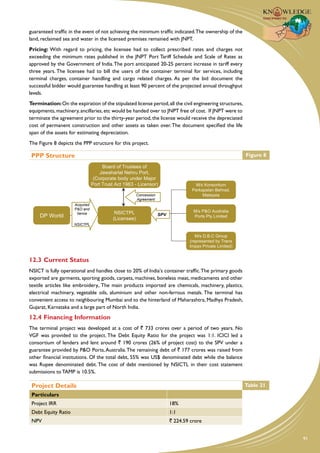
  • 137.
    Public Private Partnershipprojects in India Compendium of Case Studies The situation in the Bhiwandi circle at the time of takeover was as follows: Aggregate technical and commercial (AT&C) losses - 58% Mandatory load shedding of 6 hours per day Distress load shedding due to a deficit of 300 MVA in Extra High Voltage (EHV) network Transformer failure rate of 40% Unregistered customers Poor reliability of supply and frequent incidents of appliance failure This poor performance was on account of the following reasons: There had been effectively no capital investment in Bhiwandi’s distribution network in the last decade or so. This had resulted in a high level of network overloading and a high transformer failure rate. Getting official connections or an additional load sanctioned was very difficult and time consuming, leading to an increasing tendency on the part of consumers to resort to illegal connections. In an effort to solve problems of high distribution losses, lower collection efficiency, and inefficient distribution network, MSEDCL decided to utilize the provisions of Electricity Act 2003 and bring in private expertise through distribution franchising in the Bhiwandi circle. PPP Project Preparation: Conceptualisation: The concept development phase involved analysing various forms of distribution models to enable selection of the most suitable project structure. This involved identification of various technical and / or commercial services, forming the financial and commercial structure of the model, development of performance benchmarks for monitoring, etc. An input based distribution franchisee model was proposed for Bhiwandi. In an input based distribution franchisee model, the franchisee is primarily responsible for supply of electricity, network related capital investments, the operation and maintenance of the network and consumer services including billing and collection. The purchase of power is primarily at a pre- determined rate i.e. the input rate from the licensee, thus significantly removing the uncertainty linked to high power procurement costs. Also, since there is no transfer of assets or shares, the valuation of assets is not necessary, although a joint audit of key parameters and assets needs to be conducted. Discussion with stakeholders: The proposed structure was discussed with all concerned stakeholders including prospective investors, prior to finalisation. Various issues relating to the baseline data, human resources, arrears, regulatory risk were discussed and necessary amendments were made. The issues and the solution for addressing the same have been discussed in Table 34. Table 34 Issues and solution Key Points of Discussion Challenges / Issues Raised By Solution / Action in Stakeholder Meetings Stakeholders Opening level data Investors had concerns on the reliability Sufficient opportunity was provided to of opening level data on distribution losses bidders to carry out a due diligence of and collection efficiency, since it was the existing performance. basis for financial calculations for the bids, and impacted business profitability. Regulatory uncertainty Since tariff was regulated, investors had The franchisee was largely insulated against concerns whether tariff increases in power purchase costs changes as the bulk the future would be adequate to fully supply tariff was indexed to the average compensate for an increase in power retail tariff. purchase costs. 132
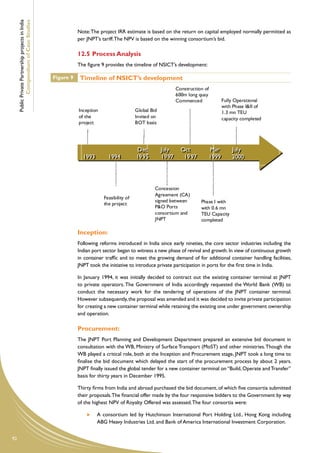
  • 138.
    Key Points ofDiscussion Challenges / Issues Raised By Solution / Action in Stakeholder Meetings Stakeholders Commitment of There was no commitment from MSEDCL MSEDCL committed to provide minimum minimum input power to supply power to Bhiwandi. Revenues input level of energy linked to the FY 2006 from MSEDCL from sale of power were directly linked level of 2,426 GWh. to energy received by the Distribution Franchisee. Thus, the investors wanted MSEDCL to commit a minimum level of energy input. Capital expenditure Since MSEDCL was better aware of the MSEDCL decided to commit ` 61 crores condition of physical assets in Bhiwandi, towards capital expenditure over the first investors proposed that MSEDCL should 5 years. The distribution franchisee was suggest and commit capital expenditure to free to invest over and above this. improve the system. Employee deputation MSEDCL employees had concerns about MSEDCL employees were given the option their terms of service and enforceability of to work on deputation with the franchisee. deputation. The franchisee was to offer equal or better terms to such employees. Employees were also given the right to return to MSEDCL. At the same time, the DF was also given the opportunity to select employees required to run its operations. It had full rights to cancel the deputation of any MSEDCL employee, if found unsuitable. Past period receivables The investors pointed out that collection of The franchisee was offered an incentive current bills would be their focus and they @10% of the total amount net of taxes should have separate financial incentives to collected from consumers who had arrears collect past arrears of MSEDCL. pending more than three months prior to the effective date but were still connected. For collections from disconnected consumers, the incentive was @ 20%. Existing contracts Some investors wanted flexibility to The same was incorporated in the final RfP terminate existing operational contracts of and DFA. MSEDCL. After due consultation with all the stakeholders, the input based franchisee structure was finalised for implementation. Procurement: Expression of Interest (EoI): MSEDCL developed the principles of EoI and sought submissions by 8th April 2005. An overwhelming 116 applications were received. RfP Process: The transaction was a single stage bidding process, wherein the bidders were asked to submit a technical and financial proposal.The RFP was issued on 10th February 2006.The following five bidders purchased the bid documents: M/s Tata Power Company Limited M/s Torrent Power AEC Limited (TPAL) M/s Crompton Greaves Limited M/s Reliance Energy Limited M/s Subhash Projects & Marketing Limited Two bidders namely, TPAL and M/s Crompton Greaves Limited submitted their offers along with the necessary documents on 20th April 2006. The evaluation criteria for the technical bid were based on two parameters, namely, Experience and Track Record and the Financial Capability of the bidder. 133
  • 139.
    Public Private Partnershipprojects in India Compendium of Case Studies Table 35 Experience and Track Record S. No. Parameter Indicator 1. Experience in handling retail consumer No. of consumers (at least 2 lakh consumers) base or experience in employee handling OR No. of employees (at least 500 employees for 2 years) 2. Relevant Experience of key Personnel Experience in power sector related activities – At least 5 personnel with power sector experience of more than 10 years Table 36 Financial Capability S. No. Parameter Indicator 1. Size of operations • Net worth – At least ` 50 crores for the last financial year • Annual Turnover – At least ` 250 crores for the last two financial years 2. Support from internal accruals Cash flow from operations - At least ` 25 crores for the last two financial years 3. Corporate Governance Listing on a recognized stock exchange The financial bid was based on the levelised (annualised) input rate to be quoted by the bidder for the power inputted by MSEDCL. The bidder was required to quote the levelised input rate for the franchisee period after factoring in the stipulated minimum loss reduction and collection efficiency improvements. MSEDCL had also set internal input rate benchmarks for evaluating the financial bids. After the technical evaluation, both the bidders were declared technically qualified and eligible for opening of price bids.The financial bids were opened on 10th May 2006 - Crompton Greaves quoted a levelised tariff of ` 2.02 per unit while TPAL quoted ` 2.04 per unit as input rate. As TPAL quoted the higher bid among the two, it was declared selected bidder. The RfP contained only principles of franchisee agreement. The agreement was finalised after negotiations between TPAL and MSEDCL. Subsequent to signing the DFA on 20th December 2006, on 25th January 2007, a day before TPAL took over operations at Bhiwandi on 26th January 2007, a supplementary agreement to DFA was signed between MSEDCL and TPAL. This agreement made some improvements / corrections in the DFA. Development: The process of handing over of electricity distribution assets started in July 2006 after the issue of the Letter of Intent (LoI) to TPAL.The following activities were completed as a part of the handover process: MSEDCL continued its own operations and in parallel helped TPAL in establishing its presence in Bhiwandi. A joint audit team comprising representatives of MSEDCL and TPAL was formed to confirm opening level details. A walk down survey for counting and verification of all the assets was conducted. An infrastructure roll out plan as per the terms of the agreement was submitted. Offices and IT infrastructure were established and staff was recruited. This handover phase from MSEDCL to TPAL lasted till January 2007 by when all the conditions precedent in the DFA were satisfied. 134
  • 140.
    Delivery: TPAL has completedover two years as the distribution franchisee for the Bhiwandi circle. TPAL, on takeover of the area, did a consumer survey and started regularizing illegal connections. Post creation of new assets, it concentrated on augmentation and overhaul of the existing distribution lines. TPAL also invested in improving the metering system of consumers. All these actions resulted in a reduction in distribution losses and an improvement in the collection efficiency in the Bhiwandi circle. The results to date have been positive and are summarised below: AT&C losses are estimated to have declined by 34% in the first two years of the franchise, to 24% (12-month moving average) at the end of FY2008-09 (from 58% in December 2006, just before handover). Based on the pre-PPP project energy input of 2,500 GWh for the Bhiwandi circle and using a per unit rate of 2 K/kwh, the annual value of the reduction in AT&C losses can be pegged at about ` 170 crores, as against capital investment of about ` 250 crores by the DF over this period. The consumption of electricity increased from ~2,200 GWh to ~ 3,000 GWh. Approximately 55,000 new connections have been added including the regularised ones The distribution transformer failure rate has reduced from 40% at the time of handover to 7.5% at the end of FY 2009. The duration of load shedding has reduced form 6 hours a day to 3.5 hours a day. The metering coverage has increased from 23% at the time of handover to 95% Consumers are satisfied due to the improvement in quality in power supply, faster processing of applications for new connections, better complaint handling and easy bill payments. TPAL focussed on three important areas namely network upgradation, loss reduction and consumer services to achieve the above results. The actions taken by TPAL are summarised below: Immediately after the handover, TPAL initiated the process of regularisation of illegal connections and metering. It replaced all existing meters with accurate and tamper proof meters to ensure that all consumers are billed as per consumption. TPAL conducted a survey jointly with Maharashtra State Transmission Company Limited (MSETCL) for augmentation of the EHV capacity and prepared a 3 year EHV augmentation plan which included reconfiguration of the EHV lines, addition of power transformers and EHV substations and feeders. TPAL has added a total EHV capacity of 250 MVA in the Bhiwandi area by the end of FY 2009. TPAL replaced 1,700 distribution transformers and added a further 241 new distribution transformers, thereby reducing the transformer failure rate. TPAL also improved customer services by introduction of 24X7 call centre facility, online collection centres, user-friendly bills, extending the operating time for customer care centres and public awareness and community development activities. Risk allocation framework Table 37 Risk Type Sensitivity Risk Period Primary Comments Risk Bearer Pre-Operative Phase Risk The distribution franchise was an operating business at the time of handover. Therefore, this risk category is not applicable 135
  • 141.
    Public Private Partnershipprojects in India Compendium of Case Studies Risk Type Sensitivity Risk Period Primary Comments Risk Bearer CONSTRUCTION PHASE The distribution franchise was an RISK operating business at the time of handover. Therefore, this risk category is not applicable. Operations Risk Procurement risk High 10 years Shared MSEDCL is obligated to supply the agreed quantum of power in absolute terms and at the agreed input rate payable by distribution franchisee. The distribution franchisee may procure power from other sources for any shortfall. Tariff Risk High 10 years Shared The tariff charged to the consumer is regulated. At the same time, the input rate i.e. the cost of power purchase is indexed to the changes in the consumer tariff. Thus in case of an increase /decrease in tariff, the input cost for the franchisee will also increase / decrease in line with the formula prescribed in the DFA. However, on a net basis, there will be some impact on the cash flows of the franchisee. Market Risk High 10 years Distribution The market risk in terms of power franchisee consumption, consumption growth, and consumer mix in the Franchise Area is borne by the Franchisee. Since the input rate bid by the franchisee is based on projections with consumer mix and consumption growth assumptions, non- achievement of the same can adversely impact the franchisee cash flows. However, the distribution franchisee is the exclusive franchise in the franchisee area and hence is not subject to any competition. Financial Risk / Receivables High 10 years Distribution The onus of collection efficiency during risk franchisee the applicability of the DFA is on the distribution franchisee. For arrears from current consumers, up to 3 months prior to the effective date, the distribution franchisee is responsible for ensuring 65% collection efficiency. For past arrears, pending more than 3 months prior to the effective date, the franchisee is provided an incentive @ 10 % of collections. The same is @20% of collections for disconnected consumers. Other Risks Risk arising from erroneous Medium 10 years Distribution The findings of the joint audit conducted baseline data Franchisee post-selection of franchisee may differ from the baseline data provided by MSEDCL. Distribution franchisee was allowed to conduct a due diligence of its own in the franchise area. Socio-political risk Medium 10 years Distribution Since the distribution franchisee becomes franchisee the point of contact for consumers, any dissatisfaction on account of action / inaction by the franchisee can lead to instances of opposition or resistance and political pressures. For example, load shedding can lead to discontent among the consumers. In such a scenario there may pressure from the state to ensure regular supply. As a result the franchisee may have to purchase expensive traded power from the market. 136
  • 142.
    Risk Type Sensitivity Risk Period Primary Comments Risk Bearer Force majeure Medium 10 years MSEDCL In case of force majeure event, no party is liable for performance of obligations under the agreement. However, in case of prolonged force majeure, the agreement may be terminated by either party, whereby assets would be transferred to MSEDCL against an expiry payment from MSEDCL. 17.6 Post facto VfM analysis In the absence of data to conduct a quantitative VfM analysis, an analysis of the actual performance of the DF has been undertaken to establish the benefit of opting for a PPP model. • AT&C losses are estimated to have declined by 34% in the first two years of the franchise, to 24% (12-month moving average) at the end of FY2008-09 (from 58% in December 2006, just before handover). • The distribution transformer failure rate reduced from 40% at the time of handover to 7.5% at the end of FY 2009. • The load shedding duration reduced from 6 hours a day to 3.5 hours a day. • The percentage of accurate metered sales increased from 23% at the time of handover to 95% • Benefits to TPAL, MSEDCL and consumers The efficiency gains brought to the power distribution system through the franchisee model benefited all the stakeholders, thus creating a win-win situation. TPAL has benefited in terms of the increased revenue from reduction in losses and improvement in collection efficiency due to refurbishment of the existing network, regularising illegal connections, metering, etc. MSEDCL benefited due to savings in terms of reduction in O&M expenditure, capital investments and interest on working capital.The consumer benefited through increased reliability of power supply, improved customer service. 17.7 Key Learning and Observations • Extensive deliberations on the selection of the PPP model and its structure at inception One of the key reasons for the success of the Bhiwandi model was that the interests of various stakeholders (i.e. MSEDCL, the franchisee, consumers and MSEDCL employees) were considered in the process of evolving the structure of the business model. The model was designed keeping in mind various sector-specific issues such as power deficit, regulated tariffs, subsidy, nature of distribution assets, etc. • Joint audit of opening levels of key parameters Since the power distribution business involves the sale of electricity to a large number of customers spread over a large geographical area, typically the distribution assets (i.e. the network) are also spread out spanning a vast area. As a result, the exercise of estimation of distribution losses, collection efficiency and total assets, the average billing rate is extremely complex and prone to errors. It is therefore necessary in a distribution franchisee model, that a joint audit be conducted for determining the value of these parameters, since they are extremely critical and can impact the profitability and return of the selected bidder. • Transparent bidding process The bid process was conducted in a transparent manner with due consultation of the prospective investors. This helped in creating trust and confidence among the investors. 137
  • 143.
    Public Private Partnershipprojects in India Compendium of Case Studies • Emergence of alternative distribution reform model to privatisation in the Indian context In the input distribution franchisee model, the risks related to power purchase costs and regulated tariff are substantially mitigated for the private partner. Further, the franchisee has an incentive to implement operational efficiencies in the distribution system (i.e. reduction of distribution losses and improvement in collection efficiency) since this would result in higher margins to the franchisee for the same power purchase cost. The ability of this PPP model to harness these profit-motivated efficiency incentives was crucial to the success of the Bhiwandi project, especially in the Indian context of power deficit and a regulated tariff regime. Documents Referred To: - Request for Proposal, Distribution Franchisee Agreement, and the Report on Evaluation of Financial Bids - Infrastructure Development Finance Corporation (IDFC) – Policy Group Quarterly, No. 4 (June, 2009) - Presentation by TAPL - Presentation by Prayas (Energy Group) before The Planning Commission Interviews: - Mr. Chatterjee, Principal Consultant, MSEDCL 138
  • 144.
    Eighteen Case Study 15: AmritsarIntercity Bus Terminal Project 18.1 Project Description Located along the Grand Trunk (G.T.) road, Amritsar city is not only the spiritual centre for the Sikh community but has traditionally been a hub for trade related activities in this region. Given the city’s religious heritage, Amritsar attracts large number of tourists (as high as 50,000 per day) who visit the Golden Temple. The proximity of Amritsar to the Wagah (India-Pakistan) border has also provided an opportunity for it to develop as a trading centre for cross border commercial activities. In addition, a significant section of the local population uses public transport such as buses for movement across the state. These factors have had a growing impact on the existing urban infrastructure, especially the transport infrastructure. Spread on an area of 8.5 acres, the existing bus terminal of Amritsar city, which functioned as an intercity terminus, was established in 1965 on the G.T. Road. This bus terminal complex included all administrative areas, passenger waiting areas as well as amenities. As per the bus schedules drawn up by the Department of Transportation (DoT), Government of Punjab (GoP), there were as many as 1,800 to 2,000 bus arrivals per day at the Amritsar bus terminal. With the growing demand pressures, traffic at the terminal far outstripping the available facilities and the existing terminal building being in a state of disrepair, the DoT, GoP facilitated by the Punjab Infrastructure Development Board (PIDB) decided on modernising and developing the existing Amritsar bus terminal through the Build, Operate, Transfer (BOT) route. This project was among the first bus terminal projects in India to be built and operated by the private sector through the BOT route. The Intercity Bus Terminal of Amritsar city was developed at the same location as the existing bus terminal. The project involved demolishing the existing terminal building and complex and development of a modern state of the art Intercity Bus Terminal to cater to the growing demands of the city. The project is under operation by a private operator for a period of 11 years and 5 months, which includes the construction period. At the end of the concession period, the project will transfer back to the concessioning authority free of all encumbrances. 18.2 PPP structure of the Project Through a two stage bidding process, DoT, GoP awarded the contract to Rohan Rajdeep Infrastructure (a partnership between Rohan Builders (India) Pvt Ltd., Rajdeep Buildcon Pvt Ltd and Rajdeep Road Developers Pvt. Ltd.) to undertake the development and operation of a modern bus terminal at Amritsar on a BOT basis. Subsequent to signing of the concession agreement, the private operator established a Special Purpose Vehicle (SPV) called the Rohan Rajdeep Infrastructure (India) Pvt Ltd. for executing the project. Under the concession agreement, the private operator was responsible for finance, building, operations and maintenance of the Amritsar Intercity Bus Terminal complex for a concession period of 11 years and 5 months. The private operator was required to pay a project development fee of ` 35 lakhs for the project site lease and a lease rental of ` 50,000 per month for use of the project site over the concession period. 139
  • 145.
    Public Private Partnershipprojects in India Compendium of Case Studies Within the concession agreement, two potential revenue streams for the private operator were identified. The first revenue stream was through the operations of the bus terminal. The private operator had the right to collect from bus operators what was termed as “adda fees” which was the charge payable by buses for use of the terminal facilities. The second source of revenue was commercial rentals from shops located within the Intercity Bus Terminal complex. Other sources of revenue included the sale of advertising rights as well as parking fees. 18.3 Current Status Subsequent to the signing of the concession agreement in February 2004, Rohan Rajdeep Infrastructure (India) Pvt. Ltd. was able to complete project development before the predetermined time frame and the Amritsar Intercity Bus Terminal complex was commissioned in October 2005. The project is operational. The bus terminal presently services, on an average, 1,100 normal buses and 600 mini buses a day and about 80-100 buses are parked within the Terminal complex overnight. While the Bus Terminal was expected to handle 2,000 to 3,000 buses per day, it presently handles approximately 1,700 buses a day. One of the reasons for these lower bus numbers is the inability of the private operator to ensure that all buses use the Intercity Bus Terminal facilities as per the schedules. 18.4 Financing Information: The project cost for the Amritsar Intercity Bus Terminal was expected to be approximately ` 19 crores at the time of project conception. But on account of an escalation in input costs during the construction period and quality assurances maintained by the private operator, the project cost finally worked out to ` 21.34 crores. Of this amount, the debt component was ` 12 crores of 11 years tenure while the equity component was ` 9.34 crores. Figure 14 Process Analysis Project Life Cycle AcƟviƟes • Project conceived by DoT, GoP and IncepƟon PIDB and configured through project advisor in 2002 Feasibility Procurement • 2 Stage Bidding Process started in Development November 2002 • Concession Agreement signed in February 2004 Delivery Exit 140
  • 146.
    18.5 Process Analysis Inception: Given thegrowing pressure on the existing transport infrastructure at the bus terminals in Punjab and the dismal state of the existing bus terminal buildings, the Government of Punjab decided to modernise bus terminals in Amritsar and Jalandhar through a private operator.With the objective of modernising the existing bus terminal in Amritsar city, the Department of Transport, GoP facilitated by the PIDB appointed project advisors to configure and structure the project as well as assist in the bid process. Given the large volumes of traffic at the Amritsar Intercity Bus Terminal and extensive use of the terminal by private bus operators who were currently paying “adda fees”, it was believed that if the Government operated buses were also required to pay such “adda fees” then a secure revenue stream could be provided to the private operator resulting in a financially viable model for modernisation of the Amritsar Intercity Bus Terminal through the BOT route. In a number of other bus terminal projects, commercial real estate development was coupled with the development of the bus terminal facility. However in the case of Amritsar, a conscious decision was made not to include commercial real estate development along with the development of the Intercity Bus Terminal primarily on account of the existing congestion in and around the project site. Hence the project concept was to develop a modern Intercity Bus Terminal at Amritsar which would provide a comfortable and convenient environment for passengers to travel to and from Amritsar. It was to be financed, built, operated and maintained by the private operator. In return the Government was to receive a monthly lease rental from the private operator for use of the project site as well as a one time project development fee. Procurement: Based on the scope of work and project configuration identified, a two stage bidding process was adopted. The RFQ for the project was issued on 28th November 2002 and 16 bids were received of which 14 prequalified to the RFP stage. The RFP for the project was issued in April 2003 and a proposal security in the form of a bank guarantee for ` 10 lakhs was sought. To avoid any ambiguities in bid evaluation with respect to different bus terminal designs, the Amritsar Intercity Bus Terminal design was frozen at the time of issue of RFP and the bid variable was defined as the concession period. The private operator demanding the lowest concession period while meeting the project criteria was to be identified as the successful bidder. At the RFP stage four bids were received. Subsequent to meeting the evaluation criteria specified in the RFP document, Rohan Rajdeep Infrastructure Developers Pvt. Ltd was declared the successful bidder and was issued a notice of award for the concession agreement in September 2003. In February 2004 the concessioning authority - the Secretary, Department of Transport, Government of Punjab - entered into a concession agreement with Rohan Rajdeep Infrastructure Developer Pvt. Ltd. for a period of 11 years and 5 months which included the project construction period. Development: The project development was undertaken in two stages. The first was the Conditions Precedent period of 90 days and thereafter the Construction period of 18 months. Conditions Precedent: As per the concession agreement, the private operator and the concessioning authority were required to fulfil the terms of the Conditions Precedent within 90 days of signing of the concession agreement which could be extended based on mutual consent. The concessioning authority was required to undertake the following: • Support the project through issue of necessary notifications authorising the private operator to collect “adda fees” from buses using the Intercity Bus Terminal. 141
  • 147.
    Public Private Partnershipprojects in India Compendium of Case Studies • Given the impact of the “adda fees” on the financial viability of the project, issue necessary notifications to make it mandatory for all intercity buses to halt and provide for embarkation and disembarkation of passengers within the Amritsar Intercity Bus Terminal complex. • Facilitate the transfer of land at the project site from the Amritsar Municipal Corporation to GoP and thereafter possession under a lease to the private operator along with the registration of the land lease. • Temporary shifting of the existing bus terminal to a different location. The private operator on his part was required to: • Obtain all necessary clearances and approvals, • Furnish the performance security and bank guarantees as well as pay the project development fee of ` 35 lakhs to the concessioning authority. • Ensure financial closure of the project and submit proof of the same to the concessioning authority. The concession terms specified that both the parties were required to issue compliance certificates regarding attainment of Conditions Precedent. Based on the issue of such compliance certificates by both parties, the concessioning authority was required thereupon to issue a notice to commence to the private operator. Construction: Keeping in mind the financial viability of the project, the concessioning authority agreed that during the concession period, it would not undertake, on its own or permit any other private operator, to develop a similar Intercity Bus Terminal within a 10 km radius of this project. During the construction period, it was also responsible for construction, operations and maintenance of a temporary bus terminal at a separate location. Within 30 days of receiving the notice of commencement, the private operator was required to mobilise resources to undertake construction activities. The project was to be developed based on the standards specified in the concession agreement.The private operator was required to prepare, maintain and get necessary approvals of the detailed drawing regarding the project design. As per the concession terms, the private operator was required to institute a quality assurance system of record keeping and timely inspection and was also required to submit monthly progress reports to the concessioning authority. The construction was required to be completed within 18 months of commencement. The private operator was able to complete the work and commission the Intercity Bus Terminal within 17 months itself. Necessary tests were carried out by the concessioning authority prior to issue of completion certificate.Two months prior to the end of the construction stage, the private operator was given the right to advertise license allotments for the passenger amenities in the Intercity Bus Terminal. Delivery: The Amritsar Intercity Bus Terminal construction was completed and commissioned in October 2005. The Intercity Bus Terminal includes 53 embarkation and 8 disembarkation bays covering long distance and local bus routes. The Terminal has parking provision for 54 cars, 102 rickshaws/autos and 1838 two-wheelers / cycles and 300 passenger seating berths. In addition to basic bus terminal facilities, the Intercity Bus Terminal has other commuter requirements in terms of convenience stores, refreshment stalls etc. For the convenience of passengers as well as drivers, provision for 10 dormitories has been made. Subsequent to receiving the completion certificate from the concessioning authority, the O&M period for the project commenced. During this period, the private operator was required to operate and maintain the project based on the performance standards laid down in the concession agreement. The private operator was also required to deploy necessary trained staff to undertake operations of the Intercity Bus Terminal. The private operator had the right to levy, collect, retain 142
  • 148.
    “adda fees” fromall buses using the Intercity Bus Terminal as well as user charges for amenities provided to passengers based on the rates specified in the concession agreement. Monthly traffic reports covering the daily “adda fees” collections and bus traffic movements had to be submitted to the concessioning authority. For the duration of the concession period, the private operator had to pay a monthly lease rental of ` 50,000 to the concessioning authority for lease of Intercity Bus Terminal site. Exit: At the end of the concession period all immovable and movable property relating to the project will transfer to the concessioning authority, free of all encumbrances. The concessioning authority will be entitled to appoint a consulting engineer, six months prior to the termination date, for inspection of the terminal facilities.The concessioning authority will issue a vesting certificate as proof of transfer of all rights, titles and interests in the Amritsar Intercity Bus Terminal assets and facilities. Risk allocation framework Table 38 Risk Type Sensitivity Risk Period Primary Risk Comments Bearer A) Pre-Operative Risks Delay in Land Low 0-90 days Concessioning Project development was undertaken on the Acquisition from signing Authority existing bus terminal site and involved transfer of of concession land from the Municipal Corporation of Amritsar agreement to GoP who in turn leased the land to the private operator. Hence delay in land acquisition was not a major risk for this project. Financing Risk High 0-90 days Private The private operator was required to ensure from signing Operator financial closure of the project within 90 days of of concession project acceptance unless a time extension was agreement provided by the concessioning authority. Inability to ensure financial closure within the stipulated time would have resulted in a default on the part of the private operator and he would have lost the performance security. Delay in Medium 0- 90 days Private The concessioning authority was to provide all obtaining from signing of Operator necessary support to the private operator in Approvals/ the concession obtaining the clearances and approvals. However Permits agreement the responsibility of obtaining the same was with the private operator. B) Construction Phase Risk Design Risk High 0-18 months Private The private operator was required to submit from Operator detailed construction design for review. The compliance private operator was also to provide design date (Date warranties for the project. of fulfilment of conditions precedent) Construction Medium 0-18 months Private For the duration of the concession period, Risk from Operator the private operator was required to furnish a compliance performance security. During the construction date period, the private operator was required to facilitate periodic inspection and was to submit monthly progress reports. Delays in Medium 0-18 months Concessioning In the event of suspension of work on account of construction from Authority the concessioning authority which was greater compliance and Private than 30 days, such a suspension would was date Operator treated as a default by concessioning authority. If the termination occurred within 3 years of commencement, the private operator was entitled to termination payment equal to the value of the total debt outstanding, plus 100% of outstanding subordinated debt, plus 125% of equity subscribed in cash and spent on the project subject to a deduction of 7.5% per annum of the equity component after making sufficient adjustments for inflation. 143
  • 149.
    Public Private Partnershipprojects in India Compendium of Case Studies Risk Type Sensitivity Risk Period Primary Risk Comments Bearer C) Operations Phase Risk Revenue Risk Low Throughout Private For the concession period, the concessioning Operator authority agreed not to permit any future development of a similar Intercity Bus Terminal within a 10 km radius of this project. Additionally, a notification was issued to the effect that all intercity buses would be required to halt, drop and pick up passengers from the Intercity Bus Terminal. However, the private operator has not been able to ensure that all buses use the Intercity Bus Terminal facilities as per the schedules, thus impacting his revenues. Policy Risk Low Throughout Concessioning In case of any changes/modification in laws, contract term Authority interpretations of the same or impositions of new statutory or regulatory approvals or taxes or duties imposed subsequent to the proposal acceptance date, the concessioning authority would take necessary action to ensure that there is no change to the private operator’s legal, commercial and financial position as a result of such change. Change in Medium Throughout Concessioning If any variations were initiated by the private Scope Risk contract term Authority operator, a proposal for the same would be and Private sought from the private operator and if found Operator reasonable, necessary changes would be made to the concession period. In case variations were initiated by the concessioning authority, the private operator would be entitled to make a claim for additional cost, if the adjustment in the concession period required as a consequence of such variation was more than 30 days. Performance High Throughout Private The private operator was required to maintain Risk Concession Operator standards  during the construction as well as Period O&M period as per the detailed specifications in the concession agreement. In case of non compliance, the concessioning authority had the power to invoke the performance security. Additionally, no dilution of stake was permissible under the concession agreement. The lead consortium member needed to maintain a minimum equity component of 26% of the concessionaire’s equity contribution. Operations & Medium Throughout Private The private operator was required to create an Maintenance Concession Operator O&M manual, detailing the regular and preventive Risk Period maintenance which would be undertaken. Strict adherence to the performance standards as per the concession agreement and O&M manual was required failing which the concessioning authority had the right to invoke the performance security and impose a penalty for non compliance. D) Other Risks Handover risk Medium 6 months from Private The concessioning authority had the right to termination Operator appoint a consulting engineer to assess the date condition of the project facilities to ensure that they met the standards specified in concession agreement after taking into account reasonable wear and tear. Any shortfalls needed to be remedied by the private operator prior to handover of assets. Default Low Throughout Private In the event of a private operator default by Private the concession Operator leading to termination, the operator would be Operator period reimbursed the cost of works undertaken up to termination date minus the cost of completion of the project by the concessioning authority or a third party. In case the cost involved in completion of works is greater than amount to be reimbursed, the concessioning authority would have the right to recover such costs by invoking the performance security or from the sale of unused plant, machinery or material of the private operator. 144
  • 150.
    Risk Type Sensitivity Risk Period Primary Risk Comments Bearer Force Majeure Medium Throughout Concessioning This risk was partially covered through insurance. Concession Authority In case of force majeure prior to commencement Period and Private of the project, an extension to the concession Operator period for the time period of the force majeure would be provided with each party bearing its own respective costs. In case of a force majeure subsequent to the commencement date and before construction completion, an extension of the concession period for the duration of force majeure would be provided. In case of a force majeure subsequent to issue of the completion certificate, the private operator would be required to make reasonable efforts to collect the user charges. In the event that he is unable to collect the user charges, the concession period would be extended by the time period for which the private operator was unable to collect the user charges. In case of force majeure as a non political event directly related to the project, the concessioning authority would reimburse 50% of any loss due to a shortfall in insurance reimbursement. In case of force majeure as a political event disrupting the project, the concessioning authority would reimburse the entire loss incurred by the private operator. Default by Low Throughout Concessioning In the event of default by the concessioning Concessioning the concession Authority authority, the private operator would receive Authority period termination payment equal to total debt due plus 100% of outstanding subordinated debt, if any and 125% of equity subscribed in cash and actually spent of the project if the termination takes place within 3 years of commencement date and thereafter the reimbursement of equity component amount would be reduced by 7.5% per annum and reduced amount would be further adjusted every year to reflect the changes in the Wholesale Price Index. 18.6 Post facto VfM analysis The VfM assessment of the Amritsar Intercity Bus Terminal has been carried out on a qualitative basis primarily on account of limited financial information available in the public domain. The VfM analysis is based on the anticipated benefits from this project. The key benefits which have accrued as a consequence of this project are: Assured revenues to the concessioning authority through lease payments. During the concession period, the concessioning authority receives a lease rental of ` 50,000 per month from the private operator for use of the project site. This is in addition to the project development fee of ` 35 lakhs paid by the private operator to the concessioning authority. Hence for the duration of the project, the concessioning authority is assured a fixed payment in addition to a state of the art Intercity Bus Terminal which it would get at the end of the concession period. Development of a modern Intercity Bus Terminal with O&M being efficiently handled by the private operator. The existing bus terminal at Amritsar was constructed in 1965 and was unable to meet the growing demands and increasing passenger traffic of Amritsar city. Additionally with the anticipated growth in the city expected in the years to come, the concessioning of this terminal to a private operator enabled the development of a modern Intercity Bus Terminal which was better equipped to handle the growing 145
  • 151.
    Public Private Partnershipprojects in India Compendium of Case Studies volumes of passenger traffic. The terminal provides a comfortable, safe and convenient environment for passengers embarking and disembarking at this terminal. It is a significant upgrade to the existing Inter city bus terminal infrastructure in Amritsar. In addition to upgrade on basic passenger services like provision of adequate seating, designated bus bays, electronic displays and car and bike parking areas, this terminal also provided for eateries and convenience shopping area for passengers. There was also provision for dormitory facilities for passengers or drivers requiring overnight stay. No cash outlay for the concessioning authority during the construction as well as O&M period. As a consequence of undertaking development of the modern Intercity Bus Terminal through the BOT route, the concessioning agency did not have any cash exposure in the project either during the construction stage or the O&M period. At the end of the concession period, the Intercity Bus Terminal complex would transfer back to the concessioning authority without any capital expenditure being undertaken by it. Demonstration effect: The Amritsar Bus Terminal was only the second such project to be undertaken in India and has met with good response with the effect that a number of other bus terminals in Punjab as well other cities in India are being bid out in a similar fashion. 18.7 Key Learning and Observations 1. Facilitation provided by Government to ensure efficient execution. In case of the development of the Amritsar Intercity Bus Terminal, necessary facilitation was provided by the Government through ensuring efficient leasing of land to the private operator, necessary approvals for project development and providing support to the private operator during the construction stage as well as the O&M stage of the project. This was a critical element in the timely execution of the project and the private operator was able to complete the construction ahead of time and largely within the budgeted costs. 2. Favourable policy environment to ensure revenue stream. As a part of the terms of the concession agreement, the Government issued notifications to the effect that all intercity buses would be required to pickup and drop off passengers at the new Inter City Bus Terminal. The concession terms also specified “adda fees” and the user charges for specific passenger amenities with assured escalations during the concession period. Additionally, uncertainties relating to the policy environment were also addressed in the concession agreement wherein any policy level changes having a direct impact on the project viability and which happened subsequent to the signing of the concession agreement would be compensated by the concessioning authority. 3. Flexible project structuring was undertaken to facilitate funding of the project. In case of the Amritsar Intercity Bus Terminal project, the Government made necessary provisions within the concession agreement to facilitate funding of the project through borrowing. Since collection of “adda fees” was similar to toll collections on road projects, the lenders were provided enough security through access to the revenue streams of the project and were provided substitution rights in case of a default by the private operator. 4. Need to develop a monitoring and implementation mechanism. As per the preliminary estimates, the Amritsar Intercity Bus Terminal was expected to be handling 2000 to 3000 buses per day based on the predefined schedules of the Department of Transportation, Government of Punjab. However presently the Intercity Bus Terminal only handles approximately 1700 buses a day. While the recent slow down in the economy has impacted the bus arrivals, part of these lower bus numbers is attributable to the inability of the private operator to ensure that all buses use the Intercity Bus Terminal facilities as per schedules. A number of buses pick and drop passengers outside the Intercity Bus Terminal complex, thereby avoiding payment of “adda fees”. In addition to issuing 146
  • 152.
    notifications, a monitoringmechanism should also be created to ensure that all buses comply with notifications. The necessary implementation mechanism between the various divisions of the government also should be identified and put in place to ensure effective implementation of predetermined schedules as well as levy of penalty for non compliance to such schedules. This would help in improving the financial viability of such projects and mitigate risks relating to such occurrences. 5. Detailed and clear definition of project design and scope. Detailed definition of project scope and providing comprehensive design specifications for the construction stage as well as performance parameters for the O&M period are critical in such projects which are being undertaken for the first time in the private sector. This is to ensure that the project is developed in line with expectations of the concessioning authority and necessary standards are maintained by the private operator for both project development and delivery. Documents Referred To: Draft Concession Agreement Interviews: Mr. G.P.S. Mann, Chief General Manager, Punjab Infrastructure Development Board Mr. Devendra Nagar, Director, Rohan Developers Mr. Anil Gandhi, President, Transaction Advisory Services, Feedback Ventures Mr. Abhijit Bhaumik, Formerly with Feedback Ventures 147
  • 153.
    Public Private Partnershipprojects in India Compendium of Case Studies Nineteen Acronyms Abbreviations and AAI Airports Authority of India ADB Asian Development Bank AMTRL Ahmedabad Mehsana Toll Road Company Limited APIIC Andhra Pradesh Infrastructure Investment Company APTDPB Andhra Pradesh Technology Development & Promotion Board ASP Alandur Sewerage Project BHEL Bharat Heavy Electricals Limited BOMST Build Own Maintain Share Transfer BOO Build Own Operate BOOT Build Own Operate Transfer BOQ Bill of Quantities BOT Build Own Transfer BPCL Bharat Petroleum Corporation Limited CAGR Compounded Annual Growth Rate CDM Clean Development Mechanism CDR Corporate Debt Restructuring CESL Consulting Engineering Services Limited CFS Container Freight Stations CIDB Construction Industry Development Board CII Confederation of Indian Industries CMDA Chennai Metropolitan Development Authority CPCL Cocanada Port Company Ltd CPI Consumer Price Index CSR Case Studies Report DDA Delhi Development Authority DEA Department of Economic Affairs DERC Delhi Electricity Regulatory Commission DFA Distribution Franchisee Agreement DJB Delhi Jal Board DMRC Delhi Metro Rail Corporation DOT Department of Transport DPR Detailed Project Report DSCR Debt Service Coverage Ratio DST Department of Science & Technology DWT Dead Weight Tonne 148
  • 154.
    ECA Economic Consulting Associates EHV Extra High Voltage EOI Expression of Interest EPC Engineering, Procurement & Construction ESR Elevated Storage Reservoir FICCI Federation of Indian Chambers of Commerce and Industry FIDIC International Federation of Consulting Engineers FIRE Financial Institution Reform and Expansion FSI Floor Space Index GAIL Gas Authority of India Limited GHMC Greater Hyderabad Municipal Corporation GIS Geographic Information System GoI Government of India GOM Government of Maharashtra GoNCTD Government of National Capital Territory of Delhi GoP Government of Punjab GoWB Government of West Bengal GPL Gangavaram Port Limited GRICL Gujarat Road and Infrastructure Company Limited GTAEPL GMR Tuni Anakapalli Expressways Private Limited GTIL Gateway Terminals India Limited HUDA Haryana Urban Development Authority HUDCO Housing and Urban Development Corporation Limited IDBI Industrial Development Bank of India IDFC Infrastructure Development Finance Company IIFCL India Infrastructure Finance Company Limited IIM Indian Institute of Management IIPDF India Infrastructure Project Development Fund IL&FS-IDC IL&FS Infrastructure Development Corporation Limited ILFS Infrastructure Leasing & Financial Services Limited IRC Indian Roads Congress IRR Internal Rate of Return ISO International Organization for Standardization ISPL International Seaports Pte Ltd ISPS International Ship and Port Facility Security ITD Italian Thai Development Corporation ITES Information Technology Enabled Services JNNURM Jawaharlal Nehru National Urban Renewal Mission JNPCT Jawaharlal Nehru Port Container Terminal JNPT Jawaharlal Nehru Port Trust JUIL Jindal Urban Infrastructure Limited JUSCO Jamshedpur Utilities and Services Company Limited KDWP Kakinada Deep Water Port KIHPL Kakinada Infrastructure Holdings Pvt. Ltd. 149
  • 155.
    Public Private Partnershipprojects in India Compendium of Case Studies KMC Kolkata Municipal Corporation KMDA Kolkata Municipal Development Authority KMEC Kumar’s Marine Engineering Corporation KPB Konsortium Perkaplan Berhard KSPL Kakinada Sea Ports Ltd KUIDFC Karnataka Urban Infrastructure Development and Finance Corporation KUWASIP Karnataka Urban Water Supply Improvement Programme KUWSDB Karnataka Urban Water Supply and Drainage Board LIBOR London Inter-bank Offer Rate LIC Life Insurance Corporation of India LMC Latur Municipal Council LPCD Litres per Capita per Day LWMC Latur Water Management Company Ltd MCD Municipal Corporation of Delhi MERC Maharashtra Electricity Regulatory Commission MGA Minimum Guaranteed Amount MJP Maharashtra Jeevan Pradhikaran MLD Million Litres Per Day MML Maytas Metro Limited MMOPL Mumbai Metro One Private Limited MMRDA Mumbai Metropolitan Region Development Authority MNRE Ministry of Natural Resource Environment MoA Memorandum of Agreement MoU Memorandum of Understanding MRTS Mass Rapid Transit System MSDECL Maharashtra State Electricity Distribution Company Limited MSETCL Maharashtra State Transmission Company Limited MSW Municipal Solid Waste MTPA Metric Tonnes Per Annum MVA Mega Volt Ampere NBWML Nabadiganta Water Management Limited NCB National Competitive Bidding NDITA Nabadiganta Industrial Township Authority NDMC New Delhi Municipal Corporation NHAI National Highways Authority of India NOC No Objection Certificate NPV Net Present Value NRW Non Revenue Water NSICT Nhava Sheva Integrated Container Terminal NSICTPL Nhava Sheva International Container Terminal Private Limited OHSAS Occupational Health and Safety Management System OMST Operate Maintain Share and Transfer OSV Offshore Supply Vessel PCB Pollution Control Board 150
  • 156.
    PCU Passenger Car Units PHPDT Peak Hour Peak Distribution Traffic PIDB Punjab Infrastructure Development Board PPPAC Public Private Partnership Appraisal Committee PPP Public Private Partnerships PWD Public Works Department RDF Refuse Derived Fuel REL Reliance Energy Limited RFP Request for Proposal RFQ Request for Qualification SBI State Bank of India SCADA Supervisory Control and Data Acquisition SCS Satyam Computer Services SMIPL Salgaocar Mining Industries Pvt. Ltd. SPV Special Purpose Vehicle SSA Stevedoring Services of America STP Sewage Treatment Plant SWM Solid Waste Management TAMP Tariff Authority of Major Ports TCE Tata Consultancy Engineering TCS Tata Consultancy Services TEU Twenty-Foot Equivalent Units TNIUFSL Tamil Nadu Urban Infrastructure Financial Services Limited TNUDF Tamil Nadu Urban Development Fund TOWMCL Timarpur-Okhla Waste Management Company Private Limited TPAL Torrent Power AEC Limited TPD Tonnes Per Day TUFIDCO Tamil Nadu Urban Infrastructure Development Corporation UEM United Engineers Malaysia UGR Underground Reservoir ULB Urban Local Body UNFCCC United Nations Framework Convention on Climate Change UPL United Phosphorous Limited USA United States of America USAID United States Agency for International Development USD United States Dollars UTI Unit Trust of India VFM Value for Money VGF Viability Gap Funding VHTR Vadodara Halol Toll Road VHTRL Vadodara Halol Toll Road Limited WEBEL West Bengal Electronics Industry Development Corporation WPI Wholesale Price Index WTP Willingness To Pay 151
  • 157.
    152 Public Private Partnership projects in India Compendium of Case Studies Notes:
  • 158.
    Public Private Partnershipprojects in India Compendium of Case Studies Capacity Building Curriculum Case Studies Education Health Legal Issues Roads Strategic Communication Toolkits Urban Transport Water b