High Demand of New Infrastructure construction
projects vis-a-vis Replacement of the Aging
Infrastructure
It is said energy saved is equal to
energy produced similarly
replacing the Aging Infrastructure
is as good as addition to the
infrastructure; but some how this
fact is neglected in our planning
process on some ground or the
other. Life span of the
infrastructure shall be honored,
particularly when lives are at stake;
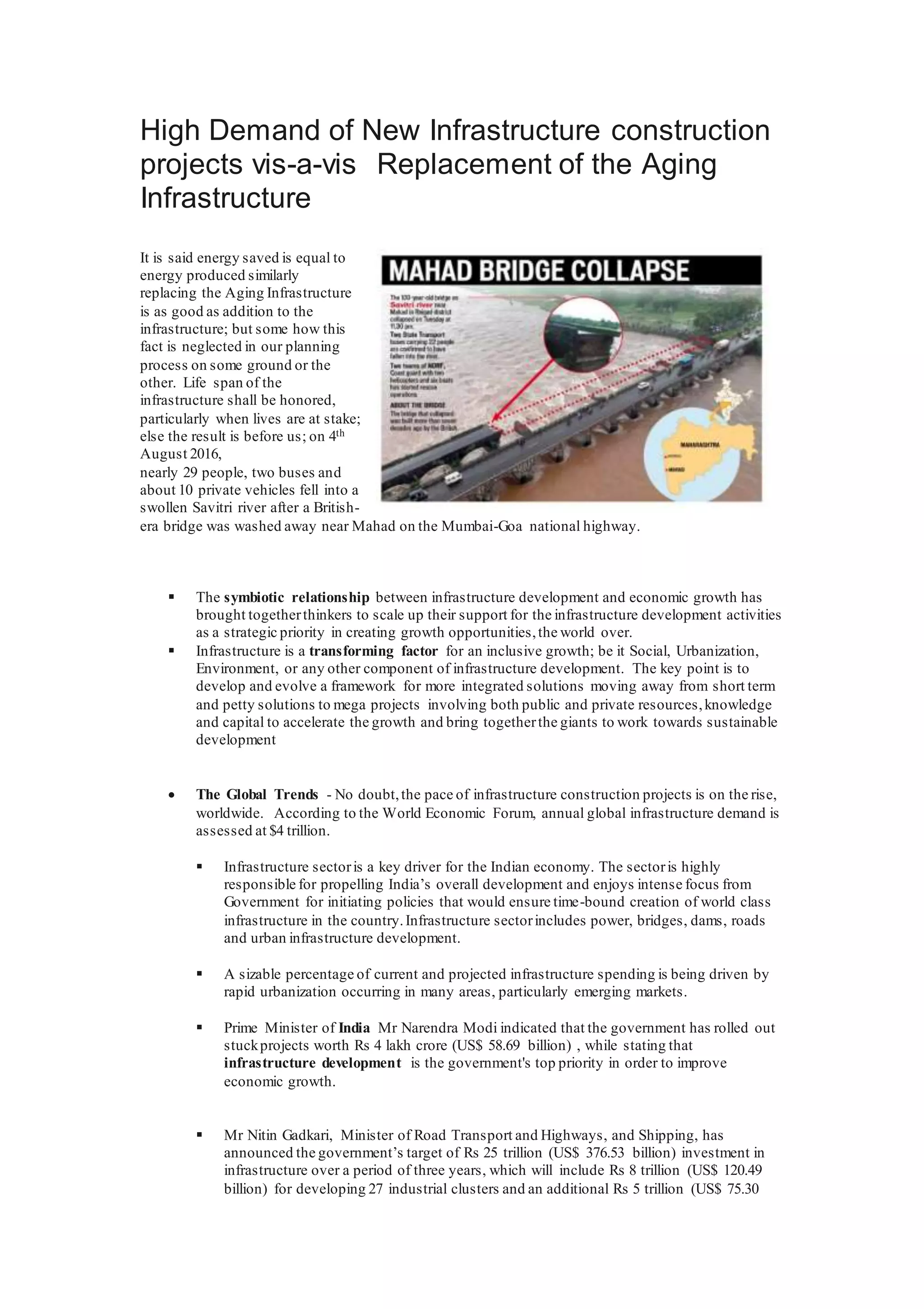
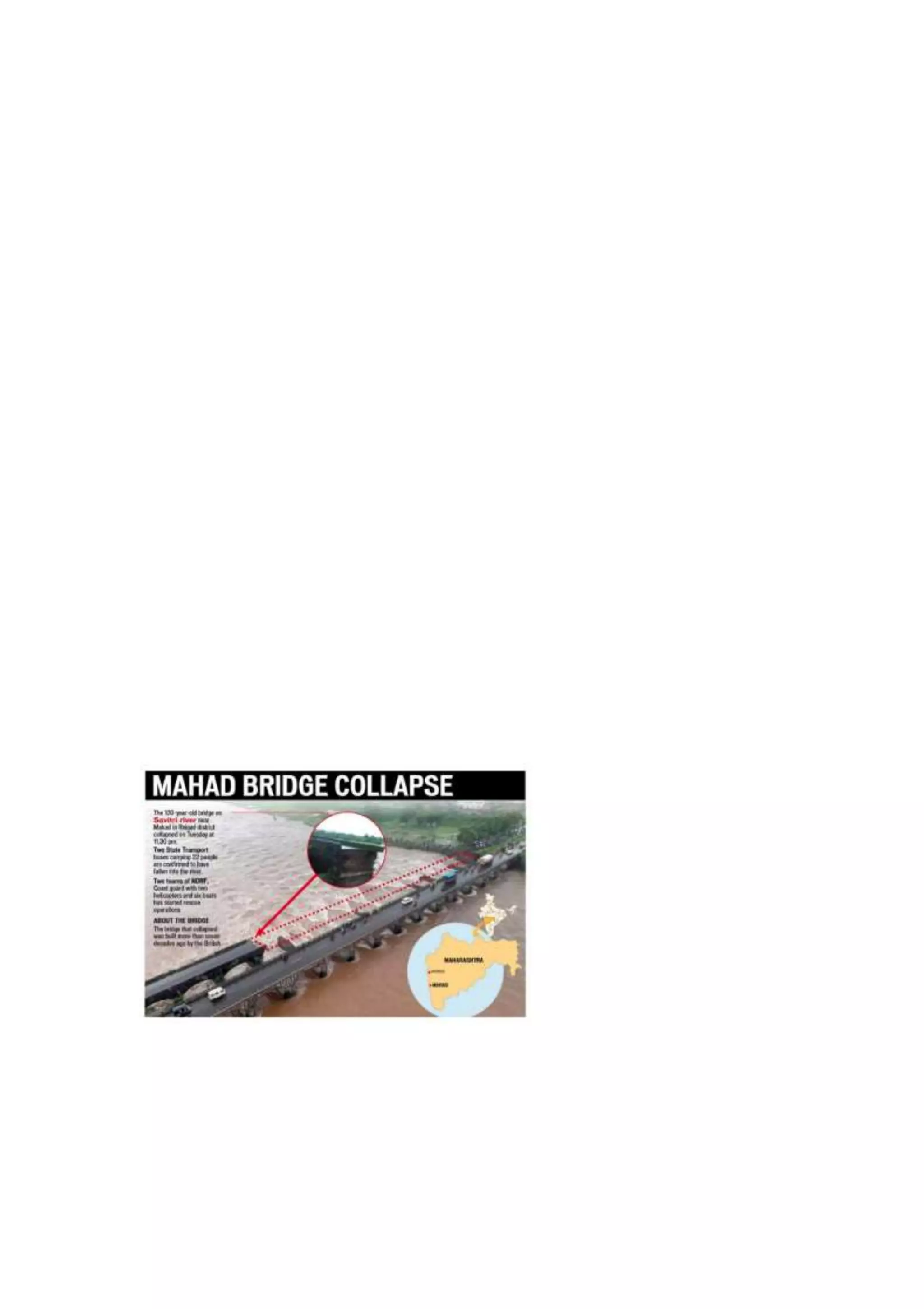
else the result is before us; on 4th
August 2016,
nearly 29 people, two buses and
about 10 private vehicles fell into a
swollen Savitri river after a British-
era bridge was washed away near Mahad on the Mumbai-Goa national highway.
 The symbiotic relationship between infrastructure development and economic growth has
brought togetherthinkers to scale up their support for the infrastructure development activities
as a strategic priority in creating growth opportunities,the world over.
 Infrastructure is a transforming factor for an inclusive growth; be it Social, Urbanization,
Environment, or any other component of infrastructure development. The key point is to
develop and evolve a framework for more integrated solutions moving away from short term
and petty solutions to mega projects involving both public and private resources,knowledge
and capital to accelerate the growth and bring togetherthe giants to work towards sustainable
development
 The Global Trends - No doubt,the pace of infrastructure construction projects is on the rise,
worldwide. According to the World Economic Forum, annual global infrastructure demand is
assessed at $4 trillion.
 Infrastructure sectoris a key driver for the Indian economy. The sectoris highly
responsible for propelling India’s overall development and enjoys intense focus from
Government for initiating policies that would ensure time-bound creation of world class
infrastructure in the country.Infrastructure sectorincludes power, bridges, dams, roads
and urban infrastructure development.
 A sizable percentage of current and projected infrastructure spending is being driven by
rapid urbanization occurring in many areas, particularly emerging markets.
 Prime Minister of India Mr Narendra Modi indicated that the government has rolled out
stuckprojects worth Rs 4 lakh crore (US$ 58.69 billion) , while stating that
infrastructure development is the government's top priority in order to improve
economic growth.
 Mr Nitin Gadkari, Minister of Road Transport and Highways, and Shipping, has
announced the government’s target of Rs 25 trillion (US$ 376.53 billion) investment in
infrastructure over a period of three years, which will include Rs 8 trillion (US$ 120.49
billion) for developing 27 industrial clusters and an additional Rs 5 trillion (US$ 75.30
billion) for road, railway and port connectivity projects.
 Building infrastructure may be a long term task; but undertaking the same under a master-plan
concept can make it more sustainable for a country like India; for which a dedicated group of
people with necessary skill, knowledge and attitude is very important.
 Developing infrastructure is no more the domain of only municipalities and the government;
with the accelerated demand and advent of technology and availability of resources at the disposal
of private sectorthe trends are shifting. To meet the infrastructure gap, countries are turning
towards the private sectorto build and operate the essentialinfrastructure under various PPP
models.
 Economic Growth through Infrastructure : Infrastructure initiatives are needed as a growth
boosting strategy; as perone of the estimates of the World Bank research , every 10 percent
increase in infrastructure provision increases out put by approximately 1 percent, in the long
run. The impact of growth vary from country to country and type of infrastructure; in
developing countries nearly 30 percent of growth is attributed to infrastructure related
projects.
 India has attained the status of ‘engine of global demand’ in select areas,
channeling this in infrastructure development would promote sustainable
development.
 In India, Infrastructure development initiatives are needed as a growth lifting
strategy; scaling up this will certainly generate a virtuous cycle, thereby triggering
mutually reinforcing growth of global recovery.
 In the modern era of today, Green Infrastructure is a concept that is being adopted to meet
the concerns of natural environment in general and Land Use Planning in particular. There is
an emphasis on the “Life Support” functions provided by a network of natural eco systems
with an emphasis on interconnectivity to support long term sustainability.
The Aging Infrastructure and its
replacement: Coming back to the issue of aging
infrastructure; it poses lot many challenges both
economic and logistics. Further the urbanization
of cities is growing there by putting additional
stress on the existing infrastructure. As per one
projection, by 2050, there will be 2 billion more
people living in cities worldwide than there are
today.
This kind of growth puts heavy stress on existing
infrastructure and paves the way for the
construction of all types of supporting
infrastructure—public transportation systems,
sewage systems,etc.
At times due to lack of will to replace these
crippling infrastructure, economic factors such as
low profitability firms start expanding for works
towards greener pastures; but there is dire need
to replace the rapidly aging infrastructure
irrespective of the risks.
Case Study of San Francisco-Oakland Bay
Bridge Replacement:
One recent example of the kind of global,
mega-infrastructure project is the
replacement of the San Francisco-Oakland
Bay Bridge. The Bay Bridge, which
originally opened to traffic on Nov. 12, 1936,
was damaged by an earthquake in 1989 and
needs to be rebuilt.
The $7 billion project involved a level of
multinational cooperation seldom seen
before. Fabrication of the main structural
steel for the bridge was outsourced to
China. South Korea handled the
manufacturing of seismic bearings and
temporary detour structures. Japan forged
the world’s first double-cable saddle, which
sits atop a 525-foot tower built by the
Chinese. England produced the main cables’
bands. And the United States handled about
80 percent of the manufacturing. The
rebuilding of the Bay Bridge was a success; it
reopened on Sept. 2, 2013.
The aging infrastructure could be a major driver of spending.As per one estimate, the annual
infrastructure spending will need to increase to $150 billion more than current levels between now
and 2020 to meet the country’s needs.
Thus within India we need to estimate this business potentialand draw a master plan to replace the
aging infrastructure.
The Golden Opportunity: According to Katz, more than 83 percent of global gross domestic product
(GDP) is expected to be generated outside the U.S. over the next five years. Because so much of GDP
rides on the quality and availability of robust infrastructure (road, freight rail, seaports,air hubs,etc.)
so that companies can create and deliver products and services when and where they are needed,this
trend portends opportunities for the global construction industry in terms of refurbishing old, and
building new, infrastructure.
Who will benefit most? Both the business enterprises and public at large; thus it is a win-win situation
for Socio-Political and Business World. Country gets Infrastructure for high impact through
Optimization for the overall accelerated growth and bettersustainable development.
*****
Aging infrastructure replacement

Aging infrastructure replacement

  • 1.
    High Demand ofNew Infrastructure construction projects vis-a-vis Replacement of the Aging Infrastructure It is said energy saved is equal to energy produced similarly replacing the Aging Infrastructure is as good as addition to the infrastructure; but some how this fact is neglected in our planning process on some ground or the other. Life span of the infrastructure shall be honored, particularly when lives are at stake; else the result is before us; on 4th August 2016, nearly 29 people, two buses and about 10 private vehicles fell into a swollen Savitri river after a British- era bridge was washed away near Mahad on the Mumbai-Goa national highway.  The symbiotic relationship between infrastructure development and economic growth has brought togetherthinkers to scale up their support for the infrastructure development activities as a strategic priority in creating growth opportunities,the world over.  Infrastructure is a transforming factor for an inclusive growth; be it Social, Urbanization, Environment, or any other component of infrastructure development. The key point is to develop and evolve a framework for more integrated solutions moving away from short term and petty solutions to mega projects involving both public and private resources,knowledge and capital to accelerate the growth and bring togetherthe giants to work towards sustainable development  The Global Trends - No doubt,the pace of infrastructure construction projects is on the rise, worldwide. According to the World Economic Forum, annual global infrastructure demand is assessed at $4 trillion.  Infrastructure sectoris a key driver for the Indian economy. The sectoris highly responsible for propelling India’s overall development and enjoys intense focus from Government for initiating policies that would ensure time-bound creation of world class infrastructure in the country.Infrastructure sectorincludes power, bridges, dams, roads and urban infrastructure development.  A sizable percentage of current and projected infrastructure spending is being driven by rapid urbanization occurring in many areas, particularly emerging markets.  Prime Minister of India Mr Narendra Modi indicated that the government has rolled out stuckprojects worth Rs 4 lakh crore (US$ 58.69 billion) , while stating that infrastructure development is the government's top priority in order to improve economic growth.  Mr Nitin Gadkari, Minister of Road Transport and Highways, and Shipping, has announced the government’s target of Rs 25 trillion (US$ 376.53 billion) investment in infrastructure over a period of three years, which will include Rs 8 trillion (US$ 120.49 billion) for developing 27 industrial clusters and an additional Rs 5 trillion (US$ 75.30
  • 2.
    billion) for road,railway and port connectivity projects.  Building infrastructure may be a long term task; but undertaking the same under a master-plan concept can make it more sustainable for a country like India; for which a dedicated group of people with necessary skill, knowledge and attitude is very important.  Developing infrastructure is no more the domain of only municipalities and the government; with the accelerated demand and advent of technology and availability of resources at the disposal of private sectorthe trends are shifting. To meet the infrastructure gap, countries are turning towards the private sectorto build and operate the essentialinfrastructure under various PPP models.  Economic Growth through Infrastructure : Infrastructure initiatives are needed as a growth boosting strategy; as perone of the estimates of the World Bank research , every 10 percent increase in infrastructure provision increases out put by approximately 1 percent, in the long run. The impact of growth vary from country to country and type of infrastructure; in developing countries nearly 30 percent of growth is attributed to infrastructure related projects.  India has attained the status of ‘engine of global demand’ in select areas, channeling this in infrastructure development would promote sustainable development.  In India, Infrastructure development initiatives are needed as a growth lifting strategy; scaling up this will certainly generate a virtuous cycle, thereby triggering mutually reinforcing growth of global recovery.  In the modern era of today, Green Infrastructure is a concept that is being adopted to meet the concerns of natural environment in general and Land Use Planning in particular. There is an emphasis on the “Life Support” functions provided by a network of natural eco systems with an emphasis on interconnectivity to support long term sustainability. The Aging Infrastructure and its replacement: Coming back to the issue of aging infrastructure; it poses lot many challenges both economic and logistics. Further the urbanization of cities is growing there by putting additional stress on the existing infrastructure. As per one projection, by 2050, there will be 2 billion more people living in cities worldwide than there are today. This kind of growth puts heavy stress on existing infrastructure and paves the way for the construction of all types of supporting infrastructure—public transportation systems, sewage systems,etc. At times due to lack of will to replace these crippling infrastructure, economic factors such as low profitability firms start expanding for works towards greener pastures; but there is dire need to replace the rapidly aging infrastructure irrespective of the risks. Case Study of San Francisco-Oakland Bay Bridge Replacement: One recent example of the kind of global, mega-infrastructure project is the replacement of the San Francisco-Oakland Bay Bridge. The Bay Bridge, which originally opened to traffic on Nov. 12, 1936, was damaged by an earthquake in 1989 and needs to be rebuilt. The $7 billion project involved a level of multinational cooperation seldom seen before. Fabrication of the main structural steel for the bridge was outsourced to China. South Korea handled the manufacturing of seismic bearings and temporary detour structures. Japan forged the world’s first double-cable saddle, which sits atop a 525-foot tower built by the Chinese. England produced the main cables’ bands. And the United States handled about 80 percent of the manufacturing. The rebuilding of the Bay Bridge was a success; it reopened on Sept. 2, 2013.
  • 3.
    The aging infrastructurecould be a major driver of spending.As per one estimate, the annual infrastructure spending will need to increase to $150 billion more than current levels between now and 2020 to meet the country’s needs. Thus within India we need to estimate this business potentialand draw a master plan to replace the aging infrastructure. The Golden Opportunity: According to Katz, more than 83 percent of global gross domestic product (GDP) is expected to be generated outside the U.S. over the next five years. Because so much of GDP rides on the quality and availability of robust infrastructure (road, freight rail, seaports,air hubs,etc.) so that companies can create and deliver products and services when and where they are needed,this trend portends opportunities for the global construction industry in terms of refurbishing old, and building new, infrastructure. Who will benefit most? Both the business enterprises and public at large; thus it is a win-win situation for Socio-Political and Business World. Country gets Infrastructure for high impact through Optimization for the overall accelerated growth and bettersustainable development. *****