©2013 DataStax Confidential. Do not distribute without consent.
@chbatey
Christopher Batey

Spark overview for C* developers
@chbatey
Scalability & Performance
• Scalability
- No single point of failure
- No special nodes that become the bottle neck
- Work/data can be re-distributed
• Operational Performance i.e single digit ms
- Single node for query
- Single disk seek per query
@chbatey
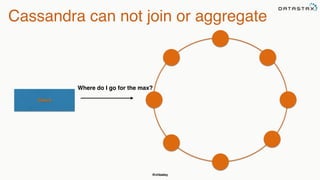
Cassandra can not join or aggregate
Client
Where do I go for the max?
@chbatey
But but…
• Sometimes you don’t need a answers in milliseconds
• Data models done wrong - how do I fix it?
• New requirements for old data?
• Ad-hoc operational queries
• Managers always want counts / maxs
@chbatey
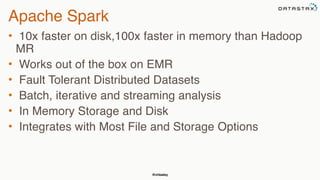
Apache Spark
• 10x faster on disk,100x faster in memory than Hadoop
MR
• Works out of the box on EMR
• Fault Tolerant Distributed Datasets
• Batch, iterative and streaming analysis
• In Memory Storage and Disk
• Integrates with Most File and Storage Options
@chbatey
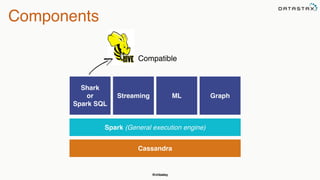
Components
Shark
or

Spark SQL
Streaming ML
Spark (General execution engine)
Graph
Cassandra
Compatible
@chbatey
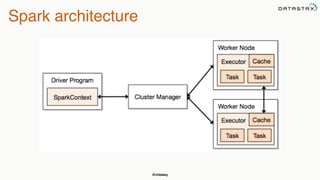
Spark architecture
@chbatey
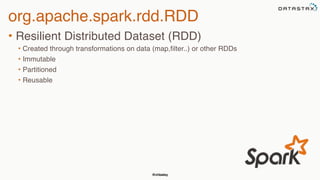
org.apache.spark.rdd.RDD
• Resilient Distributed Dataset (RDD)
• Created through transformations on data (map,filter..) or other RDDs
• Immutable
• Partitioned
• Reusable
@chbatey
RDD Operations
• Transformations - Similar to Scala collections API
• Produce new RDDs
• filter, flatmap, map, distinct, groupBy, union, zip, reduceByKey, subtract
• Actions
• Require materialization of the records to generate a value
• collect: Array[T], count, fold, reduce..
@chbatey
Word count
val file: RDD[String] = sc.textFile("hdfs://...")

val counts: RDD[(String, Int)] = file.flatMap(line =>
line.split(" "))

.map(word => (word, 1))

.reduceByKey(_ + _)


counts.saveAsTextFile("hdfs://...")
@chbatey
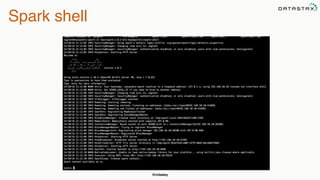
Spark shell
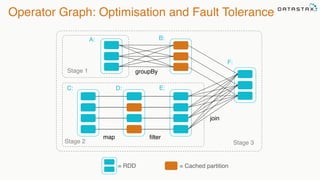
Operator Graph: Optimisation and Fault Tolerance
join
filter
groupBy
Stage 3
Stage 1
Stage 2
A: B:
C: D: E:
F:
map
= Cached partition= RDD
@chbatey
Partitioning
• Large data sets from S3, HDFS, Cassandra etc
• Split into small chunks called partitions
• Each operation is done locally on a partition before
combining other partitions
• So partitioning is important for data locality
@chbatey
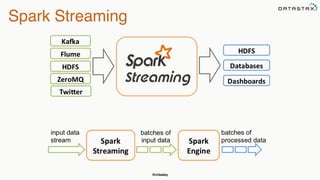
Spark Streaming
@chbatey
Cassandra
@chbatey
Spark Cassandra Connector
• Loads data from Cassandra to Spark
• Writes data from Spark to Cassandra
• Implicit Type Conversions and Object Mapping
• Implemented in Scala (offers a Java API)
• Open Source
• Exposes Cassandra Tables as Spark RDDs + Spark
DStreams
@chbatey
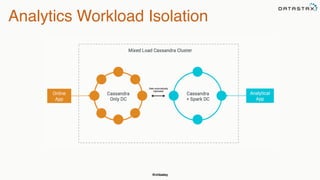
Analytics Workload Isolation
@chbatey
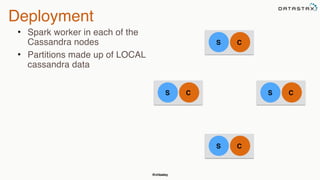
Deployment
• Spark worker in each of the
Cassandra nodes
• Partitions made up of LOCAL
cassandra data
S C
S C
S C
S C
@chbatey
Example Time
@chbatey
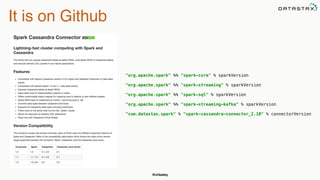
It is on Github
"org.apache.spark" %% "spark-core" % sparkVersion


"org.apache.spark" %% "spark-streaming" % sparkVersion


"org.apache.spark" %% "spark-sql" % sparkVersion


"org.apache.spark" %% "spark-streaming-kafka" % sparkVersion


"com.datastax.spark" % "spark-cassandra-connector_2.10" % connectorVersion
@chbatey
@chbatey
Boiler plate
import com.datastax.spark.connector.rdd._

import org.apache.spark._

import com.datastax.spark.connector._

import com.datastax.spark.connector.cql._


object BasicCassandraInteraction extends App {

val conf = new SparkConf(true).set("spark.cassandra.connection.host", "127.0.0.1")

val sc = new SparkContext("local[4]", "AppName", conf)
// cool stuff


}
Cassandra Host
Spark master e.g spark://host:port
@chbatey
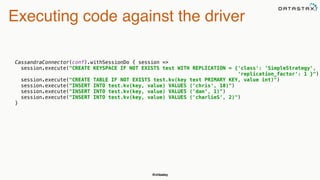
Executing code against the driver
CassandraConnector(conf).withSessionDo { session =>

session.execute("CREATE KEYSPACE IF NOT EXISTS test WITH REPLICATION = {'class': 'SimpleStrategy',
'replication_factor': 1 }")

session.execute("CREATE TABLE IF NOT EXISTS test.kv(key text PRIMARY KEY, value int)")

session.execute("INSERT INTO test.kv(key, value) VALUES ('chris', 10)")

session.execute("INSERT INTO test.kv(key, value) VALUES ('dan', 1)")

session.execute("INSERT INTO test.kv(key, value) VALUES ('charlieS', 2)")

}
@chbatey
Reading data from Cassandra
CassandraConnector(conf).withSessionDo { session =>

session.execute("CREATE TABLE IF NOT EXISTS test.kv(key text PRIMARY KEY, value int)")

session.execute("INSERT INTO test.kv(key, value) VALUES ('chris', 10)")

session.execute("INSERT INTO test.kv(key, value) VALUES ('dan', 1)")

session.execute("INSERT INTO test.kv(key, value) VALUES ('charlieS', 2)")

}


val rdd: CassandraRDD[CassandraRow] = sc.cassandraTable("test", "kv")

println(rdd.max()(new Ordering[CassandraRow] {

override def compare(x: CassandraRow, y: CassandraRow): Int =
x.getInt("value").compare(y.getInt("value"))

}))
@chbatey
Word Count + Save to Cassandra
val textFile: RDD[String] = sc.textFile("Spark-Readme.md")


val words: RDD[String] = textFile.flatMap(line => line.split("s+"))

val wordAndCount: RDD[(String, Int)] = words.map((_, 1))

val wordCounts: RDD[(String, Int)] = wordAndCount.reduceByKey(_ + _)


println(wordCounts.first())


wordCounts.saveToCassandra("test", "words", SomeColumns("word", "count"))
@chbatey
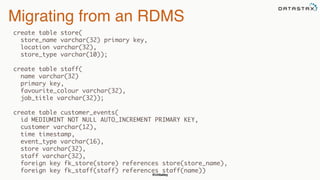
Migrating from an RDMS
create table store(
store_name varchar(32) primary key,
location varchar(32),
store_type varchar(10));
create table staff(
name varchar(32)
primary key,
favourite_colour varchar(32),
job_title varchar(32));
create table customer_events(
id MEDIUMINT NOT NULL AUTO_INCREMENT PRIMARY KEY,
customer varchar(12),
time timestamp,
event_type varchar(16),
store varchar(32),
staff varchar(32),
foreign key fk_store(store) references store(store_name),
foreign key fk_staff(staff) references staff(name))
@chbatey
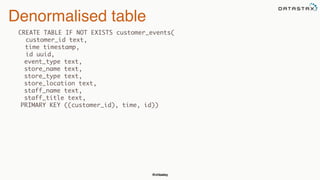
Denormalised table
CREATE TABLE IF NOT EXISTS customer_events(
customer_id text,
time timestamp,
id uuid,
event_type text,

store_name text,
store_type text,
store_location text,
staff_name text,
staff_title text,
PRIMARY KEY ((customer_id), time, id))
@chbatey
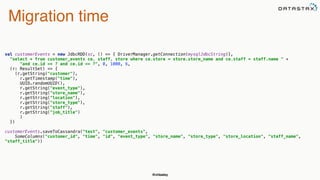
Migration time


val customerEvents = new JdbcRDD(sc, () => { DriverManager.getConnection(mysqlJdbcString)}, 

"select * from customer_events ce, staff, store where ce.store = store.store_name and ce.staff = staff.name " +

"and ce.id >= ? and ce.id <= ?", 0, 1000, 6,

(r: ResultSet) => {

(r.getString("customer"),

r.getTimestamp("time"),

UUID.randomUUID(),

r.getString("event_type"),

r.getString("store_name"),

r.getString("location"),

r.getString("store_type"),

r.getString("staff"),

r.getString("job_title")

)

})


customerEvents.saveToCassandra("test", "customer_events",

SomeColumns("customer_id", "time", "id", "event_type", "store_name", "store_type", "store_location", "staff_name",
"staff_title"))
@chbatey
Issues with denormalisation
• What happens when I need to query the denormalised
data a different way?
@chbatey
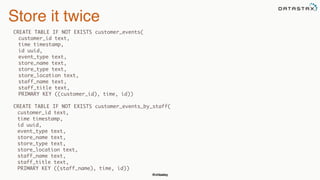
Store it twice
CREATE TABLE IF NOT EXISTS customer_events(
customer_id text,
time timestamp,
id uuid,
event_type text,
store_name text,
store_type text,
store_location text,
staff_name text,
staff_title text,
PRIMARY KEY ((customer_id), time, id))


CREATE TABLE IF NOT EXISTS customer_events_by_staff(
customer_id text,
time timestamp,
id uuid,
event_type text,
store_name text,
store_type text,
store_location text,
staff_name text,
staff_title text,
PRIMARY KEY ((staff_name), time, id))
@chbatey
My reaction a year ago
@chbatey
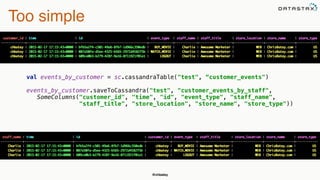
Too simple
val events_by_customer = sc.cassandraTable("test", “customer_events")


events_by_customer.saveToCassandra("test", "customer_events_by_staff",
SomeColumns("customer_id", "time", "id", "event_type", "staff_name",
"staff_title", "store_location", "store_name", "store_type"))

@chbatey
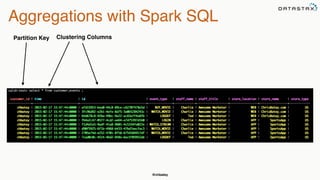
Aggregations with Spark SQL
Partition Key Clustering Columns
@chbatey
Now now…
val cc = new CassandraSQLContext(sc)

cc.setKeyspace("test")

val rdd: SchemaRDD = cc.sql("SELECT store_name, event_type, count(store_name) from customer_events
GROUP BY store_name, event_type")

rdd.collect().foreach(println)
[SportsApp,WATCH_STREAM,1]
[SportsApp,LOGOUT,1]
[SportsApp,LOGIN,1]
[ChrisBatey.com,WATCH_MOVIE,1]
[ChrisBatey.com,LOGOUT,1]
[ChrisBatey.com,BUY_MOVIE,1]
[SportsApp,WATCH_MOVIE,2]
@chbatey
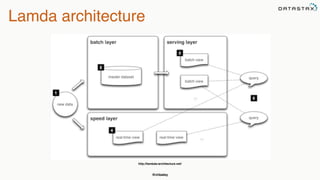
Lamda architecture
http://lambda-architecture.net/
@chbatey
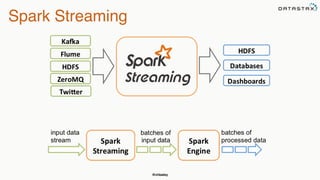
Spark Streaming
@chbatey
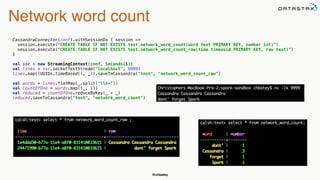
Network word count
CassandraConnector(conf).withSessionDo { session =>

session.execute("CREATE TABLE IF NOT EXISTS test.network_word_count(word text PRIMARY KEY, number int)")

session.execute("CREATE TABLE IF NOT EXISTS test.network_word_count_raw(time timeuuid PRIMARY KEY, raw text)")

}


val ssc = new StreamingContext(conf, Seconds(5))

val lines = ssc.socketTextStream("localhost", 9999)

lines.map((UUIDs.timeBased(), _)).saveToCassandra("test", "network_word_count_raw")


val words = lines.flatMap(_.split("s+"))

val countOfOne = words.map((_, 1))

val reduced = countOfOne.reduceByKey(_ + _)

reduced.saveToCassandra("test", "network_word_count")
@chbatey
Kafka
• Partitioned pub sub system
• Very high throughput
• Very scalable
@chbatey
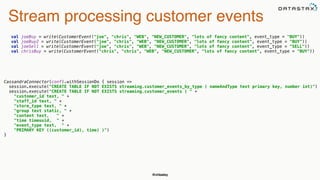
Stream processing customer events
val joeBuy = write(CustomerEvent("joe", "chris", "WEB", "NEW_CUSTOMER", "lots of fancy content", event_type = "BUY"))

val joeBuy2 = write(CustomerEvent("joe", "chris", "WEB", "NEW_CUSTOMER", "lots of fancy content", event_type = "BUY"))

val joeSell = write(CustomerEvent("joe", "chris", "WEB", "NEW_CUSTOMER", "lots of fancy content", event_type = "SELL"))

val chrisBuy = write(CustomerEvent("chris", "chris", "WEB", "NEW_CUSTOMER", "lots of fancy content", event_type = "BUY"))
CassandraConnector(conf).withSessionDo { session =>

session.execute("CREATE TABLE IF NOT EXISTS streaming.customer_events_by_type ( nameAndType text primary key, number int)")

session.execute("CREATE TABLE IF NOT EXISTS streaming.customer_events ( " +

"customer_id text, " +

"staff_id text, " +

"store_type text, " +

"group text static, " +

"content text, " +

"time timeuuid, " +

"event_type text, " +

"PRIMARY KEY ((customer_id), time) )")

}
@chbatey
Save + Process
val rawEvents: ReceiverInputDStream[(String, String)] = KafkaUtils.createStream[String, String, StringDecoder, StringDecoder]
(ssc, kafka.kafkaParams, Map(topic -> 1), StorageLevel.MEMORY_ONLY)

val events: DStream[CustomerEvent] = rawEvents.map({ case (k, v) =>

parse(v).extract[CustomerEvent]

})

events.saveToCassandra("streaming", "customer_events")

val eventsByCustomerAndType = events.map(event => (s"${event.customer_id}-${event.event_type}", 1)).reduceByKey(_ + _)


eventsByCustomerAndType.saveToCassandra("streaming", "customer_events_by_type")
@chbatey
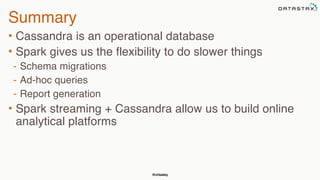
Summary
• Cassandra is an operational database
• Spark gives us the flexibility to do slower things
- Schema migrations
- Ad-hoc queries
- Report generation
• Spark streaming + Cassandra allow us to build online
analytical platforms
@chbatey
Thanks for listening
• Follow me on twitter @chbatey
• Cassandra + Fault tolerance posts a plenty:
• http://christopher-batey.blogspot.co.uk/
• Github for all examples:
• https://github.com/chbatey/spark-sandbox
• Cassandra resources: http://planetcassandra.org/

3 Dundee-Spark Overview for C* developers

  • 1.
    ©2013 DataStax Confidential.Do not distribute without consent. @chbatey Christopher Batey
 Spark overview for C* developers
  • 2.
    @chbatey Scalability & Performance •Scalability - No single point of failure - No special nodes that become the bottle neck - Work/data can be re-distributed • Operational Performance i.e single digit ms - Single node for query - Single disk seek per query
  • 3.
    @chbatey Cassandra can notjoin or aggregate Client Where do I go for the max?
  • 4.
    @chbatey But but… • Sometimesyou don’t need a answers in milliseconds • Data models done wrong - how do I fix it? • New requirements for old data? • Ad-hoc operational queries • Managers always want counts / maxs
  • 5.
    @chbatey Apache Spark • 10xfaster on disk,100x faster in memory than Hadoop MR • Works out of the box on EMR • Fault Tolerant Distributed Datasets • Batch, iterative and streaming analysis • In Memory Storage and Disk • Integrates with Most File and Storage Options
  • 6.
    @chbatey Components Shark or
 Spark SQL Streaming ML Spark(General execution engine) Graph Cassandra Compatible
  • 7.
  • 8.
    @chbatey org.apache.spark.rdd.RDD • Resilient DistributedDataset (RDD) • Created through transformations on data (map,filter..) or other RDDs • Immutable • Partitioned • Reusable
  • 9.
    @chbatey RDD Operations • Transformations- Similar to Scala collections API • Produce new RDDs • filter, flatmap, map, distinct, groupBy, union, zip, reduceByKey, subtract • Actions • Require materialization of the records to generate a value • collect: Array[T], count, fold, reduce..
  • 10.
    @chbatey Word count val file:RDD[String] = sc.textFile("hdfs://...")
 val counts: RDD[(String, Int)] = file.flatMap(line => line.split(" "))
 .map(word => (word, 1))
 .reduceByKey(_ + _) 
 counts.saveAsTextFile("hdfs://...")
  • 11.
  • 12.
    Operator Graph: Optimisationand Fault Tolerance join filter groupBy Stage 3 Stage 1 Stage 2 A: B: C: D: E: F: map = Cached partition= RDD
  • 13.
    @chbatey Partitioning • Large datasets from S3, HDFS, Cassandra etc • Split into small chunks called partitions • Each operation is done locally on a partition before combining other partitions • So partitioning is important for data locality
  • 14.
  • 15.
  • 16.
    @chbatey Spark Cassandra Connector •Loads data from Cassandra to Spark • Writes data from Spark to Cassandra • Implicit Type Conversions and Object Mapping • Implemented in Scala (offers a Java API) • Open Source • Exposes Cassandra Tables as Spark RDDs + Spark DStreams
  • 17.
  • 18.
    @chbatey Deployment • Spark workerin each of the Cassandra nodes • Partitions made up of LOCAL cassandra data S C S C S C S C
  • 19.
  • 20.
    @chbatey It is onGithub "org.apache.spark" %% "spark-core" % sparkVersion
 
 "org.apache.spark" %% "spark-streaming" % sparkVersion
 
 "org.apache.spark" %% "spark-sql" % sparkVersion
 
 "org.apache.spark" %% "spark-streaming-kafka" % sparkVersion
 
 "com.datastax.spark" % "spark-cassandra-connector_2.10" % connectorVersion
  • 21.
  • 22.
    @chbatey Boiler plate import com.datastax.spark.connector.rdd._
 importorg.apache.spark._
 import com.datastax.spark.connector._
 import com.datastax.spark.connector.cql._
 
 object BasicCassandraInteraction extends App {
 val conf = new SparkConf(true).set("spark.cassandra.connection.host", "127.0.0.1")
 val sc = new SparkContext("local[4]", "AppName", conf) // cool stuff
 
 } Cassandra Host Spark master e.g spark://host:port
  • 23.
    @chbatey Executing code againstthe driver CassandraConnector(conf).withSessionDo { session =>
 session.execute("CREATE KEYSPACE IF NOT EXISTS test WITH REPLICATION = {'class': 'SimpleStrategy', 'replication_factor': 1 }")
 session.execute("CREATE TABLE IF NOT EXISTS test.kv(key text PRIMARY KEY, value int)")
 session.execute("INSERT INTO test.kv(key, value) VALUES ('chris', 10)")
 session.execute("INSERT INTO test.kv(key, value) VALUES ('dan', 1)")
 session.execute("INSERT INTO test.kv(key, value) VALUES ('charlieS', 2)")
 }
  • 24.
    @chbatey Reading data fromCassandra CassandraConnector(conf).withSessionDo { session =>
 session.execute("CREATE TABLE IF NOT EXISTS test.kv(key text PRIMARY KEY, value int)")
 session.execute("INSERT INTO test.kv(key, value) VALUES ('chris', 10)")
 session.execute("INSERT INTO test.kv(key, value) VALUES ('dan', 1)")
 session.execute("INSERT INTO test.kv(key, value) VALUES ('charlieS', 2)")
 }
 
 val rdd: CassandraRDD[CassandraRow] = sc.cassandraTable("test", "kv")
 println(rdd.max()(new Ordering[CassandraRow] {
 override def compare(x: CassandraRow, y: CassandraRow): Int = x.getInt("value").compare(y.getInt("value"))
 }))
  • 25.
    @chbatey Word Count +Save to Cassandra val textFile: RDD[String] = sc.textFile("Spark-Readme.md")
 
 val words: RDD[String] = textFile.flatMap(line => line.split("s+"))
 val wordAndCount: RDD[(String, Int)] = words.map((_, 1))
 val wordCounts: RDD[(String, Int)] = wordAndCount.reduceByKey(_ + _)
 
 println(wordCounts.first())
 
 wordCounts.saveToCassandra("test", "words", SomeColumns("word", "count"))
  • 26.
    @chbatey Migrating from anRDMS create table store( store_name varchar(32) primary key, location varchar(32), store_type varchar(10)); create table staff( name varchar(32) primary key, favourite_colour varchar(32), job_title varchar(32)); create table customer_events( id MEDIUMINT NOT NULL AUTO_INCREMENT PRIMARY KEY, customer varchar(12), time timestamp, event_type varchar(16), store varchar(32), staff varchar(32), foreign key fk_store(store) references store(store_name), foreign key fk_staff(staff) references staff(name))
  • 27.
    @chbatey Denormalised table CREATE TABLEIF NOT EXISTS customer_events( customer_id text, time timestamp, id uuid, event_type text,
 store_name text, store_type text, store_location text, staff_name text, staff_title text, PRIMARY KEY ((customer_id), time, id))
  • 28.
    @chbatey Migration time 
 val customerEvents= new JdbcRDD(sc, () => { DriverManager.getConnection(mysqlJdbcString)}, 
 "select * from customer_events ce, staff, store where ce.store = store.store_name and ce.staff = staff.name " +
 "and ce.id >= ? and ce.id <= ?", 0, 1000, 6,
 (r: ResultSet) => {
 (r.getString("customer"),
 r.getTimestamp("time"),
 UUID.randomUUID(),
 r.getString("event_type"),
 r.getString("store_name"),
 r.getString("location"),
 r.getString("store_type"),
 r.getString("staff"),
 r.getString("job_title")
 )
 })
 
 customerEvents.saveToCassandra("test", "customer_events",
 SomeColumns("customer_id", "time", "id", "event_type", "store_name", "store_type", "store_location", "staff_name", "staff_title"))
  • 29.
    @chbatey Issues with denormalisation •What happens when I need to query the denormalised data a different way?
  • 30.
    @chbatey Store it twice CREATETABLE IF NOT EXISTS customer_events( customer_id text, time timestamp, id uuid, event_type text, store_name text, store_type text, store_location text, staff_name text, staff_title text, PRIMARY KEY ((customer_id), time, id)) 
 CREATE TABLE IF NOT EXISTS customer_events_by_staff( customer_id text, time timestamp, id uuid, event_type text, store_name text, store_type text, store_location text, staff_name text, staff_title text, PRIMARY KEY ((staff_name), time, id))
  • 31.
  • 32.
    @chbatey Too simple val events_by_customer= sc.cassandraTable("test", “customer_events") 
 events_by_customer.saveToCassandra("test", "customer_events_by_staff", SomeColumns("customer_id", "time", "id", "event_type", "staff_name", "staff_title", "store_location", "store_name", "store_type"))

  • 33.
    @chbatey Aggregations with SparkSQL Partition Key Clustering Columns
  • 34.
    @chbatey Now now… val cc= new CassandraSQLContext(sc)
 cc.setKeyspace("test")
 val rdd: SchemaRDD = cc.sql("SELECT store_name, event_type, count(store_name) from customer_events GROUP BY store_name, event_type")
 rdd.collect().foreach(println) [SportsApp,WATCH_STREAM,1] [SportsApp,LOGOUT,1] [SportsApp,LOGIN,1] [ChrisBatey.com,WATCH_MOVIE,1] [ChrisBatey.com,LOGOUT,1] [ChrisBatey.com,BUY_MOVIE,1] [SportsApp,WATCH_MOVIE,2]
  • 35.
  • 36.
  • 37.
    @chbatey Network word count CassandraConnector(conf).withSessionDo{ session =>
 session.execute("CREATE TABLE IF NOT EXISTS test.network_word_count(word text PRIMARY KEY, number int)")
 session.execute("CREATE TABLE IF NOT EXISTS test.network_word_count_raw(time timeuuid PRIMARY KEY, raw text)")
 } 
 val ssc = new StreamingContext(conf, Seconds(5))
 val lines = ssc.socketTextStream("localhost", 9999)
 lines.map((UUIDs.timeBased(), _)).saveToCassandra("test", "network_word_count_raw")
 
 val words = lines.flatMap(_.split("s+"))
 val countOfOne = words.map((_, 1))
 val reduced = countOfOne.reduceByKey(_ + _)
 reduced.saveToCassandra("test", "network_word_count")
  • 38.
    @chbatey Kafka • Partitioned pubsub system • Very high throughput • Very scalable
  • 39.
    @chbatey Stream processing customerevents val joeBuy = write(CustomerEvent("joe", "chris", "WEB", "NEW_CUSTOMER", "lots of fancy content", event_type = "BUY"))
 val joeBuy2 = write(CustomerEvent("joe", "chris", "WEB", "NEW_CUSTOMER", "lots of fancy content", event_type = "BUY"))
 val joeSell = write(CustomerEvent("joe", "chris", "WEB", "NEW_CUSTOMER", "lots of fancy content", event_type = "SELL"))
 val chrisBuy = write(CustomerEvent("chris", "chris", "WEB", "NEW_CUSTOMER", "lots of fancy content", event_type = "BUY")) CassandraConnector(conf).withSessionDo { session =>
 session.execute("CREATE TABLE IF NOT EXISTS streaming.customer_events_by_type ( nameAndType text primary key, number int)")
 session.execute("CREATE TABLE IF NOT EXISTS streaming.customer_events ( " +
 "customer_id text, " +
 "staff_id text, " +
 "store_type text, " +
 "group text static, " +
 "content text, " +
 "time timeuuid, " +
 "event_type text, " +
 "PRIMARY KEY ((customer_id), time) )")
 }
  • 40.
    @chbatey Save + Process valrawEvents: ReceiverInputDStream[(String, String)] = KafkaUtils.createStream[String, String, StringDecoder, StringDecoder] (ssc, kafka.kafkaParams, Map(topic -> 1), StorageLevel.MEMORY_ONLY)
 val events: DStream[CustomerEvent] = rawEvents.map({ case (k, v) =>
 parse(v).extract[CustomerEvent]
 })
 events.saveToCassandra("streaming", "customer_events")
 val eventsByCustomerAndType = events.map(event => (s"${event.customer_id}-${event.event_type}", 1)).reduceByKey(_ + _)
 
 eventsByCustomerAndType.saveToCassandra("streaming", "customer_events_by_type")
  • 41.
    @chbatey Summary • Cassandra isan operational database • Spark gives us the flexibility to do slower things - Schema migrations - Ad-hoc queries - Report generation • Spark streaming + Cassandra allow us to build online analytical platforms
  • 42.
    @chbatey Thanks for listening •Follow me on twitter @chbatey • Cassandra + Fault tolerance posts a plenty: • http://christopher-batey.blogspot.co.uk/ • Github for all examples: • https://github.com/chbatey/spark-sandbox • Cassandra resources: http://planetcassandra.org/