SMACK Architectures
Building data processing platforms with
Spark, Mesos, Akka, Cassandra and Kafka
Anton Kirillov Big Data AW Meetup
Sep 2015
Who is this guy?
● Scala programmer
● Focused on distributed systems
● Building data platforms with SMACK/Hadoop
● Ph.D. in Computer Science
● Big Data engineer/consultant at Big Data AB
● Currently at Ooyala Stockholm (Videoplaza AB)
● Working with startups
2
Roadmap
● SMACK stack overview
● Storage layer layout
● Fixing NoSQL limitations
● Cluster resource management
● Reliable scheduling and execution
● Data ingestion options
● Preparing for failures
3
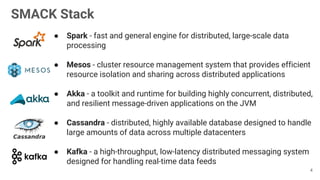
SMACK Stack
● Spark - fast and general engine for distributed, large-scale data
processing
● Mesos - cluster resource management system that provides efficient
resource isolation and sharing across distributed applications
● Akka - a toolkit and runtime for building highly concurrent, distributed,
and resilient message-driven applications on the JVM
● Cassandra - distributed, highly available database designed to handle
large amounts of data across multiple datacenters
● Kafka - a high-throughput, low-latency distributed messaging system
designed for handling real-time data feeds
4
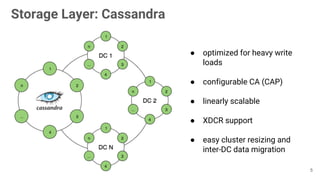
Storage Layer: Cassandra
● optimized for heavy write
loads
● configurable CA (CAP)
● linearly scalable
● XDCR support
● easy cluster resizing and
inter-DC data migration
5
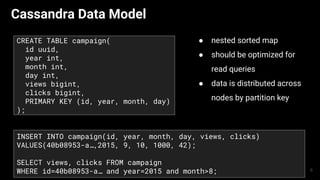
Cassandra Data Model
● nested sorted map
● should be optimized for
read queries
● data is distributed across
nodes by partition key
CREATE TABLE campaign(
id uuid,
year int,
month int,
day int,
views bigint,
clicks bigint,
PRIMARY KEY (id, year, month, day)
);
INSERT INTO campaign(id, year, month, day, views, clicks)
VALUES(40b08953-a…,2015, 9, 10, 1000, 42);
SELECT views, clicks FROM campaign
WHERE id=40b08953-a… and year=2015 and month>8; 6
Spark/Cassandra Example
● calculate total views per
campaign for given month
for all campaigns
CREATE TABLE event(
id uuid,
ad_id uuid,
campaign uuid,
ts bigint,
type text,
PRIMARY KEY(id)
);
val sc = new SparkContext(conf)
case class Event(id: UUID, ad_id: UUID, campaign: UUID, ts: Long, `type`: String)
sc.cassandraTable[Event]("keyspace", "event")
.filter(e => e.`type` == "view" && checkMonth(e.ts))
.map(e => (e.campaign, 1))
.reduceByKey(_ + _)
.collect() 7
Naive Lambda example with Spark SQL
case class CampaignReport(id: String, views: Long, clicks: Long)
sql("""SELECT campaign.id as id, campaign.views as views,
campaign.clicks as clicks, event.type as type
FROM campaign
JOIN event ON campaign.id = event.campaign
""").rdd
.groupBy(row => row.getAs[String]("id"))
.map{ case (id, rows) =>
val views = rows.head.getAs[Long]("views")
val clicks = rows.head.getAs[Long]("clicks")
val res = rows.groupBy(row => row.getAs[String]("type")).mapValues(_.size)
CampaignReport(id, views = views + res("view"), clicks = clicks + res("click"))
}.saveToCassandra(“keyspace”, “campaign_report”)
8
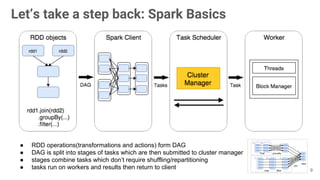
Let’s take a step back: Spark Basics
● RDD operations(transformations and actions) form DAG
● DAG is split into stages of tasks which are then submitted to cluster manager
● stages combine tasks which don’t require shuffling/repartitioning
● tasks run on workers and results then return to client 9
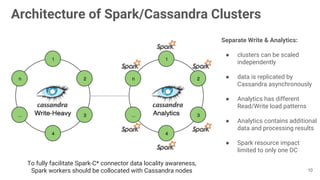
Architecture of Spark/Cassandra Clusters
Separate Write & Analytics:
● clusters can be scaled
independently
● data is replicated by
Cassandra asynchronously
● Analytics has different
Read/Write load patterns
● Analytics contains additional
data and processing results
● Spark resource impact
limited to only one DC
To fully facilitate Spark-C* connector data locality awareness,
Spark workers should be collocated with Cassandra nodes 10
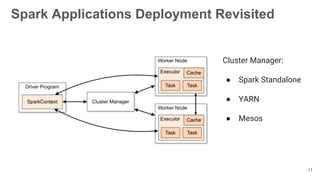
Spark Applications Deployment Revisited
Cluster Manager:
● Spark Standalone
● YARN
● Mesos
11
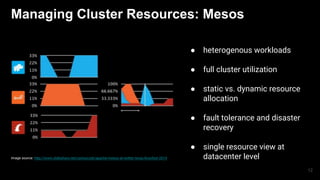
Managing Cluster Resources: Mesos
● heterogenous workloads
● full cluster utilization
● static vs. dynamic resource
allocation
● fault tolerance and disaster
recovery
● single resource view at
datacenter levelimage source: http://www.slideshare.net/caniszczyk/apache-mesos-at-twitter-texas-linuxfest-2014
12
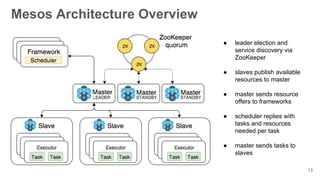
Mesos Architecture Overview
● leader election and
service discovery via
ZooKeeper
● slaves publish available
resources to master
● master sends resource
offers to frameworks
● scheduler replies with
tasks and resources
needed per task
● master sends tasks to
slaves
13
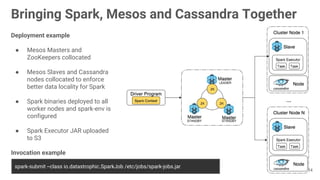
Bringing Spark, Mesos and Cassandra Together
Deployment example
● Mesos Masters and
ZooKeepers collocated
● Mesos Slaves and Cassandra
nodes collocated to enforce
better data locality for Spark
● Spark binaries deployed to all
worker nodes and spark-env is
configured
● Spark Executor JAR uploaded
to S3
Invocation example
spark-submit --class io.datastrophic.SparkJob /etc/jobs/spark-jobs.jar
14
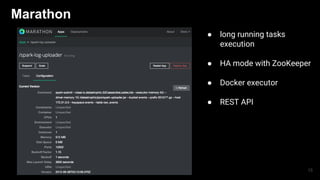
Marathon
● long running tasks
execution
● HA mode with ZooKeeper
● Docker executor
● REST API
15
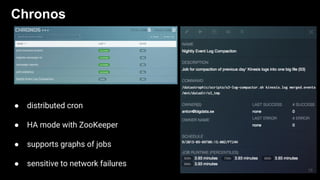
Chronos
● distributed cron
● HA mode with ZooKeeper
● supports graphs of jobs
● sensitive to network failures
16
More Mesos frameworks
● Hadoop
● Cassandra
● Kafka
● Myriad: YARN on Mesos
● Storm
● Samza
17
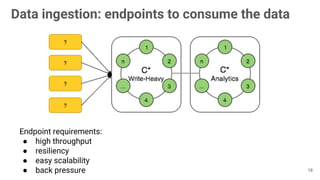
Data ingestion: endpoints to consume the data
Endpoint requirements:
● high throughput
● resiliency
● easy scalability
● back pressure 18
Akka features
class JsonParserActor extends Actor {
def receive = {
case s: String => Try(Json.parse(s).as[Event]) match {
case Failure(ex) => log.error(ex)
case Success(event) => sender ! event
}
}
}
class HttpActor extends Actor {
def receive = {
case req: HttpRequest =>
system.actorOf(Props[JsonParserActor]) ! req.body
case e: Event =>
system.actorOf(Props[CassandraWriterActor]) ! e
}
}
● actor model
implementation for JVM
● message-based and
asynchronous
● no shared mutable state
● easy scalability from one
process to cluster of
machines
● actor hierarchies with
parental supervision
● not only concurrency
framework:
○ akka-http
○ akka-streams
○ akka-persistence
19
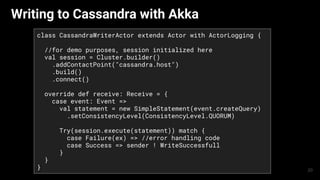
Writing to Cassandra with Akka
class CassandraWriterActor extends Actor with ActorLogging {
//for demo purposes, session initialized here
val session = Cluster.builder()
.addContactPoint("cassandra.host")
.build()
.connect()
override def receive: Receive = {
case event: Event =>
val statement = new SimpleStatement(event.createQuery)
.setConsistencyLevel(ConsistencyLevel.QUORUM)
Try(session.execute(statement)) match {
case Failure(ex) => //error handling code
case Success => sender ! WriteSuccessfull
}
}
} 20
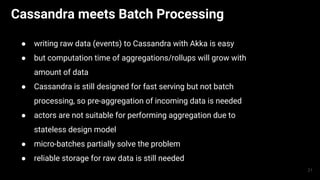
Cassandra meets Batch Processing
● writing raw data (events) to Cassandra with Akka is easy
● but computation time of aggregations/rollups will grow with
amount of data
● Cassandra is still designed for fast serving but not batch
processing, so pre-aggregation of incoming data is needed
● actors are not suitable for performing aggregation due to
stateless design model
● micro-batches partially solve the problem
● reliable storage for raw data is still needed
21
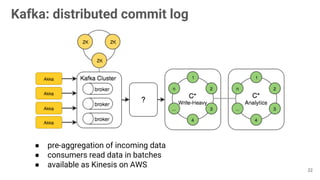
Kafka: distributed commit log
● pre-aggregation of incoming data
● consumers read data in batches
● available as Kinesis on AWS
22
Publishing to Kafka with Akka Http
val config = new ProducerConfig(KafkaConfig())
lazy val producer = new KafkaProducer[A, A](config)
val topic = “raw_events”
val routes: Route = {
post{
decodeRequest{
entity(as[String]){ str =>
JsonParser.parse(str).validate[Event] match {
case s: JsSuccess[String] => producer.send(new KeyedMessage(topic, str))
case e: JsError => BadRequest -> JsError.toFlatJson(e).toString()
}
}
}
}
}
object AkkaHttpMicroservice extends App with Service {
Http().bindAndHandle(routes, config.getString("http.interface"), config.getInt("http.
port"))
}
23
Spark Streaming
24
● variety of data sources
● at-least-once semantics
● exactly-once semantics
available with Kafka Direct
and idempotent storage
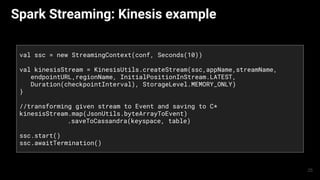
Spark Streaming: Kinesis example
val ssc = new StreamingContext(conf, Seconds(10))
val kinesisStream = KinesisUtils.createStream(ssc,appName,streamName,
endpointURL,regionName, InitialPositionInStream.LATEST,
Duration(checkpointInterval), StorageLevel.MEMORY_ONLY)
}
//transforming given stream to Event and saving to C*
kinesisStream.map(JsonUtils.byteArrayToEvent)
.saveToCassandra(keyspace, table)
ssc.start()
ssc.awaitTermination()
25
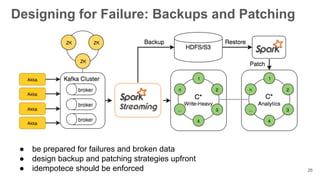
Designing for Failure: Backups and Patching
● be prepared for failures and broken data
● design backup and patching strategies upfront
● idempotece should be enforced 26
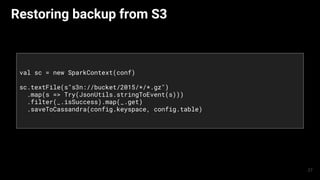
Restoring backup from S3
val sc = new SparkContext(conf)
sc.textFile(s"s3n://bucket/2015/*/*.gz")
.map(s => Try(JsonUtils.stringToEvent(s)))
.filter(_.isSuccess).map(_.get)
.saveToCassandra(config.keyspace, config.table)
27
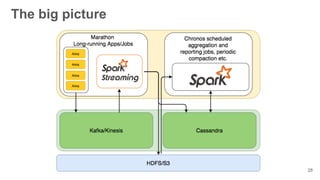
The big picture
28
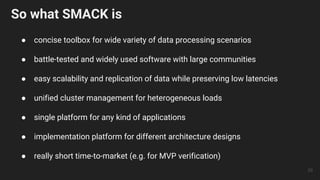
So what SMACK is
● concise toolbox for wide variety of data processing scenarios
● battle-tested and widely used software with large communities
● easy scalability and replication of data while preserving low latencies
● unified cluster management for heterogeneous loads
● single platform for any kind of applications
● implementation platform for different architecture designs
● really short time-to-market (e.g. for MVP verification)
29
Questions
@antonkirillov datastrophic.io
30

Data processing platforms architectures with Spark, Mesos, Akka, Cassandra and Kafka

  • 1.
    SMACK Architectures Building dataprocessing platforms with Spark, Mesos, Akka, Cassandra and Kafka Anton Kirillov Big Data AW Meetup Sep 2015
  • 2.
    Who is thisguy? ● Scala programmer ● Focused on distributed systems ● Building data platforms with SMACK/Hadoop ● Ph.D. in Computer Science ● Big Data engineer/consultant at Big Data AB ● Currently at Ooyala Stockholm (Videoplaza AB) ● Working with startups 2
  • 3.
    Roadmap ● SMACK stackoverview ● Storage layer layout ● Fixing NoSQL limitations ● Cluster resource management ● Reliable scheduling and execution ● Data ingestion options ● Preparing for failures 3
  • 4.
    SMACK Stack ● Spark- fast and general engine for distributed, large-scale data processing ● Mesos - cluster resource management system that provides efficient resource isolation and sharing across distributed applications ● Akka - a toolkit and runtime for building highly concurrent, distributed, and resilient message-driven applications on the JVM ● Cassandra - distributed, highly available database designed to handle large amounts of data across multiple datacenters ● Kafka - a high-throughput, low-latency distributed messaging system designed for handling real-time data feeds 4
  • 5.
    Storage Layer: Cassandra ●optimized for heavy write loads ● configurable CA (CAP) ● linearly scalable ● XDCR support ● easy cluster resizing and inter-DC data migration 5
  • 6.
    Cassandra Data Model ●nested sorted map ● should be optimized for read queries ● data is distributed across nodes by partition key CREATE TABLE campaign( id uuid, year int, month int, day int, views bigint, clicks bigint, PRIMARY KEY (id, year, month, day) ); INSERT INTO campaign(id, year, month, day, views, clicks) VALUES(40b08953-a…,2015, 9, 10, 1000, 42); SELECT views, clicks FROM campaign WHERE id=40b08953-a… and year=2015 and month>8; 6
  • 7.
    Spark/Cassandra Example ● calculatetotal views per campaign for given month for all campaigns CREATE TABLE event( id uuid, ad_id uuid, campaign uuid, ts bigint, type text, PRIMARY KEY(id) ); val sc = new SparkContext(conf) case class Event(id: UUID, ad_id: UUID, campaign: UUID, ts: Long, `type`: String) sc.cassandraTable[Event]("keyspace", "event") .filter(e => e.`type` == "view" && checkMonth(e.ts)) .map(e => (e.campaign, 1)) .reduceByKey(_ + _) .collect() 7
  • 8.
    Naive Lambda examplewith Spark SQL case class CampaignReport(id: String, views: Long, clicks: Long) sql("""SELECT campaign.id as id, campaign.views as views, campaign.clicks as clicks, event.type as type FROM campaign JOIN event ON campaign.id = event.campaign """).rdd .groupBy(row => row.getAs[String]("id")) .map{ case (id, rows) => val views = rows.head.getAs[Long]("views") val clicks = rows.head.getAs[Long]("clicks") val res = rows.groupBy(row => row.getAs[String]("type")).mapValues(_.size) CampaignReport(id, views = views + res("view"), clicks = clicks + res("click")) }.saveToCassandra(“keyspace”, “campaign_report”) 8
  • 9.
    Let’s take astep back: Spark Basics ● RDD operations(transformations and actions) form DAG ● DAG is split into stages of tasks which are then submitted to cluster manager ● stages combine tasks which don’t require shuffling/repartitioning ● tasks run on workers and results then return to client 9
  • 10.
    Architecture of Spark/CassandraClusters Separate Write & Analytics: ● clusters can be scaled independently ● data is replicated by Cassandra asynchronously ● Analytics has different Read/Write load patterns ● Analytics contains additional data and processing results ● Spark resource impact limited to only one DC To fully facilitate Spark-C* connector data locality awareness, Spark workers should be collocated with Cassandra nodes 10
  • 11.
    Spark Applications DeploymentRevisited Cluster Manager: ● Spark Standalone ● YARN ● Mesos 11
  • 12.
    Managing Cluster Resources:Mesos ● heterogenous workloads ● full cluster utilization ● static vs. dynamic resource allocation ● fault tolerance and disaster recovery ● single resource view at datacenter levelimage source: http://www.slideshare.net/caniszczyk/apache-mesos-at-twitter-texas-linuxfest-2014 12
  • 13.
    Mesos Architecture Overview ●leader election and service discovery via ZooKeeper ● slaves publish available resources to master ● master sends resource offers to frameworks ● scheduler replies with tasks and resources needed per task ● master sends tasks to slaves 13
  • 14.
    Bringing Spark, Mesosand Cassandra Together Deployment example ● Mesos Masters and ZooKeepers collocated ● Mesos Slaves and Cassandra nodes collocated to enforce better data locality for Spark ● Spark binaries deployed to all worker nodes and spark-env is configured ● Spark Executor JAR uploaded to S3 Invocation example spark-submit --class io.datastrophic.SparkJob /etc/jobs/spark-jobs.jar 14
  • 15.
    Marathon ● long runningtasks execution ● HA mode with ZooKeeper ● Docker executor ● REST API 15
  • 16.
    Chronos ● distributed cron ●HA mode with ZooKeeper ● supports graphs of jobs ● sensitive to network failures 16
  • 17.
    More Mesos frameworks ●Hadoop ● Cassandra ● Kafka ● Myriad: YARN on Mesos ● Storm ● Samza 17
  • 18.
    Data ingestion: endpointsto consume the data Endpoint requirements: ● high throughput ● resiliency ● easy scalability ● back pressure 18
  • 19.
    Akka features class JsonParserActorextends Actor { def receive = { case s: String => Try(Json.parse(s).as[Event]) match { case Failure(ex) => log.error(ex) case Success(event) => sender ! event } } } class HttpActor extends Actor { def receive = { case req: HttpRequest => system.actorOf(Props[JsonParserActor]) ! req.body case e: Event => system.actorOf(Props[CassandraWriterActor]) ! e } } ● actor model implementation for JVM ● message-based and asynchronous ● no shared mutable state ● easy scalability from one process to cluster of machines ● actor hierarchies with parental supervision ● not only concurrency framework: ○ akka-http ○ akka-streams ○ akka-persistence 19
  • 20.
    Writing to Cassandrawith Akka class CassandraWriterActor extends Actor with ActorLogging { //for demo purposes, session initialized here val session = Cluster.builder() .addContactPoint("cassandra.host") .build() .connect() override def receive: Receive = { case event: Event => val statement = new SimpleStatement(event.createQuery) .setConsistencyLevel(ConsistencyLevel.QUORUM) Try(session.execute(statement)) match { case Failure(ex) => //error handling code case Success => sender ! WriteSuccessfull } } } 20
  • 21.
    Cassandra meets BatchProcessing ● writing raw data (events) to Cassandra with Akka is easy ● but computation time of aggregations/rollups will grow with amount of data ● Cassandra is still designed for fast serving but not batch processing, so pre-aggregation of incoming data is needed ● actors are not suitable for performing aggregation due to stateless design model ● micro-batches partially solve the problem ● reliable storage for raw data is still needed 21
  • 22.
    Kafka: distributed commitlog ● pre-aggregation of incoming data ● consumers read data in batches ● available as Kinesis on AWS 22
  • 23.
    Publishing to Kafkawith Akka Http val config = new ProducerConfig(KafkaConfig()) lazy val producer = new KafkaProducer[A, A](config) val topic = “raw_events” val routes: Route = { post{ decodeRequest{ entity(as[String]){ str => JsonParser.parse(str).validate[Event] match { case s: JsSuccess[String] => producer.send(new KeyedMessage(topic, str)) case e: JsError => BadRequest -> JsError.toFlatJson(e).toString() } } } } } object AkkaHttpMicroservice extends App with Service { Http().bindAndHandle(routes, config.getString("http.interface"), config.getInt("http. port")) } 23
  • 24.
    Spark Streaming 24 ● varietyof data sources ● at-least-once semantics ● exactly-once semantics available with Kafka Direct and idempotent storage
  • 25.
    Spark Streaming: Kinesisexample val ssc = new StreamingContext(conf, Seconds(10)) val kinesisStream = KinesisUtils.createStream(ssc,appName,streamName, endpointURL,regionName, InitialPositionInStream.LATEST, Duration(checkpointInterval), StorageLevel.MEMORY_ONLY) } //transforming given stream to Event and saving to C* kinesisStream.map(JsonUtils.byteArrayToEvent) .saveToCassandra(keyspace, table) ssc.start() ssc.awaitTermination() 25
  • 26.
    Designing for Failure:Backups and Patching ● be prepared for failures and broken data ● design backup and patching strategies upfront ● idempotece should be enforced 26
  • 27.
    Restoring backup fromS3 val sc = new SparkContext(conf) sc.textFile(s"s3n://bucket/2015/*/*.gz") .map(s => Try(JsonUtils.stringToEvent(s))) .filter(_.isSuccess).map(_.get) .saveToCassandra(config.keyspace, config.table) 27
  • 28.
  • 29.
    So what SMACKis ● concise toolbox for wide variety of data processing scenarios ● battle-tested and widely used software with large communities ● easy scalability and replication of data while preserving low latencies ● unified cluster management for heterogeneous loads ● single platform for any kind of applications ● implementation platform for different architecture designs ● really short time-to-market (e.g. for MVP verification) 29
  • 30.