3D SCANNERS
BY CHETHILA FERNANDO
WHAT IS THE DIFFERENCE BETWEEN 3D AND 2D
3D (3 dimensions)
• 3D is using 3 dimensions to take copies or
for graphic designing. To use 3D in any
sector it uses the length , height & the
breath. In the use of 3D we use a special
type of scanner on mostly the graphic
designing sector to take a copy of a 3D
object and take it as a soft 3d copy
2D (2 dimensions )
• Two-dimensional or 2D animation is
characterized by having its objects and
characters created in a two-dimensional
space. It means that they only have width
and height.
• 2D animation is one of the major types of
animation. It’s widely used for creating
animated movies, cartoons, marketing
videos, advertisements, corporate
presentations, educational materials, video
games, and so much more.
WHAT IS A SCANNER ??
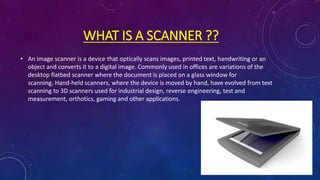
• An image scanner is a device that optically scans images, printed text, handwriting or an
object and converts it to a digital image. Commonly used in offices are variations of the
desktop flatbed scanner where the document is placed on a glass window for
scanning. Hand-held scanners, where the device is moved by hand, have evolved from text
scanning to 3D scanners used for industrial design, reverse engineering, test and
measurement, orthotics, gaming and other applications.
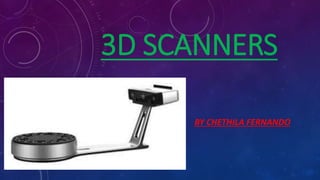
3D SCANNERS
• A 3D scanner generates 3D scans. A scanner works like a video camera, meaning it takes shots
of an object. A camera, however, makes two-dimensional stills, while the scanner captures the
geometry of the object’s surface, and the shots it has made are worked into a 3D model rather
than a video.
• 3D scanning is a technology used in cutting-edge workflows. Take the automotive industry.
Want to check if a new valve will improve an engine’s performance? 3D scan the valve to make
a 3D model, modify it via reverse engineering, and place it into CAD software to see how the
valve will perform inside the engine.
METHODS OF 3D SCANNING
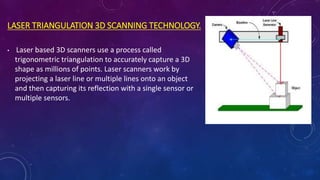
LASER TRIANGULATION 3D SCANNING TECHNOLOGY.
• Laser based 3D scanners use a process called
trigonometric triangulation to accurately capture a 3D
shape as millions of points. Laser scanners work by
projecting a laser line or multiple lines onto an object
and then capturing its reflection with a single sensor or
multiple sensors.
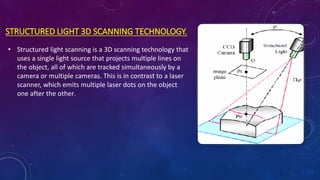
STRUCTURED LIGHT 3D SCANNING TECHNOLOGY.
• Structured light scanning is a 3D scanning technology that
uses a single light source that projects multiple lines on
the object, all of which are tracked simultaneously by a
camera or multiple cameras. This is in contrast to a laser
scanner, which emits multiple laser dots on the object
one after the other.
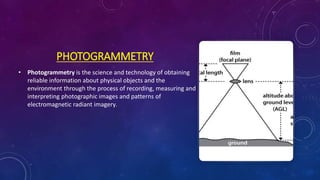
PHOTOGRAMMETRY
• Photogrammetry is the science and technology of obtaining
reliable information about physical objects and the
environment through the process of recording, measuring and
interpreting photographic images and patterns of
electromagnetic radiant imagery.
LASER PULSE-BASED 3D SCANNERS
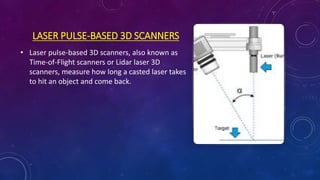
• Laser pulse-based 3D scanners, also known as
Time-of-Flight scanners or Lidar laser 3D
scanners, measure how long a casted laser takes
to hit an object and come back.
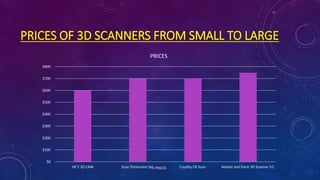
PRICES OF 3D SCANNERS FROM SMALL TO LARGE
$0
$100
$200
$300
$400
$500
$600
$700
$800
HP Z 3D CAM Scan Dimension Sol Creality CR-Scan Matter and Form 3D Scanner V2
PRICES
PRICES

3 d scanners by chethila

  • 1.
  • 2.
    WHAT IS THEDIFFERENCE BETWEEN 3D AND 2D 3D (3 dimensions) • 3D is using 3 dimensions to take copies or for graphic designing. To use 3D in any sector it uses the length , height & the breath. In the use of 3D we use a special type of scanner on mostly the graphic designing sector to take a copy of a 3D object and take it as a soft 3d copy 2D (2 dimensions ) • Two-dimensional or 2D animation is characterized by having its objects and characters created in a two-dimensional space. It means that they only have width and height. • 2D animation is one of the major types of animation. It’s widely used for creating animated movies, cartoons, marketing videos, advertisements, corporate presentations, educational materials, video games, and so much more.
  • 3.
    WHAT IS ASCANNER ?? • An image scanner is a device that optically scans images, printed text, handwriting or an object and converts it to a digital image. Commonly used in offices are variations of the desktop flatbed scanner where the document is placed on a glass window for scanning. Hand-held scanners, where the device is moved by hand, have evolved from text scanning to 3D scanners used for industrial design, reverse engineering, test and measurement, orthotics, gaming and other applications.
  • 4.
    3D SCANNERS • A3D scanner generates 3D scans. A scanner works like a video camera, meaning it takes shots of an object. A camera, however, makes two-dimensional stills, while the scanner captures the geometry of the object’s surface, and the shots it has made are worked into a 3D model rather than a video. • 3D scanning is a technology used in cutting-edge workflows. Take the automotive industry. Want to check if a new valve will improve an engine’s performance? 3D scan the valve to make a 3D model, modify it via reverse engineering, and place it into CAD software to see how the valve will perform inside the engine.
  • 5.
    METHODS OF 3DSCANNING
  • 6.
    LASER TRIANGULATION 3DSCANNING TECHNOLOGY. • Laser based 3D scanners use a process called trigonometric triangulation to accurately capture a 3D shape as millions of points. Laser scanners work by projecting a laser line or multiple lines onto an object and then capturing its reflection with a single sensor or multiple sensors.
  • 7.
    STRUCTURED LIGHT 3DSCANNING TECHNOLOGY. • Structured light scanning is a 3D scanning technology that uses a single light source that projects multiple lines on the object, all of which are tracked simultaneously by a camera or multiple cameras. This is in contrast to a laser scanner, which emits multiple laser dots on the object one after the other.
  • 8.
    PHOTOGRAMMETRY • Photogrammetry isthe science and technology of obtaining reliable information about physical objects and the environment through the process of recording, measuring and interpreting photographic images and patterns of electromagnetic radiant imagery.
  • 9.
    LASER PULSE-BASED 3DSCANNERS • Laser pulse-based 3D scanners, also known as Time-of-Flight scanners or Lidar laser 3D scanners, measure how long a casted laser takes to hit an object and come back.
  • 10.
    PRICES OF 3DSCANNERS FROM SMALL TO LARGE $0 $100 $200 $300 $400 $500 $600 $700 $800 HP Z 3D CAM Scan Dimension Sol Creality CR-Scan Matter and Form 3D Scanner V2 PRICES PRICES