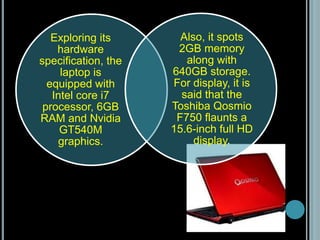
Toshiba unveils world's first glassless 3D laptop, Qosmio F750
Qosmio F750
Qosmio F750
The F750-10Q also comes with a webcam that tracks user eye position and displays slightly different pictures to each eye to create a very peculiar 3D effect
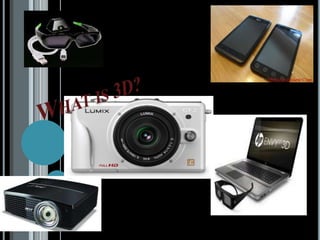
What is 3D?
What is 3D?three-dimensional, width, height and depth (length).Our physical environment is three-dimensional and we move around in 3D every day.3D perception, also known as depth perceptionthe retina in each eye forms a two-dimensional image of our surroundings and our brain processes these two images into a 3D visual experience.
What is 3D(stereoscopic vision or binoculars) is not the only way to see in 3D. with one eye (monocular vision) can still perceive the world in 3D,
They are simply missing one of the tools to see in 3D, Stereoscopic vision:Accommodation: ParallaxSize familiarity: Aerial perspective:
3D world on a flat (2D) surfaceaerial perspective and familiarity size (video camera). CGI scenes, aerial perspective so that MUST be added Distant objects appear less clearly (this is Called distance fog).
 Display common methods include:Anaglyphic processing (red / cyan glasses):Polarized light system (polarized filter glasses):Active shutter system (LCD shutter glasses):
The Earliest Forms of 3D Technologymid-19th century, Charles Wheatstone In the late 19th and early 20th century1930s, stereoscope was a popular novelty in bars and arcades
Advantageswill make your eyes create some illusion of depth thus,imbalance and disorientation

3 d laptop

  • 1.
    Toshiba unveils world'sfirst glassless 3D laptop, Qosmio F750
  • 3.
  • 4.
  • 6.
    The F750-10Q alsocomes with a webcam that tracks user eye position and displays slightly different pictures to each eye to create a very peculiar 3D effect
  • 8.
  • 9.
    What is 3D?three-dimensional,width, height and depth (length).Our physical environment is three-dimensional and we move around in 3D every day.3D perception, also known as depth perceptionthe retina in each eye forms a two-dimensional image of our surroundings and our brain processes these two images into a 3D visual experience.
  • 10.
    What is 3D(stereoscopicvision or binoculars) is not the only way to see in 3D. with one eye (monocular vision) can still perceive the world in 3D,
  • 11.
    They are simplymissing one of the tools to see in 3D, Stereoscopic vision:Accommodation: ParallaxSize familiarity: Aerial perspective:
  • 12.
    3D world ona flat (2D) surfaceaerial perspective and familiarity size (video camera). CGI scenes, aerial perspective so that MUST be added Distant objects appear less clearly (this is Called distance fog).
  • 13.
     Display common methodsinclude:Anaglyphic processing (red / cyan glasses):Polarized light system (polarized filter glasses):Active shutter system (LCD shutter glasses):
  • 14.
    The Earliest Formsof 3D Technologymid-19th century, Charles Wheatstone In the late 19th and early 20th century1930s, stereoscope was a popular novelty in bars and arcades
  • 15.
    Advantageswill make youreyes create some illusion of depth thus,imbalance and disorientation