IDEOLOGIES OF GLOBALIZATION
by
Manfred B. Steger
Department of Politics and Government
Illinois State University
Objectives of this presentation:
• To establish that Globalization is not just an ideology, but a mature
one which dominates “The Contemporary World” (TCW);
• To present the 6 Core Claims of the Ideology of “Globalism” based
on the Article, “Ideologies of Globalization” by Manfred B. Steger;
• To conduct a “thought exercise” designed to bring the insights
gained to bear on the role of TCW teacher.
Since its earliest appearance in the 1960s,
‘globalization’ has been used in both popular and
academic literature to describe a wide variety of
phenomena, including a process, a condition, a system,
a force, and an age. Given the different meanings of
these concepts, their indiscriminate usage invites
confusion.
Globality
The term globality signifies a future social condition
characterized by thick economic, political, and cultural
interconnections and global flows that make currently
existing political borders and economic barriers irrelevant.
Globality
It should not be assumed that ‘globality’ refers to a
determinate endpoint that precludes any further
development. Rather, this concept points to a particular
social condition destined to give way to new, qualitatively
distinct, constellations.
What is an Ideology?
• set of ideas
• committed to attain an ideal state
• through an organized political action
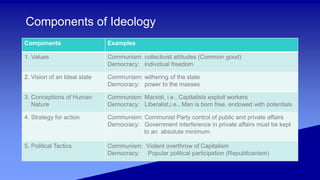
Components of Ideology
Components Examples
1. Values Communism: collectivist attitudes (Common good)
Democracy: individual freedom
2. Vision of an Ideal state Communism: withering of the state
Democracy: power to the masses
3. Conceptions of Human
Nature
Communism: Marxist, i.e., Capitalists exploit workers
Democracy: Liberalist,i.e., Man is born free, endowed with potentials
4. Strategy for action Communism: Communist Party control of public and private affairs
Democracy: Government interference in private affairs must be kept
to an absolute minimum.
5. Political Tactics Communism: Violent overthrow of Capitalism
Democracy: Popular political participation (Republicanism)
“Theories of Globalization” by Manfred B. Steger
Main Issues of the Article
• Is Globalization an Ideology or just a Process or
Condition ?
• Is “Globalism” a mature Ideology?
Criteria for a mature Ideology
- Michael Freeden
Degree of:
1. Uniqueness and morphological sophistication
2. Ability to produce effective context-bound
responsiveness to a broad range of political issues
3. Conceptual decontestation chain
***According to Steger, Globalization has reached maturity as
an Ideology (globalism) as seen in its 6 Core Claims.
Claim 1: “Globalization” is about “liberalization” and
“global integration of Markets”.
 “Liberalization is liberation of markets from state
control.” The only role of government is to get out of the way - to remove barriers to
the free flow of goods, services and capital. (Neo-liberalism)
 “Integration of markets” is opening the country's
economy to free trade and competition
(shrinking in time and space -uniqueness of globalism)
regardless of the political and cultural preferences of
the local citizens. (Globalization vs Indigenization ?)
Clain 2: Globalization is inevitable and irreversible
• Determinist terms of globalization: inevitable, inexorable,
irresistible, irreversible
‘Globalization is inevitable and inexorable and it is
accelerating .... Globalization is happening, it’s going to
happen. It does not matter whether you like it or not, it’s
happening, it’s going to happen’.
Frederick W. Smith, chairman and CEO of FedEx Corporation
“...it is the reality of the modern world”
Manny Villar
Globalization (global free market) is “providential” .
(a natural force for human survival)
Political implications:
 Political leaders simply carry out what is demanded by
Globalization
Claim 3: Nobody is in charge of Globalization
Globalization is ‘self-regulating market’
“Globalists” do not dictate.
 in the sense of imposing their own political agenda on
people
Globalization is not controlled by any individual, government
or institution
Claim 4: Globalization benefits everyone
(...in the long run)
1996 G-7 Summit
“Economic growth and progress in today’s interdependent world is bound up with the
process of globalization. Globalization provides great opportunities for the future, not only for
our countries, but for all others too. Its many positive aspects include an unprecedented
expansion of investment and trade; the opening up to international trade of the world’s most
populous regions and opportunities for more developing countries to improve their standards
of living; the increasingly rapid dissemination of information, technological innovation, and
the proliferation of skilled jobs. These characteristics of globalization have led to a
considerable expansion of wealth and prosperity in the world. Hence we are convinced that
the process of globalization is a source of hope for the future.”
Claim 4: Globalization benefits everyone
(...in the long run)
1996 G-7 Summit
• expansion of investment and trade
• opening up to international trade of the world's most
populous regions and opportunities for more developing
countries to improve their standards of living
• increasingly rapid dissemination of information
• technological innovation
• proliferation of skilled jobs
9-11 was the greatest challenge to globalization
• Globalization shifted from economic globalism to military
globalism.
• US President Bush: “Free trade and free markets have
lifted the whole societies out of poverty - so the US will
work with individual nations, entire regions, and the global
trading community to build a world that trades in
FREEDOM and therefore grows in PROSPERITY.”
Claim 5: Globalization furthers the spread of
Democracy in the world
• Democracy is synonymous to freedom, free markets, free
trade
• Level of economic development is correlated to a
successful democracy.
globalization econ dev Middle class = Democracy
But...
• Globalism limits the definition of Democracy by
emphasizing procedures (ex. voting), at the expense of
Direct participation.
• “Polyarchy” - the rule of the elected elite minorities; Voting
in elections is the only political participation of the citizens
vs
• Popular Democracy - political and economic power in the
hands of the masses
Claim 6: Globalization requires a global war on
terror
Like the previous claims, this final decontestation
chain attests to globalism’s political responsiveness and
conceptual flexibility. It combines the idea of economic
globalization with openly militaristic and nationalistic ideas
associated with the American-led global War on Terror
Claim 6: Globalization requires a global war on
terror
Logical contradictions of the claim
1. war on terror undermines the idea of “self-regulating
market” and historical 'inevitability'
2. enforcing democracy and freedom at gunpoint
conflicts with “liberty as absence of coercion.”
3. Anglo-american war on terror contradicts the
cosmopolitan, universal concept of globalization
New distinct regions of the world - by T.P.M. Barnett
I. Functioning Core or Core - globalization is thick of...
 network connectivity, financial transactions, liberal media
flows, collective security, transparency, rising standards
of living, more deaths by suicide than murder
 NAmerica, most of Europe, Australia, New Zealand,small
part of Latin America
II. Globalization is thinning or absent
 plagued by repressive political regimes, regulated
markets, mass murder, widespread poverty and disease
 Carribean rim, all of Africa, the Balkans, the Caucasus,
Central Asia, China, Middle East, much of SEAsia
III. Non-Integrating Gap or Gap
 breeding ground of global terrorists
 Middle East countries
• “Seam States” - those which lie along the Gap's bloody
boundaries
 Mexico, Brazil, SAfrica, Morocco, Algeria, Greece,
Turkey, Pakistan, Thailand, Malaysia, Indonesia, and
PHILIPPINES
Why war on terror?
• To increase the Core's immune system capabilities to
respond to 9-11 like perturbations
• To work on the Seam states to firewall the Core from
Gap's worst exports: terror, drugs, pandemics
• To Shrink the Gap...the middle east is the perfect place to
start
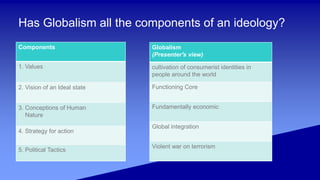
Has Globalism all the components of an ideology?
Components
1. Values
2. Vision of an Ideal state
3. Conceptions of Human
Nature
4. Strategy for action
5. Political Tactics
Globalism
(Presenter's view)
cultivation of consumerist identities in
people around the world
Functioning Core
Fundamentally economic
Global integration
Violent war on terrorism
How is it to be a “globalized” TCW Educator?
My Challenge:
For your Activity:
• Questions for group discussion:
• What shift/s or changes should happen
among teachers of the contemporary world in terms of:
1. System of Thought or Cognition
2. Capabilities and Skills
3. Attitudes and Behaviors
2-IDEOLOGIES-OF-GLOBALIZATION.pptx

2-IDEOLOGIES-OF-GLOBALIZATION.pptx

  • 1.
    IDEOLOGIES OF GLOBALIZATION by ManfredB. Steger Department of Politics and Government Illinois State University
  • 2.
    Objectives of thispresentation: • To establish that Globalization is not just an ideology, but a mature one which dominates “The Contemporary World” (TCW); • To present the 6 Core Claims of the Ideology of “Globalism” based on the Article, “Ideologies of Globalization” by Manfred B. Steger; • To conduct a “thought exercise” designed to bring the insights gained to bear on the role of TCW teacher.
  • 3.
    Since its earliestappearance in the 1960s, ‘globalization’ has been used in both popular and academic literature to describe a wide variety of phenomena, including a process, a condition, a system, a force, and an age. Given the different meanings of these concepts, their indiscriminate usage invites confusion.
  • 4.
    Globality The term globalitysignifies a future social condition characterized by thick economic, political, and cultural interconnections and global flows that make currently existing political borders and economic barriers irrelevant.
  • 5.
    Globality It should notbe assumed that ‘globality’ refers to a determinate endpoint that precludes any further development. Rather, this concept points to a particular social condition destined to give way to new, qualitatively distinct, constellations.
  • 6.
    What is anIdeology? • set of ideas • committed to attain an ideal state • through an organized political action
  • 7.
    Components of Ideology ComponentsExamples 1. Values Communism: collectivist attitudes (Common good) Democracy: individual freedom 2. Vision of an Ideal state Communism: withering of the state Democracy: power to the masses 3. Conceptions of Human Nature Communism: Marxist, i.e., Capitalists exploit workers Democracy: Liberalist,i.e., Man is born free, endowed with potentials 4. Strategy for action Communism: Communist Party control of public and private affairs Democracy: Government interference in private affairs must be kept to an absolute minimum. 5. Political Tactics Communism: Violent overthrow of Capitalism Democracy: Popular political participation (Republicanism)
  • 8.
    “Theories of Globalization”by Manfred B. Steger Main Issues of the Article • Is Globalization an Ideology or just a Process or Condition ? • Is “Globalism” a mature Ideology?
  • 9.
    Criteria for amature Ideology - Michael Freeden Degree of: 1. Uniqueness and morphological sophistication 2. Ability to produce effective context-bound responsiveness to a broad range of political issues 3. Conceptual decontestation chain ***According to Steger, Globalization has reached maturity as an Ideology (globalism) as seen in its 6 Core Claims.
  • 11.
    Claim 1: “Globalization”is about “liberalization” and “global integration of Markets”.  “Liberalization is liberation of markets from state control.” The only role of government is to get out of the way - to remove barriers to the free flow of goods, services and capital. (Neo-liberalism)  “Integration of markets” is opening the country's economy to free trade and competition (shrinking in time and space -uniqueness of globalism) regardless of the political and cultural preferences of the local citizens. (Globalization vs Indigenization ?)
  • 12.
    Clain 2: Globalizationis inevitable and irreversible • Determinist terms of globalization: inevitable, inexorable, irresistible, irreversible ‘Globalization is inevitable and inexorable and it is accelerating .... Globalization is happening, it’s going to happen. It does not matter whether you like it or not, it’s happening, it’s going to happen’. Frederick W. Smith, chairman and CEO of FedEx Corporation
  • 13.
    “...it is thereality of the modern world” Manny Villar Globalization (global free market) is “providential” . (a natural force for human survival) Political implications:  Political leaders simply carry out what is demanded by Globalization
  • 14.
    Claim 3: Nobodyis in charge of Globalization Globalization is ‘self-regulating market’ “Globalists” do not dictate.  in the sense of imposing their own political agenda on people Globalization is not controlled by any individual, government or institution
  • 15.
    Claim 4: Globalizationbenefits everyone (...in the long run) 1996 G-7 Summit “Economic growth and progress in today’s interdependent world is bound up with the process of globalization. Globalization provides great opportunities for the future, not only for our countries, but for all others too. Its many positive aspects include an unprecedented expansion of investment and trade; the opening up to international trade of the world’s most populous regions and opportunities for more developing countries to improve their standards of living; the increasingly rapid dissemination of information, technological innovation, and the proliferation of skilled jobs. These characteristics of globalization have led to a considerable expansion of wealth and prosperity in the world. Hence we are convinced that the process of globalization is a source of hope for the future.”
  • 16.
    Claim 4: Globalizationbenefits everyone (...in the long run) 1996 G-7 Summit • expansion of investment and trade • opening up to international trade of the world's most populous regions and opportunities for more developing countries to improve their standards of living • increasingly rapid dissemination of information • technological innovation • proliferation of skilled jobs
  • 17.
    9-11 was thegreatest challenge to globalization • Globalization shifted from economic globalism to military globalism. • US President Bush: “Free trade and free markets have lifted the whole societies out of poverty - so the US will work with individual nations, entire regions, and the global trading community to build a world that trades in FREEDOM and therefore grows in PROSPERITY.”
  • 18.
    Claim 5: Globalizationfurthers the spread of Democracy in the world • Democracy is synonymous to freedom, free markets, free trade • Level of economic development is correlated to a successful democracy. globalization econ dev Middle class = Democracy
  • 19.
    But... • Globalism limitsthe definition of Democracy by emphasizing procedures (ex. voting), at the expense of Direct participation. • “Polyarchy” - the rule of the elected elite minorities; Voting in elections is the only political participation of the citizens vs • Popular Democracy - political and economic power in the hands of the masses
  • 20.
    Claim 6: Globalizationrequires a global war on terror Like the previous claims, this final decontestation chain attests to globalism’s political responsiveness and conceptual flexibility. It combines the idea of economic globalization with openly militaristic and nationalistic ideas associated with the American-led global War on Terror
  • 21.
    Claim 6: Globalizationrequires a global war on terror Logical contradictions of the claim 1. war on terror undermines the idea of “self-regulating market” and historical 'inevitability' 2. enforcing democracy and freedom at gunpoint conflicts with “liberty as absence of coercion.” 3. Anglo-american war on terror contradicts the cosmopolitan, universal concept of globalization
  • 22.
    New distinct regionsof the world - by T.P.M. Barnett I. Functioning Core or Core - globalization is thick of...  network connectivity, financial transactions, liberal media flows, collective security, transparency, rising standards of living, more deaths by suicide than murder  NAmerica, most of Europe, Australia, New Zealand,small part of Latin America
  • 23.
    II. Globalization isthinning or absent  plagued by repressive political regimes, regulated markets, mass murder, widespread poverty and disease  Carribean rim, all of Africa, the Balkans, the Caucasus, Central Asia, China, Middle East, much of SEAsia
  • 24.
    III. Non-Integrating Gapor Gap  breeding ground of global terrorists  Middle East countries • “Seam States” - those which lie along the Gap's bloody boundaries  Mexico, Brazil, SAfrica, Morocco, Algeria, Greece, Turkey, Pakistan, Thailand, Malaysia, Indonesia, and PHILIPPINES
  • 25.
    Why war onterror? • To increase the Core's immune system capabilities to respond to 9-11 like perturbations • To work on the Seam states to firewall the Core from Gap's worst exports: terror, drugs, pandemics • To Shrink the Gap...the middle east is the perfect place to start
  • 27.
    Has Globalism allthe components of an ideology? Components 1. Values 2. Vision of an Ideal state 3. Conceptions of Human Nature 4. Strategy for action 5. Political Tactics Globalism (Presenter's view) cultivation of consumerist identities in people around the world Functioning Core Fundamentally economic Global integration Violent war on terrorism
  • 28.
    How is itto be a “globalized” TCW Educator? My Challenge:
  • 29.
    For your Activity: •Questions for group discussion: • What shift/s or changes should happen among teachers of the contemporary world in terms of: 1. System of Thought or Cognition 2. Capabilities and Skills 3. Attitudes and Behaviors