Update on Hydraulic Fracturing:
Preparing for “Gasland 2”

Presentation to Canadian Bar Association In-House Counsel Sub-section
November 22, 2012


    Presented by:
    Alex MacWilliam
    403 268 2090
    alex.macwilliam@fmc-law.com
Overview

• The Context
• The Process
• Legislative and Regulatory Management of Key Issues
    –   Fracture Fluid Disclosure
    –   Well Integrity
    –   Water Usage
    –   Waste Disposal by Injection
• Fracturing Litigation – Liability Issues
• Lessons/Trends


                                                        2
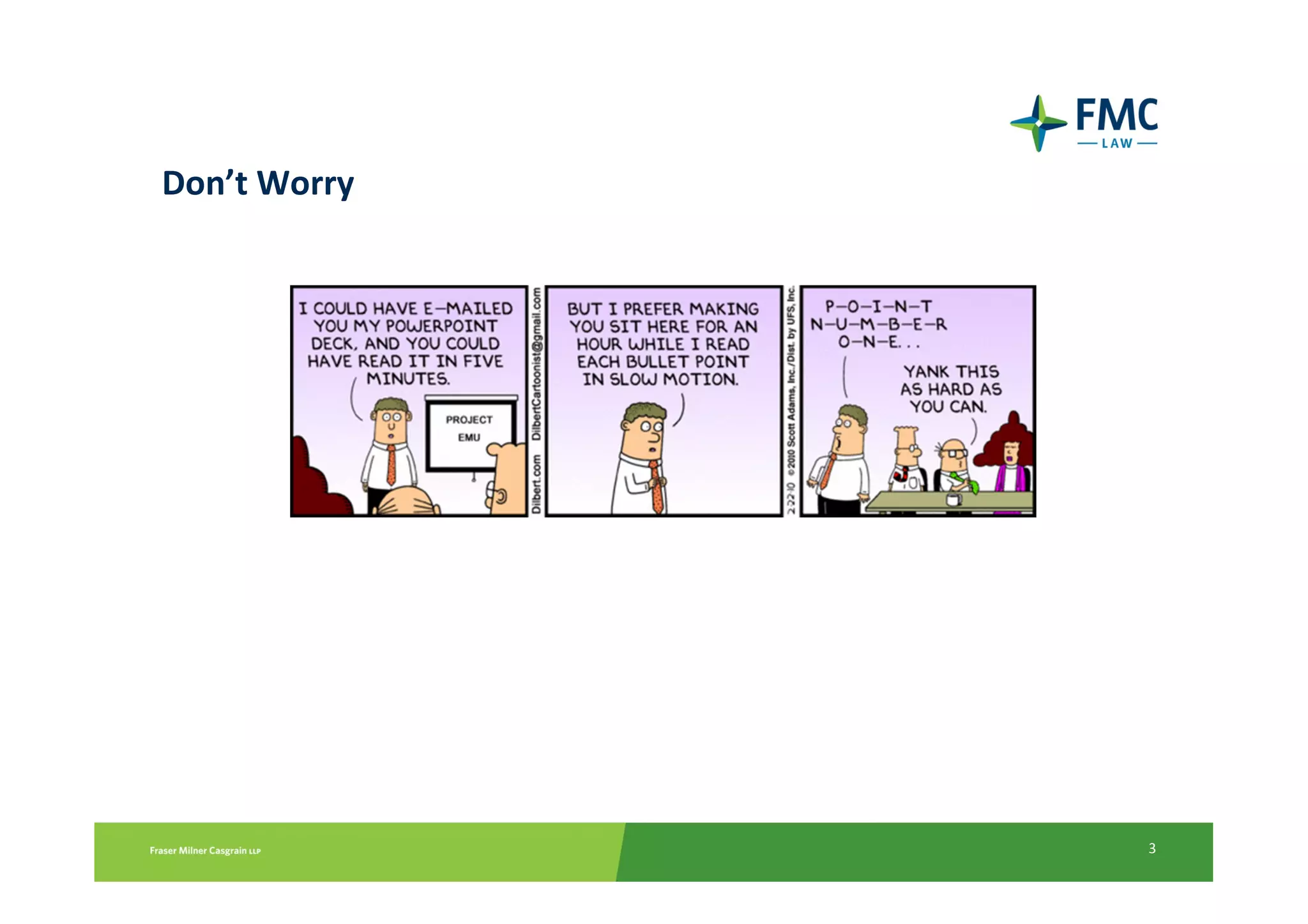
Don’t Worry


              3
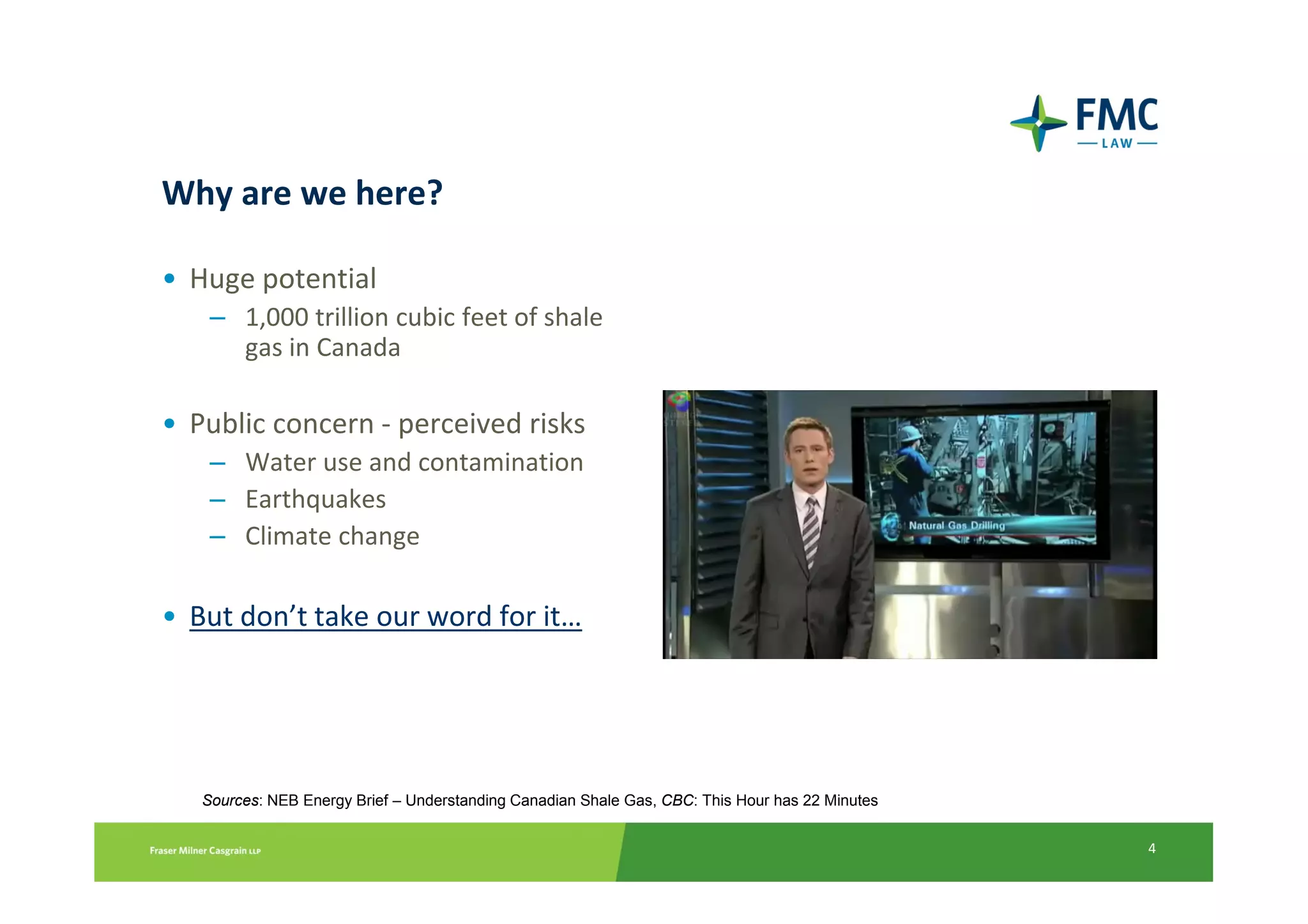
Why are we here?

• Huge potential
    – 1,000 trillion cubic feet of shale
      gas in Canada

• Public concern - perceived risks
    – Water use and contamination
    – Earthquakes
    – Climate change

• But don’t take our word for it…


   Sources: NEB Energy Brief – Understanding Canadian Shale Gas, CBC: This Hour has 22 Minutes


                                                                                                 4
Public Perception
• Industry not out in front of the issue
   – Gasland
   – Gasland 2 to be released soon
   – Hollywood is also getting on the anti-fracking bandwagon
       • Promised Land


                                                                5
The Context

• Huge deposits of oil and natural gas in low porosity/low permeability
  formations
• Combination of two existing technologies – horizontal drilling and hydraulic
  fracturing – allows for economic production of these resources
• Vertical wells vs. Horizontal wells – horizontal drilling allows for far greater
  exposure to the productive formation
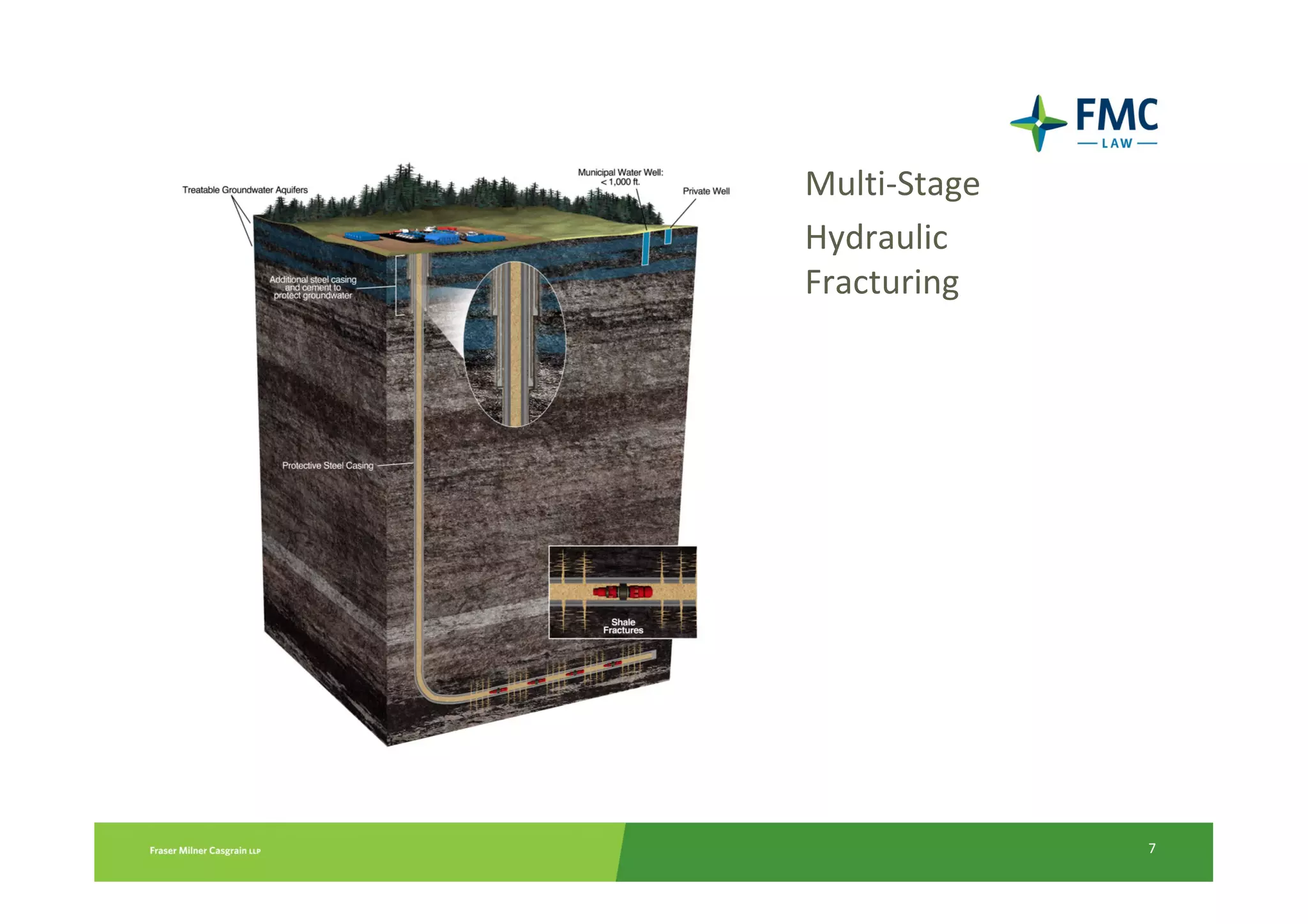
• Multi-stage hydraulic fracturing creates multiple artificial pathways to the
  wellbore and thus vastly increases recovery rates of the resource


                                                                                     6
Multi-Stage
Hydraulic
Fracturing


              7
The Process

• Hydraulic fracturing operations generally involve four steps:
   – Injecting fluids into the formation to pressurize the rock
   – Initiating and increasing fractures or fissures in the reservoir rock to create
     pathways from the wellbore into the formation to allow hydrocarbons to flow
   – Pumping sand or other “proppant” into the newly created fissures to prop
     open these pathways
   – Recovering back the fracturing fluid to surface and allowing hydrocarbons to
     flow to the wellbore


                                                                                       8
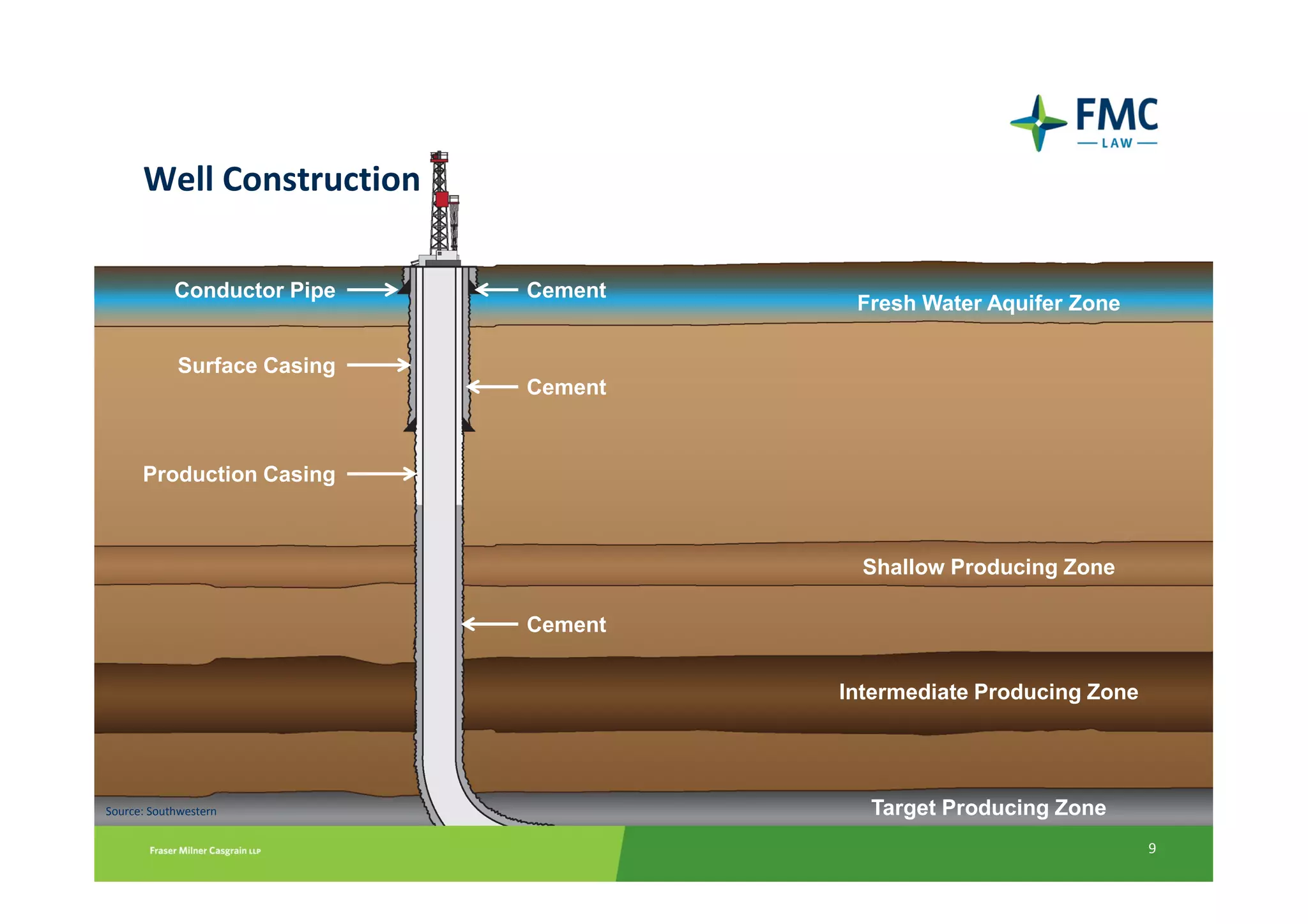
Well Construction

            Conductor Pipe   Cement
                                       Fresh Water Aquifer Zone

            Surface Casing
                             Cement


      Production Casing


                                        Shallow Producing Zone

                             Cement


                                      Intermediate Producing Zone


Source: Southwestern                    Target Producing Zone
                                                                    9
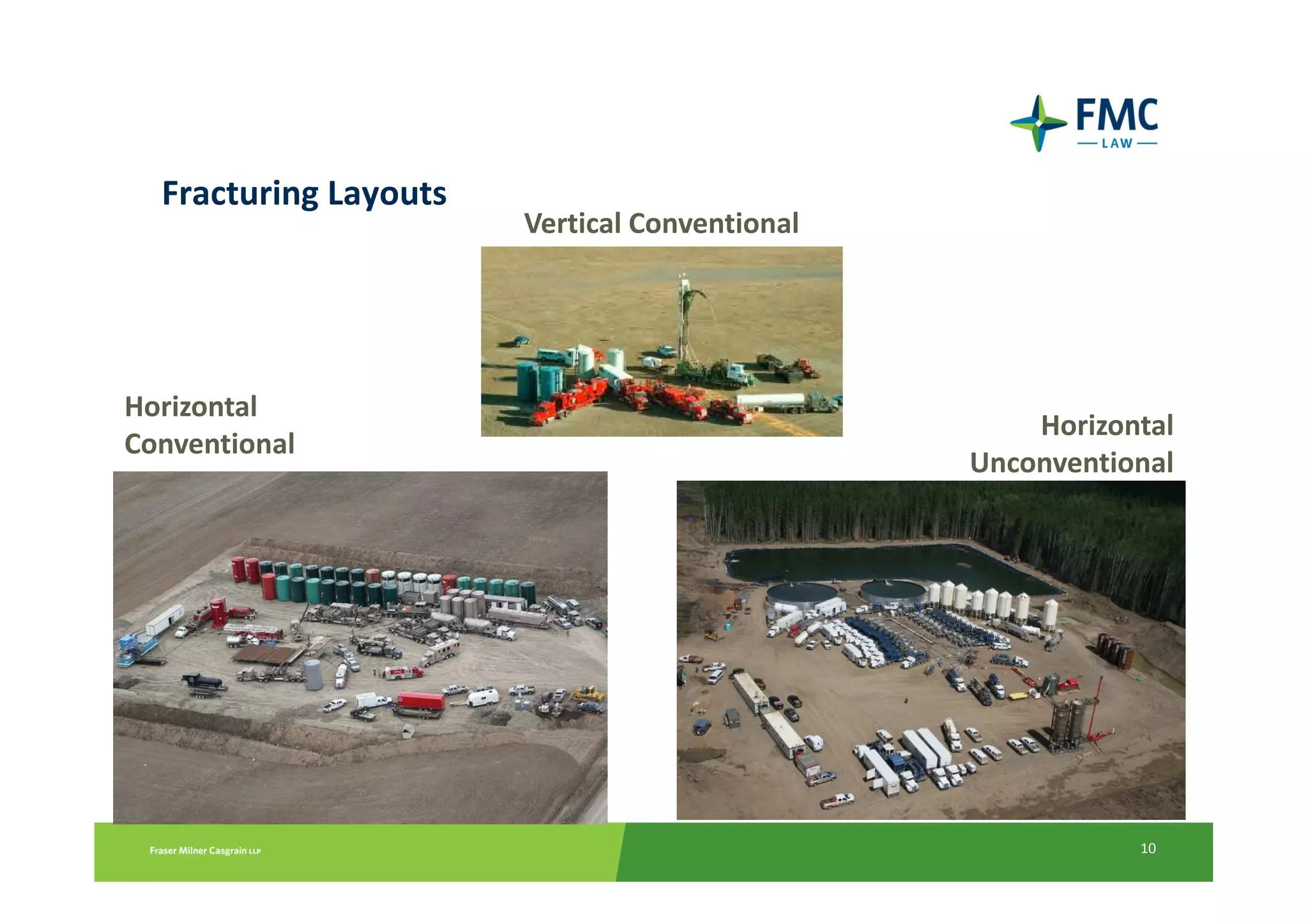
Fracturing Layouts
                       Vertical Conventional


Horizontal
                                                   Horizontal
Conventional
                                               Unconventional


                                                          10
Legislative and Regulatory Management of Key Issues

• Increase in horizontal multi-stage fracturing operations has led to
  enhanced scrutiny of issues including:
   –   fracture fluid constituents (i.e.disclosure)
   –   well integrity
   –   water usage
   –   waste disposal by injection
• Issues have been recently considered by numerous U.S. and Canadian
  jurisdictions


                                                                        11
Fracture Fluid Disclosure

• Method of Disclosure
   –   Pre-2010 - minimal public access to information
   –   2010-2012 - many jurisdictions start to mandate disclosure
   –   competing models: direct public disclosure vs regulatory disclosure
   –   clear U.S. trend to direct public disclosure
        • http://fracfocus.org
        • numerous states (16) and Federal Bureau of Land Management now require
          disclosure - others are considering it
        • DOE Secretary of Energy Advisory Board Shale Gas Subcommittee has expressed
          support for public disclosure


                                                                                        12
Fracture Fluid Disclosure (con't)

• Method of Disclosure (con't)
   – 2011 BC Regulations - direct public disclosure
        • http://fracfocus.ca/
   – Alberta intends to require direct public disclosure by 2013
        • Currently has non-detailed, regulatory reporting to ERCB
   – CAPP supports direct public disclosure model


                                                                     13
Fracture Fluid Disclosure (con't)

• Degree of Required Disclosure
   – disclosure details vary among jurisdictions
   – U.S. trend – increased detail and rigour in disclosure
        • public interest rationale
   – volumes, compositions, concentrations of additives usually disclosed
        • any ingredients vs “hazardous” ingredients only?
        • formulary disclosure of chemical compounds used in fluid
   – 2011 BC Regulation – detailed disclosure required
   – Alberta – very general disclosure only
        • may change with direct public disclosure requirements


                                                                            14
Fracture Fluid Disclosure (con't)

• Trade Secrets
   – protections recognize legitimacy of competitive advantage concerns of
     industry
        • may also be reflected in required disclosure details
   –   process for claiming trade secret protection varies
   –   challenges may be limited (e.g. Texas)
   –   common exemptions for emergency, medical response
   –   2011 BC Regulations incorporate trade secret protections
        • Defers determination to federal hazardous chemical regulator
   – Alberta may follow same path


                                                                             15
Fracture Fluid Disclosure (con't)

• Timing of Disclosure
   – generally post-operation
        • for “tracking” purposes rather than direct control through permitting
        • allows fluid design flexibility in field
   – Wyoming and New York Proposed Regs are exceptions
        • pre-operation disclosure and approval requirements
   – New York Proposed Regs specifically prohibit deviation
        • field flexibility concern


                                                                                  16
Well Integrity

• Large volumes of fluid are used in fracturing operations, magnifying
  pollution risk
• Well integrity thus critical, closely scrutinized
• Two basic concerns for all wells
   – isolate the internal conduit of the well from the surface and sub-surface
     environment (particularly freshwater aquifers)
   – isolate produced fluid to a production conduit within the well
• All jurisdictions seek to establish minimum standards for casing, cementing,
  ongoing testing/monitoring, and reporting
   – specifics vary among jurisdictions
   – standards and enforcement being reconsidered in fracturing context


                                                                                 17
Well Integrity (con’t)

• Different approaches to regulating well integrity exist along spectrum
   – general/purposive approach (reliance on regulator discretion) vs. detailed
     code
• Trend is toward more prescriptive detail in regulations, increased safety
  requirements
   – DOE “SEAB” Sub-Committee recommendation
• Some U.S. jurisdictions require heightened integrity assurances for
  fractured wells
   – Pennsylvania, New York Proposed Regs.
• BC and Alberta have special rules for shallow fracturing
   – ERCB Directive 059: Well Data and Completion Data Filing Requirements


                                                                                  18
Water Usage

• Fracturing operations may require significant volumes of water
• Permits generally required for withdrawal of ground/surface water
   – Permitting process and degree of oversight/control varies widely by
     jurisdiction
   – In some, applicants required to provide operational details and specific
     justification for use request
• Trend toward more rigorous oversight, monitoring and disclosure
• Metering and reporting of water withdrawal becoming more common
• Recent suggestions to require public disclosure of fracturing water use
   – CAPP
   – DOE “SEAB” Sub-Committee


                                                                                19
Waste Disposal by Injection

• Operators seek to minimize need for fluid disposal by recycling – but some
  fluid will remain in need of disposal
• Means of disposal should not risk contamination of surface/ground water,
  subsurface reservoirs/other wells
• Deep well injection is often preferred method
• Regulation of waste disposal by injection varies by jurisdiction
   – US federal/state regulations: EPA Rules or State “Primacy”
   – Alberta
   – British Columbia


                                                                               20
Waste Disposal by Injection (con't)

• Usual features of injection regulations/standards
   –   Depth requirements
   –   Confined formations
   –   Well construction/integrity standards
   –   Monitoring, reporting requirements
        • disposal well and “area of review” wells
• Nature of regulatory requirements similar across jurisdictions
• U.S. EPA undertaking detailed review and reassessment (2014 reporting)
   – increased standards expected
   – “area of review”, other standards may change


                                                                           21
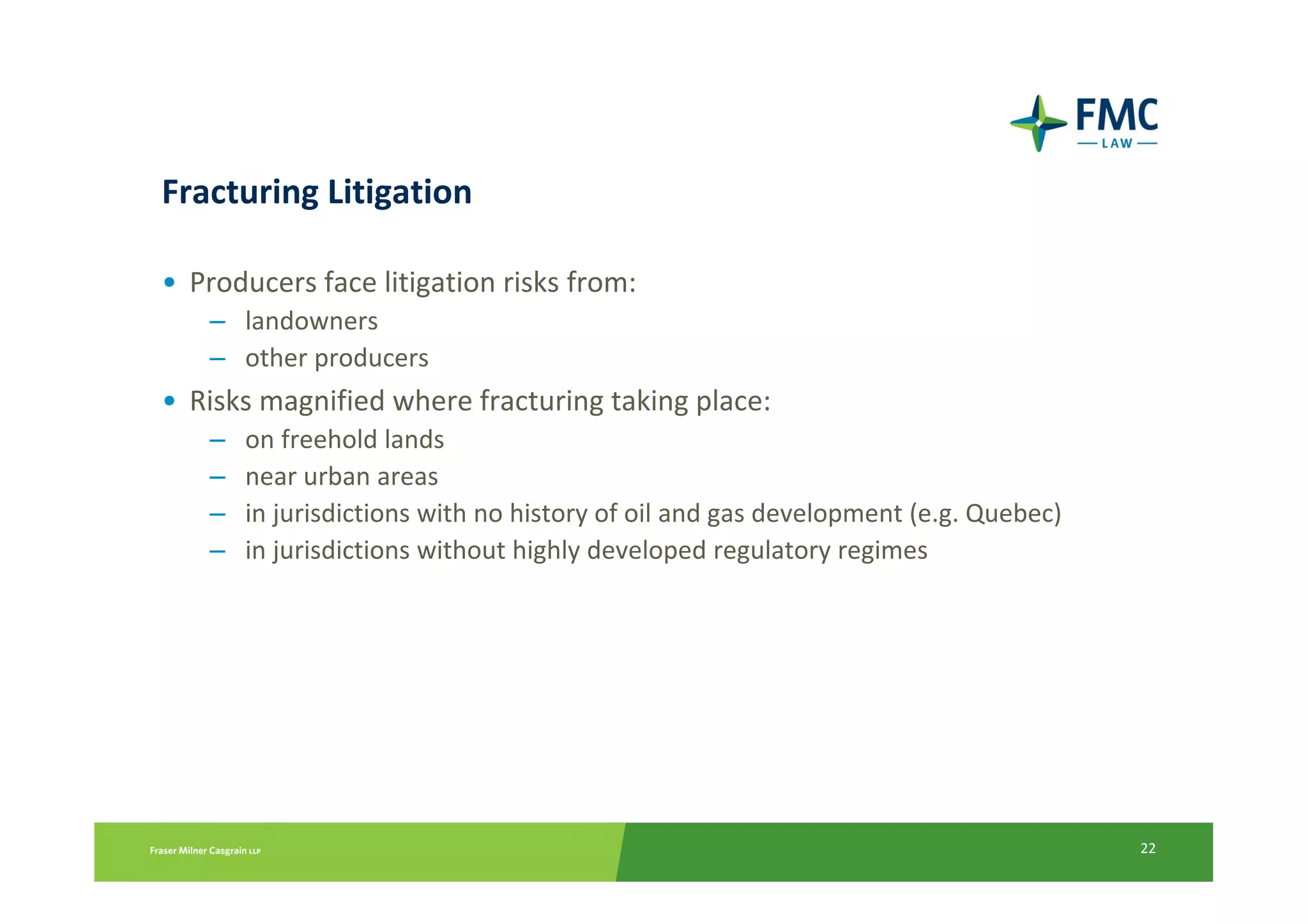
Fracturing Litigation

• Producers face litigation risks from:
   – landowners
   – other producers
• Risks magnified where fracturing taking place:
   –   on freehold lands
   –   near urban areas
   –   in jurisdictions with no history of oil and gas development (e.g. Quebec)
   –   in jurisdictions without highly developed regulatory regimes


                                                                                   22
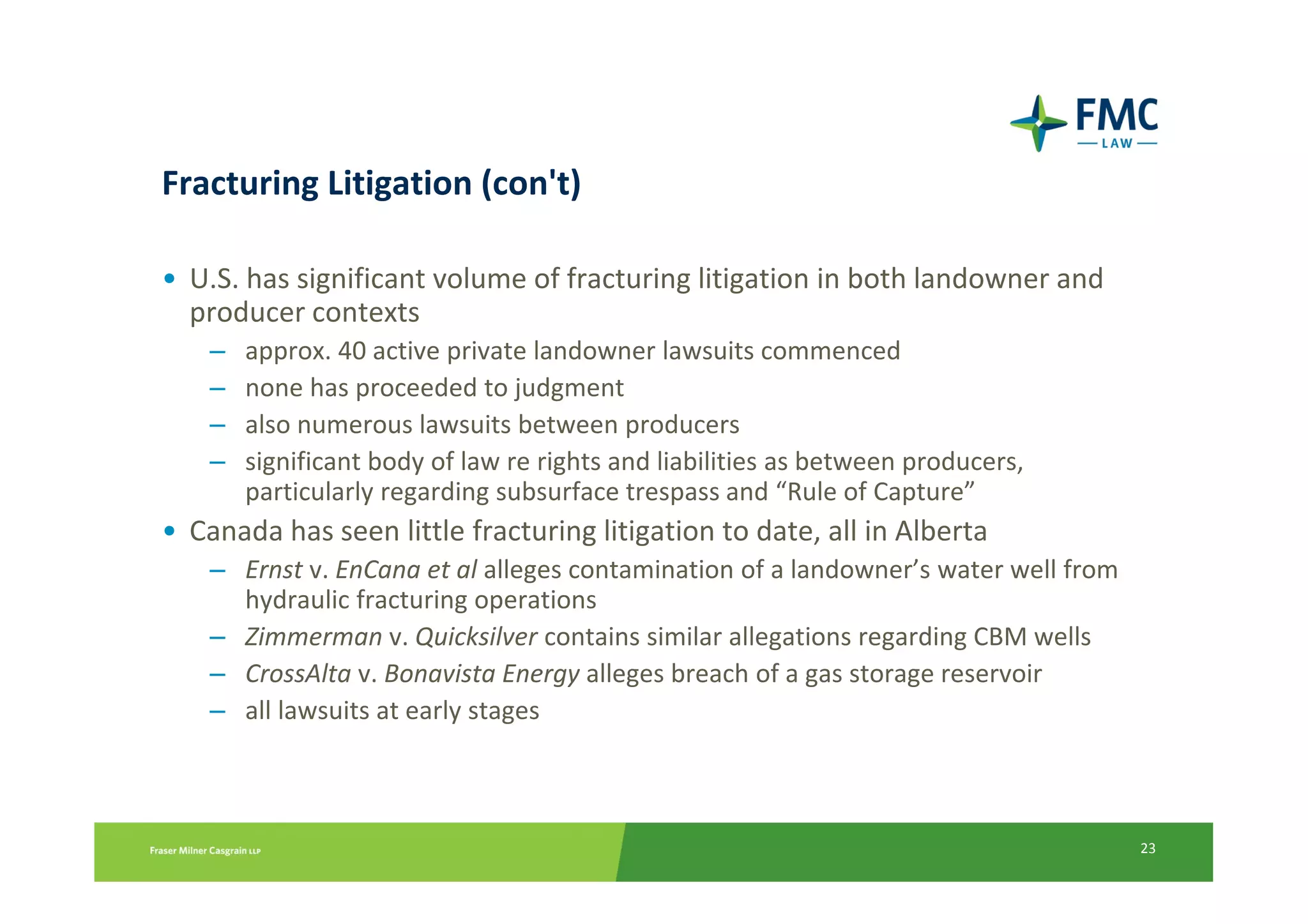
Fracturing Litigation (con't)

• U.S. has significant volume of fracturing litigation in both landowner and
  producer contexts
    –   approx. 40 active private landowner lawsuits commenced
    –   none has proceeded to judgment
    –   also numerous lawsuits between producers
    –   significant body of law re rights and liabilities as between producers,
        particularly regarding subsurface trespass and “Rule of Capture”
• Canada has seen little fracturing litigation to date, all in Alberta
    – Ernst v. EnCana et al alleges contamination of a landowner’s water well from
      hydraulic fracturing operations
    – Zimmerman v. Quicksilver contains similar allegations regarding CBM wells
    – CrossAlta v. Bonavista Energy alleges breach of a gas storage reservoir
    – all lawsuits at early stages


                                                                                     23
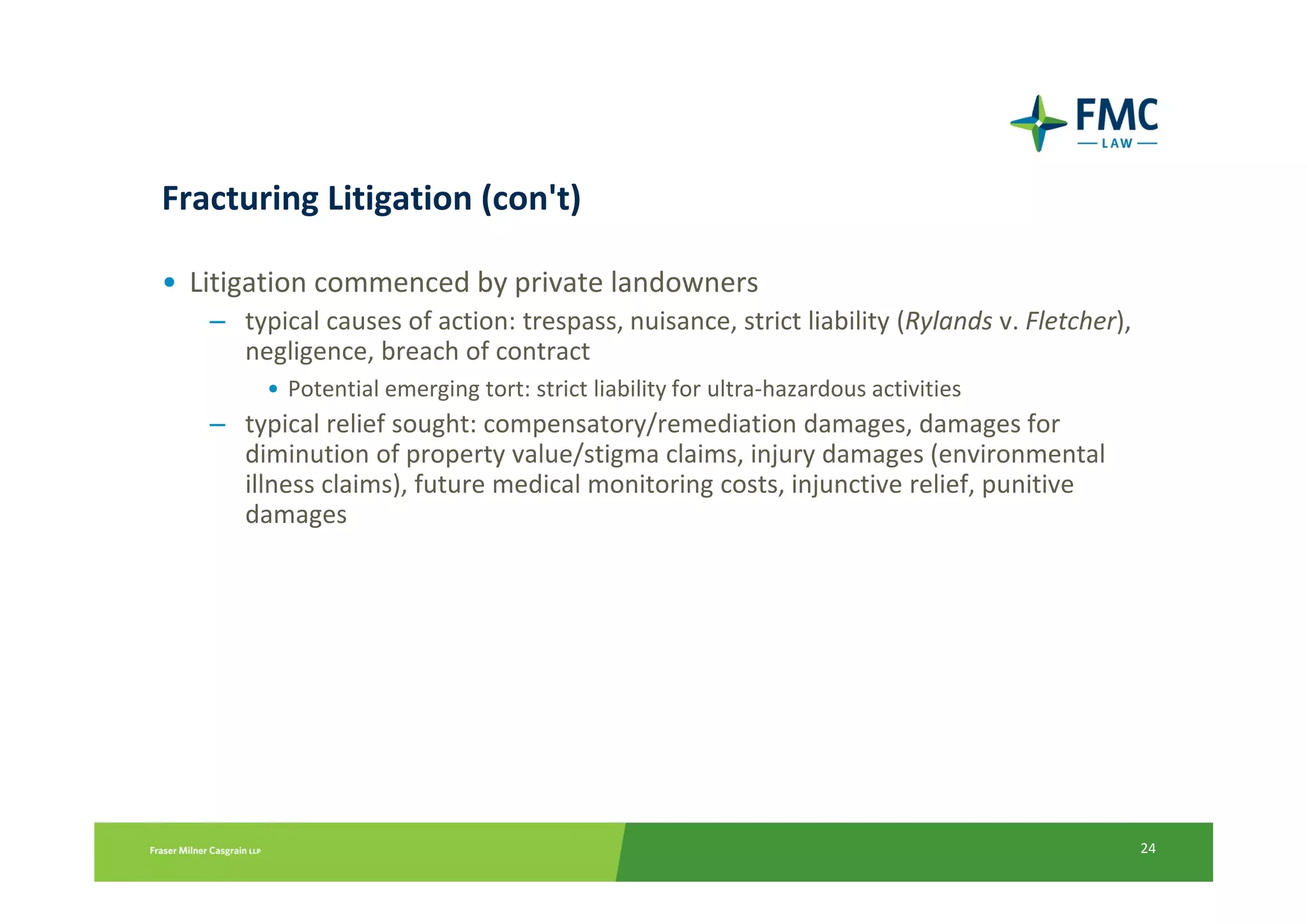
Fracturing Litigation (con't)

• Litigation commenced by private landowners
   – typical causes of action: trespass, nuisance, strict liability (Rylands v. Fletcher),
     negligence, breach of contract
        • Potential emerging tort: strict liability for ultra-hazardous activities
   – typical relief sought: compensatory/remediation damages, damages for
     diminution of property value/stigma claims, injury damages (environmental
     illness claims), future medical monitoring costs, injunctive relief, punitive
     damages


                                                                                             24
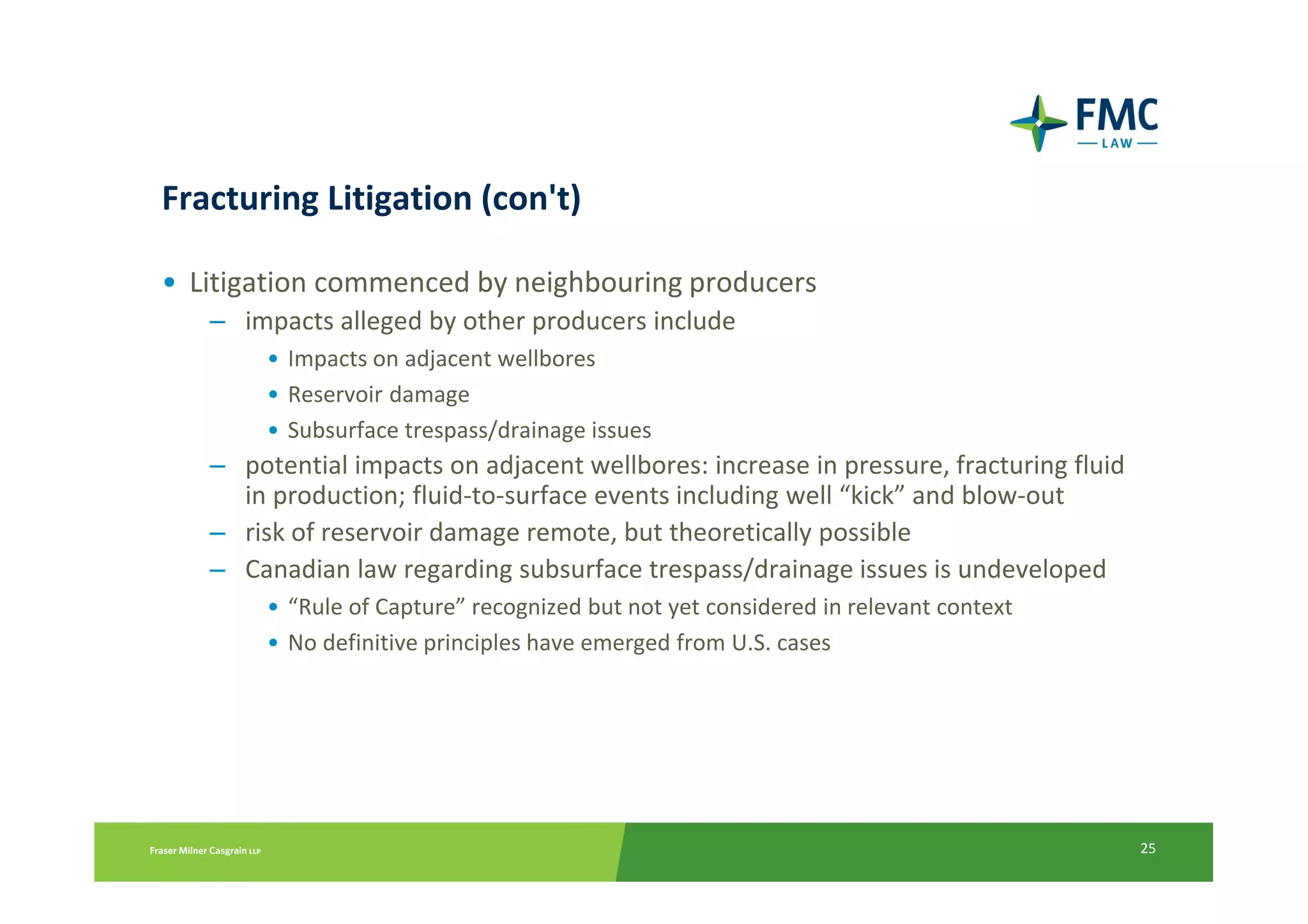
Fracturing Litigation (con't)

• Litigation commenced by neighbouring producers
   – impacts alleged by other producers include
        • Impacts on adjacent wellbores
        • Reservoir damage
        • Subsurface trespass/drainage issues
   – potential impacts on adjacent wellbores: increase in pressure, fracturing fluid
     in production; fluid-to-surface events including well “kick” and blow-out
   – risk of reservoir damage remote, but theoretically possible
   – Canadian law regarding subsurface trespass/drainage issues is undeveloped
        • “Rule of Capture” recognized but not yet considered in relevant context
        • No definitive principles have emerged from U.S. cases


                                                                                       25
Fracturing Litigation (con’t)

• Issues of Proof and Damages
   – Issues of proof may be challenging
       • multiple producers operating in a relatively small area, subsurface “facts”, lack of
         baseline info, multiple exposures over many years
       • fracturing fluid disclosure and baseline environmental assessments may simplify
         these issues
       • effective record keeping and monitoring by producers may be critical to both sides
   – Damages issues also problematic
       • required level of reclamation
       • future monitoring requirements
       • predicting future impacts


                                                                                                26
Recent Canadian Developments
• January 2012 – CAPP releases Hydraulic Fracturing Operating
  Practices guidelines
• August 2012 – BC OGC releases report linking 2009-2011
  fracturing operations in Horn River Basin to seismic events
   – authors also note that more than 8000 high-volume fracturing jobs
     have been done in NE BC with no associated anomalous seismicity
• September 2012 – new PQ Natural Resources Minister says
  Quebec will never allow fracking – despite an ongoing inquiry
• November 20, 2012 – Ontario Government announces it
  requires scientific proof that fracking is safe before it will allow
  it – So what?

                                                                         27
Lessons and Future Trends

• Hydraulic fracturing has been safely conducted in thousands of wells in
  Western Canada, suggesting there are no systemic or inherent risks
  associated with the process
• Proliferation of horizontal multi-stage fracturing operations and
  heightened public scrutiny have resulted in regulatory re-evaluation and
  increased litigation risks for producers
• Fracturing operations will likely be carefully scrutinized going forward, and
  subjected to increasingly rigorous regulation and government oversight
• Guiding principles for legislative/regulatory reforms
   – elevation of best practices
   – enforcement of best practices
   – transparency in operations


                                                                                  28
Lessons and Future Trends

• Producers will be well-served by establishing sound operational practices,
  adhering to or exceeding all regulatory requirements, and undertaking
  effective and detailed monitoring and record keeping
• Producers and industry associations need to increase efforts to “set the
  record straight” about fracturing
   – “Gasland 2” due to air on HBO in 2012 - http://www.gaslandthemovie.com/
   – “FrackNation” now in production - http://fracknation.com/
• International Energy Agency suggests operators follow “golden rule”:
    – measure, disclose, engage


                                                                               29
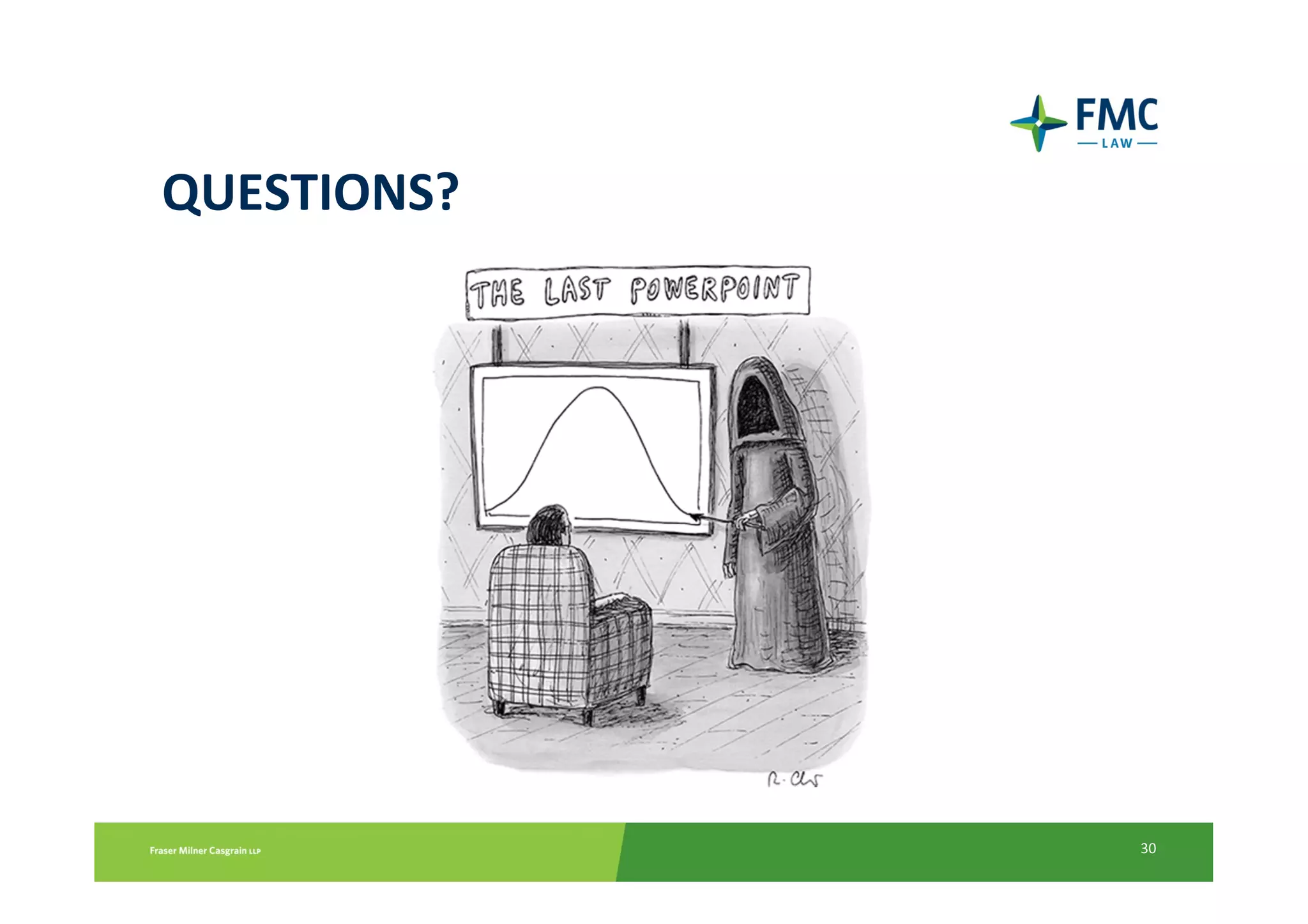
QUESTIONS?


             30
Presented by:
Alex MacWilliam
403 268 2090
alex.macwilliam@fmc-law.com
The preceding presentation contains
examples of the kinds of issues companies
concerned with Hydraulic Fracturing could
face. If you are faced with one of these
issues, please retain professional assistance
as each situation is unique.

Update on Hydraulic Fracturing: Preparing for Gasland 2

  • 1.
    Update on HydraulicFracturing: Preparing for “Gasland 2” Presentation to Canadian Bar Association In-House Counsel Sub-section November 22, 2012 Presented by: Alex MacWilliam 403 268 2090 alex.macwilliam@fmc-law.com
  • 2.
    Overview • The Context •The Process • Legislative and Regulatory Management of Key Issues – Fracture Fluid Disclosure – Well Integrity – Water Usage – Waste Disposal by Injection • Fracturing Litigation – Liability Issues • Lessons/Trends 2
  • 3.
  • 4.
    Why are wehere? • Huge potential – 1,000 trillion cubic feet of shale gas in Canada • Public concern - perceived risks – Water use and contamination – Earthquakes – Climate change • But don’t take our word for it… Sources: NEB Energy Brief – Understanding Canadian Shale Gas, CBC: This Hour has 22 Minutes 4
  • 5.
    Public Perception • Industrynot out in front of the issue – Gasland – Gasland 2 to be released soon – Hollywood is also getting on the anti-fracking bandwagon • Promised Land 5
  • 6.
    The Context • Hugedeposits of oil and natural gas in low porosity/low permeability formations • Combination of two existing technologies – horizontal drilling and hydraulic fracturing – allows for economic production of these resources • Vertical wells vs. Horizontal wells – horizontal drilling allows for far greater exposure to the productive formation • Multi-stage hydraulic fracturing creates multiple artificial pathways to the wellbore and thus vastly increases recovery rates of the resource 6
  • 7.
  • 8.
    The Process • Hydraulicfracturing operations generally involve four steps: – Injecting fluids into the formation to pressurize the rock – Initiating and increasing fractures or fissures in the reservoir rock to create pathways from the wellbore into the formation to allow hydrocarbons to flow – Pumping sand or other “proppant” into the newly created fissures to prop open these pathways – Recovering back the fracturing fluid to surface and allowing hydrocarbons to flow to the wellbore 8
  • 9.
    Well Construction Conductor Pipe Cement Fresh Water Aquifer Zone Surface Casing Cement Production Casing Shallow Producing Zone Cement Intermediate Producing Zone Source: Southwestern Target Producing Zone 9
  • 10.
    Fracturing Layouts Vertical Conventional Horizontal Horizontal Conventional Unconventional 10
  • 11.
    Legislative and RegulatoryManagement of Key Issues • Increase in horizontal multi-stage fracturing operations has led to enhanced scrutiny of issues including: – fracture fluid constituents (i.e.disclosure) – well integrity – water usage – waste disposal by injection • Issues have been recently considered by numerous U.S. and Canadian jurisdictions 11
  • 12.
    Fracture Fluid Disclosure •Method of Disclosure – Pre-2010 - minimal public access to information – 2010-2012 - many jurisdictions start to mandate disclosure – competing models: direct public disclosure vs regulatory disclosure – clear U.S. trend to direct public disclosure • http://fracfocus.org • numerous states (16) and Federal Bureau of Land Management now require disclosure - others are considering it • DOE Secretary of Energy Advisory Board Shale Gas Subcommittee has expressed support for public disclosure 12
  • 13.
    Fracture Fluid Disclosure(con't) • Method of Disclosure (con't) – 2011 BC Regulations - direct public disclosure • http://fracfocus.ca/ – Alberta intends to require direct public disclosure by 2013 • Currently has non-detailed, regulatory reporting to ERCB – CAPP supports direct public disclosure model 13
  • 14.
    Fracture Fluid Disclosure(con't) • Degree of Required Disclosure – disclosure details vary among jurisdictions – U.S. trend – increased detail and rigour in disclosure • public interest rationale – volumes, compositions, concentrations of additives usually disclosed • any ingredients vs “hazardous” ingredients only? • formulary disclosure of chemical compounds used in fluid – 2011 BC Regulation – detailed disclosure required – Alberta – very general disclosure only • may change with direct public disclosure requirements 14
  • 15.
    Fracture Fluid Disclosure(con't) • Trade Secrets – protections recognize legitimacy of competitive advantage concerns of industry • may also be reflected in required disclosure details – process for claiming trade secret protection varies – challenges may be limited (e.g. Texas) – common exemptions for emergency, medical response – 2011 BC Regulations incorporate trade secret protections • Defers determination to federal hazardous chemical regulator – Alberta may follow same path 15
  • 16.
    Fracture Fluid Disclosure(con't) • Timing of Disclosure – generally post-operation • for “tracking” purposes rather than direct control through permitting • allows fluid design flexibility in field – Wyoming and New York Proposed Regs are exceptions • pre-operation disclosure and approval requirements – New York Proposed Regs specifically prohibit deviation • field flexibility concern 16
  • 17.
    Well Integrity • Largevolumes of fluid are used in fracturing operations, magnifying pollution risk • Well integrity thus critical, closely scrutinized • Two basic concerns for all wells – isolate the internal conduit of the well from the surface and sub-surface environment (particularly freshwater aquifers) – isolate produced fluid to a production conduit within the well • All jurisdictions seek to establish minimum standards for casing, cementing, ongoing testing/monitoring, and reporting – specifics vary among jurisdictions – standards and enforcement being reconsidered in fracturing context 17
  • 18.
    Well Integrity (con’t) •Different approaches to regulating well integrity exist along spectrum – general/purposive approach (reliance on regulator discretion) vs. detailed code • Trend is toward more prescriptive detail in regulations, increased safety requirements – DOE “SEAB” Sub-Committee recommendation • Some U.S. jurisdictions require heightened integrity assurances for fractured wells – Pennsylvania, New York Proposed Regs. • BC and Alberta have special rules for shallow fracturing – ERCB Directive 059: Well Data and Completion Data Filing Requirements 18
  • 19.
    Water Usage • Fracturingoperations may require significant volumes of water • Permits generally required for withdrawal of ground/surface water – Permitting process and degree of oversight/control varies widely by jurisdiction – In some, applicants required to provide operational details and specific justification for use request • Trend toward more rigorous oversight, monitoring and disclosure • Metering and reporting of water withdrawal becoming more common • Recent suggestions to require public disclosure of fracturing water use – CAPP – DOE “SEAB” Sub-Committee 19
  • 20.
    Waste Disposal byInjection • Operators seek to minimize need for fluid disposal by recycling – but some fluid will remain in need of disposal • Means of disposal should not risk contamination of surface/ground water, subsurface reservoirs/other wells • Deep well injection is often preferred method • Regulation of waste disposal by injection varies by jurisdiction – US federal/state regulations: EPA Rules or State “Primacy” – Alberta – British Columbia 20
  • 21.
    Waste Disposal byInjection (con't) • Usual features of injection regulations/standards – Depth requirements – Confined formations – Well construction/integrity standards – Monitoring, reporting requirements • disposal well and “area of review” wells • Nature of regulatory requirements similar across jurisdictions • U.S. EPA undertaking detailed review and reassessment (2014 reporting) – increased standards expected – “area of review”, other standards may change 21
  • 22.
    Fracturing Litigation • Producersface litigation risks from: – landowners – other producers • Risks magnified where fracturing taking place: – on freehold lands – near urban areas – in jurisdictions with no history of oil and gas development (e.g. Quebec) – in jurisdictions without highly developed regulatory regimes 22
  • 23.
    Fracturing Litigation (con't) •U.S. has significant volume of fracturing litigation in both landowner and producer contexts – approx. 40 active private landowner lawsuits commenced – none has proceeded to judgment – also numerous lawsuits between producers – significant body of law re rights and liabilities as between producers, particularly regarding subsurface trespass and “Rule of Capture” • Canada has seen little fracturing litigation to date, all in Alberta – Ernst v. EnCana et al alleges contamination of a landowner’s water well from hydraulic fracturing operations – Zimmerman v. Quicksilver contains similar allegations regarding CBM wells – CrossAlta v. Bonavista Energy alleges breach of a gas storage reservoir – all lawsuits at early stages 23
  • 24.
    Fracturing Litigation (con't) •Litigation commenced by private landowners – typical causes of action: trespass, nuisance, strict liability (Rylands v. Fletcher), negligence, breach of contract • Potential emerging tort: strict liability for ultra-hazardous activities – typical relief sought: compensatory/remediation damages, damages for diminution of property value/stigma claims, injury damages (environmental illness claims), future medical monitoring costs, injunctive relief, punitive damages 24
  • 25.
    Fracturing Litigation (con't) •Litigation commenced by neighbouring producers – impacts alleged by other producers include • Impacts on adjacent wellbores • Reservoir damage • Subsurface trespass/drainage issues – potential impacts on adjacent wellbores: increase in pressure, fracturing fluid in production; fluid-to-surface events including well “kick” and blow-out – risk of reservoir damage remote, but theoretically possible – Canadian law regarding subsurface trespass/drainage issues is undeveloped • “Rule of Capture” recognized but not yet considered in relevant context • No definitive principles have emerged from U.S. cases 25
  • 26.
    Fracturing Litigation (con’t) •Issues of Proof and Damages – Issues of proof may be challenging • multiple producers operating in a relatively small area, subsurface “facts”, lack of baseline info, multiple exposures over many years • fracturing fluid disclosure and baseline environmental assessments may simplify these issues • effective record keeping and monitoring by producers may be critical to both sides – Damages issues also problematic • required level of reclamation • future monitoring requirements • predicting future impacts 26
  • 27.
    Recent Canadian Developments •January 2012 – CAPP releases Hydraulic Fracturing Operating Practices guidelines • August 2012 – BC OGC releases report linking 2009-2011 fracturing operations in Horn River Basin to seismic events – authors also note that more than 8000 high-volume fracturing jobs have been done in NE BC with no associated anomalous seismicity • September 2012 – new PQ Natural Resources Minister says Quebec will never allow fracking – despite an ongoing inquiry • November 20, 2012 – Ontario Government announces it requires scientific proof that fracking is safe before it will allow it – So what? 27
  • 28.
    Lessons and FutureTrends • Hydraulic fracturing has been safely conducted in thousands of wells in Western Canada, suggesting there are no systemic or inherent risks associated with the process • Proliferation of horizontal multi-stage fracturing operations and heightened public scrutiny have resulted in regulatory re-evaluation and increased litigation risks for producers • Fracturing operations will likely be carefully scrutinized going forward, and subjected to increasingly rigorous regulation and government oversight • Guiding principles for legislative/regulatory reforms – elevation of best practices – enforcement of best practices – transparency in operations 28
  • 29.
    Lessons and FutureTrends • Producers will be well-served by establishing sound operational practices, adhering to or exceeding all regulatory requirements, and undertaking effective and detailed monitoring and record keeping • Producers and industry associations need to increase efforts to “set the record straight” about fracturing – “Gasland 2” due to air on HBO in 2012 - http://www.gaslandthemovie.com/ – “FrackNation” now in production - http://fracknation.com/ • International Energy Agency suggests operators follow “golden rule”: – measure, disclose, engage 29
  • 30.
  • 31.
    Presented by: Alex MacWilliam 403268 2090 alex.macwilliam@fmc-law.com
  • 32.
    The preceding presentationcontains examples of the kinds of issues companies concerned with Hydraulic Fracturing could face. If you are faced with one of these issues, please retain professional assistance as each situation is unique.