Protecting Your Start‐up Company’s IP … 
Without it, There’s Only One Exit Event.

                   Presented to
                 TEC EDMONTON
                Edmonton, Alberta
                 March 15, 2013

                    Presented by: 
  Rob McDonald, Partner & Marlon Rajakaruna, Partner

                                                       1
INTRODUCTION


               2
•What is intellectual property?
•Attributes of intellectual property;
•Comparison to tangible property;
•Importance of statutes.


                                        3
TYPES OF
INTELLECTUAL PROPERTY


                        4
•Patents
•Industrial Design
•Copyright
•Trade‐mark
•Confidential Information/Trade Secrets
•Plant Breeder’s Rights
•Integrated Circuit Topographies


                                          5
6
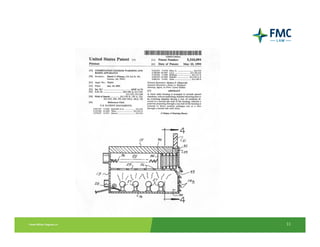
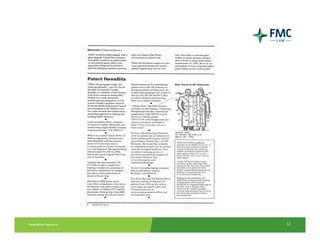
PATENTS


          7
PATENTS
•Patent Act
•Inventions – any new and useful art, process, 
 machine, method of manufacture or 
 composition of matter, or any new and useful 
 improvement thereof
•Novel
•Non‐obvious to a person skilled in the art or 
 science
                                                  8
PATENTS (con’t)

•Public Disclosure – 1 year grace period in 
 Canada and U.S. but fatal in other countries
•Must have registration for protection
•Exclusive rights to make, construct, use and 
 sell the invention – 20 years from filing date, 
 non‐renewable
•First to file – compare to U.S. first to invent 
 America Invents Act will change this
                                                    9
Patents (con’t)


Marking – not required, but penalties for 
 false marking
Filing strategies – PCT filings, foreign 
 filings and Convention Priority


                                              10
11
12
INDUSTRIAL DESIGNS


 Industrial Design Act
 Design of an article – features of shape, 
  configuration, pattern or ornament and any 
  combination of those features that, in a 
  finished article, appeal to and are judged solely 
  by the eye
 Non‐functional elements
                                                   13
INDUSTRIAL DESIGNS (con’t)
 Public Disclosure/publication – must file 
  application within 1 year from first publication
 Must have registration for protection
 Exclusive rights to apply the design to an 
  article for sale
 10 years from registration date – non‐
  renewable
 Marking ‐ Ⓓ ‐ can limit recovery of damages if 
  not properly marked

                                                     14
COPYRIGHT


            15
Copyright
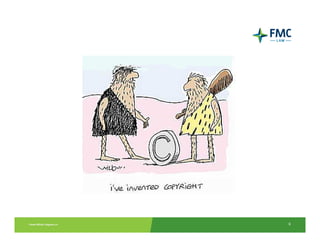
• Copyright Act
• New Copyright Modernization Act (November 7, 
  2012)
• Bundle of rights – produce, reproduce, perform, 
  publish, telecommunicate, rent, moral rights, 
  neighboring rights
• Copyright subsists in every original work
• Works – literary, musical, dramatic, artistic 
  compilations
• No copyright in concepts or ideas, fixation required
                                                         16
Copyright (con’t)

•Registration not necessary for protection
•Advantages to registration – presumptions, 
 innocent infringer defense
•Marking ‐ ©, name of owner and year of 
 creation on publication
•Exclusive rights – 50 years from death of 
 author (creator)
•Moral rights – integrity, authorship
                                               17
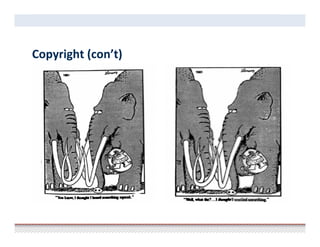
Copyright (con’t)
TRADE‐MARKS


              19
Trade‐marks
• Trade‐marks Act
• Trade‐marks – a mark used to distinguish one 
  competitor’s products and services from those of 
  another
• Words, phrases, logos, shapes of packaging, colours
• ‐non‐traditional marks – sounds, smells, tastes, 3‐D 
  shapes, holograms, moving images, etc.
• Bill C‐56 proposed revisions – “signs”


                                                          20
Trade‐mark (con’t)
•Registration not necessary for protection but 
 scope of protection more narrow for 
 unregistered marks
•Registered vs. unregistered marks
•Exclusive rights ‐ 15 year registration with 
 perpetual renewals
•Rights are based on first use and continued use


                                               21
Trade‐marks (con’t)


•Marking trade‐mark – unregistered ™ or 
 registered ®
•Filing strategies – claiming foreign filings and 
 convention priority


                                                     22
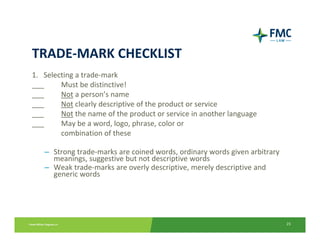
TRADE‐MARK CHECKLIST
1.   Selecting a trade‐mark
___       Must be distinctive!
___       Not a person’s name
___       Not clearly descriptive of the product or service
___       Not the name of the product or service in another language
___       May be a word, logo, phrase, color or 
          combination of these

   – Strong trade‐marks are coined words, ordinary words given arbitrary 
     meanings, suggestive but not descriptive words
   – Weak trade‐marks are overly descriptive, merely descriptive and 
     generic words


                                                                            23
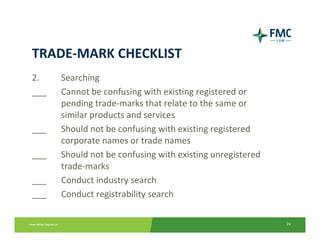
TRADE‐MARK CHECKLIST
2.    Searching
___   Cannot be confusing with existing registered or 
      pending trade‐marks that relate to the same or 
      similar products and services
___   Should not be confusing with existing registered 
      corporate names or trade names
___   Should not be confusing with existing unregistered 
      trade‐marks
___   Conduct industry search
___   Conduct registrability search

                                                            24
TRADE‐MARK CHECKLIST
3. Should you register?  Consider:
___  Exclusive use throughout Canada
___  Importance of product or service
___  Length of use (short term vs. long term)
___  Estimated value of trade‐mark (licensing, 
       merchandising)
___    Ability to enforce trade‐mark rights
___  Strength of trade‐mark


                                                  25
TRADE‐MARK CHECKLIST
4. Registration Details
___  Which entity is using or intends to use the trade‐mark 
        (ownership)?
___  Will the trade‐mark be licensed for use by other entities?
___  What specific products and services are being sold using 
        the trade‐mark?
___     When was the trade‐mark first used in commerce (for 
        services, the date of first advertisement; for products, 
        the date of first sale)


                                                                    26
TRADE‐MARK CHECKLIST
5. Using the trade‐mark
___  Always capitalize at least the first letter of the trade‐
       mark
___  Do not pluralize trade‐marks
___  Do not use trade‐marks as a verb
___  Do not change the appearance of a design trade‐mark
___  Use proper marking (® for registered, TM for 
       unregistered)
___    No generic use of trade‐mark
___  No use of the trade‐mark by others without license and 
       control
___  Monitor in‐house and outside use of the trade‐mark
___  Do not ignore infringements
                                                                 27
28
29
30
Confidential Information and Trade Secrets


•No legislation, rely on common law rights
•Maintaining secrecy and non‐disclosure is key
•Confidentiality and non‐disclosure agreements
•No registration, therefore no expiry of rights
•Fiduciary duties of shareholders, management 
 and employees

                                                  31
TOP 10 IP TRAPS
COPYRIGHT


  1. Ownership claim by     
     employee/independent contractor
  2. Moral rights claims
  3. Substantial similarity not just quantitative
  4. Improper Assignment


                                                    32
TOP 10 IP TRAPS
 TRADE‐MARKS

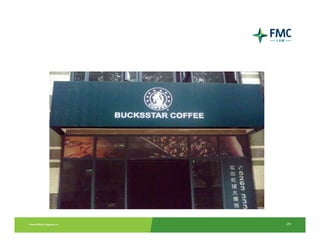
 5. Not registering and being restricted to 
    area of reputation
 6. Assuming rights in corporate names and 
    trade‐names
 7. Adopting non‐distinctive marks
 8. Losing distinctiveness through loss of 
    control and improper licensing

                                               33
TOP 10 IP TRAPS
PATENT


  9. Lack of ownership agreement
  10. Public disclosure


                                   34
OTHER WAYS TO PROTECT IP


                           35
•NDA‘s
•Other Security Measures
•IP Assignment Agreements
•Corporate Structure
•Monitoring Infringement


                            36
NDA’s
• What is a Trade Secret? Confidential information that retains 
  its value by being confidential
   – Software
   – Client Lists 
   – Procedures / methods / recipes
• No statutory rules or protection ‐ any rights or protection 
  comes from contractual arrangements and the common law
• Protection lasts for as long as the secrecy is maintained


                                                                   37
NDA’s WITH THIRD PARTIES
• Confidentiality clauses and non‐disclosure agreements 
  (“NDAs”) are crucial to protecting trade secrets
   – When to use
   – Avoid the mistake of assuming an NDA is “standard” and then execute 
     it without careful review
   – Remember to address oral disclosure of information, information 
     gathered by observation and unmarked information of a confidential 
     or proprietary nature
   – NDAs should ensure that confidential information remains confidential 
     for an appropriate length of time
   – Carve‐outs
   – Watch out for IP ownership provisions
   – It should also address the return of files, client lists, and other 
     information upon termination or expiration of the agreement
                                                                          38
NDA’s WITH EMPLOYEES AND 
CONTRACTORS
• Can use standalone NDA or incorporate as part of EA/ICA
• Remember to address oral disclosure of information, 
  information gathered by observation and information of 
  confidential or proprietary nature
• NDAs should ensure that confidential information remains 
  confidential during term of employment/ services contract and 
  for an appropriate length of time after
• Limit carve‐outs
• It should also address the return of files, client lists, and other 
  information upon termination of employment/services 
  contract
                                                                     39
OTHER SECURITY MEASURES
• Marking of documents can help establish some protection
• Internal security procedures are necessary
   –   Physical and network security
   –   Storage of information
   –   Entry and exit interviews
   –   Disclosing information on a need‐to‐know basis
   –   Proper arrangements with independent contractors


                                                            40
OTHER SECURITY MEASURES (cont’d)
• Trade Secrets cost as much (or as little) to protect as you are 
  willing to invest
• It takes time and money to:
   –   implement proper marking of documents
   –   Physically protect data and networks
   –   Educate employees and contractors
   –   Monitor for misappropriation of trade secrets
   –   Draft non‐disclosure and confidentiality agreements


                                                                     41
IP ASSIGNMENT AGREEMENTS
• At common law, independent contractors and employees own 
  the patent for inventions made in the course of business
   – Exception for employees whose job it is to invent
• Consider whether the common law position needs to be 
  shifted ‐ can be addressed by an IP assignment agreement that 
  transfers ownership to the employer or the business.
• As part of this transfer, ensure all IP developed in the course of 
  employment/services contract is transferred to the 
  employer/business


                                                                    42
IP ASSIGNMENT AGREEMENTS (cont’d)
• IP assignment agreements should deal with a waiver of moral 
  rights to ensure that the IP that can be assigned is assigned, 
  and that moral rights are waived.  
• Confidentiality
• Non‐competition?


                                                                    43
CORPORATE STRUCTURE
• Incorporate
• Use separate legal entity to “own” IP
• License to the various corporate affiliates
• Effective creditor‐proofing
• Caveat: Banks may want security over IP


                                                44
MONITORING INFRINGEMENT
• CIPO is not the IP police – they do not monitor how IP is being 
  used or stop infringement
• You need to devote resources to monitoring for infringement
   – Determine who in the organization will be responsible to monitor
   – Large organizations will have a watch service to continually monitor 
     use of IP
• Cost‐benefit analysis – if it’s really not that valuable, is it worth 
  registering and protecting?


                                                                             45
PROTECTING YOUR IP IN 
COMMERCIAL AGREEMENTS


                          46
•“Sponsor” Initiated Research Agreements
•Researcher Initiated Research Agreements
•License Agreements
•Contractor Agreements


                                            47
“SPONSOR” INITIATED RESEARCH 
AGREEMENTS
• Carve‐outs to Confidentiality
• Background IP
• Other IP developed at the same time under separate research
• Fortuitous discoveries
• License back
• Restrictions on use of names, marks, etc


                                                                48
RESEARCHER INITIATED RESEARCH 
AGREEMENTS
• Confidentiality
• Background IP
• Other IP developed at the same time under separate research
• Fortuitous discoveries
• IP developed in direct performance of research (or at least 
  license‐back)
• Restrictions on publication


                                                                 49
LICENSE AGREEMENTS
• Narrow Scope
• Confidentiality
• Address ownership of new IP
• Restrictions on use of names, marks, etc


                                             50
CONTRACTOR AGREEMENTS
• Confidentiality
• Limit carve‐outs to confidentiality
• Assignment of ownership of work product including IP; waiver 
  of moral rights
• No modification of IP
• Non‐competition?


                                                                  51
Questions?

Rob McDonald, Partner
780 423 7305
rob.mcdonald@fmc‐law.com

Marlon Rajakaruna, Partner
780 423 7281
marlon.rajakaruna@fmc‐law.com
The preceding presentation deals with the kinds of 
   issues companies dealing with the protection of 
intellectual property could face. If you are faced with 
    one of these issues, please retain professional 
        assistance as each situation is unique.

Protecting Your Start-Up Company's IP