PBI – Power Law 2012


  Water Use, Regulation and
           Effects
                October 23, 2012


                  Presented by:
           Christopher M. Roe, Esq.
             croe@foxrothschild.com
Overview

 Water uses associated with
  unconventional gas wells
 Regulatory requirements and

  permits
 Environmental and health effects


                          2
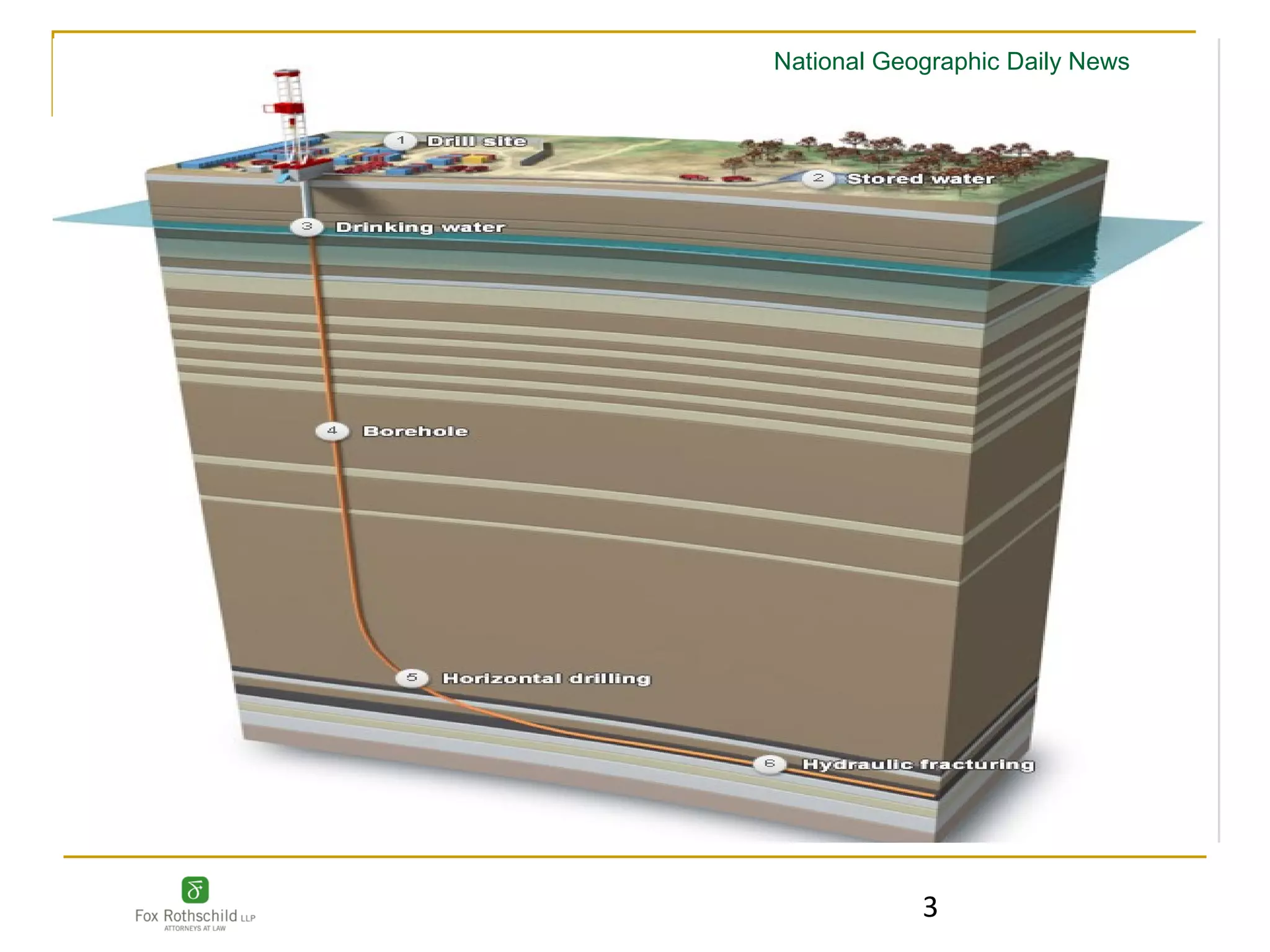
National Geographic Daily News


            3
Water Use/Waste Generation
   Drilling process – 85,000 gallons on average (GAO Sept. 2012)
   Fracturing process – 5.6 million gallons on average (GAO Sept.
    2012); 4.3 million average (SRBC)
   Sources – public water; surface water withdrawals; groundwater
   Recycling and reuse
     Onsite or offsite

     Between 75% and 100% filtered/treated and mixed with fresh water
       for reuse
   Flowback water; formation water; produced water (about 10-15
    percent returns, 60 percent in first 4 days)
     Salts (total dissolved solids), chlorides, bromides, and sulfides of
       calcium, magnesium and sodium
     Metals, barium, manganese, iron, and strontium

     Oil and grease and dissolved organics, such benzene and toluene

     Naturally occurring radioactive materials

     Production chemicals, friction reducers, biocides, corrosion inhibitors


                                                          4
Regulatory Requirements and Permits – Some
Federal Requirements and Exemptions
   40 CFR § 435.32: “there shall be no discharge of waste water pollutants
    into navigable waters from any source associated with production, field
    exploration, drilling, well completion, or well treatment ( i.e., produced
    water, drilling muds, drill cuttings, and produced sand).”
   EPA intends to develop and issue for public comment draft natural gas
    wastewater standards in 2014.
   Exemptions:
       Safe Drinking Water Act – Underground injection of fluids and propping agents
        (other than diesel fuels) related to gas production. 42 USC 300h(d)(1)
       Resource Conservation and Recovery Act – Solid wastes that are not hazardous
        wastes include: “Drilling fluids, produced waters, and other wastes associated
        with the exploration, development, or production of crude oil, natural gas or
        geothermal energy.” 40 CFR 261.4(b)(5)
       Clean Water Act – exemption from permit requirement for stormwater runoff
        from oil and gas exploration operations as long as not contaminated by
        contact with, e.g., overburden or raw materials, 33 USC 1342(l)(2)and
        1362(24).


                                                                 5
Regulatory Requirements and Permitting for
Water Protection uses (losses to basin) DEP, SRBC and DRBC
Water withdrawals and consumptive
       Water management plans required for withdrawal and use (58 Pa. C.S.A. §3211(m))
            Not adversely affect quality and quantity available for users of source; protect existing uses
            No adverse impact to watershed as a whole
            Include a reuse plan
       Docket approvals or Approval by Rule from SRBC (18 CFR 801, 806, 807 and 808)
       Wellpad dockets on hold/draft regulations DRBC
   Oil and Gas Act, Well Development Requirements – 58 Pa. C.S.A. §§3201-3227 and 25 Pa.
    Admin. Code Chapter 78
       Permits and water management plans, §3211 and 25 Pa. Admin. Code 78.11-78.33
       Pre-drill survey sampling and supply replacement (25 Pa. Admin. Code 78.51-78.52)
       Well location restrictions from buildings, public or private wells, streams or water body, and wetlands > I acre
        (100 feet); floodplains, §3215
       Storm water and erosion control and restoration (ESCGP-1 General Permit)(25 Pa. Admin. Code 78.53)
        (DRBC draft rules, Non-point Source Pollution Control Plan) §3216
       Brine and waste management, §3217(a), including and waste and oil handling (25 Pa. Admin. Code 78.54-
        78.64) (25 Pa. Admin. Code Sections
       Containment and prevention for drilling mud, hydraulic oil, diesel fuel, additives, flowback, §3218, 25 Pa.
        Admin. Code 78.55-58, 91.34
       Drilling, operation and plugging, including casing, cementing, blowout prevention (25 Pa. Admin Code 78.71-
        78.111) (Regulations were Updated Feb. 2012) Freshwater impoundments
   Treatment and Discharge
       TDS limit, 25 Pa. Admin. Code 95.10(b) for operations with wastewater resulting from fracturing, production,
        field exploration, drilling or completion of natural gas wells shall comply with the following requirements (eff.
        August 21, 2010, 40 Pa.B. 4835)
       Including source reduction strategy (recycling); from POTWs only if meet <500 mg/L


                                                                                            6
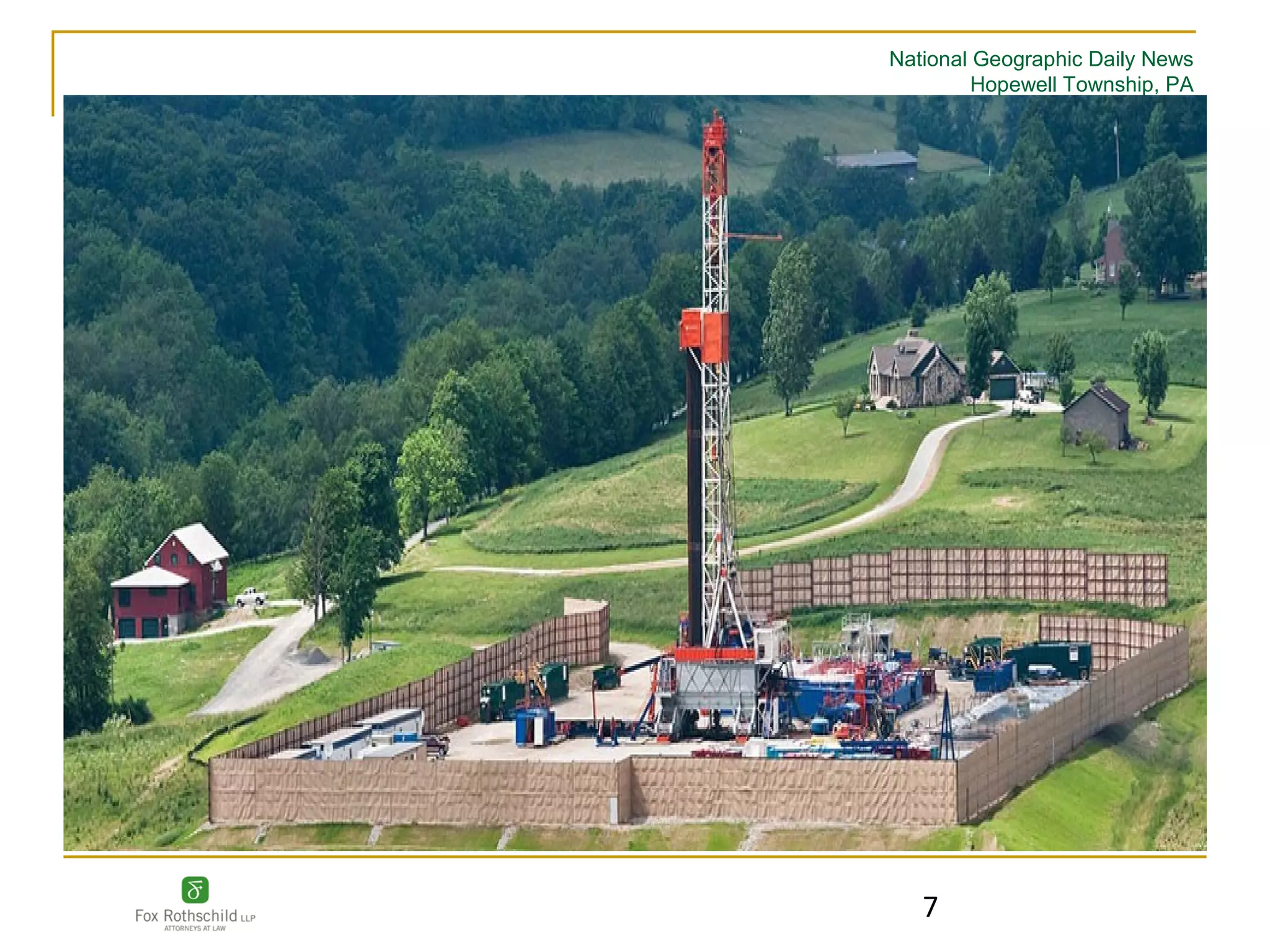
National Geographic Daily News
         Hopewell Township, PA


   7
8
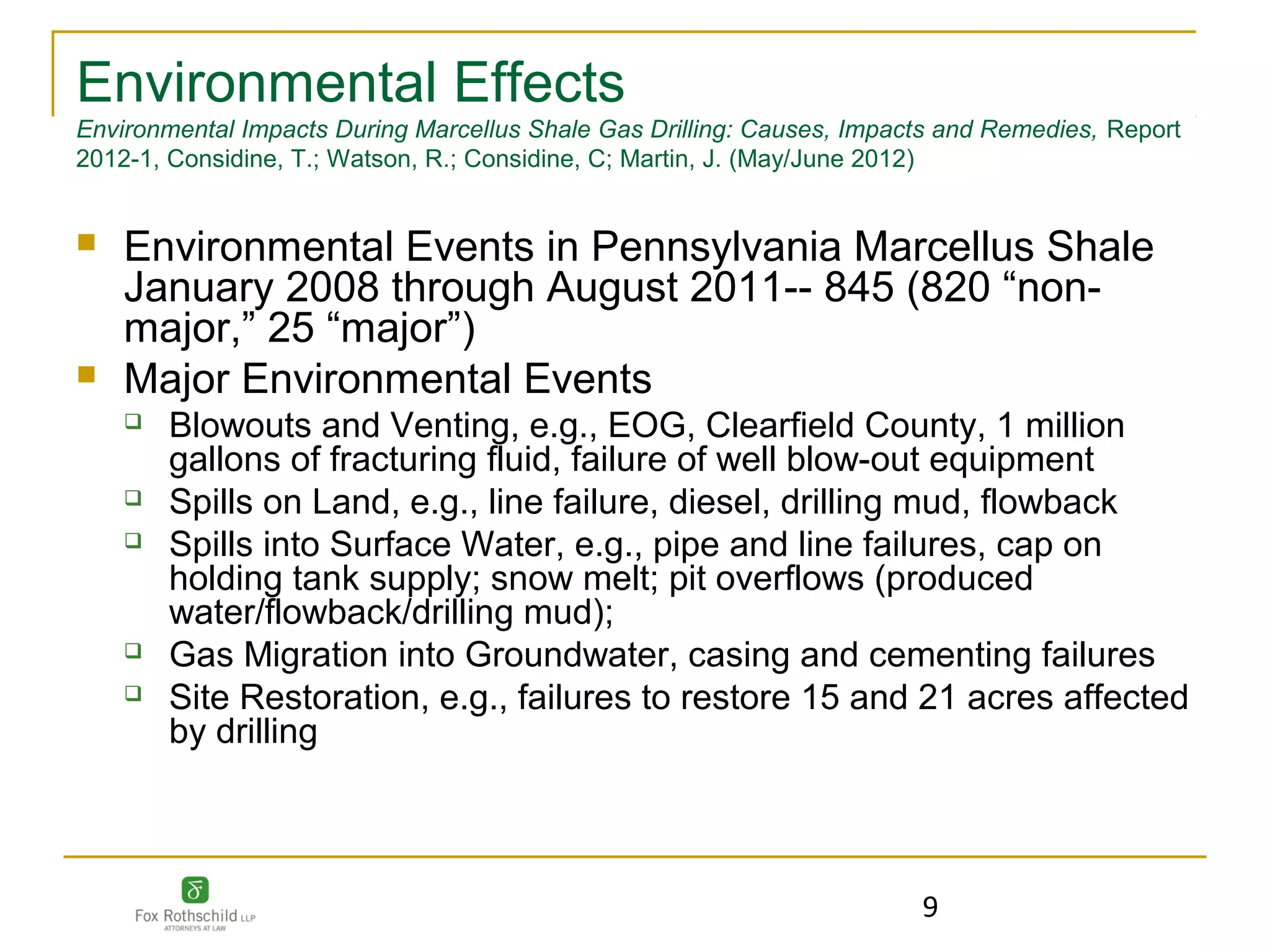
Environmental Effects
Environmental Impacts During Marcellus Shale Gas Drilling: Causes, Impacts and Remedies, Report
2012-1, Considine, T.; Watson, R.; Considine, C; Martin, J. (May/June 2012)


   Environmental Events in Pennsylvania Marcellus Shale
    January 2008 through August 2011-- 845 (820 “non-
    major,” 25 “major”)
   Major Environmental Events
       Blowouts and Venting, e.g., EOG, Clearfield County, 1 million
        gallons of fracturing fluid, failure of well blow-out equipment
       Spills on Land, e.g., line failure, diesel, drilling mud, flowback
       Spills into Surface Water, e.g., pipe and line failures, cap on
        holding tank supply; snow melt; pit overflows (produced
        water/flowback/drilling mud);
       Gas Migration into Groundwater, casing and cementing failures
       Site Restoration, e.g., failures to restore 15 and 21 acres affected
        by drilling


                                                                        9
Health Effects? Significant
Controversy; Little Information
   An article regarding the kinds of concerns being raised by communities
    and opponents: Gas Patch Roulette – How Shale Gas Development
    Risks Public Health in Pennsylvania, Steinzor, N.; Subra, W.; Sumi, L.,
    Earthworks, Oct. 2012:
       Residents surveyed reported the following issues: Sinus/respiratory;
        Behavioral/mood/energy; Neurological; Muscles/joints; Ear/nose/mouth;
        Digestive/stomach; Skin reactions; Vision/eyes
       Water sampling detected substances also associated with oil and gas
        brine/flowback (e.g., barium, manganese, iron, arsenic, lead) and methane
       The data gathered point to three conclusions:
           Contaminants that are associated with oil and gas developments are present in air
            and water where residents are experiencing health symptoms consistent with such
            exposures;
           “there is a strong likelihood that residents who are experiencing a range of health
            problems would not be if widespread gas development was not occurring”;
           by permitting widespread gas development without fully understanding its impacts
            to public health – and using that lack of knowledge to justify regulatory inaction --
            Pennsylvania is risking the public’s health [emphasis added.]


                                                                         10
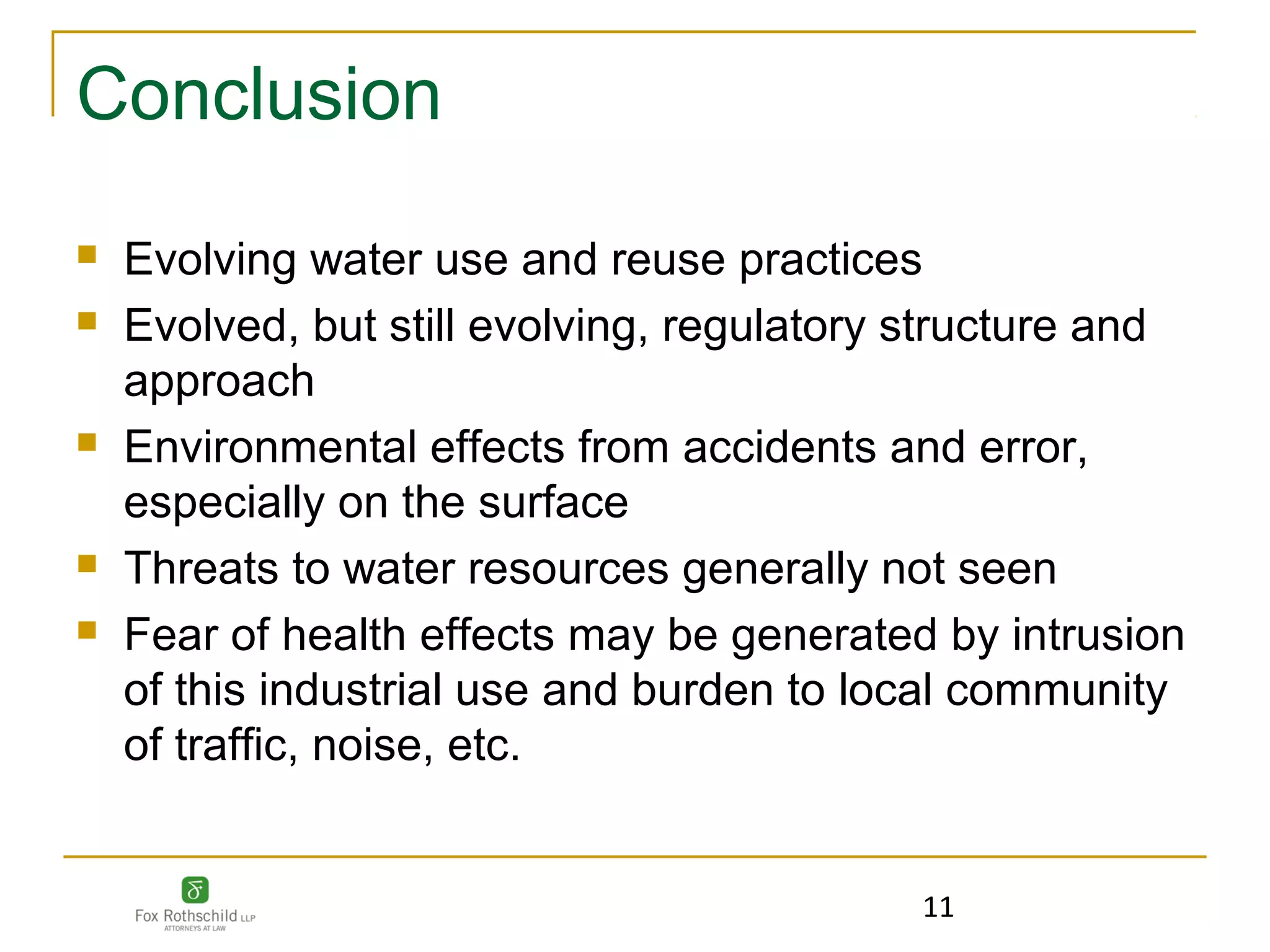
Conclusion
   Evolving water use and reuse practices
   Evolved, but still evolving, regulatory structure and
    approach
   Environmental effects from accidents and error,
    especially on the surface
   Threats to water resources generally not seen
   Fear of health effects may be generated by intrusion
    of this industrial use and burden to local community
    of traffic, noise, etc.


                                           11
Contact Information


     Christopher M. Roe, Esq.
            610-458-4987
        croe@foxrothschild.com


                                 12

Water Use, Regulations and Effects

  • 1.
    PBI – PowerLaw 2012 Water Use, Regulation and Effects October 23, 2012 Presented by: Christopher M. Roe, Esq. croe@foxrothschild.com
  • 2.
    Overview  Water usesassociated with unconventional gas wells  Regulatory requirements and permits  Environmental and health effects 2
  • 3.
  • 4.
    Water Use/Waste Generation  Drilling process – 85,000 gallons on average (GAO Sept. 2012)  Fracturing process – 5.6 million gallons on average (GAO Sept. 2012); 4.3 million average (SRBC)  Sources – public water; surface water withdrawals; groundwater  Recycling and reuse  Onsite or offsite  Between 75% and 100% filtered/treated and mixed with fresh water for reuse  Flowback water; formation water; produced water (about 10-15 percent returns, 60 percent in first 4 days)  Salts (total dissolved solids), chlorides, bromides, and sulfides of calcium, magnesium and sodium  Metals, barium, manganese, iron, and strontium  Oil and grease and dissolved organics, such benzene and toluene  Naturally occurring radioactive materials  Production chemicals, friction reducers, biocides, corrosion inhibitors 4
  • 5.
    Regulatory Requirements andPermits – Some Federal Requirements and Exemptions  40 CFR § 435.32: “there shall be no discharge of waste water pollutants into navigable waters from any source associated with production, field exploration, drilling, well completion, or well treatment ( i.e., produced water, drilling muds, drill cuttings, and produced sand).”  EPA intends to develop and issue for public comment draft natural gas wastewater standards in 2014.  Exemptions:  Safe Drinking Water Act – Underground injection of fluids and propping agents (other than diesel fuels) related to gas production. 42 USC 300h(d)(1)  Resource Conservation and Recovery Act – Solid wastes that are not hazardous wastes include: “Drilling fluids, produced waters, and other wastes associated with the exploration, development, or production of crude oil, natural gas or geothermal energy.” 40 CFR 261.4(b)(5)  Clean Water Act – exemption from permit requirement for stormwater runoff from oil and gas exploration operations as long as not contaminated by contact with, e.g., overburden or raw materials, 33 USC 1342(l)(2)and 1362(24). 5
  • 6.
    Regulatory Requirements andPermitting for Water Protection uses (losses to basin) DEP, SRBC and DRBC Water withdrawals and consumptive  Water management plans required for withdrawal and use (58 Pa. C.S.A. §3211(m))  Not adversely affect quality and quantity available for users of source; protect existing uses  No adverse impact to watershed as a whole  Include a reuse plan  Docket approvals or Approval by Rule from SRBC (18 CFR 801, 806, 807 and 808)  Wellpad dockets on hold/draft regulations DRBC  Oil and Gas Act, Well Development Requirements – 58 Pa. C.S.A. §§3201-3227 and 25 Pa. Admin. Code Chapter 78  Permits and water management plans, §3211 and 25 Pa. Admin. Code 78.11-78.33  Pre-drill survey sampling and supply replacement (25 Pa. Admin. Code 78.51-78.52)  Well location restrictions from buildings, public or private wells, streams or water body, and wetlands > I acre (100 feet); floodplains, §3215  Storm water and erosion control and restoration (ESCGP-1 General Permit)(25 Pa. Admin. Code 78.53) (DRBC draft rules, Non-point Source Pollution Control Plan) §3216  Brine and waste management, §3217(a), including and waste and oil handling (25 Pa. Admin. Code 78.54- 78.64) (25 Pa. Admin. Code Sections  Containment and prevention for drilling mud, hydraulic oil, diesel fuel, additives, flowback, §3218, 25 Pa. Admin. Code 78.55-58, 91.34  Drilling, operation and plugging, including casing, cementing, blowout prevention (25 Pa. Admin Code 78.71- 78.111) (Regulations were Updated Feb. 2012) Freshwater impoundments  Treatment and Discharge  TDS limit, 25 Pa. Admin. Code 95.10(b) for operations with wastewater resulting from fracturing, production, field exploration, drilling or completion of natural gas wells shall comply with the following requirements (eff. August 21, 2010, 40 Pa.B. 4835)  Including source reduction strategy (recycling); from POTWs only if meet <500 mg/L 6
  • 7.
    National Geographic DailyNews Hopewell Township, PA 7
  • 8.
  • 9.
    Environmental Effects Environmental ImpactsDuring Marcellus Shale Gas Drilling: Causes, Impacts and Remedies, Report 2012-1, Considine, T.; Watson, R.; Considine, C; Martin, J. (May/June 2012)  Environmental Events in Pennsylvania Marcellus Shale January 2008 through August 2011-- 845 (820 “non- major,” 25 “major”)  Major Environmental Events  Blowouts and Venting, e.g., EOG, Clearfield County, 1 million gallons of fracturing fluid, failure of well blow-out equipment  Spills on Land, e.g., line failure, diesel, drilling mud, flowback  Spills into Surface Water, e.g., pipe and line failures, cap on holding tank supply; snow melt; pit overflows (produced water/flowback/drilling mud);  Gas Migration into Groundwater, casing and cementing failures  Site Restoration, e.g., failures to restore 15 and 21 acres affected by drilling 9
  • 10.
    Health Effects? Significant Controversy;Little Information  An article regarding the kinds of concerns being raised by communities and opponents: Gas Patch Roulette – How Shale Gas Development Risks Public Health in Pennsylvania, Steinzor, N.; Subra, W.; Sumi, L., Earthworks, Oct. 2012:  Residents surveyed reported the following issues: Sinus/respiratory; Behavioral/mood/energy; Neurological; Muscles/joints; Ear/nose/mouth; Digestive/stomach; Skin reactions; Vision/eyes  Water sampling detected substances also associated with oil and gas brine/flowback (e.g., barium, manganese, iron, arsenic, lead) and methane  The data gathered point to three conclusions:  Contaminants that are associated with oil and gas developments are present in air and water where residents are experiencing health symptoms consistent with such exposures;  “there is a strong likelihood that residents who are experiencing a range of health problems would not be if widespread gas development was not occurring”;  by permitting widespread gas development without fully understanding its impacts to public health – and using that lack of knowledge to justify regulatory inaction -- Pennsylvania is risking the public’s health [emphasis added.] 10
  • 11.
    Conclusion  Evolving water use and reuse practices  Evolved, but still evolving, regulatory structure and approach  Environmental effects from accidents and error, especially on the surface  Threats to water resources generally not seen  Fear of health effects may be generated by intrusion of this industrial use and burden to local community of traffic, noise, etc. 11
  • 12.
    Contact Information Christopher M. Roe, Esq. 610-458-4987 croe@foxrothschild.com 12