
Modern Shale Gas Development

                    Presented by:
       J. Daniel Arthur, P.E. ALL Consulting


                  Presented at:
   Oklahoma Independent Petroleum Association
   Mid-Continent CBM & Shale Gas Symposium
                  December 8, 2009
                   Tulsa, Oklahoma

                                                1
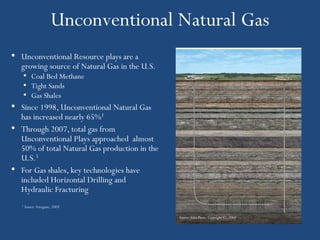
Unconventional Natural Gas
•   Unconventional Resource plays are a
    growing source of Natural Gas in the U.S.
     • Coal Bed Methane
     • Tight Sands
     • Gas Shales
•   Since 1998, Unconventional Natural Gas
    has increased nearly 65%1
•   Through 2007, total gas from
    Unconventional Plays approached almost
    50% of total Natural Gas production in the
    U.S.1
•   For Gas shales, key technologies have
    included Horizontal Drilling and
    Hydraulic Fracturing
    1   Source: Navigant, 2008

                                                 Source: John Perez, Copyright ©, 2008
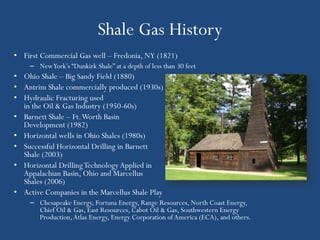
Shale Gas History
• First Commercial Gas well – Fredonia, NY (1821)
    – New York’s “Dunkirk Shale” at a depth of less than 30 feet
• Ohio Shale – Big Sandy Field (1880)
• Antrim Shale commercially produced (1930s)
• Hydraulic Fracturing used
  in the Oil & Gas Industry (1950-60s)
• Barnett Shale – Ft. Worth Basin
  Development (1982)
• Horizontal wells in Ohio Shales (1980s)
• Successful Horizontal Drilling in Barnett
  Shale (2003)
• Horizontal Drilling Technology Applied in
  Appalachian Basin, Ohio and Marcellus
  Shales (2006)
• Active Companies in the Marcellus Shale Play
    – Chesapeake Energy, Fortuna Energy, Range Resources, North Coast Energy,
      Chief Oil & Gas, East Resources, Cabot Oil & Gas, Southwestern Energy
      Production, Atlas Energy, Energy Corporation of America (ECA), and others.
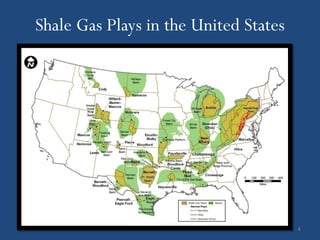
Shale Gas Plays in the United States


                                       4
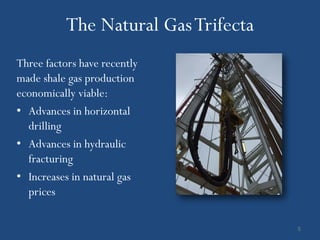
The Natural Gas Trifecta
Three factors have recently
made shale gas production
economically viable:
• Advances in horizontal
  drilling
• Advances in hydraulic
  fracturing
• Increases in natural gas
  prices

                                      5
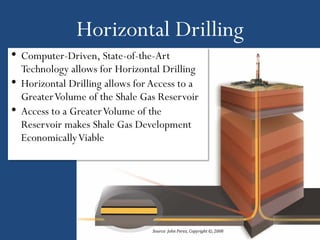
Horizontal Drilling
•   Computer-Driven, State-of-the-Art
    Technology allows for Horizontal Drilling
•   Horizontal Drilling allows for Access to a
    Greater Volume of the Shale Gas Reservoir
•   Access to a Greater Volume of the
    Reservoir makes Shale Gas Development
    Economically Viable


                                   Source: John Perez, Copyright ©, 2008
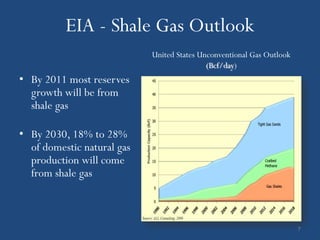
EIA - Shale Gas Outlook
                            United States Unconventional Gas Outlook
                                            (Bcf/day)
• By 2011 most reserves
  growth will be from
  shale gas

• By 2030, 18% to 28%
  of domestic natural gas
  production will come
  from shale gas


                                                                       7
Shale Gas Geology
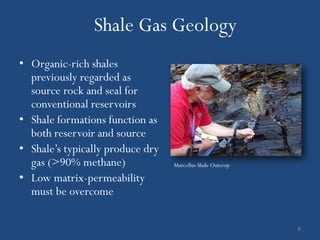
• Organic-rich shales
  previously regarded as
  source rock and seal for
  conventional reservoirs
• Shale formations function as
  both reservoir and source
• Shale’s typically produce dry
  gas (>90% methane)              Marcellus Shale Outcrop

• Low matrix-permeability
  must be overcome

                                                            8
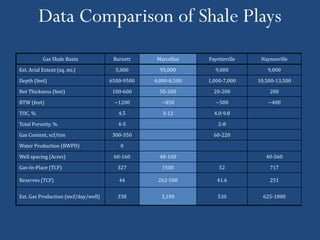
Data Comparison of Shale Plays
           Gas Shale Basin            Barnett     Marcellus    Fayetteville    Haynesville

Est. Arial Extent (sq. mi.)            5,000       95,000         9,000          9,000

Depth (feet)                         6500-9500   4,000-8,500   1,000-7,000    10,500-13,500

Net Thickness (feet)                  100-600      50-200        20-200           200

BTW (feet)                            ~1200        ~850           ~500            ~400

TOC, %                                  4.5         3-12         4.0-9.8

Total Porosity, %                       4-5                        2-8

Gas Content, scf/ton                  300-350                    60-220

Water Production (BWPD)                 0

Well spacing (Acres)                  60-160       40-160                        40-560

Gas-In-Place (TCF)                     327          1500           52             717

Reserves (TCF)                          44        262-500         41.6            251


Est. Gas Production (mcf/day/well)     338         3,100          530           625-1800
Shale Gas Environmental Issues
• Land disturbances
• Large-volume hydraulic
  fracturing:
   • Water sourcing,
       transportation and disposal
   • Fracturing fluids employed
• Groundwater protection
• Drilling and production in
  urban settings
• Naturally occurring radioactive
  material (NORM)
• Noise
• Etc.

                                      10
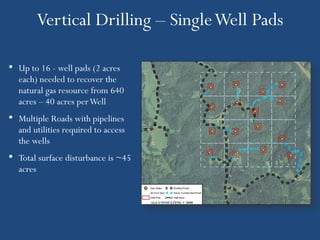
Vertical Drilling – Single Well Pads

• Up to 16 - well pads (2 acres
  each) needed to recover the
  natural gas resource from 640
  acres – 40 acres per Well
• Multiple Roads with pipelines
  and utilities required to access
  the wells
• Total surface disturbance is ~45
  acres
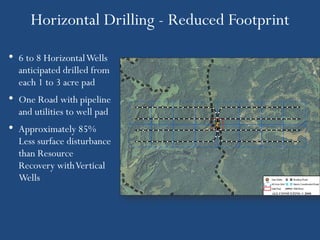
Horizontal Drilling - Reduced Footprint

• 6 to 8 Horizontal Wells
  anticipated drilled from
  each 1 to 3 acre pad
• One Road with pipeline
  and utilities to well pad
• Approximately 85%
  Less surface disturbance
  than Resource
  Recovery with Vertical
  Wells
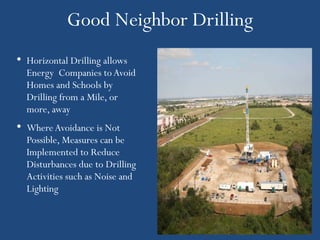
Good Neighbor Drilling
• Horizontal Drilling allows
  Energy Companies to Avoid
  Homes and Schools by
  Drilling from a Mile, or
  more, away
• Where Avoidance is Not
  Possible, Measures can be
  Implemented to Reduce
  Disturbances due to Drilling
  Activities such as Noise and
  Lighting
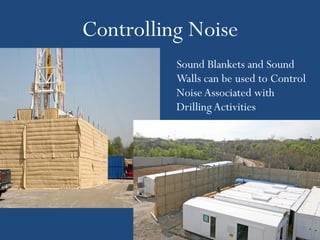
Controlling Noise
          Sound Blankets and Sound
          Walls can be used to Control
          Noise Associated with
          Drilling Activities
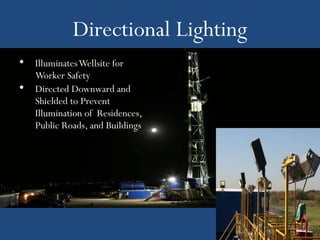
Directional Lighting
• Illuminates Wellsite for
    Worker Safety
•   Directed Downward and
    Shielded to Prevent
    Illumination of Residences,
    Public Roads, and Buildings
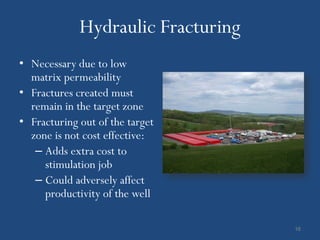
Hydraulic Fracturing
• Necessary due to low
  matrix permeability
• Fractures created must
  remain in the target zone
• Fracturing out of the target
  zone is not cost effective:
   – Adds extra cost to
     stimulation job
   – Could adversely affect
     productivity of the well

                                    16
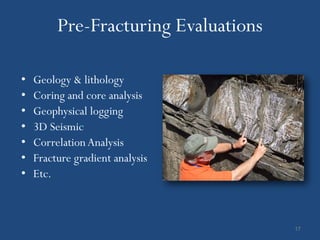
Pre-Fracturing Evaluations

•   Geology & lithology
•   Coring and core analysis
•   Geophysical logging
•   3D Seismic
•   Correlation Analysis
•   Fracture gradient analysis
•   Etc.


                                      17
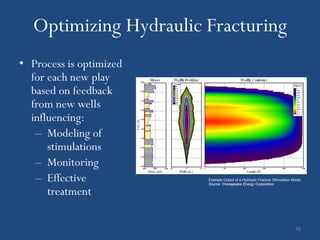
Optimizing Hydraulic Fracturing
• Process is optimized
  for each new play
  based on feedback
  from new wells
  influencing:
   – Modeling of
      stimulations
   – Monitoring
   – Effective           Example Output of a Hydraulic Fracture Stimulation Model.
                         Source: Chesapeake Energy Corporation.

      treatment

                                                                             18
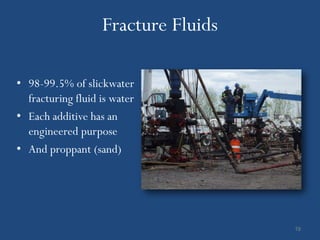
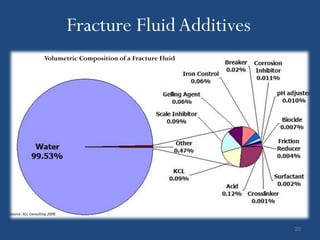
Fracture Fluids

• 98-99.5% of slickwater
  fracturing fluid is water
• Each additive has an
  engineered purpose
• And proppant (sand)


                                     19
Fracture Fluid Additives
                    Volumetric Composition of a Fracture Fluid


Source: ALL Consulting 2008.


                                                                 20
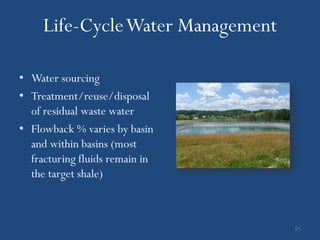
Life-Cycle Water Management

• Water sourcing
• Treatment/reuse/disposal
  of residual waste water
• Flowback % varies by basin
  and within basins (most
  fracturing fluids remain in
  the target shale)


                                   21
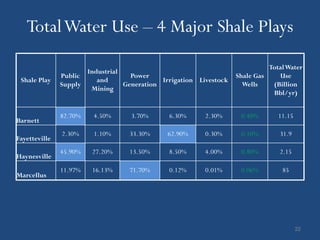
Total Water Use – 4 Major Shale Plays
                                                                             Total Water
                      Industrial
               Public              Power                           Shale Gas    Use
 Shale Play              and                Irrigation Livestock
               Supply            Generation                          Wells    (Billion
                       Mining
                                                                              Bbl/yr)


               82.70%   4.50%      3.70%      6.30%      2.30%      0.40%       11.15
Barnett
               2.30%    1.10%      33.30%     62.90%     0.30%      0.10%       31.9
Fayetteville
               45.90%   27.20%     13.50%     8.50%      4.00%      0.80%       2.15
Haynesville
               11.97%   16.13%     71.70%     0.12%      0.01%      0.06%        85
Marcellus


                                                                                        22
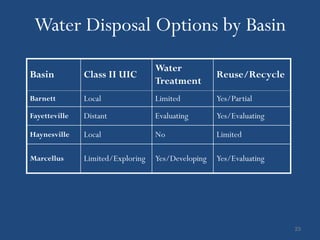
Water Disposal Options by Basin
                                   Water
Basin          Class II UIC                         Reuse/Recycle
                                   Treatment
Barnett        Local               Limited          Yes/Partial
Fayetteville   Distant             Evaluating       Yes/Evaluating

Haynesville    Local               No               Limited

Marcellus      Limited/Exploring   Yes/Developing   Yes/Evaluating


                                                                     23
Produced Water- UIC Disposal Options

• Class II UIC wells are the primary means for management
  of produced water from gas shales
• In areas new to O&G development, existing commercial
  SWD wells may not yet be available
• Some areas (e.g. the Marcellus & Fayetteville shale plays) are
  geologically challenged with limited available injection
  zones
• Some areas take considerable time to get permits
   − New York & Pennsylvania

                                                              24
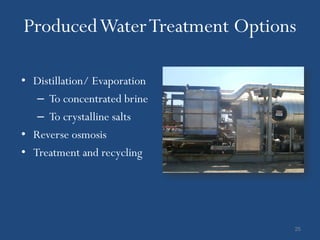
Produced Water Treatment Options

• Distillation/ Evaporation
   – To concentrated brine
   – To crystalline salts
• Reverse osmosis
• Treatment and recycling


                               25
Treatment Option Limitations
• All approaches have limitations, primarily:
   – Quality and quantity of water that can be treated
   – Waste volumes and management:
       › Concentrated brine from D/E and RO
       › Salt crystal from D/E
   – Economic viability
• Generally, as the TDS of the produced water increases, the
  volume of useable treated water decreases and waste
  increases


                                                               26
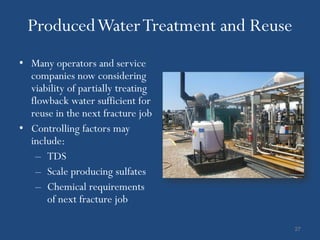
Produced Water Treatment and Reuse
• Many operators and service
  companies now considering
  viability of partially treating
  flowback water sufficient for
  reuse in the next fracture job
• Controlling factors may
  include:
   – TDS
   – Scale producing sulfates
   – Chemical requirements
      of next fracture job

                                       27
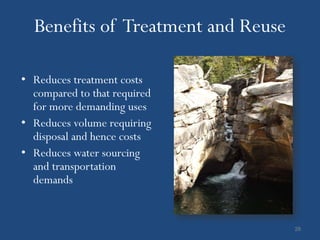
Benefits of Treatment and Reuse

• Reduces treatment costs
  compared to that required
  for more demanding uses
• Reduces volume requiring
  disposal and hence costs
• Reduces water sourcing
  and transportation
  demands


                                    28
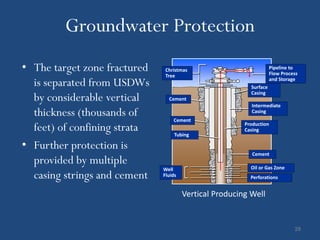
Groundwater Protection
• The target zone fractured    Christmas                            Pipeline to
                                                                    Flow Process
                               Tree
  is separated from USDWs                                 Surface
                                                                    and Storage


  by considerable vertical      Cement
                                                          Casing

                                                          Intermediate
  thickness (thousands of         Cement
                                                          Casing


  feet) of confining strata        Tubing
                                                        Production
                                                        Casing


• Further protection is
                                                           Cement
  provided by multiple                                    Oil or Gas Zone
                              Well
  casing strings and cement   Fluids                      Perforations


                                       Vertical Producing Well


                                                                              29
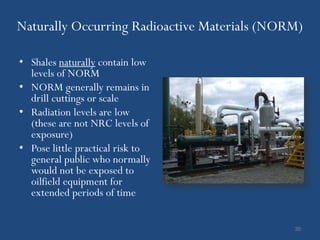
Naturally Occurring Radioactive Materials (NORM)

• Shales naturally contain low
  levels of NORM
• NORM generally remains in
  drill cuttings or scale
• Radiation levels are low
  (these are not NRC levels of
  exposure)
• Pose little practical risk to
  general public who normally
  would not be exposed to
  oilfield equipment for
  extended periods of time


                                              30
Invitation to Read


                     31
Contact Information

        Dan Arthur
    darthur@all-llc.com

       ALL Consulting
  1718 S. Cheyenne Avenue
   Tulsa, Oklahoma 74119
    www.ALL-LLC.com


                            32

Modern Shale Gas Development

  • 1.
    Modern Shale GasDevelopment Presented by: J. Daniel Arthur, P.E. ALL Consulting Presented at: Oklahoma Independent Petroleum Association Mid-Continent CBM & Shale Gas Symposium December 8, 2009 Tulsa, Oklahoma 1
  • 2.
    Unconventional Natural Gas • Unconventional Resource plays are a growing source of Natural Gas in the U.S. • Coal Bed Methane • Tight Sands • Gas Shales • Since 1998, Unconventional Natural Gas has increased nearly 65%1 • Through 2007, total gas from Unconventional Plays approached almost 50% of total Natural Gas production in the U.S.1 • For Gas shales, key technologies have included Horizontal Drilling and Hydraulic Fracturing 1 Source: Navigant, 2008 Source: John Perez, Copyright ©, 2008
  • 3.
    Shale Gas History •First Commercial Gas well – Fredonia, NY (1821) – New York’s “Dunkirk Shale” at a depth of less than 30 feet • Ohio Shale – Big Sandy Field (1880) • Antrim Shale commercially produced (1930s) • Hydraulic Fracturing used in the Oil & Gas Industry (1950-60s) • Barnett Shale – Ft. Worth Basin Development (1982) • Horizontal wells in Ohio Shales (1980s) • Successful Horizontal Drilling in Barnett Shale (2003) • Horizontal Drilling Technology Applied in Appalachian Basin, Ohio and Marcellus Shales (2006) • Active Companies in the Marcellus Shale Play – Chesapeake Energy, Fortuna Energy, Range Resources, North Coast Energy, Chief Oil & Gas, East Resources, Cabot Oil & Gas, Southwestern Energy Production, Atlas Energy, Energy Corporation of America (ECA), and others.
  • 4.
    Shale Gas Playsin the United States 4
  • 5.
    The Natural GasTrifecta Three factors have recently made shale gas production economically viable: • Advances in horizontal drilling • Advances in hydraulic fracturing • Increases in natural gas prices 5
  • 6.
    Horizontal Drilling • Computer-Driven, State-of-the-Art Technology allows for Horizontal Drilling • Horizontal Drilling allows for Access to a Greater Volume of the Shale Gas Reservoir • Access to a Greater Volume of the Reservoir makes Shale Gas Development Economically Viable Source: John Perez, Copyright ©, 2008
  • 7.
    EIA - ShaleGas Outlook United States Unconventional Gas Outlook (Bcf/day) • By 2011 most reserves growth will be from shale gas • By 2030, 18% to 28% of domestic natural gas production will come from shale gas 7
  • 8.
    Shale Gas Geology •Organic-rich shales previously regarded as source rock and seal for conventional reservoirs • Shale formations function as both reservoir and source • Shale’s typically produce dry gas (>90% methane) Marcellus Shale Outcrop • Low matrix-permeability must be overcome 8
  • 9.
    Data Comparison ofShale Plays Gas Shale Basin Barnett Marcellus Fayetteville Haynesville Est. Arial Extent (sq. mi.) 5,000 95,000 9,000 9,000 Depth (feet) 6500-9500 4,000-8,500 1,000-7,000 10,500-13,500 Net Thickness (feet) 100-600 50-200 20-200 200 BTW (feet) ~1200 ~850 ~500 ~400 TOC, % 4.5 3-12 4.0-9.8 Total Porosity, % 4-5 2-8 Gas Content, scf/ton 300-350 60-220 Water Production (BWPD) 0 Well spacing (Acres) 60-160 40-160 40-560 Gas-In-Place (TCF) 327 1500 52 717 Reserves (TCF) 44 262-500 41.6 251 Est. Gas Production (mcf/day/well) 338 3,100 530 625-1800
  • 10.
    Shale Gas EnvironmentalIssues • Land disturbances • Large-volume hydraulic fracturing: • Water sourcing, transportation and disposal • Fracturing fluids employed • Groundwater protection • Drilling and production in urban settings • Naturally occurring radioactive material (NORM) • Noise • Etc. 10
  • 11.
    Vertical Drilling –Single Well Pads • Up to 16 - well pads (2 acres each) needed to recover the natural gas resource from 640 acres – 40 acres per Well • Multiple Roads with pipelines and utilities required to access the wells • Total surface disturbance is ~45 acres
  • 12.
    Horizontal Drilling -Reduced Footprint • 6 to 8 Horizontal Wells anticipated drilled from each 1 to 3 acre pad • One Road with pipeline and utilities to well pad • Approximately 85% Less surface disturbance than Resource Recovery with Vertical Wells
  • 13.
    Good Neighbor Drilling •Horizontal Drilling allows Energy Companies to Avoid Homes and Schools by Drilling from a Mile, or more, away • Where Avoidance is Not Possible, Measures can be Implemented to Reduce Disturbances due to Drilling Activities such as Noise and Lighting
  • 14.
    Controlling Noise Sound Blankets and Sound Walls can be used to Control Noise Associated with Drilling Activities
  • 15.
    Directional Lighting • IlluminatesWellsite for Worker Safety • Directed Downward and Shielded to Prevent Illumination of Residences, Public Roads, and Buildings
  • 16.
    Hydraulic Fracturing • Necessarydue to low matrix permeability • Fractures created must remain in the target zone • Fracturing out of the target zone is not cost effective: – Adds extra cost to stimulation job – Could adversely affect productivity of the well 16
  • 17.
    Pre-Fracturing Evaluations • Geology & lithology • Coring and core analysis • Geophysical logging • 3D Seismic • Correlation Analysis • Fracture gradient analysis • Etc. 17
  • 18.
    Optimizing Hydraulic Fracturing •Process is optimized for each new play based on feedback from new wells influencing: – Modeling of stimulations – Monitoring – Effective Example Output of a Hydraulic Fracture Stimulation Model. Source: Chesapeake Energy Corporation. treatment 18
  • 19.
    Fracture Fluids • 98-99.5%of slickwater fracturing fluid is water • Each additive has an engineered purpose • And proppant (sand) 19
  • 20.
    Fracture Fluid Additives Volumetric Composition of a Fracture Fluid Source: ALL Consulting 2008. 20
  • 21.
    Life-Cycle Water Management •Water sourcing • Treatment/reuse/disposal of residual waste water • Flowback % varies by basin and within basins (most fracturing fluids remain in the target shale) 21
  • 22.
    Total Water Use– 4 Major Shale Plays Total Water Industrial Public Power Shale Gas Use Shale Play and Irrigation Livestock Supply Generation Wells (Billion Mining Bbl/yr) 82.70% 4.50% 3.70% 6.30% 2.30% 0.40% 11.15 Barnett 2.30% 1.10% 33.30% 62.90% 0.30% 0.10% 31.9 Fayetteville 45.90% 27.20% 13.50% 8.50% 4.00% 0.80% 2.15 Haynesville 11.97% 16.13% 71.70% 0.12% 0.01% 0.06% 85 Marcellus 22
  • 23.
    Water Disposal Optionsby Basin Water Basin Class II UIC Reuse/Recycle Treatment Barnett Local Limited Yes/Partial Fayetteville Distant Evaluating Yes/Evaluating Haynesville Local No Limited Marcellus Limited/Exploring Yes/Developing Yes/Evaluating 23
  • 24.
    Produced Water- UICDisposal Options • Class II UIC wells are the primary means for management of produced water from gas shales • In areas new to O&G development, existing commercial SWD wells may not yet be available • Some areas (e.g. the Marcellus & Fayetteville shale plays) are geologically challenged with limited available injection zones • Some areas take considerable time to get permits − New York & Pennsylvania 24
  • 25.
    Produced Water TreatmentOptions • Distillation/ Evaporation – To concentrated brine – To crystalline salts • Reverse osmosis • Treatment and recycling 25
  • 26.
    Treatment Option Limitations •All approaches have limitations, primarily: – Quality and quantity of water that can be treated – Waste volumes and management: › Concentrated brine from D/E and RO › Salt crystal from D/E – Economic viability • Generally, as the TDS of the produced water increases, the volume of useable treated water decreases and waste increases 26
  • 27.
    Produced Water Treatmentand Reuse • Many operators and service companies now considering viability of partially treating flowback water sufficient for reuse in the next fracture job • Controlling factors may include: – TDS – Scale producing sulfates – Chemical requirements of next fracture job 27
  • 28.
    Benefits of Treatmentand Reuse • Reduces treatment costs compared to that required for more demanding uses • Reduces volume requiring disposal and hence costs • Reduces water sourcing and transportation demands 28
  • 29.
    Groundwater Protection • Thetarget zone fractured Christmas Pipeline to Flow Process Tree is separated from USDWs Surface and Storage by considerable vertical Cement Casing Intermediate thickness (thousands of Cement Casing feet) of confining strata Tubing Production Casing • Further protection is Cement provided by multiple Oil or Gas Zone Well casing strings and cement Fluids Perforations Vertical Producing Well 29
  • 30.
    Naturally Occurring RadioactiveMaterials (NORM) • Shales naturally contain low levels of NORM • NORM generally remains in drill cuttings or scale • Radiation levels are low (these are not NRC levels of exposure) • Pose little practical risk to general public who normally would not be exposed to oilfield equipment for extended periods of time 30
  • 31.
  • 32.
    Contact Information Dan Arthur darthur@all-llc.com ALL Consulting 1718 S. Cheyenne Avenue Tulsa, Oklahoma 74119 www.ALL-LLC.com 32