Michael D. Klein, P.E., CHMM
          11/17/11
 The method used to make hard shale rock more porous
 Allows gas shale to flow through the fine grained, organic-rich,
  sedimentary rock formations to the wellbore
 Shale gas is present across much of North America in basins of both
  extreme and moderate size. Some of the major shale reserves
  include:
      Marcellus (Pennsylvania, New York,
       Ohio, West Virginia, Kentucky)
      Bakken (North Dakota, Wyoming)
      Haynesville (Texas, Louisiana)
      Barnett (Texas)
      Eagleford (Texas)
      Fayetteville (Arkansas)
      Antrim (Michigan, Illinois, Ohio)
      Woodford (Oklahoma)
 The Marcellus Shale
 is known as the
 Saudi Arabia of
 Natural Gas

 The US Geological
 Survey estimates
 500 trillion cu ft of
 natural gas in
 Marcellus alone
The Penn State study reported that Marcellus gas
industry generated . . .
 $3.0 billion in total value
  added revenue
 more than 44,000 jobs
 $389 million in state and
  local revenue
For 2011 the Penn State estimate exceeds
 $10 billion in total value
  added revenue
 more than 100,000 jobs
 $1 billion in state and local
  revenue in Pennsylvania
 Until recently shale gas could not be cost
  effectively extracted
 Two factors came together in
  recent years to make shale gas
  production economically viable:
  • Advances in horizontal drilling
  • Advances in hydraulic fracturing
By drilling and casing a well for the extraction of the
natural gas
   producers drill into the earth several thousand feet
    until they reach the natural gas reservoir
   steel casings are inserted to a depth of 1,000 to
    3,000 ft
   the space between the casing and the drilled hole
    is filled with cement to stabilize the well and prevent
    any leakage
   the cement sets
   this process is repeated, using a series of s
    successively smaller casings until the reservoir
    is reached
   depths reach distances of 6,000 to 10,000 feet
Once drilling and casing is complete
   3 to 5 million gallons of
    water, mixed with sand and
    chemical additives, are
    pumped into the wellhead
    at high pressure, creating
    cracks in the rock beds

   the hydraulic fracturing
    mixture is 95% water,
    4.5% proppant, and
    0.5% chemical additives
Once drilling and casing is complete
 proppant is a material, such as grains of sand, ceramic,
  or other particulates, that prevent the fractures from
  closing when the injection is stopped

 fracturing fluid formulas vary slightly among production
  sites in accordance with the unique requirements of each
  site’s geology

 The fracture width is typically maintained after the
  injection by introducing a proppant into the injected fluid
In the case of shale gas extraction using hydro
fracking, questions have been raised
 Environmental safety of process
 The management of the volumes of water used
  to fracture shale
 Water, water, it’s everywhere!
Environmental and human health concerns
associated with hydraulic fracturing include:
 If all goes as intended the many
  fissures and fractures in the
  surrounding rock are sealed by
  the cement
 Depending on the nature of the
  gaps and fractures, it can be
  extremely difficult to properly
  cement the casing
 Contamination of groundwater
Environmental and human health concerns
associated with hydraulic fracturing include:
 The migration of gases and hydraulic
  fracturing chemicals to the surface
 Risks to air quality
 Industrial strength waste streams
  containing high concentrations of
  a wide range of substance that have
  adverse health and water quality effects
Environmental and human health concerns
associated with hydraulic fracturing include:
 Mishandling of waste; chronic and
  persistent occurrence of spills and
  contamination incidents
 Waste streams are expected to
  exceed existing treatment and
  assimilative capacities
 Withdrawals of water to support
  hydraulic fracturing during dry
  periods extending duration of
  “drought”
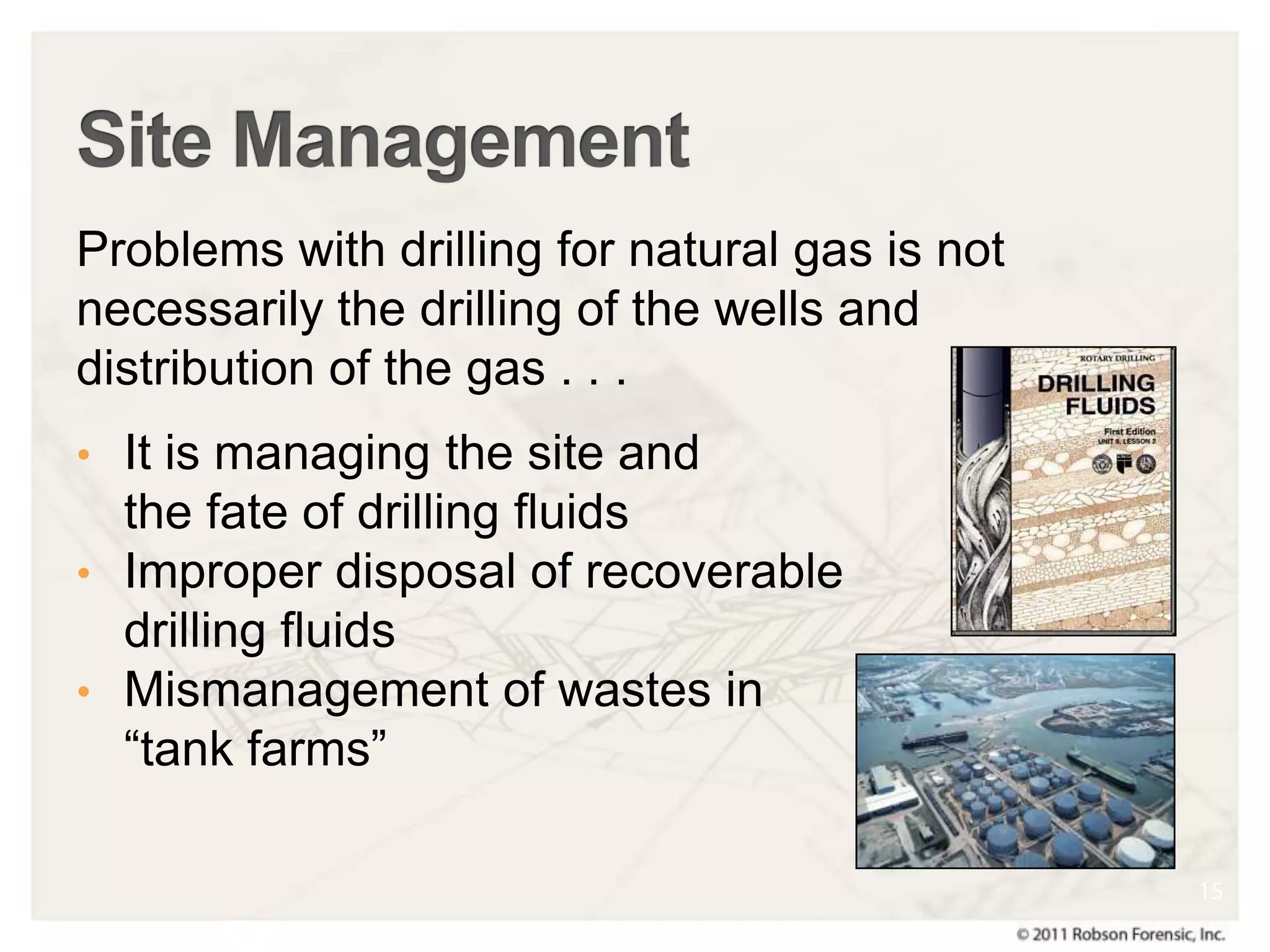
Problems with drilling for natural gas is not
necessarily the drilling of the wells and
distribution of the gas . . .
• It is managing the site and
  the fate of drilling fluids
• Improper disposal of recoverable
  drilling fluids
• Mismanagement of wastes in
  “tank farms”
 Environmental cleanup
 Loss of land value
 Human and animal health concerns
 Introduction of hundreds of tons of
  fracturing chemical into a watershed
  over a period of several decades
 The gradual dispersion of low levels
  of toxic chemicals into the
  environment and water supplies
  through multiple pathways
Nationally over 40 lawsuits have been filed
Terms of the lease
 Landowners who do not own the
  oil or gas rights under their
  property are suing for nuisance
 Physical ailments such as
  headaches, nosebleeds, nausea,
  and open skin sores
 Diminution in the value of their
  property as a result of damaged
  soil, water, and air
The 2005 Energy Act exempted oil and gas companies
from federal environmental laws such as . . .
   Safe Drinking Water Act Underground Injection Control Program
      Did restrict the use of diesel fluids in the fracking process

   Clean Water Act (CWA)
      Onsite Pretreatment
      Publically Owned Treatment
        Works (POTW)
      Centralized Waste Treatment
        Facilities
      Handling of biosolids from facilities
        treating frack water
Claims are hampered due to the lack of information concerning the
makeup of the fracking fluid
On 6/9/2009 the Fracturing Responsibility and Awareness of Chemicals
(FRAC) Act was introduced to Congress – Amends the Safe Drinking
Water Act to:
    Repeal the exemption from restrictions
     on underground injection of fluids near
     drinking water sources granted to hydraulic
     fracturing operations under such Act
    Require oil and gas companies to disclose
     the chemicals used in hydraulic fracturing
     operations
Information on the composition of fracking fluid
that has largely been protected as trade secrets
 Methane migration into the ground water and drinking
  water supply
Several States require the disclosure of the
hydraulic fracturing water composition; they are:
Wyoming
Arkansas
Montana
Louisiana
West Virginia
Colorado (pending)
Texas (pending)
New York (pending)
 The operators disclosing information posts to
  FracFocus, a website operated by the
  Ground Water Protection Council and the
  Interstate Oil & Gas Compact Commission

 The websites have become a central
  location for the posting on information
  regarding the hydraulic fracturing of wells

 Visitors to the website can search for wells
  by county, longitude and latitude, or the
  name of the operator, as well as by other
  criteria
Management of flowback fluids
Recycling of water for reuse in the fracking
process
    Total Dissolved Solids (TDS)

    Naturally occurring radioactive materials

    EPA is evaluating current and potential new CWA
     pretreatment
 The Marcellus has sought-after deposits of
  natural gas, but has also found large amounts of
  highly radioactive radium

 Significant amounts of radiation have ended up
  in wastewater, much of it sent to Public
  Treatment Plants
 However, most municipal wastewater
  treatment plants are completely
  unequipped to process the levels of
  radiation in the wastewater and
  cases of leakage and contamination
  in waterways have occurred

 The threat has caused enough
  concern that the state of New York
  recently issued a partial moratorium
  on hydrofracking activity to
  investigate the issue
Gas STAR under the Clean Air Act (CAA)
    Control air emission throughout the natural gas
     extraction and production process
    Natural gas development process causes the release
     into the atmosphere of a variety of toxic emissions:
             o   methane           o   toluene
             o   ethane            o   ethylbezene
             o   n-hexane          o   xylene
             o   benzene           o   sulfur dioxide
   These emissions are occurring during the flowback process, where
    fracking fluid, ground water, and gas come to the surface before
    natural gas is collected for transmission to the processing facility

   New EPA regulations for new frack wells; reuse of existing wells
    must separate liquid and gas hydrocarbons during the flowback
    process

   Captured gases can be treated
    and sold
 The new regulations also cover
  compressors used to transport natural
  gas through pipelines and the
  pneumatic controllers used to maintain
  liquid levels, pressure and temperature
  in processing plants and compressor
  stations, condensate and crude oil
  storage tanks

 EPA calculates cost recovery in under
  a year of compliance with regulations
  in tanks
 Public comments on the
  proposed rules October 24, 2011
  with Final rule February 28, 2012

 Estimated 11,400 new fracked
  wells and 14,000 re-fracked wells
  will be impacted by the new
  regulations

 Currently 1.1 million wells are
  producing oil and natural gas in
  the USA
   At the request of Congress, the EPA was
    tasked to better understand potential
    impacts of hydraulic fracturing on drinking
    water resources

   In March 2010, the EPA announced its
    intention to conduct the study in response
    to a request from Congress

   The EPA has held a series of public
    meetings across the nation to receive input
    from states, industry, environmental and
    public health groups, and individual citizens
 The study was reviewed by the
                      Science Advisory Board (SAB), an
                      independent panel of scientists, to
                      ensure the agency conducted the
                      research using a scientifically sound
                      approach

 The initial research results and study findings will be
  released to the public in 2012

 The final report will be delivered in 2014
 The final study plan looks at the full cycle of water in
     hydraulic fracturing
     the acquisition of the water
     the mixing of chemicals and actual fracturing
     to the post-fracturing stage, including the management of flowback
      and produced or used water as well as its ultimate treatment and
      disposal.
 Earlier this year, EPA
  announced its selection
  of locations for five
  retrospective and two
  prospective case
  studies; the two
  Pennsylvania sites are:
 Well water protection and other water protection:

    No permits would be issued for sites within 500 feet
     of a private water well or domestic use spring

    No permits may be issued for a proposed site within
     2,000 feet of a public drinking water supply well or
     reservoir at least until three years of experience
     elsewhere has been evaluated

    No permits will be issued for well pads
      sited within a 100-year floodplain
 Spill control:
                    All new guidelines will require that flowback water
                    on site must use watertight tanks within a
                    secondary containment

                    No open containment may be used


                    A secondary containment will also be required for
                    all fracturing additive containers, additive staging
                    areas and flowback tanks to ensure any spills of
                    wastewater or chemicals at the well pad do not
                    migrate into water supplies
 Regulating Water Withdrawals:
      New Legislation: A special permit would be required to withdraw
       large volumes of water for industrial and commercial purposes
       to ensure there are not adverse impacts
      Permit Condition: All withdrawals from surface water bodies will
       be subject to limits to prevent impacts upon ecosystems and
       other water quantity requirements
      Identification of the water source: An applicant intends to use
       will be required and an annual report must be issued on the
       aggregate amount of water it has withdrawn or purchased
 Delaware River Basin Commission
  governs natural gas drilling in
  northeast Pennsylvania
 The Commission oversees the water supply for
  Philadelphia and half the population of New York City
 The Commission imposed a moratorium on all Marcellus
  drilling projects in the four-state basin until the rule-
  making process is complete
    Recently established rules to allow gas drillers to use
     fracking to extract natural gas from the Marcellus
    Rules are designed to protect water quality in the
     Delaware River and its tributaries
Questions?
Thank you for having
        me!

Hydraulic Fracturing and Marcellus Shale Gas 11 22 2011

  • 1.
    Michael D. Klein,P.E., CHMM 11/17/11
  • 2.
     The methodused to make hard shale rock more porous  Allows gas shale to flow through the fine grained, organic-rich, sedimentary rock formations to the wellbore
  • 3.
     Shale gasis present across much of North America in basins of both extreme and moderate size. Some of the major shale reserves include:  Marcellus (Pennsylvania, New York, Ohio, West Virginia, Kentucky)  Bakken (North Dakota, Wyoming)  Haynesville (Texas, Louisiana)  Barnett (Texas)  Eagleford (Texas)  Fayetteville (Arkansas)  Antrim (Michigan, Illinois, Ohio)  Woodford (Oklahoma)
  • 4.
     The MarcellusShale is known as the Saudi Arabia of Natural Gas  The US Geological Survey estimates 500 trillion cu ft of natural gas in Marcellus alone
  • 5.
    The Penn Statestudy reported that Marcellus gas industry generated . . .  $3.0 billion in total value added revenue  more than 44,000 jobs  $389 million in state and local revenue
  • 6.
    For 2011 thePenn State estimate exceeds  $10 billion in total value added revenue  more than 100,000 jobs  $1 billion in state and local revenue in Pennsylvania
  • 7.
     Until recentlyshale gas could not be cost effectively extracted  Two factors came together in recent years to make shale gas production economically viable: • Advances in horizontal drilling • Advances in hydraulic fracturing
  • 8.
    By drilling andcasing a well for the extraction of the natural gas  producers drill into the earth several thousand feet until they reach the natural gas reservoir  steel casings are inserted to a depth of 1,000 to 3,000 ft  the space between the casing and the drilled hole is filled with cement to stabilize the well and prevent any leakage  the cement sets  this process is repeated, using a series of s successively smaller casings until the reservoir is reached  depths reach distances of 6,000 to 10,000 feet
  • 9.
    Once drilling andcasing is complete  3 to 5 million gallons of water, mixed with sand and chemical additives, are pumped into the wellhead at high pressure, creating cracks in the rock beds  the hydraulic fracturing mixture is 95% water, 4.5% proppant, and 0.5% chemical additives
  • 10.
    Once drilling andcasing is complete  proppant is a material, such as grains of sand, ceramic, or other particulates, that prevent the fractures from closing when the injection is stopped  fracturing fluid formulas vary slightly among production sites in accordance with the unique requirements of each site’s geology  The fracture width is typically maintained after the injection by introducing a proppant into the injected fluid
  • 11.
    In the caseof shale gas extraction using hydro fracking, questions have been raised  Environmental safety of process  The management of the volumes of water used to fracture shale  Water, water, it’s everywhere!
  • 12.
    Environmental and humanhealth concerns associated with hydraulic fracturing include:  If all goes as intended the many fissures and fractures in the surrounding rock are sealed by the cement  Depending on the nature of the gaps and fractures, it can be extremely difficult to properly cement the casing  Contamination of groundwater
  • 13.
    Environmental and humanhealth concerns associated with hydraulic fracturing include:  The migration of gases and hydraulic fracturing chemicals to the surface  Risks to air quality  Industrial strength waste streams containing high concentrations of a wide range of substance that have adverse health and water quality effects
  • 14.
    Environmental and humanhealth concerns associated with hydraulic fracturing include:  Mishandling of waste; chronic and persistent occurrence of spills and contamination incidents  Waste streams are expected to exceed existing treatment and assimilative capacities  Withdrawals of water to support hydraulic fracturing during dry periods extending duration of “drought”
  • 15.
    Problems with drillingfor natural gas is not necessarily the drilling of the wells and distribution of the gas . . . • It is managing the site and the fate of drilling fluids • Improper disposal of recoverable drilling fluids • Mismanagement of wastes in “tank farms”
  • 16.
     Environmental cleanup Loss of land value  Human and animal health concerns  Introduction of hundreds of tons of fracturing chemical into a watershed over a period of several decades  The gradual dispersion of low levels of toxic chemicals into the environment and water supplies through multiple pathways
  • 17.
    Nationally over 40lawsuits have been filed Terms of the lease  Landowners who do not own the oil or gas rights under their property are suing for nuisance  Physical ailments such as headaches, nosebleeds, nausea, and open skin sores  Diminution in the value of their property as a result of damaged soil, water, and air
  • 18.
    The 2005 EnergyAct exempted oil and gas companies from federal environmental laws such as . . .  Safe Drinking Water Act Underground Injection Control Program  Did restrict the use of diesel fluids in the fracking process  Clean Water Act (CWA)  Onsite Pretreatment  Publically Owned Treatment Works (POTW)  Centralized Waste Treatment Facilities  Handling of biosolids from facilities treating frack water
  • 19.
    Claims are hampereddue to the lack of information concerning the makeup of the fracking fluid On 6/9/2009 the Fracturing Responsibility and Awareness of Chemicals (FRAC) Act was introduced to Congress – Amends the Safe Drinking Water Act to:  Repeal the exemption from restrictions on underground injection of fluids near drinking water sources granted to hydraulic fracturing operations under such Act  Require oil and gas companies to disclose the chemicals used in hydraulic fracturing operations
  • 20.
    Information on thecomposition of fracking fluid that has largely been protected as trade secrets  Methane migration into the ground water and drinking water supply
  • 21.
    Several States requirethe disclosure of the hydraulic fracturing water composition; they are: Wyoming Arkansas Montana Louisiana West Virginia Colorado (pending) Texas (pending) New York (pending)
  • 22.
     The operatorsdisclosing information posts to FracFocus, a website operated by the Ground Water Protection Council and the Interstate Oil & Gas Compact Commission  The websites have become a central location for the posting on information regarding the hydraulic fracturing of wells  Visitors to the website can search for wells by county, longitude and latitude, or the name of the operator, as well as by other criteria
  • 23.
  • 25.
    Recycling of waterfor reuse in the fracking process  Total Dissolved Solids (TDS)  Naturally occurring radioactive materials  EPA is evaluating current and potential new CWA pretreatment
  • 26.
     The Marcellushas sought-after deposits of natural gas, but has also found large amounts of highly radioactive radium  Significant amounts of radiation have ended up in wastewater, much of it sent to Public Treatment Plants
  • 27.
     However, mostmunicipal wastewater treatment plants are completely unequipped to process the levels of radiation in the wastewater and cases of leakage and contamination in waterways have occurred  The threat has caused enough concern that the state of New York recently issued a partial moratorium on hydrofracking activity to investigate the issue
  • 28.
    Gas STAR underthe Clean Air Act (CAA)  Control air emission throughout the natural gas extraction and production process  Natural gas development process causes the release into the atmosphere of a variety of toxic emissions: o methane o toluene o ethane o ethylbezene o n-hexane o xylene o benzene o sulfur dioxide
  • 29.
    These emissions are occurring during the flowback process, where fracking fluid, ground water, and gas come to the surface before natural gas is collected for transmission to the processing facility  New EPA regulations for new frack wells; reuse of existing wells must separate liquid and gas hydrocarbons during the flowback process  Captured gases can be treated and sold
  • 30.
     The newregulations also cover compressors used to transport natural gas through pipelines and the pneumatic controllers used to maintain liquid levels, pressure and temperature in processing plants and compressor stations, condensate and crude oil storage tanks  EPA calculates cost recovery in under a year of compliance with regulations in tanks
  • 31.
     Public commentson the proposed rules October 24, 2011 with Final rule February 28, 2012  Estimated 11,400 new fracked wells and 14,000 re-fracked wells will be impacted by the new regulations  Currently 1.1 million wells are producing oil and natural gas in the USA
  • 32.
    At the request of Congress, the EPA was tasked to better understand potential impacts of hydraulic fracturing on drinking water resources  In March 2010, the EPA announced its intention to conduct the study in response to a request from Congress  The EPA has held a series of public meetings across the nation to receive input from states, industry, environmental and public health groups, and individual citizens
  • 33.
     The studywas reviewed by the Science Advisory Board (SAB), an independent panel of scientists, to ensure the agency conducted the research using a scientifically sound approach  The initial research results and study findings will be released to the public in 2012  The final report will be delivered in 2014
  • 34.
     The finalstudy plan looks at the full cycle of water in hydraulic fracturing  the acquisition of the water  the mixing of chemicals and actual fracturing  to the post-fracturing stage, including the management of flowback and produced or used water as well as its ultimate treatment and disposal.
  • 35.
     Earlier thisyear, EPA announced its selection of locations for five retrospective and two prospective case studies; the two Pennsylvania sites are:
  • 36.
     Well waterprotection and other water protection:  No permits would be issued for sites within 500 feet of a private water well or domestic use spring  No permits may be issued for a proposed site within 2,000 feet of a public drinking water supply well or reservoir at least until three years of experience elsewhere has been evaluated  No permits will be issued for well pads sited within a 100-year floodplain
  • 37.
     Spill control:  All new guidelines will require that flowback water on site must use watertight tanks within a secondary containment  No open containment may be used  A secondary containment will also be required for all fracturing additive containers, additive staging areas and flowback tanks to ensure any spills of wastewater or chemicals at the well pad do not migrate into water supplies
  • 38.
     Regulating WaterWithdrawals:  New Legislation: A special permit would be required to withdraw large volumes of water for industrial and commercial purposes to ensure there are not adverse impacts  Permit Condition: All withdrawals from surface water bodies will be subject to limits to prevent impacts upon ecosystems and other water quantity requirements  Identification of the water source: An applicant intends to use will be required and an annual report must be issued on the aggregate amount of water it has withdrawn or purchased
  • 39.
     Delaware RiverBasin Commission governs natural gas drilling in northeast Pennsylvania  The Commission oversees the water supply for Philadelphia and half the population of New York City  The Commission imposed a moratorium on all Marcellus drilling projects in the four-state basin until the rule- making process is complete  Recently established rules to allow gas drillers to use fracking to extract natural gas from the Marcellus  Rules are designed to protect water quality in the Delaware River and its tributaries
  • 40.