U.S. Geological Survey Powell Center for Analysis and Synthesis

Water Quality Studied in Areas of Unconventional Oil
and Gas Development, Including Areas Where Hydraulic
Fracturing Techniques are Used, in the United States
Domestic oil and gas production and clean water
are critical for economic growth, public health, and
national security of the United States. As domestic
oil and gas production increases in new areas and
old fields are enhanced, there is increasing public
concern about the effects of energy production on
surface-water and groundwater quality. To a great
extent, this concern arises from the hydraulic fracturing techniques being used today, including horizontal
drilling, for producing unconventional oil and gas in
low-permeability formations.
The U.S. Geological Survey (USGS) John
Wesley Powell Center for Analysis and Synthesis is
hosting an interdisciplinary working group of USGS
scientists to conduct a temporal and spatial analysis
of surface-water and groundwater quality in areas

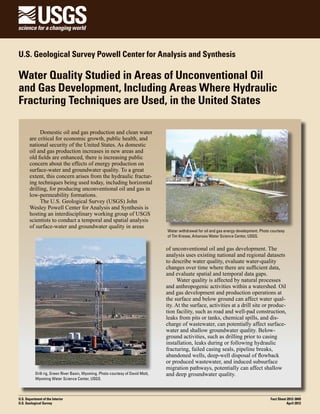
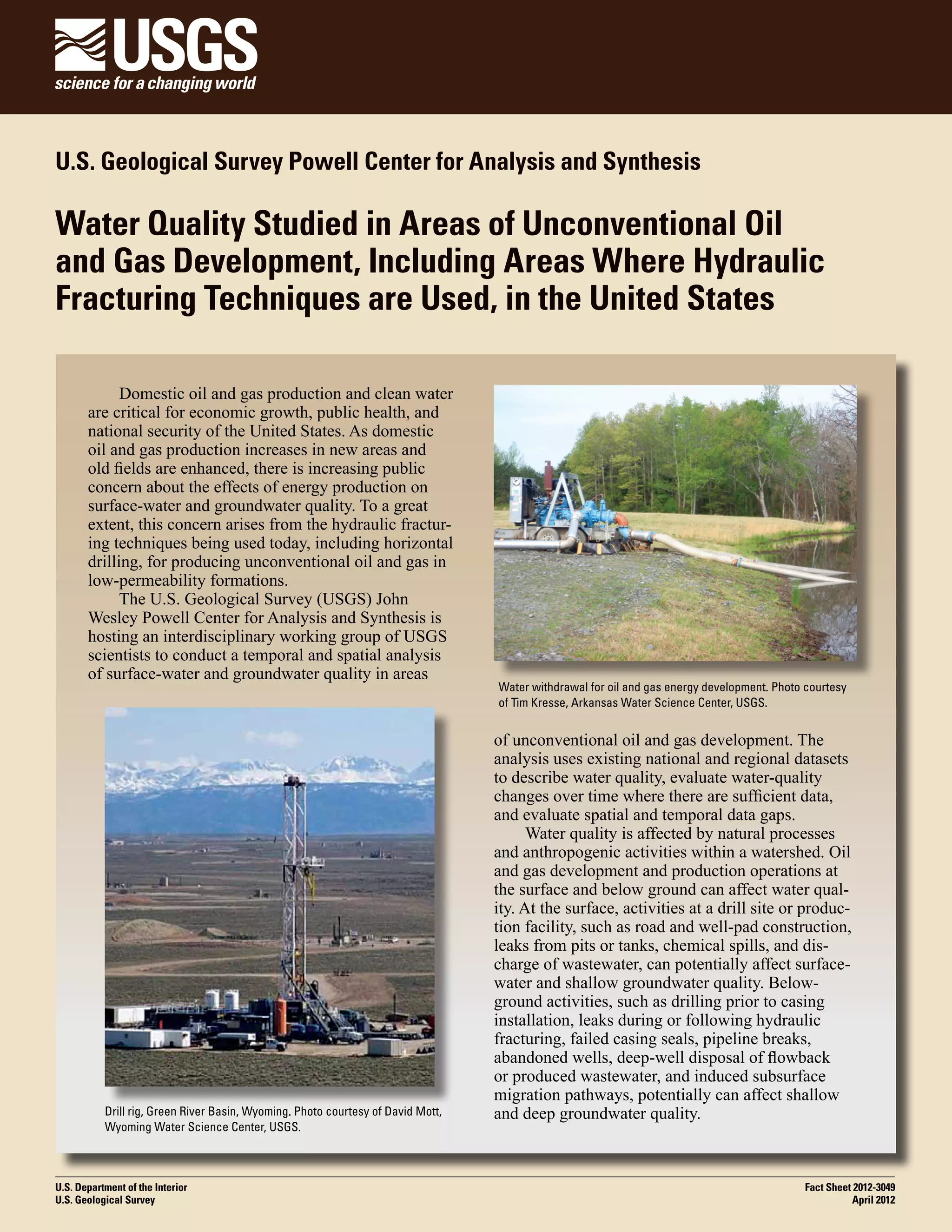
Drill rig, Green River Basin, Wyoming. Photo courtesy of David Mott,
Wyoming Water Science Center, USGS.

U.S. Department of the Interior
U.S. Geological Survey

Water withdrawal for oil and gas energy development. Photo courtesy
of Tim Kresse, Arkansas Water Science Center, USGS.

of unconventional oil and gas development. The
analysis uses existing national and regional datasets
to describe water quality, evaluate water-quality
changes over time where there are sufficient data,
and evaluate spatial and temporal data gaps.
Water quality is affected by natural processes
and anthropogenic activities within a watershed. Oil
and gas development and production operations at
the surface and below ground can affect water quality. At the surface, activities at a drill site or production facility, such as road and well-pad construction,
leaks from pits or tanks, chemical spills, and discharge of wastewater, can potentially affect surfacewater and shallow groundwater quality. Belowground activities, such as drilling prior to casing
installation, leaks during or following hydraulic
fracturing, failed casing seals, pipeline breaks,
abandoned wells, deep-well disposal of flowback
or produced wastewater, and induced subsurface
migration pathways, potentially can affect shallow
and deep groundwater quality.

Fact Sheet 2012-3049
April 2012
The effects of unconventional oil and gas
development and production on regional water
quality have not been previously described despite
the fact that oil and gas development in the United
States began nearly 150 years ago, and more than
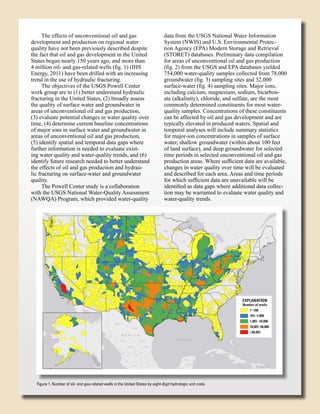
4 million oil- and gas-related wells (fig. 1) (IHS
Energy, 2011) have been drilled with an increasing
trend in the use of hydraulic fracturing.
The objectives of the USGS Powell Center
work group are to (1) better understand hydraulic
fracturing in the United States, (2) broadly assess
the quality of surface water and groundwater in
areas of unconventional oil and gas production,
(3) evaluate potential changes in water quality over
time, (4) determine current baseline concentrations
of major ions in surface water and groundwater in
areas of unconventional oil and gas production,
(5) identify spatial and temporal data gaps where
further information is needed to evaluate existing water quality and water-quality trends, and (6)
identify future research needed to better understand
the effects of oil and gas production and hydraulic fracturing on surface-water and groundwater
quality.
The Powell Center study is a collaboration
with the USGS National Water-Quality Assessment
(NAWQA) Program, which provided water-quality

data from the USGS National Water Information
System (NWIS) and U.S. Environmental Protection Agency (EPA) Modern Storage and Retrieval
(STORET) databases. Preliminary data compilation
for areas of unconventional oil and gas production
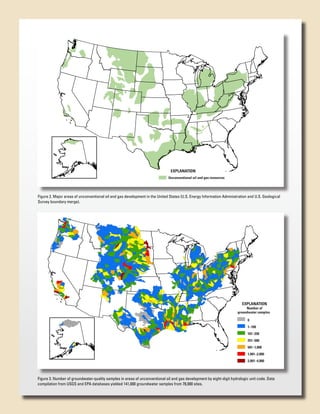
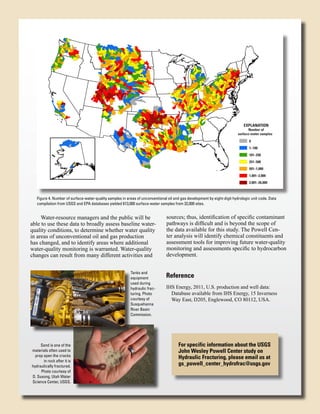
(fig. 2) from the USGS and EPA databases yielded
754,000 water-quality samples collected from 78,000
groundwater (fig. 3) sampling sites and 32,000
surface-water (fig. 4) sampling sites. Major ions,
including calcium, magnesium, sodium, bicarbonate (alkalinity), chloride, and sulfate, are the most
commonly determined constituents for most waterquality samples. Concentrations of these constituents
can be affected by oil and gas development and are
typically elevated in produced waters. Spatial and
temporal analyses will include summary statistics
for major-ion concentrations in samples of surface
water, shallow groundwater (within about 100 feet
of land surface), and deep groundwater for selected
time periods in selected unconventional oil and gas
production areas. Where sufficient data are available,
changes in water quality over time will be evaluated
and described for each area. Areas and time periods
for which sufficient data are unavailable will be
identified as data gaps where additional data collection may be warranted to evaluate water quality and
water-quality trends.

EXPLANATION

Number of wells
1–100
101–1,000
1,001–10,000
10,001–50,000
>50,001

Figure 1. Number of oil- and gas-related wells in the United States by eight-digit hydrologic unit code.
EXPLANATION
TCFG =
Trillions of Cubic Feet of Gas

Unconventional oil and gas resources

Figure 2. Major areas of unconventional oil and gas development in the United States (U.S. Energy Information Administration and U.S. Geological
Survey boundary merge).

EXPLANATION

Number of
groundwater samples
0
1–100
101–250
251–500
501–1,000
1,001–2,000
TCFG =
Trillions of Cubic Feet of Gas

2,001–4,000

Figure 3. Number of groundwater-quality samples in areas of unconventional oil and gas development by eight-digit hydrologic unit code. Data
compilation from USGS and EPA databases yielded 141,000 groundwater samples from 78,000 sites.
EXPLANATION

Number of
surface-water samples
0
1–100
101–250
251–500
501–1,000
1,001–2,000
TCFG =
Trillions of Cubic Feet of Gas

2,001–26,000

Figure 4. Number of surface-water-quality samples in areas of unconventional oil and gas development by eight-digit hydrologic unit code. Data
compilation from USGS and EPA databases yielded 613,000 surface-water samples from 32,000 sites.

Water-resource managers and the public will be
able to use these data to broadly assess baseline waterquality conditions, to determine whether water quality
in areas of unconventional oil and gas production
has changed, and to identify areas where additional
water-quality monitoring is warranted. Water-quality
changes can result from many different activities and
Tanks and
equipment
used during
hydraulic fracturing. Photo
courtesy of
Susquehanna
River Basin
Commission.

Sand is one of the
materials often used to
prop open the cracks
in rock after it is
hydraulically fractured.
Photo courtesy of
D. Susong, Utah Water
Science Center, USGS.

sources; thus, identification of specific contaminant
pathways is difficult and is beyond the scope of
the data available for this study. The Powell Center analysis will identify chemical constituents and
assessment tools for improving future water-quality
monitoring and assessments specific to hydrocarbon
development.

Reference
IHS Energy, 2011, U.S. production and well data:
Database available from IHS Energy, 15 Inverness
Way East, D205, Englewood, CO 80112, USA.

For specific information about the USGS
John Wesley Powell Center study on
Hydraulic Fracturing, please email us at
gs_powell_center_hydrofrac@usgs.gov

USGS Hydrolic fracking

  • 1.
    U.S. Geological SurveyPowell Center for Analysis and Synthesis Water Quality Studied in Areas of Unconventional Oil and Gas Development, Including Areas Where Hydraulic Fracturing Techniques are Used, in the United States Domestic oil and gas production and clean water are critical for economic growth, public health, and national security of the United States. As domestic oil and gas production increases in new areas and old fields are enhanced, there is increasing public concern about the effects of energy production on surface-water and groundwater quality. To a great extent, this concern arises from the hydraulic fracturing techniques being used today, including horizontal drilling, for producing unconventional oil and gas in low-permeability formations. The U.S. Geological Survey (USGS) John Wesley Powell Center for Analysis and Synthesis is hosting an interdisciplinary working group of USGS scientists to conduct a temporal and spatial analysis of surface-water and groundwater quality in areas Drill rig, Green River Basin, Wyoming. Photo courtesy of David Mott, Wyoming Water Science Center, USGS. U.S. Department of the Interior U.S. Geological Survey Water withdrawal for oil and gas energy development. Photo courtesy of Tim Kresse, Arkansas Water Science Center, USGS. of unconventional oil and gas development. The analysis uses existing national and regional datasets to describe water quality, evaluate water-quality changes over time where there are sufficient data, and evaluate spatial and temporal data gaps. Water quality is affected by natural processes and anthropogenic activities within a watershed. Oil and gas development and production operations at the surface and below ground can affect water quality. At the surface, activities at a drill site or production facility, such as road and well-pad construction, leaks from pits or tanks, chemical spills, and discharge of wastewater, can potentially affect surfacewater and shallow groundwater quality. Belowground activities, such as drilling prior to casing installation, leaks during or following hydraulic fracturing, failed casing seals, pipeline breaks, abandoned wells, deep-well disposal of flowback or produced wastewater, and induced subsurface migration pathways, potentially can affect shallow and deep groundwater quality. Fact Sheet 2012-3049 April 2012
  • 2.
    The effects ofunconventional oil and gas development and production on regional water quality have not been previously described despite the fact that oil and gas development in the United States began nearly 150 years ago, and more than 4 million oil- and gas-related wells (fig. 1) (IHS Energy, 2011) have been drilled with an increasing trend in the use of hydraulic fracturing. The objectives of the USGS Powell Center work group are to (1) better understand hydraulic fracturing in the United States, (2) broadly assess the quality of surface water and groundwater in areas of unconventional oil and gas production, (3) evaluate potential changes in water quality over time, (4) determine current baseline concentrations of major ions in surface water and groundwater in areas of unconventional oil and gas production, (5) identify spatial and temporal data gaps where further information is needed to evaluate existing water quality and water-quality trends, and (6) identify future research needed to better understand the effects of oil and gas production and hydraulic fracturing on surface-water and groundwater quality. The Powell Center study is a collaboration with the USGS National Water-Quality Assessment (NAWQA) Program, which provided water-quality data from the USGS National Water Information System (NWIS) and U.S. Environmental Protection Agency (EPA) Modern Storage and Retrieval (STORET) databases. Preliminary data compilation for areas of unconventional oil and gas production (fig. 2) from the USGS and EPA databases yielded 754,000 water-quality samples collected from 78,000 groundwater (fig. 3) sampling sites and 32,000 surface-water (fig. 4) sampling sites. Major ions, including calcium, magnesium, sodium, bicarbonate (alkalinity), chloride, and sulfate, are the most commonly determined constituents for most waterquality samples. Concentrations of these constituents can be affected by oil and gas development and are typically elevated in produced waters. Spatial and temporal analyses will include summary statistics for major-ion concentrations in samples of surface water, shallow groundwater (within about 100 feet of land surface), and deep groundwater for selected time periods in selected unconventional oil and gas production areas. Where sufficient data are available, changes in water quality over time will be evaluated and described for each area. Areas and time periods for which sufficient data are unavailable will be identified as data gaps where additional data collection may be warranted to evaluate water quality and water-quality trends. EXPLANATION Number of wells 1–100 101–1,000 1,001–10,000 10,001–50,000 >50,001 Figure 1. Number of oil- and gas-related wells in the United States by eight-digit hydrologic unit code.
  • 3.
    EXPLANATION TCFG = Trillions ofCubic Feet of Gas Unconventional oil and gas resources Figure 2. Major areas of unconventional oil and gas development in the United States (U.S. Energy Information Administration and U.S. Geological Survey boundary merge). EXPLANATION Number of groundwater samples 0 1–100 101–250 251–500 501–1,000 1,001–2,000 TCFG = Trillions of Cubic Feet of Gas 2,001–4,000 Figure 3. Number of groundwater-quality samples in areas of unconventional oil and gas development by eight-digit hydrologic unit code. Data compilation from USGS and EPA databases yielded 141,000 groundwater samples from 78,000 sites.
  • 4.
    EXPLANATION Number of surface-water samples 0 1–100 101–250 251–500 501–1,000 1,001–2,000 TCFG= Trillions of Cubic Feet of Gas 2,001–26,000 Figure 4. Number of surface-water-quality samples in areas of unconventional oil and gas development by eight-digit hydrologic unit code. Data compilation from USGS and EPA databases yielded 613,000 surface-water samples from 32,000 sites. Water-resource managers and the public will be able to use these data to broadly assess baseline waterquality conditions, to determine whether water quality in areas of unconventional oil and gas production has changed, and to identify areas where additional water-quality monitoring is warranted. Water-quality changes can result from many different activities and Tanks and equipment used during hydraulic fracturing. Photo courtesy of Susquehanna River Basin Commission. Sand is one of the materials often used to prop open the cracks in rock after it is hydraulically fractured. Photo courtesy of D. Susong, Utah Water Science Center, USGS. sources; thus, identification of specific contaminant pathways is difficult and is beyond the scope of the data available for this study. The Powell Center analysis will identify chemical constituents and assessment tools for improving future water-quality monitoring and assessments specific to hydrocarbon development. Reference IHS Energy, 2011, U.S. production and well data: Database available from IHS Energy, 15 Inverness Way East, D205, Englewood, CO 80112, USA. For specific information about the USGS John Wesley Powell Center study on Hydraulic Fracturing, please email us at gs_powell_center_hydrofrac@usgs.gov