States of Matter
and
Phase Change
Phase Change Diagram
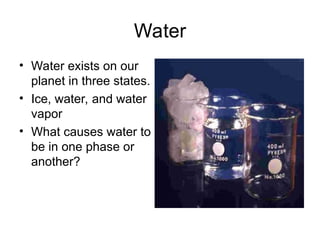
Water
• Water exists on our
planet in three states.
• Ice, water, and water
vapor
• What causes water to
be in one phase or
another?
ENERGY
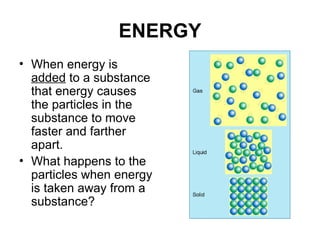
• When energy is
added to a substance
that energy causes
the particles in the
substance to move
faster and farther
apart.
• What happens to the
particles when energy
is taken away from a
substance?
Phase Change
• Energy content is responsible for the
different phases of matter.
• Matter can be made to change phase
when energy is added to or taken away
from a substance.
Adding Energy
• Phase changes that require the addition of
energy are called endothermic changes.
(endo = inside, therm = heat)
• Which phase changes are endothermic?
– Melting (solid  liquid)
– Boiling (liquid  gas)
– Sublimation (solid  gas)
Removing Energy
• Phase changes that require the addition of
energy are called exothermic changes.
(exo = outside, therm = heat)
• Which phase changes are exothermic?
– Freezing (liquid  solid)
– Condensation (gas  liquid)
– Deposition (reverse sublimation) (gas  solid)
Block of Ice to Steam
• Block of Ice to Water Vapor
Melting- Solid to Liquid
• Melting is the
changing of a solid to
a liquid when the
substance absorbs
heat energy.
• Melting Point
– Water 0° C.
– Table salt 801° C.
– Diamond 3700° C.
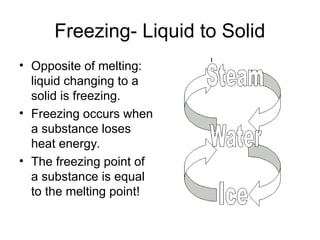
Freezing- Liquid to Solid
• Opposite of melting:
liquid changing to a
solid is freezing.
• Freezing occurs when
a substance loses
heat energy.
• The freezing point of
a substance is equal
to the melting point!
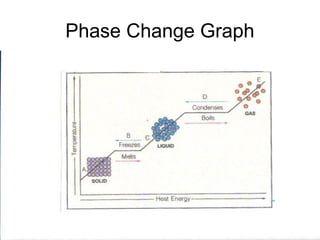
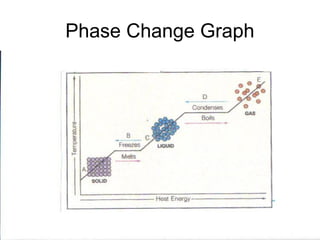
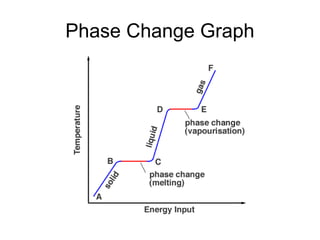
Phase Change Graph
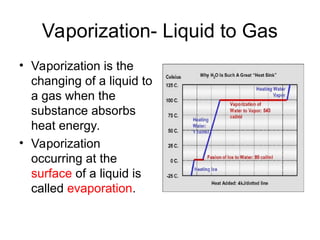
Vaporization- Liquid to Gas
• Vaporization is the
changing of a liquid to
a gas when the
substance absorbs
heat energy.
• Vaporization
occurring at the
surface of a liquid is
called evaporation.
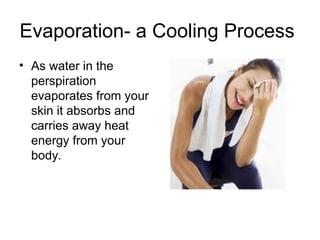
Evaporation- a Cooling Process
• As water in the
perspiration
evaporates from your
skin it absorbs and
carries away heat
energy from your
body.
Boiling
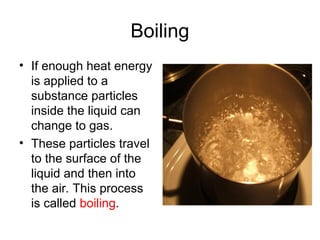
• If enough heat energy
is applied to a
substance particles
inside the liquid can
change to gas.
• These particles travel
to the surface of the
liquid and then into
the air. This process
is called boiling.
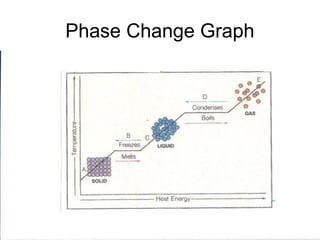
Phase Change Graph
Boiling Point
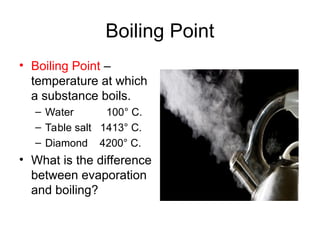
• Boiling Point –
temperature at which
a substance boils.
– Water 100° C.
– Table salt 1413° C.
– Diamond 4200° C.
• What is the difference
between evaporation
and boiling?
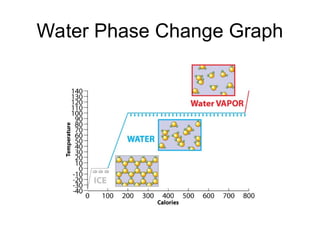
Water Phase Change Graph
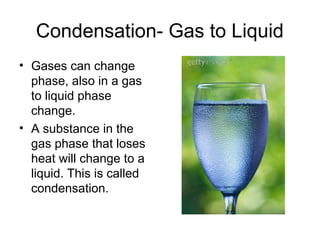
Condensation- Gas to Liquid
• Gases can change
phase, also in a gas
to liquid phase
change.
• A substance in the
gas phase that loses
heat will change to a
liquid. This is called
condensation.
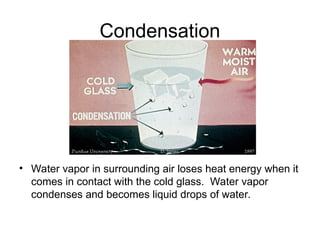
Condensation
• Water vapor in surrounding air loses heat energy when it
comes in contact with the cold glass. Water vapor
condenses and becomes liquid drops of water.
Phase Change Graph
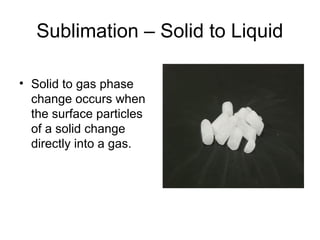
Sublimation – Solid to Liquid
• Solid to gas phase
change occurs when
the surface particles
of a solid change
directly into a gas.
Sublimation – Solid to Liquid
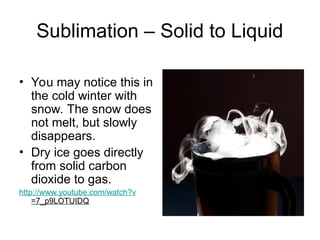
• You may notice this in
the cold winter with
snow. The snow does
not melt, but slowly
disappears.
• Dry ice goes directly
from solid carbon
dioxide to gas.
http://www.youtube.com/watch?v
=7_p9LOTUIDQ
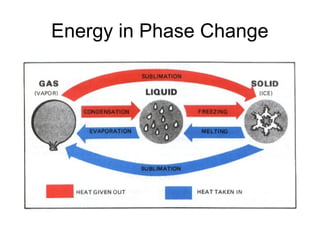
Energy in Phase Change
Phase Change
• Phase Change Diagram in Water
Temperature Comparisons
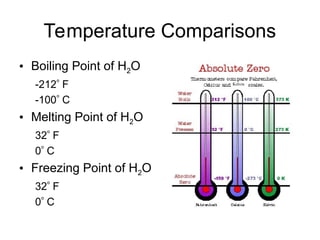
• Boiling Point of H2O
-212 F
-100 C
• Melting Point of H2O
32 F
0 C
• Freezing Point of H2O
32 F
0 C
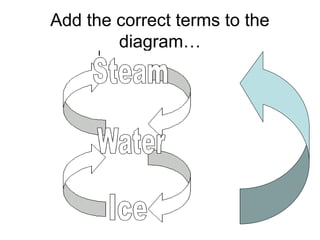
Add the correct terms to the
diagram…
Phase Change Graph

Physical Phase Changes- Grade 7 Science of Materials

  • 1.
  • 2.
  • 3.
    Water • Water existson our planet in three states. • Ice, water, and water vapor • What causes water to be in one phase or another?
  • 5.
    ENERGY • When energyis added to a substance that energy causes the particles in the substance to move faster and farther apart. • What happens to the particles when energy is taken away from a substance?
  • 6.
    Phase Change • Energycontent is responsible for the different phases of matter. • Matter can be made to change phase when energy is added to or taken away from a substance.
  • 7.
    Adding Energy • Phasechanges that require the addition of energy are called endothermic changes. (endo = inside, therm = heat) • Which phase changes are endothermic? – Melting (solid  liquid) – Boiling (liquid  gas) – Sublimation (solid  gas)
  • 8.
    Removing Energy • Phasechanges that require the addition of energy are called exothermic changes. (exo = outside, therm = heat) • Which phase changes are exothermic? – Freezing (liquid  solid) – Condensation (gas  liquid) – Deposition (reverse sublimation) (gas  solid)
  • 9.
    Block of Iceto Steam • Block of Ice to Water Vapor
  • 10.
    Melting- Solid toLiquid • Melting is the changing of a solid to a liquid when the substance absorbs heat energy. • Melting Point – Water 0° C. – Table salt 801° C. – Diamond 3700° C.
  • 11.
    Freezing- Liquid toSolid • Opposite of melting: liquid changing to a solid is freezing. • Freezing occurs when a substance loses heat energy. • The freezing point of a substance is equal to the melting point!
  • 12.
  • 13.
    Vaporization- Liquid toGas • Vaporization is the changing of a liquid to a gas when the substance absorbs heat energy. • Vaporization occurring at the surface of a liquid is called evaporation.
  • 14.
    Evaporation- a CoolingProcess • As water in the perspiration evaporates from your skin it absorbs and carries away heat energy from your body.
  • 15.
    Boiling • If enoughheat energy is applied to a substance particles inside the liquid can change to gas. • These particles travel to the surface of the liquid and then into the air. This process is called boiling.
  • 16.
  • 17.
    Boiling Point • BoilingPoint – temperature at which a substance boils. – Water 100° C. – Table salt 1413° C. – Diamond 4200° C. • What is the difference between evaporation and boiling?
  • 18.
  • 19.
    Condensation- Gas toLiquid • Gases can change phase, also in a gas to liquid phase change. • A substance in the gas phase that loses heat will change to a liquid. This is called condensation.
  • 20.
    Condensation • Water vaporin surrounding air loses heat energy when it comes in contact with the cold glass. Water vapor condenses and becomes liquid drops of water.
  • 21.
  • 22.
    Sublimation – Solidto Liquid • Solid to gas phase change occurs when the surface particles of a solid change directly into a gas.
  • 23.
    Sublimation – Solidto Liquid • You may notice this in the cold winter with snow. The snow does not melt, but slowly disappears. • Dry ice goes directly from solid carbon dioxide to gas. http://www.youtube.com/watch?v =7_p9LOTUIDQ
  • 24.
  • 25.
    Phase Change • PhaseChange Diagram in Water
  • 26.
    Temperature Comparisons • BoilingPoint of H2O -212 F -100 C • Melting Point of H2O 32 F 0 C • Freezing Point of H2O 32 F 0 C
  • 27.
    Add the correctterms to the diagram…
  • 28.