Chapter 17 — Fire Attack
Fire Officer: Principles and
Practice
Third Edition
Fire Officer I Objectives
‣ Discuss the results of the full-scale
structure fire experiments conducted by
the National Institute of Standards and
Technology (NIST) and Underwriters
Laboratories (UL).
‣ Describe a fire officer’s role in
supervising a single company.
Fire Officer I Objectives
‣ Describe how to size up the incident.
‣ Discuss how to develop an incident
action plan.
‣ Discuss tactical safety considerations
when fighting fires.
Introduction
‣ Structural firefighting is a practice built
upon experience and experiments.
‣ Recent findings have:
‣ Changed our understanding of fire dynamics
‣ Identified the importance of controlling flow path
‣ Changed ventilation and interior firefighting
practices
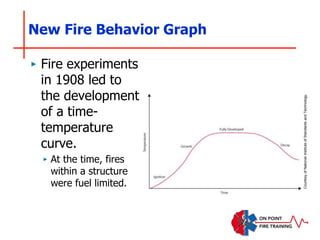
New Fire Behavior Graph
‣ Fire experiments
in 1908 led to
the development
of a time-
temperature
curve.
‣ At the time, fires
within a structure
were fuel limited.
Courtesy
of
National
Institute
of
Standards
and
Technology.
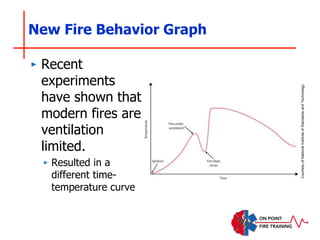
New Fire Behavior Graph
‣ Recent
experiments
have shown that
modern fires are
ventilation
limited.
‣ Resulted in a
different time-
temperature curve
Courtesy
of
National
Institute
of
Standards
and
Technology.
Modern Versus Legacy Single-
Family Dwellings
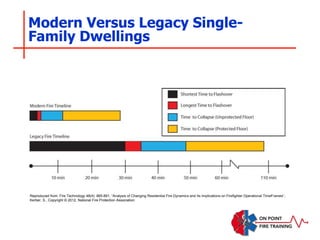
‣ Four factors distinguish modern versus
legacy single-family dwellings:
‣ Larger homes
‣ Open house geometries
‣ Increased fuel loads
‣ New construction materials
Modern Versus Legacy Single-
Family Dwellings
Reproduced from: Fire Technology 48(4): 865-891, “Analysis of Changing Residential Fire Dynamics and Its Implications on Firefighter Operational TimeFrames”,
Kerber, S., Copyright © 2012, National Fire Protection Association.
Flow Path
‣ Flow path: Volume between an inlet and
an exhaust that allows heat and smoke
to move from a higher-pressure area
toward lower-pressure areas.
Flow Path
‣ When combatting ventilation-limited
compartment fires:
‣ Control the access door.
‣ Apply water before vertical ventilation.
‣ Apply 30-90 seconds of water.
‣ You cannot make a big enough ventilation
hole.
Flow Path
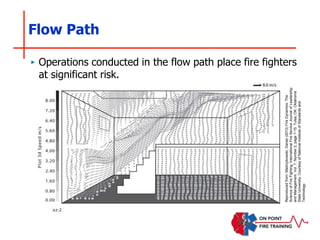
‣ Operations conducted in the flow path place fire fighters
at significant risk.
Reproduced
from:
Madrzykowski,
Daniel
(2013)
Fire
Dynamics:
The
Science
of
Fire
Fighting.
International
Fire
Service
Journal
of
Leadership
and
Management.
Vol.
7.
Number
2,
page
7-15.
Tulsa,
OK:
Oklahoma
State
University.
Courtesy
of
National
Institute
of
Standards
and
Technology.
Supervising a Single Company
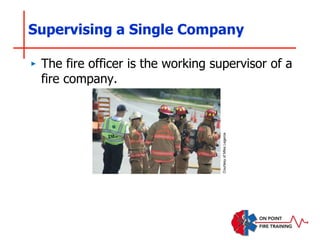
‣ The fire officer is the working supervisor of a
fire company.
Courtesy
of
Mike
Legeros
Closeness of Supervision
‣ The level of supervision should be
balanced with:
‣ The experience level of company members
‣ The nature of the assignment
‣ The level of supervision is also affected
by the location of the task.
Situational Leadership
‣ Adopt the appropriate leadership style
for the situation.
‣ Nonemergency situations: Participative
leadership is appropriate.
‣ Emergency incident: Decisions are needed
quickly.
Standardized Actions
‣ Emergency operations must be
conducted in a structured, consistent
manner.
‣ Strong emphasis is placed on standard
operating procedures (SOPs).
Command Staff Assignments
‣ Include safety officer, liaison officer, and
public information officer
‣ The fire officer working in one of these
positions reports directly to the incident
commander.
Sizing up the Incident
‣ Size-up is a systematic process of
gathering and processing information to
evaluate a situation.
‣ The end result is an incident action plan.
‣ An experienced officer will adjust the plan as
more information becomes available.
Prearrival Information
‣ Size-up begins with dispatch.
‣ The name, location, and nature of the
incident help the fire officer anticipate
what might be happening at the scene.
On-Scene Observations
‣ SOPs list the essential size-up factors.
‣ The fire officer must understand and
recognize basic fire dynamics.
‣ This information is needed to predict where
the fire is burning and where it will spread
‣ Visualization is a significant factor.
On-Scene Observations
‣ An understanding of fire dynamics is also
needed to develop action plans.
‣ Fuel load is another important factor.
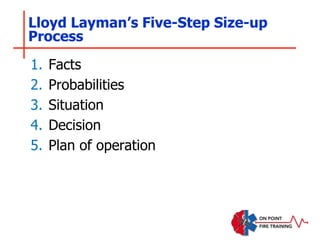
Lloyd Layman’s Five-Step Size-up
Process
1. Facts
2. Probabilities
3. Situation
4. Decision
5. Plan of operation
National Fire Academy’s
Size-up Process
1. Preincident information
2. Initial size-up
3. Ongoing size-up
Risk–Benefit Analysis
‣ Key size-up factor when selecting the
appropriate strategic mode
‣ The degree of risk that is acceptable is
determined by the benefits that can be
anticipated.
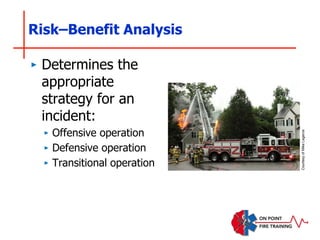
Risk–Benefit Analysis
‣ Determines the
appropriate
strategy for an
incident:
‣ Offensive operation
‣ Defensive operation
‣ Transitional operation
Courtesy
of
Mike
Legeros
Incident Action Plan
‣ After size-up, the incident commander
develops an incident action plan.
‣ Two major components:
1. Determination of appropriate strategy
2. Development of tactics to execute strategy
‣ SOPs are used.
Incident Priorities
1. Life safety
2. Incident stabilization
3. Property conservation
Tactical Priorities (RECEO VS)
‣ Rescue
‣ Remove victims from danger.
‣ Exposures
‣ Keep the incident from getting bigger.
‣ Confinement
‣ Prevent the fire from spreading to
uninvolved areas.
Tactical Priorities (RECEO VS)
‣ Extinguishment
‣ Extinguish the fire or mitigate the incident.
‣ Overhaul
‣ Make sure the fire is completely out.
Tactical Priorities (RECEO VS)
‣ Ventilation
‣ Remove heat, smoke, and products of
combustion from a fire area.
‣ Salvage
‣ Protect or remove property that could be
damaged by fire, smoke, water, or
firefighting operations.
Tactical Safety Considerations
‣ A full ensemble of protective clothing
and equipment should be worn when
exposed to hazardous conditions.
‣ Its weight, bulk, and thermal properties
must be considered during extreme weather
conditions.
Scene Safety
‣ Use lights at night.
‣ During cold weather, spread abrasive
materials about the scene.
‣ If exposed to traffic hazards:
‣ Position apparatus to protect the scene.
‣ Wear high-visibility safety vests or jackets.
‣ Request traffic control.
Scene Safety
‣ Identify hazardous areas.
‣ Hot zone
‣ Warm zone
‣ Cold zone
‣ Keep spare clothes on hand.
Rapid Intervention Crew
‣ Initial rapid intervention crew (IRIC):
‣ Two members from the initial attack crew
‣ Rapid intervention crew (RIC):
‣ Four members
‣ Generally positioned outside, ready for
immediate action
Personnel Accountability Report
(PAR)
‣ Systematic method of accounting for all
personnel at an emergency incident
‣ The fire officer physically verifies members
are present.
‣ Anytime a fire fighter cannot be
accounted for, he or she is considered
missing until proven otherwise.

2720 Ch 17 PowerPoint.pptx

  • 1.
    Chapter 17 —Fire Attack Fire Officer: Principles and Practice Third Edition
  • 2.
    Fire Officer IObjectives ‣ Discuss the results of the full-scale structure fire experiments conducted by the National Institute of Standards and Technology (NIST) and Underwriters Laboratories (UL). ‣ Describe a fire officer’s role in supervising a single company.
  • 3.
    Fire Officer IObjectives ‣ Describe how to size up the incident. ‣ Discuss how to develop an incident action plan. ‣ Discuss tactical safety considerations when fighting fires.
  • 4.
    Introduction ‣ Structural firefightingis a practice built upon experience and experiments. ‣ Recent findings have: ‣ Changed our understanding of fire dynamics ‣ Identified the importance of controlling flow path ‣ Changed ventilation and interior firefighting practices
  • 5.
    New Fire BehaviorGraph ‣ Fire experiments in 1908 led to the development of a time- temperature curve. ‣ At the time, fires within a structure were fuel limited. Courtesy of National Institute of Standards and Technology.
  • 6.
    New Fire BehaviorGraph ‣ Recent experiments have shown that modern fires are ventilation limited. ‣ Resulted in a different time- temperature curve Courtesy of National Institute of Standards and Technology.
  • 7.
    Modern Versus LegacySingle- Family Dwellings ‣ Four factors distinguish modern versus legacy single-family dwellings: ‣ Larger homes ‣ Open house geometries ‣ Increased fuel loads ‣ New construction materials
  • 8.
    Modern Versus LegacySingle- Family Dwellings Reproduced from: Fire Technology 48(4): 865-891, “Analysis of Changing Residential Fire Dynamics and Its Implications on Firefighter Operational TimeFrames”, Kerber, S., Copyright © 2012, National Fire Protection Association.
  • 9.
    Flow Path ‣ Flowpath: Volume between an inlet and an exhaust that allows heat and smoke to move from a higher-pressure area toward lower-pressure areas.
  • 10.
    Flow Path ‣ Whencombatting ventilation-limited compartment fires: ‣ Control the access door. ‣ Apply water before vertical ventilation. ‣ Apply 30-90 seconds of water. ‣ You cannot make a big enough ventilation hole.
  • 11.
    Flow Path ‣ Operationsconducted in the flow path place fire fighters at significant risk. Reproduced from: Madrzykowski, Daniel (2013) Fire Dynamics: The Science of Fire Fighting. International Fire Service Journal of Leadership and Management. Vol. 7. Number 2, page 7-15. Tulsa, OK: Oklahoma State University. Courtesy of National Institute of Standards and Technology.
  • 12.
    Supervising a SingleCompany ‣ The fire officer is the working supervisor of a fire company. Courtesy of Mike Legeros
  • 13.
    Closeness of Supervision ‣The level of supervision should be balanced with: ‣ The experience level of company members ‣ The nature of the assignment ‣ The level of supervision is also affected by the location of the task.
  • 14.
    Situational Leadership ‣ Adoptthe appropriate leadership style for the situation. ‣ Nonemergency situations: Participative leadership is appropriate. ‣ Emergency incident: Decisions are needed quickly.
  • 15.
    Standardized Actions ‣ Emergencyoperations must be conducted in a structured, consistent manner. ‣ Strong emphasis is placed on standard operating procedures (SOPs).
  • 16.
    Command Staff Assignments ‣Include safety officer, liaison officer, and public information officer ‣ The fire officer working in one of these positions reports directly to the incident commander.
  • 17.
    Sizing up theIncident ‣ Size-up is a systematic process of gathering and processing information to evaluate a situation. ‣ The end result is an incident action plan. ‣ An experienced officer will adjust the plan as more information becomes available.
  • 18.
    Prearrival Information ‣ Size-upbegins with dispatch. ‣ The name, location, and nature of the incident help the fire officer anticipate what might be happening at the scene.
  • 19.
    On-Scene Observations ‣ SOPslist the essential size-up factors. ‣ The fire officer must understand and recognize basic fire dynamics. ‣ This information is needed to predict where the fire is burning and where it will spread ‣ Visualization is a significant factor.
  • 20.
    On-Scene Observations ‣ Anunderstanding of fire dynamics is also needed to develop action plans. ‣ Fuel load is another important factor.
  • 21.
    Lloyd Layman’s Five-StepSize-up Process 1. Facts 2. Probabilities 3. Situation 4. Decision 5. Plan of operation
  • 22.
    National Fire Academy’s Size-upProcess 1. Preincident information 2. Initial size-up 3. Ongoing size-up
  • 23.
    Risk–Benefit Analysis ‣ Keysize-up factor when selecting the appropriate strategic mode ‣ The degree of risk that is acceptable is determined by the benefits that can be anticipated.
  • 24.
    Risk–Benefit Analysis ‣ Determinesthe appropriate strategy for an incident: ‣ Offensive operation ‣ Defensive operation ‣ Transitional operation Courtesy of Mike Legeros
  • 25.
    Incident Action Plan ‣After size-up, the incident commander develops an incident action plan. ‣ Two major components: 1. Determination of appropriate strategy 2. Development of tactics to execute strategy ‣ SOPs are used.
  • 26.
    Incident Priorities 1. Lifesafety 2. Incident stabilization 3. Property conservation
  • 27.
    Tactical Priorities (RECEOVS) ‣ Rescue ‣ Remove victims from danger. ‣ Exposures ‣ Keep the incident from getting bigger. ‣ Confinement ‣ Prevent the fire from spreading to uninvolved areas.
  • 28.
    Tactical Priorities (RECEOVS) ‣ Extinguishment ‣ Extinguish the fire or mitigate the incident. ‣ Overhaul ‣ Make sure the fire is completely out.
  • 29.
    Tactical Priorities (RECEOVS) ‣ Ventilation ‣ Remove heat, smoke, and products of combustion from a fire area. ‣ Salvage ‣ Protect or remove property that could be damaged by fire, smoke, water, or firefighting operations.
  • 30.
    Tactical Safety Considerations ‣A full ensemble of protective clothing and equipment should be worn when exposed to hazardous conditions. ‣ Its weight, bulk, and thermal properties must be considered during extreme weather conditions.
  • 31.
    Scene Safety ‣ Uselights at night. ‣ During cold weather, spread abrasive materials about the scene. ‣ If exposed to traffic hazards: ‣ Position apparatus to protect the scene. ‣ Wear high-visibility safety vests or jackets. ‣ Request traffic control.
  • 32.
    Scene Safety ‣ Identifyhazardous areas. ‣ Hot zone ‣ Warm zone ‣ Cold zone ‣ Keep spare clothes on hand.
  • 33.
    Rapid Intervention Crew ‣Initial rapid intervention crew (IRIC): ‣ Two members from the initial attack crew ‣ Rapid intervention crew (RIC): ‣ Four members ‣ Generally positioned outside, ready for immediate action
  • 34.
    Personnel Accountability Report (PAR) ‣Systematic method of accounting for all personnel at an emergency incident ‣ The fire officer physically verifies members are present. ‣ Anytime a fire fighter cannot be accounted for, he or she is considered missing until proven otherwise.