Dot Product of Vectors
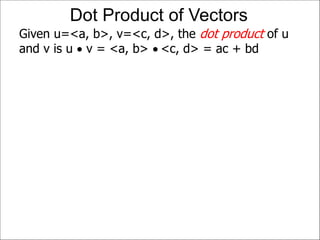
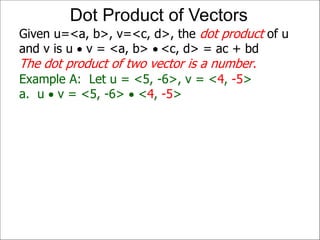
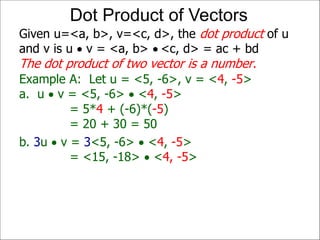
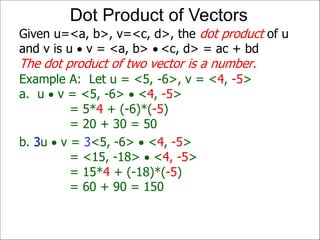
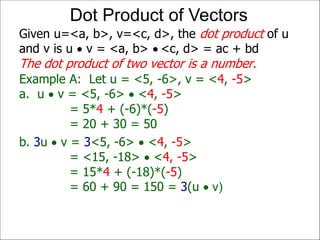
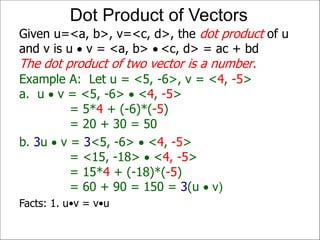
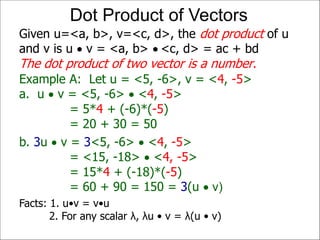
Given u=<a, b>, v=<c, d>, the dot product of u
and v is u  v = <a, b>  <c, d> = ac + bd
Dot Product of Vectors
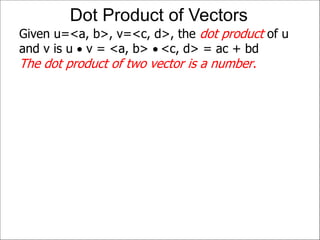
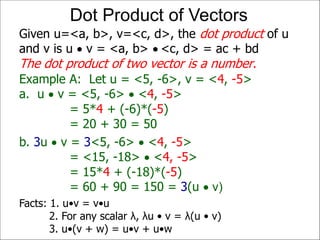
Given u=<a, b>, v=<c, d>, the dot product of u
and v is u  v = <a, b>  <c, d> = ac + bd
The dot product of two vector is a number.
Dot Product of Vectors
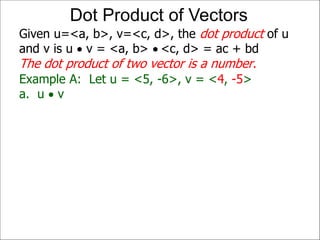
Example A: Let u = <5, -6>, v = <4, -5>
a. u  v
Given u=<a, b>, v=<c, d>, the dot product of u
and v is u  v = <a, b>  <c, d> = ac + bd
The dot product of two vector is a number.
Dot Product of Vectors
Example A: Let u = <5, -6>, v = <4, -5>
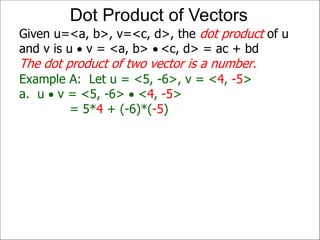
a. u  v = <5, -6>  <4, -5>
Given u=<a, b>, v=<c, d>, the dot product of u
and v is u  v = <a, b>  <c, d> = ac + bd
The dot product of two vector is a number.
Dot Product of Vectors
Example A: Let u = <5, -6>, v = <4, -5>
a. u  v = <5, -6>  <4, -5>
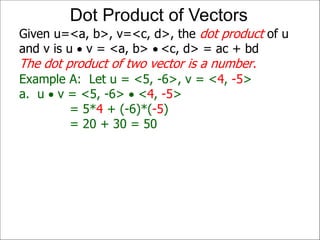
= 5*4 + (-6)*(-5)
Given u=<a, b>, v=<c, d>, the dot product of u
and v is u  v = <a, b>  <c, d> = ac + bd
The dot product of two vector is a number.
Dot Product of Vectors
Example A: Let u = <5, -6>, v = <4, -5>
a. u  v = <5, -6>  <4, -5>
= 5*4 + (-6)*(-5)
= 20 + 30 = 50
Given u=<a, b>, v=<c, d>, the dot product of u
and v is u  v = <a, b>  <c, d> = ac + bd
The dot product of two vector is a number.
Dot Product of Vectors
Example A: Let u = <5, -6>, v = <4, -5>
a. u  v = <5, -6>  <4, -5>
= 5*4 + (-6)*(-5)
= 20 + 30 = 50
Given u=<a, b>, v=<c, d>, the dot product of u
and v is u  v = <a, b>  <c, d> = ac + bd
The dot product of two vector is a number.
Dot Product of Vectors
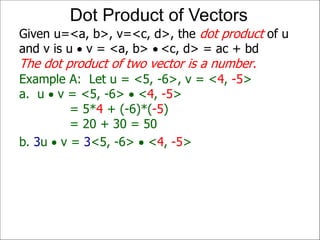
b. 3u  v = 3<5, -6>  <4, -5>
Example A: Let u = <5, -6>, v = <4, -5>
a. u  v = <5, -6>  <4, -5>
= 5*4 + (-6)*(-5)
= 20 + 30 = 50
Given u=<a, b>, v=<c, d>, the dot product of u
and v is u  v = <a, b>  <c, d> = ac + bd
The dot product of two vector is a number.
Dot Product of Vectors
b. 3u  v = 3<5, -6>  <4, -5>
= <15, -18>  <4, -5>
Example A: Let u = <5, -6>, v = <4, -5>
a. u  v = <5, -6>  <4, -5>
= 5*4 + (-6)*(-5)
= 20 + 30 = 50
Given u=<a, b>, v=<c, d>, the dot product of u
and v is u  v = <a, b>  <c, d> = ac + bd
The dot product of two vector is a number.
Dot Product of Vectors
b. 3u  v = 3<5, -6>  <4, -5>
= <15, -18>  <4, -5>
= 15*4 + (-18)*(-5)
= 60 + 90 = 150
Example A: Let u = <5, -6>, v = <4, -5>
a. u  v = <5, -6>  <4, -5>
= 5*4 + (-6)*(-5)
= 20 + 30 = 50
Given u=<a, b>, v=<c, d>, the dot product of u
and v is u  v = <a, b>  <c, d> = ac + bd
The dot product of two vector is a number.
Dot Product of Vectors
b. 3u  v = 3<5, -6>  <4, -5>
= <15, -18>  <4, -5>
= 15*4 + (-18)*(-5)
= 60 + 90 = 150 = 3(u  v)
Example A: Let u = <5, -6>, v = <4, -5>
a. u  v = <5, -6>  <4, -5>
= 5*4 + (-6)*(-5)
= 20 + 30 = 50
Given u=<a, b>, v=<c, d>, the dot product of u
and v is u  v = <a, b>  <c, d> = ac + bd
The dot product of two vector is a number.
Dot Product of Vectors
b. 3u  v = 3<5, -6>  <4, -5>
= <15, -18>  <4, -5>
= 15*4 + (-18)*(-5)
= 60 + 90 = 150 = 3(u  v)
Facts: 1. u•v = v•u
Example A: Let u = <5, -6>, v = <4, -5>
a. u  v = <5, -6>  <4, -5>
= 5*4 + (-6)*(-5)
= 20 + 30 = 50
Given u=<a, b>, v=<c, d>, the dot product of u
and v is u  v = <a, b>  <c, d> = ac + bd
The dot product of two vector is a number.
Dot Product of Vectors
b. 3u  v = 3<5, -6>  <4, -5>
= <15, -18>  <4, -5>
= 15*4 + (-18)*(-5)
= 60 + 90 = 150 = 3(u  v)
Facts: 1. u•v = v•u
2. For any scalar λ, λu • v = λ(u • v)
Example A: Let u = <5, -6>, v = <4, -5>
a. u  v = <5, -6>  <4, -5>
= 5*4 + (-6)*(-5)
= 20 + 30 = 50
Given u=<a, b>, v=<c, d>, the dot product of u
and v is u  v = <a, b>  <c, d> = ac + bd
The dot product of two vector is a number.
Dot Product of Vectors
b. 3u  v = 3<5, -6>  <4, -5>
= <15, -18>  <4, -5>
= 15*4 + (-18)*(-5)
= 60 + 90 = 150 = 3(u  v)
Facts: 1. u•v = v•u
2. For any scalar λ, λu • v = λ(u • v)
3. u•(v + w) = u•v + u•w
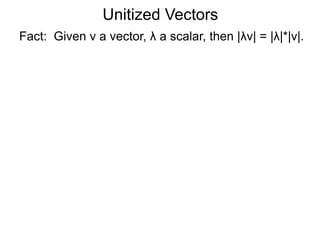
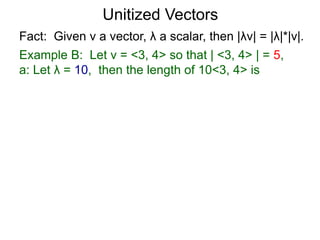
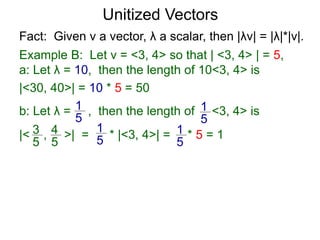
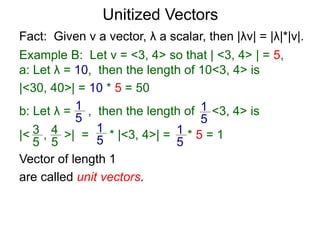
Fact: Given v a vector, λ a scalar, then |λv| = |λ|*|v|.
Unitized Vectors
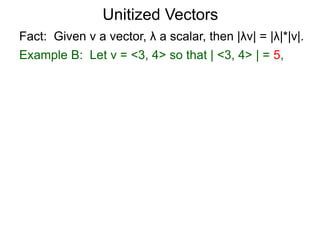
Fact: Given v a vector, λ a scalar, then |λv| = |λ|*|v|.
Example B: Let v = <3, 4> so that | <3, 4> | = 5,
Unitized Vectors
Fact: Given v a vector, λ a scalar, then |λv| = |λ|*|v|.
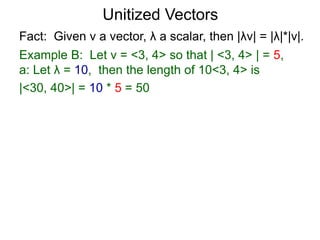
Example B: Let v = <3, 4> so that | <3, 4> | = 5,
a: Let λ = 10, then the length of 10<3, 4> is
Unitized Vectors
Fact: Given v a vector, λ a scalar, then |λv| = |λ|*|v|.
Example B: Let v = <3, 4> so that | <3, 4> | = 5,
a: Let λ = 10, then the length of 10<3, 4> is
|<30, 40>| = 10 * 5 = 50
Unitized Vectors
Fact: Given v a vector, λ a scalar, then |λv| = |λ|*|v|.
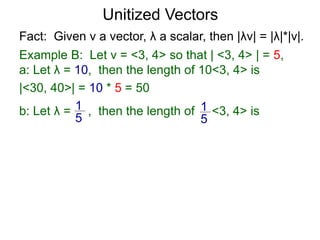
Example B: Let v = <3, 4> so that | <3, 4> | = 5,
a: Let λ = 10, then the length of 10<3, 4> is
|<30, 40>| = 10 * 5 = 50
b: Let λ = , then the length of <3, 4> is1
5
1
5
Unitized Vectors
Fact: Given v a vector, λ a scalar, then |λv| = |λ|*|v|.
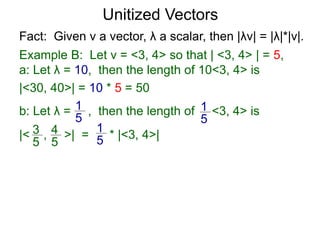
Example B: Let v = <3, 4> so that | <3, 4> | = 5,
a: Let λ = 10, then the length of 10<3, 4> is
|<30, 40>| = 10 * 5 = 50
b: Let λ = , then the length of <3, 4> is
|< , >| = * |<3, 4>|
1
5
1
5
3
5
4
5
1
5
Unitized Vectors
Fact: Given v a vector, λ a scalar, then |λv| = |λ|*|v|.
Example B: Let v = <3, 4> so that | <3, 4> | = 5,
a: Let λ = 10, then the length of 10<3, 4> is
|<30, 40>| = 10 * 5 = 50
b: Let λ = , then the length of <3, 4> is
|< , >| = * |<3, 4>| = * 5 = 1
1
5
1
5
3
5
4
5
1
5
1
5
Unitized Vectors
Fact: Given v a vector, λ a scalar, then |λv| = |λ|*|v|.
Example B: Let v = <3, 4> so that | <3, 4> | = 5,
a: Let λ = 10, then the length of 10<3, 4> is
|<30, 40>| = 10 * 5 = 50
b: Let λ = , then the length of <3, 4> is
|< , >| = * |<3, 4>| = * 5 = 1
1
5
1
5
3
5
4
5
1
5
1
5
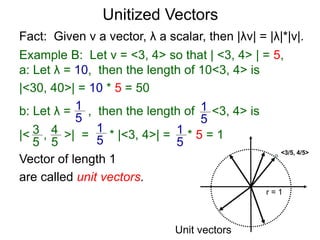
Vector of length 1
are called unit vectors.
Unitized Vectors
Fact: Given v a vector, λ a scalar, then |λv| = |λ|*|v|.
Example B: Let v = <3, 4> so that | <3, 4> | = 5,
a: Let λ = 10, then the length of 10<3, 4> is
|<30, 40>| = 10 * 5 = 50
b: Let λ = , then the length of <3, 4> is
|< , >| = * |<3, 4>| = * 5 = 1
1
5
1
5
3
5
4
5
1
5
1
5
Vector of length 1
are called unit vectors.
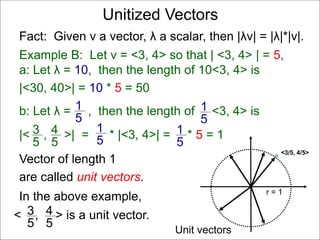
<3/5, 4/5>
r = 1
Unit vectors
Unitized Vectors
Fact: Given v a vector, λ a scalar, then |λv| = |λ|*|v|.
Example B: Let v = <3, 4> so that | <3, 4> | = 5,
a: Let λ = 10, then the length of 10<3, 4> is
|<30, 40>| = 10 * 5 = 50
b: Let λ = , then the length of <3, 4> is
|< , >| = * |<3, 4>| = * 5 = 1
1
5
1
5
3
5
4
5
1
5
1
5
Vector of length 1
are called unit vectors.
In the above example,
3
5
4
5
< , > is a unit vector.
<3/5, 4/5>
r = 1
Unit vectors
Unitized Vectors
Unitized Vectors
Unitized Vectors
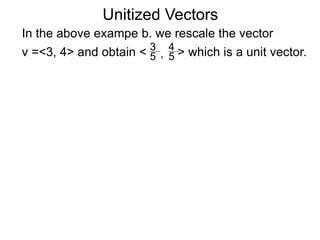
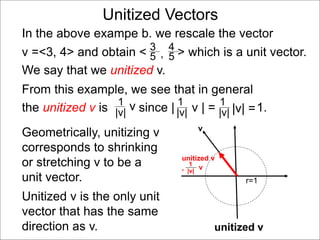
In the above exampe b. we rescale the vector
v =<3, 4> and obtain < > which is a unit vector.3
5
4
5,
Unitized Vectors
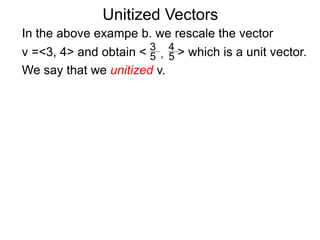
In the above exampe b. we rescale the vector
v =<3, 4> and obtain < > which is a unit vector.
We say that we unitized v.
3
5
4
5,
Unitized Vectors
In the above exampe b. we rescale the vector
v =<3, 4> and obtain < > which is a unit vector.
We say that we unitized v.
3
5
4
5,
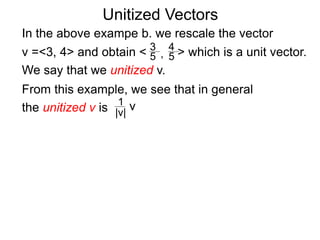
From this example, we see that in general
the unitized v is 1
|v|
v
Unitized Vectors
In the above exampe b. we rescale the vector
v =<3, 4> and obtain < > which is a unit vector.
We say that we unitized v.
3
5
4
5,
From this example, we see that in general
the unitized v is since | v | = 1.1
|v|
1
|v| |v| =
1
|v|
v
Unitized Vectors
In the above exampe b. we rescale the vector
v =<3, 4> and obtain < > which is a unit vector.
We say that we unitized v.
3
5
4
5,
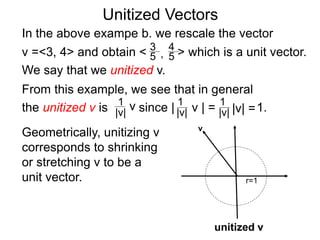
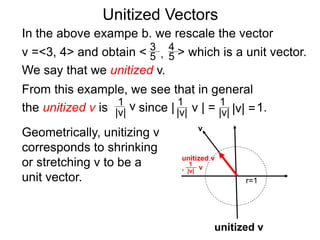
Geometrically, unitizing v
corresponds to shrinking
or stretching v to be a
unit vector.
From this example, we see that in general
the unitized v is since | v | = 1.1
|v|
1
|v| |v| =
1
|v|
v
Unitized Vectors
In the above exampe b. we rescale the vector
v =<3, 4> and obtain < > which is a unit vector.
We say that we unitized v.
3
5
4
5,
From this example, we see that in general
the unitized v is since | v | = 1.1
|v|
1
|v| |v| =
1
|v|
v
Geometrically, unitizing v
corresponds to shrinking
or stretching v to be a
unit vector.
v
r=1
unitized v
Unitized Vectors
In the above exampe b. we rescale the vector
v =<3, 4> and obtain < > which is a unit vector.
We say that we unitized v.
3
5
4
5,
Geometrically, unitizing v
corresponds to shrinking
or stretching v to be a
unit vector.
v
1
|v|
v
r=1
unitized v
unitized v
,
From this example, we see that in general
the unitized v is since | v | = 1.1
|v|
1
|v| |v| =
1
|v|
v
Unitized Vectors
In the above exampe b. we rescale the vector
v =<3, 4> and obtain < > which is a unit vector.
We say that we unitized v.
3
5
4
5,
Geometrically, unitizing v
corresponds to shrinking
or stretching v to be a
unit vector.
v
1
|v|
v
r=1
unitized v
unitized v
,
Unitized v is the only unit
vector that has the same
direction as v.
From this example, we see that in general
the unitized v is since | v | = 1.1
|v|
1
|v| |v| =
1
|v|
v
Dot product and Angles
The following theorem put all the above concepts
together.
Dot product and Angles
Dot Product Theorem:
The following theorem put all the above concepts
together.
Dot product and Angles
Dot Product Theorem:
a. Let u and v be two unit vectors and  be
the angle between them, then cos() = u•v.
The following theorem put all the above concepts
together.
Dot product and Angles
Dot Product Theorem:
a. Let u and v be two unit vectors and  be
the angle between them, then cos() = u•v.
b. Let u and v be any two vectors and  be
the angle between them
cos() = (unitized u)  (unitized v)
The following theorem put all the above concepts
together.
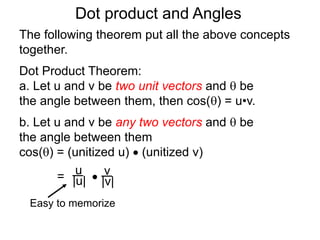
Dot product and Angles
Dot Product Theorem:
a. Let u and v be two unit vectors and  be
the angle between them, then cos() = u•v.
b. Let u and v be any two vectors and  be
the angle between them
cos() = (unitized u)  (unitized v)
=  v
|v|
u
|u|
Easy to memorize
The following theorem put all the above concepts
together.
Dot product and Angles
Dot Product Theorem:
a. Let u and v be two unit vectors and  be
the angle between them, then cos() = u•v.
b. Let u and v be any two vectors and  be
the angle between them
cos() = (unitized u)  (unitized v)
=  =v
|v|
u
|u|
u•v
|u|*|v|
Easy to memorize Easier way to compute
The following theorem put all the above concepts
together.
Dot product and Angles
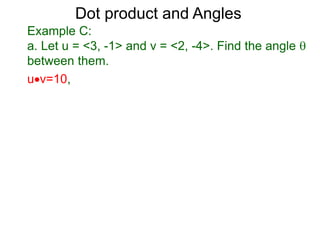
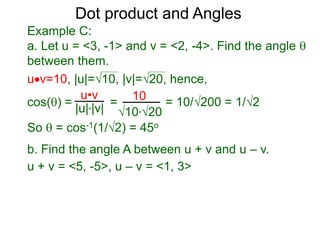
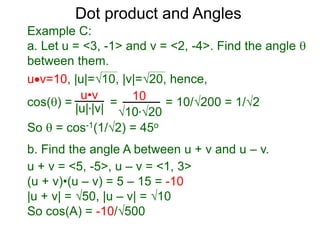
Example C:
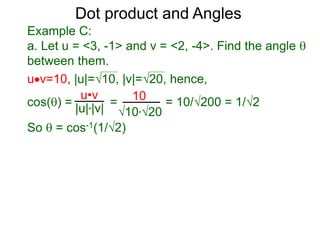
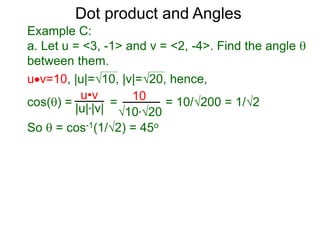
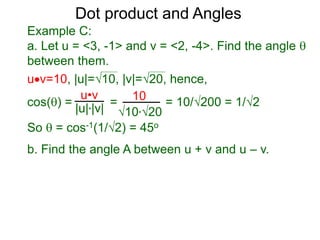
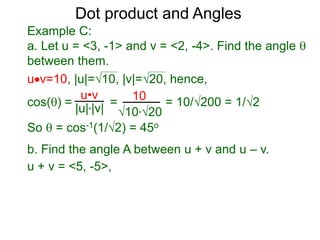
a. Let u = <3, -1> and v = <2, -4>. Find the angle 
between them.
uv=10,
Dot product and Angles
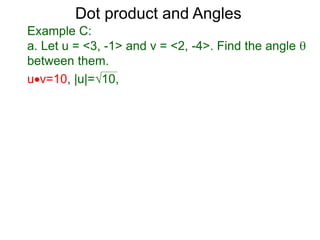
Example C:
a. Let u = <3, -1> and v = <2, -4>. Find the angle 
between them.
uv=10, |u|=10,
Dot product and Angles
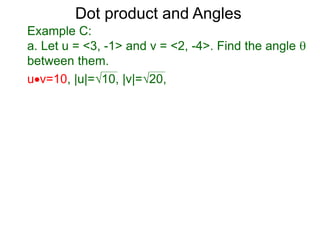
Example C:
a. Let u = <3, -1> and v = <2, -4>. Find the angle 
between them.
uv=10, |u|=10, |v|=20,
Dot product and Angles
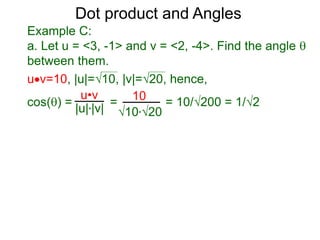
Example C:
a. Let u = <3, -1> and v = <2, -4>. Find the angle 
between them.
uv=10, |u|=10, |v|=20, hence,
cos() = =
Dot product and Angles
Example C:
a. Let u = <3, -1> and v = <2, -4>. Find the angle 
between them.
u•v
|u|*|v|
10
10*20
uv=10, |u|=10, |v|=20, hence,
cos() = = = 10/200 = 1/2
Dot product and Angles
Example C:
a. Let u = <3, -1> and v = <2, -4>. Find the angle 
between them.
u•v
|u|*|v|
10
10*20
uv=10, |u|=10, |v|=20, hence,
cos() = = = 10/200 = 1/2
So  = cos-1(1/2)
Dot product and Angles
Example C:
a. Let u = <3, -1> and v = <2, -4>. Find the angle 
between them.
u•v
|u|*|v|
10
10*20
uv=10, |u|=10, |v|=20, hence,
cos() = = = 10/200 = 1/2
So  = cos-1(1/2) = 45o
Dot product and Angles
Example C:
a. Let u = <3, -1> and v = <2, -4>. Find the angle 
between them.
u•v
|u|*|v|
10
10*20
uv=10, |u|=10, |v|=20, hence,
cos() = = = 10/200 = 1/2
So  = cos-1(1/2) = 45o
Dot product and Angles
Example C:
a. Let u = <3, -1> and v = <2, -4>. Find the angle 
between them.
u•v
|u|*|v|
10
10*20
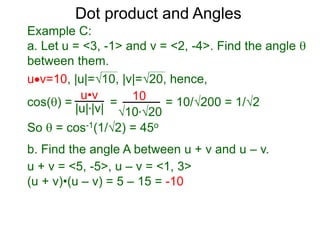
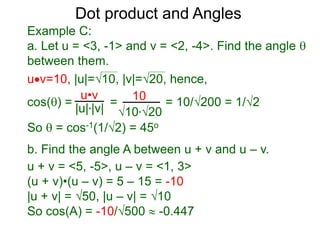
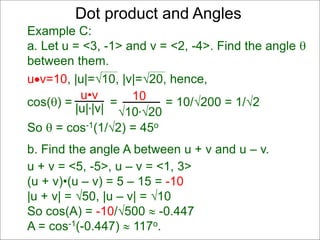
b. Find the angle A between u + v and u – v.
uv=10, |u|=10, |v|=20, hence,
cos() = = = 10/200 = 1/2
So  = cos-1(1/2) = 45o
Dot product and Angles
Example C:
a. Let u = <3, -1> and v = <2, -4>. Find the angle 
between them.
u•v
|u|*|v|
10
10*20
b. Find the angle A between u + v and u – v.
u + v = <5, -5>,
uv=10, |u|=10, |v|=20, hence,
cos() = = = 10/200 = 1/2
So  = cos-1(1/2) = 45o
Dot product and Angles
Example C:
a. Let u = <3, -1> and v = <2, -4>. Find the angle 
between them.
u•v
|u|*|v|
10
10*20
b. Find the angle A between u + v and u – v.
u + v = <5, -5>, u – v = <1, 3>
uv=10, |u|=10, |v|=20, hence,
cos() = = = 10/200 = 1/2
So  = cos-1(1/2) = 45o
Dot product and Angles
Example C:
a. Let u = <3, -1> and v = <2, -4>. Find the angle 
between them.
u•v
|u|*|v|
10
10*20
b. Find the angle A between u + v and u – v.
u + v = <5, -5>, u – v = <1, 3>
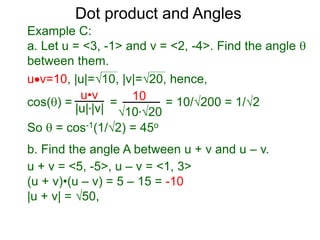
(u + v)•(u – v) = 5 – 15 = -10
uv=10, |u|=10, |v|=20, hence,
cos() = = = 10/200 = 1/2
So  = cos-1(1/2) = 45o
Dot product and Angles
Example C:
a. Let u = <3, -1> and v = <2, -4>. Find the angle 
between them.
u•v
|u|*|v|
10
10*20
b. Find the angle A between u + v and u – v.
u + v = <5, -5>, u – v = <1, 3>
(u + v)•(u – v) = 5 – 15 = -10
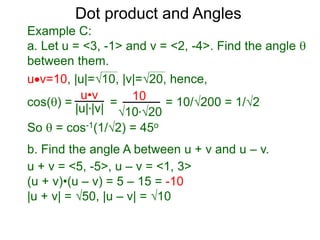
|u + v| = 50,
uv=10, |u|=10, |v|=20, hence,
cos() = = = 10/200 = 1/2
So  = cos-1(1/2) = 45o
Dot product and Angles
Example C:
a. Let u = <3, -1> and v = <2, -4>. Find the angle 
between them.
u•v
|u|*|v|
10
10*20
b. Find the angle A between u + v and u – v.
u + v = <5, -5>, u – v = <1, 3>
(u + v)•(u – v) = 5 – 15 = -10
|u + v| = 50, |u – v| = 10
uv=10, |u|=10, |v|=20, hence,
cos() = = = 10/200 = 1/2
So  = cos-1(1/2) = 45o
Dot product and Angles
Example C:
a. Let u = <3, -1> and v = <2, -4>. Find the angle 
between them.
u•v
|u|*|v|
10
10*20
b. Find the angle A between u + v and u – v.
u + v = <5, -5>, u – v = <1, 3>
(u + v)•(u – v) = 5 – 15 = -10
|u + v| = 50, |u – v| = 10
So cos(A) = -10/500
uv=10, |u|=10, |v|=20, hence,
cos() = = = 10/200 = 1/2
So  = cos-1(1/2) = 45o
Dot product and Angles
Example C:
a. Let u = <3, -1> and v = <2, -4>. Find the angle 
between them.
u•v
|u|*|v|
10
10*20
b. Find the angle A between u + v and u – v.
u + v = <5, -5>, u – v = <1, 3>
(u + v)•(u – v) = 5 – 15 = -10
|u + v| = 50, |u – v| = 10
So cos(A) = -10/500  -0.447
uv=10, |u|=10, |v|=20, hence,
cos() = = = 10/200 = 1/2
So  = cos-1(1/2) = 45o
Dot product and Angles
Example C:
a. Let u = <3, -1> and v = <2, -4>. Find the angle 
between them.
u•v
|u|*|v|
10
10*20
b. Find the angle A between u + v and u – v.
u + v = <5, -5>, u – v = <1, 3>
(u + v)•(u – v) = 5 – 15 = -10
|u + v| = 50, |u – v| = 10
So cos(A) = -10/500  -0.447
A = cos-1(-0.447)  117o.
Dot product and Angles
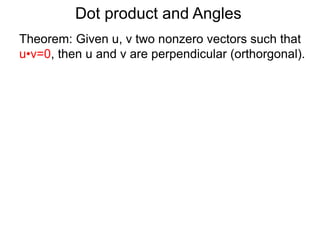
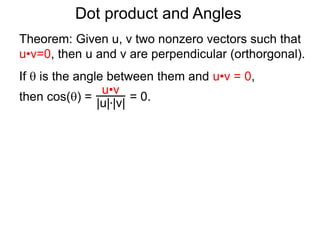
Theorem: Given u, v two nonzero vectors such that
u•v=0, then u and v are perpendicular (orthorgonal).
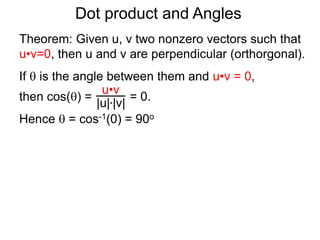
Dot product and Angles
Theorem: Given u, v two nonzero vectors such that
u•v=0, then u and v are perpendicular (orthorgonal).
If  is the angle between them and u•v = 0,
then cos() = = 0.
u•v
|u|*|v|
Dot product and Angles
Theorem: Given u, v two nonzero vectors such that
u•v=0, then u and v are perpendicular (orthorgonal).
If  is the angle between them and u•v = 0,
then cos() = = 0.
Hence  = cos-1(0) = 90o
u•v
|u|*|v|
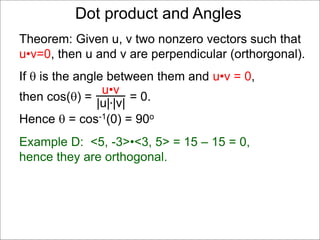
Example D: <5, -3>•<3, 5> = 15 – 15 = 0,
hence they are orthogonal.
Dot product and Angles
Theorem: Given u, v two nonzero vectors such that
u•v=0, then u and v are perpendicular (orthorgonal).
If  is the angle between them and u•v = 0,
then cos() = = 0.
Hence  = cos-1(0) = 90o
u•v
|u|*|v|
 2006, Frank Ma
Projections
Projections
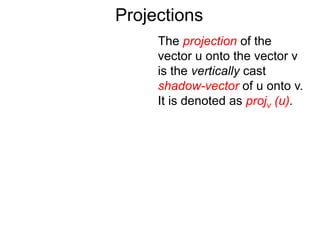
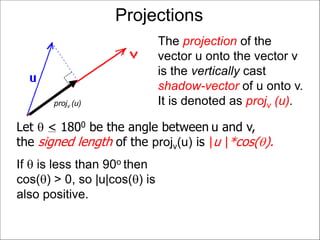
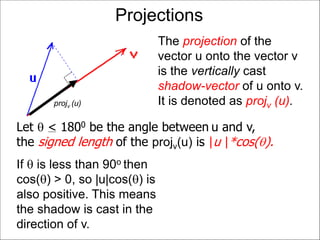
The projection of the
vector u onto the vector v
is the vertically cast
shadow-vector of u onto v.
It is denoted as projv (u).
Projections
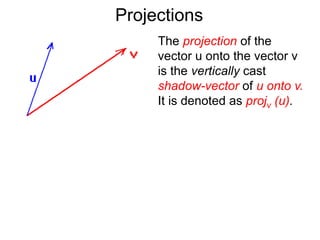
The projection of the
vector u onto the vector v
is the vertically cast
shadow-vector of u onto v.
It is denoted as projv (u).
Projections
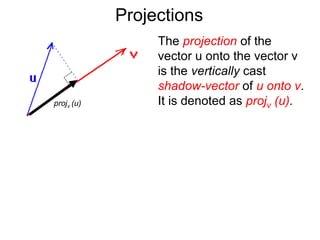
The projection of the
vector u onto the vector v
is the vertically cast
shadow-vector of u onto v.
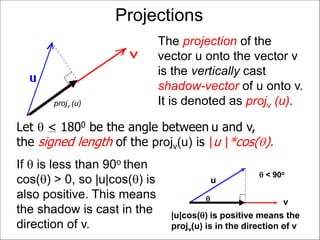
It is denoted as projv (u).projv (u)
Projections
The projection of the
vector u onto the vector v
is the vertically cast
shadow-vector of u onto v.
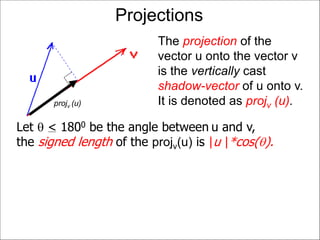
It is denoted as projv (u).projv (u)
Let  < 1800 be the angle between u and v,
the signed length of the projv(u) is |u |*cos().
Projections
The projection of the
vector u onto the vector v
is the vertically cast
shadow-vector of u onto v.
It is denoted as projv (u).projv (u)
If  is less than 90o then
cos() > 0, so |u|cos() is
also positive.
Let  < 1800 be the angle between u and v,
the signed length of the projv(u) is |u |*cos().
Projections
The projection of the
vector u onto the vector v
is the vertically cast
shadow-vector of u onto v.
It is denoted as projv (u).projv (u)
If  is less than 90o then
cos() > 0, so |u|cos() is
also positive. This means
the shadow is cast in the
direction of v.
Let  < 1800 be the angle between u and v,
the signed length of the projv(u) is |u |*cos().
Projections
The projection of the
vector u onto the vector v
is the vertically cast
shadow-vector of u onto v.
It is denoted as projv (u).projv (u)
If  is less than 90o then
cos() > 0, so |u|cos() is
also positive. This means
the shadow is cast in the
direction of v.
u
v
|u|cos() is positive means the
projv(u) is in the direction of v

 < 90o
Let  < 1800 be the angle between u and v,
the signed length of the projv(u) is |u |*cos().
Projections
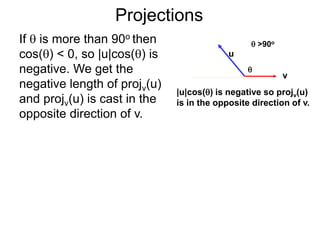
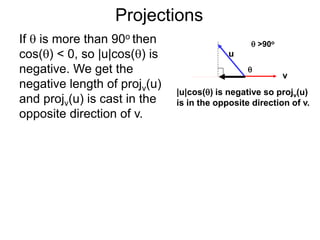
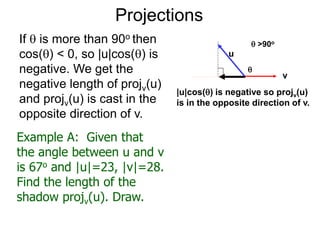
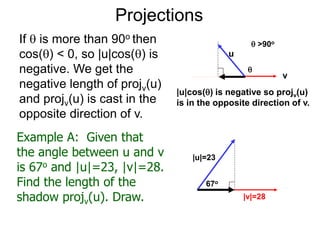
If  is more than 90o then
cos() < 0, so |u|cos() is
negative.
Projections
If  is more than 90o then
cos() < 0, so |u|cos() is
negative. We get the
negative length of projv(u)
and projv(u) is cast in the
opposite direction of v.
Projections
If  is more than 90o then
cos() < 0, so |u|cos() is
negative. We get the
negative length of projv(u)
and projv(u) is cast in the
opposite direction of v.
u
v
|u|cos() is negative so projv(u)
is in the opposite direction of v.

 >90o
Projections
If  is more than 90o then
cos() < 0, so |u|cos() is
negative. We get the
negative length of projv(u)
and projv(u) is cast in the
opposite direction of v.
u
v
|u|cos() is negative so projv(u)
is in the opposite direction of v.

 >90o
Projections
If  is more than 90o then
cos() < 0, so |u|cos() is
negative. We get the
negative length of projv(u)
and projv(u) is cast in the
opposite direction of v.
u
v
|u|cos() is negative so projv(u)
is in the opposite direction of v.

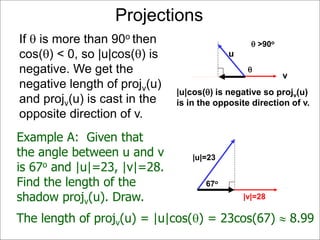
Example A: Given that
the angle between u and v
is 67o and |u|=23, |v|=28.
Find the length of the
shadow projv(u). Draw.
 >90o
Projections
If  is more than 90o then
cos() < 0, so |u|cos() is
negative. We get the
negative length of projv(u)
and projv(u) is cast in the
opposite direction of v.
u
v
|u|cos() is negative so projv(u)
is in the opposite direction of v.

Example A: Given that
the angle between u and v
is 67o and |u|=23, |v|=28.
Find the length of the
shadow projv(u). Draw.
|u|=23
67o
|v|=28
 >90o
Projections
If  is more than 90o then
cos() < 0, so |u|cos() is
negative. We get the
negative length of projv(u)
and projv(u) is cast in the
opposite direction of v.
u
v
|u|cos() is negative so projv(u)
is in the opposite direction of v.

Example A: Given that
the angle between u and v
is 67o and |u|=23, |v|=28.
Find the length of the
shadow projv(u). Draw.
|u|=23
67o
|v|=28
The length of projv(u) = |u|cos() = 23cos(67)  8.99
 >90o
Projections
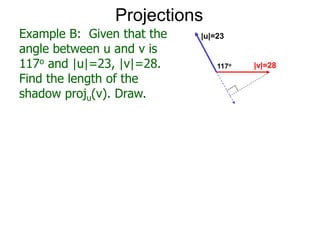
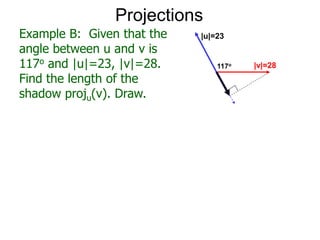
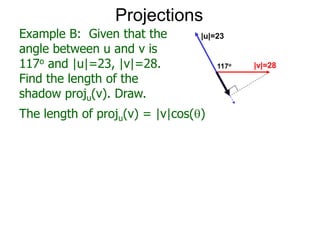
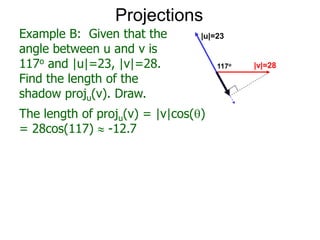
Example B: Given that the
angle between u and v is
117o and |u|=23, |v|=28.
Find the length of the
shadow proju(v). Draw.
Projections
Example B: Given that the
angle between u and v is
117o and |u|=23, |v|=28.
Find the length of the
shadow proju(v). Draw.
|u|=23
117o |v|=28
Projections
Example B: Given that the
angle between u and v is
117o and |u|=23, |v|=28.
Find the length of the
shadow proju(v). Draw.
|u|=23
117o |v|=28
Projections
Example B: Given that the
angle between u and v is
117o and |u|=23, |v|=28.
Find the length of the
shadow proju(v). Draw.
|u|=23
117o |v|=28
The length of proju(v) = |v|cos()
Projections
Example B: Given that the
angle between u and v is
117o and |u|=23, |v|=28.
Find the length of the
shadow proju(v). Draw.
|u|=23
117o |v|=28
The length of proju(v) = |v|cos()
= 28cos(117)  -12.7
Projections
Example B: Given that the
angle between u and v is
117o and |u|=23, |v|=28.
Find the length of the
shadow proju(v). Draw.
|u|=23
117o |v|=28
The length of proju(v) = |v|cos()
= 28cos(117)  -12.7
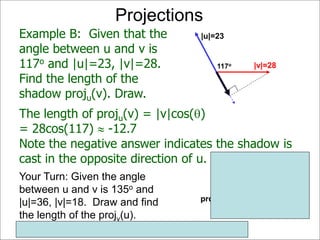
Note the negative answer indicates the shadow is
cast in the opposite direction of u.
Projections
Example B: Given that the
angle between u and v is
117o and |u|=23, |v|=28.
Find the length of the
shadow proju(v). Draw.
|u|=23
117o |v|=28
The length of proju(v) = |v|cos()
= 28cos(117)  -12.7
Note the negative answer indicates the shadow is
cast in the opposite direction of u.
Your Turn: Given the angle
between u and v is 135o and
|u|=36, |v|=18. Draw and find
the length of the projv(u).
135o
|u|=36
v
Ans: Signed length of projv(u) = –36/2  –25.4
projv(u)
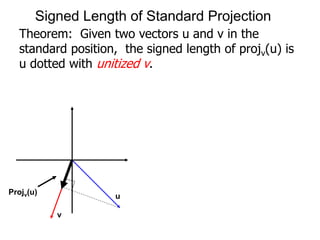
Signed Length of Standard Projection
Theorem: Given two vectors u and v in the
standard position, the signed length of projv(u) is
u dotted with unitized v.
Projv(u)
u
v
Signed Length of Standard Projection
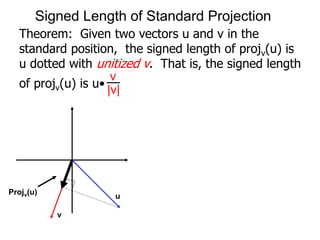
Theorem: Given two vectors u and v in the
standard position, the signed length of projv(u) is
u dotted with unitized v. That is, the signed length
of projv(u) is u•
v
|v|
Projv(u)
u
v
Signed Length of Standard Projection
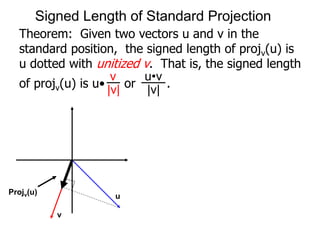
Theorem: Given two vectors u and v in the
standard position, the signed length of projv(u) is
u dotted with unitized v. That is, the signed length
of projv(u) is u• or .
Projv(u)
v
|v|
u•v
|v|
u
v
Signed Length of Standard Projection
Theorem: Given two vectors u and v in the
standard position, the signed length of projv(u) is
u dotted with unitized v. That is, the signed length
of projv(u) is u• or .
v
|v|
u•v
|v|
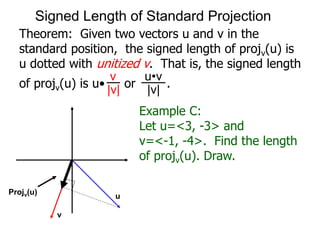
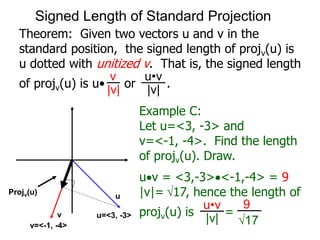
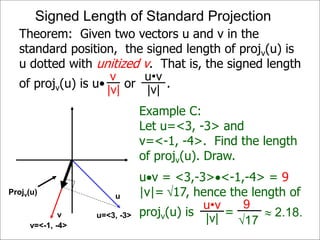
Example C:
Let u=<3, -3> and
v=<-1, -4>. Find the length
of projv(u). Draw.
Projv(u)
u
v
Signed Length of Standard Projection
Theorem: Given two vectors u and v in the
standard position, the signed length of projv(u) is
u dotted with unitized v. That is, the signed length
of projv(u) is u• or .
Projv(u)
v
|v|
u•v
|v|
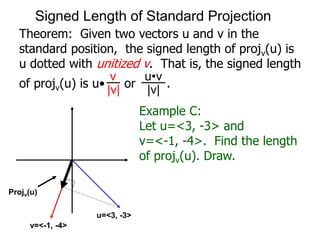
Example C:
Let u=<3, -3> and
v=<-1, -4>. Find the length
of projv(u). Draw.
u=<3, -3>
v=<-1, -4>
Signed Length of Standard Projection
Theorem: Given two vectors u and v in the
standard position, the signed length of projv(u) is
u dotted with unitized v. That is, the signed length
of projv(u) is u• or .
v
|v|
u•v
|v|
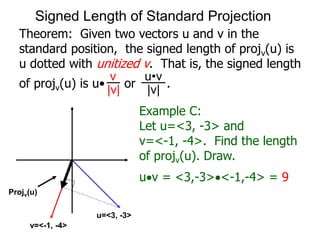
Example C:
Let u=<3, -3> and
v=<-1, -4>. Find the length
of projv(u). Draw.
uv = <3,-3><-1,-4> = 9
Projv(u)
u=<3, -3>
v=<-1, -4>
Signed Length of Standard Projection
Theorem: Given two vectors u and v in the
standard position, the signed length of projv(u) is
u dotted with unitized v. That is, the signed length
of projv(u) is u• or .
v
|v|
u•v
|v|
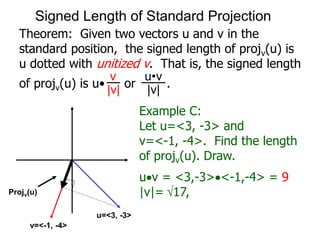
Example C:
Let u=<3, -3> and
v=<-1, -4>. Find the length
of projv(u). Draw.
uv = <3,-3><-1,-4> = 9
|v|= 17,Projv(u)
u=<3, -3>
v=<-1, -4>
Signed Length of Standard Projection
Theorem: Given two vectors u and v in the
standard position, the signed length of projv(u) is
u dotted with unitized v. That is, the signed length
of projv(u) is u• or .
Projv(u)
v
|v|
u•v
|v|
u
v
Example C:
Let u=<3, -3> and
v=<-1, -4>. Find the length
of projv(u). Draw.
uv = <3,-3><-1,-4> = 9
|v|= 17, hence the length of
projv(u) is =
Projv(u)
u=<3, -3>
v=<-1, -4>
u•v
|v|
9
17
Signed Length of Standard Projection
Theorem: Given two vectors u and v in the
standard position, the signed length of projv(u) is
u dotted with unitized v. That is, the signed length
of projv(u) is u• or .
Projv(u)
v
|v|
u•v
|v|
u
v
Example C:
Let u=<3, -3> and
v=<-1, -4>. Find the length
of projv(u). Draw.
uv = <3,-3><-1,-4> = 9
|v|= 17, hence the length of
projv(u) is =
Projv(u)
u=<3, -3>
v=<-1, -4>
u•v
|v|
9
17
 2.18.
Signed Length of Standard Projection
Projections of Standard Vectors
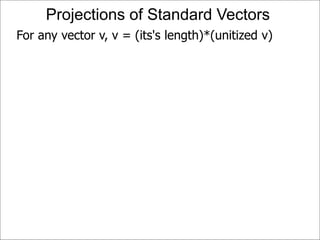
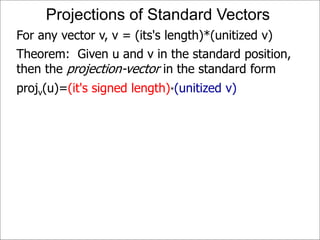
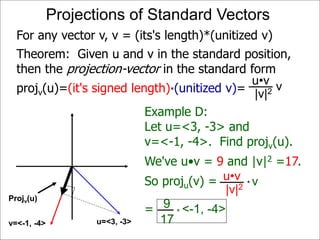
For any vector v, v = (its's length)*(unitized v)
Projections of Standard Vectors
For any vector v, v = (its's length)*(unitized v)
Theorem: Given u and v in the standard position,
then the projection-vector in the standard form
projv(u)=(it's signed length)*(unitized v)
Projections of Standard Vectors
For any vector v, v = (its's length)*(unitized v)
Theorem: Given u and v in the standard position,
then the projection-vector in the standard form
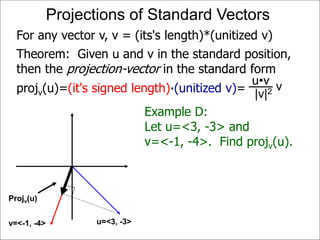
projv(u)=(it's signed length)*(unitized v)= vu•v
|v|2
Theorem: Given u and v in the standard position,
then the projection-vector in the standard form
projv(u)=(it's signed length)*(unitized v)=
Projections of Standard Vectors
For any vector v, v = (its's length)*(unitized v)
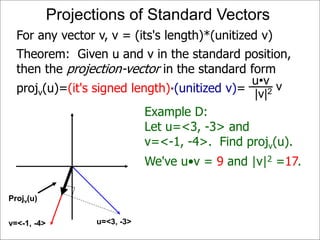
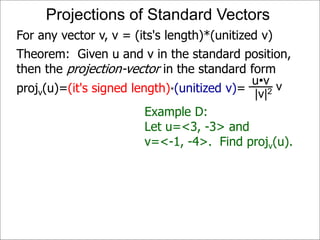
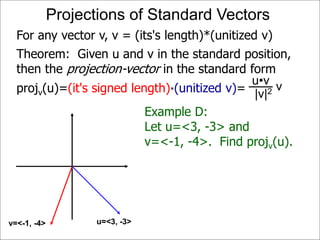
Example D:
Let u=<3, -3> and
v=<-1, -4>. Find projv(u).
vu•v
|v|2
Theorem: Given u and v in the standard position,
then the projection-vector in the standard form
projv(u)=(it's signed length)*(unitized v)=
Projections of Standard Vectors
u=<3, -3>v=<-1, -4>
For any vector v, v = (its's length)*(unitized v)
Example D:
Let u=<3, -3> and
v=<-1, -4>. Find projv(u).
vu•v
|v|2
Theorem: Given u and v in the standard position,
then the projection-vector in the standard form
projv(u)=(it's signed length)*(unitized v)=
Projv(u)
Projections of Standard Vectors
Projv(u)
u=<3, -3>v=<-1, -4>
For any vector v, v = (its's length)*(unitized v)
Example D:
Let u=<3, -3> and
v=<-1, -4>. Find projv(u).
vu•v
|v|2
Projv(u)
Projections of Standard Vectors
Projv(u)
u=<3, -3>v=<-1, -4>
For any vector v, v = (its's length)*(unitized v)
Example D:
Let u=<3, -3> and
v=<-1, -4>. Find projv(u).
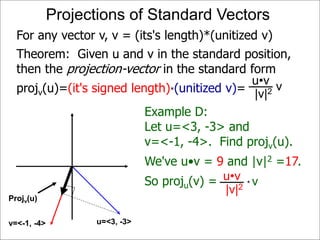
We've u•v = 9 and |v|2 =17.
Theorem: Given u and v in the standard position,
then the projection-vector in the standard form
projv(u)=(it's signed length)*(unitized v)= vu•v
|v|2
Projv(u)
Projections of Standard Vectors
Projv(u)
u=<3, -3>v=<-1, -4>
For any vector v, v = (its's length)*(unitized v)
Example D:
Let u=<3, -3> and
v=<-1, -4>. Find projv(u).
We've u•v = 9 and |v|2 =17.
So proju(v) = vu•v
|v|2 *
Theorem: Given u and v in the standard position,
then the projection-vector in the standard form
projv(u)=(it's signed length)*(unitized v)= vu•v
|v|2
Projv(u)
Projections of Standard Vectors
Projv(u)
u=<3, -3>v=<-1, -4>
For any vector v, v = (its's length)*(unitized v)
Example D:
Let u=<3, -3> and
v=<-1, -4>. Find projv(u).
We've u•v = 9 and |v|2 =17.
So proju(v) = vu•v
|v|2 *
9
17
* <-1, -4>=
Theorem: Given u and v in the standard position,
then the projection-vector in the standard form
projv(u)=(it's signed length)*(unitized v)= vu•v
|v|2
HW
Given u=<-1,2>, v=<3,-2>, and w=<4,2>
find the signed length and the vectors for
each of the following:
1. proju(v) 2. projv(u) 3. projv(w)
4. proju(u+v) 5. projw(v – u)
6. proju+v (u – w) 7. projv+w (v + u)

267 3 dot product-angles-projection-n

  • 1.
  • 2.
    Given u=<a, b>,v=<c, d>, the dot product of u and v is u  v = <a, b>  <c, d> = ac + bd Dot Product of Vectors
  • 3.
    Given u=<a, b>,v=<c, d>, the dot product of u and v is u  v = <a, b>  <c, d> = ac + bd The dot product of two vector is a number. Dot Product of Vectors
  • 4.
    Example A: Letu = <5, -6>, v = <4, -5> a. u  v Given u=<a, b>, v=<c, d>, the dot product of u and v is u  v = <a, b>  <c, d> = ac + bd The dot product of two vector is a number. Dot Product of Vectors
  • 5.
    Example A: Letu = <5, -6>, v = <4, -5> a. u  v = <5, -6>  <4, -5> Given u=<a, b>, v=<c, d>, the dot product of u and v is u  v = <a, b>  <c, d> = ac + bd The dot product of two vector is a number. Dot Product of Vectors
  • 6.
    Example A: Letu = <5, -6>, v = <4, -5> a. u  v = <5, -6>  <4, -5> = 5*4 + (-6)*(-5) Given u=<a, b>, v=<c, d>, the dot product of u and v is u  v = <a, b>  <c, d> = ac + bd The dot product of two vector is a number. Dot Product of Vectors
  • 7.
    Example A: Letu = <5, -6>, v = <4, -5> a. u  v = <5, -6>  <4, -5> = 5*4 + (-6)*(-5) = 20 + 30 = 50 Given u=<a, b>, v=<c, d>, the dot product of u and v is u  v = <a, b>  <c, d> = ac + bd The dot product of two vector is a number. Dot Product of Vectors
  • 8.
    Example A: Letu = <5, -6>, v = <4, -5> a. u  v = <5, -6>  <4, -5> = 5*4 + (-6)*(-5) = 20 + 30 = 50 Given u=<a, b>, v=<c, d>, the dot product of u and v is u  v = <a, b>  <c, d> = ac + bd The dot product of two vector is a number. Dot Product of Vectors b. 3u  v = 3<5, -6>  <4, -5>
  • 9.
    Example A: Letu = <5, -6>, v = <4, -5> a. u  v = <5, -6>  <4, -5> = 5*4 + (-6)*(-5) = 20 + 30 = 50 Given u=<a, b>, v=<c, d>, the dot product of u and v is u  v = <a, b>  <c, d> = ac + bd The dot product of two vector is a number. Dot Product of Vectors b. 3u  v = 3<5, -6>  <4, -5> = <15, -18>  <4, -5>
  • 10.
    Example A: Letu = <5, -6>, v = <4, -5> a. u  v = <5, -6>  <4, -5> = 5*4 + (-6)*(-5) = 20 + 30 = 50 Given u=<a, b>, v=<c, d>, the dot product of u and v is u  v = <a, b>  <c, d> = ac + bd The dot product of two vector is a number. Dot Product of Vectors b. 3u  v = 3<5, -6>  <4, -5> = <15, -18>  <4, -5> = 15*4 + (-18)*(-5) = 60 + 90 = 150
  • 11.
    Example A: Letu = <5, -6>, v = <4, -5> a. u  v = <5, -6>  <4, -5> = 5*4 + (-6)*(-5) = 20 + 30 = 50 Given u=<a, b>, v=<c, d>, the dot product of u and v is u  v = <a, b>  <c, d> = ac + bd The dot product of two vector is a number. Dot Product of Vectors b. 3u  v = 3<5, -6>  <4, -5> = <15, -18>  <4, -5> = 15*4 + (-18)*(-5) = 60 + 90 = 150 = 3(u  v)
  • 12.
    Example A: Letu = <5, -6>, v = <4, -5> a. u  v = <5, -6>  <4, -5> = 5*4 + (-6)*(-5) = 20 + 30 = 50 Given u=<a, b>, v=<c, d>, the dot product of u and v is u  v = <a, b>  <c, d> = ac + bd The dot product of two vector is a number. Dot Product of Vectors b. 3u  v = 3<5, -6>  <4, -5> = <15, -18>  <4, -5> = 15*4 + (-18)*(-5) = 60 + 90 = 150 = 3(u  v) Facts: 1. u•v = v•u
  • 13.
    Example A: Letu = <5, -6>, v = <4, -5> a. u  v = <5, -6>  <4, -5> = 5*4 + (-6)*(-5) = 20 + 30 = 50 Given u=<a, b>, v=<c, d>, the dot product of u and v is u  v = <a, b>  <c, d> = ac + bd The dot product of two vector is a number. Dot Product of Vectors b. 3u  v = 3<5, -6>  <4, -5> = <15, -18>  <4, -5> = 15*4 + (-18)*(-5) = 60 + 90 = 150 = 3(u  v) Facts: 1. u•v = v•u 2. For any scalar λ, λu • v = λ(u • v)
  • 14.
    Example A: Letu = <5, -6>, v = <4, -5> a. u  v = <5, -6>  <4, -5> = 5*4 + (-6)*(-5) = 20 + 30 = 50 Given u=<a, b>, v=<c, d>, the dot product of u and v is u  v = <a, b>  <c, d> = ac + bd The dot product of two vector is a number. Dot Product of Vectors b. 3u  v = 3<5, -6>  <4, -5> = <15, -18>  <4, -5> = 15*4 + (-18)*(-5) = 60 + 90 = 150 = 3(u  v) Facts: 1. u•v = v•u 2. For any scalar λ, λu • v = λ(u • v) 3. u•(v + w) = u•v + u•w
  • 15.
    Fact: Given va vector, λ a scalar, then |λv| = |λ|*|v|. Unitized Vectors
  • 16.
    Fact: Given va vector, λ a scalar, then |λv| = |λ|*|v|. Example B: Let v = <3, 4> so that | <3, 4> | = 5, Unitized Vectors
  • 17.
    Fact: Given va vector, λ a scalar, then |λv| = |λ|*|v|. Example B: Let v = <3, 4> so that | <3, 4> | = 5, a: Let λ = 10, then the length of 10<3, 4> is Unitized Vectors
  • 18.
    Fact: Given va vector, λ a scalar, then |λv| = |λ|*|v|. Example B: Let v = <3, 4> so that | <3, 4> | = 5, a: Let λ = 10, then the length of 10<3, 4> is |<30, 40>| = 10 * 5 = 50 Unitized Vectors
  • 19.
    Fact: Given va vector, λ a scalar, then |λv| = |λ|*|v|. Example B: Let v = <3, 4> so that | <3, 4> | = 5, a: Let λ = 10, then the length of 10<3, 4> is |<30, 40>| = 10 * 5 = 50 b: Let λ = , then the length of <3, 4> is1 5 1 5 Unitized Vectors
  • 20.
    Fact: Given va vector, λ a scalar, then |λv| = |λ|*|v|. Example B: Let v = <3, 4> so that | <3, 4> | = 5, a: Let λ = 10, then the length of 10<3, 4> is |<30, 40>| = 10 * 5 = 50 b: Let λ = , then the length of <3, 4> is |< , >| = * |<3, 4>| 1 5 1 5 3 5 4 5 1 5 Unitized Vectors
  • 21.
    Fact: Given va vector, λ a scalar, then |λv| = |λ|*|v|. Example B: Let v = <3, 4> so that | <3, 4> | = 5, a: Let λ = 10, then the length of 10<3, 4> is |<30, 40>| = 10 * 5 = 50 b: Let λ = , then the length of <3, 4> is |< , >| = * |<3, 4>| = * 5 = 1 1 5 1 5 3 5 4 5 1 5 1 5 Unitized Vectors
  • 22.
    Fact: Given va vector, λ a scalar, then |λv| = |λ|*|v|. Example B: Let v = <3, 4> so that | <3, 4> | = 5, a: Let λ = 10, then the length of 10<3, 4> is |<30, 40>| = 10 * 5 = 50 b: Let λ = , then the length of <3, 4> is |< , >| = * |<3, 4>| = * 5 = 1 1 5 1 5 3 5 4 5 1 5 1 5 Vector of length 1 are called unit vectors. Unitized Vectors
  • 23.
    Fact: Given va vector, λ a scalar, then |λv| = |λ|*|v|. Example B: Let v = <3, 4> so that | <3, 4> | = 5, a: Let λ = 10, then the length of 10<3, 4> is |<30, 40>| = 10 * 5 = 50 b: Let λ = , then the length of <3, 4> is |< , >| = * |<3, 4>| = * 5 = 1 1 5 1 5 3 5 4 5 1 5 1 5 Vector of length 1 are called unit vectors. <3/5, 4/5> r = 1 Unit vectors Unitized Vectors
  • 24.
    Fact: Given va vector, λ a scalar, then |λv| = |λ|*|v|. Example B: Let v = <3, 4> so that | <3, 4> | = 5, a: Let λ = 10, then the length of 10<3, 4> is |<30, 40>| = 10 * 5 = 50 b: Let λ = , then the length of <3, 4> is |< , >| = * |<3, 4>| = * 5 = 1 1 5 1 5 3 5 4 5 1 5 1 5 Vector of length 1 are called unit vectors. In the above example, 3 5 4 5 < , > is a unit vector. <3/5, 4/5> r = 1 Unit vectors Unitized Vectors
  • 25.
  • 26.
    Unitized Vectors In theabove exampe b. we rescale the vector v =<3, 4> and obtain < > which is a unit vector.3 5 4 5,
  • 27.
    Unitized Vectors In theabove exampe b. we rescale the vector v =<3, 4> and obtain < > which is a unit vector. We say that we unitized v. 3 5 4 5,
  • 28.
    Unitized Vectors In theabove exampe b. we rescale the vector v =<3, 4> and obtain < > which is a unit vector. We say that we unitized v. 3 5 4 5, From this example, we see that in general the unitized v is 1 |v| v
  • 29.
    Unitized Vectors In theabove exampe b. we rescale the vector v =<3, 4> and obtain < > which is a unit vector. We say that we unitized v. 3 5 4 5, From this example, we see that in general the unitized v is since | v | = 1.1 |v| 1 |v| |v| = 1 |v| v
  • 30.
    Unitized Vectors In theabove exampe b. we rescale the vector v =<3, 4> and obtain < > which is a unit vector. We say that we unitized v. 3 5 4 5, Geometrically, unitizing v corresponds to shrinking or stretching v to be a unit vector. From this example, we see that in general the unitized v is since | v | = 1.1 |v| 1 |v| |v| = 1 |v| v
  • 31.
    Unitized Vectors In theabove exampe b. we rescale the vector v =<3, 4> and obtain < > which is a unit vector. We say that we unitized v. 3 5 4 5, From this example, we see that in general the unitized v is since | v | = 1.1 |v| 1 |v| |v| = 1 |v| v Geometrically, unitizing v corresponds to shrinking or stretching v to be a unit vector. v r=1 unitized v
  • 32.
    Unitized Vectors In theabove exampe b. we rescale the vector v =<3, 4> and obtain < > which is a unit vector. We say that we unitized v. 3 5 4 5, Geometrically, unitizing v corresponds to shrinking or stretching v to be a unit vector. v 1 |v| v r=1 unitized v unitized v , From this example, we see that in general the unitized v is since | v | = 1.1 |v| 1 |v| |v| = 1 |v| v
  • 33.
    Unitized Vectors In theabove exampe b. we rescale the vector v =<3, 4> and obtain < > which is a unit vector. We say that we unitized v. 3 5 4 5, Geometrically, unitizing v corresponds to shrinking or stretching v to be a unit vector. v 1 |v| v r=1 unitized v unitized v , Unitized v is the only unit vector that has the same direction as v. From this example, we see that in general the unitized v is since | v | = 1.1 |v| 1 |v| |v| = 1 |v| v
  • 34.
  • 35.
    Dot product andAngles The following theorem put all the above concepts together.
  • 36.
    Dot product andAngles Dot Product Theorem: The following theorem put all the above concepts together.
  • 37.
    Dot product andAngles Dot Product Theorem: a. Let u and v be two unit vectors and  be the angle between them, then cos() = u•v. The following theorem put all the above concepts together.
  • 38.
    Dot product andAngles Dot Product Theorem: a. Let u and v be two unit vectors and  be the angle between them, then cos() = u•v. b. Let u and v be any two vectors and  be the angle between them cos() = (unitized u)  (unitized v) The following theorem put all the above concepts together.
  • 39.
    Dot product andAngles Dot Product Theorem: a. Let u and v be two unit vectors and  be the angle between them, then cos() = u•v. b. Let u and v be any two vectors and  be the angle between them cos() = (unitized u)  (unitized v) =  v |v| u |u| Easy to memorize The following theorem put all the above concepts together.
  • 40.
    Dot product andAngles Dot Product Theorem: a. Let u and v be two unit vectors and  be the angle between them, then cos() = u•v. b. Let u and v be any two vectors and  be the angle between them cos() = (unitized u)  (unitized v) =  =v |v| u |u| u•v |u|*|v| Easy to memorize Easier way to compute The following theorem put all the above concepts together.
  • 41.
    Dot product andAngles Example C: a. Let u = <3, -1> and v = <2, -4>. Find the angle  between them.
  • 42.
    uv=10, Dot product andAngles Example C: a. Let u = <3, -1> and v = <2, -4>. Find the angle  between them.
  • 43.
    uv=10, |u|=10, Dot productand Angles Example C: a. Let u = <3, -1> and v = <2, -4>. Find the angle  between them.
  • 44.
    uv=10, |u|=10, |v|=20, Dotproduct and Angles Example C: a. Let u = <3, -1> and v = <2, -4>. Find the angle  between them.
  • 45.
    uv=10, |u|=10, |v|=20,hence, cos() = = Dot product and Angles Example C: a. Let u = <3, -1> and v = <2, -4>. Find the angle  between them. u•v |u|*|v| 10 10*20
  • 46.
    uv=10, |u|=10, |v|=20,hence, cos() = = = 10/200 = 1/2 Dot product and Angles Example C: a. Let u = <3, -1> and v = <2, -4>. Find the angle  between them. u•v |u|*|v| 10 10*20
  • 47.
    uv=10, |u|=10, |v|=20,hence, cos() = = = 10/200 = 1/2 So  = cos-1(1/2) Dot product and Angles Example C: a. Let u = <3, -1> and v = <2, -4>. Find the angle  between them. u•v |u|*|v| 10 10*20
  • 48.
    uv=10, |u|=10, |v|=20,hence, cos() = = = 10/200 = 1/2 So  = cos-1(1/2) = 45o Dot product and Angles Example C: a. Let u = <3, -1> and v = <2, -4>. Find the angle  between them. u•v |u|*|v| 10 10*20
  • 49.
    uv=10, |u|=10, |v|=20,hence, cos() = = = 10/200 = 1/2 So  = cos-1(1/2) = 45o Dot product and Angles Example C: a. Let u = <3, -1> and v = <2, -4>. Find the angle  between them. u•v |u|*|v| 10 10*20 b. Find the angle A between u + v and u – v.
  • 50.
    uv=10, |u|=10, |v|=20,hence, cos() = = = 10/200 = 1/2 So  = cos-1(1/2) = 45o Dot product and Angles Example C: a. Let u = <3, -1> and v = <2, -4>. Find the angle  between them. u•v |u|*|v| 10 10*20 b. Find the angle A between u + v and u – v. u + v = <5, -5>,
  • 51.
    uv=10, |u|=10, |v|=20,hence, cos() = = = 10/200 = 1/2 So  = cos-1(1/2) = 45o Dot product and Angles Example C: a. Let u = <3, -1> and v = <2, -4>. Find the angle  between them. u•v |u|*|v| 10 10*20 b. Find the angle A between u + v and u – v. u + v = <5, -5>, u – v = <1, 3>
  • 52.
    uv=10, |u|=10, |v|=20,hence, cos() = = = 10/200 = 1/2 So  = cos-1(1/2) = 45o Dot product and Angles Example C: a. Let u = <3, -1> and v = <2, -4>. Find the angle  between them. u•v |u|*|v| 10 10*20 b. Find the angle A between u + v and u – v. u + v = <5, -5>, u – v = <1, 3> (u + v)•(u – v) = 5 – 15 = -10
  • 53.
    uv=10, |u|=10, |v|=20,hence, cos() = = = 10/200 = 1/2 So  = cos-1(1/2) = 45o Dot product and Angles Example C: a. Let u = <3, -1> and v = <2, -4>. Find the angle  between them. u•v |u|*|v| 10 10*20 b. Find the angle A between u + v and u – v. u + v = <5, -5>, u – v = <1, 3> (u + v)•(u – v) = 5 – 15 = -10 |u + v| = 50,
  • 54.
    uv=10, |u|=10, |v|=20,hence, cos() = = = 10/200 = 1/2 So  = cos-1(1/2) = 45o Dot product and Angles Example C: a. Let u = <3, -1> and v = <2, -4>. Find the angle  between them. u•v |u|*|v| 10 10*20 b. Find the angle A between u + v and u – v. u + v = <5, -5>, u – v = <1, 3> (u + v)•(u – v) = 5 – 15 = -10 |u + v| = 50, |u – v| = 10
  • 55.
    uv=10, |u|=10, |v|=20,hence, cos() = = = 10/200 = 1/2 So  = cos-1(1/2) = 45o Dot product and Angles Example C: a. Let u = <3, -1> and v = <2, -4>. Find the angle  between them. u•v |u|*|v| 10 10*20 b. Find the angle A between u + v and u – v. u + v = <5, -5>, u – v = <1, 3> (u + v)•(u – v) = 5 – 15 = -10 |u + v| = 50, |u – v| = 10 So cos(A) = -10/500
  • 56.
    uv=10, |u|=10, |v|=20,hence, cos() = = = 10/200 = 1/2 So  = cos-1(1/2) = 45o Dot product and Angles Example C: a. Let u = <3, -1> and v = <2, -4>. Find the angle  between them. u•v |u|*|v| 10 10*20 b. Find the angle A between u + v and u – v. u + v = <5, -5>, u – v = <1, 3> (u + v)•(u – v) = 5 – 15 = -10 |u + v| = 50, |u – v| = 10 So cos(A) = -10/500  -0.447
  • 57.
    uv=10, |u|=10, |v|=20,hence, cos() = = = 10/200 = 1/2 So  = cos-1(1/2) = 45o Dot product and Angles Example C: a. Let u = <3, -1> and v = <2, -4>. Find the angle  between them. u•v |u|*|v| 10 10*20 b. Find the angle A between u + v and u – v. u + v = <5, -5>, u – v = <1, 3> (u + v)•(u – v) = 5 – 15 = -10 |u + v| = 50, |u – v| = 10 So cos(A) = -10/500  -0.447 A = cos-1(-0.447)  117o.
  • 58.
    Dot product andAngles Theorem: Given u, v two nonzero vectors such that u•v=0, then u and v are perpendicular (orthorgonal).
  • 59.
    Dot product andAngles Theorem: Given u, v two nonzero vectors such that u•v=0, then u and v are perpendicular (orthorgonal). If  is the angle between them and u•v = 0, then cos() = = 0. u•v |u|*|v|
  • 60.
    Dot product andAngles Theorem: Given u, v two nonzero vectors such that u•v=0, then u and v are perpendicular (orthorgonal). If  is the angle between them and u•v = 0, then cos() = = 0. Hence  = cos-1(0) = 90o u•v |u|*|v|
  • 61.
    Example D: <5,-3>•<3, 5> = 15 – 15 = 0, hence they are orthogonal. Dot product and Angles Theorem: Given u, v two nonzero vectors such that u•v=0, then u and v are perpendicular (orthorgonal). If  is the angle between them and u•v = 0, then cos() = = 0. Hence  = cos-1(0) = 90o u•v |u|*|v|
  • 62.
     2006, FrankMa Projections
  • 63.
    Projections The projection ofthe vector u onto the vector v is the vertically cast shadow-vector of u onto v. It is denoted as projv (u).
  • 64.
    Projections The projection ofthe vector u onto the vector v is the vertically cast shadow-vector of u onto v. It is denoted as projv (u).
  • 65.
    Projections The projection ofthe vector u onto the vector v is the vertically cast shadow-vector of u onto v. It is denoted as projv (u).projv (u)
  • 66.
    Projections The projection ofthe vector u onto the vector v is the vertically cast shadow-vector of u onto v. It is denoted as projv (u).projv (u) Let  < 1800 be the angle between u and v, the signed length of the projv(u) is |u |*cos().
  • 67.
    Projections The projection ofthe vector u onto the vector v is the vertically cast shadow-vector of u onto v. It is denoted as projv (u).projv (u) If  is less than 90o then cos() > 0, so |u|cos() is also positive. Let  < 1800 be the angle between u and v, the signed length of the projv(u) is |u |*cos().
  • 68.
    Projections The projection ofthe vector u onto the vector v is the vertically cast shadow-vector of u onto v. It is denoted as projv (u).projv (u) If  is less than 90o then cos() > 0, so |u|cos() is also positive. This means the shadow is cast in the direction of v. Let  < 1800 be the angle between u and v, the signed length of the projv(u) is |u |*cos().
  • 69.
    Projections The projection ofthe vector u onto the vector v is the vertically cast shadow-vector of u onto v. It is denoted as projv (u).projv (u) If  is less than 90o then cos() > 0, so |u|cos() is also positive. This means the shadow is cast in the direction of v. u v |u|cos() is positive means the projv(u) is in the direction of v   < 90o Let  < 1800 be the angle between u and v, the signed length of the projv(u) is |u |*cos().
  • 70.
    Projections If  ismore than 90o then cos() < 0, so |u|cos() is negative.
  • 71.
    Projections If  ismore than 90o then cos() < 0, so |u|cos() is negative. We get the negative length of projv(u) and projv(u) is cast in the opposite direction of v.
  • 72.
    Projections If  ismore than 90o then cos() < 0, so |u|cos() is negative. We get the negative length of projv(u) and projv(u) is cast in the opposite direction of v. u v |u|cos() is negative so projv(u) is in the opposite direction of v.   >90o
  • 73.
    Projections If  ismore than 90o then cos() < 0, so |u|cos() is negative. We get the negative length of projv(u) and projv(u) is cast in the opposite direction of v. u v |u|cos() is negative so projv(u) is in the opposite direction of v.   >90o
  • 74.
    Projections If  ismore than 90o then cos() < 0, so |u|cos() is negative. We get the negative length of projv(u) and projv(u) is cast in the opposite direction of v. u v |u|cos() is negative so projv(u) is in the opposite direction of v.  Example A: Given that the angle between u and v is 67o and |u|=23, |v|=28. Find the length of the shadow projv(u). Draw.  >90o
  • 75.
    Projections If  ismore than 90o then cos() < 0, so |u|cos() is negative. We get the negative length of projv(u) and projv(u) is cast in the opposite direction of v. u v |u|cos() is negative so projv(u) is in the opposite direction of v.  Example A: Given that the angle between u and v is 67o and |u|=23, |v|=28. Find the length of the shadow projv(u). Draw. |u|=23 67o |v|=28  >90o
  • 76.
    Projections If  ismore than 90o then cos() < 0, so |u|cos() is negative. We get the negative length of projv(u) and projv(u) is cast in the opposite direction of v. u v |u|cos() is negative so projv(u) is in the opposite direction of v.  Example A: Given that the angle between u and v is 67o and |u|=23, |v|=28. Find the length of the shadow projv(u). Draw. |u|=23 67o |v|=28 The length of projv(u) = |u|cos() = 23cos(67)  8.99  >90o
  • 77.
    Projections Example B: Giventhat the angle between u and v is 117o and |u|=23, |v|=28. Find the length of the shadow proju(v). Draw.
  • 78.
    Projections Example B: Giventhat the angle between u and v is 117o and |u|=23, |v|=28. Find the length of the shadow proju(v). Draw. |u|=23 117o |v|=28
  • 79.
    Projections Example B: Giventhat the angle between u and v is 117o and |u|=23, |v|=28. Find the length of the shadow proju(v). Draw. |u|=23 117o |v|=28
  • 80.
    Projections Example B: Giventhat the angle between u and v is 117o and |u|=23, |v|=28. Find the length of the shadow proju(v). Draw. |u|=23 117o |v|=28 The length of proju(v) = |v|cos()
  • 81.
    Projections Example B: Giventhat the angle between u and v is 117o and |u|=23, |v|=28. Find the length of the shadow proju(v). Draw. |u|=23 117o |v|=28 The length of proju(v) = |v|cos() = 28cos(117)  -12.7
  • 82.
    Projections Example B: Giventhat the angle between u and v is 117o and |u|=23, |v|=28. Find the length of the shadow proju(v). Draw. |u|=23 117o |v|=28 The length of proju(v) = |v|cos() = 28cos(117)  -12.7 Note the negative answer indicates the shadow is cast in the opposite direction of u.
  • 83.
    Projections Example B: Giventhat the angle between u and v is 117o and |u|=23, |v|=28. Find the length of the shadow proju(v). Draw. |u|=23 117o |v|=28 The length of proju(v) = |v|cos() = 28cos(117)  -12.7 Note the negative answer indicates the shadow is cast in the opposite direction of u. Your Turn: Given the angle between u and v is 135o and |u|=36, |v|=18. Draw and find the length of the projv(u). 135o |u|=36 v Ans: Signed length of projv(u) = –36/2  –25.4 projv(u)
  • 84.
    Signed Length ofStandard Projection
  • 85.
    Theorem: Given twovectors u and v in the standard position, the signed length of projv(u) is u dotted with unitized v. Projv(u) u v Signed Length of Standard Projection
  • 86.
    Theorem: Given twovectors u and v in the standard position, the signed length of projv(u) is u dotted with unitized v. That is, the signed length of projv(u) is u• v |v| Projv(u) u v Signed Length of Standard Projection
  • 87.
    Theorem: Given twovectors u and v in the standard position, the signed length of projv(u) is u dotted with unitized v. That is, the signed length of projv(u) is u• or . Projv(u) v |v| u•v |v| u v Signed Length of Standard Projection
  • 88.
    Theorem: Given twovectors u and v in the standard position, the signed length of projv(u) is u dotted with unitized v. That is, the signed length of projv(u) is u• or . v |v| u•v |v| Example C: Let u=<3, -3> and v=<-1, -4>. Find the length of projv(u). Draw. Projv(u) u v Signed Length of Standard Projection
  • 89.
    Theorem: Given twovectors u and v in the standard position, the signed length of projv(u) is u dotted with unitized v. That is, the signed length of projv(u) is u• or . Projv(u) v |v| u•v |v| Example C: Let u=<3, -3> and v=<-1, -4>. Find the length of projv(u). Draw. u=<3, -3> v=<-1, -4> Signed Length of Standard Projection
  • 90.
    Theorem: Given twovectors u and v in the standard position, the signed length of projv(u) is u dotted with unitized v. That is, the signed length of projv(u) is u• or . v |v| u•v |v| Example C: Let u=<3, -3> and v=<-1, -4>. Find the length of projv(u). Draw. uv = <3,-3><-1,-4> = 9 Projv(u) u=<3, -3> v=<-1, -4> Signed Length of Standard Projection
  • 91.
    Theorem: Given twovectors u and v in the standard position, the signed length of projv(u) is u dotted with unitized v. That is, the signed length of projv(u) is u• or . v |v| u•v |v| Example C: Let u=<3, -3> and v=<-1, -4>. Find the length of projv(u). Draw. uv = <3,-3><-1,-4> = 9 |v|= 17,Projv(u) u=<3, -3> v=<-1, -4> Signed Length of Standard Projection
  • 92.
    Theorem: Given twovectors u and v in the standard position, the signed length of projv(u) is u dotted with unitized v. That is, the signed length of projv(u) is u• or . Projv(u) v |v| u•v |v| u v Example C: Let u=<3, -3> and v=<-1, -4>. Find the length of projv(u). Draw. uv = <3,-3><-1,-4> = 9 |v|= 17, hence the length of projv(u) is = Projv(u) u=<3, -3> v=<-1, -4> u•v |v| 9 17 Signed Length of Standard Projection
  • 93.
    Theorem: Given twovectors u and v in the standard position, the signed length of projv(u) is u dotted with unitized v. That is, the signed length of projv(u) is u• or . Projv(u) v |v| u•v |v| u v Example C: Let u=<3, -3> and v=<-1, -4>. Find the length of projv(u). Draw. uv = <3,-3><-1,-4> = 9 |v|= 17, hence the length of projv(u) is = Projv(u) u=<3, -3> v=<-1, -4> u•v |v| 9 17  2.18. Signed Length of Standard Projection
  • 94.
  • 95.
    Projections of StandardVectors For any vector v, v = (its's length)*(unitized v)
  • 96.
    Projections of StandardVectors For any vector v, v = (its's length)*(unitized v) Theorem: Given u and v in the standard position, then the projection-vector in the standard form projv(u)=(it's signed length)*(unitized v)
  • 97.
    Projections of StandardVectors For any vector v, v = (its's length)*(unitized v) Theorem: Given u and v in the standard position, then the projection-vector in the standard form projv(u)=(it's signed length)*(unitized v)= vu•v |v|2
  • 98.
    Theorem: Given uand v in the standard position, then the projection-vector in the standard form projv(u)=(it's signed length)*(unitized v)= Projections of Standard Vectors For any vector v, v = (its's length)*(unitized v) Example D: Let u=<3, -3> and v=<-1, -4>. Find projv(u). vu•v |v|2
  • 99.
    Theorem: Given uand v in the standard position, then the projection-vector in the standard form projv(u)=(it's signed length)*(unitized v)= Projections of Standard Vectors u=<3, -3>v=<-1, -4> For any vector v, v = (its's length)*(unitized v) Example D: Let u=<3, -3> and v=<-1, -4>. Find projv(u). vu•v |v|2
  • 100.
    Theorem: Given uand v in the standard position, then the projection-vector in the standard form projv(u)=(it's signed length)*(unitized v)= Projv(u) Projections of Standard Vectors Projv(u) u=<3, -3>v=<-1, -4> For any vector v, v = (its's length)*(unitized v) Example D: Let u=<3, -3> and v=<-1, -4>. Find projv(u). vu•v |v|2
  • 101.
    Projv(u) Projections of StandardVectors Projv(u) u=<3, -3>v=<-1, -4> For any vector v, v = (its's length)*(unitized v) Example D: Let u=<3, -3> and v=<-1, -4>. Find projv(u). We've u•v = 9 and |v|2 =17. Theorem: Given u and v in the standard position, then the projection-vector in the standard form projv(u)=(it's signed length)*(unitized v)= vu•v |v|2
  • 102.
    Projv(u) Projections of StandardVectors Projv(u) u=<3, -3>v=<-1, -4> For any vector v, v = (its's length)*(unitized v) Example D: Let u=<3, -3> and v=<-1, -4>. Find projv(u). We've u•v = 9 and |v|2 =17. So proju(v) = vu•v |v|2 * Theorem: Given u and v in the standard position, then the projection-vector in the standard form projv(u)=(it's signed length)*(unitized v)= vu•v |v|2
  • 103.
    Projv(u) Projections of StandardVectors Projv(u) u=<3, -3>v=<-1, -4> For any vector v, v = (its's length)*(unitized v) Example D: Let u=<3, -3> and v=<-1, -4>. Find projv(u). We've u•v = 9 and |v|2 =17. So proju(v) = vu•v |v|2 * 9 17 * <-1, -4>= Theorem: Given u and v in the standard position, then the projection-vector in the standard form projv(u)=(it's signed length)*(unitized v)= vu•v |v|2
  • 104.
    HW Given u=<-1,2>, v=<3,-2>,and w=<4,2> find the signed length and the vectors for each of the following: 1. proju(v) 2. projv(u) 3. projv(w) 4. proju(u+v) 5. projw(v – u) 6. proju+v (u – w) 7. projv+w (v + u)