SCATTER DIAGRAM
What it is:
A scatter diagram is a tool for analyzing relationships between two variables. One variable is
plotted on the horizontal axis and the other is plotted on the vertical axis. The pattern of their
intersecting points can graphically show relationship patterns. Most often a scatter diagram is used
to prove or disprove cause-and-effect relationships. While the diagram shows relationships, it
does not by itself prove that one variable causes the other. In addition to showing possible cause-
and-effect relationships, a scatter diagram can show that two variables are from a common cause
that is unknown or that one variable can be used as a surrogate for the other.

When to use it:
Use a scatter diagram to examine theories about cause-and-effect relationships and to search for
root causes of an identified problem.

Use a scatter diagram to design a control system to ensure that gains from quality improvement
efforts are maintained.

How to use it:
Collect data. Gather 50 to 100 paired samples of data that show a possible relationship.

Draw the diagram. Draw roughly equal horizontal and vertical axes of the diagram, creating a
square plotting area. Label the axes in convenient multiples (1, 2, 5, etc.) increasing on the
horizontal axes from left to right and on the vertical axis from bottom to top. Label both axes.

Plot the paired data. Plot the data on the chart, using concentric circles to indicate repeated data
points.

Title and label the diagram.

Interpret the data. Scatter diagrams will generally show one of six possible correlations
between the variables:

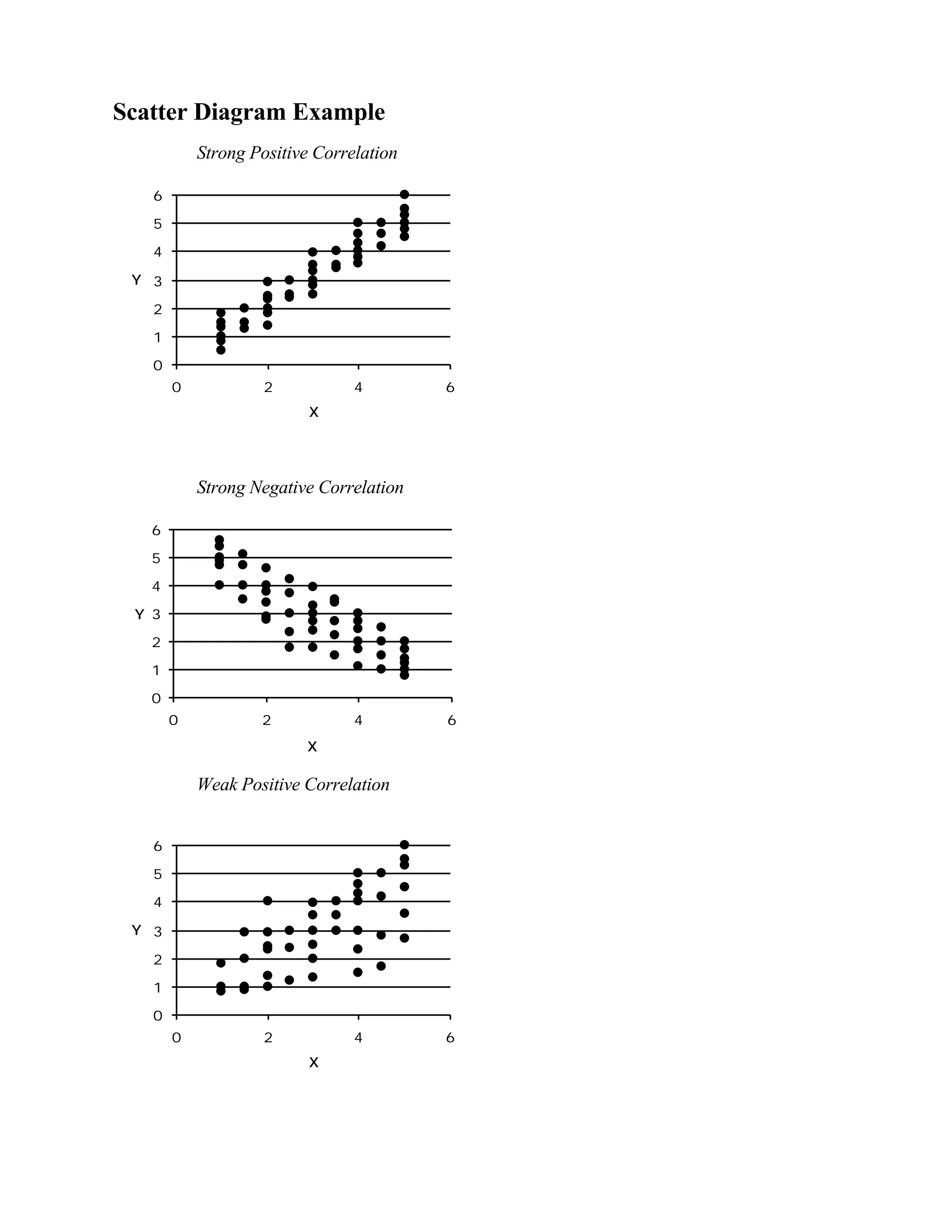
   Strong Positive Correlation      The value of Y clearly increases as the value of X increases.

   Strong Negative Correlation      The value of Y clearly decreases as the value of X increases.

   Weak Positive Correlation        The value of Y increases slightly as the value of X increases.

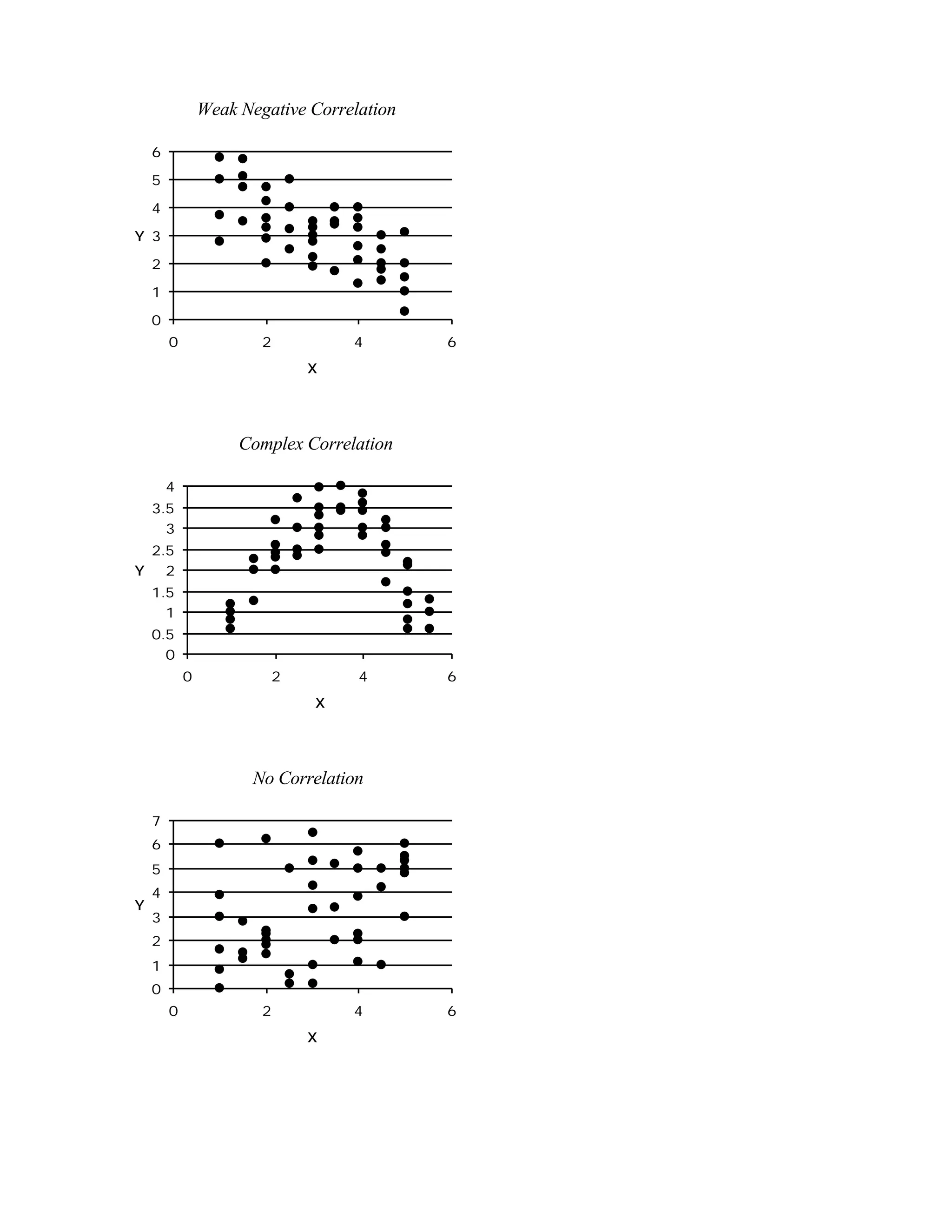
   Weak Negative Correlation        The value of Y decreases slightly as the value of X increases.

   Complex Correlation              The value of Y seems to be related to the value of X, but the
                                    relationship is not easily determined.

   No Correlation                   There is no demonstrated connection between the two variables.
Scatter Diagram Example
           Strong Positive Correlation

   6

   5

   4

 Y 3

   2

   1

   0
       0           2            4        6
                          X


           Strong Negative Correlation

   6

   5

   4

 Y 3

   2

   1

   0
       0           2            4        6
                         X

           Weak Positive Correlation


   6

   5

   4

 Y 3

   2

   1

   0
       0           2            4        6
                          X
Weak Negative Correlation

    6

    5

    4

Y 3

    2

    1

    0
        0               2          4        6
                             X


                     Complex Correlation

        4
    3.5
      3
    2.5
Y     2
    1.5
      1
    0.5
      0
            0            2          4       6
                              X


                       No Correlation

    7
    6
    5
    4
Y
    3
    2
    1
    0
        0               2          4        6
                             X

25scatter

  • 1.
    SCATTER DIAGRAM What itis: A scatter diagram is a tool for analyzing relationships between two variables. One variable is plotted on the horizontal axis and the other is plotted on the vertical axis. The pattern of their intersecting points can graphically show relationship patterns. Most often a scatter diagram is used to prove or disprove cause-and-effect relationships. While the diagram shows relationships, it does not by itself prove that one variable causes the other. In addition to showing possible cause- and-effect relationships, a scatter diagram can show that two variables are from a common cause that is unknown or that one variable can be used as a surrogate for the other. When to use it: Use a scatter diagram to examine theories about cause-and-effect relationships and to search for root causes of an identified problem. Use a scatter diagram to design a control system to ensure that gains from quality improvement efforts are maintained. How to use it: Collect data. Gather 50 to 100 paired samples of data that show a possible relationship. Draw the diagram. Draw roughly equal horizontal and vertical axes of the diagram, creating a square plotting area. Label the axes in convenient multiples (1, 2, 5, etc.) increasing on the horizontal axes from left to right and on the vertical axis from bottom to top. Label both axes. Plot the paired data. Plot the data on the chart, using concentric circles to indicate repeated data points. Title and label the diagram. Interpret the data. Scatter diagrams will generally show one of six possible correlations between the variables: Strong Positive Correlation The value of Y clearly increases as the value of X increases. Strong Negative Correlation The value of Y clearly decreases as the value of X increases. Weak Positive Correlation The value of Y increases slightly as the value of X increases. Weak Negative Correlation The value of Y decreases slightly as the value of X increases. Complex Correlation The value of Y seems to be related to the value of X, but the relationship is not easily determined. No Correlation There is no demonstrated connection between the two variables.
  • 2.
    Scatter Diagram Example Strong Positive Correlation 6 5 4 Y 3 2 1 0 0 2 4 6 X Strong Negative Correlation 6 5 4 Y 3 2 1 0 0 2 4 6 X Weak Positive Correlation 6 5 4 Y 3 2 1 0 0 2 4 6 X
  • 3.
    Weak Negative Correlation 6 5 4 Y 3 2 1 0 0 2 4 6 X Complex Correlation 4 3.5 3 2.5 Y 2 1.5 1 0.5 0 0 2 4 6 X No Correlation 7 6 5 4 Y 3 2 1 0 0 2 4 6 X