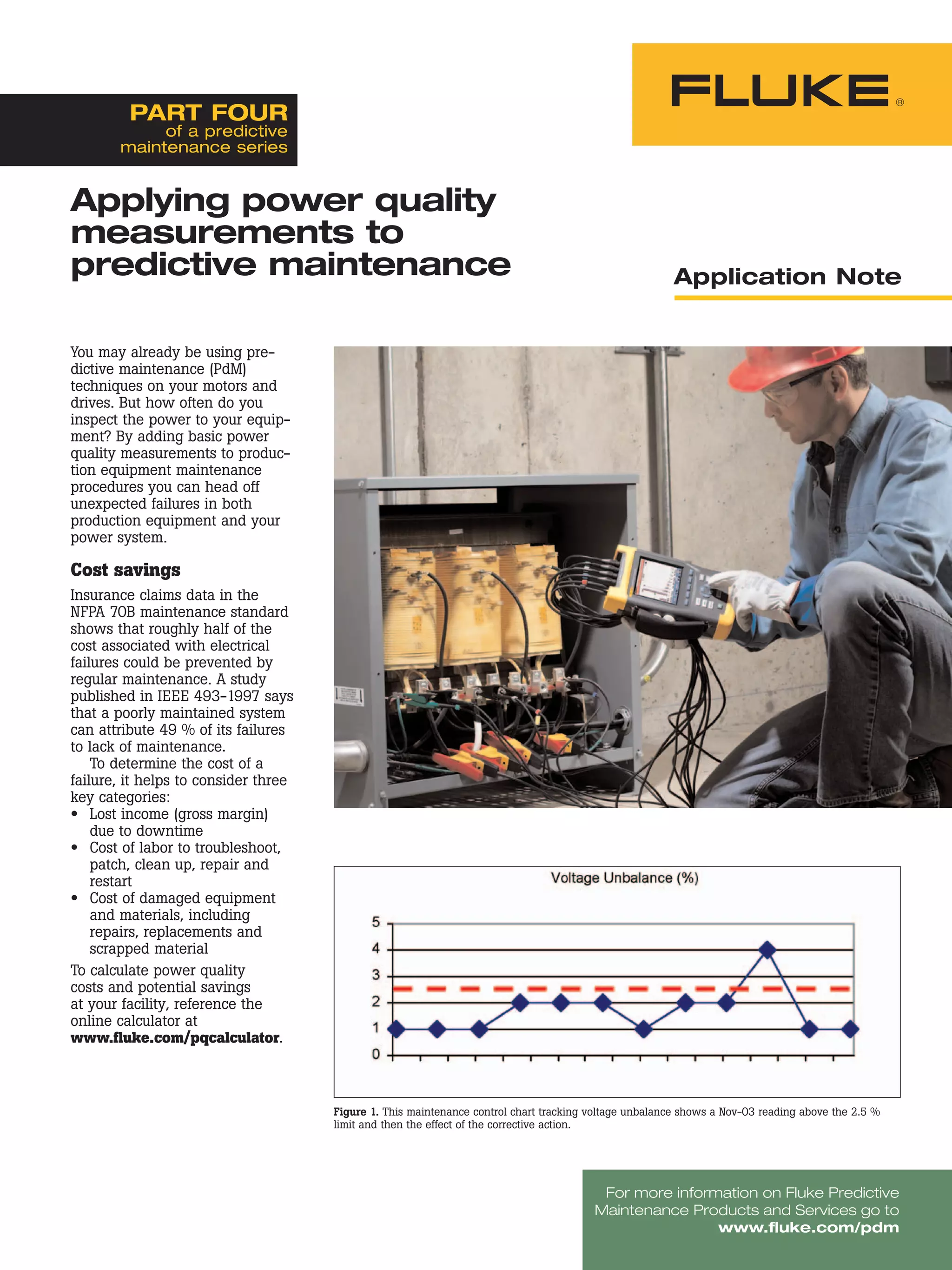
Figure 1. This maintenance control chart tracking voltage unbalance shows a Nov-03 reading above the 2.5 %
limit and then the effect of the corrective action.
Application Note
Applying power quality
measurements to
predictive maintenance
You may already be using pre-
dictive maintenance (PdM)
techniques on your motors and
drives. But how often do you
inspect the power to your equip-
ment? By adding basic power
quality measurements to produc-
tion equipment maintenance
procedures you can head off
unexpected failures in both
production equipment and your
power system.
Cost savings
Insurance claims data in the
NFPA 70B maintenance standard
shows that roughly half of the
cost associated with electrical
failures could be prevented by
regular maintenance. A study
published in IEEE 493-1997 says
that a poorly maintained system
can attribute 49 % of its failures
to lack of maintenance.
To determine the cost of a
failure, it helps to consider three
key categories:
• Lost income (gross margin)
due to downtime
• Cost of labor to troubleshoot,
patch, clean up, repair and
restart
• Cost of damaged equipment
and materials, including
repairs, replacements and
scrapped material
To calculate power quality
costs and potential savings
at your facility, reference the
online calculator at
www.fluke.com/pqcalculator.
PART FOUR
of a predictive
maintenance series
For more information on Fluke Predictive
Maintenance Products and Services go to
www.fluke.com/pdm
2 Fluke Corporation Applying power quality measurements to predictive maintenance
Integrating power quality
into PdM
Unlike a comprehensive electrical
system survey, predictive mainte-
nance power quality focuses on a
small set of measurements that
can predict power distribution or
critical load failures. By checking
the power quality at critical
loads, you see the effect of the
electrical system up to the load.
Your predictive maintenance
inspection route probably already
includes any motors, generators,
pumps, A/C units, fans, gear-
boxes, or chillers on site.
Voltage stability, harmonic
distortion, and unbalance are
good indicators of load and distri-
bution system health and can be
taken and recorded quickly with
little incremental labor. Current
measurements can identify
changes in the way the load is
drawing. All of these measure-
ments can be taken without
halting operations and generate
numbers that can easily be
entered into maintenance soft-
ware and plotted over time.
For each measurement point or
piece of equipment, determine
what limit should trigger correc-
tive action. Limits should be set
well below the point of failure,
and as time goes on limits may be
“tightened” or “loosened” by ana-
lyzing historical data. The appro-
priate limits depend somewhat on
the ability of your loads to deal
with power variation. But for most
equipment, your maintenance
team can devise a set of default,
“house limits” based on industry
standards and experience.
The cost of three-phase power
analyzers is lower now than ever
and it should only take roughly 15
minutes to take the readings dis-
cussed in this article. (Storing volt-
age sag data will add more time,
since it requires picking up the
data after a day or so.)
Voltage
Good voltage level and stability
are fundamental requirements for
reliable equipment operation.
• Running loads at overly high
or low voltages causes reliabil-
ity problems and failures.
Verify that line voltage is
within 10 % of the nameplate
rating.
• As connections in your system
deteriorate, the rising imped-
ance will cause “insulation
resistance drops” in voltage.
Measurement Guidelines
Added loads, especially those
with high inrush, will also
cause voltage decline over
time. The loads farthest from
the service entrance or trans-
former will show the lowest
voltage.
• Neutral to ground voltage tells
you how heavily your system
is loaded and helps you track
harmonic current. Neutral to
ground voltage higher than
3 % should trigger further
investigation.
Voltage Measurements Phase-to-Neutral Voltages
Neutral-to-Ground Voltages
Voltage Sags Phase to Neutral Sag Count
Voltage Harmonics Phase Voltage THD
Current Measurements Phase Currents
Voltage Unbalance Negative Sequence, Zero Sequence
Table 1. Basic power measurements for 3-phase Wye equipment
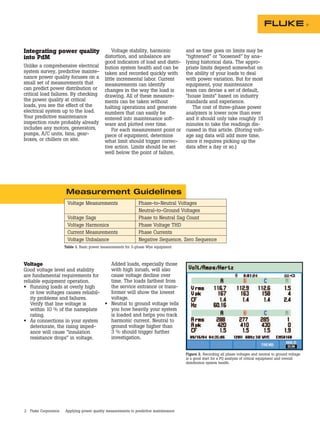
Figure 2. Recording all phase voltages and neutral to ground voltage
is a good start for a PQ analysis of critical equipment and overall
distribution system health.
3 Fluke Corporation Applying power quality measurements to predictive maintenance
Voltage sag count
Taking a single voltage reading
tells only part of the story. How is
the voltage changing during an
hour? During a day? Sags, swells
and transients are short-term
variations in voltage. The voltage
sag (or dip) is the most common
and troublesome variety.
Sags indicate that a system is
having trouble responding to load
requirements and significant sags
can interrupt production. Voltage
sags can cause spurious resets on
electronic equipment such as
computers or controllers, and a
sag on one phase can cause the
other two to overcompensate,
potentially tripping the circuit.
Sags have several dimensions:
depth, duration, and time of day.
Utilities use a special index to
track the number of sags that
occur over a period of time. To
gauge the depth of the sags, they
count how often voltage drops
below various thresholds.
The longer and larger the
voltage variations, the more likely
equipment is to malfunction.
For example, the Information
Technology Industry Council
(ITIC) curve specifies that 120 V
computer equipment should be
able to run as long as voltage
does not drop below 96 V for
more than 10 seconds or below
84 V for more than 0.5 seconds.
Current
Current measurements that trend
upward are a key indicator of a
problem or degradation in your
load. While equipment is run-
ning, monitor phase, neutral and
ground current over time. Make
sure none of the currents are
increasing significantly, verify
that they’re less than the name-
plate rating, and keep an eye out
for high neutral current, which
can indicate harmonics and
unbalance.
Voltage unbalance
In a three-phase system, signifi-
cant differences in phase voltage
indicate a problem with the sys-
tem or a defect in a load.
• High voltage unbalance causes
three-phase loads to draw
excessive current and causes
motors to deliver lower torque.
• Unbalance is tracked in per-
centages (see Figure 3). The
negative sequence voltage
(Vneg) and zero sequence
voltage (Vzero) together iden-
tify any voltage asymmetry
between phases.
• Using a power quality analyzer
to do the math, high percent-
ages indicate high unbalance.
EN 50160 requires Vneg to be
less than two percent.
Voltage harmonic distortion
Harmonic distortion is a normal
consequence of a power system
supplying electronic loads such
as computers, business machines,
electronic lighting ballasts, and
control systems. Adding or
removing loads from the system
changes the amount of distortion,
so it’s a good idea to regularly
check harmonics.
Harmonics cause heating and
reduced life in motor windings
and transformers, excessive neu-
tral current, increased suscepti-
bility to voltage sags, and
reduced transformer efficiency.
As current harmonics interact
with impedance, they’re con-
verted into voltage harmonics.
Total Harmonic Distortion (THD) is
a sum of the contributions of all
harmonics. By tracking Voltage
THD over time you can determine
if distortion is changing. For volt-
age harmonics, IEEE 519 recom-
mends less than 5 % THD.
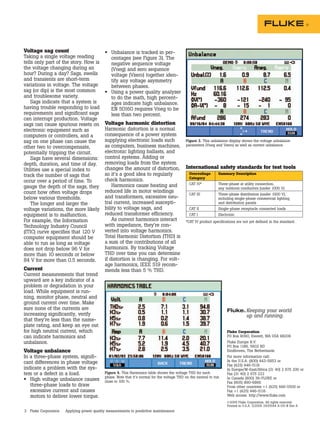
Figure 3. This unbalance display shows the voltage unbalance
parameters (Vneg and Vzero) as well as current unbalance.
Figure 4. This Harmonics table shows the voltage THD for each
phase. Note that it’s normal for the voltage THD on the neutral to run
close to 100 %.
Fluke Corporation
PO Box 9090, Everett, WA USA 98206
Fluke Europe B.V.
PO Box 1186, 5602 BD
Eindhoven, The Netherlands
For more information call:
In the U.S.A. (800) 443-5853 or
Fax (425) 446-5116
In Europe/M-East/Africa (31 40) 2 675 200 or
Fax (31 40) 2 675 222
In Canada (800) 36-FLUKE or
Fax (905) 890-6866
From other countries +1 (425) 446-5500 or
Fax +1 (425) 446-5116
Web access: http://www.fluke.com
©2005 Fluke Corporation. All rights reserved.
Printed in U.S.A. 3/2005 2435544 A-US-N Rev A
Fluke.Keeping your world
up and running.
Overvoltage Summary Description
Category
CAT IV* Three-phase at utility connection,
any outdoors conductors (under 1000 V)
CAT III Three-phase distribution (under 1000 V),
including single-phase commercial lighting
and distribution panels
CAT II Single-phase receptacle connected loads
CAT I Electronic
*CAT IV product specifications are not yet defined in the standard.
International safety standards for test tools

2435544 a w

  • 1.
    Figure 1. Thismaintenance control chart tracking voltage unbalance shows a Nov-03 reading above the 2.5 % limit and then the effect of the corrective action. Application Note Applying power quality measurements to predictive maintenance You may already be using pre- dictive maintenance (PdM) techniques on your motors and drives. But how often do you inspect the power to your equip- ment? By adding basic power quality measurements to produc- tion equipment maintenance procedures you can head off unexpected failures in both production equipment and your power system. Cost savings Insurance claims data in the NFPA 70B maintenance standard shows that roughly half of the cost associated with electrical failures could be prevented by regular maintenance. A study published in IEEE 493-1997 says that a poorly maintained system can attribute 49 % of its failures to lack of maintenance. To determine the cost of a failure, it helps to consider three key categories: • Lost income (gross margin) due to downtime • Cost of labor to troubleshoot, patch, clean up, repair and restart • Cost of damaged equipment and materials, including repairs, replacements and scrapped material To calculate power quality costs and potential savings at your facility, reference the online calculator at www.fluke.com/pqcalculator. PART FOUR of a predictive maintenance series For more information on Fluke Predictive Maintenance Products and Services go to www.fluke.com/pdm
  • 2.
    2 Fluke CorporationApplying power quality measurements to predictive maintenance Integrating power quality into PdM Unlike a comprehensive electrical system survey, predictive mainte- nance power quality focuses on a small set of measurements that can predict power distribution or critical load failures. By checking the power quality at critical loads, you see the effect of the electrical system up to the load. Your predictive maintenance inspection route probably already includes any motors, generators, pumps, A/C units, fans, gear- boxes, or chillers on site. Voltage stability, harmonic distortion, and unbalance are good indicators of load and distri- bution system health and can be taken and recorded quickly with little incremental labor. Current measurements can identify changes in the way the load is drawing. All of these measure- ments can be taken without halting operations and generate numbers that can easily be entered into maintenance soft- ware and plotted over time. For each measurement point or piece of equipment, determine what limit should trigger correc- tive action. Limits should be set well below the point of failure, and as time goes on limits may be “tightened” or “loosened” by ana- lyzing historical data. The appro- priate limits depend somewhat on the ability of your loads to deal with power variation. But for most equipment, your maintenance team can devise a set of default, “house limits” based on industry standards and experience. The cost of three-phase power analyzers is lower now than ever and it should only take roughly 15 minutes to take the readings dis- cussed in this article. (Storing volt- age sag data will add more time, since it requires picking up the data after a day or so.) Voltage Good voltage level and stability are fundamental requirements for reliable equipment operation. • Running loads at overly high or low voltages causes reliabil- ity problems and failures. Verify that line voltage is within 10 % of the nameplate rating. • As connections in your system deteriorate, the rising imped- ance will cause “insulation resistance drops” in voltage. Measurement Guidelines Added loads, especially those with high inrush, will also cause voltage decline over time. The loads farthest from the service entrance or trans- former will show the lowest voltage. • Neutral to ground voltage tells you how heavily your system is loaded and helps you track harmonic current. Neutral to ground voltage higher than 3 % should trigger further investigation. Voltage Measurements Phase-to-Neutral Voltages Neutral-to-Ground Voltages Voltage Sags Phase to Neutral Sag Count Voltage Harmonics Phase Voltage THD Current Measurements Phase Currents Voltage Unbalance Negative Sequence, Zero Sequence Table 1. Basic power measurements for 3-phase Wye equipment Figure 2. Recording all phase voltages and neutral to ground voltage is a good start for a PQ analysis of critical equipment and overall distribution system health.
  • 3.
    3 Fluke CorporationApplying power quality measurements to predictive maintenance Voltage sag count Taking a single voltage reading tells only part of the story. How is the voltage changing during an hour? During a day? Sags, swells and transients are short-term variations in voltage. The voltage sag (or dip) is the most common and troublesome variety. Sags indicate that a system is having trouble responding to load requirements and significant sags can interrupt production. Voltage sags can cause spurious resets on electronic equipment such as computers or controllers, and a sag on one phase can cause the other two to overcompensate, potentially tripping the circuit. Sags have several dimensions: depth, duration, and time of day. Utilities use a special index to track the number of sags that occur over a period of time. To gauge the depth of the sags, they count how often voltage drops below various thresholds. The longer and larger the voltage variations, the more likely equipment is to malfunction. For example, the Information Technology Industry Council (ITIC) curve specifies that 120 V computer equipment should be able to run as long as voltage does not drop below 96 V for more than 10 seconds or below 84 V for more than 0.5 seconds. Current Current measurements that trend upward are a key indicator of a problem or degradation in your load. While equipment is run- ning, monitor phase, neutral and ground current over time. Make sure none of the currents are increasing significantly, verify that they’re less than the name- plate rating, and keep an eye out for high neutral current, which can indicate harmonics and unbalance. Voltage unbalance In a three-phase system, signifi- cant differences in phase voltage indicate a problem with the sys- tem or a defect in a load. • High voltage unbalance causes three-phase loads to draw excessive current and causes motors to deliver lower torque. • Unbalance is tracked in per- centages (see Figure 3). The negative sequence voltage (Vneg) and zero sequence voltage (Vzero) together iden- tify any voltage asymmetry between phases. • Using a power quality analyzer to do the math, high percent- ages indicate high unbalance. EN 50160 requires Vneg to be less than two percent. Voltage harmonic distortion Harmonic distortion is a normal consequence of a power system supplying electronic loads such as computers, business machines, electronic lighting ballasts, and control systems. Adding or removing loads from the system changes the amount of distortion, so it’s a good idea to regularly check harmonics. Harmonics cause heating and reduced life in motor windings and transformers, excessive neu- tral current, increased suscepti- bility to voltage sags, and reduced transformer efficiency. As current harmonics interact with impedance, they’re con- verted into voltage harmonics. Total Harmonic Distortion (THD) is a sum of the contributions of all harmonics. By tracking Voltage THD over time you can determine if distortion is changing. For volt- age harmonics, IEEE 519 recom- mends less than 5 % THD. Figure 3. This unbalance display shows the voltage unbalance parameters (Vneg and Vzero) as well as current unbalance. Figure 4. This Harmonics table shows the voltage THD for each phase. Note that it’s normal for the voltage THD on the neutral to run close to 100 %. Fluke Corporation PO Box 9090, Everett, WA USA 98206 Fluke Europe B.V. PO Box 1186, 5602 BD Eindhoven, The Netherlands For more information call: In the U.S.A. (800) 443-5853 or Fax (425) 446-5116 In Europe/M-East/Africa (31 40) 2 675 200 or Fax (31 40) 2 675 222 In Canada (800) 36-FLUKE or Fax (905) 890-6866 From other countries +1 (425) 446-5500 or Fax +1 (425) 446-5116 Web access: http://www.fluke.com ©2005 Fluke Corporation. All rights reserved. Printed in U.S.A. 3/2005 2435544 A-US-N Rev A Fluke.Keeping your world up and running. Overvoltage Summary Description Category CAT IV* Three-phase at utility connection, any outdoors conductors (under 1000 V) CAT III Three-phase distribution (under 1000 V), including single-phase commercial lighting and distribution panels CAT II Single-phase receptacle connected loads CAT I Electronic *CAT IV product specifications are not yet defined in the standard. International safety standards for test tools