CONCEPTUAL FRAMEWORK DR. PREMILA LEE PROFESSOR & Ag. HOD DEPT. OF SURGICAL NURSING & CONTINUING NURSING EDUCATION
CONCEPTS Abstract ideas – e.g. Pain, anxiety Building blocks of theory & conceptual framework
CONSTRUCTS High level abstraction with general meanings
VARIABLES Concepts used in quantitative studies are called variables Variables are central building blocks of quantitative studies
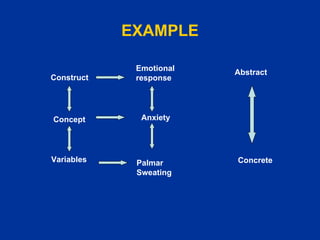
EXAMPLE Construct Concept Variables Emotional  response Anxiety Abstract Concrete Palmar Sweating
Every study has a framework Terms such as theories, models, frameworks, schemes & maps are overlapping as they are interrelated
THEORY An abstract generalization that offers a systematic explanation about how phenomena are interrelated   http://www.sandiego.edu/academics/nursing/theory/#Models
CONCEPTUAL FRAMEWORK Conceptual framework, like theories deal with abstractions (concepts) Represent a less formal attempt at organizing phenomena than theories Provide a perspective regarding interrelated phenomena, but are more loosely structured than theories
TYPES OF FRAMEWORK Theoretical framework - when a study is based on a theory Conceptual framework  -  when a study is based on a conceptual model
MODELS Schematic model is a symbolic representations of a conceptualization   Schematic models are visual representations of some aspect of reality
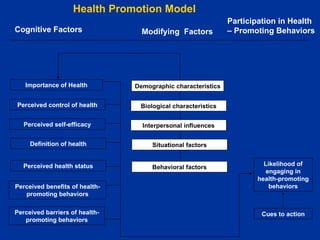
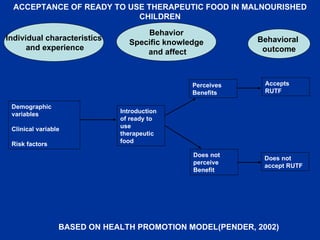
Conceptual models are common in both qualitative and quantitative research   Concepts and the linkages between them are represented through the use of boxes, arrows, or other symbols  Pender’s Health Promotion model, is a model for explaining and predicting the health promotion component of lifestyle
Health Promotion Model Importance of Health Perceived control of health Perceived self-efficacy Definition of health Perceived health status Perceived benefits of health-promoting behaviors Perceived barriers of health-promoting behaviors Likelihood of engaging in health-promoting behaviors Cues to action Demographic characteristics Biological characteristics Interpersonal influences Situational factors Behavioral factors Cognitive Factors Modifying  Factors Participation in Health – Promoting Behaviors
PURPOSES OF CONCEPTUAL FRAMEWORK   Overall purpose is to make research findings meaningful and generalizable   Allows researchers to knit together observations and facts into an orderly scheme  Help us to explain why we are doing a project in a particular way
It can help us to understand and use the ideas of others who have done similar things Conceptual frameworks act like maps that give coherence to empirical inquiry A visual or symbolic representation of a theory or conceptual framework often helps to express abstract ideas in a concise and readily understandable form
A conceptual framework is a diagram that depicts the variables in the research and the relationship among them The diagram should be accompanied by a written description of approximately six to ten sentences that explains the   diagram
HOW TO DEVELOP A CONCEPTUAL FRMEWORK Most challenging steps in the research process Much of the work involves thinking and reflecting
THEORIES / MODELS IN QUANTITATIVE RESEARCH Testing a theory Using a Model as an organizing structure Fitting a problem to a Theory
TESTING A THEORY   Theories stimulate new studies   Tip : If you are testing a specific theory or model, be sure to read about it from a primary source, and rely on the most up to date reference Researchers sometimes combine elements from more than one theory as a basis for generating hypotheses
Using a Model as an organizing structure Most common use of the nursing models - to provide an organizing structure for the studies
FITTING A PROBLEM TO A THEORY Problem is formulated before consideration is given to a conceptual framework   Tip – If you begin with a research problem and are trying to identify a suitable framework, it is wise to confer with people who may be familiar with a broad range of theoretical perspectives
Perceives Benefits  Accepts RUTF Does not accept RUTF Does not perceive Benefit Introduction of ready to use therapeutic food Demographic variables Clinical variable Risk factors Behavioral  outcome Behavior Specific knowledge and affect BASED ON HEALTH PROMOTION MODEL(PENDER, 2002) Individual characteristics and experience ACCEPTANCE OF READY TO USE THERAPEUTIC FOOD IN MALNOURISHED CHILDREN
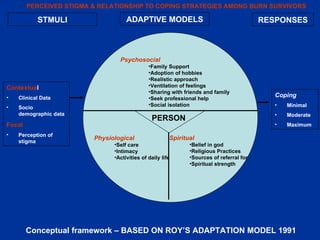
Psychosocial Family Support Adoption of hobbies Realistic approach Ventilation of feelings Sharing with friends and family Seek professional help Social isolation Physiological  Self care  Intimacy  Activities of daily life Spiritual  Belief in god  Religious Practices Sources of referral for  Spiritual strength PERSON Contextua l Clinical Data Socio demographic data Focal Perception of stigma Coping  Minimal Moderate Maximum RESPONSES ADAPTIVE MODELS STMULI Conceptual framework – BASED ON ROY’S ADAPTATION MODEL 1991 PERCEIVED STIGMA & RELATIONSHIP TO COPING STRATEGIES AMONG BURN SURVIVORS
CONCLUSION Every study has a framework  A conceptual framework is a diagram that depicts the variables in the research and the relationship among them Developing conceptual framework is challenging in research process
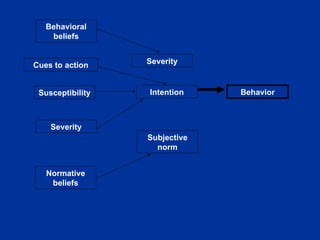
Behavioral beliefs Cues to action Susceptibility Severity Severity Intention Subjective norm Behavior Normative beliefs

241109 rm-p.l.-conceptual framework

  • 1.
    CONCEPTUAL FRAMEWORK DR.PREMILA LEE PROFESSOR & Ag. HOD DEPT. OF SURGICAL NURSING & CONTINUING NURSING EDUCATION
  • 2.
    CONCEPTS Abstract ideas– e.g. Pain, anxiety Building blocks of theory & conceptual framework
  • 3.
    CONSTRUCTS High levelabstraction with general meanings
  • 4.
    VARIABLES Concepts usedin quantitative studies are called variables Variables are central building blocks of quantitative studies
  • 5.
    EXAMPLE Construct ConceptVariables Emotional response Anxiety Abstract Concrete Palmar Sweating
  • 6.
    Every study hasa framework Terms such as theories, models, frameworks, schemes & maps are overlapping as they are interrelated
  • 7.
    THEORY An abstractgeneralization that offers a systematic explanation about how phenomena are interrelated http://www.sandiego.edu/academics/nursing/theory/#Models
  • 8.
    CONCEPTUAL FRAMEWORK Conceptualframework, like theories deal with abstractions (concepts) Represent a less formal attempt at organizing phenomena than theories Provide a perspective regarding interrelated phenomena, but are more loosely structured than theories
  • 9.
    TYPES OF FRAMEWORKTheoretical framework - when a study is based on a theory Conceptual framework - when a study is based on a conceptual model
  • 10.
    MODELS Schematic modelis a symbolic representations of a conceptualization Schematic models are visual representations of some aspect of reality
  • 11.
    Conceptual models arecommon in both qualitative and quantitative research Concepts and the linkages between them are represented through the use of boxes, arrows, or other symbols Pender’s Health Promotion model, is a model for explaining and predicting the health promotion component of lifestyle
  • 12.
    Health Promotion ModelImportance of Health Perceived control of health Perceived self-efficacy Definition of health Perceived health status Perceived benefits of health-promoting behaviors Perceived barriers of health-promoting behaviors Likelihood of engaging in health-promoting behaviors Cues to action Demographic characteristics Biological characteristics Interpersonal influences Situational factors Behavioral factors Cognitive Factors Modifying Factors Participation in Health – Promoting Behaviors
  • 13.
    PURPOSES OF CONCEPTUALFRAMEWORK Overall purpose is to make research findings meaningful and generalizable Allows researchers to knit together observations and facts into an orderly scheme Help us to explain why we are doing a project in a particular way
  • 14.
    It can helpus to understand and use the ideas of others who have done similar things Conceptual frameworks act like maps that give coherence to empirical inquiry A visual or symbolic representation of a theory or conceptual framework often helps to express abstract ideas in a concise and readily understandable form
  • 15.
    A conceptual frameworkis a diagram that depicts the variables in the research and the relationship among them The diagram should be accompanied by a written description of approximately six to ten sentences that explains the diagram
  • 16.
    HOW TO DEVELOPA CONCEPTUAL FRMEWORK Most challenging steps in the research process Much of the work involves thinking and reflecting
  • 17.
    THEORIES / MODELSIN QUANTITATIVE RESEARCH Testing a theory Using a Model as an organizing structure Fitting a problem to a Theory
  • 18.
    TESTING A THEORY Theories stimulate new studies Tip : If you are testing a specific theory or model, be sure to read about it from a primary source, and rely on the most up to date reference Researchers sometimes combine elements from more than one theory as a basis for generating hypotheses
  • 19.
    Using a Modelas an organizing structure Most common use of the nursing models - to provide an organizing structure for the studies
  • 20.
    FITTING A PROBLEMTO A THEORY Problem is formulated before consideration is given to a conceptual framework Tip – If you begin with a research problem and are trying to identify a suitable framework, it is wise to confer with people who may be familiar with a broad range of theoretical perspectives
  • 21.
    Perceives Benefits Accepts RUTF Does not accept RUTF Does not perceive Benefit Introduction of ready to use therapeutic food Demographic variables Clinical variable Risk factors Behavioral outcome Behavior Specific knowledge and affect BASED ON HEALTH PROMOTION MODEL(PENDER, 2002) Individual characteristics and experience ACCEPTANCE OF READY TO USE THERAPEUTIC FOOD IN MALNOURISHED CHILDREN
  • 22.
    Psychosocial Family SupportAdoption of hobbies Realistic approach Ventilation of feelings Sharing with friends and family Seek professional help Social isolation Physiological Self care Intimacy Activities of daily life Spiritual Belief in god Religious Practices Sources of referral for Spiritual strength PERSON Contextua l Clinical Data Socio demographic data Focal Perception of stigma Coping Minimal Moderate Maximum RESPONSES ADAPTIVE MODELS STMULI Conceptual framework – BASED ON ROY’S ADAPTATION MODEL 1991 PERCEIVED STIGMA & RELATIONSHIP TO COPING STRATEGIES AMONG BURN SURVIVORS
  • 23.
    CONCLUSION Every studyhas a framework A conceptual framework is a diagram that depicts the variables in the research and the relationship among them Developing conceptual framework is challenging in research process
  • 24.
    Behavioral beliefs Cuesto action Susceptibility Severity Severity Intention Subjective norm Behavior Normative beliefs