Forces & Motion
Review
Describe Acceleration
• A change in velocity – which may be:
– A change in speed
• Starting
• Stopping
• Speeding up
• Slowing down
– A change in direction
• Acceleration is caused by unbalanced
forces
More
Describe Acceleration
Deceleration is also called negative
acceleration - it means an object is
slowing down
When acceleration is calculated, it may be a
negative number
Describe Speed
Describe Speed
• A way to describe motion
– Average speed - Rate of motion calculated by dividing
the distance traveled by the amount of time it takes to
travel that distance
– Constant speed - Speed that does not change
– Instantaneous speed - Speed of an object at any
given time
What is the formula used to
calculate speed?
What is the formula for
calculating speed?
Speed is calculated by dividing distance
by time –
Calculate This Speed
A football field is about 100 m long. If it
takes a person 20 seconds to run its
length, how fast was the football player
running?
Calculate this Speed:
A football field is about 100 m long. If it
takes a person 20 seconds to run its
length, how fast was the football player
running?
Speed = Distance ÷ Time
Speed = 100 m ÷ 20 s
Speed = 5m/s
Remember
to include
the UNITS!!
Explain Balanced Forces
• When all the forces acting on an object
balance each other
• Balanced forces do not cause a change in
motion
Describe Friction
Describe Friction
• Force that resists motion between two
touching surfaces
• Acts in the opposite direction of the
object’s motion
• Produces heat
Explain Inertia
Explain Inertia
• Moving objects tend to continue moving unless
acted upon by an unbalanced force
• Objects at rest tend to stay at rest unless acted
upon by an unbalanced force
• The more mass an object has, the more inertia it
has
– More massive objects are harder to start moving and
stop moving
– Smaller objects are easier to start and stop moving
More
Explain Inertia
Newton’s First Law on Motion describes the
idea of inertia
• An object at rest or in constant motion is
acted upon by balanced forces – an
unbalanced force will change the motion
• Acceleration of an object at rest or in
constant motion is 0 m/s/s (no motion)
Explain Newton’s First Law
of Motion
Explain Newton’s First Law of
Motion
• Describes the idea of inertia
Click the link below to observe the law
http://archive.ncsa.uiuc.edu/Cyberia/VideoTestbed/Projects/NewPhysics/newt
When you are finished, click the back button
on your browser to return to this tutorial
Explain Newton’s Second Law of
Motion
Explain Newton’s Second Law of
Motion
• Describes motion created by unbalanced forces
• Mass and acceleration change in opposite ways
– The more mass an object has, the more force it
take to accelerate the object, the slower it
accelerates
– The less mass an object has, the less force it
take to accelerate the object, the faster it
accelerates
More
Explain Newton’s Second Law of
Motion
Click on the link below to observe the law:
http://archive.ncsa.uiuc.edu/Cyberia/VideoTestbed/Projects/NewPhysics/newto
When you are finished, click the back button
on your browser to return to this tutorial
Explain Newton’s Third Law
of Motion
Explain Newton’s Third Law of
Motion
• Describes why forces act in pairs
• For every action there is an equal and opposite
reaction
• Action and reaction forces are equal forces
acting in opposite directions on different objects
Explain Newton’s Third Law of
Motion
Click the link below to observe the law
http://archive.ncsa.uiuc.edu/Cyberia/VideoTestbed/Projects/NewPhysics/newtons_
Distinguish Between Speed
& Velocity
Distinguish Between Speed and
Velocity
• Speed describes distance and time
• Velocity describes distance, time, and
direction
How Can Forces Affect
Objects?
How Can Forces Affect Objects?
• Slow them down
• Speed them up
• Stop them
• Start them
• Change their direction
• Change their shape
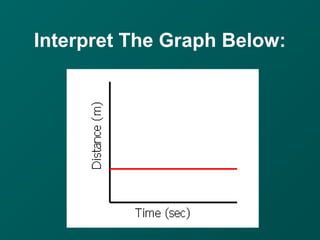
Interpret The Graph Below:
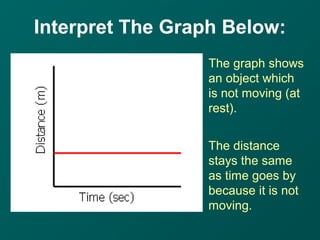
The graph shows
an object which
is not moving (at
rest).
The distance
stays the same
as time goes by
because it is not
moving.
Interpret The Graph Below:
The graph shows
that the objects
distance increases
as time passes.
The object is moving
and so it has
velocity.
The straight line
shows it is a
constant (not
changing).
Interpret The Graph Below:
Just like the
previous
graph, this
graph shows
an object
moving with
constant
velocity
Interpret The Graph Below:
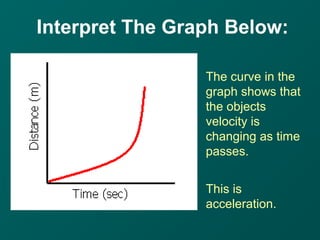
The curve in the
graph shows that
the objects
velocity is
changing as time
passes.
This is
acceleration.
Interpret The Graph Below:
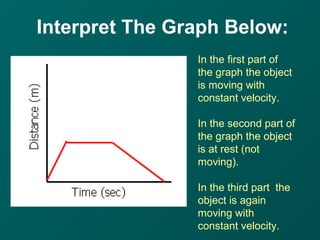
In the first part of
the graph the object
is moving with
constant velocity.
In the second part of
the graph the object
is at rest (not
moving).
In the third part the
object is again
moving with
constant velocity.
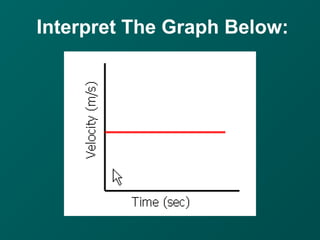
Interpret The Graph Below:
The graph shows
that the objects
velocity does not
change as time
passes.
It shows constant
velocity.
Interpret The Graph Below:
The graph shows
that the objects
velocity is
increasing as time
passes – it is
accelerating.
The straight line
shows that it is
constant
acceleration.
Click here for more review:
http://www.usoe.k12.ut.us/curr/science/scib

Nota Fizik

  • 1.
  • 2.
  • 3.
    Describe Acceleration • Achange in velocity – which may be: – A change in speed • Starting • Stopping • Speeding up • Slowing down – A change in direction • Acceleration is caused by unbalanced forces More
  • 4.
    Describe Acceleration Deceleration isalso called negative acceleration - it means an object is slowing down When acceleration is calculated, it may be a negative number
  • 5.
  • 6.
    Describe Speed • Away to describe motion – Average speed - Rate of motion calculated by dividing the distance traveled by the amount of time it takes to travel that distance – Constant speed - Speed that does not change – Instantaneous speed - Speed of an object at any given time
  • 7.
    What is theformula used to calculate speed?
  • 8.
    What is theformula for calculating speed? Speed is calculated by dividing distance by time –
  • 9.
    Calculate This Speed Afootball field is about 100 m long. If it takes a person 20 seconds to run its length, how fast was the football player running?
  • 10.
    Calculate this Speed: Afootball field is about 100 m long. If it takes a person 20 seconds to run its length, how fast was the football player running? Speed = Distance ÷ Time Speed = 100 m ÷ 20 s Speed = 5m/s Remember to include the UNITS!!
  • 11.
  • 12.
    Explain Balanced Forces •When all the forces acting on an object balance each other • Balanced forces do not cause a change in motion
  • 13.
  • 14.
    Describe Friction • Forcethat resists motion between two touching surfaces • Acts in the opposite direction of the object’s motion • Produces heat
  • 15.
  • 16.
    Explain Inertia • Movingobjects tend to continue moving unless acted upon by an unbalanced force • Objects at rest tend to stay at rest unless acted upon by an unbalanced force • The more mass an object has, the more inertia it has – More massive objects are harder to start moving and stop moving – Smaller objects are easier to start and stop moving More
  • 17.
    Explain Inertia Newton’s FirstLaw on Motion describes the idea of inertia • An object at rest or in constant motion is acted upon by balanced forces – an unbalanced force will change the motion • Acceleration of an object at rest or in constant motion is 0 m/s/s (no motion)
  • 18.
  • 19.
    Explain Newton’s FirstLaw of Motion • Describes the idea of inertia Click the link below to observe the law http://archive.ncsa.uiuc.edu/Cyberia/VideoTestbed/Projects/NewPhysics/newt When you are finished, click the back button on your browser to return to this tutorial
  • 20.
  • 21.
    Explain Newton’s SecondLaw of Motion • Describes motion created by unbalanced forces • Mass and acceleration change in opposite ways – The more mass an object has, the more force it take to accelerate the object, the slower it accelerates – The less mass an object has, the less force it take to accelerate the object, the faster it accelerates More
  • 22.
    Explain Newton’s SecondLaw of Motion Click on the link below to observe the law: http://archive.ncsa.uiuc.edu/Cyberia/VideoTestbed/Projects/NewPhysics/newto When you are finished, click the back button on your browser to return to this tutorial
  • 23.
  • 24.
    Explain Newton’s ThirdLaw of Motion • Describes why forces act in pairs • For every action there is an equal and opposite reaction • Action and reaction forces are equal forces acting in opposite directions on different objects
  • 25.
    Explain Newton’s ThirdLaw of Motion Click the link below to observe the law http://archive.ncsa.uiuc.edu/Cyberia/VideoTestbed/Projects/NewPhysics/newtons_
  • 26.
  • 27.
    Distinguish Between Speedand Velocity • Speed describes distance and time • Velocity describes distance, time, and direction
  • 28.
    How Can ForcesAffect Objects?
  • 29.
    How Can ForcesAffect Objects? • Slow them down • Speed them up • Stop them • Start them • Change their direction • Change their shape
  • 30.
  • 31.
    Interpret The GraphBelow: The graph shows an object which is not moving (at rest). The distance stays the same as time goes by because it is not moving.
  • 32.
  • 33.
    Interpret The GraphBelow: The graph shows that the objects distance increases as time passes. The object is moving and so it has velocity. The straight line shows it is a constant (not changing).
  • 34.
  • 35.
    Interpret The GraphBelow: Just like the previous graph, this graph shows an object moving with constant velocity
  • 36.
  • 37.
    Interpret The GraphBelow: The curve in the graph shows that the objects velocity is changing as time passes. This is acceleration.
  • 38.
  • 39.
    Interpret The GraphBelow: In the first part of the graph the object is moving with constant velocity. In the second part of the graph the object is at rest (not moving). In the third part the object is again moving with constant velocity.
  • 40.
  • 41.
    Interpret The GraphBelow: The graph shows that the objects velocity does not change as time passes. It shows constant velocity.
  • 42.
  • 43.
    Interpret The GraphBelow: The graph shows that the objects velocity is increasing as time passes – it is accelerating. The straight line shows that it is constant acceleration.
  • 44.
    Click here formore review: http://www.usoe.k12.ut.us/curr/science/scib