Energy Flow and Nutrient Cycles
Food Chains, Food Webs and
Ecological Pyramids
Energy Flow
What is our main source of
energy?
Energy Flow
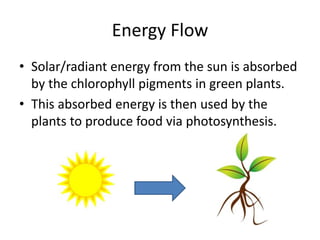
• Solar/radiant energy from the sun is absorbed
by the chlorophyll pigments in green plants.
• This absorbed energy is then used by the
plants to produce food via photosynthesis.
Energy Flow
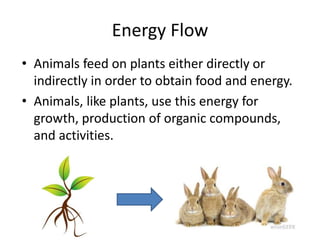
• Animals feed on plants either directly or
indirectly in order to obtain food and energy.
• Animals, like plants, use this energy for
growth, production of organic compounds,
and activities.
Energy Flow
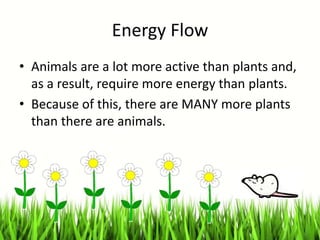
• Animals are a lot more active than plants and,
as a result, require more energy than plants.
• Because of this, there are MANY more plants
than there are animals.
Energy Flow
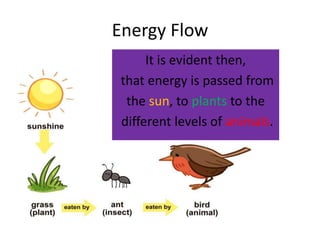
It is evident then,
that energy is passed from
the sun, to plants to the
different levels of animals.
Energy Flow
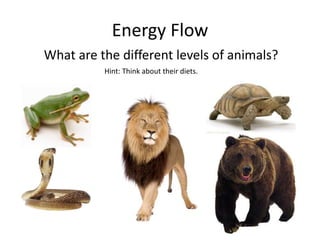
What are the different levels of animals?
Hint: Think about their diets.
Energy Flow
• When plants an animals die, the decomposers
(what are these?) break up the dead bodies
and recycle the energy back into nature.
This is known as
ENERGY FLOW.
Energy Flow and Food Chains
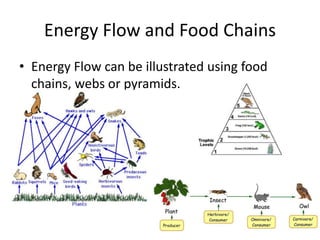
• Energy Flow can be illustrated using food
chains, webs or pyramids.
Food Chains
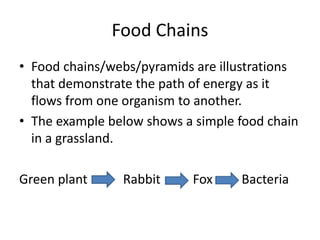
• Food chains/webs/pyramids are illustrations
that demonstrate the path of energy as it
flows from one organism to another.
• The example below shows a simple food chain
in a grassland.
Green plant Rabbit Fox Bacteria
Activity
Complete the following activity individually
1. Make a list of some organisms that you have
seen in your garden at home or your
surroundings.
2. Draw a simple food chain to represent these
organisms and their feeding relationships.
3. Draw a simple food chain that could be
present in a fish tank.
Activity
Assess each other’s work and discuss some of
your answers
Food Webs
• The path taken by energy is much more
complicated than illustrated in a chain.
• Organisms obtain food from more than one
source or they may provide energy to more
than one type of organism.
• The resulting relationships look more like a
web than a chain.
Energy flow and nutrient cycles

Energy flow and nutrient cycles

  • 1.
    Energy Flow andNutrient Cycles Food Chains, Food Webs and Ecological Pyramids
  • 2.
    Energy Flow What isour main source of energy?
  • 3.
    Energy Flow • Solar/radiantenergy from the sun is absorbed by the chlorophyll pigments in green plants. • This absorbed energy is then used by the plants to produce food via photosynthesis.
  • 4.
    Energy Flow • Animalsfeed on plants either directly or indirectly in order to obtain food and energy. • Animals, like plants, use this energy for growth, production of organic compounds, and activities.
  • 5.
    Energy Flow • Animalsare a lot more active than plants and, as a result, require more energy than plants. • Because of this, there are MANY more plants than there are animals.
  • 6.
    Energy Flow It isevident then, that energy is passed from the sun, to plants to the different levels of animals.
  • 7.
    Energy Flow What arethe different levels of animals? Hint: Think about their diets.
  • 8.
    Energy Flow • Whenplants an animals die, the decomposers (what are these?) break up the dead bodies and recycle the energy back into nature. This is known as ENERGY FLOW.
  • 9.
    Energy Flow andFood Chains • Energy Flow can be illustrated using food chains, webs or pyramids.
  • 10.
    Food Chains • Foodchains/webs/pyramids are illustrations that demonstrate the path of energy as it flows from one organism to another. • The example below shows a simple food chain in a grassland. Green plant Rabbit Fox Bacteria
  • 11.
    Activity Complete the followingactivity individually 1. Make a list of some organisms that you have seen in your garden at home or your surroundings. 2. Draw a simple food chain to represent these organisms and their feeding relationships. 3. Draw a simple food chain that could be present in a fish tank.
  • 12.
    Activity Assess each other’swork and discuss some of your answers
  • 13.
    Food Webs • Thepath taken by energy is much more complicated than illustrated in a chain. • Organisms obtain food from more than one source or they may provide energy to more than one type of organism. • The resulting relationships look more like a web than a chain.

Editor's Notes

  • #3 Answer: The SUN!!!
  • #4 Ask: What do you think this energy is used for? Answer: Growth, production of organic compounds, absorption, chemical reactions and even movement.
  • #5 Explain what you mean by the term “indirectly” Explain what organic compounds and activities
  • #8 Answer: Herbivores/omnivores, low level carnivores and high level carnivores. Lower level carnivores – Snake and frog; Higher level carnivore – Lion; Herbivore – Tortoise; Omnivore – Grizzly bear.
  • #9 Decomposers: Fungi, bacteria
  • #10 Ask for suggestions of food chains and draw a few on the board
  • #11 Energy flow is completed once the bacteria have broken down the fox’s body. The products that the bacteria create from the dead body are released back into the environment.
  • #14 Draw food web including green plant, rabbit, fox, lion, impala, and a human as an example of a food web and explain the energy flow in the web. Ask learners to join in and provide a food web of their own for the entire class.