Diagnosis and
Management
of Vertigo
Vertigo- Definition
‘The sensation of motion when no motion is occurring relative to
earth’s gravity’1
A feeling of movement, a sensation as if the external world were
revolving around the patient (objective vertigo) or as if he himself
were revolving in space (subjective vertigo)2
Sense of rotation
Symptom expression of disorder of vestibular system
1. Committee on Hearing and Equilibrium , Otolaryngol Head Neck Surg 1995;113:181–5. 2. International Classification of Disease [Online] Access at
http://www.icd9data.com/2012/Volume1/780- 799/780-789/780/780.4.htm
Vertigo- Epidemiology
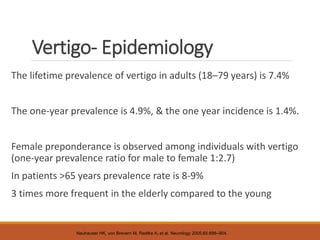
The lifetime prevalence of vertigo in adults (18–79 years) is 7.4%
The one-year prevalence is 4.9%, & the one year incidence is 1.4%.
Female preponderance is observed among individuals with vertigo
(one-year prevalence ratio for male to female 1:2.7)
In patients >65 years prevalence rate is 8-9%
3 times more frequent in the elderly compared to the young
Neuhauser HK, von Brevern M, Radtke A, et al. Neurology 2005;65:898–904.
Vertigo Impact
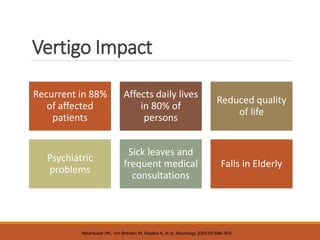
Recurrent in 88%
of affected
patients
Affects daily lives
in 80% of
persons
Reduced quality
of life
Psychiatric
problems
Sick leaves and
frequent medical
consultations
Falls in Elderly
Neuhauser HK, von Brevern M, Radtke A, et al. Neurology 2005;65:898–904.
Diagnosis
Dizziness is a common presenting complaint
Determination of accurate cause remains challenging
Accurate diagnosis helps in appropriate intervention and resolution of
symptoms
In a study of 3400 patients over 70 years of age an accurate diagnosis
was possible in more than 75%
1. Katsarkas A. Geriatrics 2008;63:18–20. 2. Moeller JJ, Kurniawan J, Gubitz GJ, et al. Can J Neurol Sci 2008;35:335–41.
Diagnosis
◦ Proper history and a good clinical examination can provide a
diagnosis in the majority of the patients.(75% cases accurate
diagnosis possible)
Systematic approach to patients with vertigo
1)Presence of vertigo is established
2)Duration of vertiginous event and recurrence is determined
3)Type of nystagmus is observed
4)Additional co occuring symptoms
Garg RK, Kothari S. Guidelines on Vertigo, Indian Academy of Neurology
Duration of vertiginous event and recurrence
1) BPPV: few seconds to <1 min [recurrent]
2)Menieres disease:20 min to 20 hr/few hr[recurrent]
3)Migraine associated vertigo: >few min to 60min [recurrent]
4)Acute long duration:vestibular neuritis,labyrinthitis,labyrinthine
concussion/ischemia
cerebellar infarct/ischemia,brain stem infarct/ischemia
Nystagmus characteristics
Peripheral:
Horizontal/tortional, fixed direction, suppressed by optical fixation,
follows Alexanders and Ewalds law
Central:
Vertical horizontal tortional, not suppressed by optical fixation,
direction changing,
Additional symptoms that aid in making diagnosis
A) Auditory symptoms:hearing loss,tinnitus,aural fullness
B) Nausea: Seen in both peripheral > central
C) Focal neurological signs: dysarthria, inco-ordinationo
D) Imbalance
Patients with central cause have prolonged time for symptoms to
subside compared to
relatively faster central compensation that is possible and typical of
peripheral causes
Test during examination
1. Spontaneous nystagmus
2. Gaze nystagmus
3. Smooth pursuit
4. Saccades
5. Fixation suppression
6. Head thrust
7. Headshake
8. Dynamic visual acuity
9. Hallpike positioning
10. Static positional
11. Limb co-ordination
12. Romberg stance
13. Gait observation
14. Specialized tests
Garg RK, Kothari S. Guidelines on Vertigo, Indian Academy of Neurology
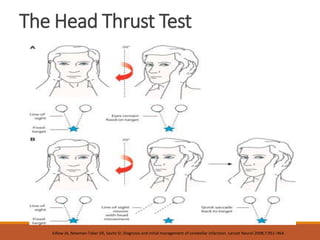
The Head Thrust Test
Edlow JA, Newman-Toker DE, Savitz SI. Diagnosis and initial management of cerebellar infarction. Lancet Neurol 2008;7:951–964.
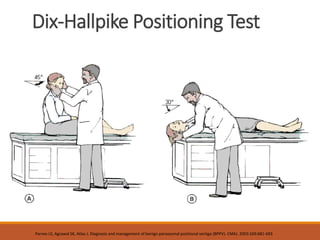
Dix-Hallpike Positioning Test
Parnes LS, Agrawal SK, Atlas J. Diagnosis and management of benign paroxysmal positional vertigo (BPPV). CMAJ. 2003:169:681-693
Supine Lateral head Turns
Lee S-H, Kim JS. Benign Paroxysmal Positional Vertigo. Journal of Clinical Neurology (Seoul, Korea). 2010;6(2):51-63. doi:10.3988/jcn.2010.6.2.51.
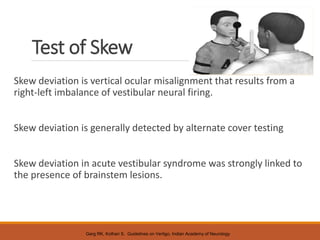
Test of Skew
Skew deviation is vertical ocular misalignment that results from a
right-left imbalance of vestibular neural firing.
Skew deviation is generally detected by alternate cover testing
Skew deviation in acute vestibular syndrome was strongly linked to
the presence of brainstem lesions.
Garg RK, Kothari S. Guidelines on Vertigo, Indian Academy of Neurology
3 dangerous, subtle occulomotor signs
“INFARCT”
IN - impulse normal
FA - fast phase alternating
RCT – re-fixation on cover test
Garg RK, Kothari S. Guidelines on Vertigo, Indian Academy of Neurology
Horizontal Head-Impulse Test,
Nystagmus and Test of Skew
(HINTS)
HINTS has recently been shown to detect
brainstem and cerebellar stroke with greater
sensitivity than neuro-imaging
Garg RK, Kothari S. Guidelines on Vertigo, Indian Academy of Neurology
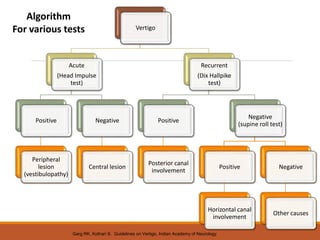
Vertigo
Acute
(Head Impulse
test)
Positive
Peripheral
lesion
(vestibulopathy)
Negative
Central lesion
Recurrent
(Dix Hallpike
test)
Positive
Posterior canal
involvement
Negative
(supine roll test)
Positive
Horizontal canal
involvement
Negative
Other causes
Algorithm
For various tests
Garg RK, Kothari S. Guidelines on Vertigo, Indian Academy of Neurology
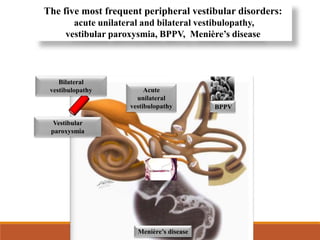
Menière’s disease
BPPV
Vestibular
paroxysmia
Bilateral
vestibulopathy Acute
unilateral
vestibulopathy
The five most frequent peripheral vestibular disorders:
acute unilateral and bilateral vestibulopathy,
vestibular paroxysmia, BPPV, Menière’s disease
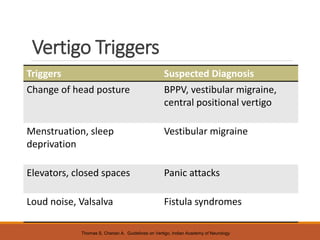
Vertigo Triggers
Thomas S, Cherian A. Guidelines on Vertigo, Indian Academy of Neurology
Triggers Suspected Diagnosis
Change of head posture BPPV, vestibular migraine,
central positional vertigo
Menstruation, sleep
deprivation
Vestibular migraine
Elevators, closed spaces Panic attacks
Loud noise, Valsalva Fistula syndromes
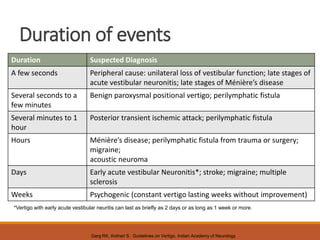
Duration of events
*Vertigo with early acute vestibular neuritis can last as briefly as 2 days or as long as 1 week or more.
Duration Suspected Diagnosis
A few seconds Peripheral cause: unilateral loss of vestibular function; late stages of
acute vestibular neuronitis; late stages of Ménière’s disease
Several seconds to a
few minutes
Benign paroxysmal positional vertigo; perilymphatic fistula
Several minutes to 1
hour
Posterior transient ischemic attack; perilymphatic fistula
Hours Ménière’s disease; perilymphatic fistula from trauma or surgery;
migraine;
acoustic neuroma
Days Early acute vestibular Neuronitis*; stroke; migraine; multiple
sclerosis
Weeks Psychogenic (constant vertigo lasting weeks without improvement)
Garg RK, Kothari S. Guidelines on Vertigo, Indian Academy of Neurology
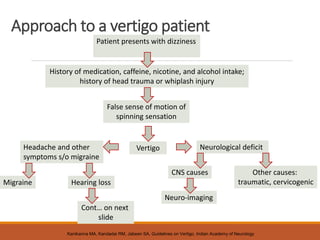
Approach to a vertigo patient
Cont… on next
slide
Patient presents with dizziness
History of medication, caffeine, nicotine, and alcohol intake;
history of head trauma or whiplash injury
False sense of motion of
spinning sensation
Vertigo
Headache and other
symptoms s/o migraine
Hearing loss
Migraine
Neurological deficit
CNS causes Other causes:
traumatic, cervicogenic
Neuro-imaging
Kanikanna MA, Kandadai RM, Jabeen SA, Guidelines on Vertigo, Indian Academy of Neurology
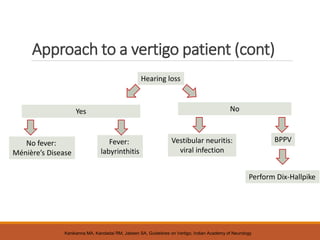
Approach to a vertigo patient (cont)
Hearing loss
Yes No
No fever:
Ménière’s Disease
Fever:
labyrinthitis
Vestibular neuritis:
viral infection
BPPV
Perform Dix-Hallpike
Kanikanna MA, Kandadai RM, Jabeen SA, Guidelines on Vertigo, Indian Academy of Neurology
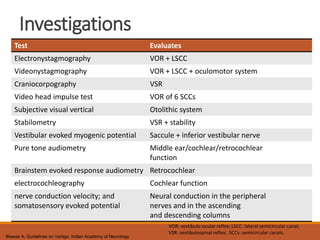
Investigations
Test Evaluates
Electronystagmography VOR + LSCC
Videonystagmography VOR + LSCC + oculomotor system
Craniocorpography VSR
Video head impulse test VOR of 6 SCCs
Subjective visual vertical Otolithic system
Stabilometry VSR + stability
Vestibular evoked myogenic potential Saccule + inferior vestibular nerve
Pure tone audiometry Middle ear/cochlear/retrocochlear
function
Brainstem evoked response audiometry Retrocochlear
electrocochleography Cochlear function
nerve conduction velocity; and
somatosensory evoked potential
Neural conduction in the peripheral
nerves and in the ascending
and descending columns
Biswas A, Guidelines on Vertigo, Indian Academy of Neurology
VOR: vestibulo-ocular reflex; LSCC: lateral semicircular canal;
VSR: vestibulospinal reflex; SCCs: semicircular canals.
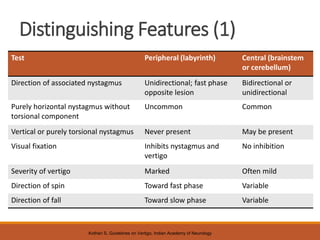
Distinguishing Features (1)
Test Peripheral (labyrinth) Central (brainstem
or cerebellum)
Direction of associated nystagmus Unidirectional; fast phase
opposite lesion
Bidirectional or
unidirectional
Purely horizontal nystagmus without
torsional component
Uncommon Common
Vertical or purely torsional nystagmus Never present May be present
Visual fixation Inhibits nystagmus and
vertigo
No inhibition
Severity of vertigo Marked Often mild
Direction of spin Toward fast phase Variable
Direction of fall Toward slow phase Variable
Kothari S, Guidelines on Vertigo, Indian Academy of Neurology
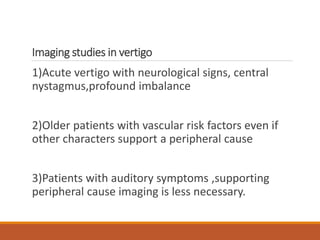
Imaging studies in vertigo
1)Acute vertigo with neurological signs, central
nystagmus,profound imbalance
2)Older patients with vascular risk factors even if
other characters support a peripheral cause
3)Patients with auditory symptoms ,supporting
peripheral cause imaging is less necessary.
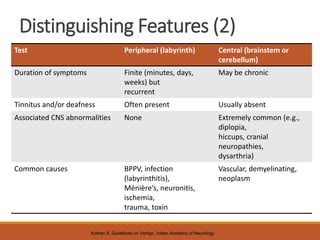
Distinguishing Features (2)
Test Peripheral (labyrinth) Central (brainstem or
cerebellum)
Duration of symptoms Finite (minutes, days,
weeks) but
recurrent
May be chronic
Tinnitus and/or deafness Often present Usually absent
Associated CNS abnormalities None Extremely common (e.g.,
diplopia,
hiccups, cranial
neuropathies,
dysarthria)
Common causes BPPV, infection
(labyrinthitis),
Ménière’s, neuronitis,
ischemia,
trauma, toxin
Vascular, demyelinating,
neoplasm
Kothari S, Guidelines on Vertigo, Indian Academy of Neurology
Vertigo
management
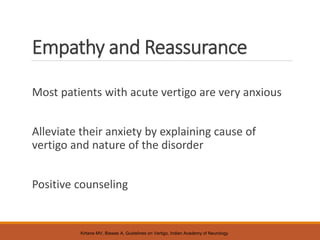
Empathy and Reassurance
Most patients with acute vertigo are very anxious
Alleviate their anxiety by explaining cause of
vertigo and nature of the disorder
Positive counseling
Kirtane MV, Biswas A, Guidelines on Vertigo, Indian Academy of Neurology
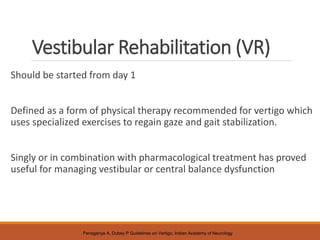
Vestibular Rehabilitation (VR)
Should be started from day 1
Defined as a form of physical therapy recommended for vertigo which
uses specialized exercises to regain gaze and gait stabilization.
Singly or in combination with pharmacological treatment has proved
useful for managing vestibular or central balance dysfunction
Panagariya A, Dubey P Guidelines on Vertigo, Indian Academy of Neurology
In BPPV
Canal repositioning maneuver is the mainstay of
management of BPPV, such as:
◦ Epley’s maneuver and the Semont’s maneuver
◦ The Brandt-Daroff ’s exercises
◦ Log-roll exercises
Panagariya A, Dubey P Guidelines on Vertigo, Indian Academy of Neurology
Pharmacotherapy
Anti-vertigo drugs, mainly to provide symptomatic relief and
not for a curative treatment
Vestibular Suppressants to be discontinued within 1 to 3
days1
Suppressants current recommendation is < 24hrs2
1. Lacour M., Restoration of vestibular function: basic aspects and practical advances for rehabilitation. Curr Med Res Opin 2006; 22:1651-59
2. Baloh RW, Kerber KA. Clinical Neurophysiology of the vestibular system. Fourth ed. New York: Oxford University Press, 2011.
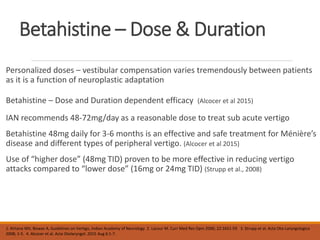
Betahistine – Dose & Duration
Personalized doses – vestibular compensation varies tremendously between patients
as it is a function of neuroplastic adaptation
Betahistine – Dose and Duration dependent efficacy (Alcocer et al 2015)
IAN recommends 48-72mg/day as a reasonable dose to treat sub acute vertigo
Betahistine 48mg daily for 3-6 months is an effective and safe treatment for Ménière’s
disease and different types of peripheral vertigo. (Alcocer et al 2015)
Use of “higher dose” (48mg TID) proven to be more effective in reducing vertigo
attacks compared to “lower dose” (16mg or 24mg TID) (Strupp et al., 2008)
1. Kirtane MV, Biswas A, Guidelines on Vertigo, Indian Academy of Neurology 2. Lacour M. Curr Med Res Opin 2006; 22:1651-59 3. Strupp et al. Acta Oto-Laryngologica
2008; 1-5. 4. Alcocer et al. Acta Otolaryngol. 2015 Aug 6:1-7.
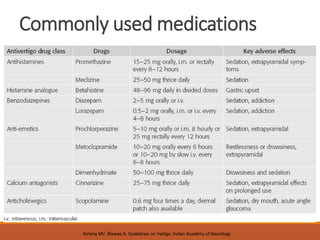
Commonly used medications
Kirtane MV, Biswas A, Guidelines on Vertigo, Indian Academy of Neurology
Management of Acute Vertigo
Providing symptomatic relief is important, to reduce anxiety and morbidity
Anti-vertigo drugs are recommended for 1-3 days
Detailed examination is required
Antiemetic (Dimenhydrinate, Prochlorperazine etc) are prudent to use for 1-3 days
Once acute symptoms subside, put the patient on a non-CNS depressant drug like
Betahistine at a dose of 48–72 mg
Put the patient on vestibular exercises right from the first or second day
Kirtane MV, Biswas A, Guidelines on Vertigo, Indian Academy of Neurology
Concerns in Management
Use of combinations of anti histamine with histamine analogues
Usage of drugs in sub-therapeutic dosage
Tapering off of anti vertigo drugs
Long-term use of anti vertigo drugs without establishing a definitive
diagnosis
Kirtane MV, Biswas A, Guidelines on Vertigo, Indian Academy of Neurology
Case 1:
A 41 year old male with recent vertigo
24 hours in duration and hearing loss in right ear
following upper respiratory infection.
Case 2:
A 35 year old female with 2 year history
of monthly intense vertigo with duration
of 2-3 hours.No auditory symptoms. But
has lateralised moderate headache,as
well as light and sound sensitivity.
Case 3:
A 72 year old male with 2 month history of intense
vertigo provoked with turning to his right side in
bed.Duration is less than one minute but patient
becomes nauseated.
2. Vertigo Diagnosis Management_Short version.pptx

2. Vertigo Diagnosis Management_Short version.pptx

  • 1.
  • 2.
    Vertigo- Definition ‘The sensationof motion when no motion is occurring relative to earth’s gravity’1 A feeling of movement, a sensation as if the external world were revolving around the patient (objective vertigo) or as if he himself were revolving in space (subjective vertigo)2 Sense of rotation Symptom expression of disorder of vestibular system 1. Committee on Hearing and Equilibrium , Otolaryngol Head Neck Surg 1995;113:181–5. 2. International Classification of Disease [Online] Access at http://www.icd9data.com/2012/Volume1/780- 799/780-789/780/780.4.htm
  • 3.
    Vertigo- Epidemiology The lifetimeprevalence of vertigo in adults (18–79 years) is 7.4% The one-year prevalence is 4.9%, & the one year incidence is 1.4%. Female preponderance is observed among individuals with vertigo (one-year prevalence ratio for male to female 1:2.7) In patients >65 years prevalence rate is 8-9% 3 times more frequent in the elderly compared to the young Neuhauser HK, von Brevern M, Radtke A, et al. Neurology 2005;65:898–904.
  • 4.
    Vertigo Impact Recurrent in88% of affected patients Affects daily lives in 80% of persons Reduced quality of life Psychiatric problems Sick leaves and frequent medical consultations Falls in Elderly Neuhauser HK, von Brevern M, Radtke A, et al. Neurology 2005;65:898–904.
  • 5.
    Diagnosis Dizziness is acommon presenting complaint Determination of accurate cause remains challenging Accurate diagnosis helps in appropriate intervention and resolution of symptoms In a study of 3400 patients over 70 years of age an accurate diagnosis was possible in more than 75% 1. Katsarkas A. Geriatrics 2008;63:18–20. 2. Moeller JJ, Kurniawan J, Gubitz GJ, et al. Can J Neurol Sci 2008;35:335–41.
  • 6.
    Diagnosis ◦ Proper historyand a good clinical examination can provide a diagnosis in the majority of the patients.(75% cases accurate diagnosis possible) Systematic approach to patients with vertigo 1)Presence of vertigo is established 2)Duration of vertiginous event and recurrence is determined 3)Type of nystagmus is observed 4)Additional co occuring symptoms Garg RK, Kothari S. Guidelines on Vertigo, Indian Academy of Neurology
  • 7.
    Duration of vertiginousevent and recurrence 1) BPPV: few seconds to <1 min [recurrent] 2)Menieres disease:20 min to 20 hr/few hr[recurrent] 3)Migraine associated vertigo: >few min to 60min [recurrent] 4)Acute long duration:vestibular neuritis,labyrinthitis,labyrinthine concussion/ischemia cerebellar infarct/ischemia,brain stem infarct/ischemia
  • 8.
    Nystagmus characteristics Peripheral: Horizontal/tortional, fixeddirection, suppressed by optical fixation, follows Alexanders and Ewalds law Central: Vertical horizontal tortional, not suppressed by optical fixation, direction changing,
  • 9.
    Additional symptoms thataid in making diagnosis A) Auditory symptoms:hearing loss,tinnitus,aural fullness B) Nausea: Seen in both peripheral > central C) Focal neurological signs: dysarthria, inco-ordinationo D) Imbalance Patients with central cause have prolonged time for symptoms to subside compared to relatively faster central compensation that is possible and typical of peripheral causes
  • 10.
    Test during examination 1.Spontaneous nystagmus 2. Gaze nystagmus 3. Smooth pursuit 4. Saccades 5. Fixation suppression 6. Head thrust 7. Headshake 8. Dynamic visual acuity 9. Hallpike positioning 10. Static positional 11. Limb co-ordination 12. Romberg stance 13. Gait observation 14. Specialized tests Garg RK, Kothari S. Guidelines on Vertigo, Indian Academy of Neurology
  • 11.
    The Head ThrustTest Edlow JA, Newman-Toker DE, Savitz SI. Diagnosis and initial management of cerebellar infarction. Lancet Neurol 2008;7:951–964.
  • 12.
    Dix-Hallpike Positioning Test ParnesLS, Agrawal SK, Atlas J. Diagnosis and management of benign paroxysmal positional vertigo (BPPV). CMAJ. 2003:169:681-693
  • 13.
    Supine Lateral headTurns Lee S-H, Kim JS. Benign Paroxysmal Positional Vertigo. Journal of Clinical Neurology (Seoul, Korea). 2010;6(2):51-63. doi:10.3988/jcn.2010.6.2.51.
  • 14.
    Test of Skew Skewdeviation is vertical ocular misalignment that results from a right-left imbalance of vestibular neural firing. Skew deviation is generally detected by alternate cover testing Skew deviation in acute vestibular syndrome was strongly linked to the presence of brainstem lesions. Garg RK, Kothari S. Guidelines on Vertigo, Indian Academy of Neurology
  • 15.
    3 dangerous, subtleocculomotor signs “INFARCT” IN - impulse normal FA - fast phase alternating RCT – re-fixation on cover test Garg RK, Kothari S. Guidelines on Vertigo, Indian Academy of Neurology
  • 16.
    Horizontal Head-Impulse Test, Nystagmusand Test of Skew (HINTS) HINTS has recently been shown to detect brainstem and cerebellar stroke with greater sensitivity than neuro-imaging Garg RK, Kothari S. Guidelines on Vertigo, Indian Academy of Neurology
  • 17.
    Vertigo Acute (Head Impulse test) Positive Peripheral lesion (vestibulopathy) Negative Central lesion Recurrent (DixHallpike test) Positive Posterior canal involvement Negative (supine roll test) Positive Horizontal canal involvement Negative Other causes Algorithm For various tests Garg RK, Kothari S. Guidelines on Vertigo, Indian Academy of Neurology
  • 18.
    Menière’s disease BPPV Vestibular paroxysmia Bilateral vestibulopathy Acute unilateral vestibulopathy Thefive most frequent peripheral vestibular disorders: acute unilateral and bilateral vestibulopathy, vestibular paroxysmia, BPPV, Menière’s disease
  • 19.
    Vertigo Triggers Thomas S,Cherian A. Guidelines on Vertigo, Indian Academy of Neurology Triggers Suspected Diagnosis Change of head posture BPPV, vestibular migraine, central positional vertigo Menstruation, sleep deprivation Vestibular migraine Elevators, closed spaces Panic attacks Loud noise, Valsalva Fistula syndromes
  • 20.
    Duration of events *Vertigowith early acute vestibular neuritis can last as briefly as 2 days or as long as 1 week or more. Duration Suspected Diagnosis A few seconds Peripheral cause: unilateral loss of vestibular function; late stages of acute vestibular neuronitis; late stages of Ménière’s disease Several seconds to a few minutes Benign paroxysmal positional vertigo; perilymphatic fistula Several minutes to 1 hour Posterior transient ischemic attack; perilymphatic fistula Hours Ménière’s disease; perilymphatic fistula from trauma or surgery; migraine; acoustic neuroma Days Early acute vestibular Neuronitis*; stroke; migraine; multiple sclerosis Weeks Psychogenic (constant vertigo lasting weeks without improvement) Garg RK, Kothari S. Guidelines on Vertigo, Indian Academy of Neurology
  • 21.
    Approach to avertigo patient Cont… on next slide Patient presents with dizziness History of medication, caffeine, nicotine, and alcohol intake; history of head trauma or whiplash injury False sense of motion of spinning sensation Vertigo Headache and other symptoms s/o migraine Hearing loss Migraine Neurological deficit CNS causes Other causes: traumatic, cervicogenic Neuro-imaging Kanikanna MA, Kandadai RM, Jabeen SA, Guidelines on Vertigo, Indian Academy of Neurology
  • 22.
    Approach to avertigo patient (cont) Hearing loss Yes No No fever: Ménière’s Disease Fever: labyrinthitis Vestibular neuritis: viral infection BPPV Perform Dix-Hallpike Kanikanna MA, Kandadai RM, Jabeen SA, Guidelines on Vertigo, Indian Academy of Neurology
  • 23.
    Investigations Test Evaluates Electronystagmography VOR+ LSCC Videonystagmography VOR + LSCC + oculomotor system Craniocorpography VSR Video head impulse test VOR of 6 SCCs Subjective visual vertical Otolithic system Stabilometry VSR + stability Vestibular evoked myogenic potential Saccule + inferior vestibular nerve Pure tone audiometry Middle ear/cochlear/retrocochlear function Brainstem evoked response audiometry Retrocochlear electrocochleography Cochlear function nerve conduction velocity; and somatosensory evoked potential Neural conduction in the peripheral nerves and in the ascending and descending columns Biswas A, Guidelines on Vertigo, Indian Academy of Neurology VOR: vestibulo-ocular reflex; LSCC: lateral semicircular canal; VSR: vestibulospinal reflex; SCCs: semicircular canals.
  • 24.
    Distinguishing Features (1) TestPeripheral (labyrinth) Central (brainstem or cerebellum) Direction of associated nystagmus Unidirectional; fast phase opposite lesion Bidirectional or unidirectional Purely horizontal nystagmus without torsional component Uncommon Common Vertical or purely torsional nystagmus Never present May be present Visual fixation Inhibits nystagmus and vertigo No inhibition Severity of vertigo Marked Often mild Direction of spin Toward fast phase Variable Direction of fall Toward slow phase Variable Kothari S, Guidelines on Vertigo, Indian Academy of Neurology
  • 25.
    Imaging studies invertigo 1)Acute vertigo with neurological signs, central nystagmus,profound imbalance 2)Older patients with vascular risk factors even if other characters support a peripheral cause 3)Patients with auditory symptoms ,supporting peripheral cause imaging is less necessary.
  • 26.
    Distinguishing Features (2) TestPeripheral (labyrinth) Central (brainstem or cerebellum) Duration of symptoms Finite (minutes, days, weeks) but recurrent May be chronic Tinnitus and/or deafness Often present Usually absent Associated CNS abnormalities None Extremely common (e.g., diplopia, hiccups, cranial neuropathies, dysarthria) Common causes BPPV, infection (labyrinthitis), Ménière’s, neuronitis, ischemia, trauma, toxin Vascular, demyelinating, neoplasm Kothari S, Guidelines on Vertigo, Indian Academy of Neurology
  • 27.
  • 28.
    Empathy and Reassurance Mostpatients with acute vertigo are very anxious Alleviate their anxiety by explaining cause of vertigo and nature of the disorder Positive counseling Kirtane MV, Biswas A, Guidelines on Vertigo, Indian Academy of Neurology
  • 29.
    Vestibular Rehabilitation (VR) Shouldbe started from day 1 Defined as a form of physical therapy recommended for vertigo which uses specialized exercises to regain gaze and gait stabilization. Singly or in combination with pharmacological treatment has proved useful for managing vestibular or central balance dysfunction Panagariya A, Dubey P Guidelines on Vertigo, Indian Academy of Neurology
  • 30.
    In BPPV Canal repositioningmaneuver is the mainstay of management of BPPV, such as: ◦ Epley’s maneuver and the Semont’s maneuver ◦ The Brandt-Daroff ’s exercises ◦ Log-roll exercises Panagariya A, Dubey P Guidelines on Vertigo, Indian Academy of Neurology
  • 31.
    Pharmacotherapy Anti-vertigo drugs, mainlyto provide symptomatic relief and not for a curative treatment Vestibular Suppressants to be discontinued within 1 to 3 days1 Suppressants current recommendation is < 24hrs2 1. Lacour M., Restoration of vestibular function: basic aspects and practical advances for rehabilitation. Curr Med Res Opin 2006; 22:1651-59 2. Baloh RW, Kerber KA. Clinical Neurophysiology of the vestibular system. Fourth ed. New York: Oxford University Press, 2011.
  • 32.
    Betahistine – Dose& Duration Personalized doses – vestibular compensation varies tremendously between patients as it is a function of neuroplastic adaptation Betahistine – Dose and Duration dependent efficacy (Alcocer et al 2015) IAN recommends 48-72mg/day as a reasonable dose to treat sub acute vertigo Betahistine 48mg daily for 3-6 months is an effective and safe treatment for Ménière’s disease and different types of peripheral vertigo. (Alcocer et al 2015) Use of “higher dose” (48mg TID) proven to be more effective in reducing vertigo attacks compared to “lower dose” (16mg or 24mg TID) (Strupp et al., 2008) 1. Kirtane MV, Biswas A, Guidelines on Vertigo, Indian Academy of Neurology 2. Lacour M. Curr Med Res Opin 2006; 22:1651-59 3. Strupp et al. Acta Oto-Laryngologica 2008; 1-5. 4. Alcocer et al. Acta Otolaryngol. 2015 Aug 6:1-7.
  • 33.
    Commonly used medications KirtaneMV, Biswas A, Guidelines on Vertigo, Indian Academy of Neurology
  • 34.
    Management of AcuteVertigo Providing symptomatic relief is important, to reduce anxiety and morbidity Anti-vertigo drugs are recommended for 1-3 days Detailed examination is required Antiemetic (Dimenhydrinate, Prochlorperazine etc) are prudent to use for 1-3 days Once acute symptoms subside, put the patient on a non-CNS depressant drug like Betahistine at a dose of 48–72 mg Put the patient on vestibular exercises right from the first or second day Kirtane MV, Biswas A, Guidelines on Vertigo, Indian Academy of Neurology
  • 35.
    Concerns in Management Useof combinations of anti histamine with histamine analogues Usage of drugs in sub-therapeutic dosage Tapering off of anti vertigo drugs Long-term use of anti vertigo drugs without establishing a definitive diagnosis Kirtane MV, Biswas A, Guidelines on Vertigo, Indian Academy of Neurology
  • 36.
    Case 1: A 41year old male with recent vertigo 24 hours in duration and hearing loss in right ear following upper respiratory infection.
  • 37.
    Case 2: A 35year old female with 2 year history of monthly intense vertigo with duration of 2-3 hours.No auditory symptoms. But has lateralised moderate headache,as well as light and sound sensitivity.
  • 38.
    Case 3: A 72year old male with 2 month history of intense vertigo provoked with turning to his right side in bed.Duration is less than one minute but patient becomes nauseated.

Editor's Notes

  • #12 The head thrust test is a test of vestibular function that is performed as part of the bedside examination. This maneuver tests the vestibulo-ocular reflex (VOR). The patient sits in front of the examiner and the examiner holds the patient's head steady in the midline. The patient is instructed to maintain gaze on the nose of the examiner. The examiner then quickly turns the patient's head about 10–15 degrees to one side and observes the ability of the patient to keep the eyes locked on the examiner's nose. Note that the test can also be performed by starting with the head turned to the side, and then making the quick movement back to the midline. If the patient's eyes stay locked on the examiner's nose (i.e., no corrective saccade) (A), then the peripheral vestibular system is assumed to be intact. Thus in a patient with acute dizziness, the absence of a corrective saccade suggests a CNS localization. If, however, the patient's eyes move with the head (B) and then the patient makes a voluntary eye movement back to the examiner's nose (i.e., corrective saccade), then this suggests a lesion of the peripheral vestibular system and not the CNS. When a patient presents with the acute vestibular syndrome, the test result shown in A would suggest a CNS lesion, whereas the test result in B would suggest a peripheral vestibular lesion (thus, vestibular neuritis). From: Edlow JA, Newman-Toker DE, Savitz SI. Diagnosis and initial management of cerebellar infarction. Lancet Neurol 2008;7:951–964.
  • #13 The Dix-Hallpike (also referred to as the Nylen-Barany) manoeuvre is the definitive diagnostic test for posterior canal BPPV. It can also be used to diagnose superior (anterior) canal BPPV, although this is exceedingly rare. The manoeuvre involves the examiner positioning the patient so that the posterior semicircular canal is vertically orientated, and the head moves in the plane of the canal. As a result, canalith particles then gravitate downwards, precipitating an episode of BPPV. The patient sits on the examination table, his or her head is turned 45° to one side, and then the patient is laid back into a supine position, with the head hanging over the edge of the bed and the neck extended by about 30° (neck extension should be avoided in patients with cervical spondylosis, rheumatoid arthritis, or vascular disease that may limit neck extension). For pure diagnostic testing purposes, the lack of hyperextension should not preclude a positive diagnostic test, but it will become a factor during treatment, as the Dix-Hallpike manoeuvre is the initial step in some of the repositioning manoeuvres used to treat BPPV. The Dix-Hallpike is positive when the patient experiences vertigo and nystagmus in the head hanging position. In posterior canal BPPV, the nystagmus is mainly torsional (or rotatory), with a weaker vertical component. In the head hanging position, if the right side is being tested and is affected by BPPV, then the eye will, as viewed by the examiner, rotate in an anticlockwise manner during the fast phase of nystagmus, with a slight up-beating vertical component (towards the forehead). If the left side is being tested and is affected by BPPV, then the eye will appear to rotate in a clockwise manner during the fast phase of nystagmus, with a similar slight up-beating vertical component. [1] In both instances, the nystagmus has a latency of several seconds, a crescendo-decrescendo pattern of intensity, and is transient (typically lasting <30 seconds). Upon resuming a sitting position, the nystagmus reverses. With repeat testing, the nystagmus fatigues and lessens in intensity. Both sides must be tested. Repositioning manoeuvres resolve the vertigo and nystagmus. [1] The latency or delay in the onset of nystagmus and vertigo occurs because the particles must overcome the resistance of the endolymph fluid, elasticity of the cupula, and inertia caused by the preceding head movement. The nystagmus is short-lived because the particles reach the limit of descent within 10 seconds. The nystagmus reverses direction when the patient is brought back up from the head hanging to the sitting position because the particles travel in the reverse direction, thereby inducing an endolymph current and cupular displacement in the opposite direction. The fatigability of nystagmus with repeat testing is accounted for by either particle dispersion or central compensation
  • #14 HC-BPPV is diagnosed by the supine roll test (the Pagnini-McClure maneuver), in which the head is turned by about 90° to each side while supine (Fig. 5). During this maneuver, horizontal nystagmus may beat toward the ground (geotropic nystagmus)(Fig. 5A) or toward the ceiling (apogeotropic nystagmus)(Fig. 5B). The induced nystagmus tends to be more persistent in HC-BPPV than in PC-BPPV. The nystagmus evoked during positioning in HC-BPPV usually exhibits less fatigability and a shorter latency than that evoked in PC-BPPV.
  • #33 Betahistine – Dose and Duration dependent efficacy - More the dose and more the duration – better is efficacy and outcome Kirtane MV, Biswas A, Guidelines on Vertigo, Indian Academy of Neurology Lacour M. Curr Med Res Opin 2006; 22:1651-59 Strupp et al. Semin Neurol 2013; 33:286-296 Lacour. Journal of Vest Research 2013; 23: 139-151 Lezius et al. Eur Arch Otorhinolaryngol 2011 Aug;268(8):1237-40 Strupp et al. Acta Oto-Laryngologica 2008; 1-5.