INTERNATIONAL JOURNAL OF CIVIL ENGINEERING 
International Journal of Civil Engineering and Technology (IJCIET), ISSN 0976 – 6308 (Print), 
ISSN 0976 – 6316(Online), Volume 5, Issue 6, June (2014), pp. 108-115 © IAEME 
AND TECHNOLOGY (IJCIET) 
ISSN 0976 – 6308 (Print) 
ISSN 0976 – 6316(Online) 
Volume 5, Issue 6, June (2014), pp. 108-115 
© IAEME: www.iaeme.com/ijciet.asp 
Journal Impact Factor (2014): 7.9290 (Calculated by GISI) 
www.jifactor.com 
108 
 
IJCIET 
©IAEME 
STUDIES ON UNPROCESSED STONE DUST AS FINE AGGREGATE IN 
MAKING CONCRETE 
Er. S. Thirougnaname1, S. Segaran2 
1M.Tech., MIE., MISTE., FIAH., MIWWA., AMISE., MIT Arb., MICI., 
Project Engineer, Pondicherry Tourism Development Corporation, Puducherry, India. 
2 
M.Tech., Civil Engineer, Puducherry, India 
ABSTRACT 
Experimental investigation was carried out to establish the feasibility of unprocessed stone 
dust as fine aggregate in place of river sand which has become a scarcity now-a-days, by casting 
cube and determining the compressive strength for the two grades of concrete M15 and M20. The 
result obtained are compared with conventional concrete. It is concluded that compressive strength at 
28 days of unprocessed stone dust used as fine aggregate in concrete gives 35% higher strength for 
M15 and 4% for M20 grade concrete when compared to the reference concrete. The split tensile 
strength of unprocessed stone dust concrete is 2.98 N/mm2 and 3.25 N/mm2 for M15 and M20 grade 
respectively where as the reference concrete is 2.58 N/mm2 and 3.18 N/mm2 only. This investigation 
has demonstrated that the unprocessed stone dust is equally good as fine aggregate like river sand 
and hence can be used in making concrete. 
Keywords: Concrete, Stone Dust, Workability, Properties of Stone Dust Concrete. 
INTRODUCTION 
Ever since, the introduction of Ordinary Portland Cement [OPC] there is a continuous 
demand for concrete, whose price has also gone up considerably due to raise in the cost of its 
constituent raw materials over the years. 
Rapid industrialization due to the implementation of successive Five Year Plans have 
contributed to the accumulation of industrial wastes and by-products which pose disposal and 
environmental problems and causing health hazards. On the other hand, the social commitment of 
providing “Shelter for All” is becoming a distant even for those with an assured decent income, 
leaving along other segments of people in lower economic level.
International Journal of Civil Engineering and Technology (IJCIET), ISSN 0976 – 6308 (Print), 
ISSN 0976 – 6316(Online), Volume 5, Issue 6, June (2014), pp. 108-115 © IAEME 
109 
 
To overcome the above problems, studies have been initiated in the use of non-conventional 
materials for partial replacement of cement by fly ash in concrete; Conversion of agricultural wastes 
like saw-dust, cork granules, rice-husk, coconut pith into some useful building materials, etc. 
Industrial by-products which were once disposed-off as a waste material are finding ever increasing 
use in the construction industry. These industrial wastes have been mainly used for quite sometime 
as fillers in roads and embankments. But at present, they are used in the manufacture of cementitious 
materials and light weight aggregates etc. Besides the above advantages, savings in energy utilization 
of industrial wastes in the manufacture of cement and aggregates are of a very special significance in 
the Indian context of power deficit and starvation. Apart from the binder materials, alternate 
materials for the other constituents of concrete like, pebbles (well rounded aggregate) as coarse 
aggregate [CA] and crushed stone dust as fine aggregate [FA] are possible. However, studies on the 
latter are very limited and rare. 
At present CA is mostly obtained from hard broken granite stones and the by-product is 
“Crusher Dust” or Stone Dust. It is also referred to as “Manufactured Sand”. According to 
ASTM : C 144-87, it is the product obtained by crushing stone, gravel or air-colled iron blast furnace 
slag, specially processed to assure suitable particle shape as well as gradation. 
Although the specifications for sand (fine aggregate) to be used in mortar and concrete do 
permit the use of crushed stone dust, there appears to be a general hesitation amongst the field 
engineers, regarding its use, even in those areas where crushed stone dust is available almost free of 
cost in abundance. The general tendency is to use river sand only, even if it has to be brought from 
long distances. 
However, the potential use of manufactured sand as FA in concrete has not been fully 
exploited, in practice. Studies on the strength characteristics of concrete using stone dust as fine 
aggregate after removing the fines to confirm to IS gradation (passing 150 microns) have revealed 
the above characteristics are comparable with the conventional concrete. 
However the effect of the materials (less than 150 microns) on the strength of concrete and 
mortar need to be ascertained. If there is a possibility of using unprocessed stone dust in the above, 
there will be further saving in the effort involved in processing and there will be a complete solution 
to the disposal problems. 
LITERATURE REVIEW 
Sand mining is banned by various states in India, and with the increasing demand for river 
sand for construction works, the Civil Engineers, have expressed the need to promote use of 
manufactured sand in the construction industry. As per report, manufactured sand is widely used all 
around the world because of its consistent gradation and zero impurity6. 
One of the earliest investigations on the suitability of manufacture sand for making quality 
concrete was carried out by Ghosh and other1 at Central Road Research Institute [CRRI], New Delhi. 
They carried out the various tests on the physical properties of manufactured sand obtained from a 
few sources in U.P. to determine their suitability as a FA. Mortar making property, compression 
strength, flexural, abrasion loss, drying shrinkage and bond strength of concrete were determined for 
all the samples and concluded that manufactured sand can be confidently used as FA to produce 
quality concrete. However, split tensile strength tests and durability studies were not conducted to 
determine the relative performance of manufactured sand concrete. 
Malhotra and Canette2 studies the performance of concrete, incorporating limestone dust 
(obtained from limestone quarries after crushing operations) as a partial replacement for natural sand 
in concrete. Three series of concrete mixes with w/c ratio 0.70, 0.53 and 0.40 respectively, 
incorporating lime stone dust from 5-20% were prepared by direct replacement on an equivalent 
mass of recombined sand basis. The properties of fresh concrete i.e. slump, unit weight and air
International Journal of Civil Engineering and Technology (IJCIET), ISSN 0976 – 6308 (Print), 
ISSN 0976 – 6316(Online), Volume 5, Issue 6, June (2014), pp. 108-115 © IAEME 
content (%) were determined. Compressive strength, freezing and thawing, drying and shrinkage, 
creep were determined for hardened concrete. They have concluded that incorporation of upto 10% 
limestone dust as a partial replacement for FA in concrete with w/c = 0.70 and 5% limestone dust in 
concrete with w/c = 0.53 does not significantly affect the properties of fresh and hardened concrete. 
However, there is considerable loss in slump, irrespective of w/c ratios, if lime stone dust is in excess 
of 10%. 
110 
 
Nagaraj and Lahida Banu3 used manufactured sand and pebbles as FA and CA in concrete 
and used the method of re-proportioning concrete to obtain M65 concrete and has concluded that the 
above combination of CA and FA can be used with confidence in concrete. 
Misra4 studied the water requirements and compressive strength of cement mortar using 
manufactured sand as FA, with FM ranging from 0.50 to 2.0 and 75% and 100% flow of mortar. 
Based on the above extensive experimental investigations, he had concluded that the strength of 
mortar with manufactured sand is higher than that of the corresponding mix with cement (sand) 
mortar. He has recommended the use of manufactured sand for mortar and has cautioned the removal 
of excessive proportions of very fine particles. 
Studies were carried out at Pondicherry Engineering Collage, Puduchery5 for using 
manufactured sand as FA in concrete and its compressive, flexural and split tensile strengths; sand 
abrasion; elastic modulus; mortar making properties and durability test under various acidic and 
alkaline mediums were determined and the performance compared with conventional concrete for 
M15 and M20 concretes. The size of manufacture sand used in the above study was restricted to 4.75 
mm to 150 microns i.e. the size range presented in IS specification. From the studies, it is concluded 
that the manufactured sand can be used in the concrete effectively by replacing normal river sand. 
Sieve analysis of the raw samples revealed that the fine materials content (i.e. less than 150 microns) 
was at the maximum 10% and it was generally between 5 - 10%. Being the case it would be of 
interest to study the properties of concrete and mortar using the raw sample as such in the above. 
The suitability of Crushed Granite Fine (CGF) to replace river sand in concrete production 
for use in rigid pavement was investigated by Manasseh7. Slump, compressive strength and indirect 
tensile strength tests were performed on fresh and hardened concrete. The 28 day peak compressive 
and indirect tensile strength values of 40.70 N/mm2 and 2.30 N/mm2 respectively, were obtained 
with the partial replacement of river sand with 20 per cent CGF, as against values of 35.00 N/mm2 
and 1.75 N/mm2 obtained with the use of river sand as fine aggregate. Based on economic analysis 
and results of tests, river sand replaced with 20 per cent CGF is recommended for use in the 
production of concrete for use in rigid pavement. Conservation of river sand in addition to better 
ways of disposing wastes from the quarry sites are some of the merits of using CGF. 
The investigation carried out by Nagabhushana and Sharada Bai8 studied the properties of 
mortar and concrete in which Crushed Rock Powder (CRP) was used as a partial and full 
replacement for natural sand. For mortar, CRP is replaced at percentages of 20, 40, 60, 80 and 100. 
The strength properties of concrete were investigated by replacing natural sand by CRP at 
replacement level of 20, 30, and 40 per cents. 
Aggrarwal et al.9 have carried out experimental investigations to study the effect of use of 
bottom ash as a replacement of fine aggregate. Different strength properties were studied and it 
consisted of compressive strength, flexural strength and splitting tensile strength. The strength 
development for various percentages of 0-50 replacement of fine aggregates with bottom ash can 
easily be equated to the strength development of normal concrete at various ages. 
Siddique10 presented the results of an experimental investigation carried out to evaluate the 
mechanical properties of concrete mixtures in which fine aggregate i.e., sand was partially replaced 
with Class F fly ash. Sand was replaced in five percentages. i.e., 10, 20, 30, 40 and 50 of class F fly 
ash by weight. Tests were performed for the evaluation of properties of fresh concrete. Compressive 
strength, splitting tensile strength, flexural strength and modulus of elasticity were determined at 7,
International Journal of Civil Engineering and Technology (IJCIET), ISSN 0976 – 6308 (Print), 
ISSN 0976 – 6316(Online), Volume 5, Issue 6, June (2014), pp. 108-115 © IAEME 
14, 28, 56, 91 and 365 days. Test results indicated significant improvement in the strength properties 
of plain concrete by the inclusion of fly ash as partial replacement of fine aggregate (sand), and could 
be effectively used in Structural Concrete. 
111 
 
Kondraivendhan et al.11 explored the possibility of making concrete using pond ash as partial 
replacement of river sand in producing M20 and M40 grade concrete. The pond ash replacement 
levels were 10, 20, 30, 40 and 50 per cent. The compressive strength of different grades of concrete 
was evaluated at 7, 28, 56 and 90 days by testing cubical specimens. The results were compared with 
the control concrete. 
Nataraja et al.12 investigated the possibility of utilizing Granulated Blast Furnace Slag 
(GBFS) as a sand substitute in cement mortar, in order to reduce environment problems related to 
aggregate mining and waste disposal. In this investigation, cement mortar mix 1:3 and GBFS at 0, 
25, 50, 75 and 100 per cent replacement to natural sand for constant w/c ratio of 0.5 was considered. 
The work was extended to 100 per cent replacements of natural sand with GBFS for w/c ratios of 0.4 
and 0.6. The flow characteristics of the various mixes and their compressive strengths at various ages 
were studied. From this study, it was observed that GBFS could be utilized partially as alternative 
construction material for natural sand in mortar applications. Reduction in workability expressed as 
flow could be compensated by adding suitable percentage of super plasticizer. 
Thandavamoorthy13 studies the feasibility of local soil instead of river sand in making 
concrete as fine aggregate in producing M25 grade concrete. A nominal mix of 1:1:2 and M25 grade 
was adopted. The soil cube yielded a compressive strength of 28 N/mm2 while sand cube yielded 
35.75 N/mm2. The split tensile strength of soil concrete was 2.387 N/mm2. For conventional 
concrete, the same value was 3.607 N/mm2. The modulus of rupture values were 8.1 N/mm2 for soil 
concrete and 6.96 N/mm2 for sand concrete. It was concluded that the properties of local soil was as 
good as the regular river sand and it can be used as fine aggregate in the production of concrete. 
EXPERIMENTAL INVESTIGATIONS 
The crusher plants located in and around Puducherry are the sources for crushed stone dust 
(manufactured sand). The stone dust of granite origin collected from Thiruvakkarai crusher plant, 
Vanur, Tamil Nadu was taken for this investigation. At present the dust is used as a filler material in 
making bituminous top for roads and the rate of production of dust is about 20-25% of total quantity. 
Only small amounts of these wastes have been used in road making and in the manufactured of 
building materials such as, light weight aggregate bricks and autoclaved blocks. 
Laboratory investigations are carried out on the stone dust obtained form the crusher plant 
and the results are compared with the existing IS Standards to decide on their suitability as FA in 
concrete. It was proposed to use of unprocessed stone dust in making of concrete as a substitute for 
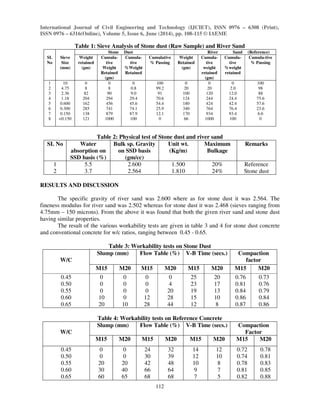
river sand. First gradation of the stone dust and river and were determined by conducting size 
analyzing as per IS. 383. The result of sieve analysis and various physical property are given in table 
1 and 2 for stone dust and river sand. The design mix M15 and M20 were adopted according to IS. 
456. The Workability tests, compressive strength, split tensile strength, flexural strength, modulus of 
elasticity and abrasion resistance test of concrete made of stone dust and river sand were determined 
by appropriate testing.
International Journal of Civil Engineering and Technology (IJCIET), ISSN 0976 – 6308 (Print), 
ISSN 0976 – 6316(Online), Volume 5, Issue 6, June (2014), pp. 108-115 © IAEME 
112 
 
Table 1: Sieve Analysis of Stone dust (Raw Sample) and River Sand 
Stone Dust River Sand (Reference) 
SI. 
No 
Sieve 
Size 
(mm) 
Weight 
retained 
(gm) 
Cumula-tive 
Weight 
Retained 
(gm) 
Cumula-tive 
%Weight 
Retained 
Cumulative 
% Passing 
Weight 
Retained 
(gm) 
Cumula-tive 
weight 
retained 
(gm) 
Cumula-tive 
%weight 
retained 
Cumula-tive 
% Passing 
1 10 0 0 0 100 0 0 0 100 
2 4.75 8 8 0.8 99.2 20 20 2.0 98 
3 2.36 82 90 9.0 91 100 120 12.0 88 
4 1.18 204 294 29.4 70.6 124 244 24.4 75.6 
5 0.600 162 456 45.6 54.4 180 424 42.4 57.6 
6 0.300 285 741 74.1 25.9 340 764 76.4 23.6 
7 0.150 138 879 87.9 12.1 170 934 93.4 6.6 
8 0.150 121 1000 100 0 66 1000 100 0 
Table 2: Physical test of Stone dust and river sand 
SI. No Water 
absorption on 
SSD basis (%) 
Bulk sp. Gravity 
on SSD basis 
(gm/cc) 
Unit wt. 
(Kg/m) 
Maximum 
Bulkage 
Remarks 
1 5.5 2.600 1.500 20% Reference 
2 3.7 2.564 1.810 24% Stone dust 
RESULTS AND DISCUSSION 
The specific gravity of river sand was 2.600 where as for stone dust it was 2.564. The 
fineness modulus for river sand was 2.502 whereas for stone dust it was 2.468 (sieves ranging from 
4.75mm – 150 microns). From the above it was found that both the given river sand and stone dust 
having similar properties. 
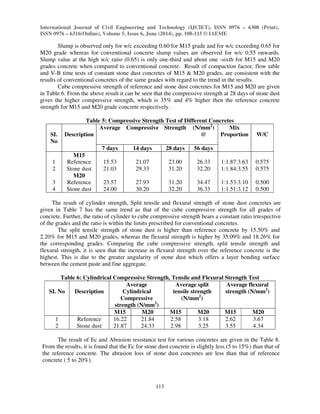
The result of the various workability tests are given in table 3 and 4 for stone dust concrete 
and conventional concrete for w/c ratios, ranging between 0.45 - 0.65. 
Table 3: Workability tests on Stone Dust 
W/C 
Slump (mm) Flow Table (%) V-B Time (secs.) Compaction 
factor 
M15 M20 M15 M20 M15 M20 M15 M20 
0.45 0 0 0 0 25 20 0.76 0.73 
0.50 0 0 0 4 23 17 0.81 0.76 
0.55 0 0 0 20 19 13 0.84 0.79 
0.60 10 0 12 28 15 10 0.86 0.84 
0.65 20 10 28 44 12 8 0.87 0.86 
Table 4: Workability tests on Reference Concrete 
W/C 
Slump (mm) Flow Table (%) V-B Time (secs.) Compaction 
Factor 
M15 M20 M15 M20 M15 M20 M15 M20 
0.45 0 0 24 32 14 12 0.72 0.78 
0.50 0 0 30 39 12 10 0.74 0.81 
0.55 20 20 42 48 10 8 0.78 0.83 
0.60 30 40 66 64 9 7 0.81 0.85 
0.65 60 65 68 68 7 5 0.82 0.88
International Journal of Civil Engineering and Technology (IJCIET), ISSN 0976 – 6308 (Print), 
ISSN 0976 – 6316(Online), Volume 5, Issue 6, June (2014), pp. 108-115 © IAEME 
113 
 
Slump is observed only for w/c exceeding 0.60 for M15 grade and for w/c exceeding 0.65 for 
M20 grade whereas for conventional concrete slump values are observed for w/c 0.55 onwards. 
Slump value at the high w/c ratio (0.65) is only one-third and about one -sixth for M15 and M20 
grades concrete when compared to conventional concrete. Result of compaction factor, flow table 
and V-B time tests of constant stone dust concretes of M15  M20 grades, are consistent with the 
results of conventional concretes of the same grades with regard to the trend in the results. 
Cube compressive strength of reference and stone dust concretes for M15 and M20 are given 
in Table 6. From the above result it can be seen that the compressive strength at 28 days of stone dust 
gives the higher compressive strength, which is 35% and 4% higher then the reference concrete 
strength for M15 and M20 grade concrete respectively. 
Table 5: Compressive Strength Test of Different Concretes 
SI. 
No 
Description 
Average Compressive Strength (N/mm2) 
@ 
Mix 
Proportion 
W/C 
7 days 14 days 28 days 56 days 
M15 
1 Reference 15.53 21.07 23.00 26.33 1:1.87:3.63 0.575 
2 Stone dust 21.03 29.33 31.20 32.20 1:1.84:3.55 0.575 
M20 
3 Reference 23.57 27.93 31.20 34.47 1:1.53:3.10 0.500 
4 Stone dust 24.00 30.20 32.20 36.33 1:1.51:3.12 0.500 
The result of cylinder strength, Split tensile and flexural strength of stone dust concretes are 
given in Table 7 has the same trend as that of the cube compressive strength for all grades of 
concrete. Further, the ratio of cylinder to cube compressive strength bears a constant ratio irrespective 
of the grades and the ratio is within the limits prescribed for conventional concretes. 
The split tensile strength of stone dust is higher than reference concrete by 15.50% and 
2.20% for M15 and M20 grades, whereas the flexural strength is higher by 35.09% and 18.26% for 
the corresponding grades. Comparing the cube compressive strength, split tensile strength and 
flexural strength, it is seen that the increase in flexural strength over the reference concrete is the 
highest. This is due to the greater angularity of stone dust which offers a layer bonding surface 
between the cement paste and fine aggregate. 
Table 6: Cylindrical Compressive Strength, Tensile and Flexural Strength Test 
SI. No 
Description 
Average 
Cylindrical 
Compressive 
strength (N/mm2) 
Average split 
tensile strength 
(N/mm2) 
Average flexural 
strength (N/mm2) 
M15 M20 M15 M20 M15 M20 
1 Reference 16.22 21.84 2.58 3.18 2.62 3.67 
2 Stone dust 21.87 24.33 2.98 3.25 3.55 4.34 
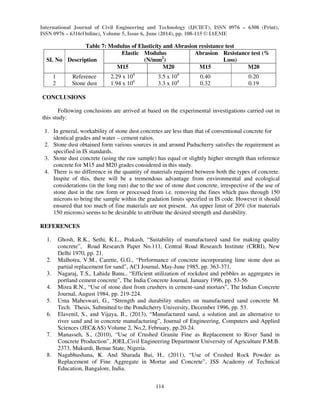
The result of Ec and Abrasion resistance test for various concretes are given in the Table 8. 
From the results, it is found that the Ec for stone dust concrete is slightly less (5 to 15%) than that of 
the reference concrete. The abrasion loss of stone dust concretes are less than that of reference 
concrete ( 5 to 20%).
International Journal of Civil Engineering and Technology (IJCIET), ISSN 0976 – 6308 (Print), 
ISSN 0976 – 6316(Online), Volume 5, Issue 6, June (2014), pp. 108-115 © IAEME 
114 
 
Table 7: Modulus of Elasticity and Abrasion resistance test 
SI. No 
Description 
Elastic Modulus 
(N/mm2) 
Abrasion Resistance test (% 
Loss) 
M15 M20 M15 M20 
1 Reference 2.29 x 10⁴ 3.5 x 10⁴ 0.40 0.20 
2 Stone dust 1.94 x 10⁴ 3.3 x 10⁴ 0.32 0.19 
CONCLUSIONS 
Following conclusions are arrived at based on the experimental investigations carried out in 
this study: 
1. In general, workability of stone dust concretes are less than that of conventional concrete for 
identical grades and water – cement ratios. 
2. Stone dust obtained form various sources in and around Puducherry satisfies the requirement as 
specified in IS standards. 
3. Stone dust concrete (using the raw sample) has equal or slightly higher strength than reference 
concrete for M15 and M20 grades considered in this study. 
4. There is no difference in the quantity of materials required between both the types of concrete. 
Inspite of this, there will be a tremendous advantage from environmental and ecological 
considerations (in the long run) due to the use of stone dust concrete, irrespective of the use of 
stone dust in the raw form or processed from i.e. removing the fines which pass through 150 
microns to bring the sample within the gradation limits specified in IS code. However it should 
ensured that too much of fine materials are not present. An upper limit of 20% (for materials 
150 microns) seems to be desirable to attribute the desired strength and durability. 
REFERENCES 
1. Ghosh, R.K., Sethi, K.L., Prakash, “Suitability of manufactured sand for making quality 
concrete”, Road Research Paper No.111, Central Road Research Institute (CRRI), New 
Delhi 1970, pp. 21. 
2. Malhotra, V.M., Carette, G.G., “Performance of concrete incorporating lime stone dust as 
partial replacement for sand”, ACI Journal, May-June 1985, pp. 363-371. 
3. Nagaraj, T.S., Lahida Banu., “Efficient utilization of rockdust and pebbles as aggregates in 
portland cement concrete”, The India Concrete Journal, January 1996, pp. 53-56 
4. Misra R.N., “Use of stone dust from crushers in cement-sand mortars”, The Indian Concrete 
Journal, August 1984, pp. 219-224. 
5. Uma Maheswari, G., “Strength and durability studies on manufactured sand concrete M. 
Tech. Thesis, Submitted to the Pondicherry University, December 1996, pp. 53. 
6. Elavenil, S., and Vijaya, B., (2013), “Manufactured sand, a solution and an alternative to 
river sand and in concrete manufacturing”, Journal of Engineering, Computers and Applied 
Sciences (JECAS) Volume 2, No.2, February, pp.20-24. 
7. Manasseh, S., (2010), “Use of Crushed Granite Fine as Replacement to River Sand in 
Concrete Production”, JOEL,Civil Engineering Department University of Agriculture P.M.B. 
2373, Makurdi, Benue State, Nigeria. 
8. Nagabhushana, K. And Sharada Bai, H., (2011), “Use of Crushed Rock Powder as 
Replacement of Fine Aggregate in Mortar and Concrete”, JSS Academy of Technical 
Education, Bangalore, India.
International Journal of Civil Engineering and Technology (IJCIET), ISSN 0976 – 6308 (Print), 
ISSN 0976 – 6316(Online), Volume 5, Issue 6, June (2014), pp. 108-115 © IAEME 
115 
 
9. Aggarwal, P., Aggarwal, Y., and Gupta, S.M., (2007), “Effect of bottom ash as replacement 
of fine aggregates in concrete”, National Institute of Technology, Kurukshetra, India. 
10. Siddique, R., (2002) “Effect of fine aggregate replacement with Class-F fly ash on the 
mechanical properties of concrete”, Institute of Engineering and Technology, Deemed 
University, Patiala, India. 
11. Kondraivendhan, B., Sairam, V., and Nandagopal, K., (2011). “Influence of pond ash as fine 
aggregate on strength and durability of concrete”, The Indian Concrete Journal, 85(10), pp. 
27-36. 
12. Nataraja, M.C., Dileep Kumar, P.G., Manu, A.S., and Sanjay, M.C., (2013) “Use of 
granulated blast furnace slag as fine aggregate in cement mortar”, International Journal of 
Structural  Civil Engg. Research, Vol.2 No. 2, May, pp. 1-12. 
13. Thandavamoorthy. T.S., (2014), “Feasibility of making concrete from soil mstead of River 
sand”, Indian concrete Institue Journal Value 15 April –June 2014.pp. 7-12. 
14. I.S. :269-1976 “Specification for ordinary and low heat portland cement”, BIS, New Delhi. 
15. I.S. :383 -1970 “Specification for coarse and fine aggregate from natural sources for 
concrete”, BIS New Delhi. 
16. I.S. :516-1959, “Methods of test for strength of concrete”, BIS, New Delhi. 
17. I.S. : 2386 (Part –I) 1963, “Methods of test for aggregates for concrete, part I: Particle size 
and shape”, BIS, New Delhi. 
18. I.S. : 2386 (Part –III) 1963, “Methods of test for aggregates for concrete, Part III: Specific 
gravity, density, voids, absorption and bulking”, BIS New Delhi. 
19. I.S. : 2386 (Part –V) 1963, “Methods of test for aggregates for concrete, Part V: Soundness”, 
BIS, New Delhi. 
20. S.P. :23 -1982, “Hand book on Concrete mixes”, BIS, New Delhi. 
21. Er.S.Thirougnaname and Dr.T.Sundararajan, “Studies on Rice Husk Ash Cement Mortar”, 
International Journal of Advanced Research in Engineering  Technology (IJARET), 
Volume 4, Issue 7, 2013, pp. 25 - 37, ISSN Print: 0976-6480, ISSN Online: 0976-6499. 
22. Riyaz Khan and Prof.S.B.Shinde, “Effect of Unprocessed Steel Slag on the Strength of 
Concrete When used as Fine Aggregate”, International Journal of Civil Engineering  
Technology (IJCIET), Volume 4, Issue 2, 2013, pp. 231 - 239, ISSN Print: 0976 – 6308, 
ISSN Online: 0976 – 6316. 
23. Er.S.Thirougnaname and Dr.T.Sundararajan, “Studies on Rice Husk Ash Cement Concrete”, 
International Journal of Civil Engineering  Technology (IJCIET), Volume 4, Issue 6, 2013, 
pp. 17 - 30, ISSN Print: 0976 – 6308, ISSN Online: 0976 – 6316. 
AUTHOR’S DETAIL 
Er. S. Thirougnaname, M.Tech., MIE., MISTE., FIAH., MIWWA., AMISE., MIT Arb., MICI., 
Project Engineer, Pondicherry Tourism Development Corporation, 
Puducherry, India.

20320140506013 2

  • 1.
    INTERNATIONAL JOURNAL OFCIVIL ENGINEERING International Journal of Civil Engineering and Technology (IJCIET), ISSN 0976 – 6308 (Print), ISSN 0976 – 6316(Online), Volume 5, Issue 6, June (2014), pp. 108-115 © IAEME AND TECHNOLOGY (IJCIET) ISSN 0976 – 6308 (Print) ISSN 0976 – 6316(Online) Volume 5, Issue 6, June (2014), pp. 108-115 © IAEME: www.iaeme.com/ijciet.asp Journal Impact Factor (2014): 7.9290 (Calculated by GISI) www.jifactor.com 108 IJCIET ©IAEME STUDIES ON UNPROCESSED STONE DUST AS FINE AGGREGATE IN MAKING CONCRETE Er. S. Thirougnaname1, S. Segaran2 1M.Tech., MIE., MISTE., FIAH., MIWWA., AMISE., MIT Arb., MICI., Project Engineer, Pondicherry Tourism Development Corporation, Puducherry, India. 2 M.Tech., Civil Engineer, Puducherry, India ABSTRACT Experimental investigation was carried out to establish the feasibility of unprocessed stone dust as fine aggregate in place of river sand which has become a scarcity now-a-days, by casting cube and determining the compressive strength for the two grades of concrete M15 and M20. The result obtained are compared with conventional concrete. It is concluded that compressive strength at 28 days of unprocessed stone dust used as fine aggregate in concrete gives 35% higher strength for M15 and 4% for M20 grade concrete when compared to the reference concrete. The split tensile strength of unprocessed stone dust concrete is 2.98 N/mm2 and 3.25 N/mm2 for M15 and M20 grade respectively where as the reference concrete is 2.58 N/mm2 and 3.18 N/mm2 only. This investigation has demonstrated that the unprocessed stone dust is equally good as fine aggregate like river sand and hence can be used in making concrete. Keywords: Concrete, Stone Dust, Workability, Properties of Stone Dust Concrete. INTRODUCTION Ever since, the introduction of Ordinary Portland Cement [OPC] there is a continuous demand for concrete, whose price has also gone up considerably due to raise in the cost of its constituent raw materials over the years. Rapid industrialization due to the implementation of successive Five Year Plans have contributed to the accumulation of industrial wastes and by-products which pose disposal and environmental problems and causing health hazards. On the other hand, the social commitment of providing “Shelter for All” is becoming a distant even for those with an assured decent income, leaving along other segments of people in lower economic level.
  • 2.
    International Journal ofCivil Engineering and Technology (IJCIET), ISSN 0976 – 6308 (Print), ISSN 0976 – 6316(Online), Volume 5, Issue 6, June (2014), pp. 108-115 © IAEME 109 To overcome the above problems, studies have been initiated in the use of non-conventional materials for partial replacement of cement by fly ash in concrete; Conversion of agricultural wastes like saw-dust, cork granules, rice-husk, coconut pith into some useful building materials, etc. Industrial by-products which were once disposed-off as a waste material are finding ever increasing use in the construction industry. These industrial wastes have been mainly used for quite sometime as fillers in roads and embankments. But at present, they are used in the manufacture of cementitious materials and light weight aggregates etc. Besides the above advantages, savings in energy utilization of industrial wastes in the manufacture of cement and aggregates are of a very special significance in the Indian context of power deficit and starvation. Apart from the binder materials, alternate materials for the other constituents of concrete like, pebbles (well rounded aggregate) as coarse aggregate [CA] and crushed stone dust as fine aggregate [FA] are possible. However, studies on the latter are very limited and rare. At present CA is mostly obtained from hard broken granite stones and the by-product is “Crusher Dust” or Stone Dust. It is also referred to as “Manufactured Sand”. According to ASTM : C 144-87, it is the product obtained by crushing stone, gravel or air-colled iron blast furnace slag, specially processed to assure suitable particle shape as well as gradation. Although the specifications for sand (fine aggregate) to be used in mortar and concrete do permit the use of crushed stone dust, there appears to be a general hesitation amongst the field engineers, regarding its use, even in those areas where crushed stone dust is available almost free of cost in abundance. The general tendency is to use river sand only, even if it has to be brought from long distances. However, the potential use of manufactured sand as FA in concrete has not been fully exploited, in practice. Studies on the strength characteristics of concrete using stone dust as fine aggregate after removing the fines to confirm to IS gradation (passing 150 microns) have revealed the above characteristics are comparable with the conventional concrete. However the effect of the materials (less than 150 microns) on the strength of concrete and mortar need to be ascertained. If there is a possibility of using unprocessed stone dust in the above, there will be further saving in the effort involved in processing and there will be a complete solution to the disposal problems. LITERATURE REVIEW Sand mining is banned by various states in India, and with the increasing demand for river sand for construction works, the Civil Engineers, have expressed the need to promote use of manufactured sand in the construction industry. As per report, manufactured sand is widely used all around the world because of its consistent gradation and zero impurity6. One of the earliest investigations on the suitability of manufacture sand for making quality concrete was carried out by Ghosh and other1 at Central Road Research Institute [CRRI], New Delhi. They carried out the various tests on the physical properties of manufactured sand obtained from a few sources in U.P. to determine their suitability as a FA. Mortar making property, compression strength, flexural, abrasion loss, drying shrinkage and bond strength of concrete were determined for all the samples and concluded that manufactured sand can be confidently used as FA to produce quality concrete. However, split tensile strength tests and durability studies were not conducted to determine the relative performance of manufactured sand concrete. Malhotra and Canette2 studies the performance of concrete, incorporating limestone dust (obtained from limestone quarries after crushing operations) as a partial replacement for natural sand in concrete. Three series of concrete mixes with w/c ratio 0.70, 0.53 and 0.40 respectively, incorporating lime stone dust from 5-20% were prepared by direct replacement on an equivalent mass of recombined sand basis. The properties of fresh concrete i.e. slump, unit weight and air
  • 3.
    International Journal ofCivil Engineering and Technology (IJCIET), ISSN 0976 – 6308 (Print), ISSN 0976 – 6316(Online), Volume 5, Issue 6, June (2014), pp. 108-115 © IAEME content (%) were determined. Compressive strength, freezing and thawing, drying and shrinkage, creep were determined for hardened concrete. They have concluded that incorporation of upto 10% limestone dust as a partial replacement for FA in concrete with w/c = 0.70 and 5% limestone dust in concrete with w/c = 0.53 does not significantly affect the properties of fresh and hardened concrete. However, there is considerable loss in slump, irrespective of w/c ratios, if lime stone dust is in excess of 10%. 110 Nagaraj and Lahida Banu3 used manufactured sand and pebbles as FA and CA in concrete and used the method of re-proportioning concrete to obtain M65 concrete and has concluded that the above combination of CA and FA can be used with confidence in concrete. Misra4 studied the water requirements and compressive strength of cement mortar using manufactured sand as FA, with FM ranging from 0.50 to 2.0 and 75% and 100% flow of mortar. Based on the above extensive experimental investigations, he had concluded that the strength of mortar with manufactured sand is higher than that of the corresponding mix with cement (sand) mortar. He has recommended the use of manufactured sand for mortar and has cautioned the removal of excessive proportions of very fine particles. Studies were carried out at Pondicherry Engineering Collage, Puduchery5 for using manufactured sand as FA in concrete and its compressive, flexural and split tensile strengths; sand abrasion; elastic modulus; mortar making properties and durability test under various acidic and alkaline mediums were determined and the performance compared with conventional concrete for M15 and M20 concretes. The size of manufacture sand used in the above study was restricted to 4.75 mm to 150 microns i.e. the size range presented in IS specification. From the studies, it is concluded that the manufactured sand can be used in the concrete effectively by replacing normal river sand. Sieve analysis of the raw samples revealed that the fine materials content (i.e. less than 150 microns) was at the maximum 10% and it was generally between 5 - 10%. Being the case it would be of interest to study the properties of concrete and mortar using the raw sample as such in the above. The suitability of Crushed Granite Fine (CGF) to replace river sand in concrete production for use in rigid pavement was investigated by Manasseh7. Slump, compressive strength and indirect tensile strength tests were performed on fresh and hardened concrete. The 28 day peak compressive and indirect tensile strength values of 40.70 N/mm2 and 2.30 N/mm2 respectively, were obtained with the partial replacement of river sand with 20 per cent CGF, as against values of 35.00 N/mm2 and 1.75 N/mm2 obtained with the use of river sand as fine aggregate. Based on economic analysis and results of tests, river sand replaced with 20 per cent CGF is recommended for use in the production of concrete for use in rigid pavement. Conservation of river sand in addition to better ways of disposing wastes from the quarry sites are some of the merits of using CGF. The investigation carried out by Nagabhushana and Sharada Bai8 studied the properties of mortar and concrete in which Crushed Rock Powder (CRP) was used as a partial and full replacement for natural sand. For mortar, CRP is replaced at percentages of 20, 40, 60, 80 and 100. The strength properties of concrete were investigated by replacing natural sand by CRP at replacement level of 20, 30, and 40 per cents. Aggrarwal et al.9 have carried out experimental investigations to study the effect of use of bottom ash as a replacement of fine aggregate. Different strength properties were studied and it consisted of compressive strength, flexural strength and splitting tensile strength. The strength development for various percentages of 0-50 replacement of fine aggregates with bottom ash can easily be equated to the strength development of normal concrete at various ages. Siddique10 presented the results of an experimental investigation carried out to evaluate the mechanical properties of concrete mixtures in which fine aggregate i.e., sand was partially replaced with Class F fly ash. Sand was replaced in five percentages. i.e., 10, 20, 30, 40 and 50 of class F fly ash by weight. Tests were performed for the evaluation of properties of fresh concrete. Compressive strength, splitting tensile strength, flexural strength and modulus of elasticity were determined at 7,
  • 4.
    International Journal ofCivil Engineering and Technology (IJCIET), ISSN 0976 – 6308 (Print), ISSN 0976 – 6316(Online), Volume 5, Issue 6, June (2014), pp. 108-115 © IAEME 14, 28, 56, 91 and 365 days. Test results indicated significant improvement in the strength properties of plain concrete by the inclusion of fly ash as partial replacement of fine aggregate (sand), and could be effectively used in Structural Concrete. 111 Kondraivendhan et al.11 explored the possibility of making concrete using pond ash as partial replacement of river sand in producing M20 and M40 grade concrete. The pond ash replacement levels were 10, 20, 30, 40 and 50 per cent. The compressive strength of different grades of concrete was evaluated at 7, 28, 56 and 90 days by testing cubical specimens. The results were compared with the control concrete. Nataraja et al.12 investigated the possibility of utilizing Granulated Blast Furnace Slag (GBFS) as a sand substitute in cement mortar, in order to reduce environment problems related to aggregate mining and waste disposal. In this investigation, cement mortar mix 1:3 and GBFS at 0, 25, 50, 75 and 100 per cent replacement to natural sand for constant w/c ratio of 0.5 was considered. The work was extended to 100 per cent replacements of natural sand with GBFS for w/c ratios of 0.4 and 0.6. The flow characteristics of the various mixes and their compressive strengths at various ages were studied. From this study, it was observed that GBFS could be utilized partially as alternative construction material for natural sand in mortar applications. Reduction in workability expressed as flow could be compensated by adding suitable percentage of super plasticizer. Thandavamoorthy13 studies the feasibility of local soil instead of river sand in making concrete as fine aggregate in producing M25 grade concrete. A nominal mix of 1:1:2 and M25 grade was adopted. The soil cube yielded a compressive strength of 28 N/mm2 while sand cube yielded 35.75 N/mm2. The split tensile strength of soil concrete was 2.387 N/mm2. For conventional concrete, the same value was 3.607 N/mm2. The modulus of rupture values were 8.1 N/mm2 for soil concrete and 6.96 N/mm2 for sand concrete. It was concluded that the properties of local soil was as good as the regular river sand and it can be used as fine aggregate in the production of concrete. EXPERIMENTAL INVESTIGATIONS The crusher plants located in and around Puducherry are the sources for crushed stone dust (manufactured sand). The stone dust of granite origin collected from Thiruvakkarai crusher plant, Vanur, Tamil Nadu was taken for this investigation. At present the dust is used as a filler material in making bituminous top for roads and the rate of production of dust is about 20-25% of total quantity. Only small amounts of these wastes have been used in road making and in the manufactured of building materials such as, light weight aggregate bricks and autoclaved blocks. Laboratory investigations are carried out on the stone dust obtained form the crusher plant and the results are compared with the existing IS Standards to decide on their suitability as FA in concrete. It was proposed to use of unprocessed stone dust in making of concrete as a substitute for river sand. First gradation of the stone dust and river and were determined by conducting size analyzing as per IS. 383. The result of sieve analysis and various physical property are given in table 1 and 2 for stone dust and river sand. The design mix M15 and M20 were adopted according to IS. 456. The Workability tests, compressive strength, split tensile strength, flexural strength, modulus of elasticity and abrasion resistance test of concrete made of stone dust and river sand were determined by appropriate testing.
  • 5.
    International Journal ofCivil Engineering and Technology (IJCIET), ISSN 0976 – 6308 (Print), ISSN 0976 – 6316(Online), Volume 5, Issue 6, June (2014), pp. 108-115 © IAEME 112 Table 1: Sieve Analysis of Stone dust (Raw Sample) and River Sand Stone Dust River Sand (Reference) SI. No Sieve Size (mm) Weight retained (gm) Cumula-tive Weight Retained (gm) Cumula-tive %Weight Retained Cumulative % Passing Weight Retained (gm) Cumula-tive weight retained (gm) Cumula-tive %weight retained Cumula-tive % Passing 1 10 0 0 0 100 0 0 0 100 2 4.75 8 8 0.8 99.2 20 20 2.0 98 3 2.36 82 90 9.0 91 100 120 12.0 88 4 1.18 204 294 29.4 70.6 124 244 24.4 75.6 5 0.600 162 456 45.6 54.4 180 424 42.4 57.6 6 0.300 285 741 74.1 25.9 340 764 76.4 23.6 7 0.150 138 879 87.9 12.1 170 934 93.4 6.6 8 0.150 121 1000 100 0 66 1000 100 0 Table 2: Physical test of Stone dust and river sand SI. No Water absorption on SSD basis (%) Bulk sp. Gravity on SSD basis (gm/cc) Unit wt. (Kg/m) Maximum Bulkage Remarks 1 5.5 2.600 1.500 20% Reference 2 3.7 2.564 1.810 24% Stone dust RESULTS AND DISCUSSION The specific gravity of river sand was 2.600 where as for stone dust it was 2.564. The fineness modulus for river sand was 2.502 whereas for stone dust it was 2.468 (sieves ranging from 4.75mm – 150 microns). From the above it was found that both the given river sand and stone dust having similar properties. The result of the various workability tests are given in table 3 and 4 for stone dust concrete and conventional concrete for w/c ratios, ranging between 0.45 - 0.65. Table 3: Workability tests on Stone Dust W/C Slump (mm) Flow Table (%) V-B Time (secs.) Compaction factor M15 M20 M15 M20 M15 M20 M15 M20 0.45 0 0 0 0 25 20 0.76 0.73 0.50 0 0 0 4 23 17 0.81 0.76 0.55 0 0 0 20 19 13 0.84 0.79 0.60 10 0 12 28 15 10 0.86 0.84 0.65 20 10 28 44 12 8 0.87 0.86 Table 4: Workability tests on Reference Concrete W/C Slump (mm) Flow Table (%) V-B Time (secs.) Compaction Factor M15 M20 M15 M20 M15 M20 M15 M20 0.45 0 0 24 32 14 12 0.72 0.78 0.50 0 0 30 39 12 10 0.74 0.81 0.55 20 20 42 48 10 8 0.78 0.83 0.60 30 40 66 64 9 7 0.81 0.85 0.65 60 65 68 68 7 5 0.82 0.88
  • 6.
    International Journal ofCivil Engineering and Technology (IJCIET), ISSN 0976 – 6308 (Print), ISSN 0976 – 6316(Online), Volume 5, Issue 6, June (2014), pp. 108-115 © IAEME 113 Slump is observed only for w/c exceeding 0.60 for M15 grade and for w/c exceeding 0.65 for M20 grade whereas for conventional concrete slump values are observed for w/c 0.55 onwards. Slump value at the high w/c ratio (0.65) is only one-third and about one -sixth for M15 and M20 grades concrete when compared to conventional concrete. Result of compaction factor, flow table and V-B time tests of constant stone dust concretes of M15 M20 grades, are consistent with the results of conventional concretes of the same grades with regard to the trend in the results. Cube compressive strength of reference and stone dust concretes for M15 and M20 are given in Table 6. From the above result it can be seen that the compressive strength at 28 days of stone dust gives the higher compressive strength, which is 35% and 4% higher then the reference concrete strength for M15 and M20 grade concrete respectively. Table 5: Compressive Strength Test of Different Concretes SI. No Description Average Compressive Strength (N/mm2) @ Mix Proportion W/C 7 days 14 days 28 days 56 days M15 1 Reference 15.53 21.07 23.00 26.33 1:1.87:3.63 0.575 2 Stone dust 21.03 29.33 31.20 32.20 1:1.84:3.55 0.575 M20 3 Reference 23.57 27.93 31.20 34.47 1:1.53:3.10 0.500 4 Stone dust 24.00 30.20 32.20 36.33 1:1.51:3.12 0.500 The result of cylinder strength, Split tensile and flexural strength of stone dust concretes are given in Table 7 has the same trend as that of the cube compressive strength for all grades of concrete. Further, the ratio of cylinder to cube compressive strength bears a constant ratio irrespective of the grades and the ratio is within the limits prescribed for conventional concretes. The split tensile strength of stone dust is higher than reference concrete by 15.50% and 2.20% for M15 and M20 grades, whereas the flexural strength is higher by 35.09% and 18.26% for the corresponding grades. Comparing the cube compressive strength, split tensile strength and flexural strength, it is seen that the increase in flexural strength over the reference concrete is the highest. This is due to the greater angularity of stone dust which offers a layer bonding surface between the cement paste and fine aggregate. Table 6: Cylindrical Compressive Strength, Tensile and Flexural Strength Test SI. No Description Average Cylindrical Compressive strength (N/mm2) Average split tensile strength (N/mm2) Average flexural strength (N/mm2) M15 M20 M15 M20 M15 M20 1 Reference 16.22 21.84 2.58 3.18 2.62 3.67 2 Stone dust 21.87 24.33 2.98 3.25 3.55 4.34 The result of Ec and Abrasion resistance test for various concretes are given in the Table 8. From the results, it is found that the Ec for stone dust concrete is slightly less (5 to 15%) than that of the reference concrete. The abrasion loss of stone dust concretes are less than that of reference concrete ( 5 to 20%).
  • 7.
    International Journal ofCivil Engineering and Technology (IJCIET), ISSN 0976 – 6308 (Print), ISSN 0976 – 6316(Online), Volume 5, Issue 6, June (2014), pp. 108-115 © IAEME 114 Table 7: Modulus of Elasticity and Abrasion resistance test SI. No Description Elastic Modulus (N/mm2) Abrasion Resistance test (% Loss) M15 M20 M15 M20 1 Reference 2.29 x 10⁴ 3.5 x 10⁴ 0.40 0.20 2 Stone dust 1.94 x 10⁴ 3.3 x 10⁴ 0.32 0.19 CONCLUSIONS Following conclusions are arrived at based on the experimental investigations carried out in this study: 1. In general, workability of stone dust concretes are less than that of conventional concrete for identical grades and water – cement ratios. 2. Stone dust obtained form various sources in and around Puducherry satisfies the requirement as specified in IS standards. 3. Stone dust concrete (using the raw sample) has equal or slightly higher strength than reference concrete for M15 and M20 grades considered in this study. 4. There is no difference in the quantity of materials required between both the types of concrete. Inspite of this, there will be a tremendous advantage from environmental and ecological considerations (in the long run) due to the use of stone dust concrete, irrespective of the use of stone dust in the raw form or processed from i.e. removing the fines which pass through 150 microns to bring the sample within the gradation limits specified in IS code. However it should ensured that too much of fine materials are not present. An upper limit of 20% (for materials 150 microns) seems to be desirable to attribute the desired strength and durability. REFERENCES 1. Ghosh, R.K., Sethi, K.L., Prakash, “Suitability of manufactured sand for making quality concrete”, Road Research Paper No.111, Central Road Research Institute (CRRI), New Delhi 1970, pp. 21. 2. Malhotra, V.M., Carette, G.G., “Performance of concrete incorporating lime stone dust as partial replacement for sand”, ACI Journal, May-June 1985, pp. 363-371. 3. Nagaraj, T.S., Lahida Banu., “Efficient utilization of rockdust and pebbles as aggregates in portland cement concrete”, The India Concrete Journal, January 1996, pp. 53-56 4. Misra R.N., “Use of stone dust from crushers in cement-sand mortars”, The Indian Concrete Journal, August 1984, pp. 219-224. 5. Uma Maheswari, G., “Strength and durability studies on manufactured sand concrete M. Tech. Thesis, Submitted to the Pondicherry University, December 1996, pp. 53. 6. Elavenil, S., and Vijaya, B., (2013), “Manufactured sand, a solution and an alternative to river sand and in concrete manufacturing”, Journal of Engineering, Computers and Applied Sciences (JECAS) Volume 2, No.2, February, pp.20-24. 7. Manasseh, S., (2010), “Use of Crushed Granite Fine as Replacement to River Sand in Concrete Production”, JOEL,Civil Engineering Department University of Agriculture P.M.B. 2373, Makurdi, Benue State, Nigeria. 8. Nagabhushana, K. And Sharada Bai, H., (2011), “Use of Crushed Rock Powder as Replacement of Fine Aggregate in Mortar and Concrete”, JSS Academy of Technical Education, Bangalore, India.
  • 8.
    International Journal ofCivil Engineering and Technology (IJCIET), ISSN 0976 – 6308 (Print), ISSN 0976 – 6316(Online), Volume 5, Issue 6, June (2014), pp. 108-115 © IAEME 115 9. Aggarwal, P., Aggarwal, Y., and Gupta, S.M., (2007), “Effect of bottom ash as replacement of fine aggregates in concrete”, National Institute of Technology, Kurukshetra, India. 10. Siddique, R., (2002) “Effect of fine aggregate replacement with Class-F fly ash on the mechanical properties of concrete”, Institute of Engineering and Technology, Deemed University, Patiala, India. 11. Kondraivendhan, B., Sairam, V., and Nandagopal, K., (2011). “Influence of pond ash as fine aggregate on strength and durability of concrete”, The Indian Concrete Journal, 85(10), pp. 27-36. 12. Nataraja, M.C., Dileep Kumar, P.G., Manu, A.S., and Sanjay, M.C., (2013) “Use of granulated blast furnace slag as fine aggregate in cement mortar”, International Journal of Structural Civil Engg. Research, Vol.2 No. 2, May, pp. 1-12. 13. Thandavamoorthy. T.S., (2014), “Feasibility of making concrete from soil mstead of River sand”, Indian concrete Institue Journal Value 15 April –June 2014.pp. 7-12. 14. I.S. :269-1976 “Specification for ordinary and low heat portland cement”, BIS, New Delhi. 15. I.S. :383 -1970 “Specification for coarse and fine aggregate from natural sources for concrete”, BIS New Delhi. 16. I.S. :516-1959, “Methods of test for strength of concrete”, BIS, New Delhi. 17. I.S. : 2386 (Part –I) 1963, “Methods of test for aggregates for concrete, part I: Particle size and shape”, BIS, New Delhi. 18. I.S. : 2386 (Part –III) 1963, “Methods of test for aggregates for concrete, Part III: Specific gravity, density, voids, absorption and bulking”, BIS New Delhi. 19. I.S. : 2386 (Part –V) 1963, “Methods of test for aggregates for concrete, Part V: Soundness”, BIS, New Delhi. 20. S.P. :23 -1982, “Hand book on Concrete mixes”, BIS, New Delhi. 21. Er.S.Thirougnaname and Dr.T.Sundararajan, “Studies on Rice Husk Ash Cement Mortar”, International Journal of Advanced Research in Engineering Technology (IJARET), Volume 4, Issue 7, 2013, pp. 25 - 37, ISSN Print: 0976-6480, ISSN Online: 0976-6499. 22. Riyaz Khan and Prof.S.B.Shinde, “Effect of Unprocessed Steel Slag on the Strength of Concrete When used as Fine Aggregate”, International Journal of Civil Engineering Technology (IJCIET), Volume 4, Issue 2, 2013, pp. 231 - 239, ISSN Print: 0976 – 6308, ISSN Online: 0976 – 6316. 23. Er.S.Thirougnaname and Dr.T.Sundararajan, “Studies on Rice Husk Ash Cement Concrete”, International Journal of Civil Engineering Technology (IJCIET), Volume 4, Issue 6, 2013, pp. 17 - 30, ISSN Print: 0976 – 6308, ISSN Online: 0976 – 6316. AUTHOR’S DETAIL Er. S. Thirougnaname, M.Tech., MIE., MISTE., FIAH., MIWWA., AMISE., MIT Arb., MICI., Project Engineer, Pondicherry Tourism Development Corporation, Puducherry, India.