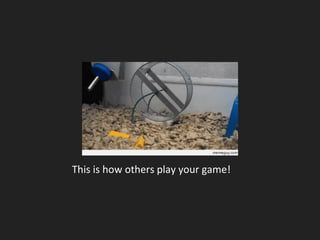
This is how others play your game!
S C I E N C E * P A S S I O N * T E C H N O L O G Y
HOW DATA IS SHAPING OUR GAMES
J O H A N N A P I R K E R , T U G R A Z , A U S T R I A
@ J O E Y P R I N K
J P I R K E R . C O M
2 8 J U N / / W E A R E D E V E L O P E R S
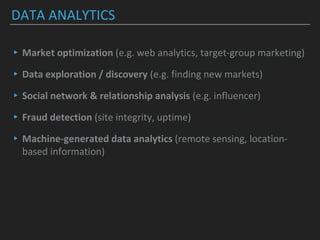
DATA ANALYTICS
▸Market optimization (e.g. web analytics, target-group marketing)
▸Data exploration / discovery (e.g. finding new markets)
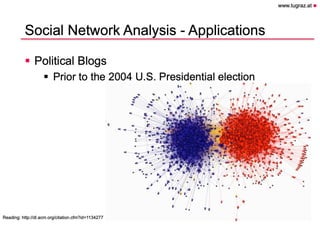
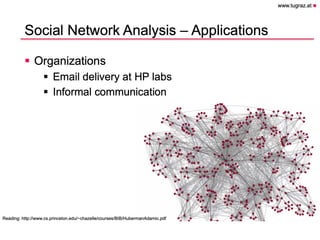
▸Social network & relationship analysis (e.g. influencer)
▸Fraud detection (site integrity, uptime)
▸Machine-generated data analytics (remote sensing, location-
based information)
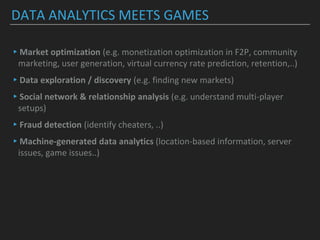
DATA ANALYTICS MEETS GAMES
▸Market optimization (e.g. monetization optimization in F2P, community
marketing, user generation, virtual currency rate prediction, retention,..)
▸Data exploration / discovery (e.g. finding new markets)
▸Social network & relationship analysis (e.g. understand multi-player
setups)
▸Fraud detection (identify cheaters, ..)
▸Machine-generated data analytics (location-based information, server
issues, game issues..)
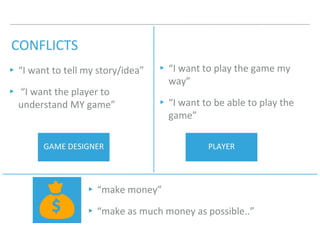
CONFLICTS
▸“I want to tell my story/idea”
▸ “I want the player to
understand MY game”
GAME DESIGNER
▸“I want to play the game my
way”
▸“I want to be able to play the
game”
PLAYER
▸“make money”
▸“make as much money as possible..”
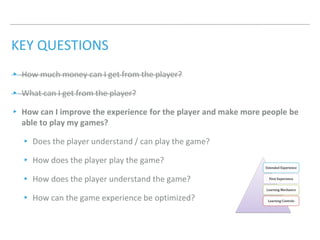
KEY QUESTIONS
▸ How much money can I get from the player?
▸ What can I get from the player?
▸ How can I improve the experience for the player and make more people be
able to play my games?
▸ Does the player understand / can play the game?
▸ How does the player play the game?
▸ How does the player understand the game?
▸ How can the game experience be optimized?
DATA ANALYTICS MEETS GAMES
▸Understanding player behavior to create better, more
inclusive and more innovative (social) game experiences
▸Understanding and identifying patterns in game data
▸-> who is the player?
▸-> statistics on player behavior (retention rate,
concurrency, ..)
▸-> social behavior of players
▸How do we interact with others? How are friendships
build? How does the game change us? Who are *we*?
DATA ANALYTICS MEETS GAMES
▸Understanding player behavior to create better, more
inclusive and more innovative (social) game experiences
▸Understanding and identifying patterns in game data
▸-> who is the player?
▸-> statistics on player behavior (retention rate,
concurrency, ..)
▸-> social behavior of players
▸How do we interact with others? How are friendships
build? How does the game change us? Who are *we*?
1) LEARN MORE ABOUT PLAYERS, LEARN MORE ABOUT THE GAMES
DATA ANALYTICS MEETS GAMES
▸Understanding player behavior to create better, more
inclusive and more innovative (social) game experiences
▸Understanding and identifying patterns in game data
▸-> who is the player?
▸-> statistics on player behavior (retention rate,
concurrency, ..)
▸-> social behavior of players
▸Who are *we*?
1) LEARN MORE ABOUT PLAYERS, LEARN MORE ABOUT THE GAMES
2) LEARN MORE ABOUT US
DATA ANALYTICS MEETS GAMES
▸Understanding player behavior to create better, more
inclusive and more innovative (social) game experiences
▸Understanding and identifying patterns in game data
▸-> who is the player?
▸-> statistics on player behavior (retention rate,
concurrency, ..)
▸-> social behavior of players
▸Who are *we*?
1) LEARN MORE ABOUT PLAYERS AND THE GAMES
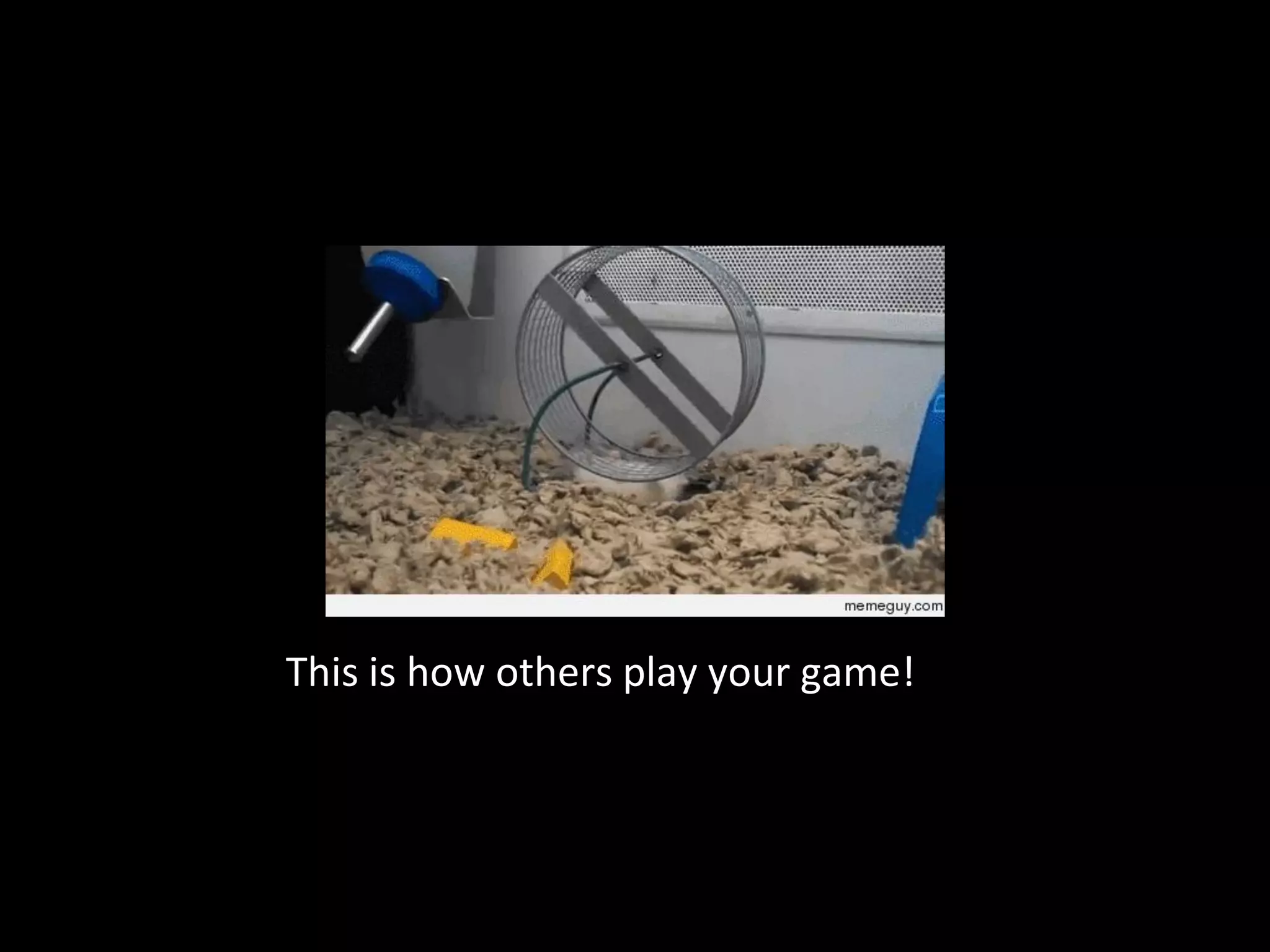
This is how others play your game!
WHAT WE WANT TO LEARN FROM THE PLAYERS..
Understanding player behavior to create better or more innovative
social game experiences
• Behavior - what players actually do
• Understanding - what the players think they have to do / have done
• Engagement - why do they keep playing?
• Experience - what the players feel
• Social Experiences – social behaviour of players, recommender systems
WHAT WE WANT TO LEARN FROM THE PLAYERS..
Understanding player behavior to create better or more innovative
social game experiences
• Behavior - what players actually do
• Understanding - what the players think they have to do / have done
• Engagement - why do they keep playing?
• Experience - what the players feel
• Social Experiences – social behaviour of players, recommender systems
I) BEHAVIOURAL PROFILING (E.G. CLUSTERING)
WHAT WE WANT TO LEARN FROM THE PLAYERS..
Understanding player behavior to create better or more innovative
social game experiences
• Behavior - what players actually do
• Understanding - what the players think they have to do / have done
• Engagement - why do they keep playing?
• Experience - what the players feel
• Social Experiences – social behaviour of players, recommender systems
I) BEHAVIOURAL PROFILING (E.G. CLUSTERING)
II) SOCIAL NETWORK ANALYSIS (E.G. GRAPH APPLICATION)
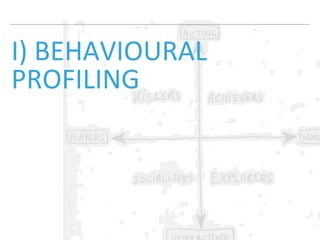
I) BEHAVIOURAL
PROFILING
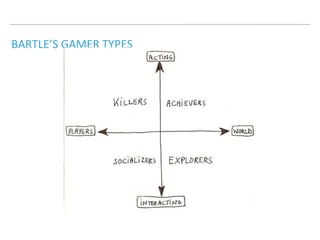
BARTLE’S GAMER TYPES
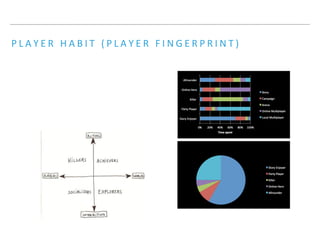
P L A Y E R H A B I T ( P L A Y E R F I N G E R P R I N T )
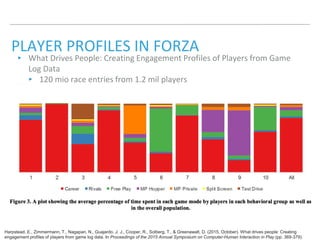
PLAYER PROFILES IN FORZA
‣ What Drives People: Creating Engagement Profiles of Players from Game
Log Data
‣ 120 mio race entries from 1.2 mil players
T., Nagapan, N., Guajardo, J. J., Cooper, R., Solberg, T., & Greenawalt, D. (2015, October). What Drives People: Creating Engagement Profiles of Players from Game Log Data. In Proceedings of the 2015 Annual Symposium on Computer-Human Interaction
Harpstead, E., Zimmermann, T., Nagapan, N., Guajardo, J. J., Cooper, R., Solberg, T., & Greenawalt, D. (2015, October). What drives people: Creating
engagement profiles of players from game log data. In Proceedings of the 2015 Annual Symposium on Computer-Human Interaction in Play (pp. 369-379).
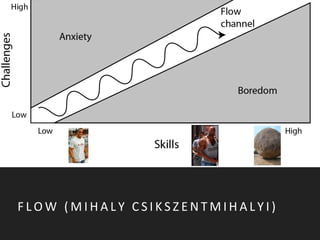
F L O W ( M I H A L Y C S I K S Z E N T M I H A L Y I )
GOALS
• Quelle: www.cynamite.de
JC2
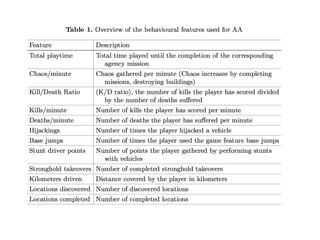
FEATURES
‣ Spatio-temporal navigation
‣ combat performance
‣ progression through the main storyline
‣ side quests..
‣ Agency missions (+ reach specific level of Chaos)
‣ subset of features based on the core mechanics
‣ -> does not impact the analytical framework
‣ -> impacts the kinds of conclusions that can be derived
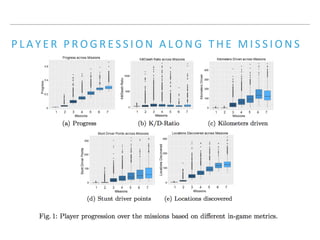
P L A Y E R P R O G R E S S I O N A L O N G T H E M I S S I O N S
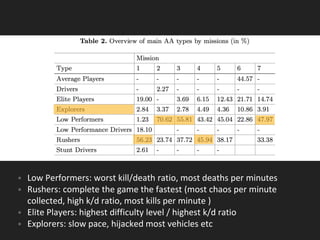
• Low Performers: worst kill/death ratio, most deaths per minutes
• Rushers: complete the game the fastest (most chaos per minute
collected, high k/d ratio, most kills per minute )
• Elite Players: highest difficulty level / highest k/d ratio
• Explorers: slow pace, hijacked most vehicles etc
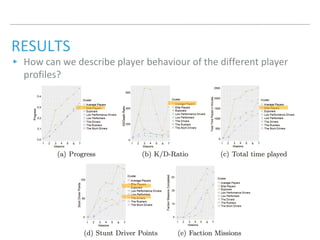
RESULTS
‣ How can we describe player behaviour of the different player
profiles?
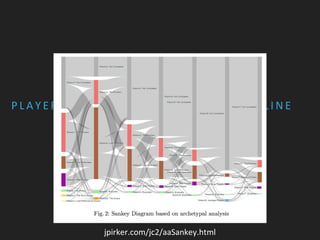
P L A Y E R B E H A V I O U R A L O N G T H E S T O R Y L I N E
jpirker.com/jc2/aaSankey.html
SOCIAL NETWORK
ANALYSIS IN GAMES
SIX DEGREES OF SEPARATION
▸In 1967, Stanley Milgram (social psychologist at Yale & Harvard)
conducted the small-world-experiment that is the basis of the “six
degrees of separation” concept.
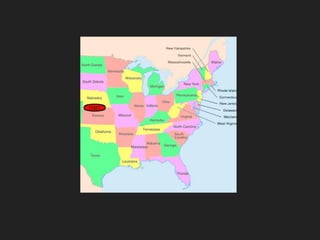
▸He sent several packages to randomly selected individuals in the
US, asking them to forward the package to a target contact
person in Boston. The average path length for the received
packages was around 5.5.
Further reading: en.wikipedia.org/wiki/Small-world_experiment
SIX DEGREES OF SEPARATION
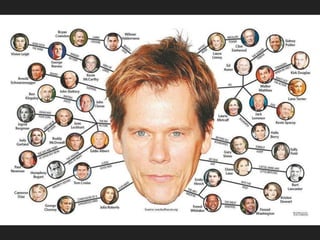
▸In 2008, a study of Microsoft showed that the average chain
of contacts between users of MSN was 6.6 people.
▸In 2016, Facebook observed an average connection distance
between Facebook users of 3.57.
Further reading: en.wikipedia.org/wiki/Small-world_experiment
ISSUES &
ETHICS
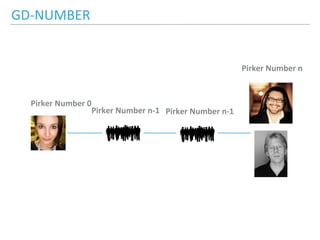
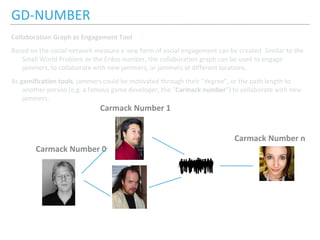
GD-NUMBER
Collaboration Graph as Engagement Tool
Based on the social network measure a new form of social engagement can be created. Similar to the
Small World Problem or the Erdos number, the collaboration graph can be used to engage
jammers, to collaborate with new jammers, or jammers at different locations.
As gamification tools, jammers could be motivated through their ”degree”, or the path length to
another person (e.g. a famous game developer, the ”Carmack number”) to collaborate with new
jammers.
Carmack Number 0
Carmack Number n
Carmack Number 1
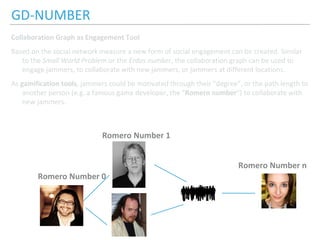
Collaboration Graph as Engagement Tool
Based on the social network measure a new form of social engagement can be created. Similar
to the Small World Problem or the Erdos number, the collaboration graph can be used to
engage jammers, to collaborate with new jammers, or jammers at different locations.
As gamification tools, jammers could be motivated through their ”degree”, or the path length to
another person (e.g. a famous game developer, the ”Romero number”) to collaborate with
new jammers.
Romero Number 0
Romero Number n
Romero Number 1
GD-NUMBER
Pirker Number 0
Pirker Number n
Pirker Number n-1
Pirker Number n-1
GD-NUMBER
ISSUES &
ETHICS
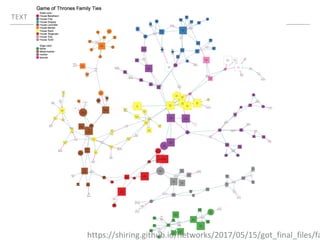
TEXT
https://shiring.github.io/networks/2017/05/15/got_final_files/fa
TYPICAL QUESTIONS
▸Analyzing individuals:
▸Who are well connected / important players in a network?
▸What is the influence of individuals?
▸Who is the player with the largest reach?
▸Who are players connecting different player groups?
TYPICAL QUESTIONS
▸Analyzing groups and communities:
▸How can we identify groups and communities?
▸How are players connected with each other?
▸Are players more engaged by playing along or together?
▸Are players in groups performing better than players playing on
their own?
▸Do connected players share common interests?
TYPICAL QUESTIONS
▸Analyzing social dynamics:
▸How do players connect to other players?
▸How do players build guilds?
▸When a player gets an interesting item to share with other
players, how far will it get transmitted?
▸How can we recommend players in PvP matches?
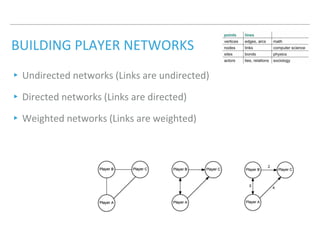
BUILDING PLAYER NETWORKS
▸Undirected networks (Links are undirected)
▸Directed networks (Links are directed)
▸Weighted networks (Links are weighted)
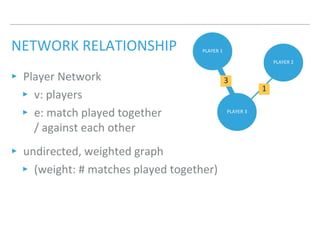
NETWORK RELATIONSHIP
‣ Player Network
‣ v: players
‣ e: match played together
/ against each other
‣ undirected, weighted graph
‣ (weight: # matches played together)
PLAYER 1
PLAYER 2
PLAYER 3
3
1
BUILDING PLAYER NETWORKS
▸Direct relationships: Direct (explicit) interactions between players
are identified and used (e.g. in-game messaging, friendships, clan
memberships).
▸Indirect relationships: Relationships also can be identified
through indirect (implicit) interactions (playing in same matches
or opponent matches, same playing time, same in-game location).
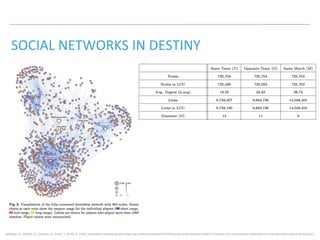
SOCIAL NETWORKS IN DESTINY
Rattinger, A., Wallner, G., Drachen, A., Pirker, J., & Sifa, R. (2016, September) Integrating and Inspecting Combined Behavioral Profiling and Social Network Models in Destiny,15th International Conference on Entertainment Computing (in press).
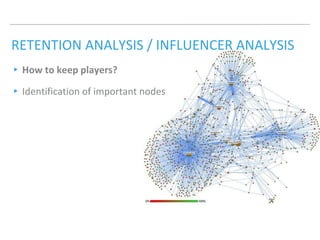
RETENTION ANALYSIS / INFLUENCER ANALYSIS
▸How to keep players?
▸Identification of important nodes
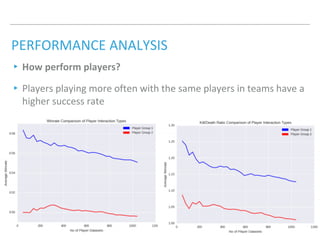
PERFORMANCE ANALYSIS
▸How perform players?
▸Players playing more often with the same players in teams have a
higher success rate
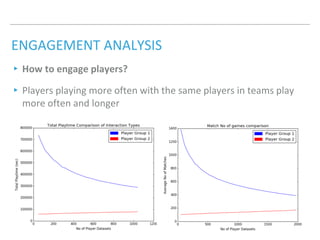
ENGAGEMENT ANALYSIS
▸How to engage players?
▸Players playing more often with the same players in teams play
more often and longer
DATA ANALYTICS MEETS GAMES
▸Understanding player behavior to create better, more
inclusive and more innovative (social) game experiences
▸Understanding and identifying patterns in game data
▸-> who is the player?
▸-> statistics on player behavior (retention rate,
concurrency, ..)
▸-> social behavior of players
▸Who are *we*?
2) LEARN MORE ABOUT US
TEXT
https://royalsocietypublishing.org/doi/pdf/10.1098/rsos.202049
DATA ANALYTICS MEETS GAMES
▸Understanding player behavior to create better, more
inclusive and more innovative (social) game experiences
▸Understanding and identifying patterns in game data
▸-> who is the player?
▸-> statistics on player behavior (retention rate,
concurrency, ..)
▸-> social behavior of players
▸Who are *we*?
3) DATA AS PART OF GAME DESIGN
DATA ANALYTICS MEETS GAMES
PROBLEMS &
CONCERNS
DATA ANALYTICS MEETS GAMES
TEXT
https://meyerweb.com/eric/thoughts/2014/12/24/inadvertent-algorithmic-cruelty/
“

2021 - We are Developers - How Data is Shaping our Games

  • 1.
    This is howothers play your game!
  • 2.
    S C IE N C E * P A S S I O N * T E C H N O L O G Y HOW DATA IS SHAPING OUR GAMES J O H A N N A P I R K E R , T U G R A Z , A U S T R I A @ J O E Y P R I N K J P I R K E R . C O M 2 8 J U N / / W E A R E D E V E L O P E R S
  • 6.
    DATA ANALYTICS ▸Market optimization(e.g. web analytics, target-group marketing) ▸Data exploration / discovery (e.g. finding new markets) ▸Social network & relationship analysis (e.g. influencer) ▸Fraud detection (site integrity, uptime) ▸Machine-generated data analytics (remote sensing, location- based information)
  • 7.
    DATA ANALYTICS MEETSGAMES ▸Market optimization (e.g. monetization optimization in F2P, community marketing, user generation, virtual currency rate prediction, retention,..) ▸Data exploration / discovery (e.g. finding new markets) ▸Social network & relationship analysis (e.g. understand multi-player setups) ▸Fraud detection (identify cheaters, ..) ▸Machine-generated data analytics (location-based information, server issues, game issues..)
  • 8.
    CONFLICTS ▸“I want totell my story/idea” ▸ “I want the player to understand MY game” GAME DESIGNER ▸“I want to play the game my way” ▸“I want to be able to play the game” PLAYER ▸“make money” ▸“make as much money as possible..”
  • 9.
    KEY QUESTIONS ▸ Howmuch money can I get from the player? ▸ What can I get from the player? ▸ How can I improve the experience for the player and make more people be able to play my games? ▸ Does the player understand / can play the game? ▸ How does the player play the game? ▸ How does the player understand the game? ▸ How can the game experience be optimized?
  • 10.
    DATA ANALYTICS MEETSGAMES ▸Understanding player behavior to create better, more inclusive and more innovative (social) game experiences ▸Understanding and identifying patterns in game data ▸-> who is the player? ▸-> statistics on player behavior (retention rate, concurrency, ..) ▸-> social behavior of players ▸How do we interact with others? How are friendships build? How does the game change us? Who are *we*?
  • 11.
    DATA ANALYTICS MEETSGAMES ▸Understanding player behavior to create better, more inclusive and more innovative (social) game experiences ▸Understanding and identifying patterns in game data ▸-> who is the player? ▸-> statistics on player behavior (retention rate, concurrency, ..) ▸-> social behavior of players ▸How do we interact with others? How are friendships build? How does the game change us? Who are *we*? 1) LEARN MORE ABOUT PLAYERS, LEARN MORE ABOUT THE GAMES
  • 12.
    DATA ANALYTICS MEETSGAMES ▸Understanding player behavior to create better, more inclusive and more innovative (social) game experiences ▸Understanding and identifying patterns in game data ▸-> who is the player? ▸-> statistics on player behavior (retention rate, concurrency, ..) ▸-> social behavior of players ▸Who are *we*? 1) LEARN MORE ABOUT PLAYERS, LEARN MORE ABOUT THE GAMES 2) LEARN MORE ABOUT US
  • 13.
    DATA ANALYTICS MEETSGAMES ▸Understanding player behavior to create better, more inclusive and more innovative (social) game experiences ▸Understanding and identifying patterns in game data ▸-> who is the player? ▸-> statistics on player behavior (retention rate, concurrency, ..) ▸-> social behavior of players ▸Who are *we*? 1) LEARN MORE ABOUT PLAYERS AND THE GAMES
  • 14.
    This is howothers play your game!
  • 15.
    WHAT WE WANTTO LEARN FROM THE PLAYERS.. Understanding player behavior to create better or more innovative social game experiences • Behavior - what players actually do • Understanding - what the players think they have to do / have done • Engagement - why do they keep playing? • Experience - what the players feel • Social Experiences – social behaviour of players, recommender systems
  • 16.
    WHAT WE WANTTO LEARN FROM THE PLAYERS.. Understanding player behavior to create better or more innovative social game experiences • Behavior - what players actually do • Understanding - what the players think they have to do / have done • Engagement - why do they keep playing? • Experience - what the players feel • Social Experiences – social behaviour of players, recommender systems I) BEHAVIOURAL PROFILING (E.G. CLUSTERING)
  • 17.
    WHAT WE WANTTO LEARN FROM THE PLAYERS.. Understanding player behavior to create better or more innovative social game experiences • Behavior - what players actually do • Understanding - what the players think they have to do / have done • Engagement - why do they keep playing? • Experience - what the players feel • Social Experiences – social behaviour of players, recommender systems I) BEHAVIOURAL PROFILING (E.G. CLUSTERING) II) SOCIAL NETWORK ANALYSIS (E.G. GRAPH APPLICATION)
  • 18.
  • 19.
  • 20.
    P L AY E R H A B I T ( P L A Y E R F I N G E R P R I N T )
  • 21.
    PLAYER PROFILES INFORZA ‣ What Drives People: Creating Engagement Profiles of Players from Game Log Data ‣ 120 mio race entries from 1.2 mil players T., Nagapan, N., Guajardo, J. J., Cooper, R., Solberg, T., & Greenawalt, D. (2015, October). What Drives People: Creating Engagement Profiles of Players from Game Log Data. In Proceedings of the 2015 Annual Symposium on Computer-Human Interaction Harpstead, E., Zimmermann, T., Nagapan, N., Guajardo, J. J., Cooper, R., Solberg, T., & Greenawalt, D. (2015, October). What drives people: Creating engagement profiles of players from game log data. In Proceedings of the 2015 Annual Symposium on Computer-Human Interaction in Play (pp. 369-379).
  • 22.
    F L OW ( M I H A L Y C S I K S Z E N T M I H A L Y I )
  • 23.
  • 24.
    FEATURES ‣ Spatio-temporal navigation ‣combat performance ‣ progression through the main storyline ‣ side quests.. ‣ Agency missions (+ reach specific level of Chaos) ‣ subset of features based on the core mechanics ‣ -> does not impact the analytical framework ‣ -> impacts the kinds of conclusions that can be derived

  • 25.
    P L AY E R P R O G R E S S I O N A L O N G T H E M I S S I O N S
  • 26.
    • Low Performers:worst kill/death ratio, most deaths per minutes • Rushers: complete the game the fastest (most chaos per minute collected, high k/d ratio, most kills per minute ) • Elite Players: highest difficulty level / highest k/d ratio • Explorers: slow pace, hijacked most vehicles etc
  • 27.
    RESULTS ‣ How canwe describe player behaviour of the different player profiles?
  • 28.
    P L AY E R B E H A V I O U R A L O N G T H E S T O R Y L I N E jpirker.com/jc2/aaSankey.html
  • 29.
  • 30.
    SIX DEGREES OFSEPARATION ▸In 1967, Stanley Milgram (social psychologist at Yale & Harvard) conducted the small-world-experiment that is the basis of the “six degrees of separation” concept. ▸He sent several packages to randomly selected individuals in the US, asking them to forward the package to a target contact person in Boston. The average path length for the received packages was around 5.5. Further reading: en.wikipedia.org/wiki/Small-world_experiment
  • 32.
    SIX DEGREES OFSEPARATION ▸In 2008, a study of Microsoft showed that the average chain of contacts between users of MSN was 6.6 people. ▸In 2016, Facebook observed an average connection distance between Facebook users of 3.57. Further reading: en.wikipedia.org/wiki/Small-world_experiment
  • 34.
  • 35.
    GD-NUMBER Collaboration Graph asEngagement Tool Based on the social network measure a new form of social engagement can be created. Similar to the Small World Problem or the Erdos number, the collaboration graph can be used to engage jammers, to collaborate with new jammers, or jammers at different locations. As gamification tools, jammers could be motivated through their ”degree”, or the path length to another person (e.g. a famous game developer, the ”Carmack number”) to collaborate with new jammers. Carmack Number 0 Carmack Number n Carmack Number 1
  • 36.
    Collaboration Graph asEngagement Tool Based on the social network measure a new form of social engagement can be created. Similar to the Small World Problem or the Erdos number, the collaboration graph can be used to engage jammers, to collaborate with new jammers, or jammers at different locations. As gamification tools, jammers could be motivated through their ”degree”, or the path length to another person (e.g. a famous game developer, the ”Romero number”) to collaborate with new jammers. Romero Number 0 Romero Number n Romero Number 1 GD-NUMBER
  • 37.
    Pirker Number 0 PirkerNumber n Pirker Number n-1 Pirker Number n-1 GD-NUMBER
  • 38.
  • 42.
  • 45.
    TYPICAL QUESTIONS ▸Analyzing individuals: ▸Whoare well connected / important players in a network? ▸What is the influence of individuals? ▸Who is the player with the largest reach? ▸Who are players connecting different player groups?
  • 46.
    TYPICAL QUESTIONS ▸Analyzing groupsand communities: ▸How can we identify groups and communities? ▸How are players connected with each other? ▸Are players more engaged by playing along or together? ▸Are players in groups performing better than players playing on their own? ▸Do connected players share common interests?
  • 47.
    TYPICAL QUESTIONS ▸Analyzing socialdynamics: ▸How do players connect to other players? ▸How do players build guilds? ▸When a player gets an interesting item to share with other players, how far will it get transmitted? ▸How can we recommend players in PvP matches?
  • 48.
    BUILDING PLAYER NETWORKS ▸Undirectednetworks (Links are undirected) ▸Directed networks (Links are directed) ▸Weighted networks (Links are weighted)
  • 49.
    NETWORK RELATIONSHIP ‣ PlayerNetwork ‣ v: players ‣ e: match played together / against each other ‣ undirected, weighted graph ‣ (weight: # matches played together) PLAYER 1 PLAYER 2 PLAYER 3 3 1
  • 50.
    BUILDING PLAYER NETWORKS ▸Directrelationships: Direct (explicit) interactions between players are identified and used (e.g. in-game messaging, friendships, clan memberships). ▸Indirect relationships: Relationships also can be identified through indirect (implicit) interactions (playing in same matches or opponent matches, same playing time, same in-game location).
  • 51.
    SOCIAL NETWORKS INDESTINY Rattinger, A., Wallner, G., Drachen, A., Pirker, J., & Sifa, R. (2016, September) Integrating and Inspecting Combined Behavioral Profiling and Social Network Models in Destiny,15th International Conference on Entertainment Computing (in press).
  • 52.
    RETENTION ANALYSIS /INFLUENCER ANALYSIS ▸How to keep players? ▸Identification of important nodes
  • 53.
    PERFORMANCE ANALYSIS ▸How performplayers? ▸Players playing more often with the same players in teams have a higher success rate
  • 54.
    ENGAGEMENT ANALYSIS ▸How toengage players? ▸Players playing more often with the same players in teams play more often and longer
  • 55.
    DATA ANALYTICS MEETSGAMES ▸Understanding player behavior to create better, more inclusive and more innovative (social) game experiences ▸Understanding and identifying patterns in game data ▸-> who is the player? ▸-> statistics on player behavior (retention rate, concurrency, ..) ▸-> social behavior of players ▸Who are *we*? 2) LEARN MORE ABOUT US
  • 56.
  • 57.
    DATA ANALYTICS MEETSGAMES ▸Understanding player behavior to create better, more inclusive and more innovative (social) game experiences ▸Understanding and identifying patterns in game data ▸-> who is the player? ▸-> statistics on player behavior (retention rate, concurrency, ..) ▸-> social behavior of players ▸Who are *we*? 3) DATA AS PART OF GAME DESIGN
  • 58.
  • 59.
  • 60.
  • 62.
  • 63.