S C I E N C E * PA S S I O N * T E C H N O L O G Y
SOCIAL NETWORK ANALYSIS 

IN GAMES AND COMMUNITIES
J O H A N N A P I R K E R , T U G R A Z , A U S T R I A
S U N A U G 1 9 : : R E S PAW N @ D E V C O M 2 0 1 7
JOHANNA PIRKER
▸ Computer Scientist & Software Engineering @Graz University of Technology
▸ Virtual Realities (Maroon) @Massachusetts Institute of Technology
▸ Research & Edu at Institute for Interactive Systems & Data Science, TU Graz
▸ Virtual Realities & Worlds
▸ HCI, E-Learning, UX, Data Analysis (SNA)
▸ GUR Consulting
▸ Games Education (for CS) & Research, Design, Development & Analysis
▸ Website: www.jpirker.com
@JOEYPRINK
DATA ANALYTICS IN GAMES
▸ Understanding player behaviour to create better or
more innovative social game experiences
▸ Understanding and identifying patterns in game data
▸ -> who is the player?
▸ -> statistics on player behaviour (retention rate,
concurrency, ..)
▸ -> social behaviour of players
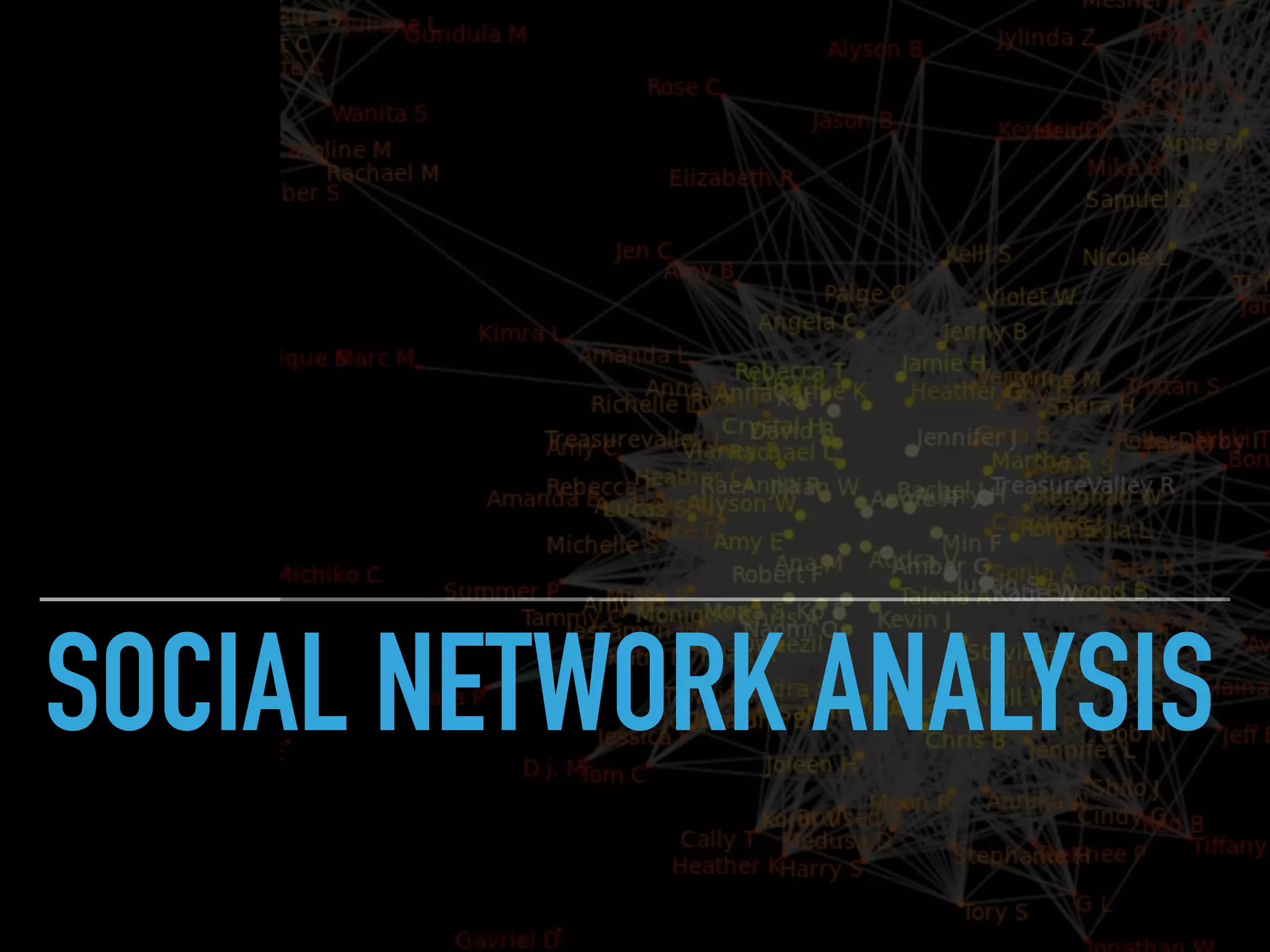
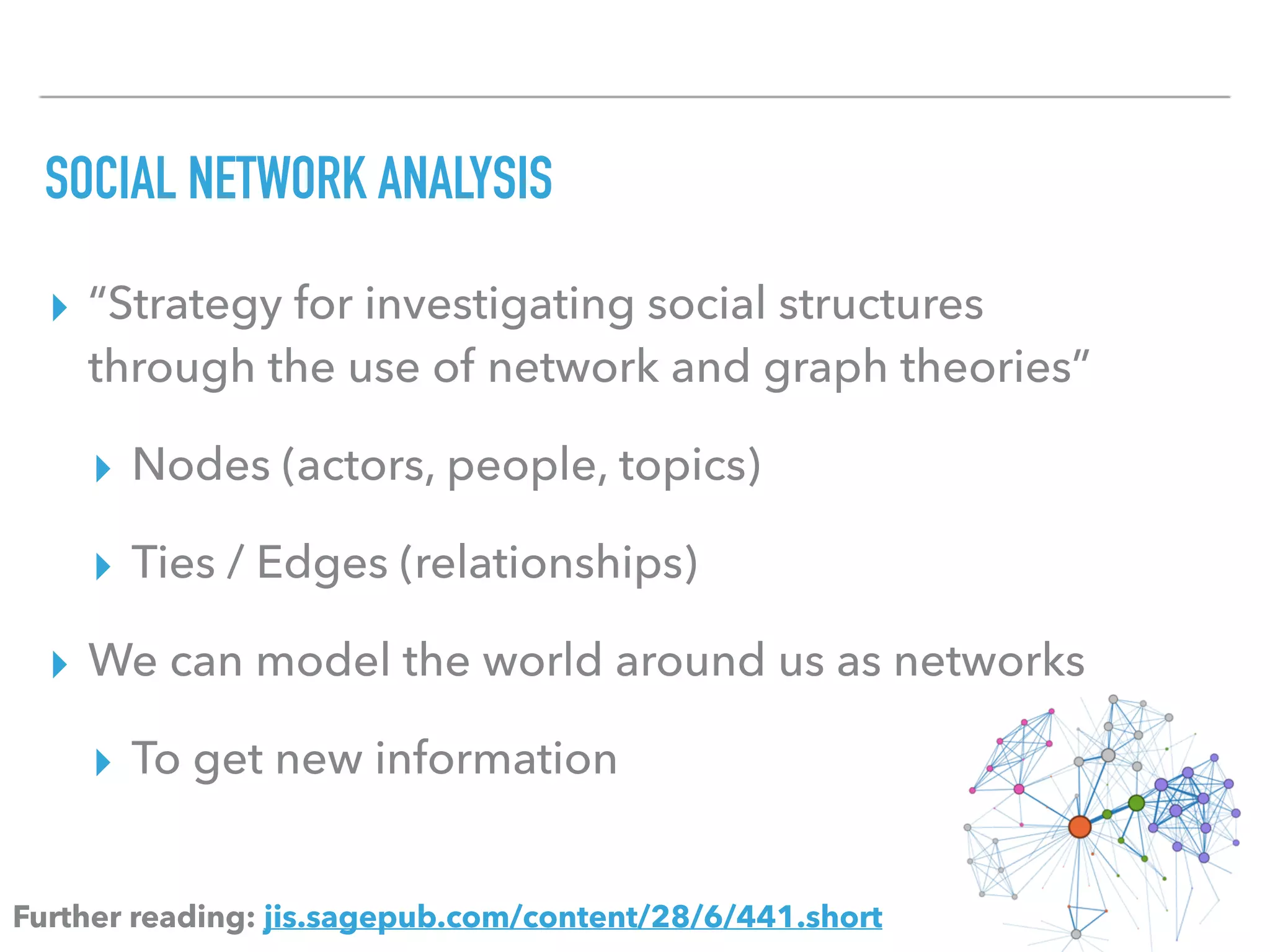
SOCIAL NETWORK ANALYSIS
▸ “Strategy for investigating social structures
through the use of network and graph theories”
▸ Nodes (actors, people, topics)
▸ Ties / Edges (relationships)
▸ We can model the world around us as networks
▸ To get new information
Further reading: jis.sagepub.com/content/28/6/441.short
SIX DEGREES OF SEPARATION
▸ In 1967, Stanley Milgram (social psychologist at Yale &
Harvard) conducted the small-world-experiment that
is the basis of the “six degrees of separation” concept.
▸ He sent several packages to randomly selected
individuals in the US, asking them to forward the
package to a target contact person in Boston. The
average path length for the received packages was
around 5.5.
Further reading: en.wikipedia.org/wiki/Small-world_experiment
SIX DEGREES OF SEPARATION
▸ In 2008, a study of Microsoft showed that the average
chain of contacts between users of MSN was 6.6
people.
▸ In 2016, Facebook observed an average connection
distance between Facebook users of 3.57.
Further reading: en.wikipedia.org/wiki/Small-world_experiment
www.tugraz.at n
Hier könnte Ihr
Logo stehen
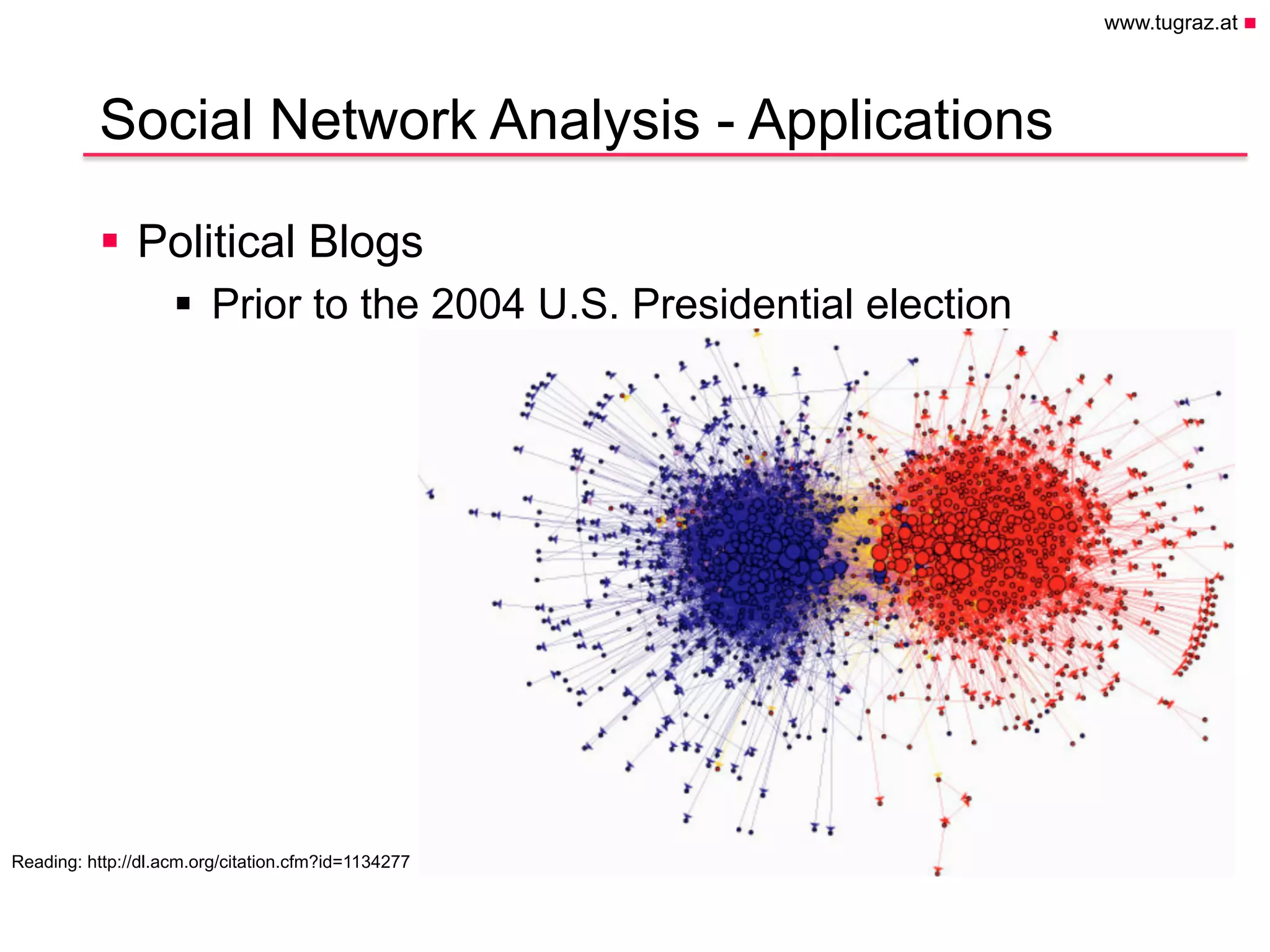
Social Network Analysis - Applications
§  Political Blogs
§  Prior to the 2004 U.S. Presidential election
April 28, 2015
Christian Gütl, Johanna Pirker - Institute of Information Systems and Computer Media
10
Reading: http://dl.acm.org/citation.cfm?id=1134277
www.tugraz.at n
Hier könnte Ihr
Logo stehen
Social Network Analysis – Applications
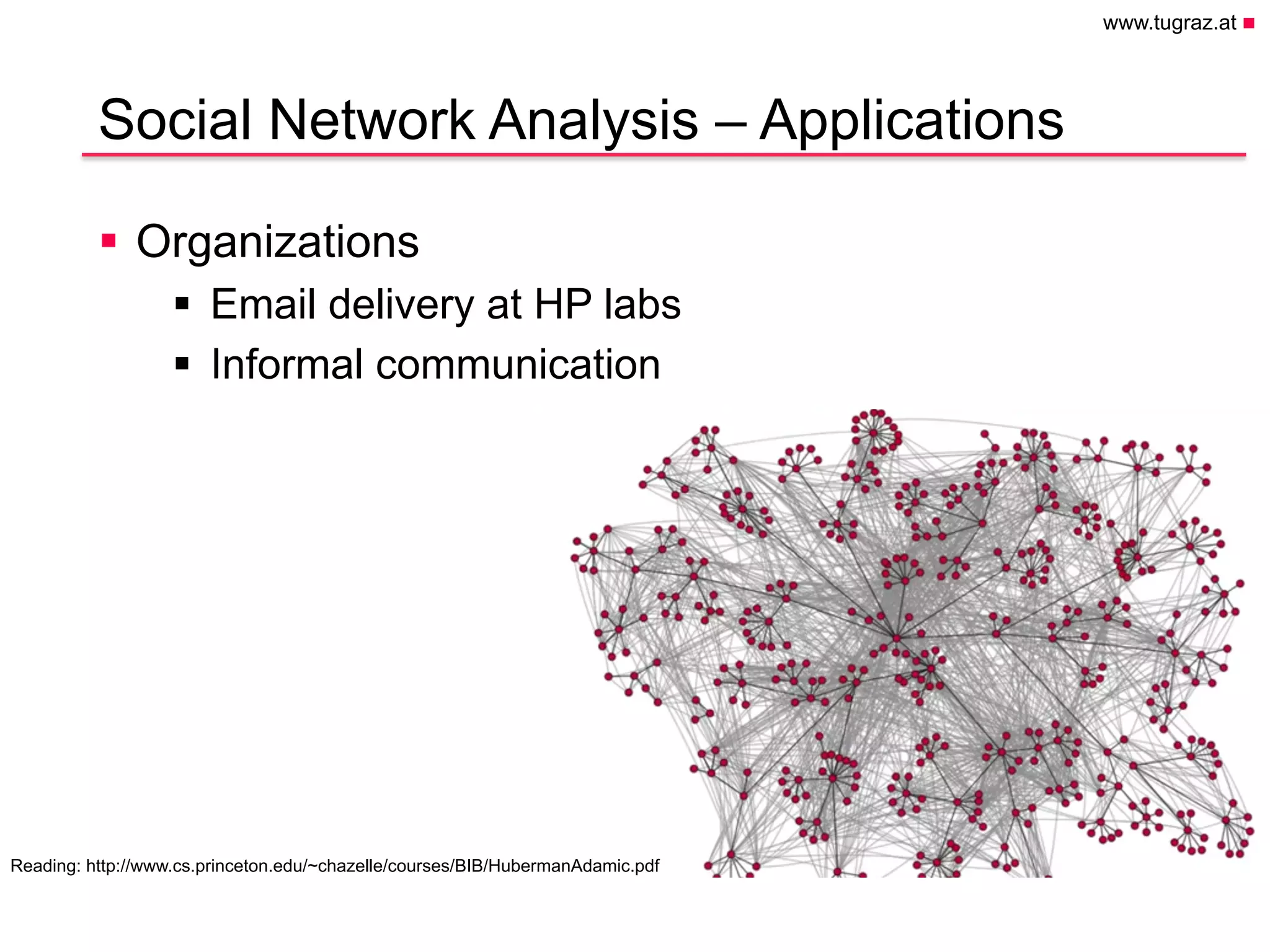
§  Organizations
§  Email delivery at HP labs
§  Informal communication
April 28, 2015
Christian Gütl, Johanna Pirker - Institute of Information Systems and Computer Media
11
Reading: http://www.cs.princeton.edu/~chazelle/courses/BIB/HubermanAdamic.pdf
www.tugraz.at n
Hier könnte Ihr
Logo stehen
Social Network Analysis – Applications
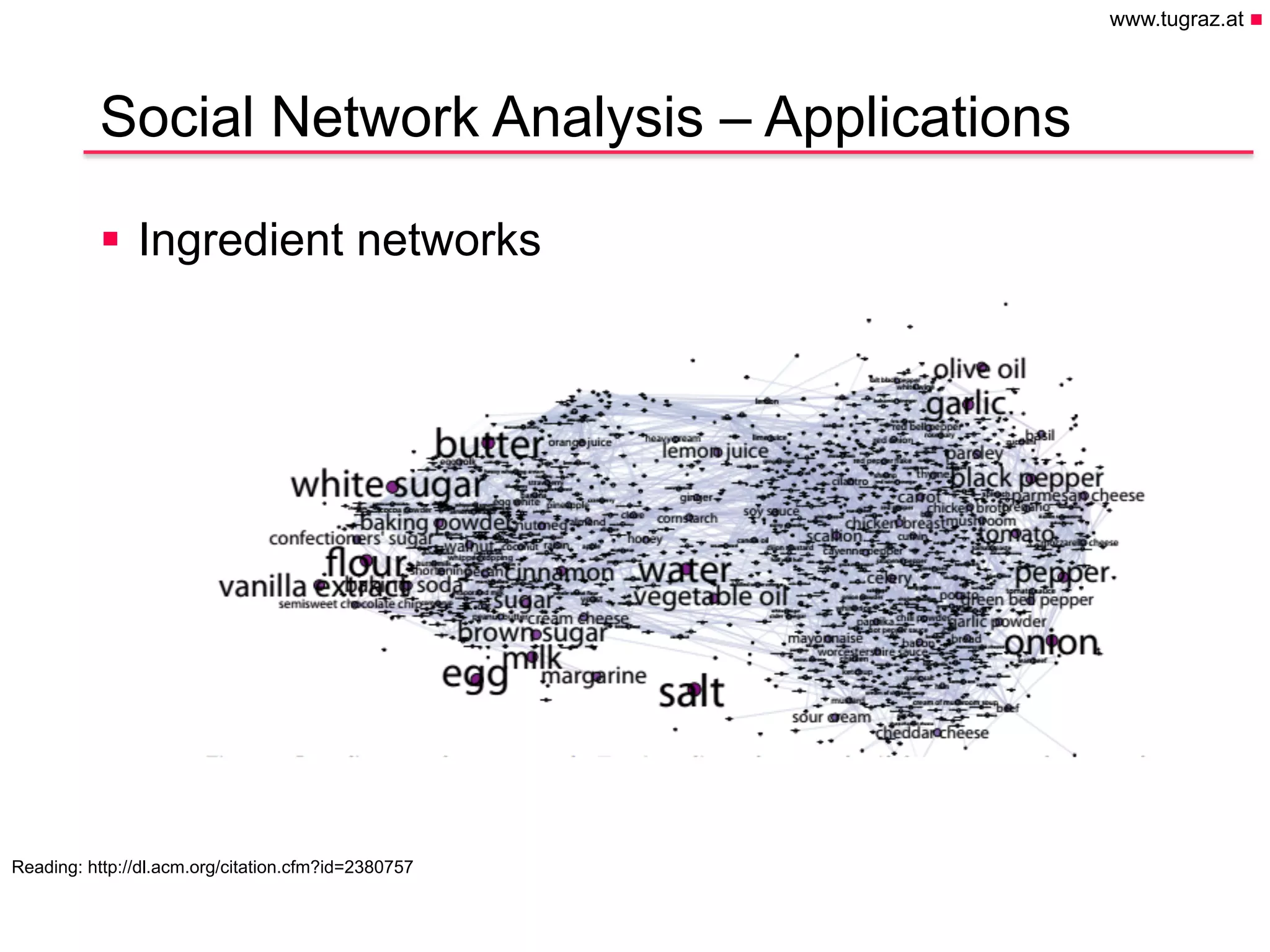
§  Ingredient networks
April 28, 2015
Christian Gütl, Johanna Pirker - Institute of Information Systems and Computer Media
12
Reading: http://dl.acm.org/citation.cfm?id=2380757
www.tugraz.at n
Hier könnte Ihr
Logo stehen
Social Network Analysis – Applications
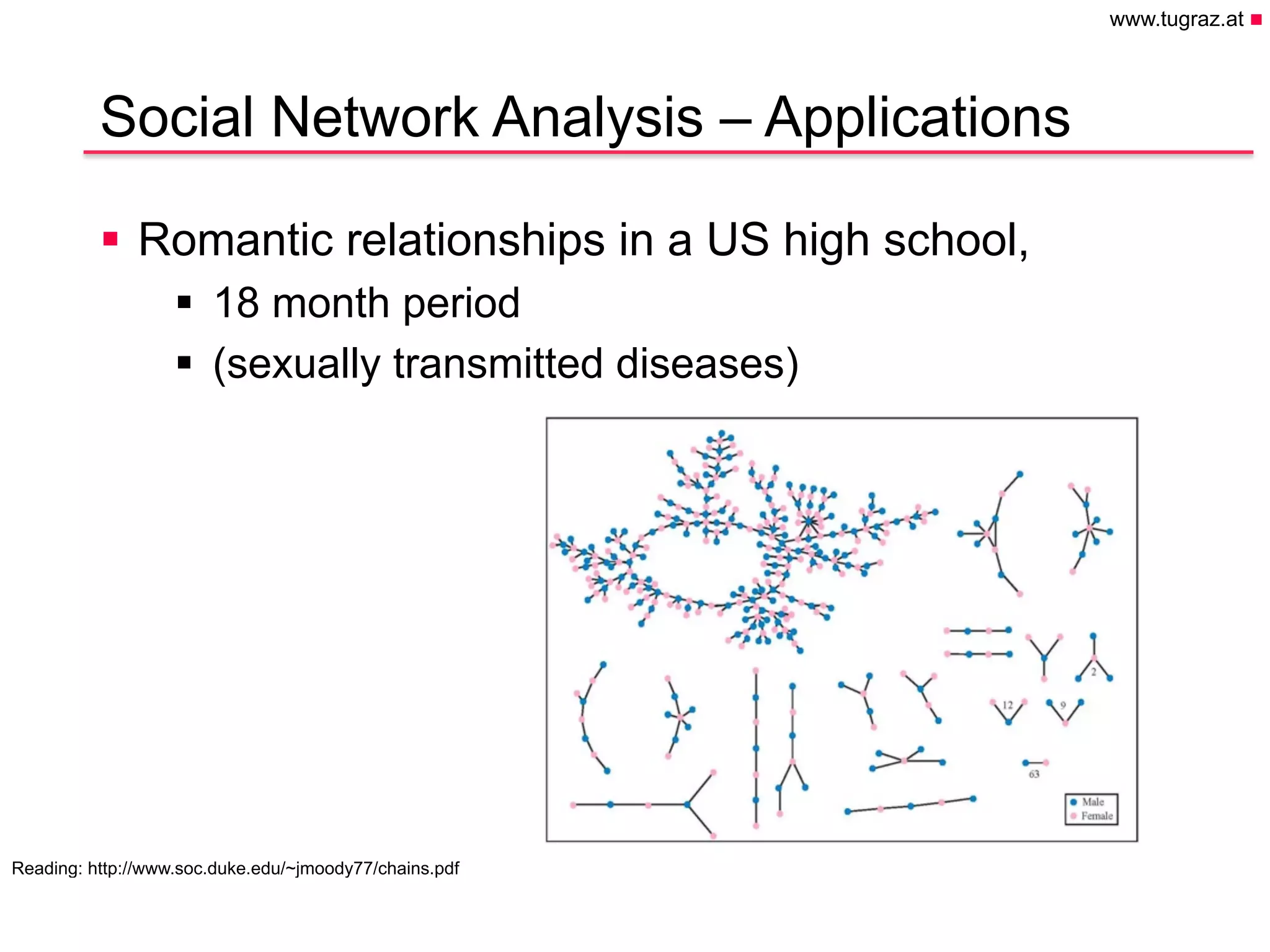
§  Romantic relationships in a US high school,
§  18 month period
§  (sexually transmitted diseases)
April 28, 2015
Christian Gütl, Johanna Pirker - Institute of Information Systems and Computer Media
13
Reading: http://www.soc.duke.edu/~jmoody77/chains.pdf
www.tugraz.at n
Hier könnte Ihr
Logo stehen
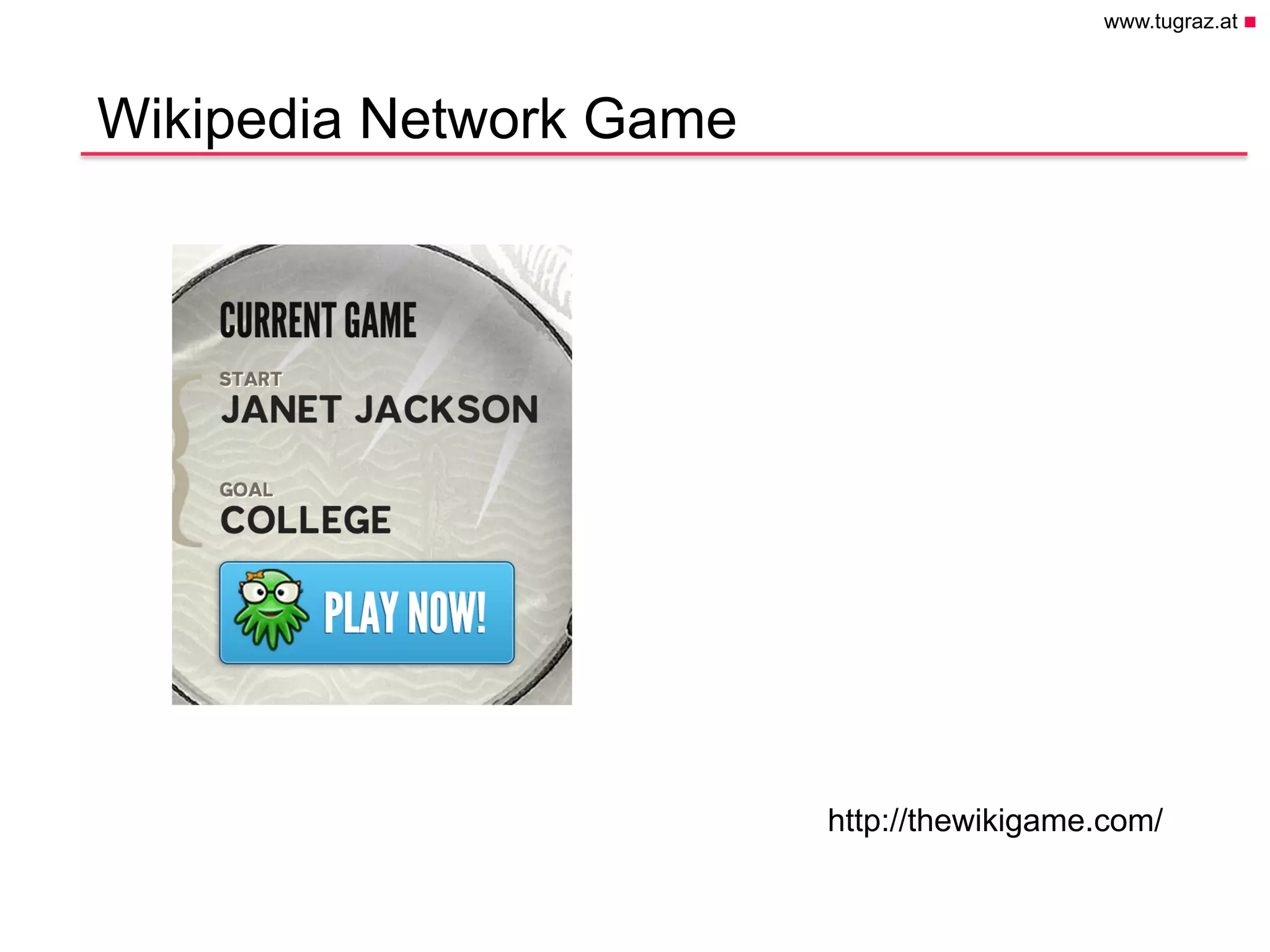
Wikipedia Network Game
April 28, 2015
Christian Gütl, Johanna Pirker - Institute of Information Systems and Computer Media
15
http://thewikigame.com/
www.tugraz.at n
Hier könnte Ihr
Logo stehen
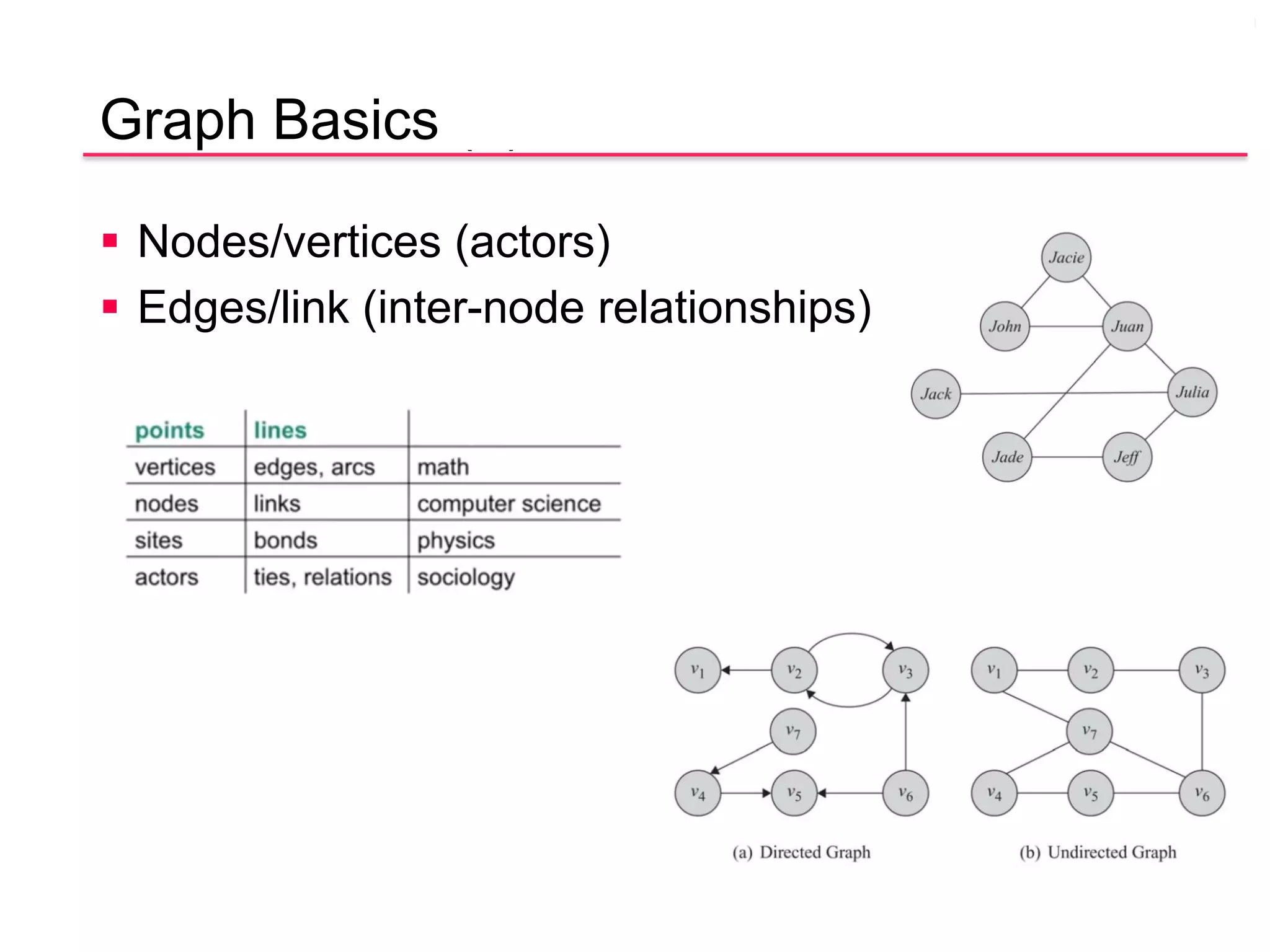
Graph Basics (1)
§  Nodes/vertices (actors)
§  Edges/link (inter-node relationships)
April 28, 2015
Christian Gütl, Johanna Pirker - Institute of Information Systems and Computer Media
19
www.tugraz.at n
Hier könnte Ihr
Logo stehen
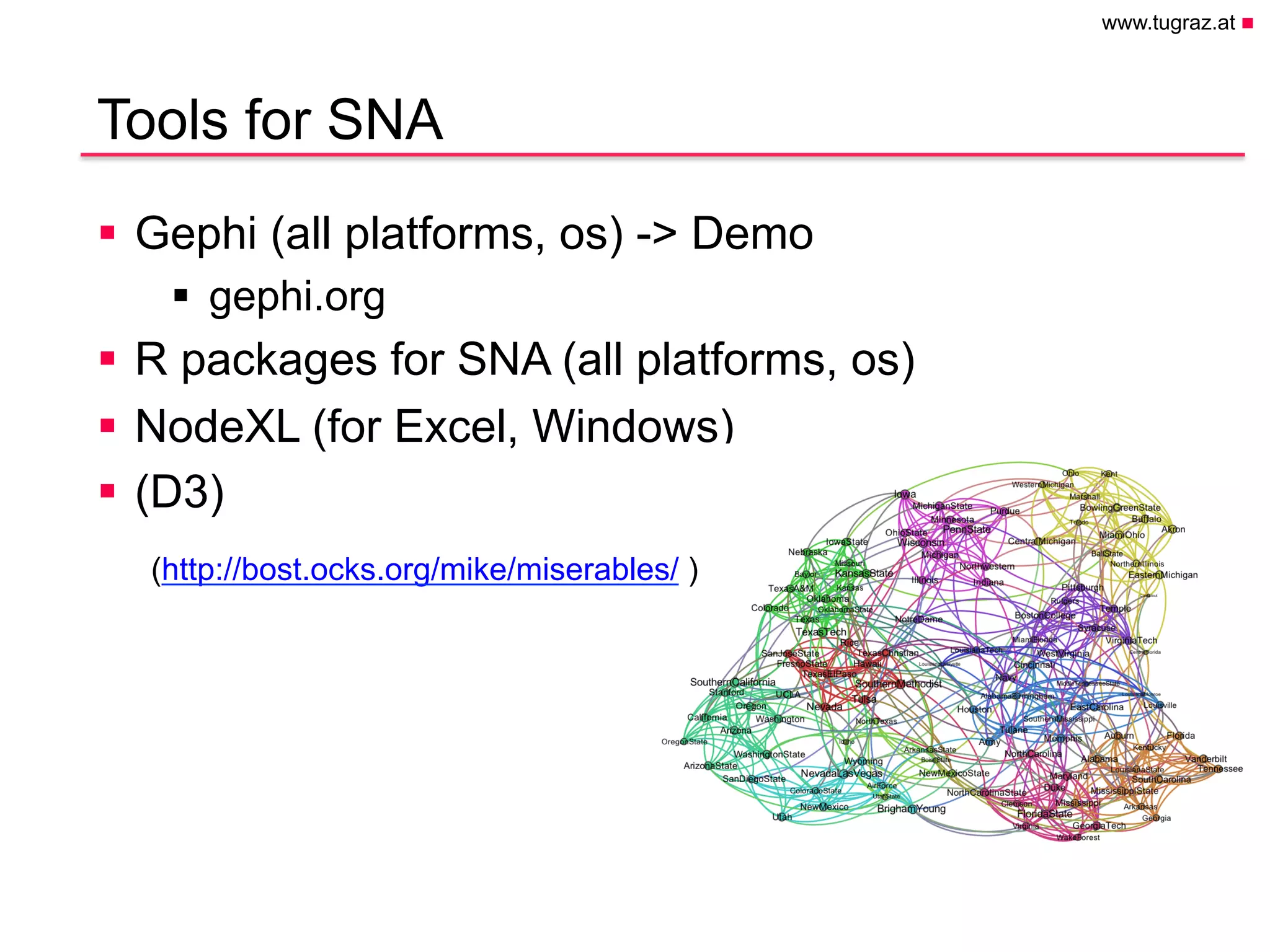
Tools for SNA
April 28, 2015
Christian Gütl, Johanna Pirker - Institute of Information Systems and Computer Media
§  Gephi (all platforms, os) -> Demo
§  gephi.org
§  R packages for SNA (all platforms, os)
§  NodeXL (for Excel, Windows)
§  (D3)
33
(http://bost.ocks.org/mike/miserables/ )
SOCIAL NETWORK ANALYSIS
IN MULTI-USER GAMES
WHY?!
TYPICAL QUESTIONS
▸ Analyzing individuals:
▸ Who are well connected / important players in a
network?
▸ What is the influence of individuals?
▸ Who is the player with the largest reach?
▸ Who are players connecting different player groups?
TYPICAL QUESTIONS
▸ Analyzing groups and communities:
▸ How can we identify groups and communities?
▸ How are players connected with each other?
▸ Are players more engaged by playing along or together?
▸ Are players in groups performing better than players
playing on their own?
▸ Do connected players share common interests?
TYPICAL QUESTIONS
▸ Analyzing social dynamics:
▸ How do players connect to other players?
▸ How do players build guilds?
▸ When a player gets an interesting item to share with
other players, how far will it get transmitted?
▸ How can we recommend players in PvP matches?
HOW?!
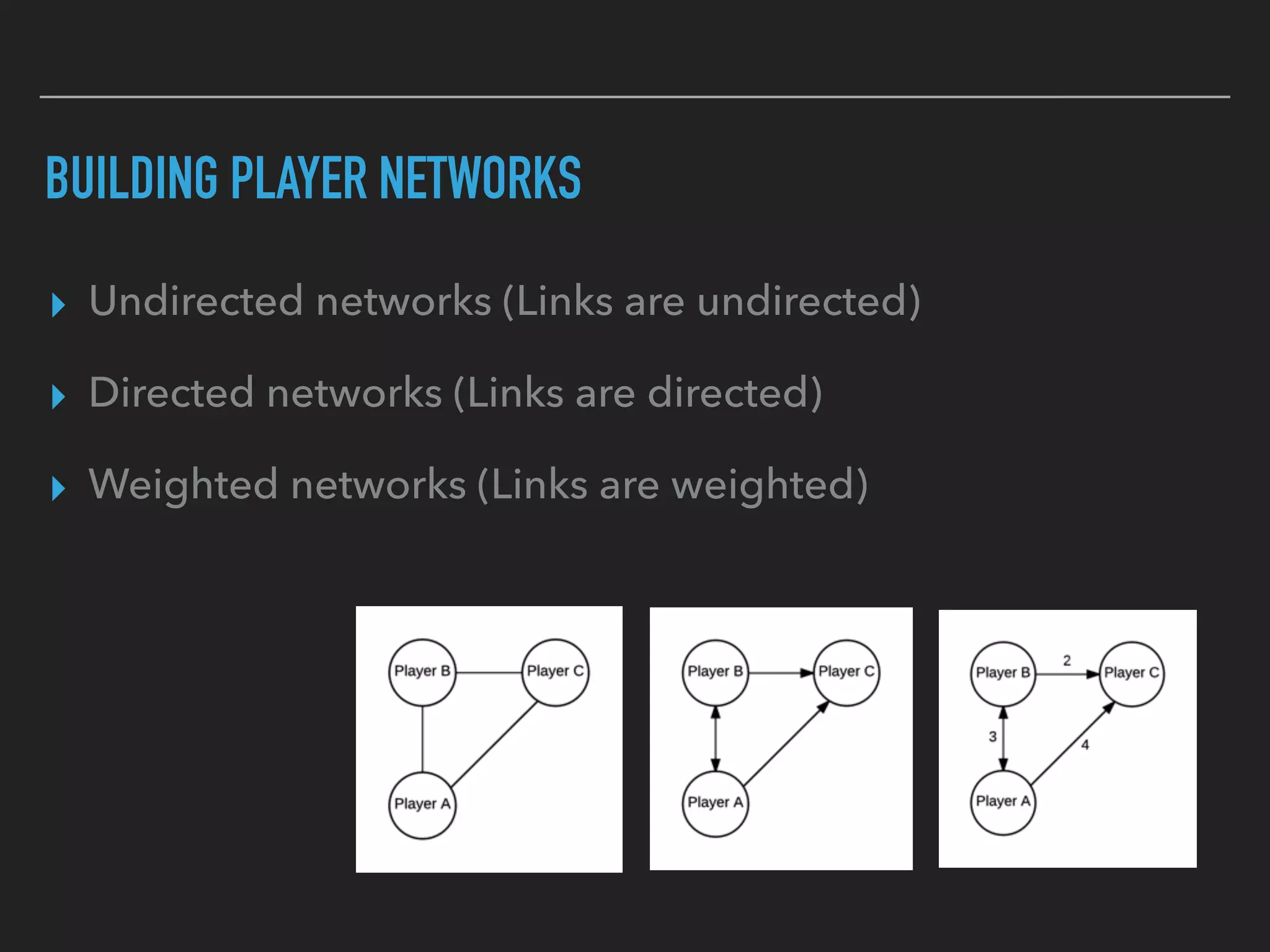
BUILDING PLAYER NETWORKS
▸ Undirected networks (Links are undirected)
▸ Directed networks (Links are directed)
▸ Weighted networks (Links are weighted)
BUILDING PLAYER NETWORKS
▸ Direct relationships: Direct (explicit) interactions between
players are identified and used (e.g. in-game messaging,
friendships, clan memberships).
▸ Indirect relationships: Relationships also can be
identified through indirect (implicit) interactions (playing
in same matches or opponent matches, same playing time,
same in-game location).
EXAMPLE?!
SOCIAL NETWORK ANALYSIS IN DESTINY
▸ Work with Anders Drachen, André Rattinger, Rafet Sifa,
Günter Wallner
▸ www.gamasutra.com/blogs/AndersDrachen/
20161123/286112/Playing_with_Friends_in_Destiny.php
▸ http://www.rafetsifa.net/wp-content/uploads/2017/02/
Rattinger_et_al_2016_ICEC.pdf 

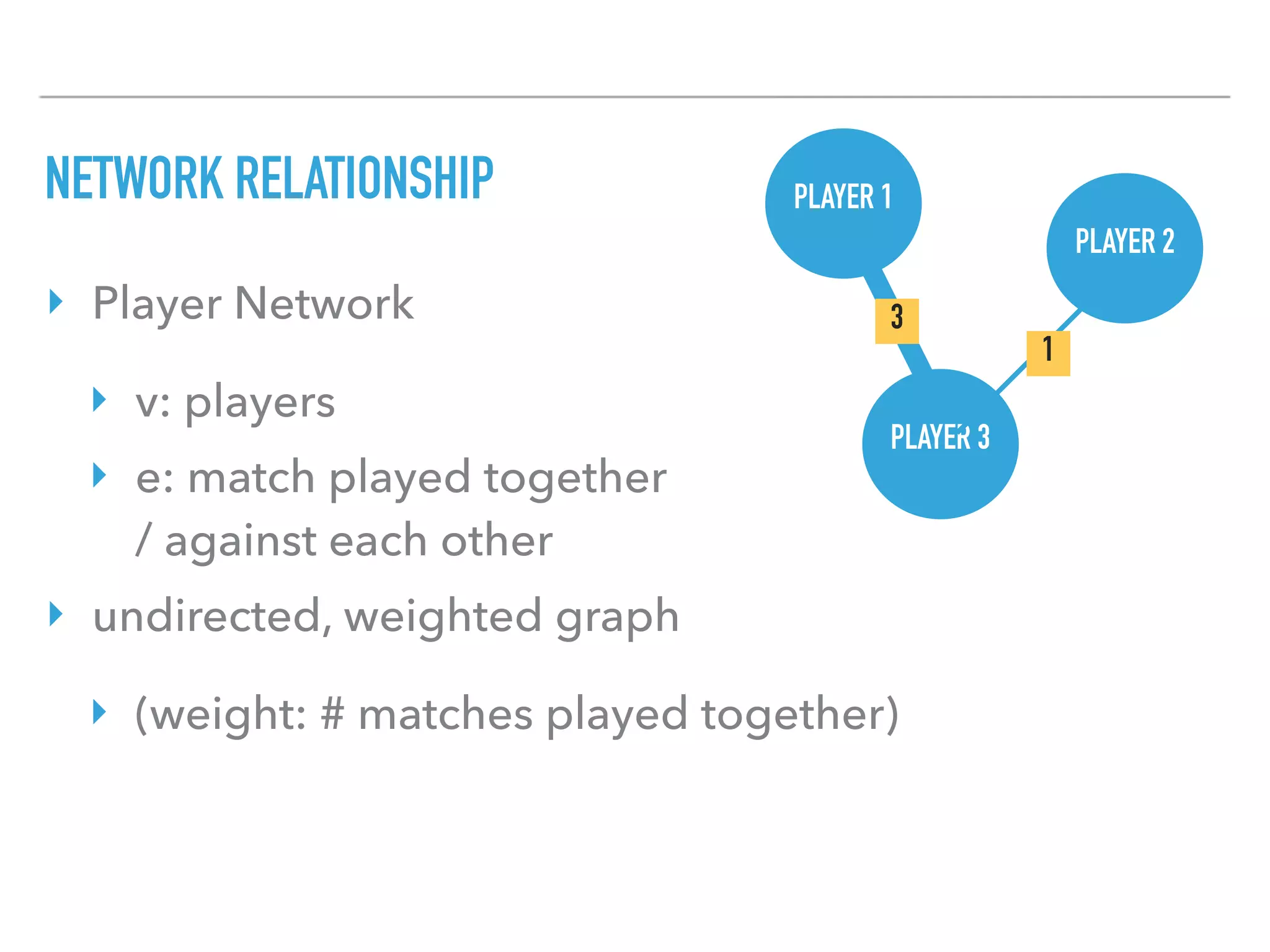
NETWORK RELATIONSHIP
‣ Player Network
‣ v: players
‣ e: match played together 

/ against each other
‣ undirected, weighted graph
‣ (weight: # matches played together)
PLAYER 1
PLAYER 2
PLAYER 3
3
1
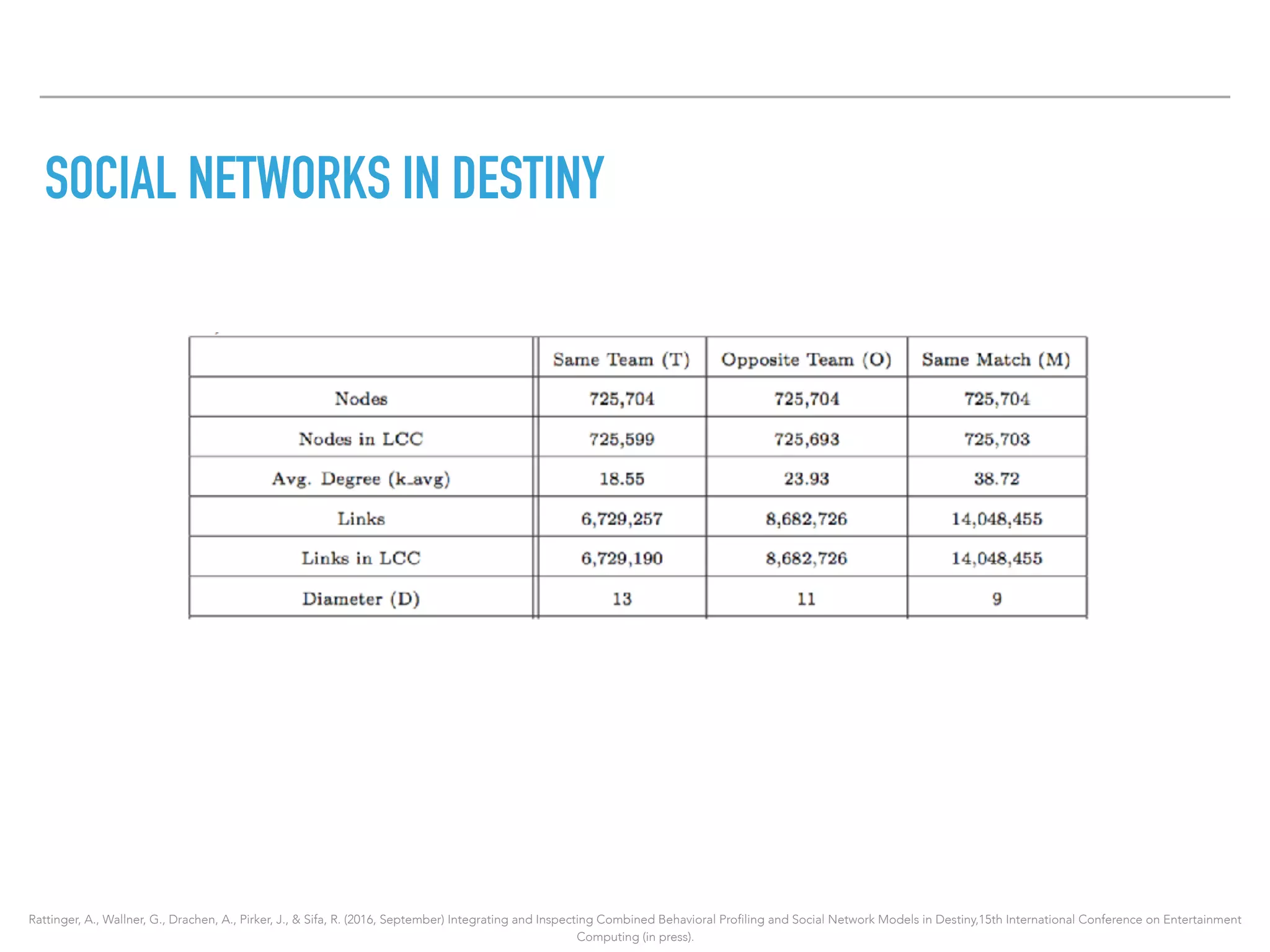
SOCIAL NETWORKS IN DESTINY
Rattinger, A., Wallner, G., Drachen, A., Pirker, J., & Sifa, R. (2016, September) Integrating and Inspecting Combined Behavioral Profiling and Social Network Models in Destiny,15th International Conference on Entertainment
Computing (in press).
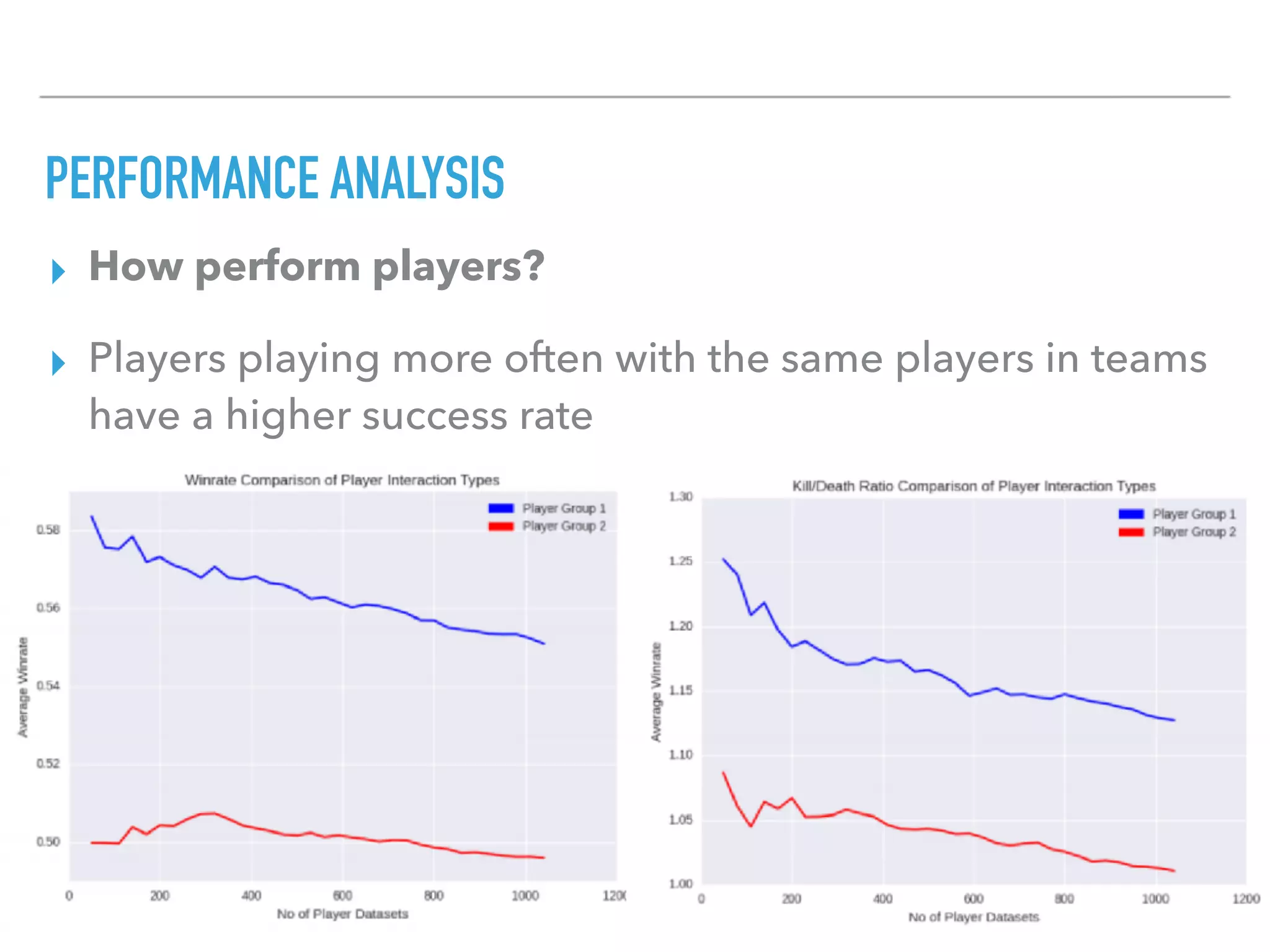
PERFORMANCE ANALYSIS
▸ How perform players?
▸ Players playing more often with the same players in teams
have a higher success rate
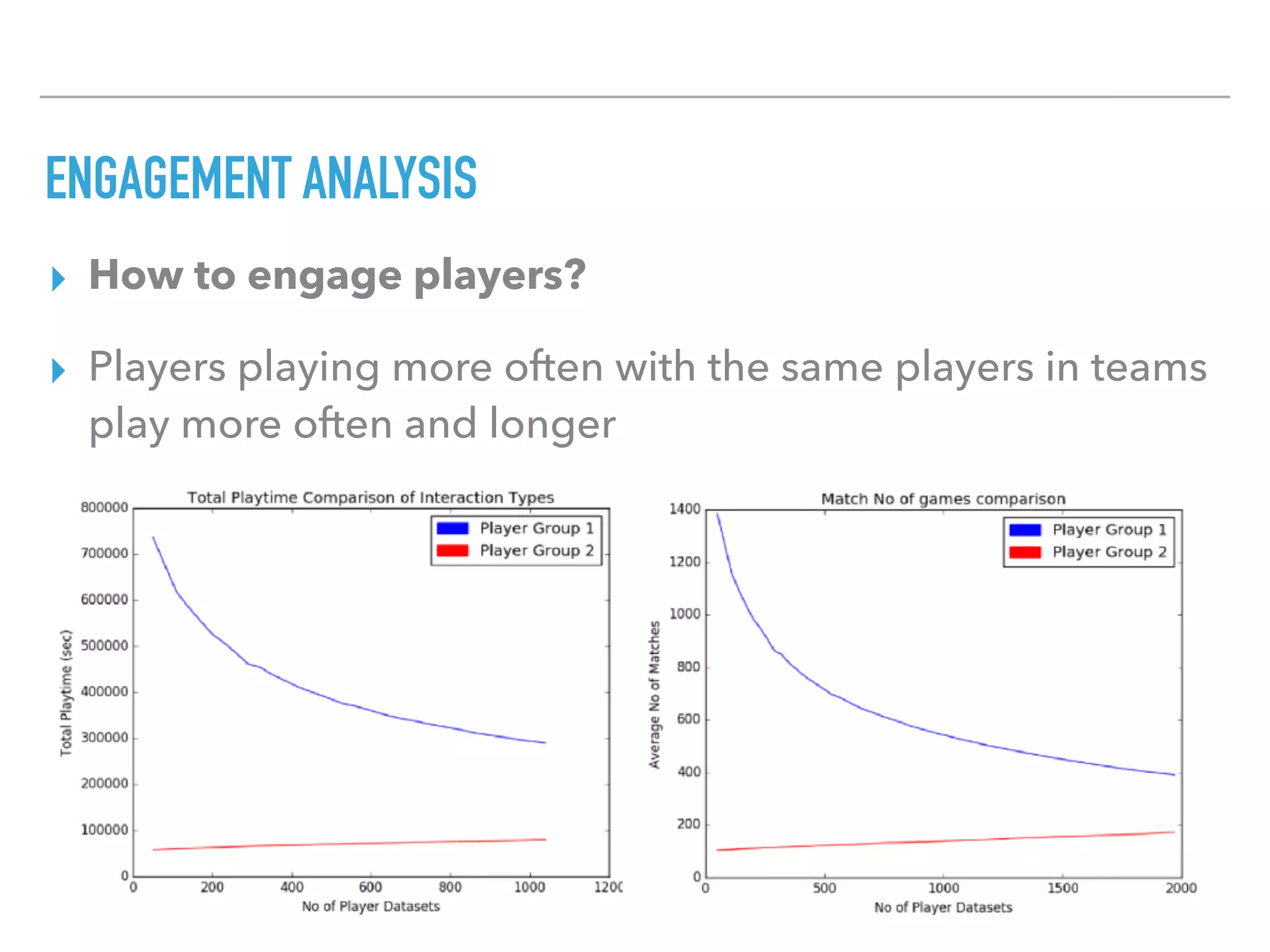
ENGAGEMENT ANALYSIS
▸ How to engage players?
▸ Players playing more often with the same players in teams
play more often and longer
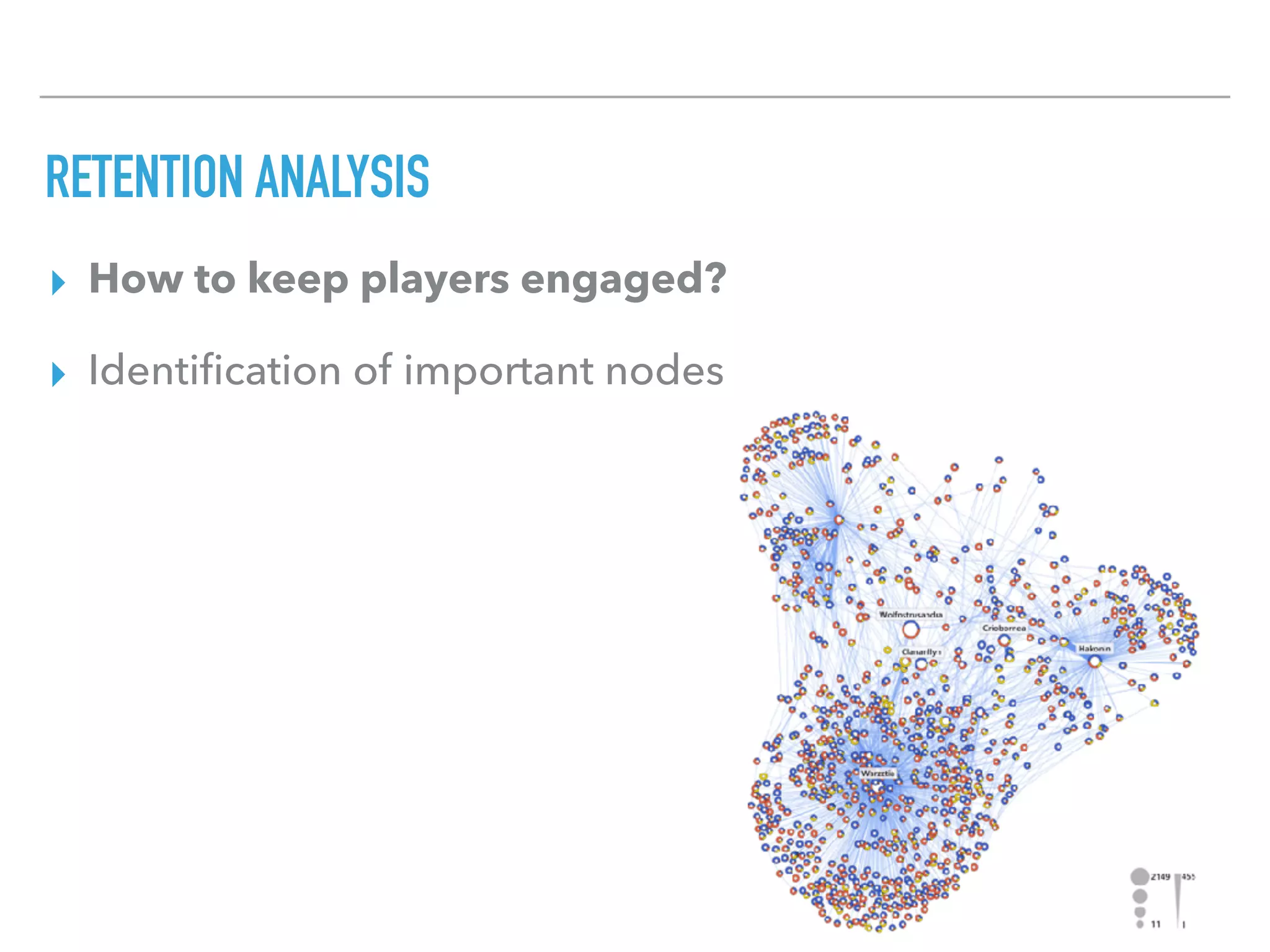
RETENTION ANALYSIS
▸ How to keep players engaged?
▸ Identification of important nodes
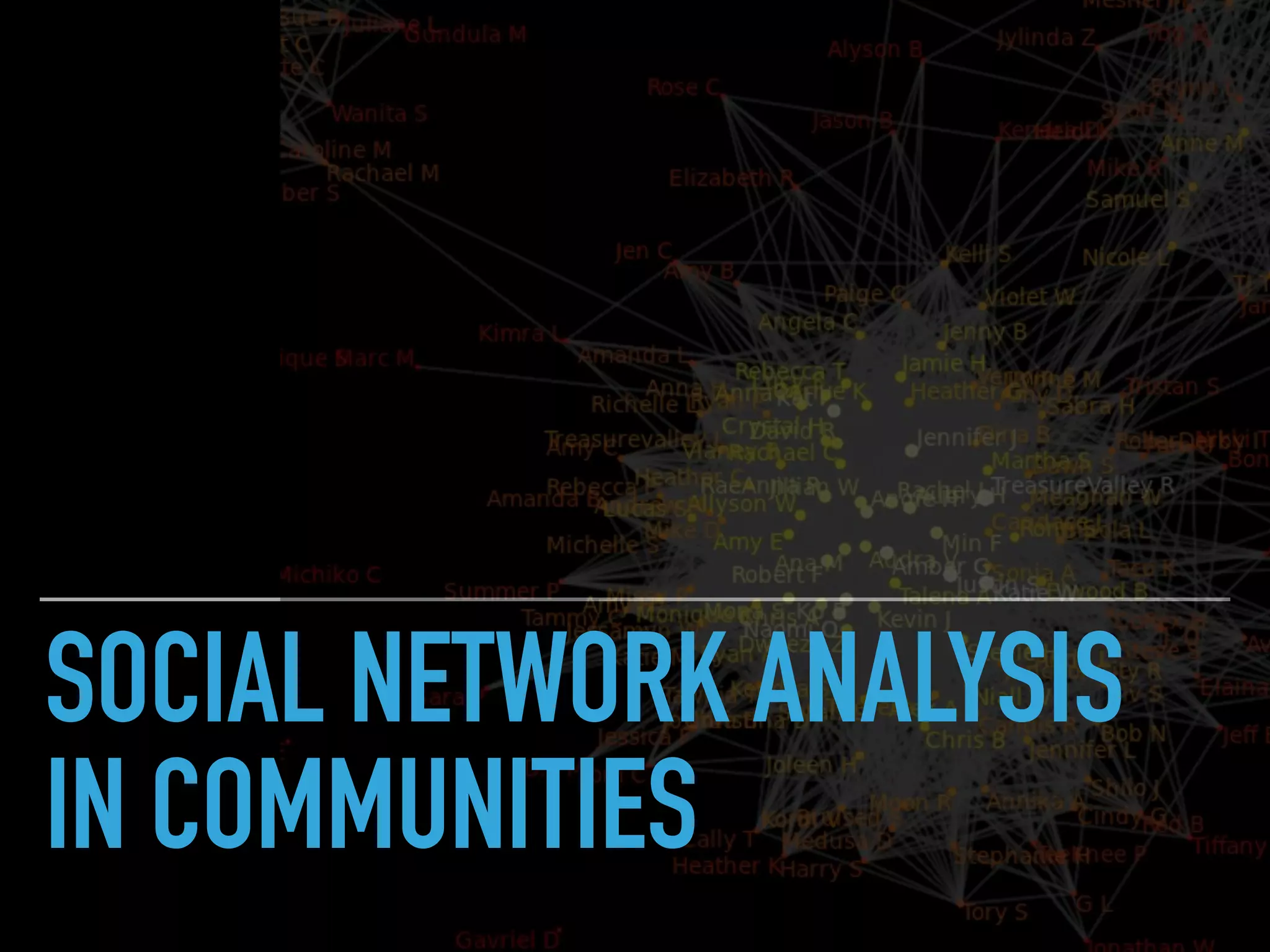
SOCIAL NETWORK ANALYSIS
IN COMMUNITIES
SOCIAL NETWORK ANALYSIS OF THE GLOBAL GAME JAM
▸ Work with Foaad Khosmood, Christian Gütl, Andreas Punz
▸ https://jpirker.com/wp-content/uploads/
2013/09/2017icgj-global-game.pdf
GLOBAL GAME JAM
▸ “world’s largest game development event taking
place around the world at physical locations”
▸ each game uploaded to GGJ website and linked to
jammer profiles
▸ -> social interactions
▸ -> international context
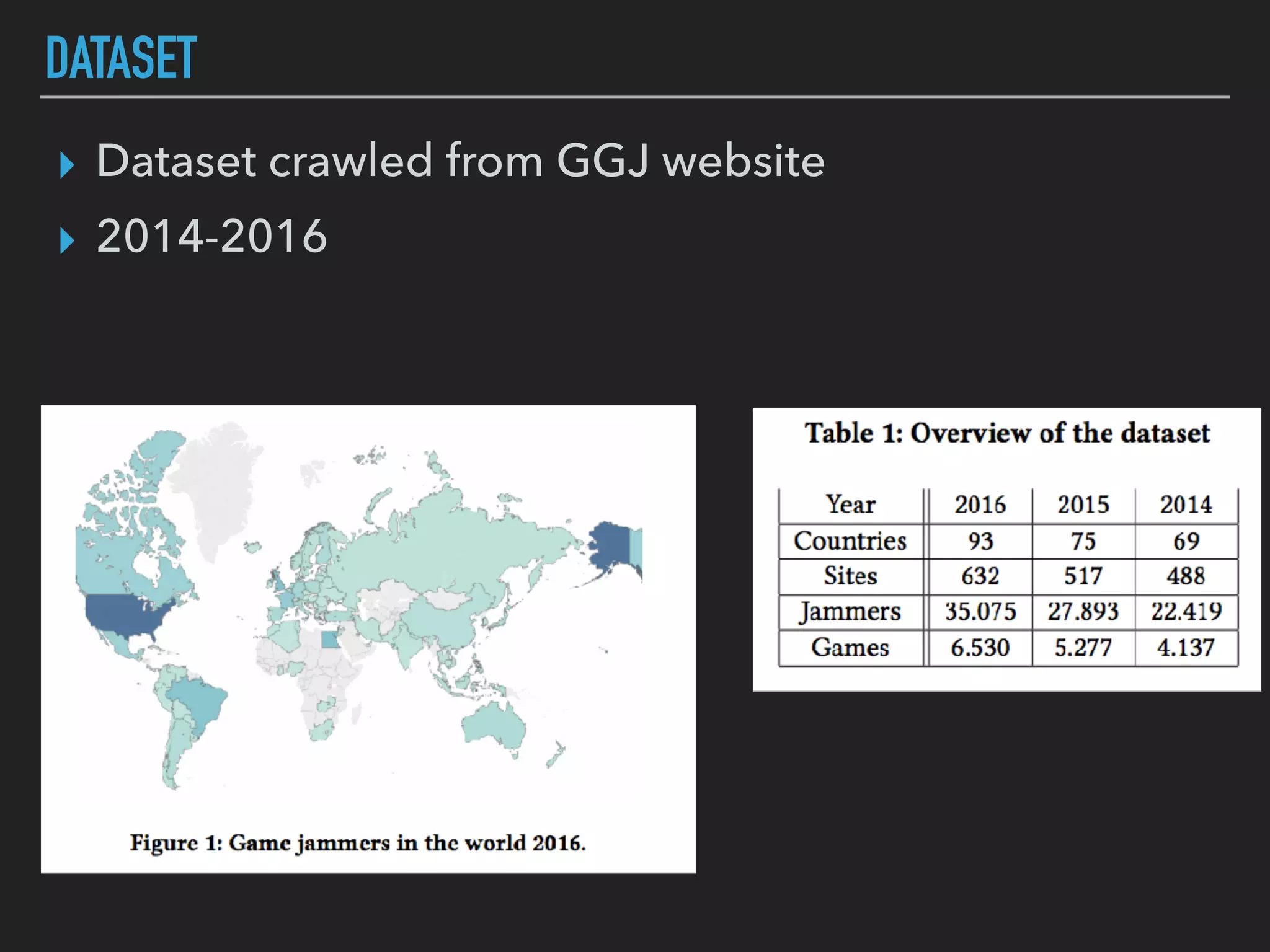
DATASET
▸ Dataset crawled from GGJ website
▸ 2014-2016
NETWORK RELATIONSHIP
explicit (friend, follow information) vs implicit (shared
interests) networks
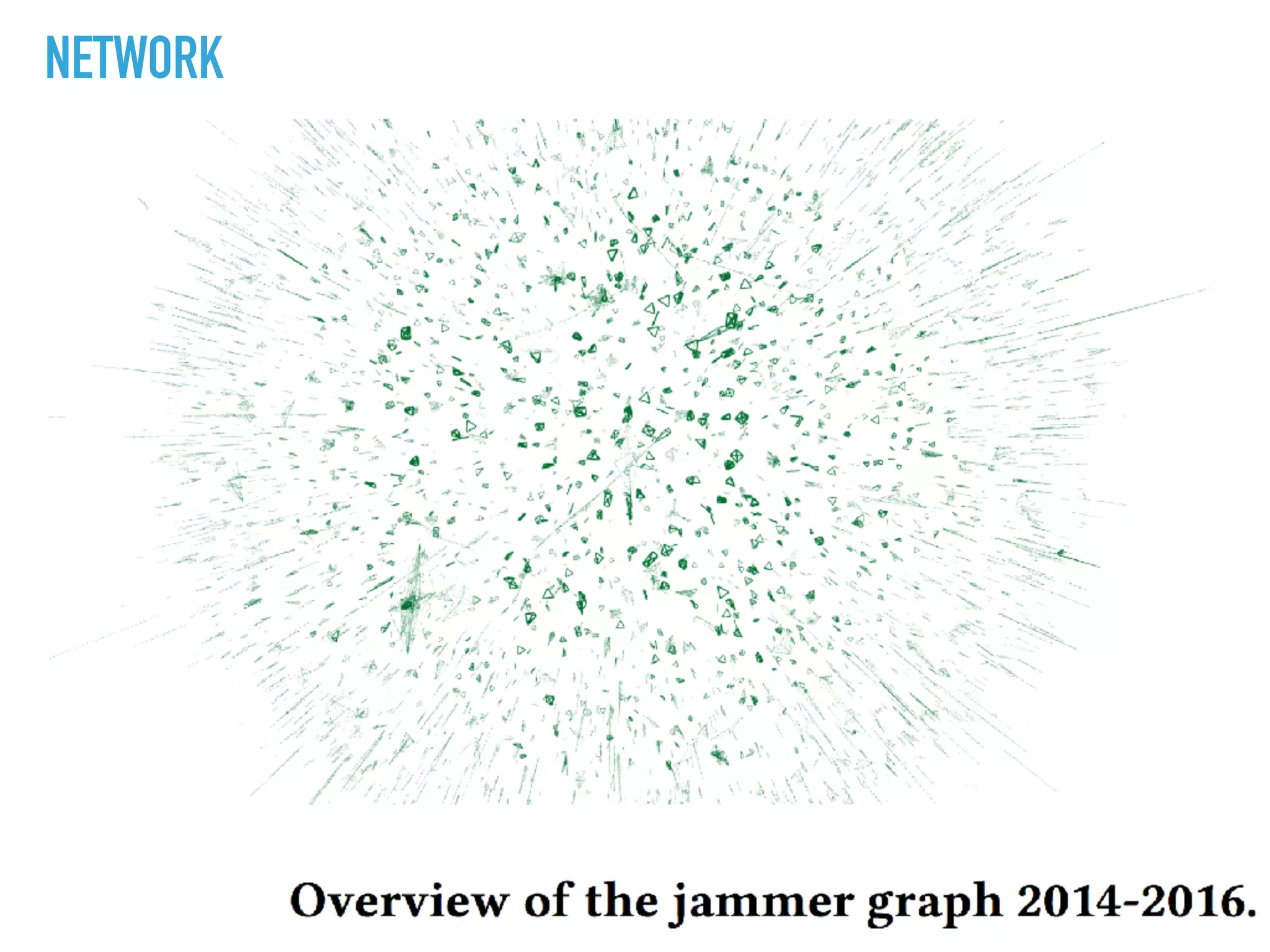
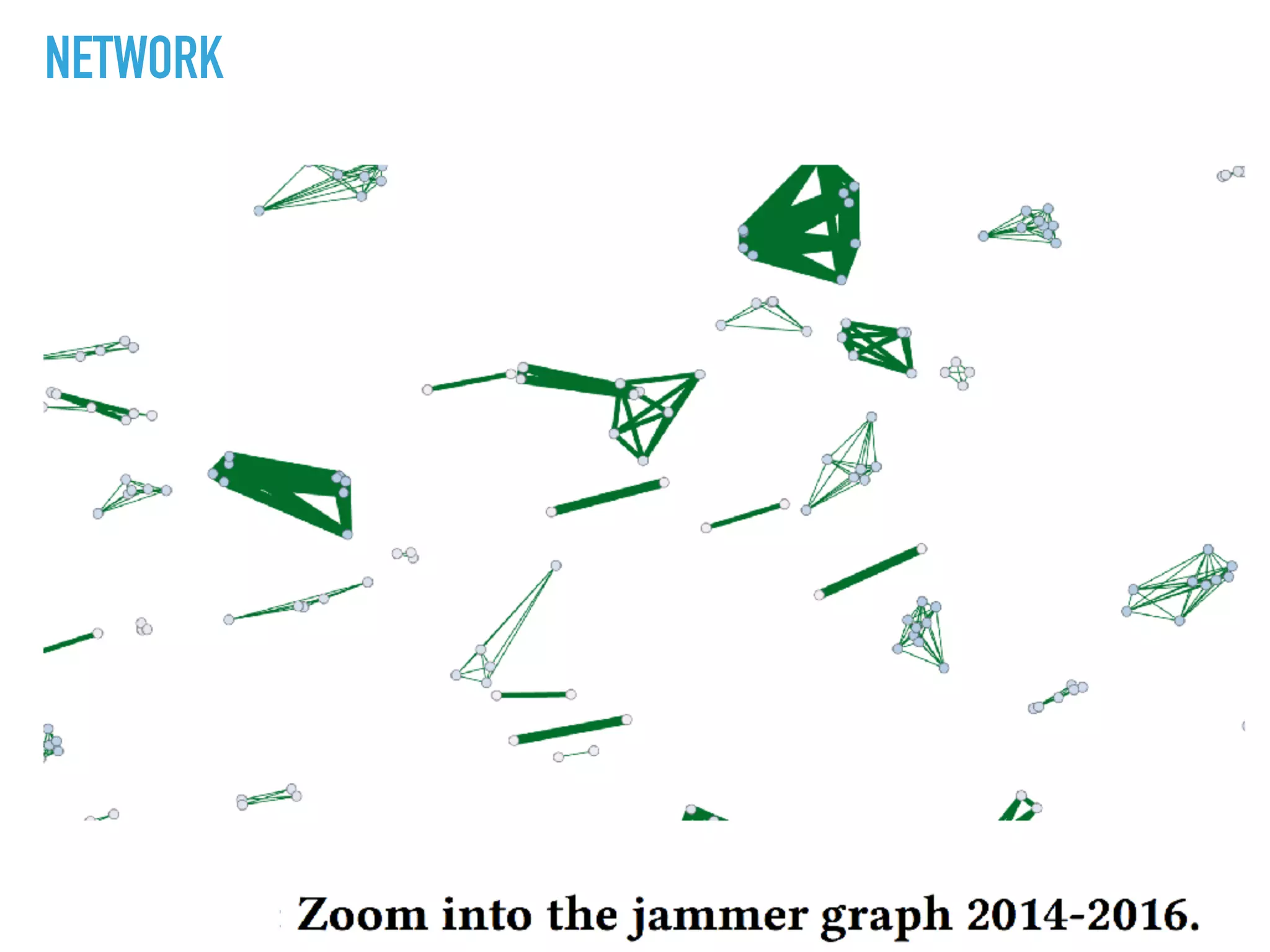
▸ Jammer Network: describes connections between
jammers through the games they have developed together
(v= jammer, e = developed games together)
▸ Location Network: demonstrates the connectivity between
various locations or nations through (moving) jammers (v =
location, e = jammers developed games together)
▸ Game Network: represents a network of all games
developed connected through jammers (v = games, e =
common jammers in the development process)
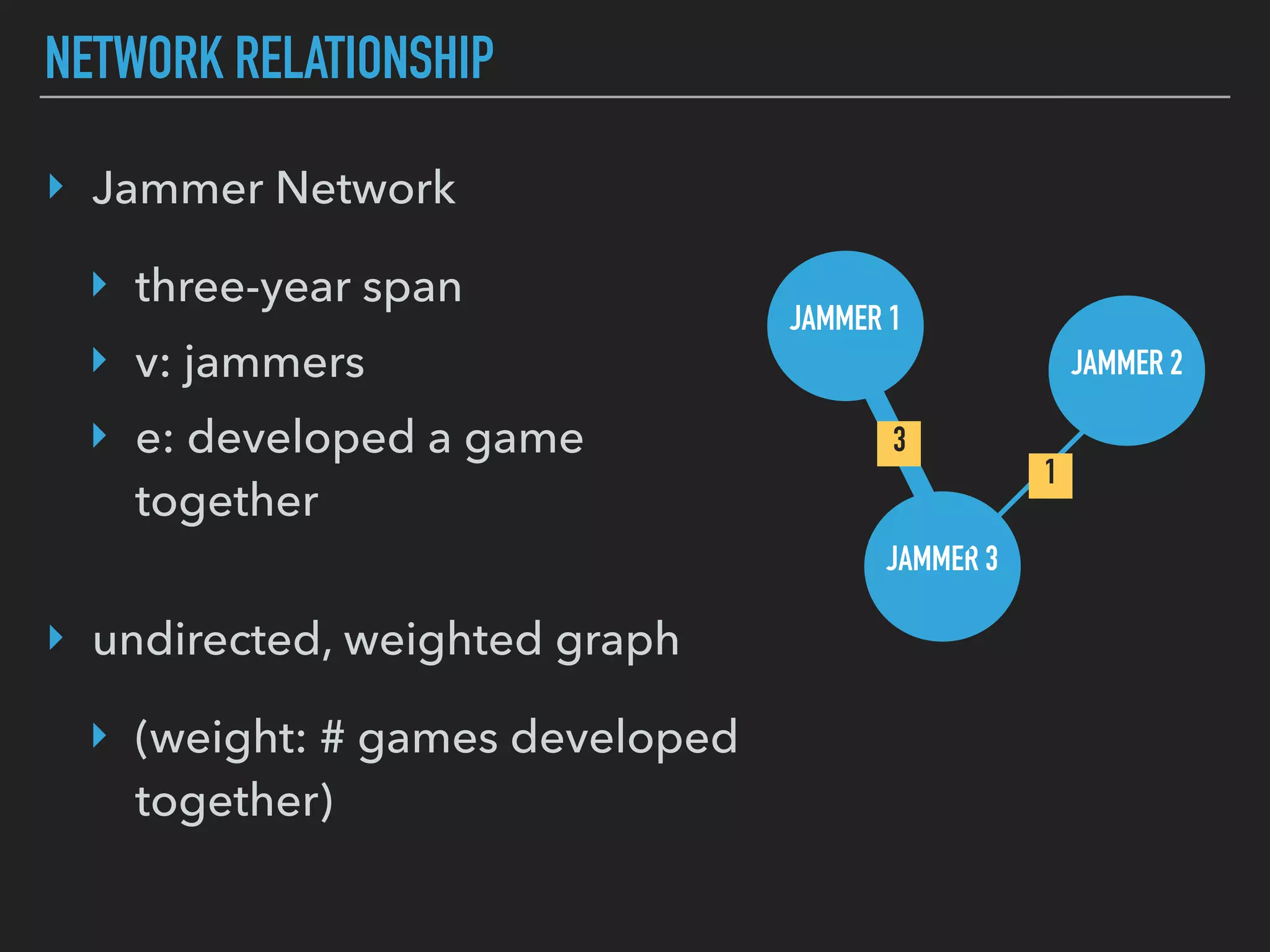
NETWORK RELATIONSHIP
‣ Jammer Network
‣ three-year span
‣ v: jammers
‣ e: developed a game
together 

‣ undirected, weighted graph
‣ (weight: # games developed
together)
JAMMER 1
JAMMER 2
JAMMER 3
3
1
NETWORK
NETWORK
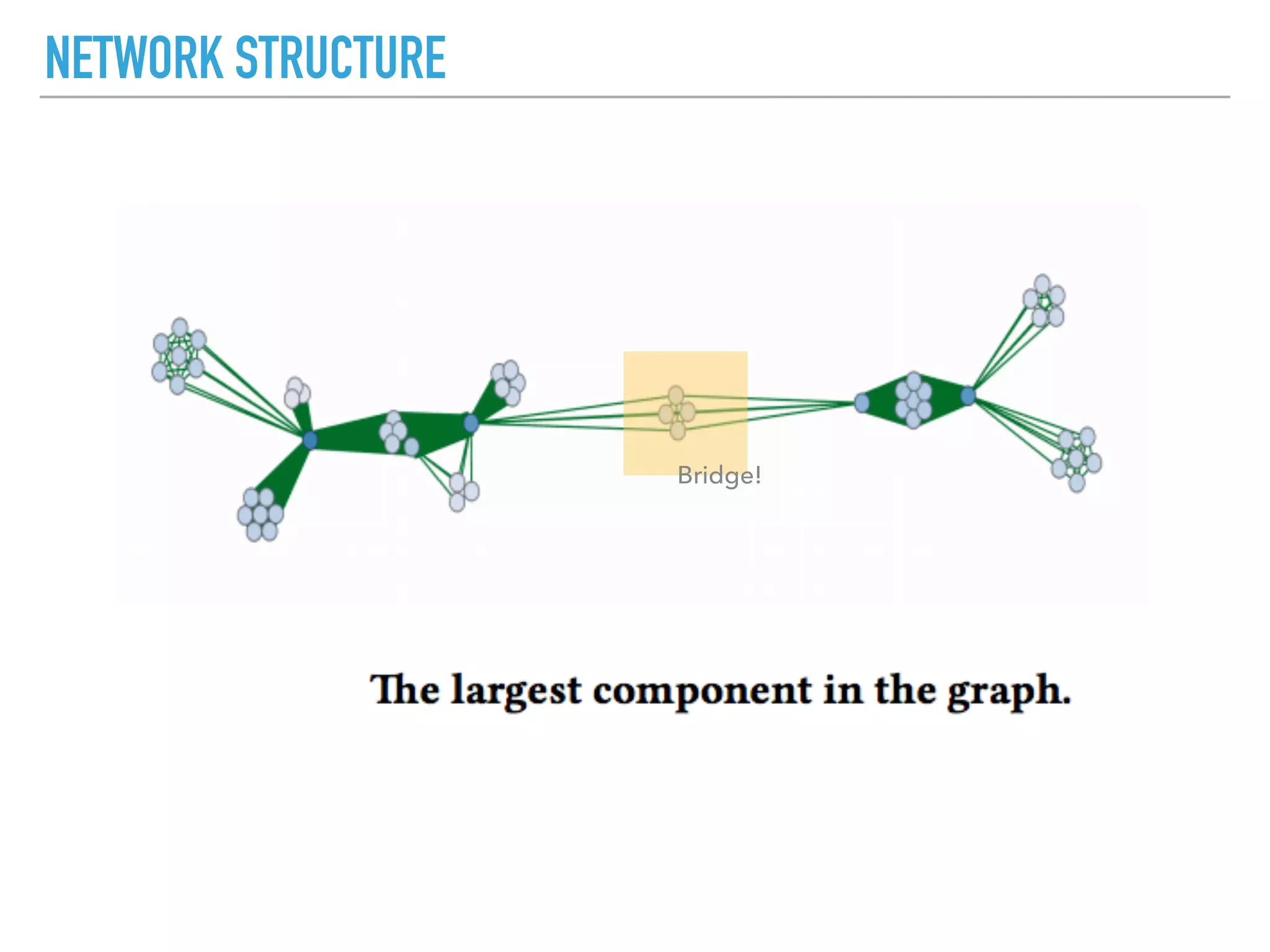
NETWORK STRUCTURE
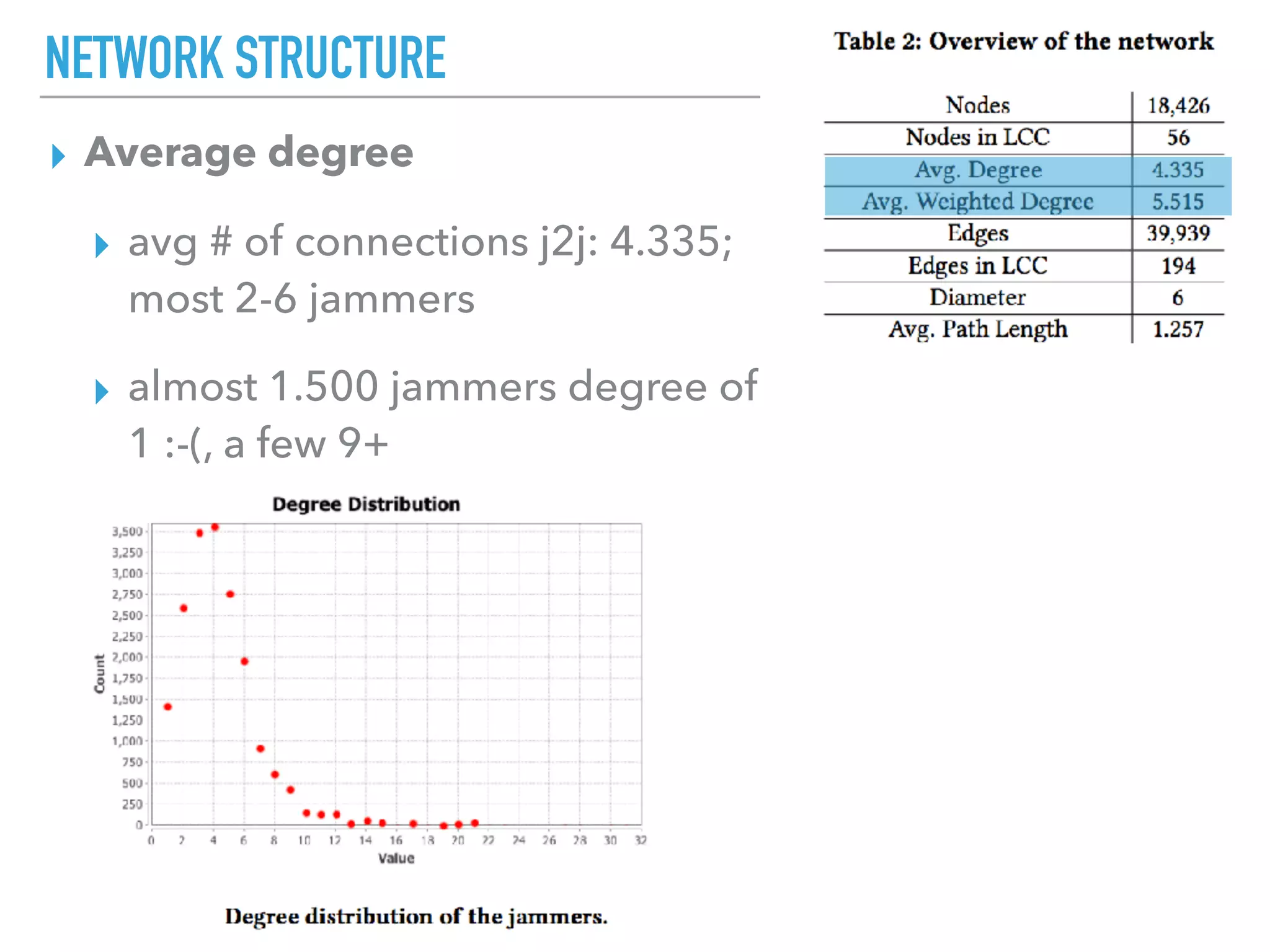
▸ Average degree
▸ avg # of connections j2j: 4.335;
most 2-6 jammers
▸ almost 1.500 jammers degree of
1 :-(, a few 9+
NETWORK STRUCTURE
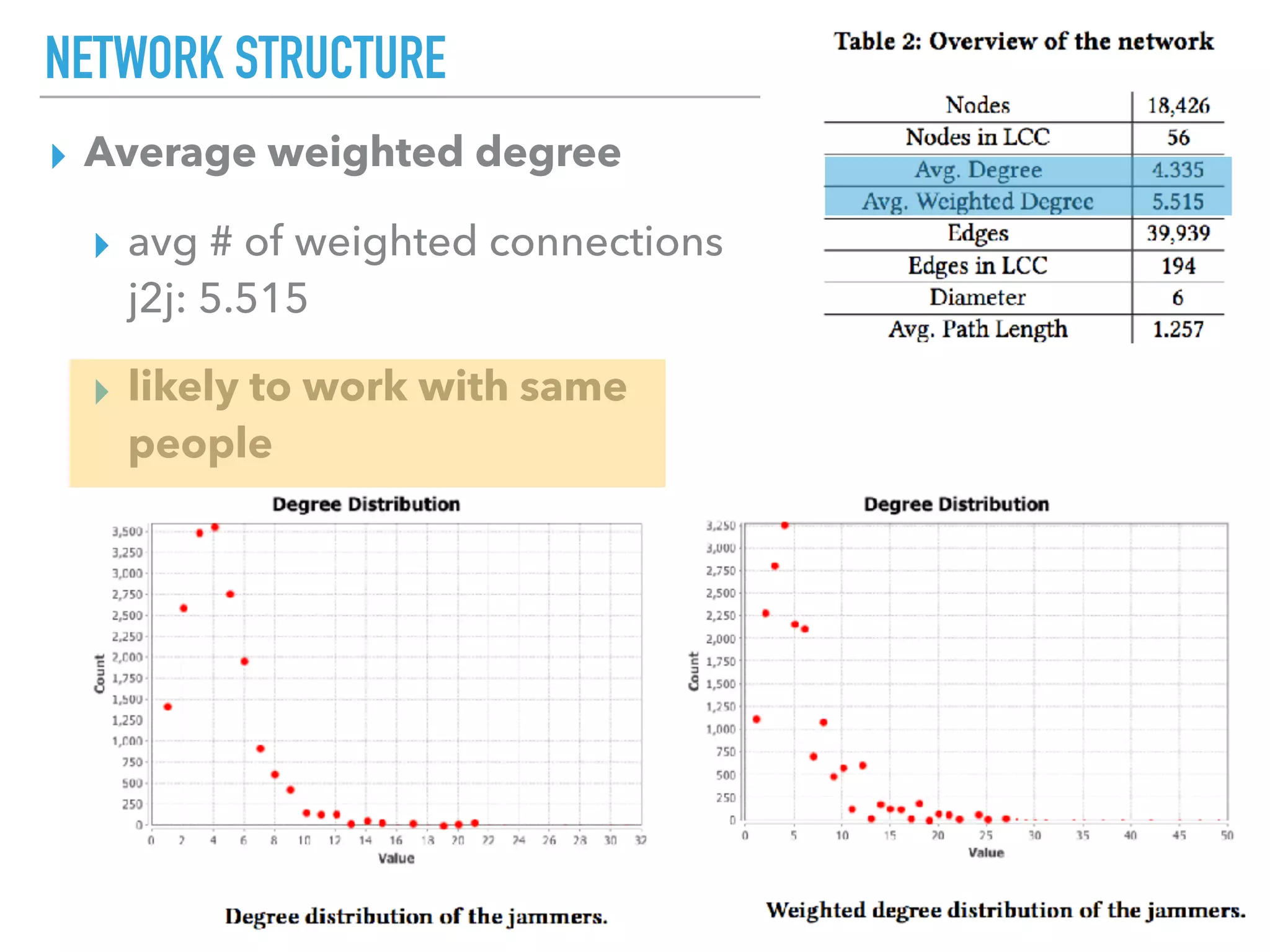
▸ Average weighted degree
▸ avg # of weighted connections
j2j: 5.515
▸ likely to work with same
people
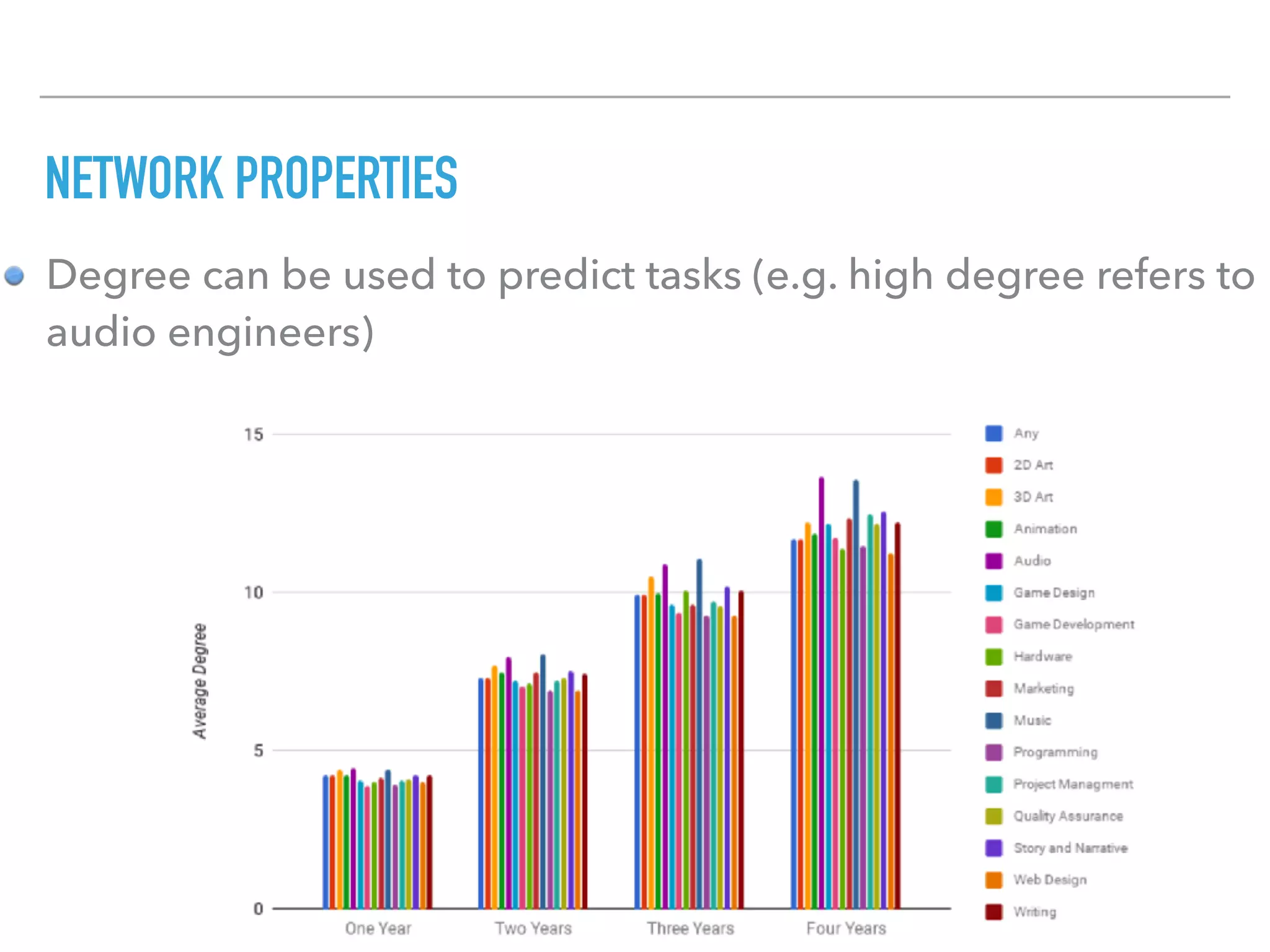
NETWORK PROPERTIES
Degree can be used to predict tasks (e.g. high degree refers to
audio engineers)
NETWORK STRUCTURE
Bridge!
GOALS
• Improve our understanding of the developer
engagement and behaviours to improve experience
• Find issues to avoid drop-outs at jam events
• Find “important” nodes (bridges) and “weak” nodes
• Find flaws early and maybe also automatically/
dynamically
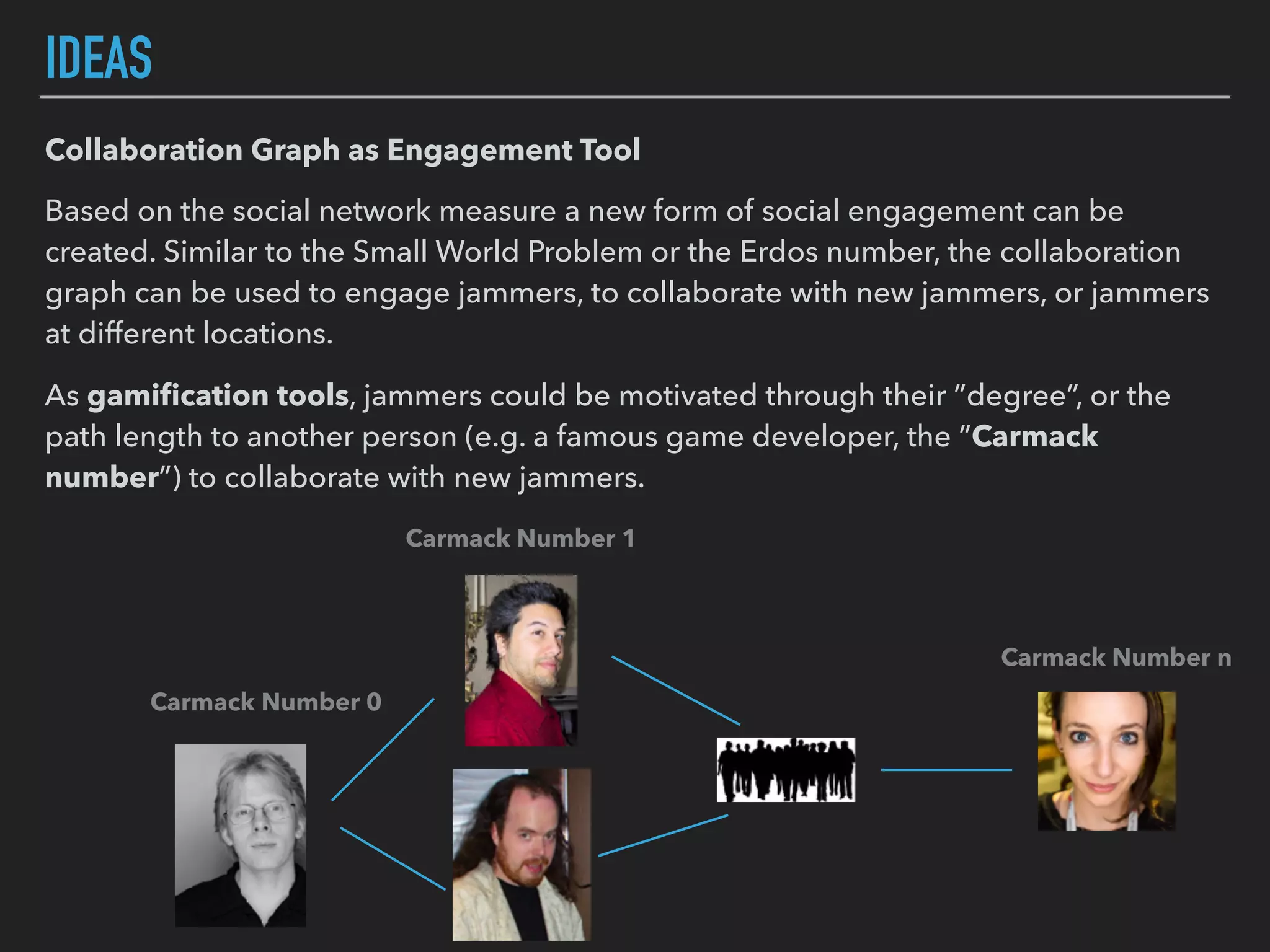
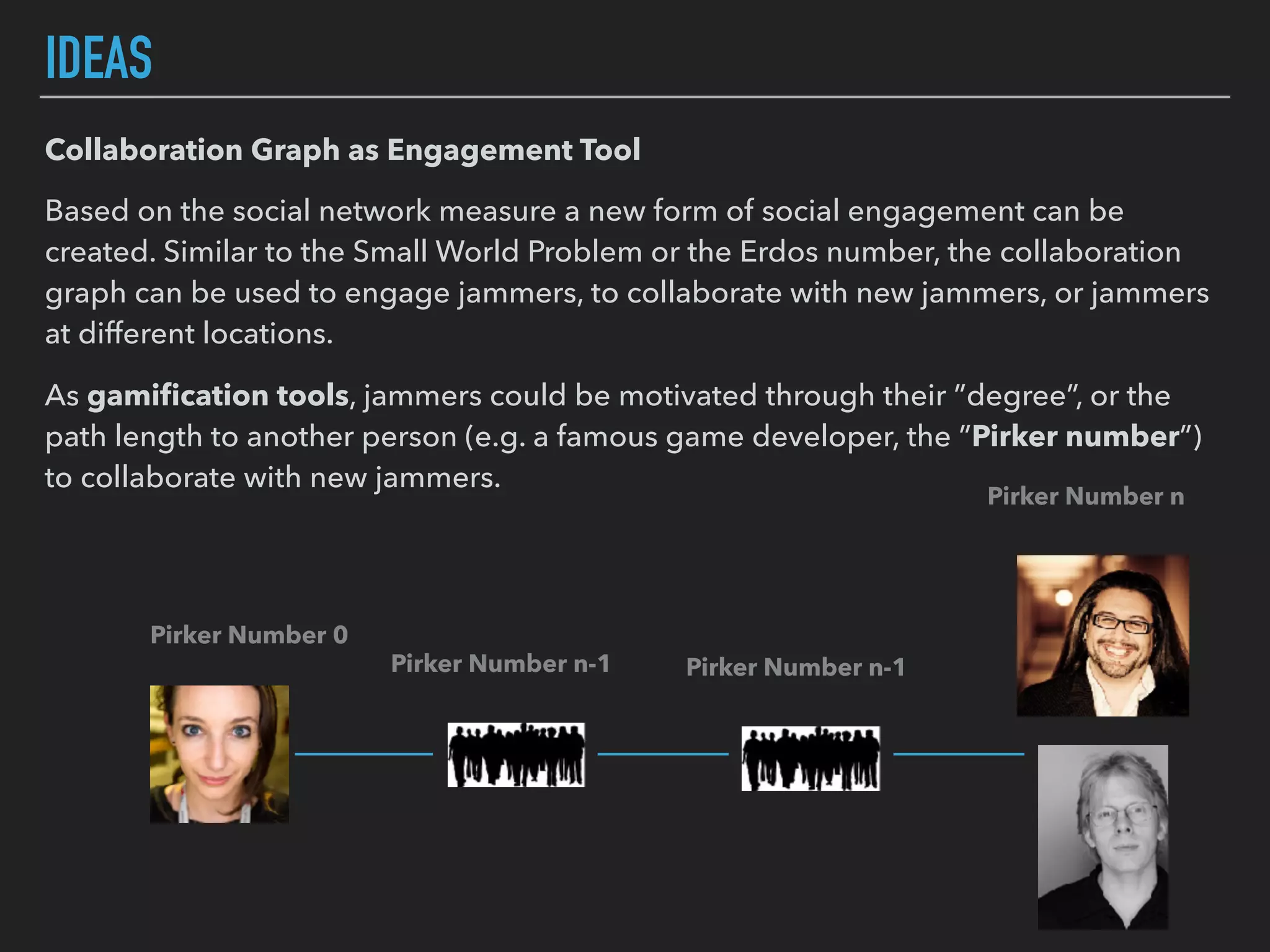
IDEAS
Collaboration Graph as Engagement Tool
Based on the social network measure a new form of social engagement can be
created. Similar to the Small World Problem or the Erdos number, the collaboration
graph can be used to engage jammers, to collaborate with new jammers, or jammers
at different locations.
As gamification tools, jammers could be motivated through their ”degree”, or the
path length to another person (e.g. a famous game developer, the ”Carmack
number”) to collaborate with new jammers.
Carmack Number 0
Carmack Number n
Carmack Number 1
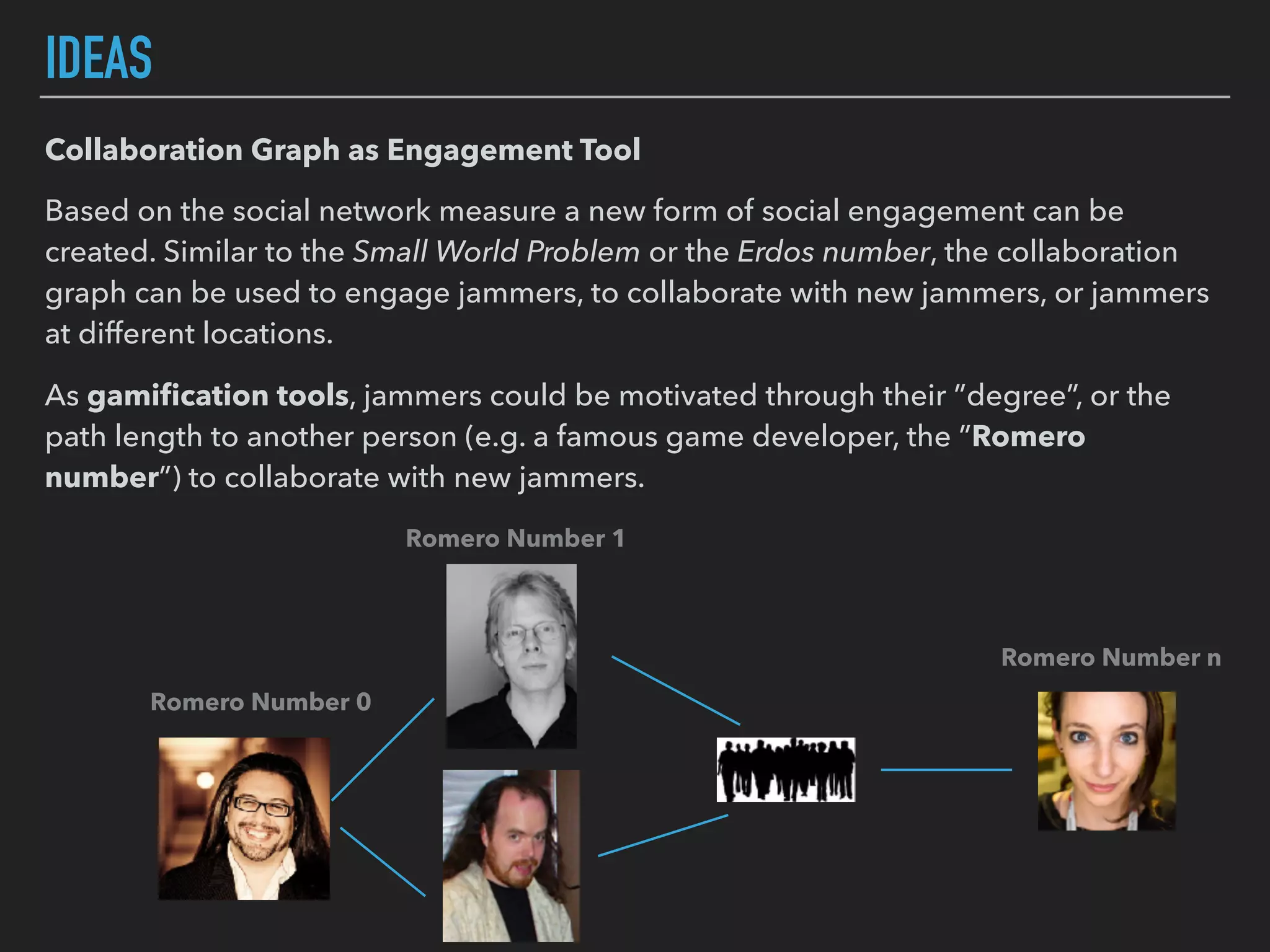
IDEAS
Collaboration Graph as Engagement Tool
Based on the social network measure a new form of social engagement can be
created. Similar to the Small World Problem or the Erdos number, the collaboration
graph can be used to engage jammers, to collaborate with new jammers, or jammers
at different locations.
As gamification tools, jammers could be motivated through their ”degree”, or the
path length to another person (e.g. a famous game developer, the ”Romero
number”) to collaborate with new jammers.
Romero Number 0
Romero Number n
Romero Number 1
IDEAS
Collaboration Graph as Engagement Tool
Based on the social network measure a new form of social engagement can be
created. Similar to the Small World Problem or the Erdos number, the collaboration
graph can be used to engage jammers, to collaborate with new jammers, or jammers
at different locations.
As gamification tools, jammers could be motivated through their ”degree”, or the
path length to another person (e.g. a famous game developer, the ”Pirker number”)
to collaborate with new jammers.
Pirker Number 0
Pirker Number n
Pirker Number n-1Pirker Number n-1
FURTHER READINGS
▸ Overview of further relevant readings:
▸ https://jpirker.com/talk-respawn/
gameconf.org
THANK YOU FOR YOUR
ATTENTION.
JOHANNA PIRKER, JPIRKER@MIT.EDU, @JOEYPRINK


Further information:
jpirker.com
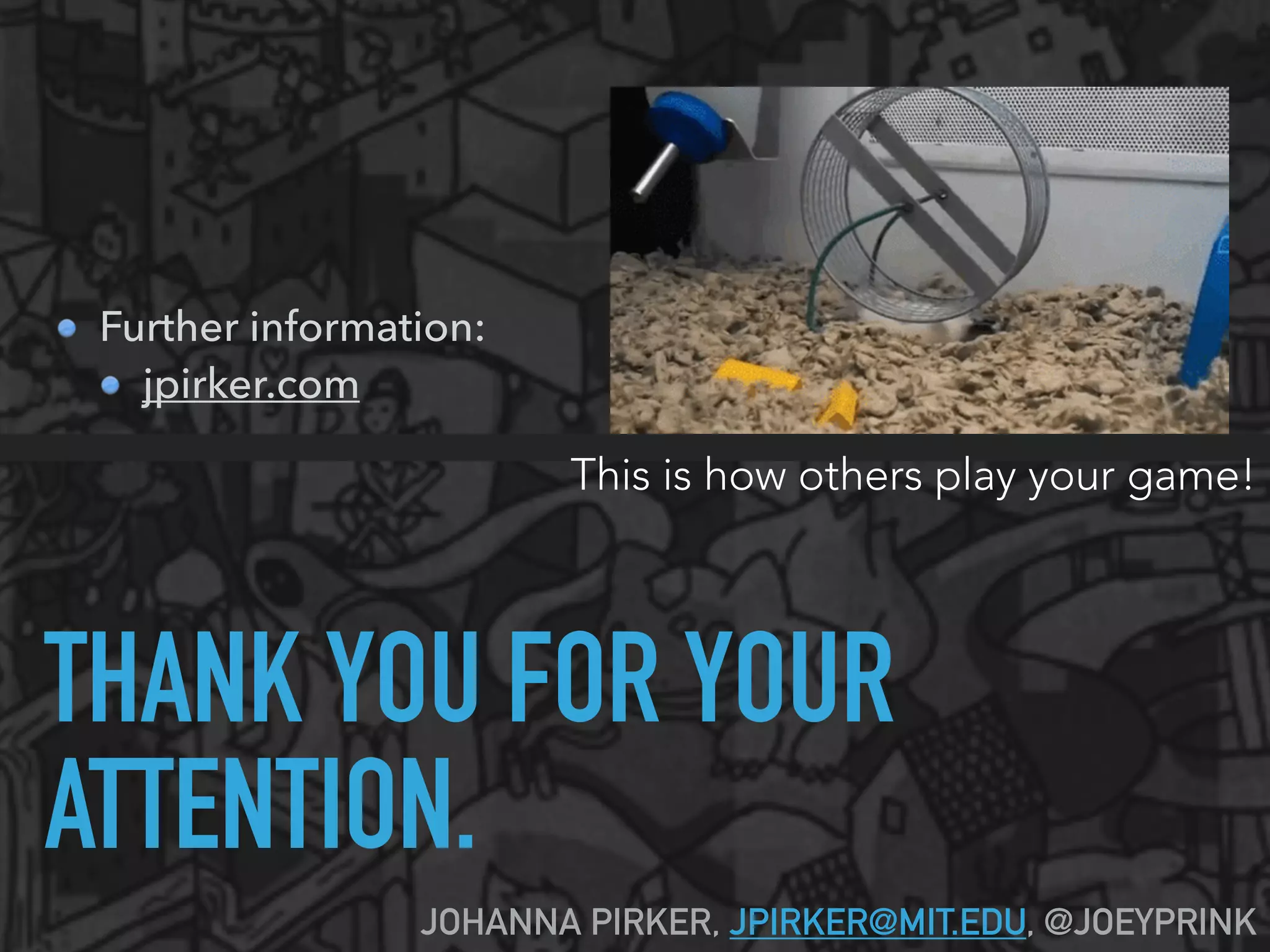
This is how others play your game!

Talk 2017 Respawn / Devcom - Social Network Analysis in Games and Communities

  • 1.
    S C IE N C E * PA S S I O N * T E C H N O L O G Y SOCIAL NETWORK ANALYSIS 
 IN GAMES AND COMMUNITIES J O H A N N A P I R K E R , T U G R A Z , A U S T R I A S U N A U G 1 9 : : R E S PAW N @ D E V C O M 2 0 1 7
  • 2.
    JOHANNA PIRKER ▸ ComputerScientist & Software Engineering @Graz University of Technology ▸ Virtual Realities (Maroon) @Massachusetts Institute of Technology ▸ Research & Edu at Institute for Interactive Systems & Data Science, TU Graz ▸ Virtual Realities & Worlds ▸ HCI, E-Learning, UX, Data Analysis (SNA) ▸ GUR Consulting ▸ Games Education (for CS) & Research, Design, Development & Analysis ▸ Website: www.jpirker.com @JOEYPRINK
  • 3.
    DATA ANALYTICS INGAMES ▸ Understanding player behaviour to create better or more innovative social game experiences ▸ Understanding and identifying patterns in game data ▸ -> who is the player? ▸ -> statistics on player behaviour (retention rate, concurrency, ..) ▸ -> social behaviour of players
  • 4.
  • 5.
    SOCIAL NETWORK ANALYSIS ▸“Strategy for investigating social structures through the use of network and graph theories” ▸ Nodes (actors, people, topics) ▸ Ties / Edges (relationships) ▸ We can model the world around us as networks ▸ To get new information Further reading: jis.sagepub.com/content/28/6/441.short
  • 6.
    SIX DEGREES OFSEPARATION ▸ In 1967, Stanley Milgram (social psychologist at Yale & Harvard) conducted the small-world-experiment that is the basis of the “six degrees of separation” concept. ▸ He sent several packages to randomly selected individuals in the US, asking them to forward the package to a target contact person in Boston. The average path length for the received packages was around 5.5. Further reading: en.wikipedia.org/wiki/Small-world_experiment
  • 7.
    SIX DEGREES OFSEPARATION ▸ In 2008, a study of Microsoft showed that the average chain of contacts between users of MSN was 6.6 people. ▸ In 2016, Facebook observed an average connection distance between Facebook users of 3.57. Further reading: en.wikipedia.org/wiki/Small-world_experiment
  • 8.
    www.tugraz.at n Hier könnteIhr Logo stehen Social Network Analysis - Applications §  Political Blogs §  Prior to the 2004 U.S. Presidential election April 28, 2015 Christian Gütl, Johanna Pirker - Institute of Information Systems and Computer Media 10 Reading: http://dl.acm.org/citation.cfm?id=1134277
  • 9.
    www.tugraz.at n Hier könnteIhr Logo stehen Social Network Analysis – Applications §  Organizations §  Email delivery at HP labs §  Informal communication April 28, 2015 Christian Gütl, Johanna Pirker - Institute of Information Systems and Computer Media 11 Reading: http://www.cs.princeton.edu/~chazelle/courses/BIB/HubermanAdamic.pdf
  • 10.
    www.tugraz.at n Hier könnteIhr Logo stehen Social Network Analysis – Applications §  Ingredient networks April 28, 2015 Christian Gütl, Johanna Pirker - Institute of Information Systems and Computer Media 12 Reading: http://dl.acm.org/citation.cfm?id=2380757
  • 11.
    www.tugraz.at n Hier könnteIhr Logo stehen Social Network Analysis – Applications §  Romantic relationships in a US high school, §  18 month period §  (sexually transmitted diseases) April 28, 2015 Christian Gütl, Johanna Pirker - Institute of Information Systems and Computer Media 13 Reading: http://www.soc.duke.edu/~jmoody77/chains.pdf
  • 12.
    www.tugraz.at n Hier könnteIhr Logo stehen Wikipedia Network Game April 28, 2015 Christian Gütl, Johanna Pirker - Institute of Information Systems and Computer Media 15 http://thewikigame.com/
  • 13.
    www.tugraz.at n Hier könnteIhr Logo stehen Graph Basics (1) §  Nodes/vertices (actors) §  Edges/link (inter-node relationships) April 28, 2015 Christian Gütl, Johanna Pirker - Institute of Information Systems and Computer Media 19
  • 14.
    www.tugraz.at n Hier könnteIhr Logo stehen Tools for SNA April 28, 2015 Christian Gütl, Johanna Pirker - Institute of Information Systems and Computer Media §  Gephi (all platforms, os) -> Demo §  gephi.org §  R packages for SNA (all platforms, os) §  NodeXL (for Excel, Windows) §  (D3) 33 (http://bost.ocks.org/mike/miserables/ )
  • 15.
  • 16.
  • 17.
    TYPICAL QUESTIONS ▸ Analyzingindividuals: ▸ Who are well connected / important players in a network? ▸ What is the influence of individuals? ▸ Who is the player with the largest reach? ▸ Who are players connecting different player groups?
  • 18.
    TYPICAL QUESTIONS ▸ Analyzinggroups and communities: ▸ How can we identify groups and communities? ▸ How are players connected with each other? ▸ Are players more engaged by playing along or together? ▸ Are players in groups performing better than players playing on their own? ▸ Do connected players share common interests?
  • 19.
    TYPICAL QUESTIONS ▸ Analyzingsocial dynamics: ▸ How do players connect to other players? ▸ How do players build guilds? ▸ When a player gets an interesting item to share with other players, how far will it get transmitted? ▸ How can we recommend players in PvP matches?
  • 20.
  • 21.
    BUILDING PLAYER NETWORKS ▸Undirected networks (Links are undirected) ▸ Directed networks (Links are directed) ▸ Weighted networks (Links are weighted)
  • 22.
    BUILDING PLAYER NETWORKS ▸Direct relationships: Direct (explicit) interactions between players are identified and used (e.g. in-game messaging, friendships, clan memberships). ▸ Indirect relationships: Relationships also can be identified through indirect (implicit) interactions (playing in same matches or opponent matches, same playing time, same in-game location).
  • 23.
  • 24.
    SOCIAL NETWORK ANALYSISIN DESTINY ▸ Work with Anders Drachen, André Rattinger, Rafet Sifa, Günter Wallner ▸ www.gamasutra.com/blogs/AndersDrachen/ 20161123/286112/Playing_with_Friends_in_Destiny.php ▸ http://www.rafetsifa.net/wp-content/uploads/2017/02/ Rattinger_et_al_2016_ICEC.pdf 

  • 25.
    NETWORK RELATIONSHIP ‣ PlayerNetwork ‣ v: players ‣ e: match played together 
 / against each other ‣ undirected, weighted graph ‣ (weight: # matches played together) PLAYER 1 PLAYER 2 PLAYER 3 3 1
  • 26.
    SOCIAL NETWORKS INDESTINY Rattinger, A., Wallner, G., Drachen, A., Pirker, J., & Sifa, R. (2016, September) Integrating and Inspecting Combined Behavioral Profiling and Social Network Models in Destiny,15th International Conference on Entertainment Computing (in press).
  • 27.
    PERFORMANCE ANALYSIS ▸ Howperform players? ▸ Players playing more often with the same players in teams have a higher success rate
  • 28.
    ENGAGEMENT ANALYSIS ▸ Howto engage players? ▸ Players playing more often with the same players in teams play more often and longer
  • 29.
    RETENTION ANALYSIS ▸ Howto keep players engaged? ▸ Identification of important nodes
  • 30.
  • 31.
    SOCIAL NETWORK ANALYSISOF THE GLOBAL GAME JAM ▸ Work with Foaad Khosmood, Christian Gütl, Andreas Punz ▸ https://jpirker.com/wp-content/uploads/ 2013/09/2017icgj-global-game.pdf
  • 32.
    GLOBAL GAME JAM ▸“world’s largest game development event taking place around the world at physical locations” ▸ each game uploaded to GGJ website and linked to jammer profiles ▸ -> social interactions ▸ -> international context
  • 33.
    DATASET ▸ Dataset crawledfrom GGJ website ▸ 2014-2016
  • 34.
    NETWORK RELATIONSHIP explicit (friend,follow information) vs implicit (shared interests) networks ▸ Jammer Network: describes connections between jammers through the games they have developed together (v= jammer, e = developed games together) ▸ Location Network: demonstrates the connectivity between various locations or nations through (moving) jammers (v = location, e = jammers developed games together) ▸ Game Network: represents a network of all games developed connected through jammers (v = games, e = common jammers in the development process)
  • 35.
    NETWORK RELATIONSHIP ‣ JammerNetwork ‣ three-year span ‣ v: jammers ‣ e: developed a game together 
 ‣ undirected, weighted graph ‣ (weight: # games developed together) JAMMER 1 JAMMER 2 JAMMER 3 3 1
  • 36.
  • 37.
  • 38.
    NETWORK STRUCTURE ▸ Averagedegree ▸ avg # of connections j2j: 4.335; most 2-6 jammers ▸ almost 1.500 jammers degree of 1 :-(, a few 9+
  • 39.
    NETWORK STRUCTURE ▸ Averageweighted degree ▸ avg # of weighted connections j2j: 5.515 ▸ likely to work with same people
  • 40.
    NETWORK PROPERTIES Degree canbe used to predict tasks (e.g. high degree refers to audio engineers)
  • 41.
  • 42.
    GOALS • Improve ourunderstanding of the developer engagement and behaviours to improve experience • Find issues to avoid drop-outs at jam events • Find “important” nodes (bridges) and “weak” nodes • Find flaws early and maybe also automatically/ dynamically
  • 43.
    IDEAS Collaboration Graph asEngagement Tool Based on the social network measure a new form of social engagement can be created. Similar to the Small World Problem or the Erdos number, the collaboration graph can be used to engage jammers, to collaborate with new jammers, or jammers at different locations. As gamification tools, jammers could be motivated through their ”degree”, or the path length to another person (e.g. a famous game developer, the ”Carmack number”) to collaborate with new jammers. Carmack Number 0 Carmack Number n Carmack Number 1
  • 44.
    IDEAS Collaboration Graph asEngagement Tool Based on the social network measure a new form of social engagement can be created. Similar to the Small World Problem or the Erdos number, the collaboration graph can be used to engage jammers, to collaborate with new jammers, or jammers at different locations. As gamification tools, jammers could be motivated through their ”degree”, or the path length to another person (e.g. a famous game developer, the ”Romero number”) to collaborate with new jammers. Romero Number 0 Romero Number n Romero Number 1
  • 45.
    IDEAS Collaboration Graph asEngagement Tool Based on the social network measure a new form of social engagement can be created. Similar to the Small World Problem or the Erdos number, the collaboration graph can be used to engage jammers, to collaborate with new jammers, or jammers at different locations. As gamification tools, jammers could be motivated through their ”degree”, or the path length to another person (e.g. a famous game developer, the ”Pirker number”) to collaborate with new jammers. Pirker Number 0 Pirker Number n Pirker Number n-1Pirker Number n-1
  • 46.
    FURTHER READINGS ▸ Overviewof further relevant readings: ▸ https://jpirker.com/talk-respawn/
  • 47.
  • 48.
    THANK YOU FORYOUR ATTENTION. JOHANNA PIRKER, JPIRKER@MIT.EDU, @JOEYPRINK 
 Further information: jpirker.com This is how others play your game!