BLEED-IN, BLEED-OUT
A DESIGN CASE IN BOARD GAME THERAPY
DIGRA Conference, Turin, July 25 2018
Mirjam Palosaari Eladhari of Södertörn University
MOTIVATIONS FOR THIS WORK
➤ table-top play situation offers unique 

opportunities for approaching real-world 

personal problems
➤ structures inherent in the problems can 

be deconstructed, examined, and 

understood
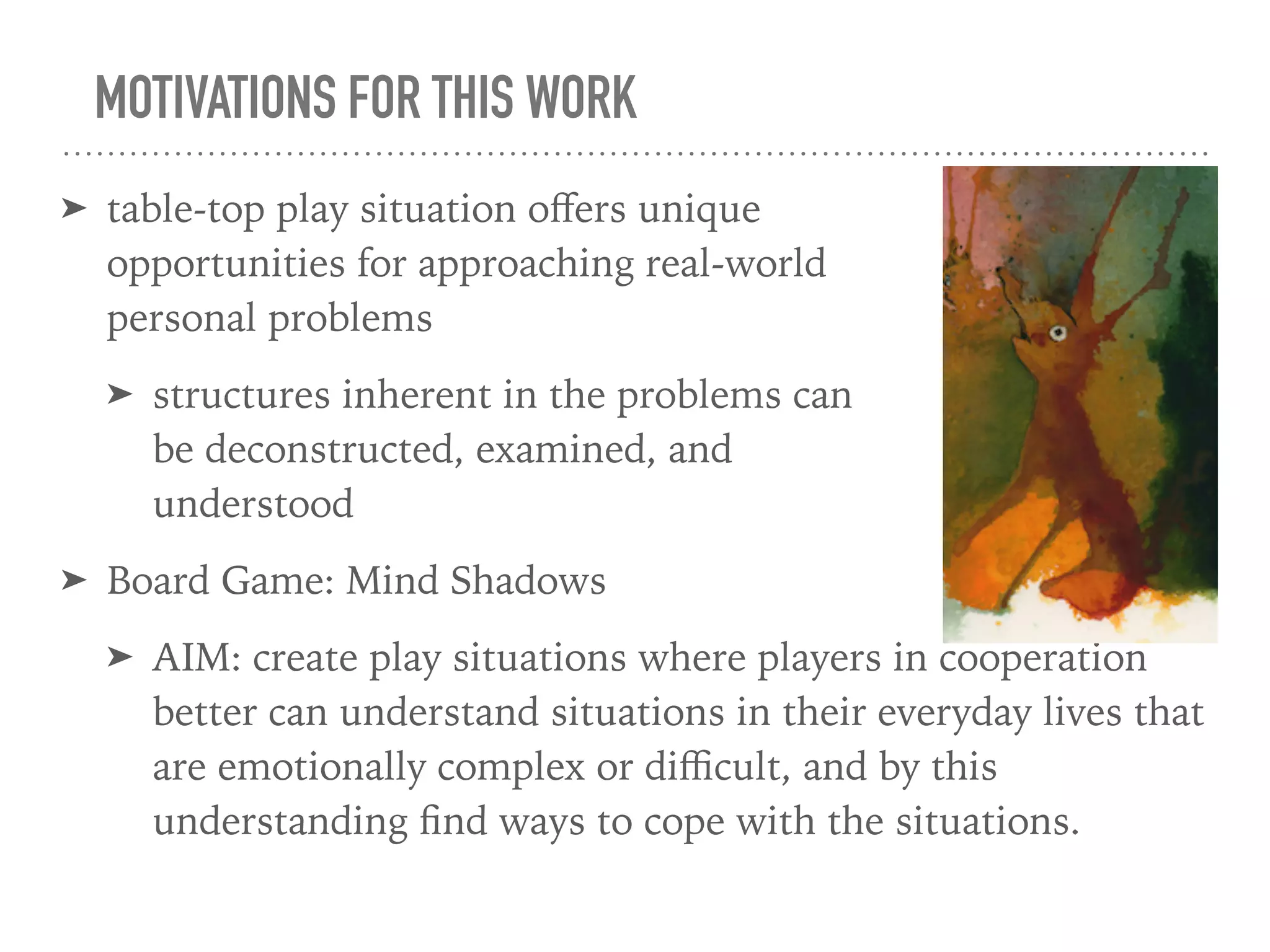
➤ Board Game: Mind Shadows
➤ AIM: create play situations where players in cooperation
better can understand situations in their everyday lives that
are emotionally complex or difficult, and by this
understanding find ways to cope with the situations.
OVERVIEW OF THIS TALK
➤ Games for therapy?
➤ Mind Shadows Board game
➤ Design considerations
➤ The tension between a gamist number counting approach to
drive the play-session forward and the need to have the game
state reflect the actual moods and emotions of the players.
➤ Bleed.The transportation real life issues into a magic circle,
where player reflect upon, and the consideration of how
effects of the reflections may bleed back into players’ every-
day lives.
➤ The framing of the play-sessions as safe-spaces.
THERAPY?
➤ it is not possible to, relying on previous research, to say that
playing (fantasy) games have either good or bad effects on
players’ mental well being. (Lieberoth and Trier-Knudsen
2016). However:
➤ The framing is a key aspect, and role-playing may become a
“safe place to communicate emotions, gain release from
anxieties, or play around with different identity
facets” (drawing upon results from several studies; e.g.
(Ascherman 1993; Hughes 1988; Denman 1988).
PSYCHODRAMA
➤ Moreno’s practice of psychodrama (Moreno and Moreno
1959)
➤ Hollander’s Psychodrama Curve (Hollander 2002). 

3 parts of a psychodrama session
➤ warm-up,
➤ the activity, and
➤ the integration.
PSYCHODRAMA
➤ Moreno’s practice of psychodrama (Moreno and Moreno
1959)
➤ Hollander’s Psychodrama Curve (Hollander 2002). 

3 parts of a psychodrama session. In table-top framing:
➤ warm-up, = set-up
➤ the activity, and = Play
➤ the integration. = Counting and determination of
results
PLAYING MIND SHADOWS - OVERVIEW
➤ Set-up: The emotional state, Giving each other super-powers,
and Defining the Shadow
➤ Play:
➤ Fictional framing: Storytellers’ turn
➤ Shadow’s turn (destructive actions)
➤ Player’s turn (supportive actions)
➤ Win If Shadows emotion or significance is exhausted
➤ Reflection: Leafing through what happened in the session,
adding new support cards to the main deck.
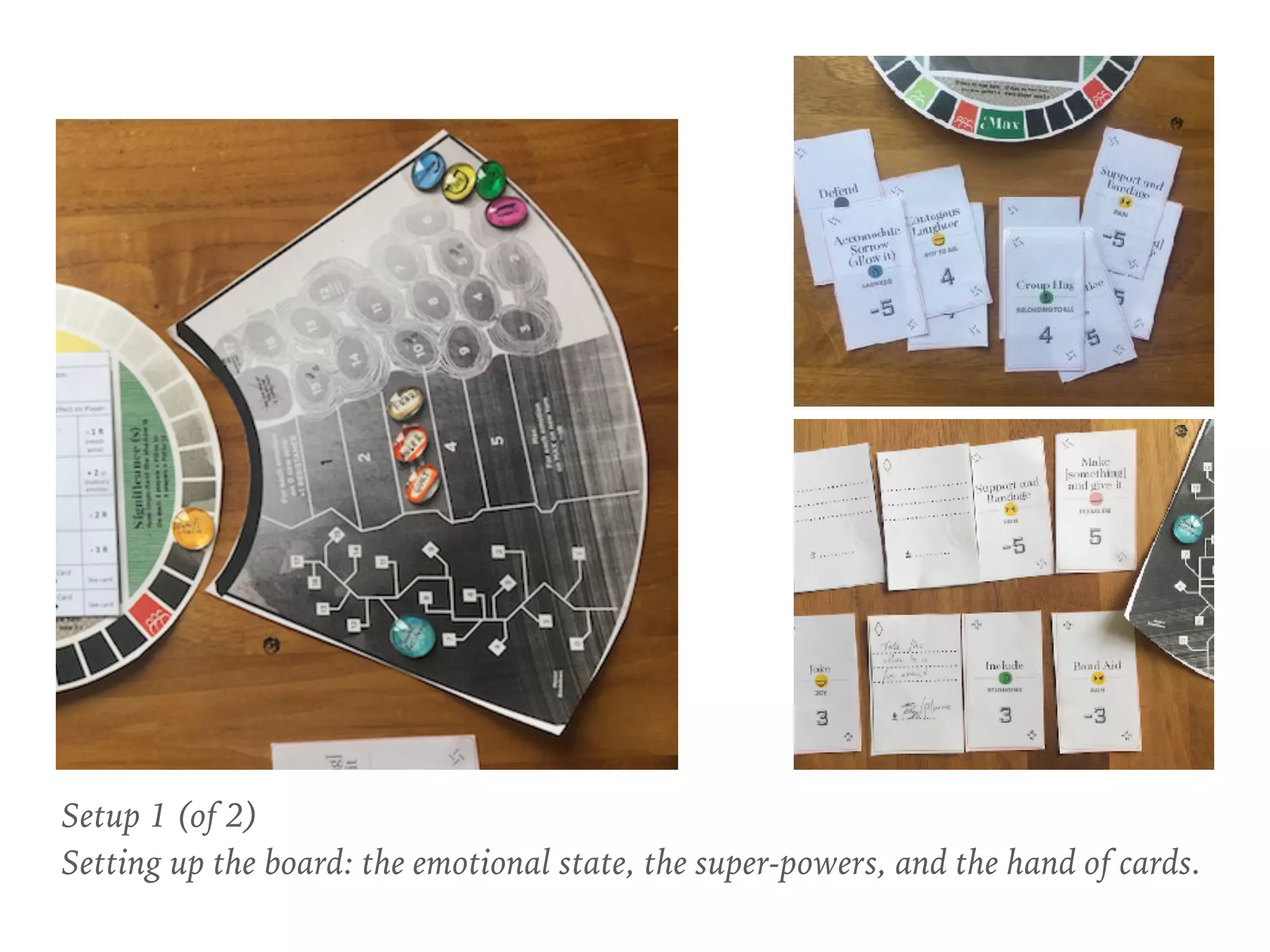
Setup 1 (of 2)

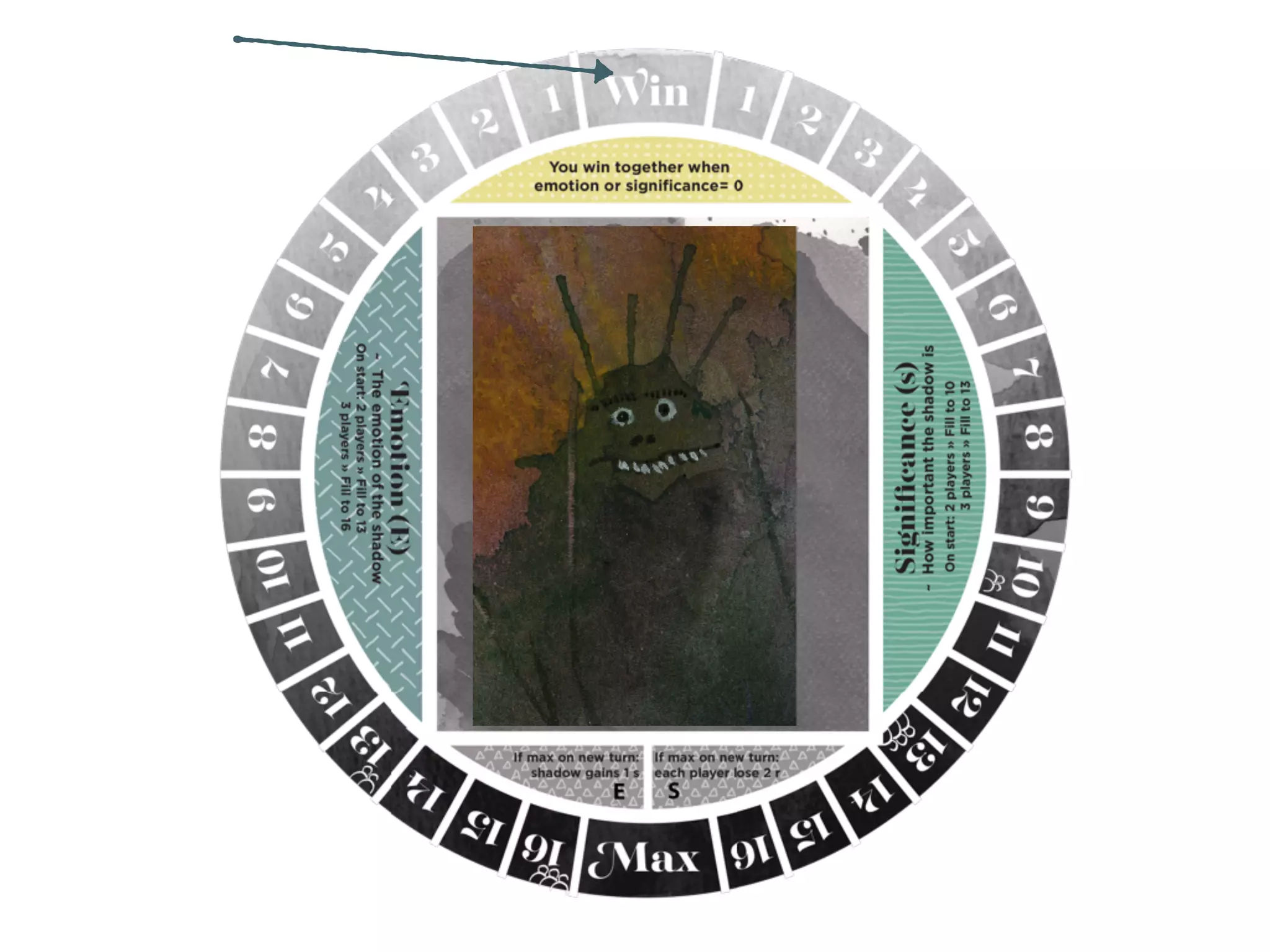
Setting up the board: the emotional state, the super-powers, and the hand of cards.
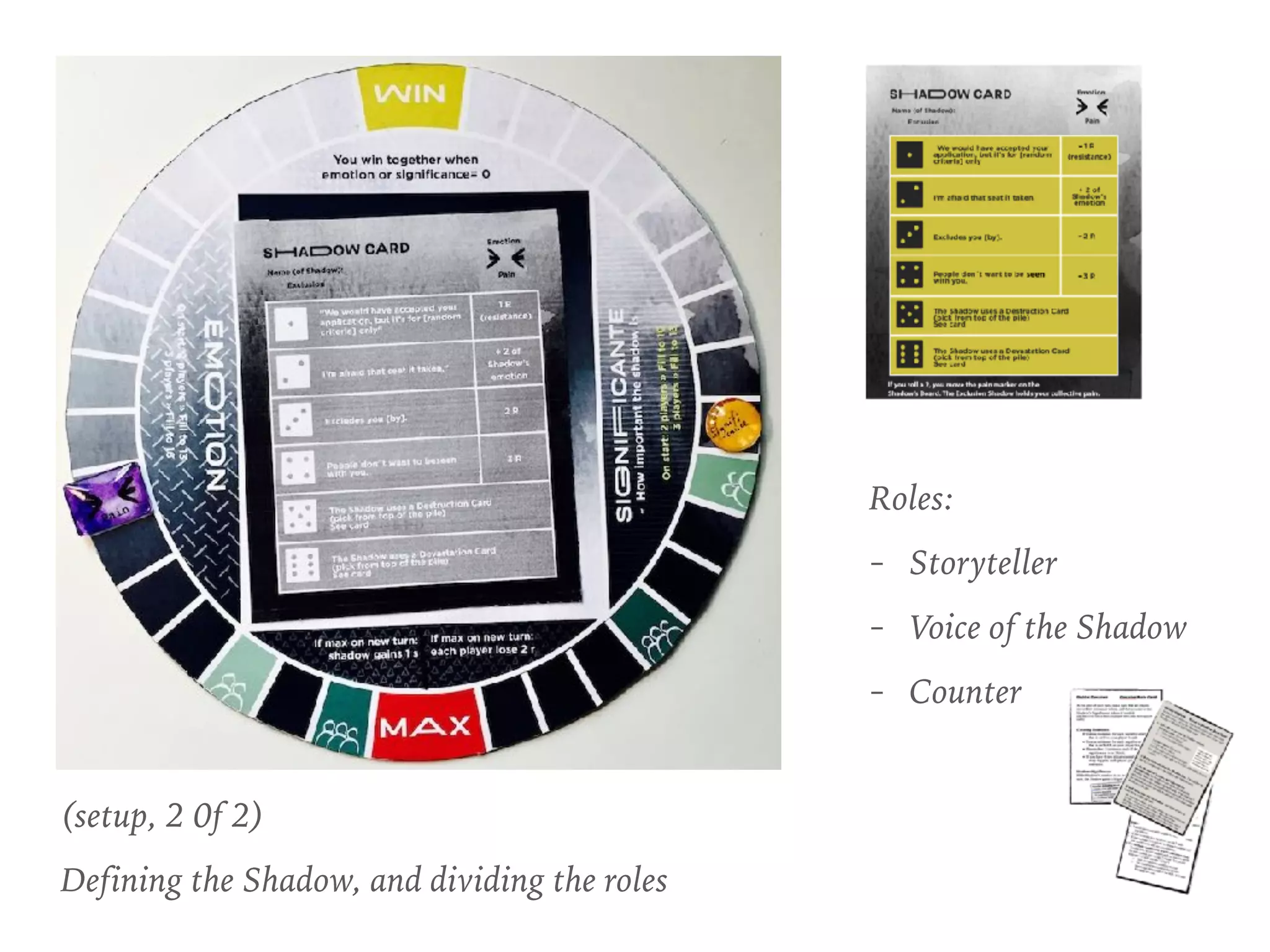
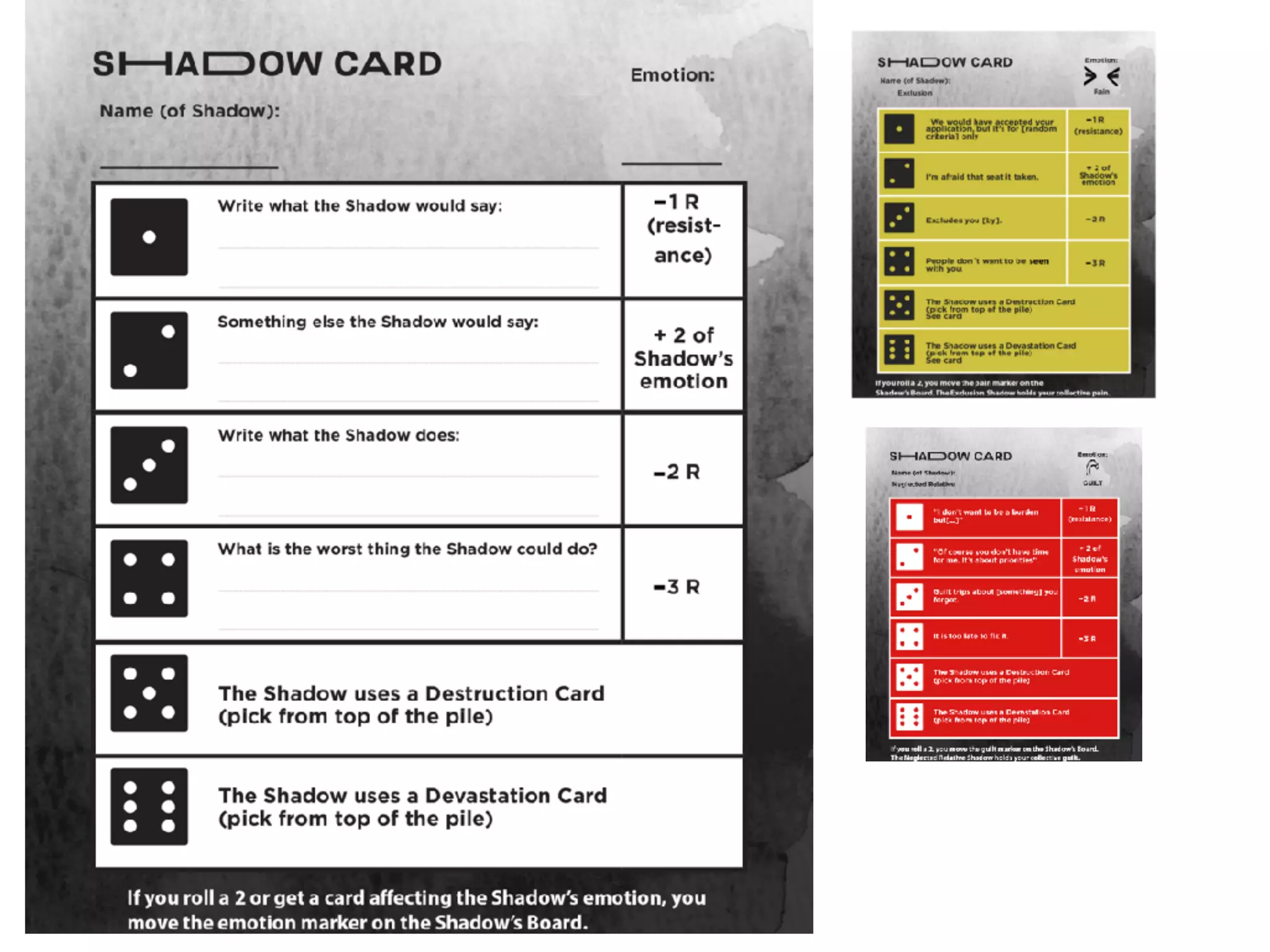
(setup, 2 0f 2)
Defining the Shadow, and dividing the roles
Roles:
- Storyteller
- Voice of the Shadow
- Counter
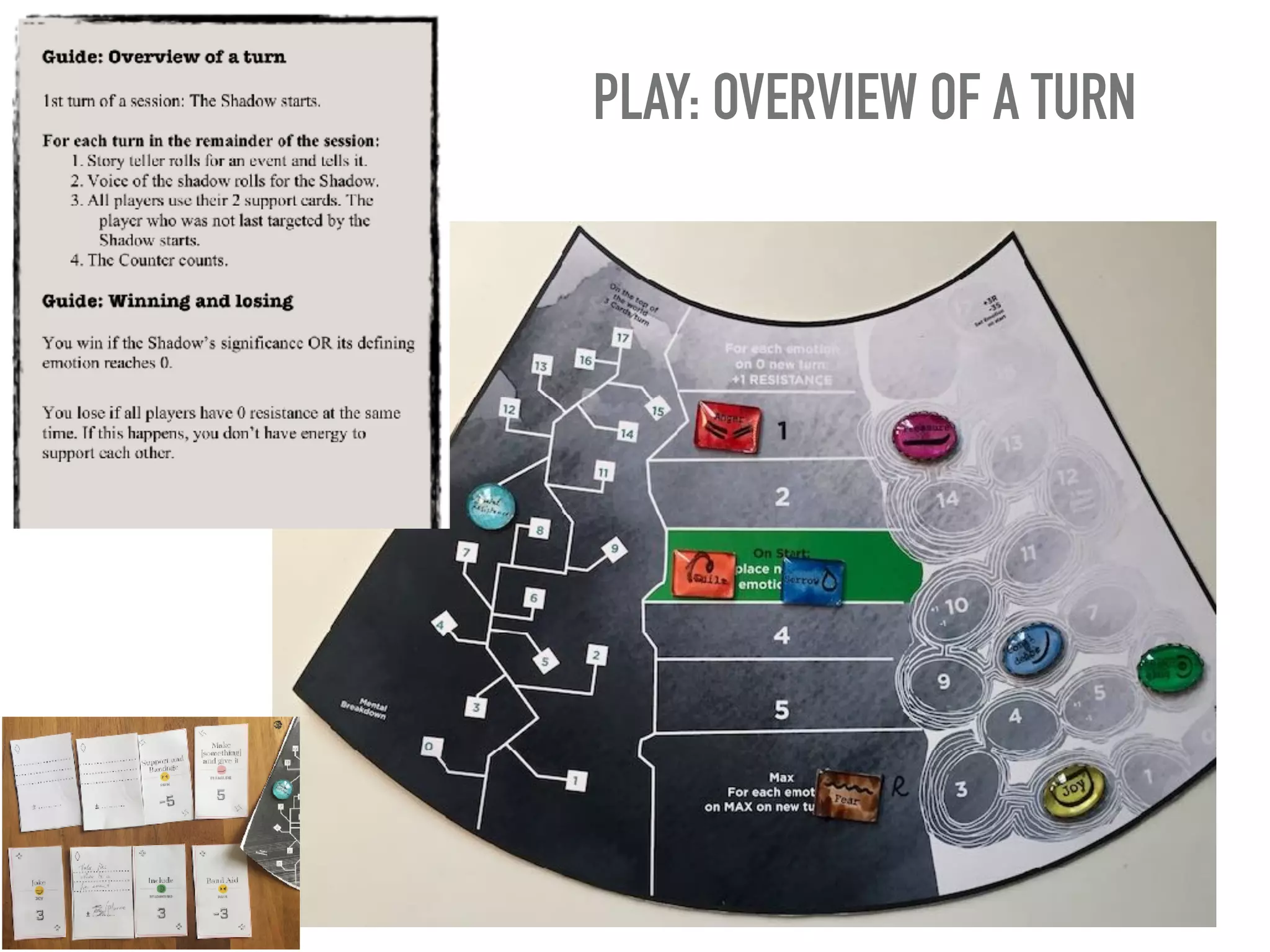
PLAY: OVERVIEW OF A TURN
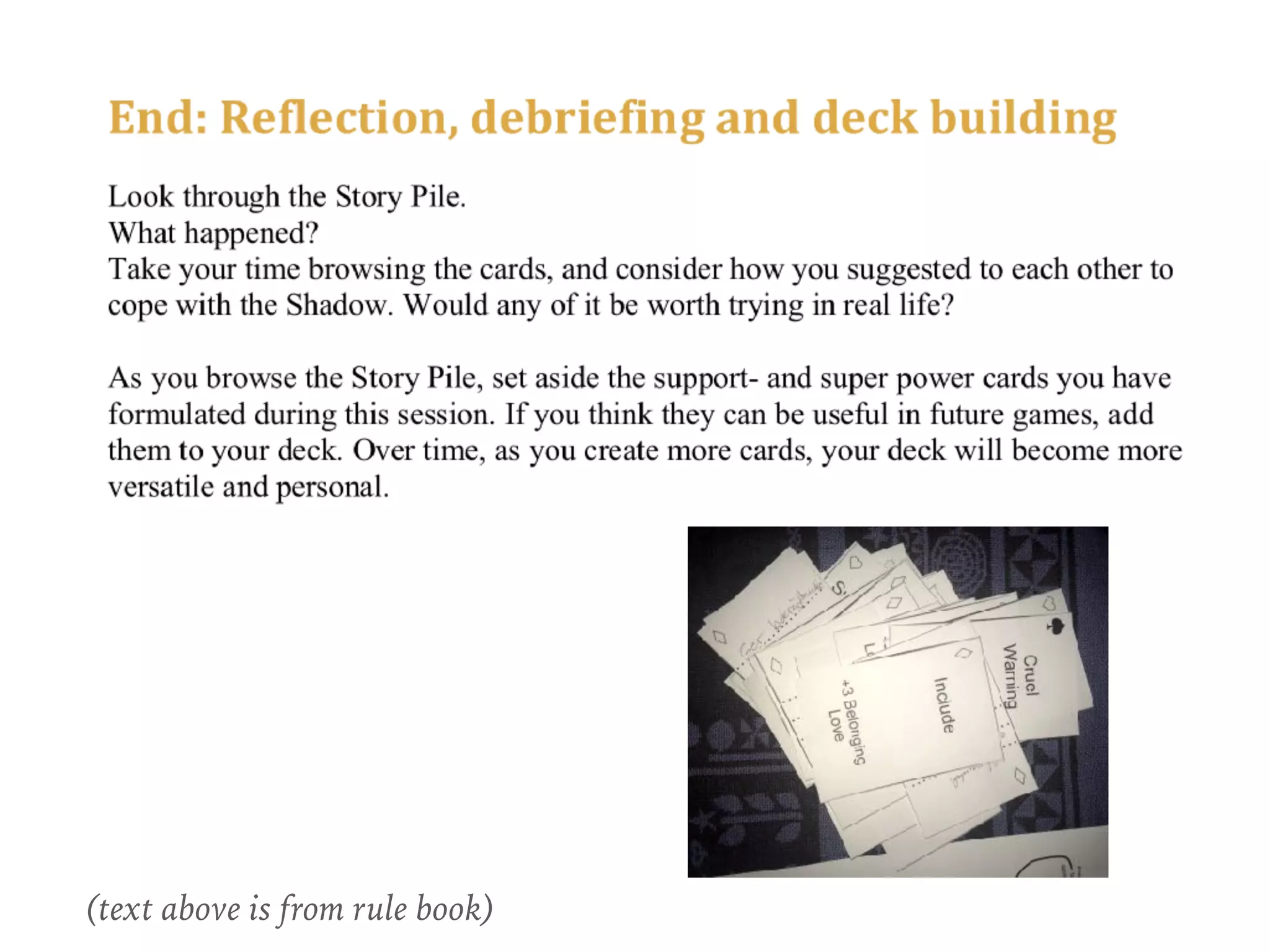
(text above is from rule book)
WHAT’S GOING ON IN PLAY
➤ Players try to understand the situation with the shadow: what
actions and events are de-facto? What is structural, what is
immutable, what can be changed?
➤ Trying to understand their own shadow
➤ Experiencing the other’s shadow, emphasising
➤ Getting to grips of how it feels (how it really feels, not how it
is supposed to feel).
➤ Coming up with suggestion after suggestion of how to help
the other - trying the actions and see how they could work. 


(These observations are grounded in 18 documented play-tests)
NOTE ABOUT THE DESIGN AND PRODUCTION PROCESS
➤ Design is loosely based on the most successful feature of a
previous game, the MMO prototype Pataphysic Institute,
where players authored their own boss mobs.
➤ I was about to isolate this feature, make it into a tablet-game,
but got the idea “How far can I get with paper and a 6 sided
die?” … and now it became this.
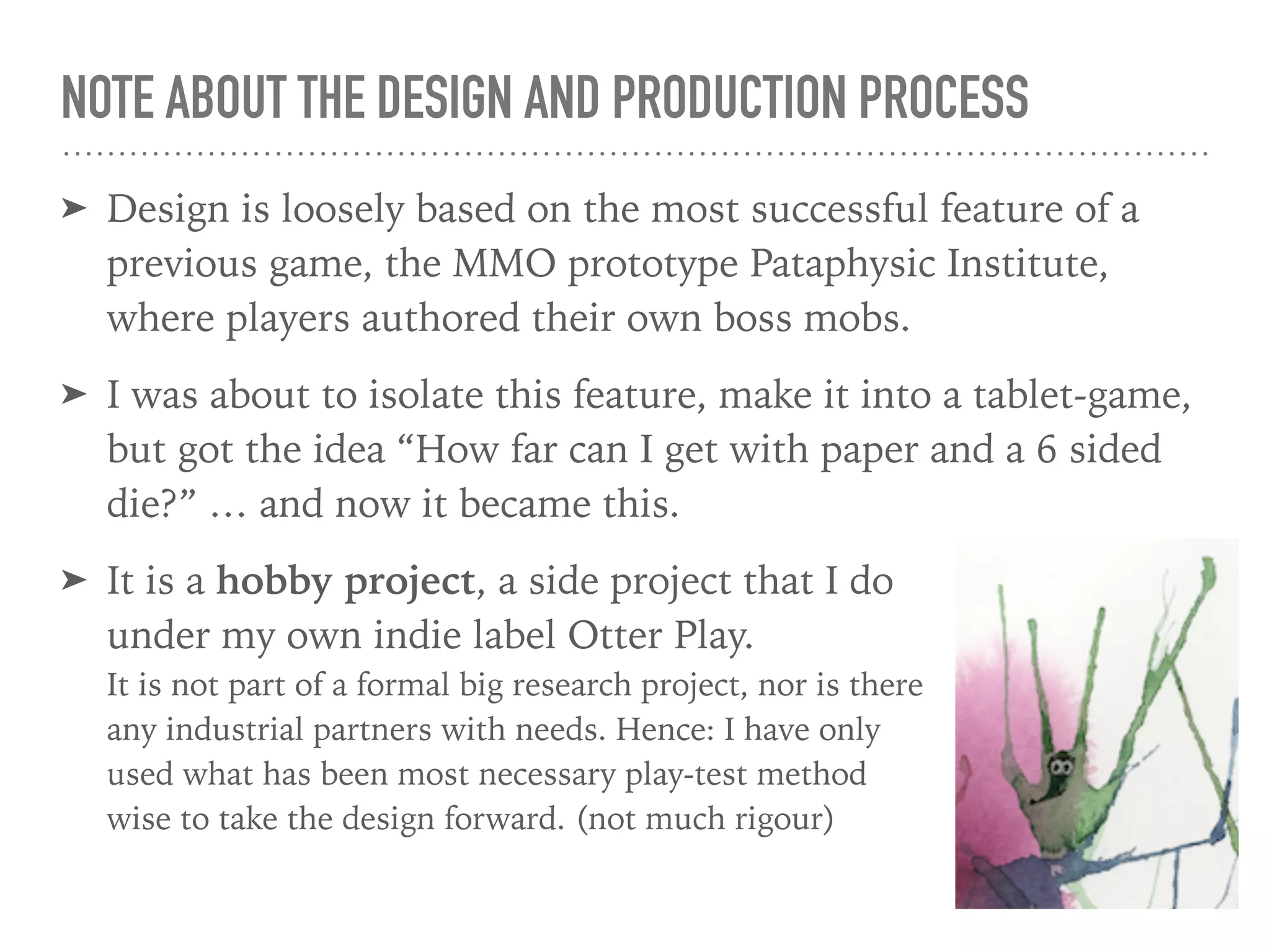
➤ It is a hobby project, a side project that I do 

under my own indie label Otter Play. 

It is not part of a formal big research project, nor is there 

any industrial partners with needs. Hence: I have only 

used what has been most necessary play-test method 

wise to take the design forward. (not much rigour)
TENSION BETWEEN ‘GAMIST’ AND ‘MALLEABLE’ APPROACH TO RULES
➤ “It doesn’t FEEL like that!”
➤ Design is now tested to allow for player’s
own reporting of their emotions -> as long
as positive-negative emotion values are
done in the same way the mechanics will
function. (A *tad* less balance in the deck
between occurrences of emotional effects,
but it works good enough)
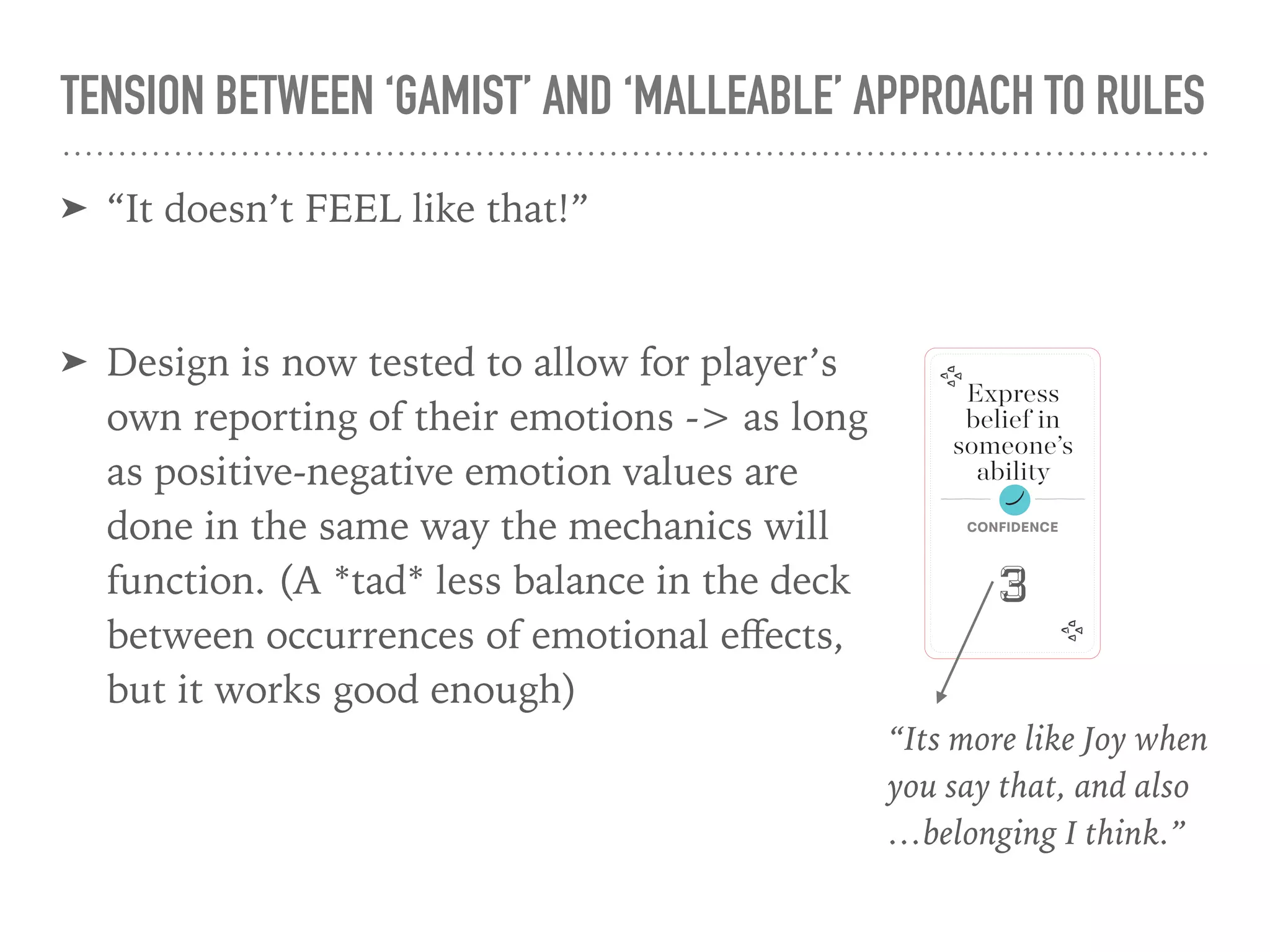
Express
belief in
someone’s
ability
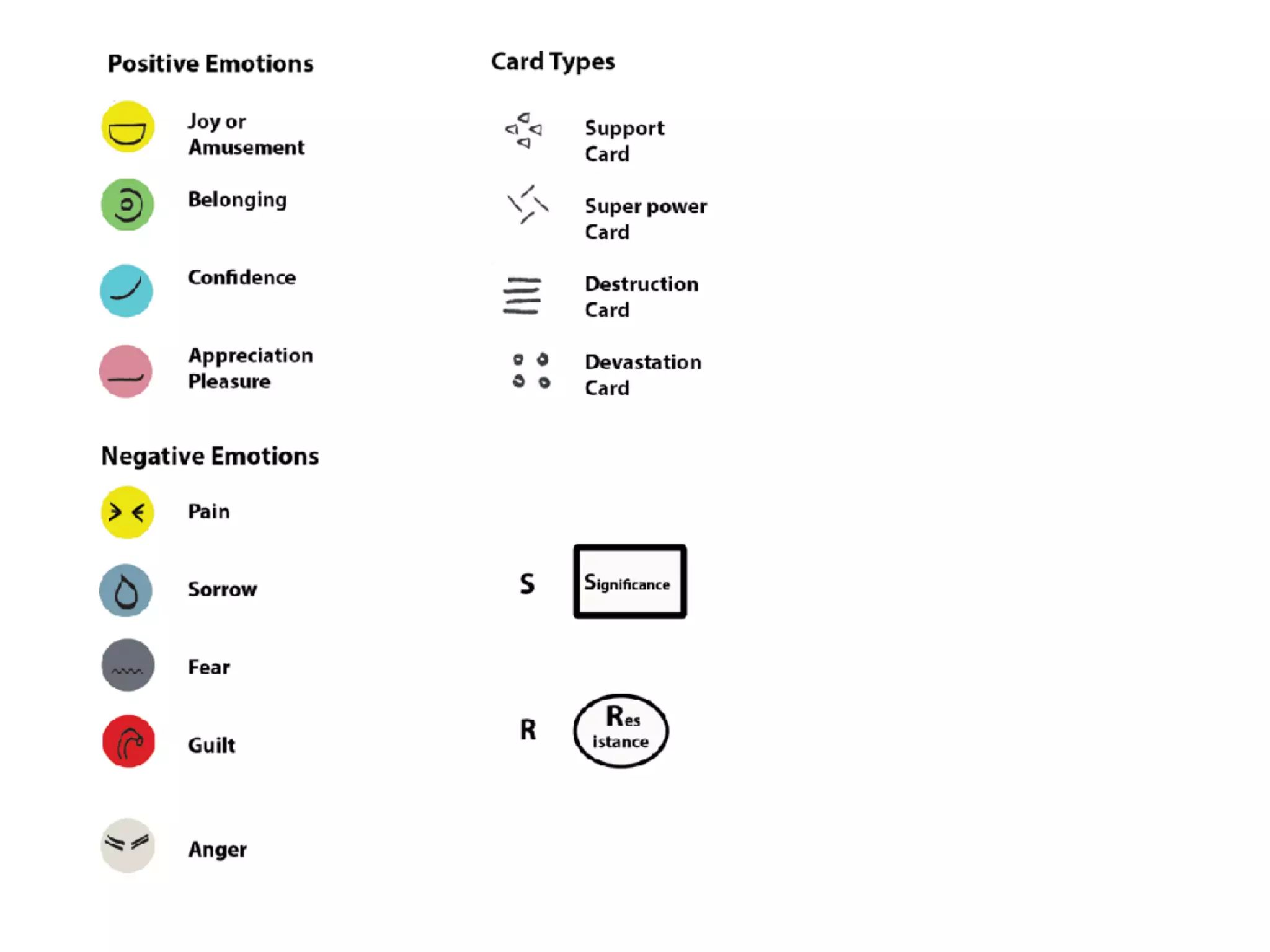
Confidence
3
“Its more like Joy when 

you say that, and also

…belonging I think.”
BLEED
Bleed - how role-players have experiences where their real life
feelings, thoughts, relationships, and physical states spill over
into their characters’ and the other way around (Montola 2013).
Bleed is central to Mind Shadows - not a side effect, but part of
the design.
But: the more malleable the play, and the more sensitive, player-
authored Shadow: the deeper the journey.
BLEED
Bleed - how role-players have experiences where their real life
feelings, thoughts, relationships, and physical states spill over
into their characters’ and the other way around (Montola 2013).
Bleed is central to Mind Shadows - not a side effect, but part of
the design.
But: the more malleable the play, and the more sensitive, player-
authored Shadow: the deeper the journey.
Framing the play session as a safe space is
CRITICAL!
(Critical in the sense that it helps approach difficult topics,
and that there is a readiness to deal with what may come up)
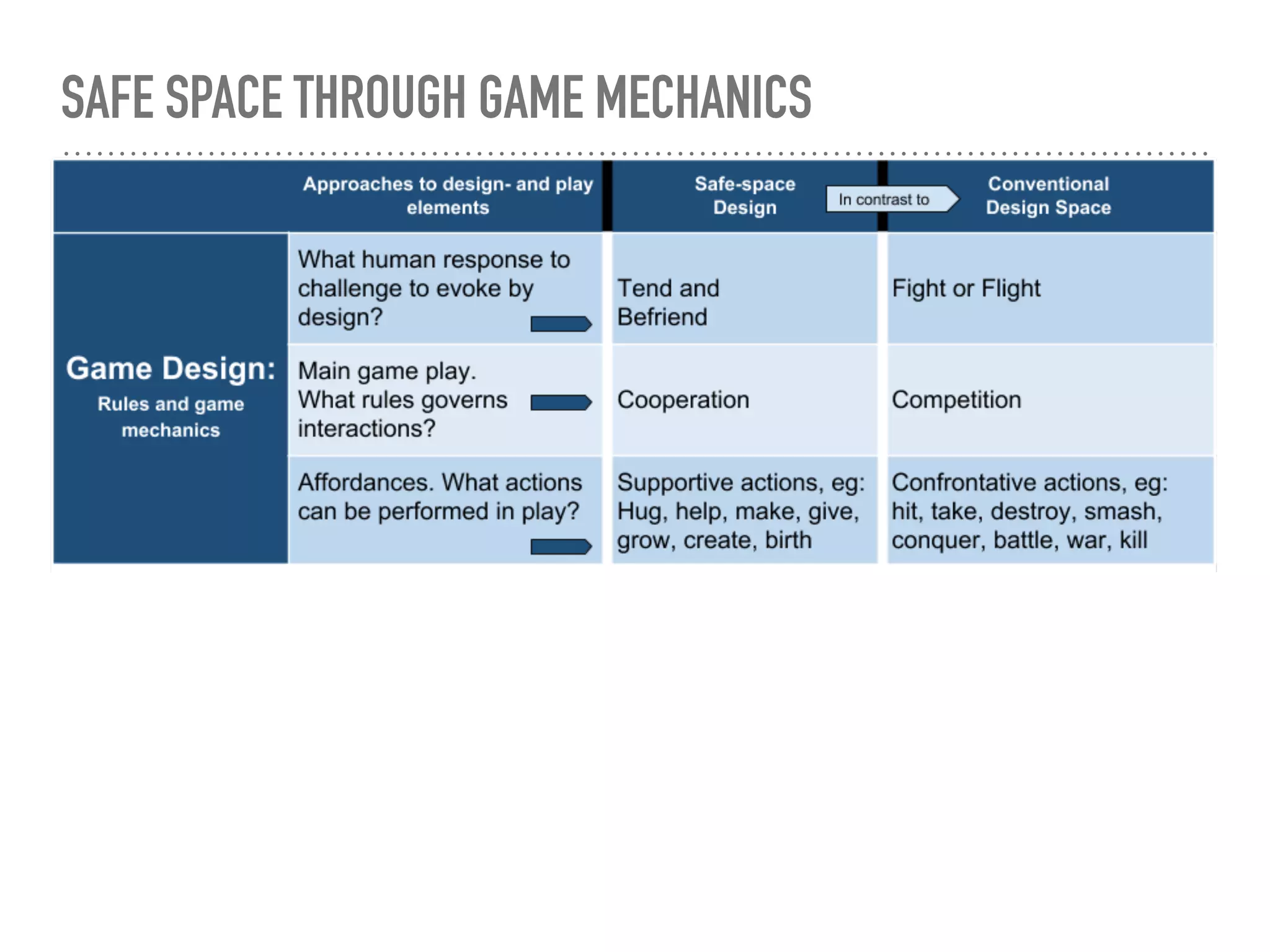
SAFE SPACE THROUGH GAME MECHANICS
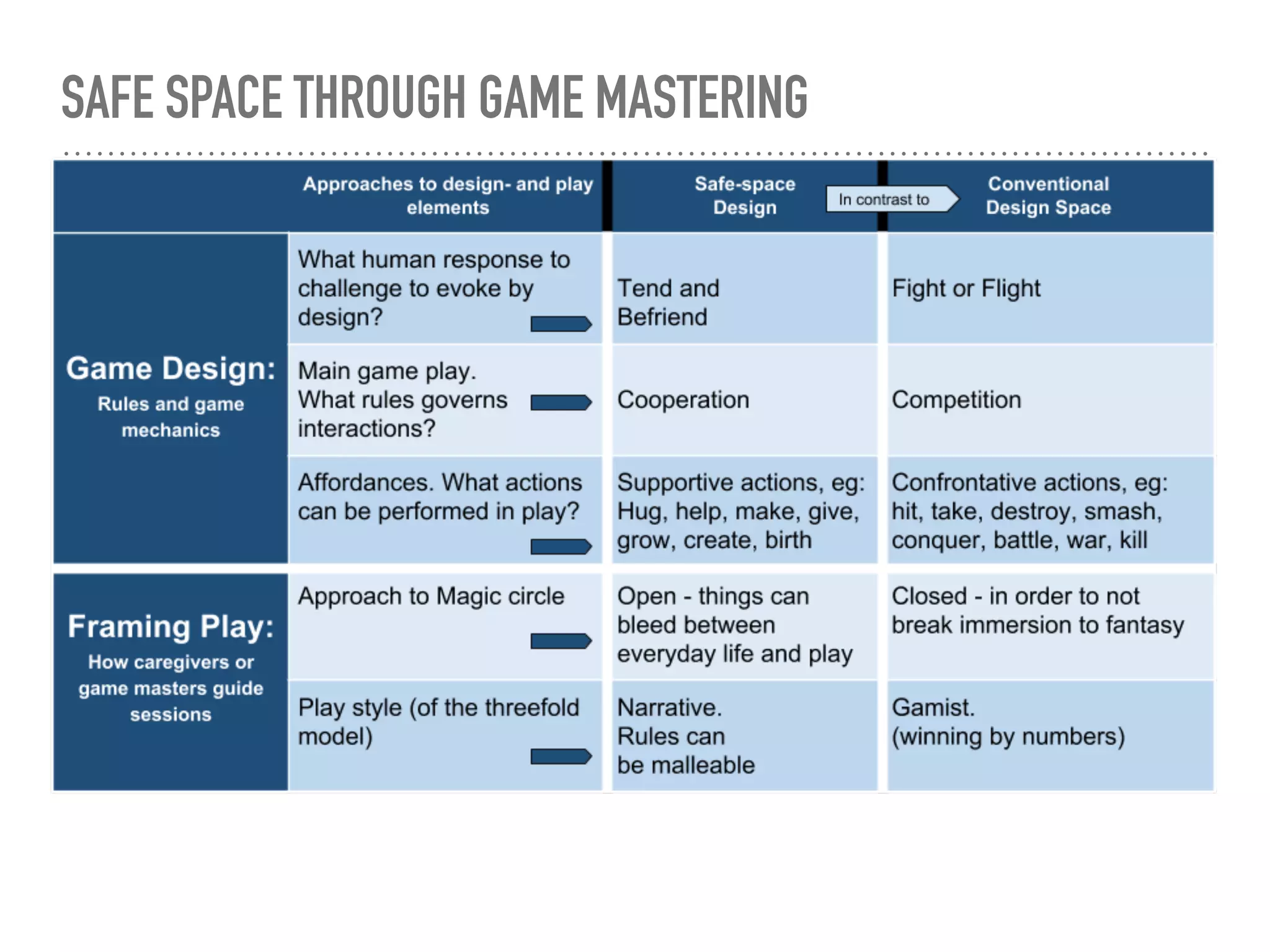
SAFE SPACE THROUGH GAME MASTERING
FUTURE WORK
➤ Mind Shadows version 2
➤ Fixed number of turns (no in-game win/lose criteria)
➤ Longer reflection phase: counting the outcome of the played turns.
➤ Perhaps more than just a printable. Bits in a box…x
➤ Strong focus on the game mastering aspect:
➤ Instructions to game masters
➤ Test of instructions, and as many iterations as necessary to make it work
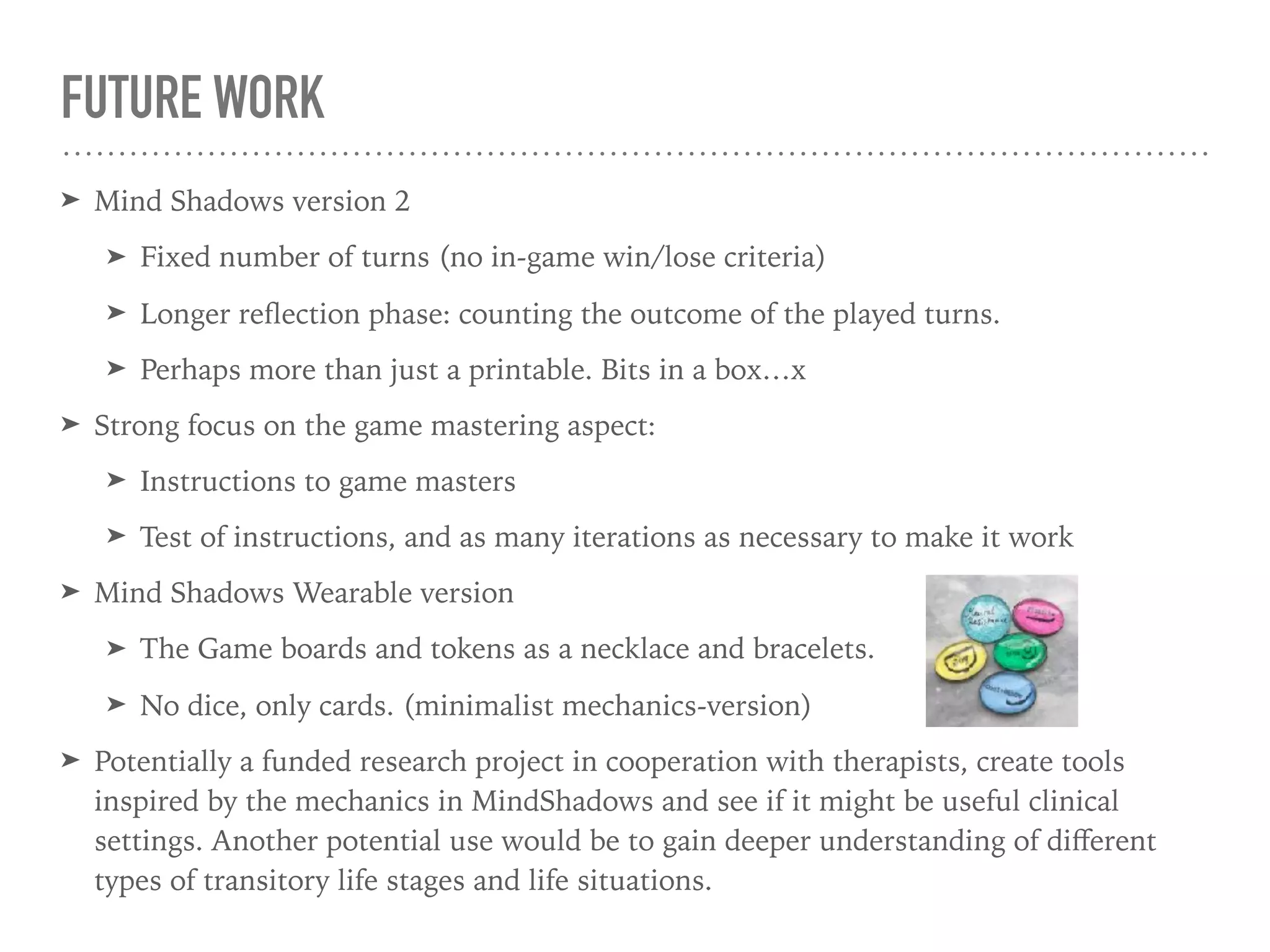
➤ Mind Shadows Wearable version
➤ The Game boards and tokens as a necklace and bracelets.
➤ No dice, only cards. (minimalist mechanics-version)
➤ Potentially a funded research project in cooperation with therapists, create tools
inspired by the mechanics in MindShadows and see if it might be useful clinical
settings. Another potential use would be to gain deeper understanding of different
types of transitory life stages and life situations.
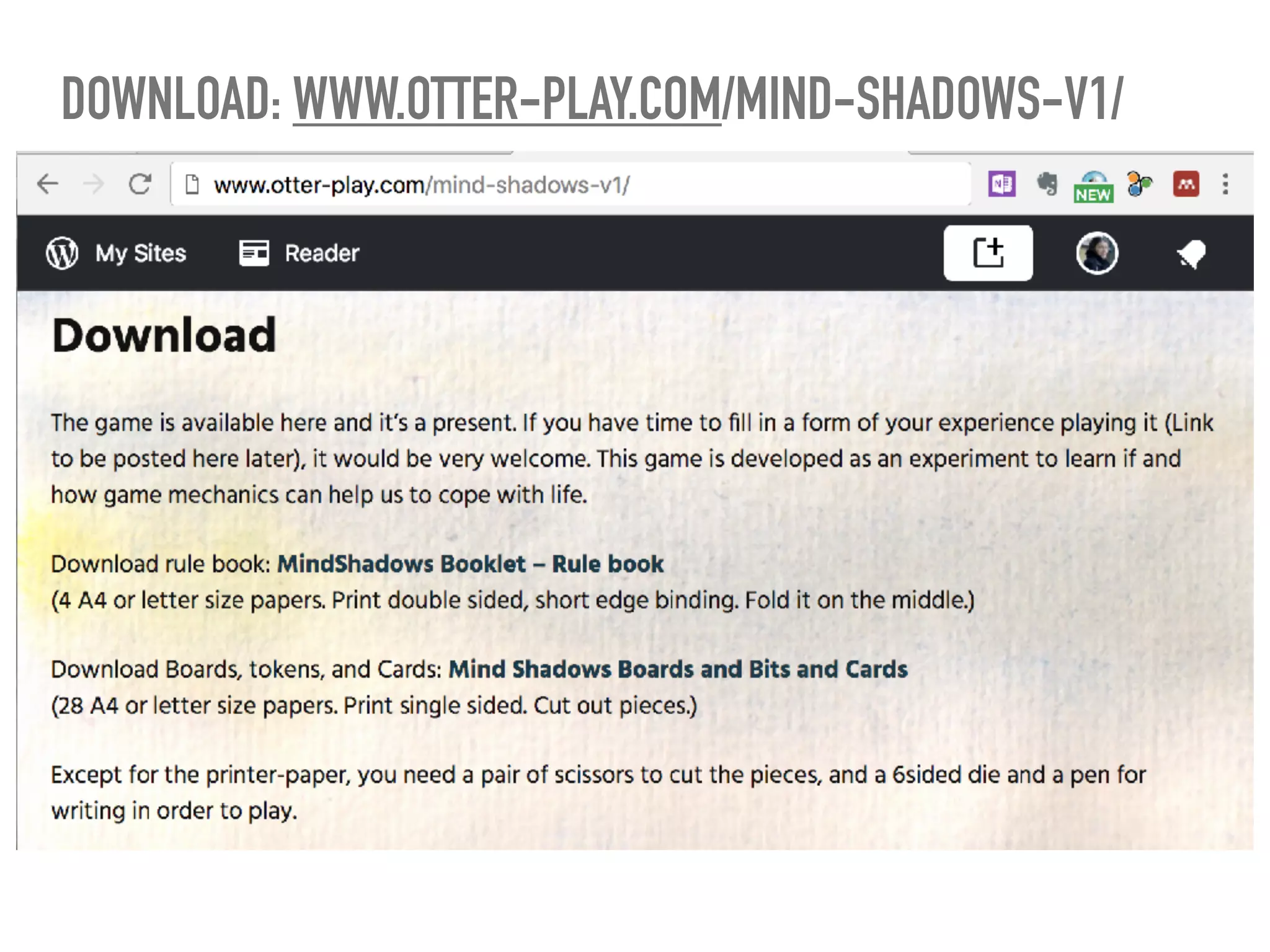
DOWNLOAD: WWW.OTTER-PLAY.COM/MIND-SHADOWS-V1/
END
(following slides are there for QA session, in case someone asks)
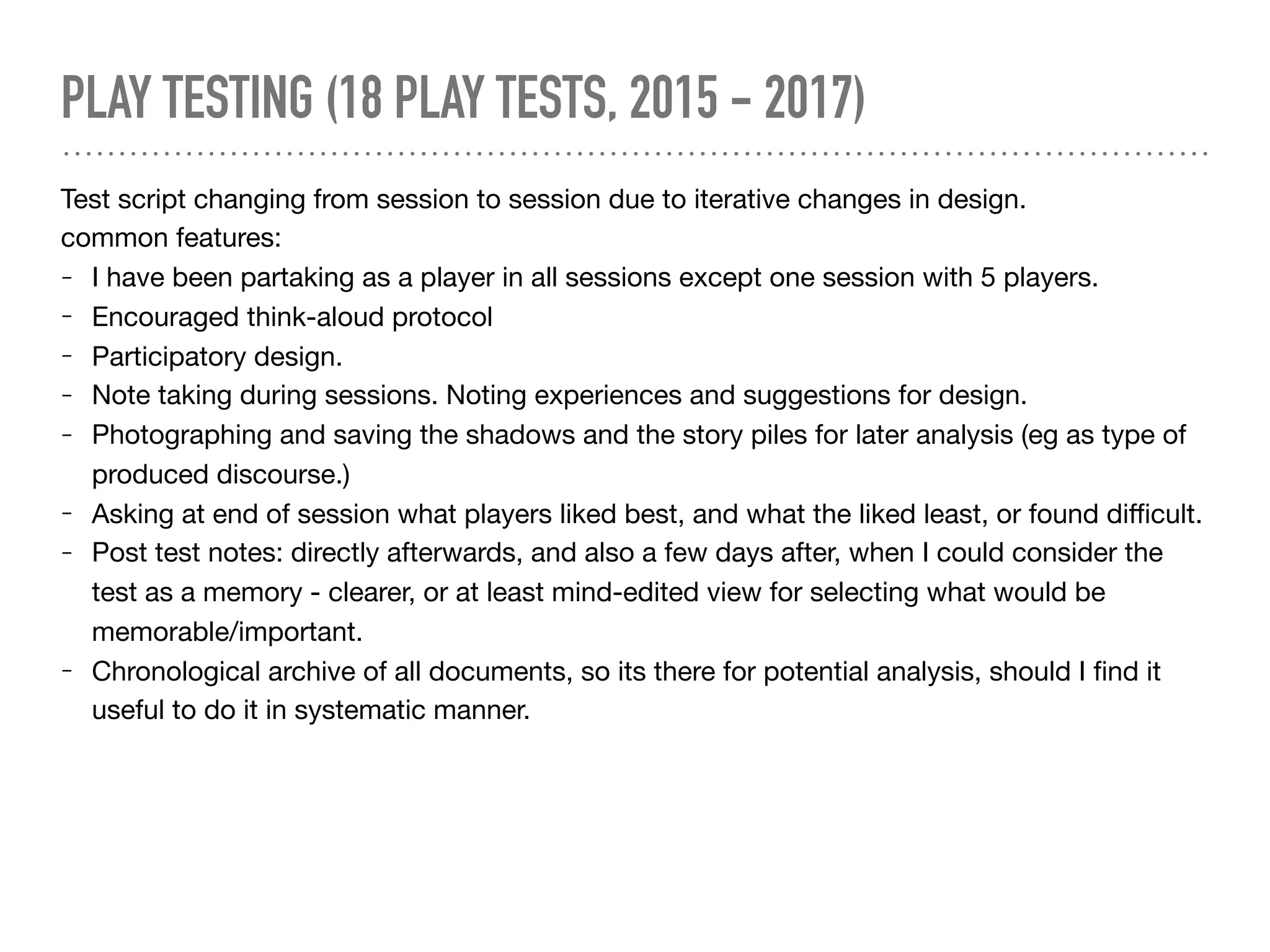
PLAY TESTING (18 PLAY TESTS, 2015 - 2017)
Test script changing from session to session due to iterative changes in design.

common features:

- I have been partaking as a player in all sessions except one session with 5 players.

- Encouraged think-aloud protocol

- Participatory design. 

- Note taking during sessions. Noting experiences and suggestions for design.

- Photographing and saving the shadows and the story piles for later analysis (eg as type of
produced discourse.)

- Asking at end of session what players liked best, and what the liked least, or found difficult. 

- Post test notes: directly afterwards, and also a few days after, when I could consider the
test as a memory - clearer, or at least mind-edited view for selecting what would be
memorable/important.

- Chronological archive of all documents, so its there for potential analysis, should I find it
useful to do it in systematic manner.
Bleed in, Bleed Out – A Design Case in Board Game Therapy

Bleed in, Bleed Out – A Design Case in Board Game Therapy

  • 1.
    BLEED-IN, BLEED-OUT A DESIGNCASE IN BOARD GAME THERAPY DIGRA Conference, Turin, July 25 2018 Mirjam Palosaari Eladhari of Södertörn University
  • 2.
    MOTIVATIONS FOR THISWORK ➤ table-top play situation offers unique 
 opportunities for approaching real-world 
 personal problems ➤ structures inherent in the problems can 
 be deconstructed, examined, and 
 understood ➤ Board Game: Mind Shadows ➤ AIM: create play situations where players in cooperation better can understand situations in their everyday lives that are emotionally complex or difficult, and by this understanding find ways to cope with the situations.
  • 3.
    OVERVIEW OF THISTALK ➤ Games for therapy? ➤ Mind Shadows Board game ➤ Design considerations ➤ The tension between a gamist number counting approach to drive the play-session forward and the need to have the game state reflect the actual moods and emotions of the players. ➤ Bleed.The transportation real life issues into a magic circle, where player reflect upon, and the consideration of how effects of the reflections may bleed back into players’ every- day lives. ➤ The framing of the play-sessions as safe-spaces.
  • 4.
    THERAPY? ➤ it isnot possible to, relying on previous research, to say that playing (fantasy) games have either good or bad effects on players’ mental well being. (Lieberoth and Trier-Knudsen 2016). However: ➤ The framing is a key aspect, and role-playing may become a “safe place to communicate emotions, gain release from anxieties, or play around with different identity facets” (drawing upon results from several studies; e.g. (Ascherman 1993; Hughes 1988; Denman 1988).
  • 5.
    PSYCHODRAMA ➤ Moreno’s practiceof psychodrama (Moreno and Moreno 1959) ➤ Hollander’s Psychodrama Curve (Hollander 2002). 
 3 parts of a psychodrama session ➤ warm-up, ➤ the activity, and ➤ the integration.
  • 6.
    PSYCHODRAMA ➤ Moreno’s practiceof psychodrama (Moreno and Moreno 1959) ➤ Hollander’s Psychodrama Curve (Hollander 2002). 
 3 parts of a psychodrama session. In table-top framing: ➤ warm-up, = set-up ➤ the activity, and = Play ➤ the integration. = Counting and determination of results
  • 7.
    PLAYING MIND SHADOWS- OVERVIEW ➤ Set-up: The emotional state, Giving each other super-powers, and Defining the Shadow ➤ Play: ➤ Fictional framing: Storytellers’ turn ➤ Shadow’s turn (destructive actions) ➤ Player’s turn (supportive actions) ➤ Win If Shadows emotion or significance is exhausted ➤ Reflection: Leafing through what happened in the session, adding new support cards to the main deck.
  • 8.
    Setup 1 (of2)
 Setting up the board: the emotional state, the super-powers, and the hand of cards.
  • 9.
    (setup, 2 0f2) Defining the Shadow, and dividing the roles Roles: - Storyteller - Voice of the Shadow - Counter
  • 11.
  • 13.
    (text above isfrom rule book)
  • 14.
    WHAT’S GOING ONIN PLAY ➤ Players try to understand the situation with the shadow: what actions and events are de-facto? What is structural, what is immutable, what can be changed? ➤ Trying to understand their own shadow ➤ Experiencing the other’s shadow, emphasising ➤ Getting to grips of how it feels (how it really feels, not how it is supposed to feel). ➤ Coming up with suggestion after suggestion of how to help the other - trying the actions and see how they could work. 
 
 (These observations are grounded in 18 documented play-tests)
  • 15.
    NOTE ABOUT THEDESIGN AND PRODUCTION PROCESS ➤ Design is loosely based on the most successful feature of a previous game, the MMO prototype Pataphysic Institute, where players authored their own boss mobs. ➤ I was about to isolate this feature, make it into a tablet-game, but got the idea “How far can I get with paper and a 6 sided die?” … and now it became this. ➤ It is a hobby project, a side project that I do 
 under my own indie label Otter Play. 
 It is not part of a formal big research project, nor is there 
 any industrial partners with needs. Hence: I have only 
 used what has been most necessary play-test method 
 wise to take the design forward. (not much rigour)
  • 16.
    TENSION BETWEEN ‘GAMIST’AND ‘MALLEABLE’ APPROACH TO RULES ➤ “It doesn’t FEEL like that!” ➤ Design is now tested to allow for player’s own reporting of their emotions -> as long as positive-negative emotion values are done in the same way the mechanics will function. (A *tad* less balance in the deck between occurrences of emotional effects, but it works good enough) Express belief in someone’s ability Confidence 3 “Its more like Joy when 
 you say that, and also
 …belonging I think.”
  • 17.
    BLEED Bleed - howrole-players have experiences where their real life feelings, thoughts, relationships, and physical states spill over into their characters’ and the other way around (Montola 2013). Bleed is central to Mind Shadows - not a side effect, but part of the design. But: the more malleable the play, and the more sensitive, player- authored Shadow: the deeper the journey.
  • 19.
    BLEED Bleed - howrole-players have experiences where their real life feelings, thoughts, relationships, and physical states spill over into their characters’ and the other way around (Montola 2013). Bleed is central to Mind Shadows - not a side effect, but part of the design. But: the more malleable the play, and the more sensitive, player- authored Shadow: the deeper the journey. Framing the play session as a safe space is CRITICAL! (Critical in the sense that it helps approach difficult topics, and that there is a readiness to deal with what may come up)
  • 20.
    SAFE SPACE THROUGHGAME MECHANICS
  • 21.
    SAFE SPACE THROUGHGAME MASTERING
  • 22.
    FUTURE WORK ➤ MindShadows version 2 ➤ Fixed number of turns (no in-game win/lose criteria) ➤ Longer reflection phase: counting the outcome of the played turns. ➤ Perhaps more than just a printable. Bits in a box…x ➤ Strong focus on the game mastering aspect: ➤ Instructions to game masters ➤ Test of instructions, and as many iterations as necessary to make it work ➤ Mind Shadows Wearable version ➤ The Game boards and tokens as a necklace and bracelets. ➤ No dice, only cards. (minimalist mechanics-version) ➤ Potentially a funded research project in cooperation with therapists, create tools inspired by the mechanics in MindShadows and see if it might be useful clinical settings. Another potential use would be to gain deeper understanding of different types of transitory life stages and life situations.
  • 23.
  • 24.
    END (following slides arethere for QA session, in case someone asks)
  • 26.
    PLAY TESTING (18PLAY TESTS, 2015 - 2017) Test script changing from session to session due to iterative changes in design. common features: - I have been partaking as a player in all sessions except one session with 5 players. - Encouraged think-aloud protocol - Participatory design. - Note taking during sessions. Noting experiences and suggestions for design. - Photographing and saving the shadows and the story piles for later analysis (eg as type of produced discourse.) - Asking at end of session what players liked best, and what the liked least, or found difficult. - Post test notes: directly afterwards, and also a few days after, when I could consider the test as a memory - clearer, or at least mind-edited view for selecting what would be memorable/important. - Chronological archive of all documents, so its there for potential analysis, should I find it useful to do it in systematic manner.