Jaemin Jeong Seminar 2
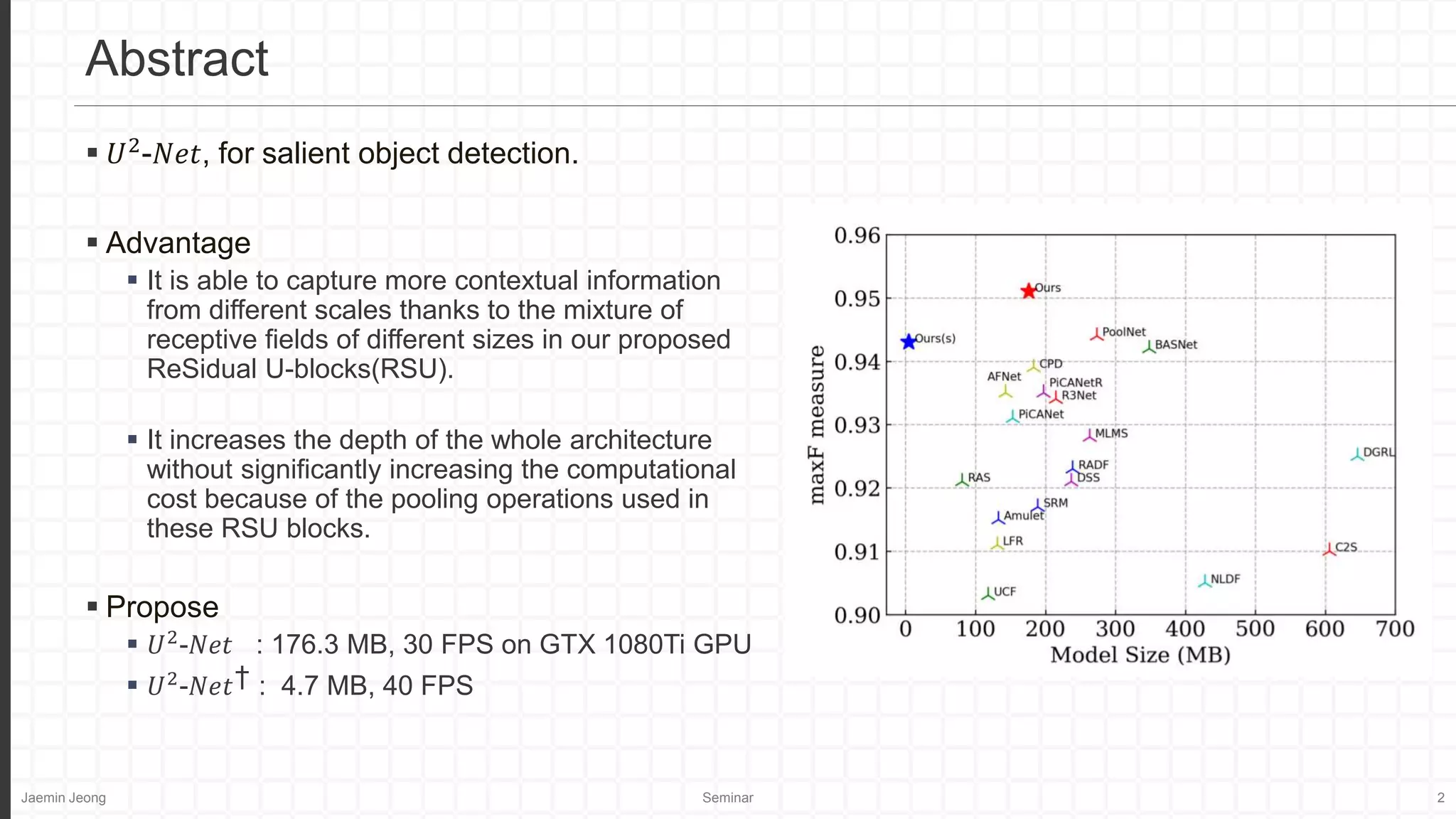
 𝑈2-𝑁𝑒𝑡, for salient object detection.
 Advantage
 It is able to capture more contextual information
from different scales thanks to the mixture of
receptive fields of different sizes in our proposed
ReSidual U-blocks(RSU).
 It increases the depth of the whole architecture
without significantly increasing the computational
cost because of the pooling operations used in
these RSU blocks.
 Propose
 𝑈2
-𝑁𝑒𝑡 : 176.3 MB, 30 FPS on GTX 1080Ti GPU
 𝑈2-𝑁𝑒𝑡† : 4.7 MB, 40 FPS
Abstract
Jaemin Jeong Seminar 3
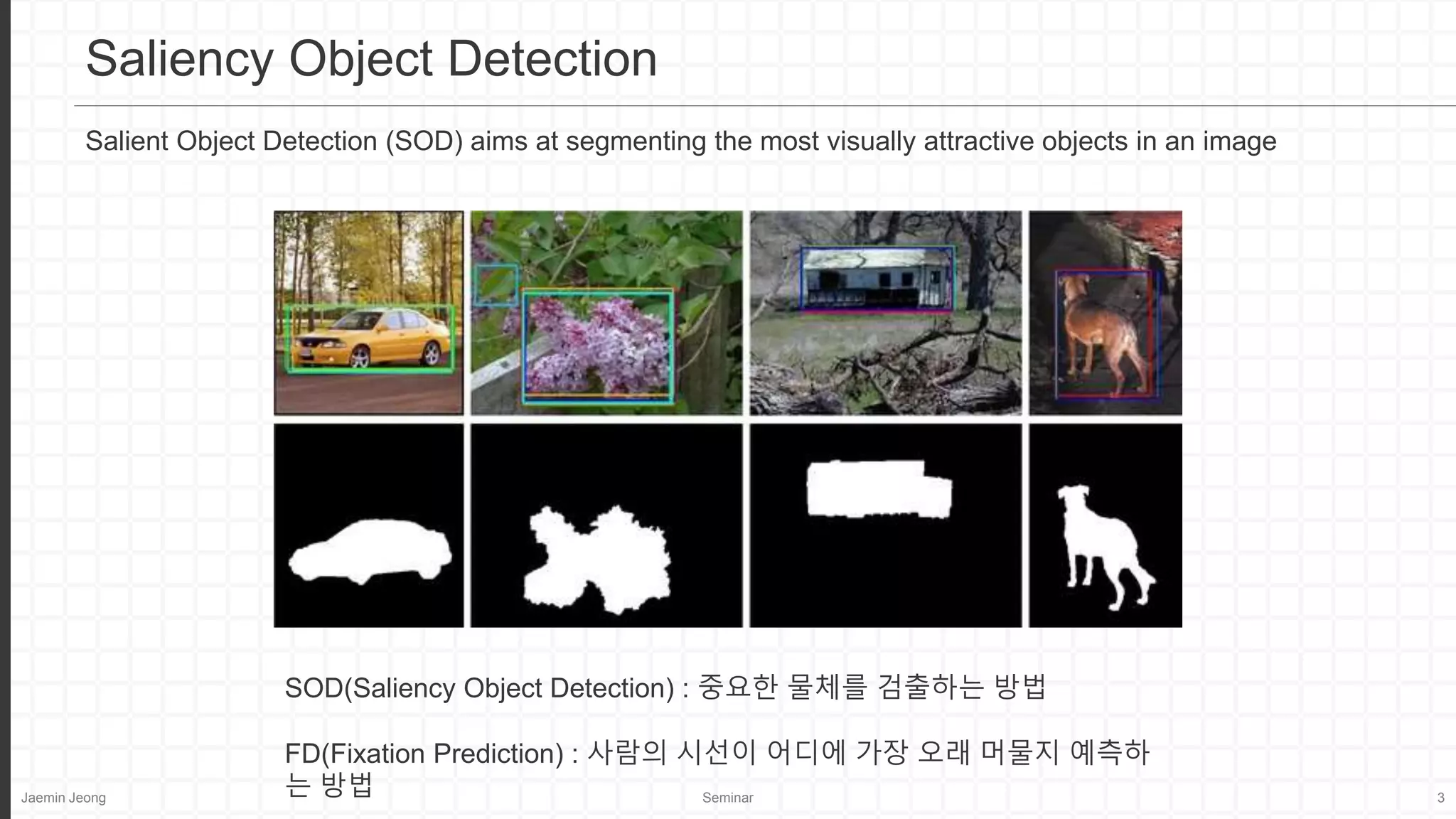
Saliency Object Detection
SOD(Saliency Object Detection) : 중요한 물체를 검출하는 방법
FD(Fixation Prediction) : 사람의 시선이 어디에 가장 오래 머물지 예측하
는 방법
Salient Object Detection (SOD) aims at segmenting the most visually attractive objects in an image
Jaemin Jeong Seminar 4
 There is a common pattern in the design of most SOD networks, that is, they focus on making
good use of deep features extracted by existing backbones, such as Alexnet, VGG, ResNet,
ResNeXt, DenseNet, etc.
 However, these backbones are all originally designed for image classification.
 They extract features that are representative of semantic meaning rather than local details and
global contrast information, which are essential to saliency detection.
 And they need to be pretrained on ImageNet data which data-inefficient especially if the target
data follows a different distribution than ImageNet.
This leads to our first question: can we design a new network for SOD, that allows training from
scratch and achieves comparable or better performance than those based on existing pre-trained
backbones?
Introduction
Jaemin Jeong Seminar 5
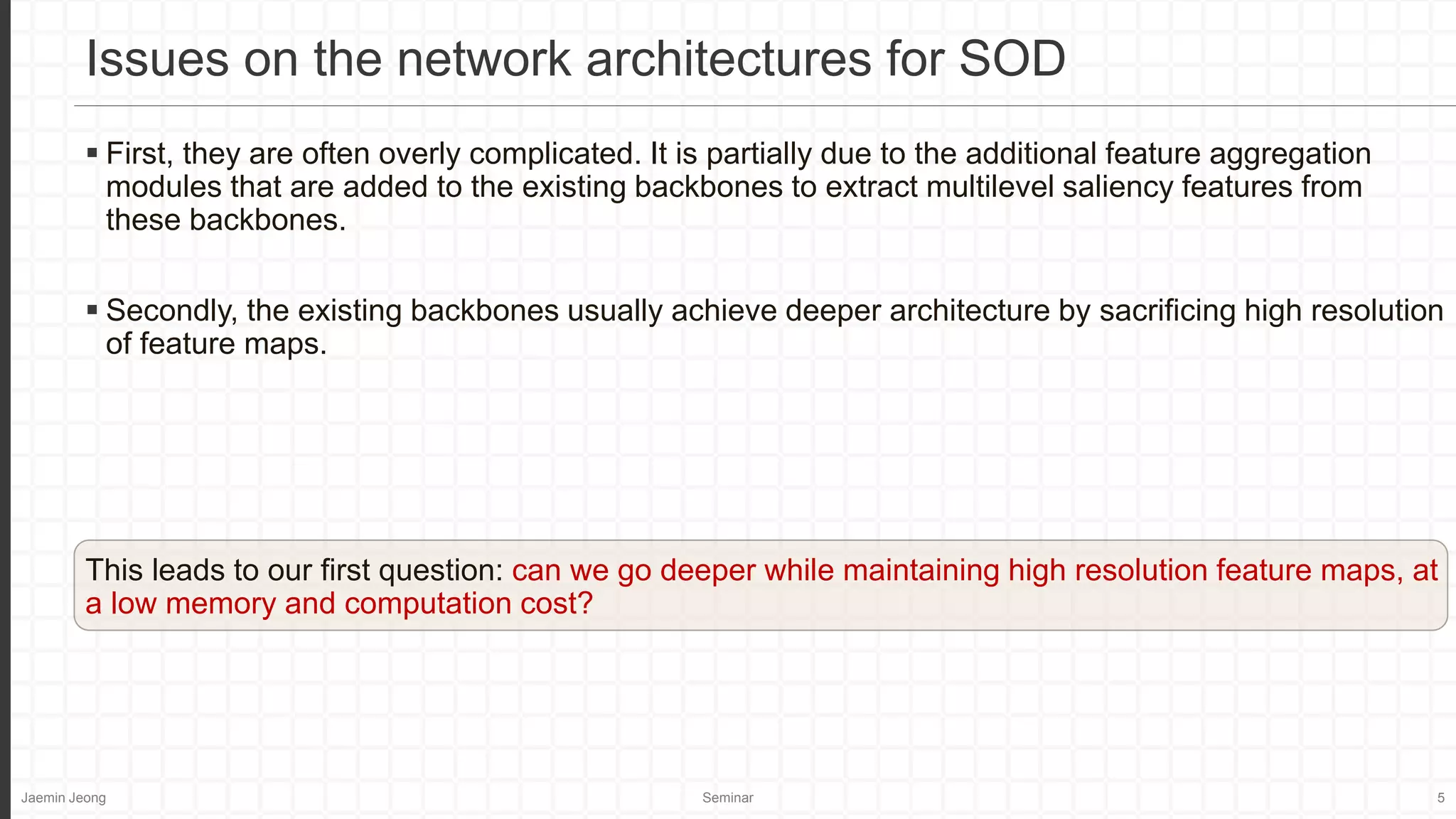
 First, they are often overly complicated. It is partially due to the additional feature aggregation
modules that are added to the existing backbones to extract multilevel saliency features from
these backbones.
 Secondly, the existing backbones usually achieve deeper architecture by sacrificing high resolution
of feature maps.
This leads to our first question: can we go deeper while maintaining high resolution feature maps, at
a low memory and computation cost?
Issues on the network architectures for SOD
Jaemin Jeong Seminar 6
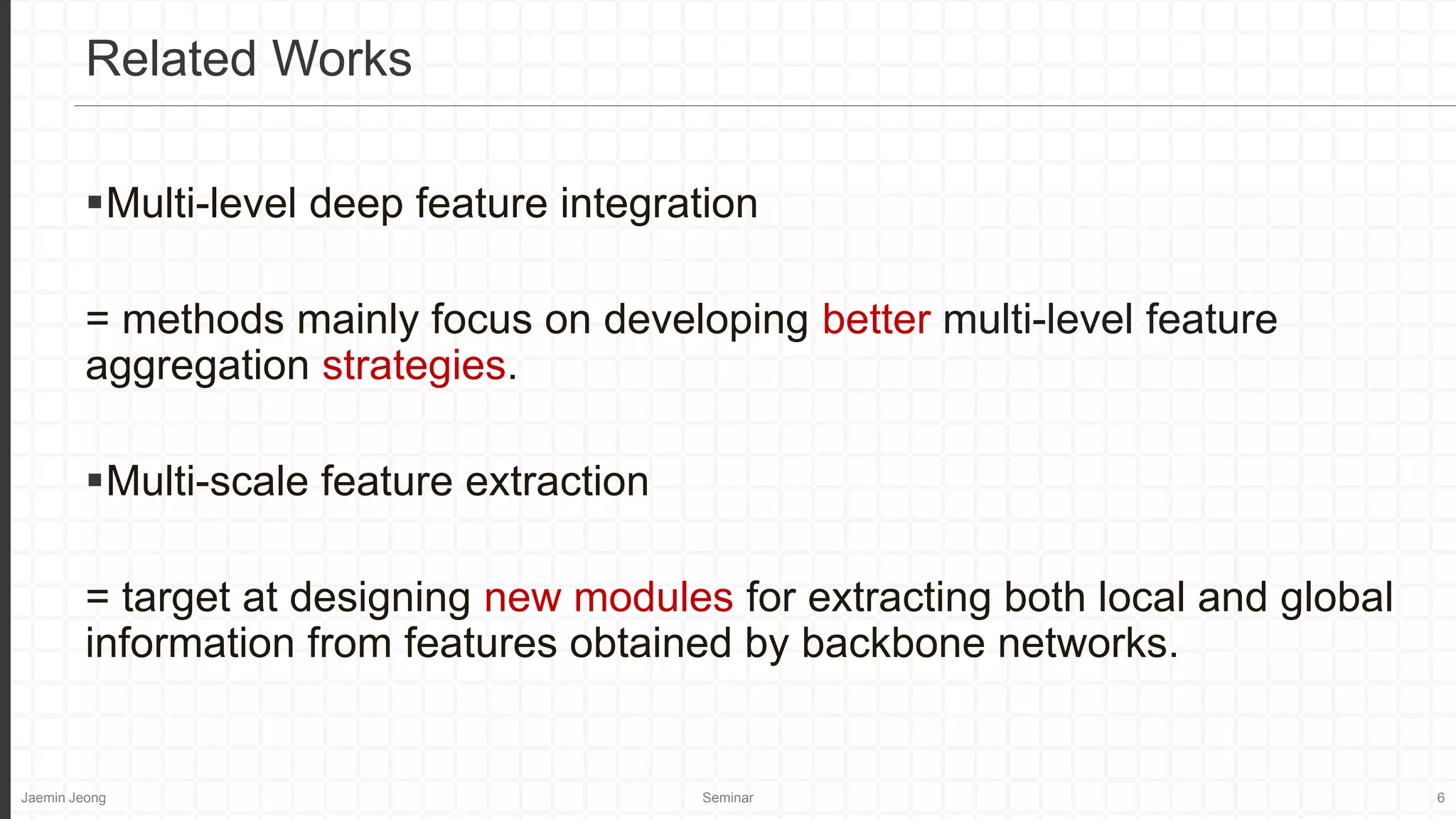
Multi-level deep feature integration
= methods mainly focus on developing better multi-level feature
aggregation strategies.
Multi-scale feature extraction
= target at designing new modules for extracting both local and global
information from features obtained by backbone networks.
Related Works
Jaemin Jeong Seminar 7
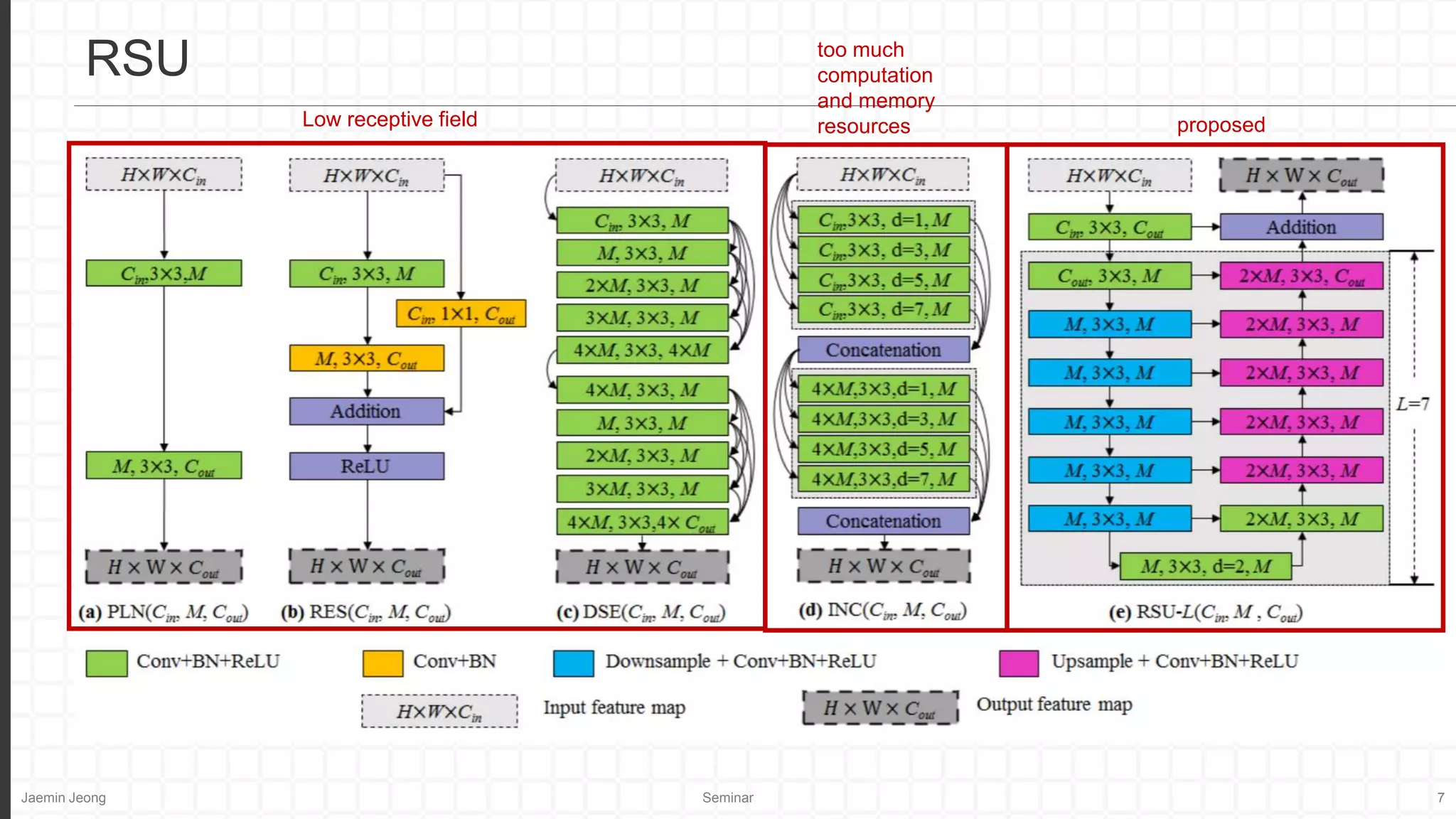
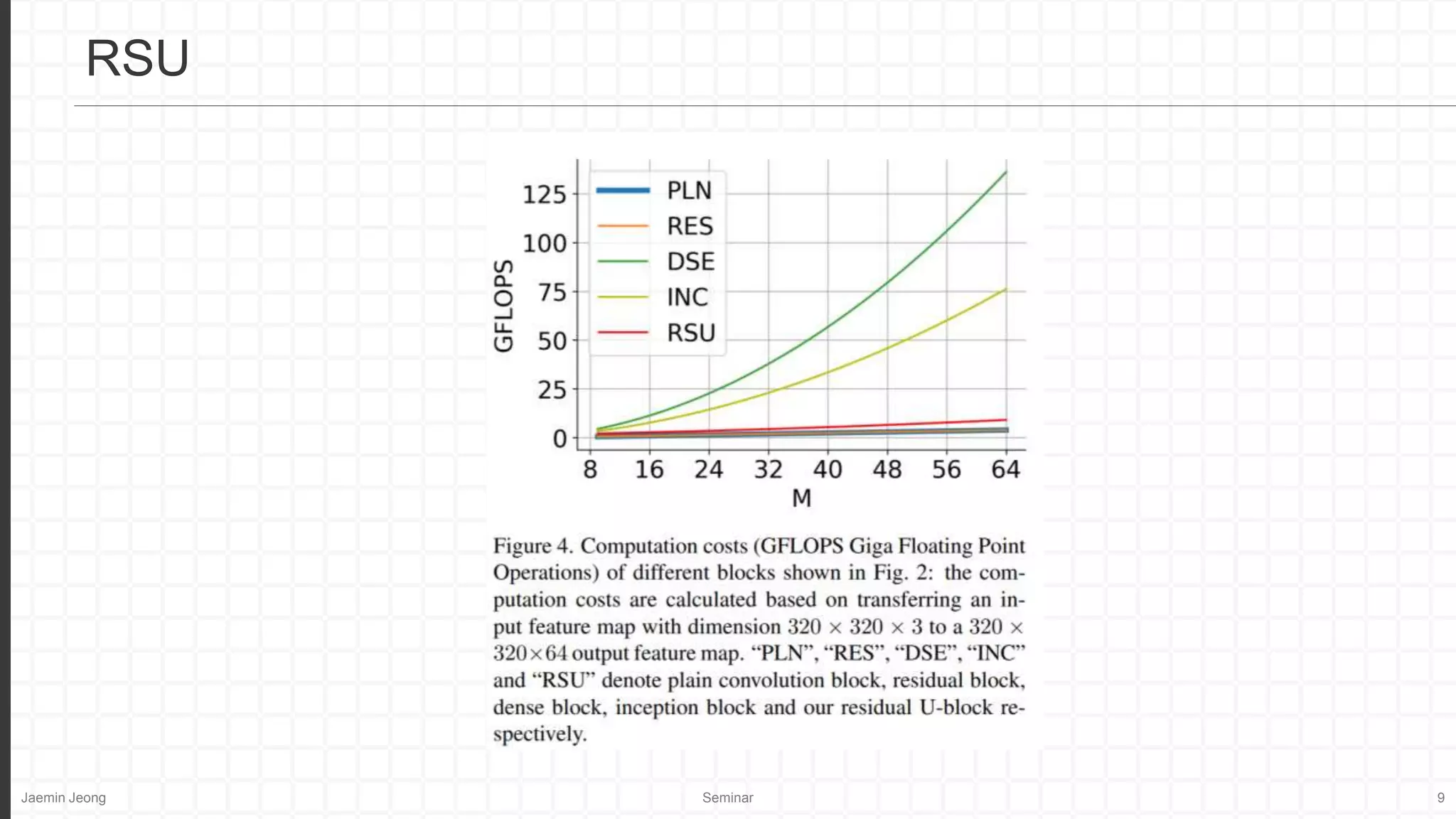
RSU too much
computation
and memory
resources
Low receptive field proposed
Jaemin Jeong Seminar 8
RSU
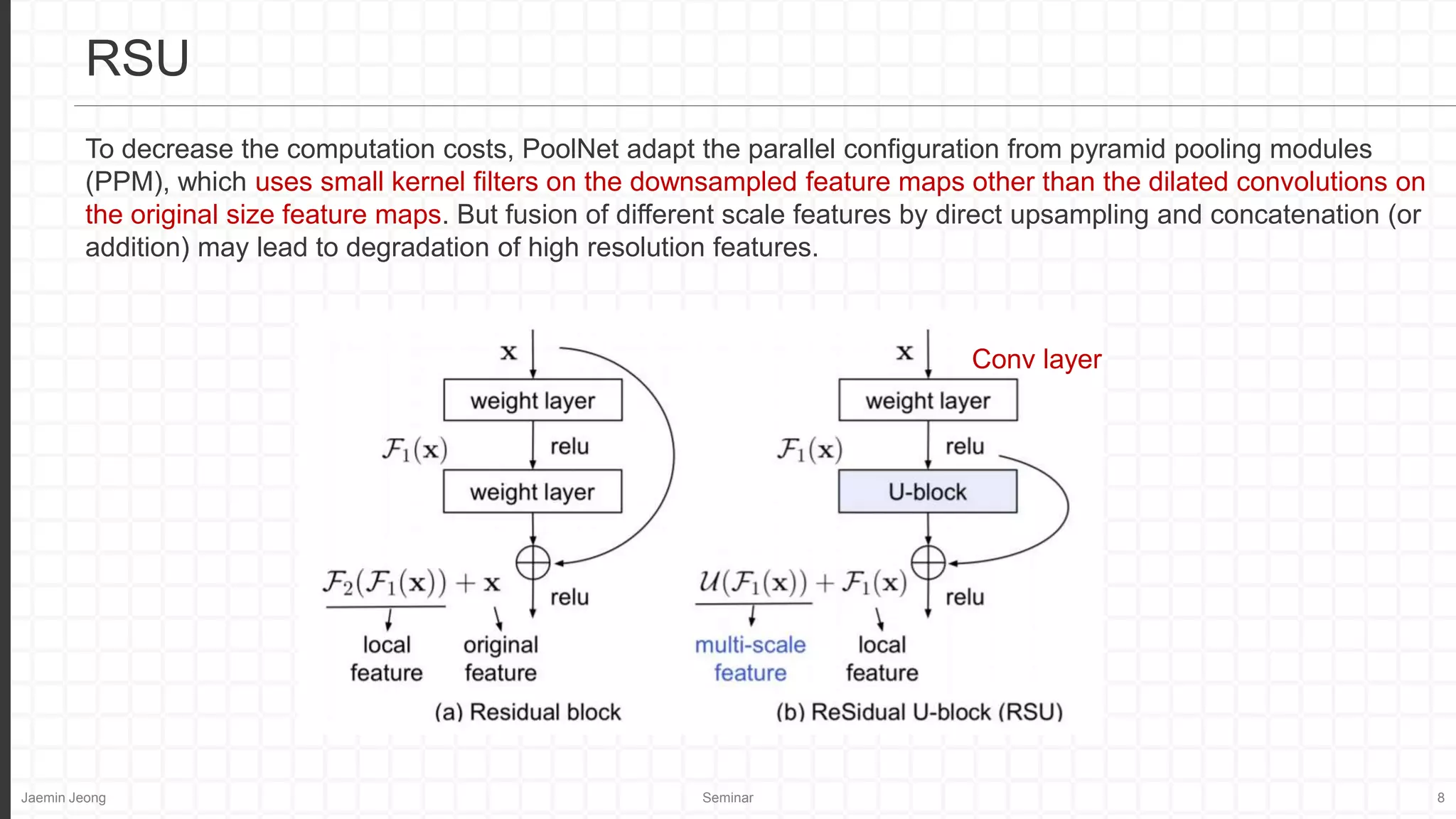
To decrease the computation costs, PoolNet adapt the parallel configuration from pyramid pooling modules
(PPM), which uses small kernel filters on the downsampled feature maps other than the dilated convolutions on
the original size feature maps. But fusion of different scale features by direct upsampling and concatenation (or
addition) may lead to degradation of high resolution features.
Conv layer
Jaemin Jeong Seminar 9
RSU
Jaemin Jeong Seminar 10
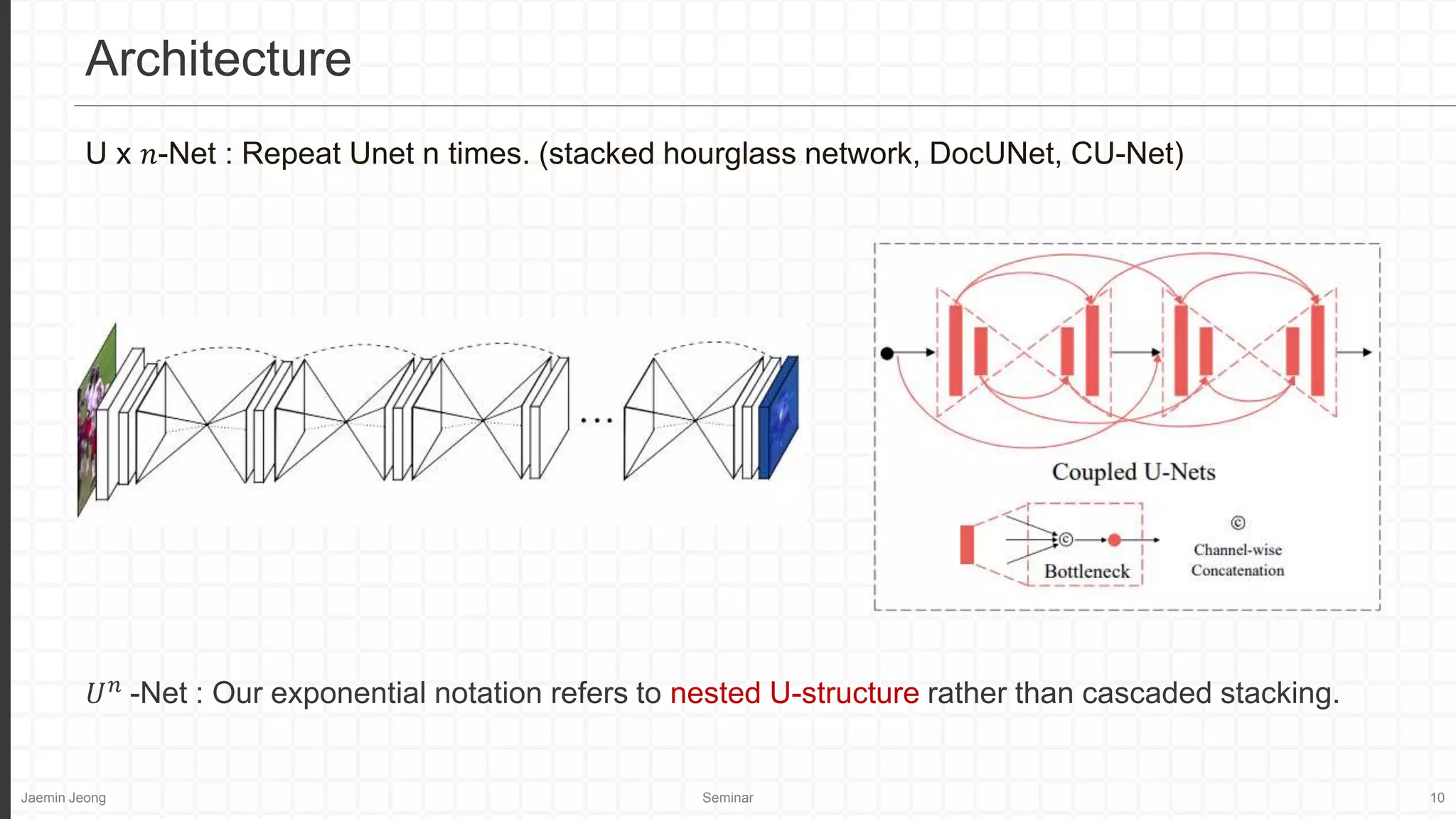
U x 𝑛-Net : Repeat Unet n times. (stacked hourglass network, DocUNet, CU-Net)
Architecture
𝑈𝑛 -Net : Our exponential notation refers to nested U-structure rather than cascaded stacking.
Jaemin Jeong Seminar 11
𝑈2
-𝑁𝑒𝑡
Relatively low resolution.
RSU-
4F
𝐿 =
𝑚=1
𝑀
𝑤𝑠𝑖𝑑𝑒
𝑚
ℓ𝑠𝑖𝑑𝑒
(𝑚)
+ 𝑤𝑓𝑢𝑠𝑒ℓ𝑓𝑢𝑠𝑒
ℓ𝑠𝑖𝑑𝑒
(𝑚)
: loss of the side output saliency
map
ℓ𝑓𝑢𝑠𝑒 : loss of the final output saliency
map
ℓ = −
(𝑟,𝑐)
(𝐻,𝑊)
[𝑃𝐺 𝑟,𝑐 log 𝑃𝑆(𝑟,𝑐) + 1 − 𝑃𝐺 𝑟,𝑐 log(1 − 𝑃𝑆(𝑟,𝑐))]
Binary Cross Entropy
𝑃𝐺(𝑟,𝑐) = Ground Truth
𝑃𝑆(𝑟,𝑐) = Predicted
𝑤
𝑚
, 𝑤 are all set to 1.
Jaemin Jeong Seminar 12
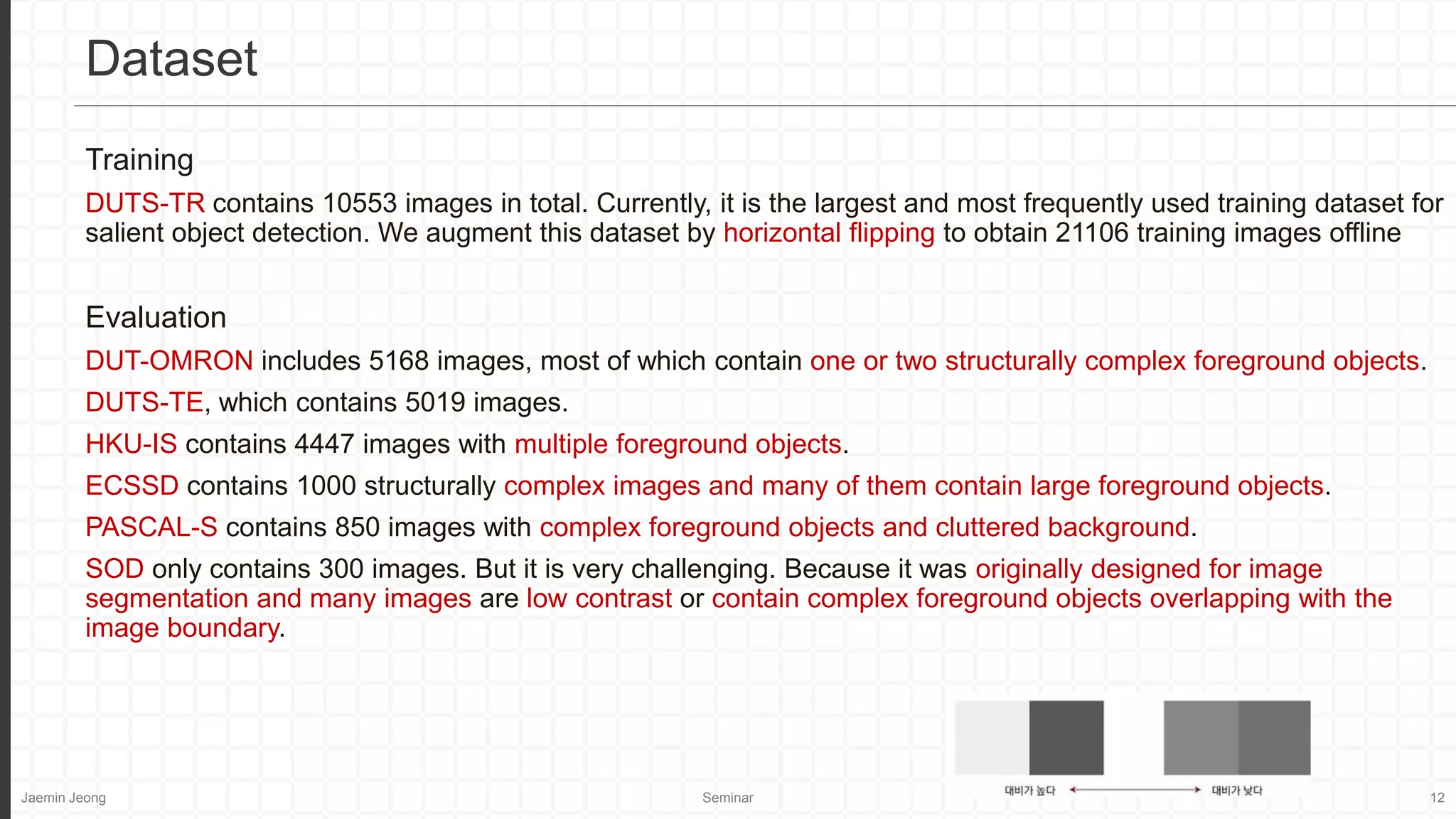
Training
DUTS-TR contains 10553 images in total. Currently, it is the largest and most frequently used training dataset for
salient object detection. We augment this dataset by horizontal flipping to obtain 21106 training images offline
Evaluation
DUT-OMRON includes 5168 images, most of which contain one or two structurally complex foreground objects.
DUTS-TE, which contains 5019 images.
HKU-IS contains 4447 images with multiple foreground objects.
ECSSD contains 1000 structurally complex images and many of them contain large foreground objects.
PASCAL-S contains 850 images with complex foreground objects and cluttered background.
SOD only contains 300 images. But it is very challenging. Because it was originally designed for image
segmentation and many images are low contrast or contain complex foreground objects overlapping with the
image boundary.
Dataset
Jaemin Jeong Seminar 13
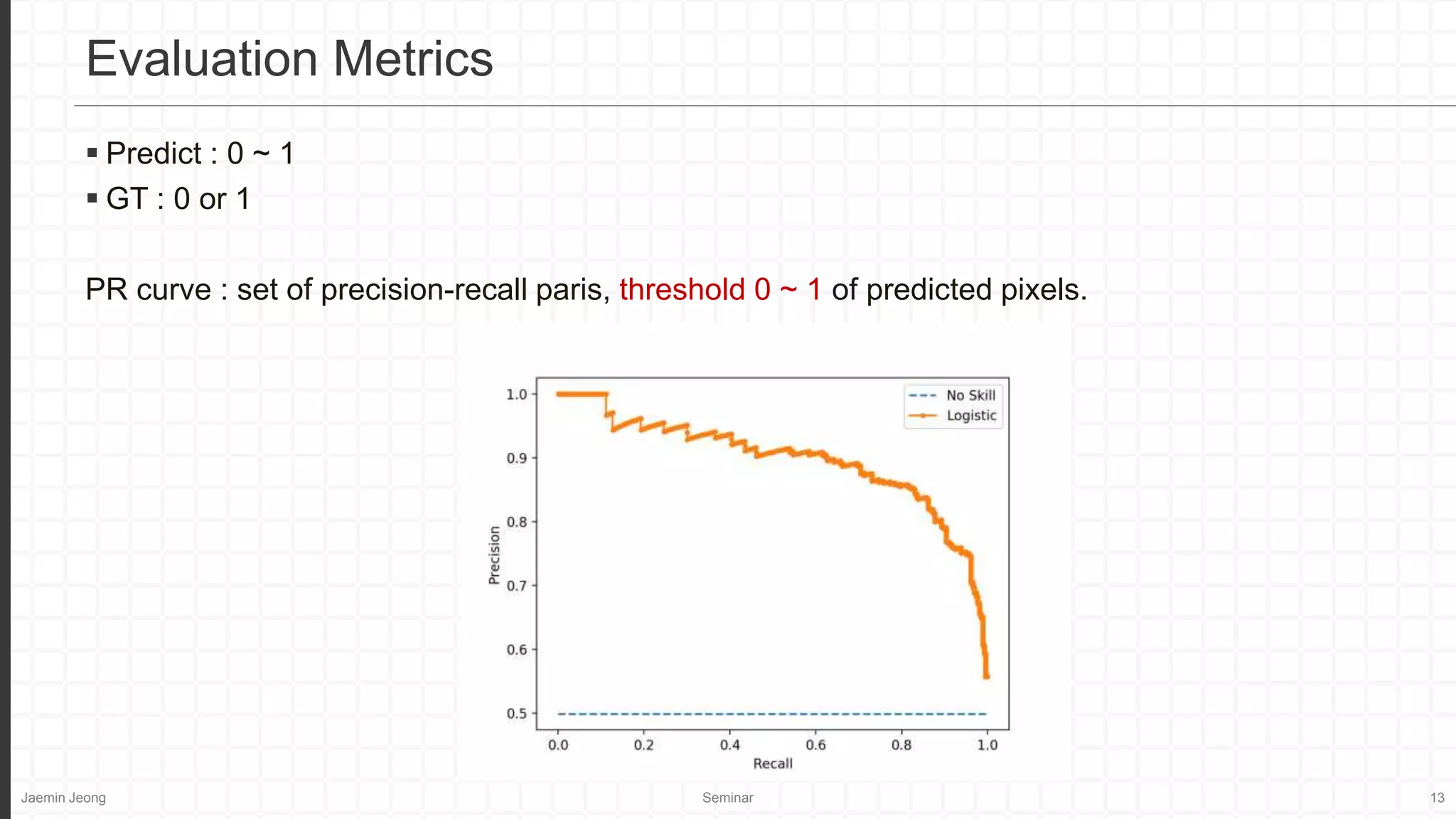
 Predict : 0 ~ 1
 GT : 0 or 1
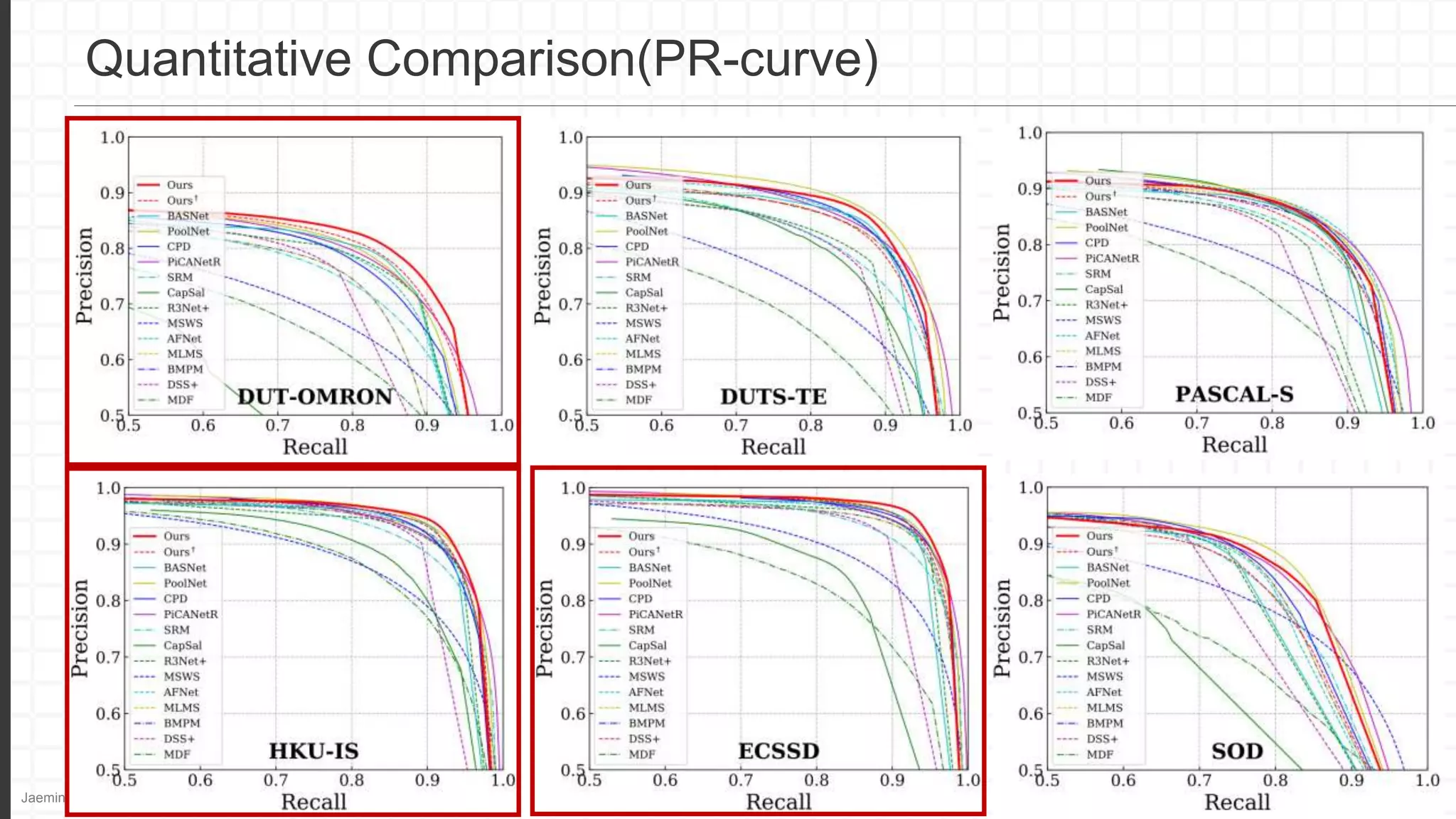
PR curve : set of precision-recall paris, threshold 0 ~ 1 of predicted pixels.
Evaluation Metrics
Jaemin Jeong Seminar 14
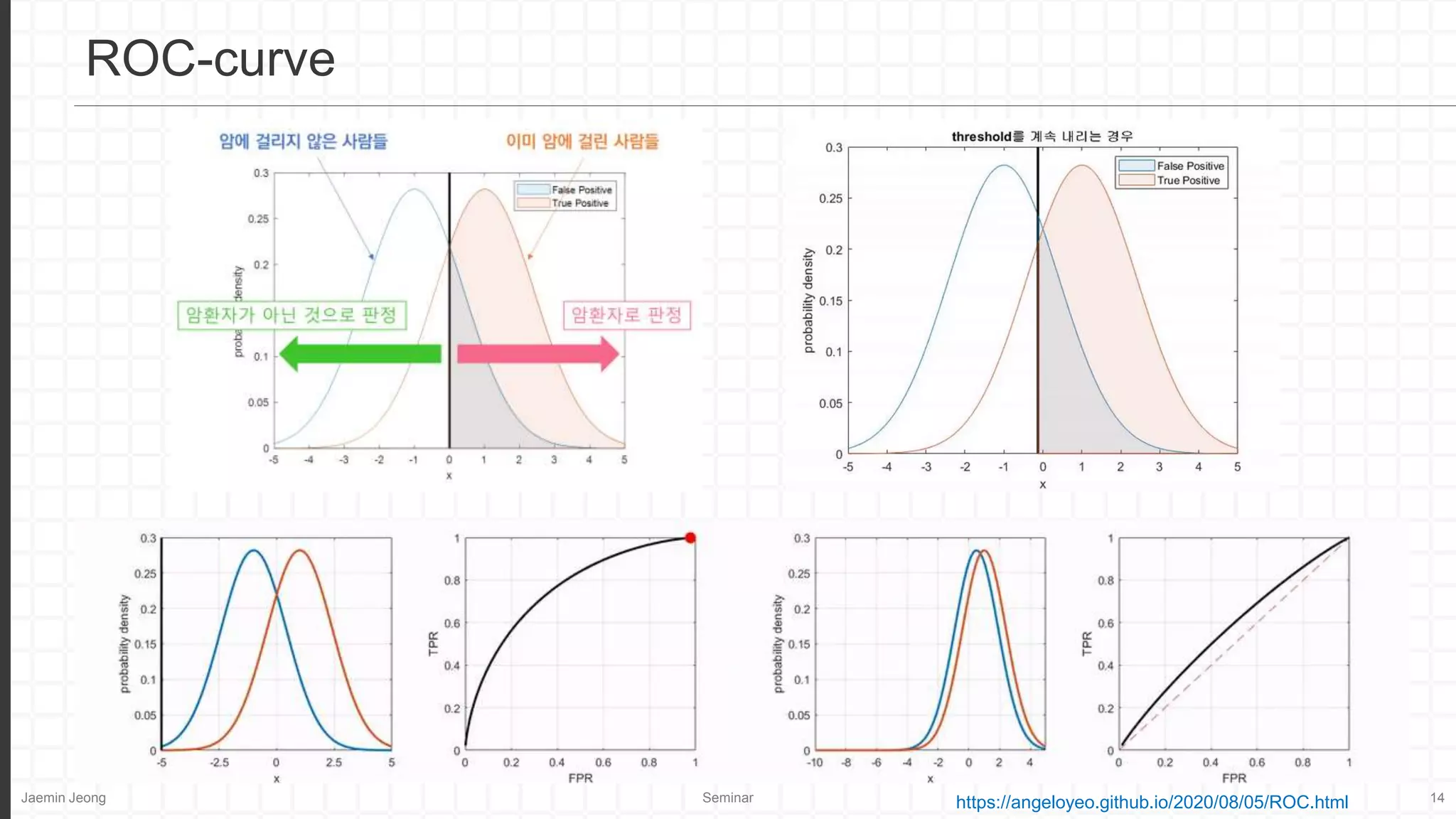
ROC-curve
https://angeloyeo.github.io/2020/08/05/ROC.html
Jaemin Jeong Seminar 15
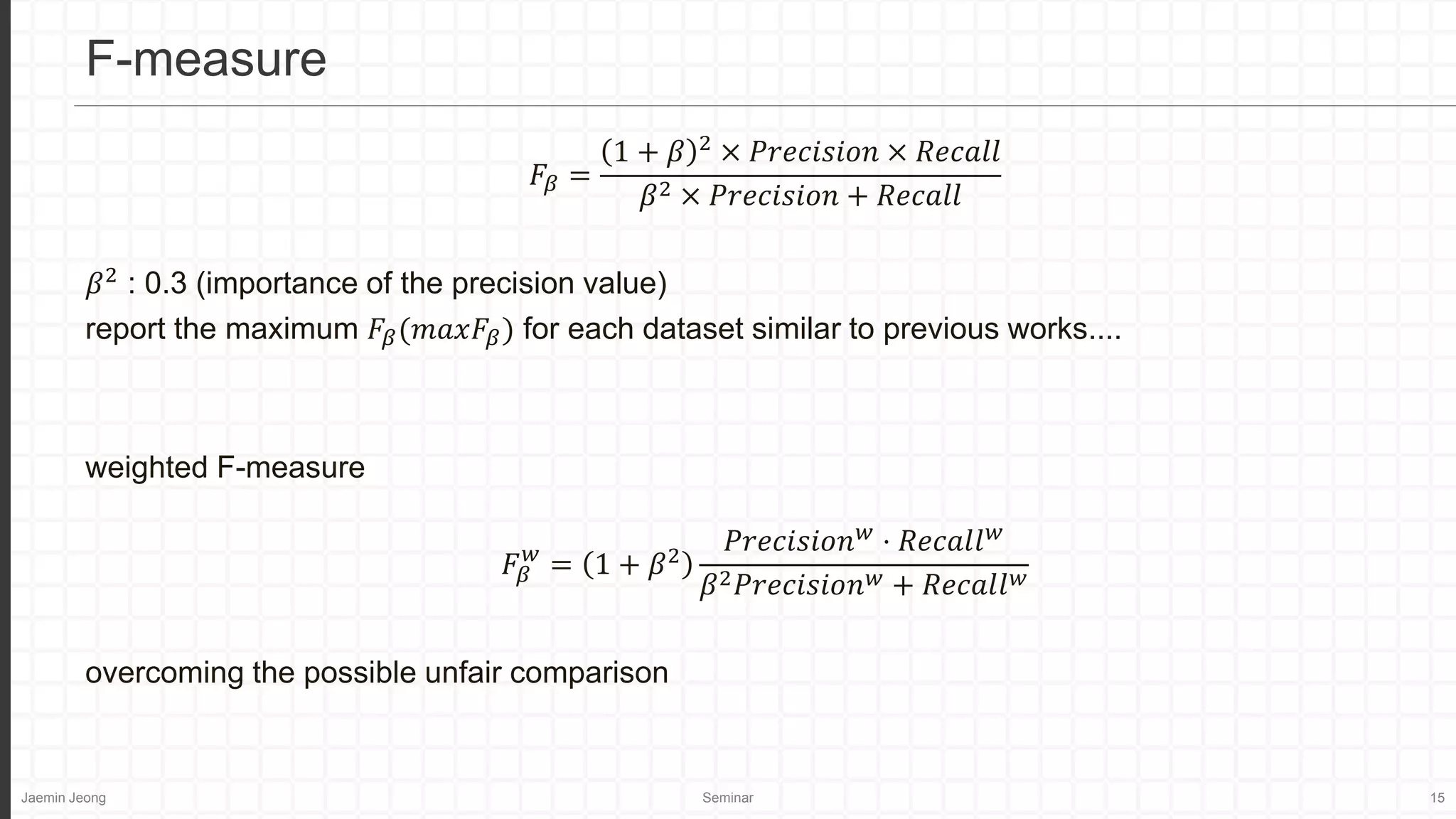
𝐹𝛽 =
1 + 𝛽 2
× 𝑃𝑟𝑒𝑐𝑖𝑠𝑖𝑜𝑛 × 𝑅𝑒𝑐𝑎𝑙𝑙
𝛽2 × 𝑃𝑟𝑒𝑐𝑖𝑠𝑖𝑜𝑛 + 𝑅𝑒𝑐𝑎𝑙𝑙
𝛽2
: 0.3 (importance of the precision value)
report the maximum 𝐹𝛽(𝑚𝑎𝑥𝐹𝛽) for each dataset similar to previous works....
weighted F-measure
𝐹𝛽
𝑤
= 1 + 𝛽2
𝑃𝑟𝑒𝑐𝑖𝑠𝑖𝑜𝑛𝑤
⋅ 𝑅𝑒𝑐𝑎𝑙𝑙𝑤
𝛽2𝑃𝑟𝑒𝑐𝑖𝑠𝑖𝑜𝑛𝑤 + 𝑅𝑒𝑐𝑎𝑙𝑙𝑤
overcoming the possible unfair comparison
F-measure
Jaemin Jeong Seminar 16
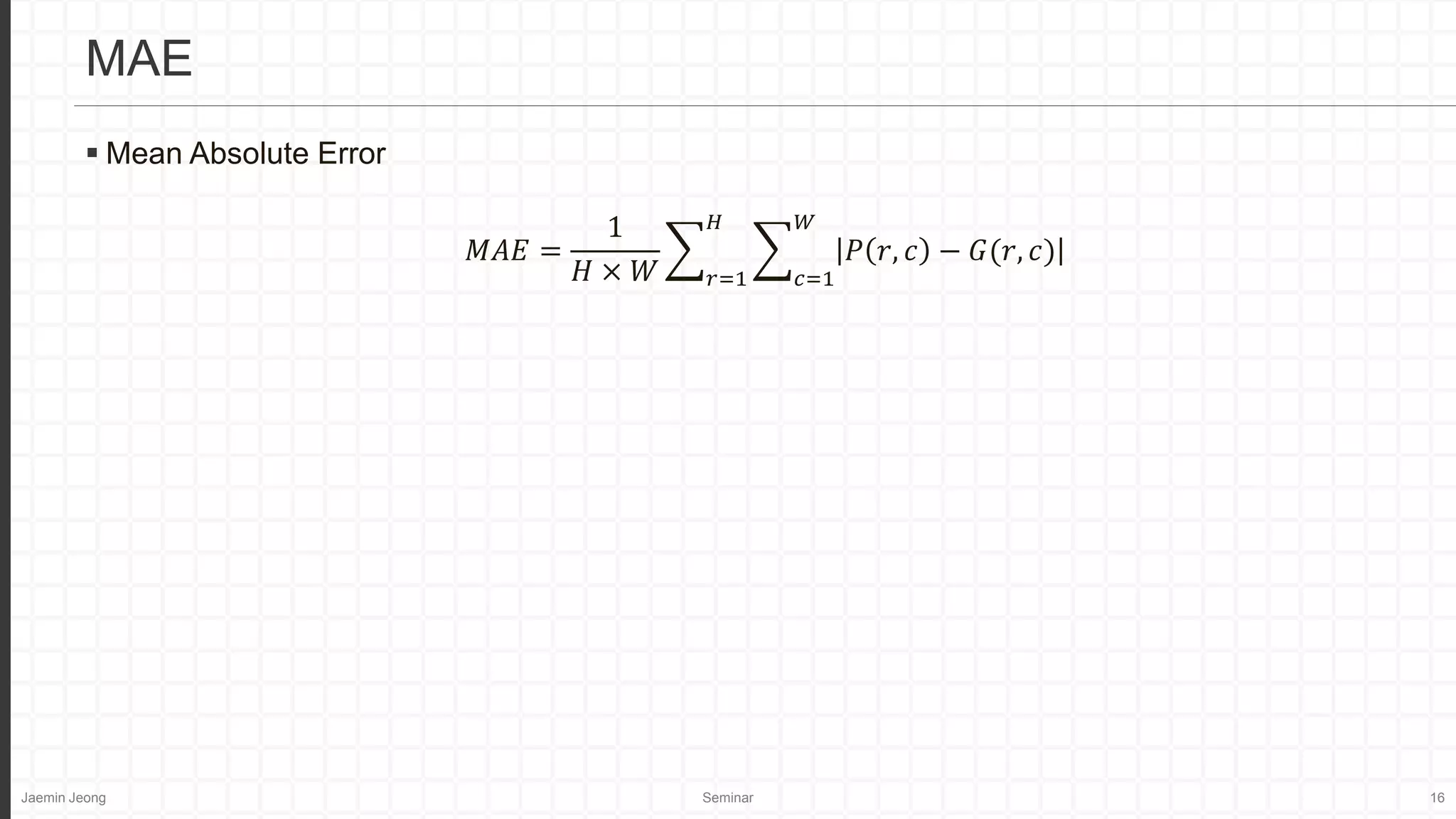
 Mean Absolute Error
𝑀𝐴𝐸 =
1
𝐻 × 𝑊 𝑟=1
𝐻
𝑐=1
𝑊
𝑃 𝑟, 𝑐 − 𝐺(𝑟, 𝑐)
MAE
Jaemin Jeong Seminar 17
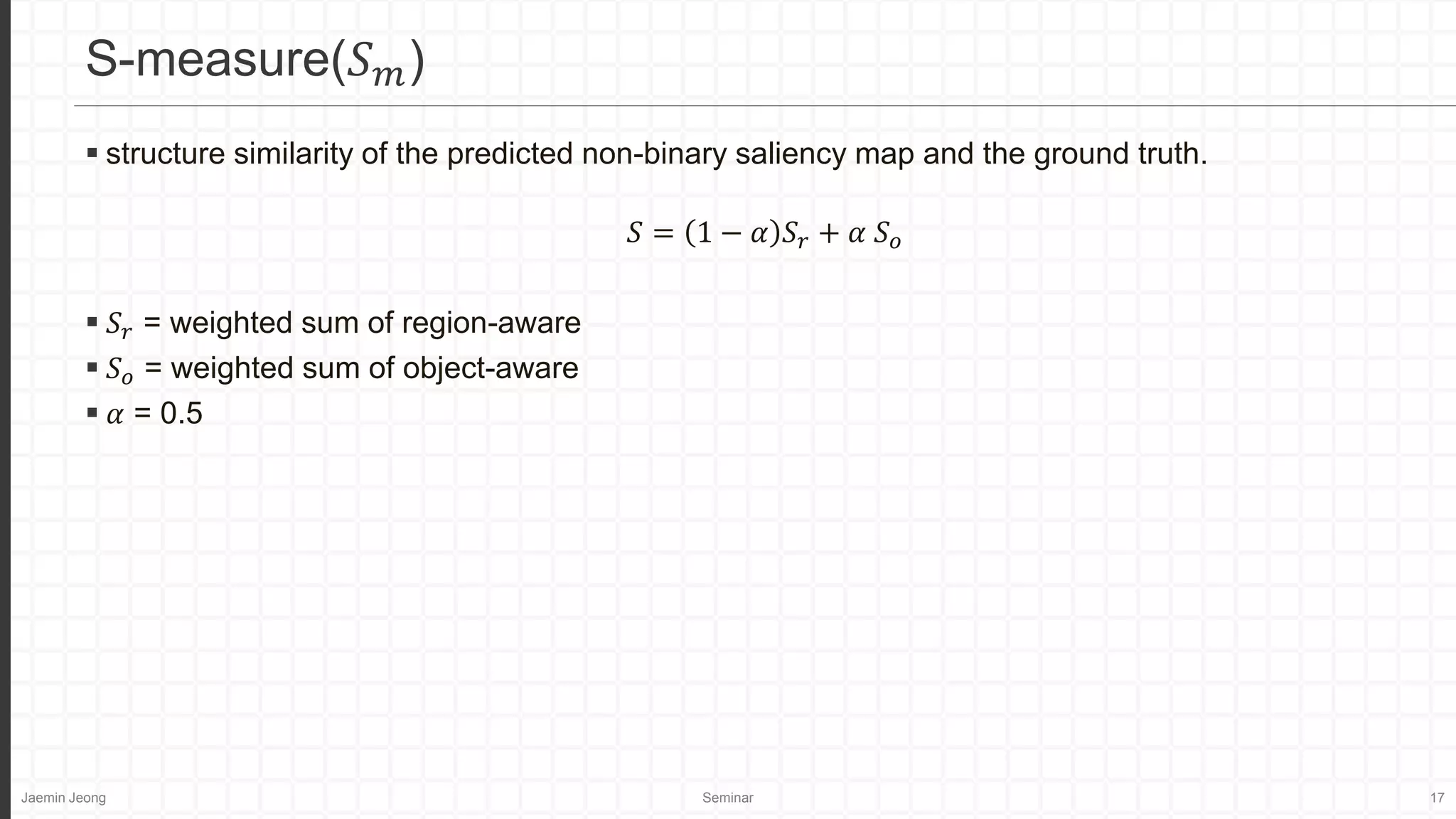
 structure similarity of the predicted non-binary saliency map and the ground truth.
𝑆 = 1 − 𝛼 𝑆𝑟 + 𝛼 𝑆𝑜
 𝑆𝑟 = weighted sum of region-aware
 𝑆𝑜 = weighted sum of object-aware
 𝛼 = 0.5
S-measure(𝑆𝑚)
Jaemin Jeong Seminar 18
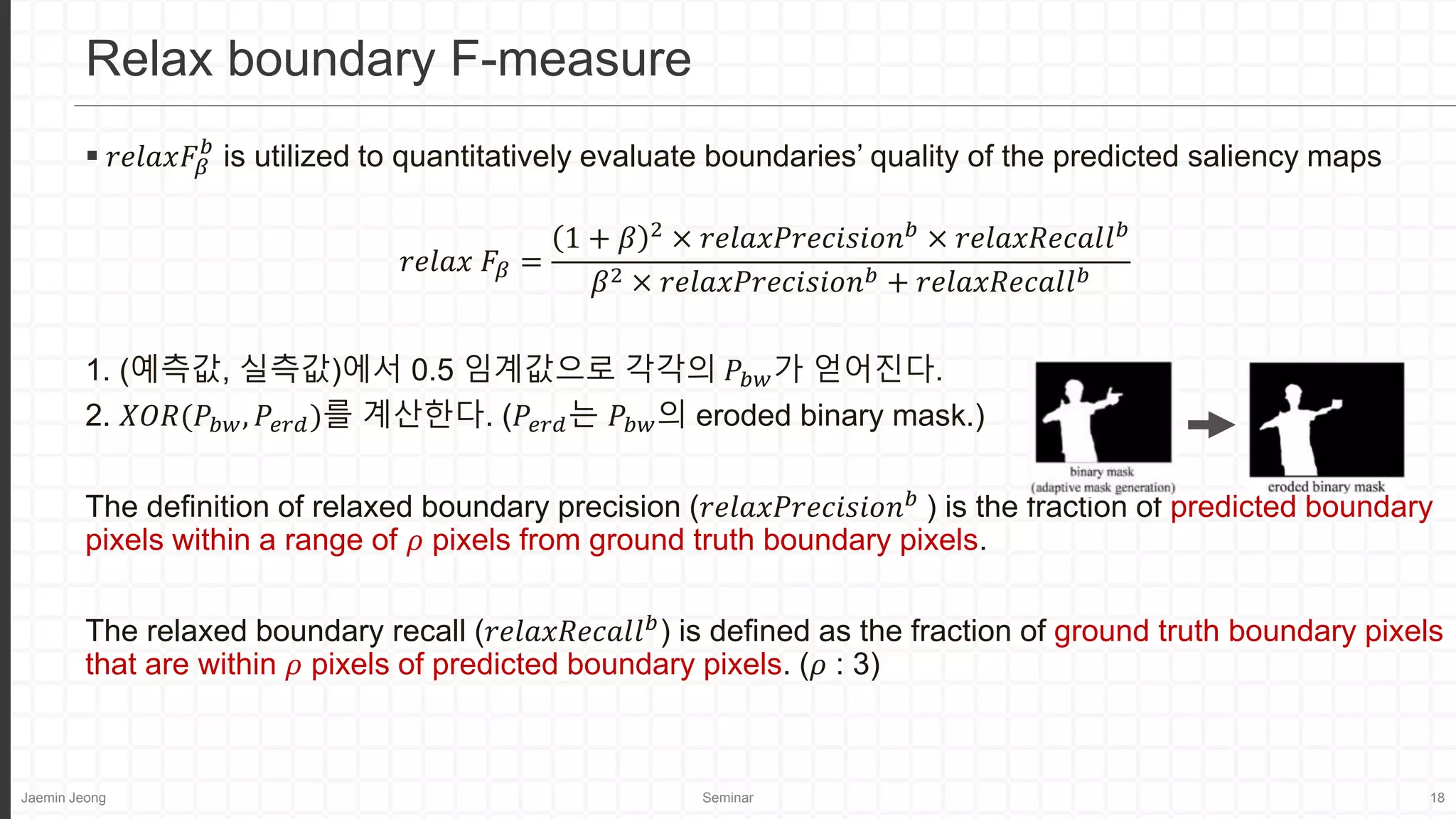
 𝑟𝑒𝑙𝑎𝑥𝐹𝛽
𝑏
is utilized to quantitatively evaluate boundaries’ quality of the predicted saliency maps
𝑟𝑒𝑙𝑎𝑥 𝐹𝛽 =
1 + 𝛽 2
× 𝑟𝑒𝑙𝑎𝑥𝑃𝑟𝑒𝑐𝑖𝑠𝑖𝑜𝑛𝑏
× 𝑟𝑒𝑙𝑎𝑥𝑅𝑒𝑐𝑎𝑙𝑙𝑏
𝛽2 × 𝑟𝑒𝑙𝑎𝑥𝑃𝑟𝑒𝑐𝑖𝑠𝑖𝑜𝑛𝑏 + 𝑟𝑒𝑙𝑎𝑥𝑅𝑒𝑐𝑎𝑙𝑙𝑏
1. (예측값, 실측값)에서 0.5 임계값으로 각각의 𝑃𝑏𝑤가 얻어진다.
2. 𝑋𝑂𝑅(𝑃𝑏𝑤, 𝑃𝑒𝑟𝑑)를 계산한다. (𝑃𝑒𝑟𝑑는 𝑃𝑏𝑤의 eroded binary mask.)
The definition of relaxed boundary precision (𝑟𝑒𝑙𝑎𝑥𝑃𝑟𝑒𝑐𝑖𝑠𝑖𝑜𝑛𝑏
) is the fraction of predicted boundary
pixels within a range of 𝜌 pixels from ground truth boundary pixels.
The relaxed boundary recall (𝑟𝑒𝑙𝑎𝑥𝑅𝑒𝑐𝑎𝑙𝑙𝑏
) is defined as the fraction of ground truth boundary pixels
that are within 𝜌 pixels of predicted boundary pixels. (𝜌 : 3)
Relax boundary F-measure
Jaemin Jeong Seminar 19
 first resized to 320×320 -> randomly flipped vertically -> cropped to 288×288.
 Adam(initial learning rate lr=1e-3, betas=(0.9, 0.999), eps=1e-8, weight decay=0)
 After 600k iterations (with a batch size of 12), the training loss converges and the whole training
process takes about 120 hours.
 Both training and testing are conducted on an eight-core, 16 threads PC with an AMD Ryzen
1800x 3.5 GHz CPU (32GB RAM) and a GTX 1080ti GPU (11GB memory).
Implementation Detail
Jaemin Jeong Seminar 20
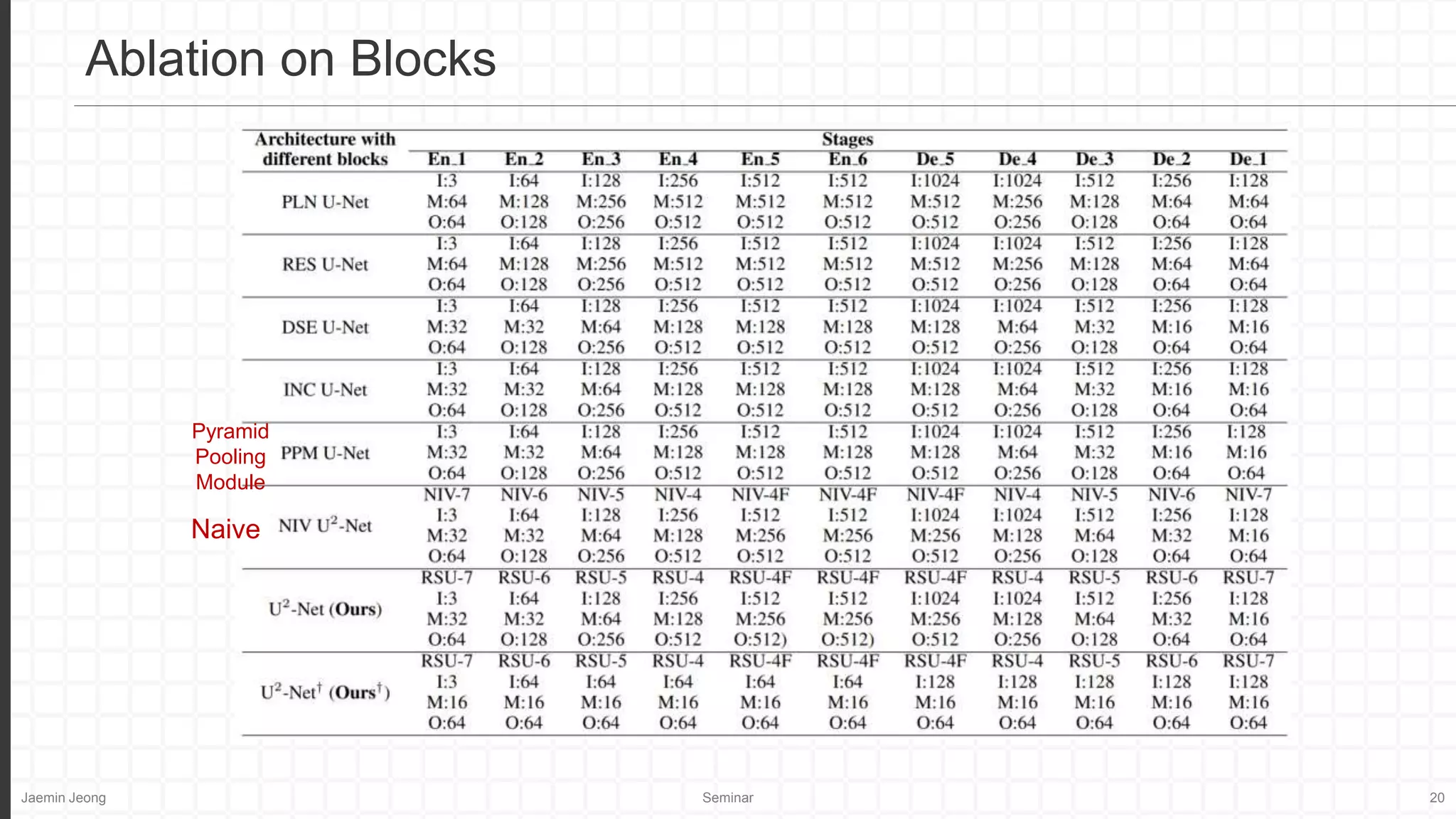
Ablation on Blocks
Naive
Pyramid
Pooling
Module
Jaemin Jeong Seminar 21
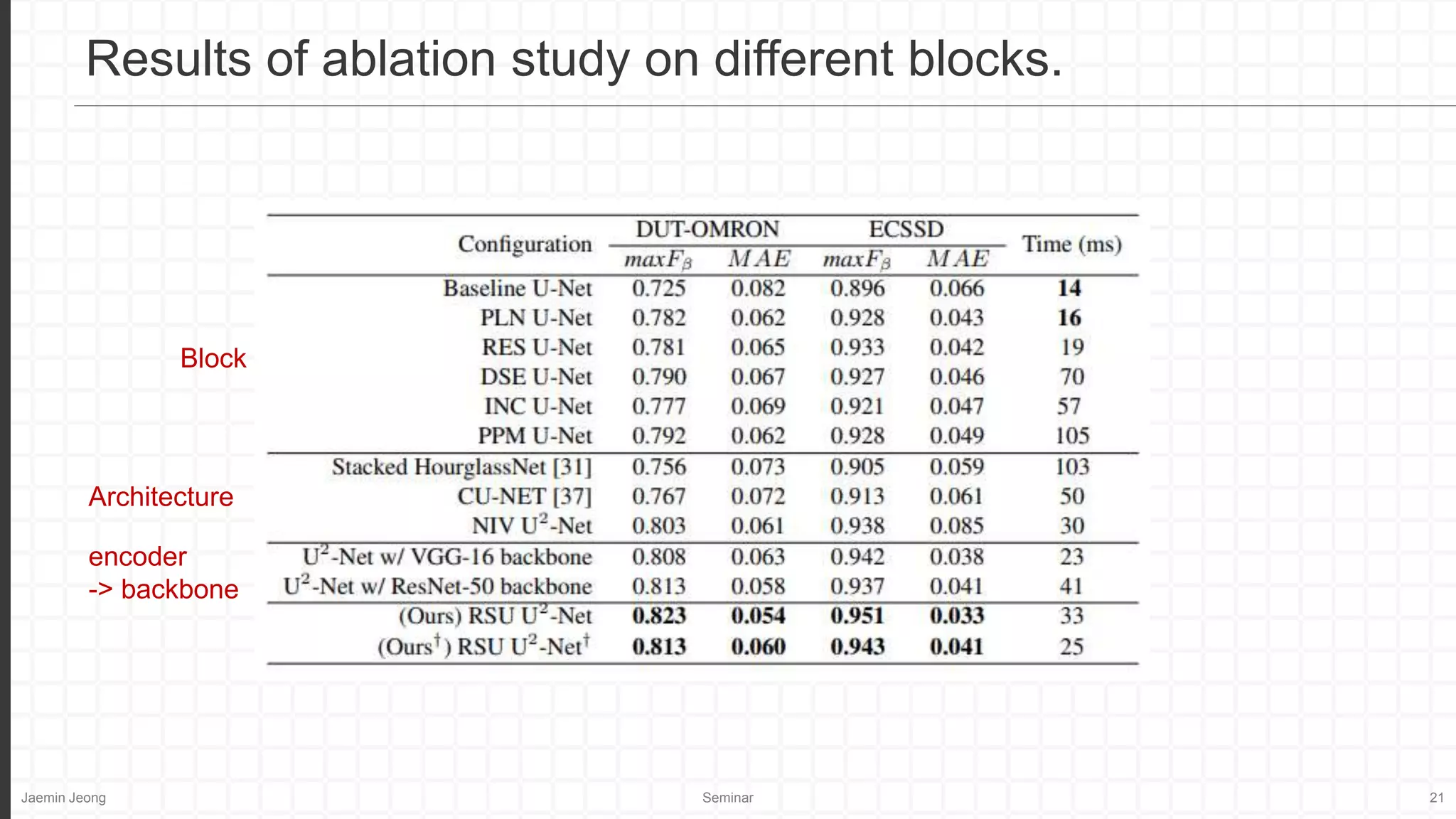
Results of ablation study on different blocks.
encoder
-> backbone
Architecture
Block
Jaemin Jeong Seminar 22
Quantitative Comparison(PR-curve)
Jaemin Jeong Seminar 23
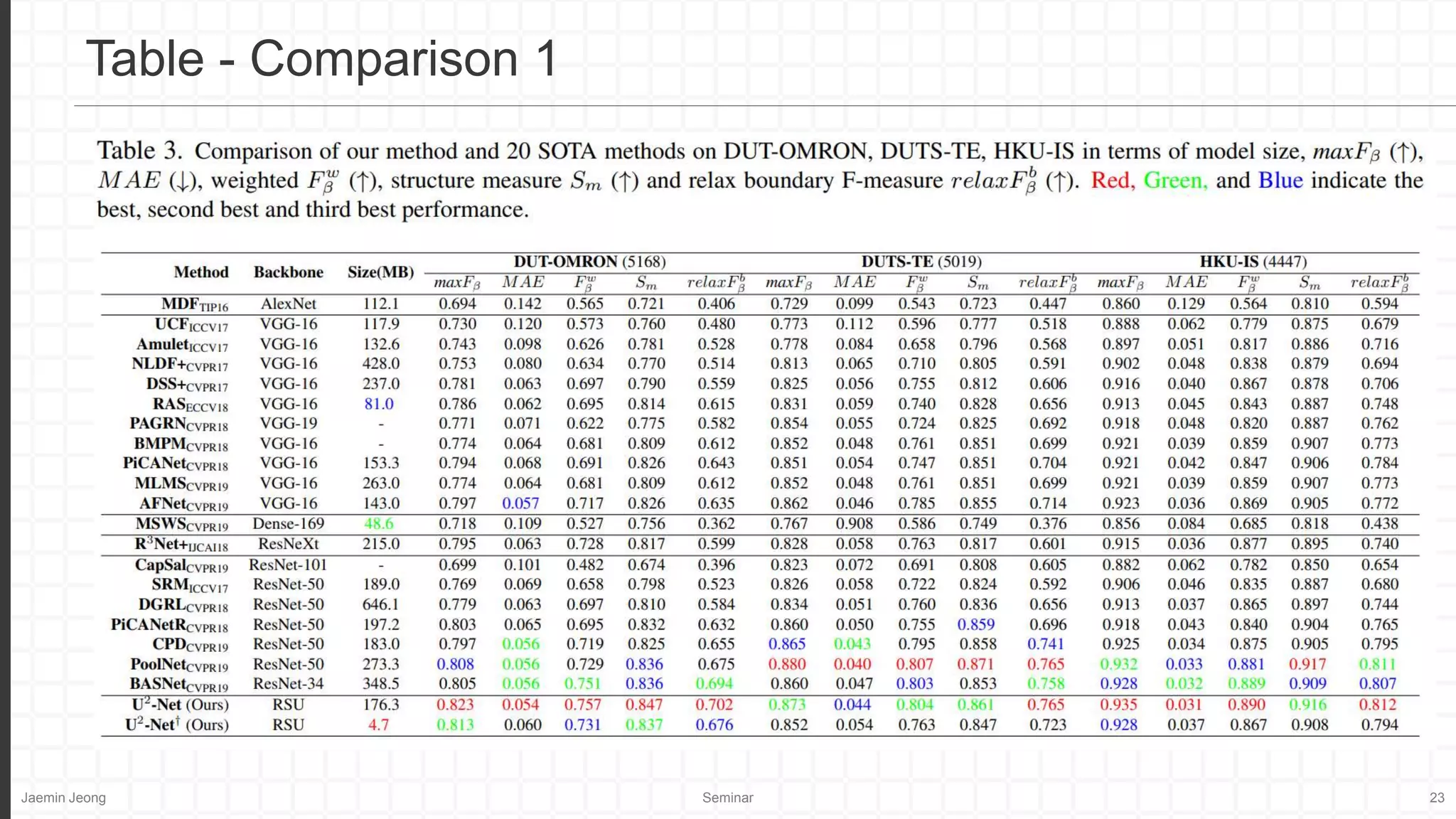
Table - Comparison 1
Jaemin Jeong Seminar 24
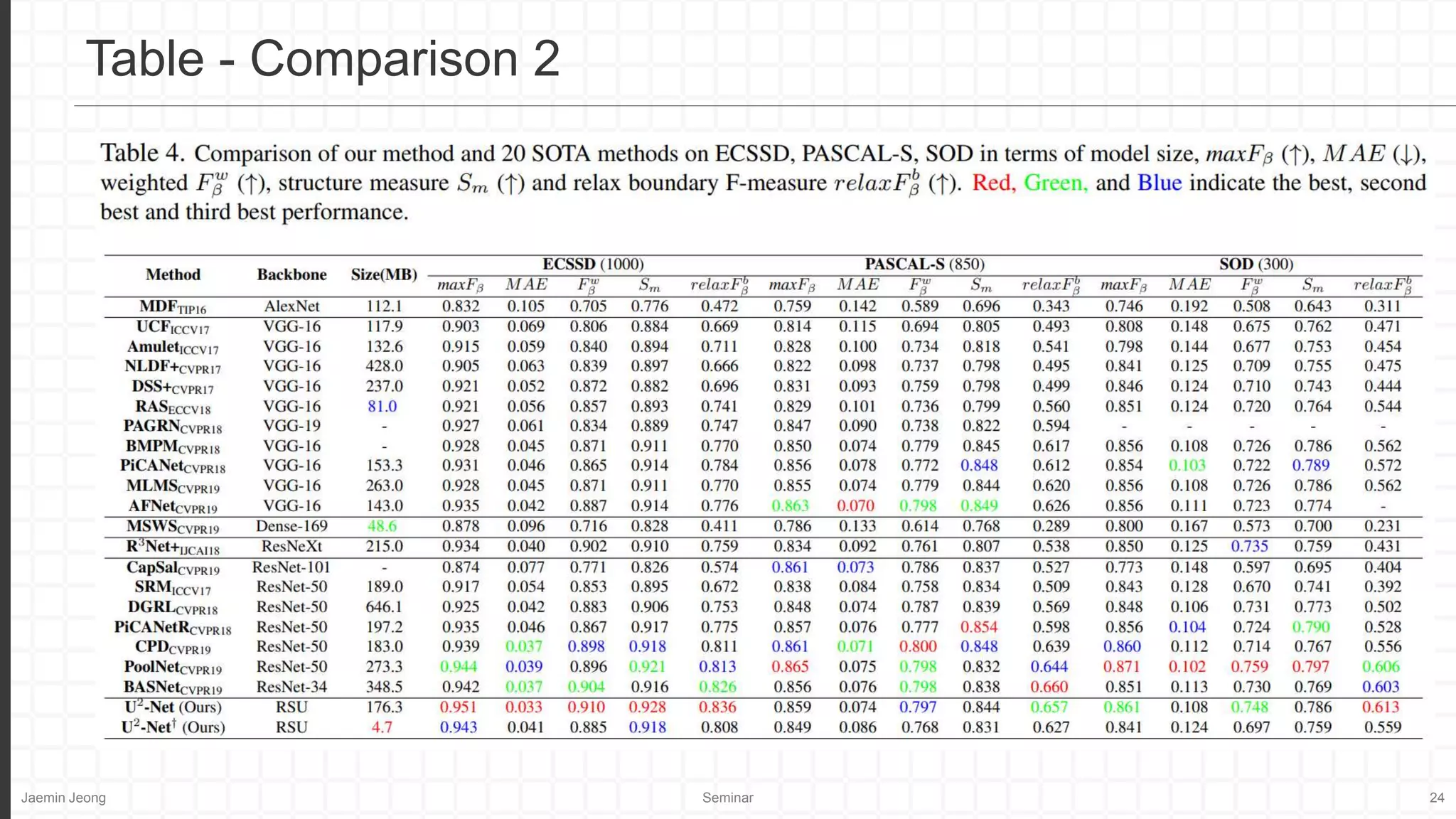
Table - Comparison 2
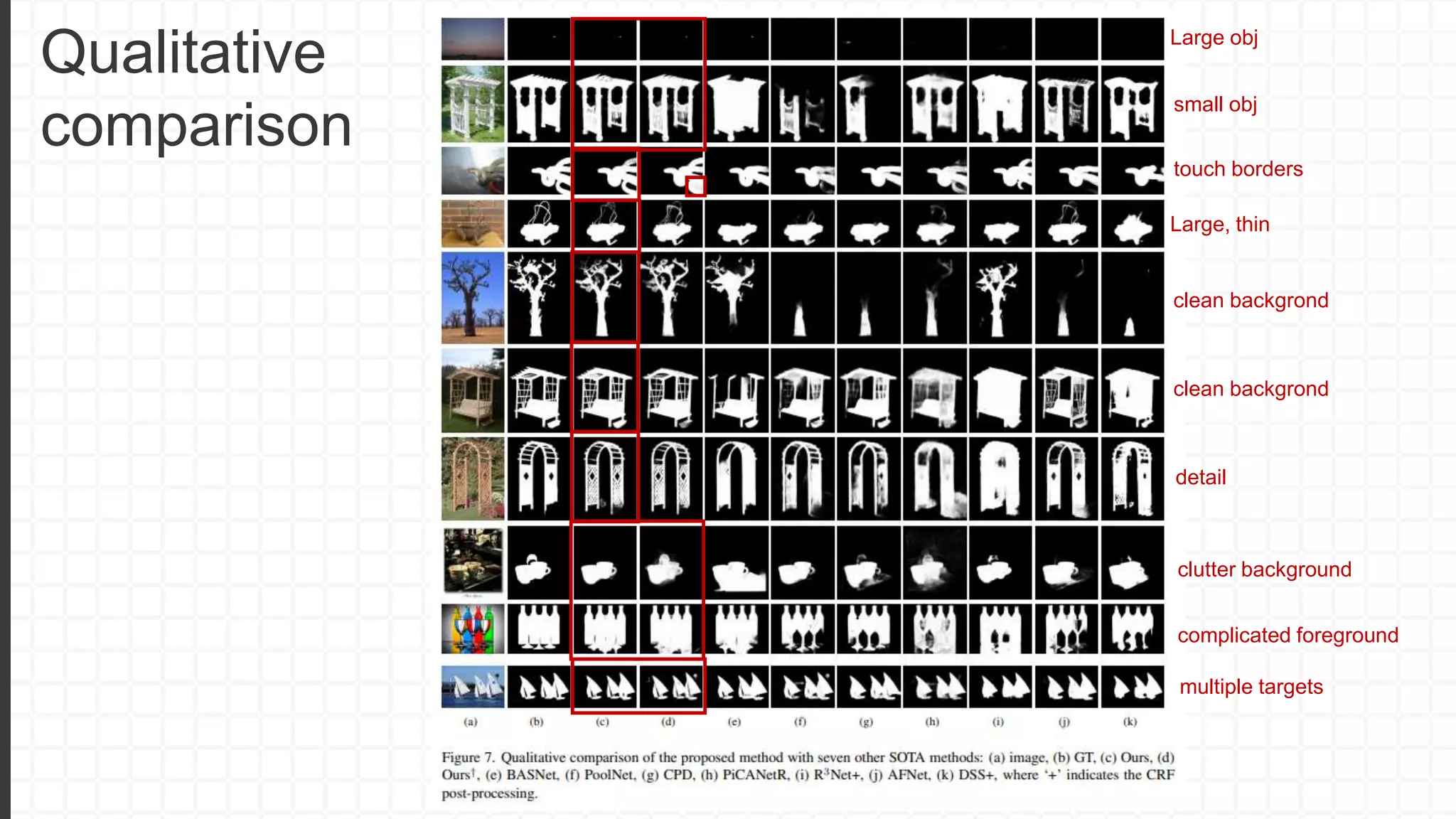
Qualitative
comparison
small obj
Large obj
touch borders
clean backgrond
Large, thin
clean backgrond
detail
clutter background
complicated foreground
multiple targets
Jaemin Jeong Seminar 26
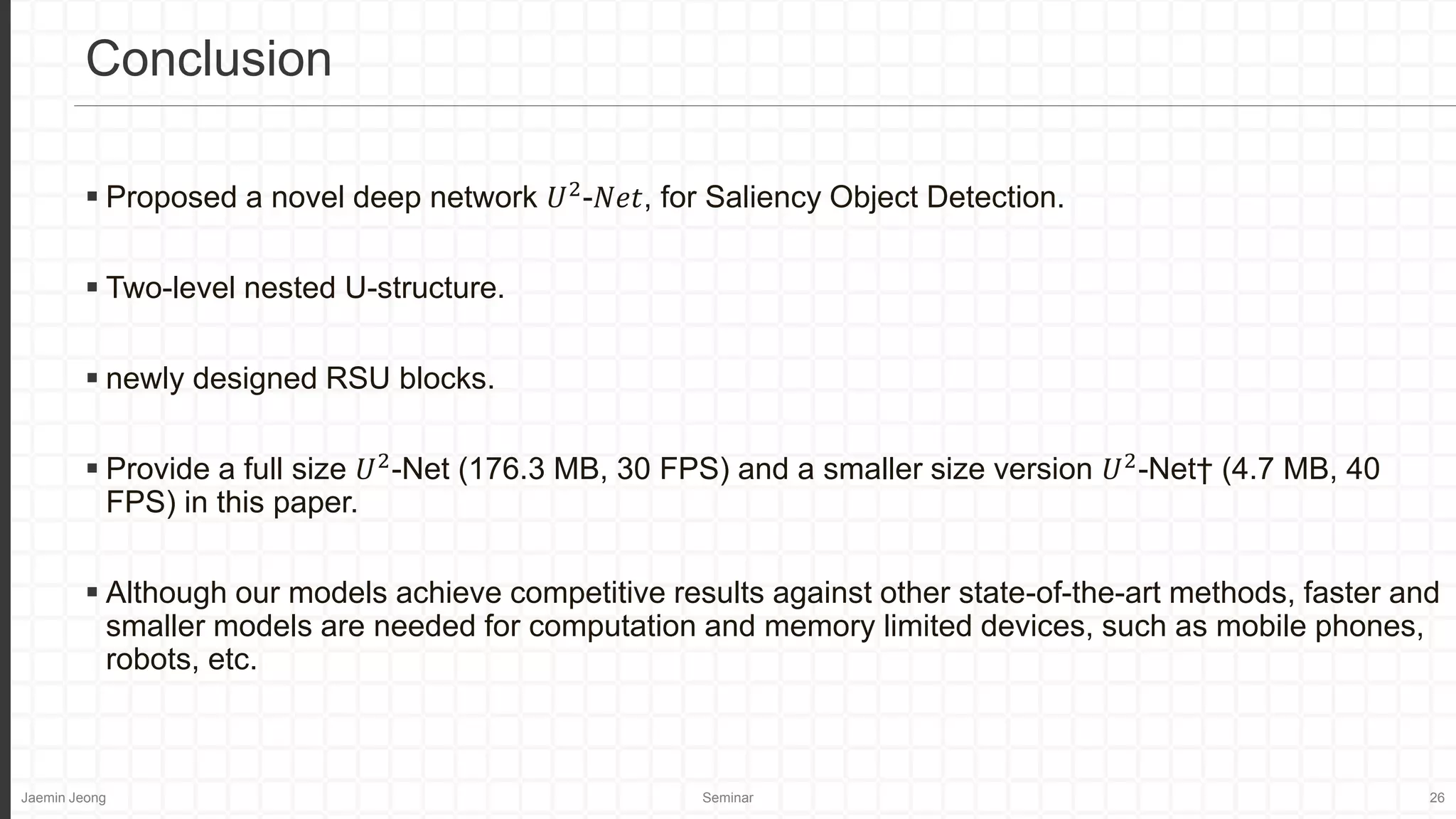
 Proposed a novel deep network 𝑈2
-𝑁𝑒𝑡, for Saliency Object Detection.
 Two-level nested U-structure.
 newly designed RSU blocks.
 Provide a full size 𝑈2
-Net (176.3 MB, 30 FPS) and a smaller size version 𝑈2
-Net† (4.7 MB, 40
FPS) in this paper.
 Although our models achieve competitive results against other state-of-the-art methods, faster and
smaller models are needed for computation and memory limited devices, such as mobile phones,
robots, etc.
Conclusion

2021 05-04-u2-net

  • 2.
    Jaemin Jeong Seminar2  𝑈2-𝑁𝑒𝑡, for salient object detection.  Advantage  It is able to capture more contextual information from different scales thanks to the mixture of receptive fields of different sizes in our proposed ReSidual U-blocks(RSU).  It increases the depth of the whole architecture without significantly increasing the computational cost because of the pooling operations used in these RSU blocks.  Propose  𝑈2 -𝑁𝑒𝑡 : 176.3 MB, 30 FPS on GTX 1080Ti GPU  𝑈2-𝑁𝑒𝑡† : 4.7 MB, 40 FPS Abstract
  • 3.
    Jaemin Jeong Seminar3 Saliency Object Detection SOD(Saliency Object Detection) : 중요한 물체를 검출하는 방법 FD(Fixation Prediction) : 사람의 시선이 어디에 가장 오래 머물지 예측하 는 방법 Salient Object Detection (SOD) aims at segmenting the most visually attractive objects in an image
  • 4.
    Jaemin Jeong Seminar4  There is a common pattern in the design of most SOD networks, that is, they focus on making good use of deep features extracted by existing backbones, such as Alexnet, VGG, ResNet, ResNeXt, DenseNet, etc.  However, these backbones are all originally designed for image classification.  They extract features that are representative of semantic meaning rather than local details and global contrast information, which are essential to saliency detection.  And they need to be pretrained on ImageNet data which data-inefficient especially if the target data follows a different distribution than ImageNet. This leads to our first question: can we design a new network for SOD, that allows training from scratch and achieves comparable or better performance than those based on existing pre-trained backbones? Introduction
  • 5.
    Jaemin Jeong Seminar5  First, they are often overly complicated. It is partially due to the additional feature aggregation modules that are added to the existing backbones to extract multilevel saliency features from these backbones.  Secondly, the existing backbones usually achieve deeper architecture by sacrificing high resolution of feature maps. This leads to our first question: can we go deeper while maintaining high resolution feature maps, at a low memory and computation cost? Issues on the network architectures for SOD
  • 6.
    Jaemin Jeong Seminar6 Multi-level deep feature integration = methods mainly focus on developing better multi-level feature aggregation strategies. Multi-scale feature extraction = target at designing new modules for extracting both local and global information from features obtained by backbone networks. Related Works
  • 7.
    Jaemin Jeong Seminar7 RSU too much computation and memory resources Low receptive field proposed
  • 8.
    Jaemin Jeong Seminar8 RSU To decrease the computation costs, PoolNet adapt the parallel configuration from pyramid pooling modules (PPM), which uses small kernel filters on the downsampled feature maps other than the dilated convolutions on the original size feature maps. But fusion of different scale features by direct upsampling and concatenation (or addition) may lead to degradation of high resolution features. Conv layer
  • 9.
  • 10.
    Jaemin Jeong Seminar10 U x 𝑛-Net : Repeat Unet n times. (stacked hourglass network, DocUNet, CU-Net) Architecture 𝑈𝑛 -Net : Our exponential notation refers to nested U-structure rather than cascaded stacking.
  • 11.
    Jaemin Jeong Seminar11 𝑈2 -𝑁𝑒𝑡 Relatively low resolution. RSU- 4F 𝐿 = 𝑚=1 𝑀 𝑤𝑠𝑖𝑑𝑒 𝑚 ℓ𝑠𝑖𝑑𝑒 (𝑚) + 𝑤𝑓𝑢𝑠𝑒ℓ𝑓𝑢𝑠𝑒 ℓ𝑠𝑖𝑑𝑒 (𝑚) : loss of the side output saliency map ℓ𝑓𝑢𝑠𝑒 : loss of the final output saliency map ℓ = − (𝑟,𝑐) (𝐻,𝑊) [𝑃𝐺 𝑟,𝑐 log 𝑃𝑆(𝑟,𝑐) + 1 − 𝑃𝐺 𝑟,𝑐 log(1 − 𝑃𝑆(𝑟,𝑐))] Binary Cross Entropy 𝑃𝐺(𝑟,𝑐) = Ground Truth 𝑃𝑆(𝑟,𝑐) = Predicted 𝑤 𝑚 , 𝑤 are all set to 1.
  • 12.
    Jaemin Jeong Seminar12 Training DUTS-TR contains 10553 images in total. Currently, it is the largest and most frequently used training dataset for salient object detection. We augment this dataset by horizontal flipping to obtain 21106 training images offline Evaluation DUT-OMRON includes 5168 images, most of which contain one or two structurally complex foreground objects. DUTS-TE, which contains 5019 images. HKU-IS contains 4447 images with multiple foreground objects. ECSSD contains 1000 structurally complex images and many of them contain large foreground objects. PASCAL-S contains 850 images with complex foreground objects and cluttered background. SOD only contains 300 images. But it is very challenging. Because it was originally designed for image segmentation and many images are low contrast or contain complex foreground objects overlapping with the image boundary. Dataset
  • 13.
    Jaemin Jeong Seminar13  Predict : 0 ~ 1  GT : 0 or 1 PR curve : set of precision-recall paris, threshold 0 ~ 1 of predicted pixels. Evaluation Metrics
  • 14.
    Jaemin Jeong Seminar14 ROC-curve https://angeloyeo.github.io/2020/08/05/ROC.html
  • 15.
    Jaemin Jeong Seminar15 𝐹𝛽 = 1 + 𝛽 2 × 𝑃𝑟𝑒𝑐𝑖𝑠𝑖𝑜𝑛 × 𝑅𝑒𝑐𝑎𝑙𝑙 𝛽2 × 𝑃𝑟𝑒𝑐𝑖𝑠𝑖𝑜𝑛 + 𝑅𝑒𝑐𝑎𝑙𝑙 𝛽2 : 0.3 (importance of the precision value) report the maximum 𝐹𝛽(𝑚𝑎𝑥𝐹𝛽) for each dataset similar to previous works.... weighted F-measure 𝐹𝛽 𝑤 = 1 + 𝛽2 𝑃𝑟𝑒𝑐𝑖𝑠𝑖𝑜𝑛𝑤 ⋅ 𝑅𝑒𝑐𝑎𝑙𝑙𝑤 𝛽2𝑃𝑟𝑒𝑐𝑖𝑠𝑖𝑜𝑛𝑤 + 𝑅𝑒𝑐𝑎𝑙𝑙𝑤 overcoming the possible unfair comparison F-measure
  • 16.
    Jaemin Jeong Seminar16  Mean Absolute Error 𝑀𝐴𝐸 = 1 𝐻 × 𝑊 𝑟=1 𝐻 𝑐=1 𝑊 𝑃 𝑟, 𝑐 − 𝐺(𝑟, 𝑐) MAE
  • 17.
    Jaemin Jeong Seminar17  structure similarity of the predicted non-binary saliency map and the ground truth. 𝑆 = 1 − 𝛼 𝑆𝑟 + 𝛼 𝑆𝑜  𝑆𝑟 = weighted sum of region-aware  𝑆𝑜 = weighted sum of object-aware  𝛼 = 0.5 S-measure(𝑆𝑚)
  • 18.
    Jaemin Jeong Seminar18  𝑟𝑒𝑙𝑎𝑥𝐹𝛽 𝑏 is utilized to quantitatively evaluate boundaries’ quality of the predicted saliency maps 𝑟𝑒𝑙𝑎𝑥 𝐹𝛽 = 1 + 𝛽 2 × 𝑟𝑒𝑙𝑎𝑥𝑃𝑟𝑒𝑐𝑖𝑠𝑖𝑜𝑛𝑏 × 𝑟𝑒𝑙𝑎𝑥𝑅𝑒𝑐𝑎𝑙𝑙𝑏 𝛽2 × 𝑟𝑒𝑙𝑎𝑥𝑃𝑟𝑒𝑐𝑖𝑠𝑖𝑜𝑛𝑏 + 𝑟𝑒𝑙𝑎𝑥𝑅𝑒𝑐𝑎𝑙𝑙𝑏 1. (예측값, 실측값)에서 0.5 임계값으로 각각의 𝑃𝑏𝑤가 얻어진다. 2. 𝑋𝑂𝑅(𝑃𝑏𝑤, 𝑃𝑒𝑟𝑑)를 계산한다. (𝑃𝑒𝑟𝑑는 𝑃𝑏𝑤의 eroded binary mask.) The definition of relaxed boundary precision (𝑟𝑒𝑙𝑎𝑥𝑃𝑟𝑒𝑐𝑖𝑠𝑖𝑜𝑛𝑏 ) is the fraction of predicted boundary pixels within a range of 𝜌 pixels from ground truth boundary pixels. The relaxed boundary recall (𝑟𝑒𝑙𝑎𝑥𝑅𝑒𝑐𝑎𝑙𝑙𝑏 ) is defined as the fraction of ground truth boundary pixels that are within 𝜌 pixels of predicted boundary pixels. (𝜌 : 3) Relax boundary F-measure
  • 19.
    Jaemin Jeong Seminar19  first resized to 320×320 -> randomly flipped vertically -> cropped to 288×288.  Adam(initial learning rate lr=1e-3, betas=(0.9, 0.999), eps=1e-8, weight decay=0)  After 600k iterations (with a batch size of 12), the training loss converges and the whole training process takes about 120 hours.  Both training and testing are conducted on an eight-core, 16 threads PC with an AMD Ryzen 1800x 3.5 GHz CPU (32GB RAM) and a GTX 1080ti GPU (11GB memory). Implementation Detail
  • 20.
    Jaemin Jeong Seminar20 Ablation on Blocks Naive Pyramid Pooling Module
  • 21.
    Jaemin Jeong Seminar21 Results of ablation study on different blocks. encoder -> backbone Architecture Block
  • 22.
    Jaemin Jeong Seminar22 Quantitative Comparison(PR-curve)
  • 23.
    Jaemin Jeong Seminar23 Table - Comparison 1
  • 24.
    Jaemin Jeong Seminar24 Table - Comparison 2
  • 25.
    Qualitative comparison small obj Large obj touchborders clean backgrond Large, thin clean backgrond detail clutter background complicated foreground multiple targets
  • 26.
    Jaemin Jeong Seminar26  Proposed a novel deep network 𝑈2 -𝑁𝑒𝑡, for Saliency Object Detection.  Two-level nested U-structure.  newly designed RSU blocks.  Provide a full size 𝑈2 -Net (176.3 MB, 30 FPS) and a smaller size version 𝑈2 -Net† (4.7 MB, 40 FPS) in this paper.  Although our models achieve competitive results against other state-of-the-art methods, faster and smaller models are needed for computation and memory limited devices, such as mobile phones, robots, etc. Conclusion

Editor's Notes

  • #15 https://angeloyeo.github.io/2020/08/05/ROC.html