CVPR 2021
Citation: 581
Presentor: Jaemin Jeong
Abstract
Annotation for Instance segmentation is usually expensive and time-consuming.
=> For example, 22 worker hours were spent per 1000 instance mask for COCO
We can summarize their contribution
• They find that the simple mechanism of pasting objects randomly is good enough.
• On COCO instance segmentation, we achieve 49.1 mask AP and 57.3 box AP, an
improvement of +0.6 mask AP and +1.5 box AP over the previous state-of-the-art.
• They further demonstrate that Copy-Paste can lead to significant improvements on the
LVIS 2020 Challenge winning entry by + 3.6 mask AP on rare categories.
Method
Method
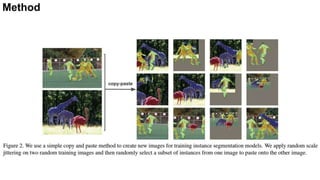
• They approach for generating new data using Copy-Paste is very simple.
• They randomly select two images and apply random scale jittering and random
horizontal flipping on each of them.
• Then they select a random subset of objects from one of the images and paste them
onto the other image. Lastly, we adjust the ground-truth annotations accordingly they
remove fully occluded objects and update the masks and bounding boxes of
partially occluded objects.
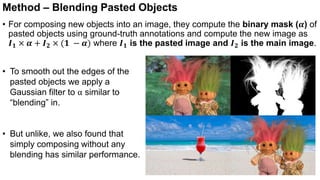
Method – Blending Pasted Objects
• For composing new objects into an image, they compute the binary mask (𝜶) of
pasted objects using ground-truth annotations and compute the new image as
𝑰𝟏 × 𝜶 + 𝑰𝟐 × (𝟏 − 𝜶) where 𝑰𝟏 is the pasted image and 𝑰𝟐 is the main image.
• To smooth out the edges of the
pasted objects we apply a
Gaussian filter to α similar to
“blending” in.
• But unlike, we also found that
simply composing without any
blending has similar performance.
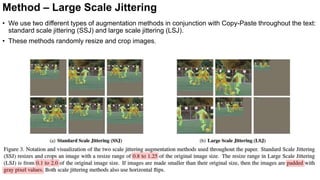
Method – Large Scale Jittering
• We use two different types of augmentation methods in conjunction with Copy-Paste throughout the text:
standard scale jittering (SSJ) and large scale jittering (LSJ).
• These methods randomly resize and crop images.
Method – Self-training Copy-Paste
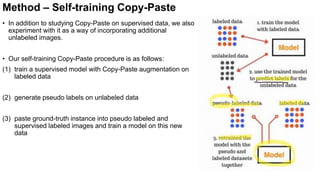
• In addition to studying Copy-Paste on supervised data, we also
experiment with it as a way of incorporating additional
unlabeled images.
• Our self-training Copy-Paste procedure is as follows:
(1) train a supervised model with Copy-Paste augmentation on
labeled data
(2) generate pseudo labels on unlabeled data
(3) paste ground-truth instance into pseudo labeled and
supervised labeled images and train a model on this new
data
Experiments - Experimental Settings
Architecture
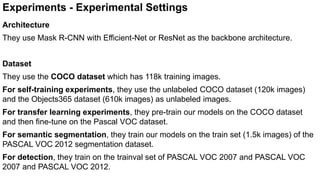
They use Mask R-CNN with Efficient-Net or ResNet as the backbone architecture.
Dataset
They use the COCO dataset which has 118k training images.
For self-training experiments, they use the unlabeled COCO dataset (120k images)
and the Objects365 dataset (610k images) as unlabeled images.
For transfer learning experiments, they pre-train our models on the COCO dataset
and then fine-tune on the Pascal VOC dataset.
For semantic segmentation, they train our models on the train set (1.5k images) of the
PASCAL VOC 2012 segmentation dataset.
For detection, they train on the trainval set of PASCAL VOC 2007 and PASCAL VOC
2007 and PASCAL VOC 2012.
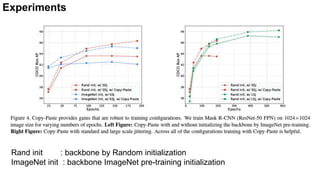
Experiments
Rand init : backbone by Random initialization
ImageNet init : backbone ImageNet pre-training initialization
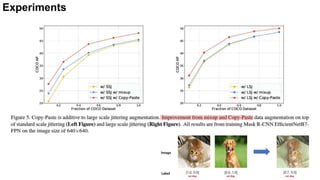
Experiments
Experiments
Experiments
Experiments RFS: Repeat Factor Sampling
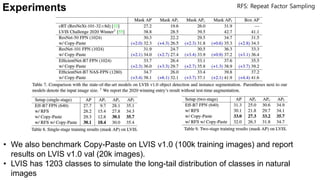
• We also benchmark Copy-Paste on LVIS v1.0 (100k training images) and report
results on LVIS v1.0 val (20k images).
• LVIS has 1203 classes to simulate the long-tail distribution of classes in natural
images
Repeat Factor Sampling
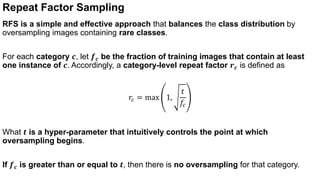
RFS is a simple and effective approach that balances the class distribution by
oversampling images containing rare classes.
For each category 𝒄, let 𝒇𝒄 be the fraction of training images that contain at least
one instance of 𝒄. Accordingly, a category-level repeat factor 𝒓𝒄 is defined as
𝑟𝑐 = max 1,
𝑡
𝑓𝑐
What 𝒕 is a hyper-parameter that intuitively controls the point at which
oversampling begins.
If 𝒇𝒄 is greater than or equal to 𝒕, then there is no oversampling for that category.
Conclusion
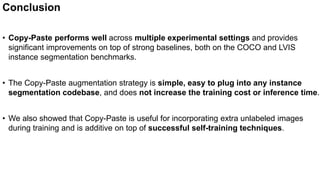
• Copy-Paste performs well across multiple experimental settings and provides
significant improvements on top of strong baselines, both on the COCO and LVIS
instance segmentation benchmarks.
• The Copy-Paste augmentation strategy is simple, easy to plug into any instance
segmentation codebase, and does not increase the training cost or inference time.
• We also showed that Copy-Paste is useful for incorporating extra unlabeled images
during training and is additive on top of successful self-training techniques.

Jaemin_230701_Simple_Copy_paste.pptx

  • 1.
  • 2.
    Abstract Annotation for Instancesegmentation is usually expensive and time-consuming. => For example, 22 worker hours were spent per 1000 instance mask for COCO We can summarize their contribution • They find that the simple mechanism of pasting objects randomly is good enough. • On COCO instance segmentation, we achieve 49.1 mask AP and 57.3 box AP, an improvement of +0.6 mask AP and +1.5 box AP over the previous state-of-the-art. • They further demonstrate that Copy-Paste can lead to significant improvements on the LVIS 2020 Challenge winning entry by + 3.6 mask AP on rare categories.
  • 3.
  • 4.
    Method • They approachfor generating new data using Copy-Paste is very simple. • They randomly select two images and apply random scale jittering and random horizontal flipping on each of them. • Then they select a random subset of objects from one of the images and paste them onto the other image. Lastly, we adjust the ground-truth annotations accordingly they remove fully occluded objects and update the masks and bounding boxes of partially occluded objects.
  • 5.
    Method – BlendingPasted Objects • For composing new objects into an image, they compute the binary mask (𝜶) of pasted objects using ground-truth annotations and compute the new image as 𝑰𝟏 × 𝜶 + 𝑰𝟐 × (𝟏 − 𝜶) where 𝑰𝟏 is the pasted image and 𝑰𝟐 is the main image. • To smooth out the edges of the pasted objects we apply a Gaussian filter to α similar to “blending” in. • But unlike, we also found that simply composing without any blending has similar performance.
  • 6.
    Method – LargeScale Jittering • We use two different types of augmentation methods in conjunction with Copy-Paste throughout the text: standard scale jittering (SSJ) and large scale jittering (LSJ). • These methods randomly resize and crop images.
  • 7.
    Method – Self-trainingCopy-Paste • In addition to studying Copy-Paste on supervised data, we also experiment with it as a way of incorporating additional unlabeled images. • Our self-training Copy-Paste procedure is as follows: (1) train a supervised model with Copy-Paste augmentation on labeled data (2) generate pseudo labels on unlabeled data (3) paste ground-truth instance into pseudo labeled and supervised labeled images and train a model on this new data
  • 8.
    Experiments - ExperimentalSettings Architecture They use Mask R-CNN with Efficient-Net or ResNet as the backbone architecture. Dataset They use the COCO dataset which has 118k training images. For self-training experiments, they use the unlabeled COCO dataset (120k images) and the Objects365 dataset (610k images) as unlabeled images. For transfer learning experiments, they pre-train our models on the COCO dataset and then fine-tune on the Pascal VOC dataset. For semantic segmentation, they train our models on the train set (1.5k images) of the PASCAL VOC 2012 segmentation dataset. For detection, they train on the trainval set of PASCAL VOC 2007 and PASCAL VOC 2007 and PASCAL VOC 2012.
  • 9.
    Experiments Rand init :backbone by Random initialization ImageNet init : backbone ImageNet pre-training initialization
  • 10.
  • 11.
  • 12.
  • 13.
    Experiments RFS: RepeatFactor Sampling • We also benchmark Copy-Paste on LVIS v1.0 (100k training images) and report results on LVIS v1.0 val (20k images). • LVIS has 1203 classes to simulate the long-tail distribution of classes in natural images
  • 14.
    Repeat Factor Sampling RFSis a simple and effective approach that balances the class distribution by oversampling images containing rare classes. For each category 𝒄, let 𝒇𝒄 be the fraction of training images that contain at least one instance of 𝒄. Accordingly, a category-level repeat factor 𝒓𝒄 is defined as 𝑟𝑐 = max 1, 𝑡 𝑓𝑐 What 𝒕 is a hyper-parameter that intuitively controls the point at which oversampling begins. If 𝒇𝒄 is greater than or equal to 𝒕, then there is no oversampling for that category.
  • 15.
    Conclusion • Copy-Paste performswell across multiple experimental settings and provides significant improvements on top of strong baselines, both on the COCO and LVIS instance segmentation benchmarks. • The Copy-Paste augmentation strategy is simple, easy to plug into any instance segmentation codebase, and does not increase the training cost or inference time. • We also showed that Copy-Paste is useful for incorporating extra unlabeled images during training and is additive on top of successful self-training techniques.
Editor's Notes

  • #2 Hello, today my presentation is Simple Copy-Paste that a Strong Data Augmentation Method for Instnce Segmentation. This paper propose Simple Copy-Paste Augmentation with many experiments They accepted CVPR 2021 They have a 581 citation Okay, Let’s start presentation
  • #3  What is it about instance segmentation problem. Instance segmentation models are often data-hungry. At the same time, annotating large datasets for instance segmentation is usually expensive and time-consuming. For example, 22 worker hours were spent per 1000 instance mask for COCO They propose the method called Copy-Paste for solving this problem. This is paper of abstract. We can summarize to 3 sentences their contribution. First, They find that the simple mechanism of pasting objects randomly is good enough. Second, They get more mask average precision in the previous state-of-the-art. Third, They demonstrate improvements of mask average precision on rare categories. Rare categories means small amount class.
  • #4 It’s just object copy and paste. It’s very simple
  • #5 Okay, now we should know copy-paste augmentation. Copy paste is very simple, They just randomly select two images and then apply random scale jittering and random horizontal flipping on each of them. Then we select a random subset of objects from one of the images and paste them onto the other image. That’s very simple
  • #6 They use alpha blending for Copy-Paste. The Alpha Blending can copy-paste with 2 rgb images and 1 gray scale mask image. We can calculate with simple equation
  • #7 They make a two different type of augmentation methods SSJ and LSJ SSJ mean standard scale jittering and LSJ mean large scale jittering Standard scale jittering mean augmentation method with resizes and crops an image with a resize range of 0.8 to 1.25 of the original image size. Large Scale Jittering mean augmentation method with resizes and crops an image with a resize range of 0.1 to 2.0 of the original image size.
  • #8 In addition, they experiment with Copy-Paste for self-training as well. The self-training is according to 3 step process. First train a supervised model with Copy-Paste augmentation on labeled data Second generate pseudo labels on unlabeled data Third paste ground-truth instance into pseudo labeled and supervised labeled images and train a model on this new data
  • #9 Architecture This Is about Model architecture They use Mask-R-CNN with Efficient Net or ResNet as the backbone architecture We also employ feature pyramid networks for multi-scale feature fusion. We use pyramid levels from 𝑃 2 to 𝑃 0 , with an anchor size of 8× 2 𝑙 and 3 anchors per pixel. Our strongest model uses Cascade R-CNN, EfficientNet-B7 as the backbone and NAS-FPN as the feature pyramid with levels from 𝑃 3 to 𝑃 7 . The anchor size is 4× 2 𝑙 and we have 9 anchors per pixel. Our NAS-FPN model uses 5 repeats and we replace convolution layers with ResNet bottleneck blocks.
  • #10 This left graph show mask average precision between Rand init and ImageNet init. This right graph show mask average precision between SSJ and LSJ. Random initialization is better than ImageNet initialization. LSJ is better than SSJ
  • #11 These graph show COCO average precision between mixup and Copy-Paste. Copy Paste is better than mixup
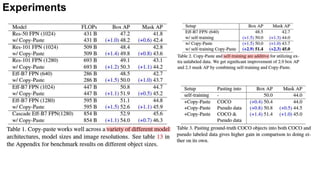
  • #12 Copy-paste works well across a variety of different model architectures, model sizes and image resolutions. And Copy-Paste with self-training works well especially when used together
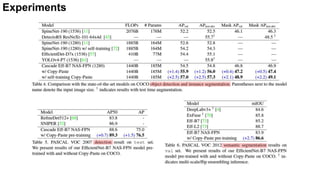
  • #13 This table shows the average precision improvement in semantic segmentation and object detection and instance segmentation when applied to SOTA with COCO and PASCAL VOC 2007, 2012 dataset.
  • #14 Finally, they shows the average precision improvement in object detection and instance segmentation when applied to various model with LVIS dataset. And they compared the performance using RFS together. However, there was no significant performance improvement.
  • #15 What is