Practical Object Detection
and Segmentation
Vincent Chen and Edward Chou
Agenda
● Why would understanding different architectures be useful?
● Modular Frameworks
● Describe Modern Frameworks
○ Detection
○ Segmentation
○ Trade-offs
○ Open Source Links
● Using Detection for Downstream Tasks
Why do I need this?
● SoTA Object Detectors are really good!
○ Used in consumer products
● Understanding trade-offs: when should I use each framework?
● Object detection/segmentation is a first step to many interesting problems!
○ While not perfect, you can assume you have bounding boxes for your visual tasks!
○ Examples: scene graph prediction, dense captioning, medical imaging features
Modular Frameworks
● Base network
○ Feature extraction
● Proposal Generation
○ Sliding windows, RoI, Use a network?
Modern Convolutional Detection/Segmentation
Detection
● R-FCN
● Faster R-CNN
● YOLO
● SSD
Segmentation
● Mask R-CNN
● SegNet
● U-Net, DeepLab, and more!
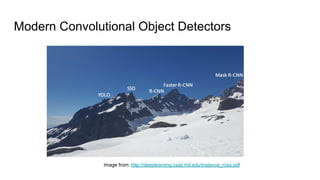
Modern Convolutional Object Detectors
Image from: http://deeplearning.csail.mit.edu/instance_ross.pdf
Faster-R CNN
● History
○ R-CNN: Selective search → Cropped Image → CNN
○ Fast R-CNN: Selective search → Crop feature map of CNN
○ Faster R-CNN: CNN → Region-Proposal Network → Crop feature map of CNN
● Proposal Generator → Box classifier
● Best performance, but longest run-time
● End-to-end, multi-task loss
● Can use fewer proposals, but running time is dependent on proposals
● https://github.com/endernewton/tf-faster-rcnn
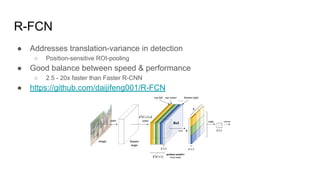
R-FCN
● Addresses translation-variance in detection
○ Position-sensitive ROI-pooling
● Good balance between speed & performance
○ 2.5 - 20x faster than Faster R-CNN
● https://github.com/daijifeng001/R-FCN
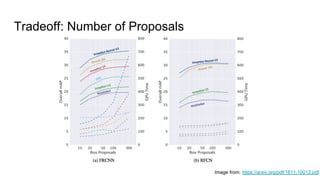
Tradeoff: Number of Proposals
Image from: https://arxiv.org/pdf/1611.10012.pdf
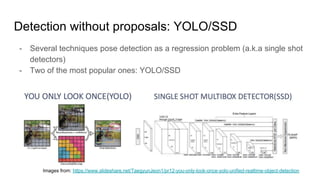
Detection without proposals: YOLO/SSD
- Several techniques pose detection as a regression problem (a.k.a single shot
detectors)
- Two of the most popular ones: YOLO/SSD
Images from: https://www.slideshare.net/TaegyunJeon1/pr12-you-only-look-once-yolo-unified-realtime-object-detection
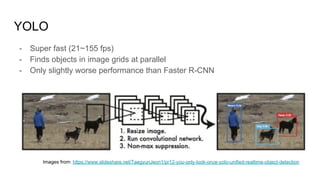
YOLO
- Super fast (21~155 fps)
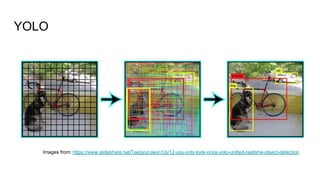
- Finds objects in image grids at parallel
- Only slightly worse performance than Faster R-CNN
Images from: https://www.slideshare.net/TaegyunJeon1/pr12-you-only-look-once-yolo-unified-realtime-object-detection
YOLO
Images from: https://www.slideshare.net/TaegyunJeon1/pr12-you-only-look-once-yolo-unified-realtime-object-detection
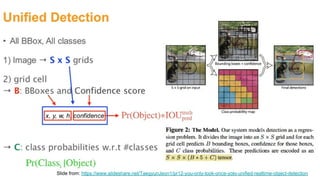
YOLO
Slide from: https://www.slideshare.net/TaegyunJeon1/pr12-you-only-look-once-yolo-unified-realtime-object-detection
Limitations of YOLO
- Groups of small objects
- Unusual aspect ratios - struggles to generalize
- Coarse Features (Due to multiple pooling layers from input images)
- Localization error of bounding boxes - treats error the same for small vs large
boxes
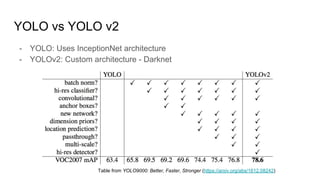
YOLO vs YOLO v2
- YOLO: Uses InceptionNet architecture
- YOLOv2: Custom architecture - Darknet
Table from YOLO9000: Better, Faster, Stronger (https://arxiv.org/abs/1612.08242)
YOLO Versions
YOLO (darknet) - https://pjreddie.com/darknet/yolov1/ (C++)
YOLO v2 (darknet) - https://pjreddie.com/darknet/yolov2/ (C++)
- Better and faster - 91 fps for 288 x 288
YOLO v3 (darknet) - https://pjreddie.com/darknet/yolo/ (C++)
YOLO (caffe) - https://github.com/xingwangsfu/caffe-yolo
YOLO (tensorflow) - https://github.com/thtrieu/darkflow
SSD
● End-to-end training (like YOLO)
○ Predicts category scores for fixed set of default bounding boxes using
small convolutional filters (different from YOLO!) applied to feature maps
○ Predictions from different feature maps of different scales (different from
YOLO!), separate predictors for different aspect ratio (different from
YOLO!)
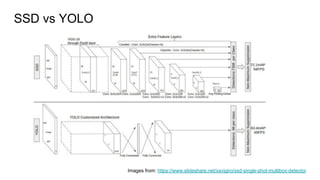
SSD vs YOLO
Images from: https://www.slideshare.net/xavigiro/ssd-single-shot-multibox-detector
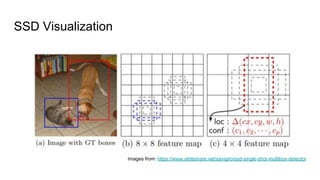
SSD Visualization
Images from: https://www.slideshare.net/xavigiro/ssd-single-shot-multibox-detector
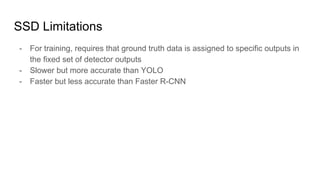
SSD Limitations
- For training, requires that ground truth data is assigned to specific outputs in
the fixed set of detector outputs
- Slower but more accurate than YOLO
- Faster but less accurate than Faster R-CNN
SSD Versions
SSD (caffe) - https://github.com/weiliu89/caffe/tree/ssd
SSD (tensorflow) - https://github.com/balancap/SSD-Tensorflow
SSD (pytorch) - https://github.com/amdegroot/ssd.pytorch
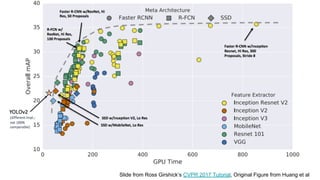
Slide from Ross Girshick’s CVPR 2017 Tutorial, Original Figure from Huang et al
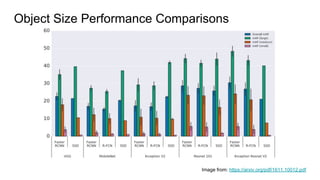
Object Size Performance Comparisons
Image from: https://arxiv.org/pdf/1611.10012.pdf
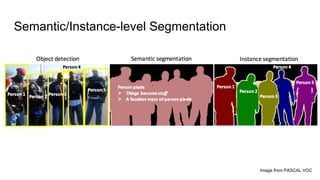
Semantic/Instance-level Segmentation
Image from PASCAL VOC
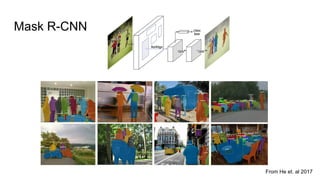
Mask R-CNN
From He et. al 2017
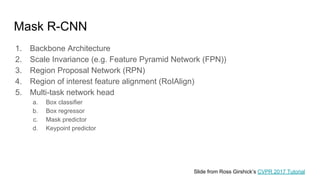
Mask R-CNN
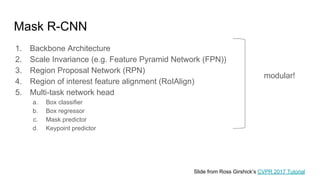
1. Backbone Architecture
2. Scale Invariance (e.g. Feature Pyramid Network (FPN))
3. Region Proposal Network (RPN)
4. Region of interest feature alignment (RoIAlign)
5. Multi-task network head
a. Box classifier
b. Box regressor
c. Mask predictor
d. Keypoint predictor
Slide from Ross Girshick’s CVPR 2017 Tutorial
Mask R-CNN
1. Backbone Architecture
2. Scale Invariance (e.g. Feature Pyramid Network (FPN))
3. Region Proposal Network (RPN)
4. Region of interest feature alignment (RoIAlign)
5. Multi-task network head
a. Box classifier
b. Box regressor
c. Mask predictor
d. Keypoint predictor
modular!
Slide from Ross Girshick’s CVPR 2017 Tutorial
Seg-Net
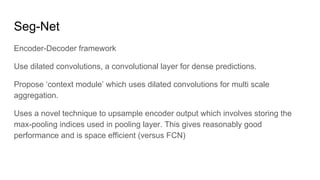
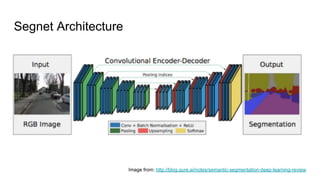
Encoder-Decoder framework
Use dilated convolutions, a convolutional layer for dense predictions.
Propose ‘context module’ which uses dilated convolutions for multi scale
aggregation.
Uses a novel technique to upsample encoder output which involves storing the
max-pooling indices used in pooling layer. This gives reasonably good
performance and is space efficient (versus FCN)
Segnet Architecture
Image from: http://blog.qure.ai/notes/semantic-segmentation-deep-learning-review
Segnet Limitations
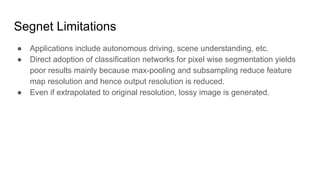
● Applications include autonomous driving, scene understanding, etc.
● Direct adoption of classification networks for pixel wise segmentation yields
poor results mainly because max-pooling and subsampling reduce feature
map resolution and hence output resolution is reduced.
● Even if extrapolated to original resolution, lossy image is generated.
Segnet Versions
Segnet (Caffe) - https://github.com/alexgkendall/caffe-segnet
Segnet (Tensorflow) - https://github.com/tkuanlun350/Tensorflow-SegNet
Segnet vs Mask R-CNN
Segnet
- Dilated convolutions are very expensive, even on modern GPUs.
-
Mask R-CNN
- Without tricks, Mask R-CNN outperforms all existing, single-model entries on
every task, including the COCO 2016 challenge winners.
- Better for pose detection
Other Segmentation Frameworks
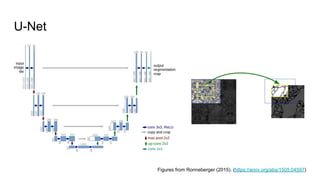
U-Net - Convolutional Networks for Biomedical Image Segmentation
- Encoder-decoder architecture.
- When desired output should include localization, i.e., a class label is
supposed to be assigned to each pixel
- Training in patches helps with lack of data
DeepLab - High Performance
- Atrous Convolution (Convolutions with upsampled filters)
- Allows user to explicitly control the resolution at which feature responses are
computed
U-Net
Figures from Ronneberger (2015). (https://arxiv.org/abs/1505.04597)
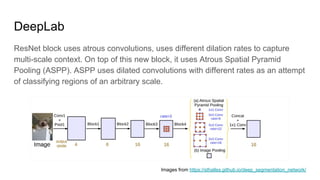
DeepLab
ResNet block uses atrous convolutions, uses different dilation rates to capture
multi-scale context. On top of this new block, it uses Atrous Spatial Pyramid
Pooling (ASPP). ASPP uses dilated convolutions with different rates as an attempt
of classifying regions of an arbitrary scale.
Images from https://sthalles.github.io/deep_segmentation_network/
Other Segmentation Frameworks
U-Net (Keras) - https://github.com/zhixuhao/unet
DeepLab (Caffe) - https://github.com/Robotertechnik/Deep-Lab
DeepLabv3 (Tensorflow) - https://github.com/NanqingD/DeepLabV3-Tensorflow
Model Zoo
Model Zoo
https://github.com/tensorflow/models/blob/master/research/object_detection/g3doc
/detection_model_zoo.md
Object Detection
https://github.com/tensorflow/models/blob/master/research/object_detection/object
_detection_tutorial.ipynb
Further Reading
Speed/accuracy tradeoffs for modern convolutional object detectors (2017):
https://arxiv.org/pdf/1611.10012.pdf

Stadnford University practical presentation.pdf

  • 1.
    Practical Object Detection andSegmentation Vincent Chen and Edward Chou
  • 2.
    Agenda ● Why wouldunderstanding different architectures be useful? ● Modular Frameworks ● Describe Modern Frameworks ○ Detection ○ Segmentation ○ Trade-offs ○ Open Source Links ● Using Detection for Downstream Tasks
  • 3.
    Why do Ineed this? ● SoTA Object Detectors are really good! ○ Used in consumer products ● Understanding trade-offs: when should I use each framework? ● Object detection/segmentation is a first step to many interesting problems! ○ While not perfect, you can assume you have bounding boxes for your visual tasks! ○ Examples: scene graph prediction, dense captioning, medical imaging features
  • 4.
    Modular Frameworks ● Basenetwork ○ Feature extraction ● Proposal Generation ○ Sliding windows, RoI, Use a network?
  • 5.
    Modern Convolutional Detection/Segmentation Detection ●R-FCN ● Faster R-CNN ● YOLO ● SSD Segmentation ● Mask R-CNN ● SegNet ● U-Net, DeepLab, and more!
  • 6.
    Modern Convolutional ObjectDetectors Image from: http://deeplearning.csail.mit.edu/instance_ross.pdf
  • 7.
    Faster-R CNN ● History ○R-CNN: Selective search → Cropped Image → CNN ○ Fast R-CNN: Selective search → Crop feature map of CNN ○ Faster R-CNN: CNN → Region-Proposal Network → Crop feature map of CNN ● Proposal Generator → Box classifier ● Best performance, but longest run-time ● End-to-end, multi-task loss ● Can use fewer proposals, but running time is dependent on proposals ● https://github.com/endernewton/tf-faster-rcnn
  • 8.
    R-FCN ● Addresses translation-variancein detection ○ Position-sensitive ROI-pooling ● Good balance between speed & performance ○ 2.5 - 20x faster than Faster R-CNN ● https://github.com/daijifeng001/R-FCN
  • 9.
    Tradeoff: Number ofProposals Image from: https://arxiv.org/pdf/1611.10012.pdf
  • 10.
    Detection without proposals:YOLO/SSD - Several techniques pose detection as a regression problem (a.k.a single shot detectors) - Two of the most popular ones: YOLO/SSD Images from: https://www.slideshare.net/TaegyunJeon1/pr12-you-only-look-once-yolo-unified-realtime-object-detection
  • 11.
    YOLO - Super fast(21~155 fps) - Finds objects in image grids at parallel - Only slightly worse performance than Faster R-CNN Images from: https://www.slideshare.net/TaegyunJeon1/pr12-you-only-look-once-yolo-unified-realtime-object-detection
  • 12.
  • 13.
  • 14.
    Limitations of YOLO -Groups of small objects - Unusual aspect ratios - struggles to generalize - Coarse Features (Due to multiple pooling layers from input images) - Localization error of bounding boxes - treats error the same for small vs large boxes
  • 15.
    YOLO vs YOLOv2 - YOLO: Uses InceptionNet architecture - YOLOv2: Custom architecture - Darknet Table from YOLO9000: Better, Faster, Stronger (https://arxiv.org/abs/1612.08242)
  • 16.
    YOLO Versions YOLO (darknet)- https://pjreddie.com/darknet/yolov1/ (C++) YOLO v2 (darknet) - https://pjreddie.com/darknet/yolov2/ (C++) - Better and faster - 91 fps for 288 x 288 YOLO v3 (darknet) - https://pjreddie.com/darknet/yolo/ (C++) YOLO (caffe) - https://github.com/xingwangsfu/caffe-yolo YOLO (tensorflow) - https://github.com/thtrieu/darkflow
  • 17.
    SSD ● End-to-end training(like YOLO) ○ Predicts category scores for fixed set of default bounding boxes using small convolutional filters (different from YOLO!) applied to feature maps ○ Predictions from different feature maps of different scales (different from YOLO!), separate predictors for different aspect ratio (different from YOLO!)
  • 18.
    SSD vs YOLO Imagesfrom: https://www.slideshare.net/xavigiro/ssd-single-shot-multibox-detector
  • 19.
    SSD Visualization Images from:https://www.slideshare.net/xavigiro/ssd-single-shot-multibox-detector
  • 20.
    SSD Limitations - Fortraining, requires that ground truth data is assigned to specific outputs in the fixed set of detector outputs - Slower but more accurate than YOLO - Faster but less accurate than Faster R-CNN
  • 21.
    SSD Versions SSD (caffe)- https://github.com/weiliu89/caffe/tree/ssd SSD (tensorflow) - https://github.com/balancap/SSD-Tensorflow SSD (pytorch) - https://github.com/amdegroot/ssd.pytorch
  • 22.
    Slide from RossGirshick’s CVPR 2017 Tutorial, Original Figure from Huang et al
  • 23.
    Object Size PerformanceComparisons Image from: https://arxiv.org/pdf/1611.10012.pdf
  • 24.
  • 25.
    Mask R-CNN From Heet. al 2017
  • 26.
    Mask R-CNN 1. BackboneArchitecture 2. Scale Invariance (e.g. Feature Pyramid Network (FPN)) 3. Region Proposal Network (RPN) 4. Region of interest feature alignment (RoIAlign) 5. Multi-task network head a. Box classifier b. Box regressor c. Mask predictor d. Keypoint predictor Slide from Ross Girshick’s CVPR 2017 Tutorial
  • 27.
    Mask R-CNN 1. BackboneArchitecture 2. Scale Invariance (e.g. Feature Pyramid Network (FPN)) 3. Region Proposal Network (RPN) 4. Region of interest feature alignment (RoIAlign) 5. Multi-task network head a. Box classifier b. Box regressor c. Mask predictor d. Keypoint predictor modular! Slide from Ross Girshick’s CVPR 2017 Tutorial
  • 28.
    Seg-Net Encoder-Decoder framework Use dilatedconvolutions, a convolutional layer for dense predictions. Propose ‘context module’ which uses dilated convolutions for multi scale aggregation. Uses a novel technique to upsample encoder output which involves storing the max-pooling indices used in pooling layer. This gives reasonably good performance and is space efficient (versus FCN)
  • 29.
    Segnet Architecture Image from:http://blog.qure.ai/notes/semantic-segmentation-deep-learning-review
  • 30.
    Segnet Limitations ● Applicationsinclude autonomous driving, scene understanding, etc. ● Direct adoption of classification networks for pixel wise segmentation yields poor results mainly because max-pooling and subsampling reduce feature map resolution and hence output resolution is reduced. ● Even if extrapolated to original resolution, lossy image is generated.
  • 31.
    Segnet Versions Segnet (Caffe)- https://github.com/alexgkendall/caffe-segnet Segnet (Tensorflow) - https://github.com/tkuanlun350/Tensorflow-SegNet
  • 32.
    Segnet vs MaskR-CNN Segnet - Dilated convolutions are very expensive, even on modern GPUs. - Mask R-CNN - Without tricks, Mask R-CNN outperforms all existing, single-model entries on every task, including the COCO 2016 challenge winners. - Better for pose detection
  • 33.
    Other Segmentation Frameworks U-Net- Convolutional Networks for Biomedical Image Segmentation - Encoder-decoder architecture. - When desired output should include localization, i.e., a class label is supposed to be assigned to each pixel - Training in patches helps with lack of data DeepLab - High Performance - Atrous Convolution (Convolutions with upsampled filters) - Allows user to explicitly control the resolution at which feature responses are computed
  • 34.
    U-Net Figures from Ronneberger(2015). (https://arxiv.org/abs/1505.04597)
  • 35.
    DeepLab ResNet block usesatrous convolutions, uses different dilation rates to capture multi-scale context. On top of this new block, it uses Atrous Spatial Pyramid Pooling (ASPP). ASPP uses dilated convolutions with different rates as an attempt of classifying regions of an arbitrary scale. Images from https://sthalles.github.io/deep_segmentation_network/
  • 36.
    Other Segmentation Frameworks U-Net(Keras) - https://github.com/zhixuhao/unet DeepLab (Caffe) - https://github.com/Robotertechnik/Deep-Lab DeepLabv3 (Tensorflow) - https://github.com/NanqingD/DeepLabV3-Tensorflow
  • 37.
    Model Zoo Model Zoo https://github.com/tensorflow/models/blob/master/research/object_detection/g3doc /detection_model_zoo.md ObjectDetection https://github.com/tensorflow/models/blob/master/research/object_detection/object _detection_tutorial.ipynb
  • 38.
    Further Reading Speed/accuracy tradeoffsfor modern convolutional object detectors (2017): https://arxiv.org/pdf/1611.10012.pdf